An Introduction to Farndale Family History
|
Return to the Home Page of the Farndale Family
Website |
The story of one family’s journey through two
thousand years of British History |
The 83 family lines into which the family is divided.
Meet the whole family and how the wider family is related |
Members of the historical family ordered by date of
birth |
Links to other pages with historical research and
related material |
The story of the Bakers of Highfields, the Chapmans,
and other related families |
This page is an introduction to the history of the Farndale
family. It should help you to understand the history of the family and its
origins back to Saxon times and as a platform from which to explore the wider
website, with a few suggestions and hyperlinks to link you to further
exploration through the thousands of pages which now make up our more detailed
history on this website.
As you read this page, you can explore more detail through the hyperlinks.
The Farndale Name
The Farndales descend from the folk who made up the engine room of
British history. For the bulk of such families, it is generally very difficult
to go back in time much beyond about 1500. However the Farndales are privileged
to have a locative name, which is rooted to a place. What is more that place is a relatively small, rural
valley in North Yorkshire, which provides a uniqueness which helps research of
early medieval records. The name therefore provides a unique beacon which makes
navigating the medieval sources much easier. This has made it possible to find
significant records of individuals back to the thirteenth century. We are extraordinarily privileged to be able
to see back that far.
You will find a bit more information about names in
family history which might help to understand why a locative
name such as Farndale provides a special opportunity to see further back in
time.
The locative nature of our surname also means that even before we
can identify individual people who were or may have been our ancestors, we can
explore the earlier history of the place itself. The place is an important part
of our story. That means we can find a route even further back in time, to the
earliest history of Farndale,
a wild forested place, as it first emerged as a place known to local folk. So
even beyond the identification of individual ancestors, we see back to the
period shortly before the Norman Conquest, with some reasonably detailed optics
to about the turn of the first millennium in 1000 CE and into the
Anglo-Saxon-Scandinavian period.
If you are a Farndale, or descended from Farndales, then this
introduction and the wider website provides your Tardis to travel back in time
to meet and understand your earliest ancestors.
Setting the scene
Prior to the
early to mid thirteenth century, the place that came
to be known as Farndale was a forest, flowing down through its valley from the
high moors. It formed part of the great estate known as Chirchebi or
Kirkbymoorside. It was in the isolated region that Bede later described as among
steep and distant mountains, which looked more like lurking-places for robbers
and dens of wild beasts, than dwellings of men. It was a place where nobles
sometimes hunted, a home only for wild beasts and wild men, and above all a
small section of enormous lands, which would be handed about from unfaithful
nobleman to faithful nobleman, across a giant chessboard.
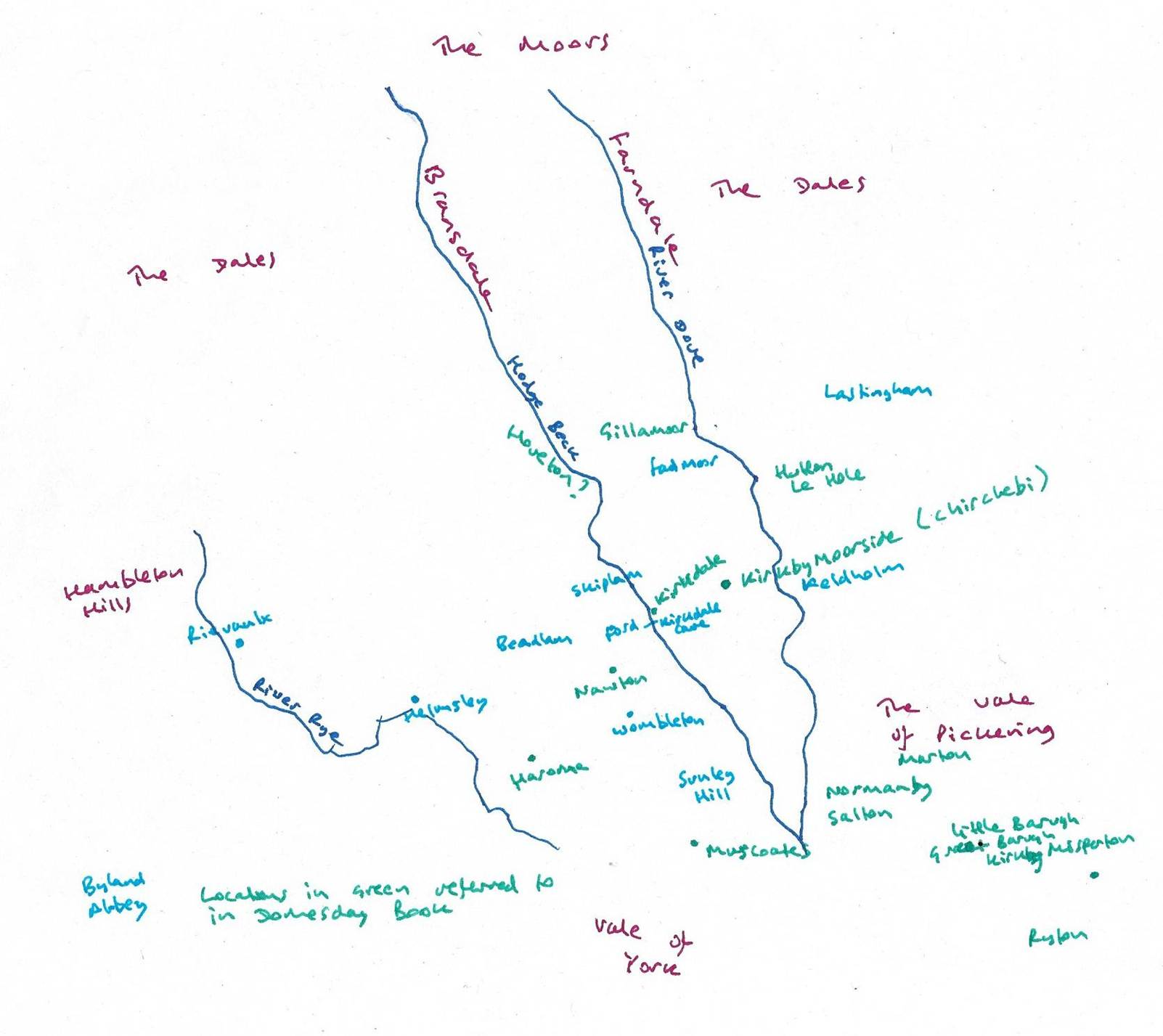
To the south of
Farndale, along the Hodge Beck as it flows out of Bransdale (Farndale’s
parallel valley), lies Kirkdale which is
located at the edge of the wild lands of the dales and the moors, but at the
northwest corner of vast agricultural lands which sweep south towards York and
the Vale of Pickering, once a lake, which flows east towards Pickering and
beyond.
It is clear from
the Domesday Book that Kirkdale was
at the centre of a northwest section of those vast agricultural lands,
stretching from Kirkby Misperton and Muscoates to the
south to Gillamoor at the approach to the dales in
the north. The River Dove and the Hodge Beck flowed out of the dales and
through Kirkdale and Chirchebi (Kirkbymoorside).
Since Kirkdale
cave has revealed animal remains dating to the last interglacial period, this
is an ancient place, where our distant ancestors lived and worked. This cave
has revealed the most northerly remains of hippopotamus.
Kirkdale was
therefore the centre of the Anglo Saxon, and before that Roman, community that
would, in the thirteenth century, extend its lands of cultivation into
Farndale. In time, after the Norman conquest, this section of agricultural land
would probe into the dales, as the wooded dales were slashed and burned to
provide extensions of the farmed land, into Farndale
and Bransdale.
Knowing that the
modern Farndale family is descended from those who once toiled for their
survival in Farndale in the mid thirteenth century, we can surmise that those
villeins from Farndale from whom we descend, themselves had their ancestral
roots amongst the folk of Kirkdale and its surroundings.
The geographical
scene is therefore to be imagined in three landscapes. The moors are the
windswept and barren heights which have always been a harsh and bitter place.
The dales were probably impenetrable and heavily forested for much of
their ancient history. They are relatively steeply sided valleys, with
Bransdale following the Hodge Beck and Farndale
following the river Dove. The vales are ancient agricultural lands of
two vast vales, of York and Pickering. Nestled at the edge of the dales, as
they pour out into the flat agricultural lands, is Kirkdale, the original
cradle of our family.
Our ancestral deep history
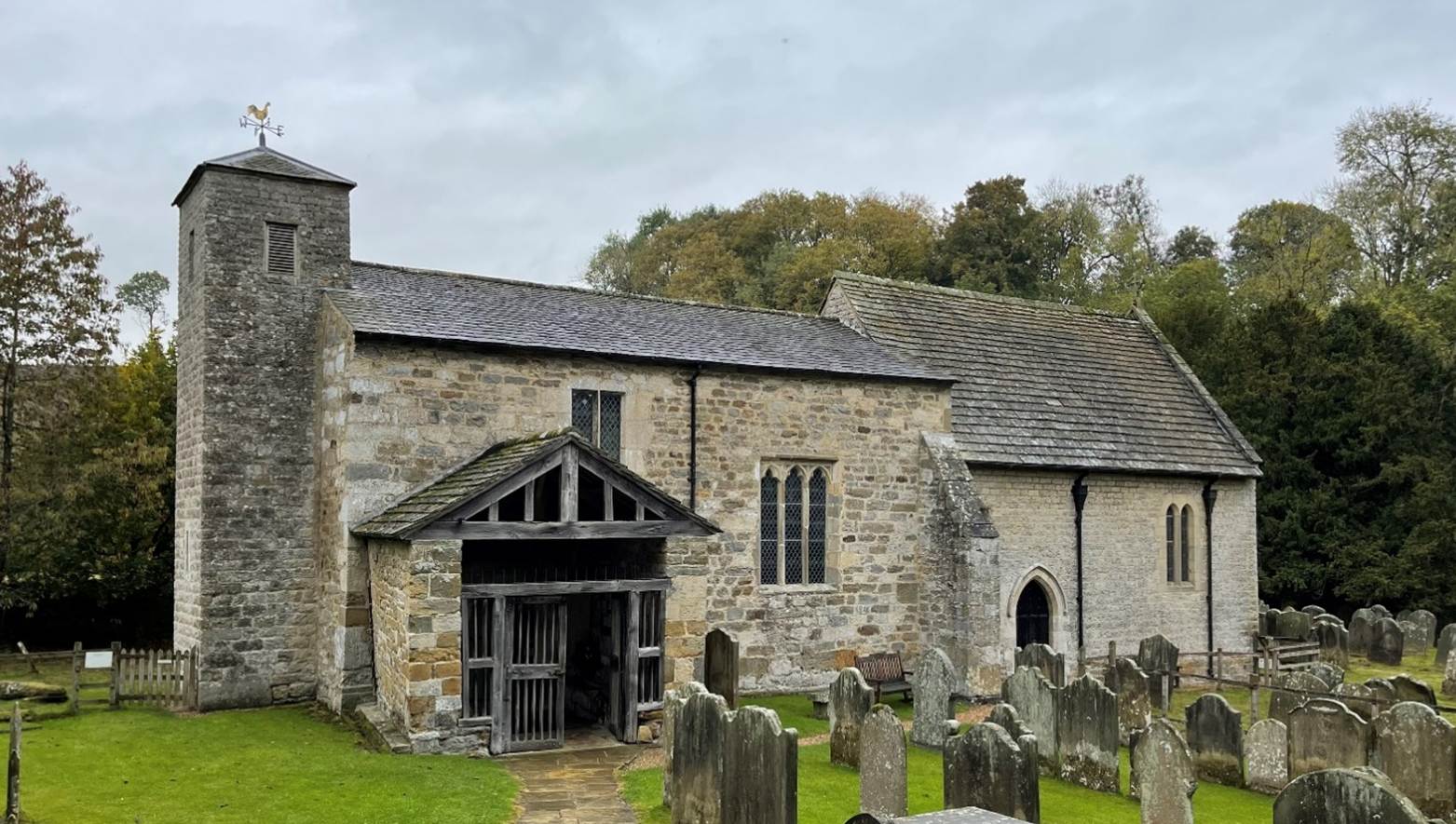
The ancient minster of St Gregory’s at Kirkdale is a beautiful Saxon Church about a
mile west of Kirkbymoorside, south of the North York Moors, which overlooks the
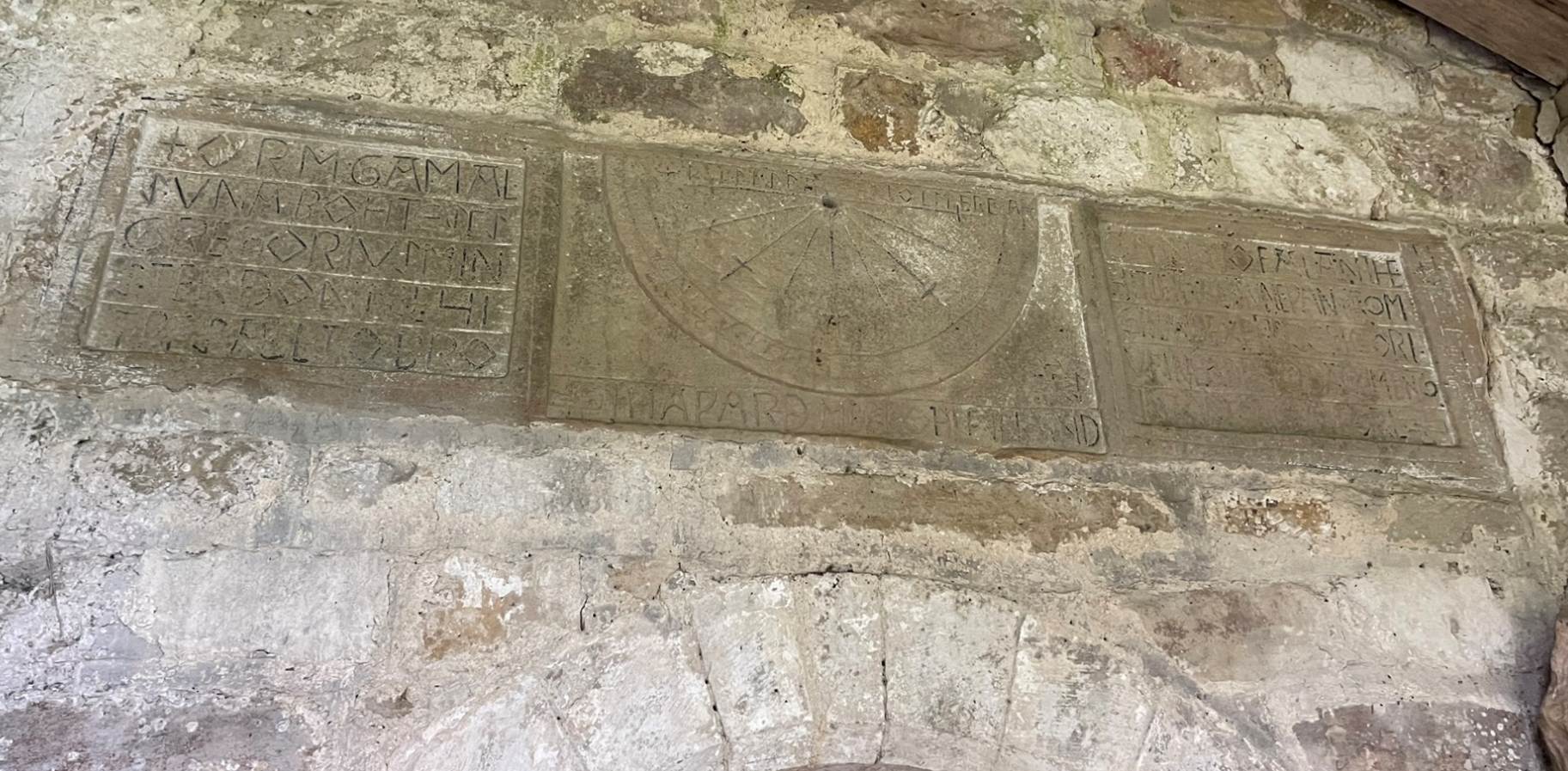
Hodge Beck. Within the porch at the entrance door is housed a Yorkshire
treasure. It is a Saxon sundial, and it bears the inscription “Orm the son
of Gamel acquired St Gregory’s Minster when it was completely ruined and
collapsed, and he had it built anew from the ground to Christ and to St Gregory
in the days of King Edward and in the days of Earl Tostig”. The inscription
refers to Edward the Confessor and to Tostig, the son of Earl Godwin of Wessex
and brother of Harold II, the last Anglo Saxon King of England. Tostig was the
Earl of Northumbria between 1055 and 1065. It was therefore during that last
relatively peaceful decade, immediately before the Norman conquest, that Orm, son of Gamel rebuilt St Gregory’s
Church.
Orm was
prominent in Northumbria in the middle years of the eleventh century. He married into the leading aristocratic clan of the
region. His wife Aethelthryth was the daughter of Ealdred, Earl of Northumbria
in the mid eleventh century. His brother in law was Siward,
Earl of Northumbria until 1055, famous for his exploits against Macbeth, the
King of Scots. Orm’s name suggests that he was of Scandinavian descent, but by
his lifetime, he was very much a Christian, and a part of the Saxon world.
The Parish Church was a part of the wider estate, most likely
handed out to Orm by King Cnut, then known as Chirchebi, but known to us
today as Kirkbymoorside. Somewhere within that great estate lay the forested
valley that would later become known as Farndale.
Nearby to the church at Kirkland is the Kirkland Cave discovered
by workmen in 1821 and found to contain the fossilised bones of a variety of
mammals no longer indigenous to Britain, including hippopotami (the farthest
north any such remains have been found), elephants and cave hyenas. After
toying with a theory that these were animals deposited after the Flood, the Rev
William Buckland came to understand that this was a cave of the interglacial
period which started 130,000 years ago, into which hyenas had dragged their
prey.
By the Roman period, Kirkdale was part of a stable and well regulated region, only 25 km north of Eboracum
(York) and 2 km to the east of the Roman villa of Beadlam,
for which Kirkdale might have been a burial place.
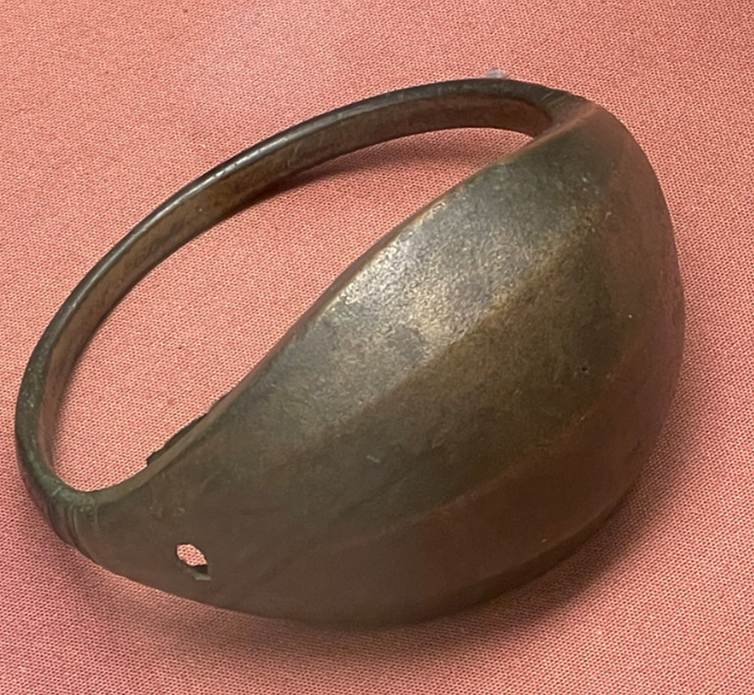
One day in the second or third century CE, a Roman soldier dropped
his arm purse, close to a prehistoric cairn, above and overlooking Farndale,
later found in 1849 and currently to be seen in the British Museum.
The Hodge Beck at Kirkdale dries up in times of dry weather, but
continues to flow under ground, to reappear
downstream. The quietness, beauty and timelessness of the site, and its
disappearing water trick, might explain its likely religious importance even
before Christian times.
In 580 CE Pope Gregory saw slaves in the market at Rome and asked
about them. He was told they were Angles from the Kingdom of Deira, the lands
between the Humber and Tees, the Kingdom of King Aelli. Gregory was clearly in
a humorous mood that day, and he made three famous puns:
· He
concluded that they were not angles, but angels, worthy of conversion, defining
a distinct nation that would one day be called England.
· He
amused himself that they were de ira, ‘of
anger’, and that they were to be saved from wrath.
· And
he declared that Allelujah (a pun on the King’s name)
should be sung in those parts.
In 597 CE Gregory sent Augustine to convert the Angli.
By the early seventh century CE, there was an incipient state
structure in the area of modern Ryedale, under King Edwin of Deira’s
peripatetic government, which held gatherings on estates where food was
consumed. Eoforwic (York) was an important
centre. Edwin converted to the Christian religion, along with his nobles and
many of his subjects in 627 CE and was baptised at Eoforwic
where he built the first wooden church amidst the Roman ruins which was later
replaced by a larger stone church.
By 659 CE, St Cedd the elder brother of St Chad, brought the
Celtic Christian traditions of Iona and Lindisfarne to found a monastery at
Lastingham, not far from the foot of Farndale, amidst the land of wild beasts,
men that appeared like beasts and robbers.
In 663 CE the Synod at Whitby agreed to a
reconciliation between the Celtic and Roman Christian traditions, agreeing to
adopt the Roman.
In about 685 CE, a minster was first built at Kirkdale, possibly
with close associations with Lastingham and Kirkbymoorside. It was dedicated to
St Gregory, reaffirming the new association with Rome and the Pope who had put
the land of the Angles on the European political map.
From that time, Kirkdale became a religious and political focal
point of relatively stable and prosperous lands in its vicinity, and where the
Farndale distant ancestors likely lived, in this place of profound influence on
the future evolution of a nation.
The evidence of the early Scandinavian period is more opaque, but
whilst our ancestors there might have witnessed unrest, disruption and
violence, Kirkdale was off centre to the known locations of Danish upheaval,
and Kirkdale might have found itself with more responsibility over an
increasingly dispersed population. When Scandinavian government was more firmly
established at Yorvik (York), Kirkdale might
have become directly associated with the city, and we know that in time the
local elite acquired property in York.
The archaeological record shows that the old church of Kirkdale
was destroyed by fire. It had previously been surmised that the church might
have fallen during the Viking period, but it seems more likely that the church
suffered a fire perhaps not many years before Orm tells us he came to rebuild
it.
Orm and his
farther Gamal were descendants of a family that gained power when the
Scandinavian King Cnut rewarded his followers for their help in the conquest of
England in 1014 to 1016. Their forebears probably included Thurbrand
the Hold (died 1024). Thurbrand was a Northumbrian
magnate in the early 11th century. Perhaps based in Holderness and East
Yorkshire, Thurbrand was recorded as the killer of
Uhtred the Bold, Earl of Northumbria. The killing appears to have been part of
the war between Sweyn Forkbeard and Cnut the Great against the English king
Æthelred the Unready, Uhtred being the latter's chief Northumbrian supporter.
The family were likely players in multi generational
Northumbrian politics and feuds. They were known political figures in the
north. They had the wealth to rebuild the church on a significant scale.
The likely home
of the distant ancestors of modern Farndales was therefore a place of general
stability, and likely political influence.
The Normans invaded England in 1066, and
although the north was not immediately subdued under Norman rule, the harrying
of the north meant that the location with which we are interested was under the
Norman thumb by 1086, which was the date when the Domesday Book recorded the
extent of Norman domination.
The Domesday Book also evidences the
administrative efficiency of the new overlords. A millennium later, that
efficiency provides us with the tools with which to have eyes on the historical
events of our very distant past. The Domesday Book recorded every important
place in the country - what was there, who owned it prior to the conquest, and
to whom it was transferred after the Conquest.
We therefore know from the Domesday Book, that Chirchebi
was in the possession of Orm at the time of the Conquest and that it comprised ten villagers, one priest, two ploughlands, two
lord’s plough teams, three men’s plough teams, a mill and a church.
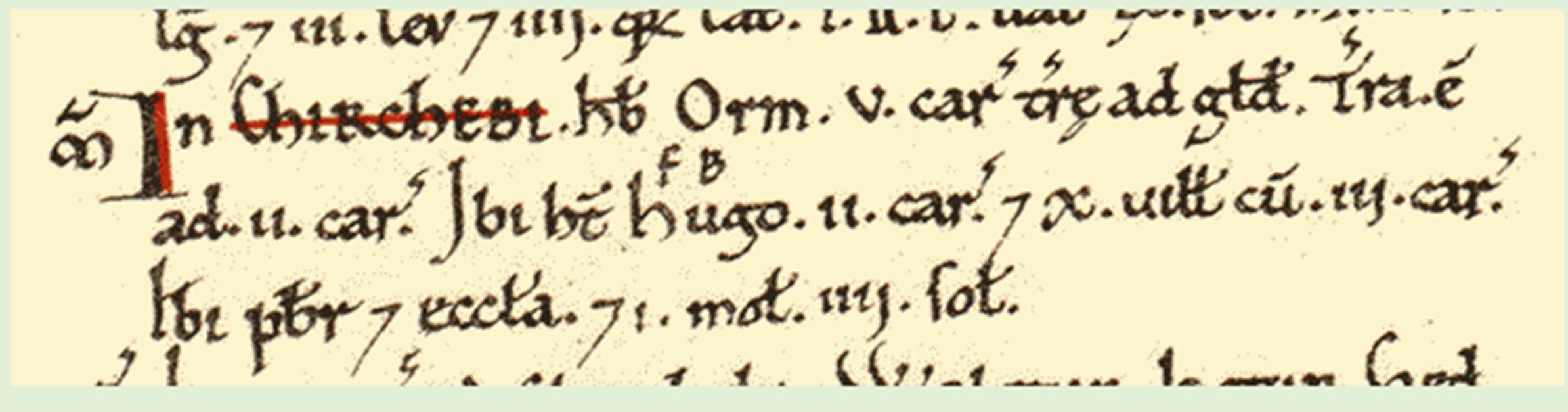
Before the Conquest, Orm seems to have held five carucates of land
at Kirkdale which were part of the wider estate of Chirchebi
which stretched 12 leagues wide by 2 leagues broad. A carucate was a
medieval land unit based on the land which eight oxen could till in a year. So
presumably this area of land described the five carucates of cultivated land
around Kirkdale. However this area of civilisation was part of a much wider
estate of Chirchebi, which was said to be twelve leagues (about 42
miles) long by the time of the Normans. A wider area
stretching south to Kirkby Misperton and north to Gillamoor was part of the agricultural lands of Orm’s
day.
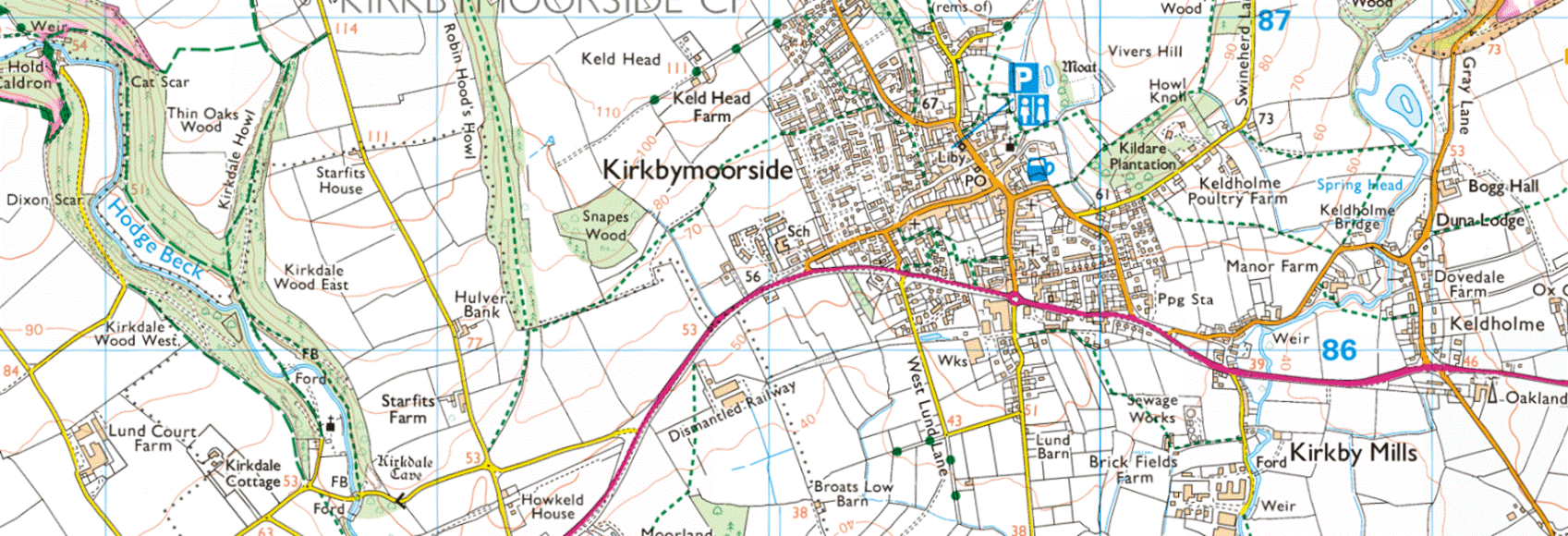
So whilst there was a small community of folk living at Kirkdale,
and in the surrounding lands within this wider estate, the bulk of the estate
was deep forest, stretching up through the dales towards the highlands of the
North York Moors. This forest was probably largely
impenetrable, and certainly not settled. It may have been used for hunting.
Centuries before, the Venerable Bede had described this region as it stretched
to the remote monastery site at Lastingham, as ‘vel bestiae commorari vel hommines
bestialiter vivere conserverant’,
‘a land fit only for wild beasts, and men who live like wild beasts’.
After
the conquest, the estate of Chirchebi was forfeited to Hugh fitz Baldric
(Hugh, the son of Baldric), a German archer who had
served William the Conqueror and became the Sheriff of the County of York in
1069. Hugh died in 1086 and the estate passed to de Stuteville
family, but they were deprived of it in 1106 when it was granted to Nigel
d’Aubigny, one of Henry I’s “new men”. Nigel d’Aubigny then passed to his son,
Roger de Mowbray, initially under the guardianship of Nigel’s
widow, Gundreda.
The Early History
of Farndale the Place
The Mowbrays were significant
benefactors of several religious institutions in Yorkshire. And
so, in 1154, we are introduced to Farndale the place for the first time in
the Chartulary of Rievaulx Abbey when
Gundreda, on behalf of her guardian, gave land to the abbey.
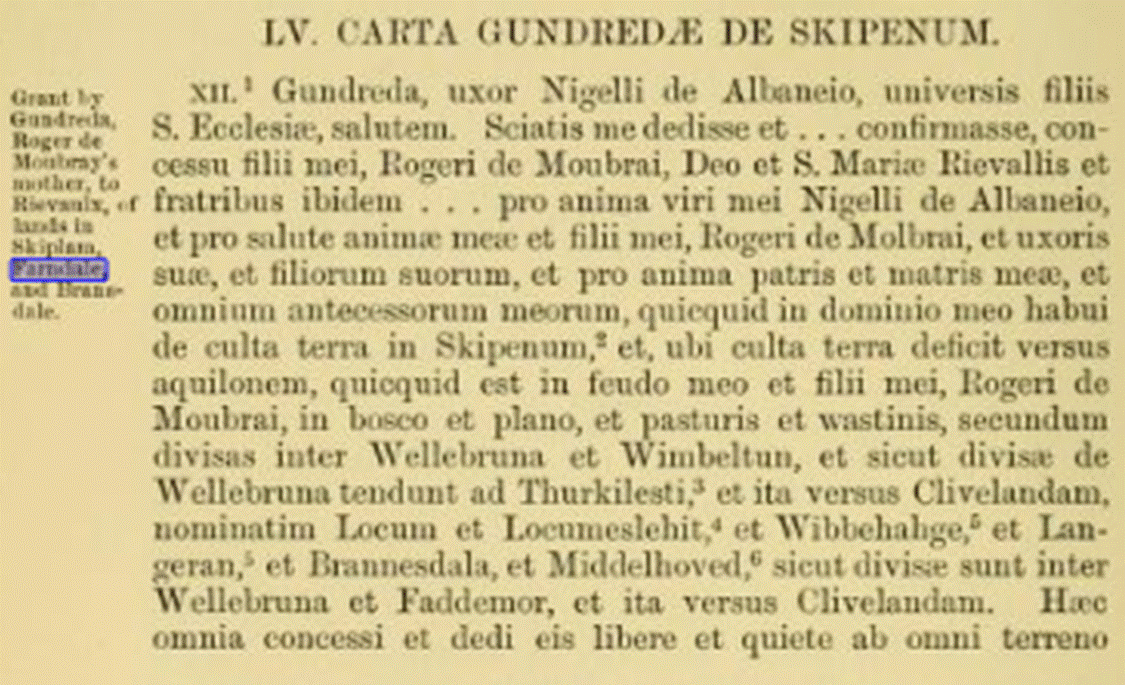
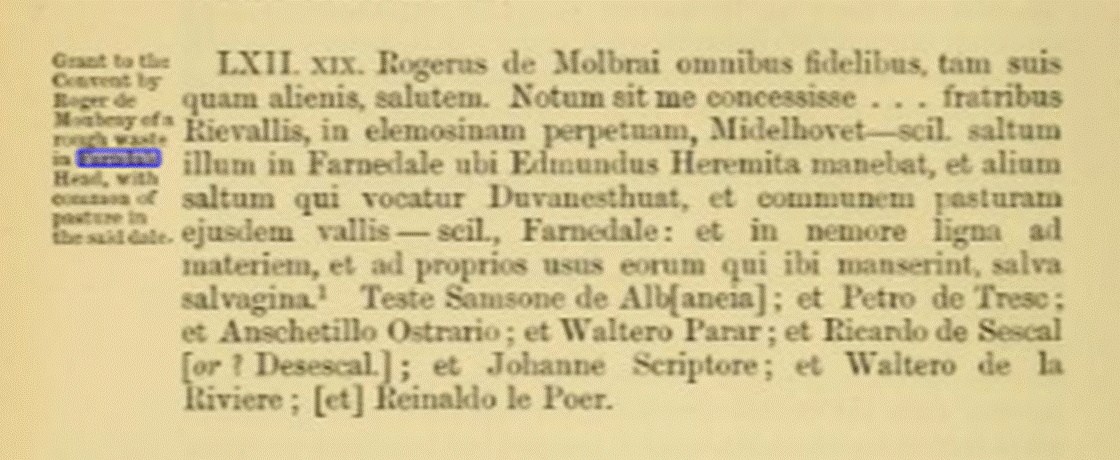
Roger
of Molbrai, to all the faithful, both his own and strangers. Let it be known
that I have granted . . to the Rievallis brothers, in perpetual alms,
Midelhovet - scil. that meadow in Farnedale where Edmund the Hermit dwelt, and
another meadow called Duvanesthuat, and the common pasture of the same valley -
scil., Farnedale:
and in the forest wood for material, and for the own uses of those who remained
there, save the salvage. Witness Samson
de Alb[aneia]; and Peter of Tresc; and Anschetillo Ostrario; and Walter Parar;
and Eicardo de Sescal [or ? Desescal.]; and John the Scribe; and Walter de la
Eiviere; [and] Eiinaldo le Poer.
And so, as we
first lay our historical goggles onto Farndale the place in 1154, we
appear to enter a Lord of the Rings World, with a dash of Game of
Thrones. The House Mowbray (a competitor to
the House Stuteville) has given to
the monks, who live in their exquisite Elven home at Rievaulx, a place called
Midelhovet, where Edmund the Hermit used to dwell, and another called
Duvanesthuat, together with the common pasture within the valley of Farndale.
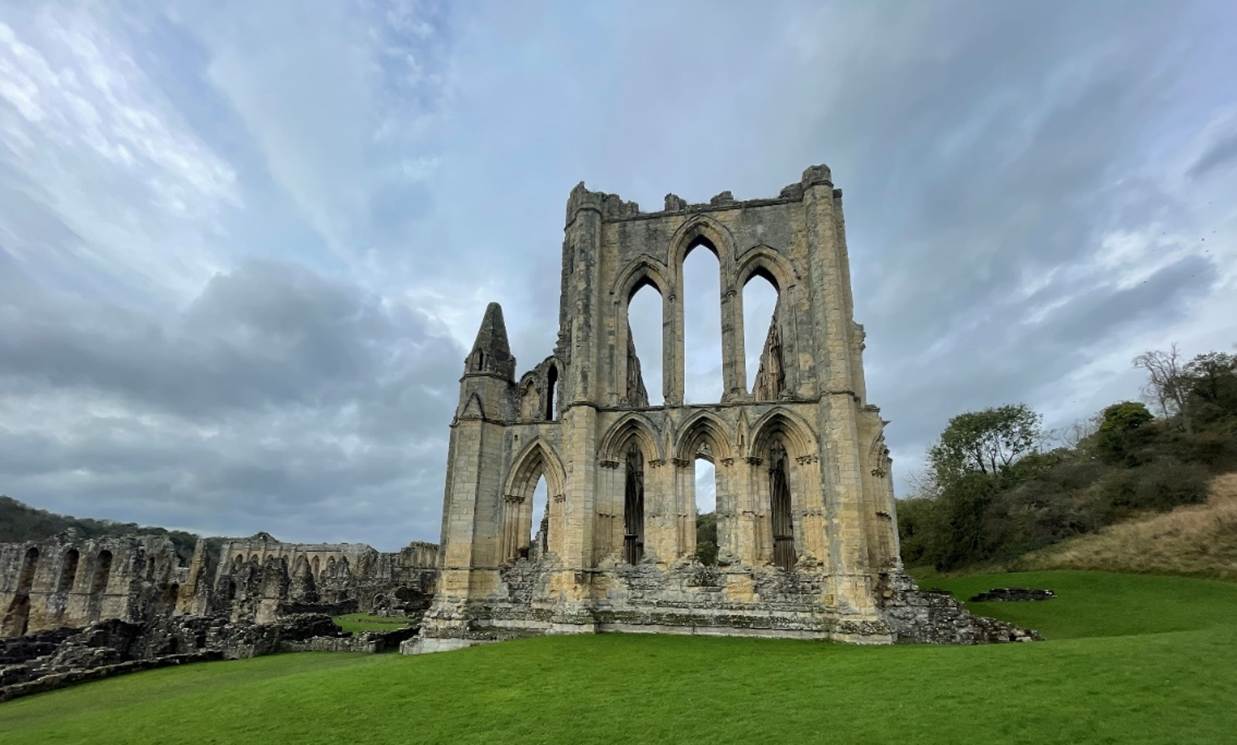
Rievaulx,
in its Elven valley, taken by the website author in 2016
Midelhovet is
almost certainly the area in Farndale known today as Middle Head and Duvanesthuat
is probably the place where the Duffin Stone lies today.
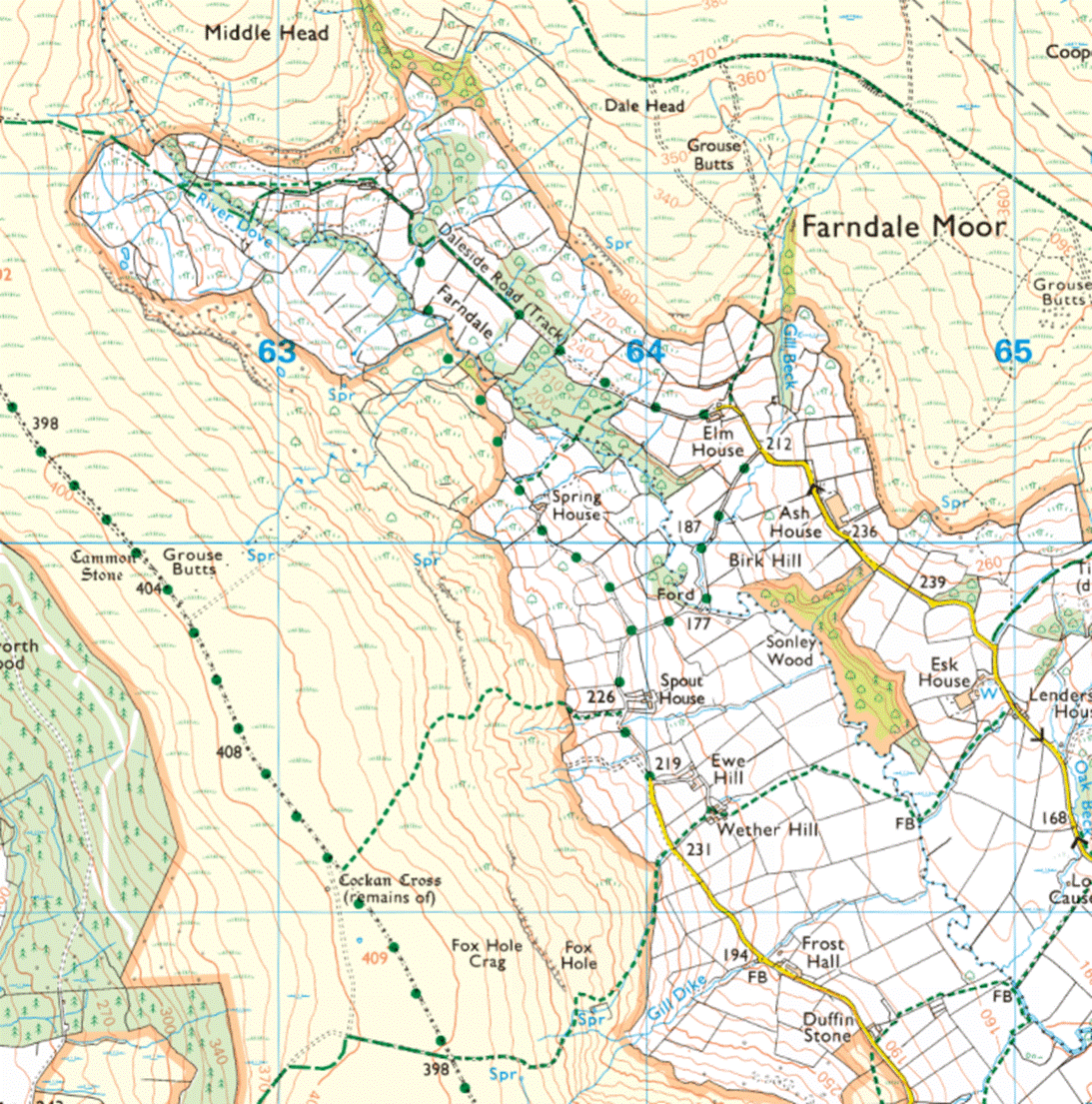
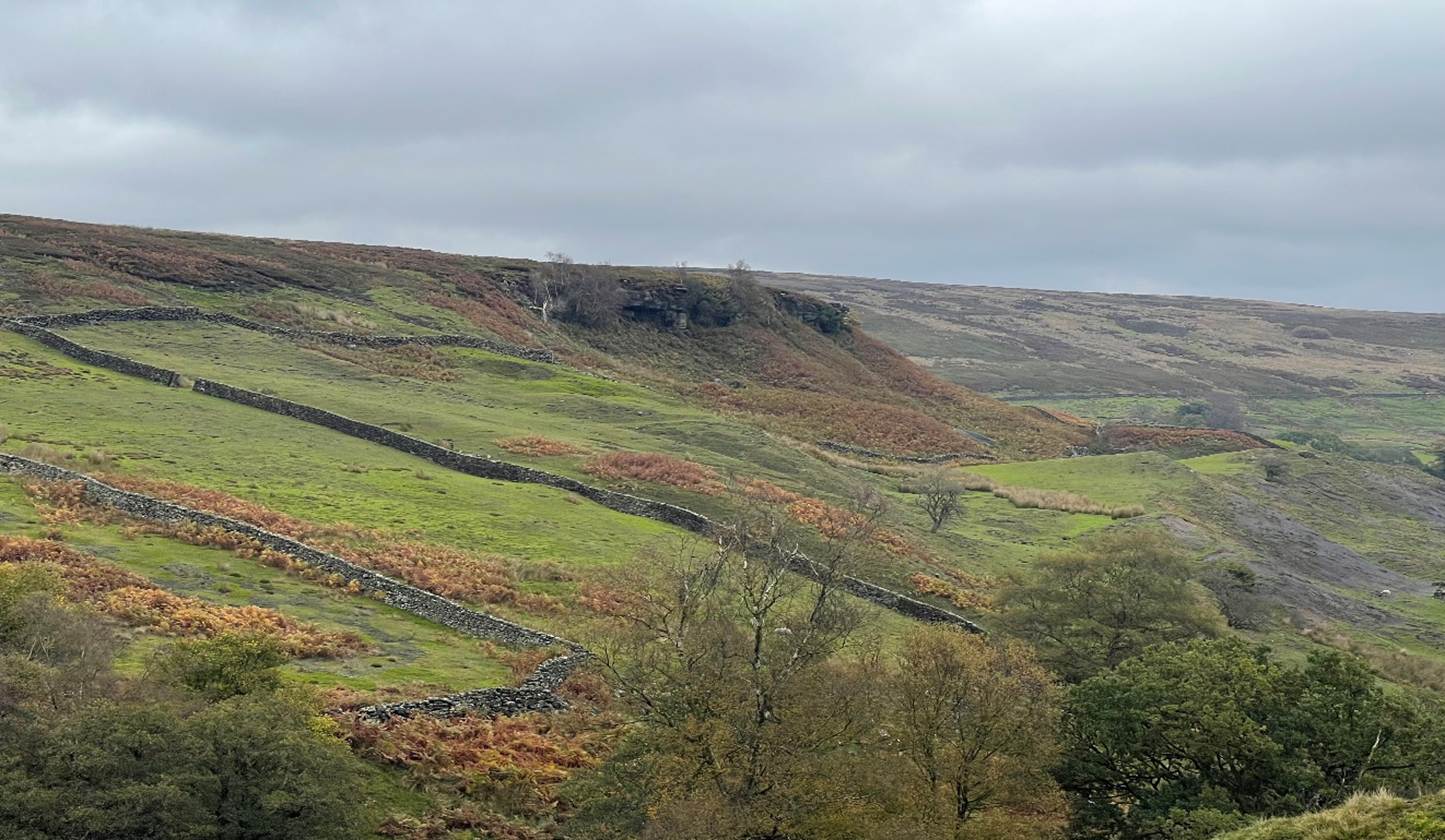
The
northwestern end of Farndale showing Middle Head and the Duffin Stone. The area of Middle Head in 2021
We are also introduced to the first individual
who roamed the lands of Farndale, who used to live at Midelhovet some years
prior to 1154. Edmund the hermit of Farndale was a legendary figure who lived
in a cave in the North York Moors in the 12th century. He was said to be a holy
man who performed miracles and healed the sick. He was also reputed to have
been a descendant of King Alfred the Great and a cousin of King Stephen. I
don’t suppose he was our ancestor, since he was a hermit, but this is our first
introduction to a character roaming the place.
So by this time, the dale had become known as Farndale.
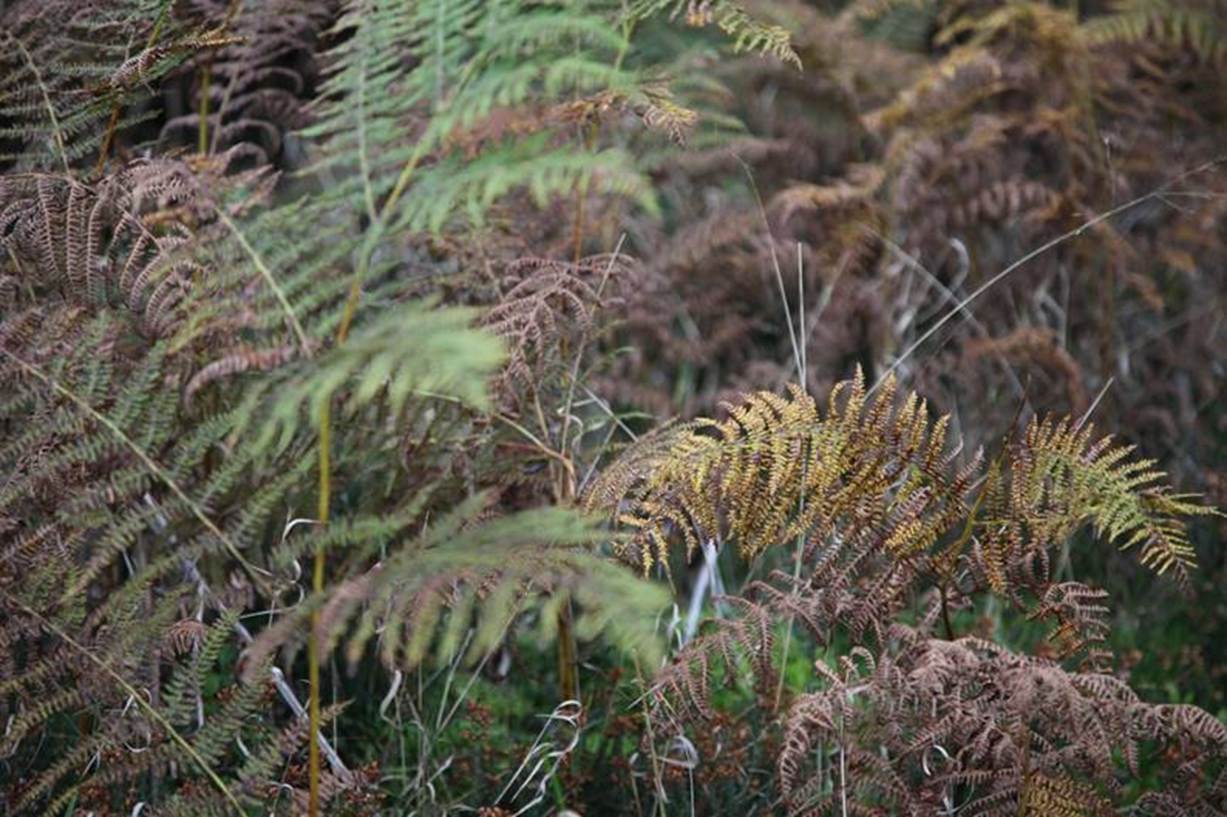
Of
course whilst Farndale is today dominated by moorland bracken and ferns, ferns
are naturally a woodland plant, so it must have been the ferns of the forested
Farndale which gave rise to its name. Perhaps it was Edmund who must have known
the valley intricately, who first chose its name.
The House
Mowbray supported the wrong side in a revolt against
Henry II and the estate of Kirkbymoorside was ceded back to the House of the de
Stutevilles. Robert III de Stuteville was one of the
northern barons who had commanded his forces the English at the Battle of the Standard at Northallerton
on 22 August 1138. He claimed the barony, which had been forfeited by his
grandfather, from Roger de Mowbray, who by way of compromise gave him
Kirkbymoorside.
The Stutevilles
favoured the Benedictine monks of Saint Mary's Abbey, York, and their own small
House of nuns founded by them at Keldholme, just to the east of Kirkbymoorside.
Rievaulx Abbey therefore went out of favour in its claim to Farndale. In about
1166 Robert de Stuteville granted to Keldholme Priory the timber and wood in
Farndale. Farndale itself then disappeared from the records for about a
century, though we can still follow the fortunes of the Stuteville family and
of the estate of Kirkbymoorside. In 1216, Joan de Stuteville, the daughter of
Nicholas II de Stuteville and Devorguilla of Galloway and the heiress of the
Stuteville estates was born. She married Hugh Wake, feudal lord of Bourne and
later Hugh Bigod, Chief Justice of England, but as a widow was known as Joan de
Stuteville, the ‘Lady of Liddell’. Before her death in 1276, she enfeoffed the
manor of Kirkbymoorside to her son, Baldwin Wake.
It is
during the time of Joan de Stutevilles, that we meet the first settled
inhabitants of Farndale. We will take up that story next. But before we do so,
we should just complete our history of the de Stutevilles who were the
overlords of the Kirkbymoorside estate and therefore of the lands of Farndale
during the following centuries, as our ancestors started to work on the land
there.
The
custody of Baldwin Wake was granted to Henry de Percy, who transferred it to
the Society of the Ballardi of Lucca. However this was not ratified by the
King, but later ‘not recollecting the confirmation of the grant’, he ‘caused
the manor, then in the hands of the merchants, to be taken into his hands, and
he delivered it with fees &c, who since he has held the said manor has
received £340 out of the issues thereof, for which Henry de Percy has made
supplication to the King to caused satisfaction to be made to the merchants for
his exoneration.”
Thomas
Wake remained in possession of the lands until he died in 1349. His heir was
his sister Margaret, wife of Edmund Earl of Kent, whose son John succeeded her.
John died three years later, however without issue, and his sister Joan, ‘the
Fair Maid of Kent’, became the heir. The
impression of the Fair Maid of Kent’s seal depicted a lady riding on horseback
sideways, which is a horse riding style which she is said to have been the
first to adopt. Her first husband was Thomas Holand, created Earl of Kent in
1360, by whom he had a son and heir Thomas Holand. Later Joan married Edward
the Black Prince, with whom in 1365 she settled this manor on Thomas and Alice
his wife and their heirs, with reversion to the prince and herself. In 1397
Thomas Earl of Kent died and Alice was left in possession for life. Of her
sons, Thomas the Elder was beheaded as a traitor in 1399 and his brother Edmund
died before his mother in 1408, when the earldom of Kent fell into abeyance.
The First Farndales
1276
Only
a few years after the death of Joan de Stuteville, the Lady of Liddell, the Inquisition Post Mortem
taken after Joan’s death in 1276, reveals assarting on a
grand scale. In Farndale, bonded tenants were paying a
standard rent of 1s 0d for each acre. This produced total income of £27 5s 0d,
suggesting a cultivated acreage in Farndale of 545 acres. So this provides us
with a snapshot to suppose that assarting must have started from about 1230,
when individuals were placed from the surrounding lands into Farndale to clear
land for agriculture and then to toil for their feudal overlords, paying them
rents to provide the landlords with an income from the land, in return for bond
holdings from which to scrape their own meagre living.
1282
The Inquisition Post Mortem of
Joan’s Son, Baldwin Wake, taken only six years later in 1282,
noted that the bonded villeins were said to hold their land ‘not by the
bovate of land, but by more or less’ (a bovate is an eighth of a carucate).
The 1282 extent shows a considerable increase over that of 1276, but this
probably means nothing more than that a new and up-to-date survey was used as
the basis for the later document. The Farndale rents now amounted £38 8s 8d
together with a nut rent and a few boon works and if the rate of 1s 0d per acre
still applied, this would give a total acreage held in bondage of 768 acres. In
neighbouring Bransdale rents were up to £4 14s 3d which would relate to about
188 acres at the old rent of 6d per acre for that valley. For the first time
the number of bondmen were given - 25 in East Bransdale and 90 in Farndale.
1301
The lay subsidy assessments of 1301 afforded a brief glimpse of
the settlement pattern, listing several contributors bearing the
names of the farms which are still to be found at Farndale such as ‘Wakelevedy’
(Wake Lady Green), ‘Westgille’ (West Gill), Monkegate (Monket House) and
‘Elleshaye (Eller House) and which are scattered all around the dale.
So
between about 1230 and the end of the thirteenth century, we have a picture of
villeins or serfs or peasants, who together formed the body of folk who must
have been our ancestors, toiling the soil in a dreadful battle of survival.
It is
probable that those individuals in turn were plucked from the cauldron or primeval sludge of Bronze Age
Beaker Folk, Iron Age Settlers, Brigantes, Romans, Vikings, Angles and Saxons
that had roamed the moors and Dales of Yorkshire since about 9,000 years BCE. Our
probable ancestors are the folk living in the cultivated lands around Kirkdale,
a place of even greater antiquity, which has left us the remains of
interglacial age hippopotami.
The Early Farndale Pioneers
But
suppose another William leaves Farndale and travels to the Wapentake of
Langbaugh. He might well call himself William of Farndale which would
distinguish him from other Williams. And so the folk who stayed in Farndale,
were more likely to adopt descriptive, patronymic or occupational names, or
defined by the location of places outside Farndale from whence they had come
previously as can be seen in the list of names in the 1301 record. But
when De Willemo de Farndale appeared
in the same 1301 Subsidy in the Wapentake of Langbaugh, he was the one to call
himself William of Farndale. It was those pioneers from Farndale, who would
adopt its name to describe themselves.
So those who first described
themselves as de Farndale, were those adventurous and pioneering soles,
who ventured out to new places. As we are introduced to our later pioneer
ancestors, we might reflect that we come from a stock of pioneers and
adventurers.
Ordinary
folk were starting to use such descriptions beyond Christian names by the early
thirteenth century. However these names tended to fluctuate until about the
fourteenth century. If William of Farndale moved from Langbaugh to York, he
might have started to call himself William of Langbaugh. However by the
fourteenth century, such names
became fixed, and started to be passed down as hereditary names. We can
actually see this happening in the Farndale history. From about 1310, we see
the ‘de’, ‘of’ being dropped. This tends to suggest folk no longer defining
themselves as ‘of’ a place, but using a name, with more permanency. So we see
the first example of William Farndale (FAR00034)
born in about 1310, and then William Farndale of Sheyrefhoton
(Sheriff Hutton)(FAR00036),
born about 1332. He is not William of Sheriff Hutton, but William Farndale, who
lives in Sheriff Hutton.
The
records of the first individuals using the Farndale name tended to record the
payment of taxes, surveys of the inhabitants of the land, and illegal activity.
To
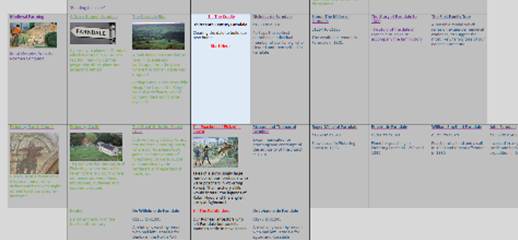
accompany this introduction you will find a timeline of Farndale history from 1000 to 1600,
which provides a summary of the history to this stage, and which draws out the
individual characters who appear from this point. The colour coding interlinks the history of individual
Farndales, with the history of the feudal
overlords who held the land, with the Kings
and Queens at the pinnacle of the hierarchy, and with the dominant events at the
national level of British history.
So it
is, that we learn much from the records about a significant number of our
ancestors who were fined, outlawed and even excommunicated, for poaching and
illegally hunting, particularly within the Royal Forest of Pickering. There is a historical documentary series on
Sky television, called The Britains. Episode 2 depicts much of the
historic background to the events described so far. It also depicts two outlaws
pursued in Pickering Forest called Philips, but who may as well have been
Farndales. The documentary observes that it was such folk who would inspire the
legend of Robin Hood, and whose archery skills would one day
comprise the successful armies who fought at Crecy and Agincourt. Park this
thought about the links to the legend of Robin Hood, because we shall find
ourselves in the heart of Robin Hood territory before too long.
· Farndales
indicted for poaching in 1280 (FAR00019)
Roger, son of Gilbert of Farndale, Nicholas de Farndale, William the smith of
Farndale, John the shepherd of Farndale, and Alan the son of Nicholas de
Farndale;
· Peter
de Farndale (FAR00008),
whose son Robert (FAR00012) was
fined at Pickering Castle in 1293.
· Robert
son of Peter de Farndale, (FAR00012)(The Farndale 2 Line) was
outlawed for hunting in 1293.
· Roger
milne (miller) of Farndale (FAR000013A),
son of Peter (FAR00008) of
Spaunton on Monday in January 1293, killed a soar and slew a hart with bows and
arrows at some unknown place in the forest. He with others were outlawed on 5
April 1293.
· Richard
de Farndale (FAR00016) was
excommunicated for stealing in 1316.
· Robert
of Farndale (FAR00024) was
fined at Pickering Castle for poaching in 1322.
· John
de Farndale (FAR00026) was
released from excommunication at Pickering Castle on 9 Apr 1324.
· Simon
de Farndale (FAR00021) (The Farndale 4 Line),
shoes son Robert was fined at Pickering Castle in 1332.
· Robert
of Farndale (FAR00031) was
outlawed with others for hunting a hart in the forest in 1332.
· Nicholas
de Farndale (FAR00022)(The Farndale 3 Line)
gave bail for Roger son of Gilbert of Farndale who had been caught poaching in
1334 and 1335.
· William,
smith of Farndale (FAR00037) on
Monday 2 December 1336, came hunting in Lefebow with bow and arrows and
gazehounds………’
· Gilbert
de Farndale (FAR00018)
bailed by Nicholas Farndale (FAR00022) for
poaching in 1344 and 1345.
· Commission
of oyer and terminer on 17 January 1348 to a long list of names including
William Smyth of Farndale (FAR00040) the
younger and Richard Ruttok of Farendale for breaking in to the park at Egton,
hunting and carrying away the property of the owner with deer, and for
assaulting the owner’s men and servants causing their inability to work for a
long time, for which they were fined 1 mark.
A historical explanation for this
activity might have been the Great Famine following bad weather and poor
harvests in 1315 which gave rise to widespread unrest, crime and infanticide;
followed by the Black Death which
hit Yorkshire in March 1349.
As
individuals who started to use the name Farndale, started to appear outside the
dale, it becomes obvious from the records that there are some geographical
groupings of Farndales in the thirteenth and fourteenth centuries around Sheriff Hutton (of
which family have been preserved two wills from two generations) , York (which family bore three generations of
freemen of York) and then Doncaster.
Perhaps there is some interrelationship between these three families. Perhaps
those who settled in Doncaster by 1335 were somehow linked to the York family.
So let’s take stock:
· From
about 1230, the land was cultivated and our villain forefathers no doubt lived
a pitiful life, surviving each day as they could.
· By
1276, there was a more developed community of folk who were farming in
Farndale, and we start to be introduced to individuals.
· From
1280, we start to see records of poachers and huntsmen who were fined,
outlawed, or even excommunicated in the imposing Norman Pickering Castle.
· The
country faced the hardships of the Great Famine of 1315 and the Black Death
from 1349 in Yorkshire, though in time, with a decimated population, that would
provide greater power to the peasantry, to negotiate a better deal for
themselves.
· By
the thirteenth and fourteenth century, the inhabitants of Farndale who had
started to use its name to define themselves had moved south and had clustered
around Sheriff Hutton, York and Doncaster.
The Doncaster Era
Modern Doncaster is strongly characterised by its industrial
past. However the Doncaster to which we now turn our attention was a very
different place. It was the place of a significant Roman Fort. After the Norman
Conquest, Nigel Fossard had built a Norman Castle. By the thirteenth century,
Doncaster was a busy town. In 1194 Richard I had given the town recognition by
bestowing a town charter. There was a disastrous fire in 1204 (fires seem to
feature heavily in Doncaster’s history) from which the town slowly recovered.
In
1248, a charter was granted for Doncaster Market to be held in the area
surrounding the Church of St Mary Magdalene, which had been built in Norman
times. But over time the parish church was transferred to the church of the old
Norman castle, the castle which by then was in ruin. The new parish church was the original Church of St George.
During the 14th century, large numbers of friars arrived in Doncaster who were
known for their religious enthusiasm and preaching. In 1307 the Franciscan
friars (Greyfriars) arrived, as did Carmelites (Whitefriars) in the mid-14th
century. Other major medieval features included the Hospital of St Nicholas and
the leper colony of the Hospital of St James, a moot hall, a grammar school and
a five-arched stone town bridge with a chapel dedicated to Our Lady of the
Bridge.
It is
in this setting that we meet William Farndale. We
first see his name in a grant of land in Latin by Walter de Thornton, the vicar
of Doncaster, and Wm de Farndell, his chaplain on 11 April 1355. Perhaps
William may have been about twenty then, so perhaps he was born in about 1335. The
Black Death had ravaged Doncaster from about 1349, and
its population had been reduced to about 1,500. So William must have survived
the Black Death. Perhaps he was already a chaplain then, experiencing the
horrors with pastoral responsibilities. Or perhaps it was his survival of those
horrors that was his path to the church.
It is
possible (but there is no evidence of this) that William Farndale might have
been the son of Walter de Farndale
(about 1300 to 1370), who was a vicar at Haltwhistle, Lazonby,
Illis- haghe hospital, Upmeadon,
and Chemlsford and that his grandfather might have
been Walter de Farndale of Cayton (about
1275 to 1328), for whose death in 1328 Hugh de Faulkes of Lebreston
was required to join an expedition against the Scots in exchange for his
pardon. There is no evidence of this, but the ecclesiastical links makes it a
possibility. Perhaps this was a family whose links with the church provided
opportunities to venture more widely.
We
then spot William of Doncaster again in the patent rolls of 1358:
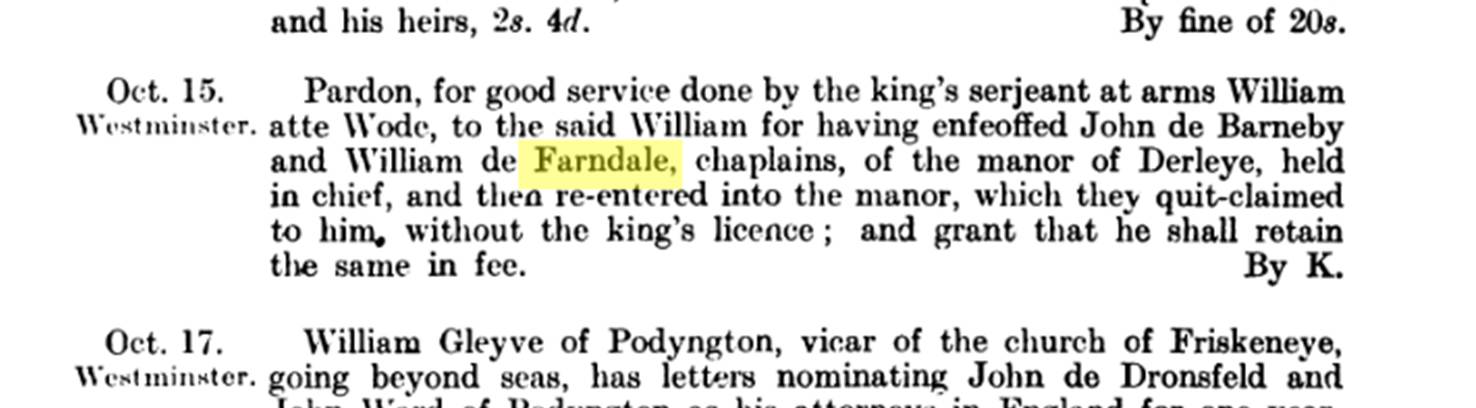
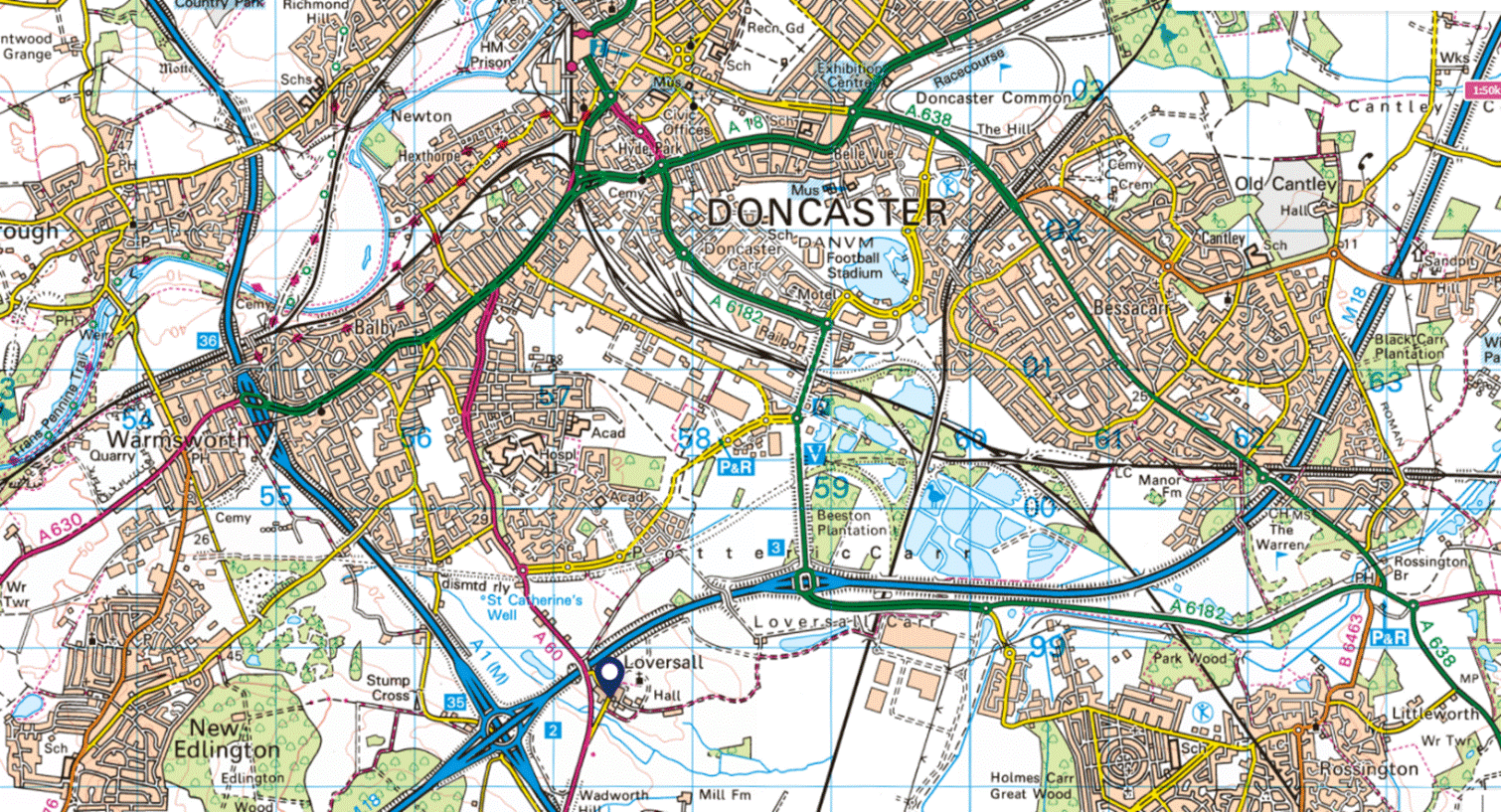
On 7 December 1368, Robert Ripers
transferred five acres of land at Lovershall (just south of Doncaster) to Sir
William Farndale, still chaplain. The term ‘sire’ was used as an address to
religious men such as priests, it does not denote a knight. ‘Know
men present and to come that I Robert Ripers of Loversall have given, granted,
and by this my present charter confirmed to Sir William Farndale, chaplain,
5 acres of land with appurtenances lying in the fields of Loversall, extending
from the meadows of the Wyke to the Kardyke, of which 1 acre 1 rood lie in
Wykefield between the land of Robert son of John son of William, son of Robert
on both sides. And 2 1/2 acres lying in the Midelfild between my own land on
the west and the land of Richard son of Robert on the east. And 1 rood lying in
Wodfild between my own land on the west and the land of John of Wakefield on
the east. To have and to hold the said 5 acres of land with appurtenances to
the said William and his heirs and assigns, freely, quietly, well and in peace,
from the chief lords of the free by the services then owed and customary by
right. And I, said Robert, and my heirs, will warrant the said 5 acres with
appurtenances to the said Sir William, his heirs and assigns against all men
for ever. In witness whereof I have affixed my seal to this present charter.
These being in witness; Sir John of Loversall, Chaplain; William Vely, Robert
Clerk, Richard Rilis, John son of William son of Roger and others. Given at
Loversall on Thursday after the Feast of St Nicholas, 42 Edward III. (7 Dec
1368).’

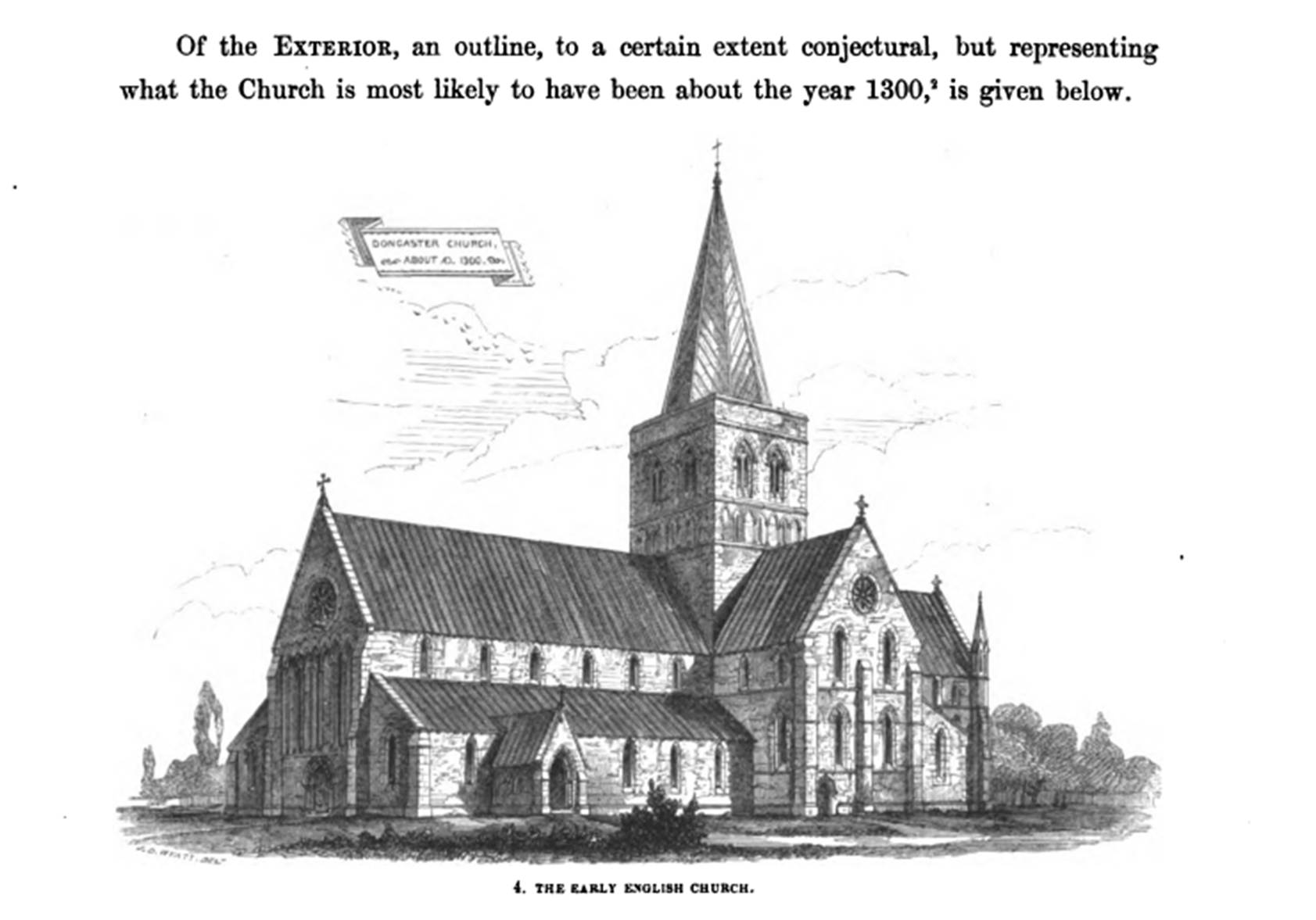
A drawing of the early church in about 1300 from the History of St
George’s Church, Doncaster, Destroyed by Fire, February 28, 1853, by the
Rev J E Jackson.
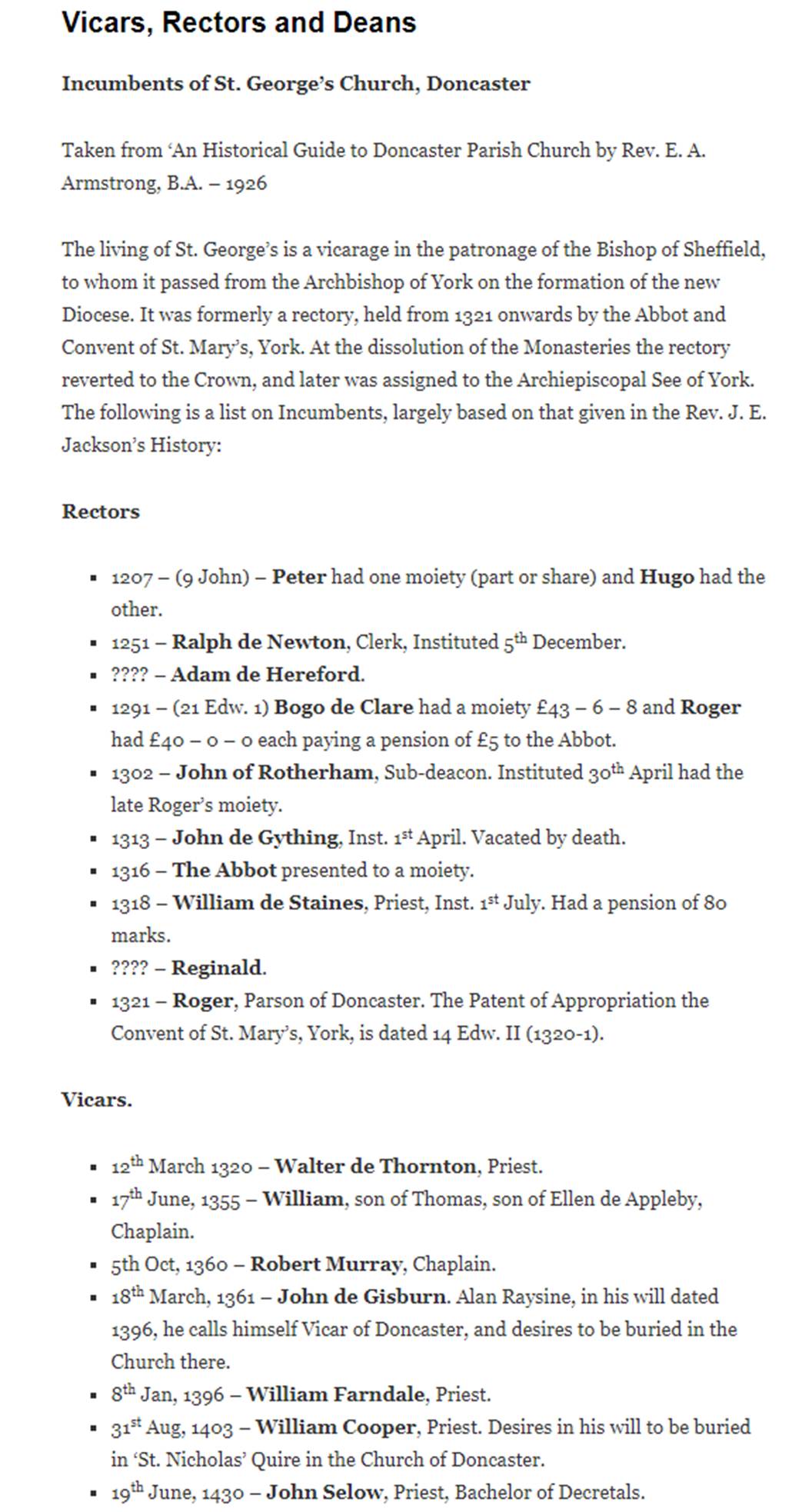
So William was the vicar of the
impressive early Church of St George’s at
the end of the fourteenth century. Whilst not yet of the stature of the
impressive Doncaster Minster of St George’s, which was rebuilt on the site
after a fire destroyed the early church in 1853 and which was given Minster
status in 2004, it was even by then an impressive church.
William
transferred his land at Lovershall to John Burton in 1402; “‘Know men
present and to come that I, William Farndalle, Vicar of the Church of
Doncastre, have given, granted and by this present charter confirmed to John
Burton of Waddeworth, his heirs and assigns 5 acres of land with appurtenances
lying in the fields of Loversall. Viz, those 5 acres of land which I had as
gift and feoffment of Robert Ryppes of Loversalle and which extend from the
meadows of the Wyke to the Kardyke as the charter drawn up for me by Robert
Ryppes more fully sets out. To have and to hold the said 5 acres of land with
appurtenances to the said John Burton, his heirs and assigns from the chief of
the lords of the fee by the services thence owed and customary by right. And I
William Farndalle and my heirs will warrant the said 5 acres of land with
appurtenances to the said John Burton, his heirs and assigns against all men
for ever. In witness whereof I have affixed my seal to this present charter.
These being witnesses; John Yorke of Loversalle, Robert Oxenford of Loversalle,
William Ryppes of the same, John Millotte of the same, William Clerk of the
same and many others. Given at Loversalle 6 April 3 Henry IV. (6 April 1402).”
In
1403 we see the installation of William Couper as the vicar of Doncaster, on
William Farndale’s resignation.
The
record then goes silent, albeit I do intend to do some detailed work in
the Doncaster record. So we don’t know if William Farndale married or
if he had children.
 However our radar warms up again on 29 October 1564 when a wedding
took place between a William Farndell and
a Margaret Atkinson in the Church of St Magdalene in the village of Campsall,
which is only a few miles north of Doncaster.
However our radar warms up again on 29 October 1564 when a wedding
took place between a William Farndell and
a Margaret Atkinson in the Church of St Magdalene in the village of Campsall,
which is only a few miles north of Doncaster.
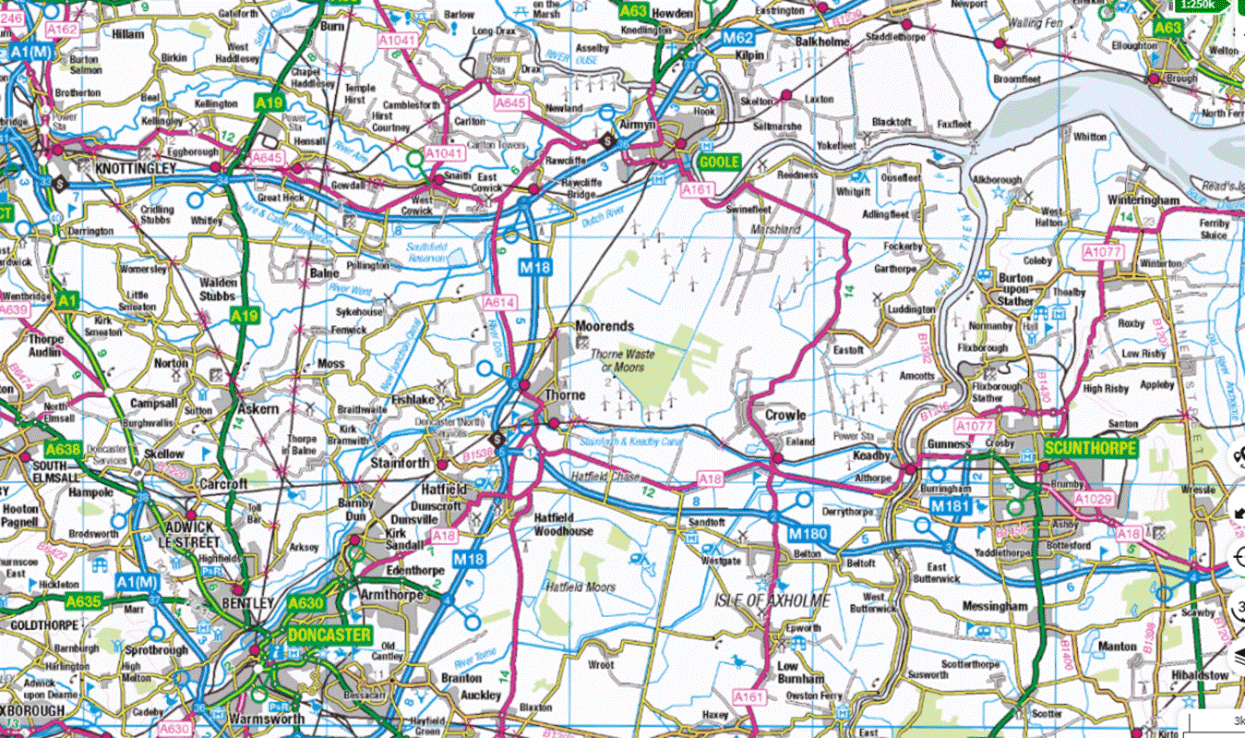
 Now this is where we remind ourselves of our more distant
ancestors who were outlaws in Pickering Forest, reminiscent at least of the Robin Hood stories. Now it is to be observed that
Campsall is a town which was then dominated to the west by the inaccessible and
waterlogged marches of the Humber levels and to the west, by Barnsdale Forest,
an area (together with Sherwood) closely associated with the legend of Robin
Hood. Robin Hood is largely a creature of ballads composed in the fourteenth
century (at the time of William Farndale, the vicar). He is reputed to have
operated in various eras from the twelfth century. A map showing the geographical
locations associated with Robin Hood
reveals that Campsall is in its heart:
Now this is where we remind ourselves of our more distant
ancestors who were outlaws in Pickering Forest, reminiscent at least of the Robin Hood stories. Now it is to be observed that
Campsall is a town which was then dominated to the west by the inaccessible and
waterlogged marches of the Humber levels and to the west, by Barnsdale Forest,
an area (together with Sherwood) closely associated with the legend of Robin
Hood. Robin Hood is largely a creature of ballads composed in the fourteenth
century (at the time of William Farndale, the vicar). He is reputed to have
operated in various eras from the twelfth century. A map showing the geographical
locations associated with Robin Hood
reveals that Campsall is in its heart:
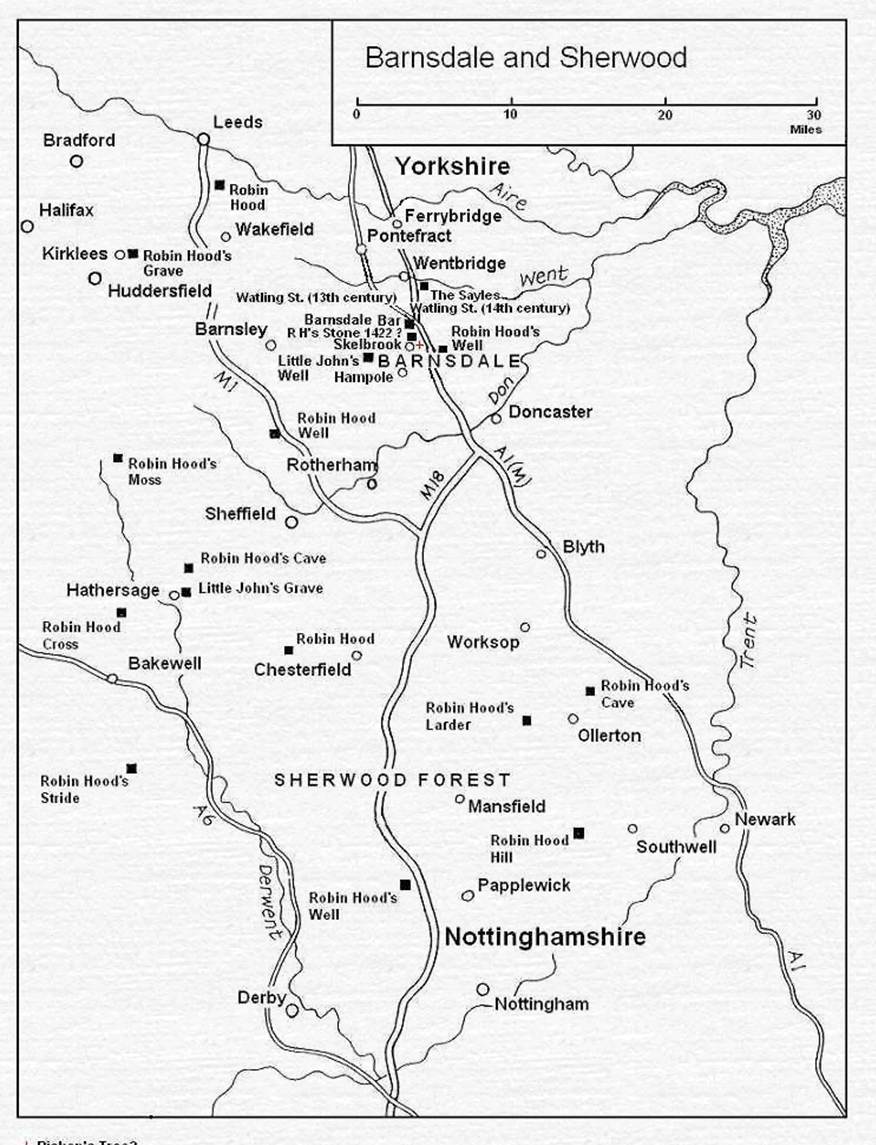
Indeed a fifteenth century ballad A Gest of Robyn Hode suggests that Robin Hood built a chapel in Barnsdale that he dedicated to Mary Magdalene - ‘I
made a chapel in Bernysdale, That seemly is to se, It is of Mary Magdaleyne,
And thereto wolde I be’ and it has been suggested that this was their
wedding place. Given the location of the Church of St Mary Magdalene at
Campsall, it has been strongly suggested that this is the church of Robin Hood
repute, and it was here in 1538, that William Farndell married Mary Atkinson.
If Robin Hood was a legend, might it not be that the
fourteenth century ballads which told of his exploits in the twelfth and
thirteenth century days of Richard I and King John, might have been strongly
influenced by the tales of our own Farndale ancestors in the forest of
Pickering, outmanoeuvring the sheriffs of Yorkshire? There have been many
suggestions that the legend of Robin Hood may have its real roots in Yorkshire.
Whilst
the records have not allowed me to put beyond doubt a link between the
Doncaster Farndales, and the family who lived predominantly in Cleveland, to
the north of the North York Moors, who are the undoubted ancestors of modern
Farndales, the evidence strongly points to that being so. If it is, then this
provides modern Farndales with a direct ancestral linkage to Sir William
Farndale, Vicar of Doncaster, and thence to the Farndales of Sheriff Hutton and
York and the emigrants from Farndale the place, who we have already met.
Arrival in Cleveland
Parish records began to be kept, by
the orders of Thomas Cromwell, in 1538. From that date, we benefit from records
which allow us to follow family relationships with certainty. And so it is that
we are able to identify with certainty that Nicholas farndaile was buried in the parish of Kirkleatham, in
Cleveland, five miles to the west of Skelton on 6 August 1572.

We
also know that an Agnes
Farndale was buried at Kirkleatham on 23 January 1586.
That is all that we know about Agnes. It has therefore been assumed that Agnes
was Nicholas’ wife. Perhaps they married in about 1537. These are carefully
considered guesses, and on a balance of probabilities, they are likely to be
about right.
Nicholas
and Agnes may well be the paternal and maternal grandparents of
all modern Farndales.
We
also know that a Jean
Farndale married Richard Fairley, a relatively
pedigreed fellow, in Kirkleatham on 16 October 1567. It seems probable that
Jean was the daughter of Nicholas and Agnes.
And
then there was a William
Farndale who died on 24 January 1606 and was buried
the next day at St John the Baptist Church in Skelton, five miles east of
Kirkleatham. Because there are not many Farndale candidates about at that time,
it seems pretty likely that William was the son of Nicholas and Agnes. Since we
have already identified that a William Farndale married Margaret Atkinson in
Campsall, near Doncaster in 1564, we have concluded that this is the same
person. Of course we can’t be sure about that. However it helps us to make sense
of the records. It seems quite likely.
We
don’t find any evidence of Farndales in Cleveland before 1572. After 1572, we
find almost all Farndales, and all Farndales who are ancestors of the Kilton
lines from which I and most others descend, in Cleveland. So we have to explain
how the Farndales who had become concentrated solely south of the North York
Moors before 1572, came to move into Cleveland, such that they were
predominantly clustered north of the North York Moors after 1572.
On a
balance of probabilities, whilst acknowledging the difficulty in putting this
beyond doubt, we might surmise that:
· Nicholas
and Agnes Farndale, who both died in Kirkleatham, were born in Campsall or
thereabouts, around Doncaster, perhaps in about 1512 and 1516 respectively. If
so, they were likely descended from William Farndale, the Vicar of Doncaster,
or at least from his wider family (his brother perhaps).
· William
Farndale junior was born in say 1538, and Jean Farndale in say 1540 to Nicholas
and Agnes.
· William
Farndale married Mary Atkinson at the Church of St Mary Magdalene in Campsall
in 1564.
· Between
1564 and 1567, the family moved to Kirkleatham. We don’t know why. Maybe that
was Agnes’ ancestral home. Perhaps more likely Jean had met Richard Fairly, a
relatively well established fellow, whose family were Scottish, but who had
more recently become associated with Cleveland and Kirkleatham. Perhaps the
family saw opportunities by a move north.
· On 16
October 1567, Jean married Richard Fairley in Kirkleatham.
· The
family lived generally at Kirkleatham until Nicholas and Anne’s death in 1572
and 1586, though William had by then realigned slightly eastward, to Skelton.
So
this allows us to draw up a family tree for the Doncaster-Kirkleatham-Skelton Line of
Farndales.
George
Farndale was the second sibling of four, and in all
probability was the son of William and Margaret (nee Atkinson). George is the
first of our direct ancestors, about whose life we can confidently record. He
seems to have moved to Moorsholm,
about three miles from Skelton, by 1592. He married Margery Nelson in 1595.
They had five children, one of whom was another George
Farndaile, born in 1602. George had four children, and
the second was Nicholas
Farndale. Nicholas was baptised on 6 July 1634 and
married Elizabeth in about 1660, with whom he had four children. He paid a
hearth tax for one hearth at Liverton in
the 1660s to 1680s. Elizabeth died in 1670 and Nicholas remarried an Elizabeth
Bennison on 23 November 1676. Nicholas died in 1694. Nicholas Farndale is the
founder of the line we have called the Liverton 2 Line.
It is
from this point that the Lines which lead to modern Farndales, start to
diverge,
From Nicholas’ first marriage was born the ancestor of some
other lines of modern Farndales, George
Farndale, whose son William Farndale was
founder of the Kilton 2 Line.
From Nicholas’
second marriage was born my own ancestor, John
Farndale, and founder of the Kilton 1 Line.
Common history of all modern Farndales
Modern Farndales are descendants of the Kilton 1 Line, the Kilton 2 Line, the Ampleforth Line and
a group of the Whitby Farndales.
Subject to some comments about the Ampleforth and Whitby families, that means
that all those whose name is Farndales, or who descend from Farndales, share
the history I have recorded so far, and can:
1. trace
their direct ancestry back to Kirkleatham and the early sixteenth century;
2. almost
certainly trace their ancestry back directly to Doncaster and the early
fourteenth century;
3. trace
their indirect ancestry back to the villeins of Farndale in the early
fourteenth century and those who emigrated out from Farndale;
4. imagine
their further ancestors swirling within the primeval swamp of Bronze Age Beaker
Folk, Iron Age Settlers, Brigantes, Romans, Vikings, Angles and Saxons that had
roamed the moors and Dales of Yorkshire since about 9,000 years BCE; and
5. identify
their geographic routes in the Saxon lands of Chirchebi that would
become Kirkbymoorside and the valley called Farndale where Edmund the Hermit
roamed when those lands first became visible in 1154.
The branching of Lines
From the early seventeenth century,
the family started to diverge. Between the mid sixteenth century and the early
eighteenth century, I have only found Farndales north of the North York moors
in Cleveland. For that reason, I think it likely that the perhaps single family
(the Doncaster-Kirkleatham-Skelton Line) who
we have seen moved into Cleveland in the mid sixteenth century, were the
ancestors to all the family lines who started to diverge to Whitby and around
Cleveland from the early seventeenth century and then some back south of the
North York Moors around Ampleforth in the early eighteen century.
Broadly,
the family started to diverge along four main branch lines, which in time would
further diverge into smaller family lines:
· A
family emerged in Whitby, and
engaged in the maritime life of the port. We can call the larger family the W1
Family, who diverged into the Whitby 1 Line, the Whitby 2 Line and the Whitby 4 Line.
· A
family settled in the village of Kilton and
later diverged across Cleveland, Stockton, Northumberland, and to Wales and
Surrey and to California. We can call the larger family the K2
family.
· Another
family settled in the village of Kilton and
later diverged into the biggest group. This family would expand across
Cleveland, Great Ayton, Whitby,
Bishop Auckland, Richmond, Thirsk, Tidkinhow on
the moors, Wensleydale and to London, Wales, Bradford, Wakefield, Holderness, Jarrow, and to Ontario, Newfoundland and Alberta in
Canada, USA, Australia and New Zealand. We
can call the larger family the K1 family.
· A
family emerged around Coxwold and Ampleforth in the early eighteenth century
and later diverged to the wider area around York, including Malton and Huttons
Ambo, and to Thornaby, Stockton, Bradford, Leeds, Cheshire, Norwich, and to USA
and New Zealand. The hub of this family is the Ampleforth 1 Line. We
can call the larger family the A1 family.
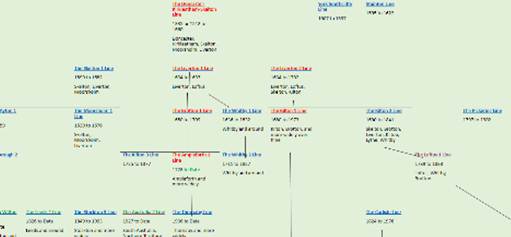
The divergence of these families can be seen in the second family Timeline,
and the different main families can be differentiated by the tags A1, K1, K2, and W1.
The divergence of the whole family can
be seen in 88 family
lines into which this genealogy has divided the
wider family The family lines can be navigated like an underground railway map
and you can change lines to trace your own history or that of a particular
family. There is an interface chart which acts like a general underground map.
Martin Farndale had originally ordered
the family in a chronological list by date of birth, which he called the Farndale Directory.
This directory also provides a means to navigate the family, particularly if
you want to start by finding an individual (or maybe yourself), from which to
explore the ancestry. As a rule the research only provides the most basic
information about living Farndales; generally year of birth and link to direct
ancestors, so that there is enough to link in to and explore the historical
ancestry. The website is intended only to provide a ‘way in’ for living
Farndales to the historical research. The detail starts with our forebears, no
longer with us.
Each
individual member of the family has his or her own webpage. As well as a
historical record, this also provides a remembrance for each member of our
family beyond a stone monument. The research tries to tell as full a story as
is possible of every Farndale.
So
from this point, the Farndale family remains related, but the family’s stories
diverge. Yet we are all very likely the ancestral descendants of Nicholas and
Agnes, and perhaps of William, the vicar of Doncaster. So the historical record
which now follows tells the extraordinary story of multiple adventures and
achievements of a significant body of folk who followed their own distinct
paths. Wouldn’t Nicholas and Agnes (and perhaps Sir William of Doncaster) be
proud, if only we could share these following stories with them?
From this point the second Farndale Timeline for the modern period from 1600 to
the present day, accompanies this introduction.
The Whitby Farndales
On 19 November 1661, John Farndale of Whitby married Alice Peckock at Whitby
Parish Church. Whilst I have not traced his parents, it seems very
probable that he descended from the Farndales of Cleveland who we have already
met, and that this was a family who moved naturally from the Cleveland
countryside to the port town of Whitby.
So it is very likely that this Whitby family were descended from the Cleveland
Farndales who we have already met.
John and Alice are the Founders of the Whitby 1 Line, from which the Whitby 2 Line and the Whitby 4 Line descend.
|
|
1636 to 1832 Whitby and around |
|
|||
|
|
1711 to 1827 Whitby and around |
|
|||
|
|
1773 to 1938 Whitby and around |
|
|||
Those Farndales who are descendants of the Whitby 1, 2 and 4 Lines,
can be identified in the timeline by the annotation W1. This maritime family
included:
·
Giles Farndale (W1), the Whitby 1 Line
was press ganged into the navy in Whitby, at the age of 27 and died at sea on
board HMS Experiment in the Caribbean having almost certainly fought in
the Battle for Cartagena de Indias, during the War of Jenkins’ Ear.
· John Farndale, (W1),
founder of the Whitby 2 Line
was a seaman named in a list of 42 of the crew of The Friendship of Whitby
when James
Cook was Mate (later the famous Captain Cook).
· John
Christopher Farndale the Elder, (W1), the Whitby 4 Line was
Master Mariner of Cragg, Whitby about whom we have extensive records of his mercantile adventures,
who died aged only 37.
·
Robert Farndale, (W1), the Whitby 2 Line was buried at St Mary the
Virgin Churchyard, Whitby, the setting for Bram Stoker’s Dracula, along
with several Whitby Farndales.
·
John Christopher Farndale the
Younger, (W1), the Whitby 4 Line, later a ship’s captain who was
charged for absence as an apprentice, was later involved in many maritime mercantile adventures,
but was lost at sea in the Bay of Biscay in 1868.
·
William Farndale (W1), the Whitby 4 Line was a Master Mariner like his
father and brother with extensive records of his commercial maritime journeys
as Captain of various ships including the William and Nancy.
· This
was a family of mariners at the heart of the maritime coal industry in the mid
Victorian era. The second generation ventured widely around the North Sea
(often called the German sea at the time) and the Baltic and further south.
· John Thomas Farndale, (W1), the Whitby 4 Line was manager of the Thirsk
Branch of the York Union Bank and a free mason. He was a member of the
naturalists society of Thirsk. He was involved with the Church. He was involved
in the cycling club. He was a member of the Thirsk chess club. He was involved
with the National Society for the Prevention of Cruelty to Children. He was
involved with a historic pageant and play.
He continued to take an interest in Whitby, where he exported his
pageant ideas to. He was a member of the National Service League (campaigning
by 1911 to introduce compulsory military training).
The Ampleforth Farndales
Elias Farndale was
born, perhaps around Thirsk, in or about 1733. He married Elizabeth Raper at
Thirsk on 28 February 1753. He is Founder of the Ampleforth 1 Line.
Because I have not yet been able to identify his parents, I cannot directly
link him, and his descendants into the wider family. It is possible he was not
related to the Farndales who arrived in Cleveland by about 1567. However the
fact that I have only found evidence of Farndales in the immediate centuries
after 1567 in Cleveland, means that I think it is highly probable that Elias
(and therefore his descendants) are somehow linked to the families in Cleveland
who we know about in the sixteenth and seventeenth centuries. In other words
Elias is probably descended from the known family above, but we have just not
yet managed to prove that or establish exactly how he links in. There is a
‘missing link’ here, but it is still probable that he is part of the same
family we have met above.
So, Elias is the Founder of the Ampleforth 1
Line which branches into a significant part of the modern
Farndale family (the lines with ** are contemporary lines which still have
family members alive today):
|
|
|
|
1728 to Date Ampleforth and more widely |
|
|
|
|
1788 to Date Bishop Wilton and more widely |
1826 to Date Leeds and around |
1849 to 1993 Stockton and more widely |
1927 to Date South Australia, Northern Territory |
1936 to Date Thornaby and more widely |
|
|
|
1875 to 1948 Wetherby, York, Northallerton |
1910 to Date Bradford and around |
1870 to 1933 Norwich and area, and New Zealand |
1911 to Date New Zealand |
1912 to 1945 Uxbridge and area |
|
|
Those Farndales who are descendants of the Ampleforth 1 Line
can be identified in the timeline by the annotation A1. This
family included:
·
William Farndale (A1), the
Ampleforth 1 Line the sub post master at Huttons Ambo, near
Malton, saved a child from drowning in the river at Huttons Ambo.
·
Herbert Arthur Farndale (A1), the Norwich Line was a mustard packer in Norwich.
· Private William Farndale (A1), the Ampleforth 1 Line
who joined the Royal Army Medical Corps and later the Lancashire Volunteers.
Later, he was an agent for Prudential Assurance by 1939.
·
Private James Farndale, (A1), the Ampleforth 1 Line
who joined the 1st Devonshire Regiment and later the Wiltshire
Regiment in 1914. He served in Egypt in 1915. Reminiscent of the War Horse
play, he worked in animal husbandry in both World Wars and tended horses in WW1
and his War Service years were 31 August 1914 to 10 March 1919 and then from
1939 to 1941.
· Lance Corporal George Weighill Farndale, (A1), the Bishop Wilton Line
joined the West Yorkshire Regiment and was an
infantryman in the first world war. He was killed in action at Arras during the
Third Battle of the Scarpe. He had also served in Egypt in 1915.
· Lance Corporal Herbert Arthur Farndale (A1), the Norwich Line, of the Norfolk Yeomanry,
the Northamptonshire Regiment and later the Royal Berkshire Regiment, was
wounded in October 1917.
· By
1917 James Arthur Farndale, (A1), the Bishop Wilton Line,
was a drawing foreman at the Saltaire Mills at Shipley now in north
Bradford. Due to the importance of his work, he was excused military duties at
consecutive military tribunal hearings. James became a dominant person in the
Saltaire community. He was later manager of the drawing room until he retired
in 1942. He was a keen cricketer and a life member of the Saltaire cricket
club, voluntarily tending its ground for five seasons. He died in 1952 on a bus
returning from a football match. The Saltaire Mills
were a Victorian ‘model village’ in Shipley to the north of Bradford. The site
is now a World Heritage Site. James Arthur Farndale, and his
descendants (see the
Bradford 2 Line) were influential in its history.
· By
1921, John W Farndale, (A1), the Bishop Wilton Line
was a gardener for Lord Allerton at the Firs, Wetherby. His daughter
with his first wife Annie Thomspon, Lily Farndale had been tragically killed
when playing ball in 1933. His second
wife Jane Wade aroused the neighbourhood when there was a fire at the village
smithy at Walton in 1952. John is the Founder of the Wetherby 1 Line.
· By
1934, Wilfred Farndale,
(A1), the Bishop Wilton Line,
was the Sanitary Inspector for Shipley. Quiet and unassuming, and a successful
cricketer in the Shipley team, he was a very popular member of the community.
He gave lectures and wrote about his work, which is all recorded on his
webpage. He was also elected President of the Shipley Branch of the National
and Local Government Association and President of the Shipley Rotary Club. He
married Kathleen Dawson. Wilfred is the Founder of the Bradford 2 Line.
·
Private James Farndale, (A1), of the Stockton 3 Line, of the West Yorkshire
Regiment, died of wounds on 16 March 1941 in Eritrea. James is buried at Keren
War Cemetery.
The Kilton 2 Farndales
Of the routes we can be certain about, William Farndale was founder of the Kilton 2 Line. The Kilton 2 Line branches into a segment of the
modern Farndale family, of which several lines (denoted by **) still have
family members alive today.
|
|
|
|
1690 to 1841 Skelton, Brotton, Liverton, Kilton, Lythe, Whitby |
|
|
|
|
|
|
1739 to 1833 Loftus, Whitby, Brotton |
|
|
Those Farndales who are descendants of the Kilton 2 Line
can be identified in the timeline by the annotation K2.
This Kilton family included:
· William Farndale (K2), the founder of the Loftus 1 Line was elected and sworn as a
constable for Loftus in 1781.
· William Leng Farndale (K2), of the Stockton 1 Line became a Sergeant in the Northumberland Hussars by
1902. That Regiment served in the Boer War, so he may have served there.
· George William Farndale (K2) of the Loftus 2 Line enlisted on 10 December 1915
and became a clerk in the Army Pay Corps at Blackheath. After the Great War,
her was a shipping clerk with George Alder Limited in Middlesbrough.
· Sergeant Bernard Farndale (K2), 115th Squadron RAF, was killed in action over
Denmark on 30 August 1944. On the night before 30 August 1944 nearly 600 RAF
bombers flew over Denmark on bombing raids to Königsberg and Stettin.
Particularly the planes for Stettin were attacked by German night fighters,
when they were passing the northern part of Jutland and the Kattegat. Avro
Lancaster Bomber LAN ME718 was hit and flew for a moment through the air before
it crashed like a burning torch at Oue (about 400 m west of Rinddalsvej in
Denmark). All of the bomb load exploded on impact. All of the crew were killed.
The Germans did not want to collect the bodies and left them in the field. The
locals were appalled by this behaviour and collected the remains in wickerwork
baskets. The Wehrmacht ordered the Danes to hand the baskets over, and these
were thrown in the crater at the crash site and covered. When the Germans had
left the area, the locals together with members of the Civil Air Defence opened
the crater and placed the remains in a coffin which was driven to Oue church. A
memorial still stands to the dead airmen at Oue.
·
John Alan Farndale, the American 3 Line (K2) saw
service during the Korean War in the Royal Air Force.
The Kilton 1 Farndales
The other certain path to family Lines of the modern family derive
from John Farndale, the founder of the
Kilton 1 Line.
John Farndale son of Nicholas Farndale, of the Liverton 2 Line (which Line preceded both K1 and K2),
married Elizabeth Bennison at Brotton on 5 February 1705. By then he was living
in Kilton and was one of the first members of the family, with his brother George Farndale (founder of the Kilton 2 Line), to live in Kilton.
John and Elizabeth were the founders of the Kilton 1 Line,
a core hub for the development of the history of the wider family.
The Kilton 1 Line branches into a very significant part
of the modern Farndale family:
See the
Interface Chart.
Those Farndales who are descendants of the Kilton 1 Line,
can be identified by the annotation K1 in the timeline. This is by far the largest hub of the family
and included:
· Johnny Farndale (“Old Farndale
of Kilton”), (K1), the Kilton 1 Line had moved to How Hill Farm on the Wharton
Estate at Kilton,
a farmer and a merchant who was involved in the alum trade and later told tales
of smugglers at Cat Nab at Old Saltburn.
· Wiliam Farndale, (K1), the Kilton 1 Line, a farmer and merchant of
Kilton like his father, who pulled down Kilton Lodge to build his new home, and
imported rods, coals and bacon at Cat Nab from sloops out to sea.
· John Farndale, (K1), the Kilton 1 Line, saved by his buckle from
tumbling down a well, an author of many books about Kilton and the
wider area, narrator of Victorian innovation, poet after the Battle of
Waterloo, an agent, and the subject of many great stories.
· Matthew Farndale (K1), the Kilton 1 Line, with his wife Hannah, his
daughter Mary Ann Martin and her new husband William Martin, and their youngest
daughter Elizabeth Farndale, left Liverpool on the Argo, bound for
Melbourne, Australia. The voyage took 103 days or just over 14 weeks. Thus started the Australia 1 Line. You can read more about the Australian Farndales and about the Martin family.
· John George Farndale, (K1), the Kilton 1 Line, took part in the Crimean War and there are
letters from him from Sebastopol on his web page. He served in the 28th of
Foot, a Yorkshire Regiment and may have transferred to that Regiment from the
Coldstream Guards. His descriptive letters show that he took part in the
battles of Alma, Balaclava and Inkerman and was at the Siege of Sebastopol. He
later emigrated to Canada. There is an unsubstantiated story that he went to
Australia first. He is the Founder of the Ontario 1 Line.
· William Masterman Farndale,(K1), the Kilton 1 Line was an officer of HM Customs, a tide waiter at
Cleveland port who discovered a fire on the ship Hydrus in Middlesbrough
and caused the fire to be extinguished to save the vessel, though the captain was
found ‘burnt to a cinder’ in his cabin.
· John Henry Farndale, (K1) the Great Ayton 3 Line, was killed by a fall or
ironstone at the Poston Mines,
Ormesby.
· Martin Farndale, (K1), the Kilton 1 Line, farmed 600 acres at Kilton Hall
Farm with 16 employees.
·
Charles Farndale (K1), the Kilton 1 Line took over Kilton from Martin Farndale, his
uncle, since Martin had no children of his own. Charles
was a farmer at Kilton of 207 acres by 1851, with 9 employees, and later 577
acres. He was a methodist: “For very many years services have been held in
the spacious farm kitchen of Mr C Farndale, Kilton Lodge, which was also that
of his father before him. Methodism in the neighbourhood, and the cause of
righteousness generally, owes much to the high Christian character and active
interest in all good works displayed by this devoted Methodist family.”
· Joseph Farndale the Older, (K1), the Whitby 5 Line was Chief Constable of
Birmingham City Police and involved in the Fenian Dynamite Conspiracy with a
peak of activity in 1883. An article in the Birmingham Daily Post on 18 April
1942, suggests that the British habit of forming an orderly queue was down to
Joseph.
· Joseph Farndale CBE KPM, nephew
of Joseph the Elder, (K1), the Wakefield 1 Line
became Chief Constable of Bradford City Police Force. Joseph was
involved in a new system for using fingerprints in 1903; a campaign to supress
scurrilous picture postcards in 1904; meeting the Prince and Princess of Wales
in 1904; the earliest use of a speed trap in 1905; the prohibition of the
shocking ‘posings’ of the actress Pansy Montague, ‘La Milo’ in Bradford in
1907; managing strikes and street violence in Bradford in 1913; dealing with an
epidemic of ‘bad language’ by children in Bradford in 1914; enforcing the
control of the possession of homing pigeons in Bradford during World War 1
under the Defence of the Realm Act 1914 and in enforcing the Aliens Restriction
(Change of Name) Order 1914; welcoming
Belgian refugees in Bradford in 1914; making arrangements for public house
licencing during World War 1; a parade exhibiting a captured 77mm German field
gun lost at the Battle of Loos, in 1915; meeting the King and Queen in Shipley
in 1918; and managing street congestion in 1924. Joseph was the inventor of the
Police Box in 1929 in Bradford. He proposed the use of miniature police
stations, kiosk shaped and equipped with a telephone, desk and red warning
light to provide a police service at a hundred points in the City, instead of
the present twelve points. So but for Joseph Farndale, Dr Who would not
have had his tardis.
· William Farndale, (K1), the Whitby 5 Line an ironstone miner
in Loftus,
and founder of the Loftus 3 Line, witnessed the death of
his colleague, Henry Durham, in the Loftus mines.
· Samuel Farndale, (K1), the Wakefield 1 Line,
and brother of Joseph Farndale the Younger, later the
Chief Constable of Bradford, was a humourist (the ‘comedian’ of the family)
appearing at soirees in Wakefield
in 1889.
· Samuel (Kirk) Farndale, (K1), the Loftus 3 Line, travelled from Liverpool to Quebec on SS
Sardinian. He settled in Oshawa, Ontario. He became a farmer at Brooklin,
Pickering, Ontario. The locality in Ontario was clearly settled from his
compatriots from the same area, since the towns there bore names like Pickering
and Whitby Township. Kirk and his wife Mary were founders of the Ontario 2 Line.
· John William Farndale MRCS Eng, LRCP Lond, (K1), the Whitby 5 Line was registered as a medical
practitioner and worked in Ba in the Fiji Islands in 1901.
· John Martin Farndale, (K1), the Loftus 2 Line, who had lived at Loftus and was
a grocery store manager at Guisborough married Bessie Stainthorpe
and they went to Newfoundland just after they were
married. John was a grocery store manager in St John’s, Newfoundland. John and
Bessie were founders of the Newfoundland Line.
· James Farndale (A1), the Stockton 3 Line was a Druid in Stockton in 1909. He worked in Stockton in the iron and
steam engine works.
· James (“Jim”) Farndale, (K1), the Tidkinhow Line, went to Canada in 1911, the year before the
Titanic Sank. There is a transcript of Jim’s
diary recording his emigration to Canada. In 1911 James
arrived to stay with Martin Farndale in Alberta. He did not stay
long in Canada before he went to America for the rest of his life. He was
involved with the Carpenter’s Union on the Boulder dam project and later was
elected a Senator for Nevada. He was a great man of American politics.
·
George William Farndale, (K1), the Coatham Line, who had been a road labourer and plumber in Coatham, emigrated to
USA. He married Frances Hilton in New York of Chicago in about 1915, but she
died from swine flu in 1918. He saw service in the First World War. He later
married Rose Cunningham in Clinton, Iowa in 1921. He became a naturalised
citizen of USA on 16 May 1934. George founded the American 2 Line. George was later a teacher in vocational
education in Milwaukie, Wisconsin.
· John George Farndale, (K1), the Hartlepool 1 Line was
Treasurer of the Royal Antediluvian Order of Buffaloes (“the Buffs”) in
Hartlepool.
·
As President of the Primitive Methodist
Conference in 1947 Rev Dr William Edward
Farndale, (K1), the Whitby 5 Line, and founder of the William Line, sounded the Call of the Countryside and
launched a “Back to the Soil” campaign.
· Florence
Farndale, wife of Rev Dr William Edward Farndale, (K1), the Whitby 5 Line was President of the North
Eastern Federation of Suffragettes. She campaigned for ‘why women need the
vote’. She was later very involved with the British Women’s Total
Abstinence Union.
· Lieutenant Graham Price, a
World War 1 Flying Ace, the younger brother of Florence Farndale, wife of Rev Dr William Edward
Farndale, (K1), the Whitby 5 Line was killed in action over the east coast of
Scotland in a duel with a German aeroplane at 8,000 feet.
· Corporal William Farndale, (K1) the Great Ayton 3
Line enlisted
at Stokesley into the Yorkshire Regiment on 12 October 1914 and arrived in
France on 27 August 1915. In a letter home in October 1915, he joked that since
he was in France, he had the Germans on the run. He served in France and Italy
and came home on leave in August 1918. He was 5 feet and 7.5 inches tall. He
was discharged in December 1920 with a 30% disablement from the War.
· Herbert Farndale, (K1), the Craggs Line was enlisted into 2/4th
Battalion, Alexandra, Princess of Wales’s Own (Yorkshire Regiment) and
undertook training. He was 23, a farmer, 5 feet
and 6.5 inches tall and weight 140 lbs, of good physical development. Later
Sergeant Herbert Farndale, 10th Battalion The Yorkshire Regiment and later the
2nd Battalion the West Yorkshire Regiment, was awarded the Military Medal for
gallantry and the British War Medal and the Victory Medal. His Military Medal for bravery arose for
service from 11 August 1915 to 30 June 1916 and particularly on 1 July 1916,
with the Expeditionary Force in France. He was commissioned in 1918. Herbert
later lived at Craggs Hall Farm and on 3 September 1940 the farmhouse received
a direct hit by a German bomb. The house was rebuilt. Herbert was an
independent Councillor, a member of Skelton and Brotton urban council.


· Alfred Farndale (K1), the Tidkinhow Line, and founder of the Wensleydale Line, enlisted into the Machine
Gun Corps. He served in France, Mesopotamia (Iraq) and India. He served at
Ypres. He and Quartermaster Sergeant Zaccarelli had been galloping up to the
Front with an ammunition limber when the Germans started to shell them. Zaccarelli
was killed, along with a horse. Alfred managed to cut the dead horse free, drag
Zaccarelli’s body into a ditch and carry on up to the Front on one horse with
his delivery of ammunition. Alfred later emigrated to Alberta and they settled
at Huxley and built their house there. They returned to Yorkshire after the
Great Depression and the family farmed in Wensleydale.
· Private (John) Richard Farndale, (K1), the Coatham Line, died at 21st
Casualty Clearing Station at La Neuville of pneumonia. He enlisted at Redcar,
and joined the 1/4th (TA) Battalion of the Princess of Wales’ Own Yorkshire
Regiment, also known as the Green Howards. At the time of his death the
battalion was not in the line but in reserve at Proyart. On 31 Dec 1916 it was
at Bazentin le Petit and in reserve at Flers on 7 Jan 1917. On 11 Jan the
battalion moved to the front line at ‘Hexham Road.’ It was again in the front
line from 30 Jan to 11 Feb at Genercourt. The battalion moved to Proyart on 19
Feb 1917. Richard was awarded the British War Medal and the Victory Medal
posthumously on 21 Jan 1921. He was presumably badly wounded at Hexham Road or
Genercourt or Proyart and evacuated to No 21 Casualty Clearing Station at La
Neuville, where he later died of pneumonia.
· Private George Farndale, (K1), the Whitby 5 Line, was killed in action on 27 May 1917, during the Battle of
Arras, barely a month after arriving in France. He was serving with the 1st/9th
(Territorial Glasgow Highlanders) Battalion of the Highland Light Infantry in
100th Infantry Brigade of 33rd Infantry Division in operations against the
Hindenburg Line. He was 26 years old. On his web-page, you will find extensive
correspondence and records about his service and correspondence.
·
William
Farndale, (K1), the Tidkinhow Line had arrived in Canada in 1913, and he went to Early Grey
in Saskatchewan where he was a butcher. He then served in the Canadian Army in WW1 and was wounded in action at Vimy Ridge on 13
December 1916. Still weakened from his wounds, he died of the flu epidemic
shortly after the War ended, having insisted on transporting patients with flu
to hospital.
· James (“Jim”) Farndale had
enlisted into the US Army on 31 August 1917 and he served in France until 1918.
He was discharged on 1 August 1919. His younger brother, William Farndale, had enlisted into the
Canadian army. His youngest brother, Alfred Farndale, had enlisted into the
British Army. So three brothers served in the British, US and Canadian
army.
· Private Robert Farndale, (K1) the Hartlepool 1 Line
was in the King’s Own Yorkshire Light Infantry. He was wounded in 1917
and later joined the Labour Corps. He was admitted to the Fourth Stationary
Hospital and discharged on 15 April 1918.
· Henry Farndale (K1), the Wakefield 1 Line
was a Regimental Quarter Master Sergeant in the Royal Field Artillery who was
gassed in November 1917. Before the War he was a solicitor’s clerk and
engineer’s draughtsman. In 1920 the Army proposed that he transfer to the Corps
of Military Accountants, but he discharged from the army in Woolwich that year.
· Gunner John William Farndale (K1), the Wakefield 1 Line was
severely wounded by a gas shell explosion and was admitted to a field hospital
in Rouen in 1918 and then to the General Hospital at Leicester. He was later a
leather salesman and founded
the Leicester 1 Line.
· Albert Farndale, (K1), the Kilton 1 Line was an architect who tragically shot himself at
Kilton in December 1918.
· Mark Farndale, (K1), the Ontario 1 Line,
a farmer who had married Mary Wiltse in Ontario in 1908, died from the flu
epidemic on 29 November 1918.
· George William Farndale (K1), the Great Ayton 2 Line,
became a well known comic actor. There are extensive records of his
performances on his web page. He regularly performed with the Yorkshire Mummers
and sang comic songs.
· Grace Farndale (K1), the Tidkinhow Line, was assistant matron at the Towers Boarding School for Girls at Saltburn
by the Sea. Grace was later a matron at Malvern and then emigrated to Alberta
where she and her husband Howard Holmes had a ranch.
· William Farndale, (K1), the Craggs Line moved to Plane Tree Farm at
Maunby, Thirsk where William and Mary farmed for forty years. They were
founders of the Thirsk Line. William chaired the
Northallerton Branch of the National Farmers Union and had an active role in
negotiations during the Second World War to get the most from the land.
· John Joseph Farndale, (K1), the Great Ayton 2 Line, was a joiner and part of
the Ayton cricket team.
· John William Farndale, (K1), the South Shields 2 Line was the youngest member of
the 185 men who set off on the Jarrow marches in 1936.
· Audrey Celina McKelvie (nee
Farndale), (K1), the Ontario 1 Line was a
comptometer operator with the Hudson Bay Company.
· Thomas Henry Farndale, (K1), the London 1 Line was a detective sergeant, later
an Inspector, a real life ‘Foyle’s War’, who solved crimes during the Second
World War in Surrey. He was involved investigating a serious crime involving
the murder of a maid by three soldiers. He continued to solve crimes until he
retired in 1955. His experiences were well recorded in the media and in a
record of his service in the Surrey Mirror on 4 November 1955. After he retired
from the police, he was a licensee of the Plough Inn at Dormansland and later
President of the Caterham Licensed Victuallers Association.
· Wilfred (or “Wilf”) Farndale, (A1), the Stockton 3 Line
lived at Filton, near Bristol, with his wife Doris Eveyln nee Howard. Wilf later worked with the Bristol Aircraft
Company making aircraft jigs, the framework on which aircraft were built. He
was involved with the Brabazon, Britannia and early stage of Concorde designs.
He was a football referee. The family then emigrated to New Zealand and founded
the New Zealand 2 Line.
· Private
Richard (“Dick”) Farndale, (K1), the American 2 Line attested into the army on
28 March 1941 at Chicago, Illinois and served in the US Army during World War
II, spending more than four years in the Pacific theatre of Operation. He was a
mechanic with the 43rd Division.
· Hazel Jane Farndale (“Janie”), (K1), the American 1 Line married John Elif Rydell.
John was a Master Sergeant in the US Air Force during WW2 and Korea. Janey
later lived in Austin, Texas and was a regular visitor to the family in
Yorkshire.
· Ronald Martin Farndale, (K1), the Wakefield 1 Line had emigrated to New
Zealand and served in 6th Field Ambulance, Royal Army Medical Corps
in Greece and Crete, before he was captured at the Battle of Sidi Rezegh in
1941 and became a Prisoner of War. He later became a builder and carpenter in
Masterton, near Auckland, New Zealand and founded the New Zealand 1 Line.
· Sergeant William Derrick Farndale, (K1), the Whitby 5 Line was a patrol member in the
Withernsea Patrol on the East Yorkshire Coast from 1942 until 3 December 1944.
· Jimmy Farndale, (K1), the American 1 Line enlisted into the US Army
on 15 December 1942 and served in the US Army Air Corps. In 1952 he flew around
the world visiting all continents by plane.
· Raymond W S Farndale, (K1), the Newfoundland Line served in 59th
(Newfoundland) Heavy Regiment Royal Artillery and was commissioned into the
Royal Artillery in September 1943. The regiment trained in Northumberland but
by July1944 it was at Worthing in Sussex. It went to France and took part in
the battles for Caen. By VE-Day it was at Hamburg. Lieutenant RWS Farndale RA
went back to Canada in September 1945 with the Defence Medal, the 1939-45 Star
and War Medal with a Mention in Dispatches. He joined 166th (Newfoundland)
Field Regiment RCA (Reserve) and was with them until 1954, retiring as a Major,
earning the Canadian Forces decoration (CD). He became an accountant and lived
at St Johns, Corner Brook, Toronto and Halifax.
· On 11
May 1945, only three days after VE day, Henry Stewart Farndale (K1), the Wakefield 1 Line
died as a pilot in training in a Tiger Moth over Leeds.
· General
Sir Martin Farndale KCB (K1), the Wensleydale Line joined the Indian Army on 3 September 1946,
transferred to the British Army in 1947 and went to the Royal Military Academy
Sandhurst where he was commissioned into the Royal Artillery. He served in
Egypt, Germany, Malaya, South Arabia, Ireland. He commanded The Chestnut Troop,
1st Regiment RHA, 7th Armoured Brigade, 2nd Armoured Division, 1st British
Corps and Northern Army Group. He became Commander-in-Chief British Army of the
Rhine and Master Gunner St James’s Park. He was awarded General Service Medal with
clasps for Malaya, South Arabia and Northern Ireland, the Silver Jubilee Medal
in 1977, and was made a Commander of the Order of the Bath in 1980 and Knight
Commander of the Order of the Bath in 1983. He was awarded the 125th
Anniversary of Canada Medal for services to Canada and an Honorary Degree of
Literature at Greenwich University.
· Major
William Arthur James Farndale, (K1), the William Line was called to the bar by the
Middle Temple. He was later a Chairman of the Governors of Dovedale Manor
School in Camberwell. He regularly gave lectures and became involved later in
residential care.
The diverse
experiences of the family can be seen with more detail in the second timeline, and by delving
deeper into the website. The website records the many achievements, struggles,
lives and relationships within our family over the centuries. Some have enjoyed
full lives and collectively the descendants of the medieval and early Farndales
such as Nicholas have a rich history of
accomplishment. Others have struggled, such as those who moved from the country
to settle in the town of Whitby, some depending on Poor Law
support. Some died very young, or at birth. Each has his or her own page, so
that each member of our family is recorded for their life and role in society.
The intention is that every historic Farndale will have a place on this
website. Although in the Twenty First Century, the family has diverse and broad
interests, we can perhaps summarise the historic Farndales, as farmers, pioneers
and soldiers, with many also taking to the sea, working
in ironstone mines in Cleveland and in many other
occupations.
Social Historical Context
Whilst ancestor hunters might secretly like to search for their
aristocratic forebears, what we find is the privilege of something much richer,
of ordinary folk, the engine room of British society and their stories. What we
find are stories of endeavours, ordeals, passion, adventure, pioneering, and
real life The rich history of this single family, stretching through British
history from the Norman Conquest, through the age of rural serfdom, the Black
Death and the emergence of a more powerful workforce, associations with the
legend of Robin Hood, centuries of rural life, the industrial revolution and
rapid social change, into the horrors of the First and Second World Wars, and
the era of the Cold War, provides a direct historical perspective of social change
over twelve centuries of British history.
A note on research methods
Parish records were introduced in England by Thomas Cromwell, the
lawyer and Chief Minister to Henry VIII (and well known to us through the
historical novels of Hilary Mantel) on 5 September 1538. After 1538, family
historians are able to rely on extensive records of births, marriages and
deaths, which provide a framework upon which to build accurate genealogies. So
from that date it is generally possible to compile factually accurate family
history. The practical date for the availability of parish records is generally
taken to be the start of the reign of Elizabeth I in 1558.
Before 1538/1558, the genealogist’s task is much harder. Extensive
records still exist back to the Norman Conquest and the Domesday book. However
gaps in evidence are inevitable. Nevertheless, with a unique locative surname
like Farndale, it is still possible to navigate these more difficult sources
and build up an impressive history.
Martin Farndale, Richard’s
father, began his research into the family’s history in 1956. Before the age of
computers and databases, he travelled around north Yorkshire, taking hand notes
from Parish records, and compiling extensive card indexes, and achieved a
remarkable history of the family, and had already identified the heart of the
history back to the Norman Conquest. That Martin was the commander of the
Northern Army Group of NATO (the north half of NATO’s defensive line) at the
heart of the Cold War and wrote the history of the Royal Artillery along with
an exhausting portfolio of other interests and still found time to undertake
this family research is remarkable. He died in 2000.
Richard Farndale, his son and the
author of this website, took the baton from Martin in 2000. The Data Age
blossomed from 2000, so that records could be analysed and compiled
electronically and over time national databases of historical material became
more easily available so that searches could be undertaken with exponential
efficiency compared to what was possible in the second half of the twentieth
century. After a decade as an artillery officer, Richard spent a quarter
century as a lawyer, and dispute resolution and the assessment of evidence were
the heart of Richard’s professional career. That has helped Richard to work
through the previous research, build on it, but also assess it evidentially and
work on the robustness of the historical record.
A lawyer generally recognises two standards of evidence. The
standard used in criminal cases is ‘beyond reasonable doubt’, that is that
facts are as near to certain as can be. The standard used in civil cases is ‘on
a balance of probabilities’, that is ‘more likely than not’ or about 50%
likely.
The research has tended to adopt the principle that for the post
1538 history of the family, there is no reason why the history cannot be
built up to meet the higher test, beyond reasonable doubt. So the record is
built on recorded facts, and there are generally no, or very few gaps, where
guesses have to be made.
A litigator also understands the importance of contemporaneous
evidence over retrospective evidence. In building up a factual narrative, it is
always sounder to base the work on the direct evidence that was recorded at the
time.
The approach to our history before 1538 has been, so far as
possible, to build the framework of events to the same standard, beyond
reasonable doubt. In other words the primary focus has been to find physical
evidence from the recorded history, to provide a certain record of events.
However the absence of comprehensive family records means that it is impossible
to identify every individual and core fact, so gaps in our history are
inevitable. Where there are gaps, and only where there are gaps, it is therefore
necessary to use common sense, logic, geographical associations, family
clusters and other clues, to make a best guess at the true circumstances and
family relationships. In general, where such an approach has been necessary,
the research has tried to apply the legal test of ‘more likely than not’, or
the ‘balance of probabilities’.
Where the work is based on records, applying the test of beyond
reasonable doubt, the history is almost certainly correct, the risk
lying in the accuracy of the contemporary evidence itself.
Where, in our pre 1538 history, it has been necessary to fill the
gaps with an application of logic, then the history is ‘more likely than not’.
It could be wrong and contrary evidence might take us down a different route in
the future. But it is the best analysis that is possible based upon the
evidence that has been reviewed to date.
There are some detailed
research notes, which cover the sources of research including
the medieval sources in much more detail, and this may be of particular
interest to family and local historians, particularly researching Yorkshire
families.
Farndale women – some comments on patrilineal lineage, descendants
with other names, and the importance of women in our history, despite the poor
historical records
We
should not blame the patrilineal system of our lineage for this. As a former
anthropologist, I know that the passage of a name through the male line is not
the only solution, and many societies particularly in West Africa have adopted
matrilineal systems, and others have adopted multi-lineal systems such as clan
systems. However the system adopted throughout Europe is a patrilineal one.
What is important to a family historian is that there is structure, and the
patrilineal nature of ancestry provides a structure which allows us to peer
deep into our history. Whilst theoretically possible to explore every diverging
family line backwards through time, that would be impracticable. The unique
locative nature of the Farndale name provides a beacon, which we can follow
through time, to find our history. It doesn’t matter whether we still bear the
Farndale name today, or are descended from a relative however distant, who
links into the Farndale chain, this family history allows us to see far back to
our more distant ancestry. It is no more the history of modern folk bearing the
name Farndale than a history of anyone who is descended from this line of
ancestry. The Farndale lineage provides a tool to look back in time and no
more.
In
order to keep this work finite, I’ve recorded a page for every person who was
born a Farndale. The record is equally about female as male folk who were born
with the name. I have not generally recorded those who married into the
Farndale family separately, but have included their stories where I can. I have
sometimes explored maternal ancestry in a few instances. The patrilineal
lineage thus provides a system to record a single family, both male and female,
and to keep the research within some structure and boundaries.
What is
to blame for the evidential focus on the menfolk is the historical record
itself. However, the evidence can only derive from the historical record. It
would be completely wrong for a historian to make up historical facts that were
not recorded. So, I think, what we have to do is to start by recording the
existing historical evidence, to build the story of the family. Inevitably it
is evidence dominated by the male stories. Wherever there is factual evidence
of the lives of women, those are of course brought in to play.
However,
what we must then do, is to apply our own perspective of what must have been.
Of course despite historical biases, women provided a bedrock of families
through time. My granny was at the heart of my own family. My father recalled
in the years of the Second World War, “My mother would come and sit with us
as we went to sleep at night and these moments became highlights of those days.
I adored her, she seemed to understand everything and she never failed to set
my mid at rest whatever my problems. I owe her a great deal indeed. She ensured
that we grew up with balance and understanding of other people.” I suspect
these sentiments reflect the reality of family life stretching far back in
time. So we might be forced to tell stories of the recorded exploits of the
menfolk, but we can add our own perspective to provide more balance.
As I
am still at a research stage, and continue to build the available evidence into
some cohesion, I am conscious that a future task will be to do what I can to
add more balance, to reflect this reality. The current focus will remain for
some time on researching the available historical material, so please bear with
me, but in time, I hope to use wider historical sources to build up a better
perspective about the lives of women, where those are not directly available
from the direct records.
The wider context
Hopefully this introduction has provided a general idea of the
history of our family. The wider website has over three thousand pages
including individual pages for every Farndale, with historical information
about our forebears.
To go from here you might start by finding yourself, or the
particular ancestor you are interested in by checking the
Farndale Directory, indexed by date of birth. I also suggest
that you explore the eighty eight Family Lines, and look at the Interface Page which shows how they all
link up.
For those with less time, you can also look at the Headlines Page, which will take you
straight to some of our ancestors most interesting exploits.
I have started to build up some underlying pages drawing together
information about the geography
of the family and particular locations such as Farndale, Rievaulx, Sheriff
Hutton, York, Doncaster, Pickering,
Kirkleatham,
Skelton,
Moorsholm,
Ampleforth,
Kilton,
Cleveland,
Brotton,
Loftus,
Liverton,
Great Ayton, Stokesley, Lythe,
Guisborough,
Coatham,
Redcar,
Marske, Saltburn by the Sea, Whitby,
Egton,
Boosbeck,
Tidkinhow,
Stockton,
Darlington,
Northallerton,
Richmond, Wensleydale,
Middlesbrough, Hartlepool,
Scarborough,
Wakefield,
Bradford,
Leeds,
Newcastle,
Australia, Birregurra in Australia,
Geelong
in Victoria, Melbourne, USA, California,
Las
Vegas, the Hoover Dam, New York, Alberta,
Huxley
in Alberta, Three Hills in Alberta,
Trochu
in Alberta, Newfoundland,
Ontario
and New Zealand. However please note that
these pages are crude and often in note form at this stage, sometimes just
capturing some material which I plane to look at further one day.
I am also starting to build up separate pages to explain the main
occupations and influences in which our ancestors were involved including agriculture, pioneers,
the armed forces, a table of the Farndales who served in World War 1,
sailors, mining,
and as lawmakers and law breakers.
I will also be building pages on aspects of Yorkshire’s history
that impacted on our family, including James Cook,
Outlaws and the Robin Hood legend, the Royal Navy in
the eighteenth century, East Coast Yorkshire smugglers, the alum trade,
nineteenth century maritime commerce, Yorkshire and the First World War, and
other themes.
I will also build pages on Yorkshire’s pre-history, eleventh century Yorkshire and there
will be further contextual historical pages including Roman Yorkshire, feudal
Yorkshire, Yorkshire and the Black Death, the Parish
of Doncaster, Elizabethan Yorkshire, Yorkshire in the Civil
War, Victorian Cleveland.
I will also be building up an underlying social record focused on
the local area, to give wider context to the family story, including education,
family self sufficiency,
homes
and big families in small houses, working in service,
religion,
poverty,
recalling the past, women,
ambition,
leisure and entertainment, health,
children.
You may see these pages evolving over time and gradually building
up the wider context.
Meantime work continues
on the wider project.
I am also now starting to link the family research to the wider
historical record and this index provides links
to the wider perspective of English and later British history, which is the
essential context for the genealogical record.