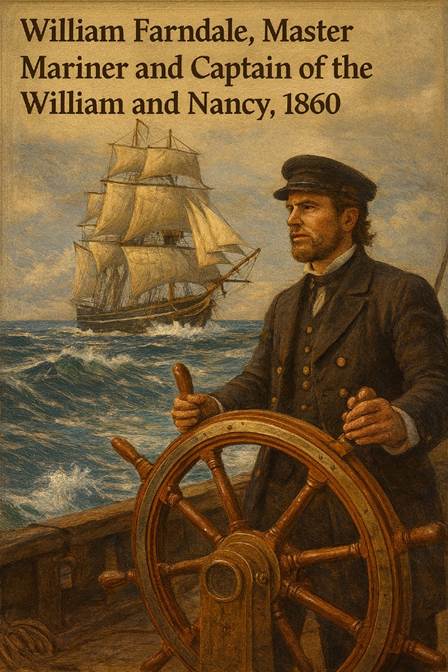
William Farndale
11 November 1825 to 6 March 1887
FAR00289
|
Return to the Home
Page of the Farndale Family Website |
The story of one
family’s journey through two thousand years of British History |
The 83 family lines
into which the family is divided. Meet the whole family and how the wider
family is related |
Members of the
historical family ordered by date of birth |
Links to other pages
with historical research and related material |
The story of the
Bakers of Highfields, the Chapmans, and other related families |

You can read the
story of William and his father and brother both John Christopher
Farndale as
part of the Farndale Story and this
page provides the detailed research notes.
Master mariner of
Whitby, whose wife was a lodge house keeper
Dates are in red.
Hyperlinks to
other pages are in dark
blue.
Headlines of
William’s life are in brown.
References and citations
are in turquoise.
Context and local
history are in purple.
Overview
John Christopher Farndale’s eldest son, William Farndale (FAR00289) also became a master
mariner and continued to captain the William and Nancy. The third son,
John Christopher Farndale the Younger (FAR00308) captained other ships.
They all lived lives of adventure, perils at sea, and travel. This was a family
of mariners at the heart of the maritime coal industry in the mid Victorian
era. The second generation ventured widely around the North Sea (often called
the German sea at the time) and the Baltic and further south.
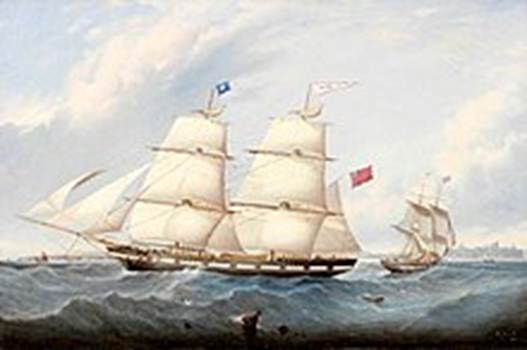
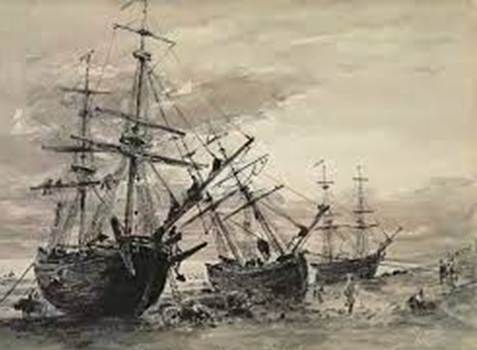
The Mary, a Brig of South Shields painted in 1855
The Traditional Song, the Collier Brig: Oh, the worst old ship
that ever set sail, Sailed out of Harwich on a windy
day. Chorus: Stormy weather, boys, stormy weather, boys, When the wind blows
the barge will go. She was built in Roman style, Held together with bits of
twine. Skipper’s half Dutch and he hasn’t got a clue,
The crew were fourteen hands too few. Cook spilt the dinner on the galley floor, Skipper caught his hand in the wheelhouse door. Off
Orford Ness we sprang a leak, Hear our poor old
timbers creak. We steered our way round Lowestoft next, The
wind backed round to the sou-sou-west. Through the Cockle to Cromer Cliff,
Steering like a wagon with a wheel adrift. Up The Humber and up to town, Pump,
you devils, pump or drown. Then on a sandbank we got
stuck, Skipper’s drunk in the Dog and Duck. Up come a mermaid covered in slime,
We took her down the hold and we had a good time. We
kept on course all through the night, Nearly went
aground at the Apex light. Coal was shot by a Keadby crew, Bottom was rotten
and it went right through. So when we saw the brig was
sunk, We went to the Barge and we all got drunk.
A master mariner is
a licensed mariner who
holds the highest grade of seafarer qualification. He is thus given an
unlimited master's license, with no limits on the tonnage, power, or geographic
location of the vessel that the holder of the license is allowed to serve upon.
A master mariner would therefore be allowed to serve as the master of
a merchant ship of
any size, of any type, operating anywhere in the world, and it reflected
the highest level of professional qualification amongst mariners and deck
officers.
The term master mariner has been in use at
least since the thirteenth century, reflecting the fact that in guild or livery
company terms, such a person was a master
craftsman in this specific profession, such as were also
a master carpenter, master blacksmith etc.
In the British Merchant Navy a
master mariner who had sailed in command of an ocean going merchant ship was titled “Captain”,
although a professional seafarer who held a restricted or limited master's
certificate who had sailed in command of a ship could also be titled captain.
Where the movements of ships were recorded in the
shipping news and other media, the name of the ship was followed by the name of
the Captain.
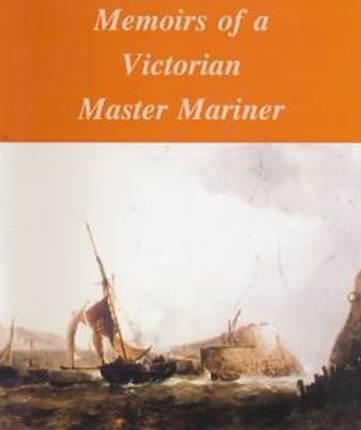
For the extensive maritime expeditions
of William Farndale, see also the Maritime Adventures of William
Farndale.
The Traditional Song, the Collier Brig: Oh, the
worst old ship that ever set sail, Sailed out of
Harwich on a windy day. Chorus: Stormy weather, boys, stormy weather, boys,
When the wind blows the barge will go. She was built in Roman style, Held
together with bits of twine. Skipper’s half Dutch and he hasn’t
got a clue, The crew were fourteen hands too few. Cook spilt the dinner on the
galley floor, Skipper caught his hand in the
wheelhouse door. Off Orford Ness we sprang a leak, Hear
our poor old timbers creak. We steered our way round Lowestoft next, The wind backed round to the sou-sou-west. Through the
Cockle to Cromer Cliff, Steering like a wagon with a wheel adrift. Up The
Humber and up to town, Pump, you devils, pump or
drown. Then on a sandbank we got stuck, Skipper’s drunk in the Dog and Duck. Up
come a mermaid covered in slime, We took her down the
hold and we had a good time. We kept on course all through the night, Nearly went aground at the Apex light. Coal was shot by a
Keadby crew, Bottom was rotten and it went right through. So
when we saw the brig was sunk, We went to the Barge
and we all got drunk.
1825
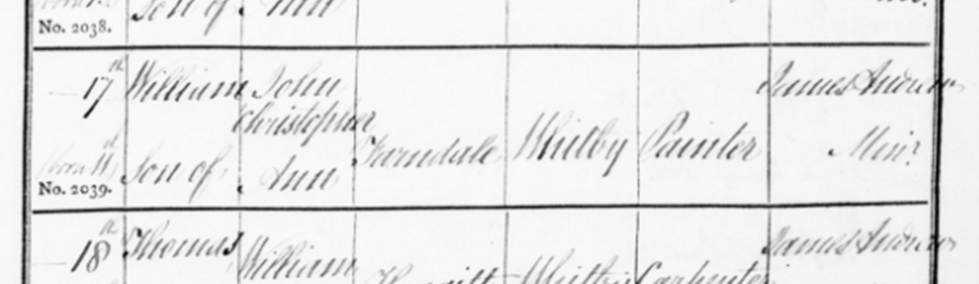
William Farndale was born on 11 November 1825, the son of John Christopher and Ann (nee
Ling) Farndale, (FAR00244)
painter (and later master mariner). He was born
on 11 November 1825 and baptised in Whitby on 17 November 1825 (Whitby PR).
1837
William’s father John
Christopher Farndale Senior died in 1837. William was only twelve years old when his father died.
1849
On 27 August 1849, he sailed for
Romney, on 1 October 1849 for Hartlepool and on 2 November 1849 he arrived at Hartlepool West from London, all as
captain of the William and Nancy.
The William and Nancy was forced to beach south of Bridlington in a
storm on 2 December 1849, but the vessel was hoved
off the beach on 15 December, and seemed to have
suffered no damage. During the whole day, it was excessively thick with rain,
with the wind blowing in the early part of the day from the south, varying to
the southeast, east south east, and east, blowing a
perfect gale. This continued without intermission. At daylight a Brig appeared
to the southward, which, being unable to reach the harbour, was run on shore
about a half a mile south of the town, and proved to be the William and
Nancy, Farndale, of Whitby. The crew were saved.
By 1849 eldest son William Farndale
was the captain and master of the ship his father had previously captained, the
William and Nancy.
Article, 16 May 1849: HARTLEPOOL. Arrived
(May 14) from … Maldon, Wm and Mary (sic, recte,
Nancy), Farndale …
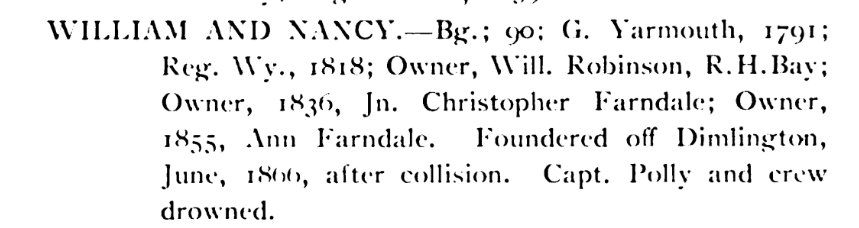
(From Richard Weatherill.
1908. The
Ancient Port of Whitby and Its Shipping. Whitby:
Horne and Son, Haithi Trust. Page
372).
The Shipping and Mercantile
Gazette, 29 August 1849: Sailed (Aug 27) …
William and Nancy, Farndale for Romney …
The Shipping and Mercantile
Gazette, 1 October 1849: Sailed
(Sept 26) … William and Nancy, Farndale, for Hartlepool …
The Shipping and Mercantile Gazette, 6 November 1849: HARTLEPOOL WEST.
Arrived (Nov 2) … William and Nancy, Farndale, from London …
The William and Nancy
was forced to beach south of Bridlington in a storm on
2 December 1849, but the vessel was hoved off the
beach on 15 December, and seemed to have suffered no
damage. The Shipping and Mercantile
Gazette, 4 December 1849: BRIDLINGTON. Dec 3.
During the whole of yesterday it was excessively thick with rain, wind blowing
in the early part of the day from the south, varying to the southeast, ESE, and
east, blowing a perfect gale. This continued without intermission. At
daylight a Brig appeared to the southward, which, being unable to reach the
harbour, was run on shore about a half a mile south of the town, and proved
to be the William and Nancy, Farndale, of Whitby; Crew saved. The Shipping and Mercantile
Gazette, 17 December 1849: BRIDLINGTON.
Dec 15. Last night it blew a gale from the south, towards morning it veered to
the northwest; during the day, light and variable, and so continued 8:30 PM. The
William and Nancy, Farndale, which ran ashore near this place on the 2nd inst, was hove off the beach and into the harbour this this
afternoon 's tide, with apparently little damage.
1850
On 7 March 1850 William sailed from London. On 29 May 1850 he
arrived at West Hartlepool from Hythe. On 13 May 1830 at 13.30 pm, in a strong south westerly wind
and fog, the William and Nancy, Farndale, lost its anchor and thirty fathoms
of chain, and the windlass was broken. An anchor windlass is a machine that
restrains and manipulates the anchor chain on a boat, allowing the anchor to be
raised and lowered by means of chain cable.
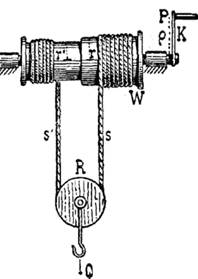
Windlass
The Shipping and Mercantile
Gazette, 7 March 1850: Wm & Nancy,
Farndale, from London.
The Shipping and Mercantile
Gazette, 31 May 1850: HARTLEPOOL WEST.
Sailed (May 29), …William and Nancy, Farndale, for Hythe …
The Shipping and Mercantile
Gazette. 1 June 1850: HARTLEPOOL WEST. May 13.
13.30pm, SE, strong, foggy, 31 – E, light, fine. Put back, 30, The William and
Nancy, Farndale, with loss of anchor and 30 fathoms of chain, windlass broken
etc …
On 6 August
1850, the William and Nancy arrived in Middlesbrough from London and on 20
September 1850, he arrived in New Romney from Middlesbrough. On 18 November
1850, he arrived in West Hartlepool from
Whitby. On 27 July 1851 the brig passed
Yarmouth at 3pm. On 17 September 1851 he arrived in West Hartlepool from Dover. On 6 December
1851 he arrived at West Hartlepool from
Whitstable.
The Shipping and Mercantile
Gazette, 6 August 1850: MIDDLESBROUGH
… Wm & Nancy, Farndale, arrived from London …
The Shipping and Mercantile
Gazette, 20 September 1850, NEW
ROMNEY. Sept 19: 18 – ENE fresh, 19 – SE light … Off, 19 – The William and Nancy,
Farndale, from Middlesbrough …
The Shipping and Mercantile
Gazette, 18 November 1850: HARTLEPOOL
– WEST. Arrived (Nov 16) … Wm & Nancy, Farndale, from Whitby…
1851
William received his Master’s Certificate of Service on 10
January 1951 (Masters
and Mates Certificates).
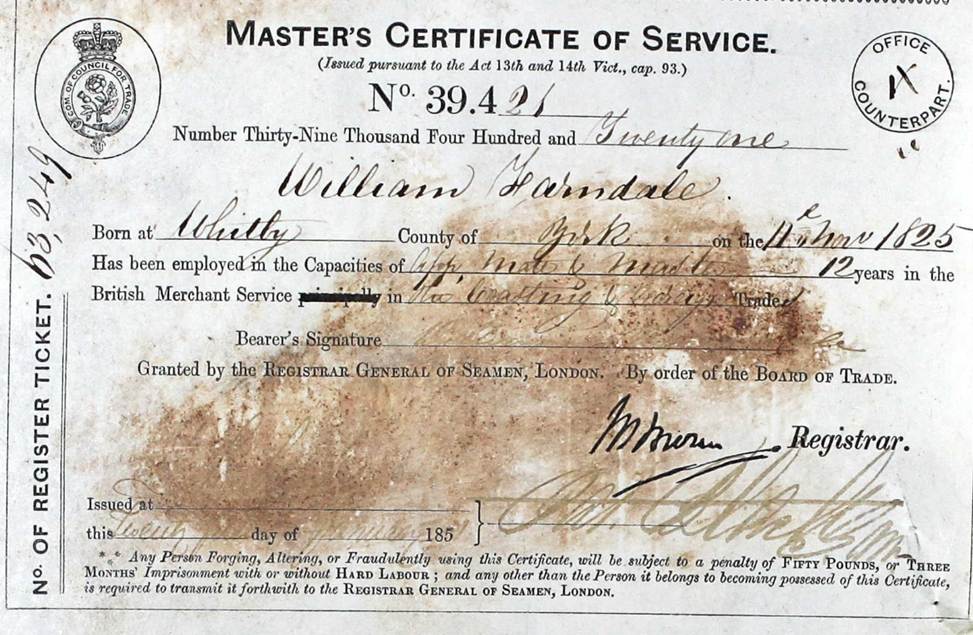
The Shipping and Mercantile Gazette, 28 July 1851: YARMOUTH … Passed, July 27 …
3pm … William and Nancy, brig, Farndale …
The Shipping and Mercantile
Gazette, 17 September 1851: HARTLEPOOL,
WEST. Arrived (Sept 15) … Wm & Nancy, Farndall
(sic), from Dover …
The Shipping and Mercantile
Gazette, 9 December 1851: HARTLEPOOL,
WEST. Arrived (Dec 6) … Wm & Nancy, Farndale, from Whitstable …
1852
On 19 May
1852 the William and Nancy passed Great Yarmouth at 6pm heading
northwards. On 15 July 1852 the William and Nancy passed Deal between
noon and the evening in a light south-westerly wind and fine weather. On 5
September 1852 it passed Deal again from west to north. On 8 May 1853 it passed
Deal westward, at 7.30am.
The Shipping and Mercantile Gazette, 20 May 1852: GREAT YARMOUTH. May 19 .. 6pm – William and Nancy brig, Farndale, of Whitby …
northward …
The Shipping and Mercantile Gazette, 16 July 1852: TELEGRAPHS. DEAL. July 15:
Morning: SW, light, fine; Noon and Evening: SW, moderate, fine … passed
northward … 4pm – Wm & Nancy brig, Farndale, Whitby …
The Shipping and Mercantile
Gazette, 6 September 1852: DEAL.
Sept 5 … The William and Nancy, Farndale, from west to north …
1853
The Shipping and Mercantile Gazette, 9 May 1853: TELEGRAPHS. DEAL. May 8 …
Passed westward, 7.30am, The William and Nancy brig, Farndale, Whitby …
On 4 July 1853 the William and Nancy passed Great
Yarmouth at 6am. William was clearly playing it close to the wind, as his
wedding was on 7 July 1853! William Farndale aged 27, a bachelor, Master Mariner of Pier, Whitby, son of John Christopher Farndale,
Master Mariner, married Ann Brown, aged 26, spinster of West Cliff, Whitby, daughter of Thomas Brown, Master
Mariner at the Parish Church Whitby on 7
July 1853. William and Ann signed the register and the
witnesses were William’s brother, Thomas Farndale, William White and Mary
Coulson. James Davidson was the Curate.
The Shipping and Mercantile Gazette,
5 July 1853: GREAT YARMOUTH – July 4 … 6am
… Wm and Nancy brig, Farndale, Whitby ….
William was clearly playing it close
to the wind, as his wedding was on 7 July 1853!
William Farndale aged 27, a bachelor, Master Mariner of Pier, Whitby, son of John Christopher Farndale,
Master Mariner, married by licence Ann Brown aged 26, spinster of
West Cliff, Whitby, daughter of Thomas Brown, Master Mariner at the
Parish Church Whitby on 7 July 1853 (Marriage
Certificate). William and Ann signed the register
and the witnesses were Thomas Farndale (FAR00300 – his brother),
William White and Mary Coulson. James Davidson was the Curate.
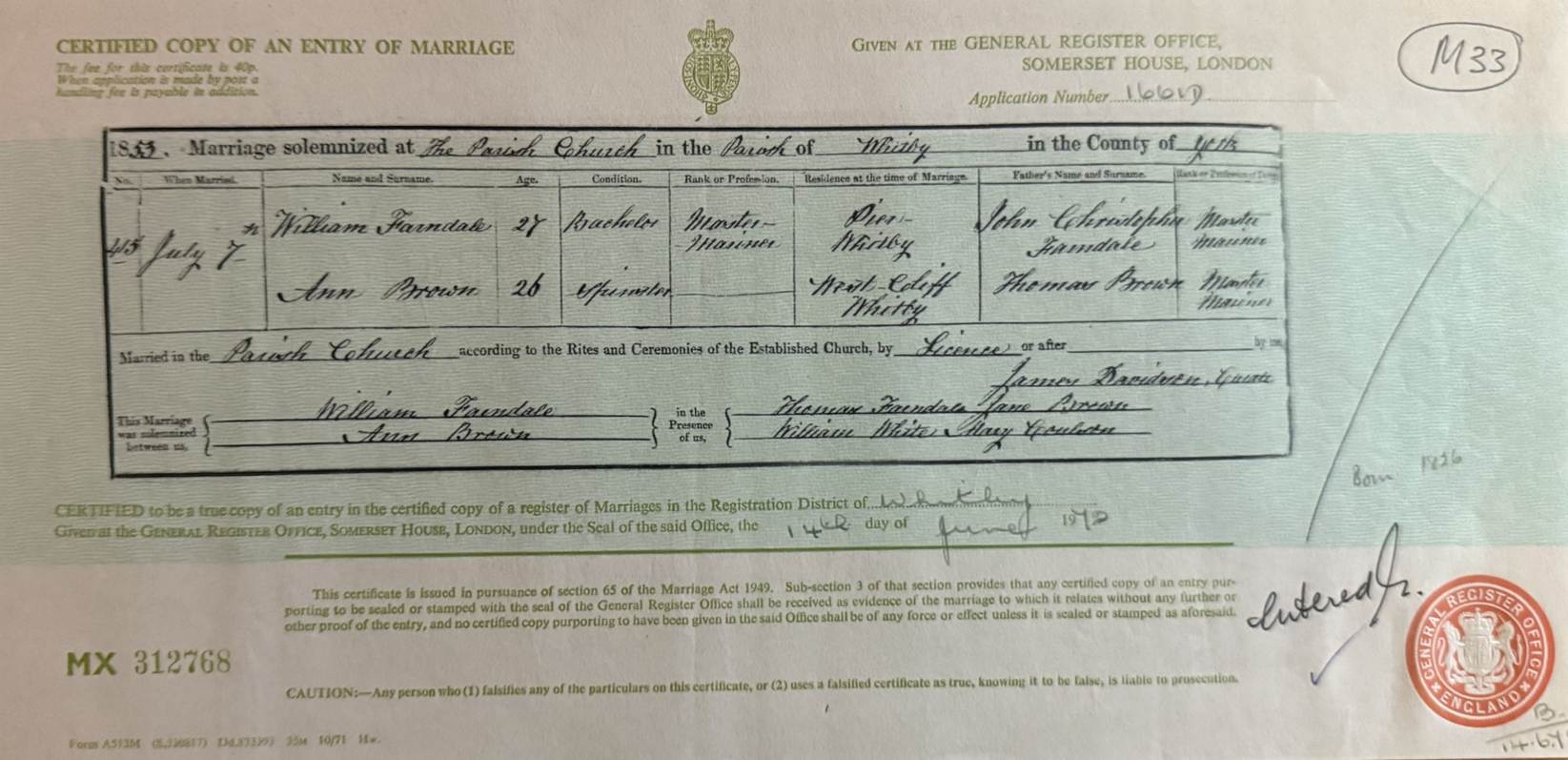
By 24 August
1853, he was back at sea off Deal, heading for Dover from Whitby, at 3.15pm, in a northeasterly in
fresh thick rain.
The
Yorkshire Gazette, 9 July
1853: MARRIAGES. On Thursday, the 7th inst, at Whitby
parish church, by the Rev J Davidson, Mr Wm Farndale, master mariner, to Miss Ann
Brown, both of Whitby.
The Shipping and Mercantile Gazette,
25 August 1853: TELEGRAPHS, DEAL. Aug 24.
Morning: NE, moderate, cloudy; Noon: E, moderate, cloudy; Evening: NE, fresh,
thick rain. Passed westward, 3.15pm – The William and Nancy, Farndale, Whitby
for Dover …
1854
In
February 1854, John faced a strong north west wind with snow squalls. It was very
cold. The William and Nancy was forced to put
in at Lowestoft through stress of weather. The Harbour Company’s tugs, and two
Yarmouth tugs by permission of the harbour master, had been engaged during the
greater part of the day assisting vessels in, with loss of anchors and other
damage. A boy whose name was never reported, belonging to the Commerce
brig, of Whitby, was drowned in the inner harbour during the previous evening
and his body was dragged for and found during the morning.
The Shipping and Mercantile Gazette,
20 February 1854: LOWESTOFT – Feb 18. AM, NW
strong, with snow squalls; PM: strong, with snow squalls, very cold. Put in through
stress of weather … Put in – The William and Nancy, Farndale … The Harbour
Company’s tugs, and also two Yarmouth tugs (the latter
by permission of the harbour master), have been engaged the greater part of the
day assisting vessels in, with loss of anchors, damage etc. The boy (name not
reported) belonging to the Commerce brig, of Whitby, was drowned in the inner
harbour last night, and the body dragged for and found this morning …
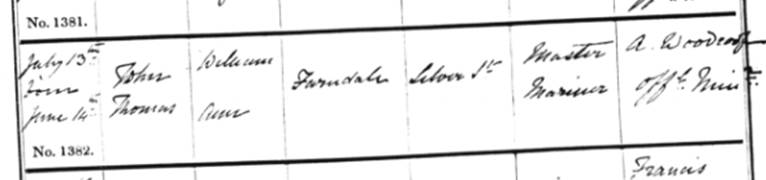
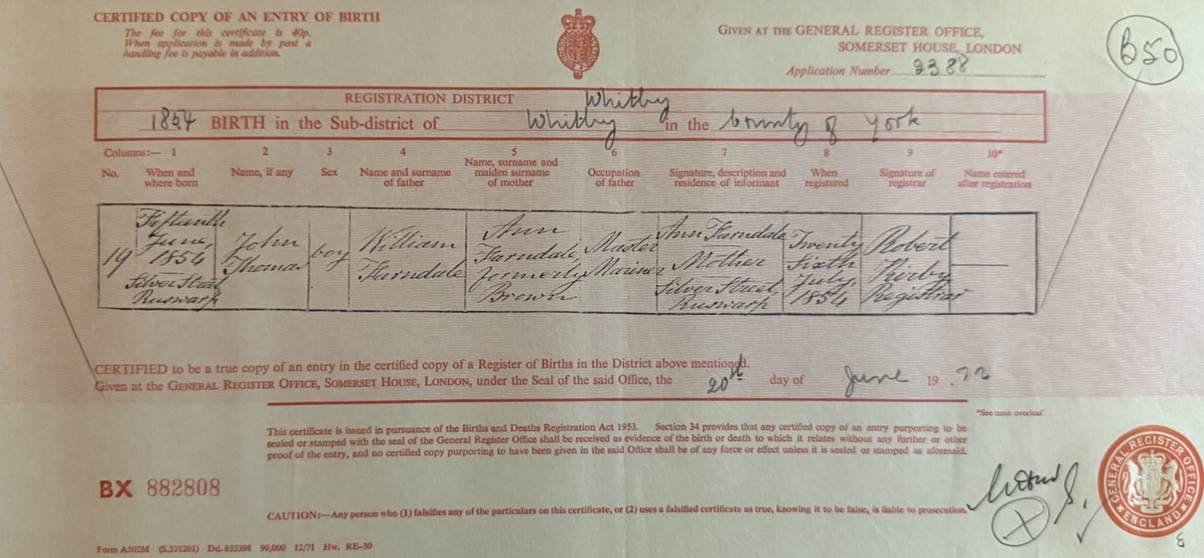
John Thomas Farndale (FAR00405) was born at Ruswarp on 14 June 1854 and baptised there on 15 June 1854
(Whitby PR, Birth Certificate).
On 22 June
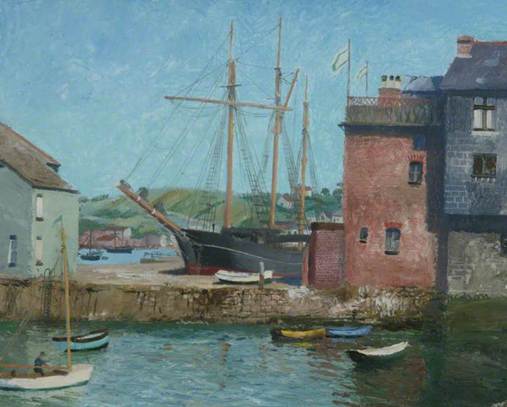
1854, the William and Nancy was anchored at
Hull. On 21 August 1854, the vessel arrived and procced on from Deal at 1pm. On
29 August and again on 8 September 1854 she arrived at West Hartlepool from Folkstone. On 29
September 1854 she arrived in Whitby from
Folkestone. On 23 October 1854, she passed Yarmouth at 10am. On 17 March 1855, she sailed out of Lowestoft
for Whitby.
The Shipping and Mercantile Gazette, 23 June 1854: HULL. June 22 .. Anchored … 1pm – Wm and Nancy brig, Farndale, Whitby
…
The Shipping and Mercantile Gazette, 22 August 1854: MARITIME EXTRACTS. DEAL Aug
21 Arrived and proceeded … William and Nancy, Farndale, of Whitby, … from west for
north … TELEGRAPOHS DEAL. Aug 21 … 1pm … William and Nancy, brig, Farndale,
Whitby …
The Shipping and Mercantile Gazette, 31 August 1854: HARTLEPOOL, WEST. Arrived
(Aug 29) … Wm & Nancy, Farndall (sic), from
Folkstone …
The Shipping and Mercantile Gazette, 11 September 1854: HARTLEPOOL WEST. Arrived
(Sept 8) … Wm & Nancy, Farndale, from Folkestone …
The Shipping and Mercantile Gazette, 30 September 1854: WHITBY. Arrived (Sept 29), Wm
& Nancy, Farndale, from Folkestone …
The Shipping and Mercantile Gazette, 23 October 1854: YARMOUTH – Oct … 22. … Passed
… 10am …William and Nancy, brig, Farndale, Whitby …
1855
The
Norwich Mercury, 17 March 1855: LOWESTOFT … SAILED – William
and Mary (sic, recte Nancy), Farndale, for Whitby
…
1856
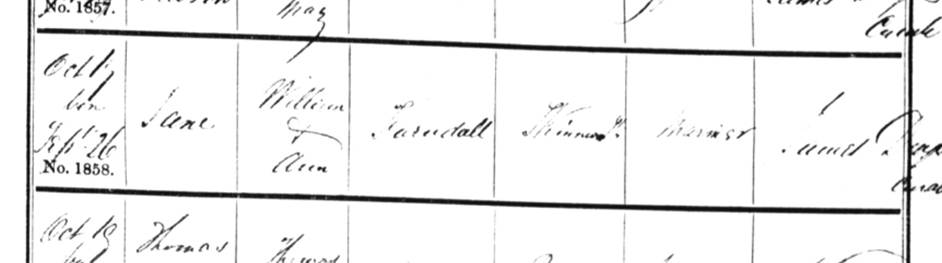
Jane Farndale (FAR00422) was born at Ruswarp on 26 September 1856 and baptised on 19 October
1856 (Whitby PR).
William
Farndale captained the William and Nancy in November 1856, and suffered
severe damage in a storm off Lowestoft in November 1856.
The Liverpool Shipping Telegraph and
Daily Commercial Advertiser, 18 November 1856: LOWESTOFT. Nov 13 …
put in through stress of weather etc, The Wm and Nancy brig, Farndale, with
loss of mainmast etc … The Norfolk Chronicle, 22 November 1856: .. The brig William and Nancy,
William Farndale, of Whitby, was forced by the brig Ruby, off Pakefield. The
former lost bowsprit, fore-mast, fore-topmast, main-topmast, and all the gear
and long boat stoven. Was assisted into harbour by a boat’s crew for £50 … Arrived,
City of Norwich … For refuge, … Wm and Nancy, Farndall
(sic) … The
Norfolk News, 22 November 1856: THE WEATHER AND THE SHIPPING.
During and subsequent to the late heavy gale, about
100 sale, many of them large class vessels, have taken
our harbour for refuge. The following are a few of the casualties that have
occurred, and owing to which they entered for repairing damages and replacing losses:... The brig ‘William and Nancy’, William
Farndale, of Whitby, was fouled by the Brig ‘Ruby’, off [Duke’s Head?]. The
former lost bowsprit, foremast, fore-topmast, main topmast, and all the gear
and longboat stove and was assisted into harbour by a boat's crew for £50....
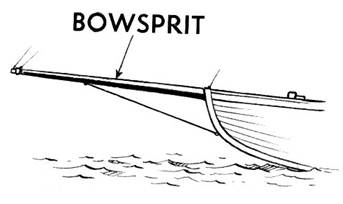
She was assisted into harbour by a boat’s crew for £50 and
came into the City of Norwich for refuge. During and subsequent to the late heavy gale, about 100 sailing vessels, many of them large class
vessels, had taken into Norwich harbour for refuge.
However again the vessel was repaired and made
seaworthy again. She sailed out of Lowestoft again on
18 December 1856.
The
Public Ledger and Daily
Advertiser, 22 December 1856: LOWESTOFT,
December 18. Sailed, the William and Mary (sic, recte
Nancy), Farndale, for Whitby, after repairing. …
1857
In 1857, we have the first record of a voyage
outwith the British shores, to France. On 23 April 1857 the William and
Nancy, Farndale, arrived in Whitby from Abbeville.
Lloyd’s List, 23 April 1857: WHITBY.
Arrived the William and Nancy, Farndale, from Abbeville.
In July 1857, William had
more problems with the William and Nancy. On 22 July
1857, en route from Sunderland for
Deal, she had to put in to port with the loss of her
fore and main topmast, off the Inner Garboard, at 11am, assisted by a fishing
smack. The Liverpool Shipping Telegraph and
Daily Commercial Advertiser, 27 July 1857: RAMSGATE. July 23.
The Wm and Nancy, Farndall (sic), from Sunderland for
Deal, has put in with the loss of fore and main topmast, off the Inner
Garboard, at 11am, on the 22nd, assisted by a fishing smack.
On 11 November 1857 William sailed to Boulogne with 44
hundredweight of coals. A hundredweight is 100 pounds or about 45 kilograms. The Newcastle Journal, 14
November 1857: WEDNESDAY, Nov 11.
William and Nancy, Farndale, Boulogne, 44 chs coals …
The North & South Shields Gazette and Northumberland
and Durham Advertiser, 26 November 1857: ARRIVALS
AT FOREIGN PORTS. … BOULOGNE. Nov 23. … William and Nancy, Farndale, from
Shields …
1859
On 11
February 1859, the William and Nancy, Farndale arrived coastwise at Warkworth from Shields. She was in ballast, so must have
been returning from a voyage delivering her cargo.
The
Newcastle Courant, 11 February 1859: WARKWORTH. ARRIVED COASTWISE.
The William and Nancy, Farndale, from Shields, in ballast …
In the elections for Whitby, caused by the death of Robert
Stephenson (the son of George
Stephenson), in 1859, William Farndale voted for the Conservative candidate,
Thomas Chapman. The Yorkshire Gazette, 19 November
1859: WHITBY ELECTIONS. The vacancy
occasioned in the representation of this borough by the lamented death of
Robert Stephenson Esquire, has given rise to a contest of unusual interest and
excitement in Whitby. As our readers are aware, in the early part of the
contest, there were three candidates: Thomas Chapman Esquire and George Hudson
Esquire who appeared under the conservative flag, and H S Thompson Esquire, who
avowed moderate liberal principles.... The Prince
Maharaja Dhuleep Singh and suite arrived at the hustings from
Mulgrave Castle at the commencement of the proceedings, and
remained until nearly their termination. His Highness appeared to take great
interest, and to be highly amused with the free and independent ebullitions of
the populace, and with the speeches of the candidates and their friends...
Votes for Mr Chapman... Farndale, William …
1860
William Farndale and the William and Nancy arrived at
Warkworth from Abbeville. Abbeville is in France not far from Le Treport, but has
a canal to the sea. Warkworth is in Northumberland near Alnmouth. The
Newcastle Journal, 3 November 1860: WARKWORTH
… CLEARED FOREIGN … William and Nancy, Farndale, Abbeville. She cleared foreign customs at Warkworth.
1861
On 4 February 1861 William Farndale and the William and
Nancy arrived at Amble from St Valery. Another report showed that the
vessel was carrying 125 tones of coals from Harrison, Carr & Co.
The Newcastle Journal, 4 February
1861:
William Farndale and the William and Nancy arrived at Amble from St Valery.
Another report showed that the vessel was carrying 125 tones of coals from
Harrison, Carr & Co.
The Newcastle Guardian and Tyne
Mercury, 6 July 1861: Blyth, June 26 - Mr Farndale,
of the schooner William and Nancy, of Whitby, from Deal, last night, or nearly
this morning, passed a quantity of German yeast, picked up one basket; several
pieces of bulwarks were floating about at the place; Tynemouth Castle bearing
SW by S, distant about 5 miles.
The Census of 1861 for Ruswarp, Whitby listed Ann Farndale, as head
of the household and married, aged 34, Master Mariner’s wife; born at Eryholm in 1825, living with John Farndale, their son; aged 6 and Jane Farndale, their daughter; aged 4. Presumably
William, Master Mariner, was at sea.
The Census
of 1861 for Ruswarp, Whitby listed Ann Farndale, head; married; aged 34; Master
Mariner’s wife; born Eryholm (ie
born 1825); John Farndale, son; aged 6 (FAR00405); Jane Farndale, daughter; aged 4 (FAR00422).

Presumably William, Master Mariner,
was at sea.
There was more trouble for William Farndale on 2 November
1861 when the brig William Nancy, Farndale, of Whitby, from Newcastle for Abbeville, put
in at Calais, with bulwarks carried away, having experienced very severe
weather.
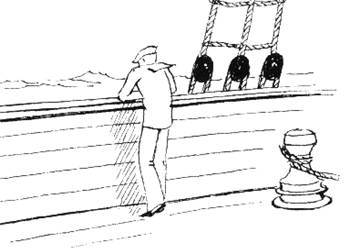
The bulwark is the extension of a
ship's side above the level of the weather deck
There was more trouble for William
Farndale and the William and Nancy in November 1861. The Shields Daily Gazette, 7
November 1861: The brig William Nancy,
Farndale, of Whitby, from Newcastle for Abbeville, put in at Calais, on the 2nd
inst, with bulwarks carried away, having experienced
very severe weather...
1862
On 10 March 1862 William Farndale and the William and
Nancy arrived at Shields from Abbeville. On 23 April 1862 she arrived from
Whitby at St Valery. On 22 August 1862 William Farndale and the William and
Nancy arrived at West Hartlepool from Deal. On 24 February 1863 she arrived
at Dunkirk from Newcastle. On 24 March 1863 she arrived at Sandwich from
Abbeville. On 9 June 1863 she arrived at West Hartlepool from Whitby. On 3 August 1863 she arrived at
West Hartlepool from Deal. On 2 May 1864 William Farndale and the William
and Nancy sailed from Ramsgate bound for Hartlepool. On 26 October 1864 William
Farndale, captain of the brig, the William and Nancy, and travelling
from Broadstairs to Whitby and while in ballast, suffered a broken mainstay. On 4 December
1864 she put into to Dover having sailed from Shields en
route to Abbeville. On 14 May 1865 she arrived in West Hartlepool from Folkestone. On 24 June 1865 she
arrived in Hartlepool from Deal.
The
Shipping and Mercantile
Gazette, 11 March 1862
showed that on 10
March 1862 William Farndale and the William and Nancy arrived at
Shields from Abbeville.
Lloyd’s List, 25 April
1862 showed that on 23 April 1862
William Farndale and the William and Nancy arrived of
Whitby arrived at St Valery.
Lloyd’s List, 3 April 1862
showed that on 25 April 1862 William Farndale and the William and Nancy
arrived at St Valery from Newcastle.
The Shipping and
Mercantile Gazette, 25 August 1862
showed that on 22 August
1862 William Farndale and the William and Nancy arrived at
West Hartlepool from Deal.
1863
Lloyd’s List, 4 March
1863 showed
that on 24 February 1863
William Farndale and the William and Nancy arrived at Dunkirk from
Newcastle.
Lloyd’s List, 26 March
1863 showed
that on 24 March 1863
William Farndale and the William and Nancy arrived at Sandwich from
Abbeville.
The
Shipping and Mercantile
Gazette, 11 June 1863
showed that on 9
June 1863 William Farndale and the William and Nancy arrived at
West Hartlepool from Whitby.
The
Shipping and Mercantile
Gazette, 5 August 1863
showed that on 3
August 1863 William Farndale and the William and Nancy arrived at
West Hartlepool from Deal.
1864
The
Shipping and Mercantile
Gazette, 3 May 1864
showed that on 2 May
1864 William Farndale and the William and Nancy sailed
from Ramsgate bound for Hartlepool.
The
Norfolk Chronicle, 29
October 1864
showed that on 26
October 1864 William Farndale, captain of the brig, the William and
Nancy, and travellng from Broadstairs to Whitby and ‘in ballast’, suffered
a mainstay broken.
The
Shields Daily News, 6
December 1864
showed that on 4
December 1864 William Farndale and the William and Nancy put into
to Dover have sailed from Shields en route to Abbeville.
1865
The
Shipping and Mercantile
Gazette, 16 May 1865
showed that on 14
May 1865 William Farndale and the William and Nancy arrived in
West Hartlepool from Folkestone.
The
Shipping and Mercantile
Gazette, 26 June 1865
showed that on 24 June
1865 William Farndale and the William and Nancy arrived in
Hartlepool from Deal.
On 24 August 1865 William Farndale captained the Ythan
arriving at Hartlepool from Deal. On 1 November 1865 William Farndale captained the Ythan
arriving at Sandwich from Hartlepool.
The
Shipping and Mercantile
Gazette, 25 August 1865
showed that on 24
August 1865 William Farndale (or someone else?) captained the Ythan
arriving at Hartlepool from Deal.
The
Shipping and Mercantile
Gazette, 4 November 1865 showed
that on 1 November 1865
William Farndale (or someone else?) captained the Ythan arriving at
Sandwich from Hartlepool.
On 13 December 1865 William Farndale and the William and
Nancy arrived in Sandwich from Hartlepool.
The Shipping
and Mercantile Gazette, 14 December 1865 showed that on 13 December 1865 William Farndale and the
William and Nancy arrived in Sandwich from Hartlepool.
On 17 December 1865 William Farndale captained the Ythan
arriving at Sandwich from Hartlepool. On 5 January 1866 William Farndale captained the Ythan arriving
at Sandwich from Middlesbrough. On 31 January 1866 William Farndale captained the Ythan arriving
at Lowestoft from London for Middlesbrough.
The
Shipping and Mercantile Gazette,
18 December 1865
showed that on 17
December 1865 William Farndale (or someone else?) captained the Ythan
arriving at Sandwich from Hartlepool.
1866
The
Shipping and Mercantile
Gazette, 8 January 1866
showed that on 5
January 1866 William Farndale (or someone else?) captained the Ythan
arriving at Sandwich from Middlesbrough.
The
Shipping and Mercantile
Gazette, 1 February 1866
showed that on 31
January 1866 William Farndale (or someone else?) captained the Ythan
arriving at Lowestoft from London for Middlesbrough.
On 2 August 1866 William Farndale
captained the Ythan arriving at Hartlepool from Deal. On 27 November 1866
William Farndale captained the Ythan arriving at Lowestoft from Deal. On
9 February 1867 William Farndale captained the Ythan arriving at Hartlepool from Arbroath.
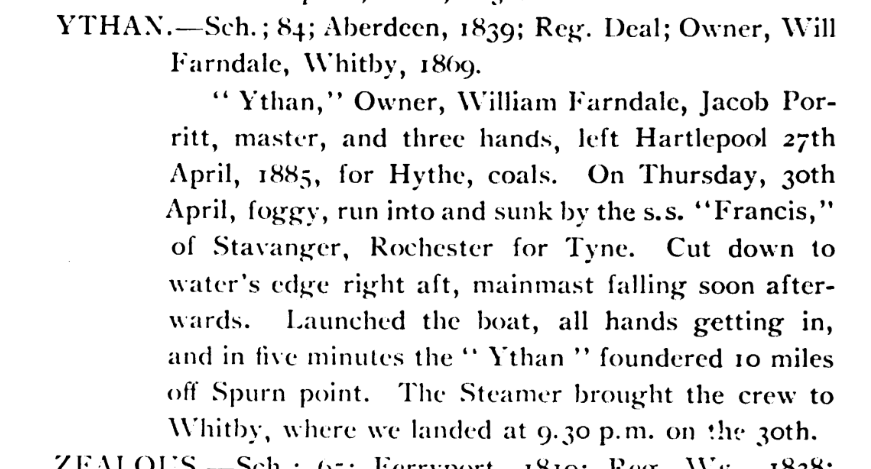
(From Richard Weatherill.
1908. The
Ancient Port of Whitby and Its Shipping. Whitby:
Horne and Son, Haithi Trust. Page
376).
The
Shipping and Mercantile
Gazette, 3 August 1866
showed that on 2
August 1866 William Farndale (or someone else?) captained the Ythan
arriving at Hartlepool from Deal.
The
Shipping and Mercantile
Gazette, 27 November 1866
showed that on 27
November 1866 William Farndale (or someone else?) captained the Ythan
arriving at Lowestoft from Deal.
1867
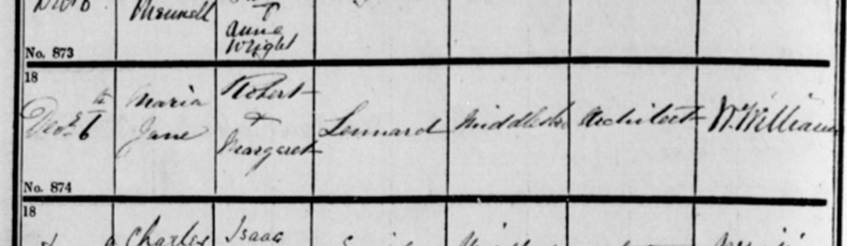
Maria Jane Farndale (FAR00485),
who may have been an adopted niece, was born in Middlesbrough in 1867 (Middlesbrough PR). By the
1871 census she was known as Mary Jane Farndale and described as
William’s niece. They may have adopted her. William did not have a sister who
married a Lennard and there is no obvious link to the Lennard family.
The
Shipping and Mercantile
Gazette, 11 February 1867 showed that on 9 February 1867
William Farndale (or someone else?) captained the Ythan arriving at
Hartlepool from Arboath.
On 5 June 1867 William Farndale captained the Medusa
arriving at Sunderland from Cronstadt.
The
Shields Daily News, 6 June
1867 showed that on 5 June 1867
William Farndale (or someone else?) captained the Medusa arriving at
Sunderland from Cronstadt.
On 3
September 1867 William Farndale captained the Ythan left Deal heading
north. On 17 October 1867 William Farndale captained the Ythan arrived
at West Hartlepool from Deal.
The
Shipping and Mercantile Gazette, 4 September 1867 showed
that on 3 September 1867 William
Farndale (or someone else?) captained the Ythan left Deal heading north.
The
Shipping and Mercantile Gazette, 18 October 1867 showed
that on 17 October 1867
William Farndale (or someone else?) captained the Ythan arrived at West
Hartlepool from Deal.
1868
The
Shipping and Mercantile
Gazette, 21 January 1868 showed that on 20 January 1868
William Farndale was captain of the Day Star, arriving in Portsmouth for
Llanelly.
William’s
younger brother John Christopher Farndale (FAR00308) was lost at sea in the
Bay of Biscay on 22 January 1868.
On 27
January 1868 William Farndale captained the Ythan arrived at Whitby from Lowestoft. On 11 March 1868
William Farndale captained the Ythan arrived at Blyth from Whitby.
The
Shipping and Mercantile Gazette, 29 January 1868 showed
that on 27 January 1868
William Farndale captained the Ythan arrived at Whitby from Lowestoft.
The
Shipping and Mercantile Gazette, 18 March 1868 showed
that on 11 March 1868
William Farndale captained the Ythan arrived at Blyth from Whitby.
The
Shields Daily Gazette, 28
March 1868: Serious Damage to the Ythan of Blyth. The Ythan,
Farndale, of Blyth, for Deal, put into Ramsgate on Thursday, having been in
collision with the brig Doune Castle, carrying away rigging, mainsail,
bulwarks, and receiving other damage.
The
Shipping and Mercantile
Gazette, 2 May 1868 showed that on 30 April 1868 William Farndale captained the
Charles Adams and was cleared at Rotterdam for Ipswich.
On 25 August
1868 The Ythan, Farndale, for Shields,
put in to Ramsgate on Sunday with loss of anchor and
chain.
The
Shields Daily News, 25 August 1868 showed
that on 25 August 1868
The Ythan, Farndale, for Shields, put in to Ramsgate on Sunday with loss
of anchor and chain.
1869
The 1869
Lloyds Captains Register of Master Mariners included a list of all those master
mariners whose place of birth was described as Whitby
or Robin Hood's Bay and this included 107. William Farndale, born 1825 at
Whitby, Certificate Number (Certificate of Service): 39421.
The 1869 Lloyds
Captains Register of Master Mariners lists all those master mariners whose
place of birth is described as Whitby or Robin Hood's Bay in the 1869 Lloyd's
Captains Register.
107. William Farndale, born 1825 at Whitby,
Certificate Number (Certificate of Service): 39421.
On 26
February 1869 The Ythan, Farndale,
sailed from Blyth for Deal. On 31 May 1869 The
Ythan, Farndale, was off Deal on Friday, running to leeward for shelter. On
23 June 1869 The Ythan, Farndale, from
Deal for Shields was in South Lowestoft Roads, windbound, on Monday. On 29
September 1869 The Ythan, Farndale, from
Shields to Deal.
The Shipping and Mercantile Gazette, 27 February 1869 showed that on 26 February 1869 The Ythan,
Farndale, sailed from Blyth for Deal
The Shields Daily Gazette, 31 May 1869 showed that on 31 May 1869 The Ythan,
Farndale, was off Deal on Friday, running to leeward for shelter.
The Shields Daily Gazette, 23 June 1869 showed that on 23 June 1869 The Ythan,
Farndale, from Deal for Shields was in South Lowestoft Roads, windbound, on
Monday.
The Shields Daily Gazette, 1 October 1869 showed that on 29 September 1869 The
Ythan, Farndale, from Shields to Deal.
1870
On 4
February 1870 The Medusa, Farndale,
arrived in Sunderland from Portsmouth.
The Shipping and Mercantile Gazette, 7 February 1870 showed that on 4 February 1870 The Medusa
(s), Farndale, arrived in Sunderland from Portsmouth.
On 2 April
1870 The Ythan schooner, of Deal,
Farndale, passed Broadstairs from Sandwich, heading north. On 6 July 1870 The Ythan, Farndale, came down at Deal and
proceeded for Shields, in a west south westerly, fresh and fine.
The Shipping and Mercantile Gazette, 4 April 1870 showed that on 2 April 1870 The Ythan schooner,
of Deal, Farndale, passed Broadstairs from Sandwich, heading north.
The Shipping and Mercantile Gazette, 6 July 1870 showed that on 6 July 1870 The Ythan,
Farndale, came down at Deal and proceeded for Shields, WSW, fresh, fine.
1871
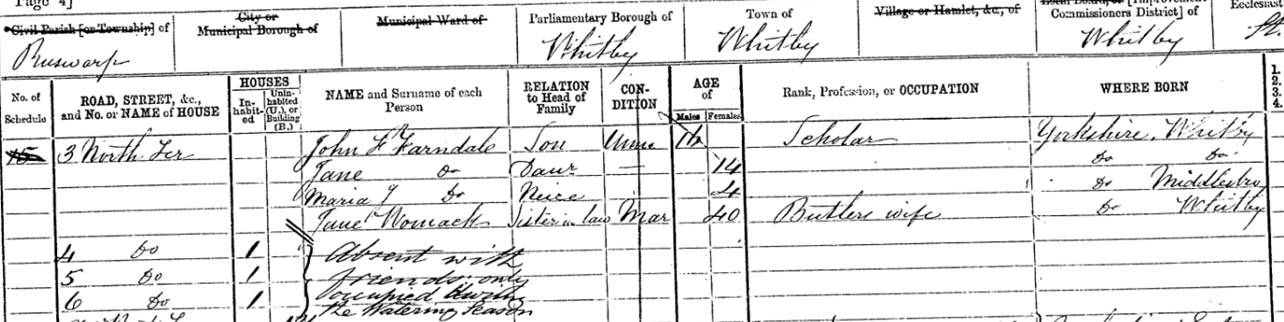
The Census of 1871 for Ruswarp, Whitby listed William Farndale, head,
married, aged 45, Master Mariner; Ann Farndale, his wife, aged 44, by then a
lodge house keeper, born at Low Hail Durham in 1827; John T
Farndale, their son, aged 16 and Jane Farndale, their daughter, aged 14, with Maria J Farndale, their niece; who they may have
adopted.
The Census
of 1871 for Ruswarp, Whitby listed William Farndale, head; married; aged
45; Master Mariner; Ann Farndale, wife; married; aged 44; lodge house
keeper; born Low Hail Durham; (ie born 1827);
John T Farndale, son; unmarried; aged 16; b Whitby; (FAR00405); Jane Farndale, daughter; aged 14 (FAR00422); Maria J Farndale, niece; aged 4; born
Middlesbro’ (ie born 1867) (FAR00485).

On 15 July
1871 The Ythan, Farndale, sailed from West Hartlepool for Deal Beach. On 6
October 1871 The Ythan, Farndale, sailed
from West Hartlepool for Deal. On 26
June 1872 The Ythan, Farndale, sailed
from Sunderland for Deal. On 24 October 1872 The
Ythan, Farndale, sailed from Shields for Deal.
The Shipping and Mercantile Gazette, 17 July 1871 showed that on 15 July 1871 The Ythan,
Farndale, sailed from West Hartlepool for Deal Beach.
The Shipping and Mercantile Gazette, 9 October 1871 showed that on 6 October 1871 The Ythan,
Farndale, sailed from West Hartlepool for Deal.
1872
The Shipping and Mercantile
Gazette, 27 June 1872 showed
that on 26 June 1872 The
Ythan, Farndale, sailed from Sunderland for Deal.
The Shipping and Mercantile
Gazette, 25 October 1872 showed
that on 24 October 1872 The Ythan, Farndale, sailed from Shields for Deal.
1873
William Farndale appears to have led a trans Atlantic voyage in February 1873. On 31 January 1873, The
China, Farndale, arrived in Liverpool from New Orleans, having
experienced very severe weather during the whole of the passage. On 27 January
1873, it had passed between Tuskar and Bardsey, through an immense quantity of
pine logs, deals and bulwarks, the latter painted blue and white, all fresh.
The crew were compelled to keep a double watch, the logs being so large and
very dangerous to shipping at night.
William Farndale appears to have
led a trans Atlantic voyage in February 1873. The Shipping and Mercantile Gazette,
1 and 3 February 1873: LIVERPOOL – Jan 31. The China, Farndale, arrived here from New Orleans,
experienced very severe weather the whole of the passage. Jan 27, between
Tuskar and Bardsey, passed through an immense quantity of pine logs, deals and
bulwarks, the latter painted blue and whte, all
fresh; was compelled to keep a double watch, the logs being so large and very
dangerous to shipping at night.
On 5 May
1873 the Ythan, Farndale, sailed from Whitby
for Hartlepool. On 24 May 1873 the
Ythan, Farndale, sailed from Shields for Dymchurch. On 26 November 1873 the
Ythan, Farndale, arrived in Whitby from Hartlepool. On 13 December the
Ythan, Farndale, sailed from Hartlepool for Whitby. On 14 December 1873 the
Ythan, Farndale, arrived in Whitby from Hartlepool.
The Shipping and Mercantile Gazette, 6 May 1873 showed that on 5 May 1873 The
Ythan, Farndale, sailed from Whitby for Hartlepool.
The Shipping and Mercantile Gazette, 26 May 1873 showed that on 24 May 1873 The Ythan,
Farndale, sailed from Shields for Dymchurch.
The Shipping and Mercantile Gazette, 27 November 1873 showed
that on 26 November 1873 The Ythan, Farndale, arrived in Whitby from Hartlepool.
The Shipping and Mercantile Gazette, 15 December 1873 showed that on 14 December 1873 The Ythan,
Farndale, arrived in Whitby from Hartlepool and the Shipping and Mercantile
Gazette, 15 December 1873: On 13 December The Ythan,
Farndale, sailed from Hartlepool for Whitby.
1874
On 5 March
1874 the Ythan, Farndale, sailed from Whitby
for Shields. On 25 March 1874 the Ythan, Farndale, sailed from Shields
for Dover. On 16 March 1875 the Ythan, Farndale, sailed from Hartlepool
for Deal Beach with coals. On 19 December 1875 the Ythan, Farndale,
sailed from Whitby for Hartlepool. On 5 July 1876 the Ythan,
Farndale, arrived in Hartlepool from Whitby. On 11 July 1876 The
Ythan, Farndale, sailed from Hartlepool for Folkestone with coals. On 27
October 1876 the Ythan, Farndale, was off Deal heading from the north to
New Romney. On 18 September 1876 the Ythan, Farndale, arrived in Whitby
from Folkestone.
The Shipping and Mercantile Gazette, 7 March 1874 showed that on 5 March 1874 The Ythan,
Farndale, sailed from Whitby for Shields.
The Sunderland Daily Echo and Shipping Gazette, 27 March
1874 showed that on 25 March 1874 The Ythan, Farndale, sailed from Shields for Dover.
1875
The Northern Echo, 17 March 1875 showed that on 16 March 1875 The Ythan,
Farndale, sailed from Hartlepool for Deal Beach with coals.
The Sunderland Daily Echo and Shipping Gazette, 21
December 1875 showed that on 19 December 1875 The Ythan, Farndale, sailed from Whitby for Hartlepool.
1876
The Shipping and Mercantile Gazette, 6 July 1876 showed that on 5 July 1876 The Ythan,
Farndale, arrived in Hartlepool from Whitby.
The Shipping and Mercantile Gazette, 12 July 1876 showed that on 11 July 1876 The Ythan,
Farndale, sailed from Hartlepool for Folkestone with coals.
The Shipping and Mercantile Gazette, 28 October 1876 showed that on 27 October 1876 The Ythan,
Farndale, was off Deal heading from the north to New Romney.
The Shipping and Mercantile Gazette, 20 September 1876 showed that on 18 September 1876 The
Ythan, Farndale, arrived in Whitby from Folkestone.
This may have been his
last voyage as a merchant captain.
On 9 December 1876, the special
business before the monthly meeting of the Trustees of the Piers and Harbour
was the appointment of a harbour master in the place of Mr William Tose,
deceased. It was resolved that Mr Robert Gibson, master mariner, be appointed
to the office, the candidates having included William Farndale. By now William
Farndale was 51, so clearly looking for a less stressful life than one on the
high seas.
The Whitby Gazette, 9 December 1876: THE
APPOINTMENT OF HARBOUR MASTER. The special business before the monthly meeting
of the Trustees of the Piers and Harbour, on Wednesday last, was the
appointment of a harbour master in the place of Mr William Tose, deceased.
… It was resolved that Mr Robert Gibson, master mariner, be appointed to the
office … The following is a list of the candidates … Wm Farndale …
By now William Farndale was 51, so clearly looking for a less stressful life
than one on the high seas.
1877
On 27
January 1877, Mr Sharrah had no lack of sailor friends to help him clear and
rearrange the furniture of the main deck of the Congress Hall for the ladies
who kindly undertook the providing and serving of the tea. The ladies included
… Mrs Farndale … There was some anxiety as to the success of the tea owing to
an increase in the price of tickets. Of late years the meeting had grown so
unwieldy by reason of the number of mischievous lads who attended that it was determined
to make a charge for admission and do away with the collection.
The Whitby Gazette, 27 January 1877: On Tuesday, Mr Sharrah had no
lack of sailor friends to help him clear and rearrange the furniture of the
main deck of the Congress Hall for the ladies who kindly undertook the
providing and serving of the tea. The ladies included … Mrs Farndale … There was
some anxiety as to the success of the tea owing to an increase in the price of
tickets. Of late years the meeting had grown so unwieldy by reason of the
number of mischievous lads who attended that it was determined to make a charge
for admission and do away with the collection...
Mr Farndale gave evidence that the deceased,
Ada Patton, had lived as servant with them about six weeks. On Saturday
morning last, a little before seven o’clock, he and Mrs Farndale were in the
front kitchen, and Ada Patton was in the back kitchen. He did not know what she
was doing. On hearing her scream he came to her
assistance and found her standing in the passage between the two kitchens with
her clothes in flames. He pushed her into the back kitchen and rolled her in
the carpet to extinguish the flames. Mrs Farndale came to his assistance with a
rug from the front kitchen which was very much burnt by being wrapped around
her. After extinguishing the flames they pulled her
clothes off and laid her on the bed. Dr Stewart was sent for and was soon in
attendance.
Ann
Farndale, wife of the first witness, said that Ada was about 15 years of age.
She was the daughter of Mr Peter Patton, jet ornament manufacturer, Cliff
Street. On Friday, the day prior to the accident, Anne Farndale gave evidence
that she went into the back kitchen where Ada had been working and found a
paraffin bottle on the floor. She asked Ada what she had been doing with the
paraffin, and she replied she had been cleaning the fire irons. This was
contrary to Ann Farndale’s orders so she asked Ada
to take it away. Ann Farndale always tells her servants not to use
paraffin and since Ada was rather young she had
cautioned her particularly about it.
On Saturday morning
Ann and William Farndale were in the front kitchen and
Ada was in the back kitchen. On hearing Ada scream William Farndale ran to her
assistance and Anne Farndale followed. After getting out the fire and
stripping the clothes off her they found she was dreadfully burnt from below
her knees to her throat. She was wearing a wincey dress, and
had only flannel petticoat on underneath. She had no stays on
or she might not have been so badly burnt.
A gentleman
lodging in the house came downstairs and ran for Dr Stewart. Ada Patton was
conscious during Saturday, but had not been since. On
asking her after the accident what she had been doing to set herself on fire,
Ada had said that she had spilt some paraffin down her dress on Friday. Ada had
left the back kitchen fire and had been cleaning out the oven top when her
dress ignited. She had left the coal rake in the oven top so that Ann Farndale had no doubt she had
caught fire in that manner.
Dr Stewart
said he was sent for about ten minutes before seven o’clock on Saturday
morning, and found Ada laid on the bed at No 3, North Terrace. He found
extensive superficial burns from the face down the front of her body. Her back
was the only part that had escaped. He attended her up to the time of her
death, which took place about ten o’clock that morning. There was no reaction,
and the deceased never rallied. Dr Stewart had administered a little stimulant to
try to cause reaction, but to no effect. He was of opinion that death was
caused by a severe shock to the nervous system, caused by excessive burning.
Ada had apparently been a healthy girl previously.
The coroner
briefly reviewed the evidence and a verdict of Accidental death by burning
and consequent shock to the nervous system was returned.
Her dress
had been saturated with paraffin oil, which she had spilled on it the previous
day. She lingered in agony for several hours.
The
Whitby Gazette, 22 June
1878:
DEATH
BY BURNING.
An
inquest was held at the Royal Hotel, on Monday, by John Buchanan Esquire,
coroner, touching the death of Ada Patton, aged 13 years, a domestic servant
in the service of Captain William farndale, No 3, North Terrace.
Mr
Farndale deposed as follows: deceased, Ada Patton, had lived as servant with
them about six weeks. On Saturday morning last, a little before seven
o’clock, he and Mrs Farndale were in the front kitchen, and deceased was in the
back kitchen. He did not know what she was doing. On hearing her scream he came
to her assistance and found her standing in the passage between the two
kitchens with her clothes in flames. He pushed her into the back kitchen
and rolled her in the carpet to extinguish the flames. Mrs Farndale came to his
assistance with a rug from the front kitchen which was very much burnt by being
wrapped around her. After extinguishing the flames they pulled her clothes off and
laid her on the bed. Dr Stewart was sent for and was soon in attendance.
Ann
farndale, wife of the first witness, said deceased was about 15 years of age.
She was the daughter of Mr Peter Patton, jet ornament manufacturer, Cliff
Street. On Friday, the day previous to the accident, witness went into the back
kitchen where deceased was working and found the paraffin bottle on the floor. She
asked deceased what she had been doing with the paraffin, and she replied she
had been cleaning the fire irons. The use of paraffin being contrary to
witness’ orders she bid her take it away. Witness always tells her servants not to use paraffin and
deceased being rather young she had cautioned her particularly about it. On
Saturday morning witness and her husband were in the front kitchen
and deceased was in the back. On hearing her scream her husband ran to her
assistance and witness followed. After getting out the fire and stripping the
clothes off her they found she was dreadfully burnt from below her knees to her
throat. She was wearing a wincey dress, and had only
flannel petticoat on underneath. She had no stays on
or she might not have been so badly burnt. A gentleman lodging in the house
came downstairs and ran for Dr Stewart. Deceased was conscious during Saturday, but had not been since. On asking her after the
accident what she had been doing to set herself on fire she said she had spilt
some paraffin down her dress on Friday. Deceased had left the back kitchen fire
and had been cleaning out the oven top when her dress ignited. She had left the
coal rake in the oven top so that witness had no doubt she had caught fire in
that manner.
Dr Stewart said he was sent for about ten
minutes before seven o’clock on Saturday morning, and
found deceased laid on the bed at No 3, North Terrace. He found extensive
superficial burns from the face down the front of her body. Her back was the
only part that had escaped. He attended her up to the time of her death, which
took place about ten o’clock that morning. There was no reaction, and the
deceased never rallied. Witness administered a little stimulant to endeavour to
cause reaction, but it did not. He was of opinion that death was caused by a
severe shock to the nervous system, caused by excessive burning. Deceased had
apparently been a healthy girl previously.
The coroner briefly reviewed the evidence and
a verdict of “Accidental death by burning and consequent shock to the nervous
system” was returned.
The
Worcestershire Chronicle,
22 June 1878: Ada Patton, living as servant with Captain
farndale, of West Cliff, Whitby, died on Monday from the effects of burning
whilst engaged in the kitchen. She spilled some paraffin on her dress, and went
too close to the fire, which, igniting her dress, the poor girl was enveloped
in flames. She was terribly burned, the whole of the front of her body being one
charred mass...
The
Edinburgh Evening News, 19
June 1878: GIRL BURNT TO DEATH AT WHITBY. Yesterday at the Royal
Hotel, Whitby, an inquest was held on the body of Ada Patton, aged 15, living
as servant with Captain Farndale, West Cliff, who met with her death by
burning. Deceased was attending to her duties on Saturday morning when her
dress caught fire, and in a moment she was completely enveloped in flames. Her
dress had been saturated with paraffin oil, which she had spilled on it the previous
day. She lingered in agony for several hours.
1881
The Census of 1881 for 3 North Terrace, Ruswarp, Whitby listed William Farndale, head,
married, aged 55, Master Mariner; Ann Farndale, his wife, aged 54; Jane
Farndale, daughter, unmarried, aged 24; and Maria J Farndale, niece, aged 14.
The Census
of 1881 for 3 North Terrace, Ruswarp, Whitby listed William Farndale, head; married, aged 55;
Master Mariner; Ann Farndale, wife; married; aged 54; born Hurwith
Durham; (ie born 1827); Jane Farndale, daughter;
unmarried; aged 24; (FAR00422); Maria J Farndale, niece; aged 14 (FAR00485).

1885
On 2 May
1885 the schooner Ythan, from Hartlepool to Folkestone with coal, was
run into by the steamer Frances, from Stavanger and sunk off the Humber.
The crew were saved. The Frances proceeded to the Tyne apparently
undamaged. The Maritime Directory gives two schooners named Ythan, one
registered at Aberdeen, built at Garmouth in 1876, of
86 tons, and owned by Mr Alexader Mitchell, Newburgh and the other registered
at Deal, built at Aberdeen, in 1837, of 76 tons, and owned by Mr William
Farndale, Whitby. From the Lloyd’s telegram it is impossible to say which
vessel is the one that has been sunk or whether William Farndale was still the
owner by then.
The
Aberdeen Free Press, 2 May 1885: LOCAL SCHOONER SUNK. A
Lloyd’s telegram states that the schooner Ythan, from Hartlepool to
Folkestone with coal, was run into and sunk on Wednesday off the Humber by
the steamer Frances, from Stavanger. The crew were sved. The Frances proceeded
to the Tyne apparently undamaged. The Maritime Directory gives two schooners
named Ythan – the one registered at Aberdeen, built at Garmouth in 1876, of 86
tons, and owned by Mr Alexader Mitchell, Newburgh; and the other registered at Deal,
built at Aberdeen, iin 1837, of 76 tons, and owned by Mr William Fandale,
Whitby. From Lloyd’s telegram it is impossible to say which vessel is
the one that has been sunk. So William Farndale was owner of the Ythan
by this time.
1887
William Farndale died at Whitby on
3 March 1887, aged 62. His death was registered in the first Quarter
of 1887 (GRO Vol 9d page
327).

Farndale, William. Personal Estate £269 10s. 2
April 1887. The Will of William Farndale late of Whitby in the County of York
Master Mariner late of Whitby who died 6 March 1887 at Whitby and proved at
York by Ann Farndale of 3 North Terrace, West Cliff, Whitby, Widow, the Relict,
the Sole Executrix. The purchasing value of £269 in
1887 is £36,000 in 2021.


The gravestone Whitby Church reads: ‘William
Farndale, died 3 March 1887, aged 62, also Ann Farndale died 16 Oct 1865, aged 70
(his mother see 244?), and Ann Farndale, died 1888
aged 62 (his wife).’ (Mon R)
1888
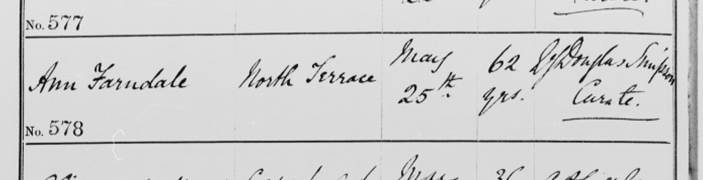
Ann Farndale died on 22 May 1888 (GRO Vol 9d page 299, Whitby PR). She was 62
years old and she was buried at St Mary’s cemetery, Whitby on 25 May 1888.

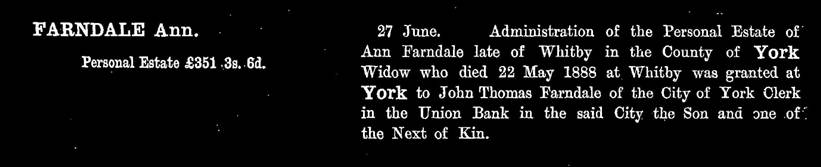
Farndale, Ann. Personal
Estate, £351 3s 6d. 27 June. Administration of the
personal estate of Ann Farndale late of Whitby in the County of York, widow,
who died 22 May 1888, at Whitby, was granted at York to John Thomas Farndale of
the City of York, Clark in the Union Bank in the said city, the son and one of
the Next of Kin. The purchasing value of £351 in 1888
is £47,000 in 2021.
The North Star (Darlington), 1 June 1888: FARNDALE.
May 22nd, at North Terrace, Whitby, Ann, widow of William Farndale,
aged 62.