Middlesbrough
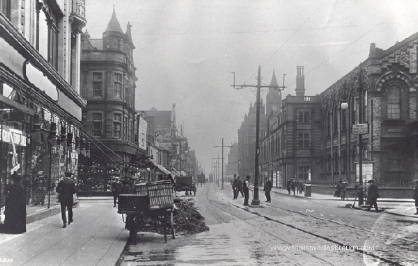
Historical and geographical information
|
Return to the Home Page of the Farndale Family
Website |
The story of one family’s journey through two
thousand years of British History |
The 83 family lines into which the family is divided.
Meet the whole family and how the wider family is related |
Members of the historical family ordered by date of
birth |
Links to other pages with historical research and
related material |
The story of the Bakers of Highfields, the Chapmans,
and other related families |
Introduction
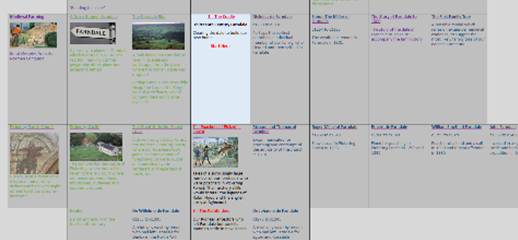
Dates are in red.
Hyperlinks to
other pages are in dark
blue.
Headlines of the
history of the Middlesbrough are in brown.
References and
citations are in turquoise.
Contextual
history is in purple.
This webpage about
the Middlesbrough has the following section headings:
· The Farndales of
Middlesbrough
· Middlesbrough, an
overview
·
Timeline of
Middlesbrough
·
Stainton
The Farndales of
Middlesbrough
The following
Farndales were associated with Middlesbrough: Richard de Farndale (FAR00016);
John Farndale (FAR00070);
John Farndale (FAR00076);
Matthew Farndale (FAR00121);
Issabel Farndale (FAR00122);
William Farndale (FAR00125);
John Farndale (FAR00168),
labourer in Middlesborough; George Farndale (FAR00215);
Joseph Farndale (FAR00228);
Henry Farndale (FAR00229);
Jane Farndale (FAR00251);
George Farndale (FAR00271),
tile maker, ironstone worker and then brick-layer of Middlesborough; Ann
Farndale (FAR00278),
servant in Middlesborough (Nunthorpe); William Farndale (FAR00283);
Elizabeth Farndale (FAR00284);
Richard Farndale (FAR00288);
Joseph Farndale (FAR00299),
Cartwright and then Joiner in Middlesborough; John H Farndale (FAR00302), Miner
of West Hartlepool who was killed aged 37 by a fall of iron stone at the Poston
Mines, Ormsby, Middlesborough; William Masterman Farndale (FAR00312),
Customs officer of Middlesborough (also referred to as a Tide Waiter of
Cleveland Port); George Farndale (FAR00333); Annie
Maria Farndale (FAR00334);
Joseph Farndale (FAR00350B),
police sergeant in Middlesborough; George Farndale (FAR00350C);
John William Farndale (FAR00454);
John W Farndale (FAR00472);
Maria J Farndale (FAR00485);
William George Farndale (FAR00492),
Clerk of Middlesborough who went to USA in 1907; Mary Jane Farndale (FAR00508);
Arthur Edwin Farndale (FAR00532);
William Leng Farndale (FAR00539);
Edith Emily Farndale (FAR00546);
John Farndale (FAR00582);
Annie Elizabeth Farndale (FAR00649);
Robert William Farndale (FAR00662);
James Farndale (FAR00669);
George W Farndale (FAR00678);
Henry Farndale (FAR00681A);
Sarah Elizabeth Farndale (FAR00693);
Arthur E Farndale (FAR00706);
Clara Farndale (FAR00713);
Alfred Farndale (FAR00721);
Dorothy Farndale (FAR00762);
Ethel Farndale (FAR00777);
Bernard Farndale (FAR00783);
Albert Farndale (FAR00820);
Ethel Farndale (FAR00831);
William H Farndale (FAR00840);
Violet Farndale (FAR00849);
James Farndale (FAR00863);
George T Farndale (FAR00871);
Rubina Farndale (FAR00873);
George T Farndale (FAR00888);
Frederick Farndale (FAR00898);
Ronald Farndale (FAR00925);
Lillian Farndale (FAR0933);
Rosalie Farndale (FAR00961);
Doreen Farndale (FAR00972);
Marion Farndale (FAR01028);
and Michael Farndale (FAR01032).
Middlesbrough
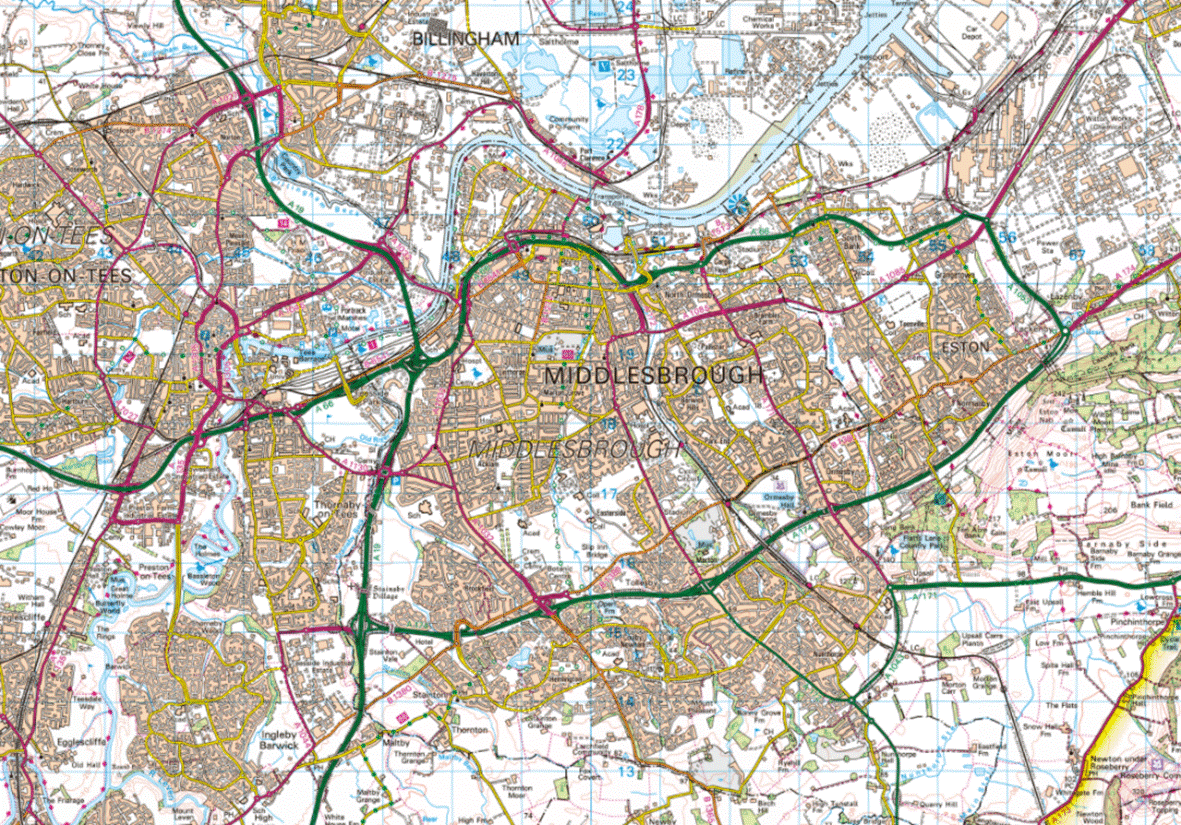
Middlesbrough
lies near the mouth of the River Tees and north of the North York Moors. Until
the early 1800s, the area was rural farmland in the historic county of
Yorkshire. The town was a planned development which started in 1830, based
around a new port with coal and later ironworks added. Steel production and
ship building began in the late 1800s, remaining associated with the town until
the post-industrial decline of the late twentieth century.
The earliest
recorded form of Middlesbrough's name is Mydilsburgh.
Some believe the name means "middle fortress", as it was midway
between the two religious houses of Durham and Whitby. It might also be an Old
English personal name (Midele or Myhailf) combined with burgh meaning town.
Middlesbrough Timeline
Bronze
Age
A Bronze Age barrow was excavated on
Upsall moor at Mount Pleasant, southeast of Middlesbrough. Before the barrow
was built, the Eston Hills at this point were subject to a sub-Boreal climatic
phase in which a forest of alder, hazel and oak flourished. The earlier flints
may belong to this period. Then the forest itself in the area of Mount Pleasant
was cleared for cultivation. In this connection, the evidence of the pollen
analysis is supported by the discovery and excavation of piles of small stones
to the south of the site, suggesting that the area had been hand-cleared.
However, in this poor soil fertility declined, bracken covered the area and the
clearing became narrower due to the encroachment of scrub woodland. These
factors tended to produce increasingly acid conditions and so the barrow was
built after the land was abandoned for cultivation purposes. (A Bronze Age Barrow at Mounty Pleasant near Normanby, North Riding, E W Sockett, Yorkshire Archaeological
Journal, Volume 43, 1971, page
33).
686
In 686,
a monastic cell was consecrated by St. Cuthbert at the request
of St. Hilda, Abbess of Whitby. The cell evolved
into Middlesbrough Priory. The manor of Middlesbrough belonged to Whitby Abbey
and Gisborough Priory.
The area
was settled by the Norsemen. Names of Viking origin are abundant in the area –
for example, Ormesby, Stainsby, Maltby and Tollesby were once separate villages that belonged
to Norsemen including Orm, Steinn, Malti and Toll. They are now suburbs of
Middlesbrough.
1086
The Victoria County History
– Yorkshire, A History of the County of York: Volume 3 Houses of Benedictine
monks: Priory of Middlesbrough, 1923: No mention of Middlesbrough by that name occurs in the
Domesday Survey, nor is there anything to show how its name arose except vague
traditions of a Roman settlement. It is never called a manor till the 16th
century; in the 11th century it was probably included in the manor of Acklam.
1119
In
1119 Robert Bruce, Lord of Cleveland and Annandale, granted and confirmed
the church of St. Hilda of Middleburg to Whitby. The Victoria County History
– Yorkshire, A History of the County of York: Volume 3 Houses of Benedictine
monks: Priory of Middlesbrough, 1974: Robert de Brus, founder of the
priory of Guisborough, granted the church of St Hilda of Middlesbrough, with
consent of his wife Agnes and Adam his son, to the abbey of Whitby, with land
in Newham, on condition that there should be monks serving God and St. Hilda in
the church of Middlesbrough, who might be sufficiently maintained by the
revenues of that church, the surplus being received by the mother church of
Whitby.
Of its medieval history little is known except that it formed part of the Bruce fee, and that a cell, dependent on the great Benedictine house of St. Hilda at Whitby, was founded here about 1120. (Ecclesiastical Middlesbrough in Medieval Times, Yorkshire Archaeological Journal, Volume 18, 1905, pages 68 to 73).
1366
The Victoria County History
– Yorkshire, A History of the County of York: Volume 3 Houses of Benedictine
monks: Priory of Middlesbrough, 1923: There is no record of mining operations carried on in the
parish by the monks, but in 1366 Isabel de Fauconberg, widow of the overlord of
Middlesbrough, had as dower 'one third of the toll of Middlesbrough and one
third of the profit arising from marl, mines of slate, iron, &c., so that
she may take profit of mining at will, and from the court of Middlesbrough for
search of the River Tees.’
1452
The
importance of the early church at "Middleburg", later known
as Middlesbrough Priory, is indicated by the fact that, in 1452, it
possessed four altars.
1537
Up until
its closure on the Dissolution of the Monasteries by Henry
VIII in 1537, St Hilda was maintained by
12 Benedictine monks, many of whom became vicars, or rectors, of
various places in Cleveland.
The Victoria County History
– Yorkshire, A History of the County of York: Volume 3 Houses of Benedictine
monks: Priory of Middlesbrough, 1923: Down to the 16th century the
land of the parish belonged for the most part to two great religious houses.
The church of Middlesbrough itself was granted by Robert de Brus to form a cell
to Whitby Abbey, and a few monks lived here down to 1534. The Priors of
Guisborough had a considerable amount of land in all the vills
of the parish and a grange at Ayresome in the township
of Linthorpe. Both Guisborough Priory and Byland
Abbey owned fisheries in the River Tees.
1791
The Victoria County History – Yorkshire,
A History of the County of York: Volume 3 Houses of Benedictine monks: Priory
of Middlesbrough, 1923: In 1791 there must
have been disused gravel-pits in the township of Middlesbrough. When on the
partition of the estate of the Hustlers their land here was assigned to Richard
William Peirse, Thomas Hustler retained the privilege of taking gravel and sand
from the Middlesbrough quarry or gravel-pit, paying Mr. Peirse 1d. a cart-load.
1801
In 1801,
Middlesbrough was a small farm with a population of just 25. During the latter
half of the nineteenth century, however, it would experience rapid growth.
The Victoria County History
– Yorkshire, A History of the County of York: Volume 3 Houses of Benedictine
monks: Priory of Middlesbrough, 1923: The population of the place at
that time must have been very small. At the beginning of the 19th century the
township was a dreary and swampy expanse, containing four farm-houses, with a
population of twenty-five persons. The church was in ruins and the churchyard
unenclosed, though it was still occasionally used as a burial place. The
township of Linthorpe appears to have been in rather
better case. Here the new village of Newport, an outport
of Stockton-on-Tees, had come into being.
1828
The
influential Quaker banker, coal mine owner and Stockton and Darlington Railway
(“S&DR”) shareholder Joseph Pease sailed up the River Tees to find a
suitable new site downriver of Stockton on which to place new coal staithes.
Joseph
Pease and a group of Quaker businessmen bought the Middlesbrough farmstead and
associated estate, which then comprised some 527 acres of land, and established
the Middlesbrough Estate Company.
Joseph
Pease was a Quaker, born on 22 June 1799 into a wealthy family. He initially
worked in the wool factories at Darlington owned by his father, Edward Pease
who also partnered George Stephenson in his engine factory at Walker,
Newcastle, and was a board member of the Stockton & Darlington Railway
where he became known as the ‘Father of the Railways’.
Joseph
became treasurer of the Stockton & Darlington Railway at the age of 25.
With the railway in need of expansion and a more convenient port necessary to
export the harvest of the Durham coalfields, the company sought a site for a
terminus on the lower Tees. Further up, the river was treacherous and almost
unnavigable, only small craft of shallow draught capable of reaching Stockton
and Yarm. The new port was to be called Port Darlington. In the face of heavy
opposition from Stockton and Yarm industrialists, who knew a new port lower
down the river would steal much of their business, it was Joseph Pease who
became prime mover in lobbying parliament to grant the necessary Act for the
Middlesbrough Railway Extension.
The Tees Navigation Company was about to
improve the river and proposed that the railway delay application to
Parliament, but, despite opposition, at a meeting in January 1828 it was
decided to proceed. A more direct northerly route from Auckland to the
Tees had been considered since 1819. This was 6 miles shorter via the route of
the S&DR, and named the Clarence
Railway in honour of the Duke of Clarence, later King William
IV. Two members of the management committee resigned, as they felt
that Stockton would be adversely affected by the line, and Meynell, the
S&DR chairman, stepped down from leadership. The Clarence Railway was
approved a few days later, with the same gauge as the S&DR. The route
of the Clarence Railway was afterwards amended to reach Samphire Batts, later
known as Port Clarence, and traffic started in
August 1833.
The
S&DR received permission for its branch on 23 May 1828 after promising to
complete the Hagger Leases Branch and to build a bridge across the Tees at
least 72 feet (22 m) wide and 19 feet (5.8 m) above low water, so as
not to affect shipping.
1829
Middlesbrough
had a population of 40 inhabitants in 1829.
The Victoria County History
– Yorkshire, A History of the County of York: Volume 3 Houses of Benedictine
monks: Priory of Middlesbrough, 1923: … the population of
Middlesbrough was forty. It seems, therefore, that the tradition of the single
house which stood in the township in 1828 is not quite correct. It was in the
latter year that the Stockton and Darlington railway was extended, largely owing
to the exertions of the Pease family, to the Middlesbrough side of the Tees.
Edward and Joseph Pease, with several other Quaker men of business, realized
the value of this tract of riverside ground as the site of a new coaling port
and purchased 500 acres on which to erect their staiths
and lay out the town. The purchasers, who styled themselves the 'Middlesbrough
Owners,' were Thomas Richardson, Henry Birkbeck, Simon Martin, Joseph Pease,
jun., Edward Pease, and Francis Gibson. Their success was phenomenal. The first
of many ships loaded with coal left Middlesbrough and passed out to sea in 1830.
1831
The Victoria County History
– Yorkshire, A History of the County of York: Volume 3 Houses of Benedictine
monks: Priory of Middlesbrough, 1923: The parish of Middlesbrough
included in 1831 the townships of Middlesbrough and Linthorpe,
and covered 2,300 acres. … The population of the parish in 1831 was 383, of the
township 154, an increase directly attributed to the extension of the railway.
During the next few years it increased in much larger proportion, and a
movement was set on foot in 1836 for building a new parish church of St. Hilda.
Money was readily contributed for the purpose, and in 1840 the church was
consecrated.
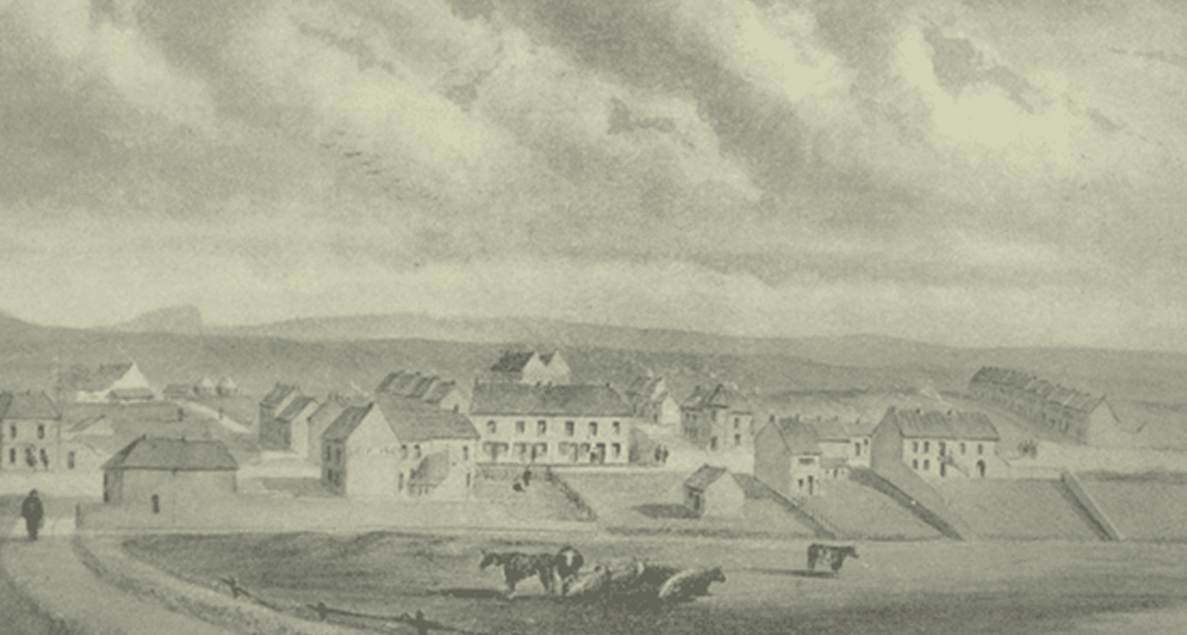
Middlesbrough,
about 1831
1832
Joseph
was elected to Parliament in 1832, representing South Durham, and became the
first Quaker to sit in the Commons. He campaigned against corruption and
slavery while fervently supporting human rights and religious freedom. He
proposed and carried a clause in the Metropolitan Police Bill prohibiting the
common pastimes of bull and bear baiting, and also sat on many committees
dealing with industry. Re-elected in 1835 and 1837 he eventually resigned from
parliament in 1841 because of heavy business commitments.
1834
By the
middle of 1834 Port Clarence had opened and 28 miles (45 km) of line was
in use. The S&DR charged the 2 1⁄4d per ton per mile landsale rate for coal it carried the 10 miles (16 km)
from the collieries to Simpasture for forwarding to
Port Clarence, rather than the lower shipping rate. By July 1834,
the Exchequer Loan Commissioners had
taken control of the Clarence Railway.
1840
A
partnership was founded in 1840 by Henry Bolckow and John Vaughan.
With his
five sons and his brother Henry, Joseph Pease formed a business called Pease
& Partners. By 1840 when Middlesbrough showed signs of stagnating, it was
clearly in his interest as one of the Owners and as a director of Pease &
Partners to attract alternative industry. The move he made was to offer Henry
Bolckow and John Vaughan land on easy terms and give them letters of
introduction when they started their iron business.
The Victoria County History
– Yorkshire, A History of the County of York: Volume 3 Houses of Benedictine
monks: Priory of Middlesbrough, 1923: It was at about this time also that Henry William
Ferdinand Bolckow and John Vaughan, the founders of Middlesbrough's most
important industry, took up their residence here. In the iron-works which they
established in Middlesbrough in 1841 they manufactured various kinds of steel
and wrought-iron.
The Iron and
Steel industry dominated the Tees area since Iron production started in
Middlesbrough during the 1840s.
1841
The Victoria County History – Yorkshire,
A History of the County of York: Volume 3 Houses of Benedictine monks: Priory
of Middlesbrough, 1923: … the newly made town, the population of
which was now more than 5,000, entered on the preliminary stage towards
incorporation. By the Middlesbrough Improvement Act of 1841 commissioners were
appointed to provide for the lighting, watching and cleansing of the streets
and the general improvement of the town. It then consisted of the township of
Middlesbrough and a piece of land of about 15 acres called Bell's Enclosure.
The commissioners had power at the same time to establish a market for green
stuff, fish, bacon, butter and butchers' meat. The farmers of the rich
Cleveland valleys made great use of this from the first.
1844
Joseph Pease
was fond of the Cleveland coast. Shortly after retiring from parliament, in
1844 he bought several fishermen’s cottages on the seafront at Marske,
demolished them then used the site to build Cliff House where his family spent
their summers.
1846
In 1846,
Bolckow and Vaughan built their first blast furnaces
at Witton Park, founding the Witton Park Ironworks. The works used coal from
Witton Park Colliery to make coke, and ironstone from Whitby on the coast. The
pig iron produced at Witton was transported to Middlesbrough for further
forging or casting.
1850
In 1850,
Vaughan and his mining geologist, John Marley discovered iron ore, conveniently
situated near Eston in the Cleveland Hills. Unknown to anyone at the time, this
vein was part of the Cleveland Ironstone Formation, which was already being
mined in Grosmont by Losh, Wilson and Bell.
1851
Middlesbrough
had grown to a population of 7,600 in 1851.
To make
use of the ore being mined at Eston, in 1851 Bolckow
and Vaughan built a blast furnace at nearby South Bank, Middlesbrough, to make
use of the ore from nearby Eston, enabling the entire process from rock to
finished products to be carried out in one place. It was the first to be built
on Teesside, on what was later nicknamed "the Steel River". The firm
drove the dramatic growth of Middlesbrough and the production of coal and iron
in the north-east of England in the nineteenth century.
The Victoria County History
– Yorkshire, A History of the County of York: Volume 3 Houses of Benedictine
monks: Priory of Middlesbrough, 1923: The first of the Middlesbrough
blast furnaces was made in [1851], and the production of pig-iron in
this district gradually increased till in 1900 it produced one-third of the
total output of Great Britain; well over a million tons were shipped from the
port in 1908. Middlesbrough is the centre both for the smelting of iron and the
manufacture of steel, and the export of these is mainly responsible for the
increasing importance of the port.
Pig
iron production rose tenfold between 1851 and 1856 and by the mid 1870's
Middlesbrough was producing one third of the entire nations Pig Iron output. It
was during this time Middlesbrough earned the nickname "Ironopolis".
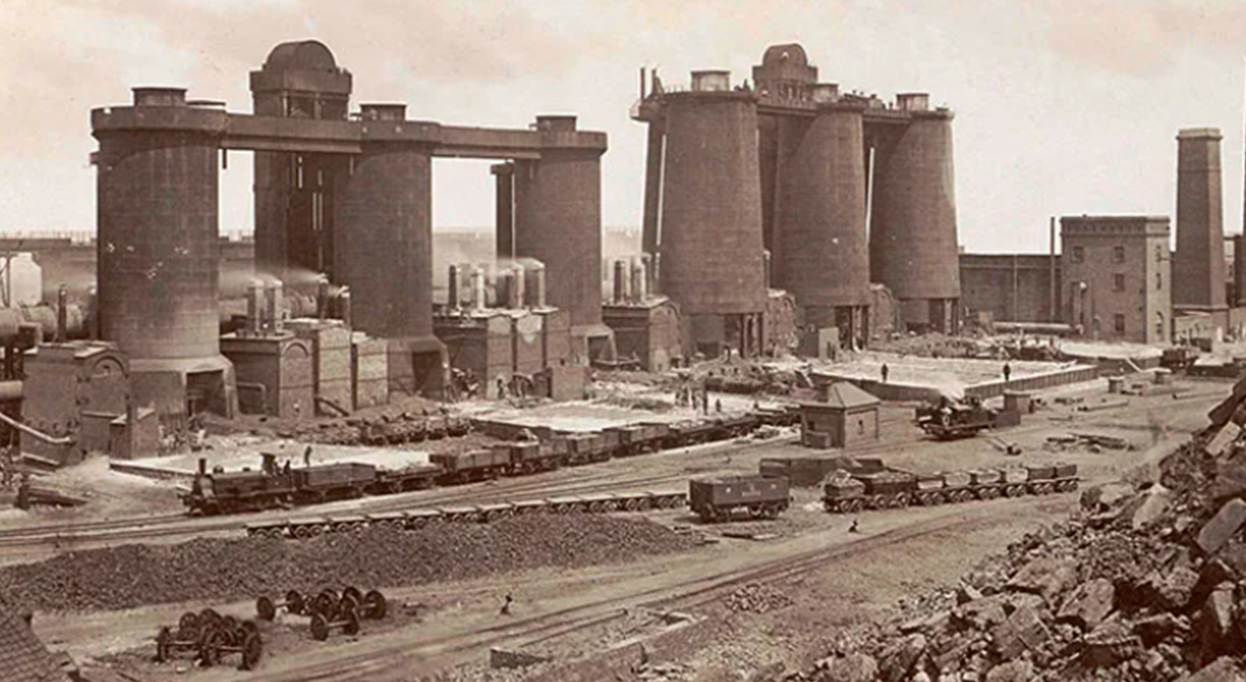
Ironopolis
1853
As the
railways pushed east beyond Redcar, Pease & Partners expanded into
ironstone mining. In 1853 they opened the Hutton Lowcross mine near
Guisborough. Soon, they owned Upleatham, Skinningrove and Hob Hill (Saltburn)
mines, between them annually producing almost a million tonnes of ore.
On 21 January 1853, Middlesbrough received its Royal Charter of Incorporation, giving the town the right to have a mayor, aldermen and councillors.
The Victoria County History
– Yorkshire, A History of the County of York: Volume 3 Houses of Benedictine
monks: Priory of Middlesbrough, 1923: In 1853 a royal charter was granted by which Middlesbrough
became a borough, and the powers of the Improvement Commissioners were vested
in a corporation under the title of the mayor, aldermen and burgesses. The
first mayor was Mr. Henry William Ferdinand Bolckow, one of the two men who had
contributed so largely towards the prosperity of the town. The corporation took
as its motto 'Erimus,' and the subsequent record of
Middlesbrough has been one of almost unchecked expansion.
Henry Bolckow
became mayor, in 1853.
Middlesbrough was
made a municipal borough in 1853. “By the provisions of its Charter, the
Corporation was authorised to have a Common Seal, which could also be used as a
Coat of Arms, and its design was entrusted to W Hylton Longstaffe, the Town
Clerk of Gateshead. There can be little doubt that he was the author of that
name who wrote “The History and Antiquities of Darlington”, which was published
in 1854, and the artist who sketched and described the remains of the
Middlesbrough Priory which came to light in 1846 with the demolition of the
Middlesbrough Farm House. As the basis of the Borough Seal, Longstaffe
borrowed the blue lion from the arms of Robert de Brus of Skelton, the 12th
century founder of the Middlesbrough Priory. To this, he added ships and
anchors to highlight the town’s importance as a seaport, while his use of black
in certain details was to denote the significance of coal in relation to its
industries. As far as a motto was concerned, he took further inspiration from
the de Brus family, whose own motto was, in the Latin, “Fuimus”
(“We have been”), denoting their former glory. Looking positively to the
future, Longstaffe opted for the Latin “Erimus” (“We shall be”).”
1857
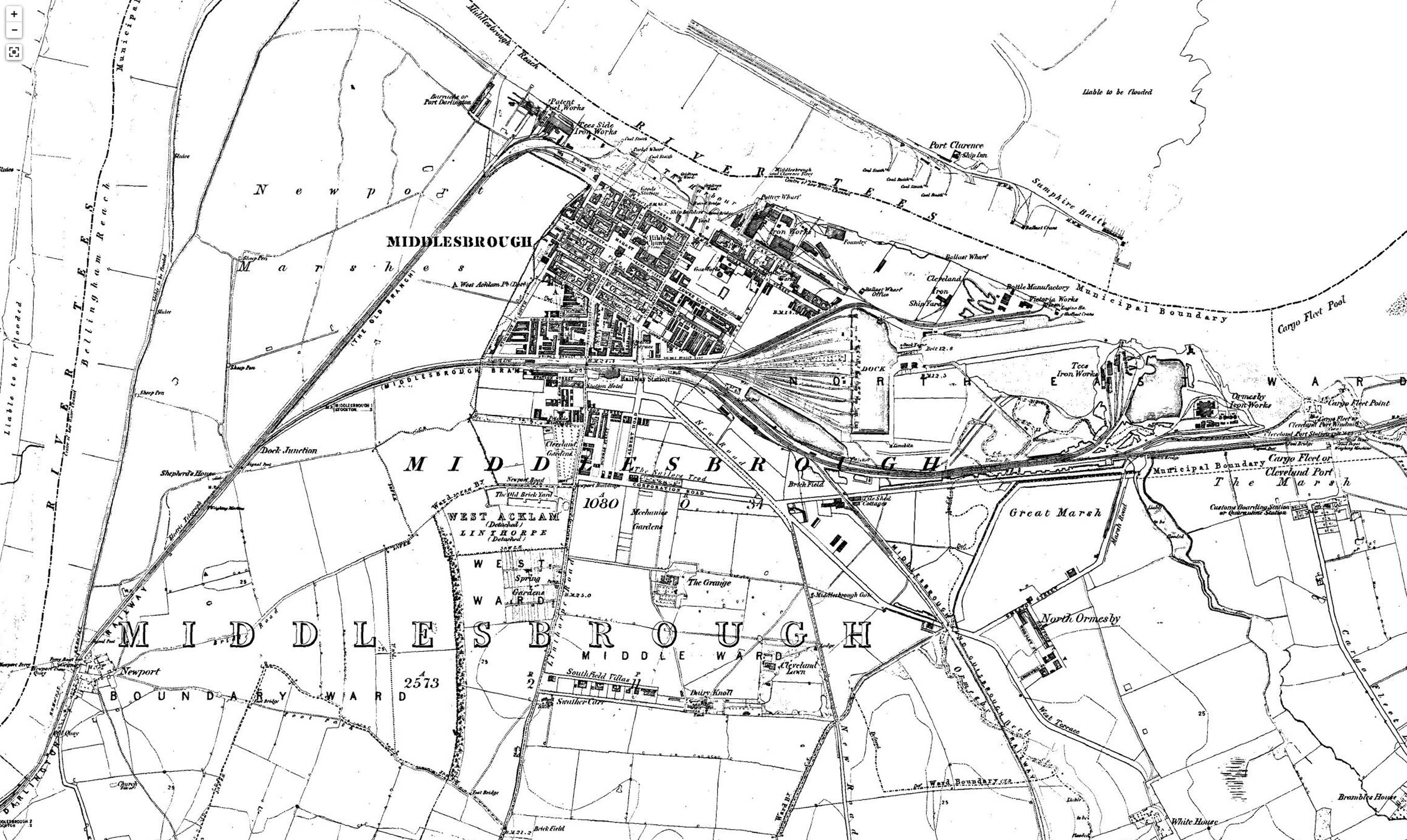
1859
It was
from Marske that one afternoon in 1859 Joseph Pease’s brother, Henry took a
stroll over the sandbanks to discover the old village of Saltburn. Returning
breathless, he stated his intention to build a new town on top of the cliff.
With some help from Joseph and the Stockton & Darlington Railway, he
succeeded, naming it Saltburn by the Sea.
1861
Middlesbrough
had grown to a population of 19,000 in 1861
1864
In 1864 Bolckow, Vaughan & Co Limited was incorporated into an
English ironmaking and mining company with capital of £2.5M, making it the
largest company ever formed up to that time. Its assets included iron mines, collieries, and
limestone quarries in Cleveland, County Durham and Weardale and had iron and
steel works extending over 700 acres (280 ha) along the banks of the River
Tees.
1867
On 15 August
1867, a Reform Bill was passed, making Middlesbrough a new parliamentary
borough, Bolckow was elected member for Middlesbrough
the following year.
1868
Vaughan died
in 1868. The Institution of Civil Engineers, in their obituary, commented on
the relationship between Vaughan and Bolckow: "There
was indeed something remarkable in the thorough division of labour in the
management of the affairs of the firm. While possessing the most unbounded
confidence in each other, the two partners never interfered in the slightest
degree with each other's work. Mr. Bolckow had the
entire management of the financial department, while Mr. Vaughan as worthily
controlled the practical work of the establishment."
1871
Middlesbrough
had grown to a population of 40,000.
The 1871 census
of England & Wales showed that Middlesbrough had the second highest
percentage of Irish born people in England after
Liverpool. This equated to 9.2% of the overall population of the district
at the time. Due to the rapid development of the town and its
industrialisation there was much need for people to work in the many blast
furnaces and steel works along the banks of the Tees. This attracted many
people from Ireland, who were in much need of work. As well as people from
Ireland, the Scottish, Welsh and overseas inhabitants made up
16% of Middlesbrough's population in 1871.
1875
By 1875,
eight and a half million tonnes of ironstone, limestone, coal and coke were
being transported, most of which was used in Teesside’s iron industry.
In 1875, Bolckow, Vaughan & Co opened the Cleveland Steelworks in Middlesbrough beginning the transition from Iron production to Steel and by the turn of the century, Teesside had become one of the major steel centres in the country and possibly the world.
1889
When elected
county councils were created in 1889, Middlesbrough was considered large enough
to provide its own county-level services and so it became a county borough,
independent from North Riding County Council.
1900
In 1900, Bolckow, Vaughan & Co had become the largest
producer of steel in Great Britain.
The population
reached 90,000.
1909
Newport Road, 1909
1914
In 1914, Dorman Long, another major steel producer from
Middlesbrough become the largest company in Britain employing a workforce of
over 20,000.
1929
By 1929 Dorman
Long was the dominant steel producer on Teesside after taking over Bolckow, Vaughan & Co and acquiring its assets. The
steel components of the Sydney Harbour Bridge (1932) were engineered
and fabricated by Dorman Long of Middlesbrough. The company was also
responsible for the New Tyne Bridge in Newcastle. The
importance of the area to the steel trade gave it the nickname "The Steel
River", referring to the River Tees and the transition from Iron to Steel.
1968
The borough of
Middlesbrough was abolished in 1968 when the area was absorbed into the larger
County Borough of Teesside.
1974
In 1974
Middlesbrough was re-established as a borough within the new county of
Cleveland.
1996
Cleveland was
abolished in 1996, since when Middlesbrough has been a unitary authority within
the ceremonial county of North Yorkshire.
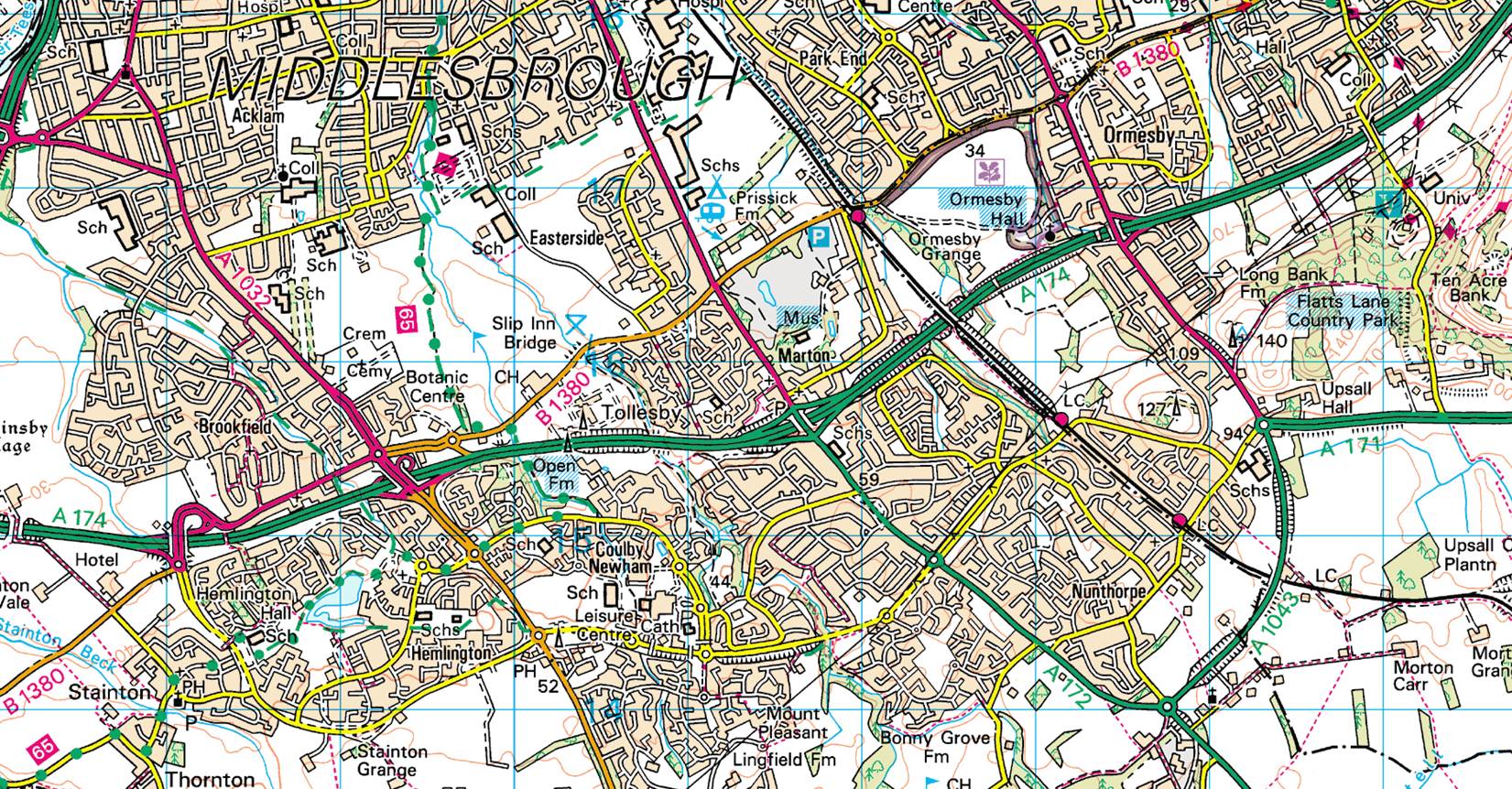
Stainton
Stainton is
a village in Middlesbrough. Stainton is one of the few areas within the
boundaries of modern day Middlesbrough to have been named in the Domesday Book of
1086. It has been a settlement since pre-Saxon times.
Its name reveals it to have been an area of Scandinavian residence.
Stainton Church
dates back to the 12th century. The Stainton Inn pub, on
Meldyke Lane, was first licensed in 1897, celebrating
its centenary in 1997. Stainton Quarry straddles Stainton Beck, between the
villages of Stainton and Thornton in Middlesbrough. A footbridge joins it to
Kell Gate Green on the other side of the beck. These countryside sites provide
three hectares of community-run open green space for local people
The parents of
the navigator Captain James Cook,
James Cook and Grace Pace, were married in the Stainton parish church on
10 October 1725, and the parish register survives.
Bibliography
Houses of
Benedictine monks: Priory of Middlesbrough, Victoria County History, Yorkshire,
A History of the County of York: Volume 3, 1923, pages 105 and
106.
Ecclesiastical Middlesbrough in Medieval Times, Yorkshire Archaeological Journal, Volume 18, 1905, pages 68 to 73.