James Cook
7 November 1728 to 14 February 1779
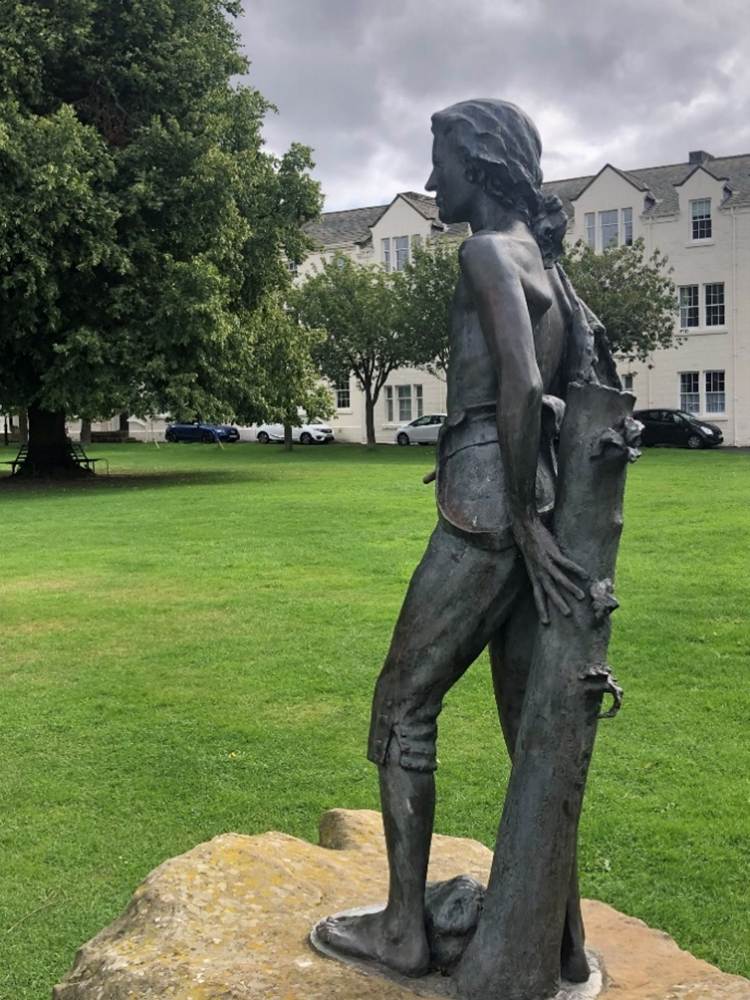
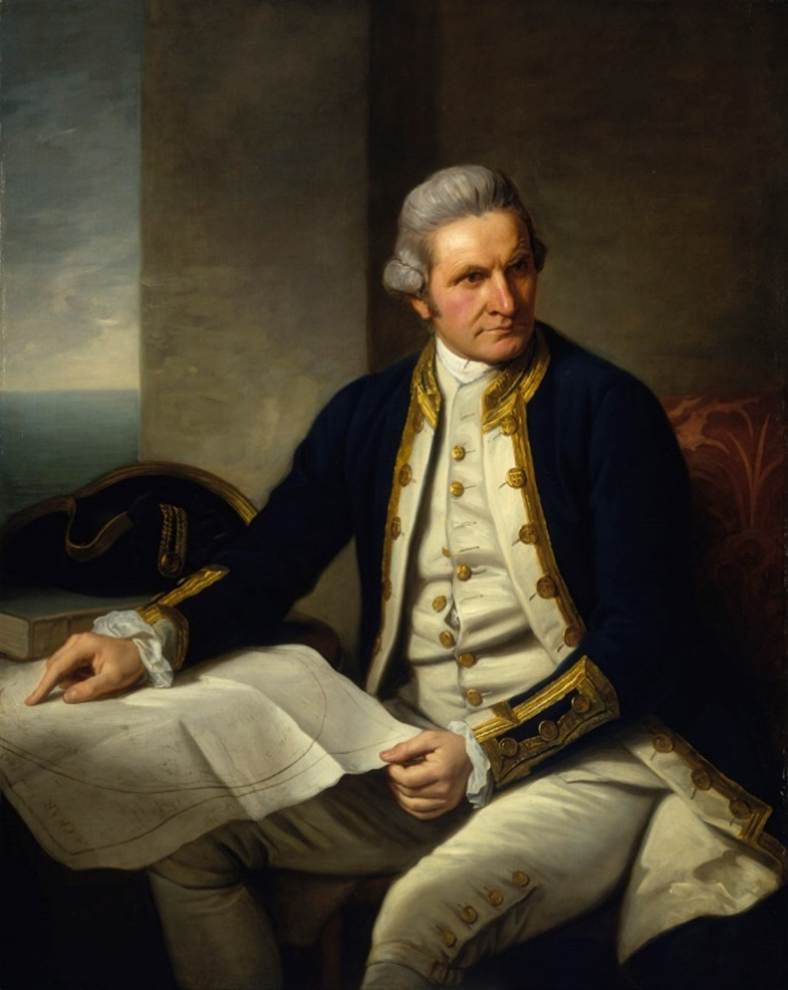
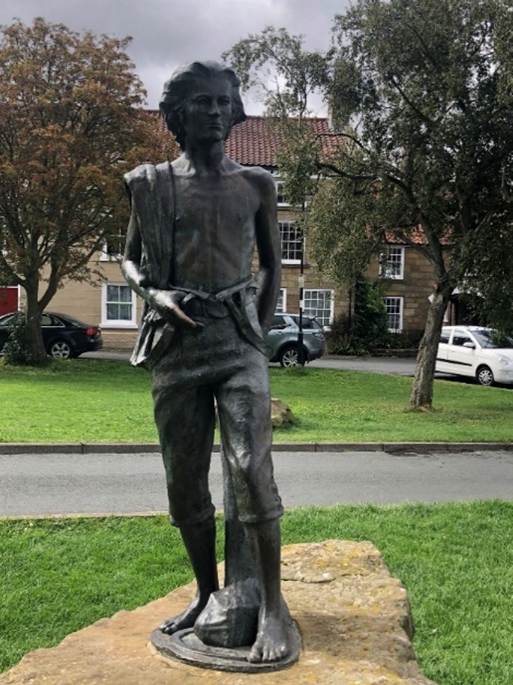
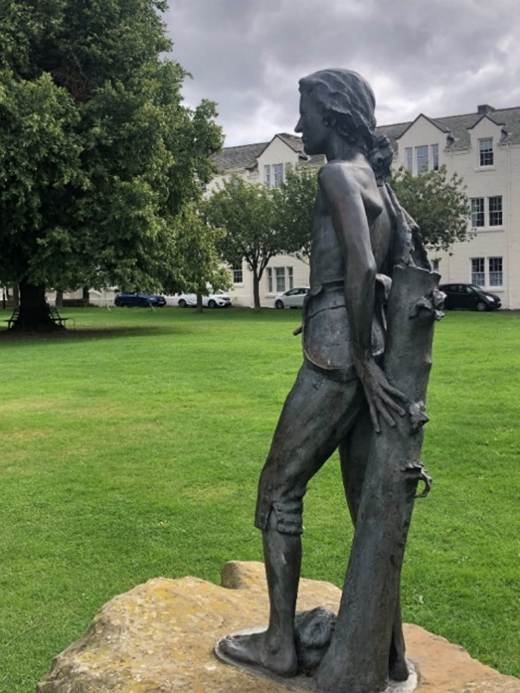
Statue of the young James Cook in Great Ayton
The Life of James cook, with whom John Farndale (FAR00136) sailed
|
Return to the Home Page of the Farndale Family
Website |
The story of one family’s journey through two
thousand years of British History |
The 83 family lines into which the family is divided.
Meet the whole family and how the wider family is related |
Members of the historical family ordered by date of
birth |
Links to other pages with historical research and
related material |
The story of the Bakers of Highfields, the Chapmans,
and other related families |
Dates are in red.
Hyperlinks to
other pages are in dark
blue.
Headlines are in brown.
References and
citations are in turquoise.
The Farndale
associations with James Cook are in purple.
This webpage is
divided into the following sections:
·
James Cook
·
The Farndales and James Cook
·
Marton and Great Ayton
·
Staithes
·
Whitby, apprenticeship and the coal trade
·
North America, Newfoundland
·
The First voyage, 1768 to 1771
·
The Second voyage, 1772 to 1775
·
The Third voyage, 1776 to 1779
·
Hawaii
·
After he died
·
Scientific contributions
·
Bibliography
James Cook
Captain James
Cook FRS was a British explorer.
He was a navigator
and cartographer.
He became a captain in the Royal Navy.
His
contributions to exploration and discovery included:
· Detailed
maps of Newfoundland;
· The
first recorded European contact with the eastern coastline of Australia;
· The
first recorded European contact with Hawaii;
· The
first recorded circumnavigation of New Zealand.

Captain
James Cook statue, Greenwich
The Farndales and James
Cook
There
were three Farndale families who lived at Great Ayton:
· The Great Ayton 1 Line who were
in Great Ayton in the late seventeenth century, just before James Cook was
born;
·
The Great Ayton 2
Line who were the descendants of Joseph Farndale who was
born in 1795; and
· The Great Ayton 3 Line who were
the descendants of Henry Farndale who was born in 1795;
Members
of the Great Ayton 1 Line,
such as Philip Farndale (FAR00092A),
born 1650 and his daughter Elizabeth Farndale (FAR00111),
born 1695 and William Farndale (FAR00093), born
1654 and his daughter Elizabeth Farndale (FAR00117),
born 1682 were probably in Great Ayton when James Cook was growing up between
1736 to 1745.
There
were six Farndale families who lived in Whitby:
· The Whitby 1 Line were the descendants
of John Farndale (FAR00087)
and were a large family in Whitby between 1636 and 1832. They included Giles
Farndale (FAR000137)
who served with the Royal Navy between 1740 and 1742 at the time James Cook was
still in Great Ayton.
· The Whitby 2 Line were the descendants
of John Farndale (FAR00136)
who sailed with James Cook on colliers.
o
There a record that John Farndill sailed on the Three
Brothers when James Cook was a seaman on the same ship between 21 November
1751 to 7 January 1752. This voyage was probably to Norway. On this voyage his
captain was Richard Ellerton, with James Cook as mate. The Three Brothers was
engaged as a transport conveying British troops from the Netherlands at the end
of the War of Austrian Succession. Later she was used for trade in the Baltic.
In 1750 her captain was John Walker.
o
John Farndill, Seaman, 45 years old, Whitby, served
seven months 12 days, on the Friendship, 30 March 1752 to 12 May 1753
when James Cook was Mate. John was paid 8/4d muster dues. On 30 March 1752, the ship sailed from Whitby to London,
where it arrived on 9 April 1752. It then sailed to Newcastle, where it arrived
on 18 April 1752. It then sailed to Norway, where it arrived on 3 May 1752. It
then returned to Newcastle on 12 May 1752, and then to Whitby on 17 May 1752.
o According
to the muster rolls of Friendship in 1753, the ship had a crew of 24
men, including Swainston and Cook. The ship left Whitby on 4 April 1753 with
James Cook as mate and returned on 26 September 1753. The voyage was probably
not very profitable, as the ship only caught one whale. It is not clear whether
John Farndale took part in this whaling expedition, but he might have done as John Farndale was a seaman named in a list of 42 of
the crew of ‘The Friendship of Whitby’ on 10 November 1753.
· The Whitby 3 Line were a small mariner
family in Whitby 1743 to the end of the eighteenth century;
· The Whitby 4 Line were a large family
in Whitby between 1773 and the late nineteenth century with several master
mariners who captained colliers and brigs.
· The Whitby 5 Line was another large
Whitby family from about 1788;
· The Whitby 6 Line were a small early
nineteenth century Whitby family.
1728
Marton and Great Ayton
James Cook was born on 7
November 1728 in Marton,
Yorkshire. James Cook was the second of 8 children of James Cook Senior (1693
to 1779), a Scottish farm labourer from Ednam, Roxburghshire, and
Grace Pace (1702 to 1765), from Thornaby-on-Tees.
He was baptised on 14 November 1728 in
the parish church of St Cuthbert (Parish Register).
He was born in a
crowded and damp cottage with clay walls and a thatched roof. His father was an
agricultural labourer who had moved to Cleveland from Scotland in search of
work. His mother came from the nearby village of Thornaby.
1733
When he was 5,
James Cook was sent to Dame Walker, a widow, to learn his alphabet and how to
read.
1736
Just
after James’ 8th birthday the family moved to Great Ayton.
James Cook Senior was employed by Thomas Skottowe as his bailiff on Aireyholme
Farm about a mile out of the village. By this time there were four children and
four more were to follow, although out of the 8, 4 died young.
After the Cook family
moved to Great Ayton, James was sent to the
Postgate school, built by Michael Postgate in 1704. This was a one storey
cottage with just one school room, above which was a garret for the master to
live in. At this small village school the local children learnt their letters
and their sums. James excelled at maths. James 's school fees were paid by
Thomas Skottowe. James Cook's teacher was called William Rowland. We know this
because he was licenced to teach at great eight and by the Archbishop of York.
Because William Rowland was also employed to write the annual churchwardens
accounts, we know he had a stylish handwriting.
1740
James Cook stayed
at school until he was 12. This was the only formal schooling that he ever
received and even this was probably interrupted because throughout his
childhood he would have been expected to help his father with farm work. When
he began work for his father, James Cook Senior had
been promoted to farm manager. These were influential and formative years for
James Cook. Despite his educational disadvantages, James became capable in
mathematics, astronomy and charting by the time of his later voyages.
From
time to time he would climb the nearby hill, Roseberry Topping,
and enjoy the solitude.
Cooks' Cottage,
his parents' last home, which he is likely to have visited, is now in Melbourne,
Australia, having been moved from England and reassembled, brick by brick, in
1934. Memories continued in Grteat Ayton of the small cottage with the initials
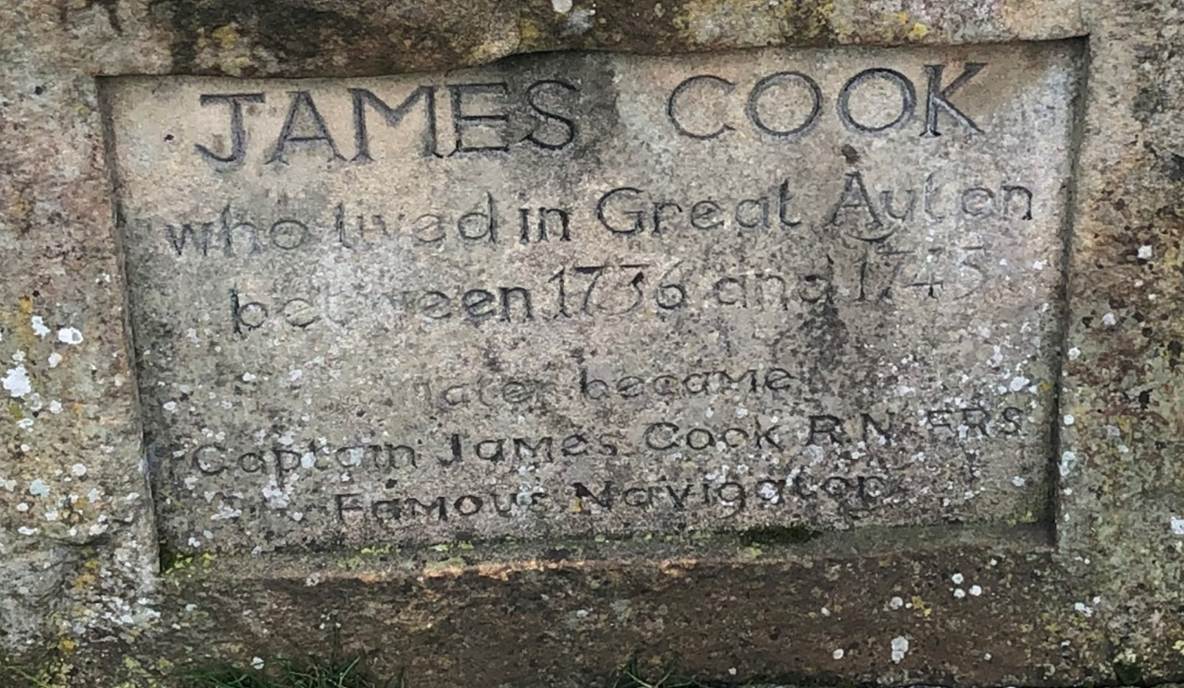
of James Cook Senior and Grace on the door. There is now a obelisk memorial
where the cottage once stood.
When he finally
left school he went to work with his father full time for a few years before
leaving home at the age of 16, when he set out for Staithes.
After his voyages
of circumnavigation he would return to visit his parents at the small cottage
at Great Ayton.
Staithes
1745
In
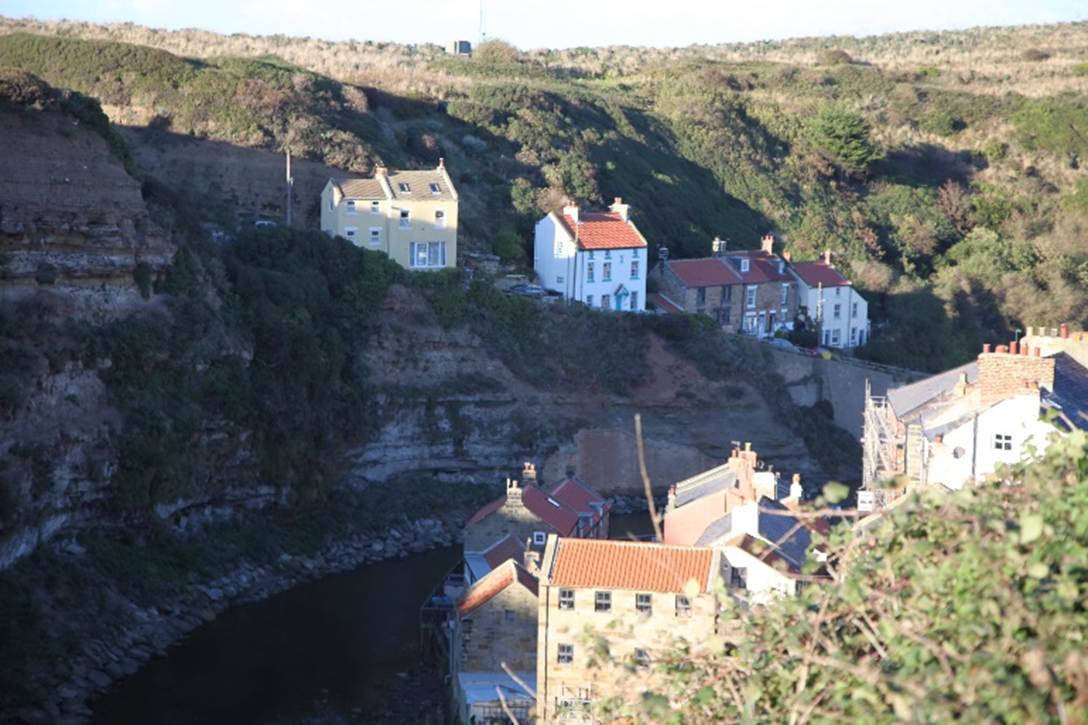
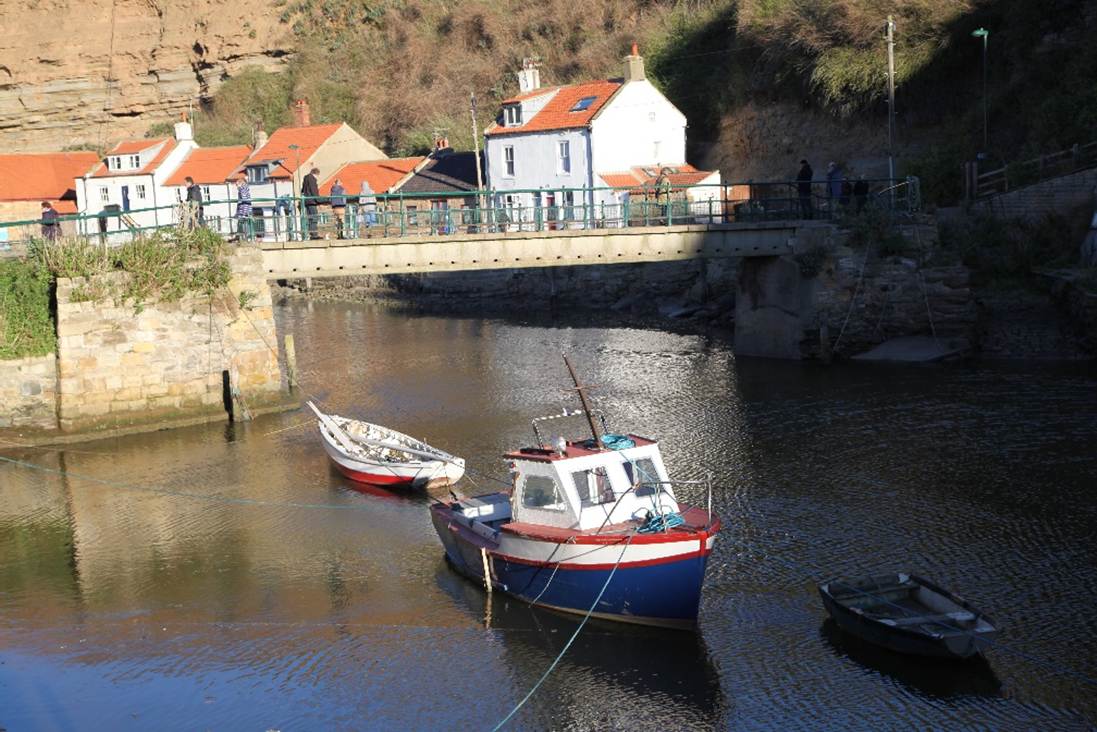
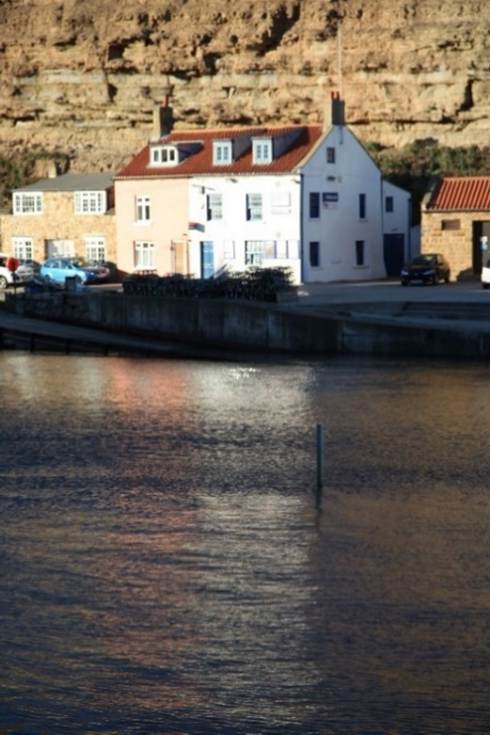
1745, at the age of seventeen, it is thought encouraged by his parents, James
Cook set out twenty miles to the fishing village of Staithes,
to be apprenticed as a
shop boy to a local merchant, William Sanderson. Sanderson
had a quayside shop and it may be that Staithes is where James Cook first felt
the lure of the sea while gazing out of the shop window. The shop was later
destroyed in a violent storm in the nineteenth century.
He
stayed only eighteen months in Staithes. He did not enjoy his grocery
apprenticeship.
Whitby, apprenticeship and
the coal trade
Cook
travelled to the nearby port town of Whitby
where he was introduced to friends of Sanderson's, John and Henry
Walker. The Walkers were Quakers and prominent local ship-owners in
the coal trade. Their house is now the Captain Cook Memorial Museum. Cook was
taken on as a sea apprentice in their small fleet of colliers, transporting
coal along the English coast.
1747
His
first voyages were on the collier Freelove, and he spent several
years on this and various other coasters, sailing between the Tyne and
London.
James Cook served on the following Whitby ships:
|
Ship |
Type of
Vessel |
Dates |
Role of
James Cook |
Overlap with John Farndale |
|
Freelove |
Collier |
29
September 1747 to 17 December 1747 |
Apprentice |
|
|
Freelove |
Collier |
26
February 1746 to 22 April 1748 |
Apprentice |
|
|
Three
Brothers |
Collier |
14 June
1748 to 14 October 1748 |
Apprentice |
|
|
Troopship
to Holland and Ireland |
14
October 1748 to 20 April 1749 |
Apprentice |
|
|
|
Three
Brothers |
Voyage
to Norway |
20
April 1749 to 26 September 1749 |
Seaman |
|
|
Three
Brothers |
Collier? |
27
September 1749 to 8 December 1749 |
Seaman |
|
|
Mary of
Whitby |
Voyage
to The Baltic |
8
February 1750 to 5 December 1750 |
Seaman |
|
|
Three
Brothers |
Collier |
19
February 1751 to 30 July 1751 |
Seaman |
|
|
Friendship |
Collier |
31 July
1751 to 8 January 1752 |
Seaman Was he
promoted to Mate by November 1751 and returned to the Three Brothers from 21
November 1751 to 7 or 8 January 1752? |
There a record that
John Farndill sailed on the Three Brothers between 21
November 1751 to 7 January 1752 This voyage was probably to
Norway. On this voyage his captain was Richard Ellerton, with James Cook as
mate. The Three Brothers was engaged as a transport conveying British troops
from the Netherlands at the end of the War of Austrian Succession. Later she
was used for trade in the Baltic. In 1750 her captain was John Walker. |
|
Friendship |
Collier |
30
March 1752 to 10 November 1752 |
Mate |
John Farndill, Seaman, 45
years old, Whitby, served seven months 12 days, on the Friendship, 30
March 1752 to 12 May 1753. Paid 8/4d muster dues. On 30 March 1752, the ship
sailed from Whitby to London, where it arrived on 9 April 1752. It then
sailed to Newcastle, where it arrived on 18 April 1752. It then sailed to
Norway, where it arrived on 3 May 1752. It then returned to Newcastle on 12
May 1752, and then to Whitby on 17 May 1752. |
|
Friendship |
Collier |
2
February 1753 to 4 February 1754 |
Mate |
According to the muster rolls
of Friendship in 1753, the ship had a crew of 24 men,
including Swainston and Cook. The ship left Whitby on 4 April 1753 and
returned on 26 September 1753. The voyage was probably not very profitable,
as the ship only caught one whale. It is not clear whether John Farndale took
part in this whaling expedition, but he might have done. John Farndale was a seaman
named in a list of 42 of the crew of ‘The Friendship of Whitby’ on 10
November 1753. |
|
Friendship |
Collier |
2 March
1754 to 28 July 1754 |
Mate |
|
|
Friendship |
Collier |
9
August 1754 to 19 December 1754 |
Mate |
|
|
Friendship |
Collier |
15
February 1755 to 14 June 1755 |
Mate |
|
|
Friendship |
Collier |
22
April 1776 |
Nil |
John Farndale was captain of
the Friendship and sailed out from Portsmouth, bound for
Whitehaven in Cumbria. |
(Clifford E Thornton, Captain Cook in Cleveland,
Middlesbrough Council, 1978; C Preston, Captain James Cook RN, FRS, Whitby
Literary Society, 1973).
As
part of his apprenticeship, Cook applied himself to the study of algebra, geometry, trigonometry, navigation and astronomy—all
skills he would need one day to command his own ship.
After
his three-year apprenticeship completed, Cook began working on trading ships in
the Baltic Sea.
1752
After
passing his examinations in 1752, he started his progress through the merchant
navy ranks. He was promoted to mate aboard
the collier brig Friendship.
1755
In
1755, within a month of being offered command of the Friendship, he volunteered for service
in the Royal Navy. At this time Britain was re-arming for what was to
become the Seven Years' War. Cook felt his career would
advance more quickly in military service. He entered service with the Royal
Navy at Wapping on
17 June 1755.
Cook's
first posting was with HMS Eagle,
serving as able seaman and master's mate under
Captain Joseph Hamar for his first year aboard, and Captain Hugh Palliser thereafter.
In
October and November 1755, he took part in Eagle's capture of one
French warship and the sinking of another. After this, he was promoted to boatswain in
addition to his other duties.
1756
Cook
was given temporary command in March 1756, when he was briefly master of Cruizer,
a small cutter attached to Eagle while on patrol.
1757
In
June 1757 Cook formally passed his master's
examinations at Trinity House, Deptford.
This qualified him to navigate and handle Royal Navy vessel.
He
next joined the frigate HMS Solebay as
master under Captain Robert Craig.
North America,
Newfoundland
During
the Seven Years' War,
Cook served in North America as master aboard the fourth-rate Navy
vessel HMS Pembroke. With others
in Pembroke's crew, he took part in the major amphibious assault that
captured the Fortress of Louisbourg from the French in
1758, and in the siege of Quebec City in
1759. Throughout his service he demonstrated a talent for surveying and cartography and
was responsible for mapping much of the
entrance to the Saint Lawrence River during
the siege, thus allowing General Wolfe to
make his famous stealth attack during the 1759 Battle of the Plains of Abraham.
1762
James
Cook married Elizabeth Batts, the daughter of Samuel
Batts, keeper of the Bell Inn in Wapping and one of his
mentors on 21 December 1762 at St Margaret's Church, Barking,
Essex.
James
and Elizabeth would have six children:
· James
Cook (1763 to 1794), who died aged 31;
· Nathaniel
Cook (1764 to 1780, lost aboard HMS Thunderer at the age of 16
when it foundered with all hands lost in a hurricane in the West Indies;
· Elizabeth
Cook (1767 to 1771), who died aged 4;
· Joseph
Cook (1768 to 1768), who died at birth;
· George
Cook (1772 to 1772), who died at birth;
· Hugh
Cook (1776 to 1793), who died of scarlet fever aged 17, while a student
at Christ's College, Cambridge.
Jamesd
Cook has no direct descendants. All of his children died before having children
of their own.
When
he was not at sea, James Cook lived in the East End of London. He attended St Paul's Church, Shadwell, where his son
James was baptised.
1763
Cook's
surveying ability was also put to use in mapping the jagged coast of Newfoundland aboard HMS Grenville.
He
surveyed the northwest stretch of Newfoundland in 1763 and 1764.
1765
Cook
surveyed the south coast of Newfoundland between the Burin Peninsula and Cape Ray in
1765 and 1766.
Cook
employed local pilots to point out the "rocks and hidden dangers"
along the south and west coasts. During the 1765 season, four pilots were
engaged at a daily pay of 4s each. John Beck was engaged for the coast west of
"Great St Lawrence", Morgan Snook for Fortune Bay,
John Dawson for Connaigre and Hermitage Bay,
and John Peck for the "Bay of Despair".
1767
Cook
surveyed the west coast of Newfoundland in 1767.
His
five seasons in Newfoundland produced the first large-scale and accurate maps
of the island's coasts and were the first scientific, large scale, hydrographic
surveys to use precise triangulation to establish land outlines.
The
experience gave Cook his mastery of practical surveying, achieved under often
adverse conditions, and brought him to the attention of the Admiralty and Royal
Society at a crucial moment both in his career and in the direction of British
overseas discovery.
Cook's
map were used into the 20th century, with copies being referenced by those
sailing Newfoundland's waters for 200 years.

James
Cook's 1775 chart of Newfoundland
Following
on from his work in Newfoundland, Cook wrote that he intended to go not only
"farther than any man has been before me, but as far as I think it is
possible for a man to go".
1768
The
Global Voyages of James Cook.

The
routes of Captain James Cook's voyages. The first voyage is shown in red,
second voyage in green, and third voyage in blue. The route of Cook's
crew following his death is shown as a dashed blue line.
1768
The First voyage, 1768 to
1771
On 25
May 1768, the Admiralty commissioned James Cook to command a scientific
voyage to the Pacific Ocean. The purpose of the voyage was to observe and
record the 1769 transit of Venus across the Sun. When combined with
observations from other places, this would help to determine the distance of
the Sun.
Cook,
at age 39, was promoted to lieutenant to grant him sufficient status to take the
command. For its part, the Royal Society agreed that Cook would receive a
one hundred guinea gratuity in addition to his Naval pay.

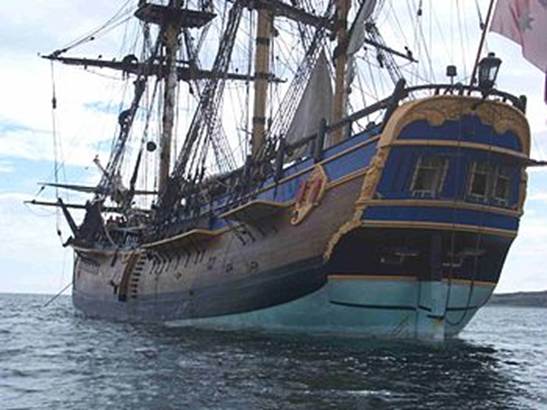
Endeavour replica in Cooktown, Queensland harbour –
anchored where the original Endeavour was beached for seven weeks in
1770 HMS Endeavour was
a collier
The
expedition sailed aboard HMS Endeavour,
departing on 26 August 1768.
1769
James
Cook and his crew rounded Cape Horn and continued westward across the Pacific,
arriving at Tahiti on 13 April 1769. Whilst in Tahiti the observations of the Venus Transit were
made. The result of the observations was not as conclusive or
accurate as had been hoped.
Once
the observations were completed, Cook opened the sealed orders which were
additional instructions from the Admiralty for the second part of his voyage.
This was to search the south
Pacific for signs of the postulated rich southern continent of Terra Australis.
Cook then sailed to New
Zealand and mapped the complete coastline, making only some minor
errors.
1770
He
then voyaged west, reaching the
southeastern coast of Australia on 19 April 1770, and
in doing so his expedition became the first recorded Europeans to have
encountered its eastern coastline.
On 23
April 1770, he made his first recorded direct observation of indigenous Australians at Brush Island near Bawley Point, noting in his journal:
"...and were so near the Shore as to distinguish several people upon
the Sea beach they appear'd to be of a very dark or black Colour but whether
this was the real colour of their skins or the Clothes they might have on I
know not."
On 29
April 1770, Cook and crew made their first landfall on the mainland of the
continent at a place now known as the Kurnell Peninsula. Cook originally christened
the area as "Stingray Bay", but later he crossed this out and named
it "Botany Bay" after
the unique specimens retrieved by the botanists Joseph Banks and Daniel Solander.
It is here that James Cook made first contact with an aboriginal tribe known as
the Gweagal.
After
his departure from Botany Bay, he continued northwards. He stopped at Bustard
Bay (now known as Seventeen Seventy) on 23 May 1770.
On 24
May 1770, Cook and Banks and others went ashore. Continuing north, on 11 June
1770 a mishap occurred when Endeavour ran aground on a shoal
of the Great Barrier Reef, and then "nursed
into a river mouth on 18 June 1770". The ship was badly damaged,
and his voyage was delayed almost seven weeks while repairs were carried out on
the beach, near the docks of modern Cooktown, Queensland, at the mouth of the Endeavour River.
The
voyage then continued and at about midday on 22 August 1770, they reached the
northernmost tip of the coast and, without leaving the ship, Cook named it Cape
York.
Leaving
the east coast, Cook turned west and nursed his battered ship through the
dangerously shallow waters of Torres Strait.
Searching for a high vantage point, Cook saw a steep hill on a nearby island
from the top of which he hoped to see 'a passage into the Indian Seas'.
He climbed the hill with three others, including Joseph Banks. On seeing a
navigable passage, he signalled the good news down to the men on the ship, who
cheered loudly.
Cook
later wrote that he had claimed possession of the east coast when up on that
hill, and named the place 'Possession Island'. However, the Admiralty's
instructions did not authorise Cook to annexe New Holland (Australia) and therefore it
is unlikely that any possession ceremony occurred that August. Importantly,
Joseph Banks, who was standing beside Cook, does not mention any such episode
or announcement in his journal.
1771
In
his revised journal entry, Cook wrote that he had claimed the entire coastline
that he had just explored as British territory. He returned to England
via Batavia, where many in his crew succumbed
to malaria.
Cook rewrote his journal on his arrival in Batavia (Jakarta) when he was
confronted with the news that the Frenchman, Louis Bougainville, had sailed across the
Pacific the previous year.
The
voyage continued around the Cape of Good Hope,
and arrived at the island of Saint Helena on
12 July 1771.
Shortly
after his return from the first voyage, James Cook was promoted in August 1771 to
the rank of commander.
1772
Cook's
journals were published upon his return, and he became something of a hero
among the scientific community. Among the general public, however, the
aristocratic botanist Joseph Banks was a greater hero. Banks even
attempted to take command of Cook's second voyage but removed himself from the
voyage before it began, and Johann Reinhold Forster and his son Georg Forster were
taken on as scientists for the voyage.
Cook's
son (his fifth child) George was born five days before he left for his second
voyage.
The Second voyage, 1772 to
1775

Portrait
of James Cook by William Hodges, who accompanied Cook on his
second voyage.
In 1772, James Cook was
commissioned to lead another scientific expedition on behalf of the Royal
Society, to search for the hypothetical Terra Australis. On his
first voyage, Cook had demonstrated by circumnavigating New Zealand that it was
not attached to a larger landmass to the south. Although he charted almost the
entire eastern coastline of Australia, showing it to be continental in size,
the Terra Australis was believed to lie further south. Despite this evidence to
the contrary, Alexander Dalrymple and others of the
Royal Society still believed that a massive southern continent should exist.
1773
Cook
commanded HMS Resolution on this voyage,
while Tobias Furneaux commanded its companion
ship, HMS Adventure. Cook's expedition
circumnavigated the globe at an extreme southern latitude, becoming one of the first to cross
the Antarctic Circle on
17 January 1773. In the Antarctic
fog, Resolution and Adventure became separated. Furneaux
made his way to New Zealand, where he lost some of his men during an encounter
with Māori, and eventually sailed back to
Britain.
1774
James
Cook continued to explore the
Antarctic, reaching 71°10'S on 31 January 1774.
Cook
almost encountered the mainland of Antarctica but
turned towards Tahiti to resupply his ship. He then resumed his southward
course in a second fruitless attempt to find the supposed continent. On this
leg of the voyage, he brought a young Tahitian named Omai, who proved to be
somewhat less knowledgeable about the Pacific than Tupaia had been on the first voyage.
On
his return voyage to New Zealand in 1774, Cook landed at the Friendly Islands, Easter Island, Norfolk Island, New Caledonia,
and Vanuatu.
Before
returning home, Cook made a final sweep across the South Atlantic from Cape Horn and
surveyed, mapped, and took possession for Britain of South Georgia, which had
been explored by the English merchant Anthony de la Roché in 1675. Cook also
discovered and named Clerke Rocks and the South Sandwich Islands ("Sandwich
Land").
1775
He
then turned north to South Africa and from there continued back to England. His
reports upon his return home put to rest the popular myth of Terra Australis.
Cook's
second voyage marked a successful employment of Larcum Kendall's
K1 copy of John Harrison's
H4 marine chronometer,
which enabled Cook to calculate his longitudinal position with much greater
accuracy. Cook's log was full of praise for this time-piece which he used to
make charts of the southern Pacific Ocean that were so remarkably accurate that
copies of them were still in use in the middle of the twentieth century.
Upon his return, Cook was
promoted to the rank of post-captain and given an
honorary retirement from the Royal Navy, with a posting as an officer of
the Greenwich Hospital. He reluctantly
accepted, insisting that he be allowed to quit the post if an opportunity for
active duty should arise. His fame extended beyond the Admiralty. He was
made a Fellow of the Royal Society and awarded the Copley Gold Medal for
completing his second voyage without losing a man to scurvy.
Nathaniel Dance-Holland painted his
portrait. He dined with James Boswell.
He was described in the House of Lords as
"the first navigator in Europe".
But
he could not be kept away from the sea. A third voyage was planned, and Cook volunteered to find
the Northwest Passage. He
travelled to the Pacific and hoped to travel east to the Atlantic, while a
simultaneous voyage travelled the opposite route.
1776
The Third voyage,
1776 to 1779
On
his last voyage, Cook again commanded HMS Resolution, while
Captain Charles Clerke commanded HMS Discovery. The voyage was
ostensibly planned to return the Pacific Islander Omai to Tahiti,
or so the public was led to believe. The trip's principal goal was to locate
a Northwest Passage around the American
continent.
1777
After
dropping Omai at Tahiti, Cook travelled north.
.jpg)
HMS Resolution and Discovery in
Tahiti
1778
In
1778 became the first European to begin formal contact with the Hawaiian Islands. A
statue of James Cook stands in Waimea, Kauai commemorating
his first contact with the Hawaiian Islands at the town's harbour in January
1778. After his initial landfall in January 1778 at Waimea harbour, Kauai, Cook named
the archipelago the
"Sandwich Islands" after the fourth Earl of Sandwich—the acting First Lord of the Admiralty.
From
the Sandwich Islands, Cook sailed north and then northeast to explore the west
coast of North America north of the Spanish settlements in Alta California.
He made landfall on the Oregon coast at approximately 44°30′ north
latitude, naming his landing point Cape Foulweather.
Bad weather forced his ships south to about 43° north before they could begin their
exploration of the coast northward.
He
unknowingly sailed past the Strait of Juan de Fuca and soon after
entered Nootka Sound on Vancouver Island.
He anchored near the First Nations village of Yuquot. Cook's two ships remained in Nootka
Sound from 29 March to 26 April 1778, in what Cook called Ship Cove, now
Resolution Cove, at the south end of Bligh Island. Relations between Cook's crew and
the people of Yuquot were cordial but sometimes strained. In trading,
the people of Yuquot demanded much more valuable items than the usual
trinkets that had worked in Hawaii. Metal objects were much desired, but the
lead, pewter, and tin traded at first soon fell into disrepute. The most
valuable items which the British received in trade were sea otter pelts.
During the stay, the Yuquot "hosts" essentially controlled the
trade with the British vessels. The natives usually visited the British vessels
at Resolution Cove instead of the British visiting the village of Yuquot
at Friendly Cove.
After
leaving Nootka Sound, Cook explored and mapped the coast all the way to
the Bering Strait, on the way identifying what came to be known
as Cook Inlet in
Alaska. In a single visit, Cook charted the
majority of the North American northwest coastline on
world maps for the first time, determined the extent of Alaska, and closed the gaps in
Russian (from the west) and Spanish (from the south) exploratory probes of the
northern limits of the Pacific.
By
the second week of August 1778, Cook was through the Bering Strait, sailing
into the Chukchi Sea. He headed northeast up the coast of Alaska until
he was blocked by sea ice. His furthest north was 70 degrees 44 minutes. Cook
then sailed west to the Siberian coast, and then southeast down the Siberian
coast back to the Bering Strait.
By
early September 1778 Cook was back in the Bering Sea to
begin the trip to the Sandwich (Hawaiian) Islands. He became increasingly
frustrated on this voyage and perhaps began to suffer from a stomach ailment;
it has been speculated that this led to irrational behaviour towards his crew,
such as forcing them to eat walrus meat,
which they had pronounced inedible.
1779
Hawaii
Cook
returned to Hawaii in 1779. After sailing around the archipelago for some eight
weeks, he made landfall at Kealakekua Bay,
on 'Hawaii Island', largest island in the Hawaiian
Archipelago. Cook's arrival coincided with the Makahiki,
a Hawaiian harvest festival of worship for the
Polynesian god Lono.
Coincidentally the form of Cook's ship, HMS Resolution, or more
particularly the mast formation, sails and rigging, resembled certain
significant artefacts that formed part of the season of
worship. Similarly, Cook's clockwise route around the island of Hawaii
before making landfall resembled the processions that took place in a clockwise
direction around the island during the Lono festivals. It has been argued (most
extensively by Marshall Sahlins) that such coincidences were
the reasons for Cook's (and to a limited extent, his crew's) initial deification by
some Hawaiians who treated Cook as an incarnation of Lono. Though
this view was first suggested by members of Cook's expedition, the idea that
any Hawaiians understood Cook to be Lono, and the evidence presented in
support of it, were later challenged.

The Death of Captain James Cook on 14
February 1779 (an unfinished painting by Johan Zoffany,
circa 1795).
After
a month's stay, Cook attempted to resume his exploration of the northern
Pacific. Shortly after leaving Hawaii Island, however, Resolution's
foremast broke, so the ships returned to Kealakekua Bay for repairs.
Tensions
rose, and a number of quarrels broke out between the Europeans and Hawaiians at
Kealakekua Bay. An unknown group of Hawaiians took one of Cook's small boats.
The evening when the cutter was taken, the people had become
"insolent" even with threats to fire upon them. Cook attempted
to kidnap and ransom the King of Hawaiʻi, Kalaniʻōpuʻu.
The
following day on 14 February 1779, Cook marched through the village to retrieve
the King. Cook took the King (aliʻi nui) by his own hand and led him willingly
away. One of Kalaniʻōpuʻu's favourite wives, Kanekapolei,
and two chiefs approached the group as they were heading to boats. They pleaded
with the King not to go. An old kahuna (priest),
chanting rapidly while holding out a coconut, attempted to distract Cook and
his men as a large crowd began to form at the shore. The King began to
understand that Cook was his enemy. As Cook turned his back to help launch
the boats, he was struck on the
head by the villagers and then stabbed to death as he fell on his face in
the surf. He
was first struck on the head with a club by a chief named Kalaimanokahoʻowaha or Kanaʻina
and then stabbed by one of the king's attendants, Nuaa. The
Hawaiians carried his body away towards the back of the town, still visible to
the ship through their spyglass. Four marines, Corporal James Thomas, Private
Theophilus Hinks, Private Thomas Fatchett and Private John Allen, were also
killed and two others were wounded in the confrontation.
James
Cook died at the age of 51.
The
esteem which the Hawaiian islanders held for Cook caused them to retain his
body. Following their practice, they prepared his body with funerary rituals
usually reserved for the chiefs and highest elders of the society. The body
was disembowelled, baked to facilitate removal of the
flesh, and the bones were carefully cleaned for preservation
as religious icons in
a fashion somewhat reminiscent of the treatment of European saints in the Middle Ages.
Some of Cook's remains, thus preserved, were eventually returned to his crew
for a formal burial at sea.
Clerke
assumed leadership of the expedition and made a final attempt to pass through
the Bering Strait. He died of tuberculosis on 22 August 1779 and John Gore, a veteran of Cook's first
voyage, took command of Resolution and of the
expedition. James King replaced Gore in command
of Discovery.
1780
The
expedition returned home, reaching England in October 1780. After their arrival
in England, King completed Cook's account of the voyage.
David
Samwell, who sailed with Cook on Resolution, wrote of him: "He
was a modest man, and rather bashful; of an agreeable lively conversation,
sensible and intelligent. In temper he was somewhat hasty, but of a disposition
the most friendly, benevolent and humane. His person was above six feet high:
and, though a good looking man, he was plain both in dress and appearance. His
face was full of expression: his nose extremely well shaped: his eyes which
were small and of a brown cast, were quick and piercing; his eyebrows
prominent, which gave his countenance altogether an air of austerity."
1830

Elizabeth Cook, by William Henderson, 1830
Memorials to James
Cook


Memorial
to James Cook and family in St Andrew the Great, Cambridge Blue plaque at
326 The Highway, Shadwell, East London
A
U.S. coin, the 1928 Hawaiian Sesquicentennial half-dollar carries Cook's image.
The site where he was
killed in Hawaii was marked in 1874 by a white obelisk.
A
nearby town is named Captain Cook, Hawaii; several Hawaiian
businesses also carry his name.
The Apollo 15 Command/Service Module Endeavour was
named after Cook's ship, HMS Endeavour,
as was the Space Shuttle Endeavour. Another
shuttle, Discovery, was named after Cook's HMS Discovery.
The
first institution of higher education in North Queensland, Australia was named
after him, with James Cook University opening in Townsville in
1970.
Numerous
institutions, landmarks and place names reflect the importance of Cook's
contributions, including the Cook Islands,
the Cook Strait, Cook Inlet,
and the Cook crater on the Moon. Aoraki/Mount Cook,
the highest summit in New Zealand, is named for him. Another Mount Cook is on the border between
the U.S. state of Alaska and the Canadian Yukon Territory, and
is designated Boundary Peak 182 as one of the official Boundary Peaks of
the Hay–Herbert Treaty.
A
life-size statue of Cook upon a column stands in Hyde Park located
in the centre of Sydney. A large aquatic monument is planned for Cook's landing
place at Botany Bay, Sydney.
One
of the earliest monuments to Cook in the United Kingdom is located at The Vache,
erected in 1780 by Admiral Hugh Palliser,
a contemporary of Cook and one-time owner of the estate. A huge obelisk
was built in 1827 as a monument to Cook on Easby Moor overlooking
his boyhood village of Great Ayton, along
with a smaller monument at the former location of Cook's cottage.
There
is also a monument to Cook in the church of St Andrew the Great, St Andrew's Street, Cambridge, where his
sons Hugh, a student at Christ's College, and James were buried. Cook's widow
Elizabeth was also buried in the church and in her will left money for the
memorial's upkeep.
The
250th anniversary of Cook's birth was marked at the site of his birthplace
in Marton, by the opening of the Captain Cook Birthplace Museum, located
within Stewart Park (1978). A granite vase
just to the south of the museum marks the approximate spot where he was
born.
Tributes
also abound in post-industrial Middlesbrough, including a primary school, shopping
square and the Bottle 'O Notes, a public artwork by Claes Oldenburg,
that was erected in the town's Central Gardens in 1993.
Also
named after Cook is the James Cook University Hospital, a major
teaching hospital which opened in 2003 with a railway station serving it
called James Cook opening in 2014.
The
Royal Research Ship RRS James
Cook was built in 2006 to replace the RRS Charles Darwin in the UK's Royal
Research Fleet, and Stepney Historical Trust placed a plaque
on Free Trade Wharf in the Highway, Shadwell to commemorate his life in the
East End of London.
In
2002 Cook was placed at number 12 in the BBC's poll of the 100 Greatest Britons.
Scientific
contributions
Cook's
12 years sailing around the Pacific Ocean contributed much to European
knowledge of the area.
Several
islands such as the Sandwich Islands (Hawaii) were encountered for the first
time by Europeans, and his more accurate navigational charting of large areas
of the Pacific was a major achievement.
To
create accurate maps, latitude and longitude must be accurately determined.
Navigators had been able to work out latitude accurately for centuries by
measuring the angle of the sun or a star above the horizon with an instrument
such as a backstaff or quadrant. Longitude was more difficult to
measure accurately because it requires precise knowledge of the time difference
between points on the surface of the earth. The Earth turns a full 360 degrees
relative to the sun each day. Thus longitude corresponds to time - 15 degrees
every hour, or 1 degree every 4 minutes.
Cook
gathered accurate longitude measurements during his first voyage using his
navigational skills and the help of astronomer Charles Green, and by using the newly
published Nautical Almanac tables, via the lunar distance method (measuring the
angular distance from the moon to either the sun during daytime or one of eight
bright stars during night-time to determine the time at the Royal Observatory, Greenwich, and
comparing that to his local time determined via the altitude of the sun, moon,
or stars).
On
his second voyage, Cook used the K1 chronometer made by Larcum Kendall,
which was the shape of a large pocket watch,
5 inches (13 cm) in diameter. It was a copy of the H4 clock made by John Harrison,
which proved to be the first to keep accurate time at sea when used on the
ship Deptford's journey to Jamaica in
1761–62.
Cook
succeeded in circumnavigating the world on his first voyage without losing a
single man to scurvy,
an unusual accomplishment at the time. He tested several preventive measures,
but the most important was frequent replenishment of fresh food. It was
for presenting a paper on this aspect of the voyage to the Royal Society that
he was presented with the Copley Medal in
1776.
Ever
the observer, Cook was the first European to have extensive contact with
various people of the Pacific. He correctly postulated a link among all the
Pacific peoples, despite their being separated by great ocean stretches. Cook
theorised that Polynesians originated from Asia, which scientist Bryan Sykes later
verified.
In
New Zealand the coming of Cook is often used to signify the onset of
colonisation.
Cook
carried several scientists on his voyages. They made significant observations
and discoveries. Two botanists, Joseph Banks and
Swede Daniel Solander, were on the first voyage. The
two collected over 3,000 plant species. Banks subsequently strongly
promoted British settlement of Australia.
Artists
also sailed on Cook's first voyage. Sydney Parkinson was
heavily involved in documenting the botanists' findings, completing 264
drawings before his death near the end of the voyage. They were of immense
scientific value to British botanists. Cook's second expedition
included William Hodges, who produced notable landscape
paintings of Tahiti, Easter Island,
and other locations.
Several
officers who served under Cook went on to distinctive accomplishments.
William Bligh,
Cook's sailing master, was given command of HMS Bounty in
1787 to sail to Tahiti and return with breadfruit.
Bligh is most known for the mutiny of his crew which resulted in his
being set adrift in 1789. He later became governor of New South Wales, where he was
the subject of another mutiny—the Rum Rebellion.
George Vancouver,
one of Cook's midshipmen, led a voyage of exploration to the Pacific Coast of North
America from 1791 to 1794. In honour of his former
commander, Vancouver's ship was named Discovery.
George Dixon, who sailed under Cook on his
third expedition, later commanded his own.
Henry Roberts, a lieutenant under Cook,
spent many years after that voyage preparing the detailed charts that went into
Cook's posthumous atlas, published around 1784.
Cook's
contributions to knowledge were internationally recognised during his lifetime.
In 1779, while the American colonies were fighting Britain for their independence, Benjamin Franklin wrote
to captains of colonial warships at sea, recommending that if they came into
contact with Cook's vessel, they were to "not consider her an enemy,
nor suffer any plunder to be made of the effects contained in her, nor obstruct
her immediate return to England by detaining her or sending her into any other
part of Europe or to America; but that you treat the said Captain Cook and his
people with all civility and kindness ... as common friends to mankind."
Unknown to Franklin, Cook had met his death a month before this safe conduct "passport"
was written.
Cook's
voyages were involved in another unusual first. The first recorded
circumnavigation of the world by an animal was by Cook's goat, who made that
memorable journey twice; the first time on HMS Dolphin, under Samuel Wallis,
and then aboard Endeavour. When they returned to England, Cook had
the goat presented with a silver collar engraved with lines from Samuel Johnson: Perpetui,
ambita bis terra, praemia lactis Haec habet altrici Capra secunda Jovis. "In
fame scarce second to the nurse of Jove, This Goat, who twice the world had
traversed round, Deserving both her master's care and love, Ease and perpetual
pasture now has found.") She was put to pasture on Cook's farm outside
London and was reportedly admitted to the privileges of the Royal Naval Hospital at Greenwich.
Cook's journal recorded the date of the goat's death: 28 March 1772.
Bibliography
The Captain
Cook Tour.
The website of Captain Cook Society
http://www.cookmuseumwhitby.co.uk/captain-cook/cook-in-whitby
The Australian Museum acquired
its "Cook Collection" in 1894 from the Government of New South Wales. At that
time the collection consisted of 115 artefacts collected on Cook's three
voyages throughout the Pacific Ocean, during the period 1768–80, along with
documents and memorabilia related to these voyages. Many of the ethnographic artefacts
were collected at a time of first contact between Pacific Peoples and Europeans.
In 1935 most of the documents and memorabilia were transferred to the Mitchell
Library in the State Library of New South Wales. The
provenance of the collection shows that the objects remained in the hands of
Cook's widow Elizabeth Cook, and her descendants, until 1886. In this year John
Mackrell, the great-nephew of Isaac Smith, Elizabeth Cook's cousin,
organised the display of this collection at the request of the NSW Government
at the Colonial and Indian Exhibition in
London. In 1887 the London-based Agent-General for
the New South Wales Government, Saul Samuel, bought John Mackrell's items and
also acquired items belonging to the other relatives Reverend Canon Frederick
Bennett, Mrs Thomas Langton, H.M.C. Alexander, and William Adams. The
collection remained with the Colonial Secretary of NSW until 1894, when it was
transferred to the Australian Museum.