22 May 1709 (baptised) to 28 March 1790 (buried)
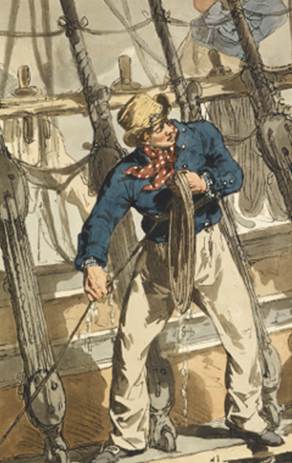
John Farndale
served alongside James Cook, discoverer of the Southern Continent, on colliers
out of Whitby
FAR00136
|
Return to the Home
Page of the Farndale Family Website |
The story of one
family’s journey through two thousand years of British History |
The 83 family lines
into which the family is divided. Meet the whole family and how the wider
family is related |
Members of the
historical family ordered by date of birth |
Links to other pages with
historical research and related material |
The story of the
Bakers of Highfields, the Chapmans, and other related families |
John Farndale served on colliers alongside James
Cook, discoverer of the Southern Continent, on colliers
out of Whitby.
Dates are in red.
Hyperlinks to
other pages are in dark
blue.
Headlines of
John’s life are in brown.
References and citations
are in turquoise.
Context and local
history are in purple.
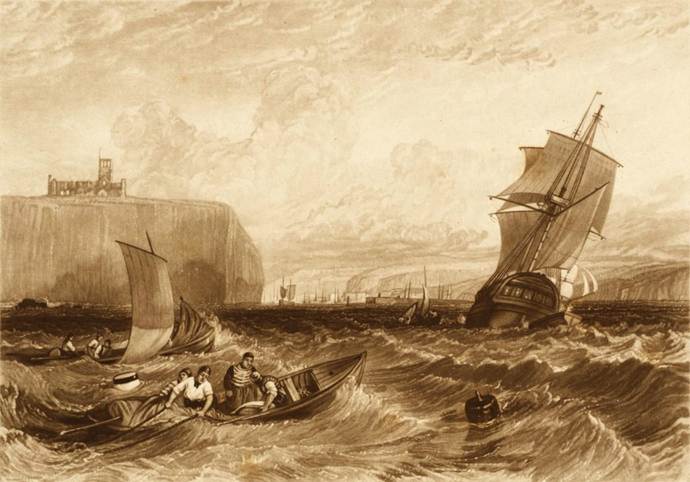
Eighteenth century
Whitby
1709
John, son of Thomas
Farndale, was baptised at St Mary the Virgin, Whitby on 22 May 1709 (Whitby PR). He was the son of
Thomas and Sarah (nee Perkins) Farndale (FAR00118), a carpenter of
Whitby. John’s first
son is called Thomas, after his grandfather.

His brother was Giles Farndale (FAR00137), who served in the Royal Navy and died at sea in the
Spanish Main.
1736
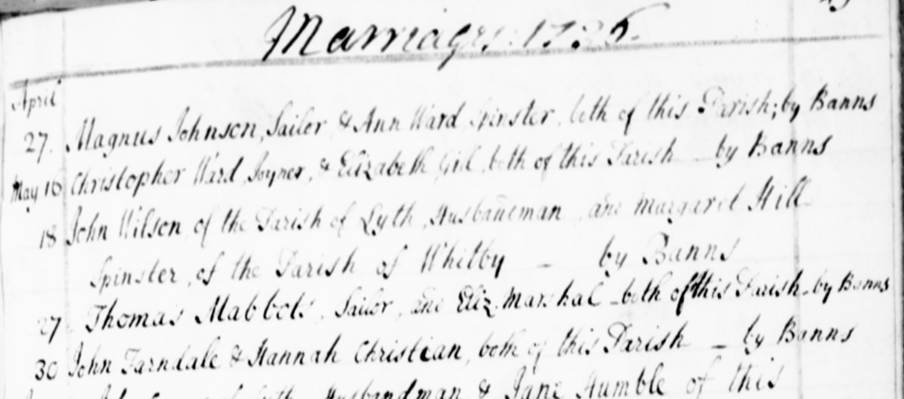
John Farndale,
married Hannah Christian also of Whitby at Whitby Parish Church by
Banns on 30 May 1736 (Whitby PR, Boyds Marriage
Index 1538 to 1850). John would have been 27 when he was married.
1737
Sarah Farndale, daughter of John and Hannah
Farndale of Whitby, sailor, baptised Whitby 19 Mar 1737 (FAR00150) (Whitby PR).
1739
Thomas Farndale, son of John and Hannah Farndale,
sailor baptised Whitby 30 Sep 1739 (FAR00153) (Whitby PR).
1743
John Farndale, son of John and Hannah Farndale,
sailor baptised Whitby 16 Oct 1743 (FAR00159) (Whitby PR).
1747
Hannah Farndale, daughter of John and Hannah
Farndale, sailor, baptised Whitby 27 Dec 1747 (FAR00162) (Whitby PR).
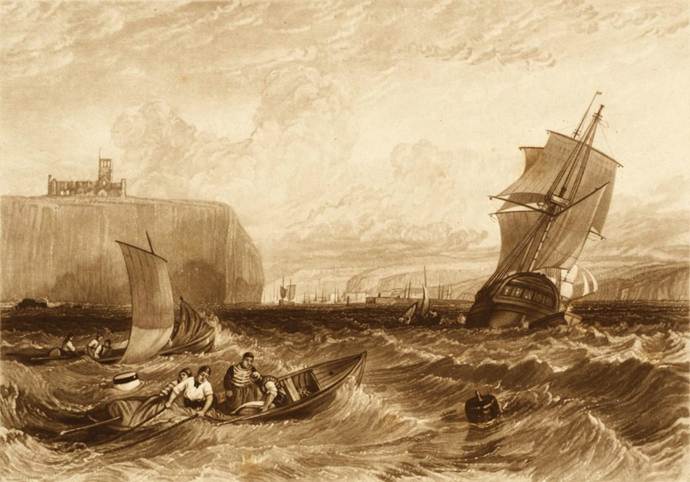
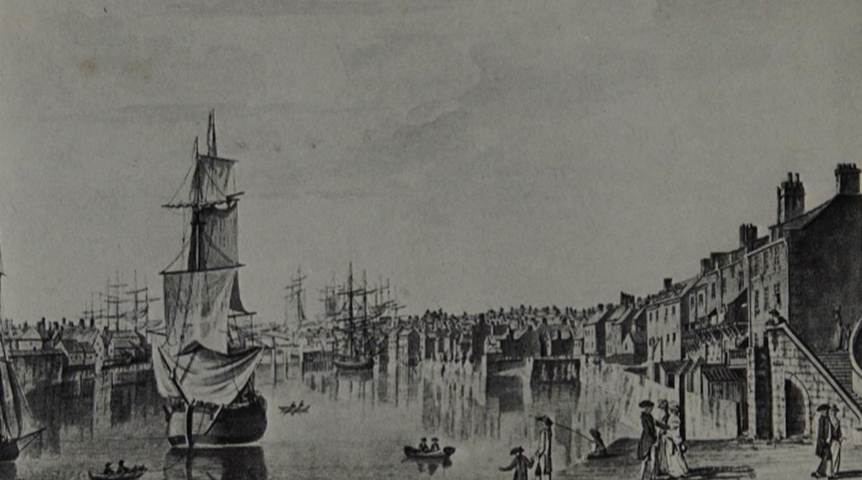
Eighteenth century Whitby
1751
John Farndill sailed
on the Three Brothers between 21 November 1751 to 7 January 1752:

He was aged 45, so this is consistent with birth in 1709. This
voyage was probably to Norway. On this voyage his captain was Richard Ellerton, with James Cook as mate.
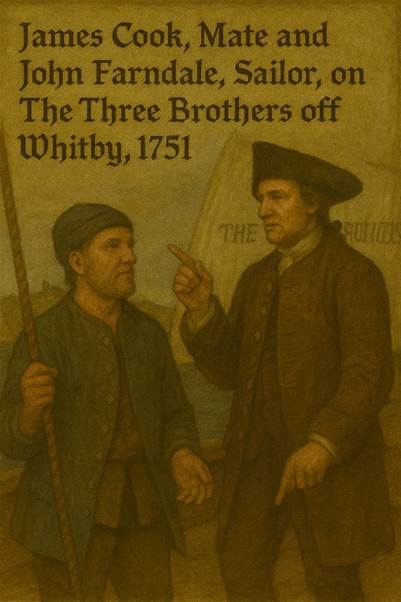
November 1751 to January 1752
John Farndill sailed on the Three
Brothers between 21 November 1751 to 7 January 1752. On this voyage his
captain was Richard Ellerton, with James Cook as mate. The Three Brothers
was engaged as a transport ship, conveying British troops from the Netherlands
at the end of the War of Austrian Succession. Later she was used for trade in
the Baltic, probably sailing to Norway.
The Three Brothers was engaged as a transport
conveying British troops from the Netherlands at the end of the War of Austrian
Succession. Later she was used for trade in the Baltic. In 1750 her captain was
John Walker.
So we know that John Farndale served with James Cook, the famous explorer, soon to embark on three famous
voyages to the southern continent and around the globe.
James Cook served on the following Whitby ships:
|
Ship |
Type of Vessel |
Dates |
Role of James Cook |
Overlap with John Farndale |
|
Freelove |
Collier |
29 September 1747 to 17 December 1747 |
Apprentice |
|
|
Freelove |
Collier |
26 February 1746 to 22 April 1748 |
Apprentice |
|
|
Three Brothers |
Collier |
14 June 1748 to 14 October 1748 |
Apprentice |
|
|
Troopship
to Holland and Ireland |
14
October 1748 to 20 April 1749 |
Apprentice |
|
|
|
Three
Brothers |
Voyage
to Norway |
20
April 1749 to 26 September 1749 |
Seaman |
|
|
Three
Brothers |
Collier? |
27
September 1749 to 8 December 1749 |
Seaman |
|
|
Mary
of Whitby |
Voyage
to The Baltic |
8
February 1750 to 5 December 1750 |
Seaman |
|
|
Three
Brothers |
Collier |
19
February 1751 to 30 July 1751 |
Seaman |
|
|
Friendship |
Collier |
Seaman Was
he promoted to Mate by November 1751 and returned to the Three Brothers from
21 November 1751 to 7 or 8 January 1752? |
There a record that
John Farndill sailed on the Three Brothers between 21 November 1751
to 7 January 1752 |
|
|
Friendship |
Collier |
30
March 1752 to 10 November 1752 |
Mate |
|
|
Friendship |
Collier |
Mate |
|
|
|
Friendship |
Collier |
2
March 1754 to 28 July 1754 |
Mate |
|
|
Friendship |
Collier |
9
August 1754 to 19 December 1754 |
Mate |
|
|
Friendship |
Collier |
15
February 1755 to 14 June 1755 |
Mate |
|
|
Friendship |
Collier |
22 April 1776 |
Nil |
John Farndale
was captain of the Friendship and sailed out from Portsmouth, bound
for Whitehaven in Cumbria. |
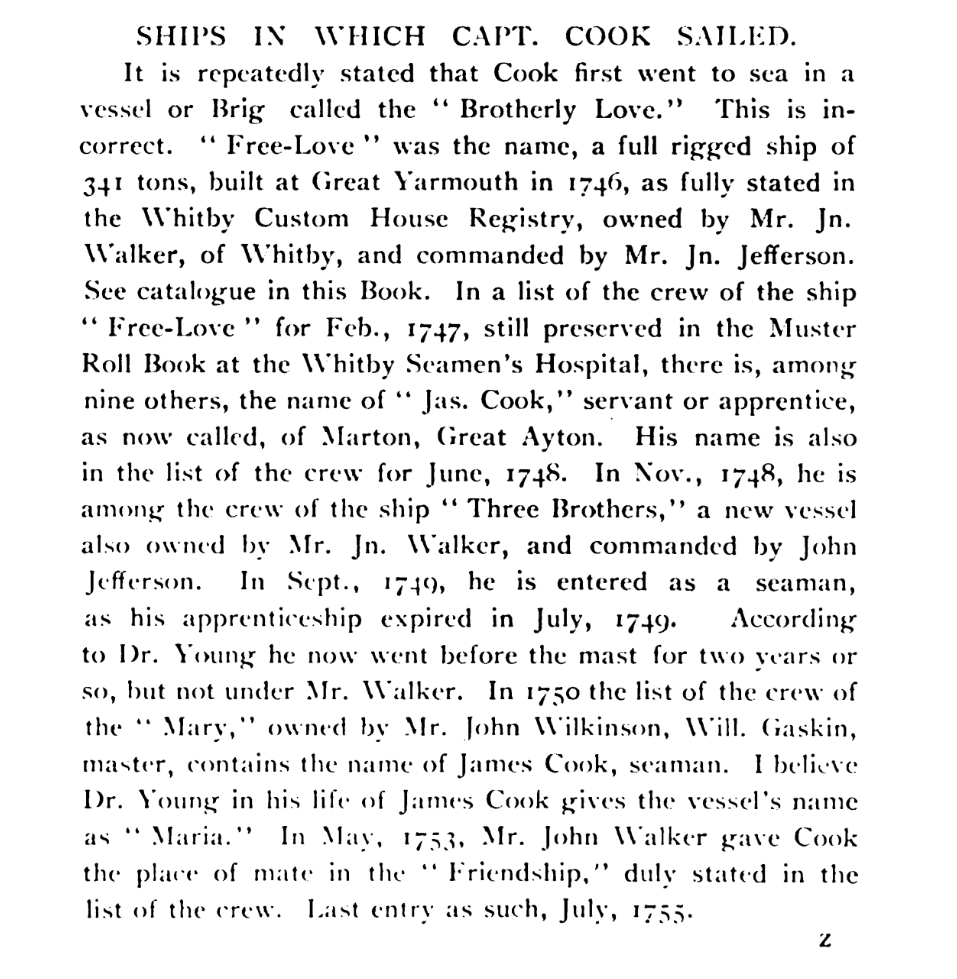
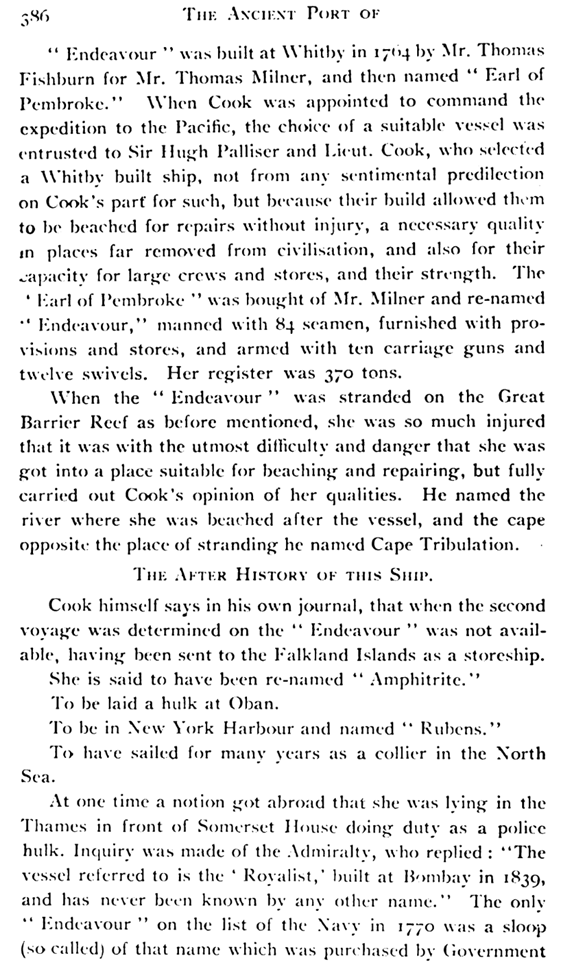
(From Richard Weatherill. 1908. The Ancient Port of Whitby and Its Shipping. Whitby: Horne and Son, Haithi Trust.
Page 385).
James Cook spent nine years in Whitby,
three as apprentice and six as a seaman and later mate for Captain Walker’s
shipping service. These years had a profound influence on his later life and
career.
Coal Cats
Whitby
in the mid eighteenth century was a centre of shipbuilding. The town was
highly prosperous, and the heart of the coal-carrying trade between Newcastle
and London. It was the sixth biggest ship-building port in the country outside
London.
There
were many shipyards, mostly on the banks of the river Esk,
several dry-docks, three ropewalks for manufacturing the cordage needed for
ships, sail-making lofts, and even sailcloth manufactories from 1756. It was a place
teeming with highly skilled craftsmen. Tough, capacious collier barks,
sometimes called cat-built barks, or simply ‘cats’, were being built.
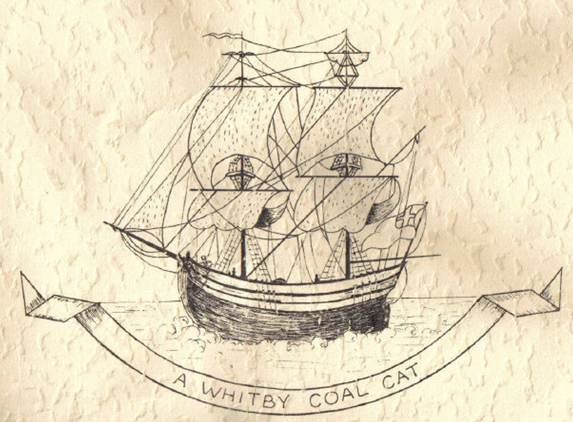
William
Falconer's Dictionary of the Marine, 1769, as corrected by Thomas Cadell
in 1780, defines cat as "(chatte,
Fr.) a ship employed in the coal trade, formed from the Norwegian model. It is
distinguished by a narrow stern, projecting quarters, a deep waist, and by
having no ornamental figure on the prow."
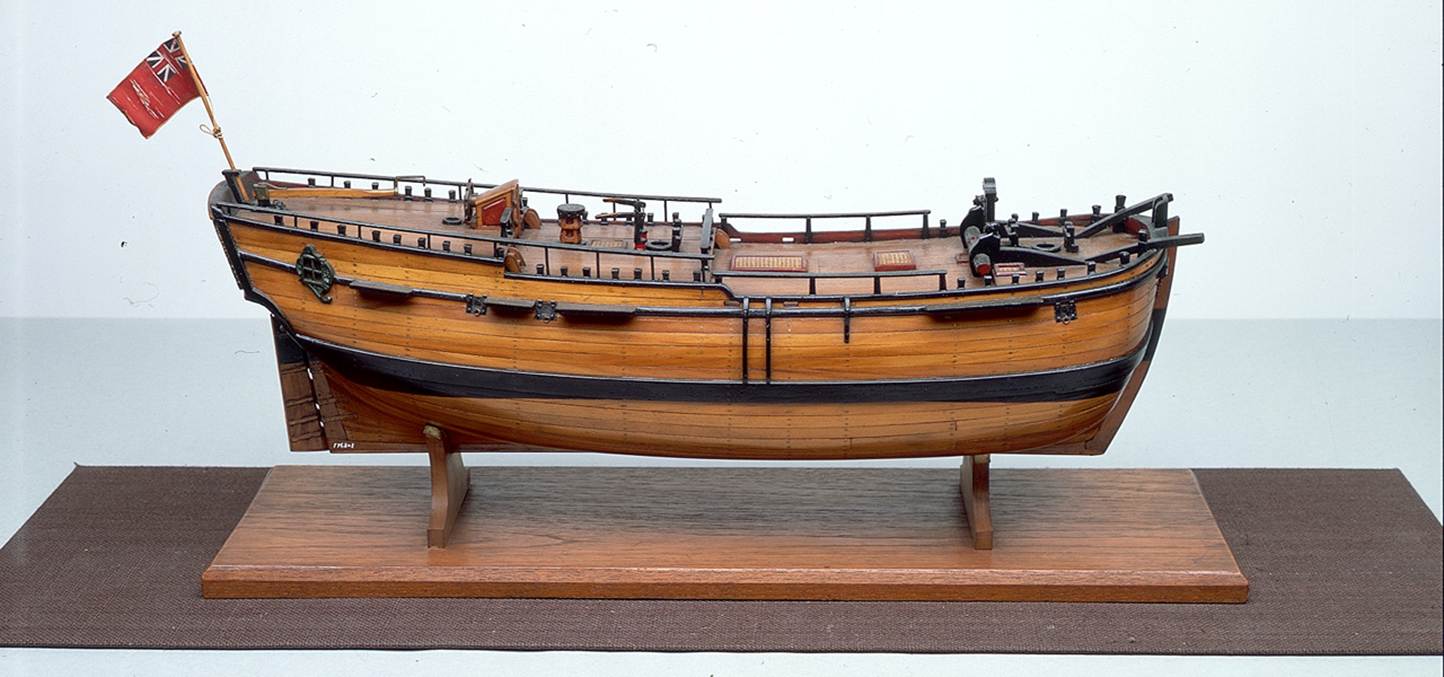
The 'Earl of Pembroke', a cat built (with a bluff
bow and broad stern) bark used in the coal trade. Known as colliers, these
vessels were used in the North Sea coal trade and were robustly built to withstand
the handling of their cargo as well as the harsh weather conditions. Measuring
98 feet in length by 29 feet in the beam and with a tonnage of 369 burden, the
‘Earl of Pembroke’ was built by Fishburne of Whitby, launched in 1768 and
renamed the ‘Endeavour’ after its purchase (see SLR0353). Following the return
from Captain Cook’s voyage of discovery of 1768-71, the vessel made several
voyages to the Falkland Islands before being sold in 1775. It was eventually
returned to the North Sea coal trade and later passed to French ownership,
before finally ending up at Newport, Rhode Island, towards the end of the 18th
century.
A collier - literally, coal boat - also
known as a Whitby collier, and colloquially as a cat , was
an 18th century bulk carrier designed expressly to
transport coal by sea from the north
east of England to London. Traditional collier
brigs of wooden hull and two masts could carry between
280 and 300 tons of coal (although some sources that could lead up
to 600 tons) And it took between five and six weeks to make the round trip
in optimal conditions. In contrast, collier John Bowes,
an iron-hulled steamboat , launched in
1852, would make the same trip in five days with 650 tons.
The first colliers wood had a wide and
deep line, with a stern narrow
and lacked figureheads of the bow . They
had two or three masts . Bats catch and most wore
large square sails , while
the mizzen had gaff sails front and rear. This type of
sail allowed the boat to navigate with almost any weather condition, facing the
most violent storms. Also, if the boat needed to be beached, it could be
done without suffering any damage.
William Falconer's Dictionary of the Marine, 1769 defined a cat, which it describes as from the French chatte, as a ship employed in the coal trade, formed
from the Norwegian model. It was distinguished by a narrow stern, projecting
quarters, a deep waist, and by having no ornamental figure on the prow,
generally built remarkably strong, and carrying from four to six hundred tons
J C Beaglehole says the broad bottomed blunt bowed Whitby Collier was no sprite of
the sea, she was a 'cat built' vessel or simply a 'cat'.
Also known as colliers, these vessels
were used in the North Sea coal trade and were robustly built to withstand the
handling of their cargo as well as the harsh weather conditions.
Traditional collier brigs of wooden
hull and two masts could carry between 280 and 300 tons of coal, although some
sources suggest they could loads up to 600 tons.
They had two or three masts and most
had large square sails. This type of sail allowed the boat to navigate in almost
any weather condition, facing the most violent storms.
HMB Endeavor was a collier
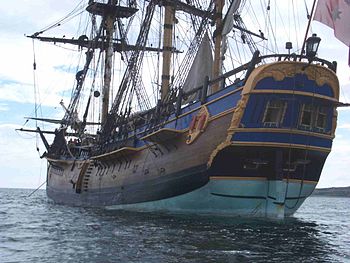
Since James Cook knew this type of ship
well, having sailed on one on his first voyage on sea - in fact, his first
nine years as a sailor, before enlisting in the Royal Navy, he passed them on
three colliers - and for its ability to carry heavy loads and many
men for a long voyage, in 1768 I chose the Earl of Pembroke, launched in 1764,
for his first expedition to the South sea , from 1768 to 1771
successive his voyages of exploration, of 1772-1775 , and from
1776-79 , he would also make them aboard colliers- Endeavor's
wineries were modified to house food for 18 months, scientific material and 94
people (a crew of 71 men, 11 scientists from the Royal Society and
12 Royal Marines.
Collier
barks were square-rigged, three-masted ships. They were designed to transport
coal from the coalfields of northern England south to London. They also traded across
the Baltic, bringing back timber, tar, hemp and other naval supplies. They were
not elegant or particularly fast, but very capacious in order
to carry low-value, bulky goods such as coal, and very reliable and
durable. As they were virtually flat-bottomed, they could be beached anywhere.
No quay or dock was needed. There were between 250-300 ships owned by Whitby
men sailing out of the port. There were too many Whitby registered vessels to
fit in to the harbour altogether at once. Many
over-wintered to the north in Newcastle or Sunderland. The ships were well
known to the Royal Navy, and frequently hired as troop
transports or supply ships in times of war. For example, a
large number of collier barks were used during the Seven Years War in
North America.
Whitby
was a bustling port with lots of opportunity for work. It also had a strong
Quaker community which was very influential in the town. The Society of Friends,
or Quakers, believed in moderation, in not bearing arms and abstaining from
violence.
Whitby gained a reputation for training young men for the sea. Boys came not
only from the surrounding countryside, but also from places much further away,
even as far as the Orkneys. The town must have been awash with boys and young
men. In the years 1747 to 1748 when James Cook was an apprentice,
there were over 1,200 apprentices listed in Whitby’s ship muster rolls. The town
had a population of 5,000 inhabitants.
There
was no publicly endowed school nor or grammar school in Whitby. That meant that
there was no accepted model of a standard classical education for the sons of
prosperous burgesses – boys did not have to learn Latin or study Roman models
of behaviour. Instead, there were commercially oriented schools
and the teaching of mathematics was encouraged because of its practical use at
sea. It was here that Cook acquired the mathematical knowledge which enabled
him to develop navigational, cartographic and astronomical skills of a high
order.
1752
January to March 1752
Between January and March 1752, John
seems to have sailed on a ship of an unknown names with Robert Easton of
London.
March 1752 to May 1753
John Farndill, Seaman, 45 years old,
Whitby, served seven months 12 days, on the Friendship, between 30 March
1752 to 12 May 1753 and was paid 8s 4d muster dues.
On 30 March 1752, the ship sailed
from Whitby to London, where it arrived on 9 April 1752. It then sailed to
Newcastle, where it arrived on 18 April 1752. It then sailed to Norway, where
it arrived on 3 May 1752. It then returned to Newcastle on 12 May 1752, and
then to Whitby on 17 May 1752
The following information appears in
the ledgers of the library of Whitby museum: Ship:
"Friendship" of Whitby, owned by John Walker, Grape Lane, Whitby.
Richard Allerton, Master, James Cook, Mate. John Farndill, Seaman, 45 years
old, Whitby, served seven months 12 days, 30 March 1752 to 12 May 1753. Paid
8/4d muster dues. Prior to this he sailed with Robert Easton of London, but the
name of ship is not given. No ship of James Peacock appears in Whitby records,
but the name Peacock appears often as crew member in the muster rolls. In fact there was a Captain Peacock still living in Whitby in
1984.
The Friendship of Whitby was a
collier ship that carried coal and other goods between London, Newcastle, and
Norway. Friendship appears also to have been used as a whaling ship that
sailed from Whitby to the Arctic regions in search of whales and seals.
The Friendship was owned by John Walker, a Quaker shipowner and merchant in Whitby. He
was also the master of James Cook, who served as his apprentice and later as
his mate. He owned several ships that traded coal and other goods between London,
Newcastle, and Norway. He was also involved in the whaling industry and sent
his ships to the Arctic regions.
Cook served on the Freelove, the
Three Brothers and the Mary before sailing in the Friendship.
All the ships were owned by the Walker Brothers who were engaged in the coal
trade.
The following information appears in the ledgers of the library of Whitby
museum:
Ship:
"Friendship" of Whitby, owned by John Walker, Grape Lane, Whitby. Richard
Allerton, Master, James Cook, Mate. John Farndill,
Seaman, 45 years old, Whitby, served seven months 12 days, 30 March 1752 to 12
May 1753. Paid 8/4d muster dues.
Prior to this he sailed with Robert Easton of London, but the name of ship is
not given. No ship of James Peacock appears in Whitby records, but
the name Peacock appears often as crew member in the muster rolls. In fact there was a Captain Peacock still living in Whitby in
1984.
Friendship appears
also to have been used as a whaling ship that sailed from Whitby to the Arctic
regions in search of whales and seals. In 1753, the ship was commanded by John
Swainston, who had been the mate of Three Brothers, another ship of
Walker’s fleet, in 1751. James Cook was the mate of Friendship in 1753, and
this was his last voyage as a merchant seaman before he joined the Royal Navy.
The
Friendship was owned by John Walker, a Quaker shipowner and merchant in
Whitby. He was also the master of James Cook,
the famous explorer and navigator, who served as his apprentice and later as
his mate. He owned several ships that traded coal and other goods between
London, Newcastle, and Norway. He was also involved in the whaling industry and
sent his ships to the Arctic regions.
Cook
served in the Freelove, the Three Brothers and the Mary before sailing in the
Friendship. All the ships were owned by the Walker Brothers who were engaged in
the coal trade. About the type of vessel Beaglehole says: ' the broad bottomed blunt
bowed Whitby Collier was no sprite of the sea: she was a 'cat built' vessel or
simply a 'cat'. The 'cat' was defined by the Dictionary of the Marine (William
Faulkner, 1789) as "a ship employed in the coal trade, formed from the
Norwegian model. It is distinguished by a narrow stern, projecting quarters, a
deep waist, and by having no ornamental figure on the prow ... generally built
remarkably strong , and carrying from four to six
hundred tons".'
Robert Farndale, son of John and Hannah Farndale, sailor,
baptised Whitby 17
Nov 1752 (FAR00169) (Whitby PR).
1753
In 1753, the ship was commanded by John Swainston, who
had been the mate of Three Brothers, another ship of Walker’s fleet, in
1751. James Cook was still the mate of the Friendship in from 2 February
1753 to 4 February 1754. On Friday 2 February 1753, the Friendship,
still operating as a collier, sailed from Whitby. On Monday 4 February 1754, she
returned to Whitby. According to the muster rolls of Friendship in 1753,
the ship had a crew of 24 men, including Swainston and Cook.
Between 4 April and 26 September
1753, the Friendship was engaged in a whaling expedition. The voyage was
probably not very profitable, as the ship only caught one whale. John Farndale
must have taken part in this whaling expedition, as we know that he was on the
Friendship until 12 May 1753, and it is not clear whether he returned during
a pause in this expedition in May.
September 1753 to 1755
John Farndale was a seaman named in a
list of 42 of the crew of The Friendship of Whitby on 10 November 1753.
John was about 46 years old at this stage.
During winter months outside of the
sailing season, ships were overwintered at Whitby. Repairs were carried out to
vessels and Cook, like the other apprentices, lodged
at Mr. Walker’s house in Grape Lane. During these periods Cook appears to have
studied hard and by 1755 he had the chance to become Master of the
Friendship, deciding instead to join the Royal Navy.
James Cook was the mate of the
Friendship between 2 March and 28 July 1754; from 9 August to 19 December 1754
and then from 15 February to 14 June 1755. There is no record of John Farndale
on these voyages, but he might still have been on the crew.
These were the last voyages of James
Cook on colliers before he joined the Royal Navy.
Captain Cook,
was Mate on the Friendship (a Collier), from 2 February 1753 to 4
February 1754. On Friday 2 February 1753, the Friendship, as collier, sailed
from Whitby with Cook as Mate. On Monday 4 February 1754, she returned to
Whitby.
According to the muster rolls of Friendship
in 1753, the ship had a crew of 24 men, including Swainston and Cook. The ship
left Whitby on April 4 and returned on September 26. The voyage was probably
not very profitable, as the ship only caught one whale.
There are no records to show whether John Farndale was part of
these earlier voyages of the year. John Farndale was a seaman named in a list
of 42 of the crew of ‘The Friendship of Whitby’ on 10 November 1753 when
James Cook (later the
famous Captain Cook) was the Mate. John was about 46 years old at this stage.
During
winter months outside of the sailing season ships were overwintered at Whitby. Repairs
were carried out to vessels and Cook, like the other
apprentices, lodged at Mr. Walker’s house in Grape Lane. During these periods
Cook appears to have studied hard and by 1755 he had the chance to become
Master of the “Friendship”, deciding instead to join the Royal Navy.
1776
By 1776, when James Cook embarked on
his third voyage, the Hampshire Chronicle on 22 April 1776 reported: Ship News.
Sailed from Portsmouth, April 18th … Friendship, Farndale, for Whitehaven
… The naming of John Farndale after the name of the ship records him as captain
of the Friendship, sailing out from Portsmouth, bound for Whitehaven in
Cumbria.
So between 1755 and 1776 John Farndale had become a master mariner and
captain of a collier.
The Hampshire
Chronicle, 22 April 1776: Ship News. Sailed from Portsmouth,
April 18th … Friendship, Farndale, for Whitehaven …
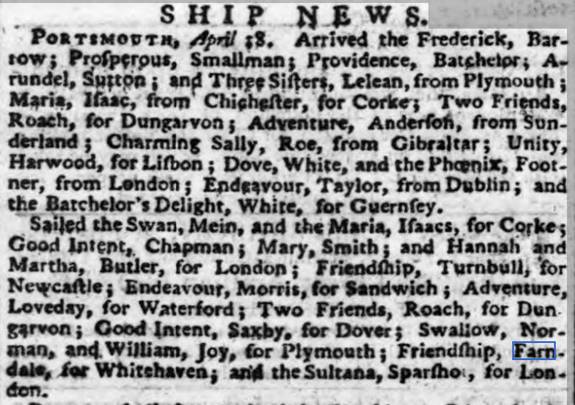
This record records that by 1776 John Farndale was captain of the Friendship and sailed
out from Portsmouth, bound for Whitehaven in Cumbria.
1782
Hannah Farndale,
wife of John Farndale, mariner aged 75 was buried at Whitby on 26 Mar 1782. She was therefore born in 1707. John was
described at that time as a mariner.

1790
John Farndale,
sailor, age 79 buried St Mary, Whitby 28 Mar 1790 in the
graveyard which would one day be made famous for its association with the
fictional Dracula (Whitby PR).

|
How
does John Farndale relate to the modern family? John
Farndale was part of the branch of the family called the Whitby 1 Line
and had a family of his own, the Whitby 2 Line,
but there were no Farndale descendants of either line. However John was the great grandson of Richard
Farndale (1604 to 1685), of the Moorsholm family
recently settled in Cleveland, so this was a branch of the wider family. |
The Captain Cook Museum, Whitby
Whitby Museum, maritime collection
J C Beaglehole, the Life of Captain James Cook, 1974
Clifford E Thornton, Captain Cook in
Cleveland, Middlesbrough Council, 1978
C Preston, Captain James Cook RN,
FRS, Whitby Literary Society, 1973