c 1275 to c
1350

The Medieval
Inhabitants of Farndale
FAR00016
|
Return to the Home
Page of the Farndale Family Website |
The story of one
family’s journey through two thousand years of British History |
The 83 family lines
into which the family is divided. Meet the whole family and how the wider
family is related |
Members of the
historical family ordered by date of birth |
Links to other pages
with historical research and related material |
The story of the
Bakers of Highfields, the Chapmans, and other related families |
Dates are in red.
Hyperlinks to
other pages are in dark
blue.
Headlines are in brown.
References and
citations are in turquoise.
Context and local
history are in purple.
1275
If
Richard was aged 25 at the time of the gift of land in 1300, then he may have been
born in or about 1275 in Farndale, probably in the mill at Low Mill. He was the
son of John the miller (FAR00021B).
By 1282, on the
death of the landlord Baldwin Wake, the cultivated acreage in Farndale had
risen to 768 acres in only six years (FAR000020). There were 90
bondmen by this time in Farndale. This must have represented a planned campaign
of settlement and activity in the dale must have been noisy and constant at
this time.
1300
Richard
de Farndale had a gift of land at Marton.
De
Martona. In est Martona ad existum
villae versus aquilonem et
part villae orientali, Ricardus
de Farnedale xvd viij prec pro tofto
et orto ex dono Tosti, et j
acra in campo.
“Concerning
Marton. In East Marton on the way out of the village towards the north,
on the east side, Richard de Farendale 15d 8? for a
toft and a garden, the gift of Tosti and one acre in the field.”
(Guisborough
Cartulary, Cartularium Prioratus de Gyseburne, Surtees Society Volume LXXXIX, page 423, in the section The Rent Roll of the Priory circa
1300)
Marton is probably the village still of that name about three
kilometres south of Aldborough (the Roman provincial capital of Isurium Brigantum), some 20 km southwest of Farndale. There
is also a village called Marton
northeast of Hull.
If this was the same person, then if
Richard de Farndale was 25 at the time of the gift, he would have been born in
about 1275. Perhaps he was one of the sons of Nicholas de Farndale. If he lived to 70 he might have died in about 1345.
There was a Richard, son of John the
Miller of Farndale, who was charged with various poaching offences in 1334, but
this is likely to have been a different Richard, since the excommunicated
Richard would have been about 59 by then, and it seems unlikely he would still
have been referred to as his father’s son.
That would mean that he was about 41
when he was excommunicated.
1316
Richard de Farndale (FAR00016) and
Thomas of Farndale (FAR00023),
were excommunicated for stealing on 12 August 1316. (Patent Rolls). This relates to Pickering Castle and may have arisen from an earlier
poaching incident.
Sentence
of Excommunication; ‘To the Most Serene Prince, his Lord Edward by the Grace
of God, King of England, illustrious Lord of Ireland and Duke of Aquitaine, his
humble and devoted clerks, the Reverend Dean and Chapter of the Church of St
Peter, York; custodians of the spiritualities of the Archbishopric while the
See is vacant; Greetings to him to serve whom is to reign for ever. We make
known to your Royal Excellency by these presents that John de Carter, William
of Elington, Adam of Killeburn, John Porter, Hugh
Fullo, Peter Fullo, John of Halmby, Adam Playceman,
John Foghill, Thomas Thoyman, Robert the Miller, Adam of the Kitchen, Richard
Mereschall, John Gomodman, John Wallefrere, Alan Gage, Henry Cucte, Nicholas of
the Stable, John the baker, Adam of Craven, John son of Imanye, Michael of Cokewald, Thomas of Morton, John of Westmerland,
Thomas of Bradeford, Adam of Craven, John of Mittelhaue,
John called Lamb, William Cowherd, Simon of Plabay,
William the Oxherd, Henry of Rossedale, John of
Carlton, Peter of Boldeby, Thomas of Redmere, Walter of Boys, William of Fairland, John of Skalton, John of Thufden, Henry
the Shepherd’s boy, John of Foxton, Thomas of Farndale, John of Ampleford, John Boost, Roger of Kerby, John of Stybbyng, William of Carlton, Richard of Kilburn, Adam
Scot, Peter of Gilling, John of Skalton, Stephen of Skalton, Richard of Farndale, Richard of Malthous, John the Oxherd, Robert of Rypon,
Walter of Fyssheburn, Adam of Oswadkyrke,
William of Everley, Hugh of Salton, William Robley, William of Kilburn,
Geoffrey the Gaythirde, John of the Loge, Robert of Faldington,
Nicholas of Wasse, William of Eversley, Robert of Habym,
John of Baggeby and William Boost, our Parishioners,
by reason of their contumacy and offence were bound in our authority by
sentence of greater excommunication, and in this have remained obdurate for 40
days and more, and have up to now continued in contempt of the authority of
the Church. Wherefore we beseech your Royal Excellency, in order that the
pride of these said rebels may be overcome, that it may please you to
grant Letters, according to previous meritorious and pious custom of your
Realm, so that the Mother Church may, in this matter, be supported by the power
of Your Majesty. May God preserve you for His Church and people.’
Given
at York 12 August 1316.
There
are full details of this incident at
another webpage.
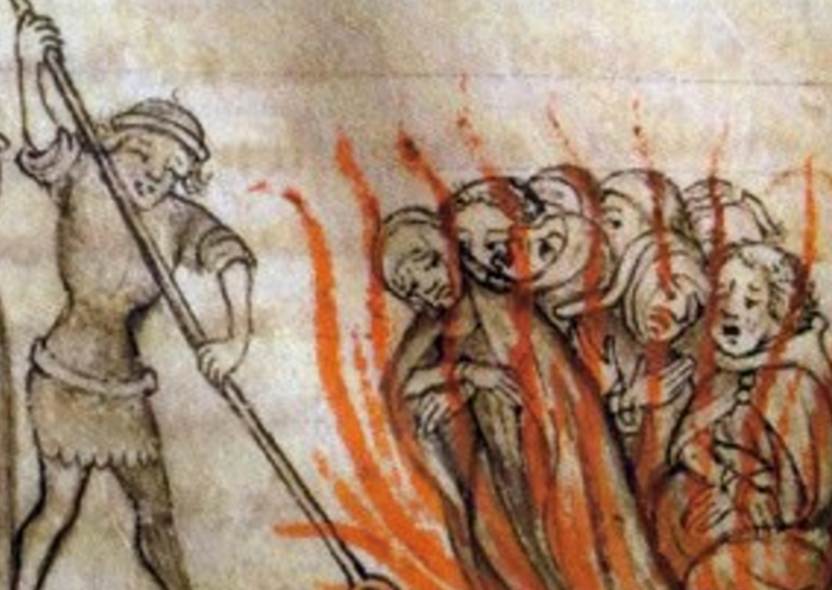
We don’t know the nature of their
crime. It seems to have been a crime under canon law, which therefore involved
the church in the first instance, and in their sentence of excommunication, and
was sufficiently serious that the church felt it necessary to involve the
secular authorities when the pride of the rebels could not be quashed.
Under canon law, excommunication was the most serious sanction the Church had to wield against those who
disobeyed its laws. Gratian's Decretum (c 1140), which contained the basic
texts of the canon law, described excommunication as equivalent to handing a
person over to the Devil. Later medieval canonists echoed and amplified
this sentiment in their descriptions of the consequences of the sanction. It
cut the excommunicate off from the Church's sacraments and from most contacts
with other Christians
In England there was an additional
penalty of imprisonment for standing obdurately excommunicate for more than
forty days. This seems to explain the duration and the language used above.
In the eyes of medieval canonists,
these consequences made it necessary that imposition of the sentence of
excommunication was governed by a series of procedural requirements for the
valid imposition of the sanction. Sentences of excommunication could be imposed
only by a proper official, acting in his judicial capacity, normally the bishop
of the diocese where the person lived or his deputy. Excommunication required
proper citation of the persons involved and provision for them to be heard in
their own defence. Imposition of the sentence had to be accompanied by certain
prescribed formalities, including judicial deliberation and a written document.
|
Excommunication in the Middle Ages
There is a podcast in the Gone
Medieval series on the impact, or sometimes lack of impact, of
excommunication. King John was excommunicated in 1307 and initially at least
ignored it. |
1323
1 July 1323
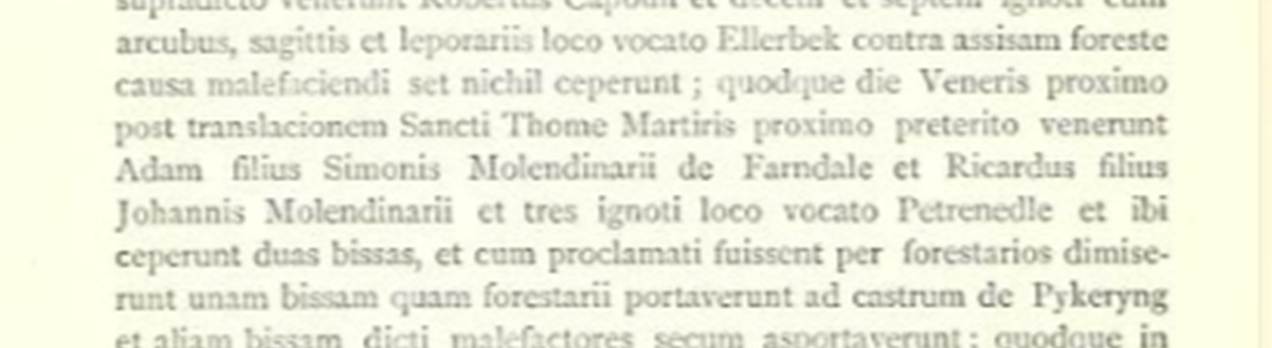
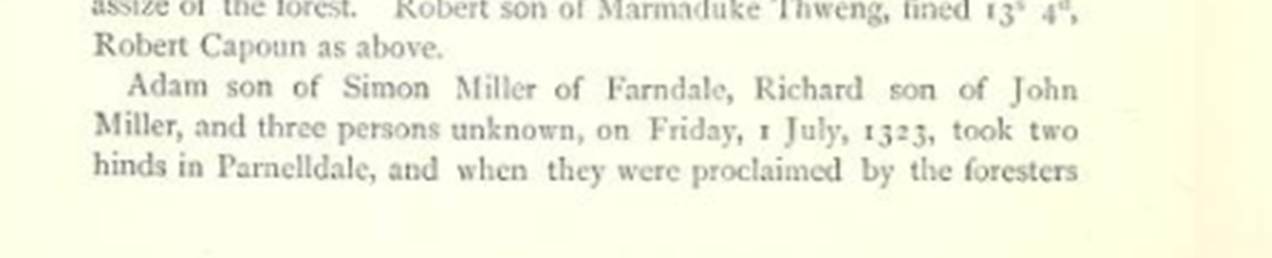
On 1 July 1323 Adam (FAR00025), son of Simon the miller of Farndale (FAR00021), and Richard (FAR00016), son of John the miller (FAR00021B), with three other unknown men, came into
Pickering Forest in a place called Petrenedle, and
took two deer. When confronted by the forester, they had sent away one deer,
which the foresters carried to Pickering Castle, but the poachers carried away
the other deer. The Eyre Court had a long period when it did not sit and the
case did not come to be heard until 3 October 1334 (some eleven years later)
when they did not appear and the sheriff was ordered to apprehend them. Later,
Adam and Richard came before the justices and asked to pay for licence to make
concord for their offence so that they could be redeemed. Adam paid £1 6s 8d
and Richard paid £2 for this licence, and they found mainpernors
(or guarantors) for these amounts (The Great Cowcher
of the Duchy of Lancaster, The National Archives, DL42/1 Folio 217, DL 42/1/23/U22 folios 217 to 218v, Close Rolls 22 August 1323, 17 Edward II
page 15 and 16, North Riding Records Yorks, The Honour
and Forest of Pickering, 1894, Volume
II at
page 217
to 218).
There are full
details of this incident at another
webpage.
3 October 1334
1334 was the year
of the Eyre Court. It was therefore time to catch up with the Farndale
misbehaviour of the preceding years. A mainpernor was
a person who gave a guarantee that a prisoner would attend court. The folk of
Farndale had clearly been out in significant numbers to engaging in poaching.
The hearing dealt with offences of some antiquity, the reference to the
seventeenth regnal year of Edward I indicating offences that had taken place
over several decades as the Eyre had not sat during that time. So these records
were catching up with many years of activity in the forest (The Duchy of Lancaster Records, from the North Riding
Record Society, The Honour and Forest of Pickering, Edited by Robert
Bell Turton, Volume IV, 1897, page xiii).
Richard (FAR00016), son of John the miller of Farndale (FAR00021B) and Adam (FAR00025), son of Simon the miller of Farndale (FAR00021) had trespassed and hunted in Pickering
Forest, others
including Adam (FAR00022A), son of
Nicholas de Farndale (FAR00006), and John (FAR00016A), son of John
the miller (FAR00021B) and John
Wraghby of Farndale (WRA00001)
mainperned (provided guarantees) for their
appearance (The Great Cowcher of the Duchy
of Lancaster, The National Archives, DL42/1 Folio 227, 227v, DL
42/1/35/U7 folios 337 to 338v).
As mainpernor (guarantor) for Richard (FAR00016), son of John de Farndale (FAR00021B), indicted of hunting, Alan (FAR00011), son of Nicholas de Farndale (FAR00006) was fined 40d because Richard did
not turn up. For John (FAR00016A), son of John the miller (FAR00021B) was fined 2s as mainpernor of Richard (FAR00016), son of John the miller of Farndale (FAR00021B), also indicted for hunting. Nicholas Brakenthwayt was fined 2s as mainpernor of Richard
(FAR00016), son of John the miller of Farndale (FAR00021B), also indicted for hunting. Alan de Braghby
was fined 3s as mainpernor of Richard (FAR00016), son of John the miller of Farndale (FAR00021B), also indicted for hunting. John de Braghby was fined 20d as mainpernor of Richard
(FAR00016), son of John the miller of Farndale (FAR00021B), also indicted for hunting. (The Great
Cowcher of the Duchy of Lancaster, The National Archives, DL42/1 Folios 336v
and 337, DL 42/1/35/U6, Folio 335v-336v
(not on public record)).
Under medieval forest law, mainpernors were individuals who acted as guarantors for
others, ensuring they appeared in court to answer for alleged offenses against
forest law. These offenses primarily involved the king's hunting rights and the
protection of forest resources like timber and vegetation. Mainpernors
essentially vouched for the accused's future appearance in court, preventing
them from fleeing justice within the forest jurisdiction.
On
3 October 1334, as mainpernor
(guarantor) for Richard (FAR00016), son of John (FAR00021B), and Adam (FAR00025), son of
Simon the miller of Farndale (FAR00021), Nicholas de Rippingale was
fined 5s because they did not turn up (The
Great Cowcher of the Duchy of Lancaster, The National Archives, DL42/1 Folios
342v, The Great Cowcher of the Duchy of Lancaster, The National Archives, DL 42/1/35/U9,
Folio 341 to 343v).
There are full
details of this hearing at another webpage.
A number of individuals
from Farndale were fined following prior indictments for poaching in 1334 and
not turning up at the Eyre. They paid bail or had bail paid for them (North Riding Records, Volume IV
by the North Yorkshire Record Society, the Honour and Forest of Pickering,
1897, page 23, 28, and 34 not on line but I have a physical copy).
|
Date of Hearing |
Notional date of Offence |
Payer |
Guarantor (malpernor) |
Poacher |
Amount of Fine |
|
3 October 1334 |
c 1320 |
John Alberd |
Richard (FAR00016) son of John the Miller of Farndale (FAR00021B) |
3s 4d |
|
|
3 October 1334 |
c 1325 |
Walter Trusseleygh |
Adam (FAR00025) son of Simon
the Miller of Farndale (FAR00021) |
Nicholas
de Repyngale |
5s |
There are further
details of these offences at another webpage.
c late 1336
In a list of offences committed since
the commencement of the Eyre, were included Richard (FAR00016) son of John Miller of Farndale (FAR00021B), and Adam (FAR00025) son of Simon Miller of Farndale (FAR00021), John
Cockerell of Cropton (COK00001), John (WES00004) son of Richard Westgill of Farndale (WES00001), Robert (WES00005) son of Richard Westgill of Farndale (WES00001) (The Great Cowcher of the Duchy of Lancaster, The National
Archives, DL42/1 Folio 204v, DL 42/1/23/U14 folios 203 to 205
and North Riding Records Yorks Volume II, The Honour and Forest of Pickering, page
119).
See details and research notes.
1345
If Richard lived to 70, he might have lived to about 1345.
|
How do Richard and Thomas Farndale
relate to the modern family? It is not possible to be accurate about the early family tree,
before the recording of births, marriages and deaths in parish records, but
we do have a lot of medieval material including important clues on
relationships between individuals. The matrix of the family before about 1550
is the most probable structure based on the available evidence. If it is accurate, then both Richard and Thomas
Farndale were related to the thirteenth century ancestors of the modern
Farndale family, but are not on the direct line of later modern Farndales. |