c 1274 to c 1350
The Medieval
Inhabitants of Farndale
FAR00025
|
Return to the Home
Page of the Farndale Family Website |
The story of one
family’s journey through two thousand years of British History |
The 83 family lines
into which the family is divided. Meet the whole family and how the wider
family is related |
Members of the
historical family ordered by date of birth |
Links to other pages
with historical research and related material |
The story of the
Bakers of Highfields, the Chapmans, and other related families |
Dates are in red.
Hyperlinks to
other pages are in dark
blue.
Headlines are in brown.
References and
citations are in turquoise.
Context and local
history are in purple.
A murderer and a prolific poacher, or was he wrongly accused?
1274
Adam Farndale might have been born in about 1274, perhaps the eldest
son of Simon the Miller of Farndale (FAR00021). He may have been born in the mill at Low Mill in the heart of
the dale.
By 1282, on the death
of Baldwin Wake, the cultivated acreage in Farndale had risen to 768 acres in
only six years (FAR000020). There were 90
bondmen by this time in Farndale. This must have represented a planned campaign
of settlement and activity in the dale must have been noisy and
constant at this time. Activity at the mill must have been hectic.
1292
His son, Nicholas
of Farndale (FAR00025A), might have been born in about 1292.
1310
His young son, Nicholas, may have taken the
family heard into the forest in 1310.
A number of local folk had taken draught beasts into Pickering Forest in the
reign of Edward III in 1310 or 1311, where the draught animals were forbidden
to wander. Some pasturages were reserved for the use of the King where there
was no right in common and here, cattle were agisted
at a fixed price, to be paid to the bailiff. These sums were collected by the
agisters, of whom there were two in each ward, men of substance it seems by
their assessments in the Lay Subsidies.
Not the least of the profits derived from the possession of a
forest was that arising from the agistment of cattle in waste grounds. (The Duchy of
Lancaster Records, from the North Riding Record Society, The Honour and
Forest of Pickering, Edited by Robert Bell Turton, Volume IV, 1897, page
xxvii).
There was a lengthy list of those individuals from Farndale found by the agisters in about
1310 with their cattle in the forests. Thomas Wake, the Lord of Liddell,
whose tenants they were, said the price had already been paid and the tenants
should be discharged of the matter. Amongst those fined were Nicholas
(FAR00025A), son
of Adam of Farndale (FAR00025) had 6 oxen and one cow, worth 27s agisted (North
Riding Records Yorks Volume III, The Honour and Forest of Pickering, 1894, Edited
Robert Bell Turton, page 61, The Great Cowcher of the Duchy of
Lancaster, The National Archives, DL42/1 Folio 273, 273v, DL 42/1/23/U64 folios 273 to 274v).
1320
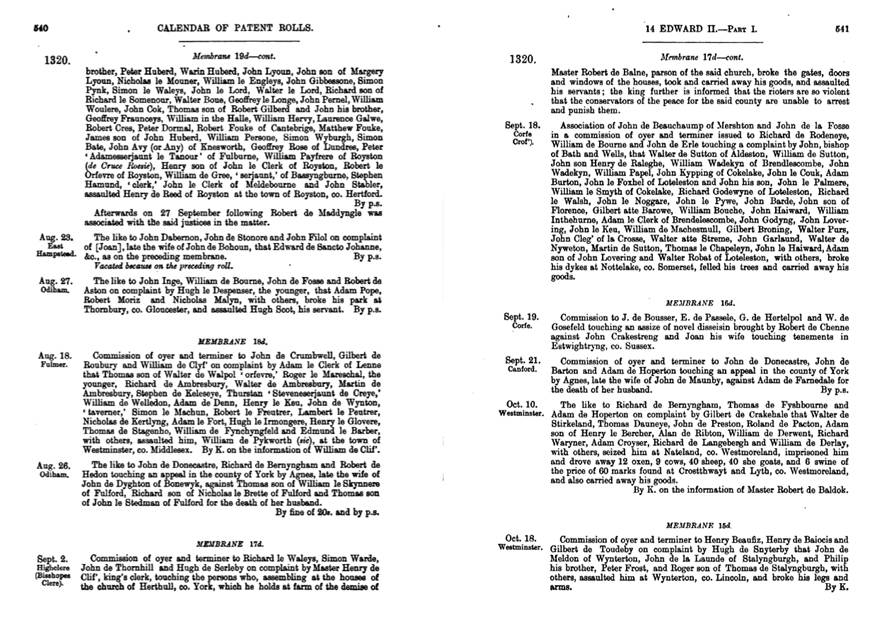
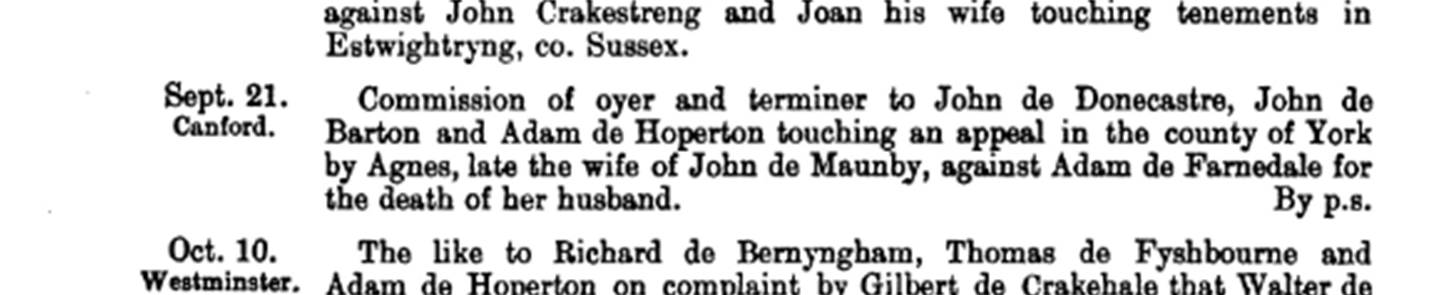
There was an appeal against Adam de Farndale for the death of
Agnes’ husband, John de Maunby, in 1320 (Patent
Rolls).
The Commission of
Oyer and Terminer to John de Doncastre, John de Barton and Adam de Hoperton
touching on appeal in the County of York by Agnes, late wife of John de Maunby against
Adam de Farndale for the death of her husband on 21 Sep 1320. (Patent Rolls of the reign of Edward II, 1317 to 1321,
page 541).
On 1 July
1323 Adam (FAR00025), son of Simon the miller of Farndale (FAR00021), and Richard (FAR00016), son of John the miller (FAR00021B) (who was probably Simon’s fellow miller
either from the High Mill or working as Simon’s servant at Low Mill), with
three other unknown men, came into Pickering Forest in a place called Petrenedle, and took two deer. When confronted by the
forester, they had sent away one deer, which the foresters carried to Pickering
Castle, but the poachers carried away the other deer. The Eyre Court had a long
period when it did not sit and the case did not come
to be heard until 3 October 1334 (some eleven years later) when they did not
appear and the sheriff was ordered to apprehend them. Later, Adam and Richard
came before the justices and asked to pay for licence to make concord for their
offence so that they could be redeemed. Adam paid £1 6s 8d and Richard paid £2
for this licence, and they found mainpernors (or
guarantors) for these amounts (The Great
Cowcher of the Duchy of Lancaster, The National Archives, DL42/1 Folio 217, DL 42/1/23/U22 folios 217 to 218v, Close Rolls 22 August 1323, 17 Edward II page 15 and 16, North Riding Records Yorks, The Honour and Forest of
Pickering, 1894, Volume II at page 217 to 218).
There
are full details of this incident at another webpage.
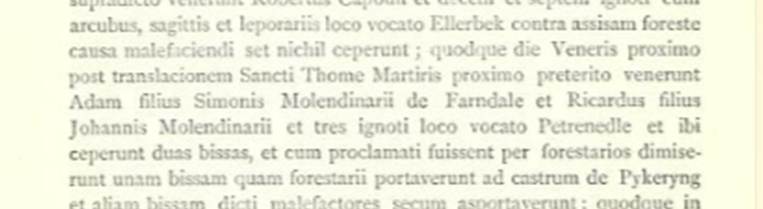
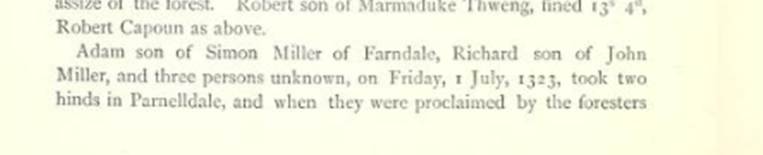
In this record,
we have another early record of Simonis Molendinarii
(Latin for a Miller). Simon was probably an old man by this time.
3
October 1334
A
hearing of the itinerant Eyre Court (FAR00015B), before
Justices Richard Willoughby and John de Hambury, picking up cases from several decades
previously, took place at Pickering on 3 October 1334 (The Duchy of
Lancaster Records, from the North Riding Record Society, The Honour and
Forest of Pickering, Edited by Robert Bell Turton, Volume IV, 1897, page
xiii).
Justices of the Common Pleas were a
later judicial position within the Court of Common Pleas of
England and Wales, under the Chief Justice. The Common Pleas was the
primary court of common law within England and Wales, dealing with
common pleas (civil matters between subject and subject).
Sir Richard Willoughby (c 1290 to 1362) was the son
of Sir Richard Willoughby of Willoughby-on-the-Wolds, a lawyer, who served as
Chief Justice of the Bench in Ireland from 1323-1325. Richard attended
Parliament in 1324 and inherited the estate from his father the following year.
Richard was a successful lawyer and increased his wealth greatly by his legal
career. He was appointed one of the justices of Common Pleas in 1328 and served
between 6 March 1328 to 22 December 1330; 9 October 1340 to November 1341; and
20 November 1343 to 1357. He was one of the justices of King's Bench in 1330.
He was briefly Chief Justice between 1338-1340, but
was demoted and charged with corruption. He threw himself on the King's mercy
and was pardoned on payment of 1200 marks. In 1343 he was re-appointed as a justice, and served until 1357. Sir Richard
was buried at Willoughby-on-the-Wolds, where there is a monumental effigy.
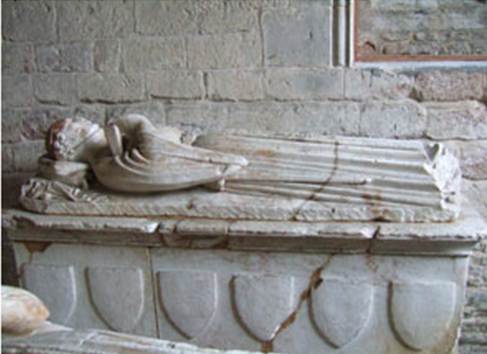
The monument to Sir Richard Willoughby, judge
in chief over the Farndale poachers
After Richard (FAR00016), son of John the miller of Farndale
(FAR00021B) and Adam (FAR00025), son of Simon the miller of
Farndale (FAR00021) had trespassed and
hunted in Pickering Forest, others including Adam (FAR00022A), son of Nicholas de Farndale (FAR00006), and John (FAR00016A), son of John the miller (FAR00021B) and John Wraghby of Farndale (WRA00001)
mainperned (provided guarantees) for their
appearance (The Great Cowcher of the Duchy
of Lancaster, The National Archives, DL42/1 Folio 227, 227v, DL 42/1/35/U7 folios 337 to 338v).
The offence was clearly many years
before as one or more of the mainpernors had died.
As mainpernors
(guarantors) Nicholas Laverock was fined 20d as mainpernor
of Adam (FAR00025), son of
Simon the miller (FAR00021), indicted for hunting; John (FAR00016A), son of
John the miller (FAR00021B) was fined 2s as mainpernor of Adam (FAR00025), son of
Simon the miller (FAR00021), indicted for hunting; Nicholas
Brakenthwayt was also fined 2s as mainpernor of Adam (FAR00025), son of
Simon the miller (FAR00021), indicted for hunting, Alan de Braghby was fined 2s as mainpernor
of Adam (FAR00025), son of
Simon the miller (FAR00021), indicted for hunting; John de
Braghby was also fined 20d as mainpernor of Adam (FAR00025), son of
Simon the miller (FAR00021), also indicted for hunting (The Great Cowcher of the Duchy of Lancaster, The National
Archives, DL42/1 Folios 336v and 337, DL 42/1/35/U6, Folio 335v-336v (not on public record)).
Under medieval forest law, mainpernors were individuals who acted as guarantors for others,
ensuring they appeared in court to answer for alleged offenses against forest
law. These offenses primarily involved the king's hunting rights and the
protection of forest resources like timber and vegetation. Mainpernors
essentially vouched for the accused's future appearance in court, preventing
them from fleeing justice within the forest jurisdiction.
As mainpernor
(guarantor) Richard (FAR00016), son of John (FAR00021B), and Adam (FAR00025), son of Simon the miller of
Farndale (FAR00021), Nicholas de Rippingale was fined 5s because
they did not turn up (The Great Cowcher of
the Duchy of Lancaster, The National Archives, DL42/1 Folios 342v).
There
are full
details of this hearing at
another webpage.
A
number of individuals from Farndale were
fined following prior indictments for poaching in 1334 and not turning up at
the Eyre. They paid bail or had bail paid for them (North Riding Records, Volume IV
by the North Yorkshire Record Society, the Honour and Forest of Pickering,
1897, page 23, 28, and 34 not on line but I
have a physical copy).
|
Date of Hearing |
Notional date of Offence |
Payer |
Guarantor (malpernor) |
Poacher |
Amount of Fine |
|
3 October 1334 |
c 1321 |
John Alberd |
Adam (FAR00025) son of Simon the Miller of Farndale (FAR00021) |
3s 4d |
|
|
3 October 1334 |
c 1321 |
Walter Trusseleygh |
Adam (FAR00025) son of Simon the Miller of Farndale (FAR00021) |
Nicholas de Repyngale |
5s |
There are further details
of these offences at another webpage.
In
late 1336, offences committed since the commencement of the Eyre included Richard (FAR00016) son of John Miller of Farndale (FAR00021B), and Adam (FAR00025) son of Simon Miller of Farndale (FAR00021), John Brown,
Walter Smyth of Hackness, John son of Simon del Hull
of Lockton, John Storm of Levisham, William son of
Moyson of Dales, William Moor senior of Uglebardby, John Cockerell of Cropton (COK00001), John Tendbarn of Harewood, Geoffrey Langdale, Peter
Wyles, Thomas Blount of Alverstan, John (WES00004) son of Richard Westgill of Farndale (WES00001), Robert (WES00005) son of Richard Westgill of Farndale (WES00001) (The Great Cowcher of the Duchy of Lancaster, The National
Archives, DL42/1 Folio 204v, DL 42/1/23/U14 folios 203 to 205 and North Riding Records Yorks
Volume II, The Honour and Forest of Pickering, page 119).
1337
A long list of names appeared of those who
had been arrested for poaching in the forest and had been let out on bail to
appear at the next assizes, but neither appeared nor excused themselves, as the
custom is, together with the names of the bail. The long list included Adam (FAR00025) son of Simon Miller of Farndale (FAR00021). (North Riding Records Yorks, The Honour and Forest of
Pickering, 1894, Volume
II at page
119).
1350
If Adam survived
into his seventies, he might have lived until 1350.