The 1334 to 1339 Eyre Court of Pickering Forest

FAR00015B
|
Return to the Home
Page of the Farndale Family Website |
The story of one
family’s journey through two thousand years of British History |
The 83 family lines
into which the family is divided. Meet the whole family and how the wider
family is related |
Members of the
historical family ordered by date of birth |
Links to other pages
with historical research and related material |
The story of the
Bakers of Highfields, the Chapmans, and other related families |

Dates are in red.
Hyperlinks to
other pages are in dark
blue.
Headlines are in brown.
References and
citations are in turquoise.
Context and local
history are in purple.
The consolidation of a
centralised legal system
After civil war
at the hands of his son the young Prince Henry, Henry II (1154 to 1189)
reinstated his authority over his Kingdom by taking direct control of every
castle in England and undertaking his own legal and administrative revolution.
By the Assize of Clarendon in 1166, he took the whole system of criminal law
into royal control, so that his royal sheriffs and justices dealt with such
crimes as murder, robbery and theft. Criminals were rooted out through
juries of presentment or empanelled bodies, usually of twelve men, who were
required to tell the sheriff or justice under oath all the crimes that had been
committed in their local community. Royal sheriffs were empowered to
investigate crimes wherever they needed to, even if this meant crossing into
the formerly private jurisdictions of the more powerful lords. The king’s
law now clearly trumped all other jurisdictions. Harsher punishments were
imposed after the chaos of civil war.
Royal justice
also embraced civil law. The assize of novel disseisin resolved land
disputes, investigating whether land had been unjustly disseised and the
losing party was amerced or penalised by damages. Mort d’ancestor resolved disputes over inheritance and a
writ de recto (a writ of right) provided for a royal hearing for lesser
folk who felt they had been denied justice by their local lord. In 1178 the
royal council (curia regis) was reorganised
and while five members of the royal council remained at Westminster, appeals of
justice also travelled, creating a supreme court that in time would be the
Court of King’s Bench.
(The Plantagenets,
Dan Jones, 2013, page 96).
In 1218 the
government appointed a group of justices to travel into the counties of York
and Northumberland. They sat at York from 25 November to 18 December 18218, at
Newcastle from 7 January to 14 January 1219, and at York again from 21 January
to mid April 1219. This was one of a great number of
parties of justices sent into the counties of England that year, in an attempt
to deal with the mass of legislation shelved during the late war: the only surviving
rolls from this eyre in England are three from Yorkshire and one from Lincolnshire. (Additional Records of the Yorkshire Eyre, 1218 to 1219, B A English, Yorkshire Archaeological Journal, Volume
48, 1976, page 95).
Forest Eyres
The Forest Eyres comprised of panels of itinerant
judges commissioned to try ordinary criminal offences under the Forest Law.
By the reign of
Edward I (1272 to 1307), they were referred to as Justices Itinerant of the
Forest. Between 1280 and 1288, there were three or four Eyres in Pickering of:
·
Alexander de Kirkton and Ralph de Dacre later replaced for other
duties by John de Lithegraines;
·
William de Vescy, Thomas de Normanville
and Richard de Crepping;
·
William Wyther and Roger Brabazon.
It was in the
period of these 1280 to 1288 Eyres that Edward I granted to his brother Edmund
the right to have Justices of the Forest hold their Eyres in Pickering Forest
in the same manner as King’s Justices, but for the House of Lancaster (see FAR00015A).
We do not hear of
any Forest Eyres having taken place during the period of the Scotch wars, and
in the state of impoverishment to which Yorkshire was reduced in the reign of
Edward II (1307 to 1327), the profits derived from fines could not be
expected to be very great. We do however hear of a special commission being
sent down to try Sir John de Faucomberge and others
of his party for poaching in Pickering Forest.
The Eyre of 1334 to 1339
By 1334, seven
years in to the reign of Edward III (1327 to 1377) the nation had become more
settled and there is evidence of Forest Eyres in Wiltshire, Nottinghamshire,
Yorkshire and elsewhere.
By this time the
Lord of Pickering was Henry, the Third Earl of Lancaster who was the son of
Edmund the first Earl. He handed over management of Pickering to his eldest
son, Henry of Grosmont, Duke of Lancaster KG.
After decades
during which there had been no eyre court, a summons was issued on 6 October
1334 and the court sat on:
·
Monday 6 October 1334 (The first Monday after Michaelmas in 1334
was 3 October 1334, which is believed to be the correct date);
·
Monday 13 March 1335;
·
Monday 15 May 1335;
·
Tuesday 31 October 1335;
·
Thursday 15 February 1336;
·
Monday 2 December 1336;
·
Monday 17 March 1337;
·
Monday 22 September 1337;
·
Monday 31 March 1338;
·
Tuesday 15 September 1338.
In every one of
these hearings, there were cases involving the folk of Farndale, narrated in
the Poachers of
Pickering Forest, and there are also references there
to cases heard on:
· Monday 5 April
1339;
· Tuesday 14 or 21
September 1339.
The records are
not generally chronological, but follow headings to group them into various
subject matters.
All freeholders
of the forest were directed to attend, along with the forest officers. Those
who failed to attend were fined. The Summons to appear at the Eyre was directed
to all freeholders and others of hiugh rank within
the forest, to the reeve and four men from every township, to the foresters of
the townships, to the past and present officers of the forest who were to bring
the rolls relating to all attachments against non residents
as well as residents which had not been brought to a definite conclusion … The
first business was to receive the essoigns or
excuses for non attendance (The Duchy of Lancaster
Records, from the North Riding Record Society, The Honour and Forest of
Pickering, Edited by Robert Bell Turton, Volume IV, 1897, page xxxiii).
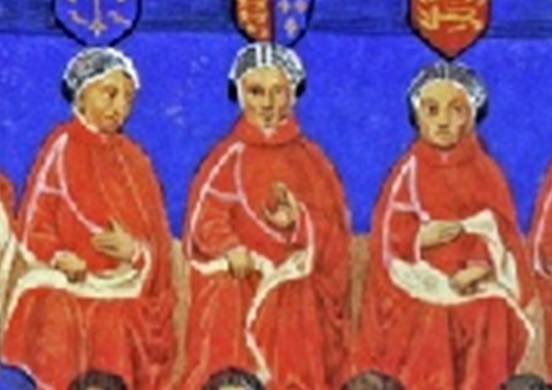
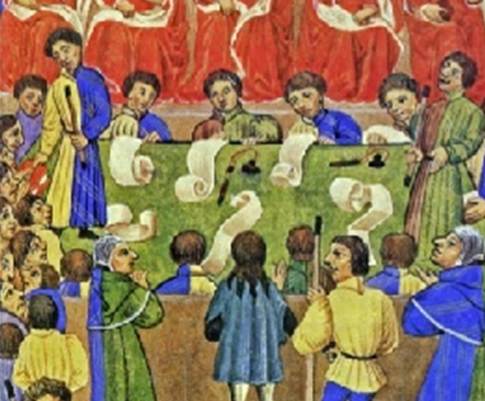
The hearing was before Justices Richard Willoughby and John de Hambury,
and others. Justices of the Common Pleas were a later judicial
position within the Court of Common Pleas of England and Wales, under
the Chief Justice. The Common Pleas was the primary court of common
law within England and Wales, dealing with common pleas (civil matters
between subject and subject).
Sir Richard
Willoughby (c 1290 to 1362) was the son of Sir Richard Willoughby of
Willoughby-on-the-Wolds, a lawyer, who served as Chief Justice of the Bench in
Ireland from 1323-1325. Richard attended Parliament in 1324 and inherited the
estate from his father the following year. Richard was a successful lawyer and
increased his wealth greatly by his legal career. He was appointed one of the
justices of Common Pleas in 1328 and served between 6 March 1328 to 22 December
1330; 9 October 1340 to November 1341; and 20 November 1343 to 1357. He was one
of the justices of King's Bench in 1330. He was briefly Chief Justice between
1338-1340, but was demoted and charged with corruption. He threw himself on the
King's mercy and was pardoned on payment of 1200 marks. In 1343 he was
re-appointed as a justice, and served until 1357. Sir Richard was buried at
Willoughby-on-the-Wolds, where there is a monumental effigy.

The monument
to Sir Richard Willoughby, judge in chief over the Farndale poachers
There was a
distinction between cases where a poacher was caught in the act and those which
were otherwise brought to the notice of the forester. The forester was only
entitled to arrest in the former cases.
The fines
were arbitrary, but tended to vary according to ability to pay.
The more
important offenders required greater sureties. However almost every accused
person had to find a surety, and indeed those fined as the provider of surety,
had to find a surety themselves. The
sureties were generally provided by friends and neighbours and sometimes a
system of reciprocity developed. There was also a group of guarantors who seem
to have done so as professional men.
Orders may also
have been made to attach the offender, by seizing his lands, and this
was often enough to cause the offender to appear.
Under medieval forest law, mainpernors were individuals who acted as guarantors for others,
ensuring they appeared in court to answer for alleged offenses against forest
law. These offenses primarily involved the king's hunting rights and the
protection of forest resources like timber and vegetation. Mainpernors
essentially vouched for the accused's future appearance in court, preventing
them from fleeing justice within the forest jurisdiction.
So fines in the
evidence might be for poaching offences, for mainpernors
(guarantors) whose subject failed to turn up at court, or for just not turning
up at the eyre when ordered to do so.
The form of
indictment suggests that cases were presented by the foresters and the
verderers had convicted the offenders:
It is presented
by the foresters and twelve jurymen of the ward, and convicted by the verderers
that …
There were attorneys
who practised in the court. They were not treated as officers of the court, but
seem to have been a closed professional class. There was unlikely to have been
much competition between attorneys, as the same names repeat regularly.
While the Eyre
was sitting, offences in the forest were rare, but not unheard of.
(The Duchy of Lancaster Records, from the North Riding
Record Society, The Honour and Forest of Pickering, Edited by Robert
Bell Turton, Volume IV, 1897, pages xi to xiv, xxxiv to xliv).
There is a separate page about poaching in Pickering Forest.