Illegal Grazing in
Pickering Forest
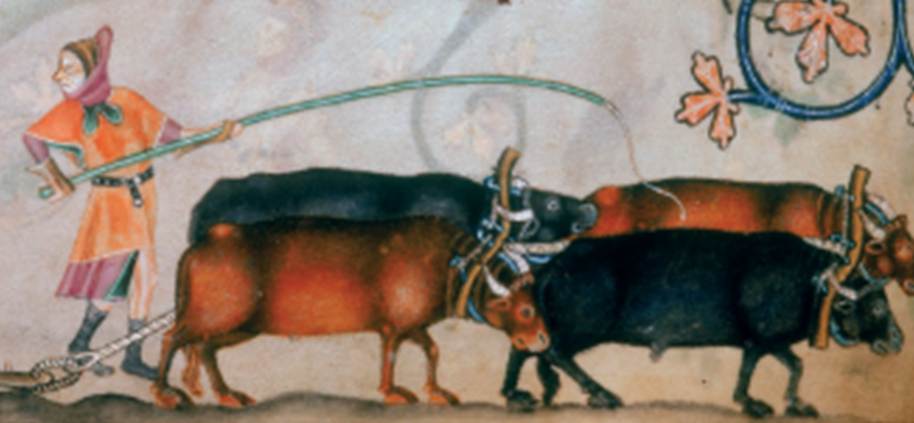
1310
|
Return to the Home
Page of the Farndale Family Website |
The story of one
family’s journey through two thousand years of British History |
The 83 family lines
into which the family is divided. Meet the whole family and how the wider
family is related |
Members of the
historical family ordered by date of birth |
Links to other pages
with historical research and related material |
The story of the
Bakers of Highfields, the Chapmans, and other related families |
Under
a section of the Coucher Book titled Cattle Taken
into the Forest, in respect of pleas of the forest of Henry, earl of
Lancaster, of Pickering, held at Pickering before Richard de Wylughby
[Willoughby], Robert de Hungerford and John de Hambury, justices itinerant were
assigned to take pleas of the said forest in Yorkshire regarding the takings of
draught-beasts within this forest.
Not the least of the profits derived from the
possession of a forest was that arising from the agistment of cattle in waste
grounds.
Rights over the common moors of Pickering varied. Some pasturages were reserved
for the use of the King where there was no right in common and here, cattle
were agisted at a fixed price, to be paid to the
bailiff. Agistments were also made on the High Moor. These sums were collected
by the agisters, of whom there were two in each ward, men of substance
by their assessments in the Law Subsidies.
(The Duchy of Lancaster Records, from the North Riding
Record Society, The Honour and Forest of Pickering, Edited by Robert
Bell Turton, Volume IV, 1897, page xxvii).
There
were certain periods for agistment of sheep and cattle however, and if animals
were found pasturing at other times they were seized. The Duchy Coucher Book has full records of such cattle ‘taken in the
Forest’ during 1334 to 1335. By examining the lists given it becomes possible
to see how important cattle and sheep farming was to smallholders living within
the Duchy estate. For as Professor Power said, ‘it must never be forgotten that
thousands of peasant farmers all over England were keeping sheep ... I have a
suspicion that even in the heyday of demesne farming peasant sheep flocks
exceeded those of demesne, even though the more scientific farming of the
latter may have produced the better wool’.
The
Duchy records of cattle taken in the forest, limited as they are, nevertheless
give support to this idea. During 1334 to 1335 more than 800 sheep had been unagisted in fence months at the following places — Ebberston, Allantofts, Dalby
demesne, Fulwood moor, Langdale moor, Scalby Flay and, a comprehensive term, ‘in
the earl’s demesne’. The details of owners are interesting; invariably they
were various including monastic as well as lay farmers. Thus the Preceptor of Foulbridge had 40 wethers in
Dalby demesne; Alan de Bilaclif, 100 sheep in Scalby; Ralph Gegge 20 sheep;
Ralph Prest of Suffleld 50 sheep; Richard Russell 50
sheep; the tenants of Richard de Skelton almost 300 sheep, Henry de Bougheland
60 sheep in Scalby Hay, the township of Cawthorn more than 100 sheep, and so
on. Most of the men mentioned (except the Preceptor) were small farmers. Yet
they each had fairly large numbers of sheep unagisted,
and, presumably their flocks were more numerous than this. The combined flocks
of all such men must, it seems, have far exceeded those of the Duchy itself.
(Pastoral Farming on the Duchy of Lancaster’s Pickering
Estate in the Fourteenth and Fifteenth Centuries, Yorkshire Archaeological Journal, Volume 49, 1977, page 83).
A
number of local folk had taken draught beasts into Pickering Forest in the
reign of Edward III in 1310 or 1311, where the beasts were found and forfeited
for a price. Thomas Wake, the Lord of Liddell, whose tenants they were, said
the price had already been paid and the tenants should be discharged of the
matter. Those involved from Farndale were:
|
Individual from Farndale |
Draught animals found in Pickering
Forest |
Value of the beasts agisted |
|
1 oxen and 2 stirks (a stirk is a
young bull or cow especially between one and two years old) |
7s 4d |
|
|
Walter (FAR00014A), son
of Robert the Smith of Farndale (FAR00021C) |
5 oxen |
20s |
|
3 oxen |
12s |
|
|
Hugh Laverok of Farndale (LEV00001) |
1
cow and 1 stirk |
4s
8d |
|
William Stibbyng of Farndale (FAR00033) |
6
oxen |
24s |
|
William de Waldehus of Farndale (WAL00001) |
5
oxen, 4 cows and 4 stirks |
38s
8d |
|
4
oxen and 1 stirk |
17s
8d |
|
|
1
cow |
3s |
|
|
6
oxen, 2 bullocks and 2 beasts of burden |
38s |
|
|
6
oxen and 1 cow |
27s |
|
|
Hugh del Radmire of
Farndale (RED00001) |
6
oxen |
24s |
|
William ad Portam of
Farndale (POR00001) |
5
oxen |
20s |
|
John the shepherd of Farndale (FAR00010) |
9
oxen, 1 cow and 1 stirk |
41s
8d |
|
Roger, the groom of John the shepherd of Farndale (FAR00010) |
1
bullock |
4s |
|
Nicholas de Harland of Farndale (HAR00001) |
1
ox and 1 bullock |
7s |
|
Alan de Wrelton of
Farndale (WRE00001) |
4
oxen and 2 cows |
19s |
|
2
bullocks and 1 ox |
12s |
|
|
4
oxen, 3 bullocks, 1 cow, 2 beasts of burden and 1 stirk |
38s
8d |
(The Great Cowcher
of the Duchy of Lancaster, The National Archives, DL42/1 Folio 273, 273v, DL 42/1/23/U64 folios 273 to 274v, North Riding Records Yorks Volume III,
The Honour and Forest of Pickering, 1894, Edited Robert Bell Turton, page 61)
In
respect of the taking of draught-beasts within Pickering Forest there was a
hearing on the Monday next after Michaelmas 8 Edw. III (1334 to 1335).
Michaelmas is 29 September each year. The next Monday in 1334 was 3 October
1334.
They
present that, in 4 Edw. II (1310 to 1311), two oxen, which were of Nicholas the
parker of Kirkeby Morset [Kirkbymoorside], worth 8s; and 6
oxen and 3 stirks, which were of William in le Hirne,
worth 29s; and 4 oxen and 2 stirks, which were of William Cundy of the same,
worth 19s 4d; and one ox and 3 beasts of burden, which were of Thomas son of
Constance of the same, worth 13s; and two cows, which were of Stephen Brounyng
of the same, worth 6s; and one beast of burden, which was of Thomas Blank of
the same, worth 3s; and one stirk, which was of William son of Adam, of the
same, worth 20d; and one cow, which was of Thomas son of Lawrence, of the same,
worth 3s; and one ox, which was of Alan de Werdale of
the same, worth 4s; and one stirk, which was of Alan Bagot of the same, worth
20d; and one stirk, which was of Roger Tan of the same, worth 20d; and 11 oxen,
which were of John the forester of Gillyngmor [Gillamoor], worth 44s; and one oxen and two stirks,
which were of Robert the smith of Farndale, worth 7s 4d; and 5 oxen,
which were of Walter, son of the same Robert, of the same, worth 20s; and 3
oxen, which were of John son of Simon of the same, worth 12s; and one
cow and one stirk, worth 4s 8d, which were of Hugh Leverok of the same; and
4 oxen and 3 stirks, which were of Simon Cundy of Kirkeby Morset
[Kirkbymoorside], worth 21s; and 6 oxen, which were of William Stibbyng of Farnedale [Farndale], worth 24s; and 5 oxen, 4 cows
and 4 stirks, which were of William de Waldehus of the same, worth 38s 8d;
and 4 oxen and one stirk, which were of John, son of Walter of the same,
worth 17s 8d; and one cow which was of Alice daughter of Roger, worth 3s;
and 6 oxen, 2 bullocks and 2 beasts of burden, which were of Henry, son of
Hugh of the same, worth 38s; and 6 oxen and one cow, which were of
Nicholas, son of Adam of the same, worth 27s; and 6 oxen, which were of
Hugh del Radmire of the same, worth 24s; and 5
oxen, which were of William ad Portam of the same,
worth 20s; and 9 oxen, one cow and one stirk, which were of John the
shepherd of the same, worth 41s 8d; and one bullock, which was of Roger,
his groom, worth 4s; and one ox and one bullock, which were of Nicholas
de Harland of the same, worth 7s; and 4 oxen and two cows, which were of
Alan de Wrelton of the same, worth 19s; and 2
bullocks and one ox, which were of Stephen son of William, worth 12s; and 4
oxen, 3 bullocks, one cow, 2 beasts of burden and one stirk, which were of John
son of Helewise, worth 38s 8d; and one cow, which was of Maud la Huntere,
worth 3s; and 6 oxen, which were of Adam de Marton, worth 24s; and 4 oxen,
which were of the parson of Northmanby [Normanby],
worth 16s; and 2 oxen, which were of Richard de Calthorn
[Cawthorn], worth 8s; and one calf, which was of Thomas Tendant, worth 16d; and
one stirk, which was of Agnes, daughter of William the clerk, worth 20d; and
one stirk, which was of Thomas Sitewell, worth 20d; and one ox, which was of NIcholas, son of Richard de Kirkeby, worth 4s; and one
stirk, which was of Walter del Wode, worth 20d; and two oxen, which were of
Robert son of Lyolf, worth 8s; and one ox and one cow, which were of William de
Merston, worth 7s; and two oxen, which were of Peter Wyles of Egton, worth 8s;
and one stirk, which was of Theobald de Cropton, worth 20d, were found in the
said forest there by the watch, and they were forfeited to the lord at the said
price. Therefore each of them is to answer for the price of his beasts. Sum
total forfeited, £30.
Afterwards
Thomas [Wake], lord of Lydel [Liddle] came, and he says that
Robert the parker and all the others, except for the said parson of Northmanby [Normanby], Richard de Calthorn
[Cawthorn], Thomas Tendant, Agnes, daughter of William the clerk, and Thomas
Sitewell are his men and tenants, and for himself and them he says that
immediately after the said beasts were forfeited by this watch, the said men
and their tenants paid the said money at the said price to John de Dalton,
then constable of Thomas, then earl of Lancaster, brother of the present earl,
whose heir he is, of the said castle, and to the keeper of the said forest, and
to Roger le Long, then clerk of the same constable. And this he is ready to
verify by all the ministers of this forest. And he seeks that John and
Roger, then constable and clerk, come to him and his tenants to be
discharged in this matter. And Roger, being present in court, well acknowledges
that he had received the said money in the name and by the order of John de
Dalton, then master and constable of the said castle, as clerk of the same
John, to the use of Earl Thomas, and thereupon he calls John. Which same John,
present in court, not acknowledging the receipt of the said money for himself
and Roger, says that the said money were computed in the account of the then
reeve of Pikeryng [Pickering] before the auditors of
the account of Earl Thomas in 4 Edw. II,
allowance for which, and for other issues of the bailiwick of Pikering [Pickering] the reeve possessed. And as to this he
calls the record of the rolls of the said account before the said auditors.
They are to have them here at the next session, etc.
In the year 1310 to 1311 two oxen, the property of
Nicholas the Parker, worth 8s , six oxen and three stirks of William in the
Horn £1 9s , four oxen and two stirks of William Cundy 19s 4d , an ox and three
mares of Thomas, son of Constance, 13s , two cows of Stephen Browning 6s , a
mare of Thomas White 3s , a stirk of William, son of Adam, Is 8d , a cow of
Thomas, son of Laurence 3s , an ox of Alan de Weardale 4s , a stirk of Alan
Bagot is 8d , a stirk of Roger Tan is 8d , all of Kirby eleven oxen of John the
forester of Gillingmoor £2 4s ; an ox and two stirks
of Robert
the smith 7s 4d
, five oxen of Walter,
his son, £1,
three oxen of John,
son of Simon, 12s
, a cow and a stirk of Hugh Laverock 4s 8d , all of Farndale ; four oxen and three stirks of Simon Cundy of Kirkby
Moorside jQi i s , six oxen
of William
Stibbing £1 4s , five oxen, four cows and four stirks of William de Woldhouse £1 18s 8d , four oxen and a stirk of John, son of Walter 17s 8d , a cow of Alice, daughter of Roger, 3s , six oxen, two young oxen and two mares of Henry, son of Hugh, £1 18s , six oxen and a cow of Nicholas, son of Adam, £1 7s , six oxen of Hugh del Redmire
£1 4s , five oxen of William at the Gate £1, nine oxen, a cow and a stirk of John Shepherd £2 is 8d , a heifer of Roger, his servant, 4s , an ox and a heifer of Nicholas de Harland 7s , four oxen and two cows of Alan de Wrelton 19s , all of Farndale; two heifers and an ox of Stephen, son of William,
12s , four oxen, three heifers, a cow, two mares and a stirk of John, son of
Helewis, £1 18s 8d , a cow of Matilda the huntress 3s , six oxen of Adam de
Marton £1 4s , four oxen of the Rector of Normanby 16s , two oxen of Richard de
Cawthorn 8s , a calf of Thomas Tendant Is 4d , a stirk of Agnes, daughter of
William the clerk is 8d , a stirk of Thomas Sitwell Is 8d , an ox of Nicholas,
son of Richard of Kirkby Moorside, 4s , a stirk of Walter del Wode 1s 8d , two oxen of Robert, son of Lyolf, 8s , an ox
and a cow of William de Marston 7s , two oxen of Peter Wyles of Egton 8s , and
a stirk of Theobald de Cropton 1s 8d , were found in the forest and forfeited.
Each is to be responsible for the value of his animal. Total £30.
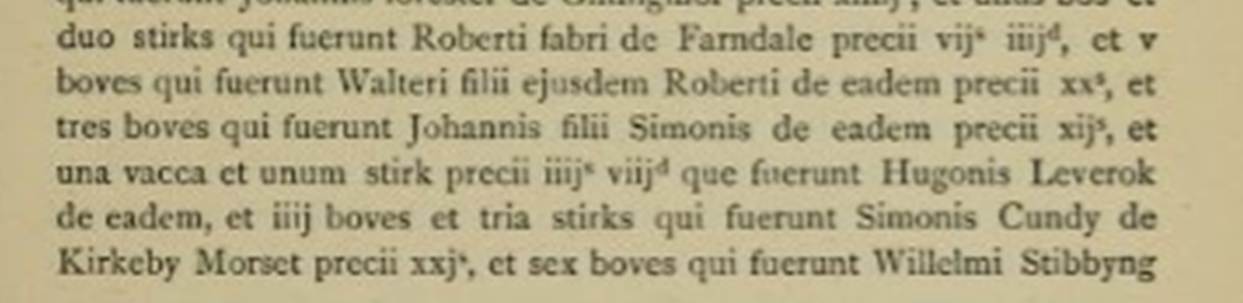
(North Riding Records Yorks Volume III,
The Honour and Forest of Pickering, 1894, Edited Robert Bell Turton, page 61)
There is a separate page about poaching in Pickering Forest.