The
Inquisition of 1282 relating to Farndale
24
March 1282
FAR00020
|
Return to the Home Page of the Farndale Family
Website |
The story of one family’s journey through two
thousand years of British History |
The 83 family lines into which the family is divided.
Meet the whole family and how the wider family is related |
Members of the historical family ordered by date of
birth |
Links to other pages with historical research and
related material |
The story of the Bakers of Highfields, the Chapmans,
and other related families |
Dates are in red.
Hyperlinks to other pages are in dark blue.
Headlines are in brown.
References and citations are in turquoise.
Context and local history are in purple.
Settlement in
Farndale by 1282
In 1282 there was another Inquisition on the death of
Joan’s son, Baldwin Wake (Yorkshire
Archaeological Record Series, Volume 12 Yorkshire inquisitions of the reigns
of Henry III and Edward I (1241-83), Volume 1, edited by William Brown,
1892, page 249, the National Archives C133/31/3, Calendar of
Inquisitions Post Mortem, Volume II, Edward I, 1906, page 259). The Farndale rents then amounted to £38 8s 8d
together with two strikes of nut (valued at 43s 9d) and services in the form of
harrowing at Lent (valued at 29s 4d). If we assume that the rent was unchanged,
this implies an increase of the acreage under cultivation to 768 acres in only
six years, which suggests a rapid pace of settlement. Of course it is possible
that there were changes in survey techniques or rent increases which might also
have contributed to the total rent increase, but the evidence suggests that
this was a period of intense activity in the dale.
There were four score and ten natives in Farndale in
1282, described as servi or serfs. They held
land by more or less, which suggests variable sizes of holdings.
In neighbouring Bransdale rents were up to £4 14s 3d
which would give us about 188 acres at the old rent of 6d per acre.
For the first time the number of bondmen are given, 25
in East Bransdale and 90 in Farndale.
The sheer scale is impressive enough, but there are
features which point to a planned campaign of settlement. It is
difficult to imagine how men of villain status, compelled to pay rents of 1s 0d
per acre for minute holdings of marginal land, could also have managed to
undertake their own assarting. It is possible that the land had been reclaimed
in advance of letting, as at Goathland, by the Lord’s agents, while the
standard rents suggest a single campaign on a large scale rather than piece
meal assaulting. A number of key questions cannot be answered from the sources
we have used so far. It is not clear whether settlement of the two Dales
completed by 1282. (New
Settlements in the North Yorkshire Moors 086 to 1340, Barry Harrison in Medieval
Settlement in North East England, Architectural and Archaeological Society
of Durham and Northumberland Research Report No 2, edited by B E Vyner, 1990,
page 27).
Baldwin Wake died in 1282 and was succeeded by his son
and heir John Wake who was summoned to Parliament as Lord Wake by Edward I.
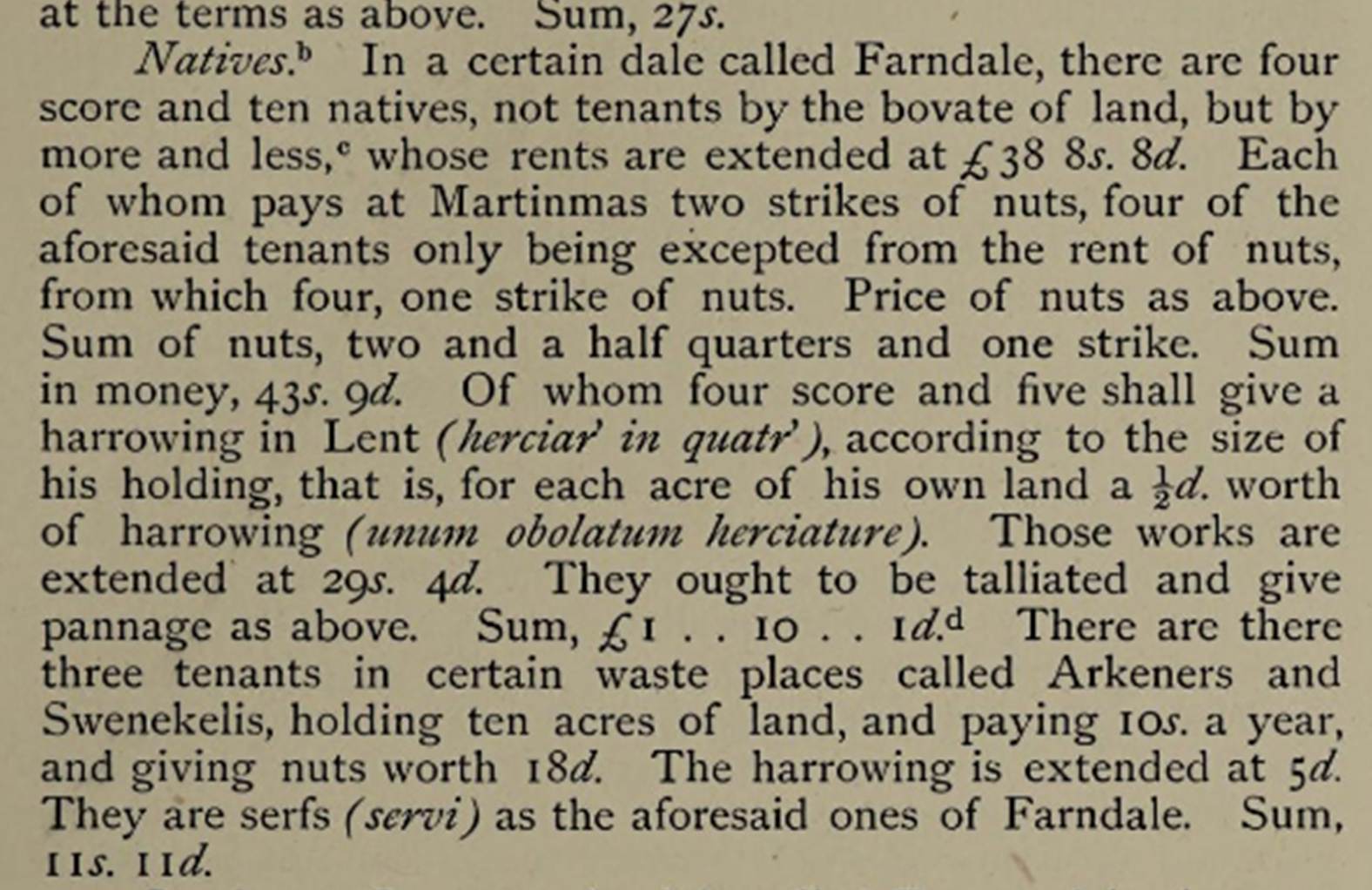
In a
certain dale called Farndale there are fourscore and ten natives,
not tenants by bovate of land, but by, more and less, whose rents are
extended at £38 8s 8d. Each of whom pays at Martinmas two strikes of
nuts, four of the aforesaid tenants only being excepted from the rent of
nuts. Price of nuts as above. Sum of nuts, two and a half quarters and one
strike. Sum in money 43s 9d of whom four score and five shall be harrowing at
Lent according to the size of his holding, that is, for each acre of his own
land a 1/2d worth of harrowing. Those works are extended at 29s 4d. They ought
to be talliated and given pannage as above. The sum of £1 10s 1d. There are
there three tenants in waste places called Arkeners and Swenekelis, holding ten
acres of land, an paying 10s a year and giving nuts worth 18d. The harrowing is
extended at 5d. They are serfs as the aforesaid ones of Farndale. Sum 11s 11d.’
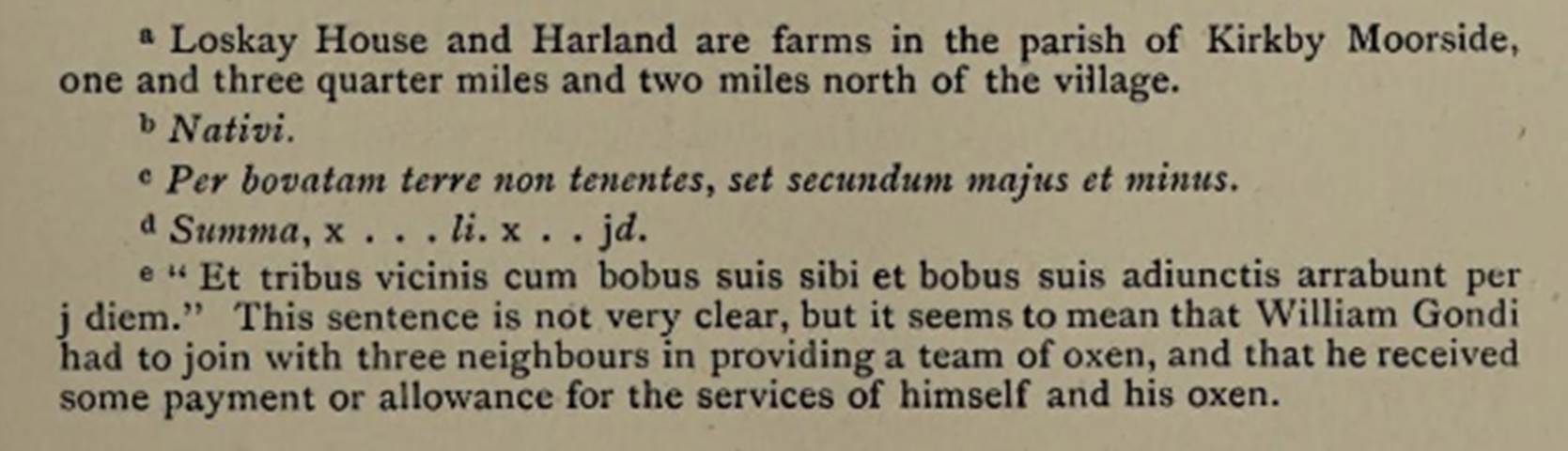
This would mean that on average each native
paid 8s 7d rent and that if the rent per acre was the same as in 1276 (FAR00017) then each
tenant had 8.5 acres which would mean about 66 farmers in the dale in 1282.
We
cannot now know, of course, whether the extent of each ''native's"' (i.e.
villein's) holding was the same, and thus whether each paid the same rent. But
assuming for the moment that this was so, we can calculate from the figures
given that the rent paid by each villein was 8s 63d, and if the rent per acre
was the same as in 1276, this would mean that each tenant farmed approximately
85 acres apiece. By simple arithmetic again it can be deduced that in 1276
there were 66 tenant farmers in the dale. Apparently then, in the six years
between 1276 and 1282 there had been an increase of twenty-four in the number
of Farndale farmers. It is interesting to note how the 12d per acre paid in
1276 compares with the rent per acre in 1782 . By this later date, of course,
the rent varied according to the quality of the land, but the average rent per
acre of the Middle Head Farm was 4s, as was that of Duffinstone,
whilst Wake Lady Green brought in 6s per acre. These three farms are chosen as
illustrations because from documentary evidence they
appear to be amongst the oldest established; but the general average rent per
acre of all the farms was much the same. What the comparative values of 1s in
Edward I's reign and in the reign of George III were it is impossible to say,
but clearly the value of the land in Farndale had not changed much in five
hundred years.
In addition to paying their rents, these medieval
farmers of Farndale also had to pay at Martinmas two strikes of nuts each, with
the exception of four tenants who only paid one strike each. What the term
'nuts' included it is hard to determine exactly, but it seems to have meant
acorns as much as any other kind. Eighty-five of the farmers were obliged to
give a harrowing in Lent - ''according to the size of his holding, that is, for
each acre of his own land a ½ d. worth of harrowing". Further obligations which
fell upon them are listed at the end of the inquisition: - ''And be it known
(they) ought to be talliated every year at
Michaelmas, and shall give merchet for their daughters, and gersume,
and do suit to the lord's mill, and shall give the tenth pig, although the lord
shall not find them pannage."' Such were some of the conditions of life
under which the farmers laboured in 13th century Farndale. (Notes on the History of Farndale
in the Middle Ages, Arthur H Whitaker,
Ryedale Historian, Volume 1, 1965, page 7).
At Kirkby Moorside bondsmen and
cottagers paid Michaelmas tax, gave their tenth pig, paid 'gersumes' and gave '‘merchet' for their daughters. Villein farmers lived by
such customs. As late as 1410 a villein moving into Farndale was obliged to
return to his place of origin by its manor court. Freeholders could move, and a
lively land market had developed in their properties. Many were of that broad
class, often of knightly descent from which the knights were drawn. Many a
minor manor lord never saw knighthood, while some freeholders already had
taxable wealth comparable with those who did. All lived on a grain diet, with
ale as their drink. Peas and beans made puddings and pigs were widely kept.
Hens and geese occur and nuts were valued. Meat was scarce, though more was
eaten as time passed, but fish was relatively cheap. The prob!em
was to survive the winter and the all too frequent pestilences. (Life in Ryedale in the 14th century, J H Rushton, Ryedale Historian,
Volume 8, 1976, page 19).
In Anglo-Saxon and early Norman England, the
peasant tenantry is broadly to be distinguished from slaves. To employ the
terminology of Domesday Book, in the late eleventh century the peasantry was
divided between villani, cotarii,
bordarii, servi, bovarii, coliberti. The villani, but also the cotarii,
and bordarii, could stand on a par with the sections
of the freer elements in the eleventh-century countryside, notably the sochmanni or sokemen. Although all owed obligations to
their lord, relativities of freedom were indistinct and villani
and their like were, as we shall see, not ‘serfs’ in a thirteenth-century sense
of the word. Instead, they were husbandmen or farmers who held land and were
restrained only by the particular expectations of lordship but not formally
distinguished as unfree. Essentially, they enjoyed rights at law. By contrast the
servi, bovarii and coliberti were servile or of servile origin and, as such,
were obliged to labour upon their lord’s demesnes in roles that would, in later
centuries, be filled by paid estate workers or famuli. Their rights were
extremely limited and, at least in the eyes of Anglo-Saxon laws, they existed
more as chattels than as individuals. In particular, they did not enjoy a right
to leave their lord’s demesne at will. (Land
Tenure, Landholding and Rent, from Peasant and Community in Medieval England,
1200-1500, Phillip R Schofield, 2003, page 12).
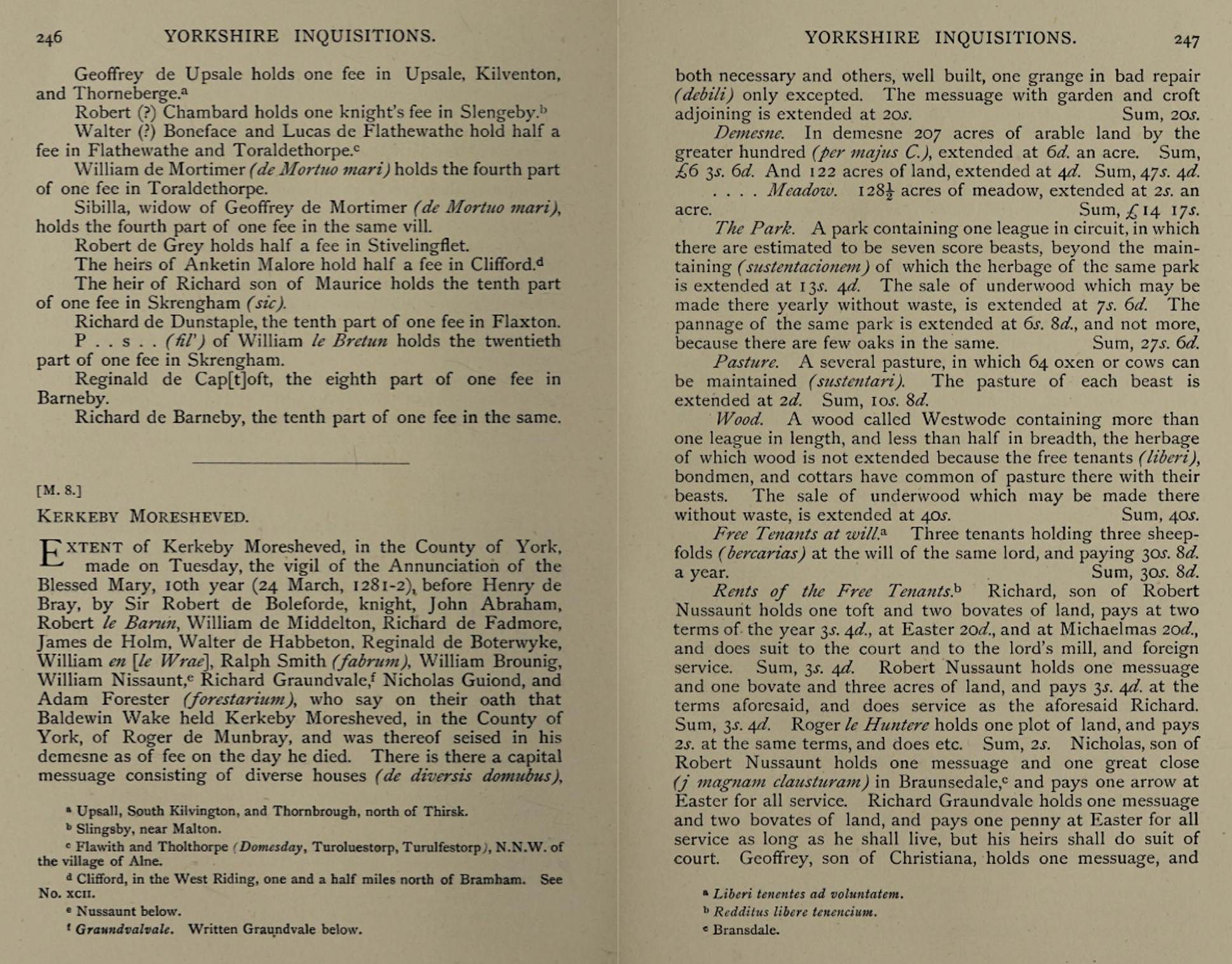
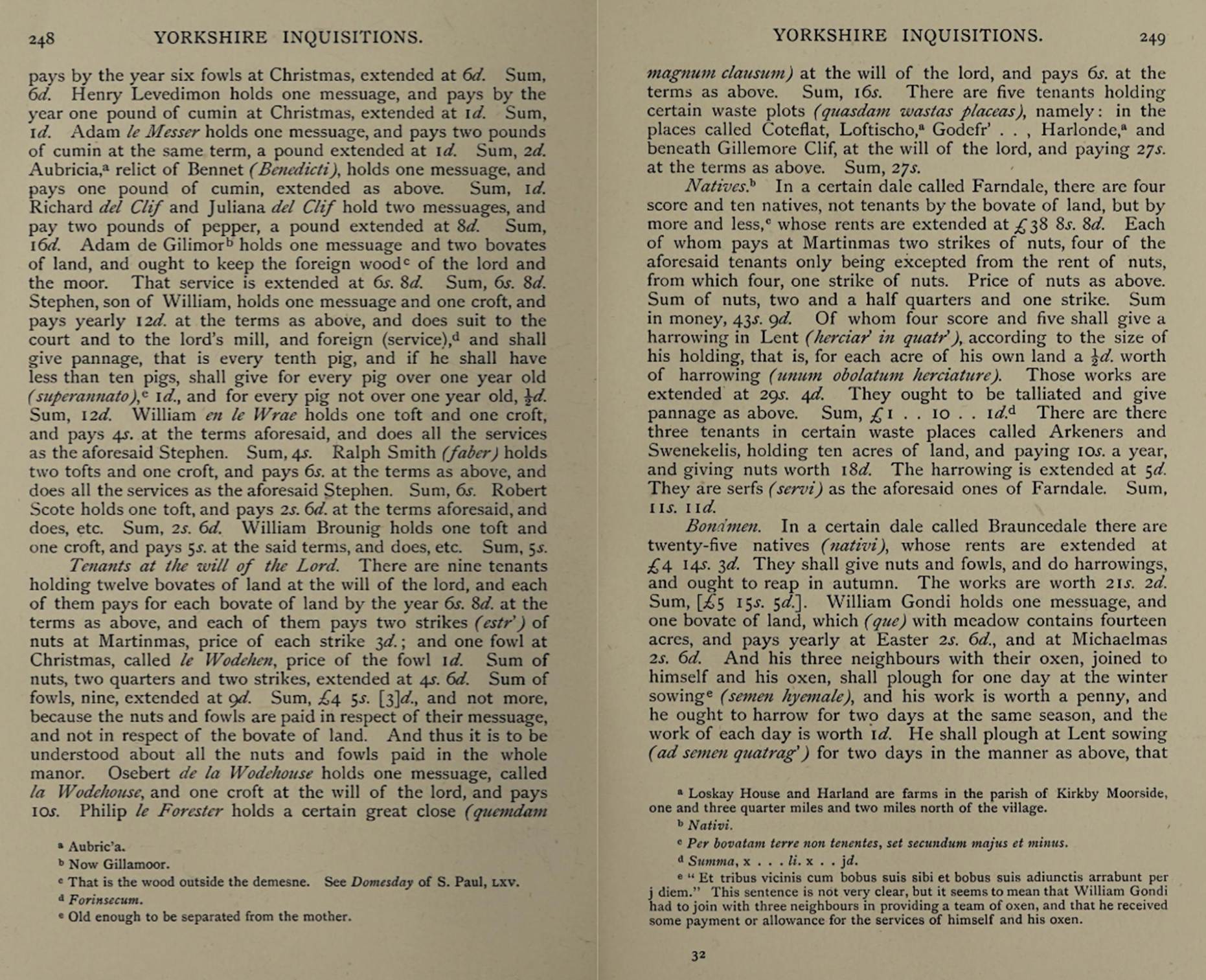
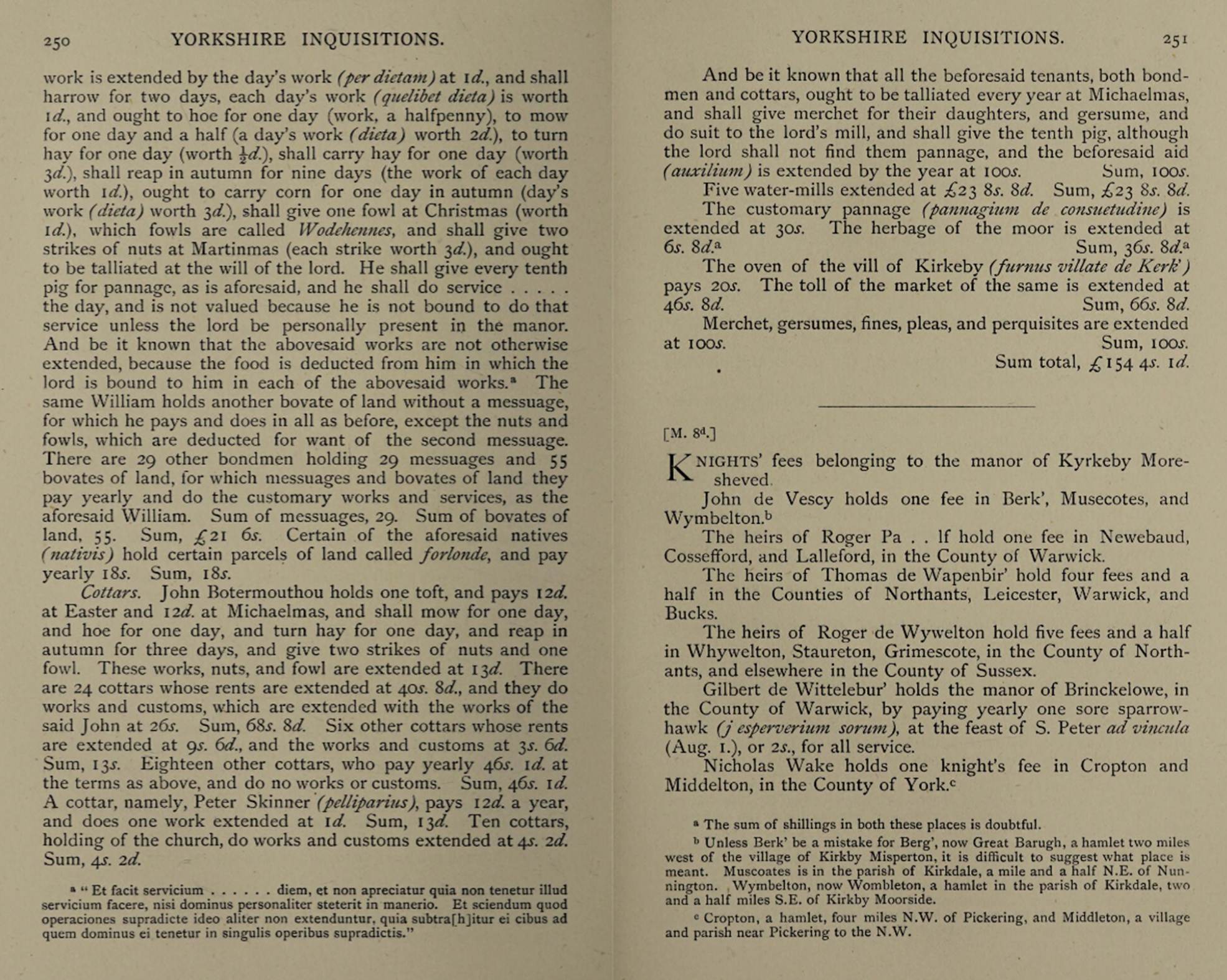
(Yorkshire Archaeological Record
Series, Volume 12 Yorkshire inquisitions of the reigns of Henry III and Edward
I (1241-83), vol i, ed William Brown, 1892, page 246 to 251)
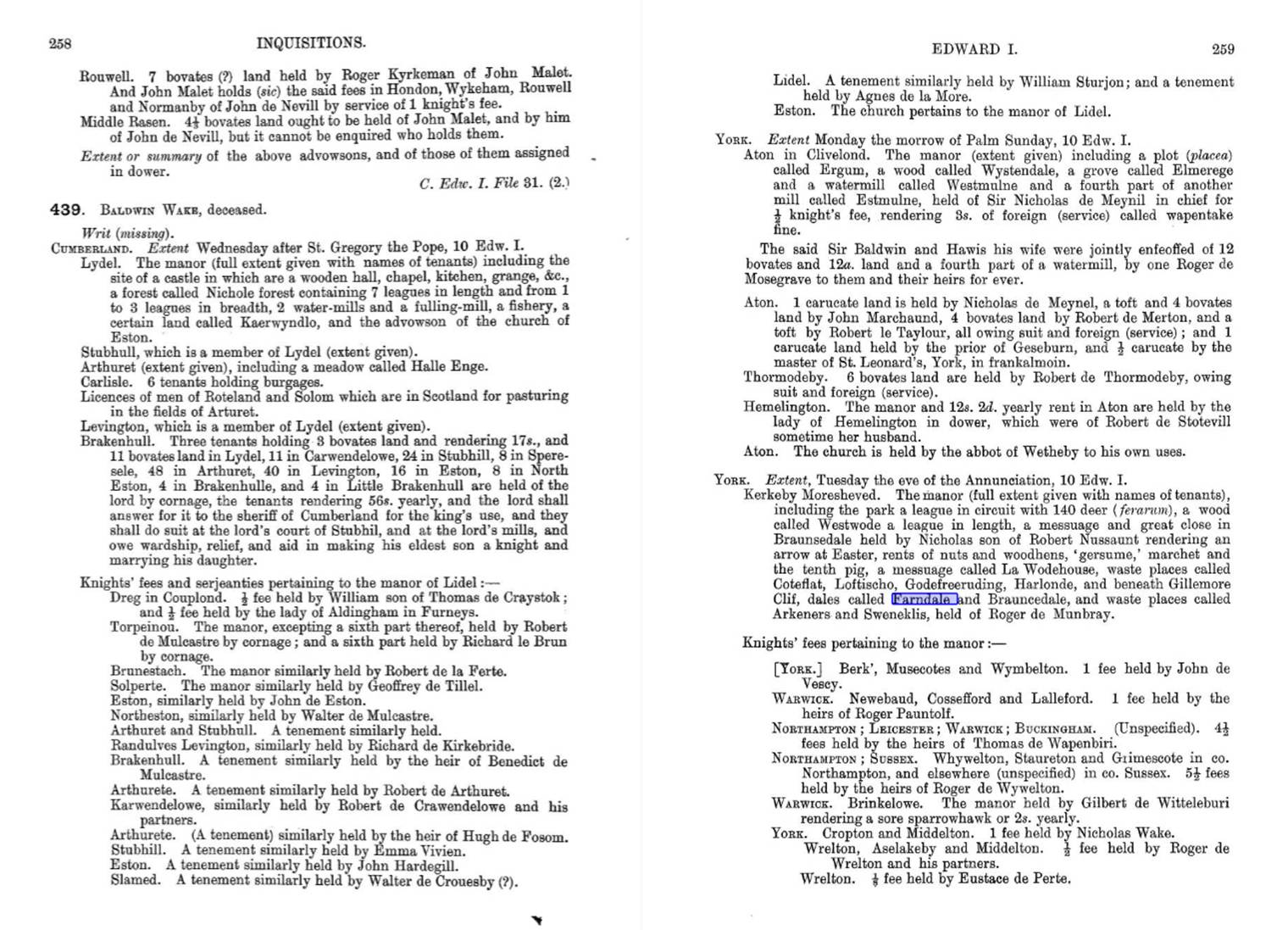
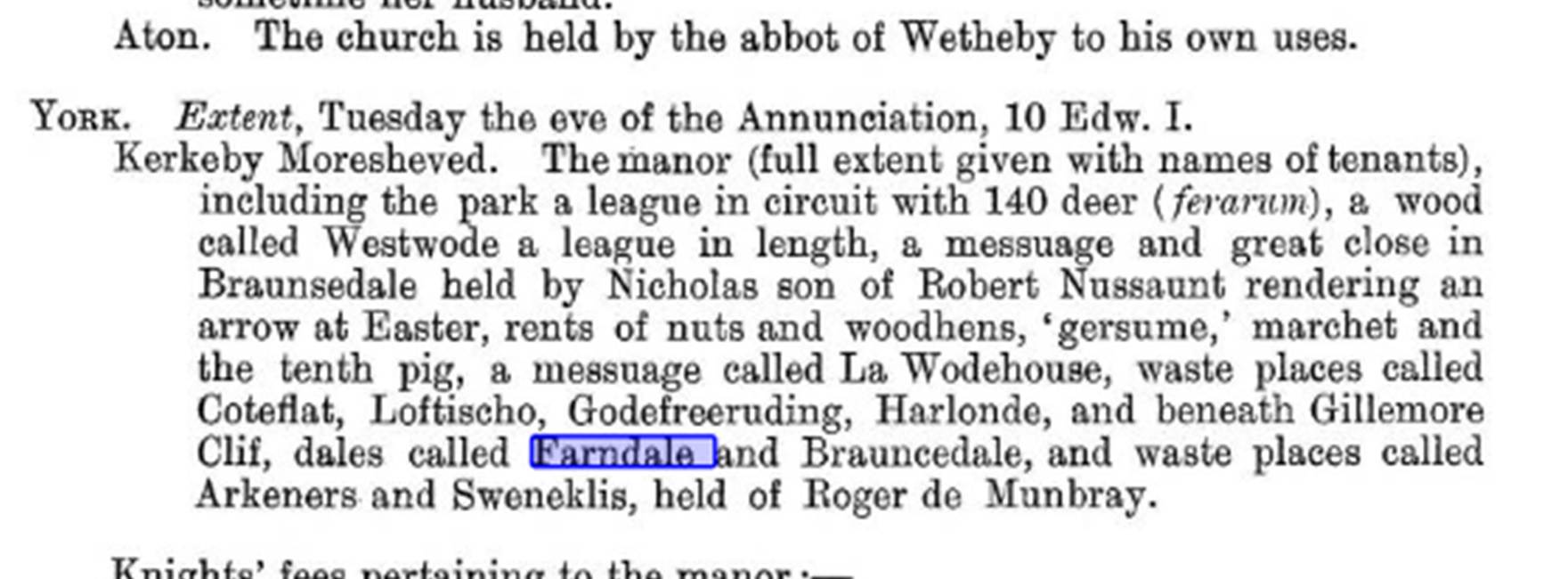
(Calendar of
Inquisitions Post Mortem, Volume 2, Edward I, 1272 – 1291, page 259).
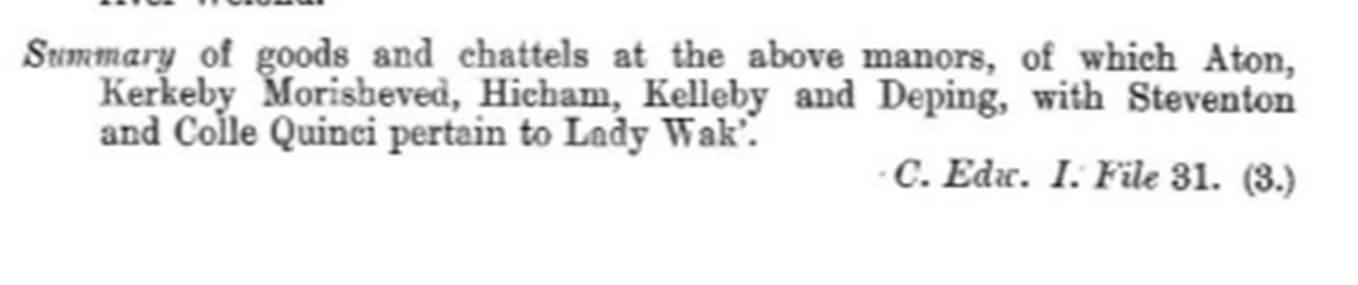
York. Extent, Tuesday the eve of the
Annunciation, 10 Edw I. Kerkeby Moresheved.
The Manor (full extent given with names of tenants), including the park a
league in circuit with 140 deer (ferarum), a wood
called Westwode a league in length, a messuage and
great close in Braunsdale held by Nicholas son of Robert Nussuant rendering an
arrow at Easter, rents of nuts and woodhens, ‘gersume’,
marchet and the tenth pig, a massuage
called La Wodehouse, waste places called Coteflat, Loftischo, Godefreeruding, Harlonde, and beneath Gilemore
Clif, dales called Farndale and Bransdale, and waste places called Arkeners and Sweneklis, held of
Roger de Munbray.
The Regnal Year 10 Edward I is 1282 - https://www.justcite.com/kb/search-technology/regnal-years/
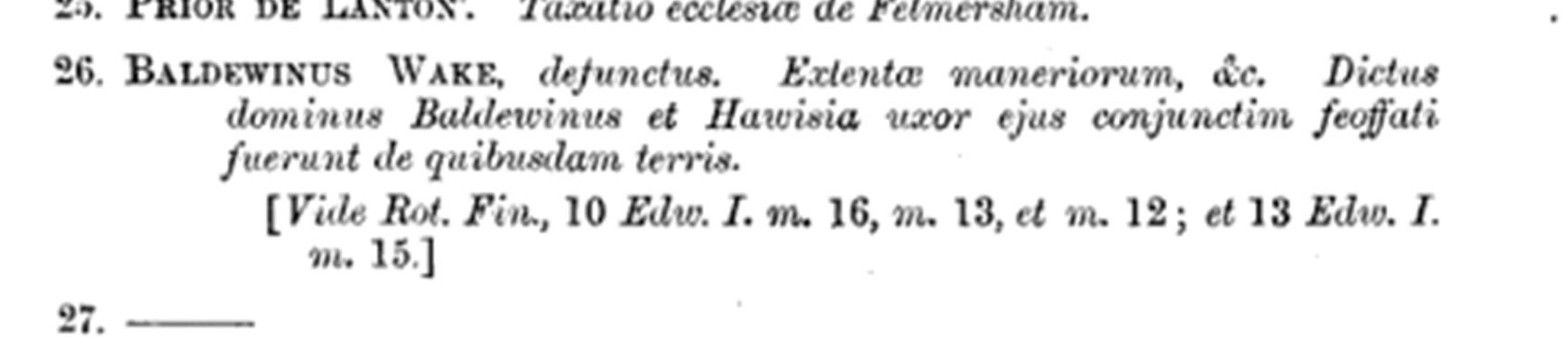
Other business relating to Baldwin Wake’s
estate on his death
18 February 1282, Sherborne. To the sheriff of
Lincoln. Order to deliver to Hawisia, late the wife of Baldwin Wake, the manor
of Deping, which the king caused to be taken into his
hands upon the death of Baldwin, as the king has committed it to her to hold in
tenencia until a month from Easter, so that the king
may then cause dower to be assigned to her. (Close Rolls of the
reign of Edward I, 1279 to 1288, page
148).
18 September 1282, Dymmayn. To the
treasurer and barons of the exchequer. Order to cause Thomas de Normanvill,
escheator beyond Trent, to be discharged of thirty-five greater plough-horses (jumenta) and nine smaller ones and of a stallion,
which were appraised at ill. 18s. id., of the chattels that belonged to Baldwin
Wake, deceased, tenant in chief, taken into the king's hands by reason of the
debts due to him from Baldwin, which horses were retained for the price for the
king's use and delivered by the king's order to Queen Eleanor, the king's
consort, and to cause allowance for the value as above to be made to Baldwin's
heir. (Close Rolls of the reign of Edward I, 1279 to 1288, page
167).
11 December 1282, Rhuddlan. To Master Roger de
Holebrok, steward of the forest between the bridges of Oxford and Staunford. Whereas the king gave to Baldwin Wak before his
death ten oaks in the forest of Salcey (Salceto) for the construction of his hall at Stivinton, and Baldwin before his death received only six
oaks, as the king learns : the king, wishing to show favour to Hawisia, late
the wife of Baldwin, for the remaining trees, orders Roger to deliver to her
the remaining four trees, if Baldwin received six only. (Close Rolls of the
reign of Edward I, 1279 to 1288, page 198).
26 May 1285, Westminster. To the treasurer and
barons of the exchequer. Whereas the king after the death of Baldwin Wak
enjoined Master Henry de Bray to take into the king's hands, by reason of the
debts due from Baldwin to him, all Baldwin's stud {eqvicium)
that belonged to Baldwin at Cotingham and Skeldinghope at his death, and to cause it to be appraised
and kept safely until further orders, and the king afterwards enjoined Henry by
word of mouth to deliver the stud, which was appraised by him at 161L 6s. 8ii.,
to Queen Eleanor, the king's consort, of the king's gift, and Henry delivered
it to her, as she has acknowledged before the king : the king orders the
treasurer and barons to acquit Henry of the appraisement, wherewith he is
charged, in his account of the issues of the goods and chattels that belonged
to Baldwin at his death, and to cause John, son and heir of Baldwin, to have
allowance therefor in the debts due to the king from his father. (Close Rolls of the
reign of Edward I, 1279 to 1288, page
322).