William Leng Farndale
1876 to 8 May 1932
Brewer
and Northumberland Hussar of Rothbury, Northumberland
FAR00539
|
Return to the Home Page of the Farndale Family
Website |
The story of one family’s journey through two
thousand years of British History |
The 83 family lines into which the family is divided.
Meet the whole family and how the wider family is related |
Members of the historical family ordered by date of
birth |
Links to other pages with historical research and
related material |
The story of the Bakers of Highfields, the Chapmans,
and other related families |
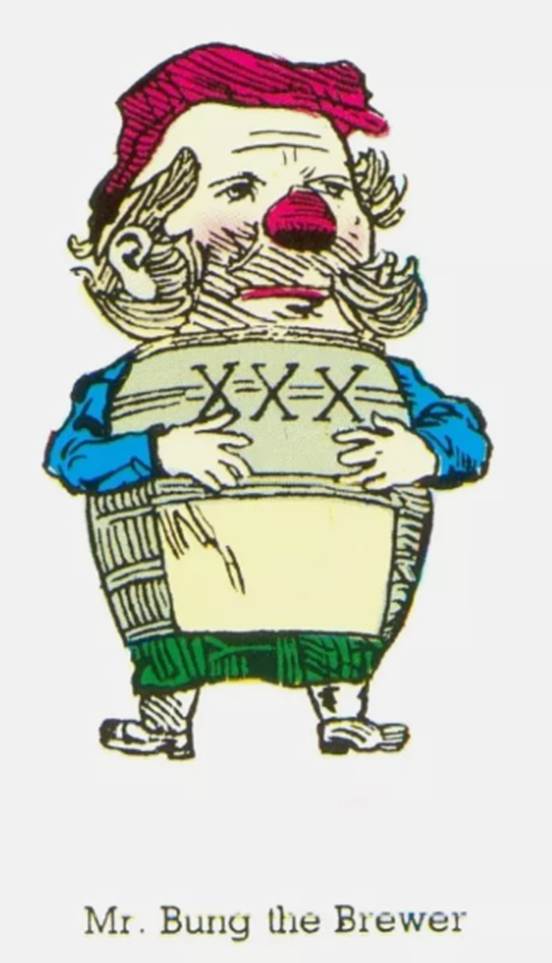
Brewer and wine
merchant and later a Brewer’s Merchant in Rothbury who served as a Sergeant in
the Northumberland (Hussars) Imperial Yeomanry.
Dates are in red.
Hyperlinks to
other pages are in dark
blue.
Headlines of
Kirk’s life are in brown.
References and
citations are in turquoise.
Context and local
history are in purple.
Geographical
context is in green.
Middlesbrough
1876
William
Leng Farndale, son of George and Catherine Wemyss (nee Leng) Farndale (FAR00333), was born in Middlesbro’ in 1876.
William Leng Farndale’s birth was registered in Middlesborough District in the second
quarter of 1876 (GRO Vol 9d page 618).

Liverpool
1881
By 1881, the
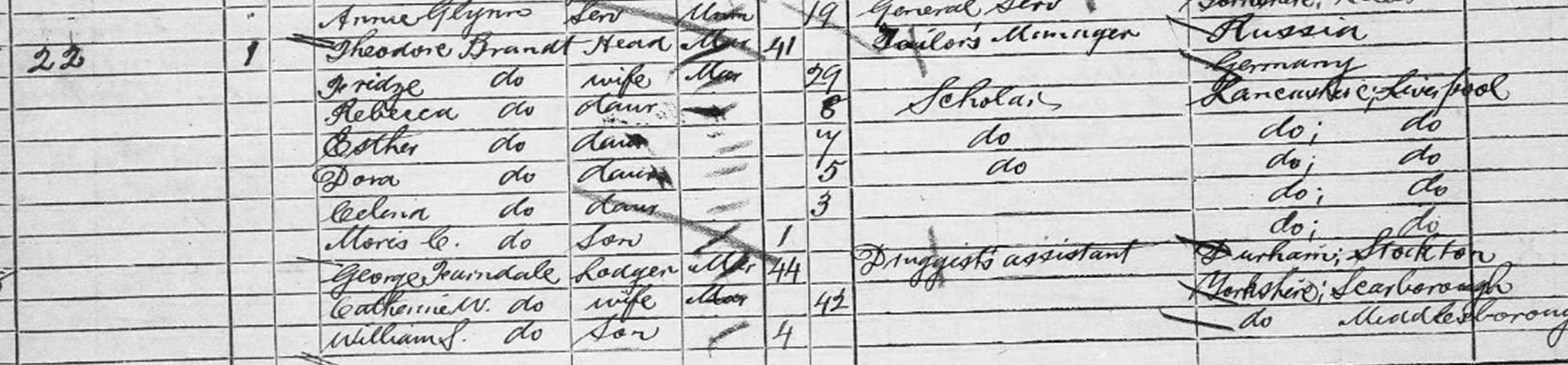
family had moved to 22 Great Oxford Street, Liverpool where the four year old
William’s father, George was a druggist’s assistant. They were lodging with the
Russian and German Brandt family, who were tailors.
Census
1881 – 22 Great Oxford Street, Liverpool
George
Farndale, druggist’s assistant, aged 44, born Stockton in 1837
Catherine
W Farndale, 42
William
L Farndale, son, 4 (FAR00539)
Lodging
with the Brandt family, tailors (Russian and German)
Gateshead
1891
Ten years
later, they had moved to 15 and 17 Linn Street, Gateshead. William was fifteen
years old and had started working as a clerk in an iron foundry.
Census
1891 – 15 and 17 Linn Street, Gateshead, Durham
G H Farndale,
50, dress maker, born Stockton in 1841
William
Farndale, 15, clerk iron foundry,
born Middlesbrough about 1876

1896
William Leng Farndale married Margaret Ann
Davison in 1896 and their marriage was registered in the fourth quarter
of 1896 in Sunderland District (GRO
Vol 10a page 1053).
Margaret
Davison was the daughter of George Davison (1846 to 1904), a stone mason, and
Dorothy (nee Wilkie) Davison)(1845 to 1921) and was born in Rothbury on 28
March 1877.
1901
By 1901, William’s mother
Catherine was still a dress maker, in old age, aged 61 in Gateshead (1901 census – St
Cuthbert, West Central Ward, Gateshead).

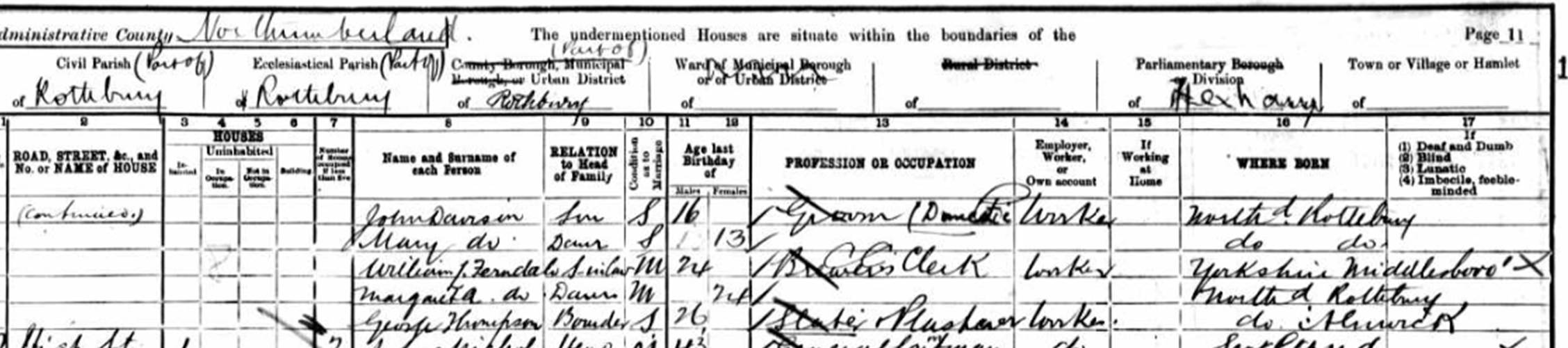
William Leng Farndale was with
his parents in law, the Davisons and Margaret at
Rothbury, and William was a brewer’s clerk (1901 Census, High
Street, Rothbury).

Rothbury, Northumberland
They seem to have moved soon afterwards to Rothbury,
in Northumberland. Rothbury
is a medium sized town about forty kilometres north of Newcastle which had been
a medieval centre for dealing in cattle and wool. The town developed
extensively in the Victorian era, partly by the arrival of a railway and also
as a result of the industrialist Sir William Armstrong’s
influence, who built Cragside
between 1862 and 1865, a country house and hunting lodge, just outside Rothbury
which included state of the art renewable energy sources.
William and
Margaret settled there by the turn of the century and lived there until William
died.
Rothbury
in north of Newcastle and north of Morpeth in Northumberland.
William and Margaret, with William’s mother Catherine, clearly settled there at
the turn of the century and lived there until he died.
1900 to
1902
It is
possible that William Leng Farndale who served with the Northumberland Imperial Yeomanry (Hussars)
served during the Second Boer War when
that Regiment was used as mounted infantry, although we know he was in Rothbury
as a civilian in 1901.
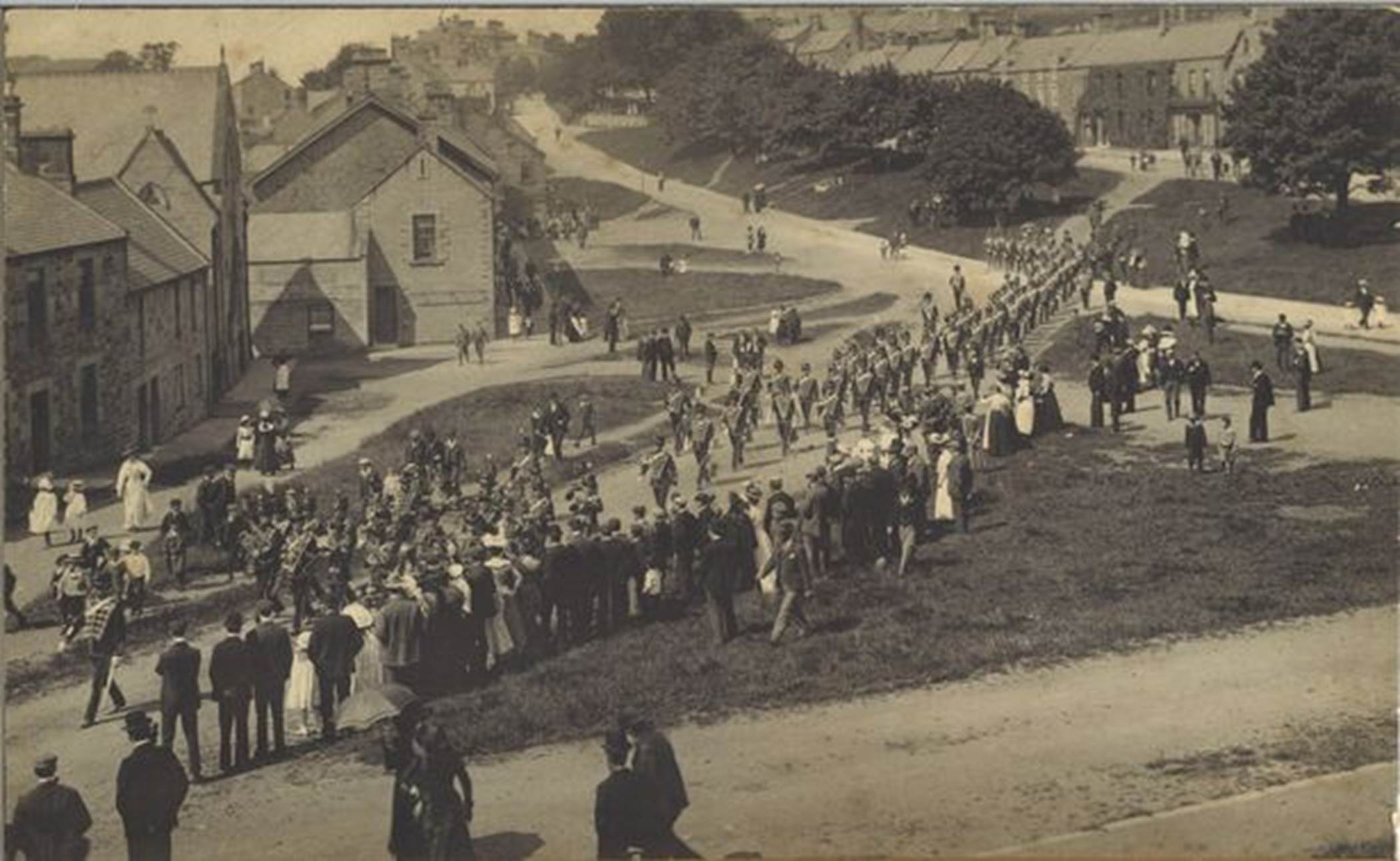
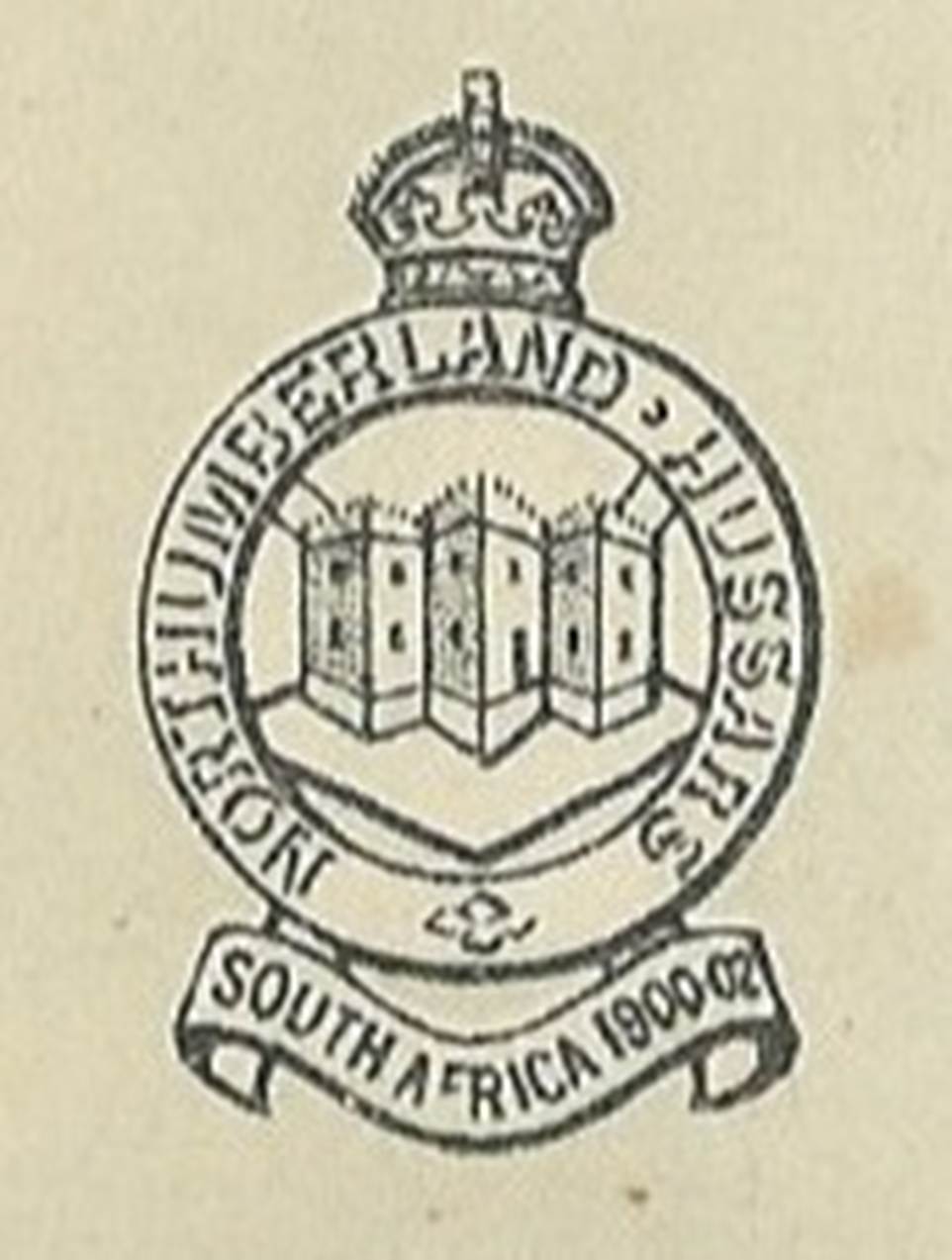
The
Hussars parade through Rothbury in 1900
The
Northumberland (Hussars) could trace its origins to December 1819 when the
Northumberland and Newcastle Volunteer Corps of Cavalry formed, under the
command of Charles John Brandling, of Gosforth House.
The Yeomanry
was not intended to serve overseas, but due to the string of defeats during
Black Week in December 1899, the British government realised they were going to
need more troops than just the regular army. A Royal Warrant was issued on 24
December 1899 to allow volunteer forces to serve in the Second Boer War. The
Royal Warrant asked standing Yeomanry regiments to provide service companies of
about 115 men each for the Imperial Yeomanry equipped as Mounted infantry. The
regiment provided 14th (Northumberland) Company, 5th Battalion in 1900; 15th
(Northumberland) Company, 5th Battalion in 1900; 55th (Northumberland) Company,
14th Battalion in 1900, transferred to 5th Battalion in 1902; 100th
(Northumberland) Company, 5th Battalion in 1901; 101st (Northumberland)
Company, 5th Battalion in 1901; 105th (Northumberland) Company, 5th Battalion
in 1901 and 110th (Northumberland) Company, 2nd Battalion in 1901.
The mounted
infantry experiment was considered a success and the Regiment was designated
the Northumberland Imperial Yeomanry (Hussars) from 1901 to 1908.
1902
William Farndale was a sergeant in the
Northumberland Hussars by 1902. William Leng Farndale continued to
serve with the Yeomanry until about 1907, regularly organising social balls. He
later became Rothbury’s brewer.
Newcastle Journal, 25 October 1902 and Morpeth
Herald, 1 November 1902: NORTHUMBERLAND
HUSSARS. ANNUAL DINNER AT ROTHBURY. The annual dinner given to the
members and ex members of the Rothbury Detachment of the Northumberland
Hussars Imperial Yeomanry by Major Watson Armstrong was held in the Queen's
Head Hotel, Rothbury, the splendid repass being catered for by the host and
hostess, Mr and Mrs Bell. Major Watson Armstrong presided, the vice chairs
being occupied by the Regimental Quartermaster Sergeant Bell and Sergeant
Farndale. The shooting prizes given by Major Watson Armstrong were then
distributed by the chairman, who observed that they Rothbury Detachment stood
high in the Squadron so far as marksmanship was concerned. The Colonel’s Cup
(Colonel J B Cookson CB) was held by
Sergeant Farndale... The Silver Cup of the Rothbury Detachment... Fourth
prize, Sergeant Farndale … Mr D D Dixon proposed
“The Northumberland Hussars” coupling with the toast the name of the Regimental
Quartermaster Sergeant Bell, who replied. He observed that when he joined in
1894 he received the kit of a yeoman who had immigrated to Australia, and who,
when the war broke out, went to South Africa... The Chairman, in reply,
said that reunion gave him much pleasure, especially the reunion of those
who had fought in South Africa. He welcomed them back. Applause. It was a
happy thought of Mr Harvey to bring ex trooper Wilson from Hepple with him.
Applause. This was the first time he had met then since he was appointed
Commander of the C Squadron of the Regiment. Sergeant Major Wilson had told
them that the C Squadron had been specially creditably mentioned by Lord
Chesham. He had the privilege of being the oldest yeoman in the room.
The
Northumberland (Hussars) could trace its origins to December 1819 when the
Northumberland and Newcastle Volunteer Corps of Cavalry formed, under the
command of Charles John Brandling, of Gosforth House.
The
Yeomanry was not intended to serve overseas, but due to the string of defeats
during Black Week in December 1899, the British government realized they were
going to need more troops than just the regular army. A Royal Warrant was
issued on 24 December 1899 to allow volunteer forces to serve in the Second
Boer War. The Royal Warrant asked standing Yeomanry regiments to provide
service companies of approximately 115 men each for the Imperial Yeomanry
equipped as Mounted infantry. The regiment provided:
14th
(Northumberland) Company, 5th Battalion in 1900
15th
(Northumberland) Company, 5th Battalion in 1900
55th
(Northumberland) Company, 14th Battalion in 1900, transferred to 5th Battalion
in 1902
100th
(Northumberland) Company, 5th Battalion in 1901
101st
(Northumberland) Company, 5th Battalion in 1901
105th
(Northumberland) Company, 5th Battalion in 1901
110th
(Northumberland) Company, 2nd Battalion in 1901
The
mounted infantry experiment was considered a success and the regiment
was designated the Northumberland Imperial Yeomanry
(Hussars) from 1901 to 1908.
1903
Morpeth Herald, 10 January 1903: YEOMANRY BALL AT ROTHBURY. A
most successful ball was held on Monday evening in the Jubilee Hall, Rothbury,
at the kind invitation of Major and Mrs Watson Armstrong. There were present
the whole of the non commissioned officers and
troopers of the Rothbury Detachment Northumberland Hussars Imperial Yeomanry,
residents of Rothbury, and the tenantry of the various farms on the Cragside
estate, the number of guests being about 180. The hall, supper and ante rooms
were beautifully decorated, pictures, military trophies, crossed swords,
shields, banners and flags being effectively displayed while evergreens and
festoons of flowers, with trees hung with Chinese lanterns, rendered the
decorations additionally attractive. The walls of the supper room were draped
with blue and white, the Regimental colours. … The duties of MC were
agreeably performed by Major Watson Armstrong, Regimental Quartermaster J W
Bell, Sergeant Farndale … the following ladies and gentlemen also accepted
invitations, most of whom were present... Mr and Mrs Farndale...
The
Northumberland Hussars were a reserve territorial unit, so he attended civilian
events too.
Morpeth Herald, 24 January 1903: ROTHBURY ODDFELLOWS’ BALL.
The annual bull of the Loyal Vale of Coquet lodge was held in the Jubilee Hall,
Rothbury, when nearly 200 were present. … the programme was an artistic pen and
ink sketch by … an excellent supper was provided by... The ball was led off by
... and amongst others present were … Mr Farndale...
William
Leng Farndale continued to serve as a sergeant in the Northumberland (Hussars)
Imperial Yeomanry. Newcastle Daily Chronicle, 12 June 1903: THE
“CHRONICLE” RIFLE MEETING. WINNER OF THE CUP. THE PRIZE LIST. Yesterday the
third “Chronicle” Cup meeting came to a conclusion at the heart and range,
being attended by success of the meet. Throughout the two days shooting
proceeded without a single hitch of any kind. The scoring all round was good,
while the registering and the marking could not possibly have been improved
upon. The shots were marked with dispatch and accuracy, and as an instance of
its true character it is only to be stated that during the two days just one
shot was challenged, when the verdict was in favour of the marker... List of
Results … Sergt W L Farndale, NHIY 21 22-43
…
1904
Catherine
Dorothy Farndale (FAR00722)
was born in Rothbury, Northumberland on 19 January 1904 (1939 Register). Catherine Dorothy Farndale’s birth
was registered in Rothbury District in the first quarter of 1904 (GRO Vol 10b page 550).
William
Leng Farndale, then an assistant manager, was initiated into the United Grand
Lodge of Freemasons on 24 October 1904 at Gateshead (Freemason Membership Registrations, Lodge Number 498, Folio 320).
Newcastle Daily Chronicle, 18 January 1904: YEOMANRY BALL AT ROTHBURY.
The annual ball of the Rothbury detachment of the Northumberland Hussars, was
held in the Jubilee Hall, by permission of Lieutenant Colonel J B Cookson, CB,
on Friday evening. The ballroom presented an animated in picturesque appearance,
being exquisitely decorated with banners, bannerettes, and evergreens,
festooned and interwoven with trophies of war, weapons ancient and modern being
tastefully hung round the walls. An excellent portrait of the late Lord
Armstrong was hung at the head of the room. The dining room was draped all
round with palms etc and was equally charming in appearance, and contained
portraits of Lord and Lady Armstrong. The decorations reflected the greatest
credit on Mr Hudson and Mr Barnett of Cragside, and their assistants and
Sergeant Major Wilson; while the general arrangements were in the hands of
Sergeant W L Farndale, who is to be complemented on the success of the
same, everything passing off without a single hitch …
1905
Newcastle Evening Chronicle, 7 March 1905: LONG SERVICE MEDALISTS. It
was announced yesterday from the War Office that long service medals have been
awarded to the following members of militia, yeomanry, and volunteers serving
in this district... Northumberland Hussars... W Farndale...
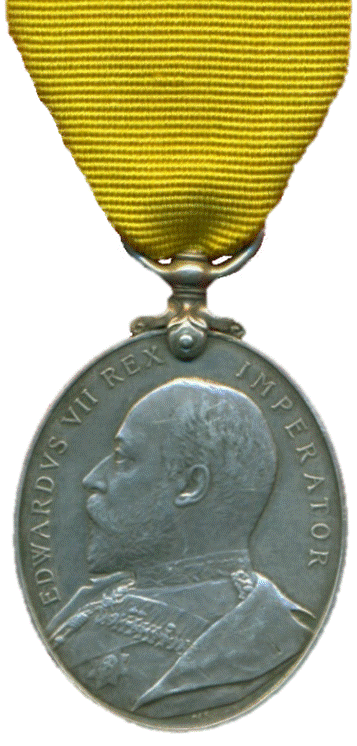
Authorised
by King Edward VII under Army Order No. 211 of 1904, the Imperial Yeomanry Long
Service Medal was awarded to troopers and non-commissioned officers in the
Imperial Yeomanry for 10 years’ service and attending 10 annual camps. William
must therefore have joined the Yeomanry in about 1895, which tends to suggest
he was with the Regiment when they served in the Second Boer War. There were a
total of 1,674 of these medals awarded.
Berwickshire
News and general Advertiser, 21 March 1905: The following non commissioned officers of Northumberland (Hussars)
Imperial Yeomanry have been awarded the “Imperial Yeomanry Long Service
Medal” … W Farndale …
Volunteer
Service Gazette, 24 March 1905. Imperial Yeomanry Long Service Medal. The
following is a list of non commissioned officers and
men of the Imperial Yeomanry who have been awarded “The Imperial Yeomanry Long
Service Medal”... Northumberland Hussars Imperial Yeomanry … Sergeant W
Farndale...
1906
Frances
Mary Farndale (FAR00737)
was born in Rothbury on 20 May 1906 (1939 Register).
Frances Mary Farndale’s birth was registered in Rothbury District in the second
quarter of 1906 (GRO Vol 10b page 534).
1907
Morpeth
Herald, 5 January 1907: Yeomanry Ball at Rothbury. The annual Yeomanry
ball of the Rothbury troop was held, by the kind permission of Colonel Bates in
the Jubilee Hall, last week, under most disadvantageous circumstances, many
being unable to attend owing to the roads being blocked all round. About 50
couples, however, braved the elements, and the most enjoyable night was spent.
The hall was beautifully decorated with regimental flags, trophies of war and
so on. The programme of dances was a most beautifully designed pen and ink
sketch by... dancing commenced at 8:30 after the arrival of Major Lord
Armstrong, Lady Armstrong, and party... The general arrangements were in the
hands of Sergeant Farndale and Trooper Worsnop, and the music was supplied
by Messrs Ross’s string band.
Volunteer
Service Gazette and Military Dispatch, 9 October 1907:
NORTHUMBERLAND HUSSARS. The annual price shoot of the Northumberland Hussars Imperial
Yeomanry took place on the heart and more rifle range. The weather was fine,
but the light was dull, and the wind blew from the north rather steadily.
Scores. Sergeants competition. To decide the best shot amongst that Sergeant
and ranks above, who will be entitled to the regimental badge. Conditions,
seven shots rapid at 200 yards and one sighter, seven shots at 500 yards, one
sighter, and sudden shots at 600 yards:
|
|
200 yards |
500 yards |
600 yards |
Total |
|
Sergt Parmley |
26 |
33 |
32 |
91 |
|
Sergt Maddison |
30 |
25 |
27 |
82 |
|
Sergt Allison |
17 |
27 |
25 |
69 |
|
Sergt Saddler Jackson |
17 |
19 |
22 |
58 |
|
Sergt Booth |
16 |
19 |
17 |
52 |
|
Sergt Farndale |
13 |
17 |
14 |
44 |
The Brewer
William Farndale continued the business of Brewers and
Wine Merchants trading as Geo Storey and Company in Rothbury, Northumberland in
1907.
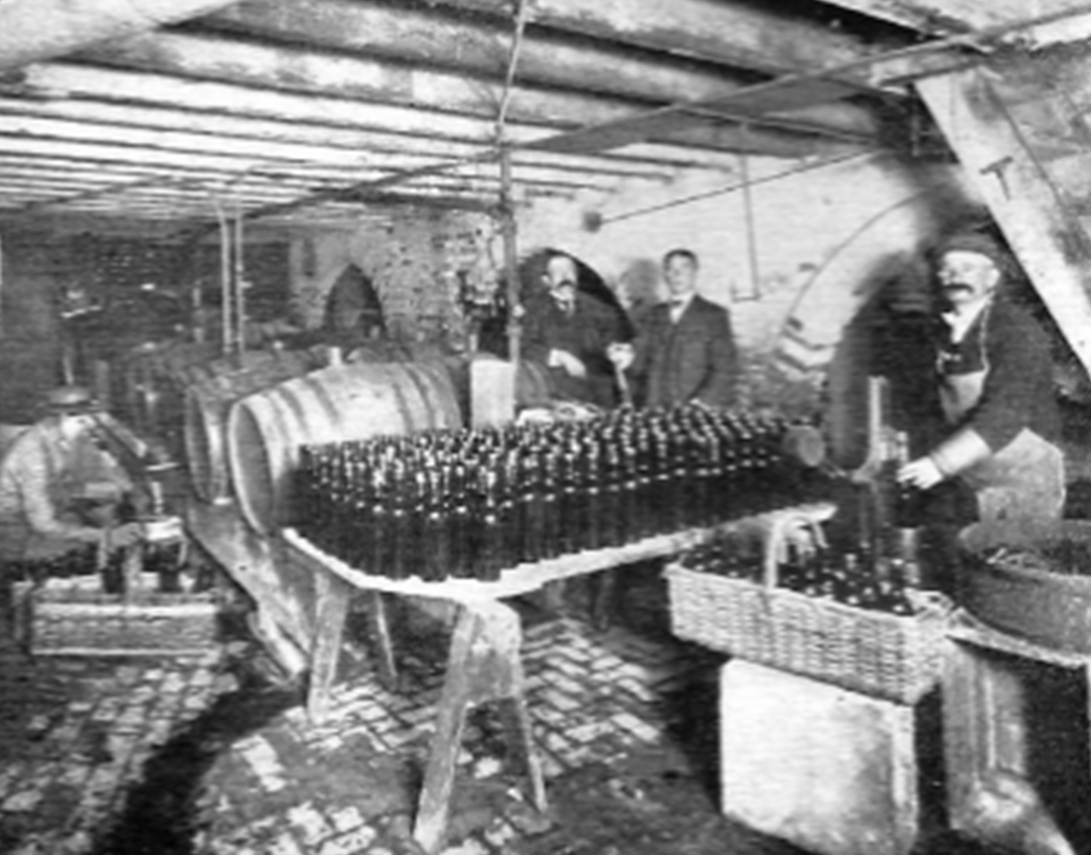
In
this article, William Farndale’s
distillery business had supplied a landlady who later adulterated the
whisky and he gave evidence in the trial. Morpeth
Herald, 20 April 1907: ADULTERATED
WHISKY. WARNING TO A LANDLADY. Mrs Mary Stevenson, licensee of the Turks Head hotel,
Rothbury, was summoned on a charge of having sold adulterated whisky. Sergeant
Taylor, who is an inspector under the Food and Drugs Act, stated that on Feb
19th, he visited the Turks Head and purchased from the landlady a pint of
whisky. He divided the whisky into three parts, one of which he returned to the
landlady, informing her that one of the others would be sent to the county
analyst for analysis... William Farndale, manager for Messrs Storey and
company, Rothbury, the Brewers who supplied to the whisky to Mrs Stevenson,
stated that the whisky was always scientifically tested before being sent out
to customers, and the class of liquor in this case was never more than 22%
under proof. Questioned by one of the Magistrates, Mr Farndale said the Firm
gave certificates as to the strength of the whisky with their sales of whisky.
Replying to Mr. Perry, witness said that a very small quantity of water would
be required to reduce a gallon of whiskey from 22% to 27.2% under proof,
probably about ¾ of a gill, or as much as would cover the bottom of a gallon
measure. The magistrates retired to consider the case, and the returning the
chairman said the Bench had been uncertain whether or not to convict, but they
had decided not to, on the defendant paying costs...
Official Gazette, 17 September 1907: NOTICE is hereby given, that
the Partnership heretofore subsisting between the undersigned, John Wardle
Nicholson, Rachael Temple and Cuthbert William Storey, carrying on business as
Brewers and Wine and Spirit merchants, at Rothbury, in the county of Northumberland,
under the style or firm of GEO STOREY & CO, have been dissolved as from the
date hereof so far as concerns that said Cuthbert William Storey, who retires
from the said firm. All debts due to and owing by the said late firm will be
received and paid respectively by the said John Wardle Nicholson and Rachael
Temple and William Leng Farndale of Rothbury aforesaid, who will continue to
carry on the said business in partnership under the style or firm of Geo story
and Co. Dated this 28th day of August 1907. John W Nicholson. Rachael temple. C
W Storey. W L Farndale.
So,
William Farndale continued the business of Brewers and Wine Merchants trading
as Geo Storey and Company in Rothbury, Northumberland in 1907.
Morpeth
Herald, 30 November 1907: UNIONIST GATHERING AT ROTHBURY. SPEECHES BY LORD
ARMSTRONG AND COLONEL BATES. Under the auspices of the Rothbury and Hepple
Unionist Association, a dinner was held at the Jubilee Hall, Rothbury, on
Monday evening. A representative company, numbering fully 100 sat down to a well served repast. The chair was occupied by Lord
Armstrong and among those supporting him were Colonel Bates DSO... W L
Farndale...
1908
Morpeth
Herald, 29 February 1908: FANCY DRESS BALL AT ROTHBURY. The annual fancy
dress ball, held under the auspices of the tradesmen of Rothbury and district,
took place in the Jubilee Hall, last night last Friday night, under the
superintendence of Mr Henry Hudson, Cragside gardens... Mr W L Farndale,
brewery...
1911
Kenneth
Farndale (FAR00767) was
born in Rothbury on 9 January 1911 (1939 Register). Kenneth Farndale’s birth was
registered in Rothbury, Northumberland in the first quarter of 1911 (GRO Vol 10b page 515).
Morpeth
Herald, 24 February 1911: ROTHBURY FLOWER SHOW. A ball and whist drive were
held in the Jubilee Hall, Rothbury, on Friday evening, in aid of the local
flower show funds..... The prize winners in the whist drive were:...
Gentleman … 2, Mr Farndale...
Could
John Johnston Farndale be somehow related as William’s wife’s maiden name was
Johnston – she came from Sunderland, so could this perhaps have been a relative
of Margaret’s who for some reason then took both names?
Northern
Weekly Gazette, 11 March 1911, Northern Weekly Gazette, 1 April 1911, Durham
Chronicle, 14 April 1911: JOHN FARNDALE JOHNSTON. Who was employed by
Messrs Lingford, Gardiner and Co of Bishop Auckland, was killed by having his
head crushed while testing a boiler. The deceased having had his name entered
in the “Gazette” agent book as a regular purchaser, was thus insured. Though
only four copies of this journal had been purchased the next of kin became
entitled to £10 and the sum was paid to the widow, Mrs H Johnston, of 18,
Nelson St, Bishop Auckland…. An application was made by Mr. T Jennings on
behalf of Mrs Harriet Johnston, widow of John Farndale Johnston, fitter, who
was killed in the recent explosion at the works of Messrs Lingford, Gardner and
company, for the apportionment of £214 2s, which had been paid into quarters
compensation...
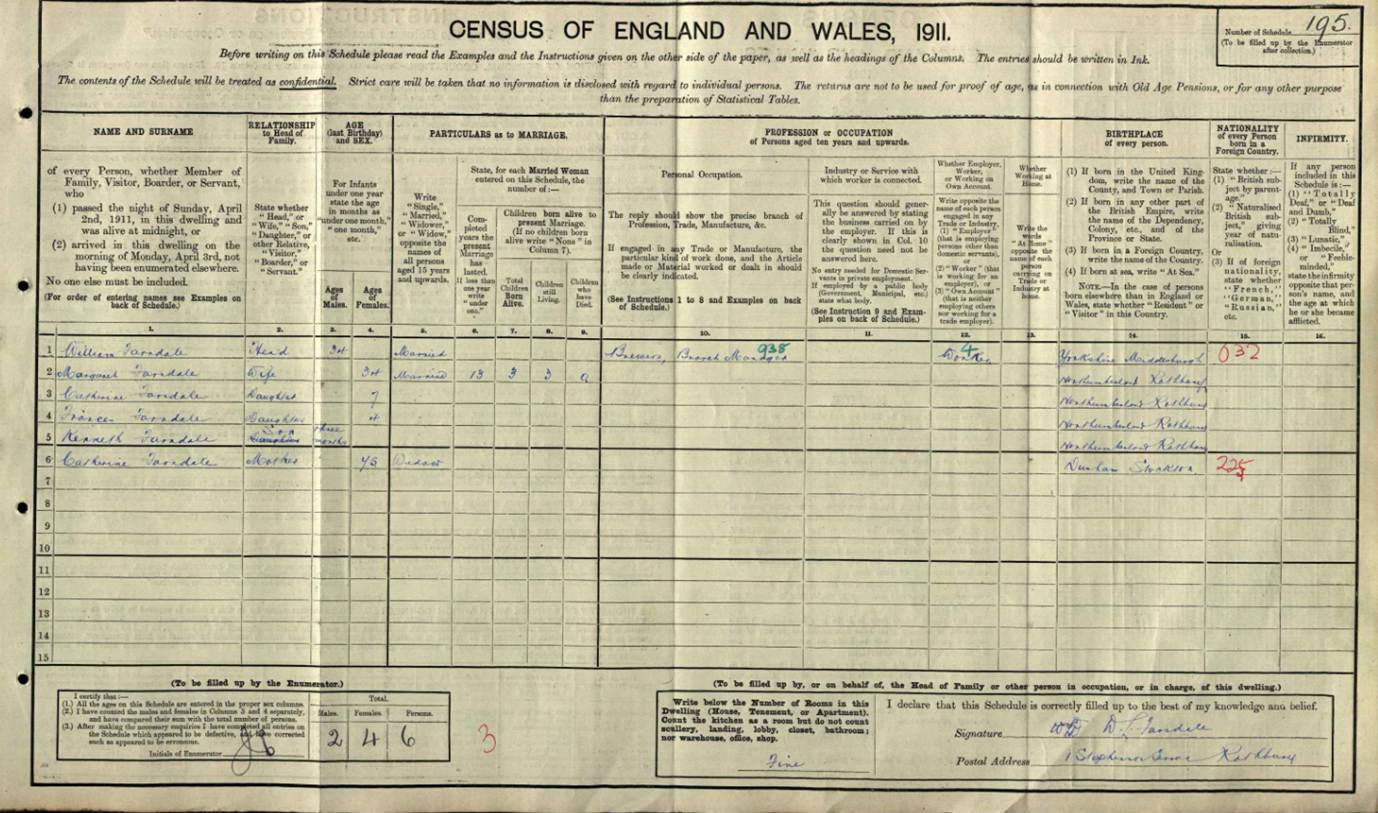
1911
Census – Stephenson’s Terrace, Rothbury, Northumberland
William
Farndale, 34, Brewer’s Branch Manager
Margaret
Farndale, 34, born 1877 at Rothbury
Catherine
Farndale, 7, born Rothbury in about 1904
Frances
Farndale, 4, born in Rothbury in about 1907
Kenneth
Farndale, 0, born in Rothbury in about 1911
Catherine
Farndale, mother, widow, 75, born in Stockton in about 1836
1912
Alnwick
Mercury, 16 March 1912: Earl Percy at Unionists “smoker”. Earl Percy,
prospective Unionist candidate for the Hexham division, was the principal
speaker at a gathering held at the Jubilee Hall, Rothbury, on Thursday evening,
in connection with the annual meeting of the Rothbury and Hepple Unionist
Association... W L Farndale...
1913
George
Patrick Farndale (FAR00794)
was born in Rothbury, Northumberland (GRO Vol 10B Page 1066) on 20 March 1913 (1939 Register).
1915
Margaret
Farndale (FAR00815) was
born in Rothbury (census)
on 28 February 1915 (1939 Register). Her
birth was registered in Rothbury District in the second quarter of 1915 (GRO Vol 10B Page 1058).
1916
Newcastle Journal, 28 February 1916: ROTHBURY LICENSED
VICTUALLERS. A meeting of the licenced victuallers of Rothbury and district was
held at the Railway Hotel. Mr W L Farndale, manager for Rothbury Brewery
Company, presided. It was unanimously decided, owing to the considerable
increase in the price of spirits, that on and after today an increased charge
of 1 penny per glass be made. It was also decided that steps be taken to form a
licenced victories association for Rothbury and district.
Inflation
due the War was 12.5% in 1915, 18.1% in 1916 and 25.2% in 1917.
1918
Winifreda Farndale (FAR00843) was born in
Rothbury (census)
on 8 August 1917 (1939 Register). Her birth
was registered in Rothbury District in the third quarter of 1917 (GRO Vol 11B Page 676).
Morpeth
Herald, 25 January 1918: EGG COLLECTION AT ROTHBURY. The children of the
CE school have made a fortnightly collection of eggs for the national egg
collection amounting to 2,172. The following have contributed eggs... Mrs
Farndale...
1920
Nancy
Farndale (FAR00867) was born
in Rothbury, Northumberland (census) on 2 June 1920 (1939
Register). Her birth was registered in Rothbury District in the third
quarter of 1920 (Vol 10B Page 1060).
Dundee
Evening Telegraph, 1 March 1920:
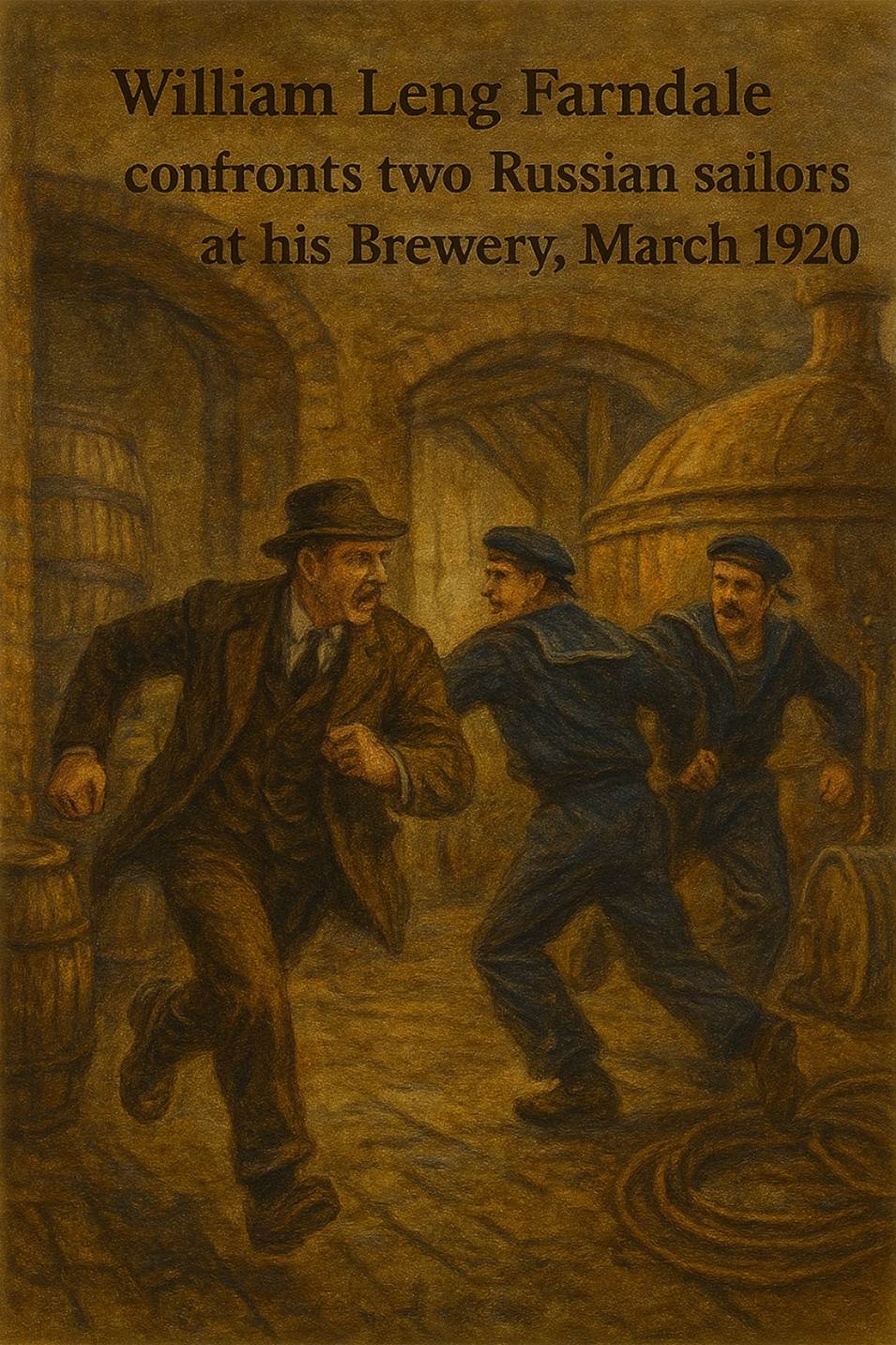
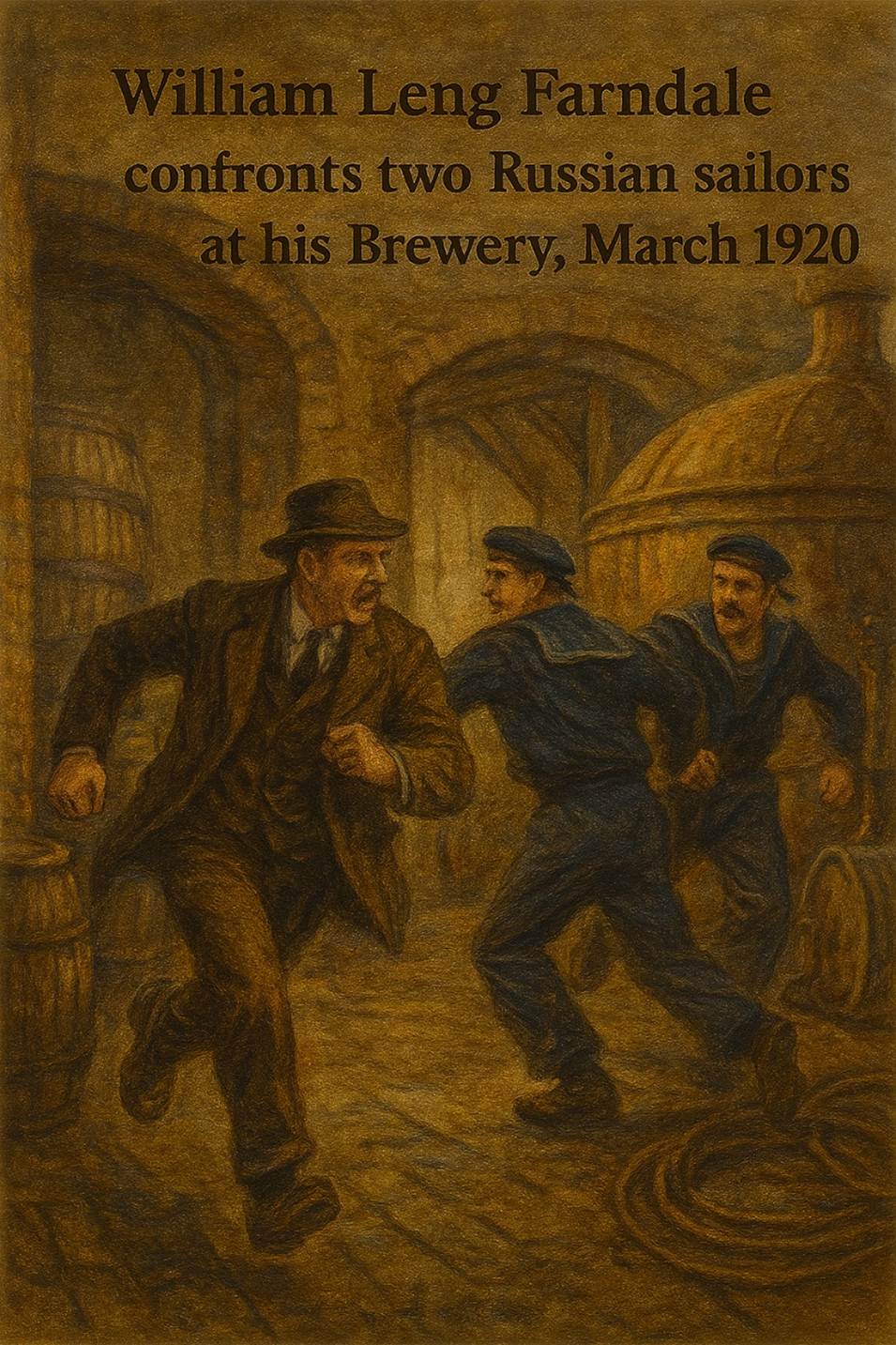
Armed robbery at
William’s Brewery
CONSTABLE
STRUGGLED WITH BURGLARS.
The little
town of Rothbury, nestling among the Northumberland hills, has been the scene
of one of those sensational affairs which have lately become almost commonplace of
the wave of crime.
There
has been a murderous attack on a local constable, following an attempted
burglary, the latter alone being quite sufficient to stir the place out of
its usual placid calm.
The
facts of the affair are:
Constable
Sinton, about 9:15 on Saturday night, in the course of his round, suspected
that there was someone tampering with the back premises of the block utilised
by the Rothbury Brewery Company.
He
stopped a local man named James Curry in the street, and asked him to keep
watch on the front of the premises, a one storey building in the Main Street,
with a backyard and outbuildings, while he went for assistance.
It
would appear that Sinton had gone in search of the Sergeant, the only other
policeman in the vicinity, but returned alone, and asked Curry to go over the
road and inform the local manager of the firm, Mr William Farndale, that
something unusual was afoot.
What
happened after that will best be explained in the words of Mr Farndale.
That
a burglary at the brewery was frustrated by the intervention of the constable
seemed certain, but so far the identity of the miscreants remains a mystery.
It
was suspected that they had escaped in a motor car, and, very soon after the
occurrence, the principal roads from Rothbury were being watched and all cars
stopped and the occupants questioned. The car came under the inquisition of the
police.
Morpeth Herald, 5 March 1920: SENSATIONAL AFFAIR AT ROTHBURY. ATTEMPTED BURGLARY AT BREWERY
PREMISES. BRUTAL ATTACK ON CONSTABLE. As a result of an encounter with two men
who attempted to break in to the office of the Rothbury Brewery Company
at about 9:15 on Saturday night, P C Francis Sinton received severe injuries to
his head, supposed to have been inflicted by an iron bar or a jemmy. Whilst
going his rounds the policeman came to the conclusion that there was “something
doing” in the rear of the premises referred to. He preceded at once to
investigate, and finding his suspicions well founded, he asked Mr James
Curry to communicate with the manager, Mr W L Farndale, who lives close by
on the opposite side of the road. Mr Farndale came across in his slippers, and
as he passed through the gateway he met a man rushing out. “It was dark”, said
Mr Farndale, in an interview with a newspaper representative on Sunday, “but I
saw his white scarf or muffler, and immediately grasped it. A struggle ensued,
and it was left in my hand. Just then, a shot was fired from somewhere in the
yard, and I made my way forward, thinking I might be of more use there if the
policeman was being attacked. I believe, however, that the shot was fired at
me. This morning, an empty cartridge was picked up near where I was. With the
man who came for me, I went round to the back of the premises. The door was
fast, and I struck a match, but could find nothing wrong. We came away and just
as we did so we heard a whistle from the opposite side of the yard and I
thought the police had got somebody. We will have another look at the door I
said. We found it alright, but as we were coming away my companion remarked “is
there not something there?” pointing to a narrow avenue or passage between
stacks of empty bottles”..
Newcastle Daily Chronicle, 26 March 1920: ROTHBURY BREWERY AFFAIR.
CHARGE OF ATTEMPTED MURDER OF POLICEMAN. PRISONER COMMITTED FOR TRIAL. The
police proceedings against Peter Klighe and Carl Strautin, the two foreigners,
of Newcastle, now in custody awaiting their trial at the next assizes on burglary
charges, were continued at Rothbury this morning. Two charges were preferred
against them, one of having attempted to murder PC Francis Douglas Sinton, and
the other of alleged warehouse breaking at the Rothbury Brewery on February 28.
The magistrates were Mr L C Davey presiding and Mr N Smith. John William
Rutherford, bank clerk, Heather Lee, Rothbury and Miss Gertrude May Perceval,
Railway Hotel, Rothbury, gave evidence of identification. PC Sinton was the next
witness. He gave his evidence seated. He saw the two prisoners, he said, leave
the 7.5pm train at Rothbury on February 28. At 9.10 on the same night, he was
on duty on the roadway near the premises of the Rothbury Brewery Company. He
heard a noise, but was under the impression that it came from the inside of the
premises. He listened at the door, and heard glass breaking, which he still
thought was inside. He sent a messenger to Mr Farndale, the manager, and
he himself went round to the rear of the premises. He shone his Lantern into
the bottle shed and saw the smaller of the two prisoners, Klighe,
standing in the opening. Accused shouted something in a foreign language and
ran inside the shed. Witness followed him in, keeping the light on him. He
rushed to the far end of the shed. When witness followed him in, accused took a
revolver from his right hand pocket in his overcoat, and told witness if he
came forward he would fire on him. Witness drew his truncheon from his pocket
and rushed at him. Witness got hold of him by the right shoulder. The man
immediately fired at him, the bullet passing the side of his head. Somebody
else came behind him, and he was struck on the head with something. His cap was
knocked off, then he was struck a second time on the bare head. He was knocked
to the ground and was insensible for several days afterwards. William Leng
Farndale, Brewery House, Rothbury, manager of the brewery, said that
shortly after 9 pm on February 28th, he was sent for by the police. He ran
across to the brewery at once. A photograph, produced, showed the gateway into
which he ran. After he had got about a couple of yards into the gateway, a
figure appeared, coming towards him on his right, close to the main building.
There was nothing showing distinctly except a white muffler. He got hold of
the muffler with both hands. There was a struggle. The wearer of the
muffler wriggled away and left the muffler in his hands. At that time a shot
was fired from the yard. He went round the corner of the bottle shed but saw
nothing unusual. He was joined by James Curry, and with the aid of matches,
made an examination of the back door. At the far end of the bottle shed they
found PC Sinton sitting on the ground, his head covered with blood, and his
cap and baton beside his right knee. He asked PC Sinton if he was badly hurt,
and he replied “Is there anybody behind me?”. Witness ran for a light, and PC
Sinton was removed home.... medical evidence... Committal for trial...
Morpeth Herald, 2 April 1920: THE ROTHBURY OUTRAGE. CHARGES OF ATTEMPTED MURDER OF A
CONSTABLE. Prisoners committed to assizes. The little town of Rothbury was all
agog yesterday when the morning train arrived with the prisoners, Peter Klighe
and Carl Strautin, seaman, to answer a charge of attempting to murder constable
Francis Douglas Sinton on 28 February and also with breaking and entering the
brewery premises on the same date... Charges of breaking and entering. The
charge of breaking and entering the brewery was then taken. William L Farndale
said at 4.20pm on Feb 28th he fastened up the brewery premises and left
everything in order. Shortly after 9 o’clock the same night he was sent for by
the police and, with Sergeant Crossford, examined the premises of the brewery
company. At the head of the staircase abutting the brewery there was a window
with six panes. Two of the panes had been broken and one side of the frame had
been pushed away from its seating in the brickwork. There had not been bars in front
of that window. There had been two bars wrenched from its socket in the window
of the store room, which also abutted the little shed room. The room bars
produced were those recovered from the window. The crowbar produced was the
property of the brewery company and was generally kept in the cart shed....
Newcastle Daily Chronicle, 2 July 1920: ATTEMPT TO MURDER. RUSSIAN
SEAMEN CONVICTED OF ROTHBURY OUTRAGE. “CAREER OF BRIGANDAGE”. The attack made
upon the Rothbury policeman by two Russian seaman had its sequel, at the
Newcastle Assizes, yesterday... The statement of the case made by counsel
was confirmed by the evidence of the witnesses PC Sinton and Mr Farndale giving
a graphic story of their encounter in the dark... Strautin,
who is a Russian, said he had been in this country since 1913, and since 1914
he had been working on British ships. On the night at Rothbury, when on the
roof, he saw a dark figure, and when he jumped down and was seized he
discharged a pistol in the air. He saw no one to murder, and did not intend to
do any bodily harm to anybody...
Yorkshire Post and Leeds Intelligencer, 2 July 1920: NEWCASTLE ASSIZES. RUSSIANS
SENT TO PENAL SERVITUDE FOR 13 YEARS. THE ROTHBURY OUTRAGE. The business of
Newcastle Assizes was continued at Newcastle yesterday... Mr Justice Shearman
dealt with Peter Klinje (27) and Karl Strautin (24), Russian seamen, charged
with the attempted murder of Police Constable Francies
Douglas Sinton at Rothbury on February 28th last … Mr Atkin
called prisoners in their own defence, and Strautin
said he was on the roof of the bottling shed, and had pulled out two bars, and
throw them to the ground when Sinton appeared. He then jumped down and ran
away, and when seized by Mr Farndale he fired off his pistol in the air to
frighten Farndale. He never struck Sinton and did not intend to harm anyone. Klinghe said he had sailed for seven years on British
ships, and having no money, had for three months
prior to his arrest been partner with Strautin in a career of brigandage in Northumberland
and Durham. On the
night of this occurrence he was keeping watch, and just before Sinton appeared
told Strautin he was making too much noise. Sinton
then drove him into the shed, and he pointed a revolver at him, saying “Don't
move, I’ll shoot.” Sinton then closed with him, and in self
defence he struck Sinton once with the iron bar. He had no revolver, and
the shot was fired in the shed. Prisoners were found guilty of attempted
murder, and Mr. Mitchell Innes then drew judge’s attention to the fact that
the four burglaries to which they had pleaded guilty were only part of 23,
most of which could be brought down to them. In passing sentence his lordship
said there was only one good thing to be said about the defendants, they had
apparently done honest work until labour troubles prevented them continuing at
a time when their country was in such a condition that there appeared to be a
reluctance to return to it. As soon as people who started a career of crime
took to going out with loaded revolvers as these two men had done, prepared to
shoot in order to retain their liberty, a state of affairs arose which judges
of the High Court must try to end by passing sentence is which would serve an
example. For the burglary alone he would have opposed no more than three years
penal servitude, but this last crime shows they were perfectly reckless of any
other’s life so long as they could keep their freedom, and the sentences would
be three years for each burglary, to run concurrently, and 10 years for the
attempted murder, with a recommendation for deportation at the conclusion of
the sentence.
1921
Last Years
William L
Farndale, 45, continued to work as a Brewer’s manager with Rothbury Brewery Co
in 1921, living in Rothbury with his family, including by then his widowed
mother, Catherine. The family home was at Embleton Terrace which is about a
kilometre south of Rothbury, south of the road to nearby Longframlington.
1921 Census – Rothbury
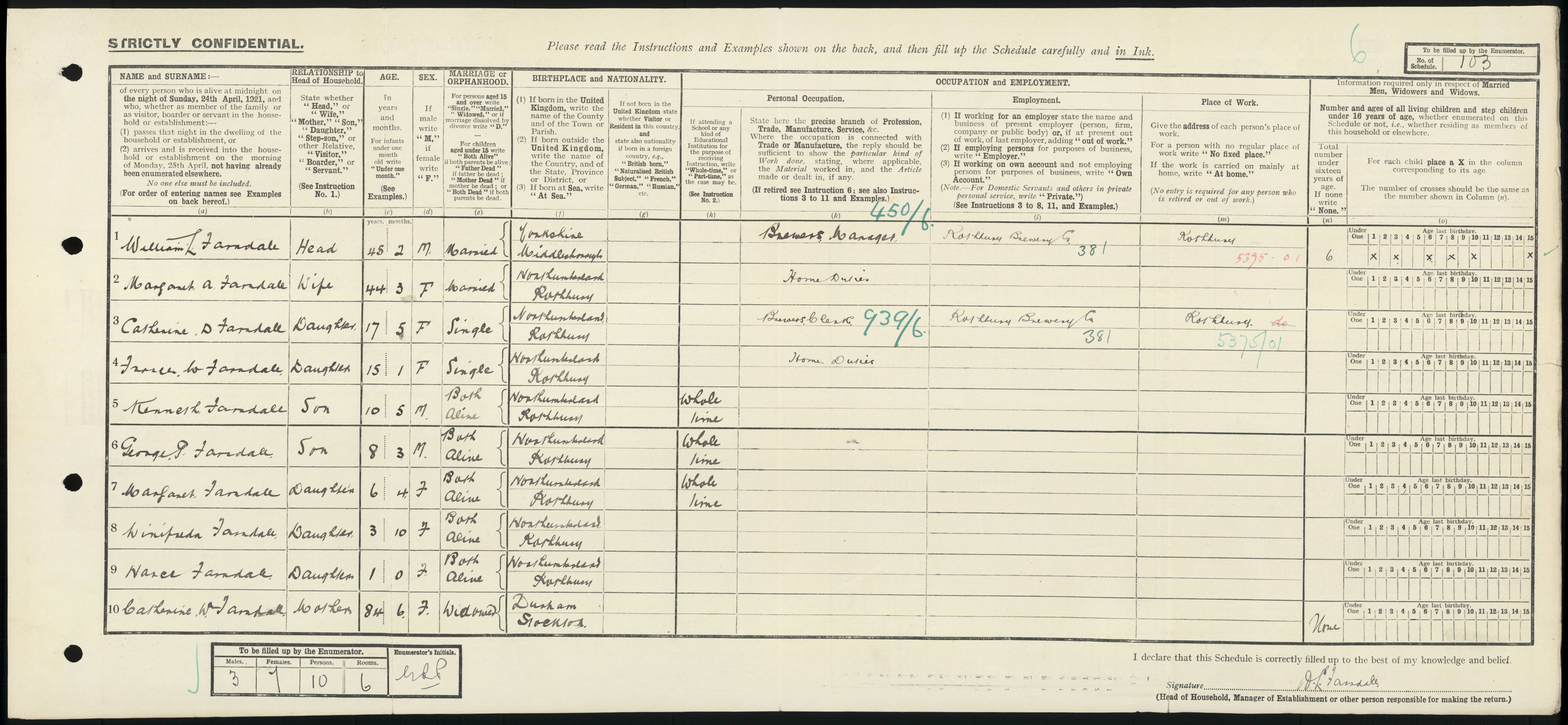
William
L Farndale, 45, married, born Middlesbrough, a Brewer’s manager with
Rothbury Brewery Co
Margaret
A Farndale, 44, home duties
Catherine
D Farndale, 17, single, clerk with Rothbury Brewery Co, born Rothbury about
1904
Frances
W Farndale, 15, born Rothbury about 1906, single , home duties
Kenneth
Farndale, 10, born Rothbury about 1911
George
S? Farndale, 8, born Rothbury about 1913
Margaret
Farndale, 6, born Rothbury about 1915
Winifreda Farndale, 3, born Rothbury about 1918
Nancy
Farndale, 1, daughter, born Rothbury about 1920
Catherine
W Farndale, 84, widowed (his mother)
1926
William’s mother, Catherine W Farndale died age 89 at
Rothbury District, Northumberland in late 1926 (so was born in or about 1837) (GRO Vol 10b page 542).

1932
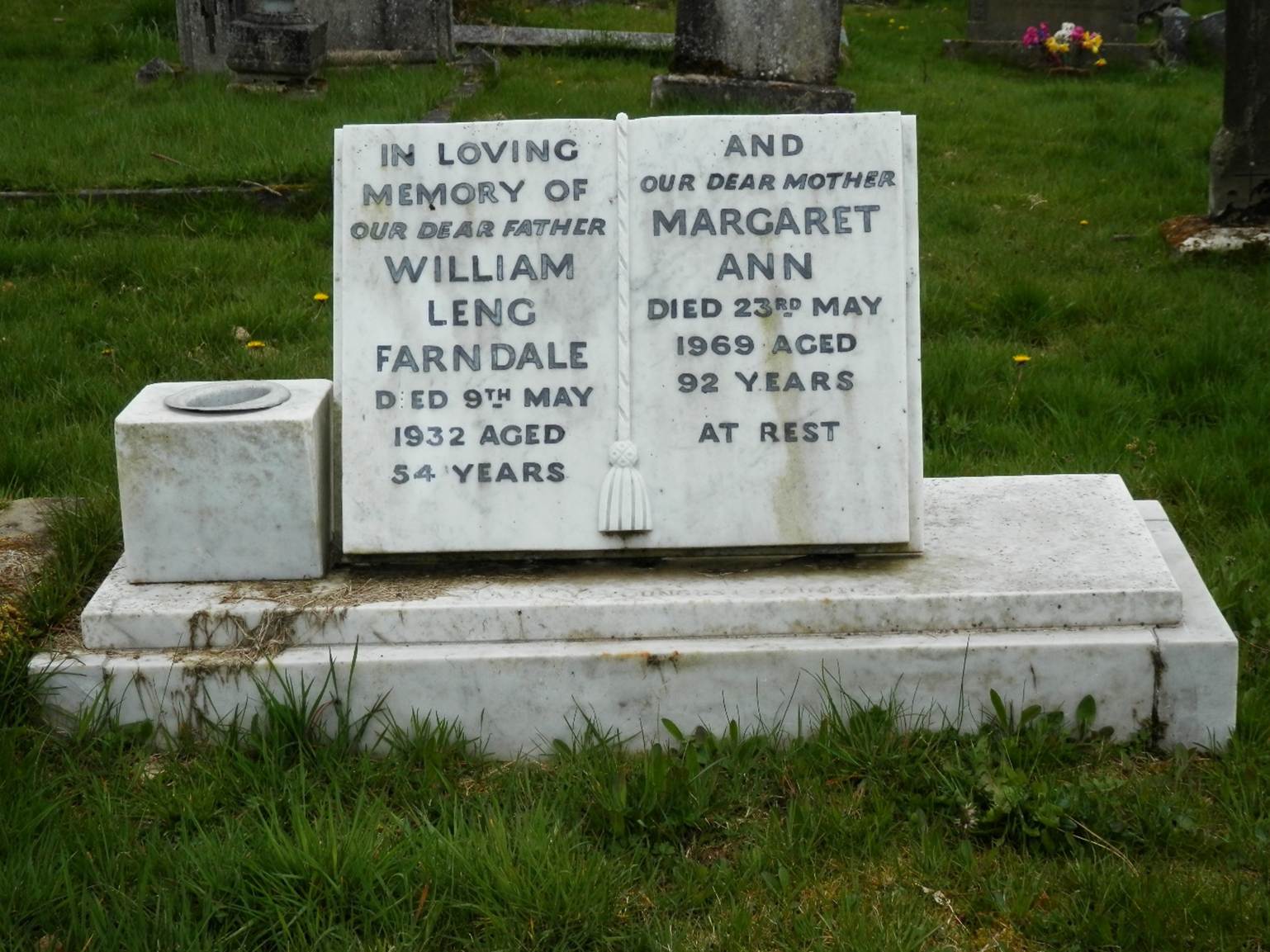
William Lend Farndale, died, aged 54, on
9 May 1932 (Monumental Record) and his death was registered at
Rothbury District in the second quarter of 1932 (DR).
Newcastle
Evening Chronicle, 10 May 1932: FARNDALE -
Longframlington, Embleton Terrace, on the 8th, aged
54 years, William Lang (sic, rente Leng), beloved
husband of Margaret Farndale. Interment at Rothbury Cemetery on Wednesday,
11th, at 2.45. Service at residence at 2 pm. Friends please accept this
intimation.
1939
William’s widow
still lived at Embleton Terrace in 1939. In March 1941, work of any
description has always made a strong appeal to the residents of the Lee
district, and in the past the RVI Newcastle has benefited considerably through
efforts organised on its behalf in the neighbourhood. With the claims of the
present national situation so prominently before our minds, a whist drive and
dance was organised on behalf of the British Red Cross society. The first
portion of the evening was devoted to whist. The prize winners were, 6, Mrs
Farndale.
1939 Register - 1 Embleton
Terrace, Rothbury, Northumberland.
Margaret A Farndale,
‘unpaid householder’, born 28 March 1878. William’s widow.
Kenneth Farndale, born 9
January 1911, single, a general labourer
George P Farndale (FAR00794), born 20 March
1913, roadstone quarries heavy worker, Kenneth’s brother.
Freda Milburn, married,
born 8 August 1917 (FAR00843).
Nancy Farndale (marked as
later Freeman)(FAR00867) born
2 June 1920, unpaid domestic duties

1941
Morpeth Herald 14 March 1941: SPLENDID EFFORT AT THE LEE. BRITISH RED CROSS SOCIETRY BENEFIT.
Work of any description has always made a strong appeal to the residents of the
Lee district, and in the past the RVI Newcastle has benefited considerably
through efforts organised on its behalf in the neighbourhood. With the claims
of the present national situation so prominently before our minds, a whist
drive and dance was organised on behalf of the British Red Cross society... The
first portion of the evening was devoted to whist... the prize winners
were... 6, Mrs Farndale...
1950
Alnwick
Mercury, 22 September 1950: POINTS SYSTEM FOR HOUSES TO BE SHELVED. As the
list of applicants for council houses in Rothbury rural district has become
smaller it has been decided that in future the point system will no longer be
used as a guide but that the case of every applicant will be considered on its
individual merits.... The council also agreed to the recommendation of the
committee that houses shortly to be made available should be let to the following talents... Mrs M H Farndale, Embleton
terrace, Longframlington...
The Morpeth Herald, 22 September 1950: HOUSING PROGRESS AT ROTHBURY. The report of the sanitary
inspector at Rothbury RDC meeting on Tuesday evening referred to housing
progress at Rothbury and Longframlington. The
pressure of the water supply to the Rothbury housing estate had improved and a
new main had been laid from Garleigh Road in respect
of which the committee recommended the council to pay the Duke of
Northumberland a wayleave of £1 per annum.... The selection subcommittee's
report was considered. The committee let to Mr DG Williams of Longframlington, a house which had been surrendered by Mr S
and Davidson... The committee recommended as tenants for the houses shortly
to be available... Mrs M H Farndale, Embleton terrace, Longframlington...
Point system. As the list of applicants for council houses has become smaller
it was agreed that in future the point system should no longer be used as a
guide but that the case of every applicant be considered on its individual
merits.
1969
Margaret Ann Farndale died on 23 May 1969 (Monumental Record).