Leisure and entertainment
Making use of ‘spare time’
|
Return to the Home Page of the Farndale Family
Website |
The story of one family’s journey through two
thousand years of British History |
The 83 family lines into which the family is divided.
Meet the whole family and how the wider family is related |
Members of the historical family ordered by date of
birth |
Links to other pages with historical research and
related material |
The story of the Bakers of Highfields, the Chapmans,
and other related families |

Introduction
Dates are in red.
Hyperlinks to
other pages are in dark
blue.
Headlines are in brown.
References and
citations are in turquoise.
Contextual
history is in purple.
Victorian Leisure
By the 1830s East
End artisans went on trips to Gravesend and Margate, and by the 1840s,
Lancashire cotton workers went on trips to Blackpool.
Employers
grudgingly but increasingly agreed to seasonal holidays or wakes.
Official Bank
holidays were introduced in 1871 for bank workers and soon were practised more
widely.
Working hours
fell to the internationally envied English five and a half day working week.
New forms of
amusement developed. It was relatively orderly under the disapproving eye of
the respectable and the commercial interests of the providers – drunkenness,
vice and violence were discouraged at football clubs, fairgrounds and music
halls.
There was an
element of cross class interest for instance in horse racing and the boat race.
Boxing had a disreputable air, but even it was bound by the
Queensberry Rules in 1867.
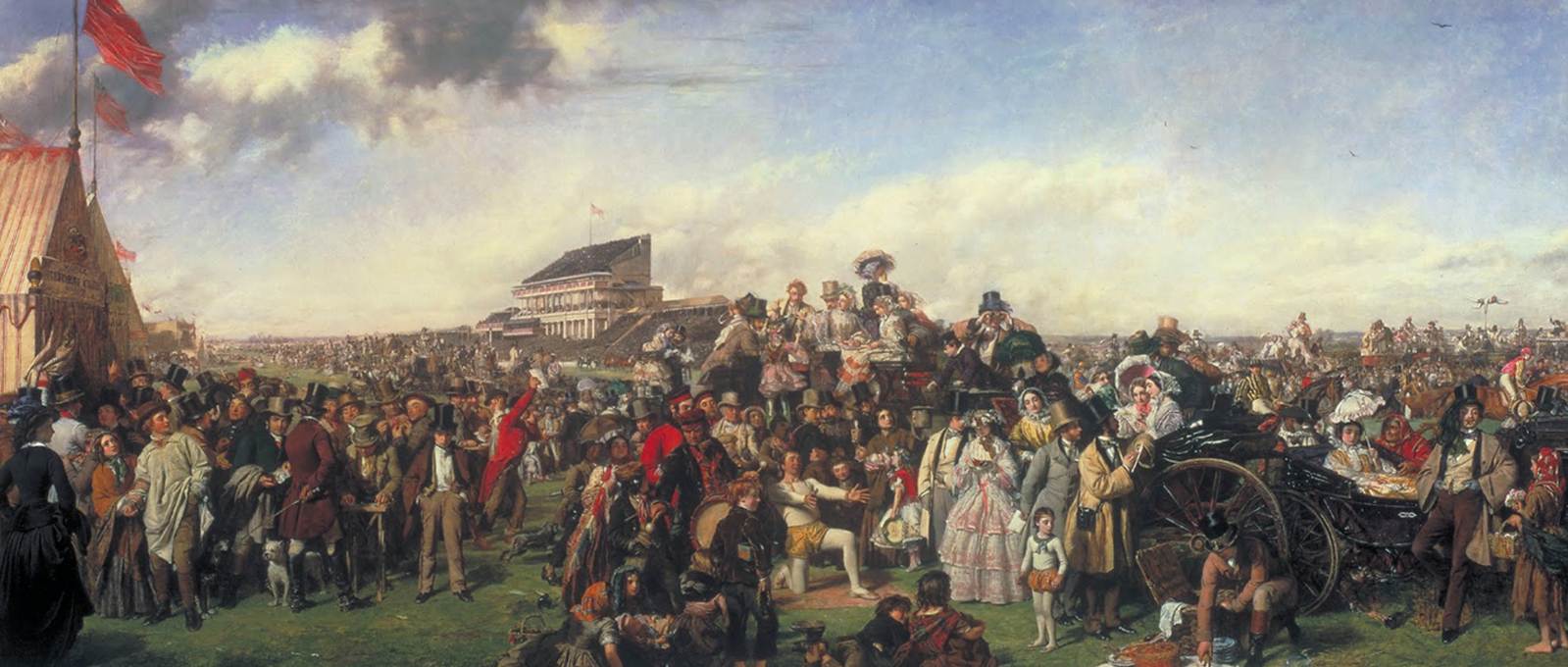
William Frith’s
Derby Day
Cricket and
rowing gave both elite and popular enjoyment. Eventually the Oxford and
Cambridge Boat Race and the Henley Regatta sidelined professional rowers.
Fox hunting
expanded during the nineteenth century and increasingly brought the landed
elite and the middle classes together.
(Robert Tombs, The English and their History, 2023, 484 to
485).
Sport
In the early
nineteenth century there was disapproval of sport. He Master of Balliol tried
to interfere with the first Boat Race in 1829.
This changed
within a generation, spurred by urbanisation, shorter working hours, higher
income and better transport. The Victorian age moralised sport as a manly
Christian value. Disraeli called it ‘muscular Christianity’. In 1851 it was
noted that crime was light where cricket was played.
Football, rugby,
tennis, croquet, and badminton developed between 1850 to 1870.
· The Football
Association founded in 1863 by old boys’ clubs adopted Cambridge University
rules and forbade hacking (kicking an opponent).
· The Rugby
Football Union founded in 1871 adopted Rugby school rules
International matches and tours began in the 1860s.
In the 1883 Cup Final, the professional working class team,
Blackburn Olympics beat the Old Etonians. However there was a growing rift
between gentleman amateurs and semi professional
working class teams.
·
In 1895 the Northern Union, which later became Rugby League was
founded.
·
Cricket tended to bring different classes together often on the
village green. It was quintessentially English and brought aspirations such as
playing a straight bat.
·
Gentlemanly amateurs disliked commercialisation, or rowdy crowd
behaviour and two cultures emerged.
·
The working class focus on professionalism looed to physical
aggression and winning at all costs.
·
There was often hypocrisy. Dr W G Grace (1848 to 1915) made
£120,000 as an ‘amateur’.
(Robert Tombs, The English and their
History, 2023, 513 to 517).
Leisure Time
Lark Rise, Flora
Thomson, Chapter IV, At the ‘Wagon and Horses’: Fordlow
might boast of its church, its school, its annual concert, and its quarterly
penny reading, but the hamlet did not envy it these amenities, for it had its
own social centre, warmer, more human, and altogether preferable in the
taproom of the 'Wagon and Horses'. There the adult male population
gathered every evening, to sip its half-pints, drop by drop, to make them
last, and to discuss local events, wrangle over politics or farming methods, or
to sing a few songs 'to oblige'. It was an innocent gathering. None of them
got drunk; they had not money enough, even with beer, and good beer, at
twopence a pint.
Lark Rise, Flora
Thomson, Chapter XV, Harvest Home: Harvest
time was a natural holiday. Against the billowing gold of the
fields the hedges stood dark, solid and dew-sleeked; dewdrops beaded the
gossamer webs, and the children's feet left long, dark trails on the dewy turf.
There were night scents of wheat-straw and flowers and moist earth on the air
and the sky was fleeced with pink clouds. For a few days or a week or a
fortnight, the fields stood 'ripe unto harvest'. It was the one perfect period
in the hamlet year.
Entertainment
Lark Rise, Flora Thomson, Chapter XV, Harvest Home: There
were still bands of mummers in some of the larger villages, and village
choirs went carol-singing about the country-side; but none of these came to the
hamlet, for they knew the collection to be expected there would not make it
worth their while.
Samuel Farndale (FAR00475) was
the son of a publican who sang comic songs in the 1880s.
George William Farndale (FAR00614)
was a comedian, pianist and member of the Yorkshire Mummers.
Humour
Traditional
English humour was irreverent, cruel and often obscene. The Victorians sought a
more restrained and polite form of humour and saw cruelty as bad taste. They
enjoyed the genial cartoons of Sir John
Tenniel (1820 to 1914), the nonsense
poems of Edward
Lear (1846) and the bizarre tales of Lewis Carroll
(Alice in Wonderland, 1865). Oscar Wilde
entertained the upper classes in the 1880s and 1890s.
Music Hall songs
entertained the masses with a humour of fatalism, political scepticism, parody,
irony and absurdity, often impenetrable to outsiders.
(Robert Tombs, The English and their History, 2023, 521 to
522).
Stories and Tales
Lark Rise, Flora
Thomson, Chapter IV, At the ‘Wagon and Horses’: The newspapers
furnished other tales of dread. Jack the Ripper was stalking the
streets of East London by night, and one poor wretched woman after another was
found murdered and butchered. These crimes were discussed for hours together
in the hamlet and everybody had some theory as to the identity and motive of
the elusive murderer. To the children the name was indeed one of dread and
the cause of much anguished sleeplessness. Father might be hammering away in
the shed and Mother quietly busy with her sewing downstairs; but the Ripper!
the Ripper! he might be nearer still, for he might have crept in during the day
and be hiding in the cupboard on the landing!
Joseph Farndale (FAR00350B) was
involved in the investigation of a Jack the Ripper hoax claim in Birmingham.
The cradle of the Farndale family shares many stories, including
that of the Farndale Hob.
Queen Victoria and the
Jubilee
Lark Rise, Flora Thomson, Chapter XV, Harvest Home:
Up to the middle of the 'eighties the hamlet
had taken little interest in the Royal House. The Queen and the Prince and
Princess of Wales were sometimes mentioned, but with little respect and no
affection. 'The old Queen', as she was called, was supposed to have shut
herself up in Balmoral Castle with a favourite servant named John Brown and to
have refused to open Parliament when Mr. Gladstone begged her to. The Prince
was said to be leading a gay life, and the dear, beautiful Princess, afterwards
Queen Alexandra, was celebrated only for her supposed make-up.
The Queen, it appeared, had reigned fifty
years.
As the time drew nearer, the Queen and her
jubilee became the chief topic of conversation.
Then there were rumours of a subscription
fund. The women of England were going to give the Queen a jubilee present,
and, wonder of wonders, the amount given was not to exceed one penny.
'Oh, please, Miss Ellison, you haven't been to
Mrs. Parker's, and she's got her penny all ready and she wants the Queen to
have it so much.'