Our Farndale ancestors and the
Robin Hood Legends
Exploring
the connections between our Farndale outlaw ancestors and the legends of Robin
Hood
|
Return to the Home Page of the Farndale Family
Website |
The story of one family’s journey through two
thousand years of British History |
The 83 family lines into which the family is divided.
Meet the whole family and how the wider family is related |
Members of the historical family ordered by date of
birth |
Links to other pages with historical research and
related material |
The story of the Bakers of Highfields, the Chapmans,
and other related families |

Contents and
structure of this webpage
This webpage
has the following section headings:
·
Earliest
References
·
Robin Hood,
the Yorkshireman
· The Robin Hood stories and local ecclesiastical links
· Campsall
· Ancestral Farndales and the idea of Robin Hood – actors and story tellers
· Our rebellious ancestors
· Dick Turpin
· Other references
·
Bibliography
Dates are in red.
Hyperlinks to other pages are in dark blue.
Headlines are in brown.
References and citations are in turquoise.
Contextual history is in purple.
The idea of Robin Hood
An idea had crystalised into stories by the mid thirteenth
century, about the outlaw Robehod. By the fifteenth century those
compound stories, with a stock character encountering various formulae of
adventure, had evolved into more formal tales of Robin Hood, a forest outlaw.
The first surviving written stories date to about 1450 by which
time there were large numbers of rymes, some of which have survived (Robin
Hood and the Monk, Robin Hood and the Potter; Richard Morris, Yorkshire a Lyrical History of England’s Greatest
County, 2018, 184). Robin Hood was then portrayed as a yeoman
(I shall you tel of a gode yeman, His name was Robyn Hode – The Gest, Fytte 1, 1) and characters such as Maid
Marion and Friar Tuck had not yet emerged. By then he lived in a green wood
with merry men, including Little John, Will Scarlock and Much the miller’s son.
The sheriff of Nottingham was their nemesis. They hunted the king’s deer,
although they were loyal to the King. They were selectively anti clerical.
Friar Tuck was a real outlawed priest, Frere Tuck, of the 1400s.
Maid Marion was a character from French literature,
and was added later.
The association with Robin Hood and Richard the Lionheart set the
story in the 1190s, but this was a later elaboration of John Major, a Scottish historian, in the sixteenth century,
later enhanced by Walter Scott in Ivanhoe
in 1819.
In the late fifteenth century, the tales were brought together
into A Gest of Robyn Hode (“the Gest”), which was structured into
sections or fyttes. Various editions of the Gest were printed between
1490 and 1550.
The idea of Robin Hood represents a nostalgic view of a past
heroic age, of topsy turvy justice, where justice was administered by the noble
outlaws. The protagonists of the tales were not real people, but as all epic
literature, it provides a contemporary record which emerged from historic
events and experiences.
The emergence of the Robin Hood
stories in the 1400s was likely to have been inspired in part by the complaints
against oppression that led to the Peasants’ Revolt in 1381,
which itself was triggered by the imposition of three poll taxes in 1377, 1379
and 1381.
Robert Tombs, The
English and their History, 2023, 128: Popular
Robin Hood stories, recited in verse by travelling minstrels, go back to around
the 1330s, they were referred to, disapprovingly, in Langland's poem Piers
Ploughman, c 1377, and were first written down in the early 1400s. The stories
traditionally originate in adjoining parts of Yorkshire and Nottinghamshire. It
has been suggested that if there ever was a real Robin Hood (Robin Hod), he
fought the Sheriff of Yorkshire between 1226 and 1234.
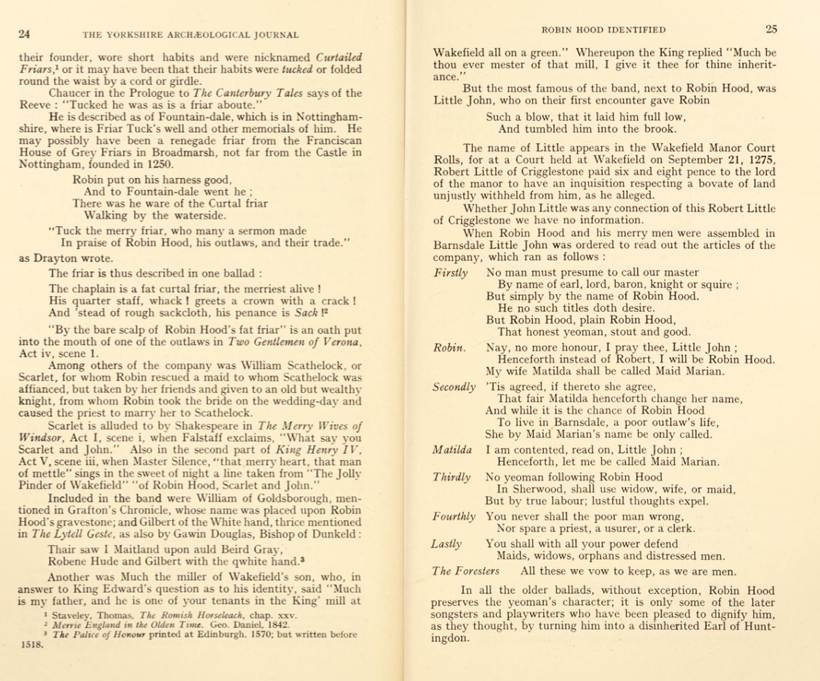
Robin
Hood’s 700 year survival into modern popular culture
is unique.
There is an In Our Time podcast on
the centuries old myth of the most romantic noble
outlaw, Robin Hood and whether he was a yeoman, an aristocrat, an anarchist or the
figment of a collective imagination.
About this time the memorable hero Robin Hood flourished in a
romantic manner (1066 and all that, Walter
Sellar and Robert Yeatman, 1930).
The ballads
were for the most part handed down from father to son by word of mouth, and by
the wandering minstrels who spread them over the country until Caxton gave us
the printing press. These ballads are full of incident and human character;
they reflect the manners and feelings of distant ages; they express a sense of
public injury or of private wrong, a love of whatever is free, manly and
warm-hearted, a hatred of all oppression, whether clerical or lay. In the Robin
Hood ballads the personal character of the hero and of
many of his companions is never lost sight of, but is
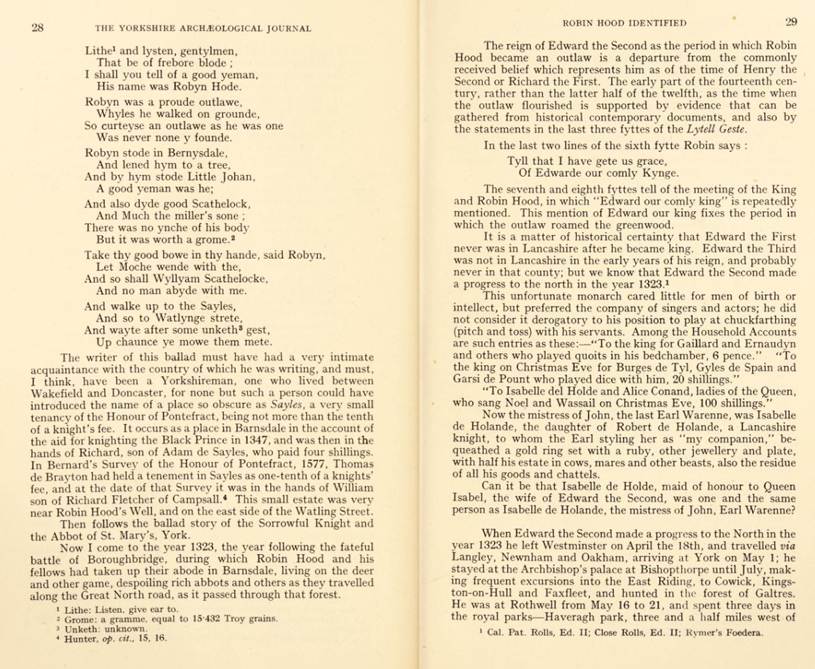
stamped on every verse. (Robin Hood Identified,
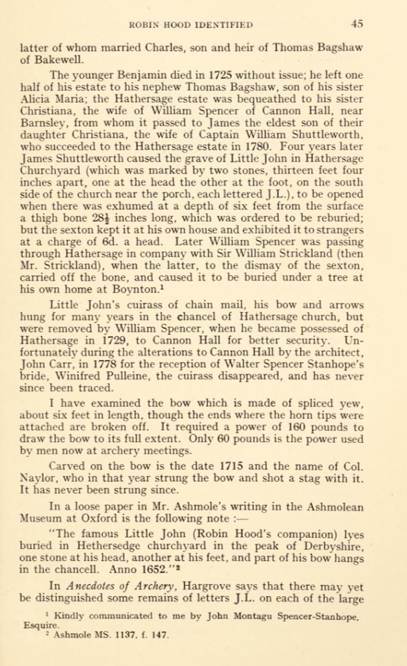
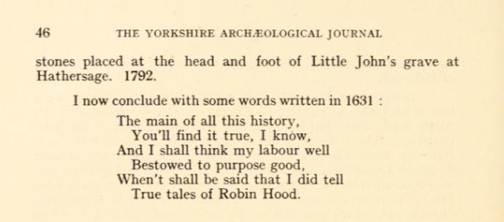
J W Walker OBE, FRCS, FSA, Yorkshire Archaeological Journal, Volume 36, 1947, page 4).
Earliest references
John
Fordun, a chantry priest of Aberdeen, author of Scotichronicon, a history of Scotland, written
in 1341, says : “About this time (1265) arose from
among the dispossessed and banished that most famous outlaw, Robin Hood, and
Little John with their companions. Robin was reputed to be as devout at church
as he was brave in combat, and it was said of him that when once he entered a
church to hear the service, whatsoever danger might occur, he never went away
until it was finished.”
Thomas
Wright, F.S.A. and Joseph Hunter, F.S.A. doubt the authenticity of this passage
in the original Scotichronicon , but consider it a part of the interpolation made to the
genuine Fordun by his personal pupil and continuator,
Walter Bower, abbot of Inchcolm,2 in 1440-7. This passage is only found in the
finely written and illuminated fifteenth century copy of Fordun’s
Scotichronicon, Harleian MSS, British Museum, 4764.
Another
Scotchman, John Major or Mair, historian and Scottish divine, teacher of
philosophy and logic at St. Andrew’s University, published his Majoris Britannice Historia,
1521, which Stow has incorporated in his Annates
of England, 1591; in it he says : “About this time (Richard I, 1189-99,
though he gives no authority for this statement), Robert Hude and Little John,
most famous outlaws, hid in the woods, and only plundered the goods of rich
men, and never slew any unless they opposed them in defence of their goods.
Robert maintained one hundred archers most skilful in battle, whom four hundred
of the boldest fellows did not dare to attack. He never allowed any harm to be done
to a woman, nor took the goods of poor men, but seized the rich oblations of
abbots. The exploits of this Robert are celebrated in songs throughout all
Britain. I disapprove of the rapine of the man, but he was the most humane and
prince of robbers.”
This
reputation of Robin Hood was endorsed by Sir Walter
Scott, who wrote : “But Robin will still remain the gentlest of thieves. He acted upon a larger
scale, or in opposition to a larger injustice, and to a whole political
system.”
In his
Essay on Romance, Sir Walter said: “The history of this popular hero (Robin
Hood) is but little known, and all the scattered fragments concerning him,
could they be brought together, would fall far short of satisfying such an
enquirer as none but real and authenticated facts will content”.
Andrew Wyntoun,
Canon regular of St. Andrews, prior of St. Serf’s Inch in Loch Leven, where he
wrote his Oryginale Cronykil, a vernacular
metrical history of Scotland, 1420, first published in 1795 from a manuscript in
the Royal Library, in which, under the year 1283, occur the following lines: “Lytil Jhon and Robyn Hude Waythmen
were commendyd gud; In Yngil-wode and Barnysdale Thei oysyd (used) all this tyme thare travaile.”
Hector Boece or Boethius, chaplain of St. Andrew’s altar in St.
Nicholas church, Aberdeen; professor in the University of Paris; joint founder
with William Elphinstone of Aberdeen University; author of Historia Scotorum, 1536;
in the nineteenth chapter of his “threttene buke”
says : “about this tyme’ (early fourteenth century,
though again he gives no authority for his statement,) 'was that waithman Robert Hode with his fallow litil
Johne, of quhoum ar mony fabillis and mery sportis soung
amang the vulgar pepyll.’’
James
V of Scotland commanded John Bellenden, archdeacon of Moray and canon of Ross,
to translate Boece’s work from the Latin into the Scottish vernacular, which
was published at Edinburgh in 1536. It was translated into English by William Harrison
for Holinshed’ s Chronicles, 1577. A French edition appeared in 1574.
One
of the earliest if not the first historic mention of Robin Hood is by William Langland in The
Vision of Piers the Plowman, which was produced in three texts, the
first in 1362, the second in 1377, and the third in 1392, all in the unrhymed
alliterative metre, which in the earliest times was employed in Anglo-Saxon
poetry. In Passus V, the seventh Deadly Sin is typified in the character of ‘Sloth,’
an ignorant secular priest, the representative probably of many of the chantry
chaplains of his time, who can find a hare in a field more readily than he can
read the lives of the Saints. This was not unusual, for an episcopal visitation
in the diocese of Salisbury in 1222 shows five priests out of seventeen
parishes who could not construe the very first sentence of the Canon of the
Mass. Roger Bacon, c. 1290, complained that many of his fellow-clergy knew as
little even of their own service books, as “brute beasts.” Similar evidence
could be multiplied down to the eve of the Reformation. When Bishop Hooper made
a Visitation at Gloucester in 1552, out of the 311 clergy he examined, he found
171 who were not able to repeat the Ten Commandments.
Of these, 31 did not know where in the Bible the Commandments were recorded; 10
could not repeat the Lord’s Prayer; 30 did not know where to find it, and 27 could
not tell who was its author. Sloth knows rhymes about
Robin Hood better than his prayers; for he makes the following confession “I
cannot parfitli mi paternoster, as the preist it syngeth, But I can ryms of Robert Hode, and Randolf erl
of Chestre, But of our lorde
or of oure lady I lerne nothyng at all.”
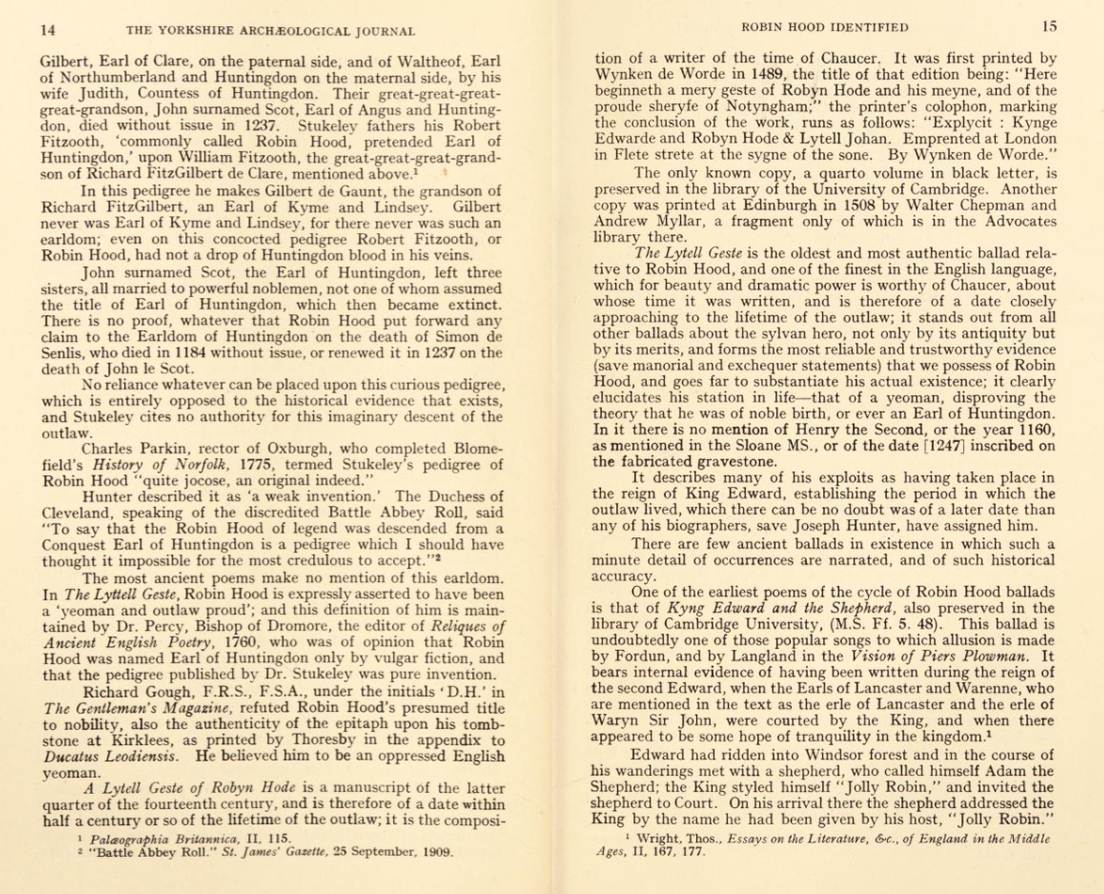
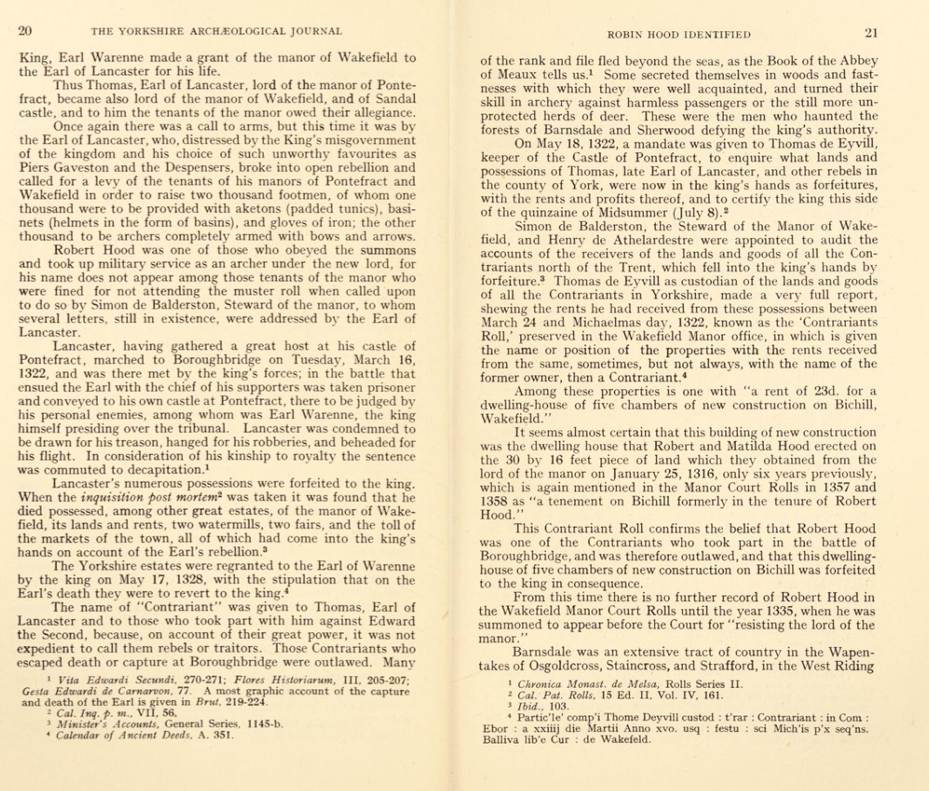
(Robin Hood Identified,
J W Walker OBE, FRCS, FSA, Yorkshire Archaeological Journal, Volume 36, 1947, page 4).
Robin Hood, the
Yorkshireman
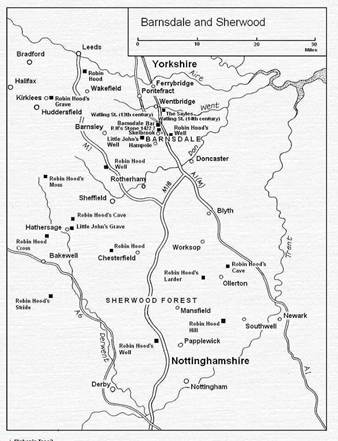
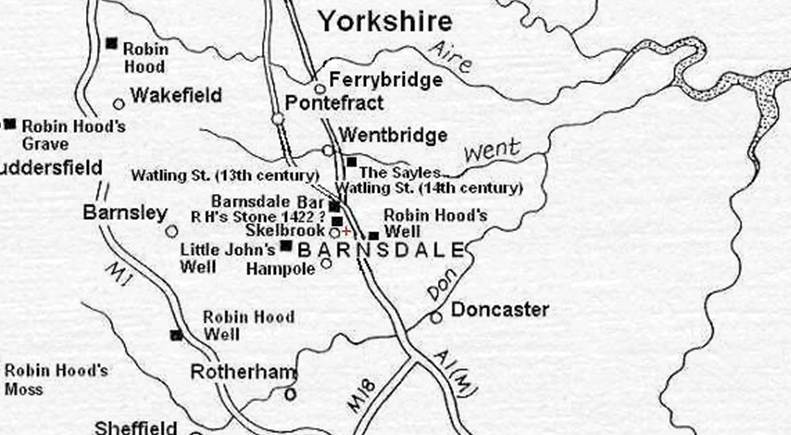
The earliest references to Robin Hood are more associated with
Barnsdale Forest than Sherwood. Many of the names given to geographical
locations in that area, such as Robin Hood’s Well and Robin Hood’s cave, were
given in the nineteenth century. Some names though are much older, such as
Barnsdale’s Stone of Robin Hood (about 500m north of Robin Hood’s Well), which
was mentioned as a boundary marker in 1422 (John
Leland, The Itinery in or about the years 1535-1543 edited by L T Smith,
London, Bell, 1909, 51; Richard Morris, Yorkshire a Lyrical History of
England’s Greatest County, 2018, 183; https://robinhoodlegend.com/monkbretton-priory-2/).
In Robin Hood and the Monk the
geography was focused on Sherwood and Nottingham. Robin Hood and the Potter
named Wentbridge (Went breg) in Barnsdale. In Robin Hood and Guy of
Gisborne, the action took place in Barnsdale, and the sheriff was slain
when he tried to flee to Nottingham.


The Gest places Robin Hood firmly in Barnsdale. It begins (Gest, Fytte I, 3):
Robyn strode in Bernesdale,
And lenyd him to a tre.
Barnsdale is a constant reference in the Gest:
But as they loked in to
Bernysdale,
Bi a dernë strete,
Than came
a knyght ridinghe;
Full sone they gan hym mete.
Now is the knight gone on his way;
This game hym thought full gode;
Whanne he loked on Bernesdale
He blessyd Robyn Hode.
(Gest, Fytte II, 57)
The same knight later watched wrestling at Wentbridge:
He bare a launsgay in
his honde,
And a man ledde his male,
And reden with a lyght songe
Vnto Bernysdale.
But he went at a bridge ther was a wrastelyng,
And there taryed was he,
And there was all the best yemen
Of all the west countree.
(Gest, Fytte II, 81)
In a later part of the story, Robin Hood intercepted two
Benedictine monks on the highway north of Doncaster:
But as [t]he[y] loked in Bernysdale,
By the hyë waye,
Than were
they ware of two blacke monkes,
Eche on a good palferay
(Gest, Fytte IV,130)
262.
He dyde him streyt to Bernysdale,
Under the grene-wode tre,
And he founde there Robyn Hode,
And all his mery meynë.
After Robin’s royal pardon, when he was in royal service, he
longeth sore for Bernysdale (Gest, Fytte 8, 442)
439
Forth than went
Robyn Hode
Tyll he came to
our kynge:
'My lorde the
kynge of Englonde,
Graunte me myn
askynge.
440.
'I made a chapell
in Bernysdale,
That semely is to
se,
It is of Mary
Magdaleyne,
And thereto wolde
I be.
441.
'I myght never in
this seven nyght
No tyme to slepe
ne wynke,
Nother all these
seven dayes
Nother ete ne
drynke.
442.
'Me longeth sore
to Bernysdale,
I may not be
therfro;
Barefote and
wolwarde I have hyght
Thyder for to
go.'
We will return later to Robin Hood’s longing to see his chapel of
Mary Magdalene, when we meet a direct ancestor of the modern Farndale family, William
Farndale, who was married at St Mary Magdelene’s church at Campsall, to
Margaret Atkinson, on 29 October 1564.
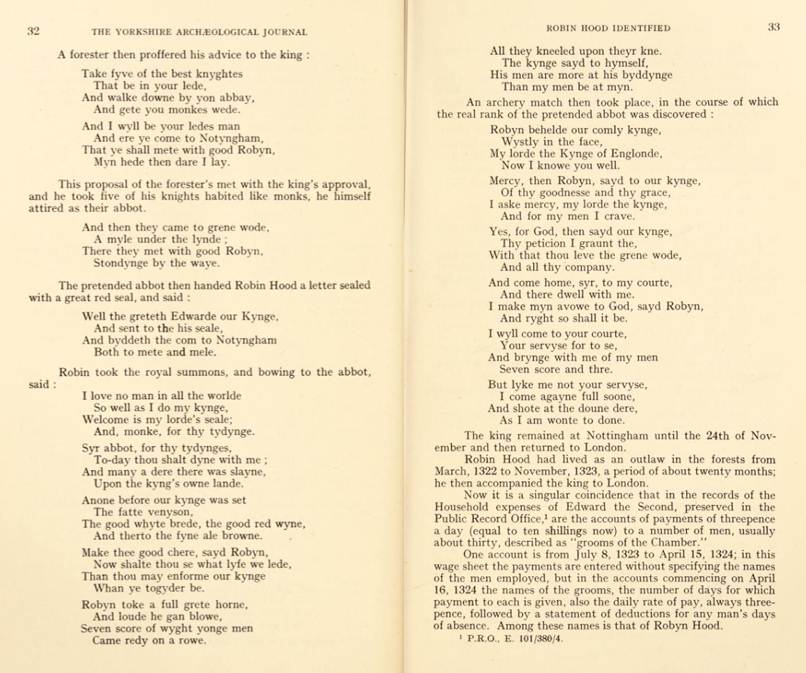
The King allowed Robin to return to Barnsdale for a short time (Seven
nyght I gyve thee leve, No lengre, to dwell fro me.' Gest, Fytte 8,
443).
So Robin gratefully returned to
Barnsdale forest.
444.
'Gramercy,
lorde,' then sayd Robyn,
And set hym on
his kne;
He toke his leve full courteysly,
To grene wode
then went he.
445.
When he came to
grene wode,
In a mery
mornynge,
There he herde
the notës small
Of byrdës mery
syngynge.
446.
'It is ferre
gone,' sayd Robyn,
'That I was last
here;
Me lyste a lytell
for to shote
At the donnë
dere.'
447.
Robyn slewe a
full grete harte;
His horne than
gan he blow,
That all the
outlawes of that forest
That horne coud
they knowe,
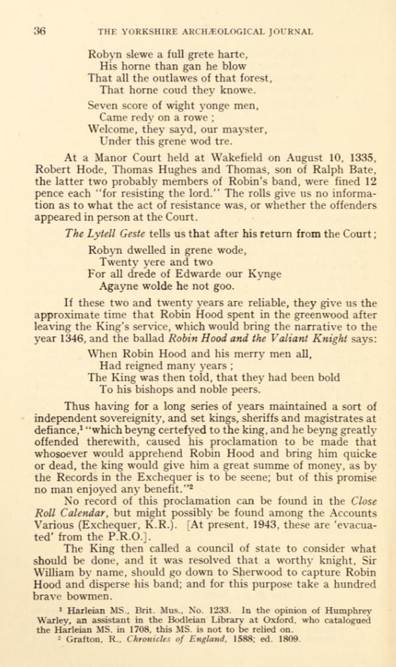
So on his return to the grene wode at Barnsdale, he slew a hart
(as Roger milne (miller) of Farndale (FAR000013A), son of Peter (FAR00008) had done in January 1293),
and gave a joyous blast of the horn he had made, so his merry followers would know
that he had returned. Robin then did not rejoin the King, but
returned to his old ways and lived in Barnsdale for another 22 years until he
was betrayed by the prioress of Kyrkësly to her lover, the knight, Sir Roger of
Donkestere.
450.
Robyn dwelled in
grenë wode
Twenty yere and
two;
For all drede of
Edwarde our kynge,
Agayne wolde he
not goo.
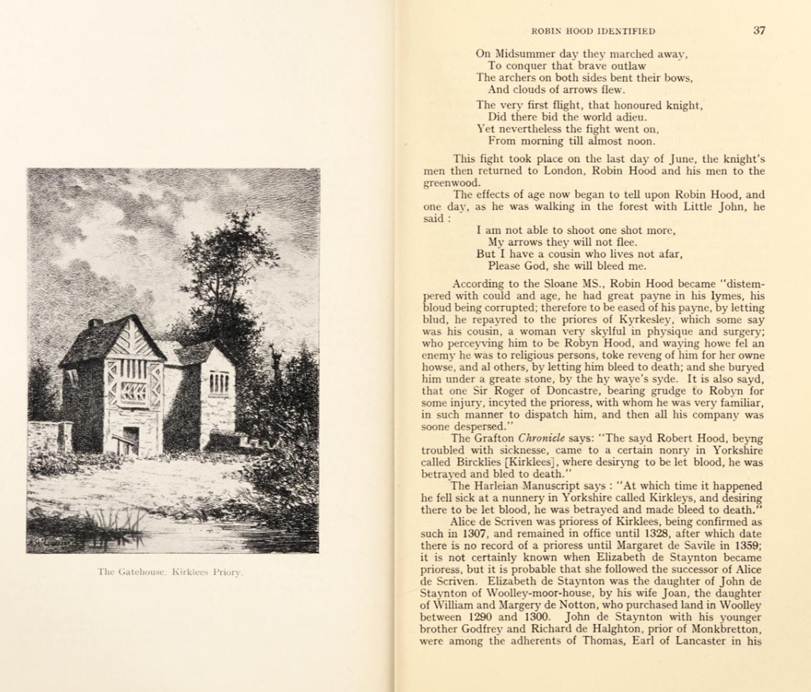
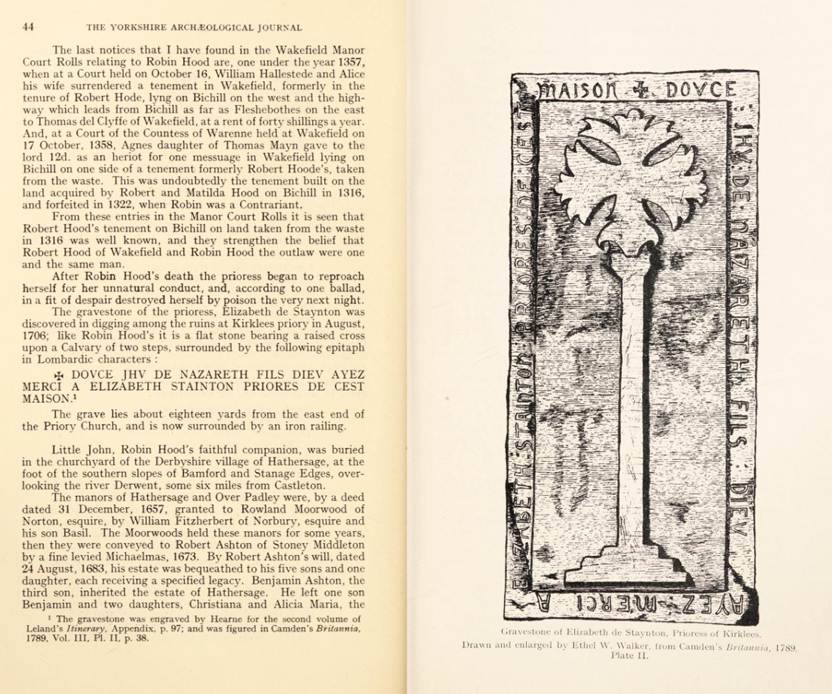
Kirklees Priory was a Cistercian nunnery whose site is in the present day Kirklees Park, Clifton near Brighouse,
Calderdale, West Yorkshire. The priory is featured in the medieval legend of
Robin Hood. According to Robin Hood's Death, Robin was killed by the prioress
of Kirklees. She was medically treating Robin by bleeding,
but treacherously drained too much of his blood instead.
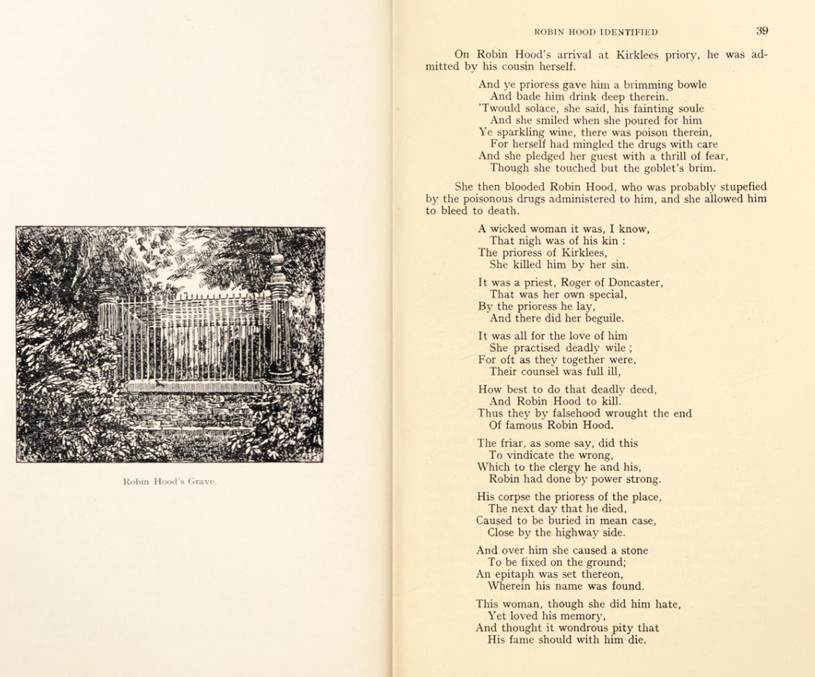
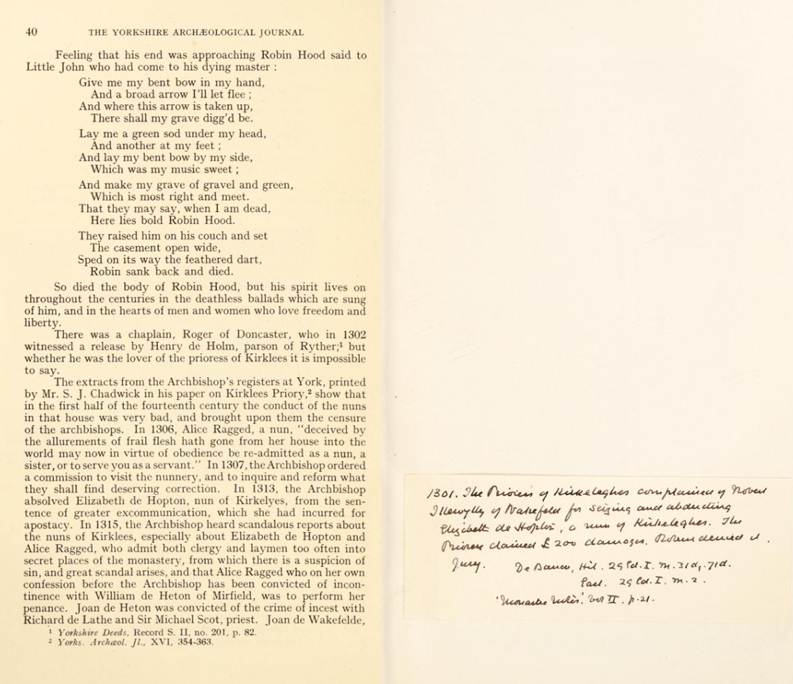
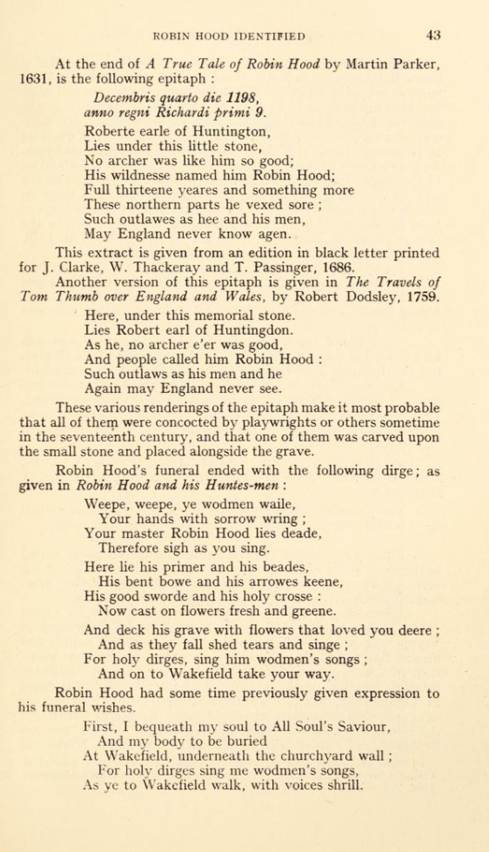
The tradition that Robin Hood was buried at
Kirklees was credited in the time of Henry the Eighth, for Leland thus records
it, “Kirkley monasterium monialium
ubi Ro. Hood nobilis ille et lex sepultus.” (Collectanea,
Leland, I, 54; Robin Hood Identified, J W Walker OBE, FRCS, FSA, Yorkshire Archaeological
Journal, Volume 36, 1947, page
41, also The Site of Robin Hood’s Grave, W B Crump, Yorkshire Archaeological Journal, Volume 37,
1951, page
105).
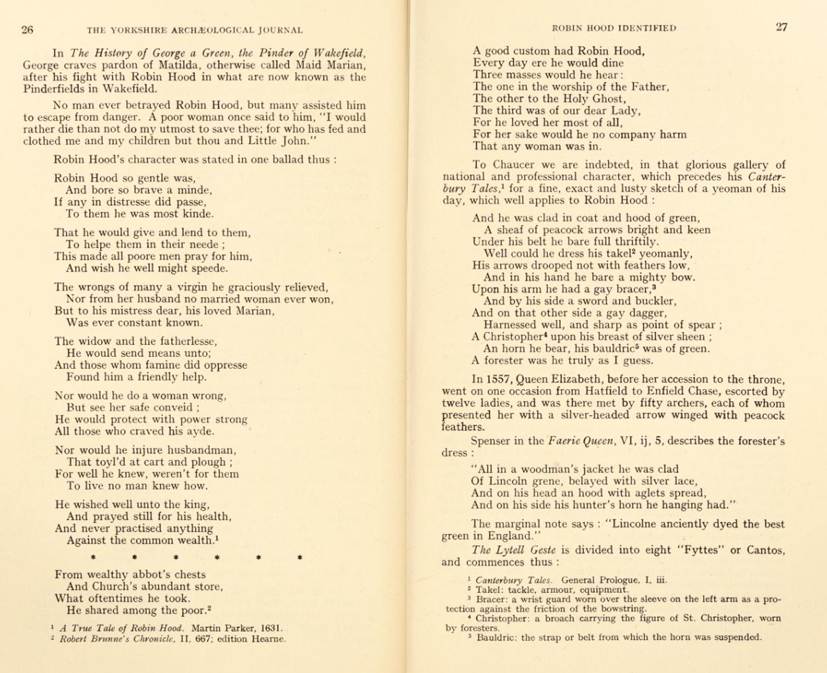
Robin Hood’s association with Barnsdale was more widely recorded.
For instance the Scottish poet and Augustinian canon
Andrew of Wyntoun in his Orygynale Chronicle of circa 1420 wrote in the Allusion (in book VII
under the year 1283, i.e. during the reign of Edward I):
litill Iohne and
Robyne rude
Waichmen were
commendit gud
In Yngilwod and
Bernysdale,
And vsit þis tyme
þer travale.
(Wemyss MS, ll. 3453-56)
Litil Iohun and
Robert Hude
Waythmen war
commendit gud;
In Ingilwode and
Bernnysdaile
Þai oyssit al þis
tyme þar trawale.
(Cottonian MS, ll. 3525-28)
"Yngilwod"
is Inglewood forest in Cumberland. Wyntoun is the only
writer to locate Robin Hood's activities in that area. However
the reference to Barnsdale was more aligned to the wider tradition.
‘Robin Hood in
Barnesdale Stood’ was quoted by a judge in the court of Common Pleas in
1429 (Court of Common Pleas, 1429, 7 Henry 6).
The locations with which Robin Hood is associated, like the
stories themselves, are imagined over centuries of storytelling. The places,
like to stories, are ephemeral and locating the green wood precisely is not the
right approach to take. Yet there is no doubt that the idea of the green wood
has a very close association with Barnsdale, Campsall, and the area immediately
to the north of Doncaster. Robin Hood’s domain, though flexible to the
imagination of countless story tellers, clearly stretched to Doncaster - My
purpos was to haue dyned to day; At Blith or
Dancastere (Gest, Fytte 1, 22). Robin
Hood’s ultimate betrayal was to the knight, Sir Roger of Doncaster. Barnsdale
forest was then at the eastern edge of the great swamp land that dominated the
land westward to the Humber estuary.
The parish church at Campsall, still the Church of St Mary
Magdalene, coincides with Robin’s chapell in Bernysdale, That
semely is to se, It is of Mary Magdaleyne. There
were several churches dedicated to Mary Magdelene, including the parish church
in Doncaster itself, but the church at Campsall is the most likely association
as it sits in the heart of the area associated with Barnsdale.
The forest of Barnsdale is somewhat intangible for a retrospective
analysis, for there is no forest at Barnsdale today. It seems likely that a
large area around Campsall was once forested. It may even have stretched past
Doncaster to merge with Sherwood (eg H L Gee, Folk
Tales of Yorkshire, London, Nelson, 1952, 48). The medieval records do
not though suggest forest at Barnsdale, at least of an administered nature,
like Pickering,
with its forest verderers and regarders. Barnsdale or Bernysdale was known as a
lightly wooded area that was not officially a forest, but it was a place of
ambush in the fourteenth century. Highway robbery in Yorkshire in the
fourteenth and fifteenth century was a significant problem and there were
recorded holdups around Barnsdale and Wentbridge. There was at least one inn at
Wentbridge, where stories would have been retold. The area along the road from
Doncaster and Pontefract at that time, was likely a melting pot of
storytelling.
Yet the references in the tales of Robin Hood and the grene
wode to which he returns is obviously associated with Barnsdale. Carey’s map of Yorkshire 1754-1835 referred to
Barnsdale Lodge (also known as Barnsdale House) near the modern Barnsdale Bar
on the A1 junction.
Richard Morris, Yorkshire a Lyrical History of
England’s Greatest County, 2018, 183 suggests: If the Gest was designed
to be recited in instalments, what if someone in the vicinity adapted a
selection of tales that were already widely known for a local audience? If such
a collection was then printed and began to circulate it would
appear that the stories had originated around Barnsdale.
Perhaps then the written record which has been passed through the
generations originated in Barnsdale, but arose from a
collective memory of stories from Barnsdale and from further afield.
There are hints of the Robin Hood stories more directly associated
with the North York Moors and Kirkbymoorside. There are stories of Robin Hood’s
butts above Robin Hood’s bay from where he fired an arrow that landed in the
bay, taken as a positive sign for the future seaside village. There are other
Robin Hood butts near Danby in Cleveland and associations with Castleton. It
was suggested that Robin Hood regularly fled the law at Robin Hood’s bay and was
given local shelter, sometimes heading out to sea with the fishing boats. The
English ballad The Noble Fisherman tells a story of Robin Hood visiting
Scarborough, taking a job as a fisherman, defeating French pirates with his
archery skills, and using half the looted treasure to build a home for the
poor. However, the ballad is only attested to in the 17th century at the
earliest.
There is also recorded history of forest outlaws in such places as
Pickering forest.
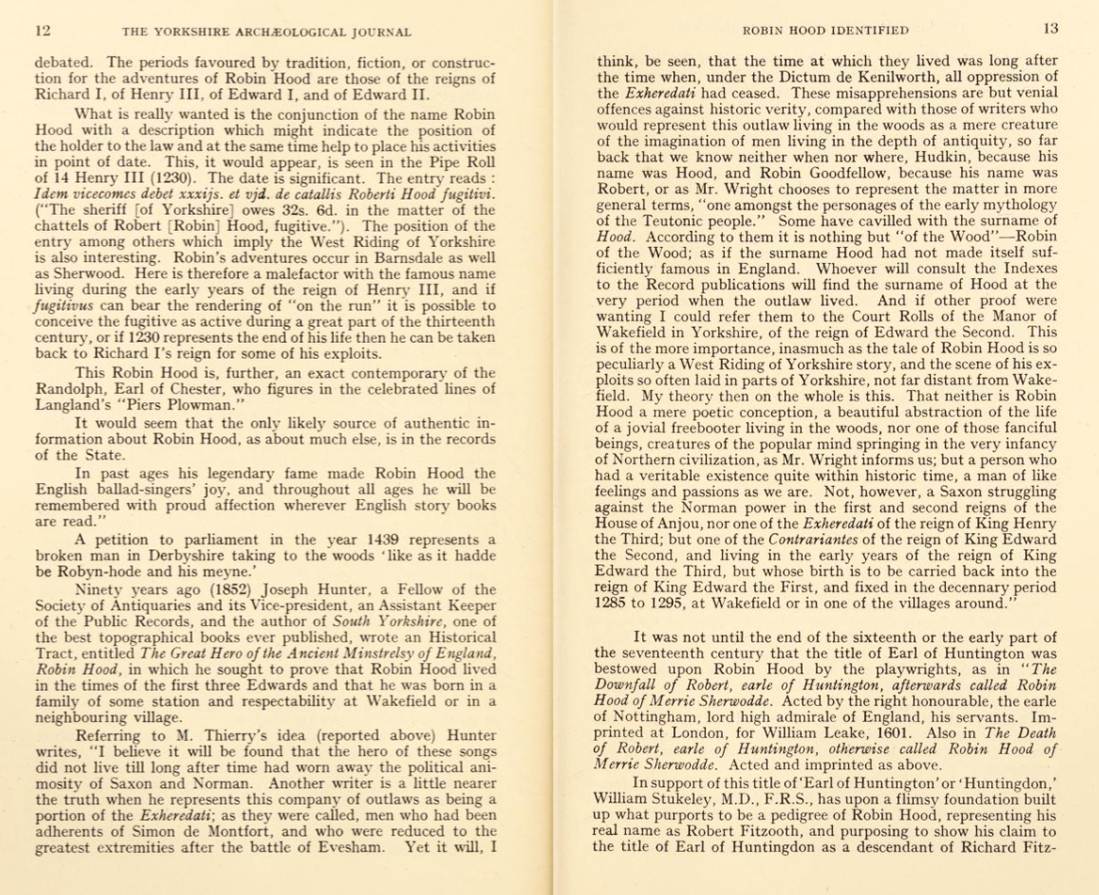
What is really wanted is the conjunction of
the name Robin Hood with a description which might indicate the position of the
holder to the law and at the same time help to place his activities in point of
date. This, it would appear, is seen in the Pipe
Roll of 14 Henry III (1230). The date is significant. The entry reads : Idem vicecomes debet xxxijs et vjd de catallis Roberti Hood fugitivi. (“The sheriff [of Yorkshire] owes 32s 6d in the
matter of the chattels of Robert Hood, fugitive.”). The position of the entry
among others which imply the West Riding of Yorkshire is also interesting.
Robin’s adventures occur in Barnsdale as well as Sherwood. Here is therefore a
malefactor with the famous name living during the early years of the reign of
Henry III, and if fugitivus can bear the rendering of
“on the run” it is possible to conceive the fugitive as active during a great
part of the thirteenth century, or if 1230 represents the end of his life then
he can be taken back to Richard I’s reign for some of his exploits. This Robin
Hood is, further, an exact contemporary of the Randolph, Earl of Chester, who
figures in the celebrated lines of Langland’s “Piers Plowman.” (Robin Hood Identified,
J W Walker OBE, FRCS, FSA, Yorkshire Archaeological Journal, Volume 36, 1947, page
12).
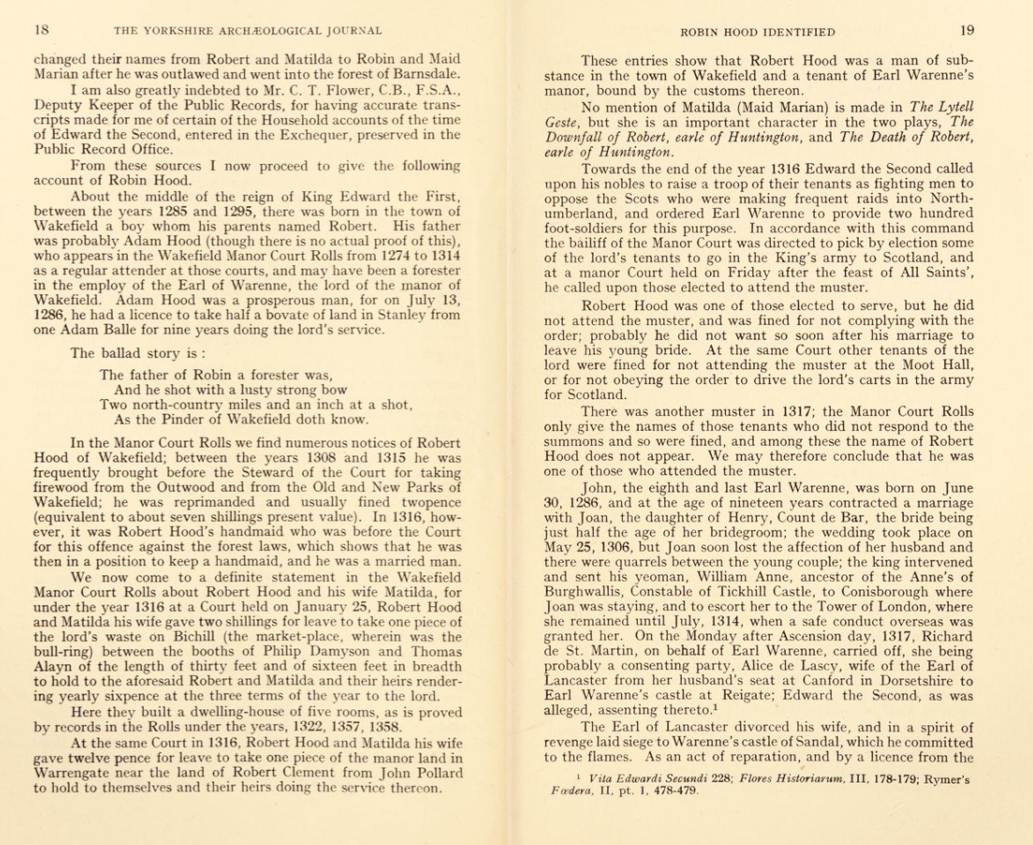
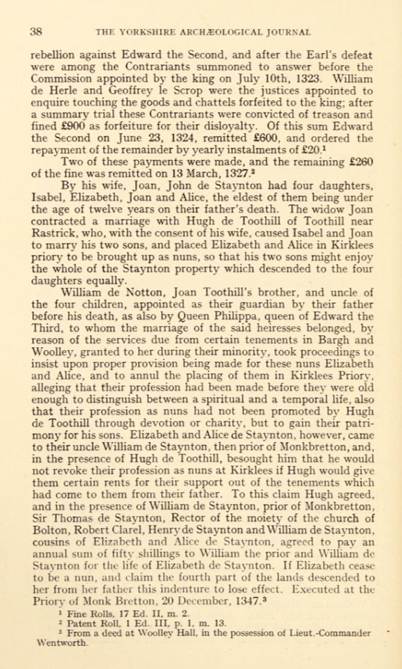
From a careful examination of the Wakefield
Manor Court Rolls, made through the kindness of Mr. D. P. Mosby, Steward of the
Manor, I am able to give some particulars about Robert Hood of Wakefield and
his wife Matilda, who, as the ballad tells us changed their names from Robert
and Matilda to Robin and Maid Marian after he was outlawed and went into the
forest of Barnsdale (Robin Hood
Identified, J W Walker OBE, FRCS, FSA,
Yorkshire Archaeological Journal, Volume 36, 1947, page
18).
The Robin Hood stories and
local ecclesiastical links
Most English writers of the fifteenth century had at least some
association with the Church. Those who captured the rymes of Robehod
into the written word were therefore likely to have had some ecclesiastical
background.
Richard Morris, Yorkshire a Lyrical History of England’s
Greatest County, 2018, 183 surmises a likely association of the stories
with Barnsdale and Robin Hood’s chapel, dedicated to Mary Magdalene. The
original building resembled a collegiate church and was the investment of two
Norman families of the twelfth century, seeking a long term
legacy. By the sixteenth century, there was a vicar and a deacon at Campsall (Valor Ecclesiasticus, Record Commission 1810 to 1834 v179).
There were also chantry priests in the vicinity who sang masses for the repose of
the souls of individuals who left endowments to the church. Morris suggests
that the chantry priests were supernumerary to the parish clergy and may have
been involved in teaching and he surmises that the first
floor chamber above the vaulted west bay of the south aisle at St Mary
Magdalene, dating from the late thirteenth century might have been a space used
for such a purpose.
The emergence of the theologian Richard of Campsall (1280 to 1350)
suggests a well established tradition of teaching in
Campsall. Richard of Campsall (Ricardus de Campsalle) was an English theologian
and scholastic philosopher, at the University of Oxford. He was a Fellow of
Balliol College and then of Merton College. He is now considered a possible
precursor to the views usually associated with William of Ockham. He commented
on Aristotle's Prior Analytics, with emphasis on "conversion" and
"consequences". He is an apparent innovator in speculation about
God's foreknowledge, particularly concerning future contingents, around 1317.
By the fifteenth century the villagers at Campsall had formed a fraternity, and hired their own priest to pray for the
parishioners living and the souls departed (The
Certificates of Commissioners Appointed to Survey the Chantries, Guilds,
Hospitals etc I, 200). The references in the stories of Robin Hood,
including Barnsdale, the Saylis and Wentbridge suggest a very local knowledge
of those who captured the stories into writing. Doncaster
is just seven miles to the south. By 1540 its population was about 2,000.
The historian John Paul Davis wrote of a connection
between Robin Hood and the Church of Saint Mary Magdalene at Campsall.
Davis surmised that there is only one church dedicated to Mary Magdalene within
what might reasonably be considered to have been the medieval forest of
Barnsdale, being the church at Campsall. The church was built in the late
eleventh century by Robert de Lacy, 2nd Baron of Pontefract. Indeed,
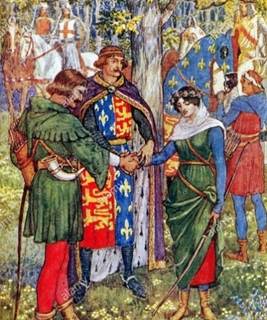
a local legend suggests that Robin Hood and Maid Marion were married at the
church of Saint Mary Magdalene, at Campsall.
Campsall
One persistent legend
attached to Campsall is that Robin Hood and Maid Marian got married in St Mary
Magdalene Church. There is a strong claim amongst Robin Hood scholars that the
legendary outlaw comes from Yorkshire and not Nottingham. Based on the
references to locations contained in early versions of the Robin Hood stories,
they argue that Barnsdale Forest is the original, and Sherwood the imposter.
And in one verse telling of the story, Robin declares: I made a chapel in Barnsdale,
That seemly is to see, It is
of Mary Magdalene, And there to would I be."
Campsall’s church is the only one in Barnsdale dedicated to St Mary Magdalene.
The wedding story was certainly widely told during Edwin’s tenure there. Unfortunately Maid Marian, like (perhaps) Sherwood, is a
later and fictional addition to the Robin Hood entourage. The historical Robin
Hood was in fact already married to a certain Matilda at the time of his
outlawing in 1322 (a time, incidentally, when for a very brief period the
sheriff of Nottingham had jurisdiction over Yorkshire. (Rev
Edwin Castle(1843-1898) and the Yorkshire Robin Hood).
Barnsdale was in
the time of the Edwards a very dangerous forest to travel through. In 1307 the
Bishops of St. Andrew’s and of Glasgow with the abbot of Scone were conveyed at
the King’s charge from Scotland to Winchester. On this journey they had a guard
sometimes of eight archers, sometimes of twelve; but when they left Pontefract
the guard was increased to the number of twenty archers until they reached
Tickhill; the reason given for this increase of guards in the accounts of
payments is “on account of Barnsdale.” From Daventry to Winchester
they proceeded without any archers in attendance. This shows that there was
more than common danger in passing through Barnsdale.
In 1320, when the
sum of 2050 marks was to be transmitted from London to York there was a guard
of eleven horsemen and twelve archers.
In 1339 so small
a sum as £200 was sent from York to Newcastle carried in panniers slung on
horseback, with two men at arms and four archers to guard it.
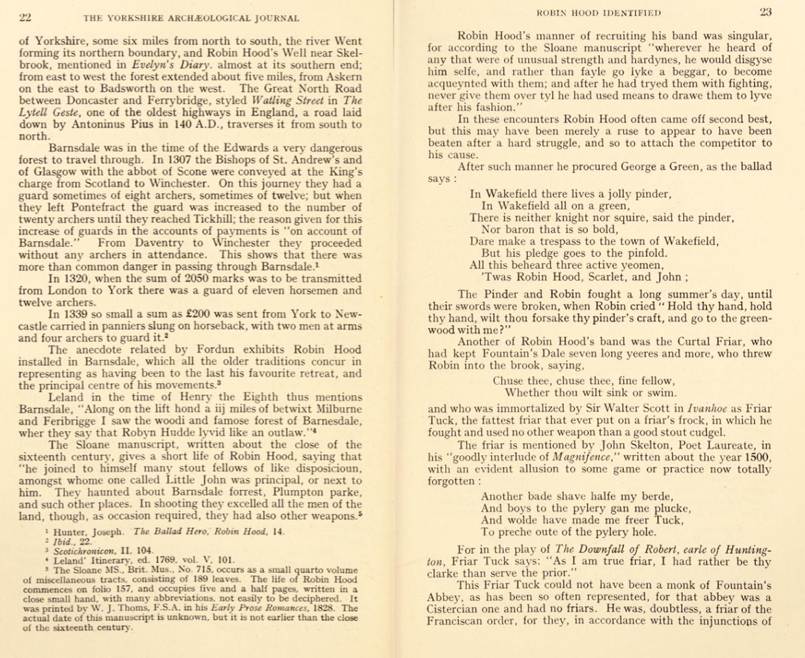
The anecdote
related by Fordun exhibits Robin Hood installed in
Barnsdale, which all the older traditions concur in representing as having been
to the last his favourite retreat, and the principal centre of his movements.
Leland in the
time of Henry the Eighth thus mentions Barnsdale, “Along on the lift hond a iij
miles of betwixt Milburne and Feribrigge I saw the woodi and famose forest of Barnesdale, wher they say that
Robyn Hudde lyvid like an outlaw.”
The Sloane
manuscript, written about the close of the sixteenth century, gives a short
life of Robin Hood, saying that “he joined to himself many stout fellows of
like disposicioun, amongst whome
one called Little John was principal, or next to him. They haunted about Barnsdale
forrest, Plumpton parke,
and such other places. In shooting they excelled all the men of the land,
though, as occasion required, they had also other weapons.
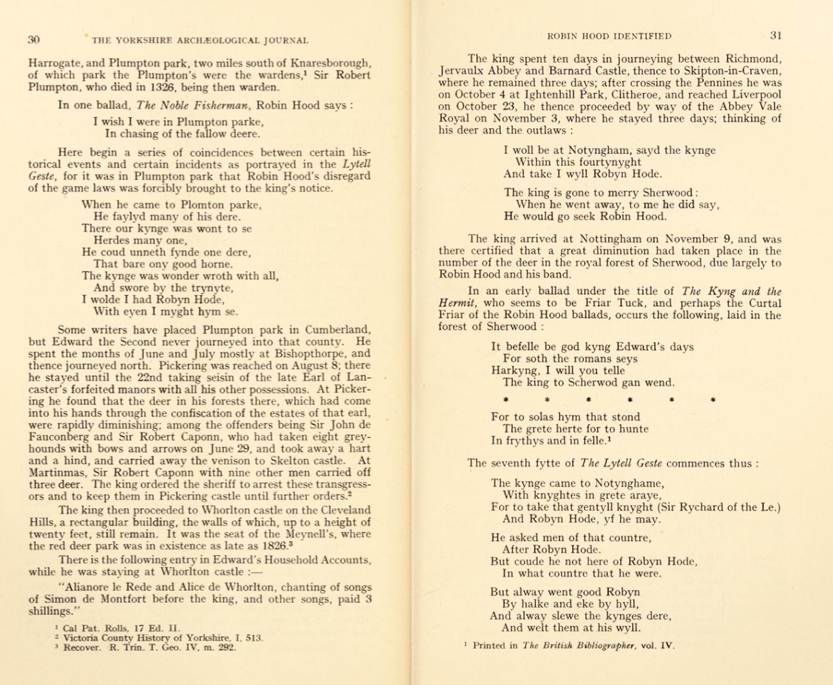
(Robin Hood Identified,
J W Walker OBE, FRCS, FSA, Yorkshire Archaeological Journal, Volume 36, 1947, page
22).
From early times
the parish of Campsall consisted of six townships or hamlets; Campsall, Askern,
Fenwick, Moss, Norton and Sutton. At the time of the Domesday survey in 1086,
the area was in the possession of Ilbert de Lacy, the founder of Pontefract
Castle. The fact that Domesday does not mention a church here is no proof that
such did not exist, since cases are to be found where there is similarly no
such reference. Yet the existing church contains work of pre-Conquest date;
there may have been merely a chapel attached to the manor without parochial
rights. The earliest existing work in the church is of twelfth century date.
In the reign of Edward I Henry Lacy obtained a royal charter for a market at
Campsall, which would suggest that it was a place of some consequence by that
time. By 1288 the benefice was in the Taxatio of Pope Nicholas IV (1291) and
had an annual value of £66 13s. 4d. By a curious arrangement, the chapel of St.
Clement in Pontefract Castle had a share in tithe. The probable explanation of
this anomaly is the fact that Ilbert de Lacy and his successors held both
estates and adopted this method of supporting the chapel which was an important
foundation in its own right. In 1336 there was a
composition under the sanction of the Archbishop of York in the name of Thomas
de Bracton, Rector of Campsall, and William de Mudene, Prebendary of the
chapel, by which one hundred shillings was to be paid by the Rector in lieu of
the tithe.
A great change took
place in 1481 when Edward IV granted the rectory of Campsall to the Priory of
Wallingwells in Nottinghamshire, a small house of Benedictine nuns. In the
following year Thomas Rotherham, Archbishop of York, appropriated it to this
purpose and decreed that henceforth the benefice should be served by a Vicar,
and gave the appointment to Cambridge University. After the dissolution of the
monasteries under Henry VIII the rectorial tithes passed into lay hands.
St Mary Magdalene,
Campsall is a large church with at least two main phases of twelfth century
building identifiable: at first it had a cruciform
plan; later, nave aisles enclosing a west tower were added. Pevsner 1967, 154, says Campsall church has ‘the
most ambitious Norman west tower of any parish church in the Riding’.
Subsequently, alterations were made to the aisle arcades, windows, chancel and
south doorway. The church was restored between 1871 and 1877 by G. G. Scott (Borthwick Institute Faculty Papers 1871/2 with plan)
and piecemeal after. Restoration of stonework on the tower was in progress in
2005. Romanesque sculpture is on the west doorway and tower; one chancel window
(inside and out); arches at the crossing; and numerous loose and reset
fragments.
Hunter
1831, 460,
says 'Campsal church was the joint work of the Lacis, the chief lords, and
the Reineviles, the subinfudatories. It exceded [the churches of Bramwith, Owston
and Burgh] in magnificence as much as it did in the extent of country that was
attached to it'
The manor of
Campsall thrived after the Conquest, rather than retracting, and was largely
owned directly by Ilbert de Lacy (Hunter 1831, 463).
There were
originally two rectors, one appointed by each family; and this continued until
about the time of Henry III (Hunter 1831, 463).
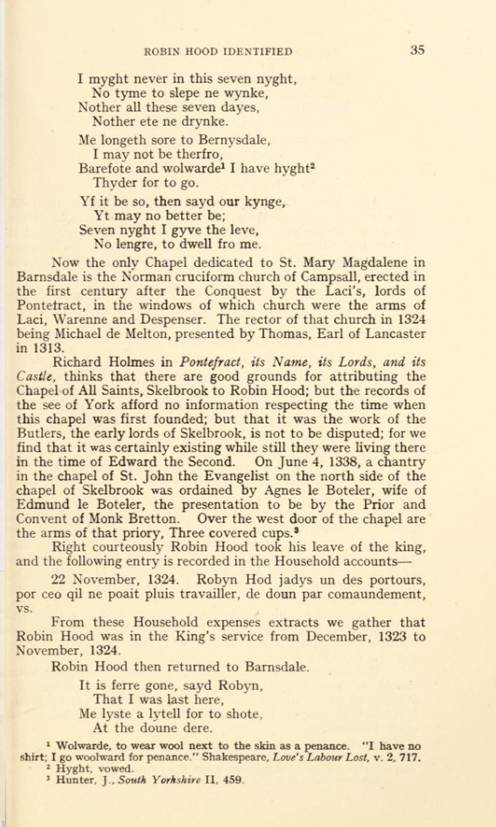
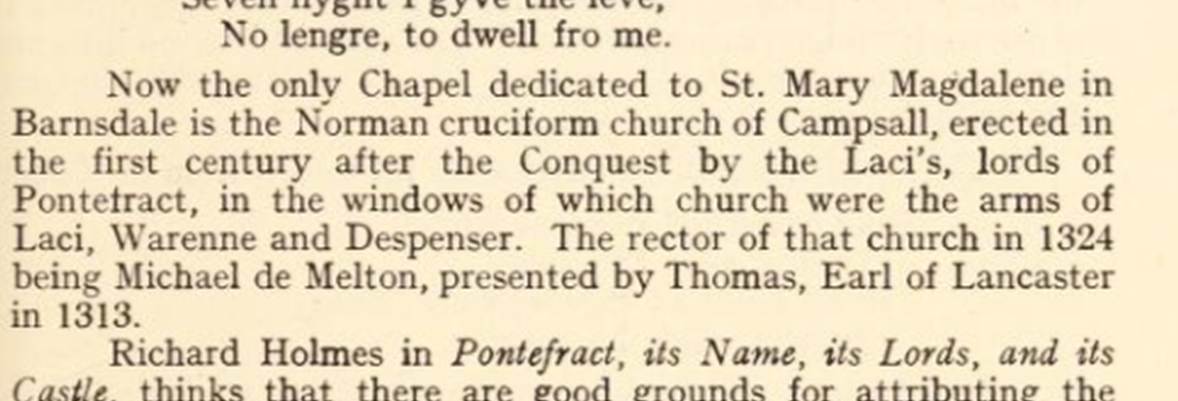
Now the only
Chapel dedicated to St. Mary Magdalene in Barnsdale is the Norman cruciform church
of Campsall, erected in the first century after the Conquest by the Lad’s,
lords of Pontefract, in the windows of which church were the arms of Laci, Warenne and Despenser. The rector of that church in 1324
being Michael de Melton, presented by Thomas, Earl of Lancaster in 1313. (Robin Hood Identified,
J W Walker OBE, FRCS, FSA, Yorkshire Archaeological Journal, Volume 36, 1947, page
35).
There is a
podcast on BBC Sounds, Secret
South Yorkshire: Did Robin Hood get married in Doncaster?
Ancestral Farndales and the
idea of Robin Hood – actors and story tellers
It was the green-clad figure of Robin Hood,
the bold yeoman and forester, the representative of the great unrecorded host
of free Englishmen, whose exploits form a romantic episode of history, and
whose story has for long ages delighted young and old; for he was one of those
who stood up for the rights of the industrious common folk and protected the
desolate and oppressed against the galling tyranny of the nobles and the chief men
of the church, who at that time wronged the poor as much as did the nobles. (Robin Hood Identified,
J W Walker OBE, FRCS, FSA, Yorkshire Archaeological Journal, Volume 36, 1947, page
4).
Robert Tombs, The English and their History, 2023,
128: It has been suggested that if there ever was a real Robin
Hood (Robin Hod), he fought the Sheriff of Yorkshire between 1226 and 1234.
There are three aspects
to the history of the Farndale family which support a close association with
the Robin Hood stories.
First, the earliest
records associated with our ancestors who started to leave the dale itself, but
adopted its name, provide us with a dozen or so direct references to poachers
and outlaws in Pickering Forest.
· Farndales
indicted for poaching in 1280 (FAR00019)
included Roger, son of Gilbert of Farndale, Nicholas de Farndale, William the
smith of Farndale, John the shepherd of Farndale, and Alan the son of Nicholas
de Farndale;
· Peter
de Farndale (FAR00008)’s
son Robert (FAR00012)
was fined at Pickering Castle in 1293. Robert son of Peter de Farndale, (FAR00012)(The Farndale 2 Line)
was outlawed for hunting in 1293.
·
Roger milne (miller) of Farndale (FAR000013A),
son of Peter (FAR00008) of
Spaunton on Monday in January 1293, killed a soar and slew a hart with bows
and arrows at some unknown place in the forest. He with others were outlawed on
5 April 1293.
· Richard
de Farndale (FAR00016)
was excommunicated for stealing in 1316.
· Robert
of Farndale (FAR00024)
was fined at Pickering Castle for poaching in 1322.
· John
de Farndale (FAR00026)
was released from excommunication at Pickering Castle on 9 Apr 1324.
· Simon
de Farndale (FAR00021)
(The Farndale 4 Line),
whose son Robert was fined at Pickering Castle in 1332.
· Robert
of Farndale (FAR00031)
was outlawed with others for hunting a hart in the forest in 1332.
· Nicholas
de Farndale (FAR00022)(The Farndale 3 Line)
gave bail for Roger son of Gilbert of Farndale who had been caught poaching in
1334 and 1335.
· William,
smith of Farndale (FAR00037)
on Monday 2 December 1336, came hunting in Lefebow with bow and arrows and
gazehounds………’
· Gilbert
de Farndale (FAR00018)
was bailed by Nicholas Farndale (FAR00022)
for poaching in 1344 and 1345.
· Commission
of oyer and terminer on 17 January 1348 to a long list of names including
William Smyth of Farndale (FAR00040)
the younger and Richard Ruttok of Farendale for breaking in to the park at
Egton, hunting and carrying away the property of the owner with deer, and for
assaulting the owner’s men and servants causing their inability to work for a
long time, for which they were fined 1 mark.
The emergence of the Robin Hood stories in the 1400s was likely to
have been inspired in part by the complaints against oppression that led to the
Peasants’ Revolt in 1381,
which itself was triggered by the imposition of three poll taxes in 1377, 1379
and 1381. It is notable that Nicholaus de ffarnedale
(FAR00838A)
paid 4d for the second Poll Tax in 1379, and may well
have had rebellious sympathies with these ideas.
Second, the family who called themselves
Farndale, by the early fourteenth century were focused around
Doncaster, and by the sixteenth century, were living in or around Campsall,
where Robin Hood had made a chapell in Bernysdale.
It seems probable that the descendants of the outlaws of Pickering
Forest were living in the area of Barnsdale at the same time that the rymes were committed to
writing, including in the form of the Gest.
The historical record suggests that those individuals who left the
dale, but adopted its name, first headed south across the agricultural plains
around York and settled in York
itself, around Sheriff
Hutton to the north of York and to the area around Doncaster
where William
Farndale was the chaplain immediately after the Black Death and then parish
vicar from 1397 to 1403.
The written record is at least for the moment, cold, after 1403
until William
Farndale, son of Nicholas
Farndale and Agnes
Farndale, married Margaret Atkinson at St Mary of Magdalene, Campsall on 29
October 1564. We can then directly link William’s son, George
Farndale to all (or probably all) modern Farndales. It seems probable that
the direct ancestors of all modern Farndales therefore lived in or around
Campsall in 1564 before they emigrated north of the North York Moors to the
Cleveland area by 1567. It seems very likely that the family group who lived in
or around Campsall in the mid sixteenth century were the descendants possibly
of William
Farndale, the vicar of Doncaster himself, but very probably of his wider
family.
Third, the family who called themselves
Farndale, and who lived in the area of Barnsdale at
that time, were probably descended from the vicar of Doncaster, William
Farndale of the fourteenth century. If the church of St Mary Magdalene was
a centre of learning by the late thirteenth century, this places our family at
the same location where the stories of Robin Hood may well have first been
committed to writing. Given that they were likely descended from outlaws of Pickering
Forest, who poached for hart and soar in desperate acts of survival, they
had the inspiration to romanticise about their ancestors’ exploits.
There are other associations with the Farndale’s ancestral past.
Perhaps the oldest Robin Hood story, which appears in the Gest, is that of a
knight, Richard of the Lee who had become indebted to the abbot of St Mary’s, York
who threatened to possess his lands. Robin Hood came to his aid by robbing the
monks themselves to repay the loan. It will be recalled from the
general history of the Farndales’ origins, that after the Norman Conquest,
the lands of Kirkbymoorside were the property of two rival baronial families,
the House Mowbray and the House Stuteville. Farndale was first mentioned as a gift
by Roger de Mowbray’s ward to the Cistercian abbey of Rievaulx. However the Stutevilles favoured the Benedictine monks of St
Mary’s Abbey in York and so in 1209 it was St Mary’s who had rights in the
forest of Farndale.
The Robin Hood stories are well rooted in historical experiences,
of which our Farndale ancestors were players and direct witnesses.
In passing, it is interesting to note that the valley which runs
parallel to Farndale, and with which it is closely associated in the medieval records,
is Bransdale, and it is tempting to draw some association with those around
Campsall who later named the area of Barnsdale. Only two letters shift!
It seems probable that our ancestors were both the actors who, no
doubt amongst many like them, inspired the stories of Robin Hood, and may well
have been amongst those who passed down the stories and eventually recorded
them to writing.
Our rebellious ancestors
Hence, we find our family history in the heart of Robin Hood territory.
There is a historical documentary series on Sky
television, called The Britains, and episode 2 which depicts two outlaws pursued in Pickering Forest
whilst poaching for deer. They were brothers called Philips, but they may as
well have been Farndales. The documentary observes that it was such folk who
would inspire the legend of Robin Hood, and their archery skills would one day
comprise the successful armies who fought at Crecy and Agincourt.
The medieval sources record a significant number of our ancestors
who were fined, outlawed and even excommunicated, for poaching and illegally
hunting, particularly within the Royal Forest of Pickering. At the time they were petty
criminals, but they later became the heroic ‘merry men’, and there are plenty
of such characters in our history.
A historical explanation for this activity might have been the struggles
of the villein classes in the thirteenth century and the Great Famine following
bad weather and poor harvests in 1315 which gave rise to widespread unrest,
crime and infanticide; followed by the Black Death which hit Yorkshire in March
1349.
A rebellious trait is a seam which runs through the history of the
English people and is perhaps the origin of the democratic gains which were
slowly achieved through time. Our family’s association with this trait can be identified
regularly in the records. For instance John
William Farndale in 1936 was the youngest member of the Jarrow marchers.
As we learn more about our ancestral history, this nostalgia for a
world where justice and fairness is administered by a
noble outlaw on behalf of the ordinary folk, weaves itself easily into the
factual narrative of our ancestors.
We cannot say that our descendants were the fictional Robin Hood
nor his merry men, but our ancestral path weaves closely betwixt the idea of
Robin Hood, and it seems probable that our ancestors were those who inspired
the tales and who, in later generations, were close to those who wrote them
down for posterity.
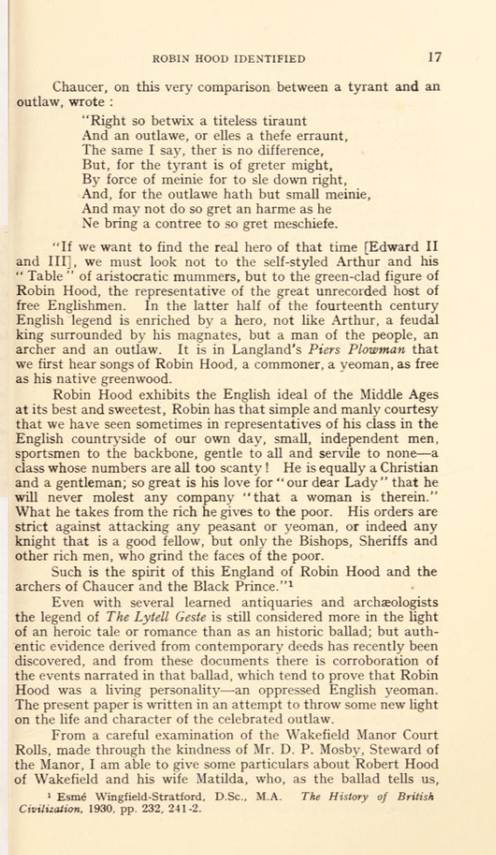
Robin Hood exhibits the English ideal of the
Middle Ages at its best and sweetest, Robin has that simple and manly courtesy that
we have seen sometimes in representatives of his class in the English
countryside of our own day, small, independent men, sportsmen to the backbone,
gentle to all and servile to none — a class whose numbers are all too scanty!
He is equally a Christian and a gentleman; so great is his love for "our
dear Lady” that he will never molest any company "that a woman is
therein.” What he takes from the rich he gives to the poor. His orders are
strict against attacking any peasant or yeoman, or indeed any knight that is a
good fellow, but only the Bishops, Sheriffs and other rich men, who grind the
faces of the poor. “Such is the spirit of this England of Robin Hood and the
archers of Chaucer and the Black Prince”. (Robin
Hood Identified, J W Walker OBE, FRCS,
FSA, Yorkshire Archaeological Journal, Volume 36, 1947, page
17, The History of British Civilization, Esme Wingfield-Stratford DSc MA, 1930, pages
241 to 242).
Other references
Yorkshire
is the Birthplace, refuge and burial place of Robin Hood (copied text for
further review)
Robin Hood of
Wakefield
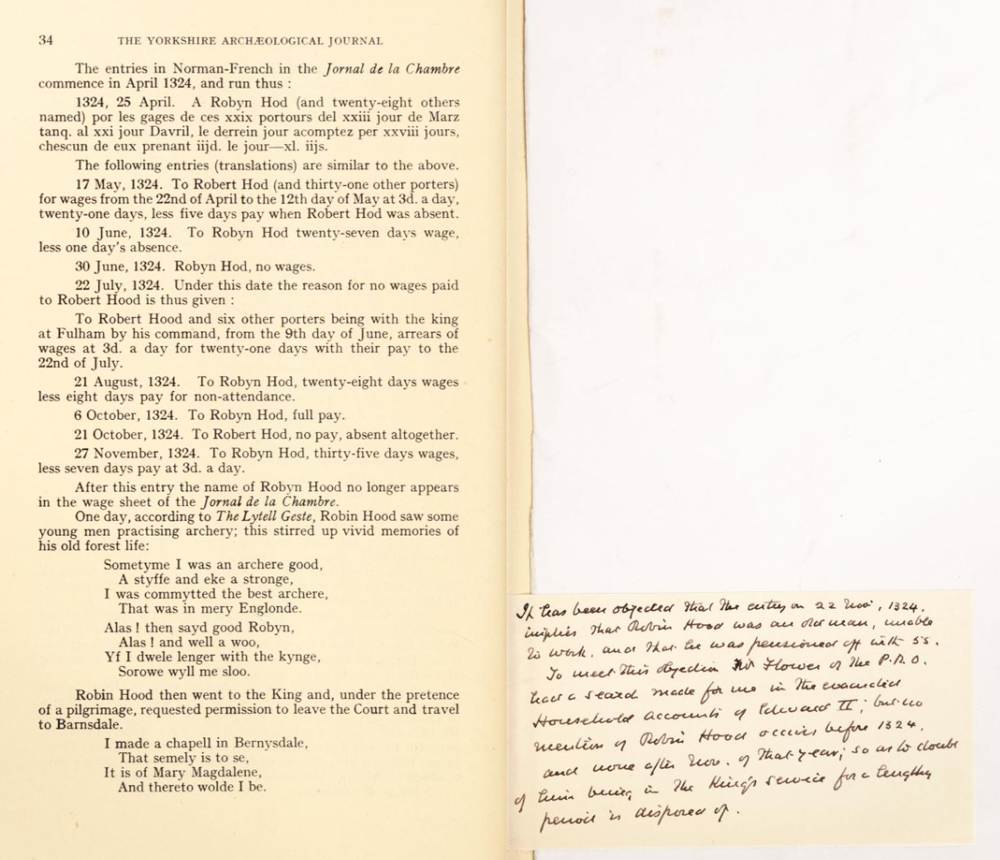
One theory of
origin was proposed by Joseph Hunter in 1852. Hunter identified the outlaw with
a "Robyn Hode" recorded as employed by Edward II in 1323 during the
king's progress through Lancashire. This Robyn Hode was identified with (one or
more people called) Robert Hood living in Wakefield before and after that time.
Comparing the available records with especially the Gest and
also other ballads, Hunter developed a fairly detailed
theory according to which Robin Hood was an adherent of the rebel Earl of
Lancaster, defeated at the Battle of Boroughbridge in 1322. According to this
theory, Robin Hood was pardoned and employed by the king in 1323. (The Gest
does relate that Robin Hood was pardoned by "King Edward" and taken
into his service.) The theory supplies Robin Hood with a wife, Matilda, thought
to be the origin of Maid Marian, and Hunter also conjectured that the author of
the Gest may have been the religious poet Richard Rolle (1290–1349), who lived
in the village of Hampole in Barnsdale. Hunter's theory has long been
recognised to have serious problems, one of the most serious being that
"Robin Hood" and similar names were already used as nicknames for
outlaws in the 13th century. Another is that there is no direct evidence that
Hunter's Hood had ever been an outlaw or any kind of criminal or rebel at all;
the theory is built on conjecture and coincidence of detail. Finally, recent
research has shown that Hunter's Robyn Hood had been employed by the king at an
earlier stage, thus casting doubt on this Robyn Hood's supposed earlier career
as outlaw and rebel.
Robin Hood of
York
The historian L.
V. D. Owen in 1936 and more recently floated by J.C. Holt proposed that the
original Robin Hood might be identified with an outlawed Robert Hood, or Hod,
or Hobbehod, all apparently the same man, referred to in nine successive
Yorkshire Pipe Rolls between 1226 and 1234.There is no evidence however that this
Robert Hood, although an outlaw, was also a bandit.
The early ballads
give a number of possible historical clues: notably,
the Gest names the reigning king as being an unnamed "Edward", but
unfortunately the ballads cannot be assumed to be reliable in such details.
This is of little help as in addition to King Edward I who took the throne in
1272 with an Edward on the throne until the death of Edward III in 1377, there
was also Edward the Elder (900–924), Edward the Martyr (975–978) and Edward the
Confessor (1042–1066)
Robin Hood as an
alias
It has long been
suggested, notably by John Maddicott, that "Robin Hood" was a stock
alias used by thieves. What appears to be the first known example of
"Robin Hood" as stock name for an outlaw dates
to 1262 in Berkshire, where the surname "Robehod" was applied to a
man apparently because he had been outlawed. This could suggest two main
possibilities: either that an early form of the Robin Hood legend was already
well established in the mid-13th century; or alternatively that the name
"Robin Hood" preceded the outlaw hero that we know; so that the
"Robin Hood" of legend was so called because that was seen as an
appropriate name for an outlaw.
Another theory
identifies him with the historical outlaw Roger Godberd, who was a die-hard
supporter of Simon de Montfort, which would place Robin Hood around the 1260s. There
are certainly parallels between Godberd's career and that of Robin Hood as he
appears in the Gest. John Maddicott has called Godberd "that prototype
Robin Hood". Some problems with this theory are that there is no evidence
that Godberd was ever known as Robin Hood and no sign in the early Robin Hood
ballads of the specific concerns of de Montfort's revolt.
Robin Hood, the
high-minded Saxon yeoman
The idea of Robin
Hood as an Anglo-Saxon freedom fighter opposing oppressive Norman lords found popular
appeal in the nineteenth century. The most notable contributions to the idea
are Sir Walter Scott's Ivanhoe (1819) and Augustin Thierry's Histoire de la
Conquête de l'Angleterre par les Normands, A History of the Conquest of England
by the Normans (1825). Robin Hood appears as a character along with his
"merry men" in Ivanhoe, a historical novel by Sir Walter Scott
published in 1820, and set in 12th-century England. The character that Scott gave
to Robin Hood in Ivanhoe helped shape the modern notion of this figure as a
cheery noble outlaw. In the novel Robin is depicted as a follower of King
Richard the Lionheart and helps him and Wilfred Ivanhoe to fight against the
Knights Templar. It is in this work that the modern Robin Hood – "King of
Outlaws and prince of good fellows!" - as Richard the Lionheart calls him
– makes his debut!
Academics
indicate that there are a number of verifiable
historical clues that allude to the legend's Anglo-Saxon origins. In particular, The Coucher Book of Selby Abbey, a manuscript
dating from the eleventh century, records that ‘a certain Prince of Thieves by
the name of Swain, son of Sigge, constantly prowled around Yorkshire's woods
with his band on perpetual raids’. The medieval chronicler speaks of how a
'cursed villain' in Swein's gang robbed Abbot Benedict of Selby. J. Green
indicates that Hugh fitz Baldric, the late eleventh century Sheriff of
Nottinghamshire and Yorkshire, held responsibility for bringing
Swein-son-of-Sicga to justice.[31] William E. Kapelle indicates that Hugh fitz
Baldric needed to travel around Yorkshire in the company of a small army
because of the threat that was posed to his safety by the region’s outlaws.
Historians indicate that the deeds of Yorkshire's eleventh century outlaws, men
such as Swein-son-of-Siccga, and their battles against the Sheriff of Nottingham,
merged together to form the legend that is today
universally known as The Adventures of Robin Hood.[33]
Yorkshire
Nottinghamshire's
claim to Robin Hood's heritage is disputed, with Yorkists staking a claim to
the outlaw. In demonstrating Yorkshire's Robin Hood heritage, the historian J.
C. Holt drew attention to the fact that although Sherwood Forest is mentioned
in Robin Hood and the Monk, there is little information about the topography of
the region, and thus suggested that Robin Hood was
drawn to Nottinghamshire through his interactions with the city's sheriff. And,
the linguist Lister Matheson has observed that the language of the Gest of
Robyn Hode is written in a definite northern dialect, probably that of
Yorkshire.[48] In consequence, it seems probable that the Robin Hood legend actually originates from the county of Yorkshire. Robin
Hood's Yorkshire origins are universally accepted by professional historians.
Barnsdale
A tradition dating
back at least to the end of the 16th century gives Robin Hood's birthplace as
Loxley, Sheffield, in South Yorkshire. The original Robin Hood ballads, which
originate from the fifteenth century, set events in the medieval forest of
Barnsdale. Barnsdale was a wooded area which covered an expanse of no more than
thirty square miles, ranging six miles from north to south, with the River Went
at Wentbridge near Pontefract forming its northern boundary and the villages of
Skelbrooke and Hampole forming the southernmost region. From east to west the
forest extended about five miles, from Askern on the east to Badsworth in the
west. At the northern most edge of the forest of Barnsdale, in the heart of the
Went Valley, resides the village of Wentbridge. Wentbridge is a village in the
City of Wakefield district of West Yorkshire, England. It lies around 3 miles
(5 km) southeast of its nearest township of size, Pontefract, close to the A1 road. During the medieval age Wentbridge was sometimes
locally referred to by the name of Barnsdale because it was the predominant
settlement in the forest. Wentbridge is mentioned in what may be the earliest
Robin Hood ballad, entitled, Robin Hood and the Potter, which reads, "Y
mete hem bot at Went breg,' syde Lyttyl John". And, whilst Wentbridge is
not directly named in A Gest of Robyn Hode, the poem does appear to make a
cryptic reference to the locality by depicting a poor knight explaining to
Robin Hood that he ‘went at a bridge’ where there was wrestling'. A
commemorative Blue Plaque has been placed on the bridge that crosses the River
Went by Wakefield City Council.
The Saylis
The Gest makes a
specific reference to the Saylis at Wentbridge. Credit is due to the nineteenth
century antiquarian Joseph Hunter, who correctly identifed the site of the
Saylis. From this location it was once possible to look out over the Went Valley
and observe the traffic that passed along the Great North Road. The Saylis is
recorded as having contributed towards the aid that was granted to Edward III
in 1346-47 for the knighting of the Black Prince. An acre of landholding is
listed within a glebe terrier of 1688 relating to Kirk Smeaton, which later
came to be called ‘Sailes Close’. Professor Dobson and Mr Taylor indicate that
such evidence of continuity makes it virtually certain that the Saylis that was
so well known to Robin Hood is preserved today as ‘Sayles Plantation’.[55] It
is this location that provides a vital clue to Robin Hood’s Yorkshire heritage.
One final locality in the forest of Barnsdale that is associated with Robin
Hood is the village of Campsall.
The Church of
Saint Mary Magdalene at Campsall
The historian
John Paul Davis wrote of Robin's connection to the Church of Saint Mary
Magdalene at Campsall. A Gest of Robyn Hode states that the outlaw built a chapel
in Barnsdale that he dedicated to Mary Magdalene,
‘I made a chapel
in Bernysdale, That seemly is to se, It is of Mary Magdaleyne, And
thereto wolde I be’.
Davis indicates
that there is only one church dedicated to Mary Magdalene within what one might
reasonably consider to have been the medieval forest
of Barnsdale, and that is the church at Campsall. The church was built in the
late eleventh century by Robert de Lacy, the 2nd Baron of Pontefract. Local
legend suggests that Robin Hood and Maid Marion were married at the church.
The Abbey of
Saint Mary at York
The backdrop of
Saint Mary's Abbey at York plays a central role in the Gest as the poor knight
who Robin aids owes money to the abbot.
Robin Hood's
grave at Kirklees
At Kirklees
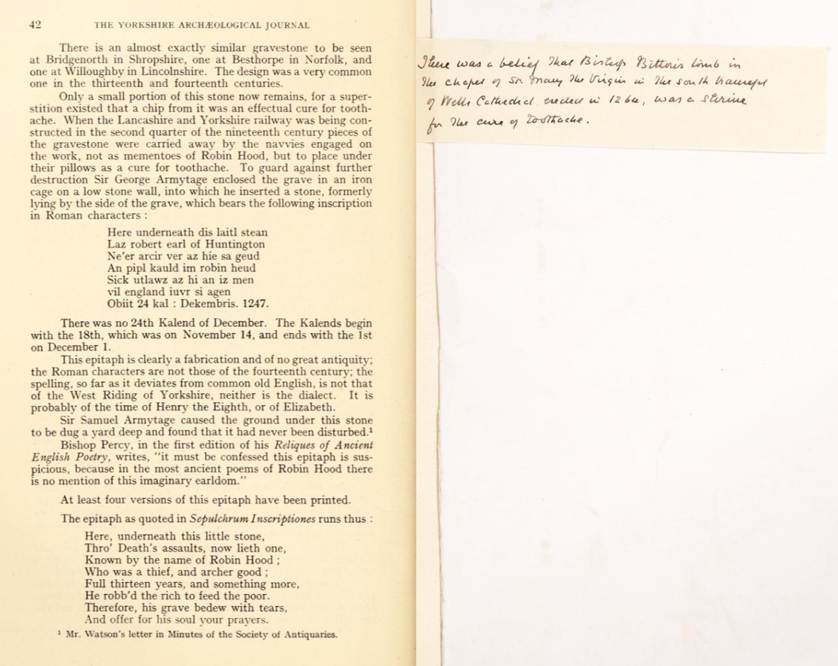
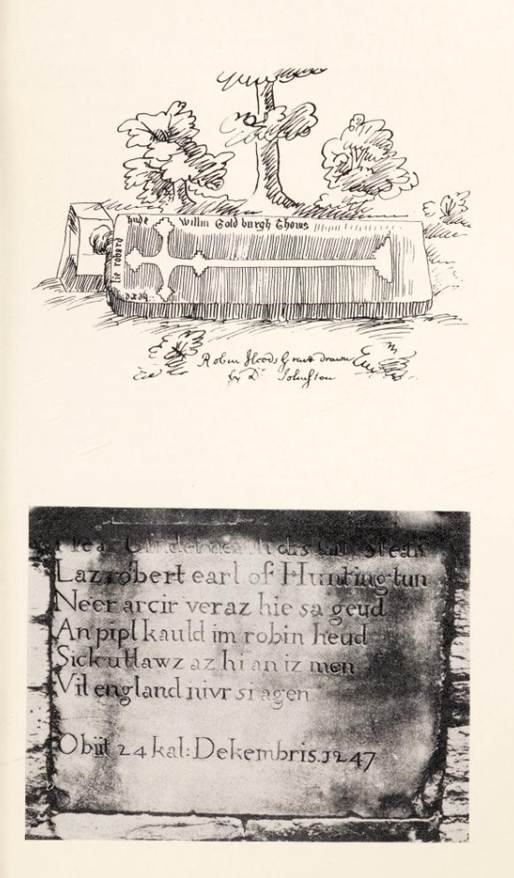
priory in Yorkshire stands an alleged grave with a spurious inscription, which
relates to Robin Hood. The fifteenth century ballads relate that before he
died, Robin told Little John where to bury him. He shot an arrow from the Priory
window, and where the arrow landed was to be the site of his grave. The Gest
states that the Prioress was a relative of Robin's. Robin was ill and staying
at the Priory where the Prioress was supposedly caring for him. However, she
betrayed him, his health worsened, and he eventually died there. The
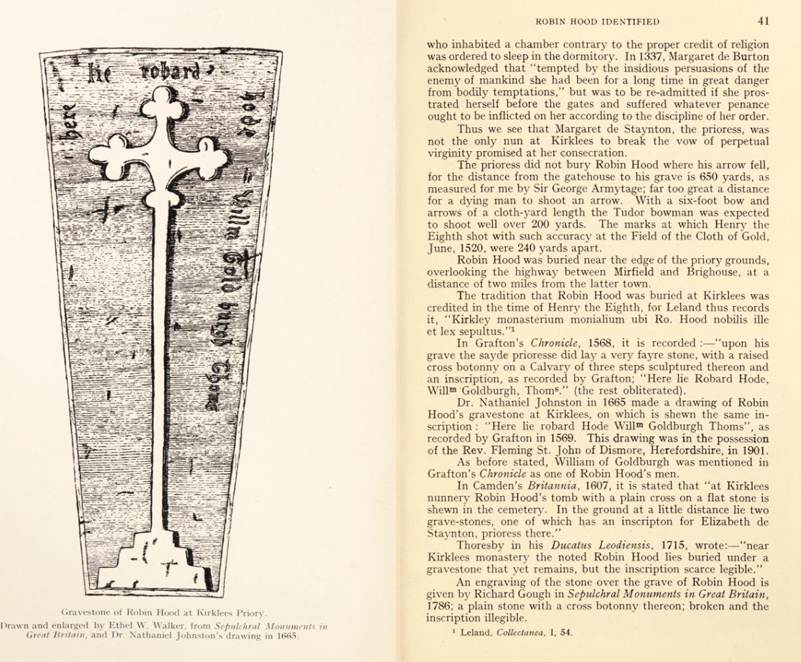
inscription on the grave reads,
'Hear underneath
dis laitl stean
Laz robert earl
of Huntingtun
Ne’er arcir ver
as hie sa geud
An pipl kauld im robin heud
Sick [such] utlawz as he an iz men
Vil england nivr si agen
Obiit 24 kal: Dekembris, 1247'.
Robin Hood's
Grave in the woods near Kirklees Priory
The grave with
the inscription is within sight of the ruins of the Kirklees Priory, behind the
Three Nuns pub in Mirfield, West Yorkshire. Though local folklore suggests that
Robin is buried in the grounds of Kirklees Priory, this theory has now largely been
abandoned by professional historians.
All Saints church
at Pontefract
A more recent theory
proposes that Robin Hood died at Kirkby, Pontefract. Drayton’s Poly-Olbion Song
28 (67-70) composed in 1622 speaks of Robin Hood’s death and clearly states
that the outlaw died at ‘Kirkby’.[59] Acknowledging that Robin Hood operated in
the Went Valley, located three miles to the southeast of the town of
Pontefract, historians today indicate that the outlaw is buried at nearby
Kirkby. The location is approximately three miles from the site of Robin’s
robberies at the now famous Saylis. In the Anglo-Saxon period, Kirkby was home
to All Saints Church. All Saints Church had a priory hospital attached to it.
The Tudor historian Richard Grafton stated that the prioress who murdered Robin
Hood buried the outlaw beside the road,
‘Where he had
used to rob and spoyle those that passed that way…and the cause why she buryed
him there was, for that common strangers and travailers, knowing and seeing him
there buryed, might more safely and without feare take their journeys that way,
which they durst not do in the life of the sayd outlaes’.
In a similar
fashion, the Gest reads,
‘Cryst have mercy
on his soule, That dyed on the rode! For he was a good
outlawe, And dyde pore men moch god’.
All Saints Church
at Kirkby, modern Pontefract, which was located approximately three miles from
the site of Robin Hood’s robberies at the Saylis, accurately matches both Richard
Grafton's and the Gest's description because a road ran directly from
Wentbridge to the hospital at Kirkby.
The new church
within the old. After All Saints church was damaged during the civil war a new
one was built within.
Robin Hood
place-name locations
Within close proximity of Wentbridge reside several notable
landmarks which relate to Robin Hood. One such place-name location occurred in
a cartulary deed of 1422 from Monkbretton Priory, which makes direct reference
to a landmark named Robin Hood’s Stone which resided upon the eastern side of
the Great North Road, a mile south of Barnsdale Bar.[63] The historians Barry
Dobson and John Taylor suggested that on the opposite side of the road once
stood Robin Hood's Well, which has since been relocated six miles north-west of
Doncaster, on the south-bound side of the Great North Road. Over the next three
centuries, the name popped-up all over the place, such
as at Robin Hood's Bay near Whitby Yorkshire, Robin Hood's Butts in Cumbria,
and Robin Hood's Walk at Richmond Surrey. Robin Hood type place-names
occurred particularly everywhere except Sherwood. The first place-name in
Sherwood does not appear until the year 1700, demonstrating that
Nottinghamshire jumped on the bandwagon at least four centuries after the
event.[64] The fact that the earliest Robin Hood type place-names originated in
West Yorkshire is deemed to be historically significant because, generally,
place-name evidence originates from the locality where legends begin The
overall picture from the surviving early ballads and other early references[66]
indicate that Robin Hood was based in the Barnsdale area of what is now South
Yorkshire (which borders Nottinghamshire), and that he made occasional forays
into Nottinghamshire.
The tales of highwaymen in the seventeenth and eighteenth century
were a modernisation of Robin Hood.
Richard Turpin (baptised. 21 September 1705 – 7 April 1739) was an English
highwayman whose exploits were romanticised following his execution in York for
horse theft. Turpin may have followed his father's trade as a butcher early in
his life but, by the early 1730s, he had joined a gang of deer thieves and,
later, became a poacher, burglar, horse thief and killer. He is also known for a
fictional 200-mile overnight ride from London to York on his horse Black Bess,
a story that was made famous by the Victorian novelist William Harrison
Ainsworth almost 100 years after Turpin's death.
Turpin's involvement in highway robbery followed the arrest of the
other members of his gang in 1735. He then disappeared from public view towards
the end of that year, only to resurface in 1737 with two new accomplices, one
of whom Turpin may have accidentally shot and killed. Turpin fled from the scene
and shortly afterwards killed a man who attempted his capture.
Later that year, he moved to Yorkshire and assumed the alias of
John Palmer. While he was staying at an inn, local magistrates became
suspicious of "Palmer" and made enquiries as to how he funded his
lifestyle. Suspected of being a horse thief, "Palmer" was imprisoned
in York Castle, to be
tried at the next assizes. Turpin's true identity was
revealed by a letter he wrote to his brother-in-law from his prison cell, which
fell into the hands of the authorities. On 22 March 1739, Turpin was found
guilty on two charges of horse theft and sentenced to death. He was hanged at Knavesmire on 7 April 1739.
Turpin became the subject of legend after his execution,
romanticised as dashing and heroic in English ballads and popular theatre of
the 18th and 19th centuries.
Robin Hood and
Yorkshire Bibliography
Popular Ballads of the Olden Time, selected and edited by Frank Sidgewick, Fourth Series. Ballads
of Robin Hood and other Outlaws, 1906, https://www.gutenberg.org/files/28744/28744-h/28744-h.htm
Rev
Edwin Castle(1843-1898) and the Yorkshire Robin Hood.
Richard Morris, Yorkshire
a Lyrical History of England’s Greatest County, 2018.
Robin Hood
Identified, J W
Walker OBE, FRCS, FSA, Yorkshire Archaeological Journal, Volume 36, 1947, page
4.
Campsall bibliography
Arts Council of
Great Britain: London, Hayward Gallery, English Romanesque Art, 1066-1200,
London, 1984
Borthwick
Institute, Faculty papers, Fac. 1871/2; Faculty Book 6, 18-19
Campsall, St Mary
Magdalene guide, The Story of St. Mary Magdalene Church, Campsall Yorkshire, n.
p., 1965/1969
K. J. Conant, Cluny, Les églises et la maison du chef d’Ordre, Mâcon, 1968
J. Fowler, “Note
on the restoration of the west doorway of Campsall church” Proceedings of the
Society of Antiquaries of London 8 (1879-81), 130-31
J. Hunter, South
Yorkshire: The History and Topography of the Deanery of Doncaster, in the
Diocese and County of York, 2 vols. J. B. Nichols & Son, London, 1828-31
J. E. Morris, The
West Riding, 2nd ed. London, 1923
N. Pevsner, Yorkshire:
West Riding. The Buildings of England, Harmondsworth, 1959, 2nd ed, Revised E.
Radcliffe, 1967
Victoria County
History: Yorkshire, II (General volume, including Domesday Book) 1912,
reprinted 1974
Other Notes
Yorkshire
Archaeological Journal, Vol 36