Nicholaus de ffarnedale
c1332
to c1400
FAR00038A
|
Return to the Home
Page of the Farndale Family Website |
The story of one
family’s journey through two thousand years of British History |
The 83 family lines
into which the family is divided. Meet the whole family and how the wider
family is related |
Members of the
historical family ordered by date of birth |
Links to other pages
with historical research and related material |
The story of the
Bakers of Highfields, the Chapmans, and other related families |
Dates are in red.
Hyperlinks to other pages are in dark blue.
Headlines of Nicholaus’ life are in brown.
References and citations are in turquoise.
Context and local history are in purple.
|
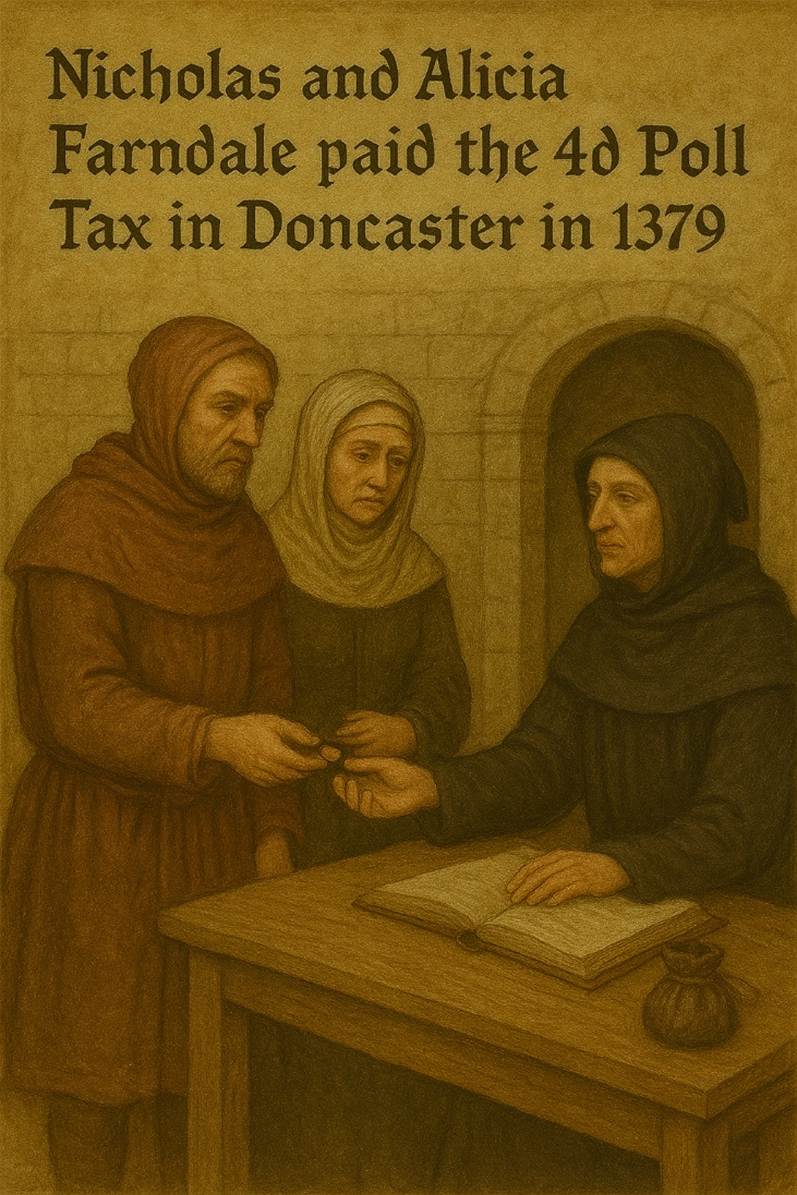
1332 To 1400 Nicholas paid the
4d Poll Tax of 1379 which led to the Peasant’s Revolt A narrative of
Nicholas’ life. |
1332
It seems likely
that William Farndale (FAR00038),
who was the Vicar of Doncaster, and was probably born in about 1332, was
Nicholaus’ older brother. It is possible William was his father, but the date
of his payment of the Poll Tax make a sibling relationship more likely.
If Nicholas was
indeed William’s younger brother then Nicholaus could have been the son of Johannes de
Farendale, whose family had left Farndale for Egton and then Rosedale..
1349
Nicholas was
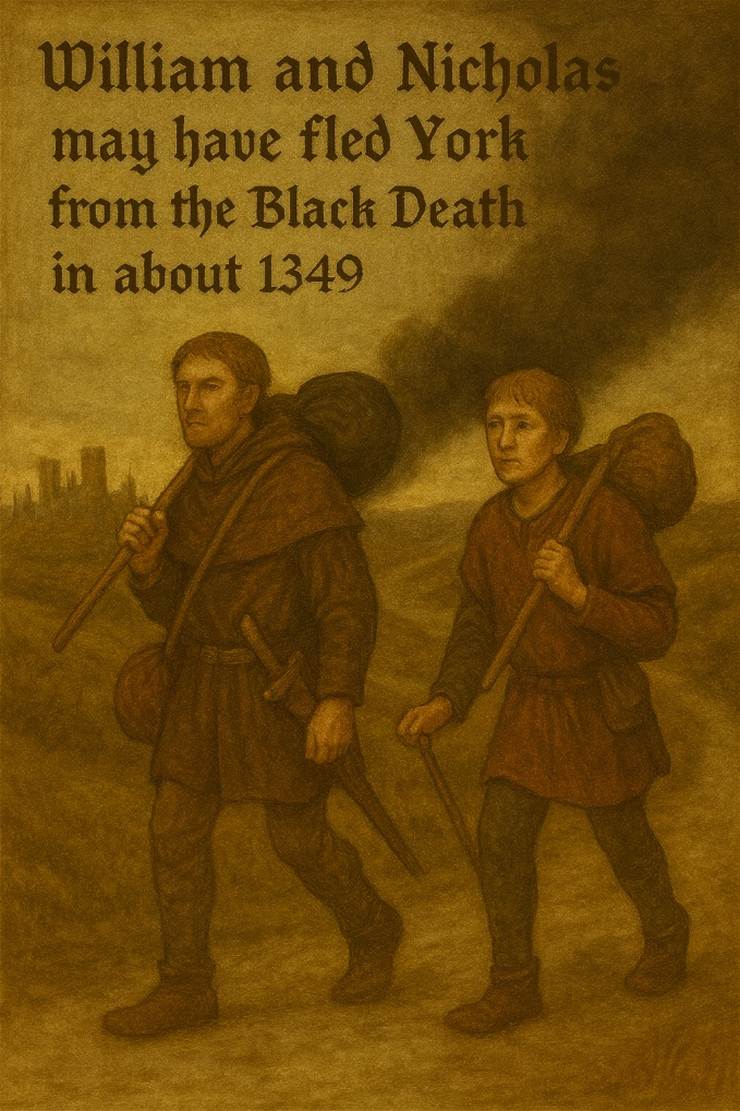
likely to have been in his teens during the Black Death. The two
brothers William and Nicholas might have left York for Doncaster during the
traumas of the Black Death.
By
1334, Doncaster was the wealthiest town in southern Yorkshire and the sixth in
Yorkshire as a whole, even boasting its own banker. By 1379, it too was
recovering from the Black Death, which had reduced its population to 1,500.
The
Black Death hit Doncaster again in the late sixteenth century, with a deadly
outbreak in 1582, when about a third of the population died. But that is two
centuries later.
1355
By 1355, Nicholaus’ brother William was a chaplain at
the parish church of Doncaster. This was an ambitious family, who had become
part of the business class of York, and it seems likely that Nicholaus took
those commercial ambitions to Doncaster.
1365
Nicholas ffarnedale married Alicia (Alice) according to the Poll Tax
records. This might have been in or about 1365.
1368
In 1368,
Nicholaus’ brother, William, took five acres of land at Loversall, south of Doncaster.
1379
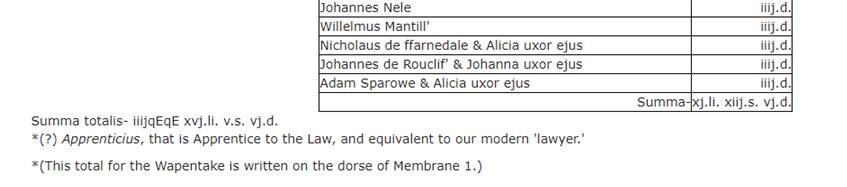
Nicholaus de ffarnedale
& Alicia uxor ejus paid poll tax iiij.d
for the Villata de Donecastre in the Wapentake
of Strafforth in the Yorkshire
Subsidy Rolls for the year 1379.
Iiij is an alternative form of iiii or iv. So he paid 4d.
uxor ejus means “his
wife”.
Villata refers to the “villages” of
Doncaster.
(Yorkshire Subsidy Rolls 1379, http://www.genuki.org.uk/big/eng/YKS/Misc/SubsidyRolls/WRY/Doncaster.html).

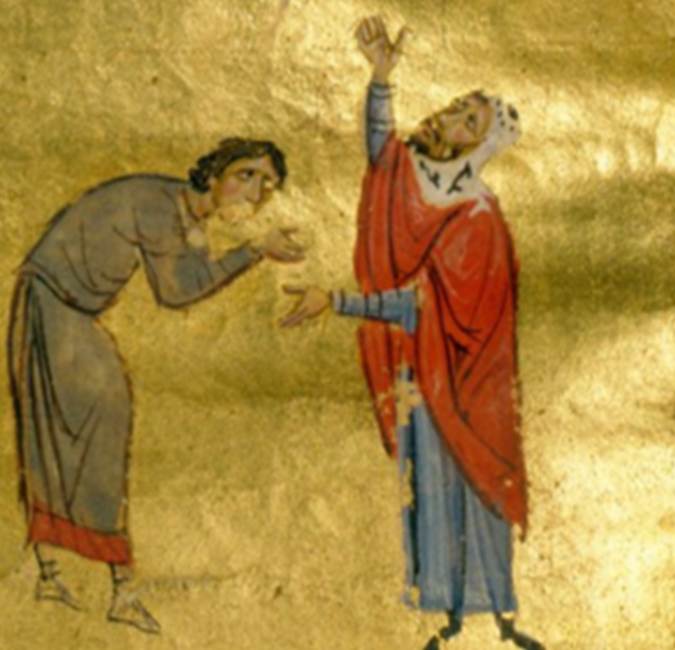
The decline in population following the Black Death
gave rise to a burgeoning middle class, of people who sought to better
themselves. In the years following the Black Death, the depletion in population
saw a growth in the power of the middle classes, particularly in towns. This
was also the time of Geoffrey Chaucer and the same societal changes saw
increasing autonomy of women than anywhere else across the globe at that time.
Alicia might have had greater power in the household, reflected in the story of
the
Wife of Bath, than during other periods of our family history. Rest is
History, Canterbury Tales. Wives in
fourteenth century had more autonomy than anywhere in the world. There
was a growing power of middle classes.
John of
Gaunt, brother of the dead Black Prince, and an important influence in the
court of the new nine year old King Richard II, from 1377, despised the growing
middle class, who he saw as inappropriately taking liberties reserved for those
of nobility, as much as he disliked the excesses of the church. His counsel to
the monarch was to give no quarter to these ambitious new classes.
The
financial demands of the Hundred Years' War led to the government levying three
unpopular poll taxes in four years. A Poll Tax was levied in 1377,
1379 and 1381.
The Poll Tax of 1379 was granted to the new King
Richard II (who was the son of Joan, the Fair Maid of Kent who held the
Kirkbymoorside estate) by the lords, commoners and clergy of England in order
to finance the Hundred Years' War. It was graduated according to each taxpayers
rank or social position, thereby avoiding dissatisfaction based on inequality
and unfairness. The schedule of charge for this tax therefore contained a
classification of the taxpayers. This poll tax was expected to net over £50,000,
but the revenue never reached half that sum.
The fiscal exigencies of the Hundred Years' War
compelled the Bad Parliament of 1377 to grant to the King a tax of four pence
or a groat to be taken from the goods of each man and woman in the kingdom over
fourteen, with the exception of genuine beggars. In addition the clergy granted
a tax of 12 pence from every beneficed person, and a groat from every other
religious person, with the exception of mendicant friars. Special commissions
were appointed to collect the tax, and the county sheriffs were ordered to aid
with the collection. The tax on laymen netted £22,607, 2 s., 6d. paid by 1,376,
442 persons, although the records of County Durham and Cheshire are missing.
The war continued with French attack on the southern
coast of England, the towns of Dartmouth, Plymouth, Winchelsea and others
suffered. The first parliament of Richard II therefore in 1377 granted for two
years a tax of two fifteenths on movables without cities and boroughs and two
tenths within. In addition parliament added a grant of customs subsidy on wool,
woolfells and leather for three years. It also granted for one year six pence
on the pound in goods imported and exported. The second parliament of Richard
II granted in 1378 a tax of one fifteenth and a half on movables without cities
and boroughs and one tenth and a half within. It also continued the previous
customs on wool and merchandise a year longer. This grant did not produce the
sum of money required for the war, and the third parliament of Richard II
repealed in and replaced it with a poll tax that would be easier and faster to
collect.
The schedule of charge for this tax therefore
contained a classification of taxpayers. It is divided into four groups: the
first is based on rank, the second on occupation (men of law), the third on
civic hierarchy, and the fourth other men. Two commissions were appointed, one
to assess, and the other to collect. Later in 1379 reassessment commissions
were appointed. In 1379 the Convocations of Canterbury and York met and granted
an almost identical poll tax for the clergy.
In the Doncaster listing, there was no order, almost all paying
the standard 4d tax, with a few interspersed in the list who paid more.
Therefore although Nicolaus is listed
third from the bottom of a long list, this does not necessarily mean his low
status.
Following the Black
Death, Edward III took steps to keep society
running as it had before the plague. Edicts were issued requiring folk to
maintain their obligations. The Statute of Labourers
in 1349 and Statute of Artificers fixed princes at pre plague levels, required
people to work at those levels and forbad employers to pay more. Serfs were not
to leave their manors. Even the wearing of clothes was regulated so that
ordinary folk would know their station.
In 1376, the
Good Parliament protested as a Commons about the
costs of the French Wars and elected a new office, the
Speaker.
The French Wars were becoming unpopular and seen as
an enterprise by the aristocracy for glory, at the cost of ordinary people. The
church was becoming unpopular, and another source of heavy taxation.
The shortage of population following the Black Death
gave rise to a burgeoning middle class, of people who sought to better
themselves.
The fiscal costs of the Hundred Years' War compelled Edward
III’s last parliament, known as the Bad Parliament of 1377 to grant to the King a tax of four pence or a groat to be taken from the
goods of each man and woman in the kingdom over fourteen, with the exception of
genuine beggars. In addition the clergy granted a tax of 12 pence from every
beneficed person, and a groat from every other religious person, with the
exception of mendicant friars. Special commissions were appointed to collect
the tax, and the county sheriffs were ordered to aid with the collection. The
tax on laymen netted £22,607, 2s 6d, paid by 1,376,442 persons, although the
records of County Durham and Cheshire are missing.
Richard II, the Boy King, was crowned in 1377. Richard II was
the son of the Black Prince and Joan the Fair Maid of Kent, daughter of
Margaret Wake, 3rd Baroness Wake of Liddell. and of descent of the House
Stuteville, the landowning
family of Kirkbymoorside, and therefore of Farndale.
The war was growing costly, and he sought more taxes
through his parliament, but the landowning class who made up the parliament
felt it was time for the new middle classes, whose wealth was growing, to field
some of the cost.
The financial demands of the Hundred Years' War led
to the government levying three poll taxes in four years. A Poll Tax was levied
in 1377, 1379 and 1381. In 1377 and 1379 a flat
rate of 4d was imposed on all taxpayers, with a higher amount payable by the
wealthier. This was unpopular and there was growing resentment. The third,
demanded a flat rate of 12d per adult and was levied in April 1381.
The war
continued with French incursions along the southern coast of England. The towns
of Dartmouth, Plymouth, Winchelsea and others suffered. In 1377, the first
parliament of the new King Richard II therefore granted permission for two
years to impose a tax of two fifteenths on movables outwith
cities and boroughs and two tenths within. In addition parliament added a grant
of customs subsidy on wool, woolfells and leather for three years. It also
granted a right to tax six pence in the pound on imported and exported goods
for a year. In 1378 confirmed its permission to tax. These grants did not
produce the sum of money required for the war, and the third parliament of
Richard II repealed the previous awards and replaced it with a poll tax that
would be easier and faster to collect.
The Poll Tax
of 1379 was granted to the newly crowned young King Richard II, under the
influence of his mother Joan, the Fair Maid of Kent, by the lords, commoners
and clergy of England in order to finance the continuing costs of the Hundred
Years' War. It was graduated according to each taxpayers rank or social
position, thereby avoiding dissatisfaction based on inequality and unfairness.
The schedule of charge for this tax therefore contained a classification of the
taxpayers. This poll tax was expected to net over £50,000, but the revenue
never reached half that sum.
The schedule
of charge for the poll tax therefore contained a classification of taxpayers.
It was divided into four groups. The first was based on rank, the second on
occupation (men of law), the third on civic hierarchy, and the fourth listed
other men. Two commissions were appointed, one to assess, and the other to
collect. Later in 1379 reassessment commissions were appointed. In 1379 the
Convocations of Canterbury and York met and granted an almost identical poll
tax for the clergy.
As the war
was growing costly, and Richard II sought more taxes through his parliament,
the landowning class who made up the parliament felt it was time for the new
middle classes, whose wealth was growing, to field some of the cost.
In the
Doncaster listing almost all paid the standard 4d tax, with a few
interspersed in the list who paid more. Therefore although Nicolaus is listed
third from the bottom of a long list, this does not necessarily mean his low
status.
In 1377 and
1379 a flat rate of 4d was imposed on all taxpayers, with a higher amount
payable by the wealthier. This was unpopular and there was growing resentment.
The third poll tax demanded a flat rate of 12d per adult and was levied in
April 1381.
1381
On
30 May 1381, John Bampton imposed the third poll tax in Brentwood, Essex and a
significant uprising was triggered, insisting on reductions in taxation, the
end of serfdom, and the removal of some senior officials and law courts.
The Peasants Revolt led by Wat Tyler arose from
tensions from high taxes and fixed incomes following the Black Death. There is
also a Rest is History Podcast.
The seeds of the revolt were in
Kent and Essex. There is no reason to suppose the folk of Doncaster had any
direct involvement in the Peasants Revolt. However Nicholaus de ffarnedale
was likely to have been one of the new aspiring classes who would have resented
the Poll Tax. And there were related revolts in the north.
There is an In Our Time podcast on the Peasants’ Revolt, 1381.
John Ball, Jack Straw and Wat
Tyler led the rebels to London
and they met Richard II at Mile End where charters were conceded freeing them
from all bondage. However there was a further meeting between the
rebels at Smithfield. Violence broke out. Tyler was stabbed and killed by the
mayor of London.
The London rebellion was
eventually quashed. However the germs had been sewn for greater
rights for the general population. There were sporadic follow up rebellions
including in York.
The rebels demanded an
end to serfdom, and that land should be tented for 4d per acre, so 4d was
clearly a significant sum. Their demands were initially agreed to be Richard at
Mile End, but the agreement broke down at Smithfield, by which time the King’s
advisers had gathered together a sufficient military force to surround the
rebels.
Revolts in Northern
England
Revolts also occurred
across the rest of England, particularly in the cities of the north,
traditionally centres of political unrest. In the town of Beverley, violence
broke out between the richer mercantile elite and the poorer townspeople during
May 1381. By the end of the month the rebels had taken power and replaced the
former town administration with their own. The rebels attempted to enlist the
support of Alexander Neville, the Archbishop of York, and in June forced the
former town government to agree to arbitration through Neville. Peace was
restored in June 1382 but tensions continued to simmer for many years.
Word of the troubles in
the south-east spread north, slowed by the poor communication links of medieval
England. In Leicester, where John of Gaunt had a substantial castle, warnings
arrived of a force of rebels advancing on the city from Lincolnshire, who were
intent on destroying the castle and its contents. The mayor and the town
mobilised their defences, including a local militia, but the rebels never
arrived. John of Gaunt was in Berwick when word reached him on 17 June of the
revolt. Not knowing that Wat Tyler had by now been killed, John of Gaunt placed
his castles in Yorkshire and Wales on alert. Fresh rumours, many of them
incorrect, continued to arrive in Berwick, suggesting widespread rebellions
across the west and east of England and the looting of the ducal household in
Leicester; rebel units were even said to be hunting for the Duke himself. Gaunt
began to march to Bamburgh Castle, but then changed course and diverted north
into Scotland, only returning south once the fighting was over.
News of the initial
events in London also reached York around 17 June 1381, and attacks at once
broke out on the properties of the Dominican friars, the Franciscan friaries
and other religious institutions. Violence continued over the coming weeks, and
on 1 July a group of armed men, under the command of John de Gisbourne, forced
their way into the city and attempted to seize control. The mayor, Simon de
Quixlay, gradually began to reclaim authority, but order was not properly
restored until 1382. The news of the southern revolt reached Scarborough where
riots broke out against the ruling elite on 23 June, with the rebels dressed in
white hoods with a red tail at the back. Members of the local government were
deposed from office, and one tax collector was nearly lynched. By 1382 the
elite had re-established power.
Robin Hood
The emergence of the Robin Hood legends at about this time was likely
to have been inspired in part at the general grievances of the new aspiring
middle class which led to the peasants revolt.
1400
If Nicholas lived to the age of 65, he might have died in or about
1400.
1493
It is possible a
descendant (perhaps his son or grandson) also called William Farndale (FAR00056A) married
Rose Farndale:
Short
title: Farndale v Reignold. Plaintiffs: Rose Farndale, late the wife of William – Reference: C 1/201/47 Farndale v Reignold;
Plaintiffs: Rose Farndale, late the wife of William Farndale.
Defendants: John Reignold, of Dodynghurst. Subject: A
tenement and land in Dodynghurst. Essex. SFP Date:
1493-1500 Held by: The National Archives,
Kew (still to visit Kew to check)
Doddinghurst is a village and civil parish in the Borough of
Brentwood, in south Essex. It is 3 miles (5 km) to the north of Brentwood.
Abstract From Proceedings: “To The Archbishop of Canterbury and
Chancellor of England. Rose Farndale, plaintiff, late wife of William
Farndale that John Reignold of Dodynghurst, Co
Essex, husbandman, sold to said William for a sum agreed and paid, a
tenement set in Dodynghurst aforesaid, called Whitefeldes ‘tenement’ with a garden and two fields, one
called Hornefeld and the other Barnefeld and the said
john Reignold promised to make ‘sufficient estate thereof’ to said William or
to whom he would advise; before any estate made thereof the same William
made his will by which he willed that the plaintiff should have the said
tenement and land to her and her heirs for ever. Since his death the
plaintiff has required said John Reignold to make estate of the premises to her
and to her heirs and he has refused and has entered into the said lands and
occupies them contrary to all reason and conscience.”
Pledges for the Prosecution; William Brecas of London, Yeoman,
John Nores of the same, Yeoman. Written on dorse; Before the Lord King in His
Chancery in the quindene of St Hilary next. (No
answer recorded).
(Translation of chancery proceedings)
This would put one of his descendants in the area of Brentwood
which is where the Peasants Revolt started in 1381, and it might be tempting to
imagine this family being involved not only in paying the poll tax, but in the
Peasants’ Revolt and a part of the family then remaining around Brentwood. But
this is just supposition.
The direct
ancestors of the modern Farndales were living just north of Doncaster by about
1512, and continued to do so until about 1564, when the family moved to
Kirkleatham in Cleveland. So it seems reasonable to suppose that there was a
family of modern Farndales’ ancestors living around Doncaster who descended
from the Doncaster family of William and Nicholaus. Since William Farndale the
vicar was likely to have been celibate, it seems more likely that his brother,
Nicholaus was a direct ancestor of Nicholas Farndale of Campsall, later born into that
family
It therefore
seems most likely that the modern Farndales descend from Nicholas Farndale of Doncaster, who was contemporary
with William, and probably his brother.
It has not
been possible so far to uncover many records of Farndales living around
Doncaster or elsewhere between the fourteenth and sixteenth centuries. It is
possible a descendant, perhaps his grandson or great grandson, was William Farndale, who
was married to Rose Farndale. There is a document dated between 1493 and 1500
which relates to a court action, Farndale v Reignold,
in which the Plaintiffs was Rose Farndale, late the wife of William Farndale.
The defendant was John Reignold of Dodynghurst. The
dispute related to a tenement and land in Dodynghurst,
Essex.
To The
Archbishop of Canterbury and Chancellor of England. Rose Farndale, plaintiff,
late wife of William Farndale that John Reignold of Dodynghurst,
Co Essex, husbandman, sold to said William for a sum agreed and paid, a
tenement set in Dodynghurst aforesaid, called Whitefeldes ‘tenement’ with a garden and two fields, one
called Hornefeld and the other Barnefeld and the said
john Reignold promised to make ‘sufficient estate thereof’ to said William or
to whom he would advise; before any estate made thereof the same William made
his will by which he willed that the plaintiff should have the said tenement
and land to her and her heirs for ever. Since his death the plaintiff has
required said John Reignold to make estate of the premises to her and to her
heirs and he has refused and has entered into the said lands and occupies them
contrary to all reason and conscience.
Pledges
for the Prosecution; William Brecas of London, Yeoman, John Nores of the same,
Yeoman. Written on dorse; Before the Lord King in His Chancery in the quindene of St Hilary next. (No answer recorded).
Doddinghurst
is a village and civil parish in the Borough of Brentwood, in south Essex. It
is 3 miles (5 km) to the north of Brentwood. There is a road called Whitefields Way in the modern village of Kelvedon Hatch,
and this may be where the disputed land was. There is also a Wishfields Farm, two kilometres south of Doddinghurst.
Interestingly,
Doddinghurst is 5 kilometres to the north of
Brentwood, where the Peasant’s Revolt began in 1381.
It is
tempting to imagine a son of Nicholaus and Alicia Farndale, leaving home in
Doncaster for the outskirts of London at about the time that we know his
parents paid the unpopular poll tax of 1379, and who might have joined the
rebellion of 1381. Perhaps they marched south in order to join that rebellion,
and stayed there.
Perhaps the
rest of Nicholaus and Alicia Farndale’s family remained in Doncaster, but over
the coming two centuries, came to live ten kilometres north of Doncaster in or
around Campsall, where perhaps in about
1512, Nicholas
Farndale might have been born.
|
How do Nicholaus de ffarnedale
& Alicia relate to the modern family? It is not possible to be accurate about the early family tree,
before the recording of births, marriages and deaths in parish records, but
we do have a lot of medieval material including important clues on
relationships between individuals. The matrix of the family before about 1550
is the most probable structure based on the available evidence. If it is accurate, Nicholaus Farndale was related
to the thirteenth century ancestors of the modern Farndale family, and he
might have been related to the York
Line. Nicholaus’ own family settled in Doncaster, with his brother William Farndale
the Vicar of Doncaster, and he and his wife Alicia might be on the direct
ancestral line of the
modern Farndales. |