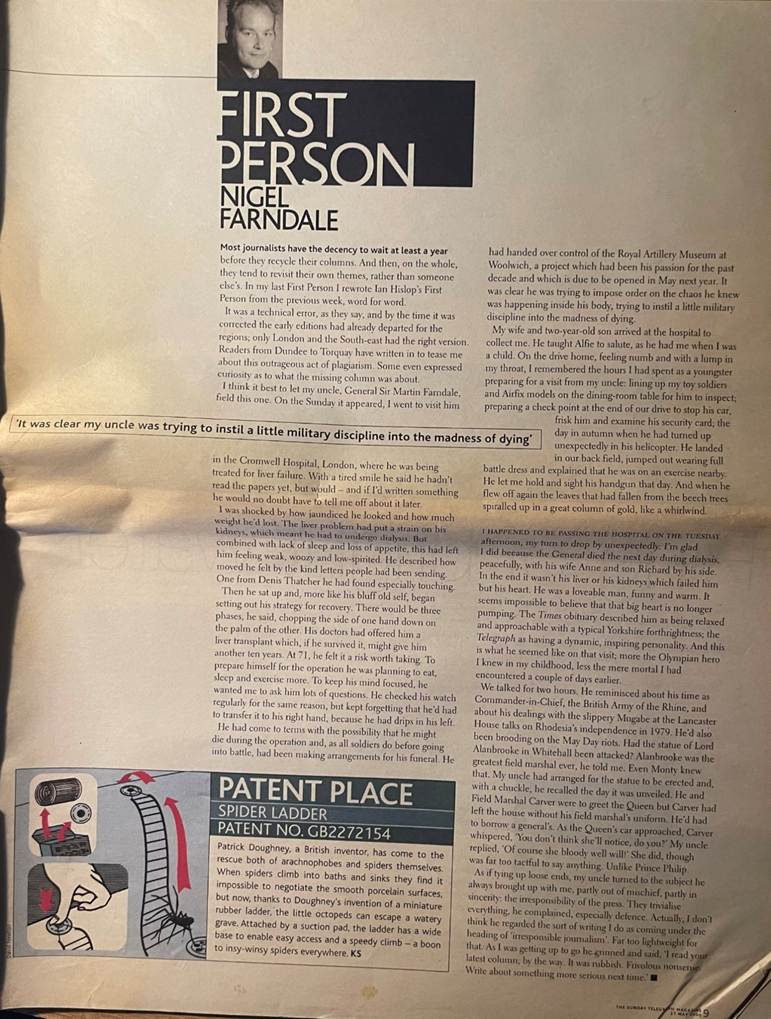
General Sir Martin Baker Farndale
KCB
6 January 1929 to
10 May 2000
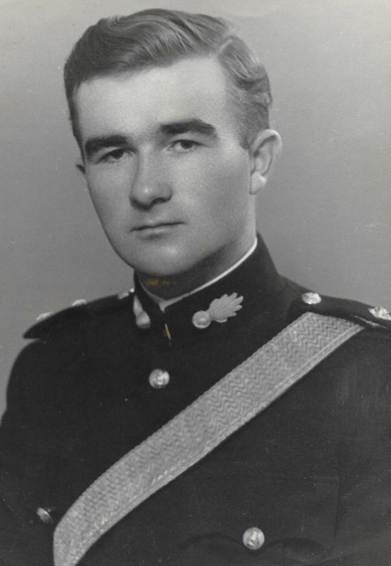
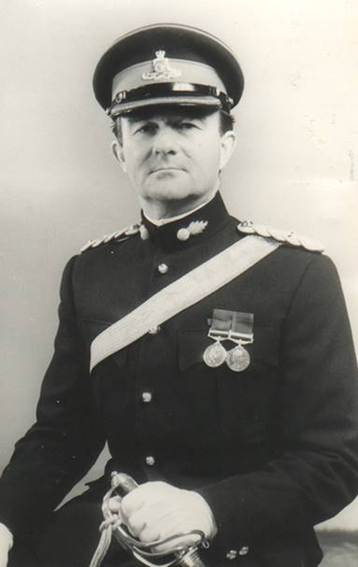
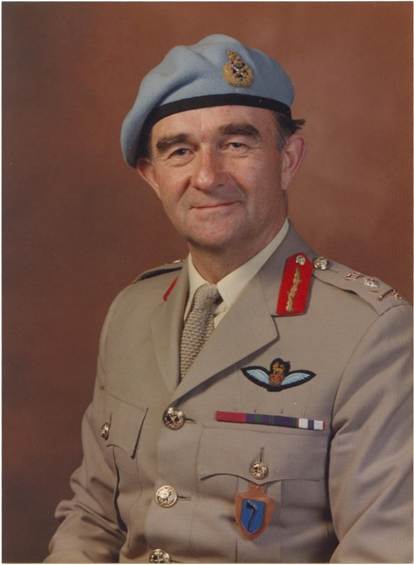
The original author of this genealogy who led the British Army in Germany
and the Northern Command of NATO in the crucial years of the Cold War
Commander in
Chief British Army of the Rhine; Commander Northern Army Group of NATO at time
of the Cold War, Master Gunner St James Park, KCB
FAR00911
|
Return to the Home Page of the Farndale Family
Website |
The story of one family’s journey through two
thousand years of British History |
The 83 family lines into which the family is divided.
Meet the whole family and how the wider family is related |
Members of the historical family ordered by date of
birth |
Links to other pages with historical research and
related material |
The story of the Bakers of Highfields, the Chapmans,
and other related families |
Headlines of Martin Farndale’s life are in brown.
Dates are in red.
Hyperlinks to other pages are in dark blue.
References and citations are in turquoise.
Context and local history are in purple.
Geographical
context is in green.
The text in italics below is in Martin’s own
words, extracted from a retrospective journal.
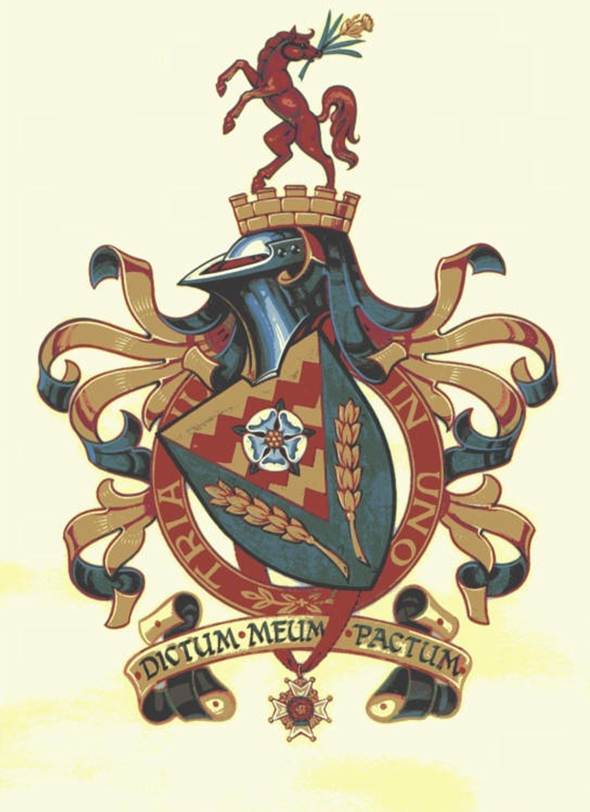
Martin
Farndale’s coat of arms
There is a separate page about the
life of Martin’s wife, Margaret Anne (“Anne”) Farndale (nee Buckingham) (BUC00002).
This page should be read in
conjunction with chapters regarding:
· Video
and audio recordings of Martin Farndale transferred from original cine and
tape reels, cassette and video.
· The Royal
Military Academy Sandhurst Intake 1A 1946 to 1947.
· Martin Farndale and First
Regiment Royal Horse Artillery 1950 to 1971 and thereafter and a page of further
material.
· Commander 7th
Armoured Brigade, The Desert Rats, 1973 to 1975.
· Commander Second
Armoured Division 1980 to 1983.
· Commander 1st
(British) Corps 1983 to 1985.
· Commander British
Army on the Rhine and Northern Army Group 1985 to 1987.
· Colonel Commandant the
Army Air Corps from 1979.
· Master
Gunner St James’ Park, 1988 to 1996.
· Martin
and Anne’s Wedding in 1955.
· Anne
Farndale’s journal of travels from 1946.
· A record of the
Journey from Malaysia (then Malaya) to the UK overland in 1962.
Trochu, Alberta, Canada
1929
Martin Baker Farndale was born in Trochu, Alberta, Canada, the eldest
son of Alfred Farndale (FAR00683) and Margaret
Louise (nee Baker) (“Peggy”) Farndale on 6 January
1929. The birth was registered at Trochu on
1 March 1929.
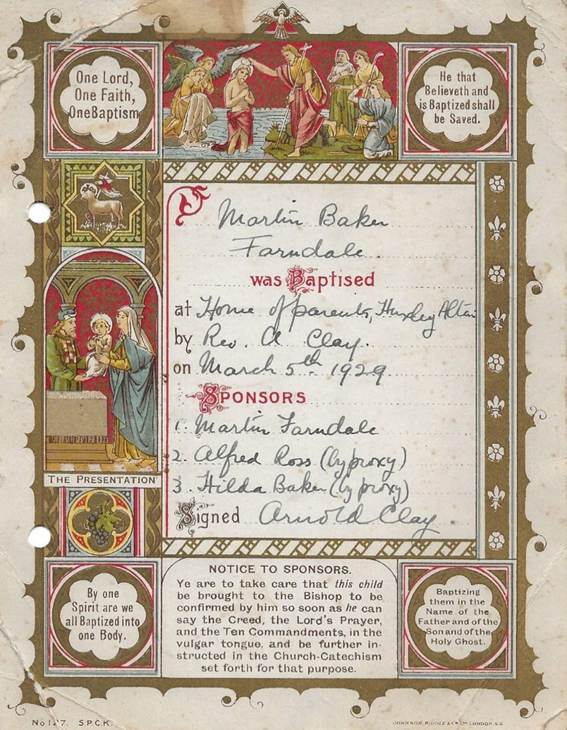
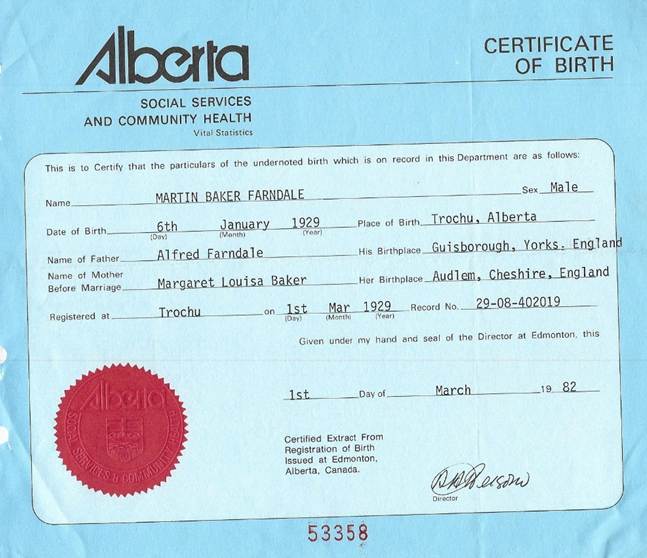
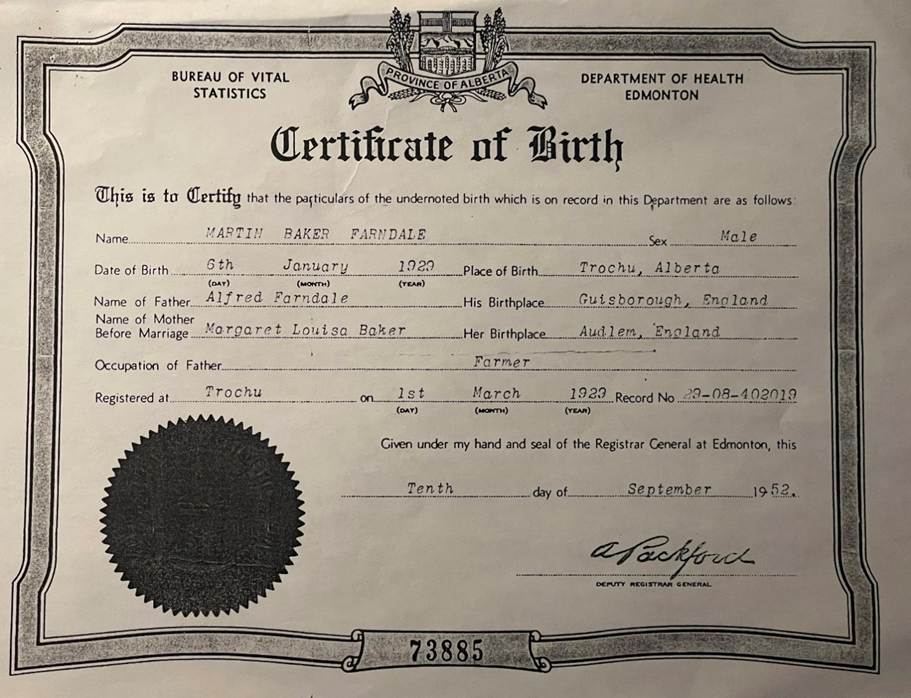
I was born eldest son to Alfred and
Margaret Louise Farndale (nee Baker) on 6 January 1929 at Trochu, Alberta,
Canada. Trochu is about 100 miles north north east of
Calgary and 20 miles south south east of Red Deer.
Alfred and Margaret (always known as Peggy) were married at Bedale Church,
Yorkshire on 16 March 1928 and had moved directly to Canada where Alfred’s
older brothers, Martin and George were already living together with an older
sister, Kate. Two other brothers had also been in Canada – James who had moved
to USA in 1913 and William who died of influenza in Winnipeg in 1919. Alfred
was soon joined by his sister Grace, who later married Howard Holmes.
Martin’s early life
1929 to 1935
Martin Baker Farndale lived in Huxley,
Alberta, Canada until 1935.
Alfred rented a section and a half
near Huxley some 10 miles north of Trochu and built a house there. The farm was
almost entirely devoted to wheat but with some cattle. I grew up at the farm and my first memories are of playing on the prairie and
around the slews (a kind of duck pond) near the farm. I remember all the horses
used for farm work, the box waggons with racks, threshing in the fields and the
hot summers. The winters were cold - well below zero, and I remember the horse
drawn sleighs and the bright sun on the snow. I remember the village of Huxley,
the annual sports day, the Legion parade and buying sweets at Miss Hibbs’
store. I remember visits to the neighbours, the Hoggs, the Saggers, the
Morris’, the Wagstaffs, the Millers and I remember the postman, Mr Hibbs
whistling in his buggy as he came up the road to what is still today called
Farndale’s corner. But above all I remember the family. Uncle Martin and Aunt
Ruth lived near Trochu and he spoiled me a lot. Uncle
George was a bachelor, remote and living alone near Three Hills. Aunt Kate was
strict and austere, but kind and she lived between Trochu and Three Hills with
her husband Bill Kinsey and their children George, Alfred and Dorothy. I
remember evening parties and sitting waiting while the grown ups played bridge.
I remember being well looked after by our nannie, Gladys Grist who later
married Aubrey, the son of our nearest neighbour, Ralph Hogg.
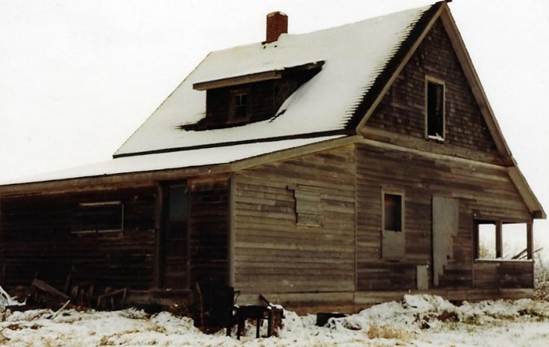
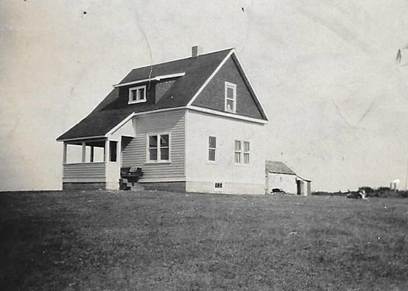
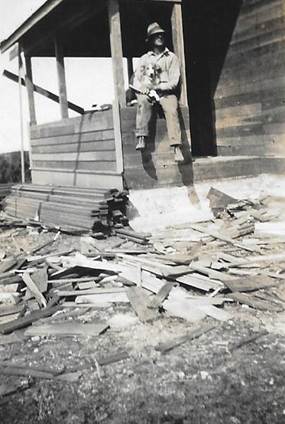
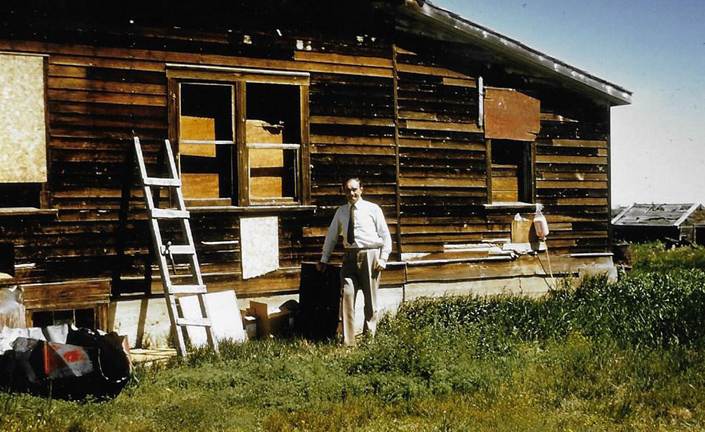
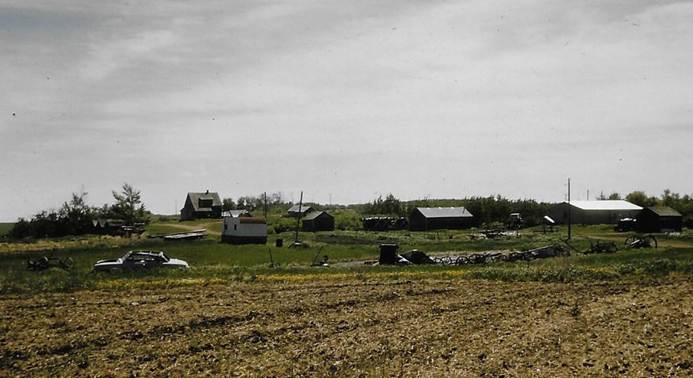
The Farndale house near Huxley
Martin returning to the house in the 1970s
1931 Census of Canada – Red Deer,
Alberta
Alfred Farndale,
32
Margaret
Farndale, 30
Martin Baker
Farndale, 2
Marianne
Farndale, 7 months
Grace Alice
Farndale, 36

There was a visit by mother’s sister, Aunt
Hilda from England and we all (by this time my sister Marianne Catherine
Farndale and brother Alfred Geoffrey Farndale had been born on 30 October 1930
and 10 April 1932 respectively) went to Banff and on through the Rockies by
train to Vancouver and Victoria Island where we looked over the new liner, the
Empress of Japan.
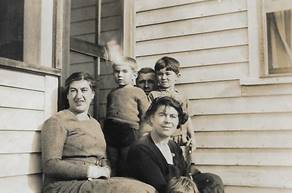
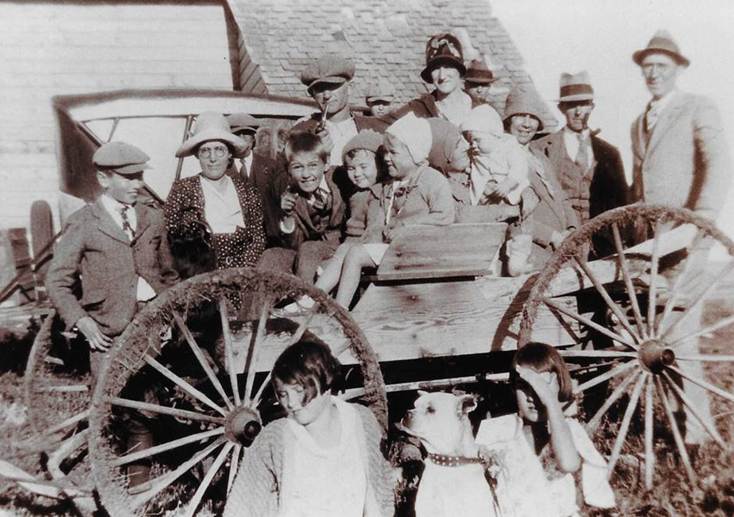
On another occasion we stayed at the
Palliser Hotel in Calgary and went up in a lift for the first time and we
visited the Calgary Stampede.
I was playing with Meccano one
afternoon at the farm when a bunch of Indians rode right up to the door in
search of work. I also remember Uncle Jim and Aunt Edna with their family Hazel
Jae, Jimmy, Mary, Doris and Gordon, visiting from USA. I can remember their
arrival in a large open car with luggage tied all around it.
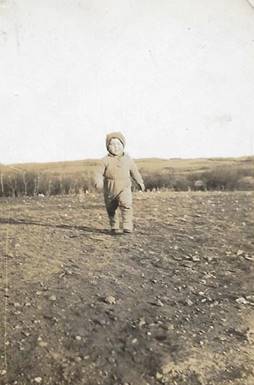
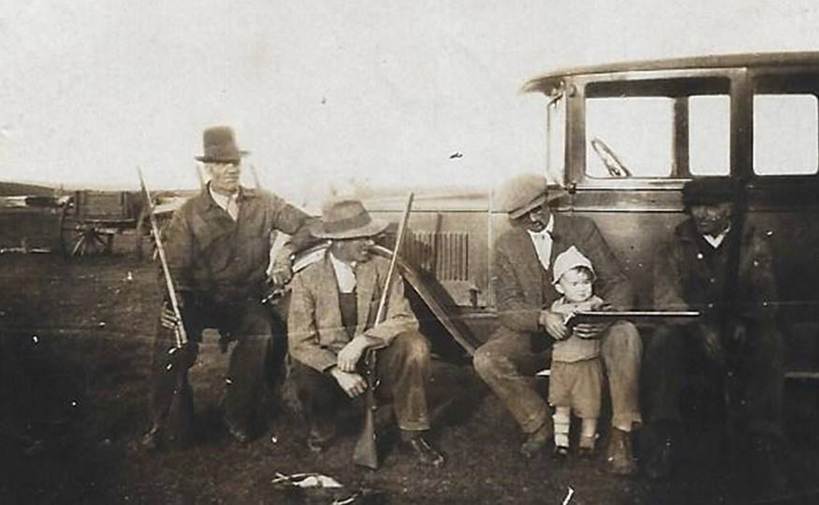
Sergeant Hammond of the Royal North West Mounted Police often visited the farm.
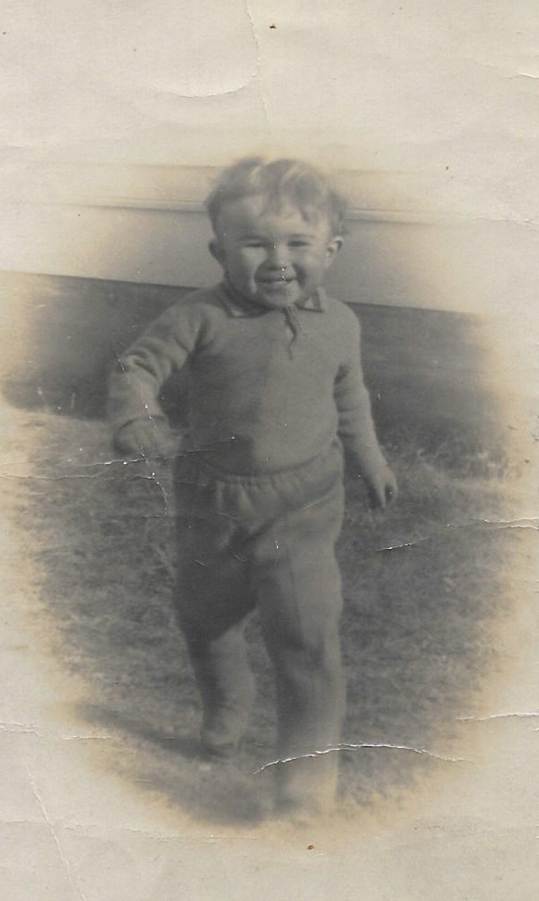
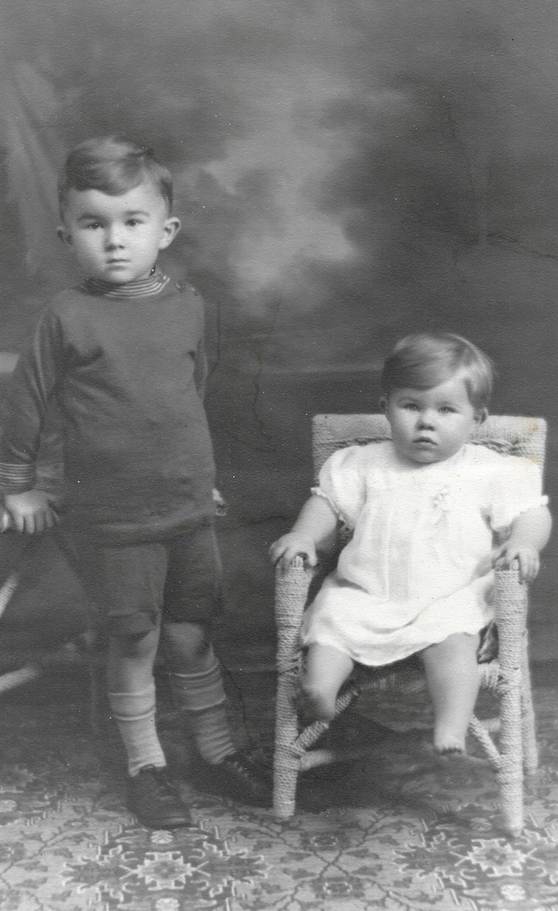
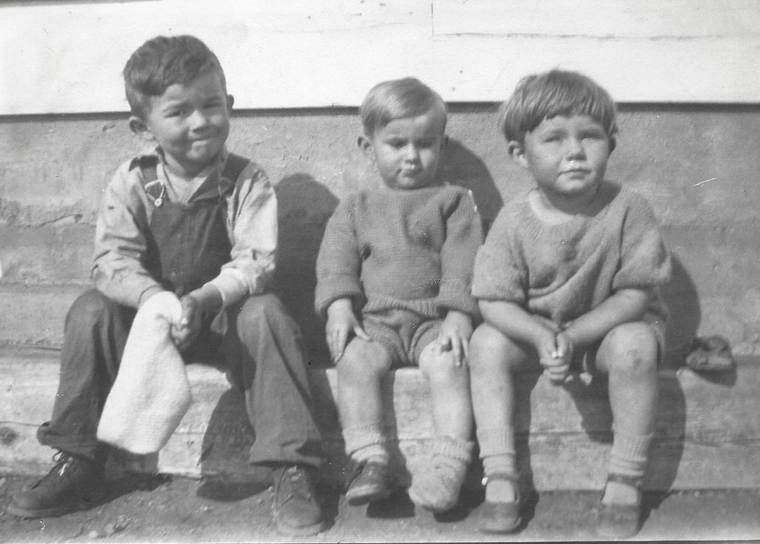
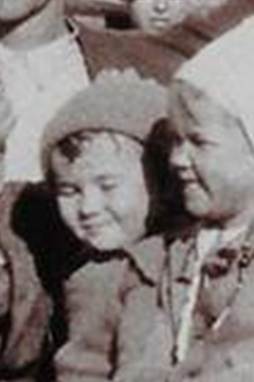
Martin, aged 1 year and 9 months at
Huxley in September 1930 Martin
and Anne, Vancouver 1931 Martin, Geoff and
Anne at the farm at Huxley in 1934
One event I can remember clearly was
when my father promised to take me the 5 miles or so to the other half section
– the Wickizer Place – to see the horses. Towards evening I was playing around
the threshing set at the farm when I saw a Chevrolet car like the one my father
owned drive past the red gate at the entrance to the farm and was convinced
that I had been left behind. I therefore set off to walk. I was about 6 years old and the corn was high and it was getting dark. There was
consternation when I could not be found later on, for
once into the corn I would be very difficult to find. Search parties were
called out from neighbours and from Huxley but apparently
I had got into a ditch beside the road and could not be seen. However the ditch took me to Huxley and though I can
remember nothing about my 3 mile walk, I do remember
being picked up by two men who worked in the Huxley garage and being taken home
to a mixture of relief and scolding.
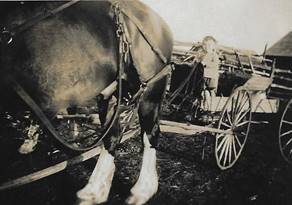
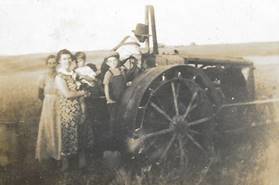
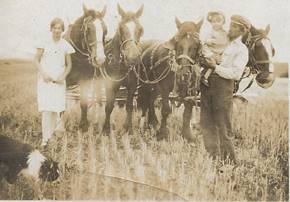
I remember my sister Anne falling down
the cellar steps, and, on another occasion, while visiting Aunt Grace and Uncle
Howard, throwing his best spanner down his well. I also remember learning to ride
our horse, Chubb and I remember our Colley dog, Scot, who slept beside my bed.
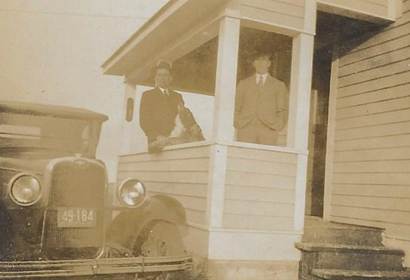
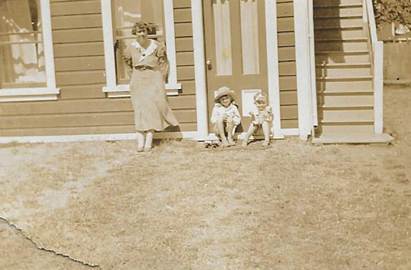
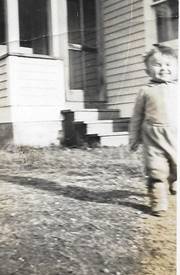
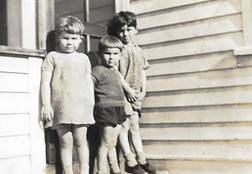
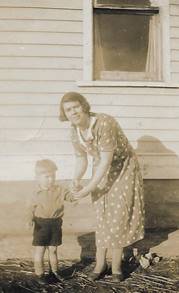
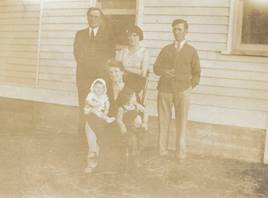
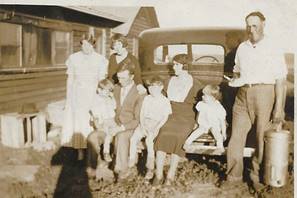
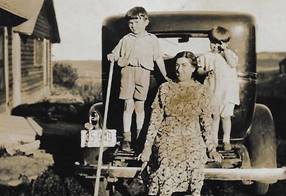
1935
But things were not well on the farm.
Prices were bad in the slump years of the early 30s
and the weather was unkind so that my father, along with many others, soon lost
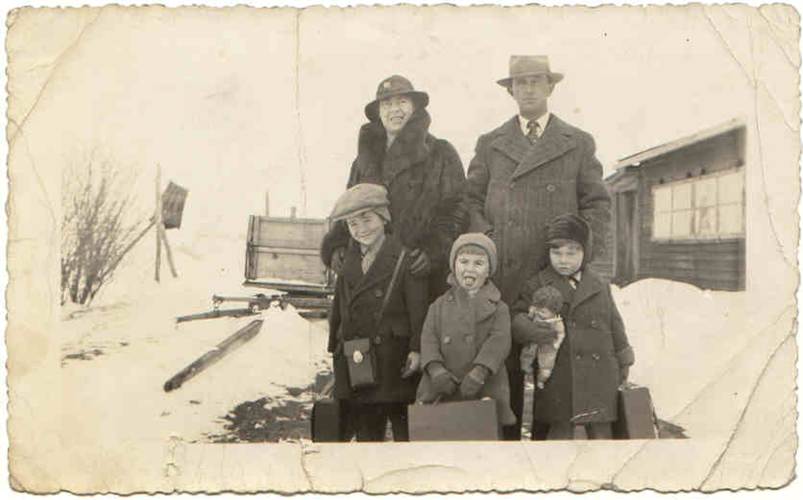
all his savings, and in 1935, he decided to return to England. I remember well
the excitement of the farm sale by our white house with a black roof, on the
hill overlooking Huxley. It was early April and it was cold with snow still on
the ground. We spent our last few days in Alberta with Aunt Grace and Uncle
Howard at their Ranch near Huxley and finally caught the train at Huxley for
Edmonton on 9 April 1935.

At Edmonton we changed onto a CNR
train for the four day journey to Montreal. I remember
my brother Geoffrey having his third birthday on the train and having a cake. I
remember the train, and the porter turning the seats and the roof rack into
beds at night and the small carriage at the end of each carriage for cooking. I
remember the observation car and passing endless forests and lakes as we
crossed Canada. We changed trains at Montreal to a train entirely staffed by
French speakers for the two day trip to Halifax where
I can remember my father saying, as we boarded the ship, that we had now come half way!
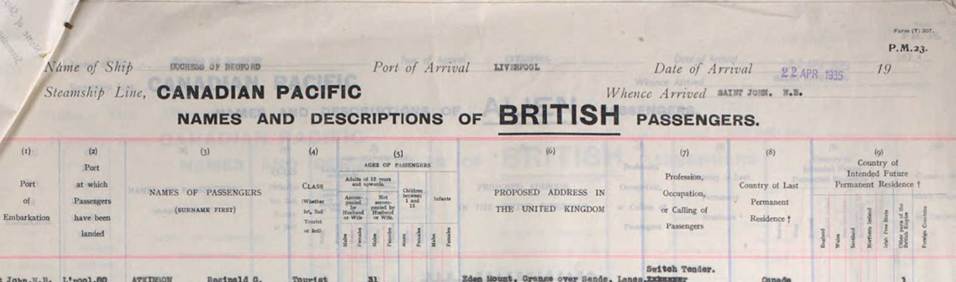
The voyage across the Atlantic was on the
Duchess of Bedford. We sailed on about 17 April 1935. The weather was cold and foggy and we saw icebergs through the fog. Later across the
Atlantic it was pretty rough and I was sea sick until I was taken on a walk around the deck by my
father. I can recall the meals and the huge excitement of the voyage. I saw the
north of Ireland and we sailed into Liverpool on about
23 April 1935. There at the quayside we were met by mother’s brother, Geoffrey
Baker and her sister, Hilda Baker. We were taken to stay with cousins at Conway
in North Wales while my father went off to Yorkshire to sort out our future
back in England.
Northallerton and Thornton le Moor
Then due to the slump and drought the family
moved first to Middleton-one-Row in Durham, England. Then in 1936 to Sycamore
Lodge, Thornton-le-Moor, Yorkshire. He went to Wensley House private School in Northallerton and then to Northallerton Grammar School. His family
moved to 117 Crosby Road, Northallerton
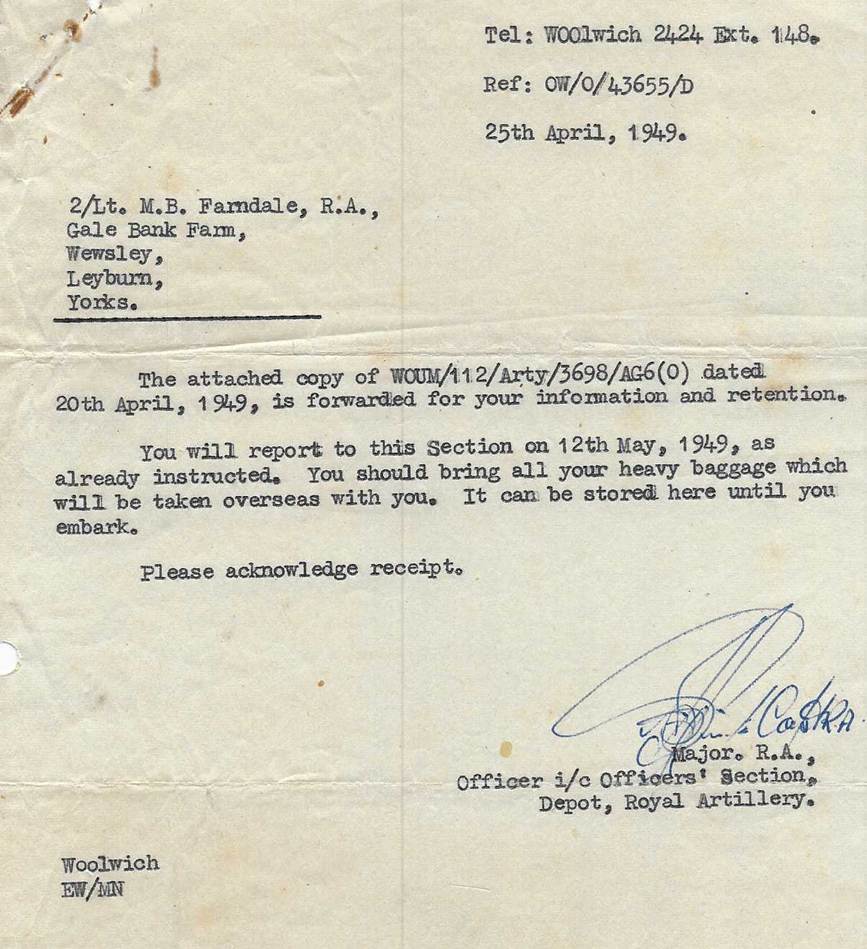
in 1940 and then to Gale Bank Farm, Wensley
in Wensleydale in 1944. He then went to
Yorebridge Grammar School until 1946 until he joined the Indian Army at
Caterham on 3rd September 1946.
I
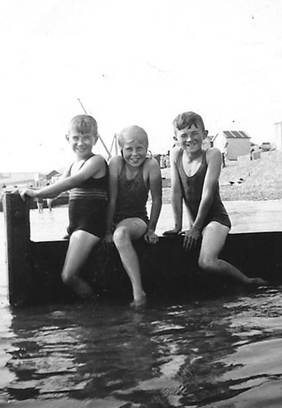
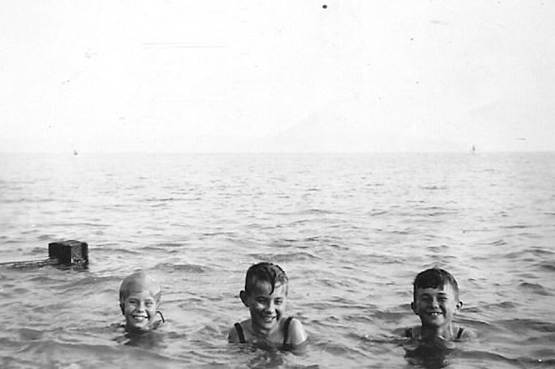
remember our stay in Conway. King George V’s silver jubillee was in June 1935
and there were parades and illuminations at Conway Castle. We visited Snowden
and Betsy Coed and later drove to “The Upwoods” in Derbyshire near Utoxeter
where Uncle Geoff and Aunt Hilda lived.
Manwhile
my father was negotiating the purchase of a farm at Middleton-One-Row near
Darlington ad we moved north to stay with my father’s sister, Dorothy ad her
husband Alfred Ross who lived at Gree Farm, Skelton Green, Skelton in Cleveland.
Eventually in about Septemer 1935, we moved to the 100 acre farm at
Middeleton-One-Row on the Rver Tees and just inside County Durham. But it was
ot a success and my father was already looking for something better. I do’t
remember too much about this period except visiting new relations. In
particular my sister Ane and I wenty to stay at Tancred Grange at Scorton near
Ricond to stay with yet another of my father’s sisters. Lynn, whose husband George
Baker had died many year befoe, but living there were their children, Margaret,
William, John, George and Dorothy. I particularly remember their gooseberry
pies! Another fist visit was to my father’s eldest brother John who lived with
his wife Elsie at Tidkinhow Farm near Guisbrorough where all the Farnale family
had been born. I have memories of my uncle John clipping sheep near the house.
1936
Then
in Spring of 1936 we moved again to Sycamore Lodge Farm, Thornton-Le-Moor, near
Northallerton which was a much better and slightly bigger farm, but still not
really big eough for my father’s plans. I was seven and my sister Anne was six
and we had ot yet been to school. So mother fixed us up at a small private
school called Wensley House School in South parade, Northallerton which was run
by an old fried of hers, Mrs Harriet Lord. I have a lot lof memories about
Thornton -Le-Moor and Wensley House school and holidays by the sea with Aunt Dorothy
at Skelton or Aunt Hilda in Derbyshire at the “Upwoods”. I thoroughly enjoyed
working with my father about the farm. Most of the work was done by horses and
at threshing time great staem engines arrived with great gags of men who worked
through the threshing days. Huge meals were cooked by my mother for up to
twenty men at a time. Again we had a Nanny, Betty, who married the son of the
farmer oppositie (history repeating itself!), but he was tragcaly electrocuted by
his new electric milking machine only a year or so later.
Every
day Anne and I, and later Geoffrey as well, were driven into Northallerton,
which was five miles away, to school and we were collected in the evening.
School was a very new adventure and ot easy going for me. Mrs Lord was a hard
but far task master, insisting on high standards. Much was leart by heart –
poems, hymns and tables. Mr Lordtaught history ad geography and these quickly became
my favourite subjects. On Friday aftrernoons the school walked in a long
crocodle to the village of Romanby, there to sit and watch lantern slides given
by a Mr and Mrs Linton about their travels to the Holy Land and Egypt. These
were wonderful, hazy black and a browny colour and white, but they opened up
the idea of travel and excitement. They also taught us a great deal and left a
deep impression on me. It was at Wensley House school that I made my first friends.
Richard Sawfell was the son of the county surveyor whose mother kew my mother
before they were both married. David Ramsden was the son of a farmer near
Northallerton. Jack Errington came with his mother during the school holidays
to stay with his Grandmother in Thornton-Le-Moor.
1938
About
this time I became aare of the world situation and listening to the BBC radio
news became a feature. There were press pictures of a man called Adolf Hitler and
another called Mussolini. My father talked about his army days and our games in
the woods were always as soldiers fighting the Germans. Once, it must have been
in about 1938, I remember seeing a colour film about Rogers Rangers in Caada
and for months afterwards we were Roger Rangers in all our games. About this
time I was given a bicycle. We used to cycle everywhere with Betty and it was
all exiting.
On
Sundays we went to the village Sunday School and on Saturdays we each had 6d (sixpece)
and spent it at the village shop seeing how many differet items we could get.
One stick of licquorise and a small paper sachet of sherbert were about 1/4d
each, a small packet of sugar cigarettes a penny and a bar of chocolate 2d. I
was pretty bossy at that time and I had the advantrages of ‘supervising’ the
expenditure of all our money, which together was 1/6d. I collected tin soldiers
at 1d or 2d each. This normally meant going to Northallerton or exceptionally
to Woolworths at Darlington. I also collected Meccano and Hornby trains, but
had to rely on Father Christmas for these more exensve items.
My
parents both worked very hard and times were not easy. My mother looked after
us wonderfully well and set very high standards. She taught us all how to
behave, how to talk, to dress and conduct ourselves in company. There were
quarrels, which I remember worried me, but I realised they were never very
serious.
In
1937, on 8 October, my sister Margaret Susan was born. The idea was that the
three of us should go and stay with Aunt Dorothy for a few days during the
confinement, which was of course at home. My father took us half was and at the
Tontine Hotel near Stokesley we met my aunt who would take us on. However
Geoffrey, who was five at the time, screamed and yelled and refused to go and
had to be taken back home. We were all very excited about the new baby and took
it in turns to help. Life was suddenly very busy.
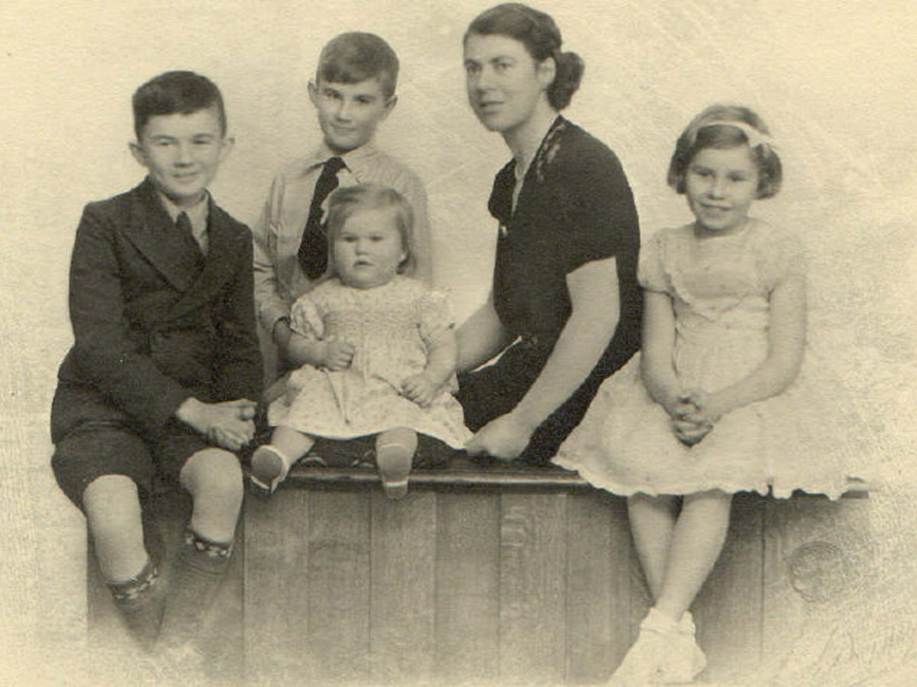
Family photograph, Sycamore Lodge,
Thornton-le-moor, 1938
Martin Farndale,
Geoffrey Farndale, Peggy Farndale, Anne Farndale
Margot Farndale
1939
By
1939 Margot (as she was always called) became our casualty in games and was
regularly carried about in a stretcher. It can’t have been very safe. Over
Christmas, 1938 I think, I was given an air rifle. This was a truly prize
possession and gave me a huge advantage over everyone. One evening, Jack Errington
and myself decided to ambush cars as they came along the road into the village.
We were certainly not firing pellets, but the village Bobby did not know that
and he cycled up to us and made a great point of entering our names into a book
and saying how dangerous air rifles were and that he would speak to my father.
I was terrified, but nothing ever happened. I’m sure that he never did speak to
my father, but he taught me a lesson early in my life which I’ve never
forgotten, about the dangers of weapons.
About this time there was much going on that I
didn’t understand. My mother would come and sit with me as I went to sleep at
night and these moments became highlights of those days. I adored her, she
seemed to understand everything and she never failed to set my mind at rest
whatever my problems. I owe her a great deal indeed. She ensured that we grew
up with balance and understanding of other people.
My father, who I worshipped, represented all that was strong, good and upright
in life. He was direct, outspoken and eliable. I always felt nothing could
happen to us if he was there. We were unbelievably lucky with our parents.
Almost without knowing it they gave us all an ideal upbringing, treating us all
the same, insisting on standards, respect for them, and for the law, yet with
love and understading which gave us great confidence.
By
1938 I realised that I was to go to Northallerton Grammar School if I could
pass the entrance exam. It was clear that I had a chance, but that my maths was
weak. I remember that three times a week a retired school mater, Mr Archer,
came in to teach me maths. I didn’t enjoy it but it did help. Anyway in 1939 I
passed the exam, though ot with the scholarship which would have helped my
parents so much. I was to start in September 1940. By 1939 it was arranged that
Anne and I should go to school by train. This meant cycling to Thornton-Le-Moor
station and then walking from Northallerton station to the school in Smith
Parade.
I
remember pre war Christmases both in Canada and Yorkshire. It all started at
Haloween on 30 October, which was Anne’s birthday. We hollowed out turnips and
cut faces in them, putting candles inside and suspended them from sticks and
walked through the village after dark making howling noises. Then came Guy Fawkes
day on 5 November with its bonfire and guy, baked potatoes and a few fireworks.
Next was writing letters to Father Christmas, a major event, which was
supervised by Mother. They had to be just right and not asking for too much.
School broke up on about 15 or 16 December and soon we were out carol
singining. The exitement was almost unbreable. On Christmas Eve we left a glass
of sherry, a biscuit and a florin on the kitchen table fo Santa Claus, which had
always been consumed next day. Somehow Santa Claus’ crumbs on the plate on
Christmas morning were magic! I remember the fire in the bedroom on Christmas
Eve and its flickering flames. It all seemed very strange, but we never
questioned it. I was eight when I discovered the truth and was bitterly
disappointed, but my mother told me not to worry as there was no reason for it
to stop. Christmas 1939 produced a clockwork model of the Flying Scotsman,
which was a dream come true.
I
remember at this time realising that war might happen. We were all on holiday
at Lymington in Hampshire, staying with Great Aunt Catherine playing with
trains in an upstairs bedroom with Jack Errington when on Sunday 3rd
September 1939 my mother called us down at 11 o’clock to listen to the radio. I
can clearly remember hearing the Prime Minister, Mr Neville Chamberlain, saying
“… we are therefore at war with Germany”. Things then happened very quickly. Gas
masks arrived and we stuck paper strips on our windows to prevent them
shattering. Evacuees arrived from the big cities. Our farm was used as an
assembly point for them and I was shocked at their poor dress and how without
shame they ‘made water’ against our house. They had never seen a cow or horse
and they had bugs in their hair. They didn’t stay long. They could not take the
country and soon they all went back home.
As
the eldest, I had a few privileges and one was to be allowed back downstairs at
7.30pm to listen to Arthur Askey and Stinker Murdock in Bandwaggon on the radio
and once to go to the cinema in Tirsk in the eveing to see “Enid Bob” with my
parents. We all always went to bed at 7pm until we were about ten. Non
nonsense, no arguments. However we were always tired and were asleep in
minutes.
Our
birthdays were always made into great days, but without ostentation. We all had
to save up to buy each other presents, not much, but enough to make the point. We
used to get together and make or buy something for our parents and watch the
huge pleasure which they always showed when we woke them up. Times were never
easy in those days. We never had much but we learned early how to use it, save
it, and how to think of others.
At
this time my father felt that we must move and that he must get a bigger farm.
Rightly or wrongly in 1940, he sold Sycamore Lodge ad we moved to 117 Crosby
Road, Northallerton. My father became a thrashing and ploughing contractor until
he could get another farm. To his dismay this period turned out to be some
three years.
I
started at Northallerton Grammar School in September. I was sorry to leave
Wensley House, which had given me a wide background in life. The Grammar School
was big and frightening, particularly the head master, Mr H J Palmer.
Competition entered my life and I was pushed to keep up. I managed well in
arts, but struggled with French, maths and French.
It
was while at school that I joined the Boy Scouts and was very proud of my
uniform. I took it all very seriously as a patrol leader of the Woodpeckers. I
became keen on woodwork and model making, using tools and odd scraps of wood to
make ships and aeroplanes. Idetifying aircraft was an absolute requirement and
most of us could identify both British and German planes by sound alone. My
scouting led me to do duties on the air raid warning communications in the Town
Hall when I was thirteen. This seemed most important particularly when we got
warning of enemy aircraft approaching. About this time I joined D Company of
the Northallerton Army Cadet Force battalion, which involved drill nights twice
a week at the new Allertonshire Secondary School. There were Saturday morning
parades and exercises. We were attached to the Green Howards and wore their cap
badge. I was proud of my battledress and Green Howards uniform and my first guard
duty was at Gallowgate Camp, Richmond, ouside our tented camp.
The
1939 Register for Sycamore Lodge, Thirsk
listed Alfred Farndale, born 5 July 1897, farmer (mixed); Margaret Louisa
Farndale, born 24 February 1901; Martin, Ann, Geoff and Margot records not yet
open; Lerna E Gerrard (later married Hutchinson), single, born 6 February 1918,
paid domestic duties.
1942
By
about 1942 I got a Saturday job as an errand boy working for the local grocer’s
shop and I often helped to serve in the shop too. This gave me 2/6d for a
morning’s work and together with my now 1/- pocket money on a Saturday, this
gave me untold riches. We went off on visits much less now, but somehow we
still got away on holidays to Skelton and occasionally to the Upwoods. On many
occasions at Skelton we could hear the bombing and the anti aircraft guns on
Teeside. This happened in Northallerton too. One night a stick of bombs fell right
across the town with a terrific crash as we huddled under the stairs. My father
made a dug out in the garden, but it filled with water and I never remember us
using it. One afternoon, with Aunt Lynn with us for tea, a German bomber flew
overhead with two spitfires attacking it, machine guns blazing. On another
occasion, while playing in a field on David Ramsden’s father’s farm, a Heinkel
bomber came low overhead and we stood mesmerised looking straight at the German
pilot, but nothing happened. My father was a special constable and went out
nightly helping the police.
Geoff
had a lazy eye at that time and wore a black patch on his good eye for a year
or two and glasses. He also got scarlet fever but recovered in good shape.
Generally we were all very healthy. Once when we were all out cycling towards
Osmotherly Geoff fell off his bike when his brakes failed, coming down a hill, and
he was knocked out losing part of both his front teeth I remember my shock as I
found his unconscious body by the road. Together we somehow got him to a farm
who drove us back home. It was an awful shock, but again it was mother who made
it all come right. I blamed myself, but she explained that it was an accident,
but warned us to be more careful in future.
Gale Bank Farm, Wensley
Towards the end of 1942, I came home from school one
day to be told by mother that it looked as if we had got a farm near Wensley in
Wensleydale. I had never been there, but I knew some children
at school who came from up there. It had always seemed a strange a remote land
to me. However I was to cycle out to quickly give the message to my father as
he was wanted for an interview. Apparently the existing farmer was not up to
the standard demanded in war time by the War Agricutural Committee and he was
being turned off the farm. My father was to be interviewed by the “War Ag” and
by the Bolton estate on which the farm lay. I remember to this day the
excitement he showed saying in his quiet way, “that’s splendid news”. It was
indeed the best farm he had bid for and the one he wanted most, some 450 acres
between Wensley and Middleton, called Gale
Bank Farm. He knew it well and had already done some work on it. A few days
later we heard that he had got it, which was indeed wonderful news. It meat a
lot of changes. Anne and I were both at Northallerton Grammar School aged 13
and 12, Geoff was at Wensley House School aged ten, and Margot at home but
about to start school.
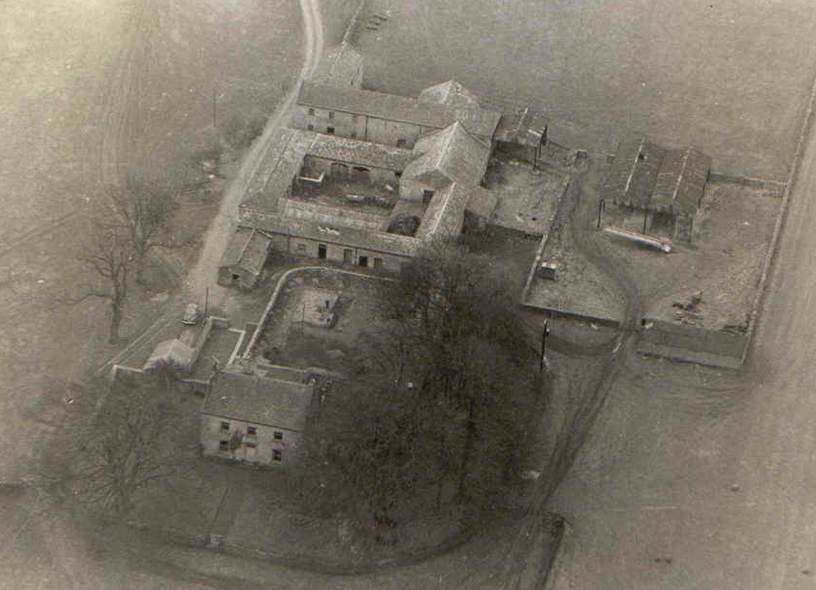
Gale
Bank Farm
1943
We
moved to Gale Bank on 28 January 1943. I remember it all very well. The
furniture van came and everything was packed up. The rest of us went in our heavily
overloaded Standard 12. I remember it over heating just outside Bedale and my
father going into a farm and helping himself to a bucket of water! I remember
our arrival well, the house, and the buildings were quite empty and we children
raced throughout the empty house. There were strange smells everywhere,
particularly that of smoked bacon, which our predecessors had done for years.
We raced through all the farm buildings which were big and extensive compared
to anything we had known before. It must have been cold in January and apart
from a fire in the drawing room and kitchen in daytime only there was o heat.
But I don’t remember it being cold. With great excitement we all chose our
bedrooms and then the furniture van arrived and we all helped move our things
into the house. The beds were made – the same ones we had got out of that
morning in Crosby Road, and we were ready for bed in our new house. Little did
we know what a major step in our lives this day was to be for us all. Gale Bank
was to become our home, and a firm base for us all, for many years to come.
Geoff and Margot started at Wensley school. Anne and I started at Yorebridge
Grammar School straight away. This meant a three mile walk or cycle across the
fields and roads to Wensley station, a 15 mile train journey, and then s short
walk to the school, then a return in the evening. It meant an early rise,
leaving the house in the dark at 7.15am and getting home about 5.15pm.
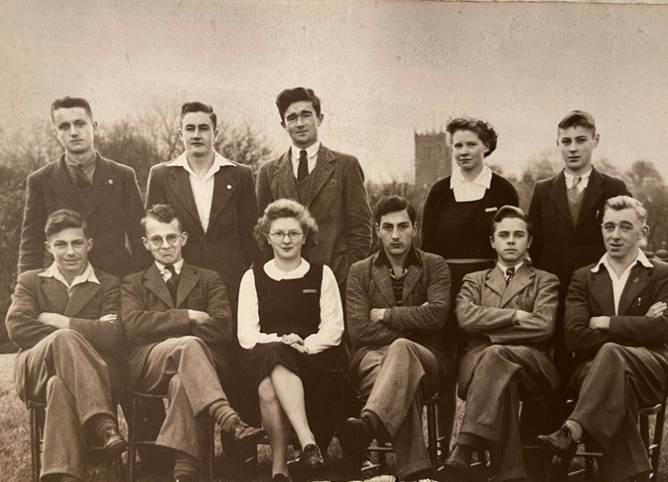
Yorebridge
Grammar School (Martin Farndale centre rear row)
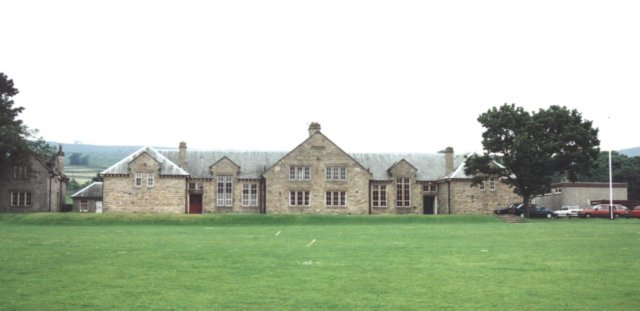
Yorebridge
Grammar School was established in 1602 by Anthony Besson. New premises were
built in the 1840s. It closed in 1975.
Summary
of Martin Farndale’s Military Service
Martin Baker Farndale joined the
Indian Army on 3 September 1946, transferred to the British Army in 1947 and
went to the Royal Military Academy Sandhurst where he was commissioned into the
Royal Artillery. Served in Egypt, Germany, Malaya, South Arabia, Ireland.
He commanded The Chestnut Troop, 1st Regiment RHA, 7th Armoured Brigade, 2nd
Armoured Division, 1st British Corps and Northern Army Group. He became
Commander-in-Chief British Army of the Rhine and
Master Gunner St James’s Park. Awarded General Service Medal with clasps for
Malaya, South Arabia and Northern Ireland. Awarded Silver Jubilee Medal in
1977, Commander of the Order of the Bath in 1980 and Knight Commander of
the Order of the Bath in 1983. Awarded 125th Anniversary of Canada Medal for
services to Canada. Hon Degree Literature at Greenwich University.
Martin’s early Military
service 1946 to 1960
1946
Martin joined the Indian Army on 3
September 1946.
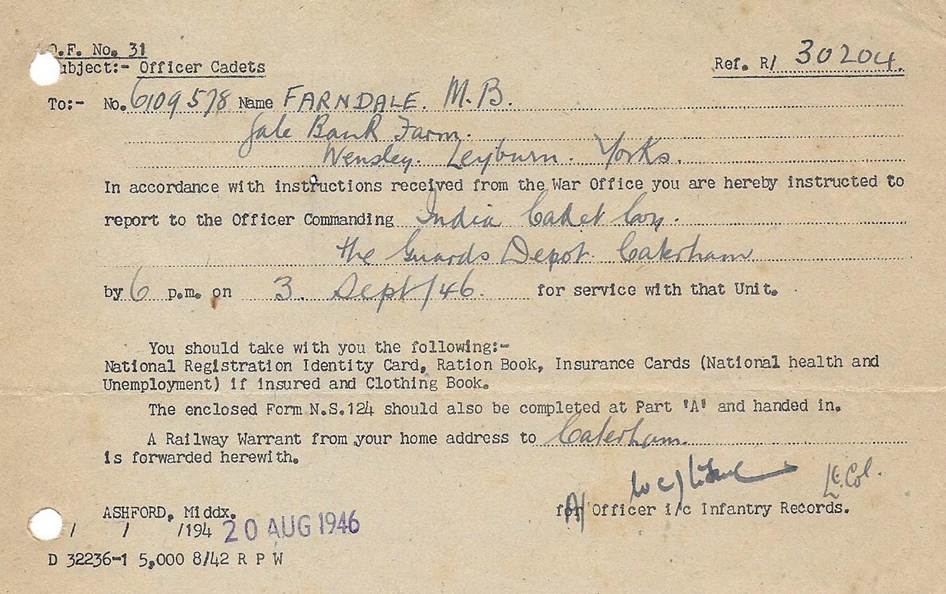
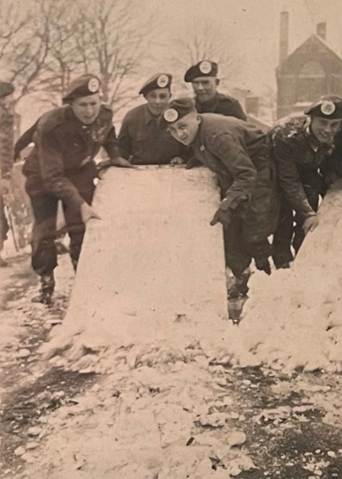
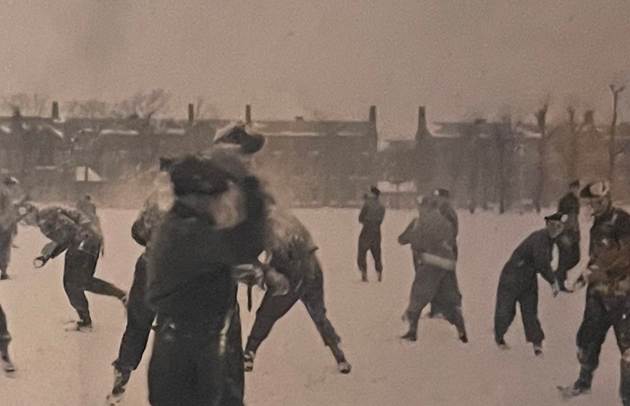
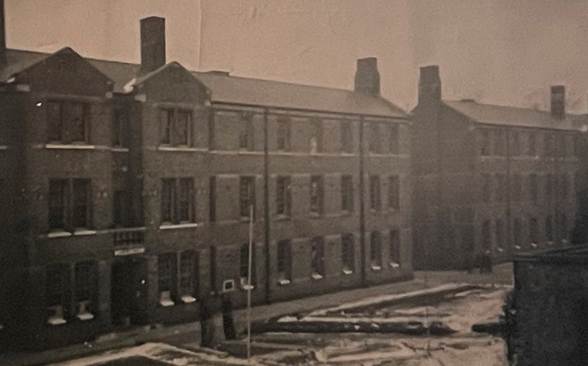
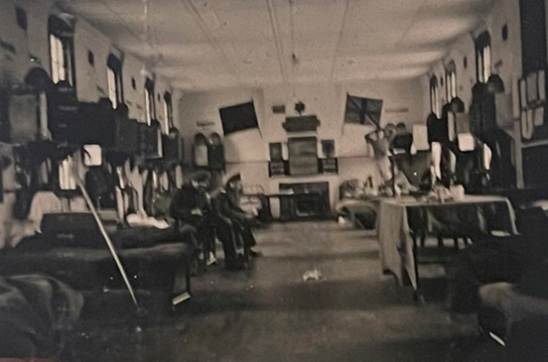
Caterham
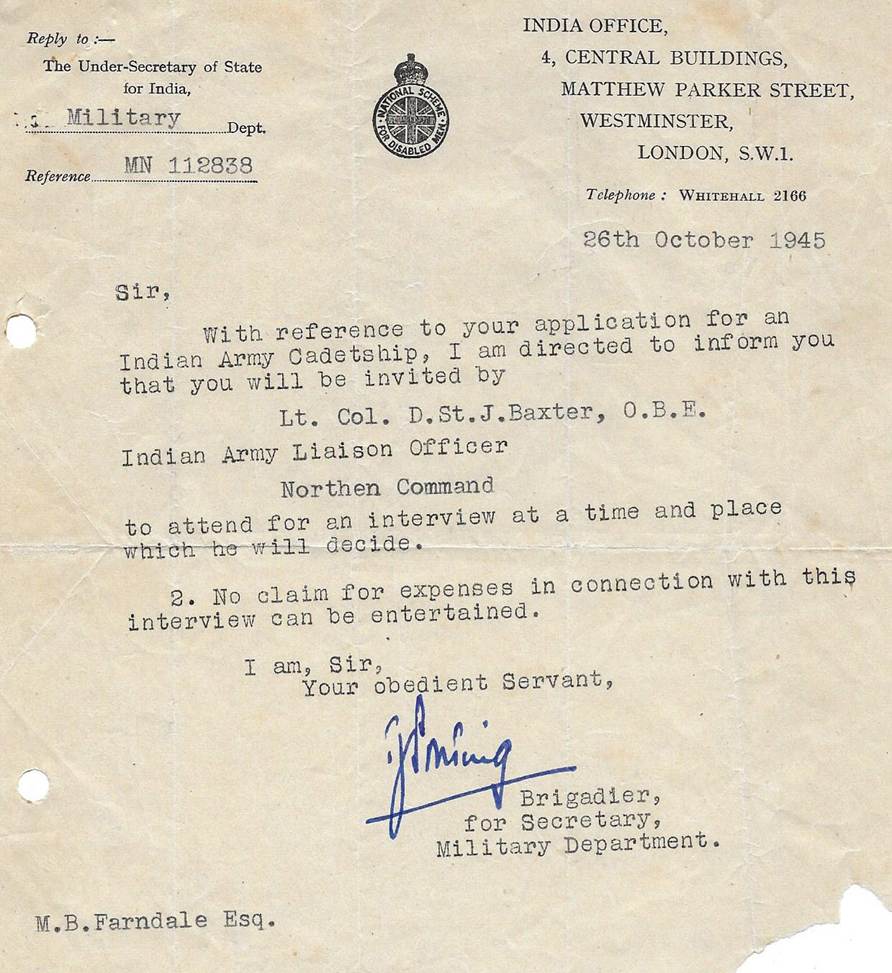
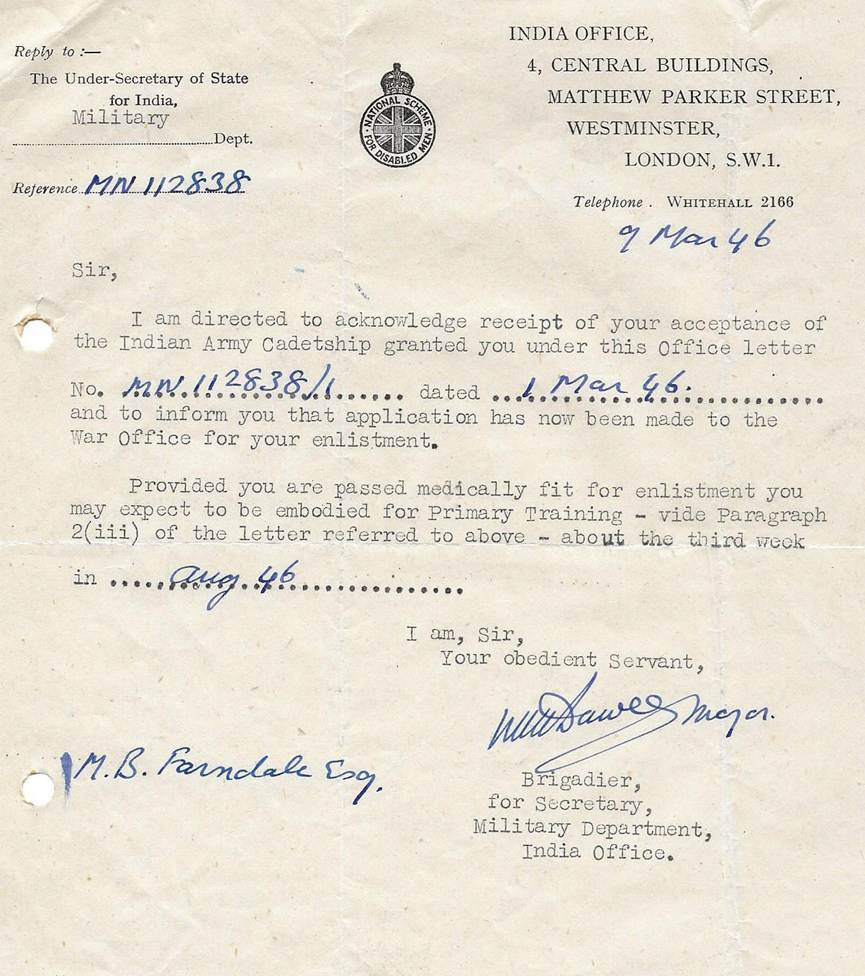
He was ordered to report to the Guards
depot at Caterham:
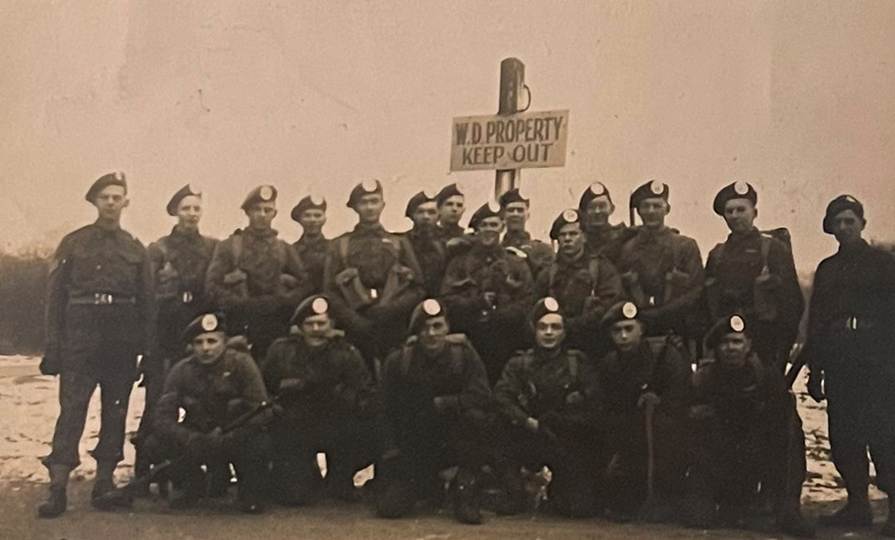
Life at the Guards depot:
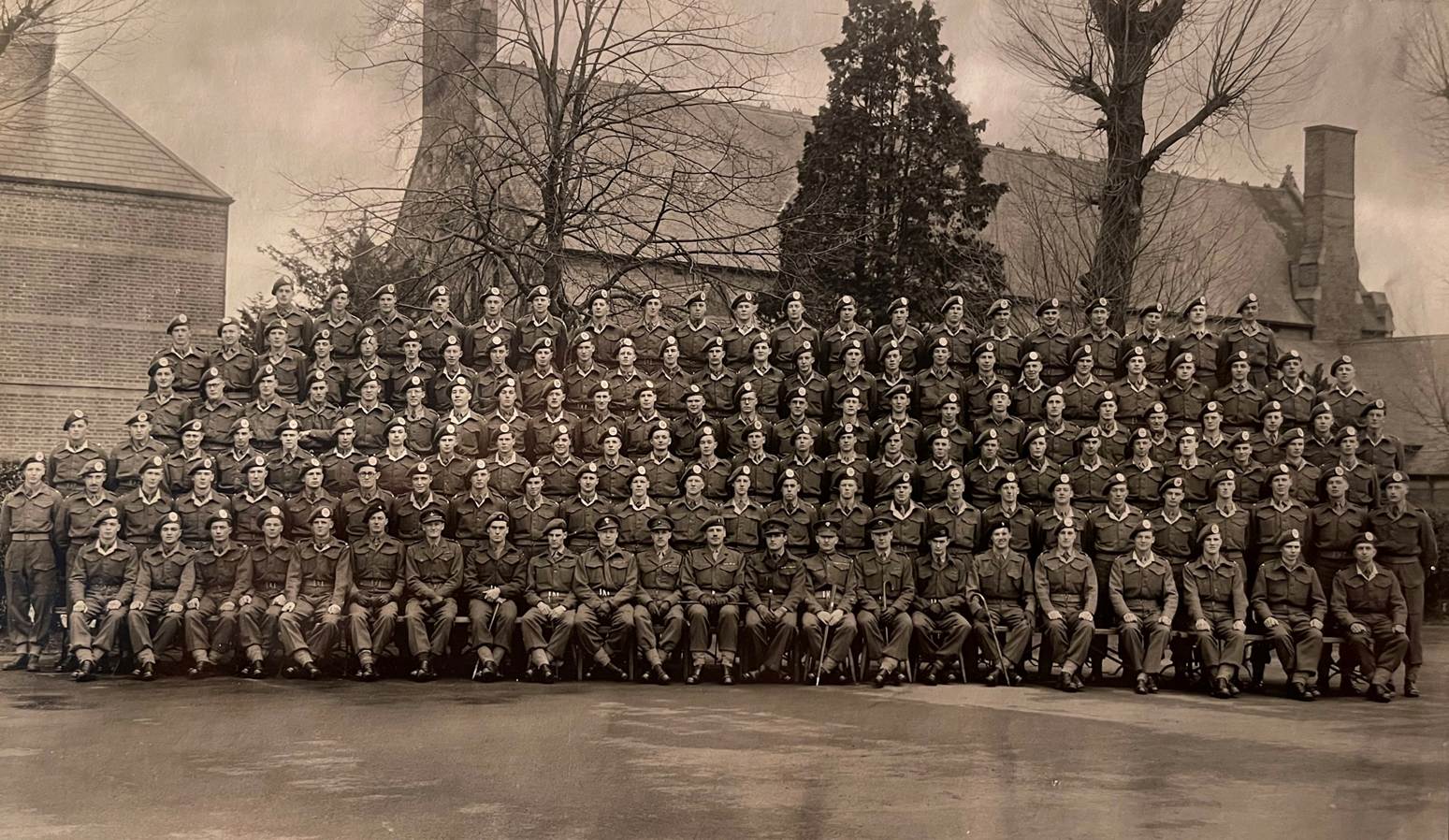
1947
He transferred to the British Army in
1947, after Indian independence.
Royal Military Academy Sandhurst
He went to the Royal
Military Academy Sandhurst where he was in his company's boxing
and motor-cycle team. He won the Brian Philpotts Memorial Prize for Military
History. He was Intake 1A, Dettingen Company and passed out on 20 October 1948.
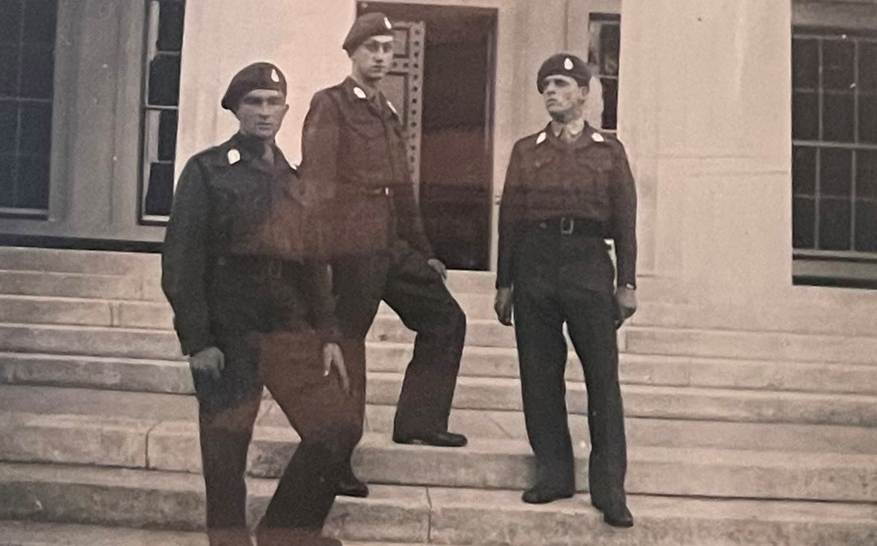
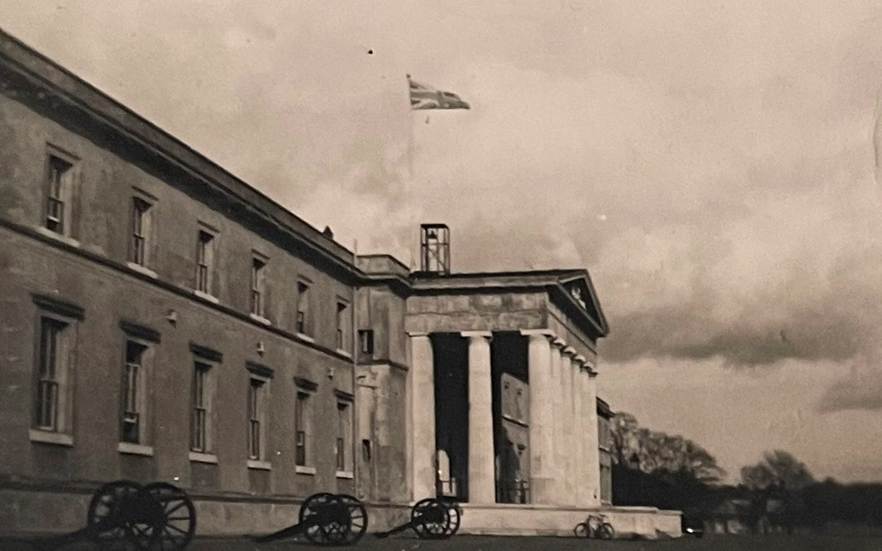
There is a separate page about Martin
Farndale’s time at the Royal Military Academy Sandhurst which is also a record
of the first days of Sandhurst.
1948
Larkhill
He was commissioned into the Royal
Artillery. He attended the RA Young Officers' Course.
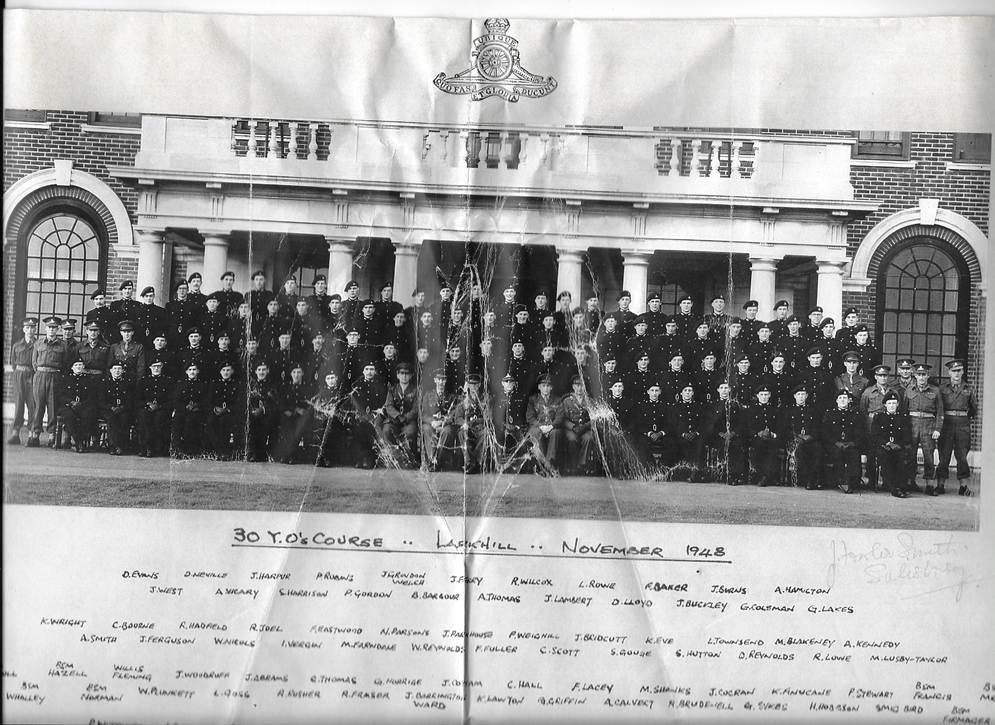
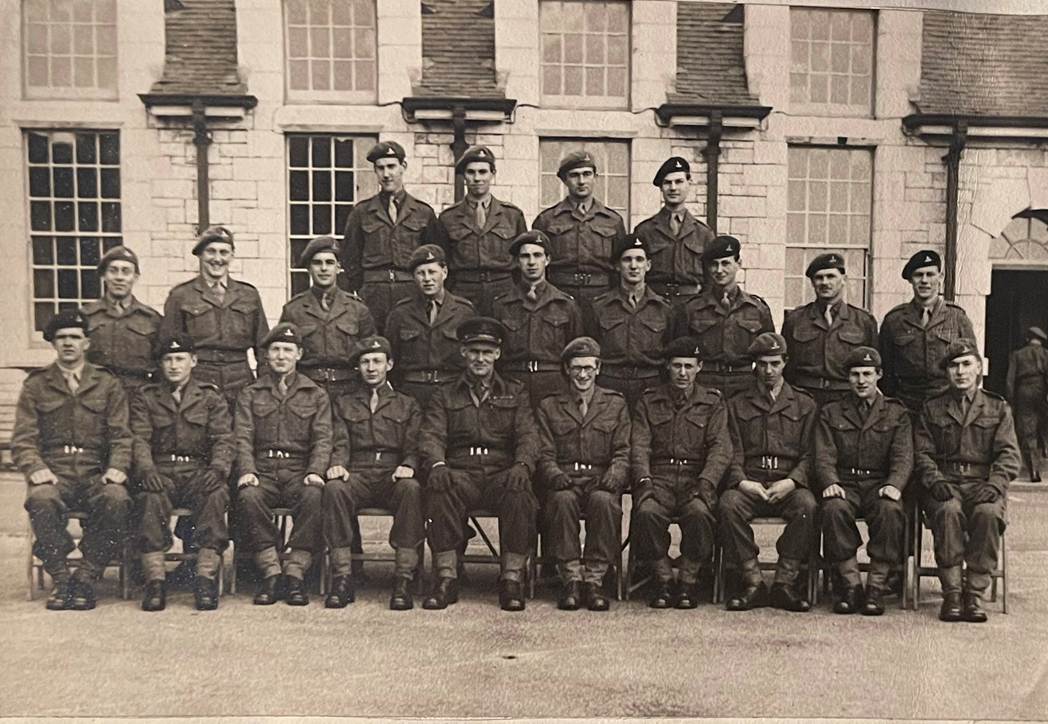
Young Officers’ Course, Larkhill, November 1948 Young
Officers Coastal Artillery Gunnery Couse, November 1948, Plymouth, Second
Lieutenant Farndale third in the back row
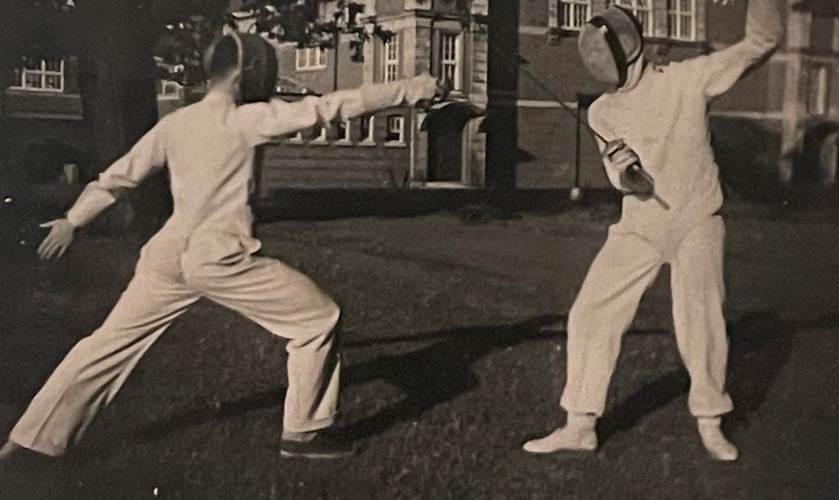
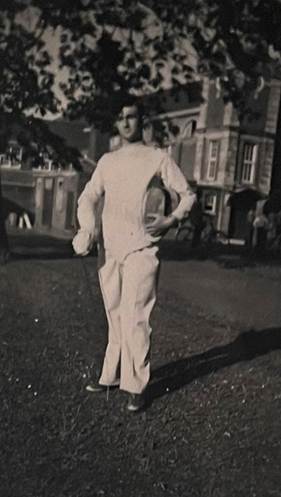
Fencing on the Young Officers’ Course
1949
Egypt
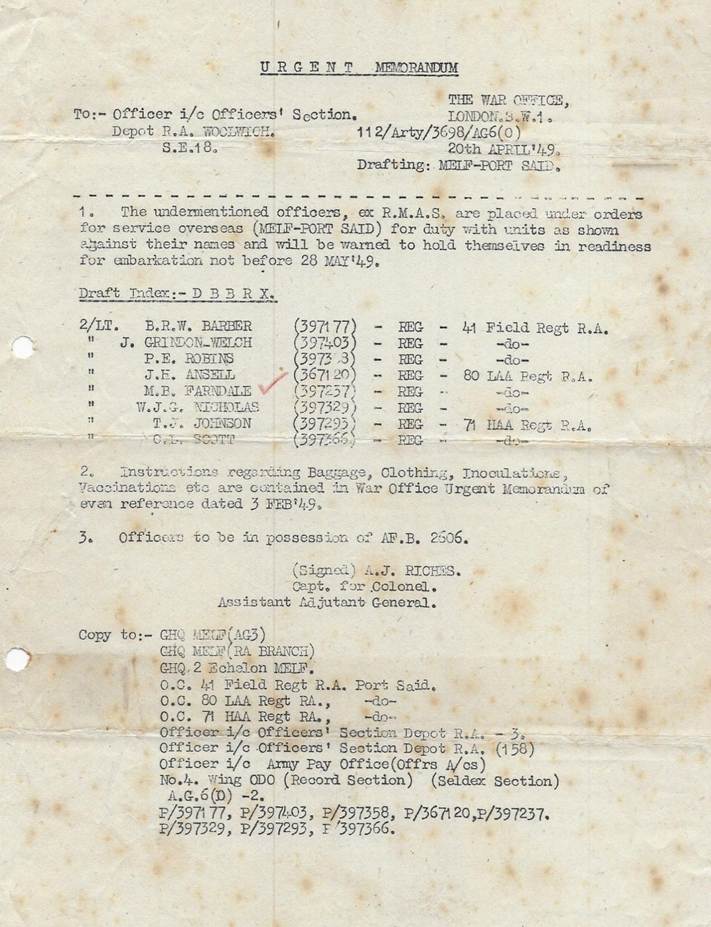
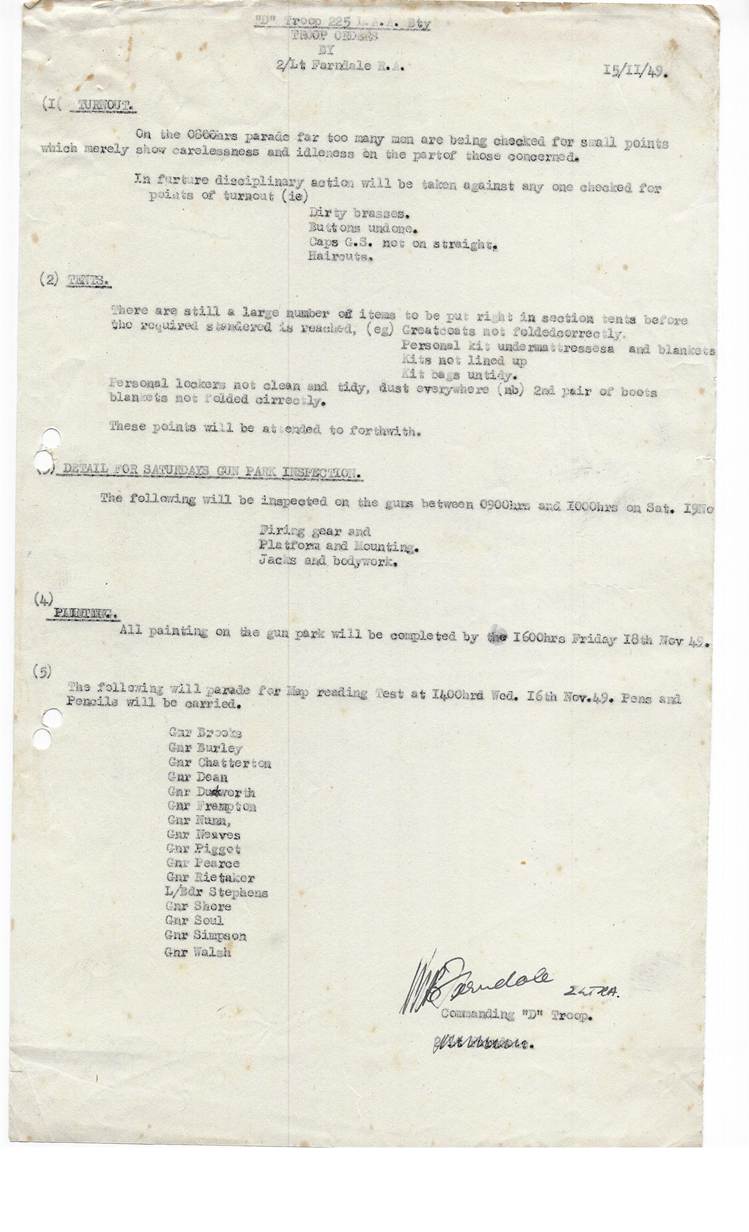
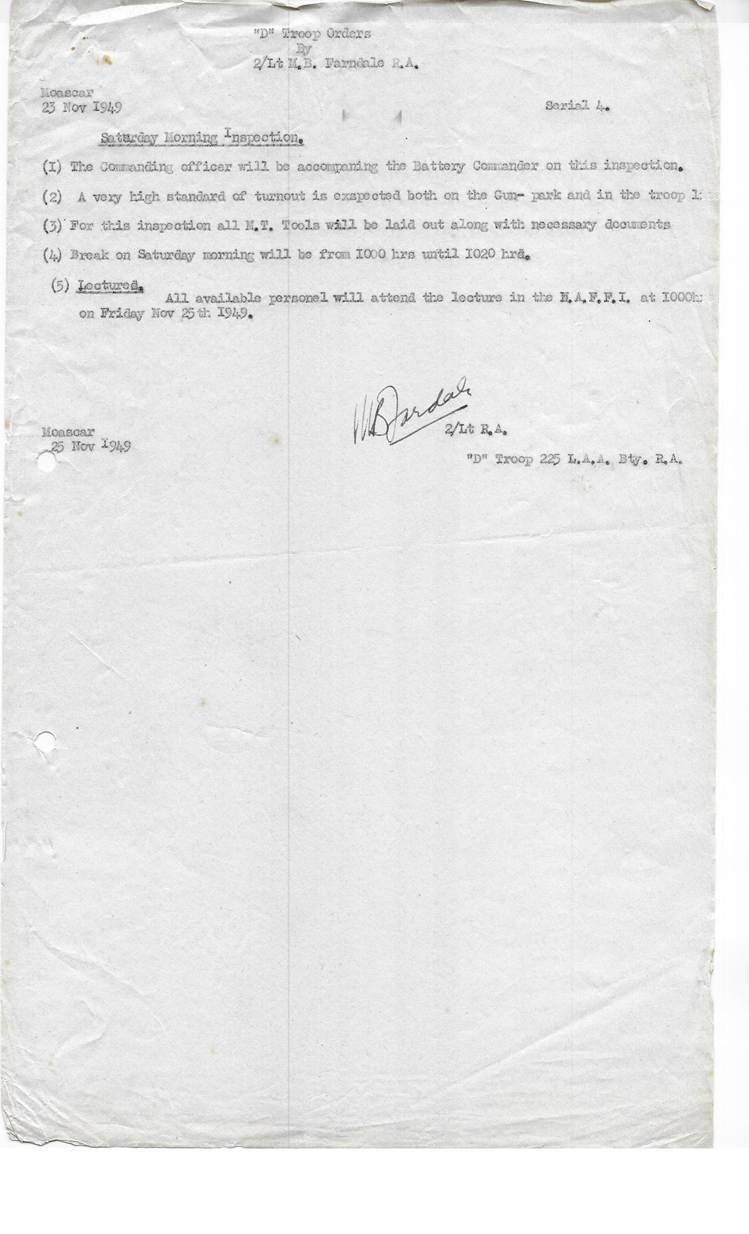
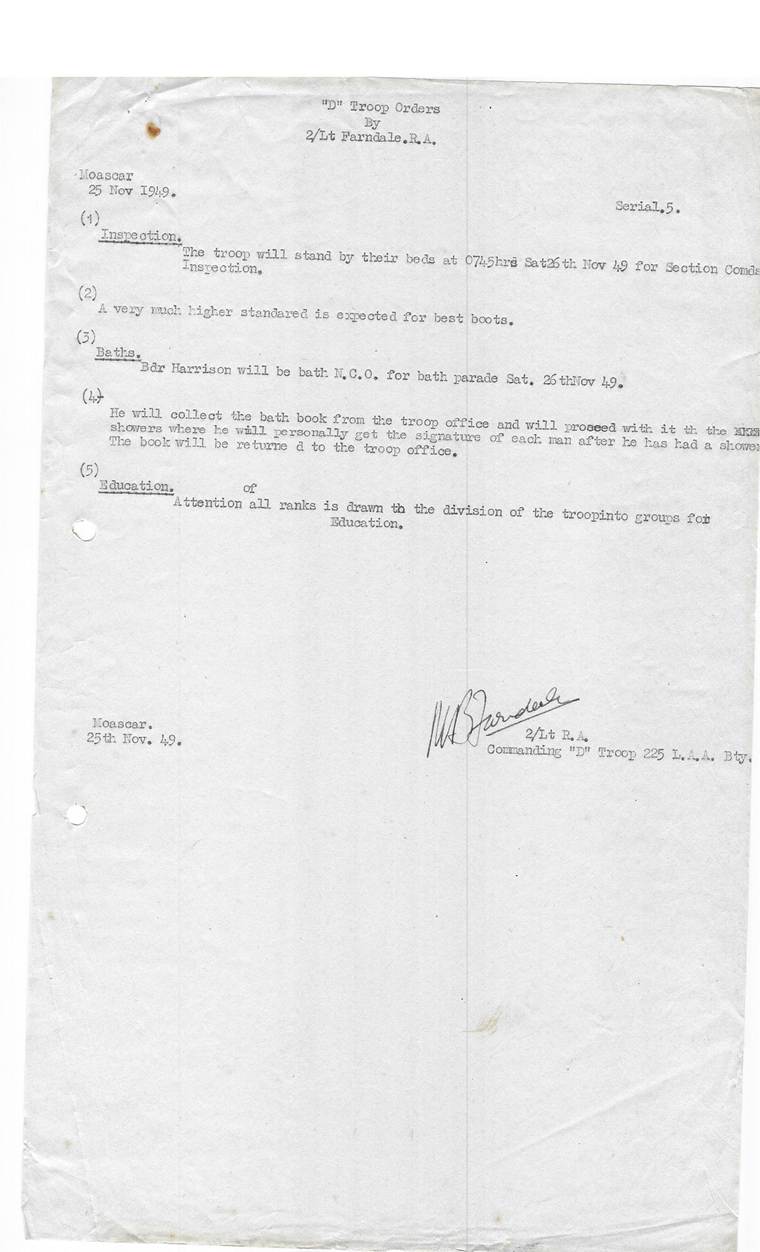
Martin Farndale started his military
career in 80th Light Anti-aircraft Regiment in the Suez Canal Zone. In January
1949, he sailed by Troop Ship to Egypt with his great friends, John Ansell and
Bill Nicholas.
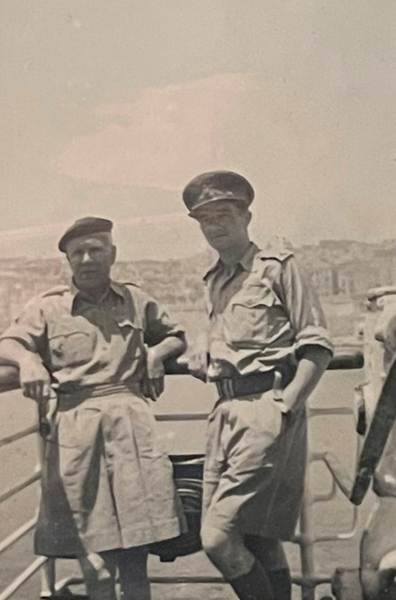
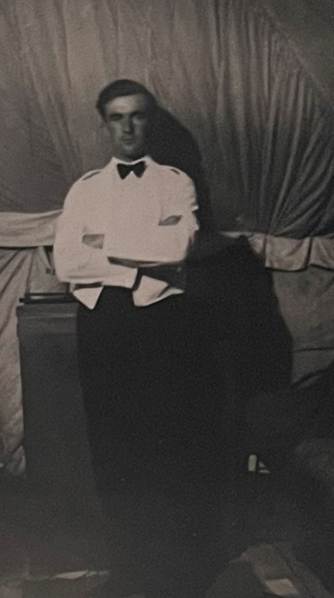
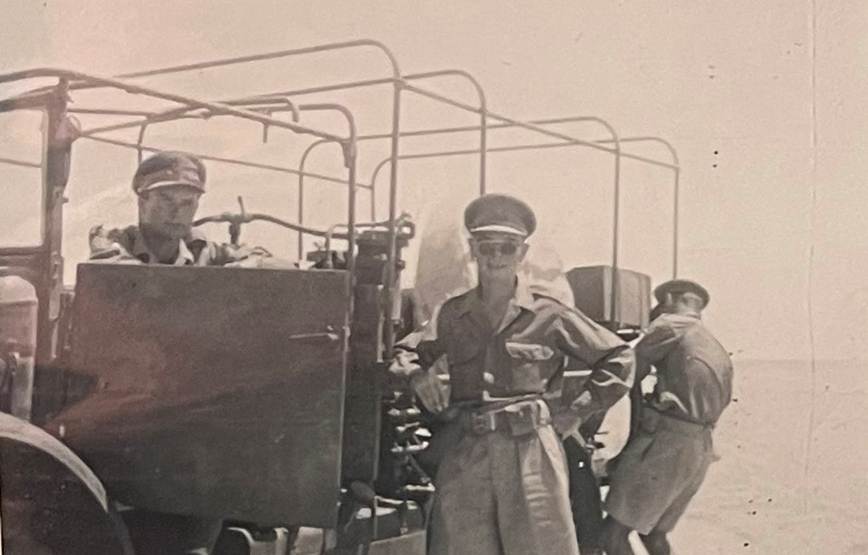
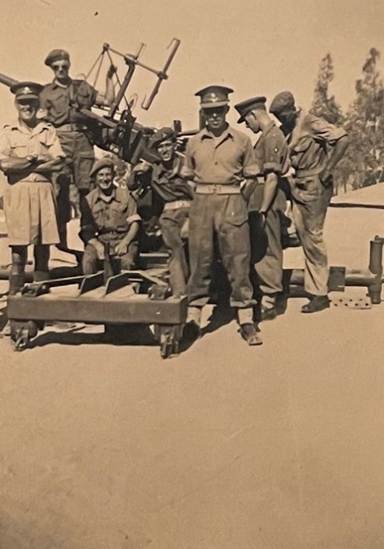
On the Troop Ship to Egypt A young officer
with 80th LAA Regiment
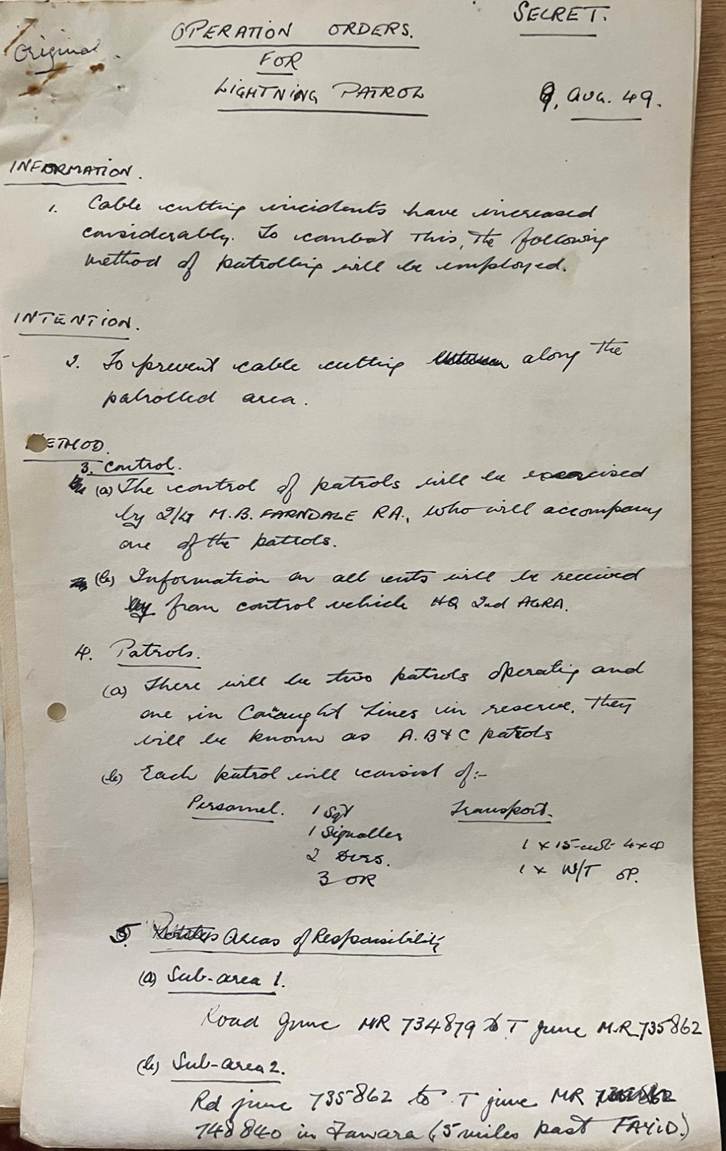
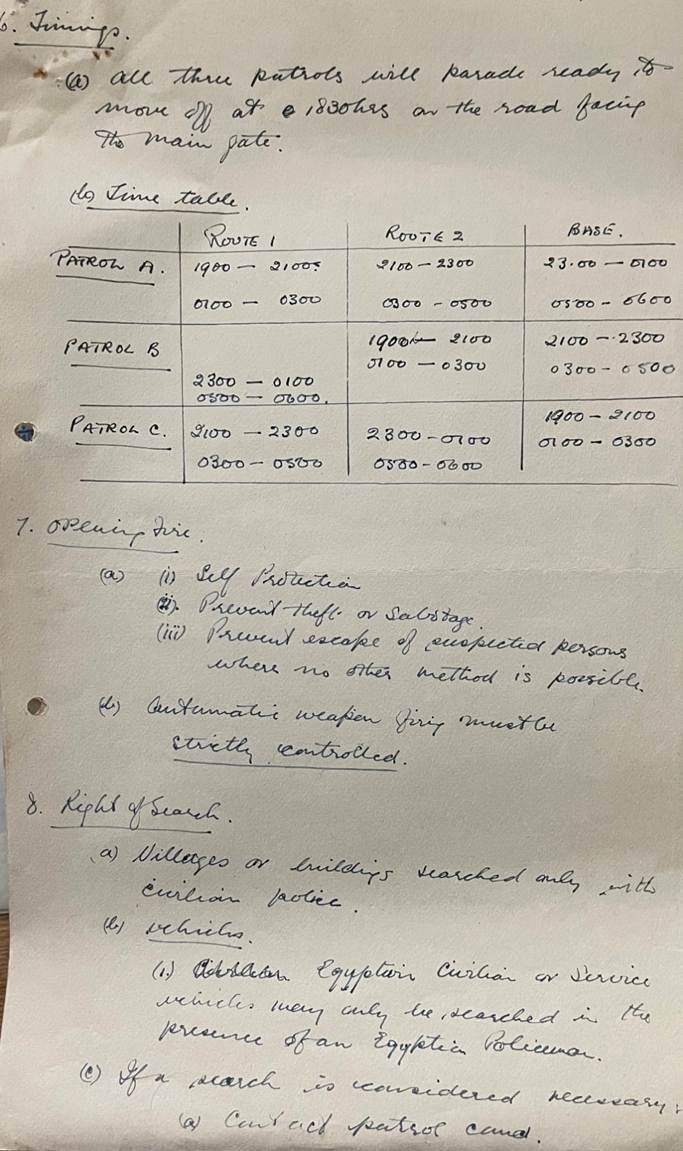
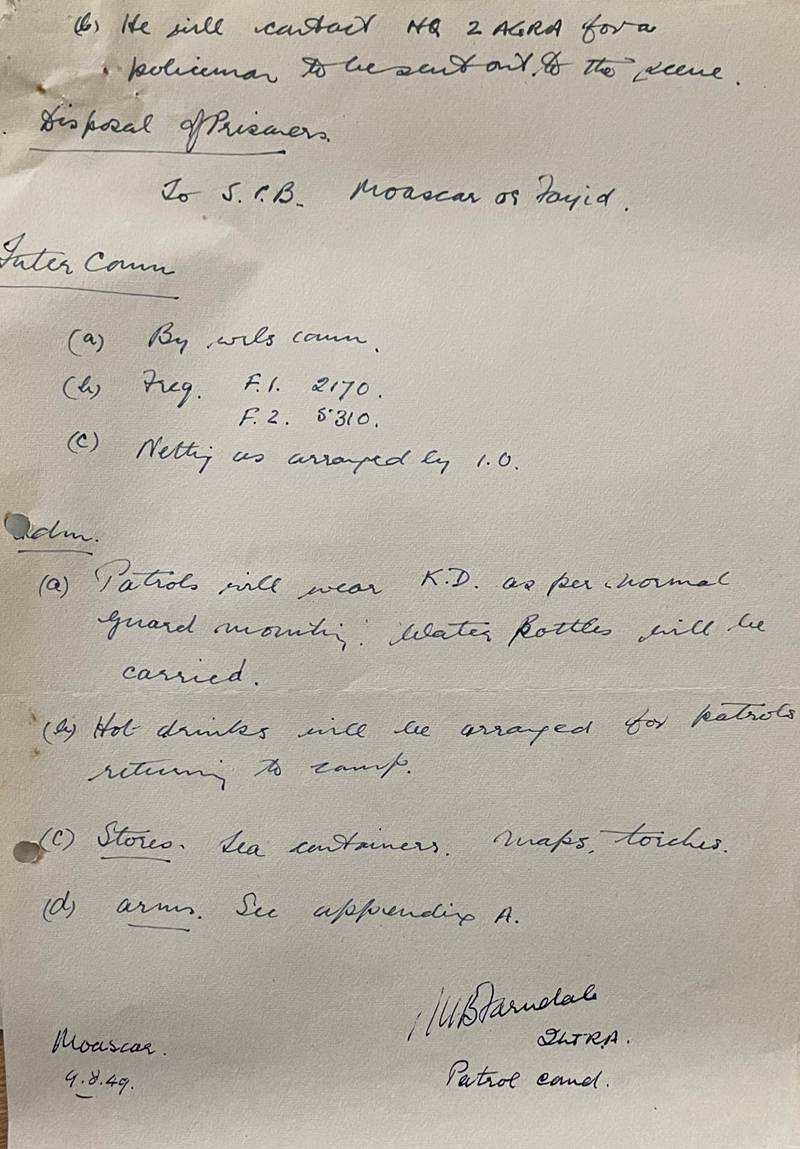
1950
Soon he was selected for the elite
Royal Horse Artillery and he joined First
Regiment Royal Horse Artillery in 1950.
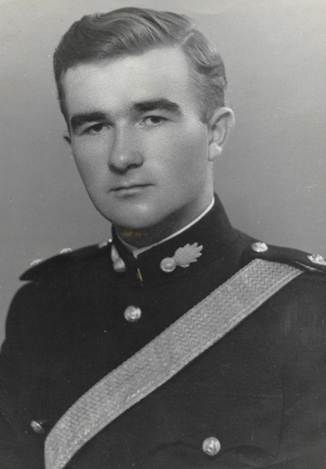
Second Lieutenant Martin Farndale RHA,
1950, aged 21
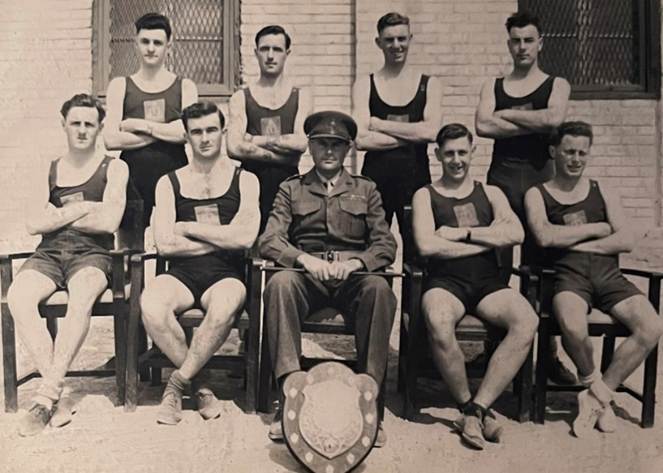
The Athletics
Team
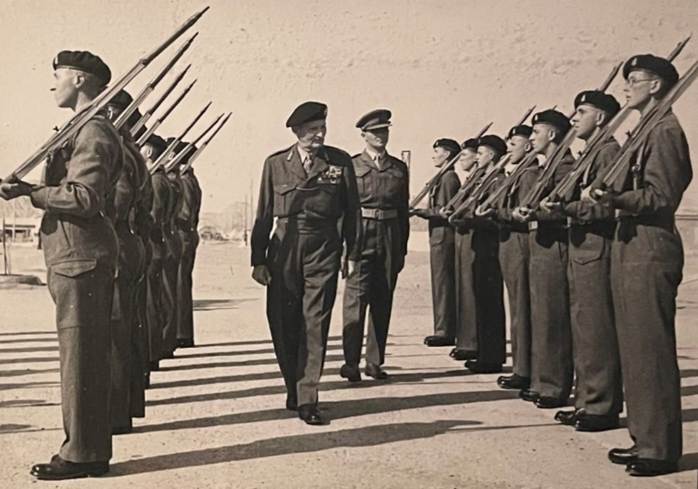
Field Marshall Montgomery (“Monty”) inspects Martin Farndale’s Troop,
Fayid, Egypt
He met Anne
Buckingham, who was working for the foreign office, in Sinai at that time.
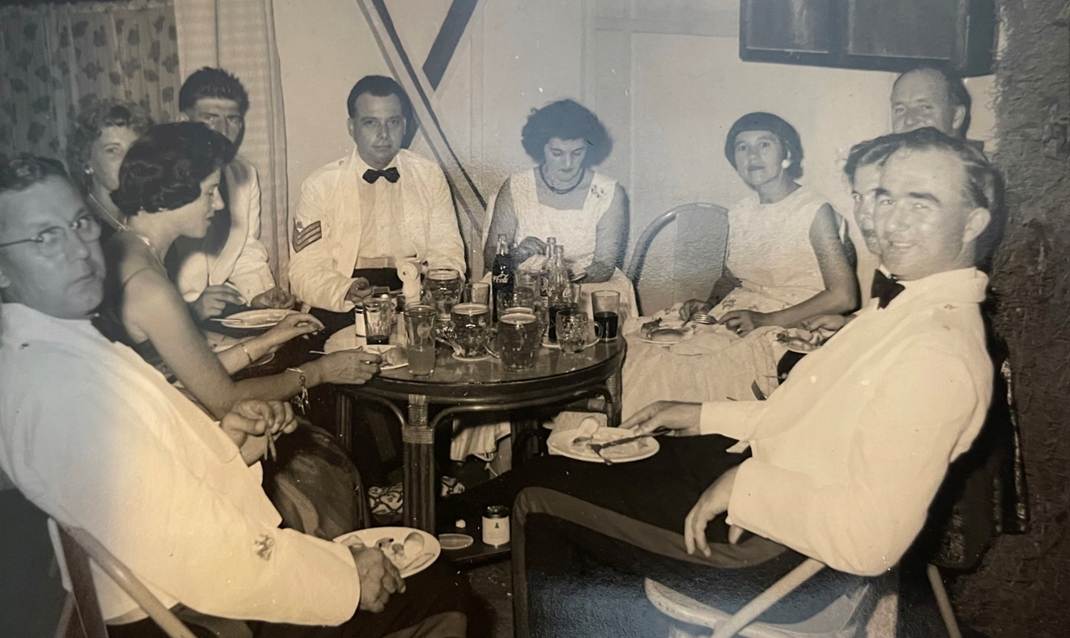
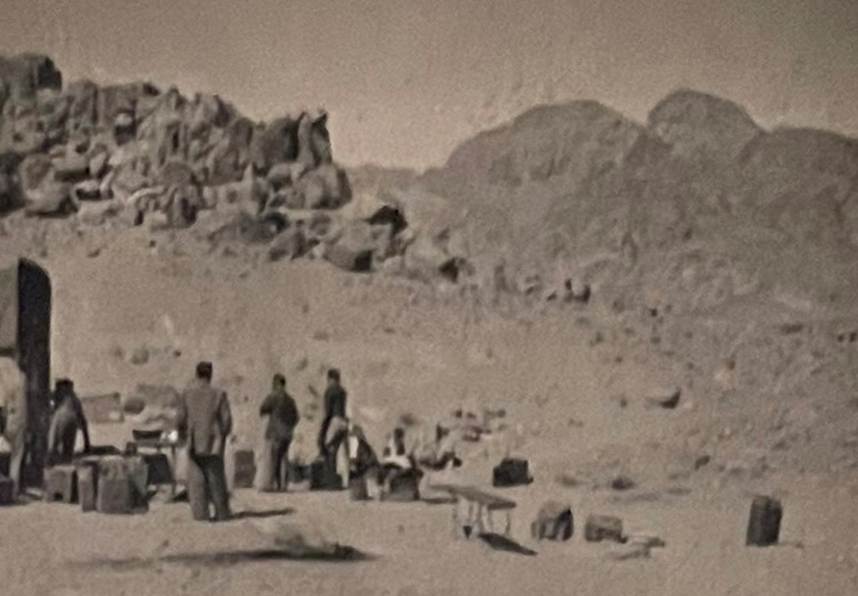
Martin Farndale (right) and Anne
Buckingham (second left) at the Ryal Artillery Ball, Fayid, Egypt On
exercise in the Sinai
Germany
The regiment returned from Egypt in 1951 to
the British Army on the Rhine. He served in E Battery and then in B Battery.
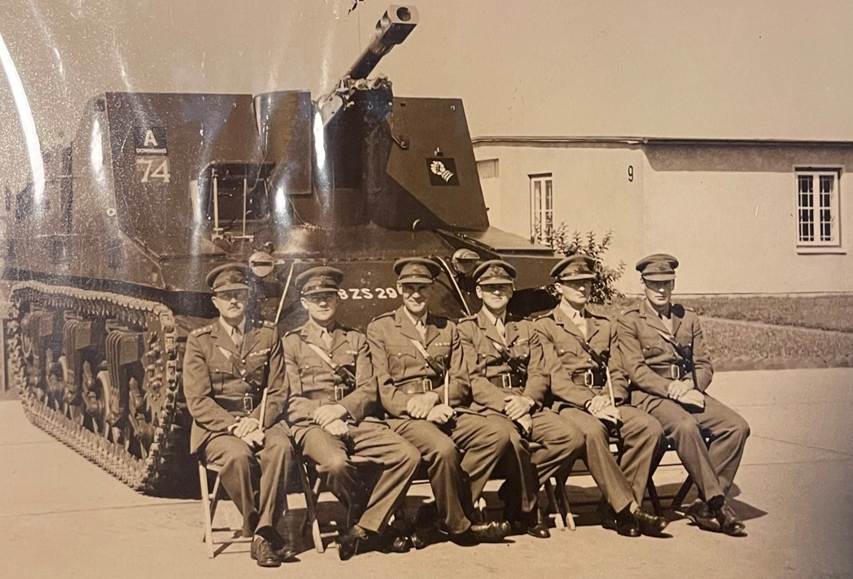
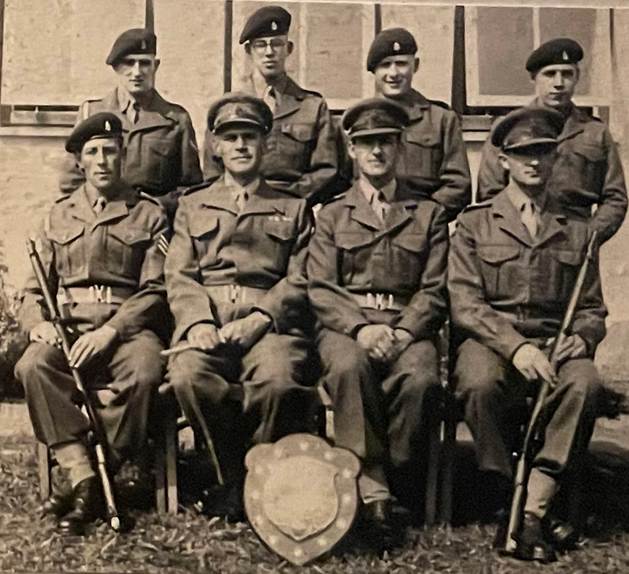
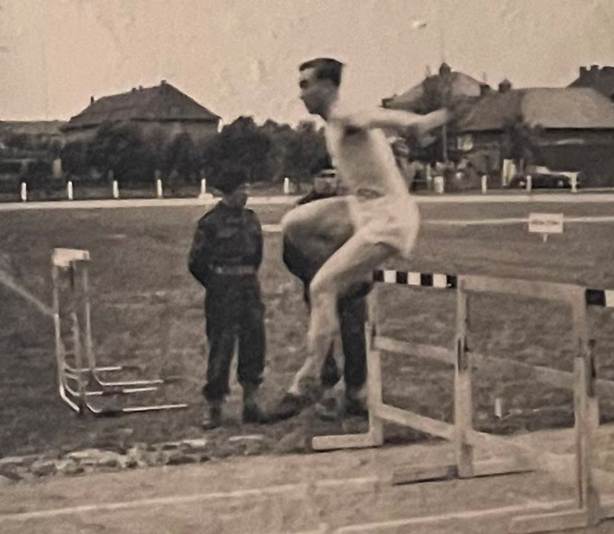
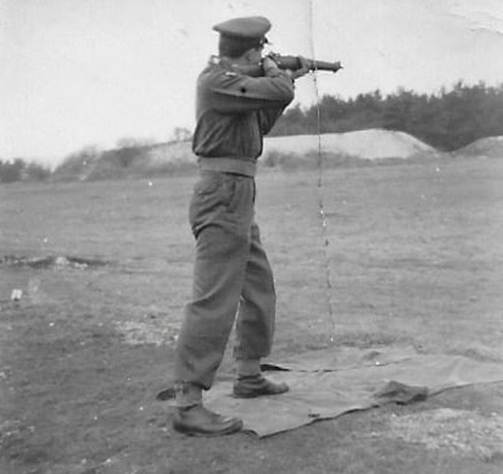
There is a separate page about Martin Farndale and First Regiment
Royal Horse Artillery.
1952
Martin was Best Man at the Davidge wedding:
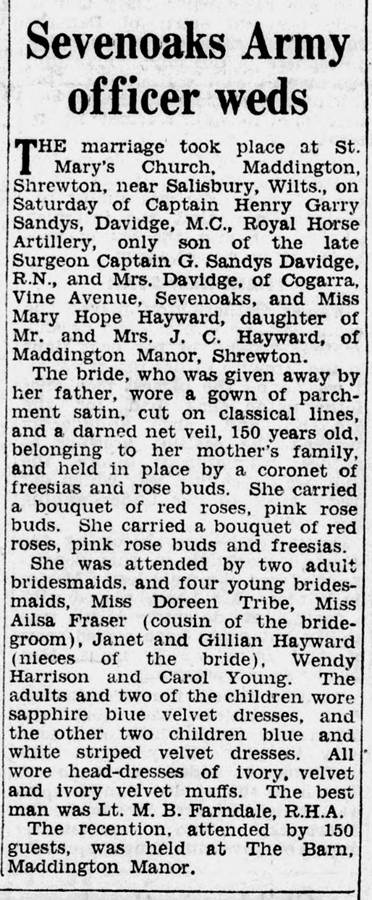
(Sevenoaks
Chronicle and Kentish Advertiser, 1 February 1952)
1954
He was then posted to the Royal
Artillery Staff of 7th Armoured Division at Verden in Lower Saxony, from 1954
to 1957.
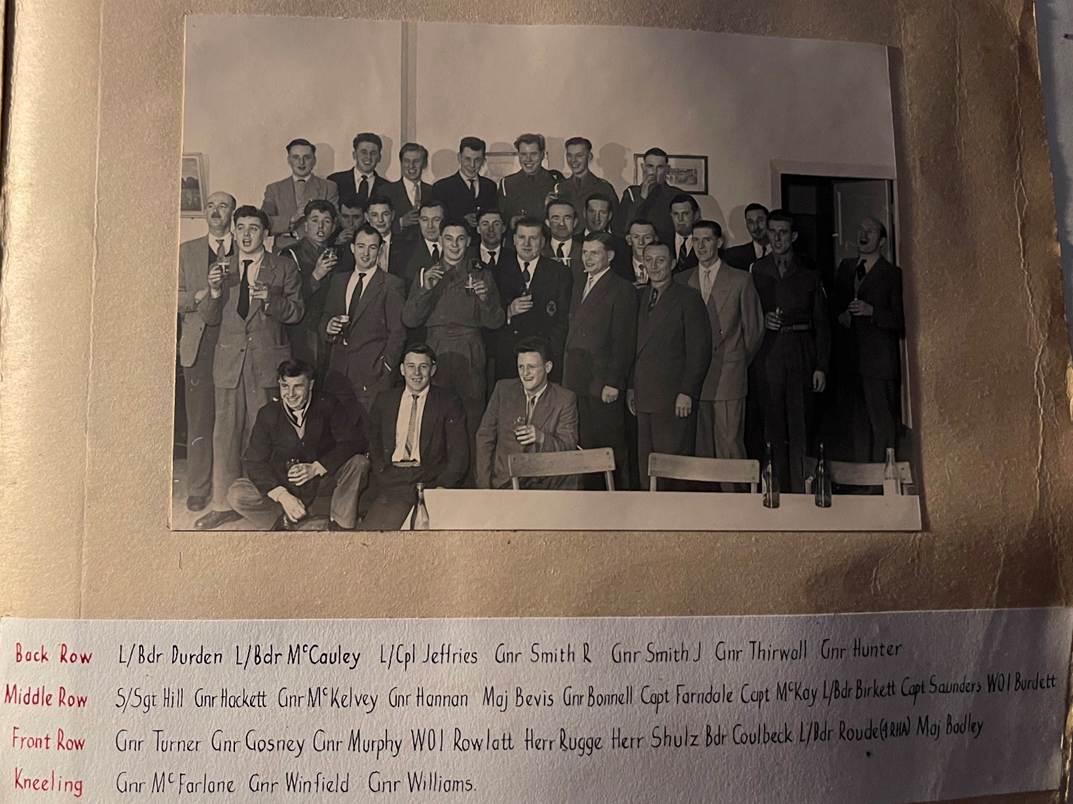
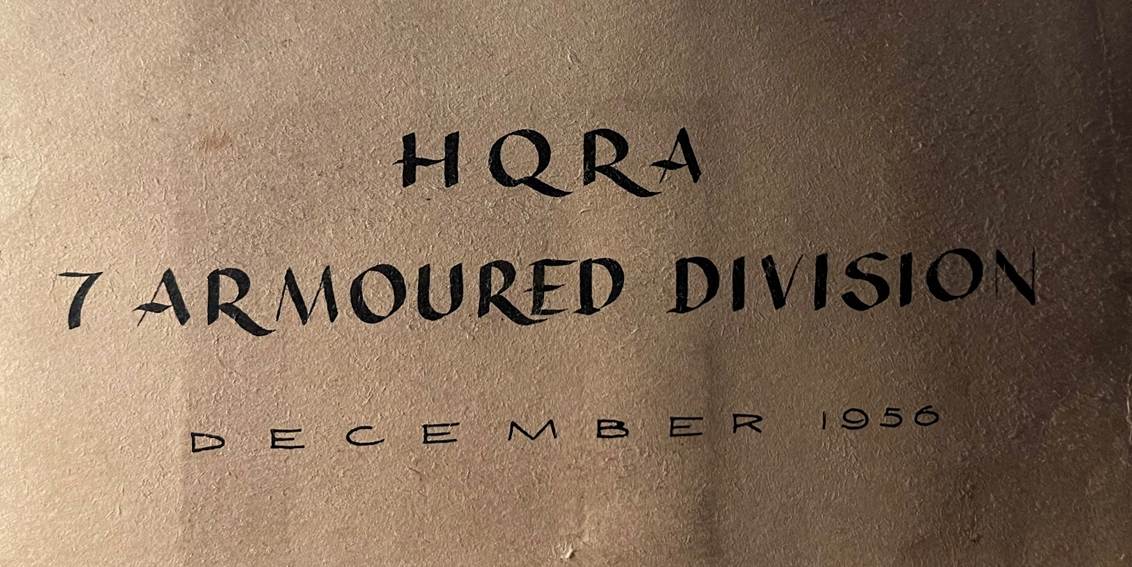
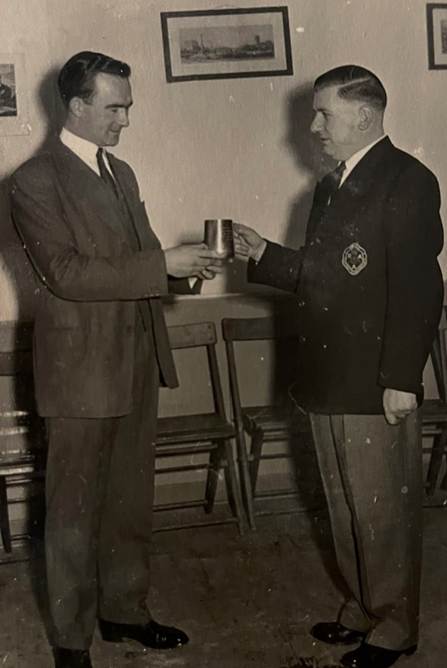
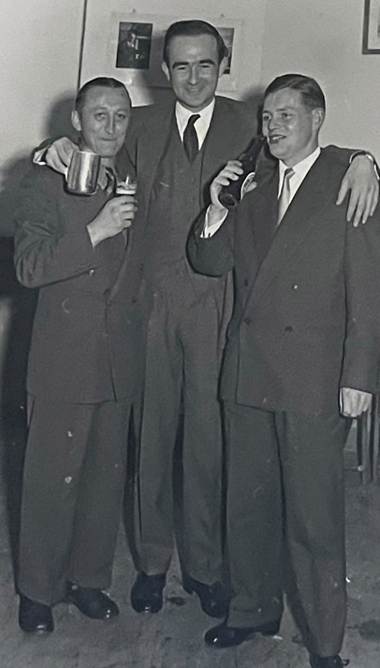
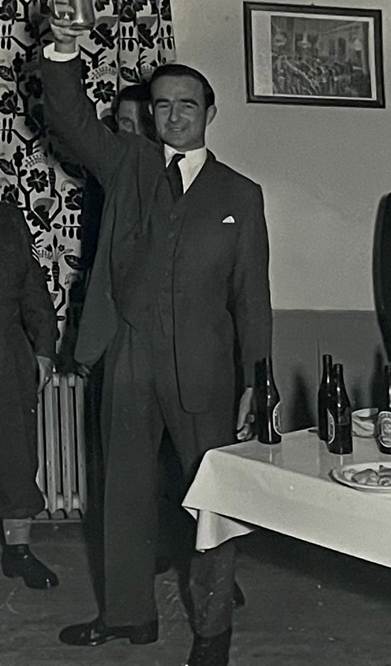
He then served with 53rd (Louisberg) Battery
and as Adjutant of 22nd Light Anti-Aircraft Regiment (which he used to
affectionately call "22 Light ack ack").
Married
1955
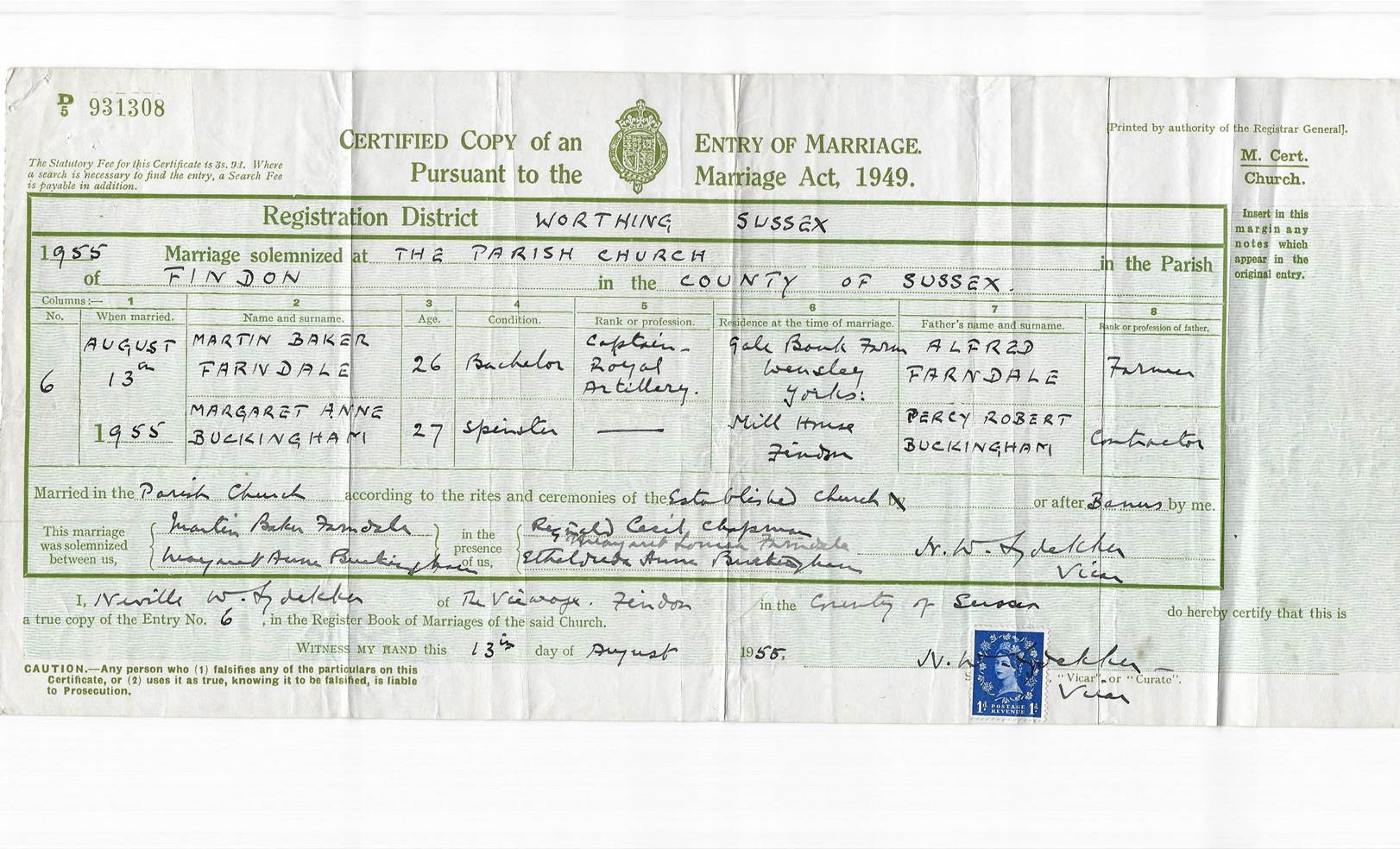
Martin Baker Farndale, age 26,
bachelor, Captain Royal Artillery of Gale Bank Farm Wensley Yorkshire, son of Alfred Farndale,
farmer, married by Banns Margaret
Anne Buckingham, age 27 spinster of Mill House, Findon daughter of Percy
Robert Buckingham, contractor. Both signed. Witnesses Reginald Cecil
Chapman, Margaret Louisa Farndale and Etheldreda Annie Buckingham. NW
Lydeker Vicar. The wedding was on 13 August 1955.
There are
photographs and other records of the Wedding of Anne Buckingham and
Martin Farndale.
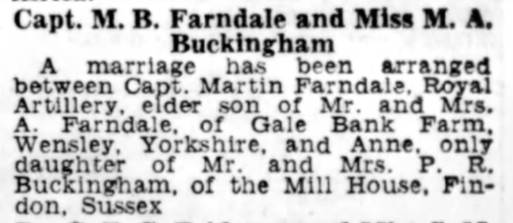
(The Daily Telegraph, 28 February 1955)
There is a
separate page about their travels together in the 50s and 60s.
17th Gurkha Division, Malaya, Headquarters Royal
Artillery (Major), 1960 to 1962
1960
Malaysia
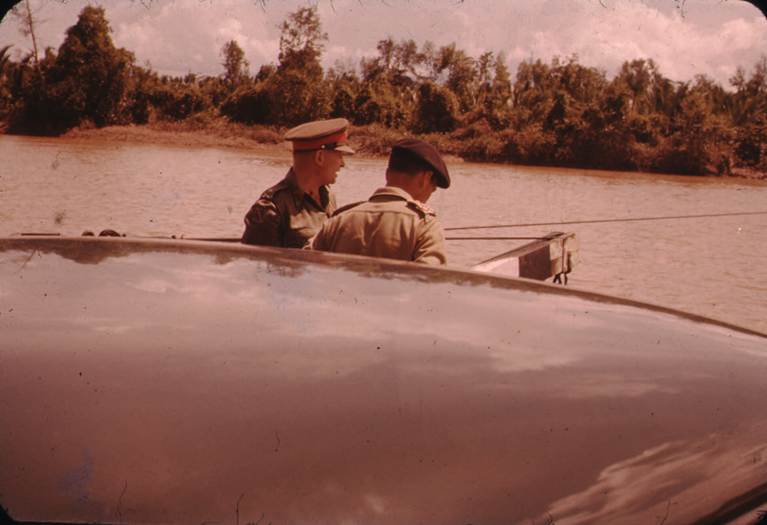
He then went to the Gunner Staff of
17th Gurkha Division in Malaya from 1960 to 1962, where he saw active service
during the final phases of the Malayan Campaign.
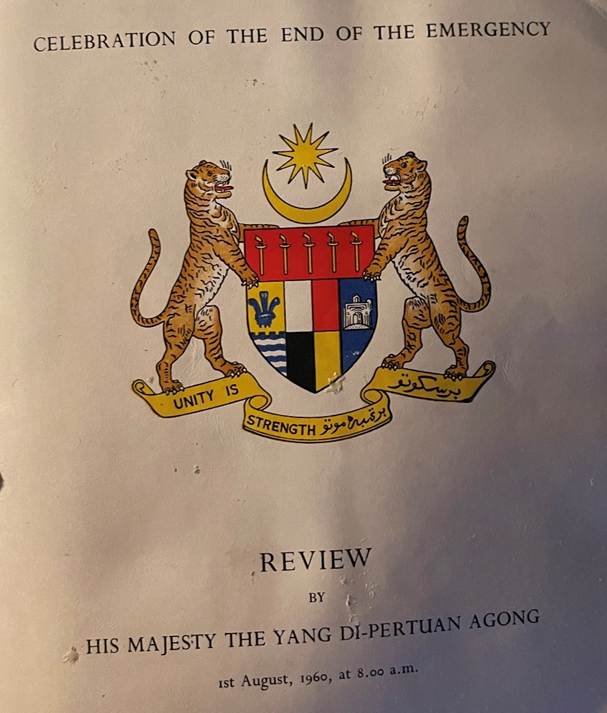
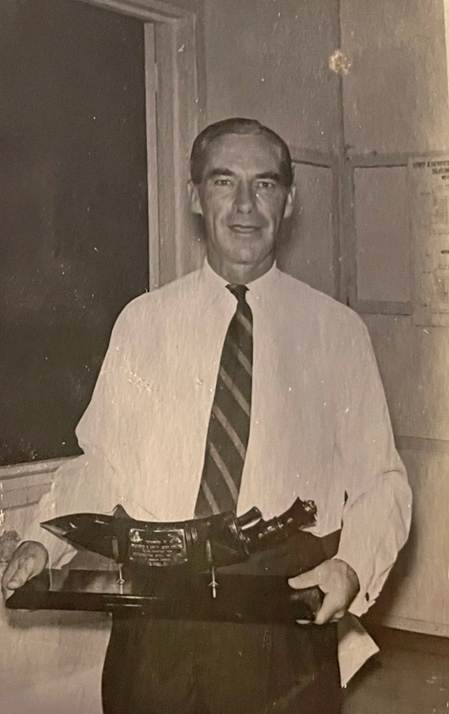
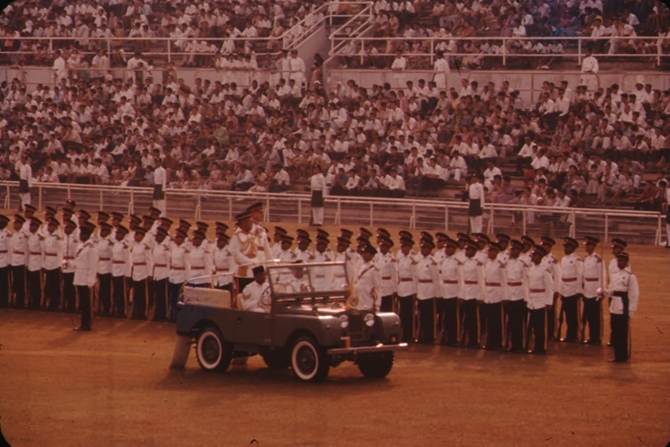
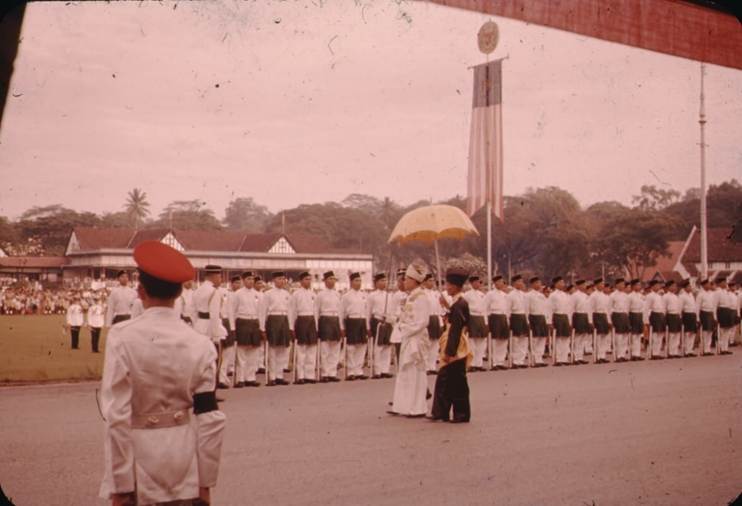
The End of Emergency Celebration 1 August
1960 Farewell to Brigadier R
Keith Jones, CRA 1961 Freedom
Parade
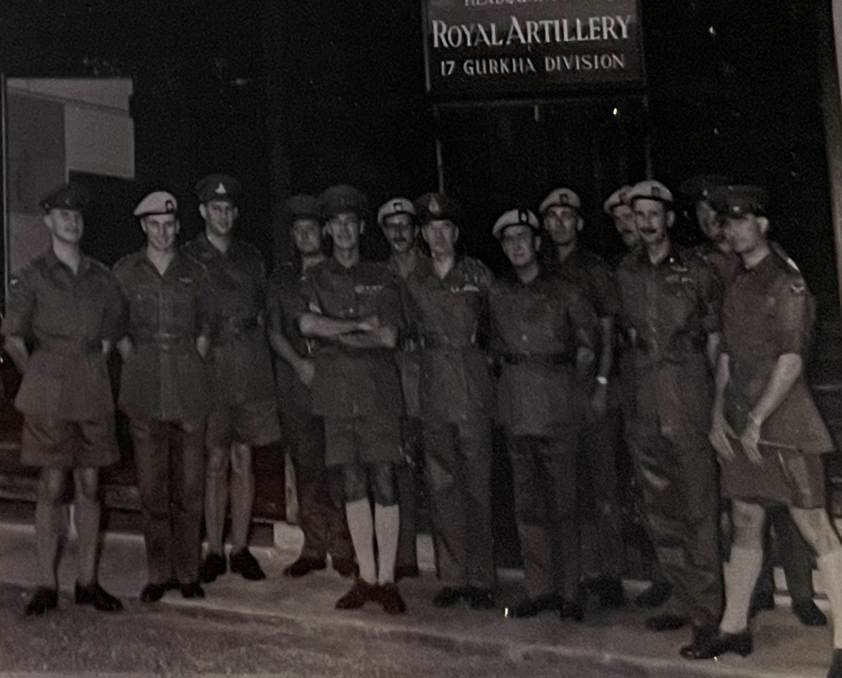
Headquarters Royal Artillery, 17 Gurkha Division, 1962
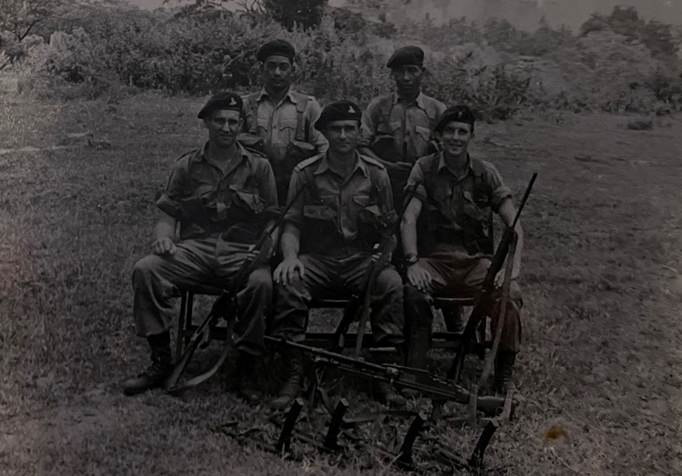
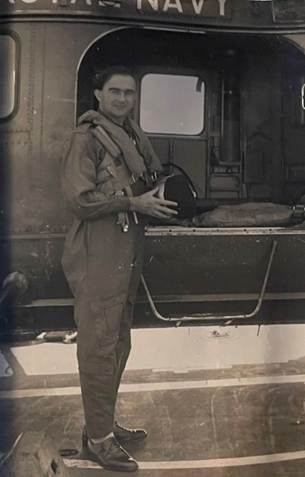
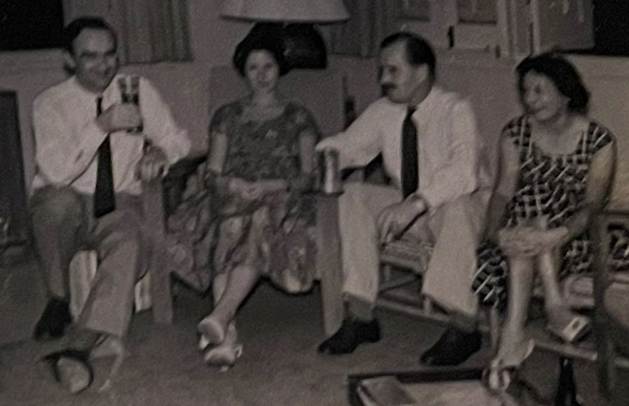
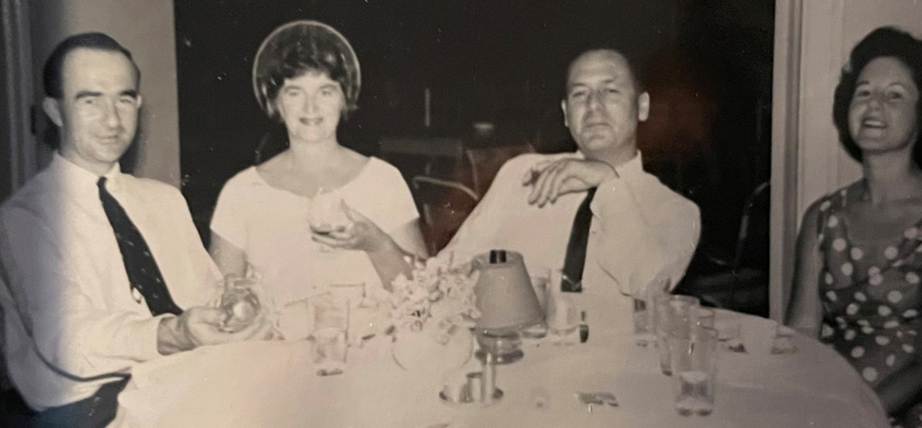
The HQRA Rifle Team 1961 Major Farndale, HMS Victorious, South
China Sea, 1961 Martin and Ann
Farndale, Dougie and Nora Mitchell, Singapore 1961 With the Howards in Singapore, 1961
1961
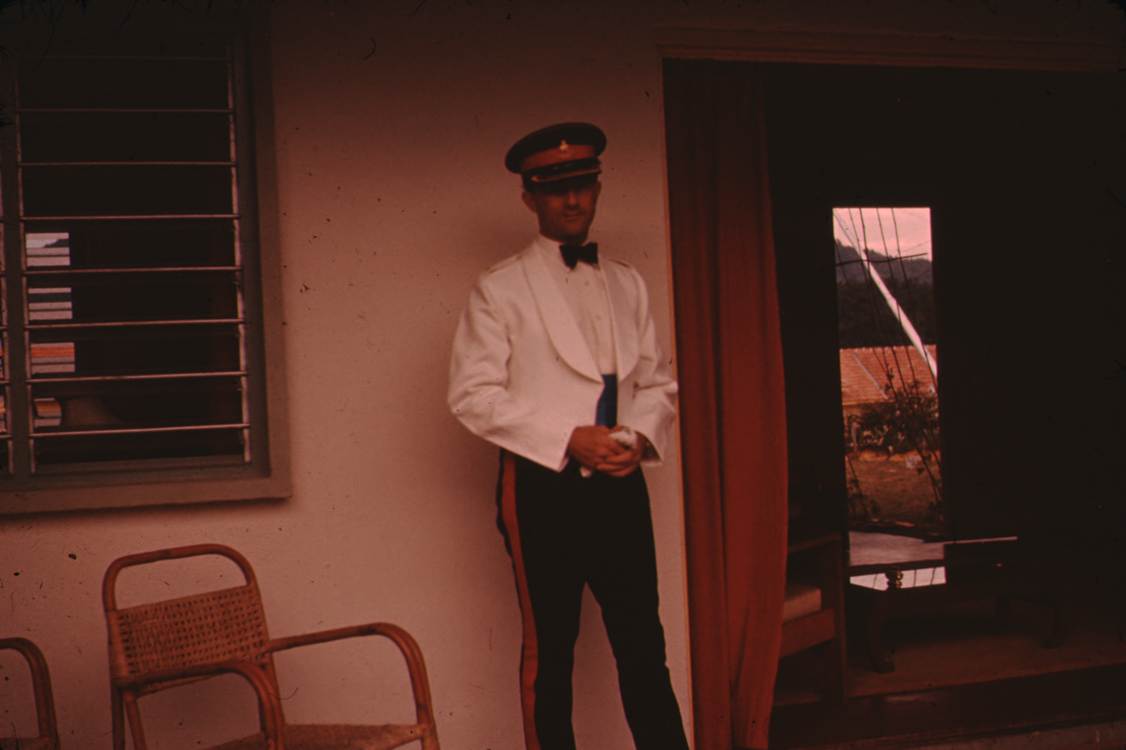
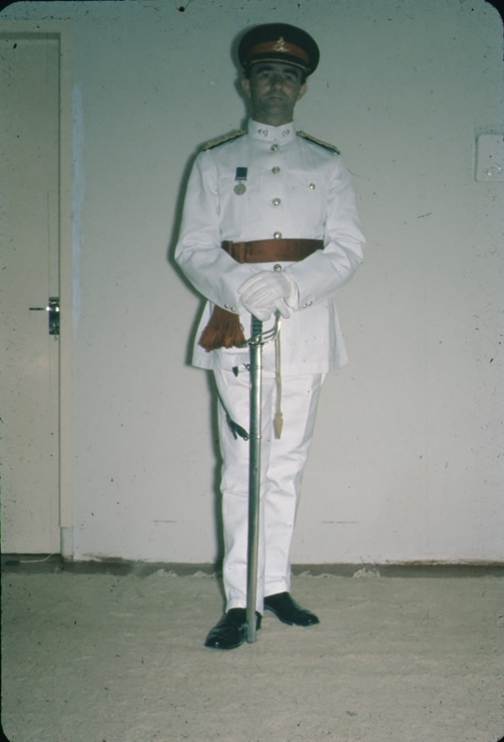
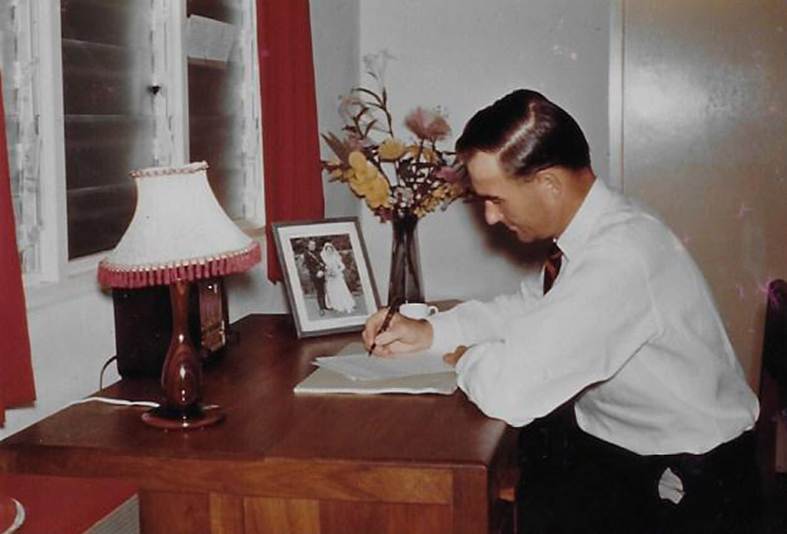
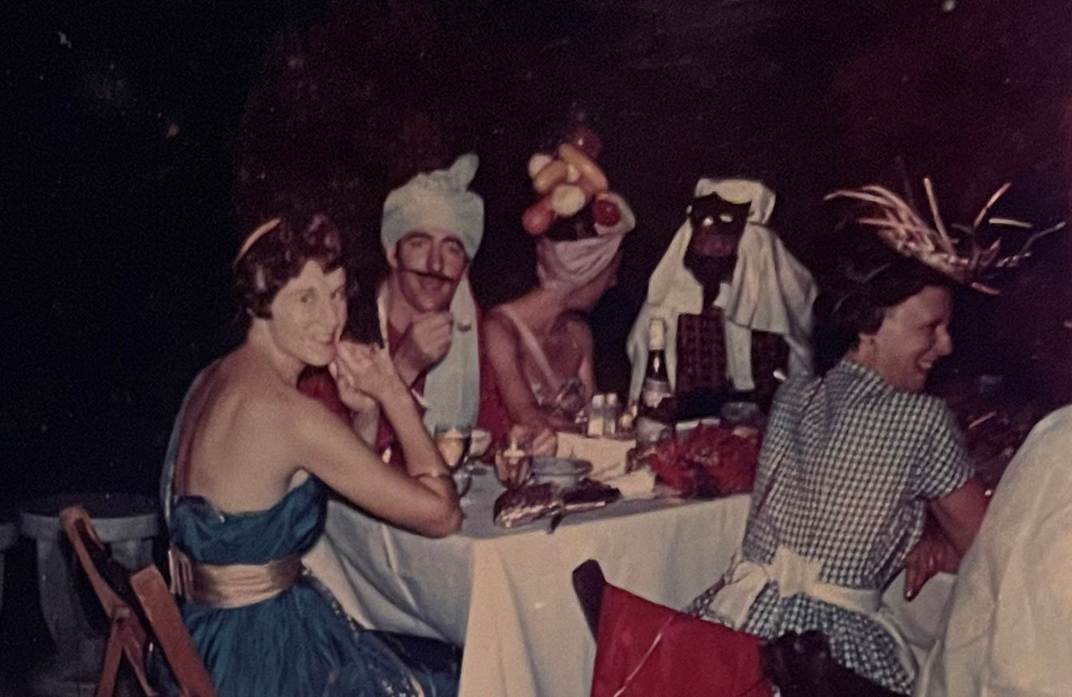
New Year Party, Seremban, Malaya,
1961
Victory Parade
On exercise
There is a
separate page which includes photographs and records of their travels around South East Asia during this time.
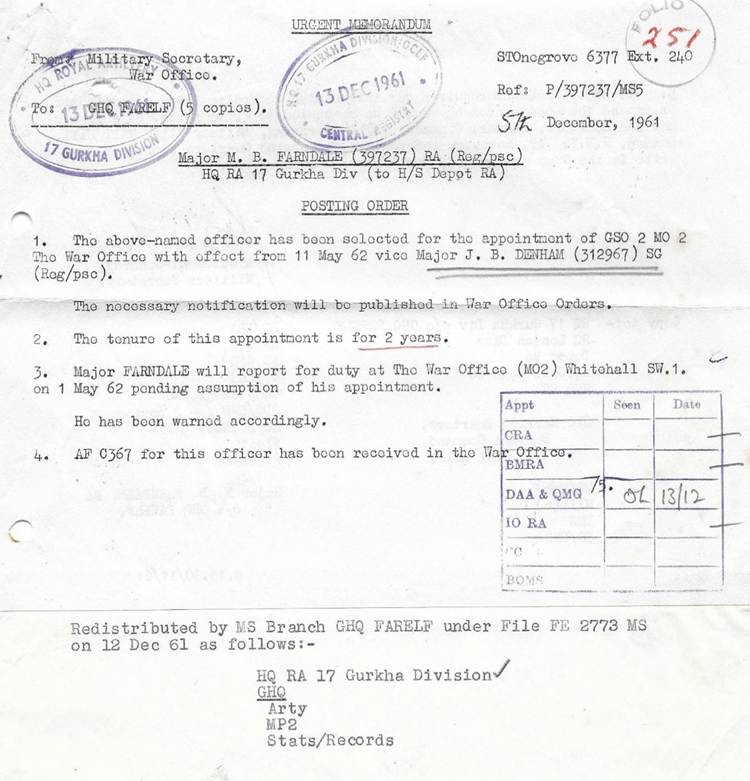
Overland from Malaysia to UK
After their posting to Malaya, Martin
and Anne Farndale drove home overland in a Ford Prefect in a remarkable journey
and you can read more about the
Journey on a separate page.
They travelled by car from Malaya to
Burma, to Calcutta, across India with a flight to Kathmandu and the Himalayas,
across Pakistan, Iran (through Isfahan and Tehran), across the length of Turkey
to Istanbul, to Ephesus by sea and then to Athens, and then back home via
Yugoslavia, Venice, the Alps, Austria, Germany, and Belgium.
The War Office, 1962 to
1964
1962
Epsom and London
In 1962, he served for two years in the
Military Operations Directorate of the War Office (which then became the
Ministry of Defence).
Family
1963
Richard Martin Farndale (FAR01122), Martin and
Anne’s only son, was born at Epson, Surrey on 17 April 1963.
First Regiment Royal Horse
Artillery, Battery Command (Major), The Chestnut Troop, 1964 to 1966
1964
Germany
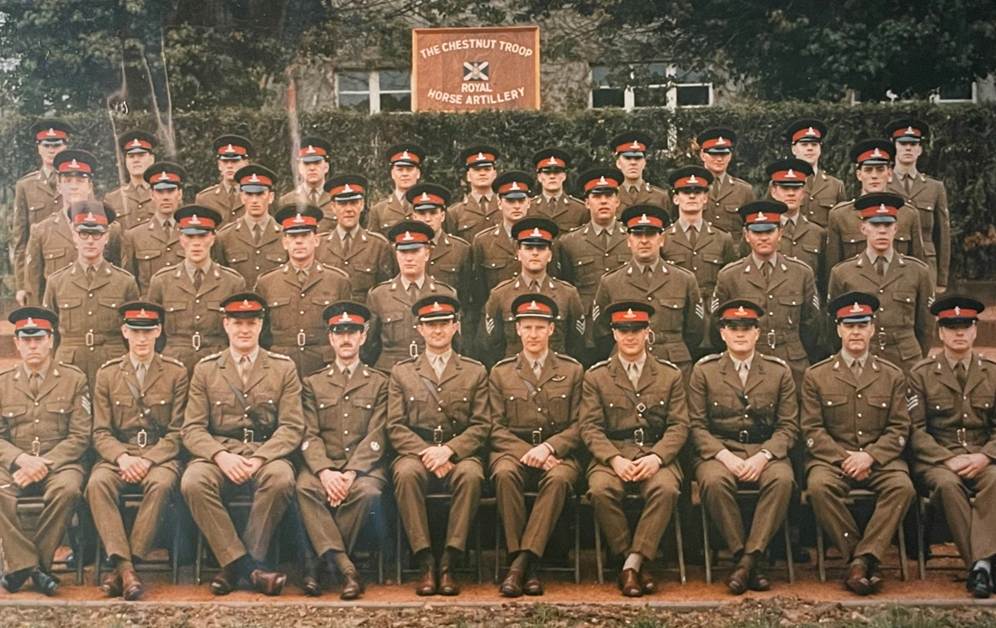
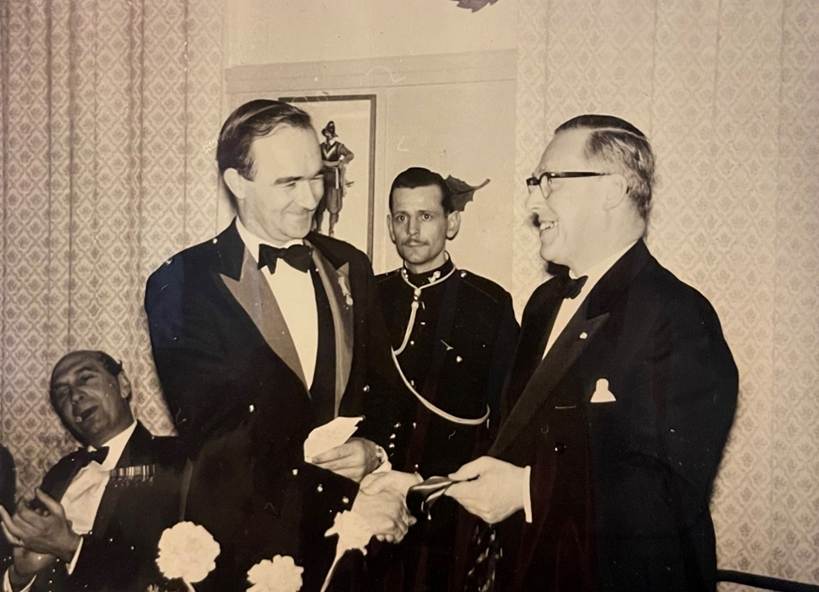
He returned to First Regiment RHA in
1964 to command the Chestnut Troop, first in Germany (Hildesheim).
The Regiment was equipped with 105 mm
pack howitzers.
1965
Aden
The Regiment was then posted to Aden
during the Radfan Campaign in the arid mountains of the Protectorate.
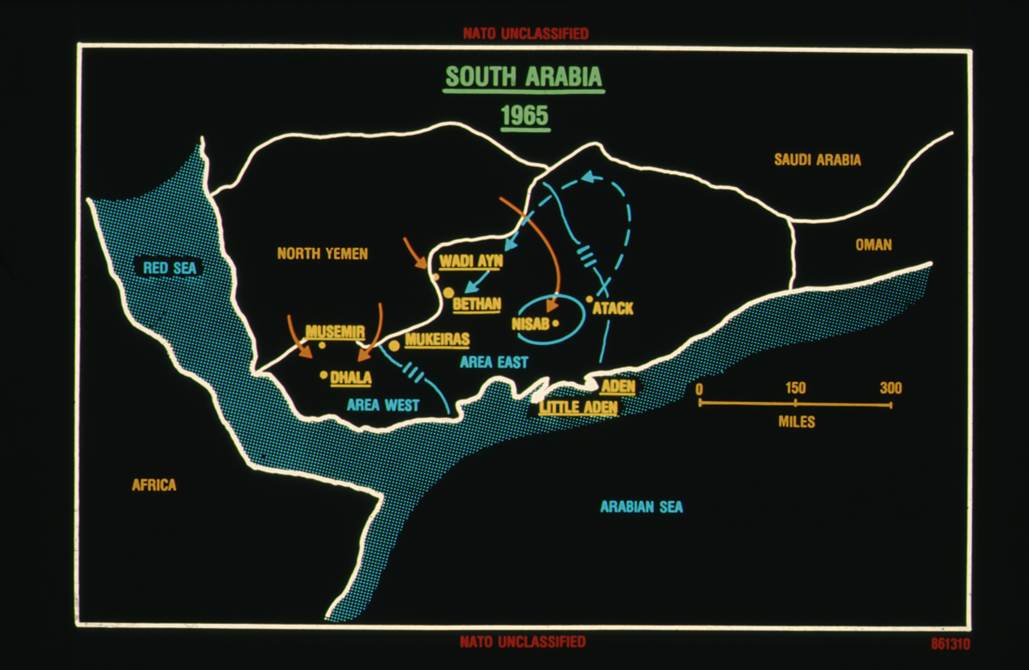
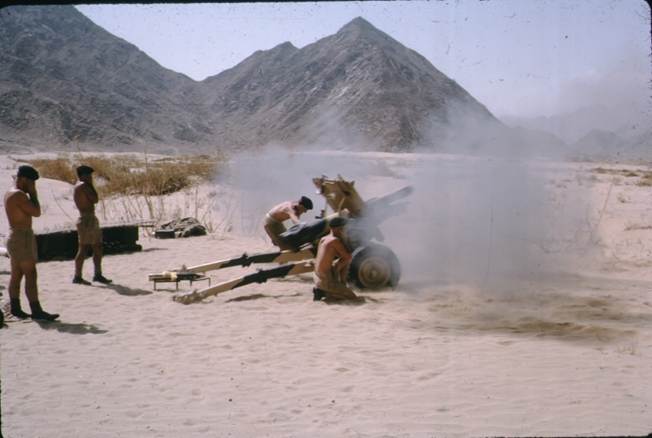
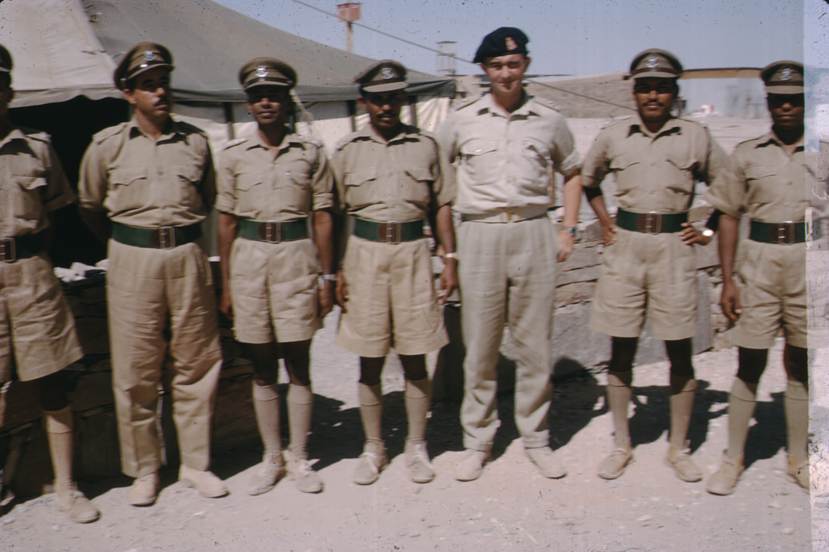
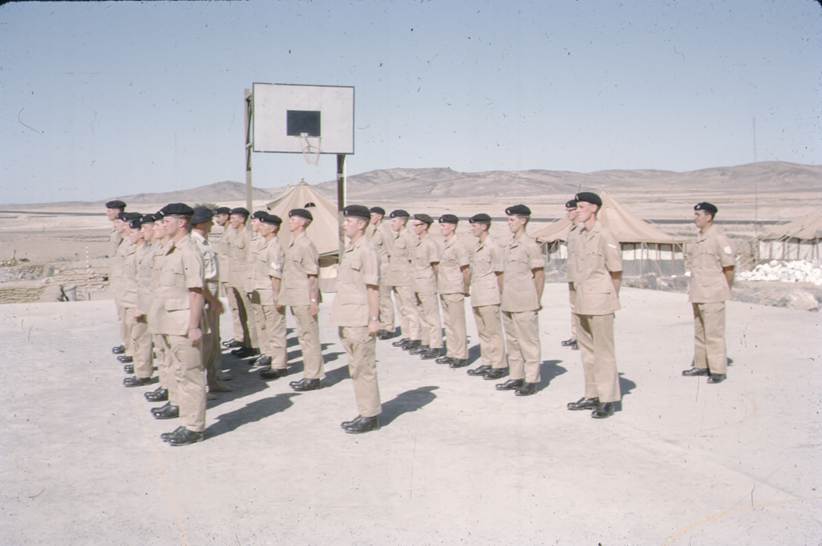
In Aden, he saw action against
tribesmen in the Radfan mountains, bordering the Empty Quarter.
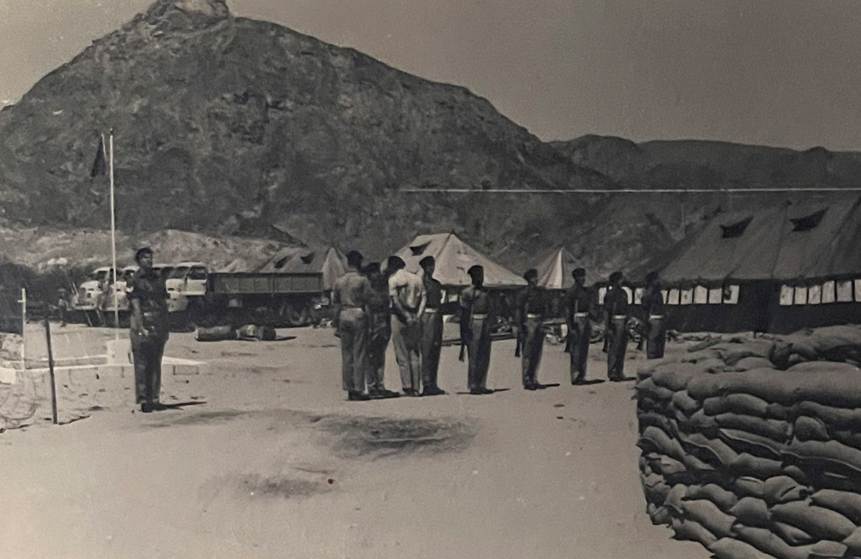
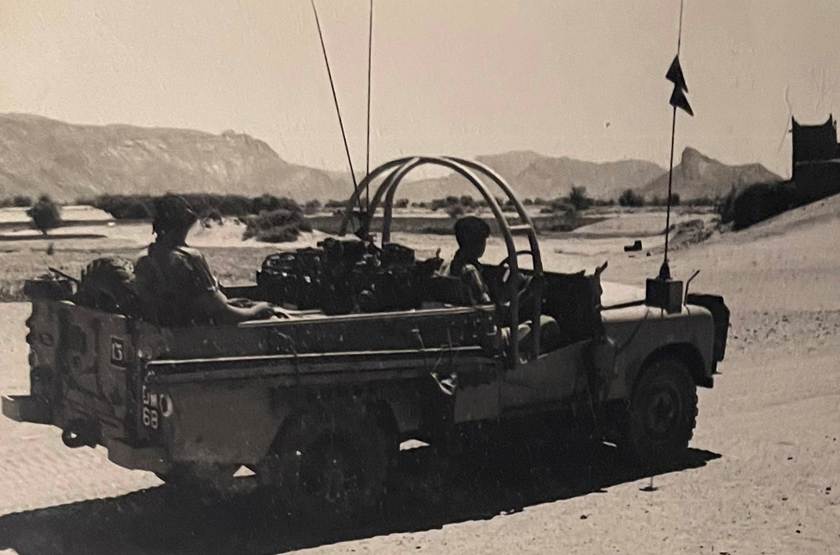
Tobruk Section, Chestnut Troop in
South Arabia, November 1965 The Battery Commander’s land rover, Border patrol, 1965
1966
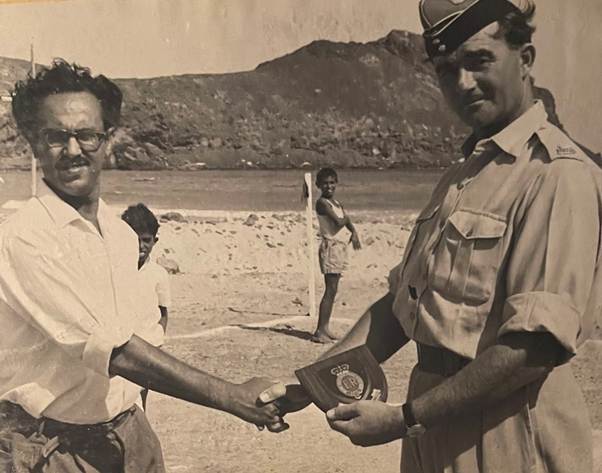
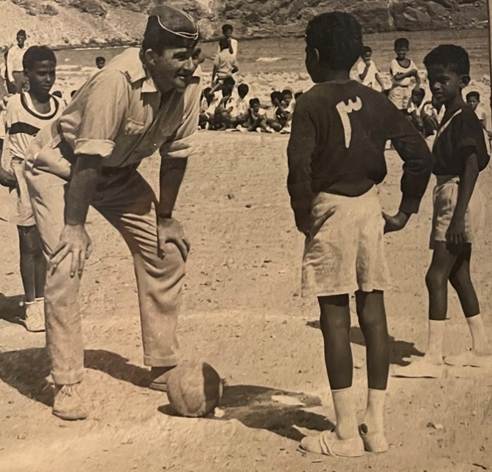
Liaison with the local school, Little Aden,
May 1966
There is a separate page about Martin
Farndale and First Regiment Royal Horse Artillery.
Staff College Instructor,
1966 to 1969
Camberley
After Battery Command, he went back to
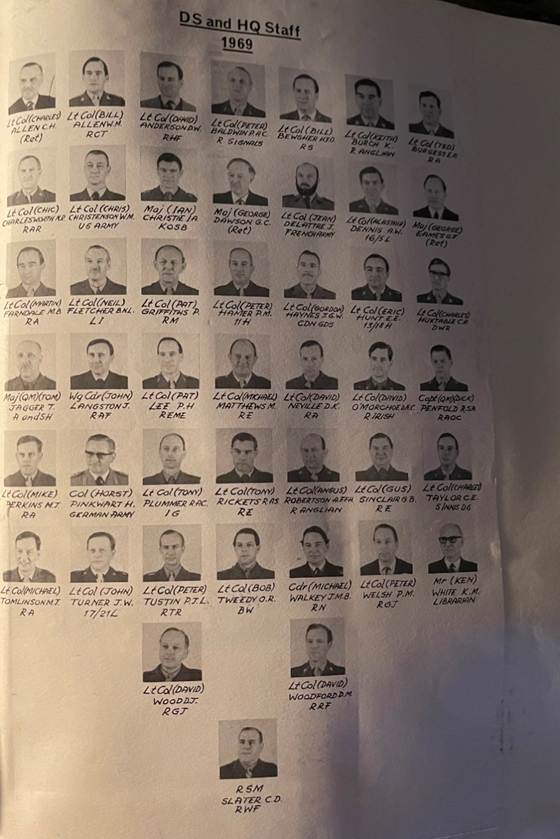
the Staff College for three years as an instructor from 1966.
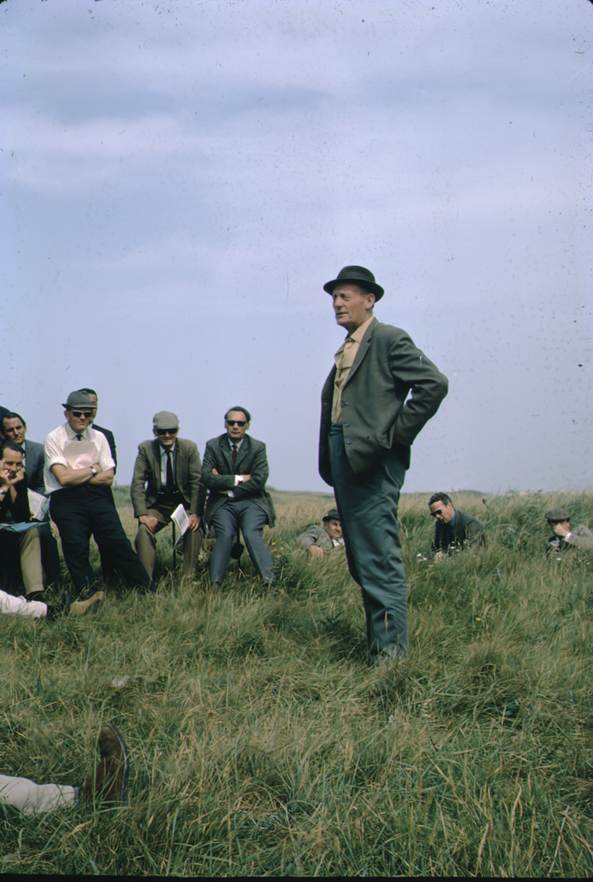
Staff College battlefield Tour (50
Division Tour) – Stan Hollis VC
First Regiment Royal Horse Artillery,
Commanding Officer (Lieutenant Colonel), 1969 to 1971
1969
Northern Ireland
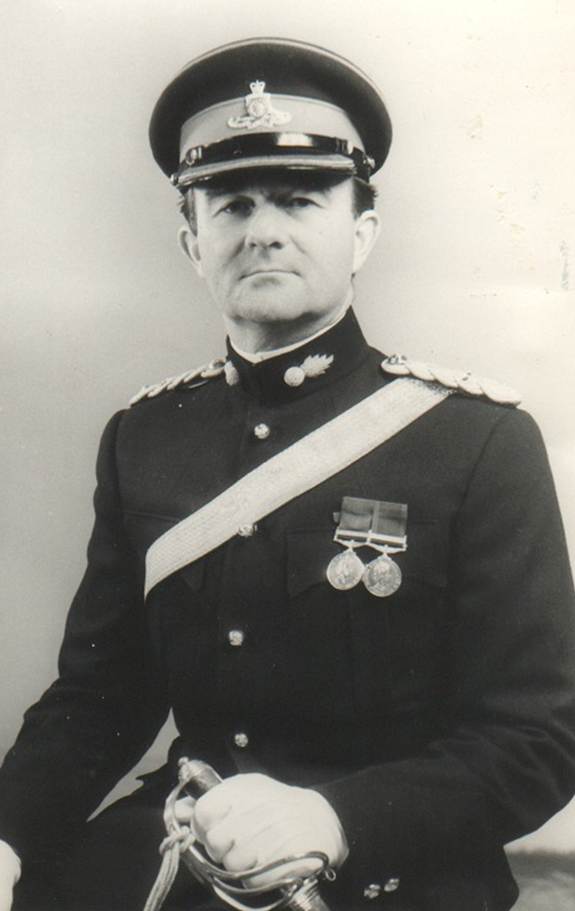
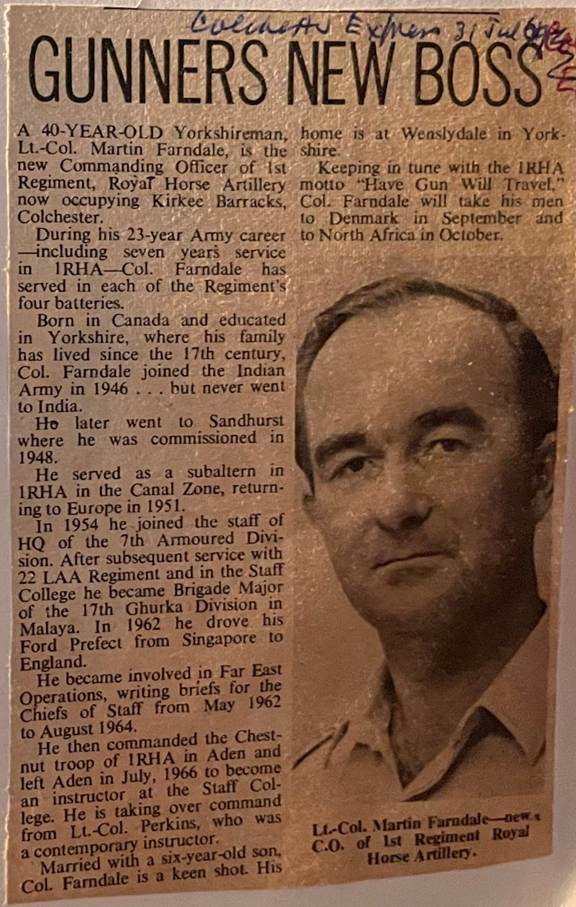
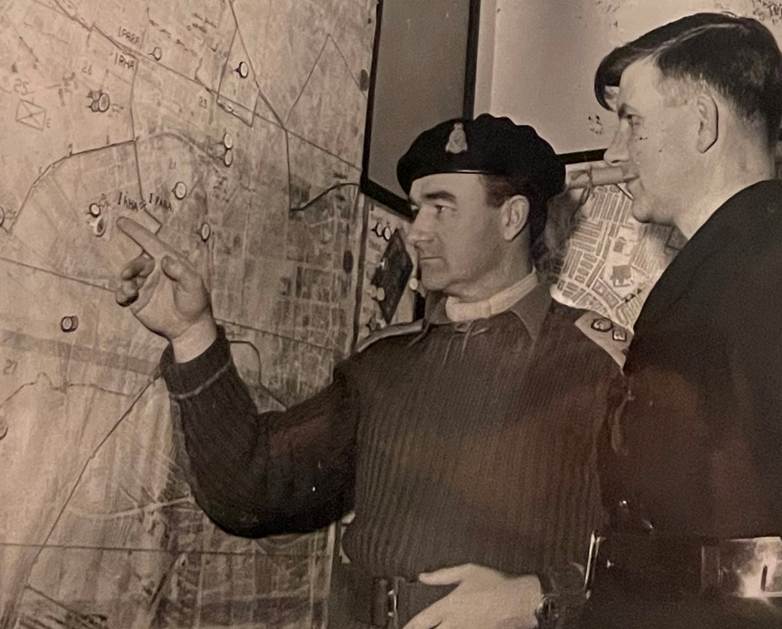
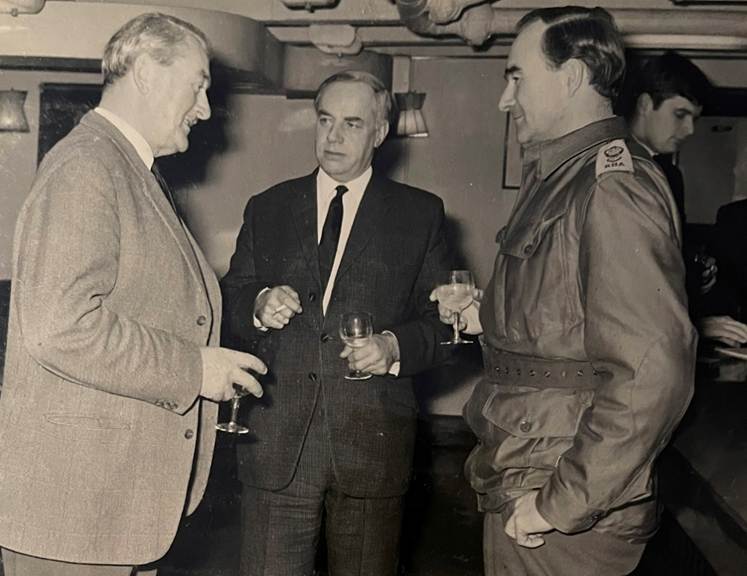
From 1969 to 1971, he was given
command of First Regiment. He was the first artillery commanding officer to
take his regiment to Northern Ireland and to serve in an infantry role on the
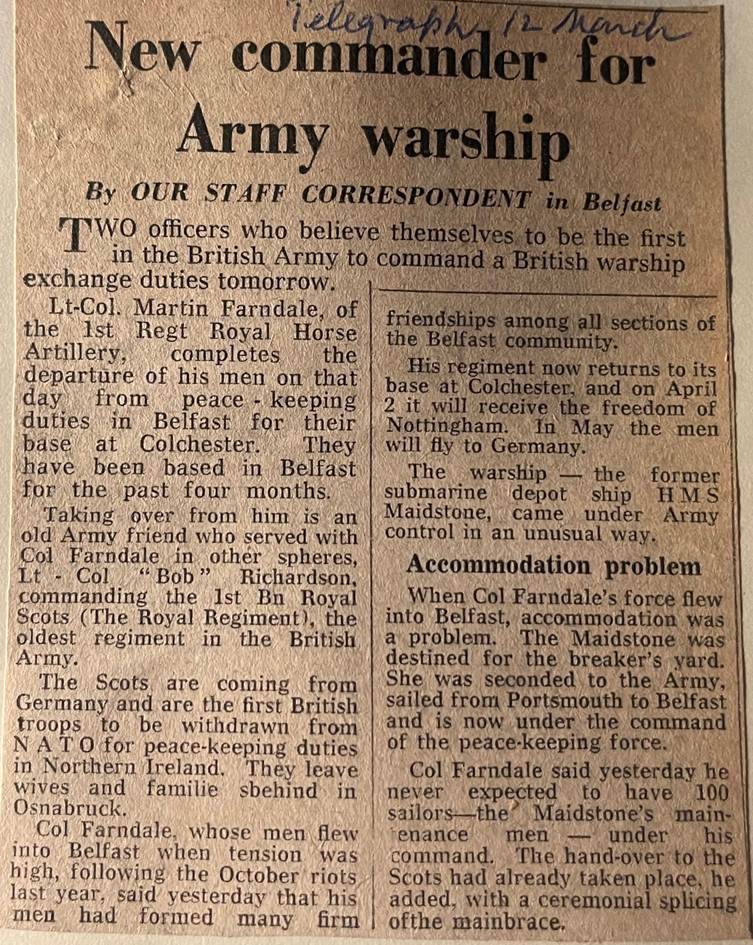
streets of Belfast. He was also the first Lieutenant Colonel to command a
warship. Accommodation was sparse in those early days, so HMS Maidstone, which
was destined for the breaker's yard, was instead sailed from Portsmouth to Belfast
and acted as a maritime barracks for the Regiment. His command included a
hundred sailors, the Maidstone's maintenance team. Also
during his command, the Regiment was granted the freedom of the City of Nottingham and a parade took place through the city on 22
April 1970. There is a painting by Terence Cuneo of the parade (Martin got to
know Terence Cuneo very well during his career and was involved in the
commissioning of many of Cuneo's military paintings). After Northern Ireland,
Lieutenant Colonel Farndale took the Regiment to Detmold in Germany, where the
Regiment was equipped with the Abbot self propelled gun.
There is a separate page about Martin
Farndale and First Regiment Royal Horse Artillery.
Northern Ireland
1970
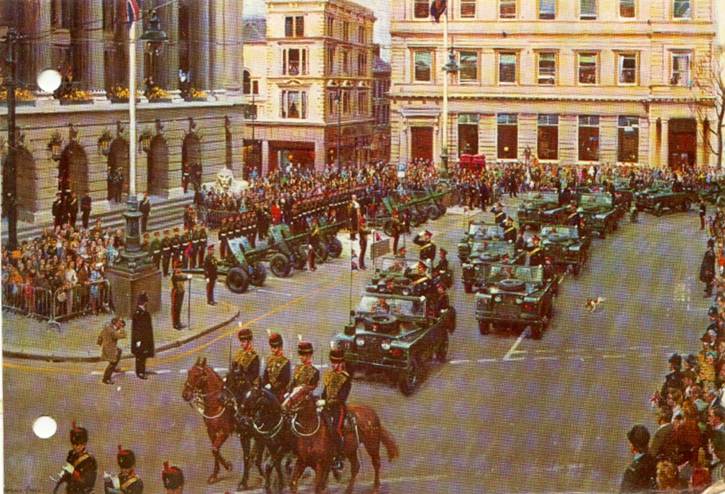
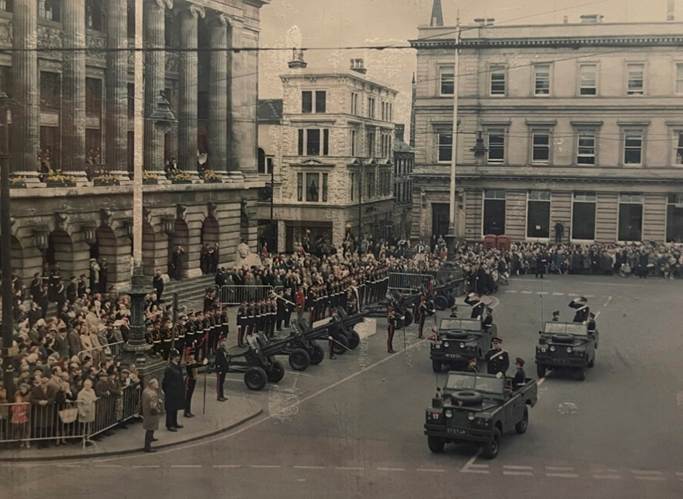
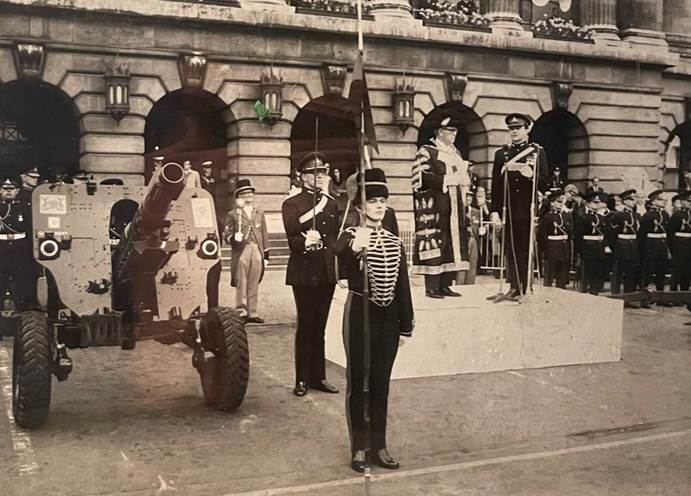
The Freedom of the City of Nottingham
Germany
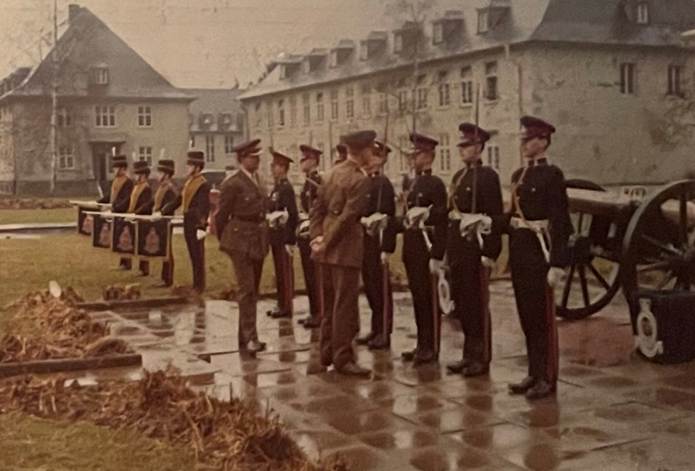
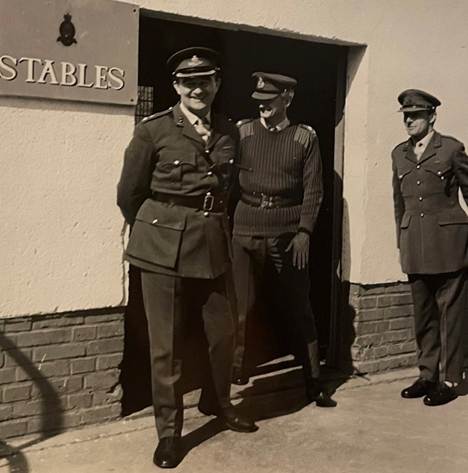
Detmold, West Germany
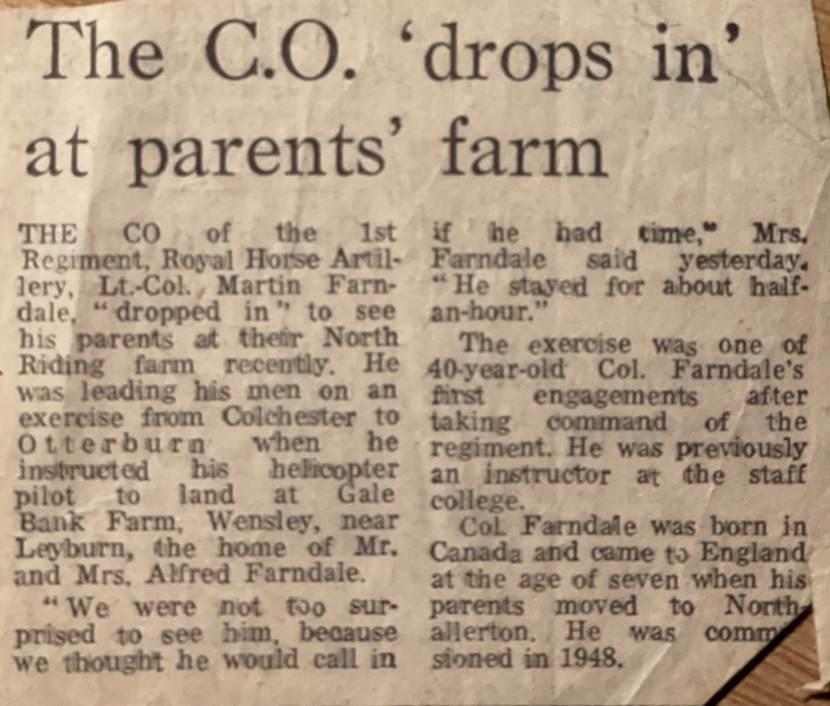
1971
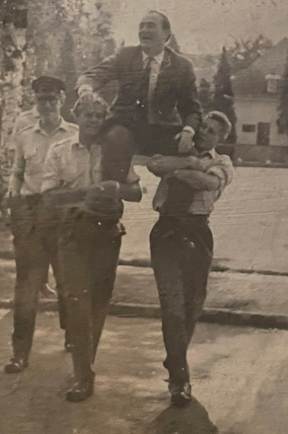
Farewell to 1 RHA
Defence Policy Staff,
Ministry of Defence, 1971 to 1973
London
Next he had two years on the Defence Policy Staff
in the Ministry of Defence.
1972
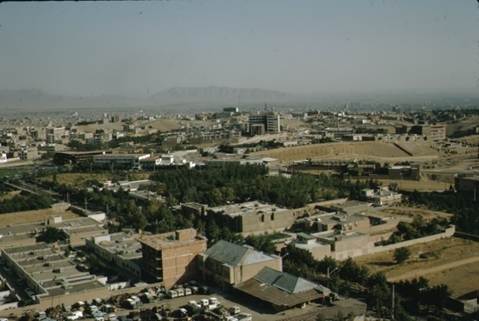
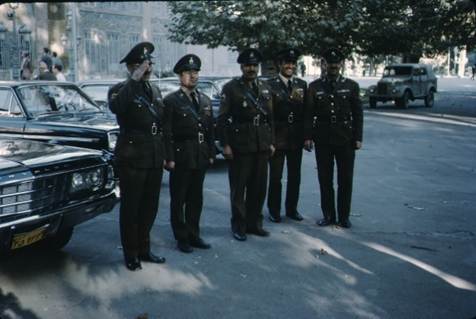
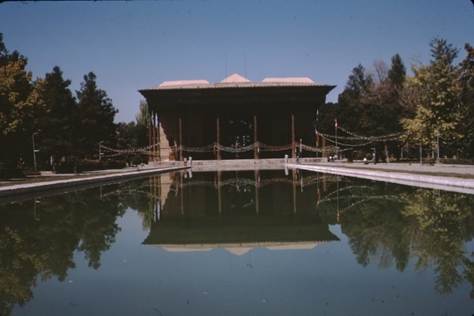
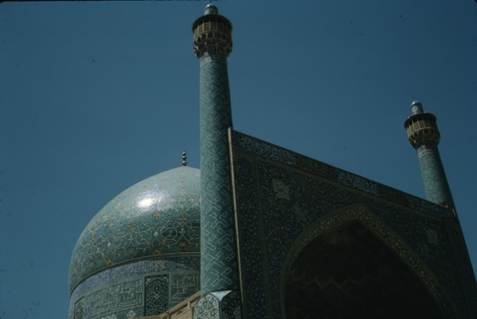
Tehran
Persian Officers
Isfahan
Persia Staff Talks 1972
7th Armoured
Brigade (The Desert Rats), Brigade Commander (Brigadier), 1973 to 1975
1973
Germany
In 1973, he was promoted to Brigadier.
The focus of his military career was with the British Army of the Rhine in then
West Germany. He commanded 7th Armoured Brigade (The Desert Rats) from December
1973 to December 1975. The Headquarters was in Soltau, Lower Saxony and he
lived at the Jagd Haus Weiss (originally the hunting lodge of the Weiss family)
at Marbostel, near Soltau. He planned the Brigade Exercise, Red Rat 74. He also
reorganised the battlefield headquarters of the Brigade from
a large conglomeration of vehicles, to a more tactical and manoeuvrable
headquarters of 22 vehicles around a 'heart' of 6 armoured vehicles.
There is a separate page about Martin
Farndale’s time as Brigade
Commander of 7th Armoured Brigade.
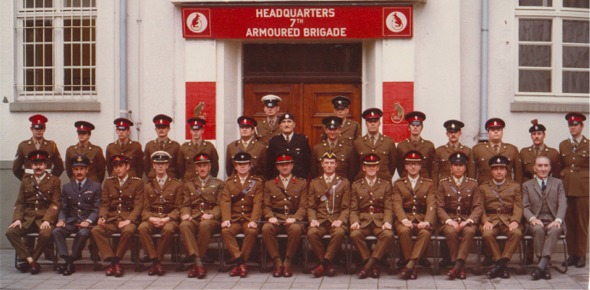
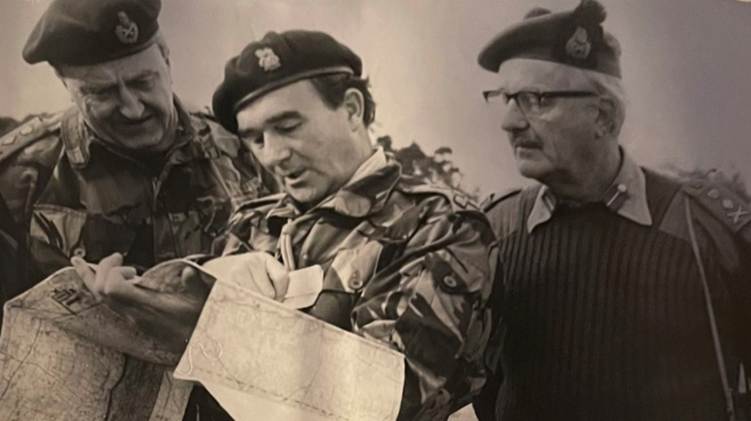
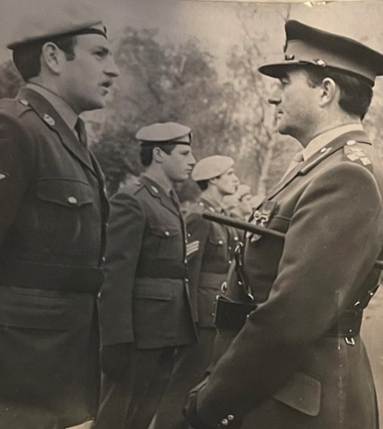
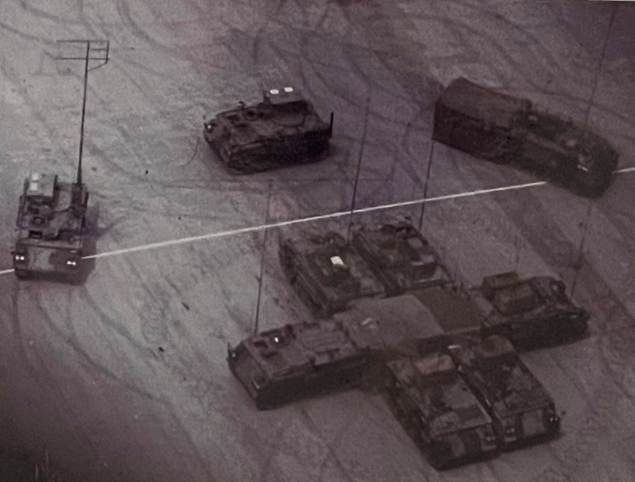
Reduced size Tactical Brigade
Headquarters
Ministry of Defence, 1976
to 1980, Director of Public Relations (“DPR”)(Brigadier)
and Director of Military Operations (“DMO”)(Major
General)
1976
London
In New Year 1975/76 he moved back to
the Ministry of Defence as Director of Military Operations (1976 to 1978).
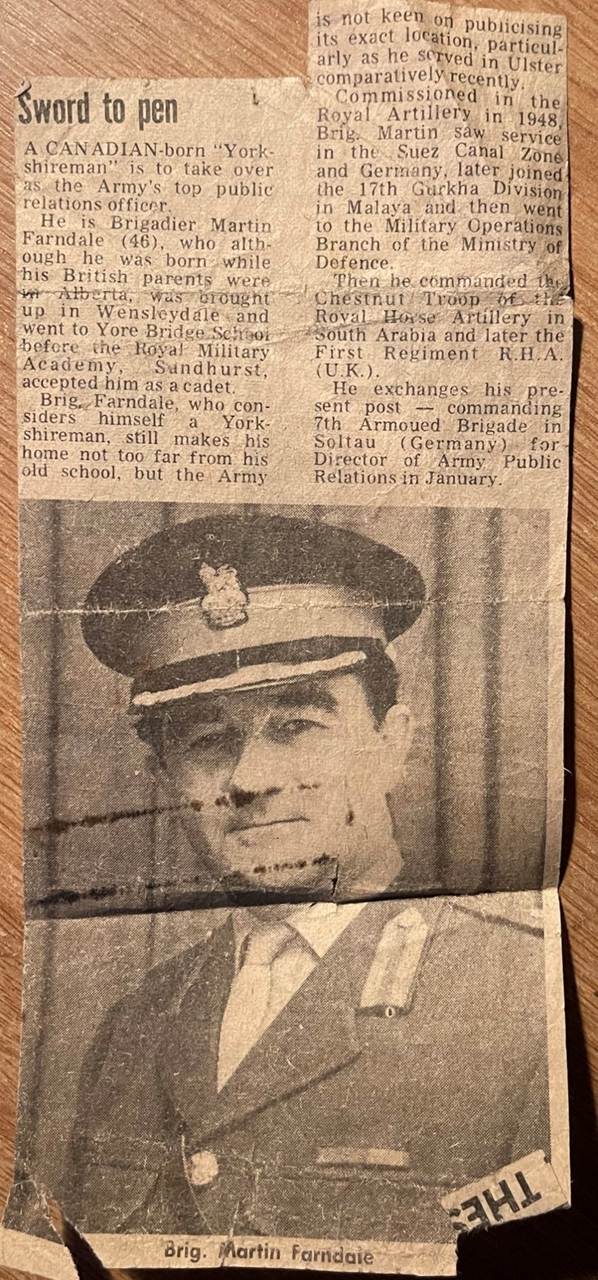
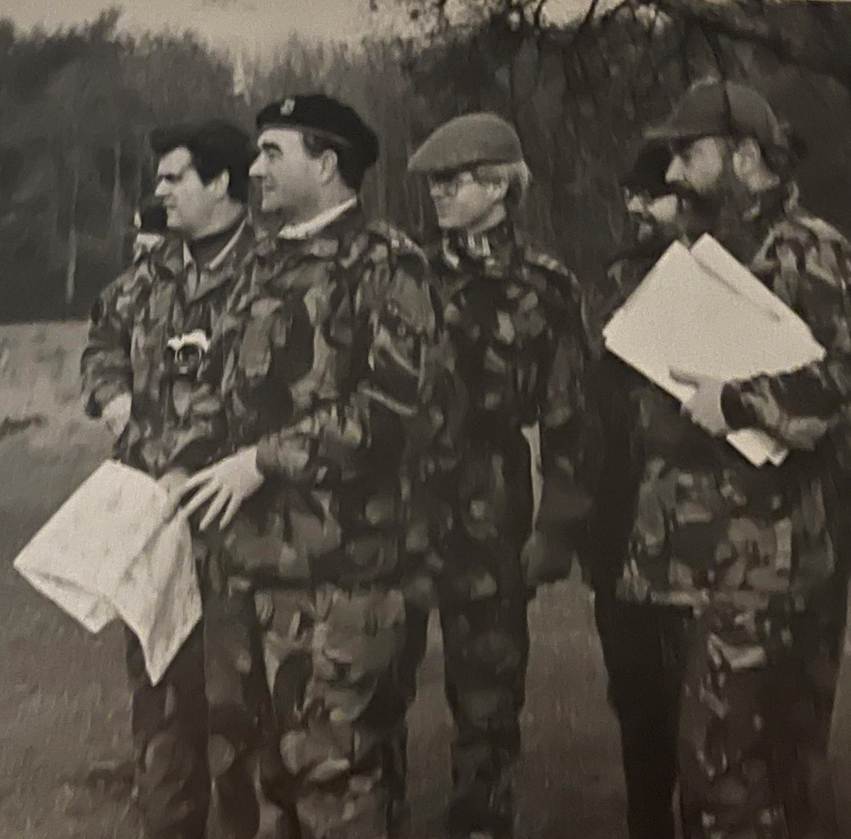
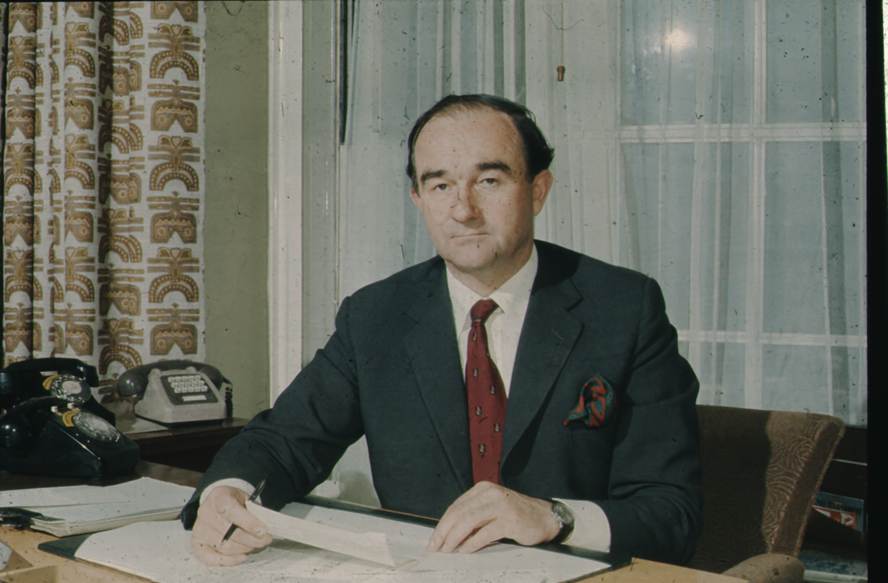
With the Press, Exercise Spearpoint 1976 (Harry Greenfield, Sunday
Telegraph extreme right)
Brigadier Farndale,
DPR (Army)
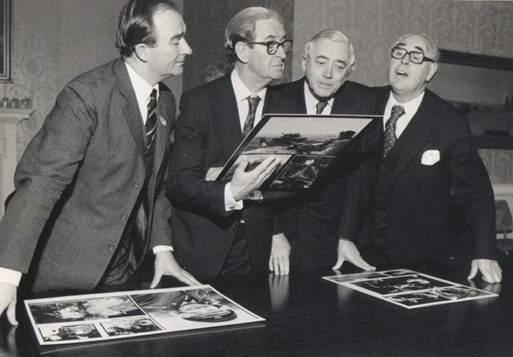
Judging the annual photographic
competition in 1976
1978
In 1978, he was appointed as Director
of Military Operations in the rank of Major General (1978-1980). He was DMO
during the final phases of the guerrilla campaign in Rhodesia after Ian Smith's
unilateral declaration of independence. He was largely responsible for setting
up the British Monitoring Force which helped to end the guerrilla war and bring
about an independent Zimbabwe. He was also responsible for considering the
increased military requirements for dealing with a spiralling illegal immigrant
problem in Hong Kong.

1979
In his role as Director of Operations
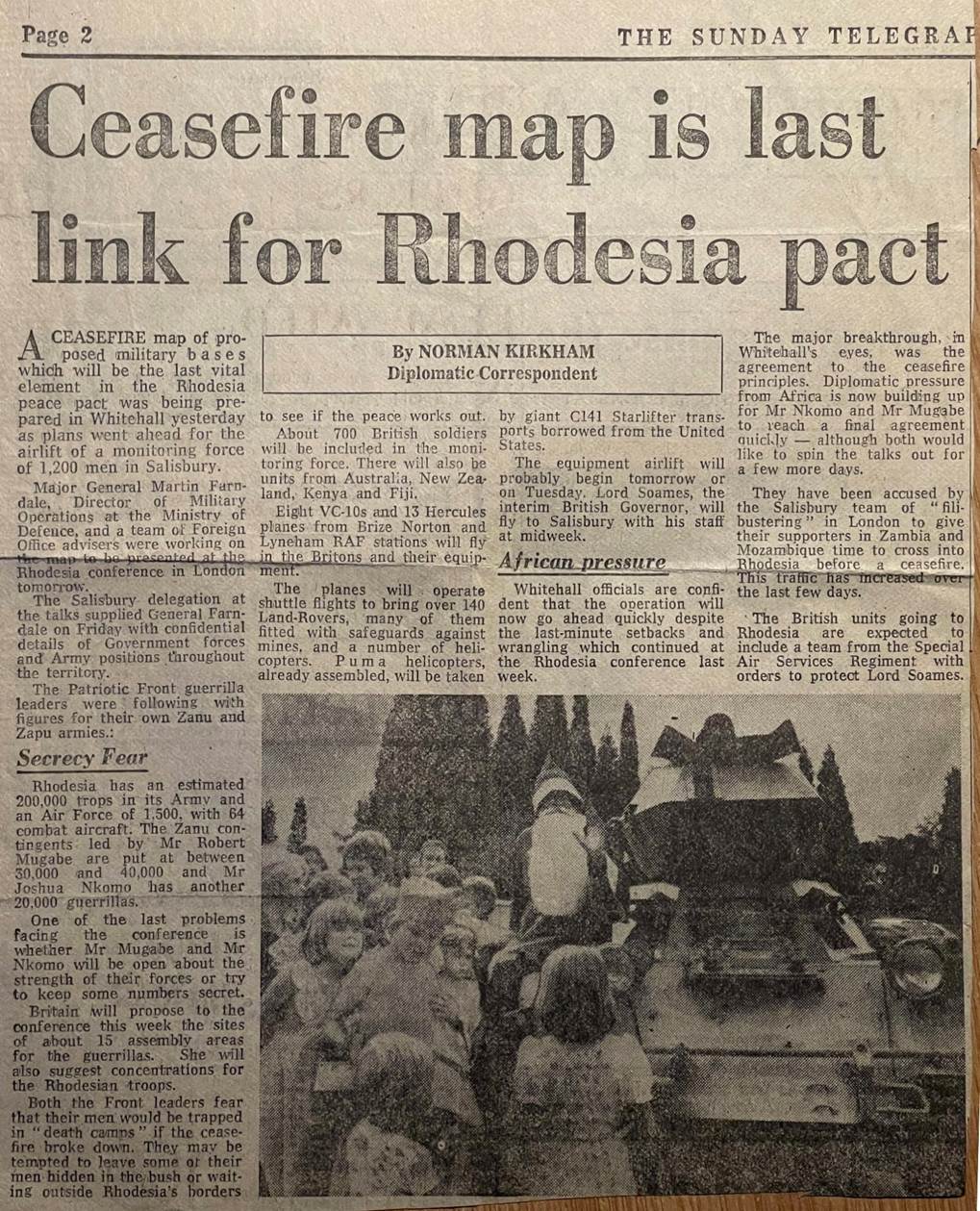
at the Ministry of Defence Martin Farndale had to organise the disarming of
guerillas in order to facilitate the creation of the
future nation of Zimbabwe.
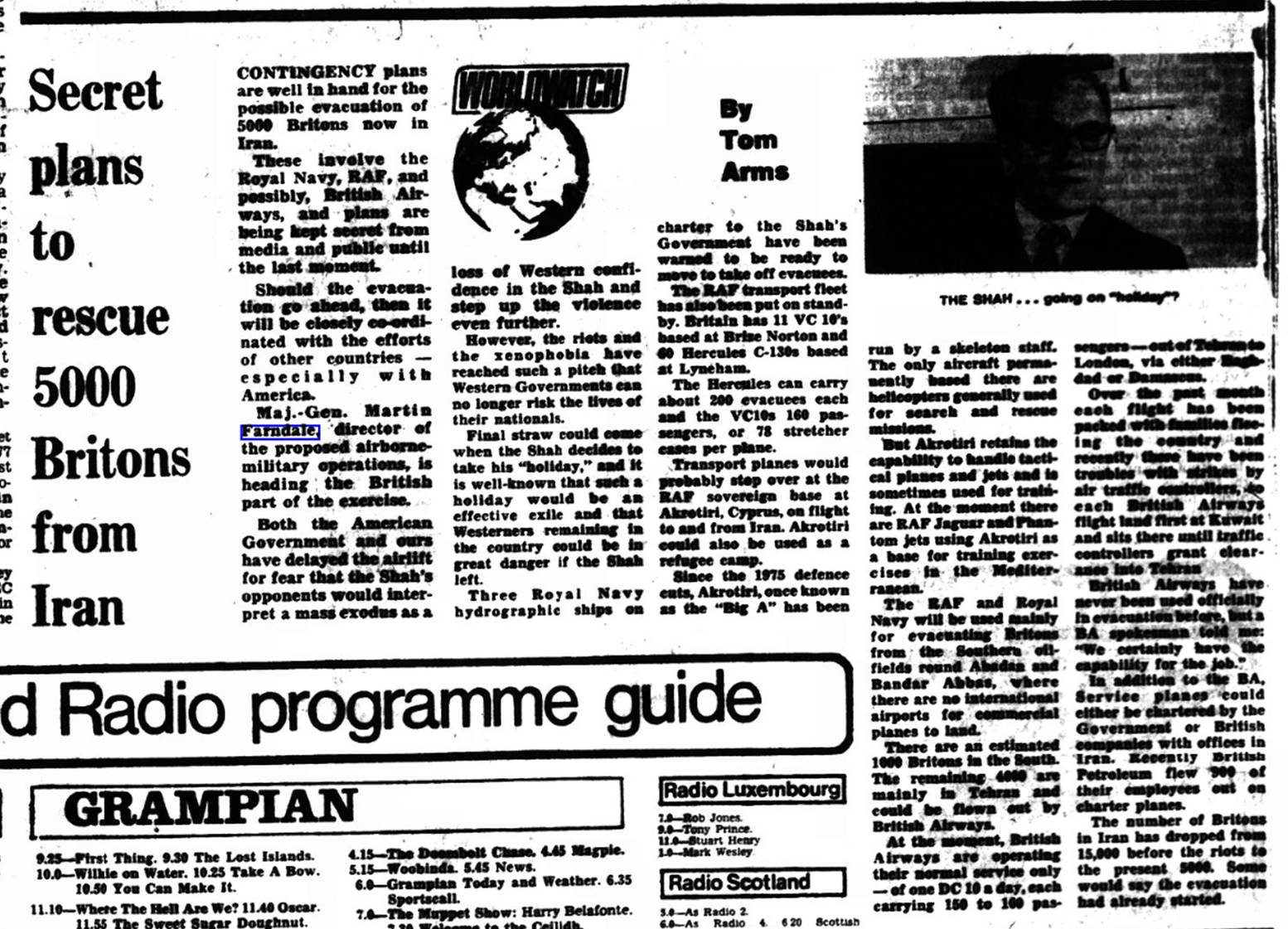
(Press and
journal, 5 January 1979)
The Rhodesia Ceasefire:
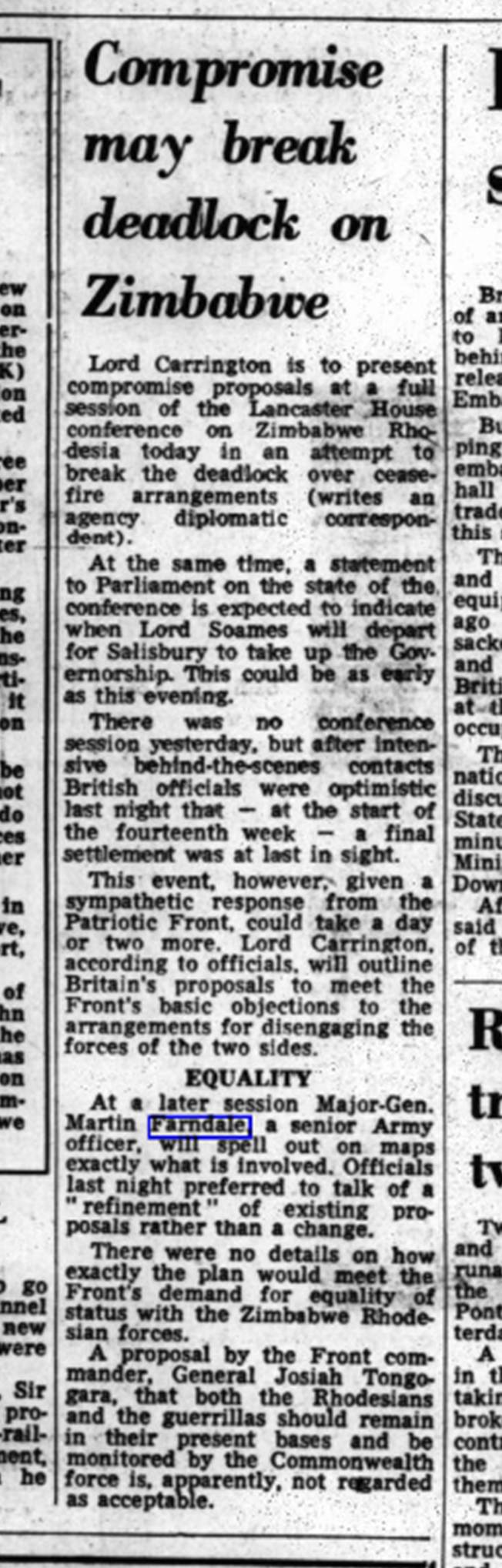
(The Scotsman, 11 December 1979)
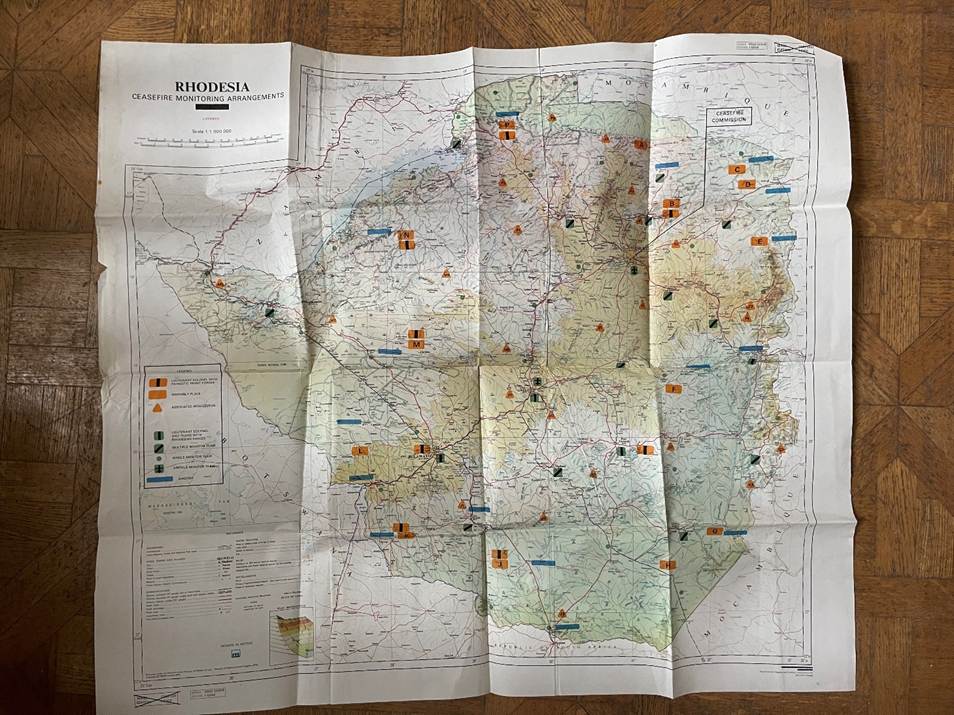
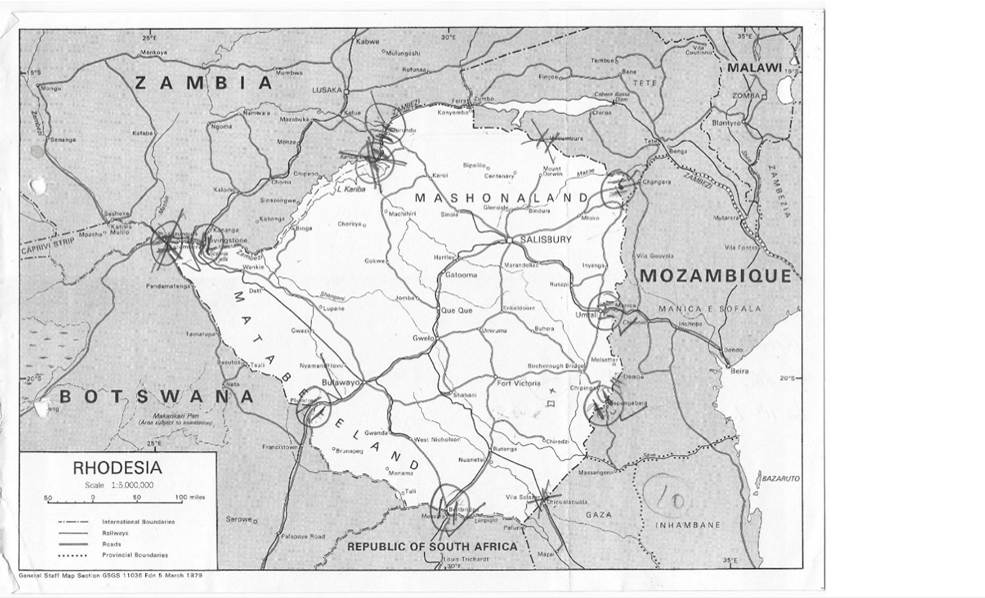
The map used by Martin Farndale as DMO
to produce the ceasefire plan for Rhodesia, November to December 1979 The map
marked up by General Walls at a meeting with Martin Farndale to resolve the
knotty cross border problem at the eleventh hour on 12 December 1979
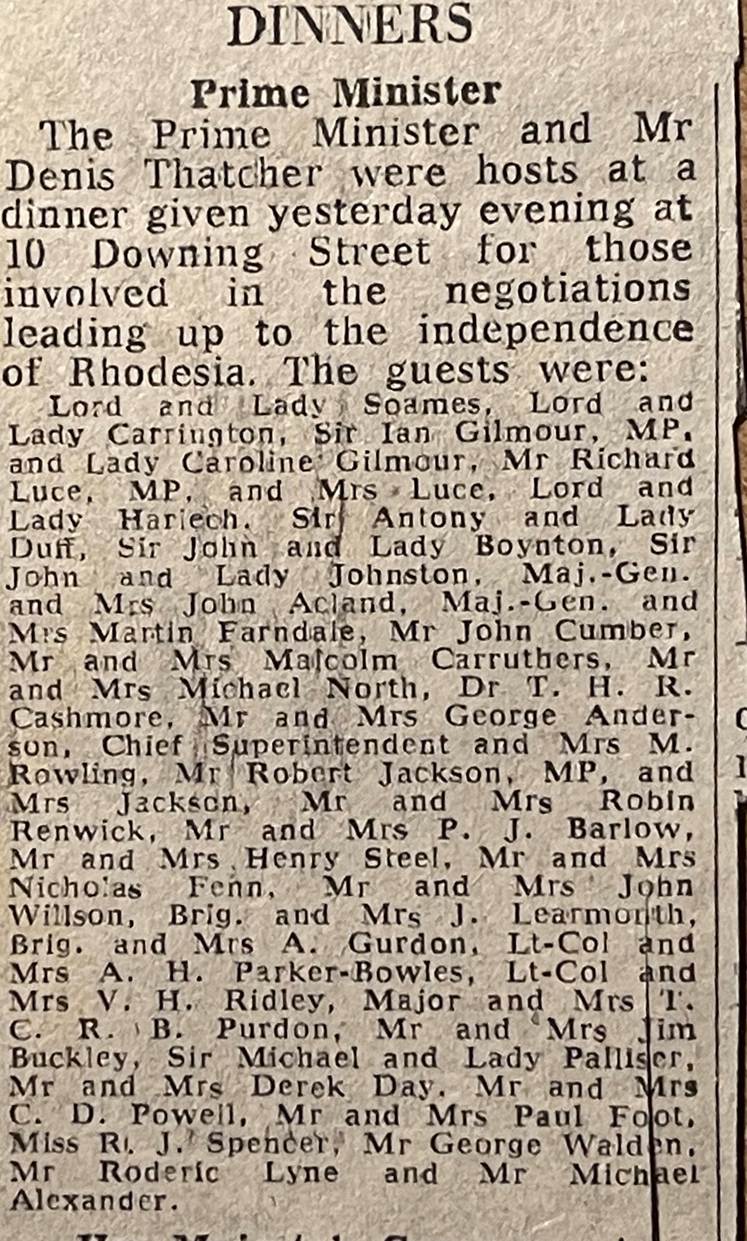
The Army Air Corps, Colonel
Commandant, 1980 to 1988
1980
In 1980 he became Colonel Commandant
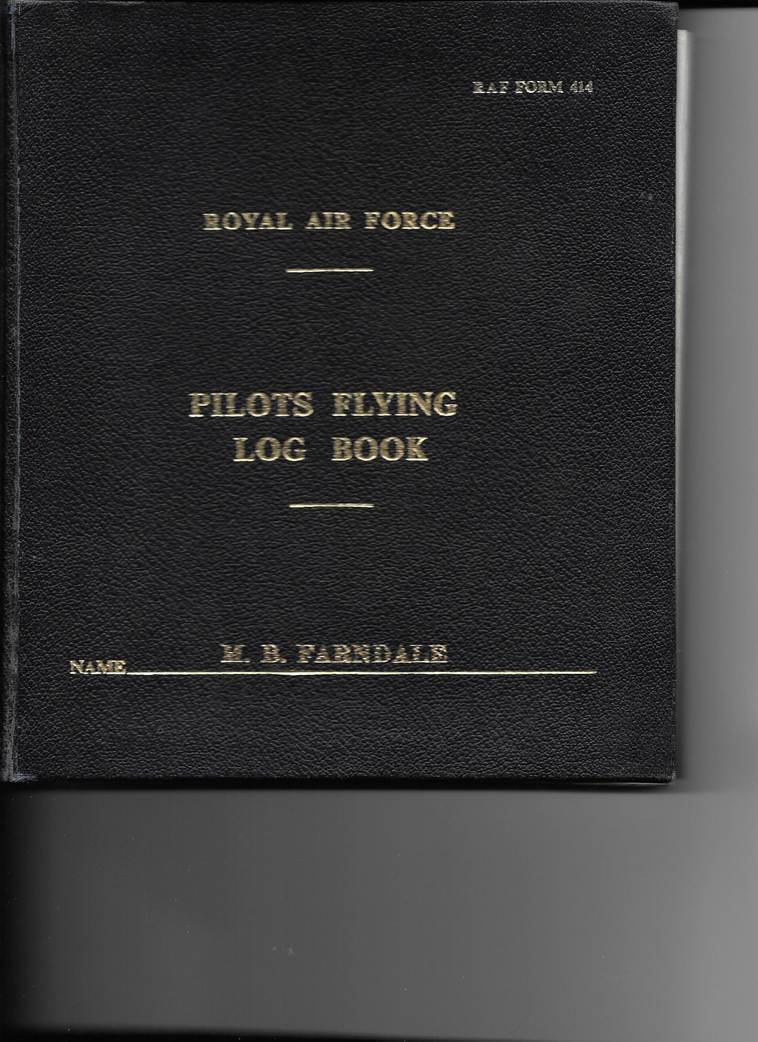
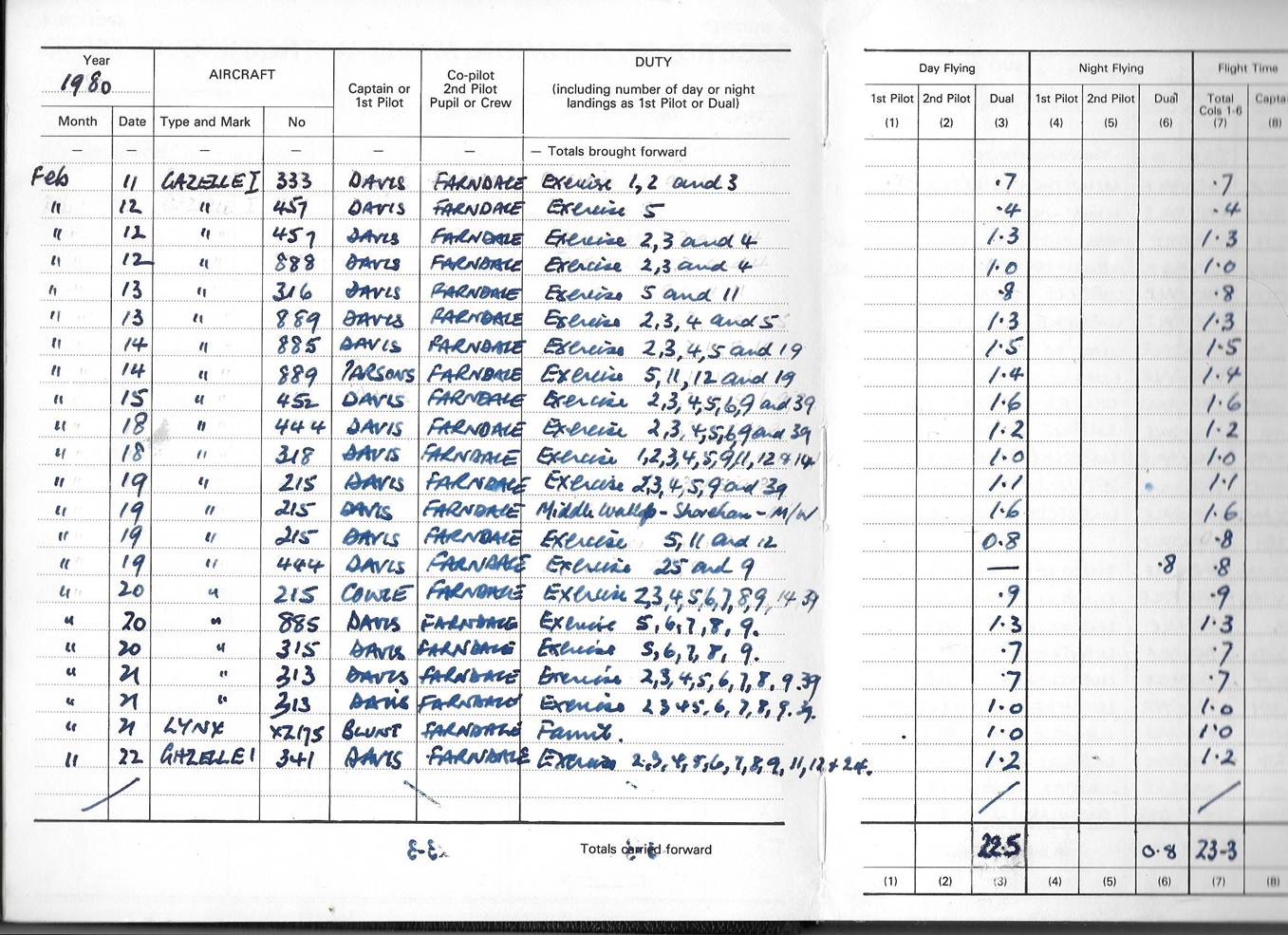
Army Air Corps. He learnt to fly a helicopter and built up a considerable log of
flying time, particularly during his later commands in Germany. He continued in
that post until 1988.
There is a separate page about Martin
Farndale as Colonel Commandant of the Army Air Corps.
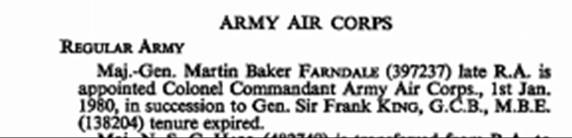
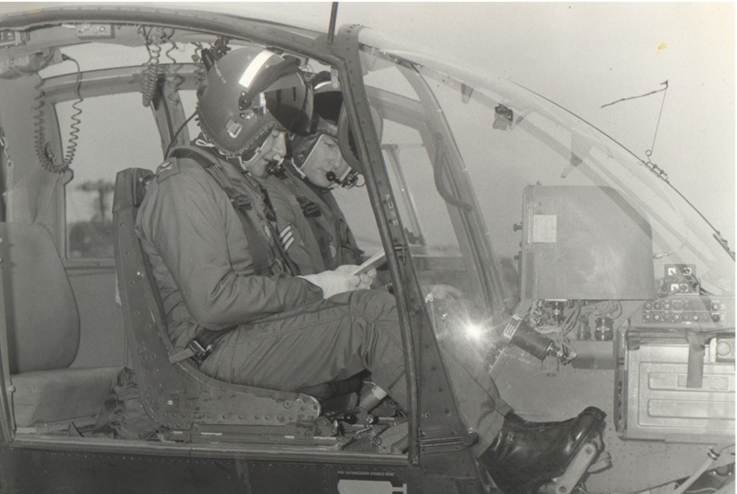
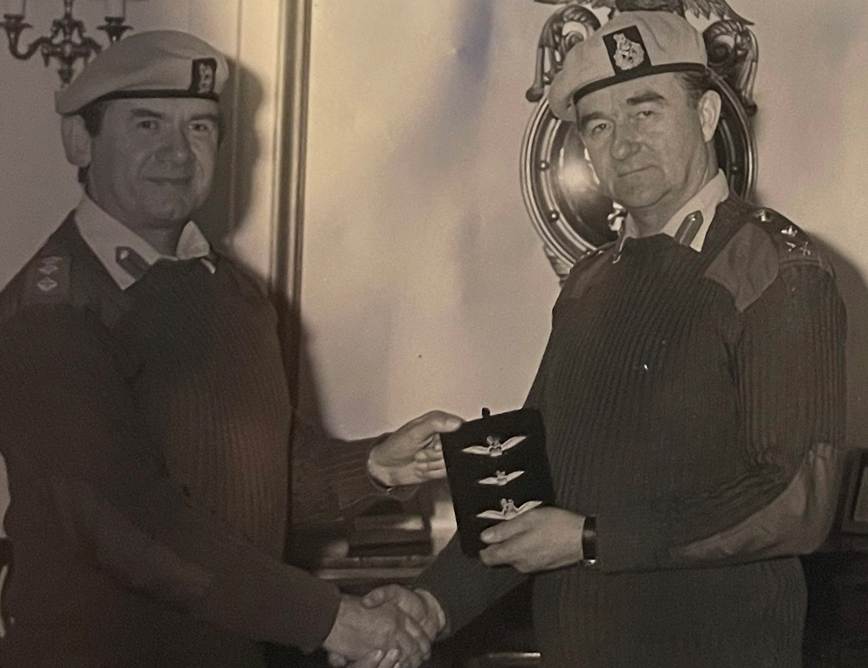
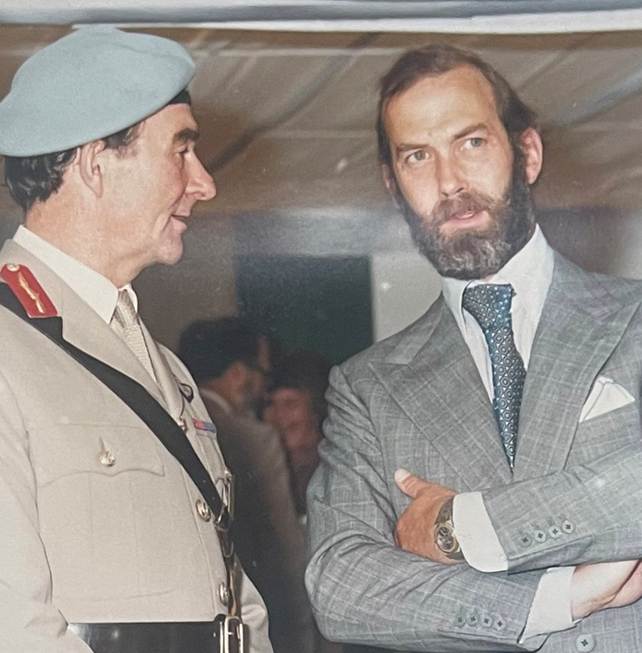
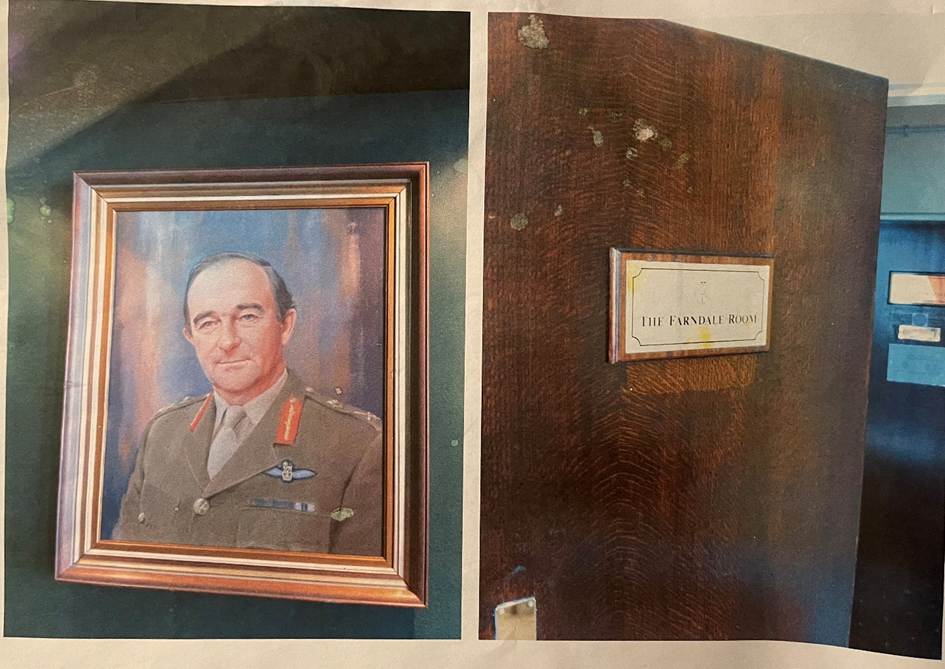
Learning to fly
Receiving his wings at Middle Wallop from Colonel Mike Badger, 1980 With the Duke of Kent
Second Armoured Division,
Commander (Major General), 1980 to 1983
Germany
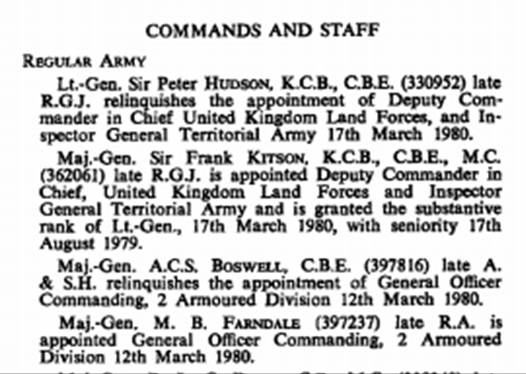
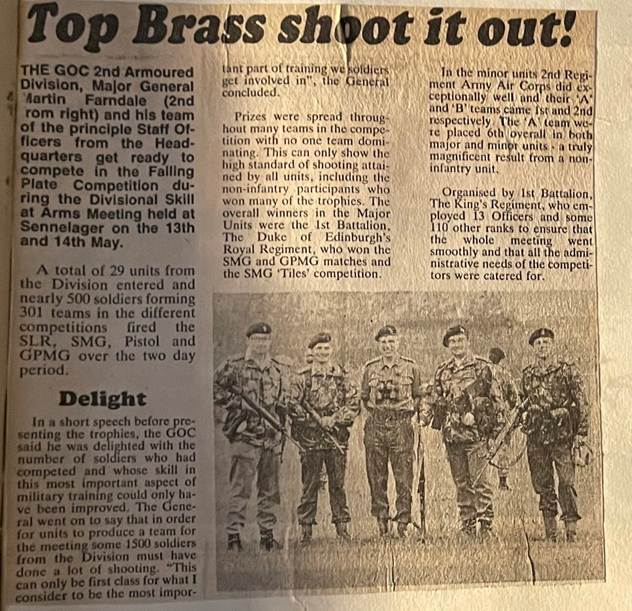
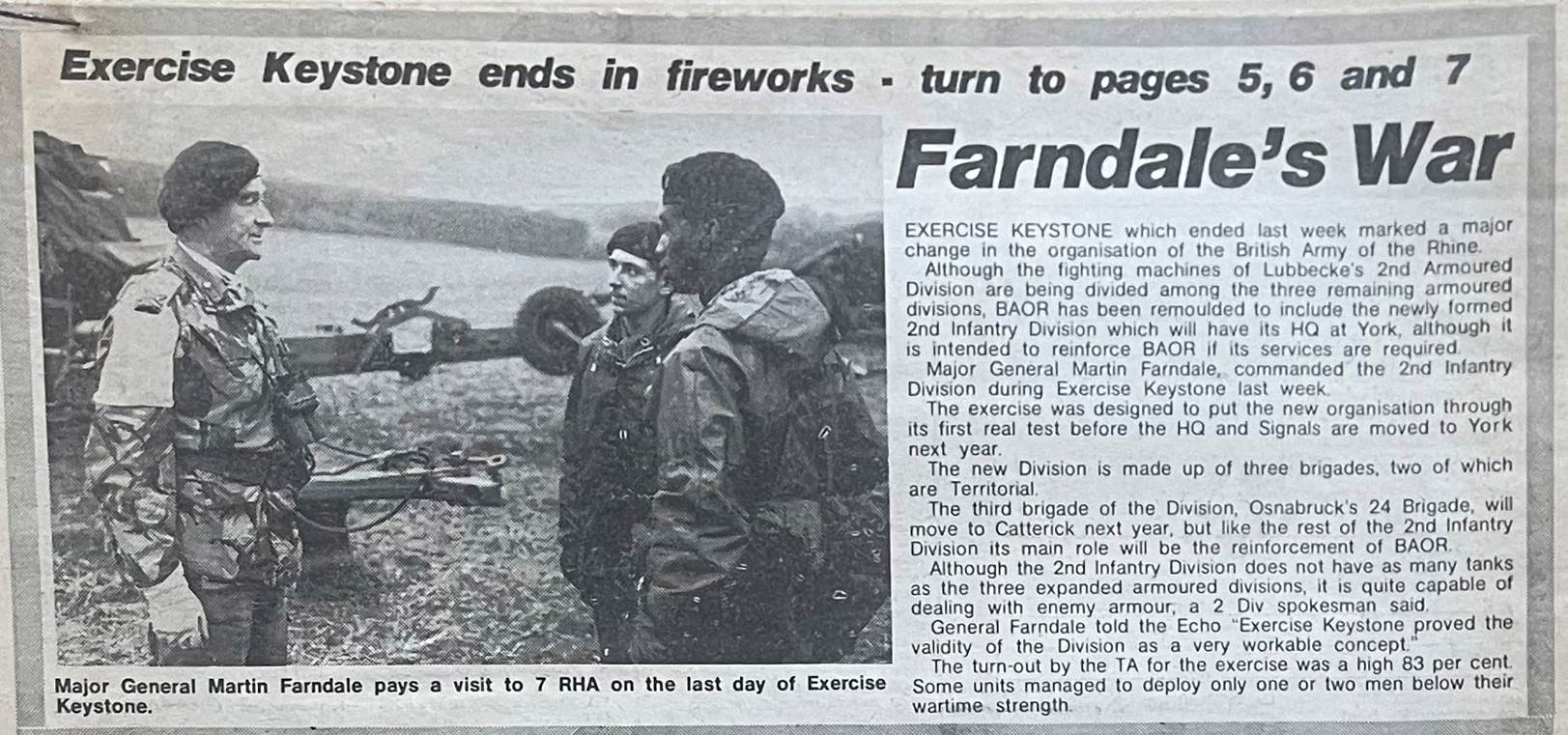
He commanded 2nd Armoured Division as
Major General from June 1980 to March 1983. The Headquarters was in Lubbecke and he lived at Cross Keys House, a house of
remarkable architecture with no corners and curved edges. He commanded the
Division during Exercise Spearpoint in September 1980, during which the
Division's 14,000 men and 150 tanks took the full weight of an enemy 'Orange'
simulated Soviet break-in. He also planned Second Division's Exercise Keystone
in November 1982.
There is a separate page about Martin
Farndale as Commander of Second Armoured Brigade.
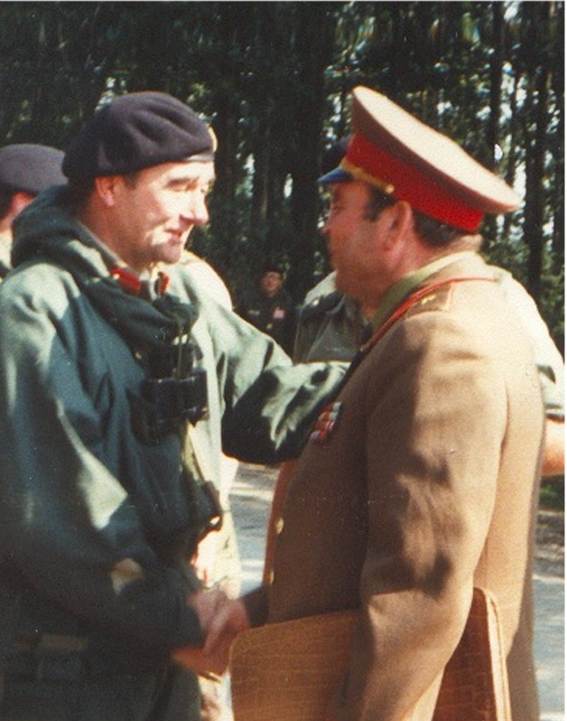
Major General Farndale meets a Russian
General observer during Exercise Spearpoint 1980
First (British) Corps,
Commander (Lieutenant General), 1983 to 1985
1983
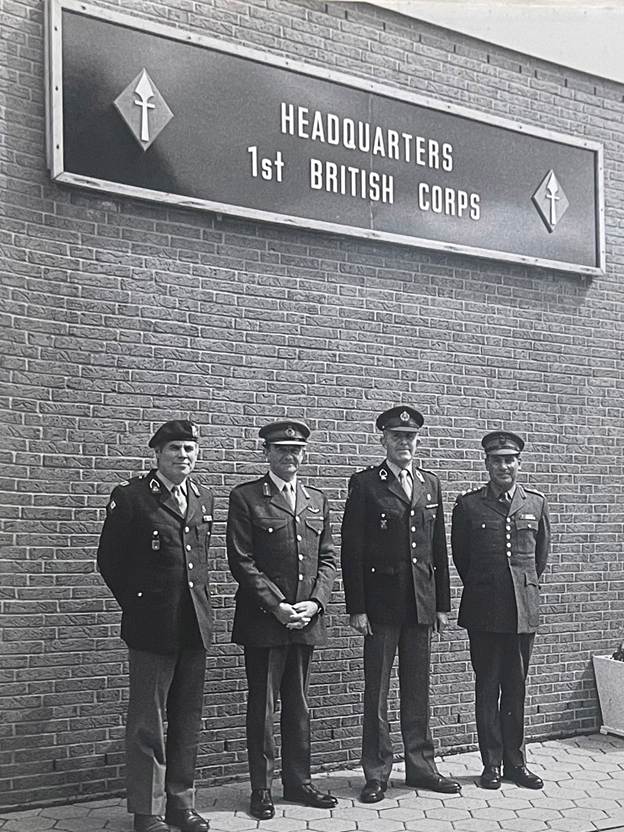
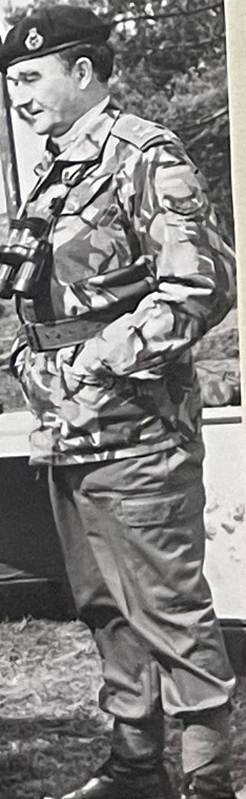
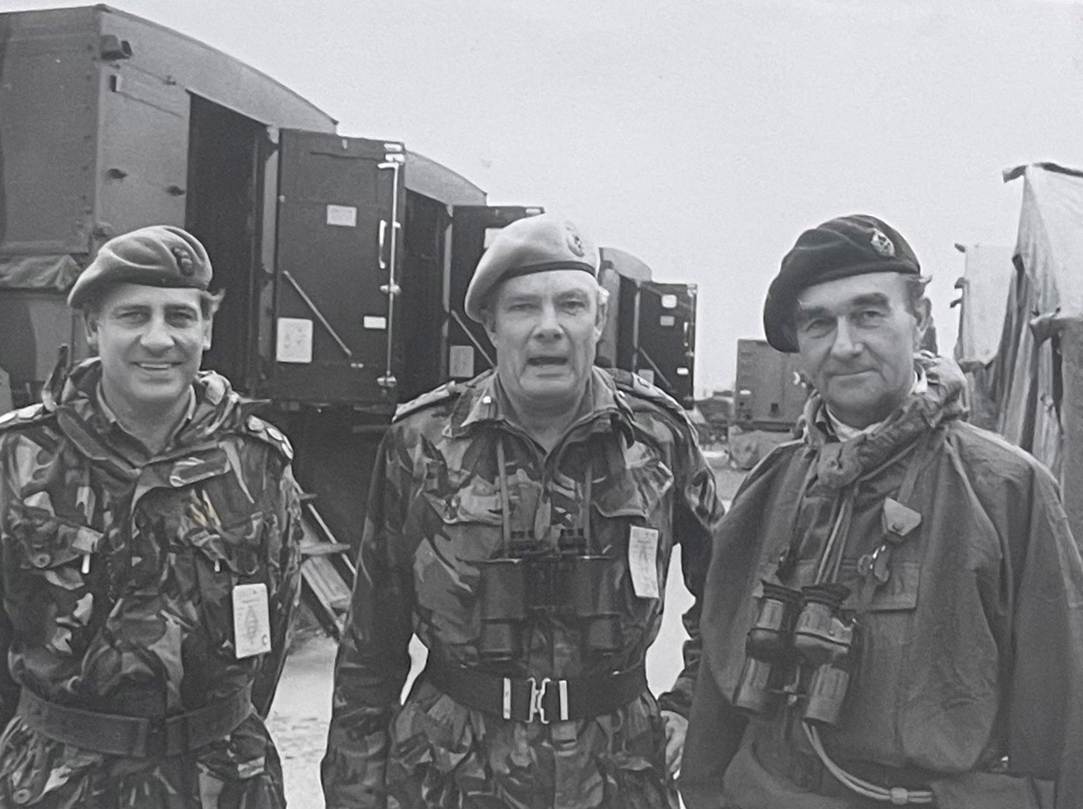
He commanded 1st (British) Corps as
Lieutenant General from March 1983 to 1985. This was the fighting component of
the British Forces in Germany, still during the height of the Cold War. The
Headquarters was at Bielefeld and he lived at
Spearhead House. In those days, tests and demonstrations of ability to
withstand an invasion from the east were critical to keeping the peace and
winning the Cold War. In 1984, he devised and oversaw the vast Exercise
Lionheart, a show of strength of the height of the Cold War, which involved
131,000 British troops, including tens of thousands or Territorials and Army
Reservists and which extended over 3,700 square miles. During a second phase a
further 6,300 German, 3,500 Dutch, 3,400 American and 165 Commonwealth (from
Australia, New Zealand and Canada) took part. It was intended to test BAOR's
reinforcement plans and was the biggest military exercise to be held since the
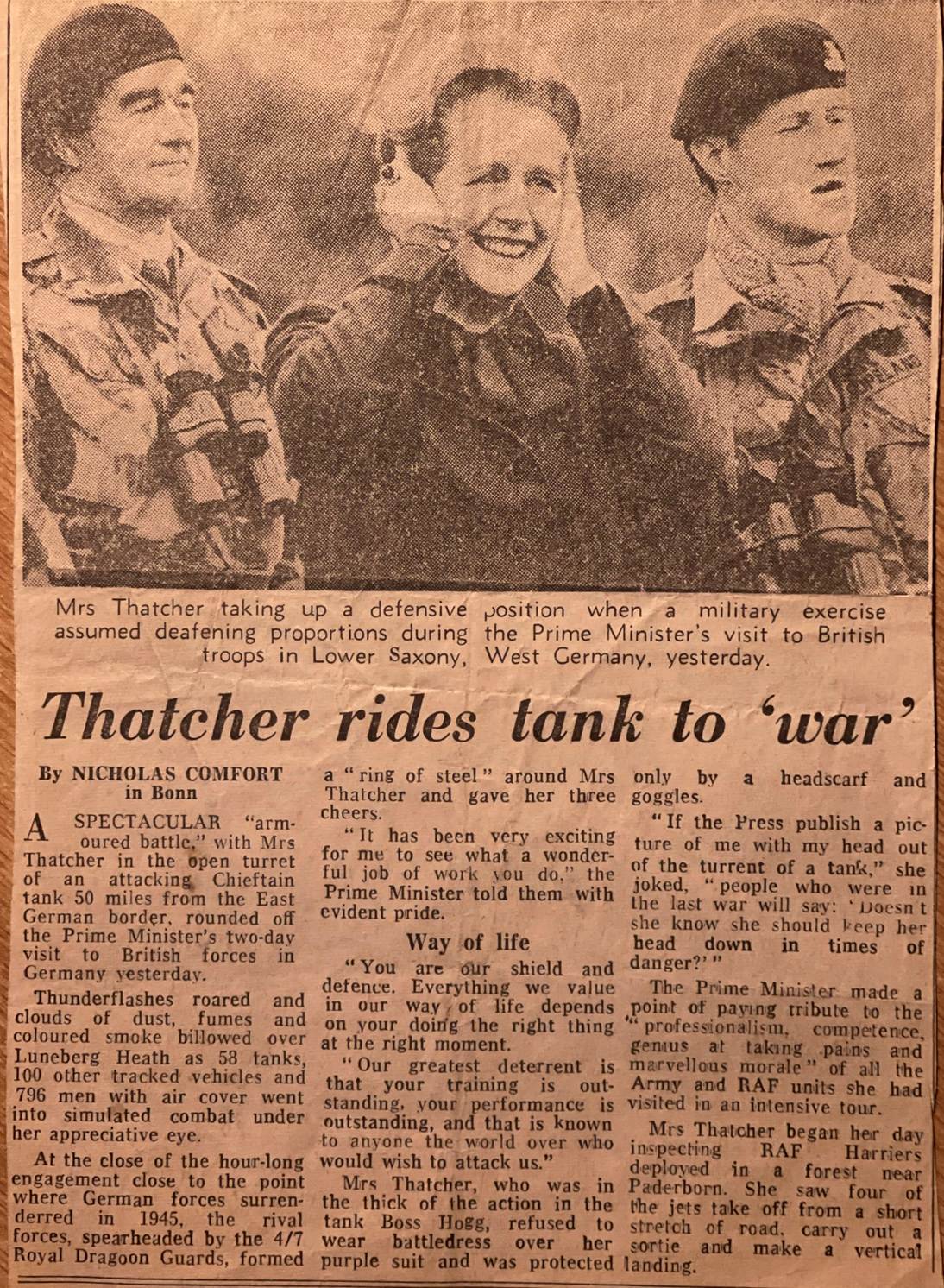
Second World War. In September 1983, he showed the Prime Minister, Mrs
Thatcher, around his Corps during an exercise, during which now infamous
photographs were taken of the later Lady Thatcher riding in a Chieftain tank.
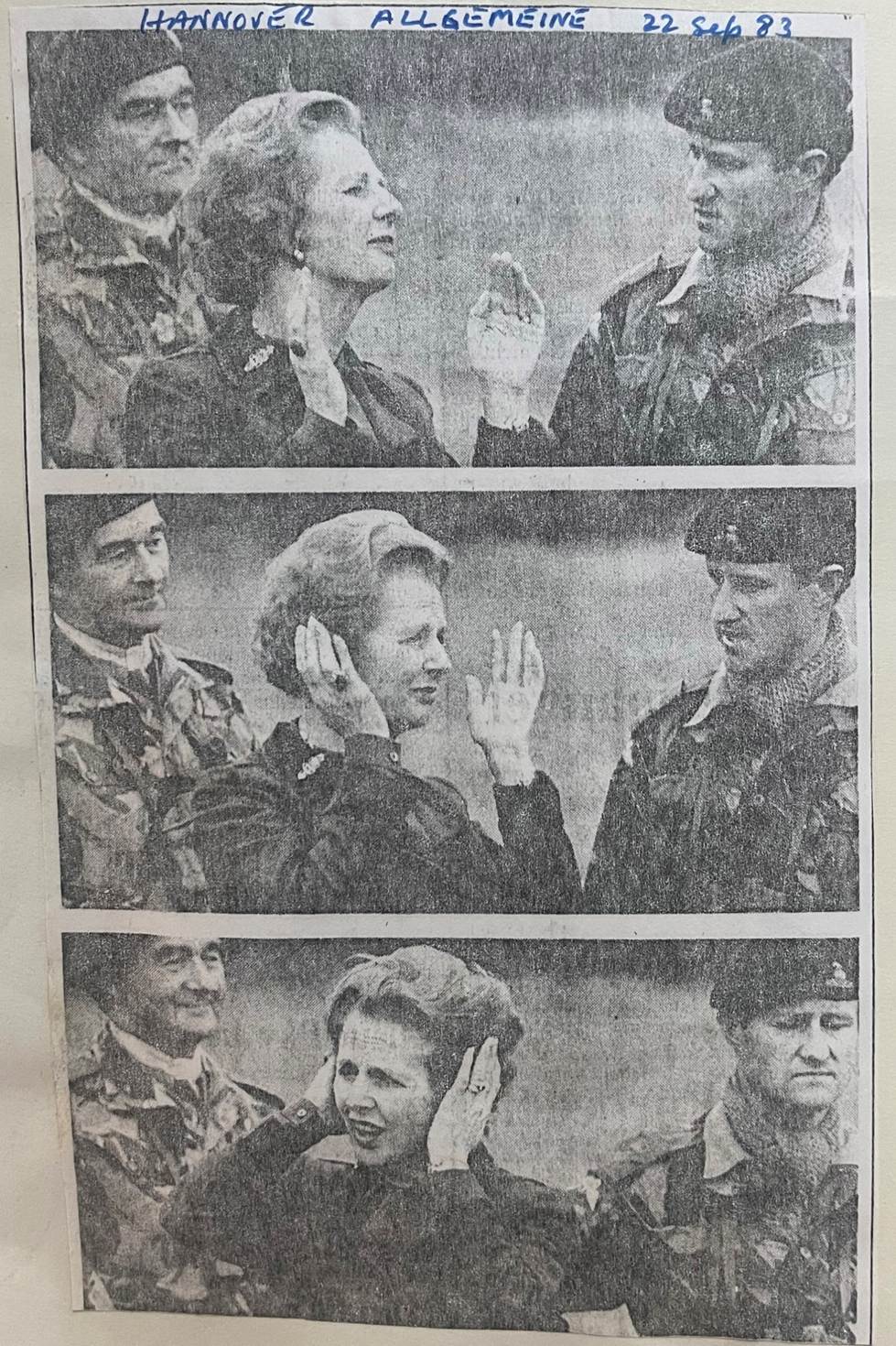
There is a separate page about Martin
Farndale as Commander of 1st (British Corps).
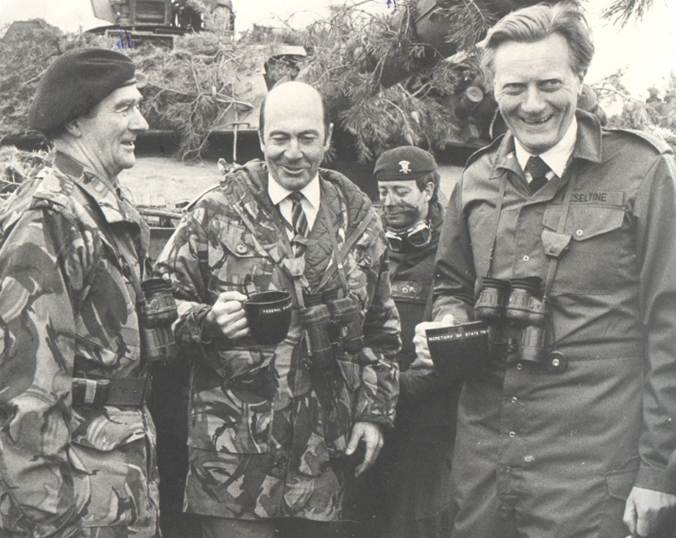
With Michael Heseltine
Commander British Army of
the Rhine and Northern Army Group (General), 1985 to 1987
1985
Finally, he commanded the British Army
of the Rhine, at the time 55,000 strong, and also
commanded the Northern Army Group, an Army Group consisting of a British,
Dutch, German, and American Corps, from its headquarters at Rheindalen. This
was from 1985 to 1987. He lived at Flagstaff House. He worked to implement a
revised concept of operations for the Northern Army Group. In the event of a
Soviet invasion, the new plans would enable NATO forces to 'bide our time and
then strike viciously, at the time of our choosing, at an exposed flank or
sector.'
1987
These new plans were tested in 1987 during
another major exercise, Exercise Certain Strike, which proved itself to be the
largest and most complex field exercise of its type staged in Europe since the
D-Day landings in 1944.
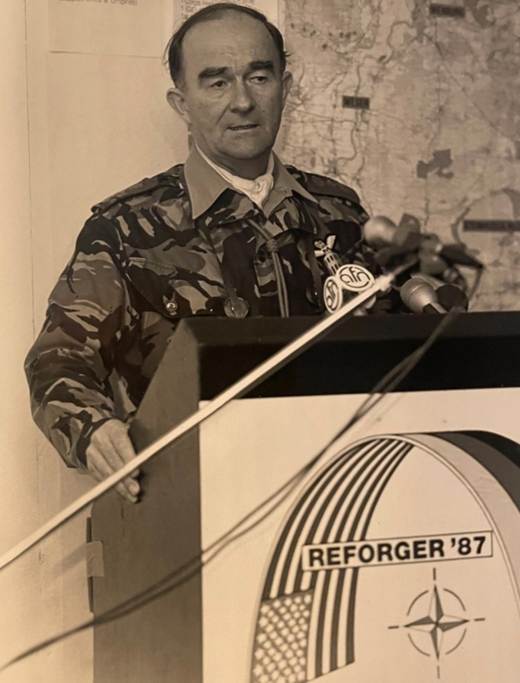
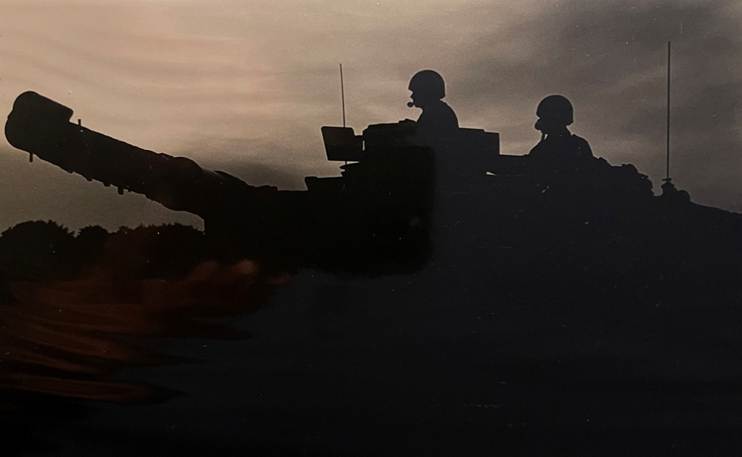
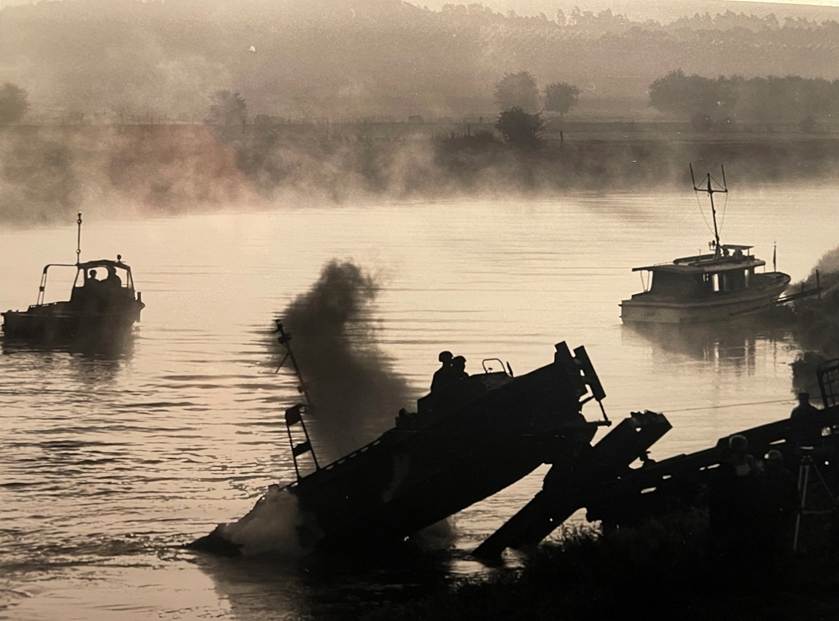
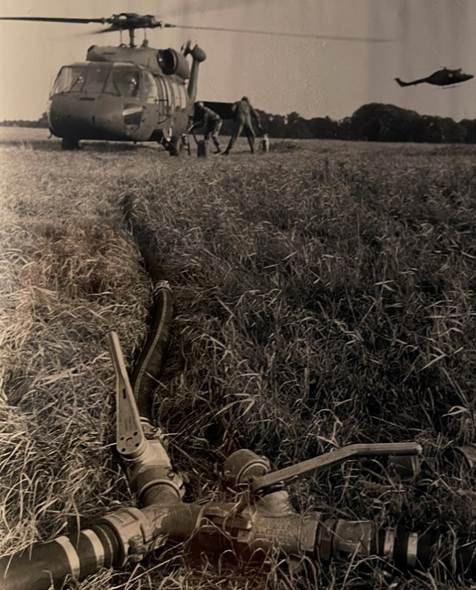
Exercise Certain Strike (also known as
Reforger) 1987
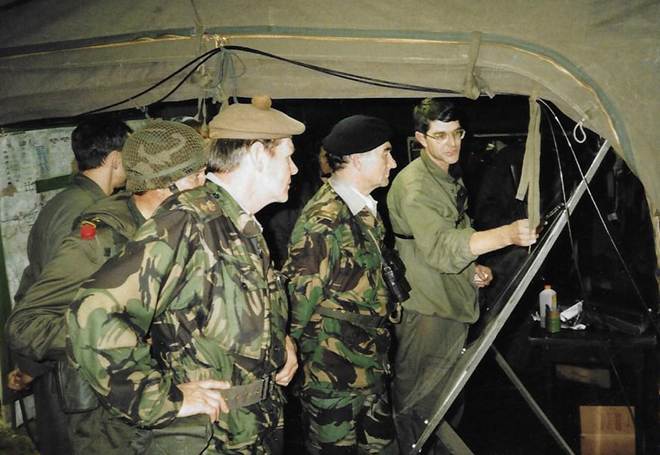
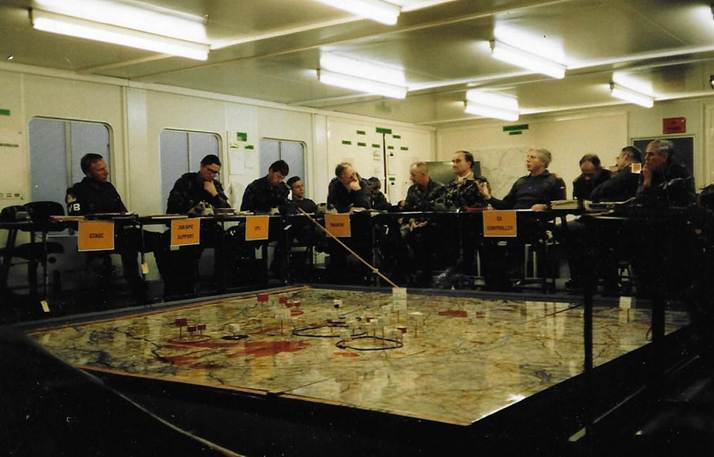
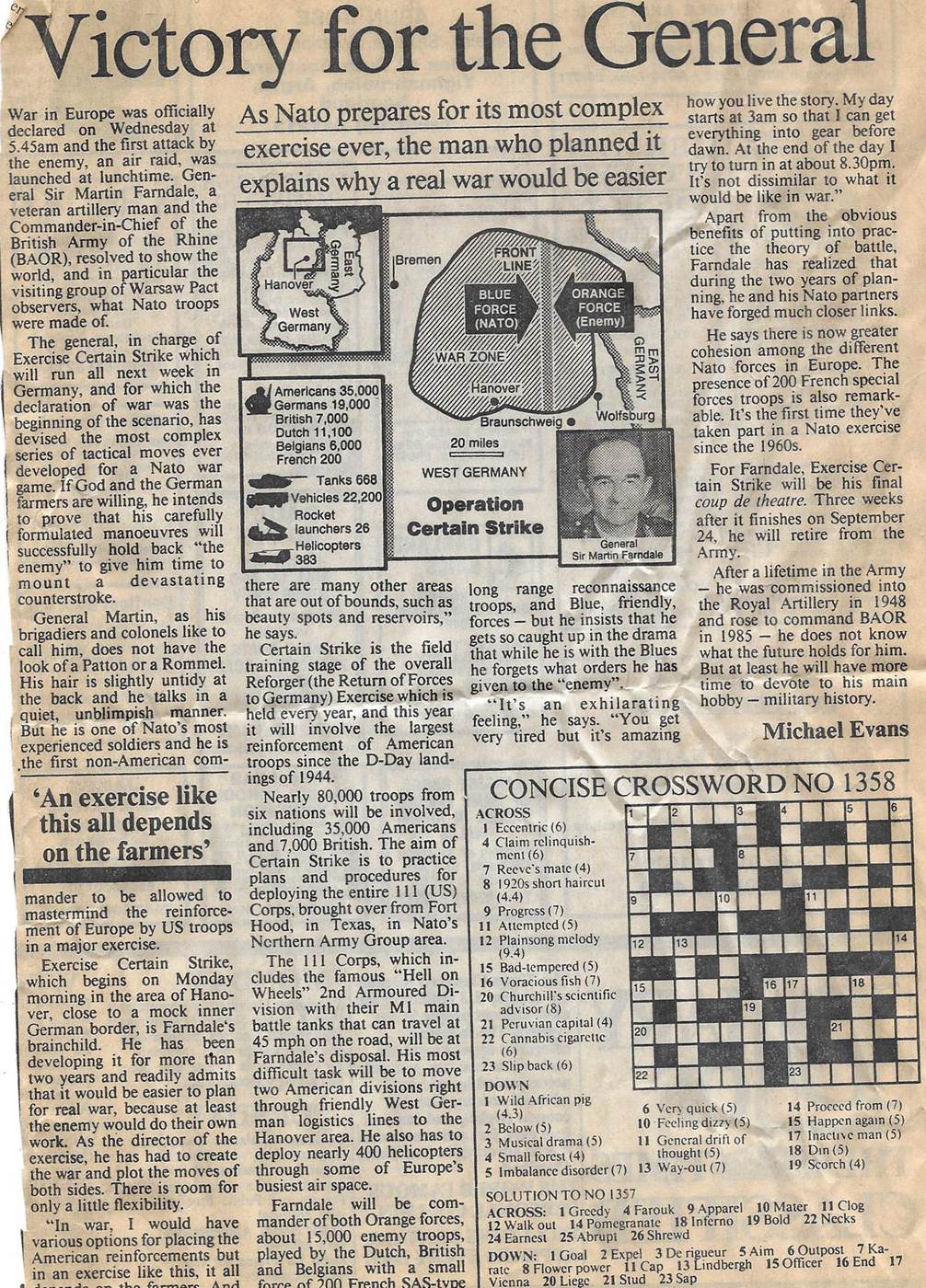
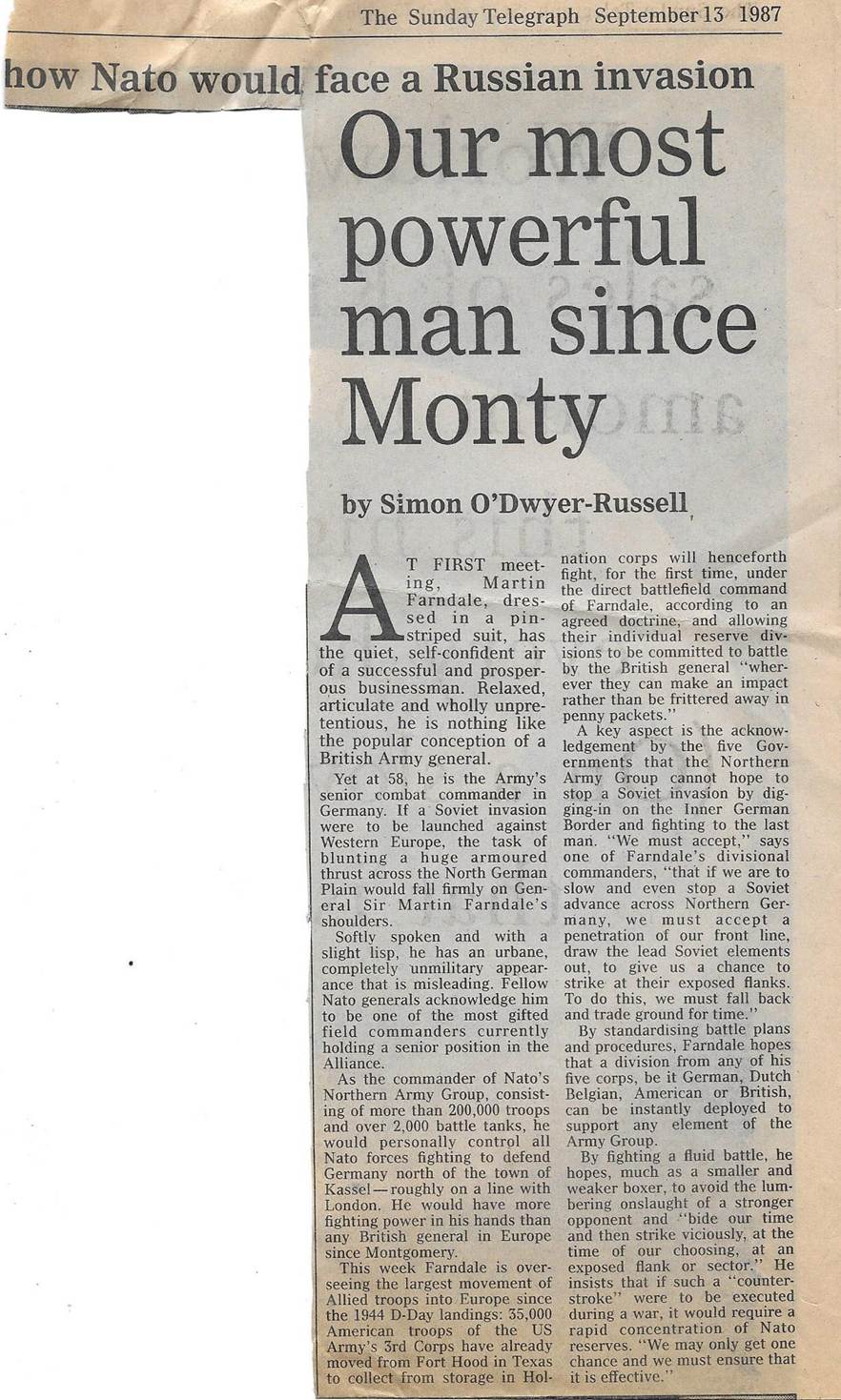
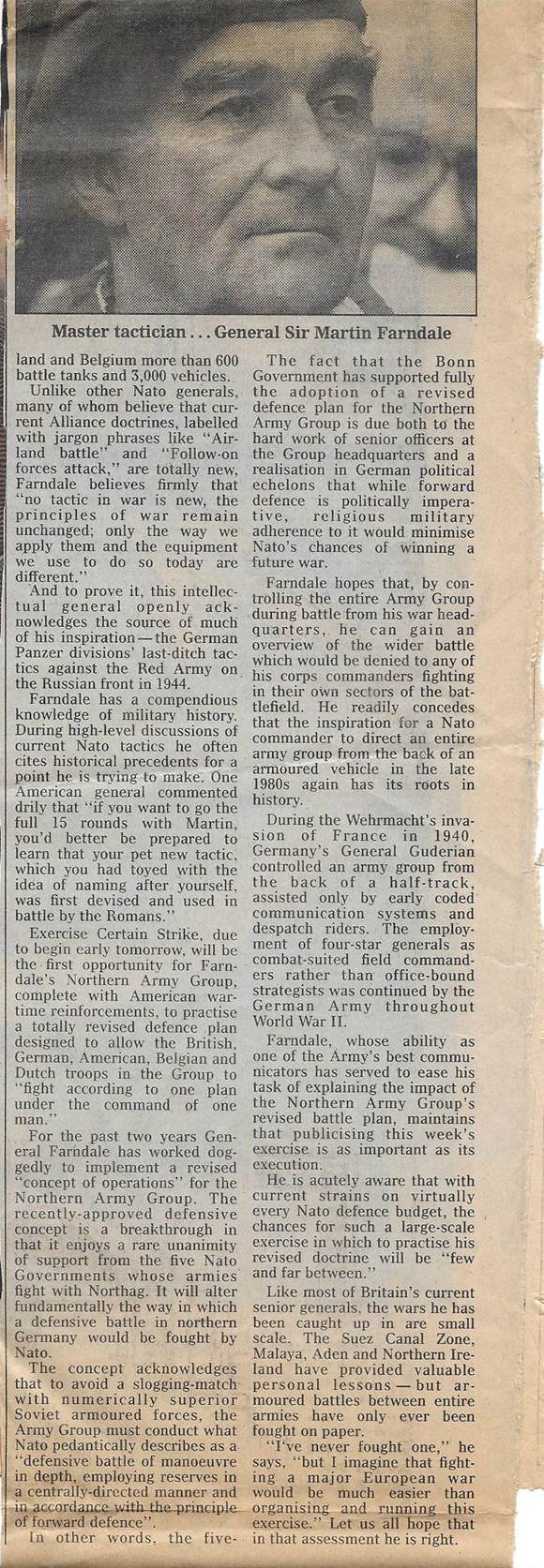
He applied the principles of war in his
tactical approach to the Soviet threat, particularly relative to the
concentration of the force available to him in fluid deep defensive battle.
This involved the concentration of force at the decisive point of the
battlefield and the coordination of the offensive power of armour and infantry
with artillery, helicopter and airpower. This culminated in what became known
as the Farndale Cocktail.
There is a separate page about Martin
Farndale as Commander of the Northern Army Group and the British Army of the
Rhine.
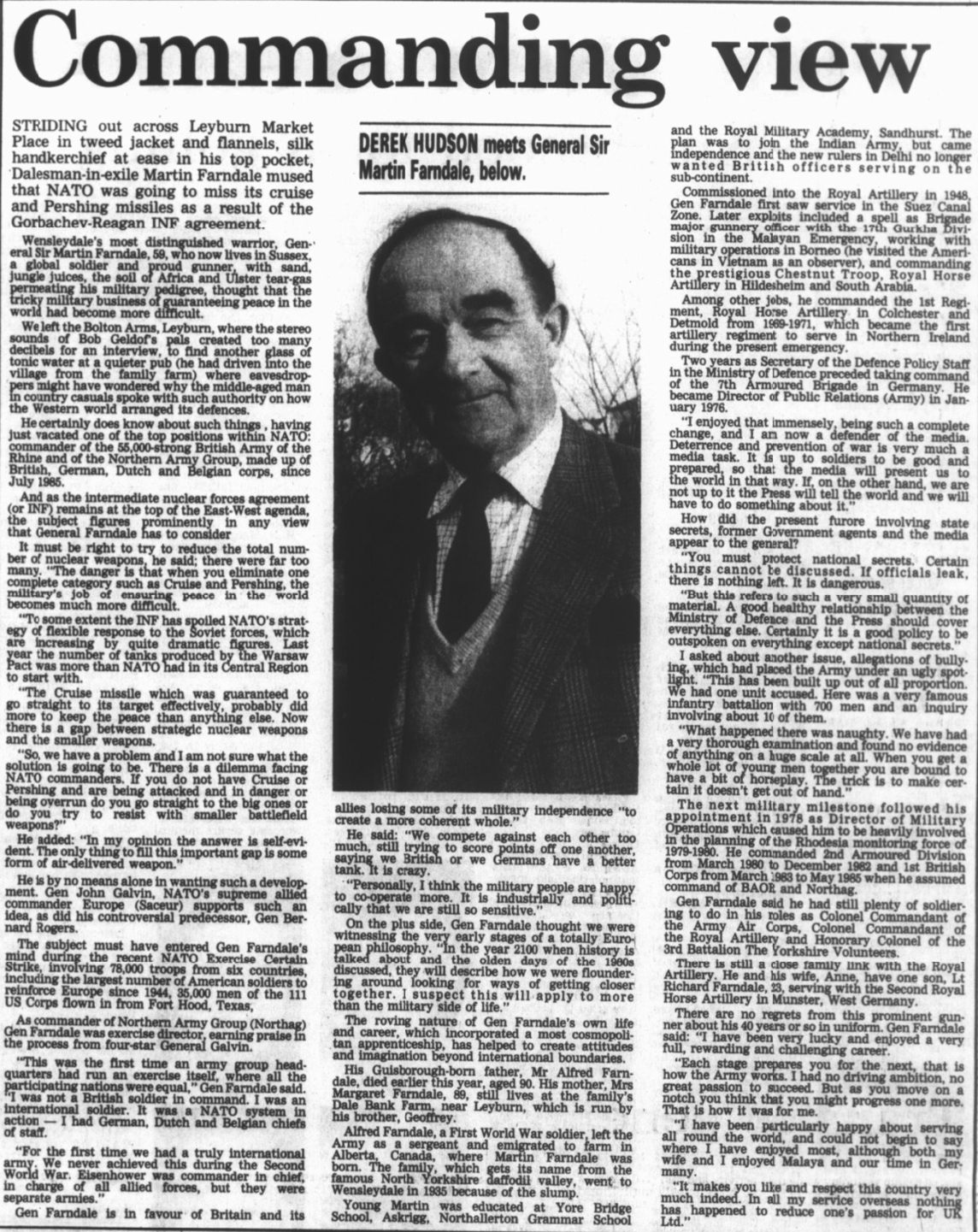
(Yorkshire
Post, 31 December 1987)
Master Gunner, St James’
Park 1988 to 1996
Angmering, West Sussex
1988
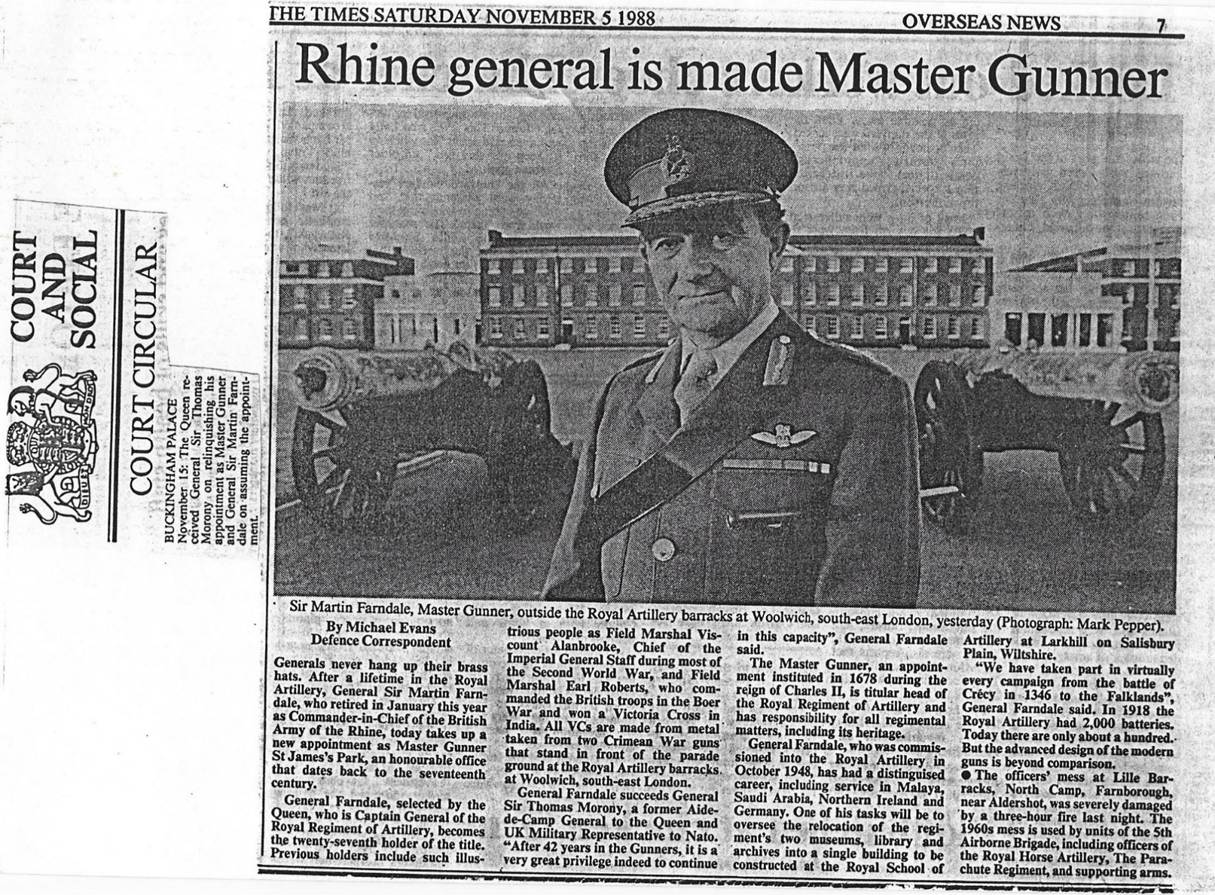
He became Master Gunner of St James'
Park (an office dating back to the seventeenth century), the honorary head of
the Royal Regiment of Artillery, on 5 November 1988. His principal duty as Master
Gunner was to keep the Queen, the Royal Regiment's Captain General, informed of
all matters pertaining to the Royal Artillery. He was also Colonel Commandant
of the Royal Horse Artillery, Honorary Colonel of First Regiment Royal Hose
Artillery and of Third Battalion, the Yorkshire Volunteers, his home county. He
was Colonel Commandant of the Army Air Corps. He also had a close interest in
the South Notts Hussars.
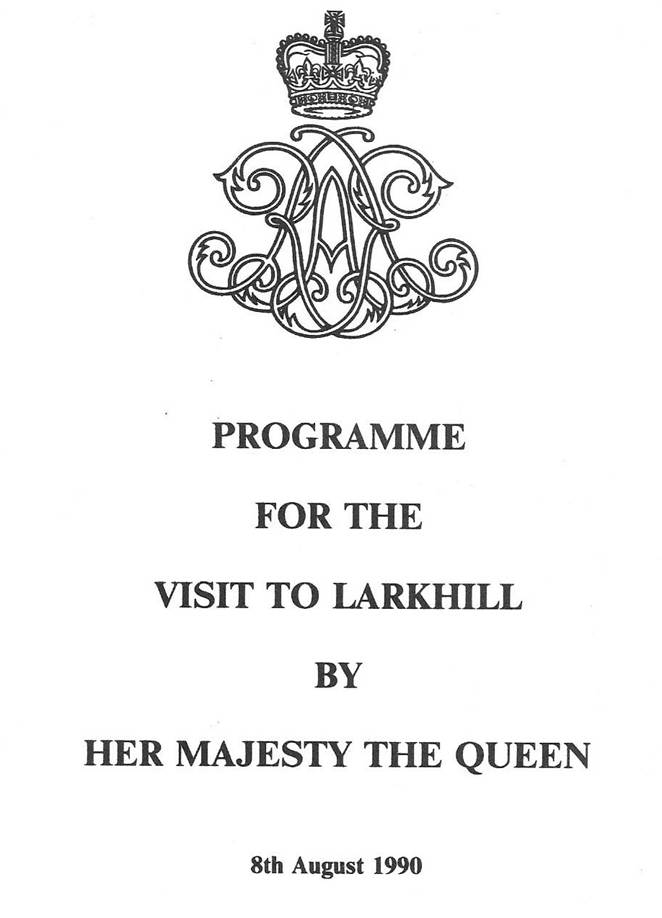
1990
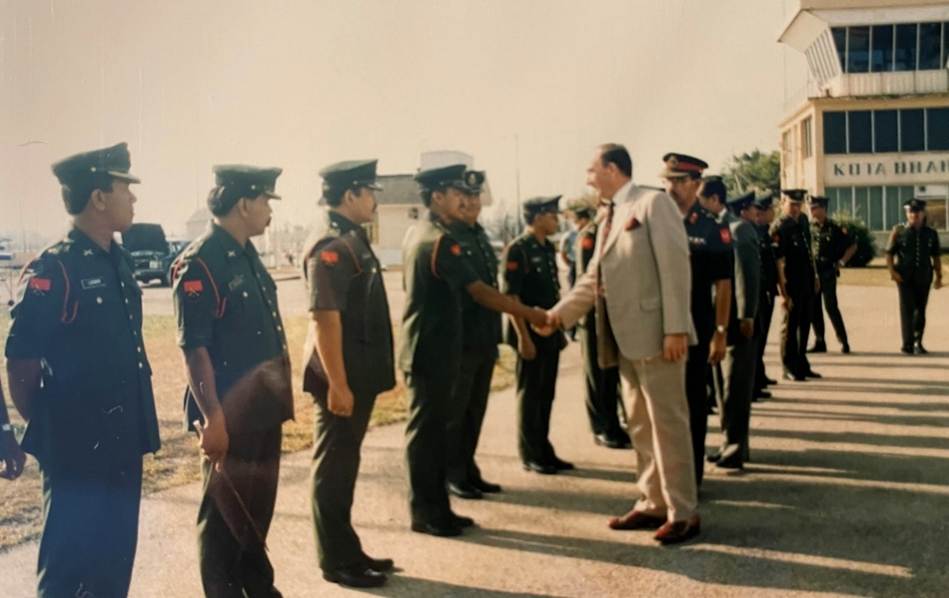
Visit
to the Sultan of Kelantan, Malaysia, March 1990
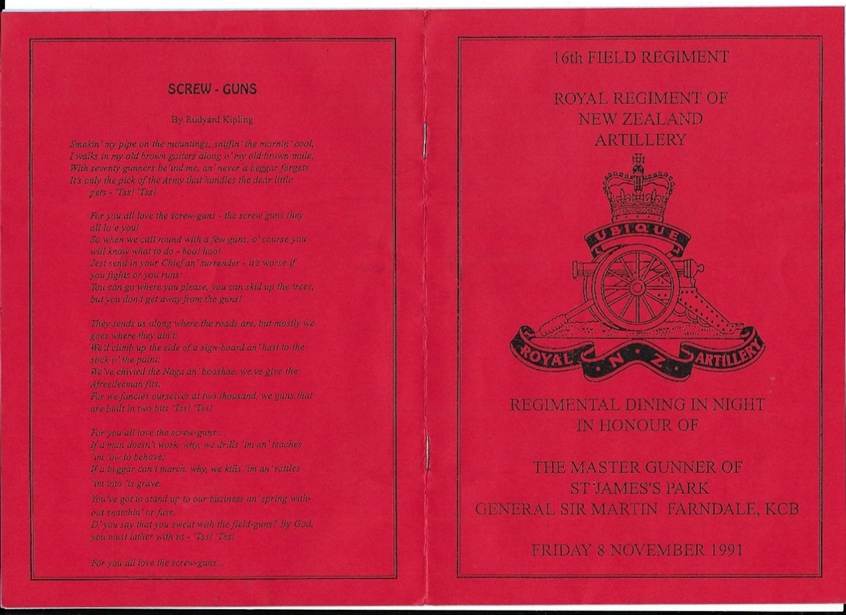
1993
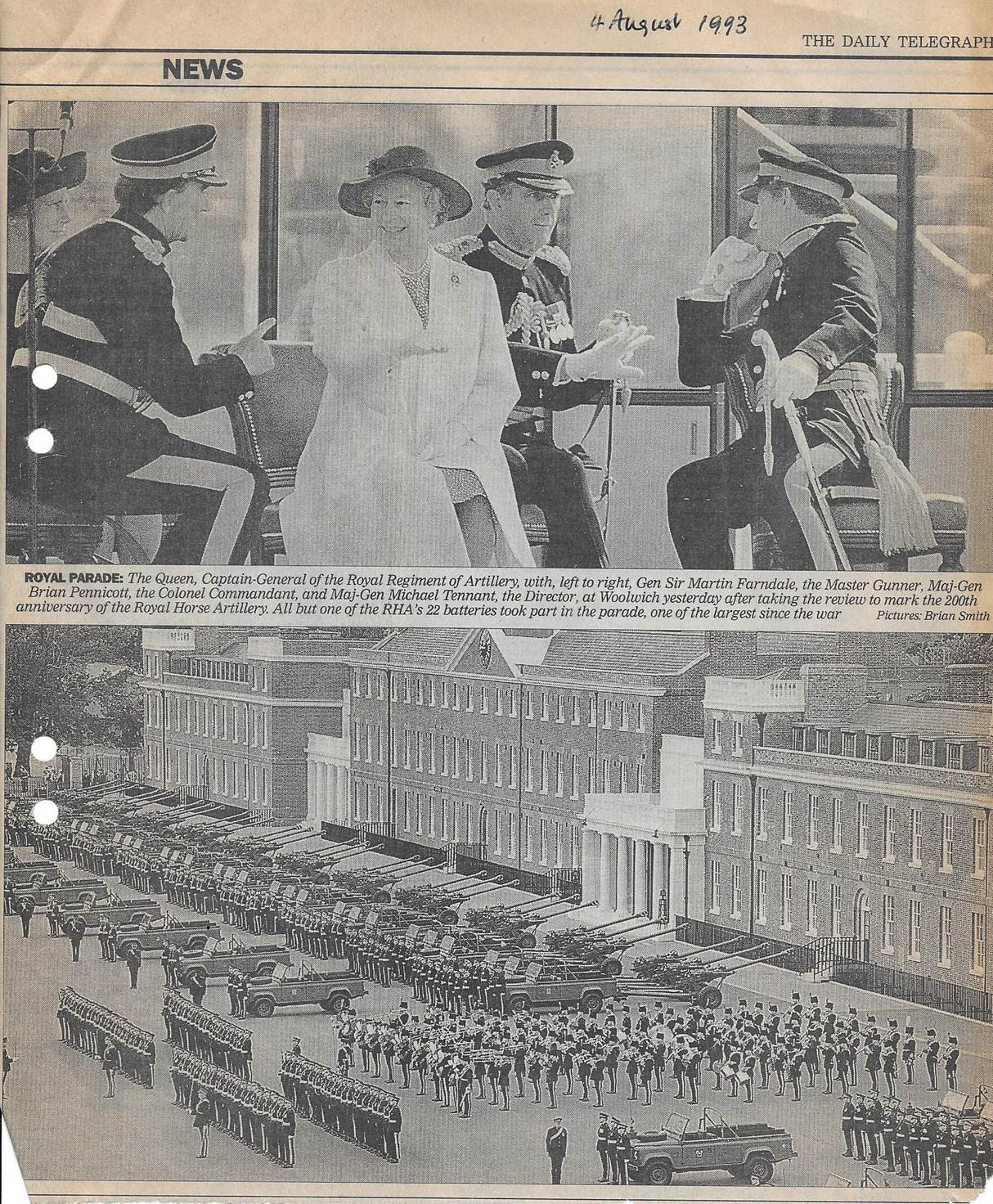
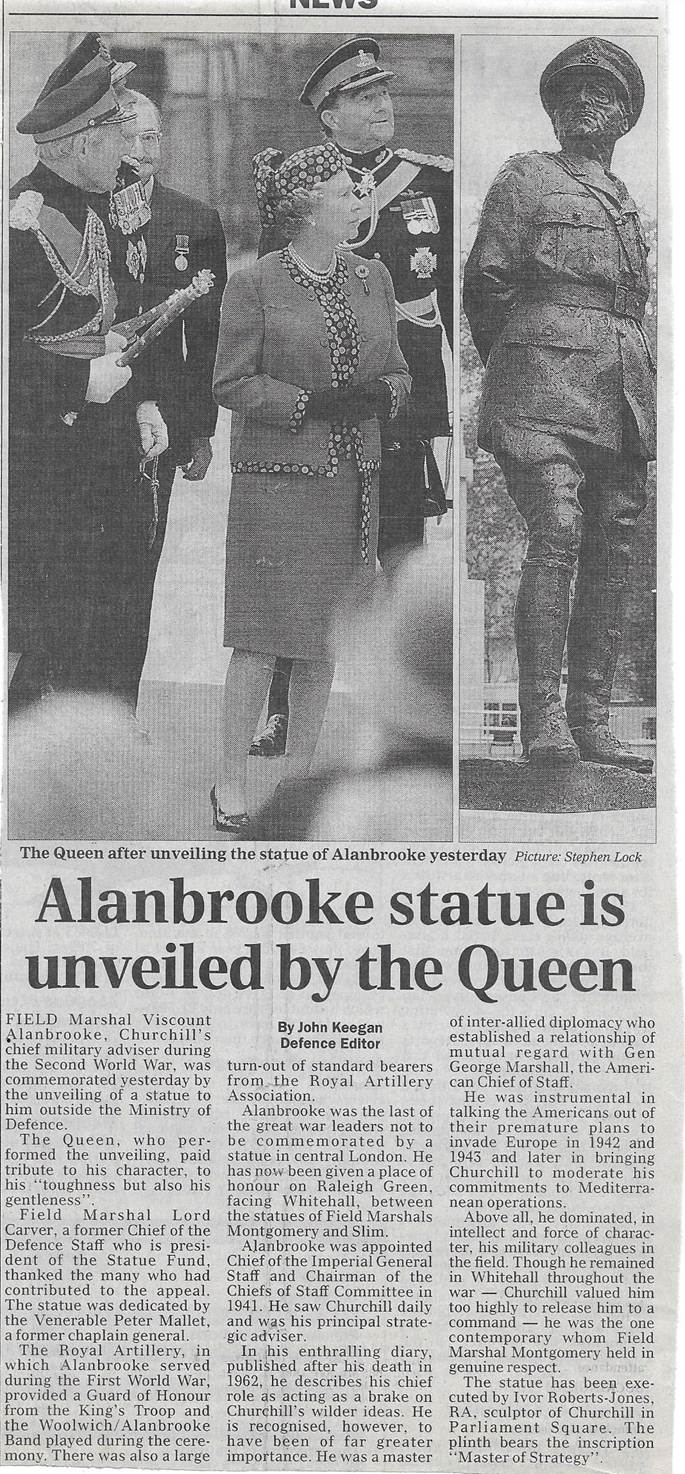
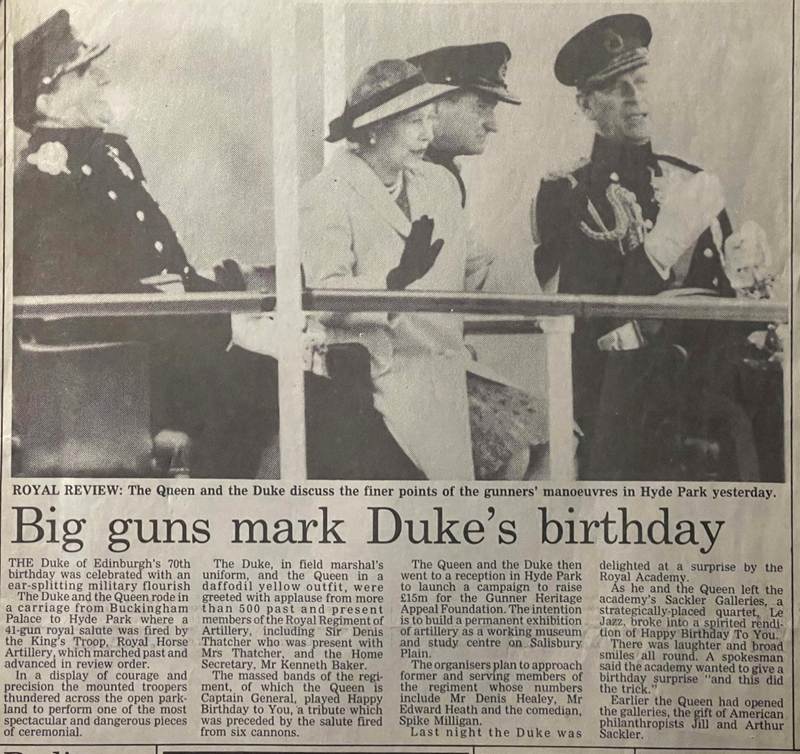
Splitting his sides with laughter
beside the Queen in 1991
There is a separate page about Martin
Farndale’s time as the Master Gunner, St James’ Park.
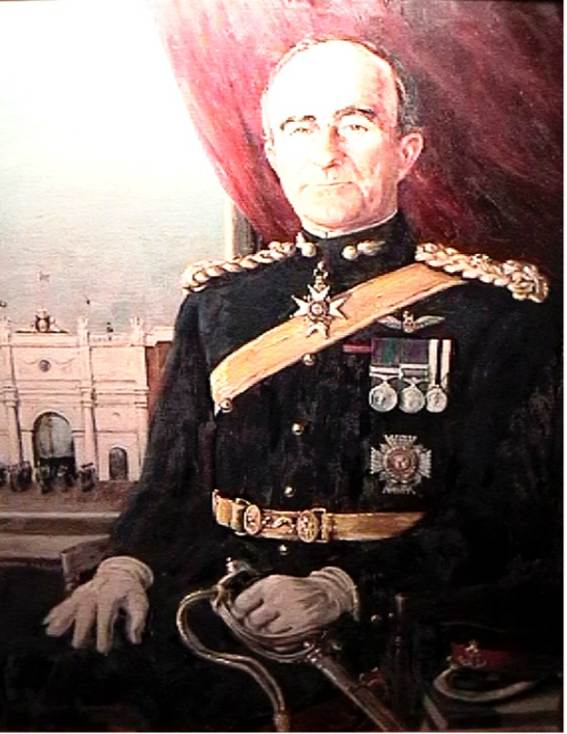
1996
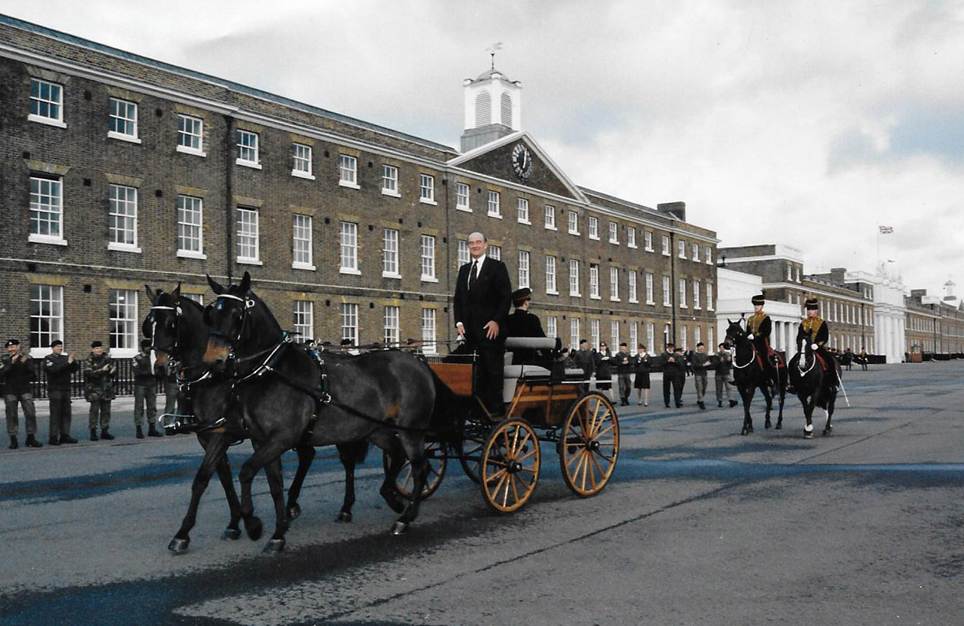
Farewell as Master Gunner
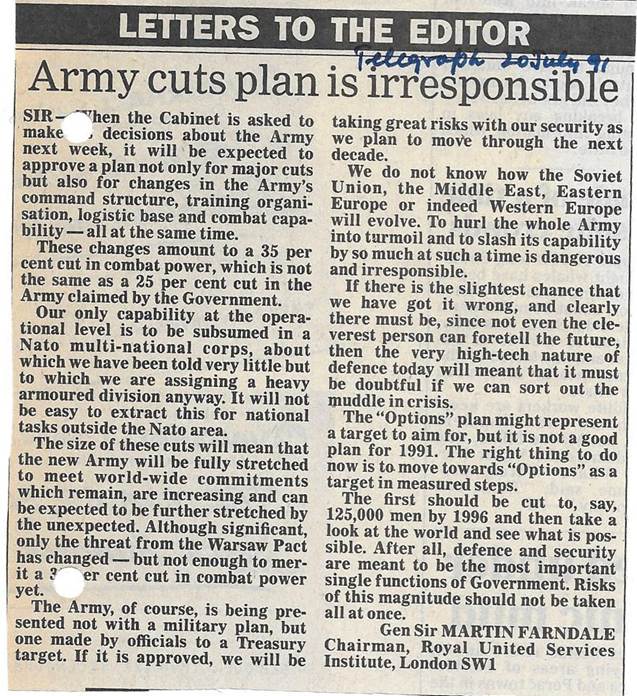
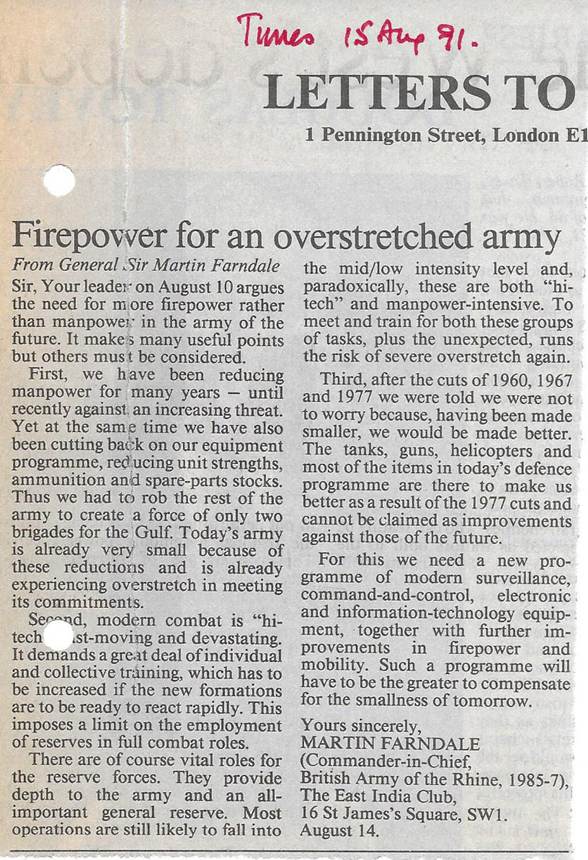
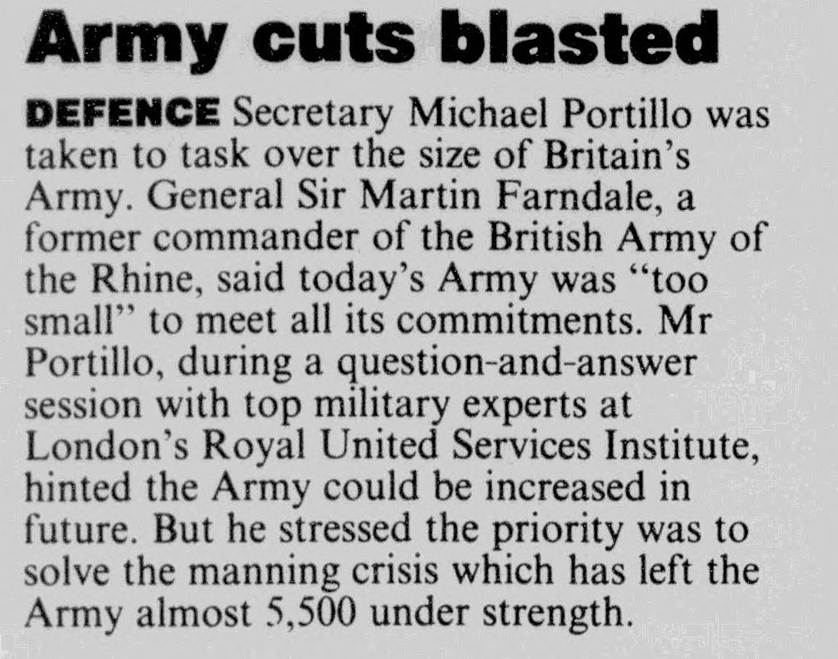
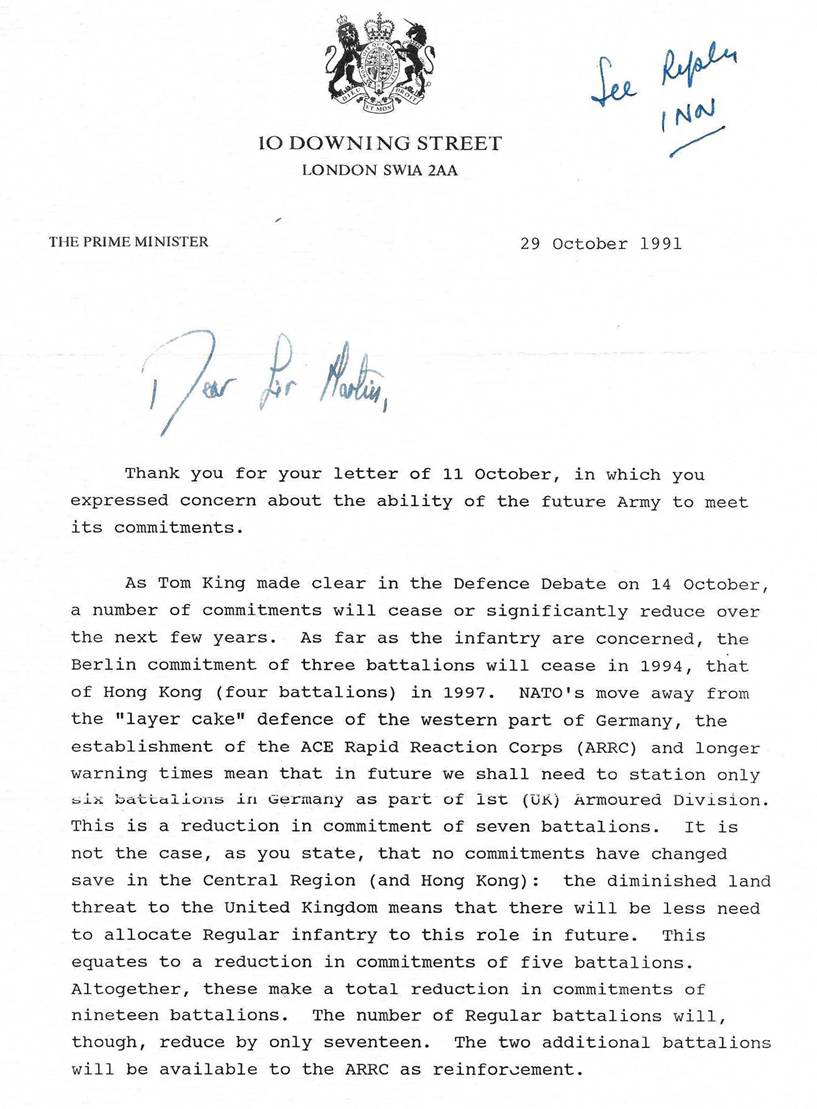
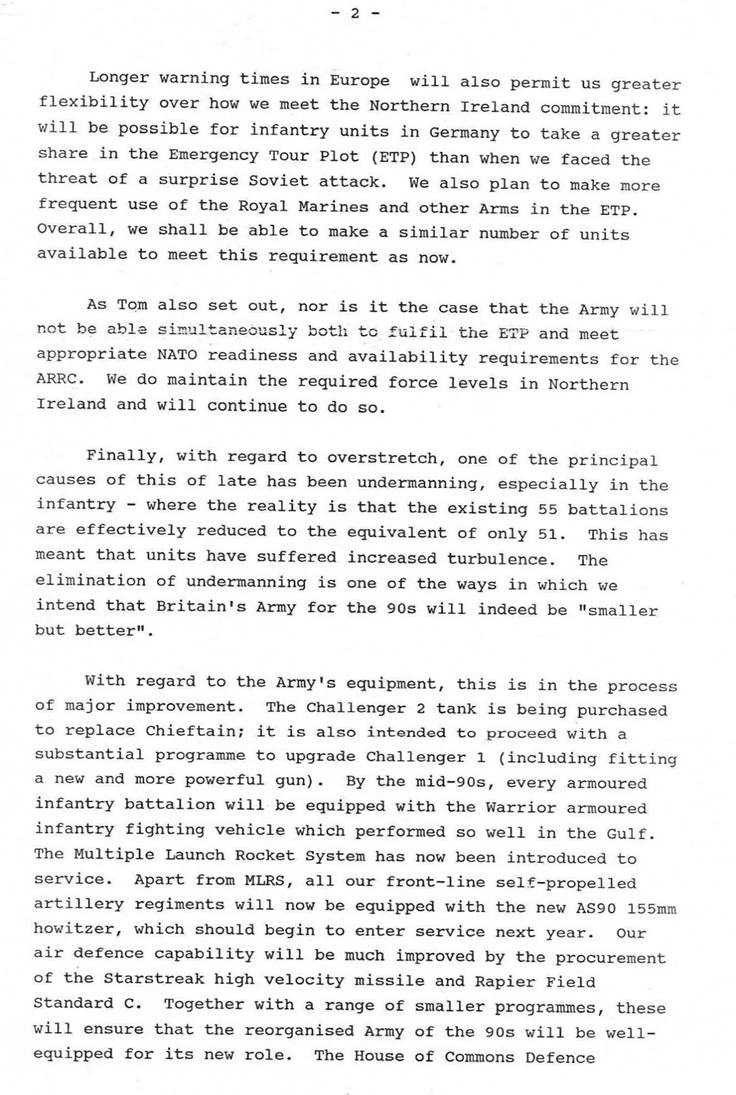
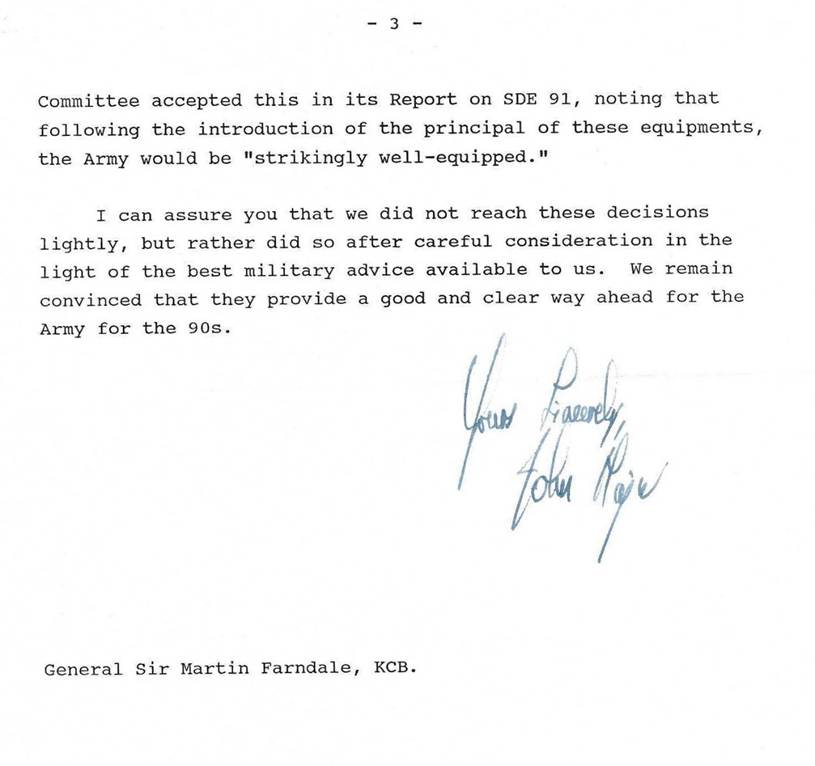
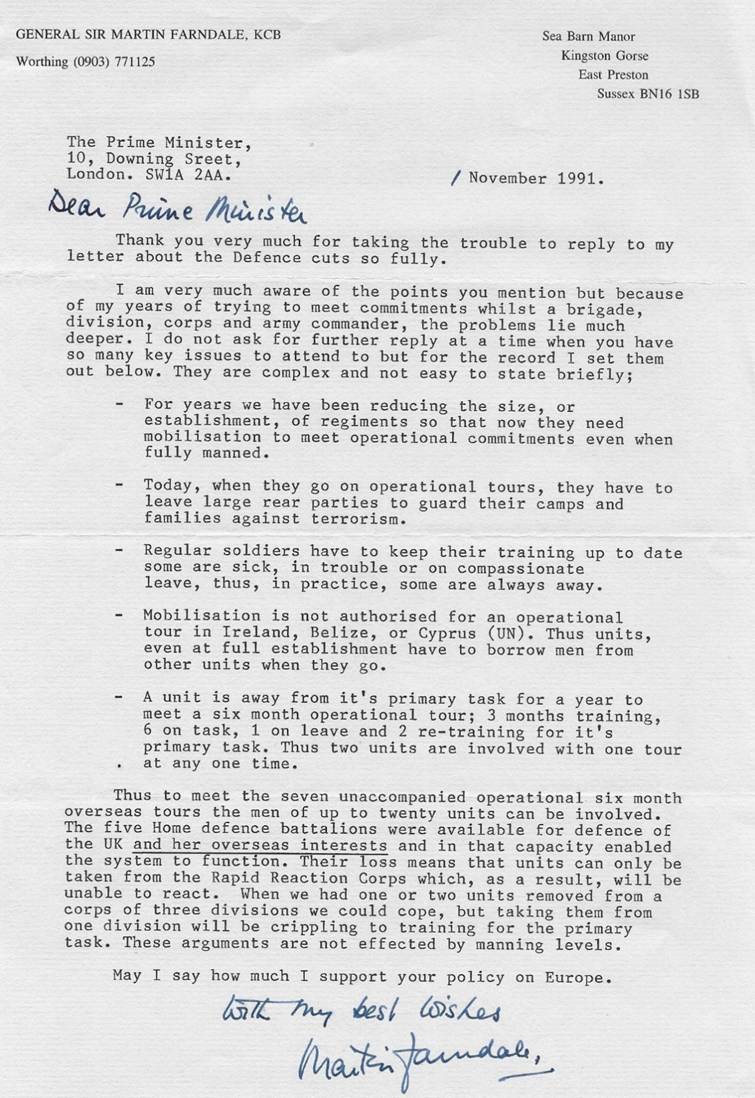
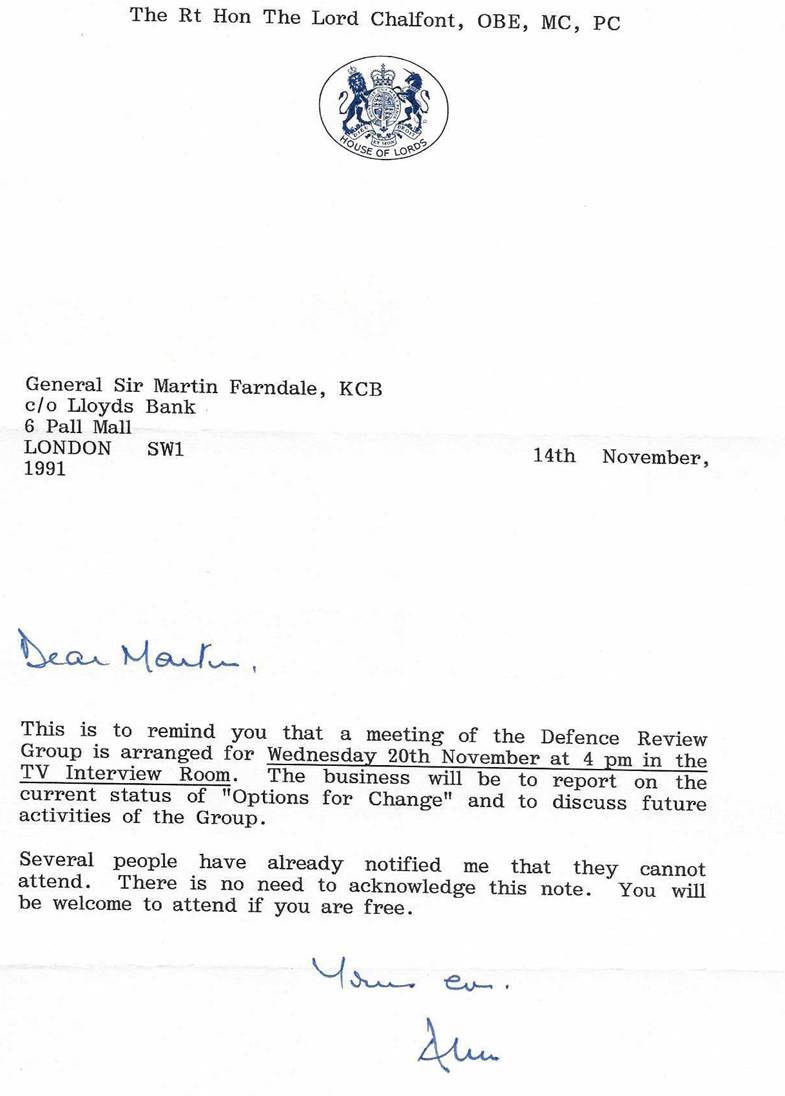
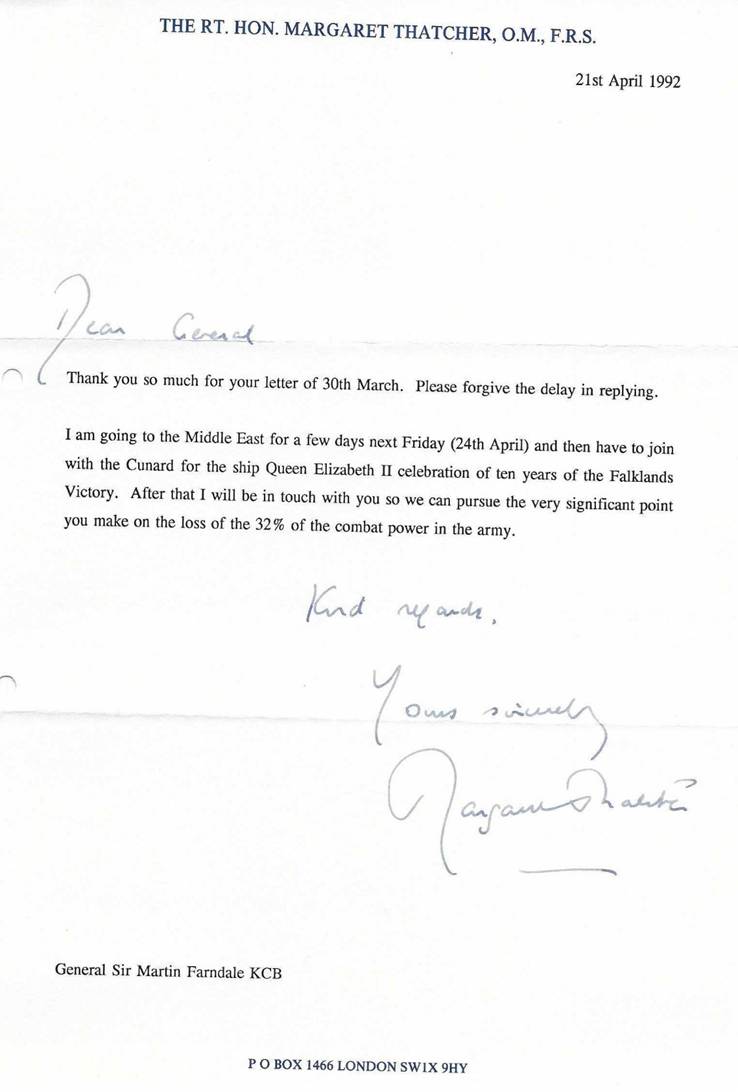
Arguing the case against
Defence Cuts in the 1990s
He was Chairman of the Royal United Services
Institute and he argued the case against defence cuts in the 1990s.
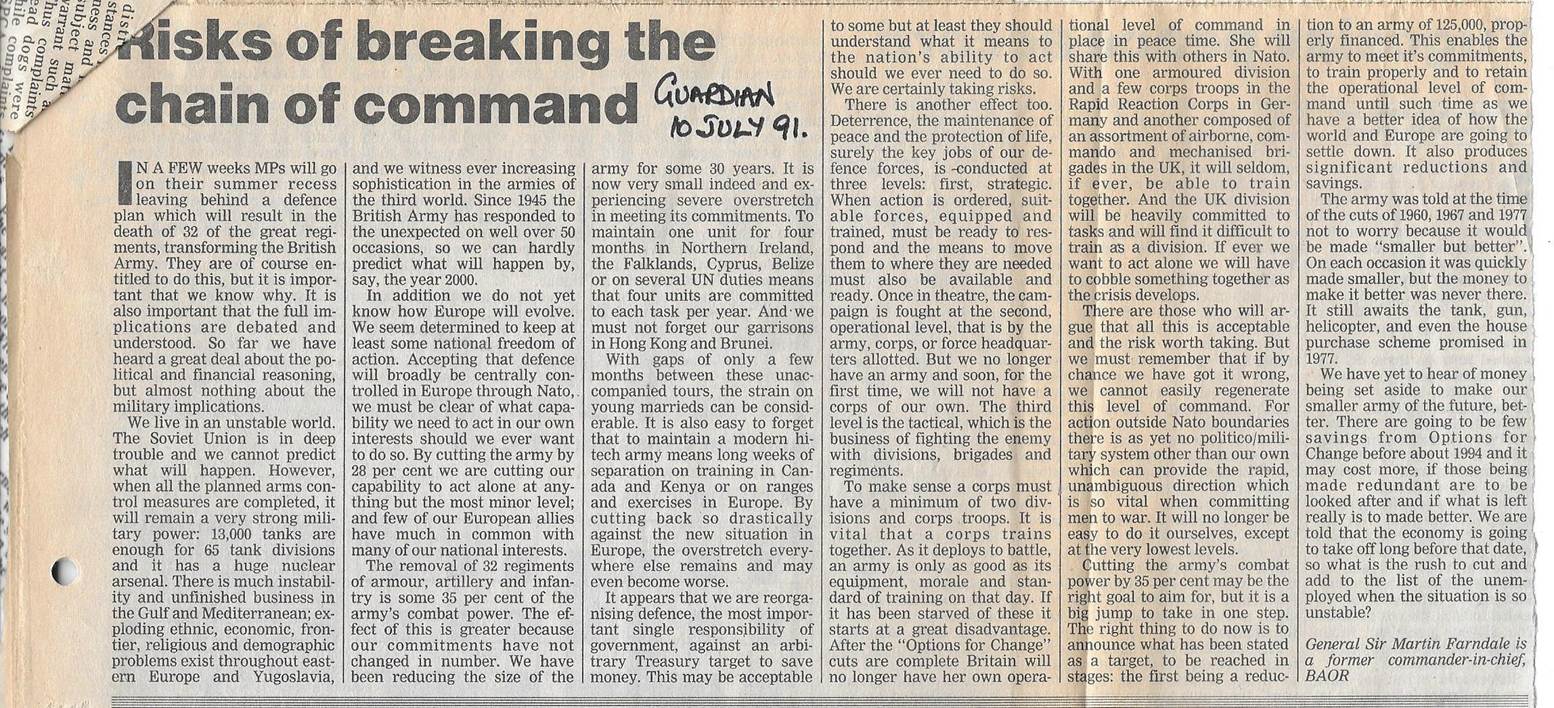
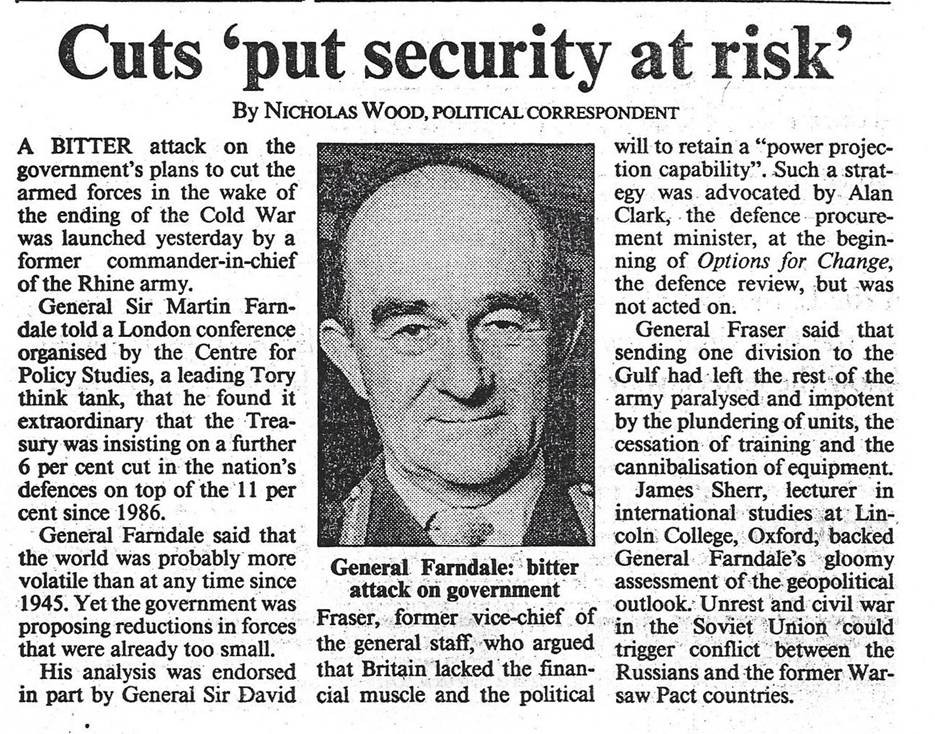
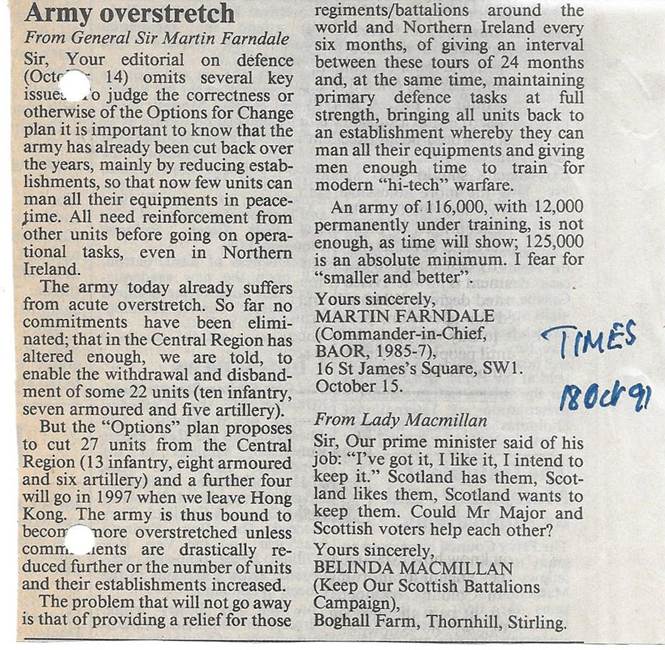
(Huddersfield Daily Examiner, 24 April
1997)
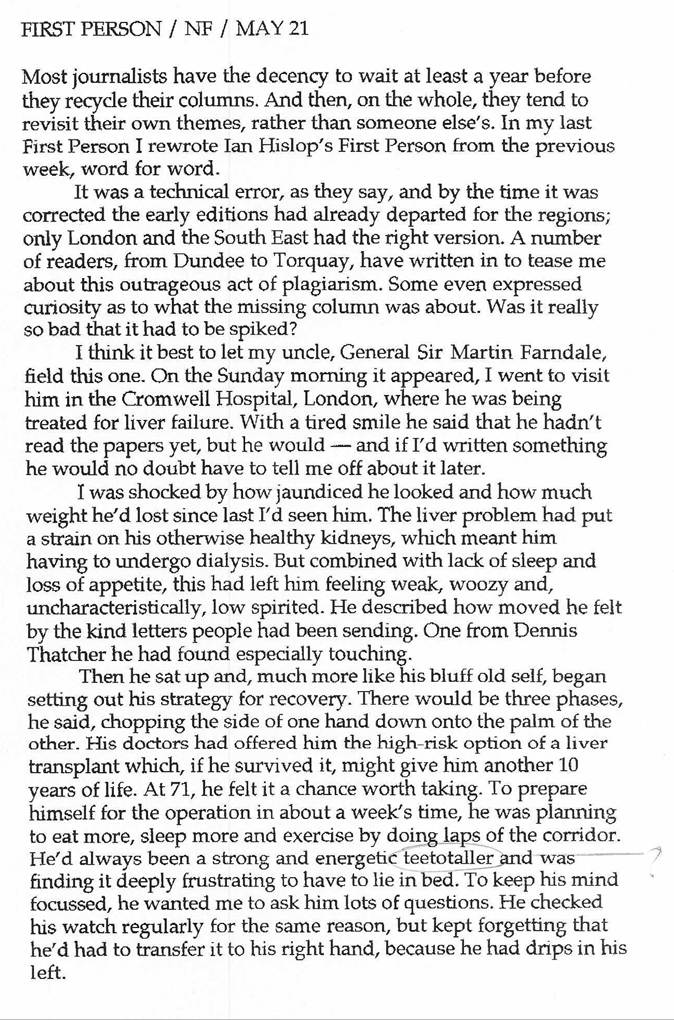
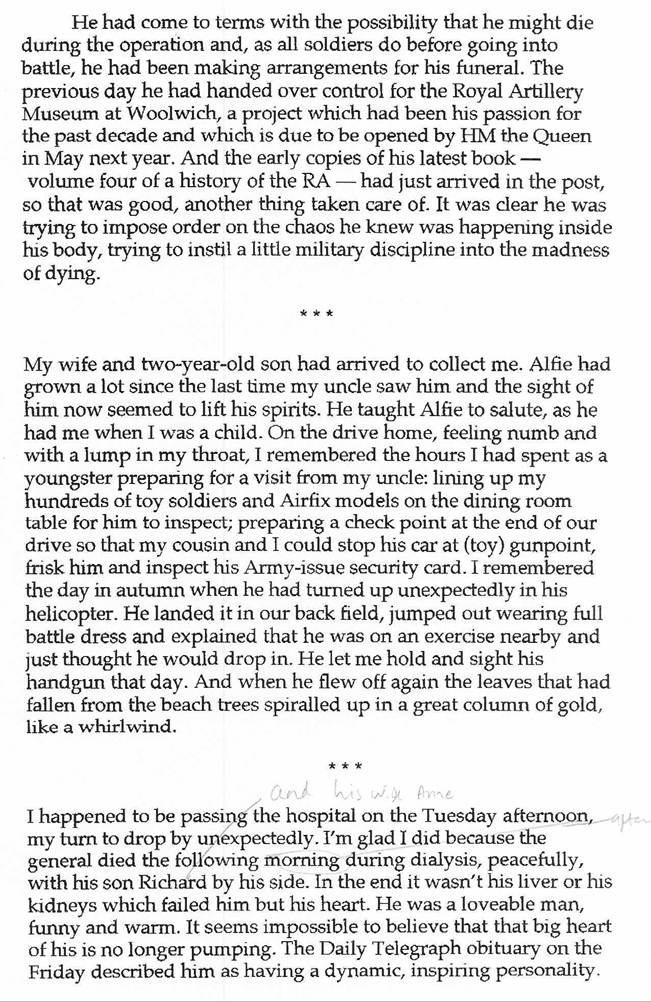
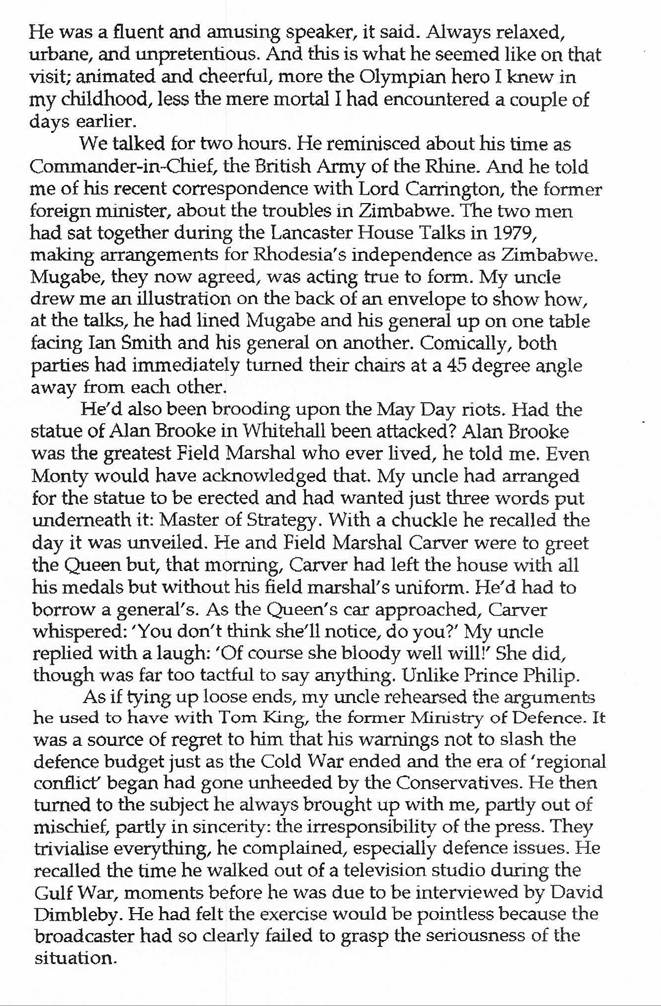
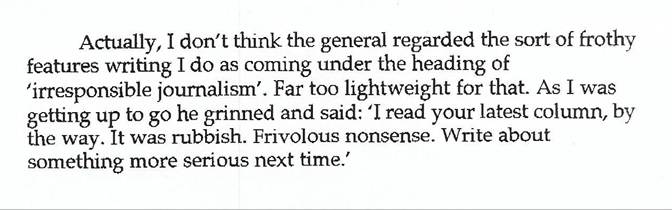
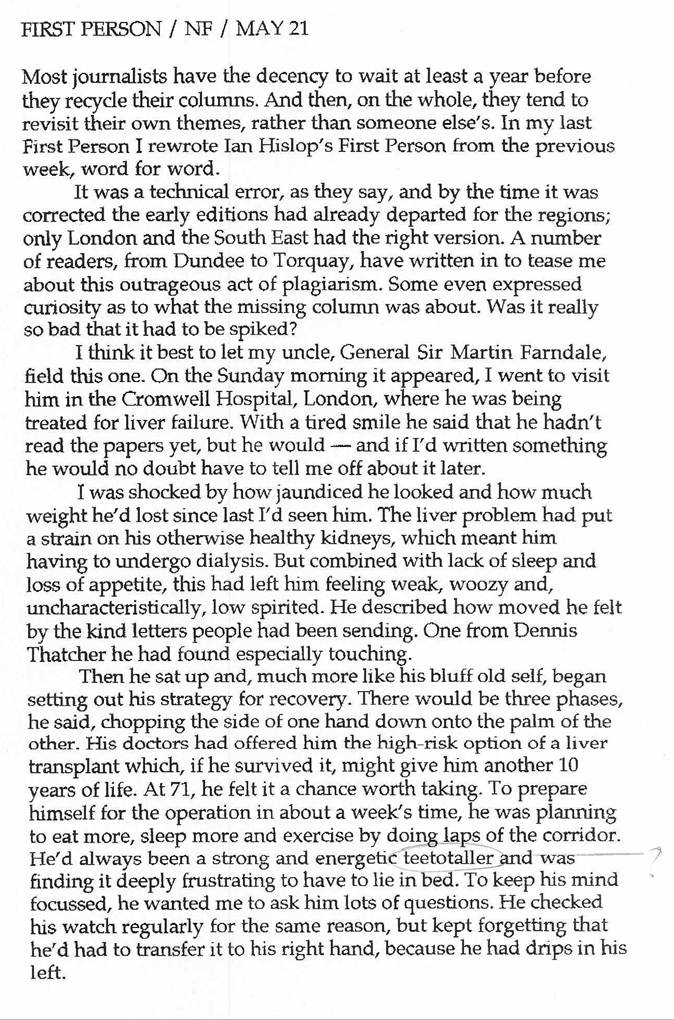
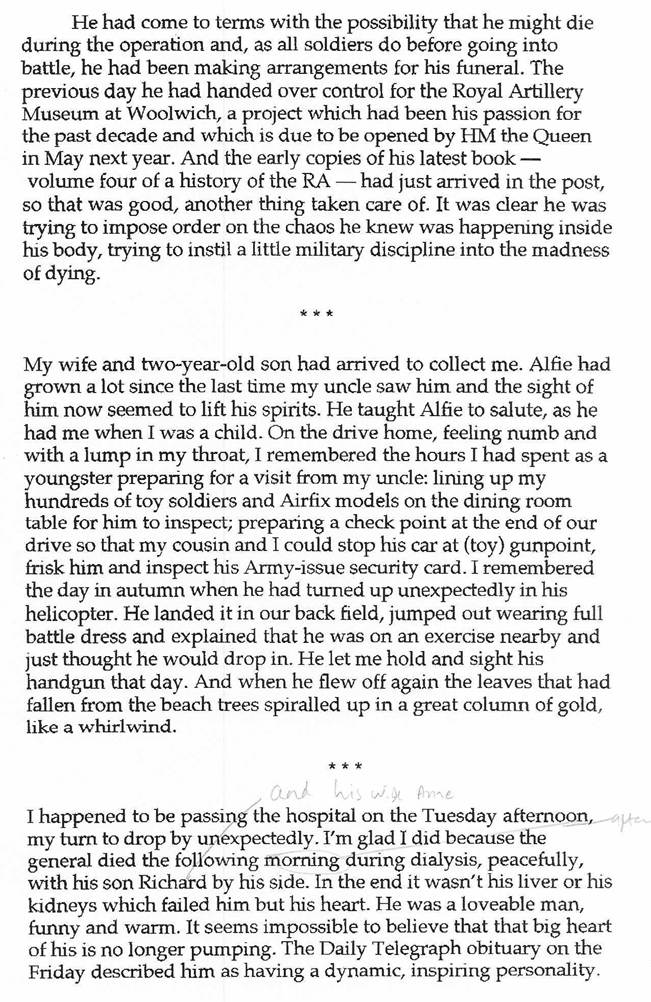
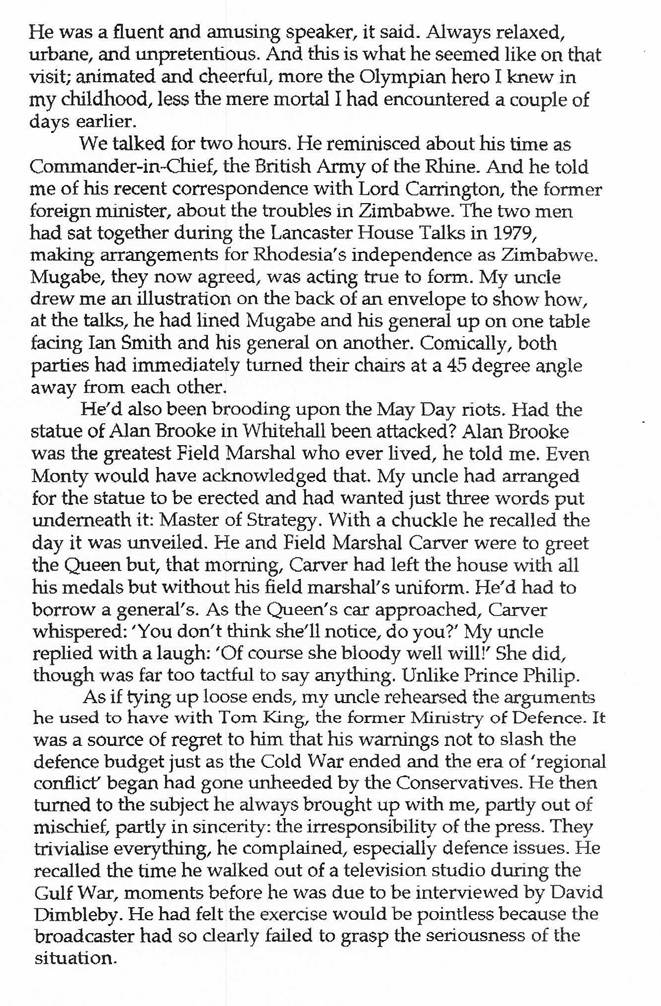
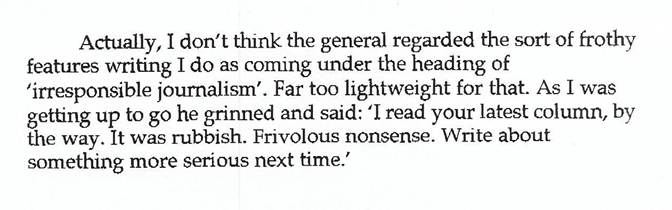
Martin
Farndale’s nephew also later wrote that during the first Gulf war my late
uncle, General Sir Martin Farndale, was invited to discuss military strategy
with David Dimbleby. He accepted, even though he thought the BBC was being frivolous
in its coverage of the war - indulging in endless, pointless speculation and
treating the whole thing as a game and, worse, an excuse to try out its new
computer graphics. I imagine he wanted to convey the seriousness of the
situation, to impress upon viewers the fact that the lives of British soldiers,
including that of his own son, were at risk. He was shown to a chair, had a
microphone attached to his lapel and was accosted by a make-up artist with a
brush covered in orange powder. This didn't go down well. My uncle ripped off
his microphone and stormed out the studio, muttering darkly to himself. In one
gesture, it seemed, that poor make-up artist had epitomised all that my uncle
felt was rotten and decadent about the BBC in particular and
modern society in general. Perhaps
things have changed since my uncle's day, although when I look at General Sir
Mike Jackson, he of the face and voice of thunder, I find this hard to believe.
While it is true that Jackson had surgery to reduce the bags under his eyes,
this was done for medical reasons - they were affecting his eyesight - and woe
betide the journalist who suggests otherwise. Unlike prime ministers, generals
cannot afford to appear effete. They are and must be bastions of masculinity,
not least because they have to command the respect of
their men. And not only do they have to make tough decisions
but they also have to witness the consequences of
them, unsentimentally. I suspect that a dusting of orange powder would have
been to my uncle what the cutting off of hair was to
Sampson, a sapping of his strength, albeit it mental rather than physical.
History of the Royal
Artillery
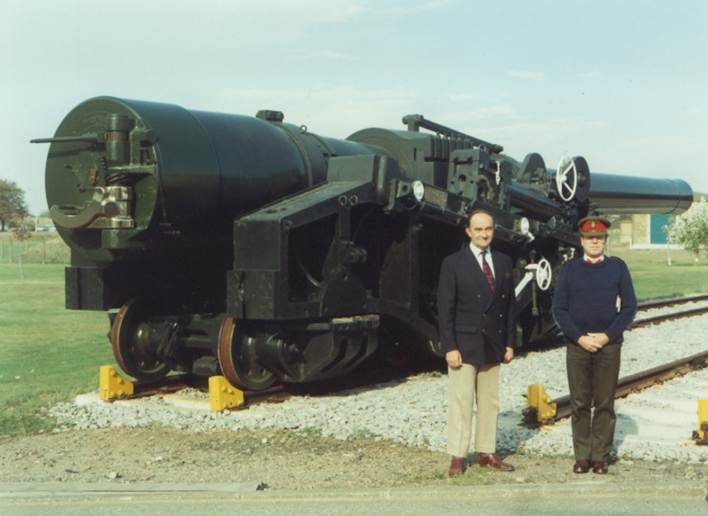
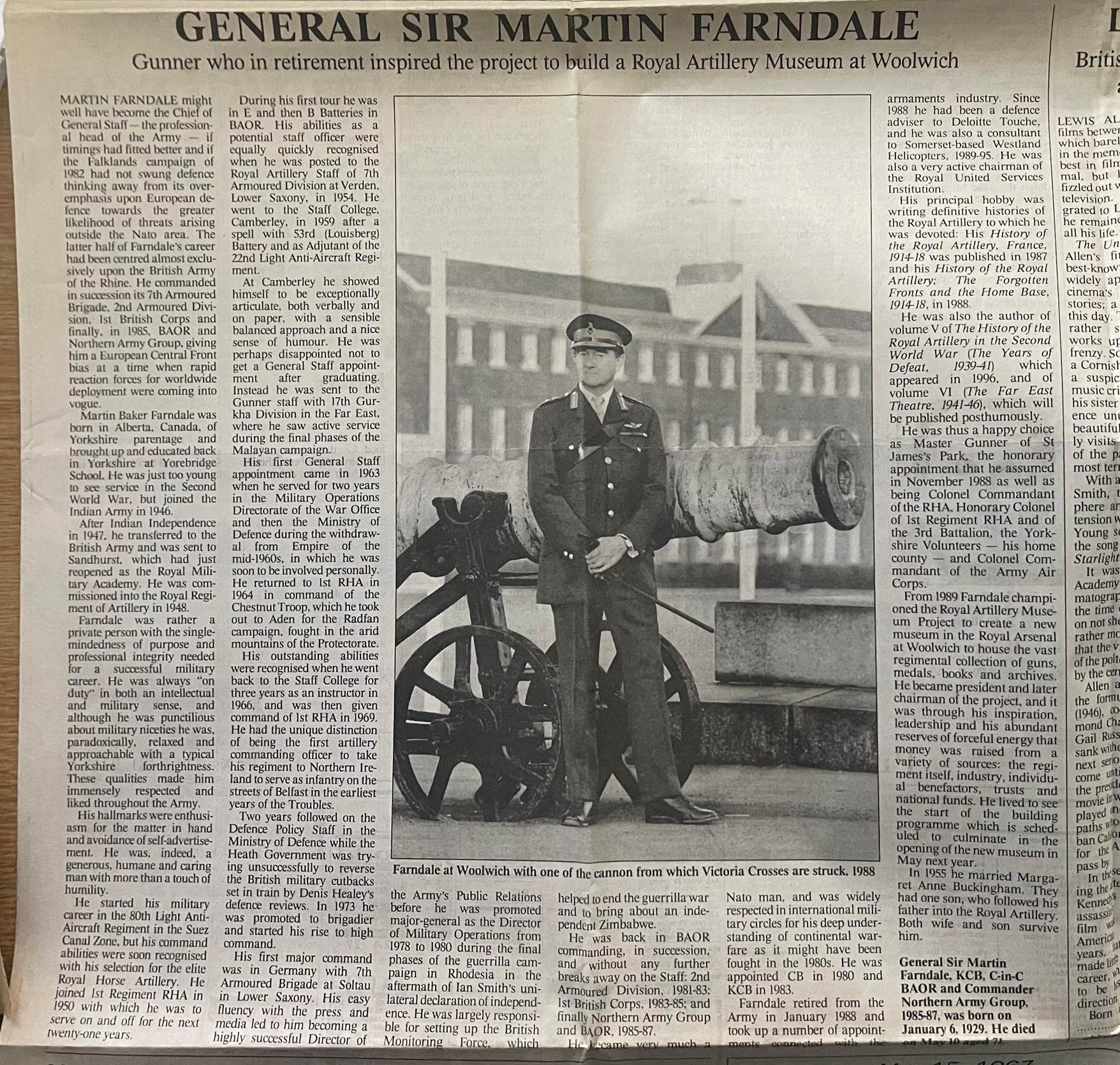
From 1989 until his death, he worked
tirelessly to create a museum of artillery at the Royal Arsenal, Woolwich. This
was known as the Royal Artillery Museum Project and became Royal Artillery Museums
Limited, of which he was Chairman. The museum opened a year after his death in
May 2001 and is known as Firepower. It houses the vast regimental collection of
guns, medals, books and archives and is also an interactive museum of the
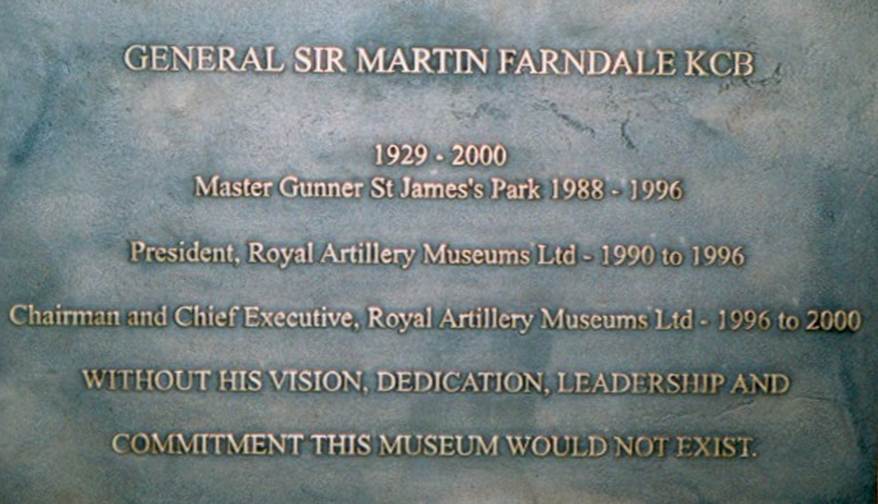
history of artillery. The principal building of the museum is now known as the
Farndale Building and a plaque at the entrance is dedicated to Martin and
states "without his vision, dedication, leadership and commitment, this
museum would not exist."
Martin was a
passionate historian and as well as his genealogical work, he wrote definitive
histories of the Royal Artillery, a task which he started early in his military
career and continued until he died. He wrote the History
of the Royal Artillery, France 1914-1918 (published 1987). He wrote the History
of the Royal Artillery, The Forgotten Fronts and the Home Base, 1914-1918
(published 1988). He wrote the History
of the Royal Artillery in the Second World War (The Years of Defeat 1939-41)
(published 1996). He wrote the History of the
Royal Artillery (The Far East Theatre 1941-1946) which was published posthumously.
He also wrote many articles for the British Army Review and the Royal Artillery
Journal.
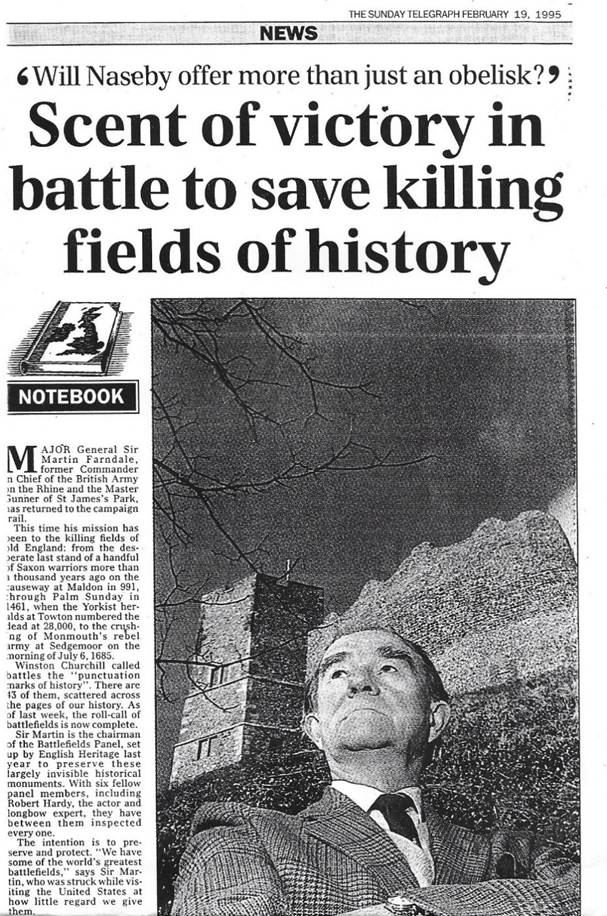
He was also
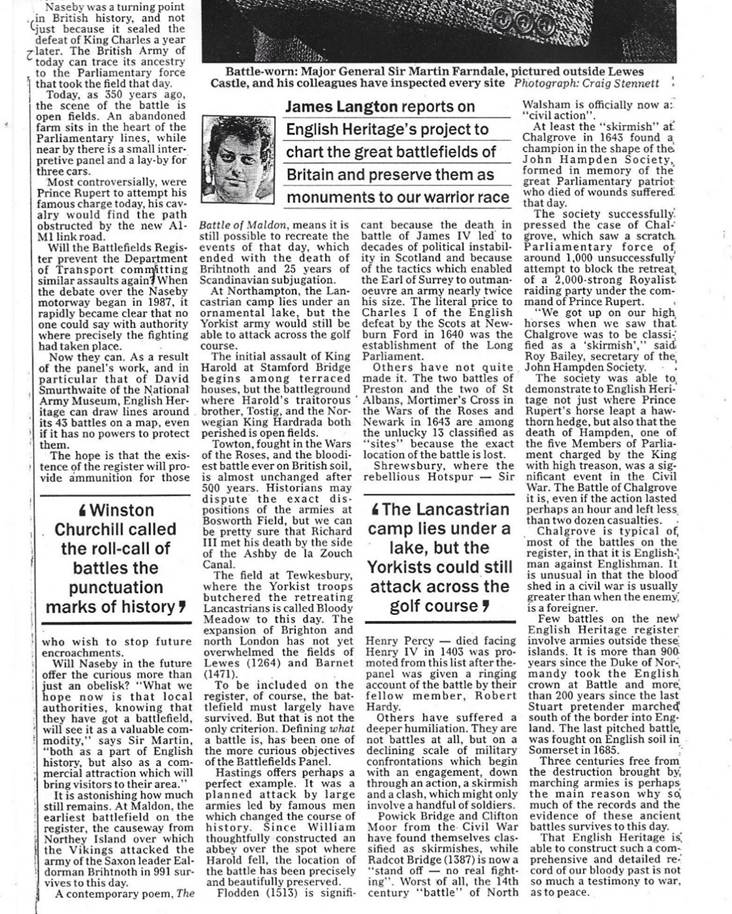
Chairman of the English Heritage Battlefields Trust from
1993. The trust endeavours to preserve battlefields from being destroyed by new
roads of buildings. Martin succeeded in saving the site of the Battle of
Tewkesbury (1471) from developers.
He took part as a guest lecturer during
a number of battlefield tours covering both the First
and Second World Wars.
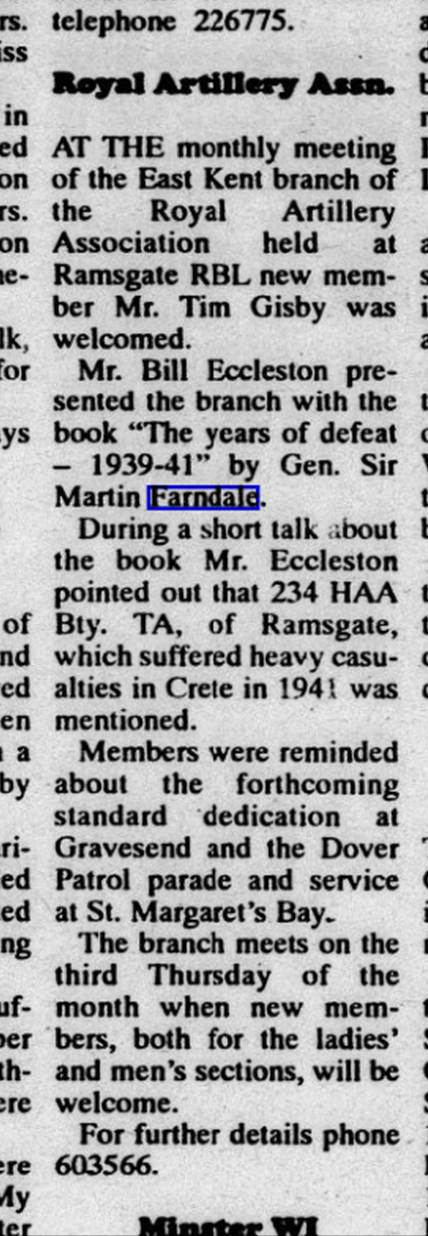
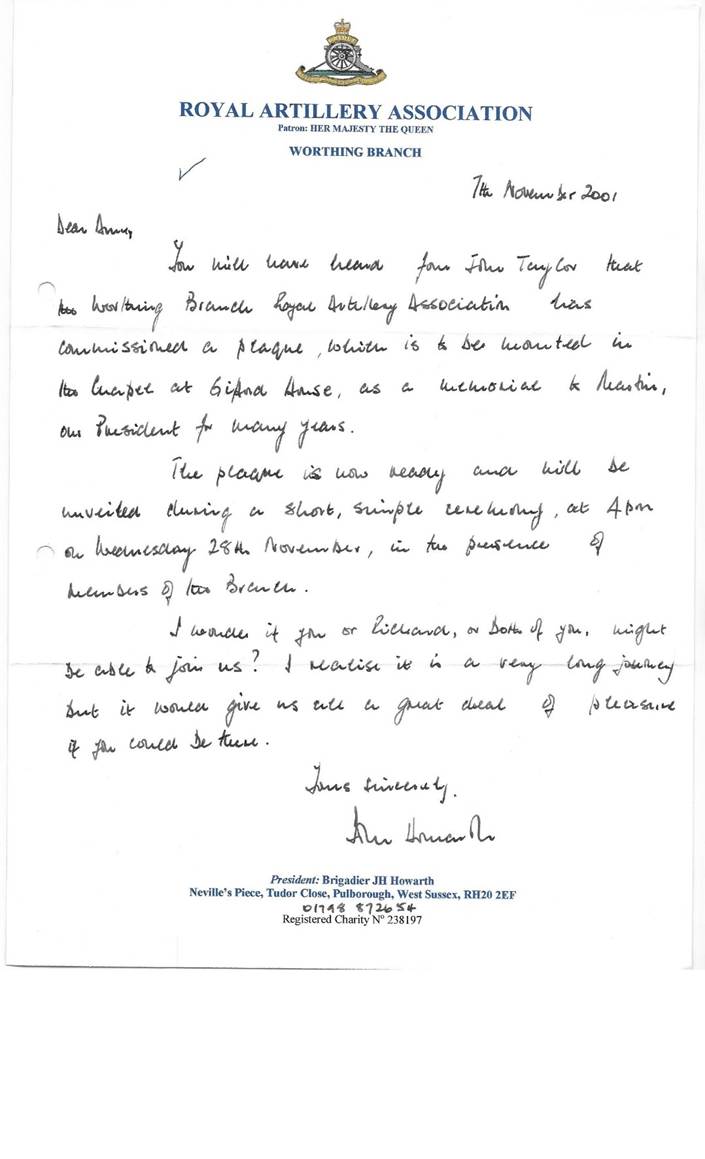
Royal Artillery Association
He was President of the Worthing
Branch of the Royal Artillery Association from 1988 to 2000. He attended almost
every branch meeting and in 1999, to his great pride, the branch won the Burton
Cup for the best achievement in fundraising towards the museum. The branch
unveiled a plaque to his memory at Gifford House chapel in Worthing in December
2001. The plaque reads "In Memory of General Sir Martin Farndale
1929-2000, Commander British Army of the Rhine and Northern Army Group 1985-87,
Master Gunner St James's Park 1988-96, President Worthing Branch The Royal Artillery Association 1988-2000".
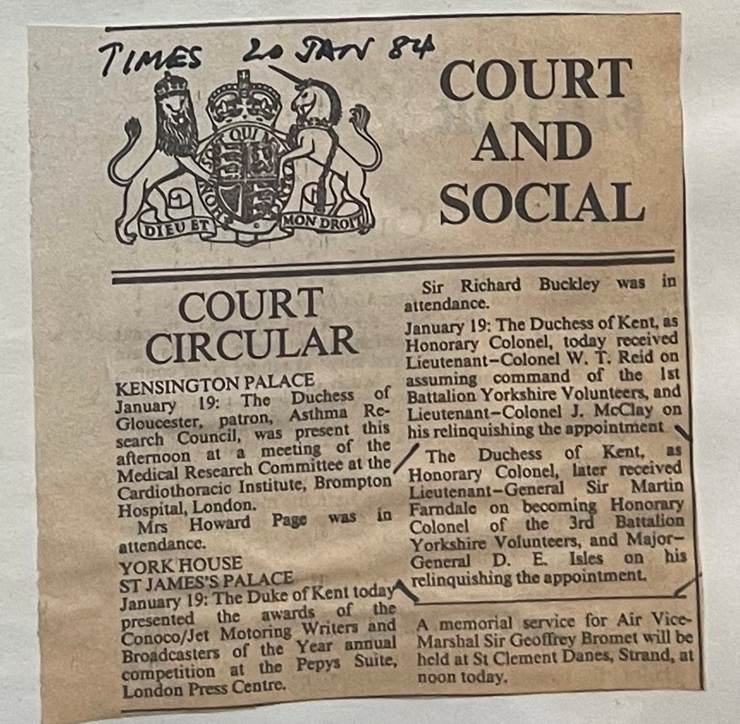
He was also Honorary Colonel of First
Regiment Royal Horse Artillery and of the 3rd Battalion the
Yorkshire Volunteers. He continued to be
passionately involved with First Regiment Royal Horse Artillery. His son, Captain
Richard Farndale RHA was Adjutant of the Regiment in 1992 to 1993.
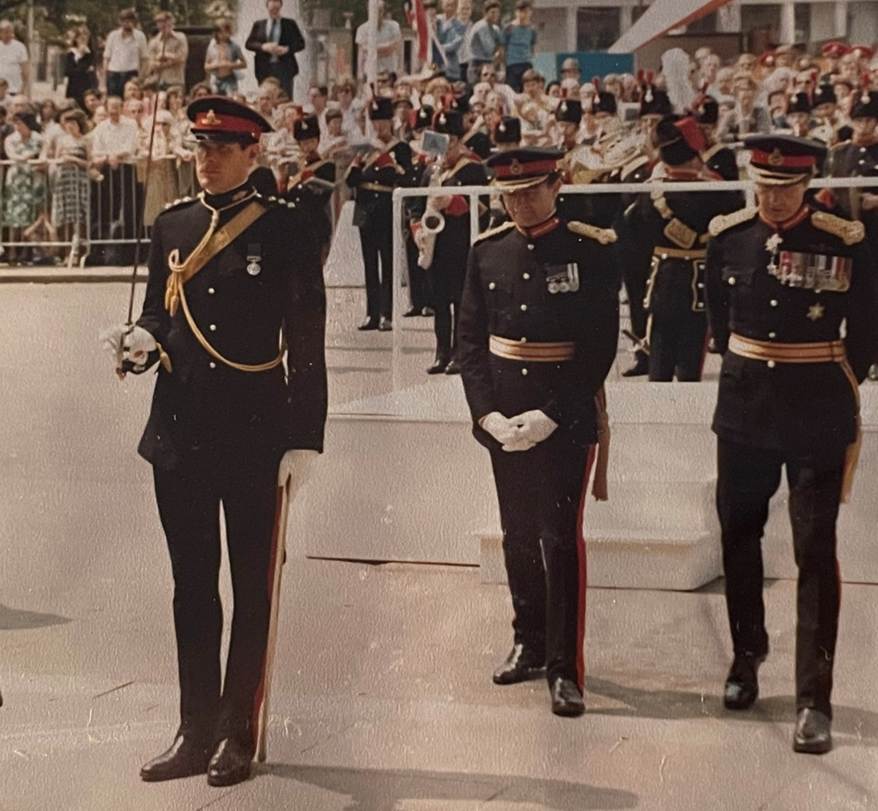
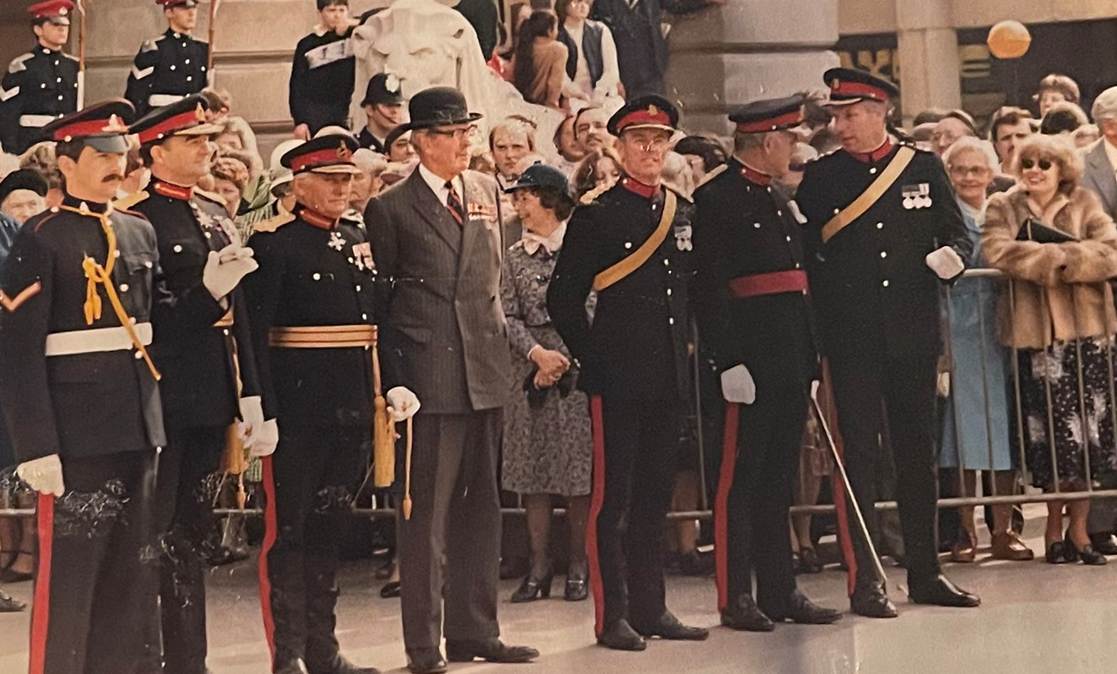
With 1RHA exercising their freedom of
Nottingham in 1978 and
again in 1982
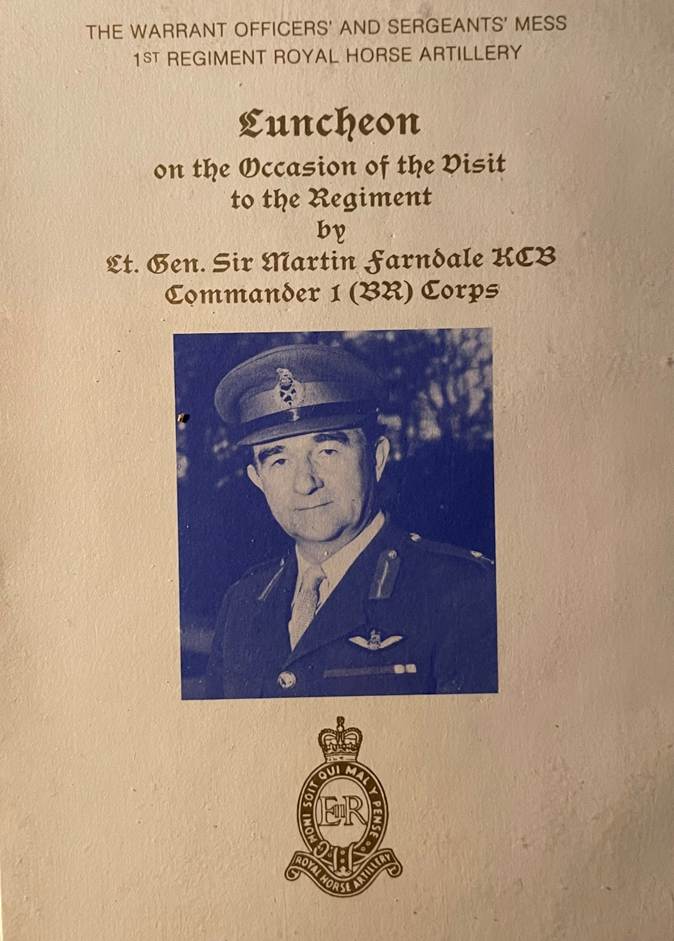
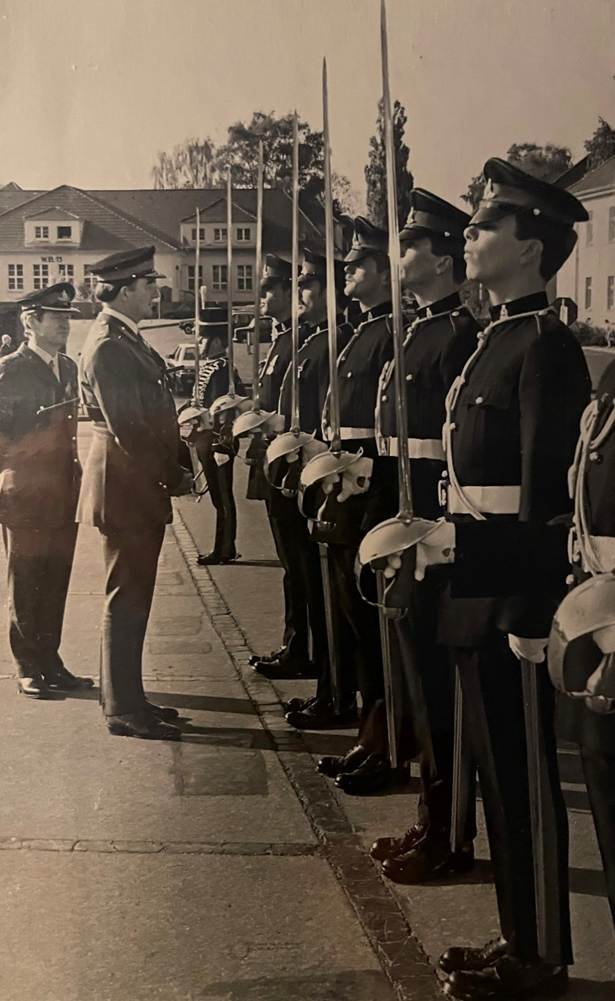
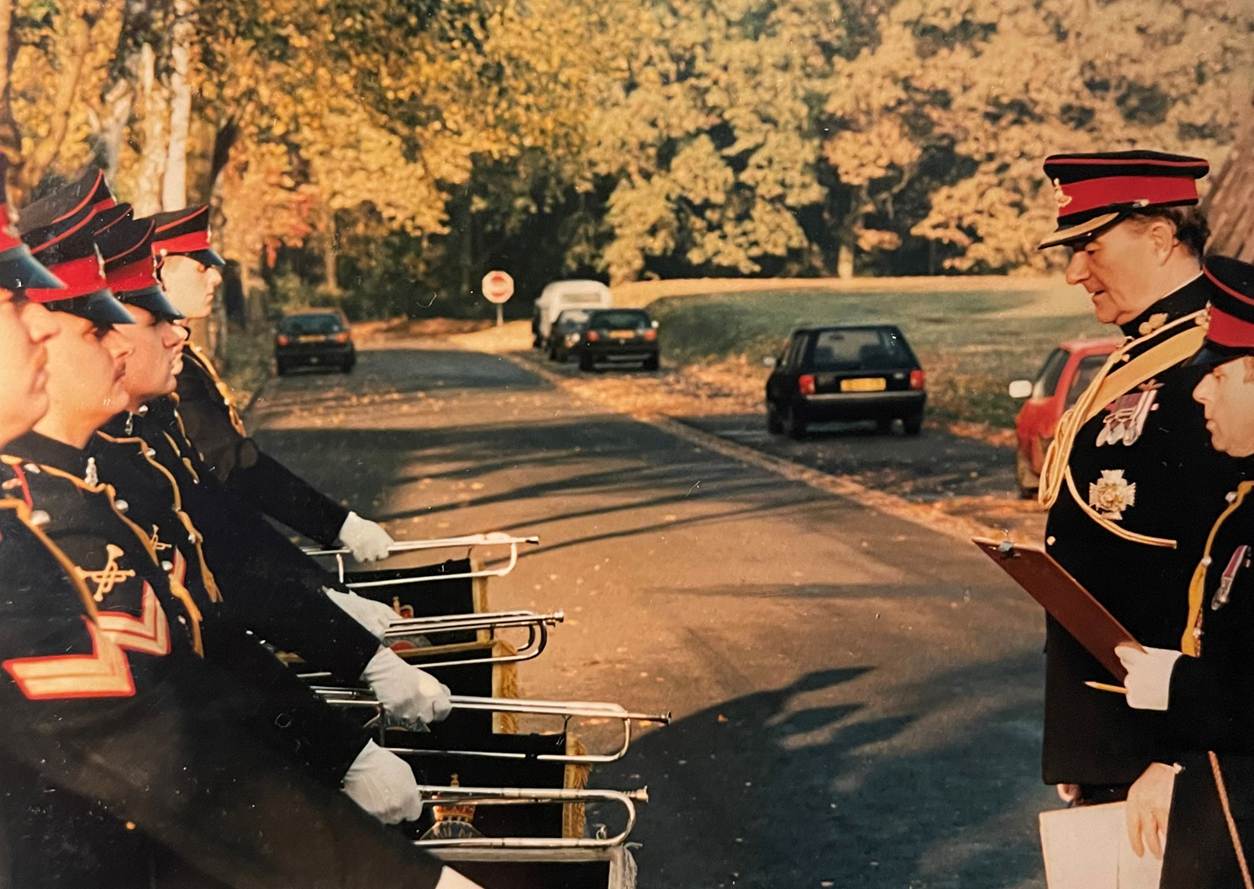
Inspecting B battery in Hohne in 1984
Farewell as Honorary Colonel of 1 RHA in 1989, Hohne, West Germany
(Isle of Thanet Gazette, 30 May 1997)
Civilian Appointments
He became a
Director of Short Brothers plc, Defence Adviser to Westland Helicopters and to
Deloitte & Touche in the City. He was also a very active chairman of the Royal United Services
Institute from 1989-1993. He became a Freeman
of the City of London and a member of the
Wheelwrights Livery.
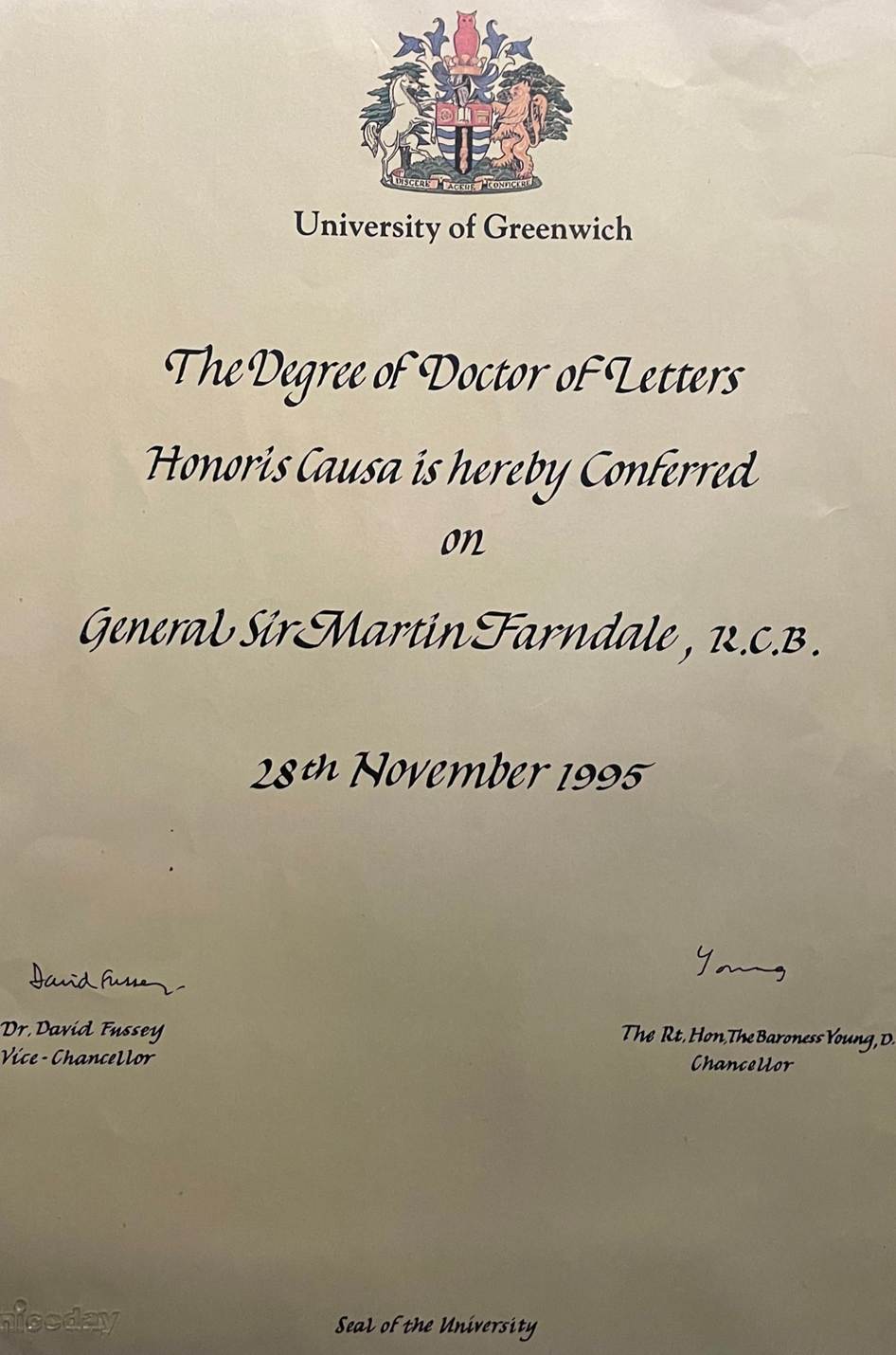
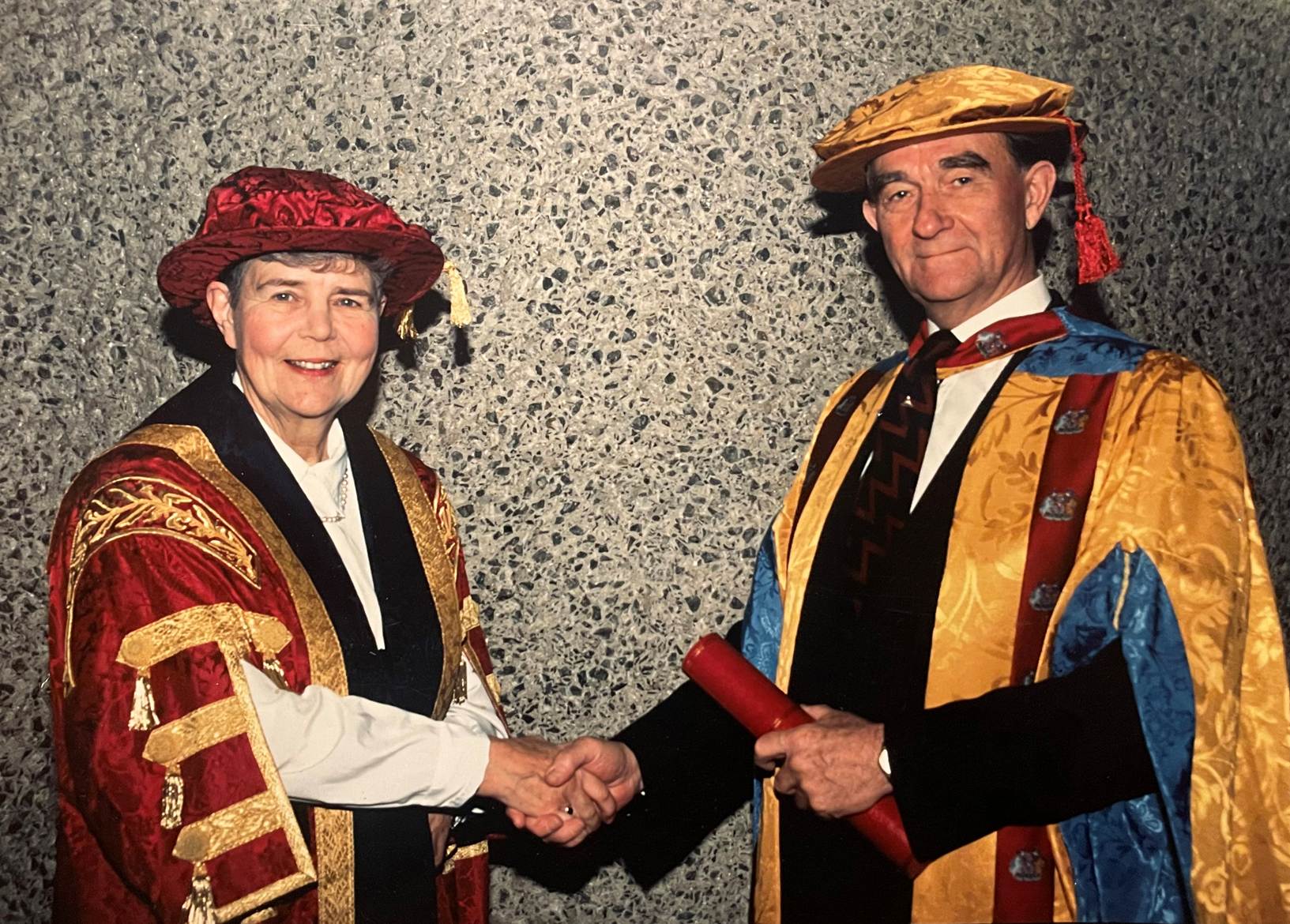
He was awarded an Honorary Degree of
Doctor of Letters at the University of Greenwich for his work on the history of
the Royal Artillery.
Medals and Honours
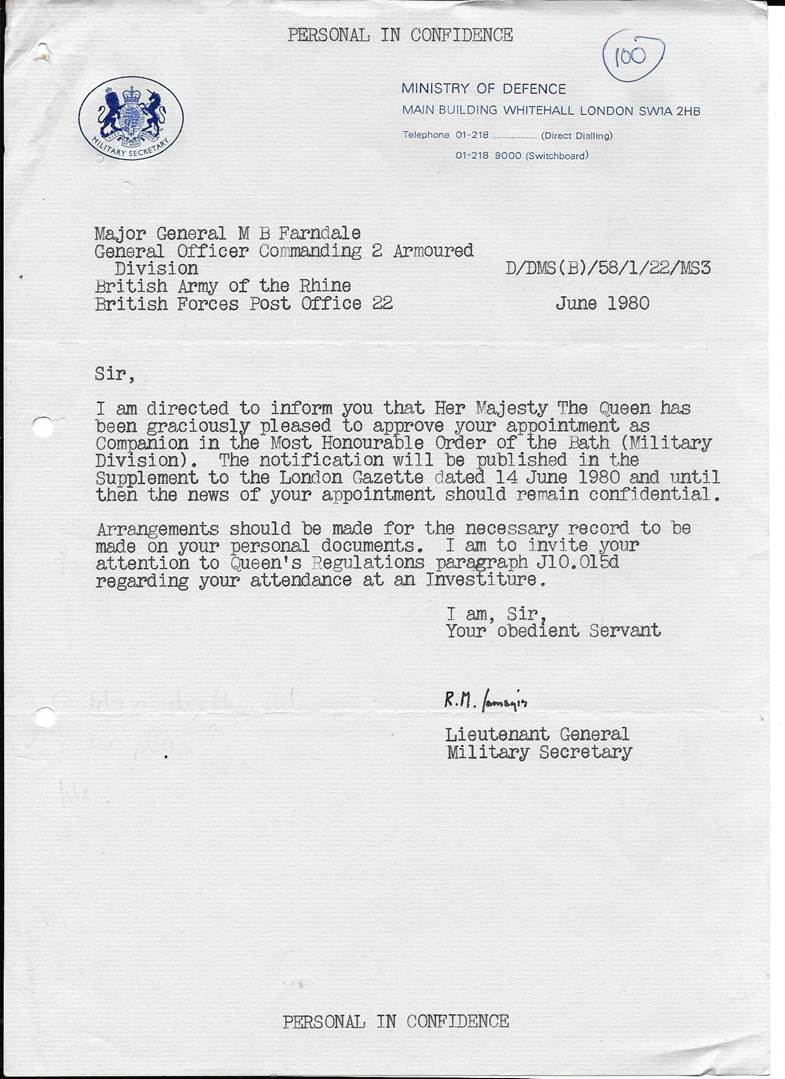
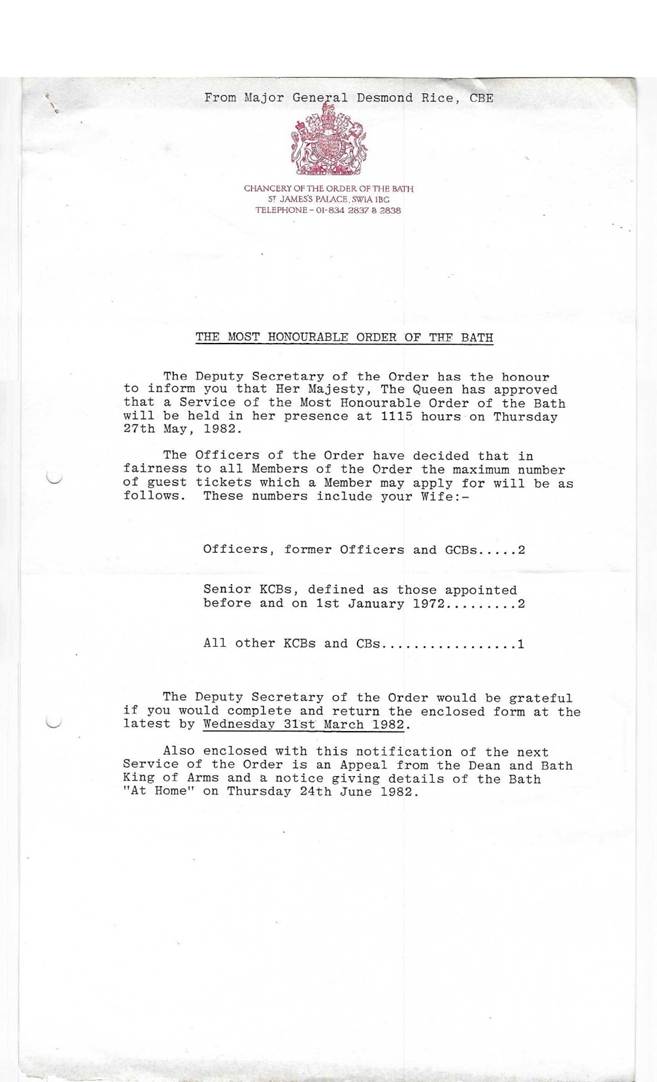
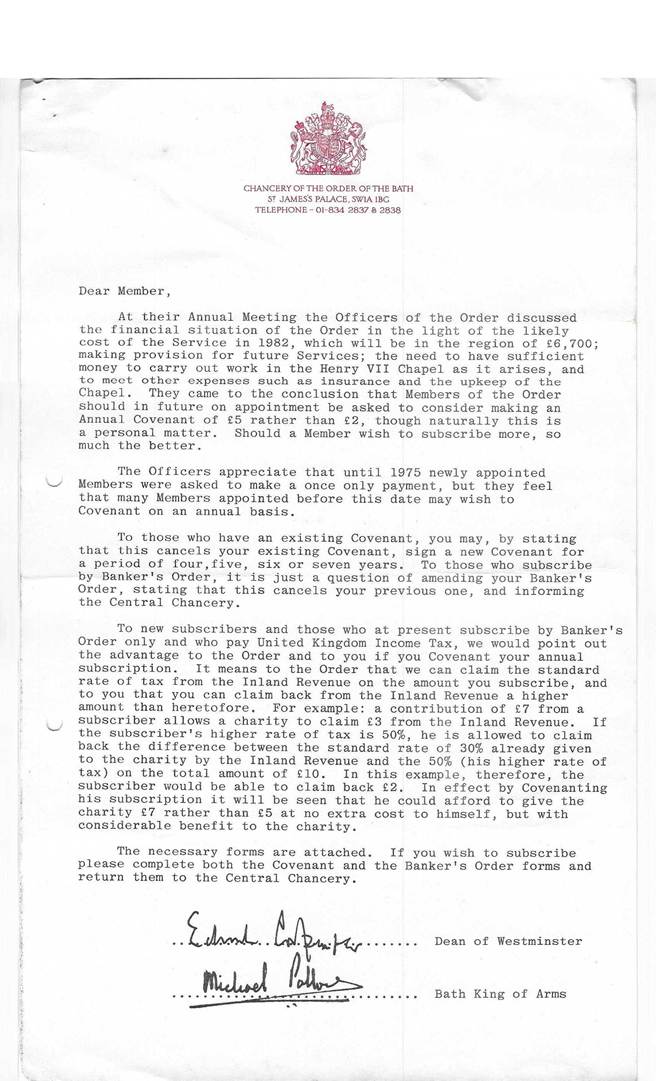
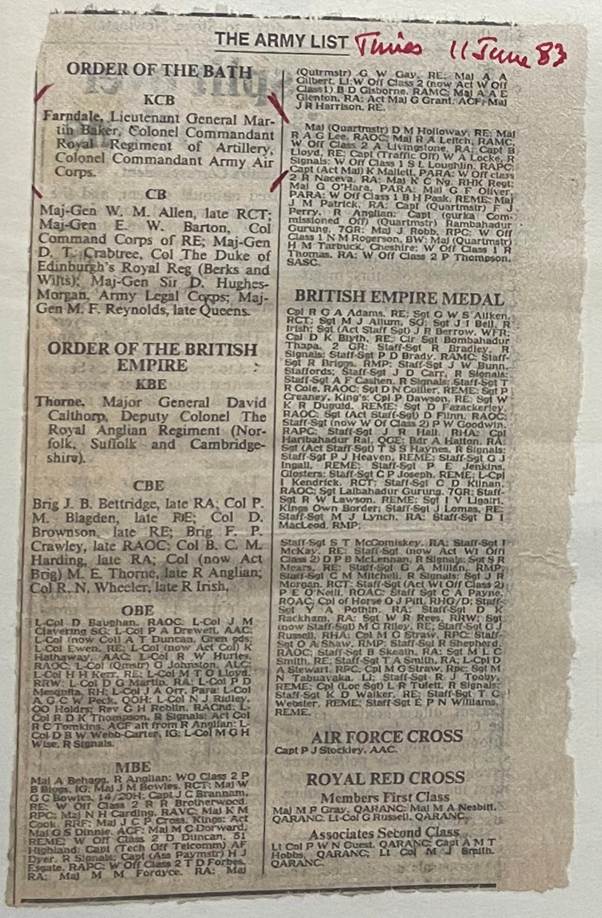
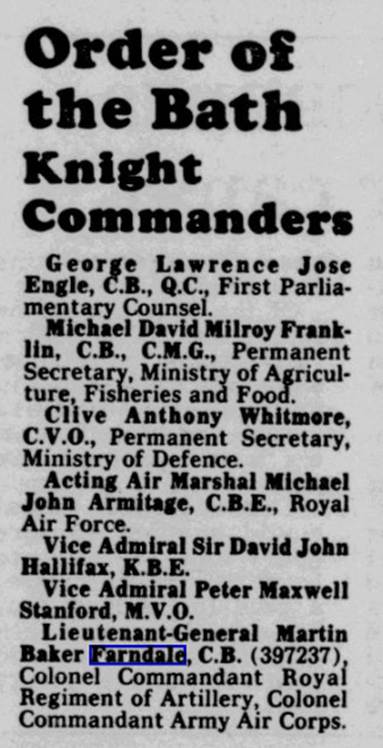
He was appointed Companion of the Most
Honourable Order of the Bath in 1980 and Knight Commander of the Order of the
Bath in 1983.
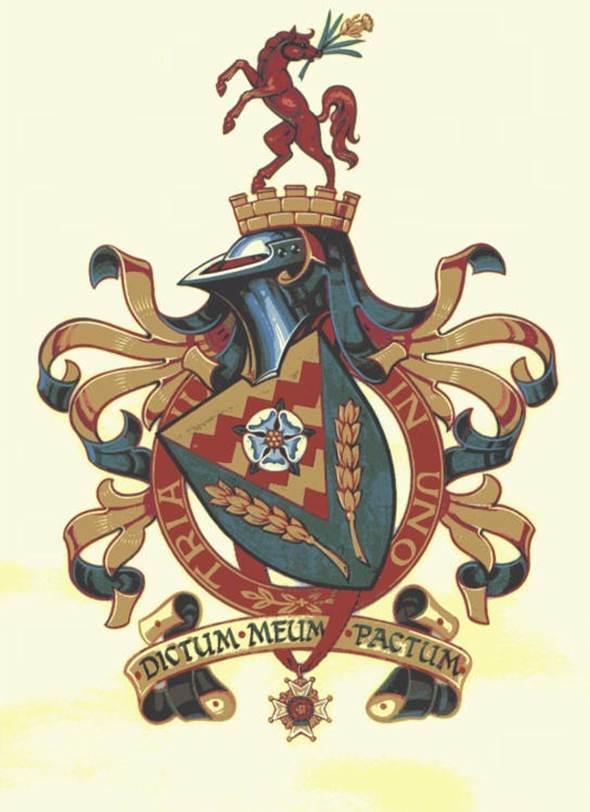
Martin
Farndale’s coat of arms is displayed below.
Martin
Farndale’s coat of arms
(Daily Post: The Paper for Wales, 11 June
1983)
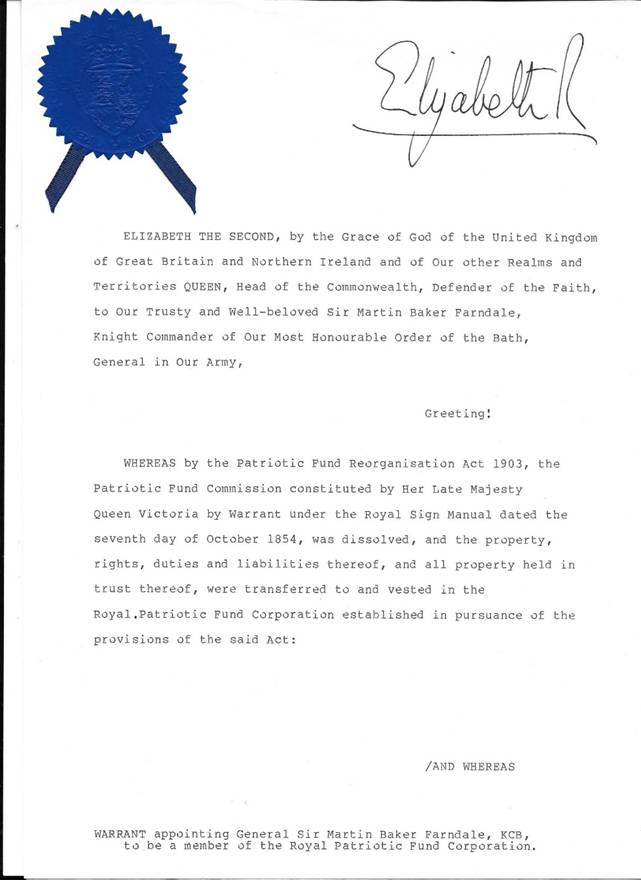
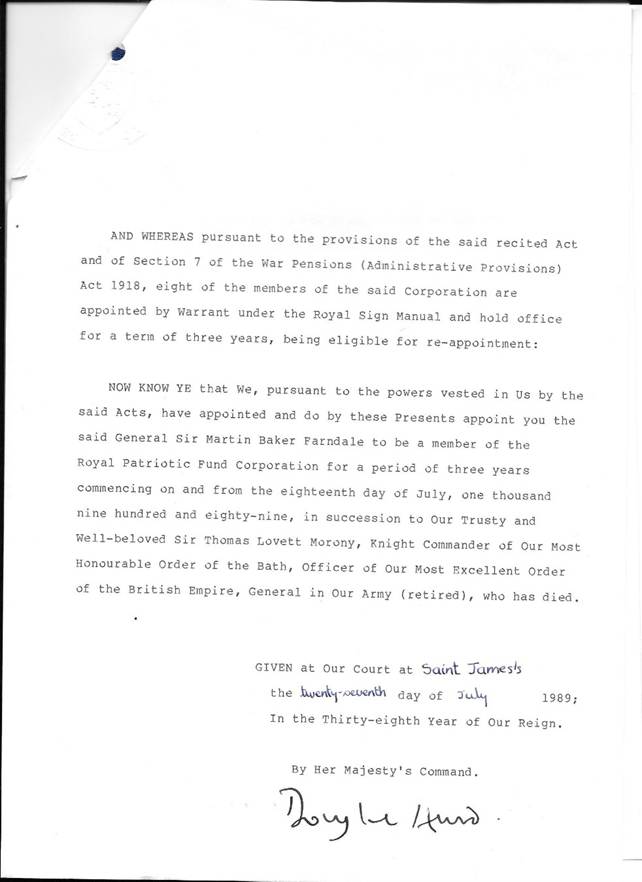
He was a
member of the
Royal Patriotic Fund.
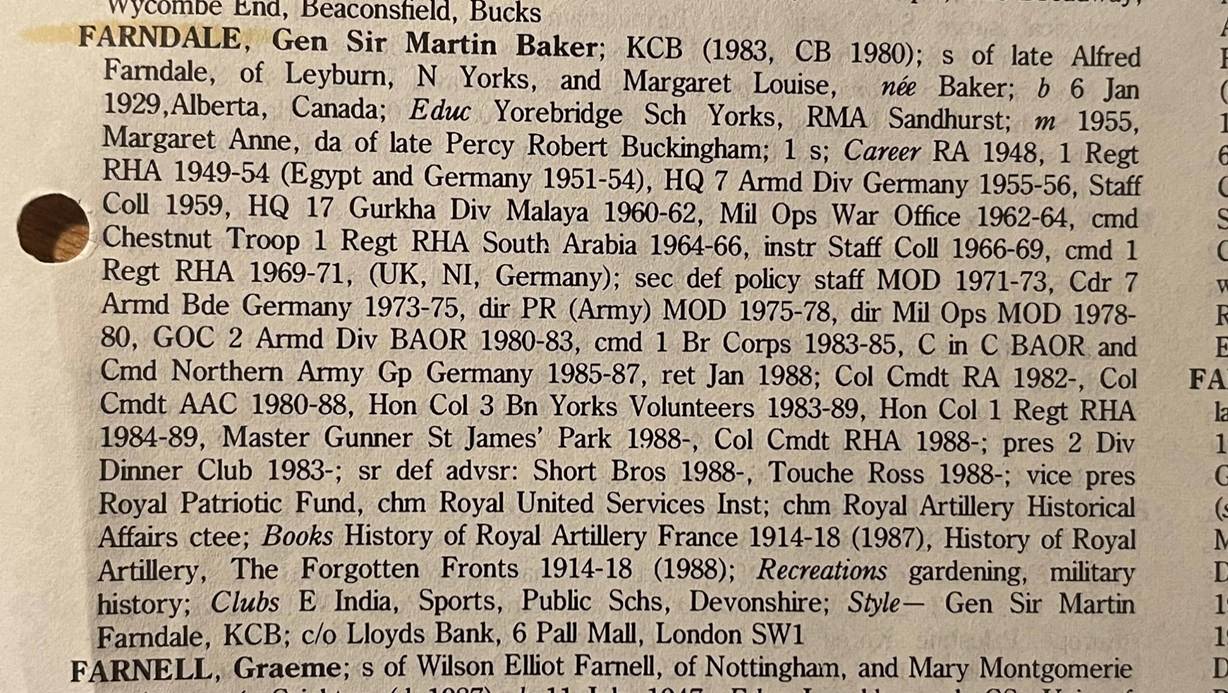
Biography entries in Who’s Who and
Debrett’s People of Today:
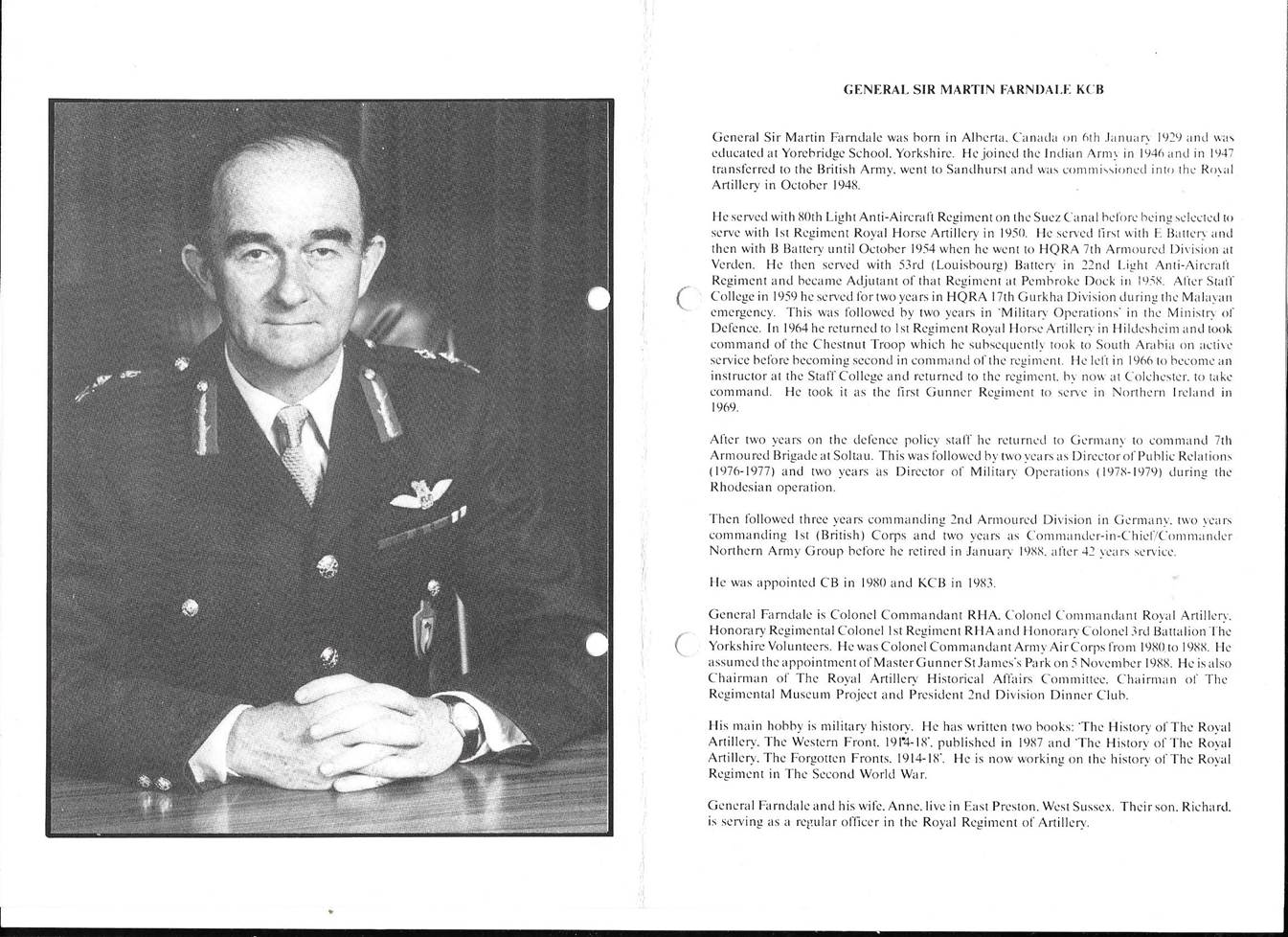
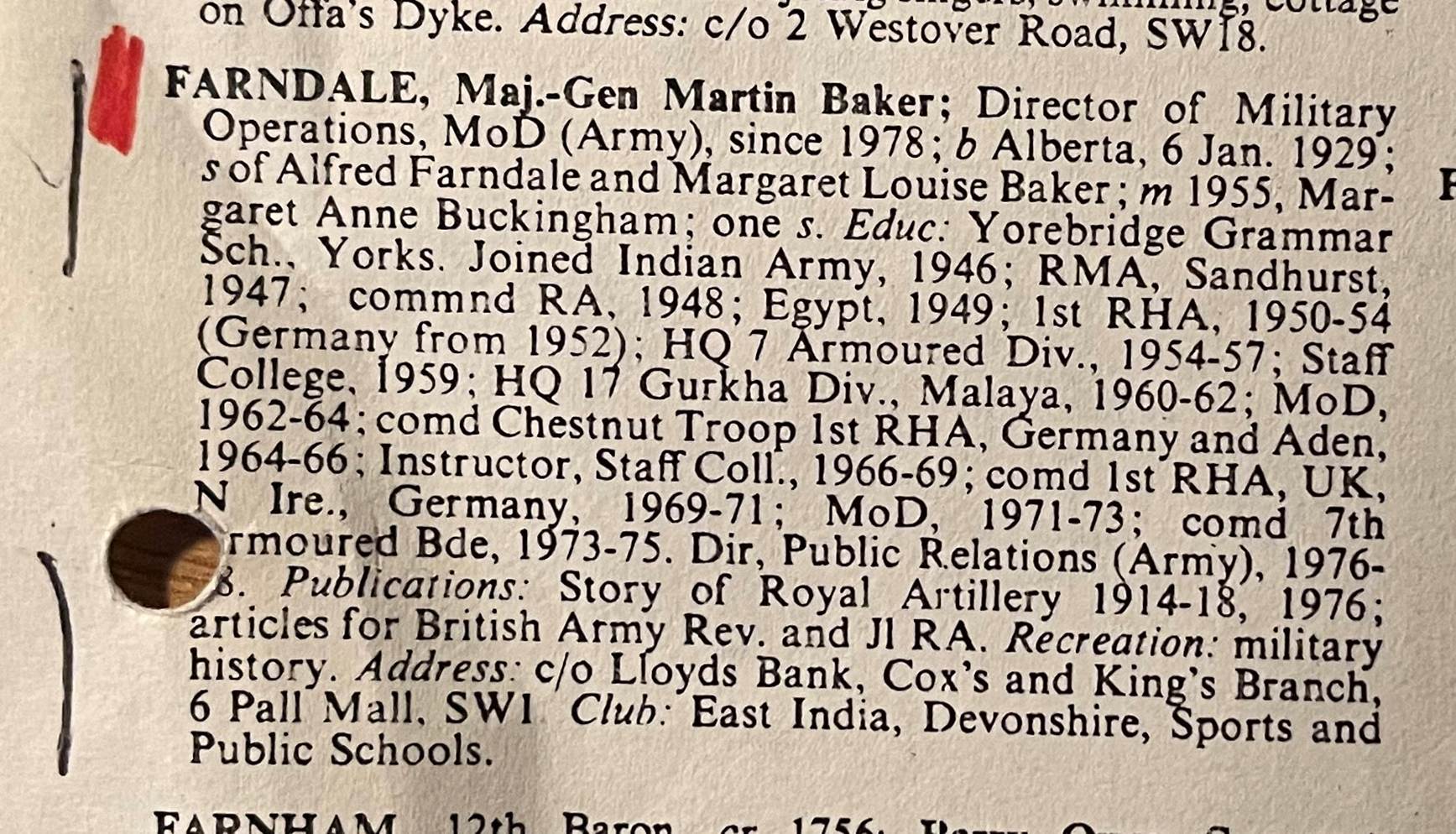
Who’s Who 1978
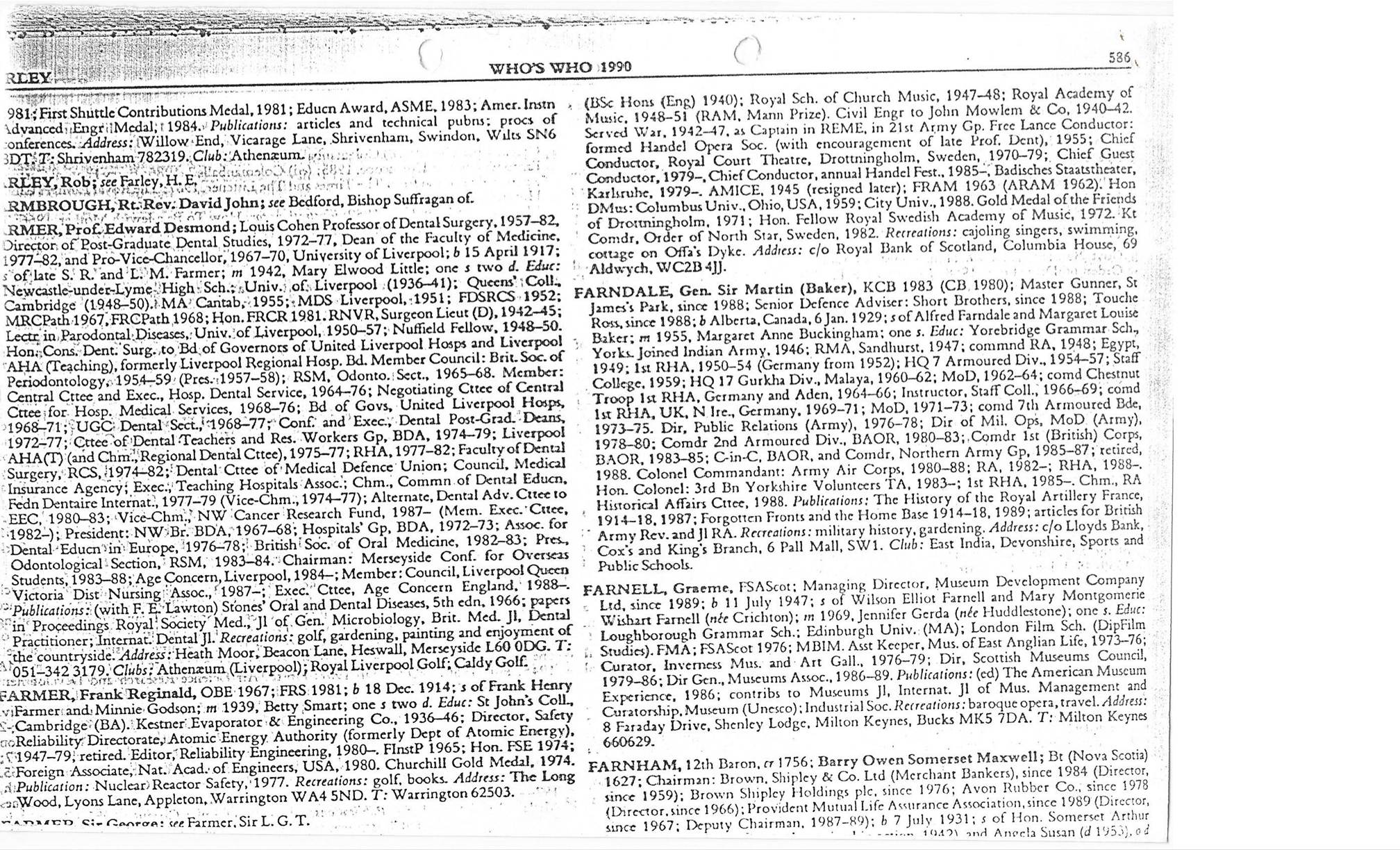
Who’s Who 1990
Other interests
He was a member of the East India and
Sports Club from June 1962.
He was also passionately interested in
the Farndale family history and the information contained on this website is
almost entirely the result of his work.
He was a very keen and successful
gardener which perhaps kept him close to his farming roots, with his hands
firmly in the soil.
2000
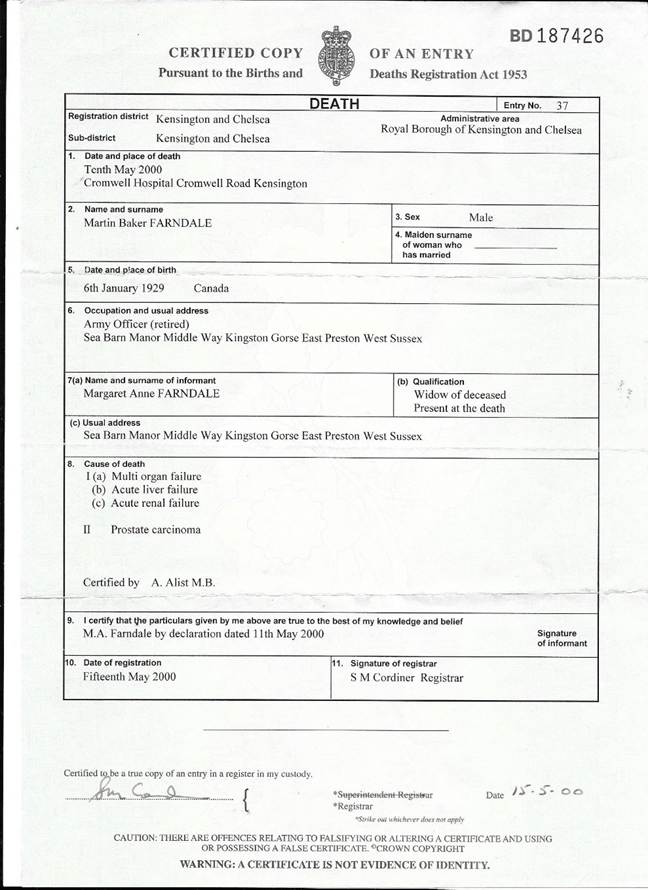
Died
Martin Baker Farndale died at the age
of 71 at Cromwell Hospital, London on 10 May 2000 (GRO
District 2391B Register Number B61B entry 37). He was cremated at
Worthing Crematorium and is buried at Wensley Church, Wensleydale, North
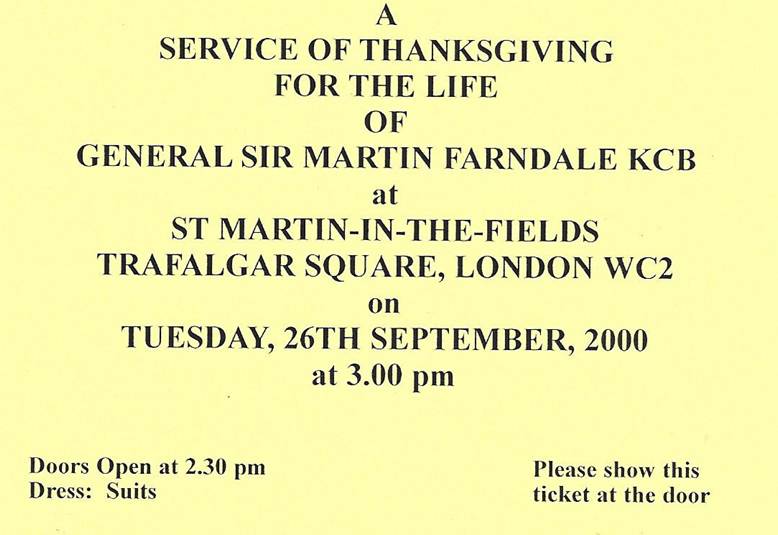
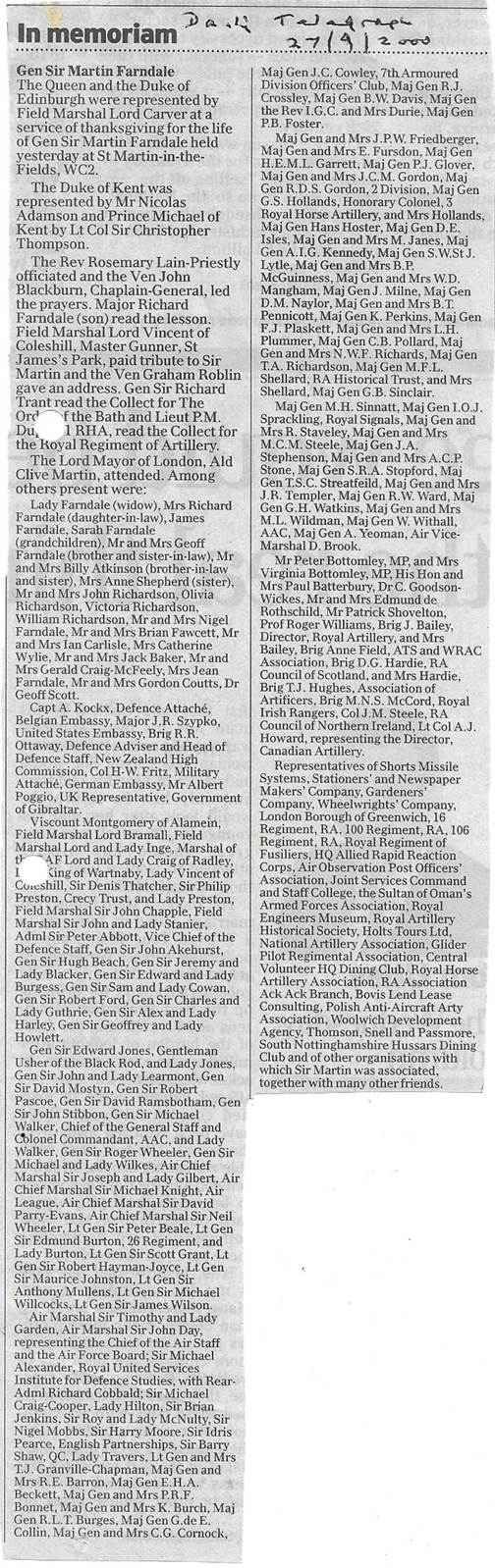
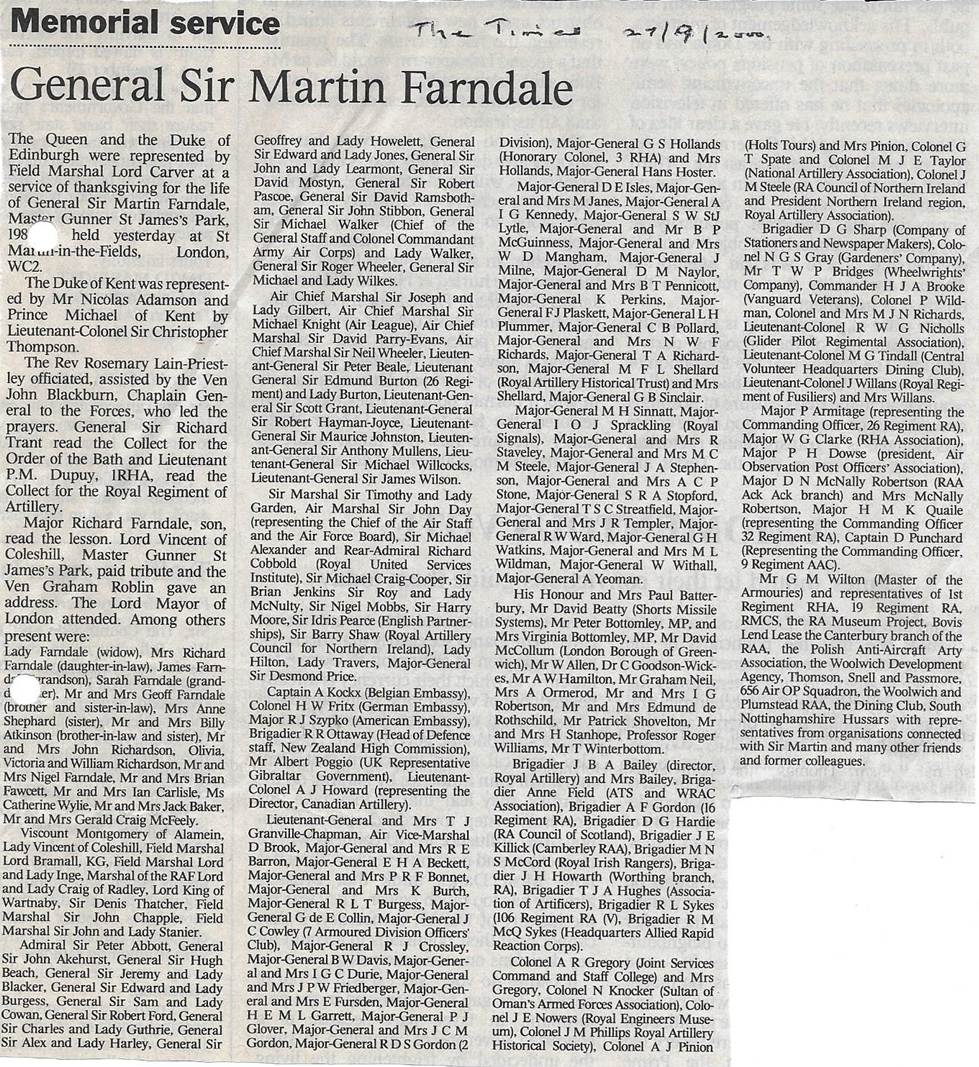
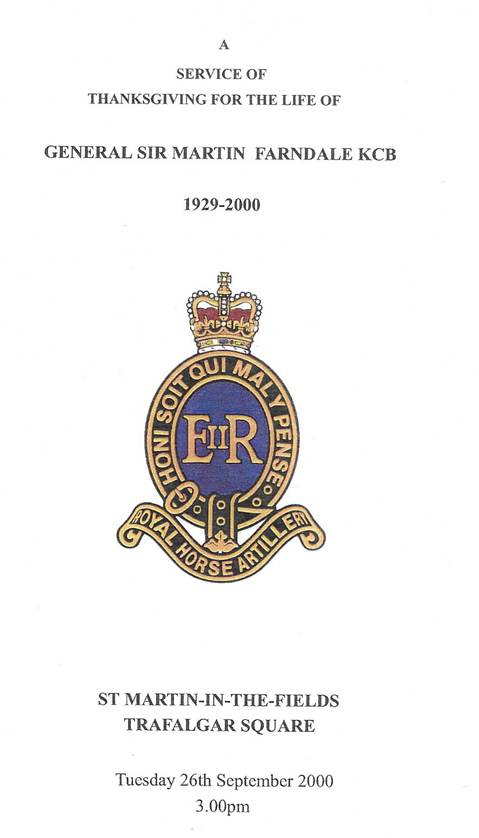
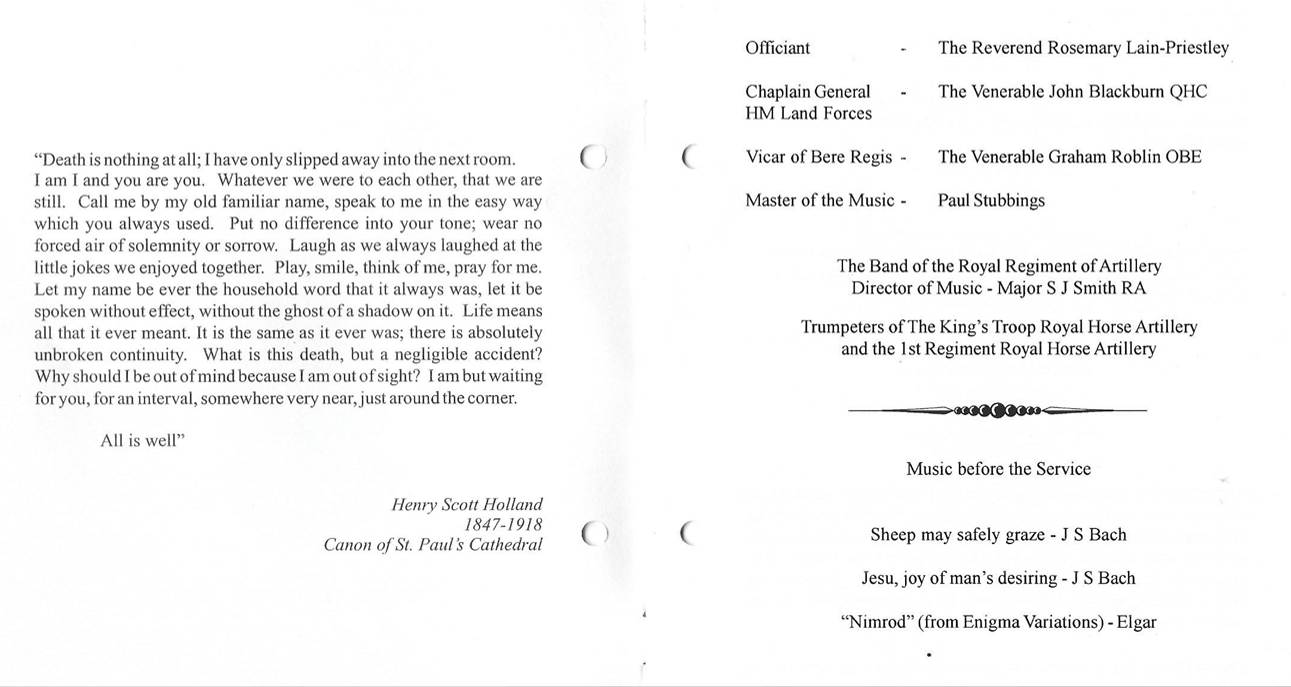
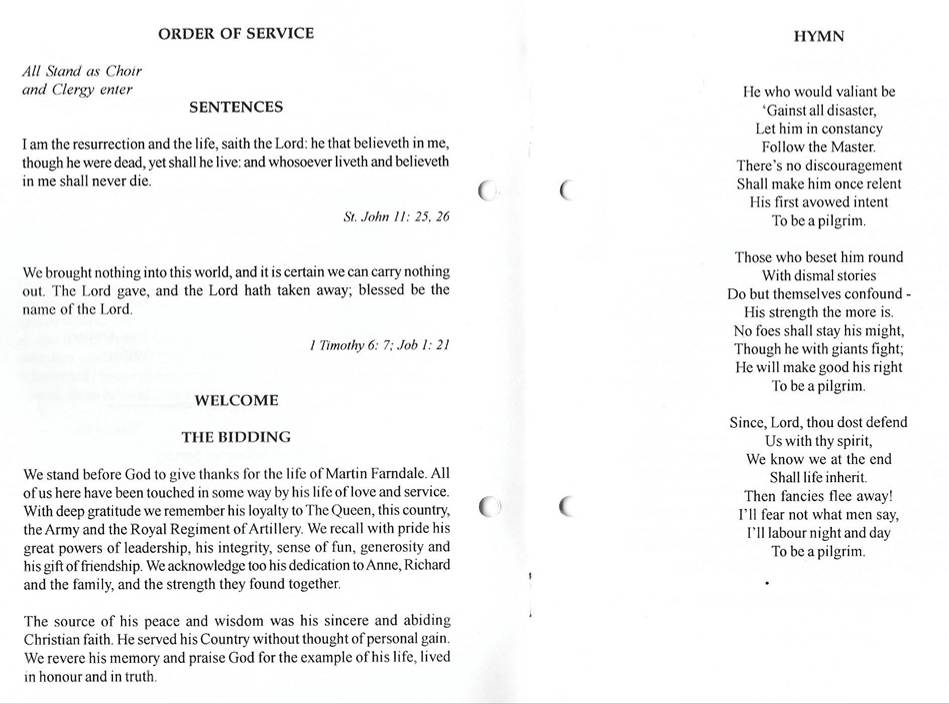
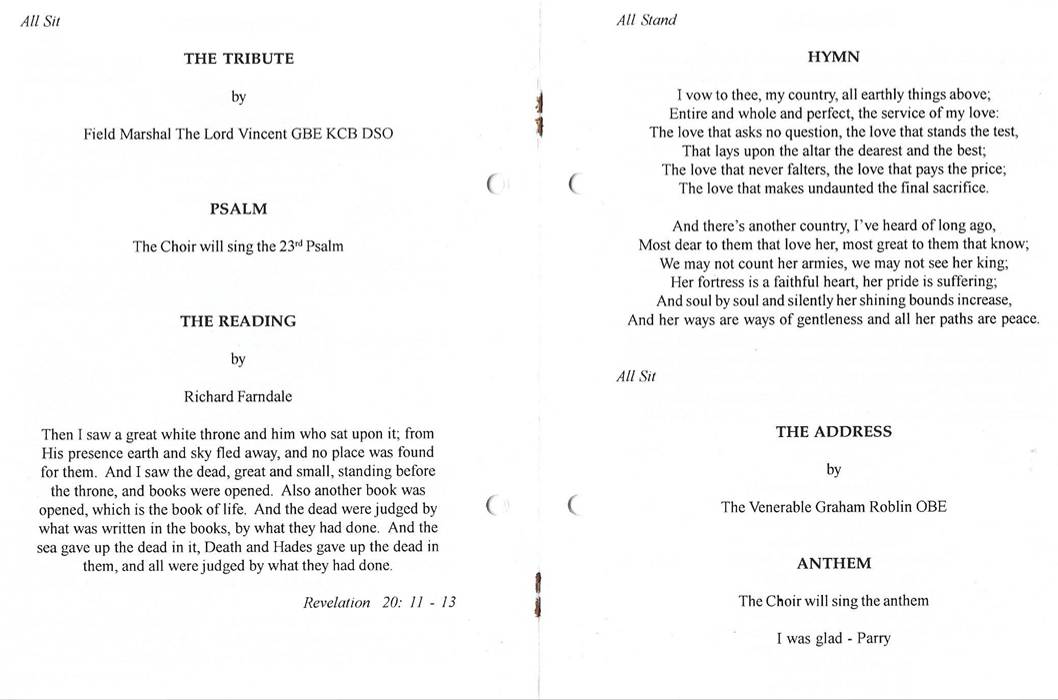
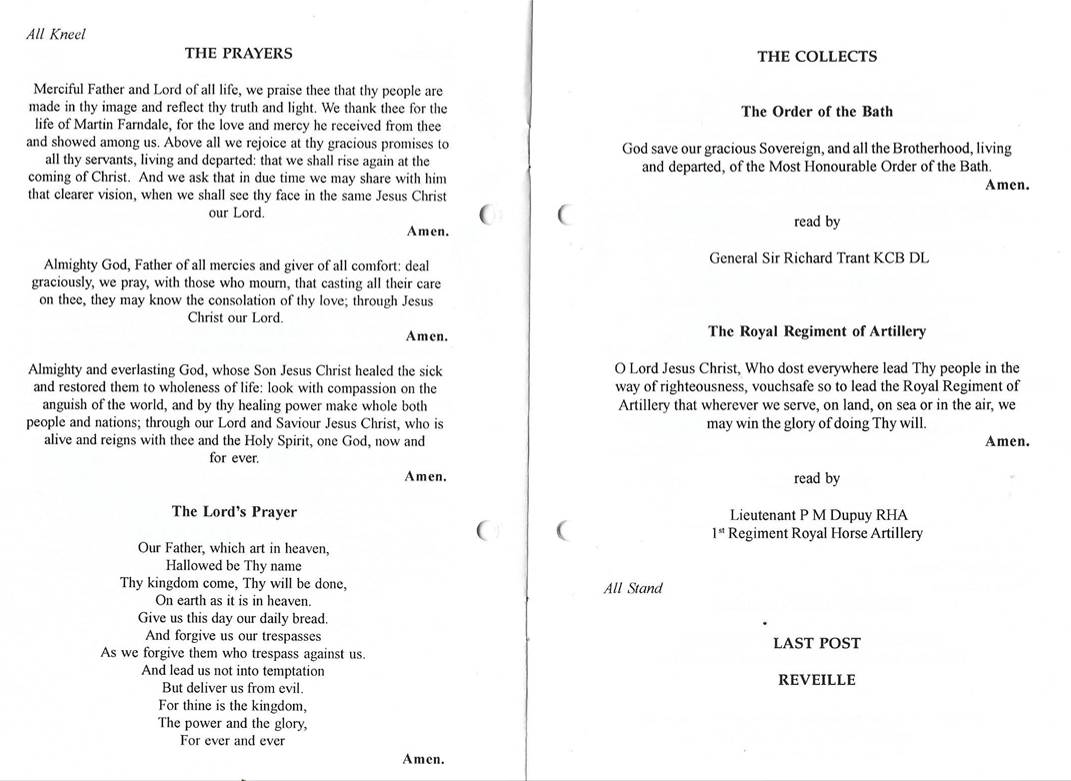
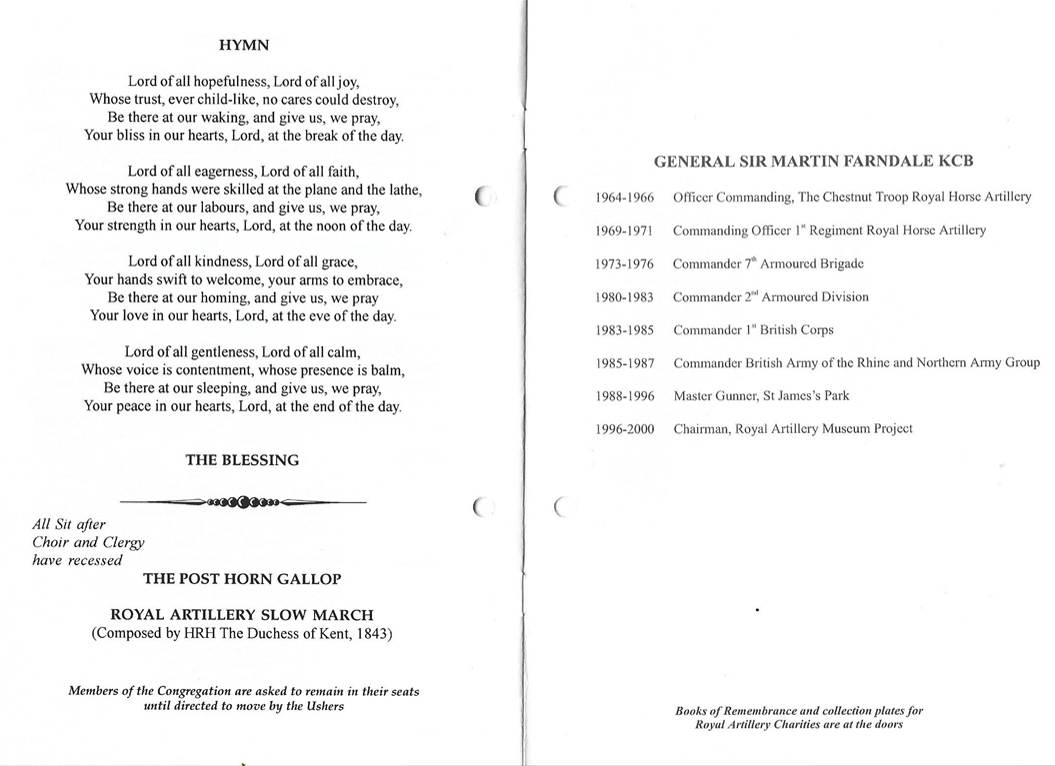
Yorkshire beside his parents. A Memorial Service was held at St
Martin-in-the-fields in London on 26 September 2000.
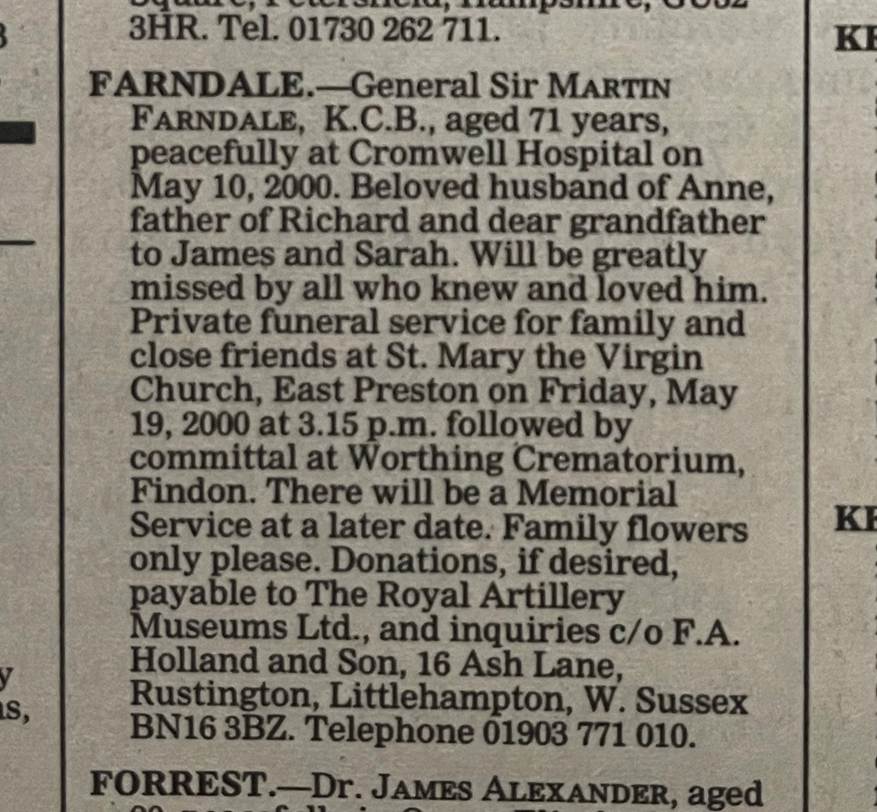
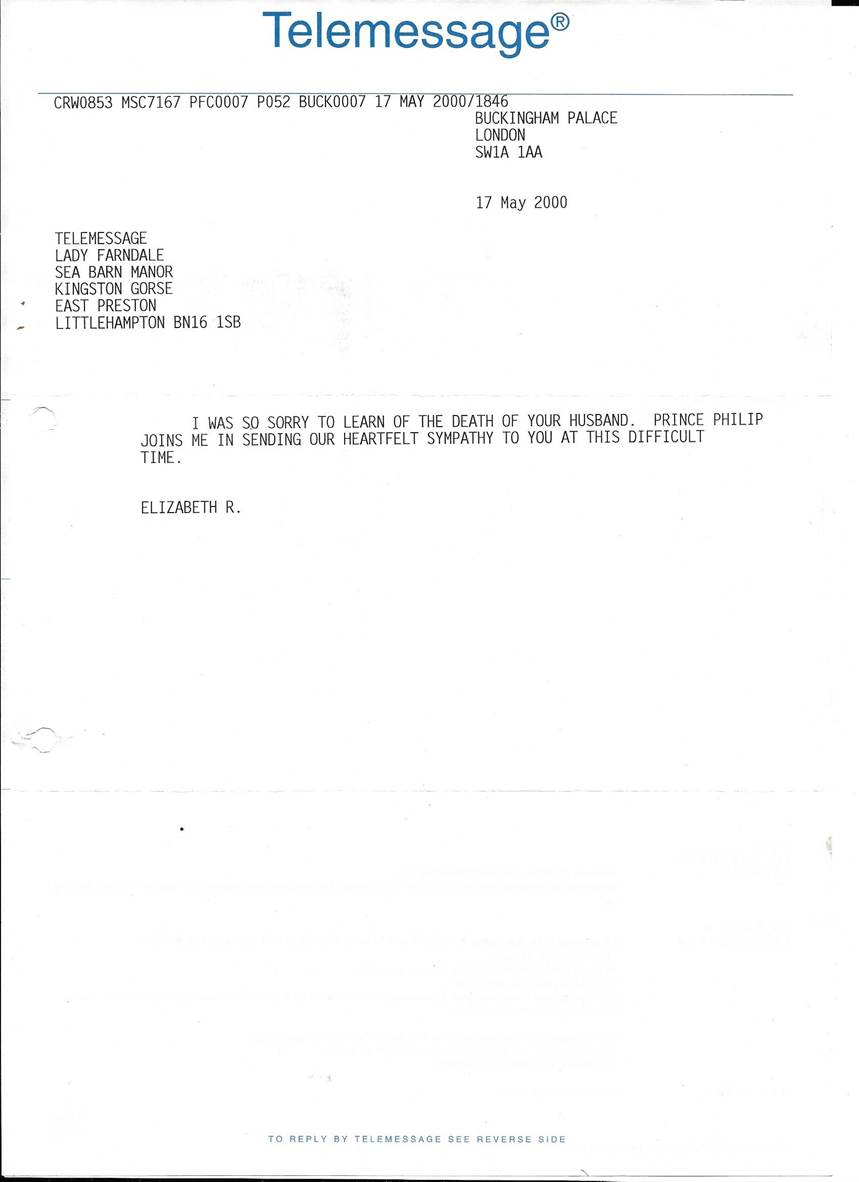
A memorial service was held at St
Martin in the Fields in London
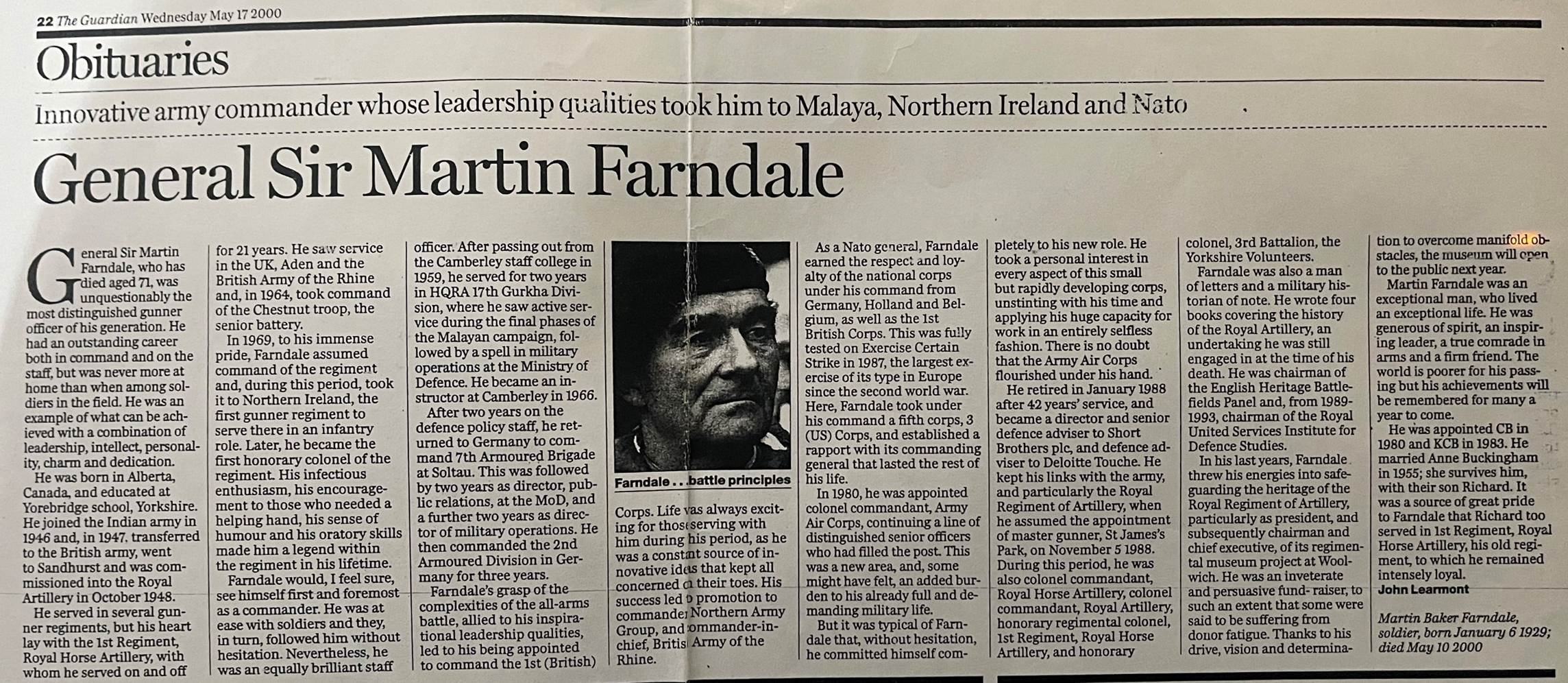
Obituaries
The Guardian,
Wednesday 17 May 2000:
John Learmont
Innovative army commander whose leadership
qualities took him to Malaya, Northern Ireland and NATO.
General Sir Martin Farndale, who has
died aged 71, was unquestionably the most distinguished gunner officer of his
generation. He had an outstanding career both in command and on the staff, but was never more at home than when among soldiers
in the field. He was an example of what can be achieved with a combination of
leadership, intellect, personality, charm and dedication.
He was born in Alberta, Canada, and educated
at Yorebridge school, Yorkshire. He joined the Indian army in 1946 and, in
1947, transferred to the British army, went to Sandhurst and was commissioned
into the Royal Artillery in October 1948.
He served in several gunner regiments,
but his heart lay with the 1st Regiment, Royal Horse Artillery, with whom he
served on and off for 21 years. He saw service in the UK, Aden and the British
Army of the Rhine and, in 1964, took command of the Chestnut troop, the senior
battery.
In 1969, to his immense pride,
Farndale assumed command of the regiment and, during this period, took it to
Northern Ireland, the first gunner regiment to serve there in an infantry role.
Later, he became the first honorary colonel of the regiment. His infectious
enthusiasm, his encouragement to those who needed a helping hand, his sense of
humour and his oratory skills made him a legend within the regiment in his
lifetime.
Farndale would, I feel sure, see himself
first and foremost as a commander. He was at ease with soldiers and they, in
turn, followed him without hesitation. Nevertheless, he was an equally
brilliant staff officer. After passing out from the Camberley staff college in
1959, he served for two years in HQRA 17th Gurkha Division, where he saw active
service during the final phases of the Malayan campaign, followed by a spell in
military operations at the Ministry of Defence. He became an instructor at
Camberley in 1966.
After two years on the defence policy
staff, he returned to Germany to command 7th Armoured Brigade at Soltau. This
was followed by two years as director, public relations, at the MoD, and a
further two years as director of military operations. He then commanded the 2nd
Armoured Division in Germany for three years.
Farndale's grasp of the complexities
of the all-arms battle, allied to his inspirational leadership qualities, led
to his being appointed to command the 1st (British) Corps. Life was always exciting
for those serving with him during this period, as he was a constant source of
innovative ideas that kept all concerned on their toes. His success led to
promotion to commander, Northern Army Group, and commander-in-chief, British
Army of the Rhine.
As a NATO general, Farndale earned the
respect and loyalty of the national corps under his command from Germany,
Holland and Belgium, as well as the 1st British Corps. This was fully tested on
Exercise Certain Strike in 1987, the largest exercise of its type in Europe
since the second world war. Here, Farndale took under his command a fifth
corps, 3 (US) Corps, and established a rapport with its commanding general that
lasted the rest of his life.
In 1980, he was appointed colonel
commandant, Army Air Corps, continuing a line of distinguished senior officers
who had filled the post. This was a new area, and, some might have felt, an
added burden to his already full and demanding military life.
But it was typical of Farndale that,
without hesitation, he committed himself completely to his new role. He took a
personal interest in every aspect of this small but rapidly developing corps,
unstinting with his time and applying his huge capacity for work in an entirely
selfless fashion. There is no doubt that the Army Air Corps flourished under
his hand.
He retired in January 1988 after 42
years' service, and became a director and senior
defence adviser to Short Brothers plc, and defence adviser to Deloitte Touche.
He kept his links with the army, and particularly the Royal Regiment of
Artillery, when he assumed the appointment of master gunner, St James's Park,
on November 5 1988. During this period, he was also
colonel commandant, Royal Horse Artillery, colonel commandant, Royal Artillery,
honorary regimental colonel, 1st Regiment, Royal Horse Artillery, and honorary
colonel, 3rd Battalion, the Yorkshire Volunteers.
Farndale was also a man of letters and
a military historian of note. He wrote four books covering the history of the
Royal Artillery, an undertaking he was still engaged in at the time of his
death. He was chairman of the English Heritage Battlefields Panel and, from
1989-1993, chairman of the Royal United Services Institute for Defence Studies.
In his last years, Farndale threw his
energies into safeguarding the heritage of the Royal Regiment of Artillery,
particularly as president, and subsequently chairman and chief executive, of its
regimental museum project at Woolwich. He was an inveterate and persuasive
fund- raiser, to such an extent that some were said to be suffering from donor
fatigue. Thanks to his drive, vision and determination to overcome manifold
obstacles, the museum will open to the public next year.
Martin Farndale was an exceptional
man, who lived an exceptional life. He was generous of spirit, an inspiring
leader, a true comrade in arms and a firm friend. The world is poorer for his passing but his achievements will be remembered for many a
year to come.
He was appointed CB in 1980 and KCB in
1983. He married Anne Buckingham in 1955; she survives him, with their son
Richard. It was a source of great pride to Farndale that Richard too served in
1st Regiment, Royal Horse Artillery, his old regiment, to which he remained
intensely loyal.
Martin Baker Farndale, soldier, born
January 6 1929; died May 10 2000.
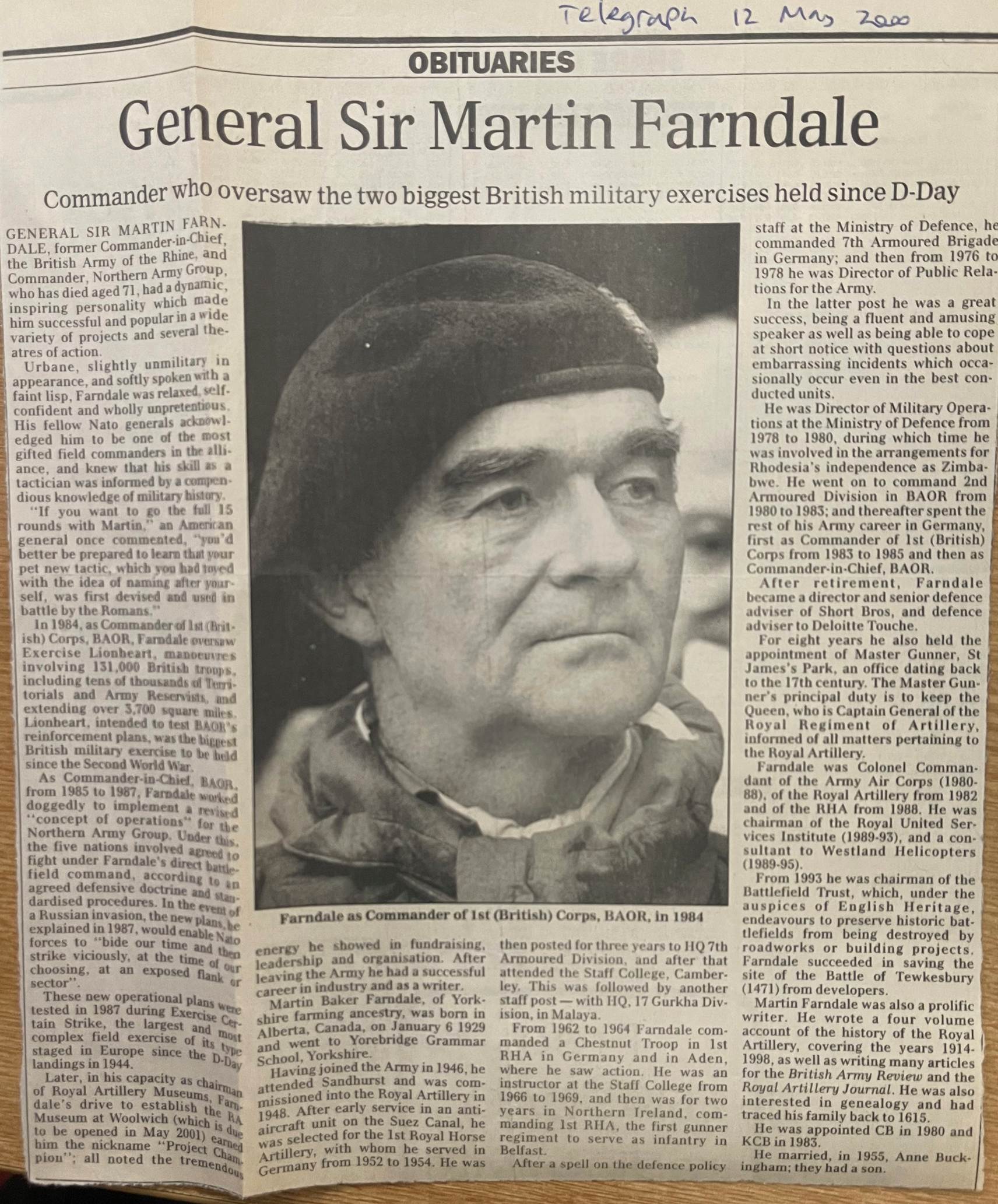
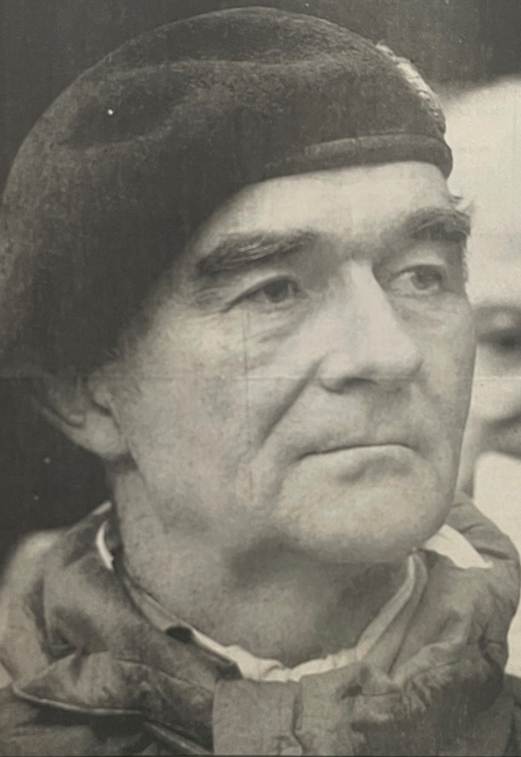
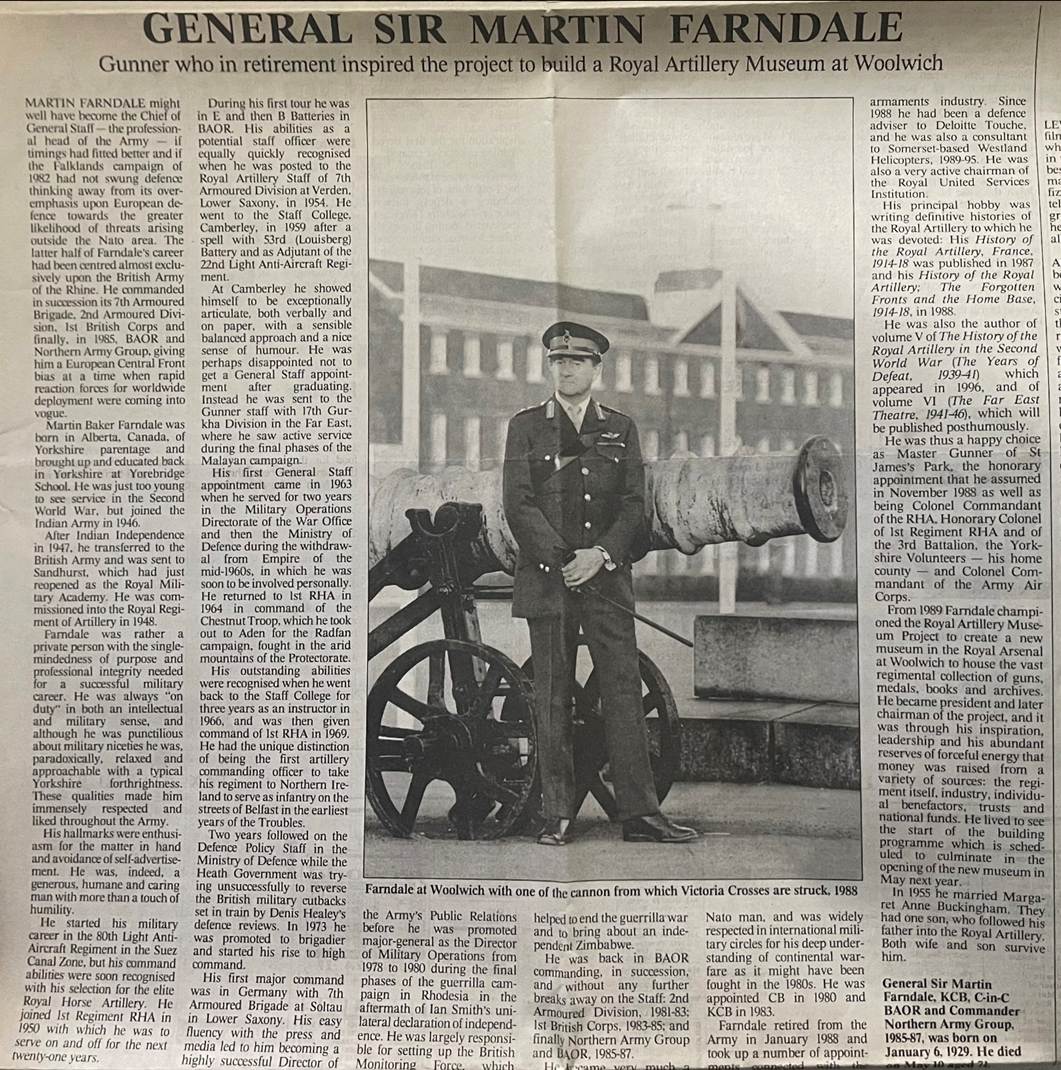
MARTIN FARNDALE was one of the most outstanding
generals of the post-war British army. Confident and dynamic, he was regarded
by NATO as one of its finest field commanders.
As Commander 1st (British) Corps,
British Army of the Rhine, in 1984, Farndale successfully oversaw Operation
Lionheart. It was a vast exercise which involved 131,000 British troops
including thousands of Army Reservists and Territorials. His success led him to
being appointed a year later, Commander-in-Chief BAOR. He earned the respect of
the National Corps under his command and worked tenaciously to bring about a
defence policy to counter any Russian invasion. This policy was fully tested on
Exercise Certain Strike, the largest postwar exercise carried out in Europe.
Martin Farndale was born in 1929 in
Alberta, Canada, of British parents and brought up in Yorkshire. He joined the
Indian Army in 1946, transferring to the British army a year later. After
Sandhurst he was comissioned into the Royal Regiment of Artillery in 1948. He saw
service in the volatile Suez Canal zone where his command qualities were soon
recognised. He was selected for the Royal Horse Artillery (RHA) and attended
Staff College, Camberley, in 1959 before enjoying a staff post with HQ, 17
Gurkha Division towards the end of the conflict in Malaya.
From 1964 to 1966 he commanded
Chestnut Troop in 1st RHA in Germany and Aden during a particularly difficult
period. In 1969, after three years as a Staff instructor at Camberley, he was given
command of 1st RHA in Northern Ireland, where his gunners were used as infantry
during the mounting civil unrest in Belfast.
After two quieter years at the
Ministry of Defence, where he worked on defence policy, he was given command of
7th Armoured Brigade in Germany in 1976. His natural enthusiasm and charm
helped him become a highly successful Director of Public Relations for the Army
before becoming Director of Military Operations at the MoD in 1978. This post called
for all his diplomatic skills as he was involved in the arrangements for
Rhodesia's independence as Zimbabwe.
In 1980 he commanded 2nd Armoured
Division in Germany where he was to serve for the remainder of his time in the
Army. In 1983 he became Commander 1st (British) Corps and from 1985 until his
retirement in 1987 he was Commander-in-Chief, BAOR, and Commander, Northern
Army Group. He brought to this post a vast experience. An astute man, he was much
admired by those who served under him for his single mindedness of purpose
coupled with humility and humour.
On retirement after 42 years of service he became a director and senior defence adviser to
Short Brothers and defence adviser to Deloitte Touche. He maintained his links
with the Army and in particular his old regiment and was very proud to be
appointed Master Gunner, St James's Park in 1988. He was also Colonel
Commandant, RHA as well as the Royal Artillery and Army Air Corps and Honorary
Colonel 3rd BattalionYorkshire Volunteers (TA).
In 1989 Farndale began to champion the
idea of a Royal Artillery museum at the Royal Arsenal at Woolwich to house the regiment's in large collection. It was mainly due to his
inspired leadership and fund raising skills both as
president and chairman that the money was raised for the building. He lived
long enough to see it take shape. It will be opened in May 2001.
This exceptional man was also fine writer,
producing his History of the Royal Artillery, published in five volumes from
1986. The sixth volume, The Far East Theatre 1941- 1946, is to be published
posthumously. He was also a contributor to the British Army Review.
Farndale's only son, Richard, followed
his father and joined the Royal Artillery
MAX ARTHUR
Other recollections of his life
From The Daily Telegraph, 31
July 2005:
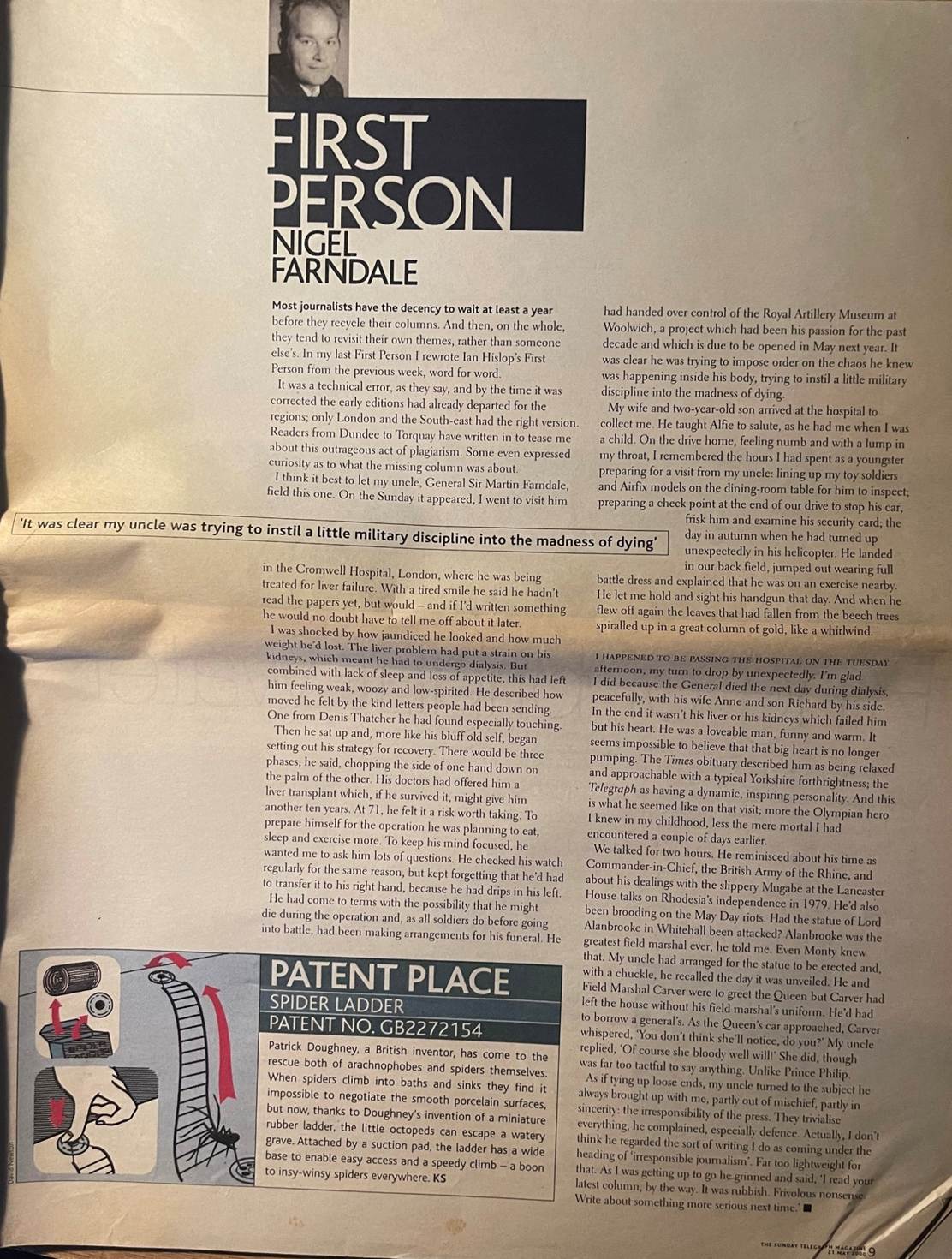
You couldn't make it up
By Nigel Farndale (Nephew of
Martin Farndale)
… During
the first Gulf war my late uncle, General Sir Martin Farndale, was invited to
discuss military strategy with David Dimbleby.
He
accepted, even though he thought the BBC was being frivolous in its coverage of
the war - indulging in endless, pointless speculation and treating the whole
thing as a game and, worse, an excuse to try out its new computer graphics. I
imagine he wanted to convey the seriousness of the situation, to impress upon viewers
the fact that the lives of British soldiers, including that of his own son,
were at risk.
He was
shown to a chair, had a microphone attached to his lapel and was accosted by a
make-up artist with a brush covered in orange powder. This didn't go down well.
My uncle ripped off his microphone and stormed out the studio, muttering darkly
to himself. In one gesture, it seemed, that poor make-up artist had epitomised
all that my uncle felt was rotten and decadent about the BBC in
particular and modern society in general.
Perhaps
things have changed since my uncle's day, although when I look at General Sir
Mike Jackson, he of the face and voice of thunder, I find this hard to believe.
While it is true that Jackson had surgery to reduce the bags under his eyes,
this was done for medical reasons - they were affecting his eyesight - and woe
betide the journalist who suggests otherwise.
Unlike prime ministers, generals
cannot afford to appear effete. They are and must be bastions of masculinity, not
least because they have to command the respect of
their men. And not only do they have to make tough decisions
but they also have to witness the consequences of
them, unsentimentally.
I suspect that a dusting of
orange powder would have been to my uncle what the cutting off
of hair was to Sampson, a sapping of his strength, albeit it mental
rather than physical. …
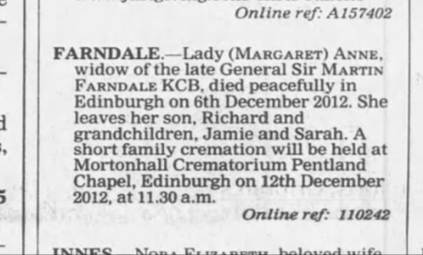
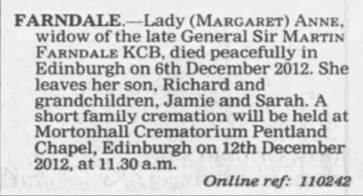
Anne
Farndale moved to Edinburgh to live near her family
and she died on 6 December 2012.
Obituaries
The Guardian,
Wednesday 17 May 2000:
John
Learmont
Innovative
army commander whose leadership qualities took him to Malaya, Northern Ireland
and NATO.
General
Sir Martin Farndale, who has died aged 71, was unquestionably the most
distinguished gunner officer of his generation. He had an outstanding career
both in command and on the staff, but was never more
at home than when among soldiers in the field. He was an example of what can be
achieved with a combination of leadership, intellect, personality, charm and
dedication.
He was
born in Alberta, Canada, and educated at Yorebridge
school, Yorkshire. He joined the Indian army in 1946 and, in 1947, transferred
to the British army, went to Sandhurst and was commissioned into the Royal
Artillery in October 1948.
He served
in several gunner regiments, but his heart lay with the 1st Regiment, Royal
Horse Artillery, with whom he served on and off for 21 years. He saw service in
the UK, Aden and the British Army of the Rhine and, in 1964, took command of
the Chestnut troop, the senior battery.
In 1969,
to his immense pride, Farndale assumed command of the regiment and, during this
period, took it to Northern Ireland, the first gunner regiment to serve there
in an infantry role. Later, he became the first honorary colonel of the
regiment. His infectious enthusiasm, his encouragement to those who needed a
helping hand, his sense of humour and his oratory skills made him a legend within
the regiment in his lifetime.
Farndale
would, I feel sure, see himself first and foremost as a commander. He was at
ease with soldiers and they, in turn, followed him without hesitation.
Nevertheless, he was an equally brilliant staff officer. After passing out from
the Camberley staff college in 1959, he served for two years in HQRA 17th
Gurkha Division, where he saw active service during the final phases of the
Malayan campaign, followed by a spell in military operations at the Ministry of
Defence. He became an instructor at Camberley in 1966.
After two
years on the defence policy staff, he returned to Germany to command 7th
Armoured Brigade at Soltau. This was followed by two years as director, public
relations, at the MoD, and a further two years as director of military
operations. He then commanded the 2nd Armoured Division in Germany for three
years.
Farndale's
grasp of the complexities of the all-arms battle, allied to his inspirational leadership
qualities, led to his being appointed to command the 1st (British) Corps. Life
was always exciting for those serving with him during this period, as he was a
constant source of innovative ideas that kept all concerned on their toes. His
success led to promotion to commander, Northern Army Group, and
commander-in-chief, British Army of the Rhine.
As a NATO
general, Farndale earned the respect and loyalty of the national corps under his
command from Germany, Holland and Belgium, as well as the 1st British Corps.
This was fully tested on Exercise Certain Strike in 1987, the largest exercise
of its type in Europe since the second world war. Here, Farndale took under his
command a fifth corps, 3 (US) Corps, and established a rapport with its
commanding general that lasted the rest of his life.
In 1980,
he was appointed colonel commandant, Army Air Corps, continuing a line of distinguished
senior officers who had filled the post. This was a new area, and, some might
have felt, an added burden to his already full and demanding military life.
But it
was typical of Farndale that, without hesitation, he committed himself
completely to his new role. He took a personal interest in every aspect of this
small but rapidly developing corps, unstinting with his time and applying his
huge capacity for work in an entirely selfless fashion. There is no doubt that the
Army Air Corps flourished under his hand.
He
retired in January 1988 after 42 years' service, and
became a director and senior defence adviser to Short Brothers plc, and defence
adviser to Deloitte Touche. He kept his links with the army, and particularly
the Royal Regiment of Artillery, when he assumed the appointment of master
gunner, St James's Park, on November 5 1988. During
this period, he was also colonel commandant, Royal Horse Artillery, colonel
commandant, Royal Artillery, honorary regimental colonel, 1st Regiment, Royal
Horse Artillery, and honorary colonel, 3rd Battalion, the Yorkshire Volunteers.
Farndale
was also a man of letters and a military historian of note. He wrote four books
covering the history of the Royal Artillery, an undertaking he was still
engaged in at the time of his death. He was chairman of the English Heritage
Battlefields Panel and, from 1989-1993, chairman of the Royal United Services
Institute for Defence Studies.
In his last
years, Farndale threw his energies into safeguarding the heritage of the Royal
Regiment of Artillery, particularly as president, and subsequently chairman and
chief executive, of its regimental museum project at Woolwich. He was an
inveterate and persuasive fund- raiser, to such an extent that some were said
to be suffering from donor fatigue. Thanks to his drive, vision and
determination to overcome manifold obstacles, the museum will open to the
public next year.
Martin Farndale
was an exceptional man, who lived an exceptional life. He was generous of
spirit, an inspiring leader, a true comrade in arms and a firm friend. The
world is poorer for his passing but his achievements
will be remembered for many a year to come.
He was
appointed CB in 1980 and KCB in 1983. He married Anne Buckingham in 1955; she
survives him, with their son Richard. It was a source of great pride to
Farndale that Richard too served in 1st Regiment, Royal Horse Artillery, his old
regiment, to which he remained intensely loyal.
Martin
Baker Farndale, soldier, born January 6 1929; died May
10 2000.
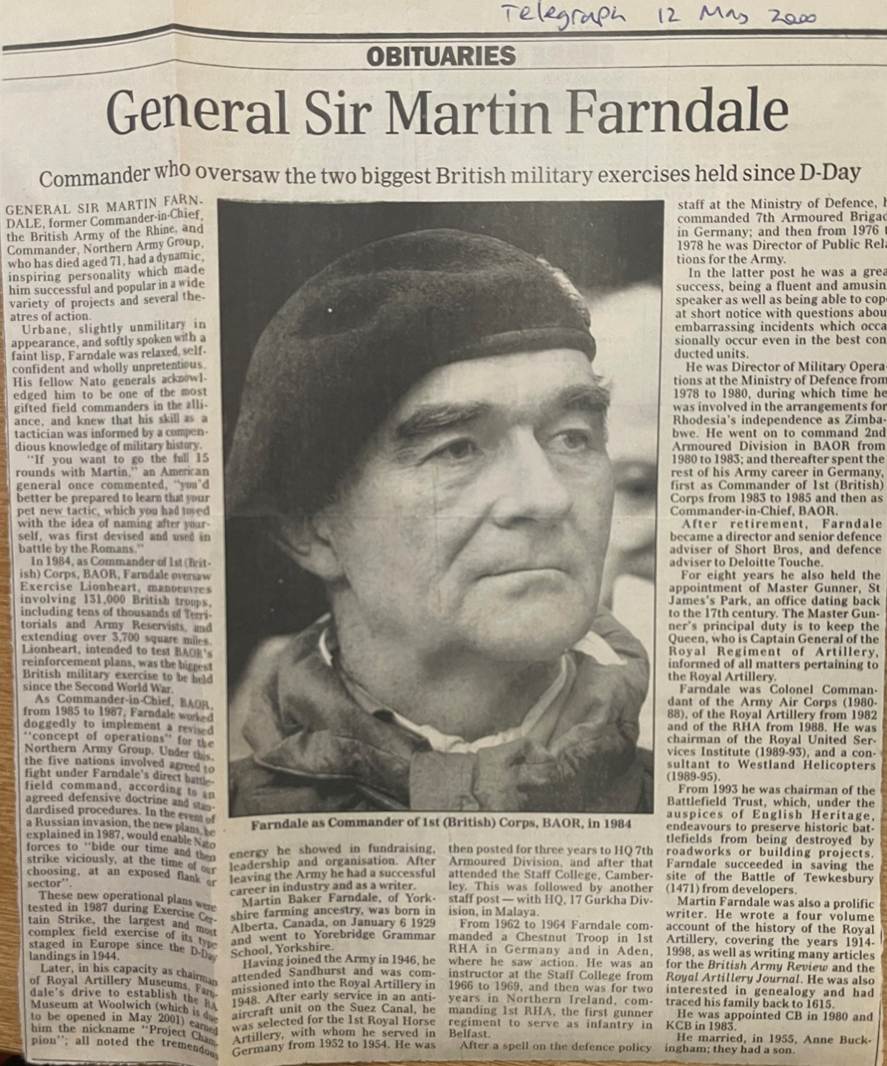
Martin
Farndale was one of the most outstanding generals of the post-war British army.
Confident and dynamic, he was regarded by NATO as one of its finest field
commanders.
As
Commander 1st (British) Corps, British Army of the Rhine, in 1984, Farndale
successfully oversaw Operation Lionheart. It was a vast exercise which involved
131,000 British troops including thousands of Army Reservists and Territorials.
His success led him to being appointed a year later, Commander-in-Chief BAOR.
He earned the respect of the National Corps under his command and worked
tenaciously to bring about a defence policy to counter any Russian invasion.
This policy was fully tested on Exercise Certain Strike, the largest postwar
exercise carried out in Europe.
Martin
Farndale was born in 1929 in Alberta, Canada, of British parents and brought up
in Yorkshire. He joined the Indian Army in 1946, transferring to the British
army a year later. After Sandhurst he was commissioned into the Royal Regiment
of Artillery in 1948. He saw service in the volatile Suez Canal zone where his
command qualities were soon recognised. He was selected for the Royal Horse
Artillery (RHA) and attended Staff College, Camberley, in 1959 before enjoying
a staff post with HQ, 17 Gurkha Division towards the end of the conflict in
Malaya.
From 1964
to 1966 he commanded Chestnut Troop in 1st RHA in Germany and Aden during a
particularly difficult period. In 1969, after three years as a Staff instructor
at Camberley, he was given command of 1st RHA in Northern Ireland, where his
gunners were used as infantry during the mounting civil unrest in Belfast.
After two
quieter years at the Ministry of Defence, where he worked on defence policy, he
was given command of 7th Armoured Brigade in Germany in 1976. His natural enthusiasm
and charm helped him become a highly successful Director of Public Relations
for the Army before becoming Director of Military Operations at the MoD in
1978. This post called for all his diplomatic skills as he was involved in the
arrangements for Rhodesia's independence as Zimbabwe.
In 1980
he commanded 2nd Armoured Division in Germany where he was to serve for the
remainder of his time in the Army. In 1983 he became Commander 1st (British) Corps
and from 1985 until his retirement in 1987 he was Commander-in-Chief, BAOR, and
Commander, Northern Army Group. He brought to this post a vast experience. An
astute man, he was much admired by those who served under him for his single
mindedness of purpose coupled with humility and humour.
On
retirement after 42 years of service he became a
director and senior defence adviser to Short Brothers and defence adviser to
Deloitte Touche. He maintained his links with the Army and in particular his
old regiment and was very proud to be appointed Master Gunner, St James's Park
in 1988. He was also Colonel Commandant, RHA as well as the Royal Artillery and
Army Air Corps and Honorary Colonel 3rd Battalion Yorkshire Volunteers (TA).
In 1989
Farndale began to champion the idea of a Royal Artillery museum at the Royal
Arsenal at Woolwich to house the regiment's in large
collection. It was mainly due to his inspired leadership and fund
raising skills both as president and chairman that the money was raised
for the building. He lived long enough to see it take shape. It will be opened
in May 2001.
This
exceptional man was also fine writer, producing his History of the Royal
Artillery, published in five volumes from 1986. The sixth volume, The Far East
Theatre 1941- 1946, is to be published posthumously. He was also a contributor
to the British Army Review.
Farndale's
only son, Richard, followed his father and joined the Royal Artillery
Max
Arthur