A
History of Gale Bank Farm, farmed by Alfred Farndale and later by Geoff Farndale
|
Return to the Home
Page of the Farndale Family Website |
The story of one
family’s journey through two thousand years of British History |
The 83 family lines
into which the family is divided. Meet the whole family and how the wider
family is related |
Members of the
historical family ordered by date of birth |
Links to other pages
with historical research and related material |
The story of the
Bakers of Highfields, the Chapmans, and other related families |
Hyperlinks to
other pages are in dark
blue.
Headlines are in brown.
References and
citations are in turquoise.
Context and local
history are in purple.
This webpage is
divided into the following sections:
· The Farndale
association with Gale Bank Farm
·
The History of Gale Bank Farm
·
Notes on the Kirk Family
·
Martin’s research notes
The Farndale Association
with Gale Bank Farm
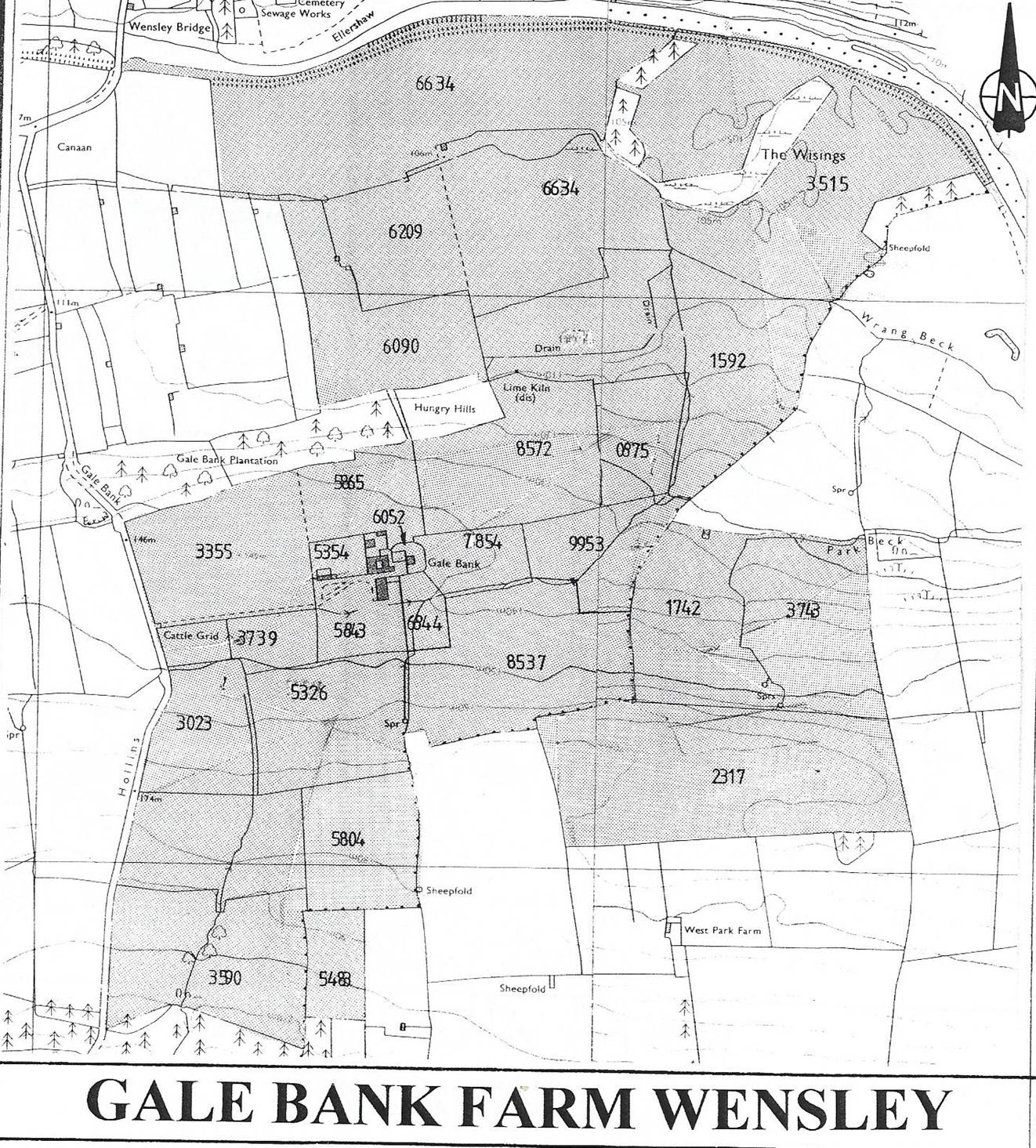
Gale Bank Farm was leased by the Farndale family from 23 January
1943 to 30 September 1998, a period of 55 years. This was the longest tenancy
in its history and by then the farm had grown to 401 acres.
Alfred Farndale (FAR00683) took the
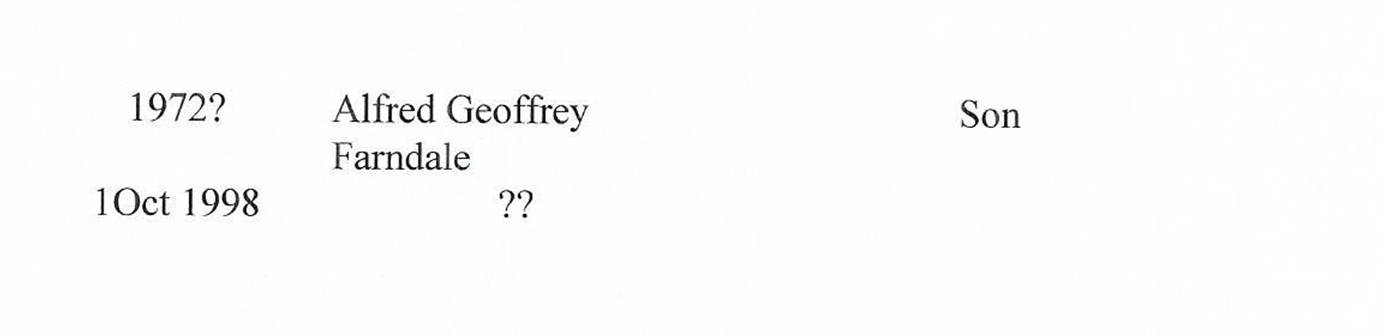
tenancy at Gale Bank Farm on 23 January 1943 and farmed there until about 1972
when his son Alfred Geoffrey Farndale (FAR00922) continued to
farm at Gale Bank until 1 October 1998.
Martin Farndale recalled: Towards the end of 1942, I came home
from school one day to be told by mother that it looked as if we had got a farm
near Wensley in Wensleydale. I had never been there, but I knew some children
at school who came from up there. It had always seemed a strange a remote land
to me. However I was to cycle out to quickly give the message to my father as
he was wanted for an interview. Apparently the existing farmer was not up to
the standard demanded in war time by the War Agricultural Committee and he was
being turned off the farm. My father was to be interviewed by the “War Ag” and
by the Bolton estate on which the farm lay. I remember to this day the
excitement he showed saying in his quiet way, “that’s splendid news”. It was
indeed the best farm he had bid for and the one he wanted most, some 450 acres
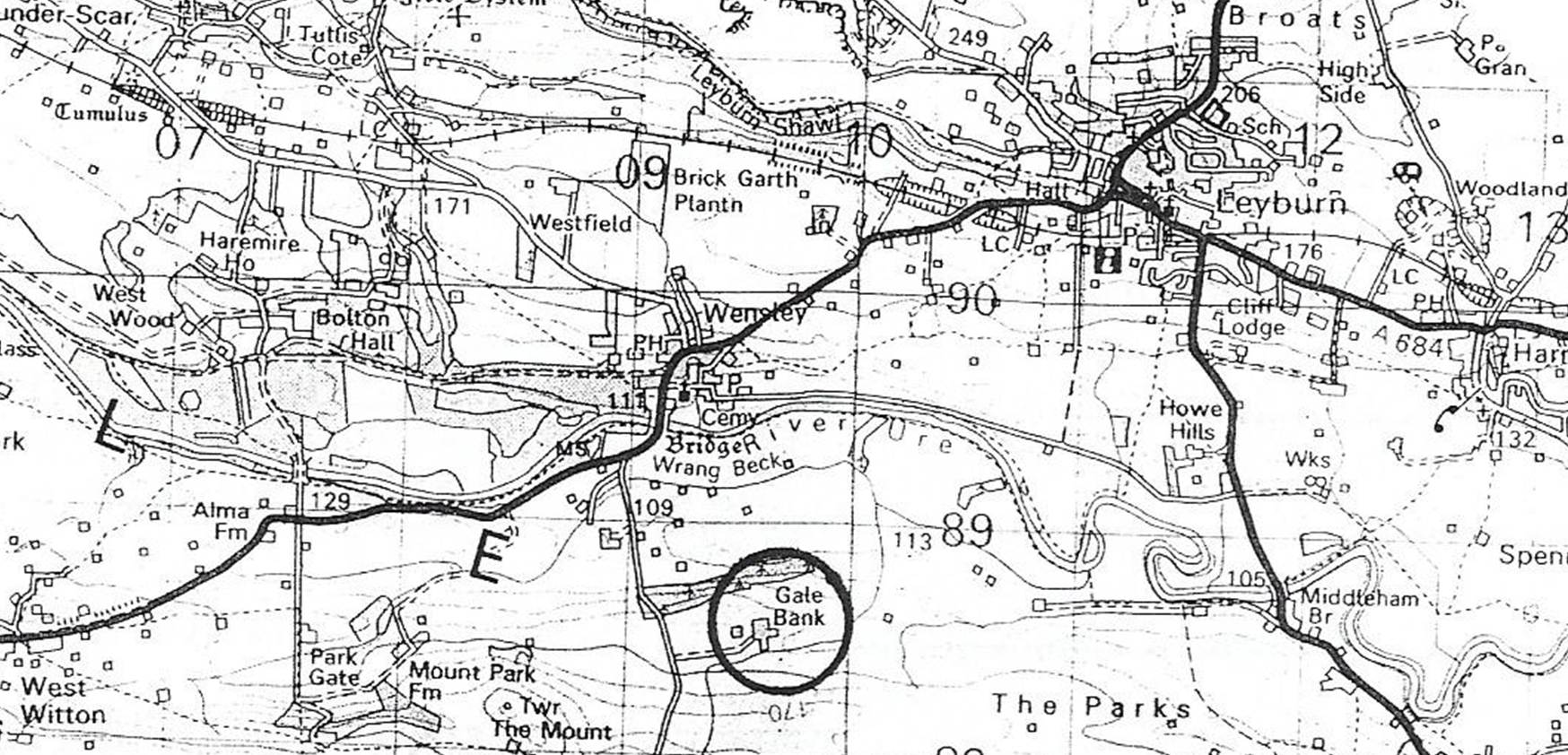
between Wensley and Middleton, called Gale Bank Farm. He knew it well and had
already done some work on it. A few days later we heard that he had got it,
which was indeed wonderful news. It meant a lot of changes. Anne and I were
both at Northallerton Grammar School aged 13 and 212 respectively, Geoff was at
Welsey House School aged ten, and Margot at home but about to start school.
We moved to Gale Bank on 28 January 1943. I remember it all very
well. The furniture van came and everything was packed up. The rest of us went
in our heavily overloaded Standard 12. I remember it over heating just outside
Bedale and my father going into a farm and helping himself to a bucket of
water! I remember our arrival well, the house, and the buildings were quite
empty and we children raced throughout the empty house. There were strange
smells everywhere, particularly that of smoked bacon, which our predecessors
had done for years. We raced through all the farm buildings which were big and
extensive compared to anything we had known before. It must have been cold in
January and apart from a fire in the drawing room and kitchen in daytime only
there was no heat. But I don’t remember it being cold. With great excitement we
all chose our bedrooms and then the furniture van arrived and we all helped
move our things into the house. The beds were made – the same ones we had got
out of that morning in Crosby Road, and we were ready for bed in our new house.
Little did we know what a major step in our lives this day was to be for us
all. Gale Bank was to become our home, and a firm base for us all, for many
years to come. Geoff and Margot started at Wensley school. Anne and I started
at Yorebridge Grammar School straight away. This
meant a three mile walk or cycle across the fields and roads to Wensley
station, a 15 mile train journey, and then s short walk to the school, then a
return in the evening. It meant an early rise, leaving the house in the dark at
7.15am and getting home about 5.15pm.
The History of Gale Bank
Farm
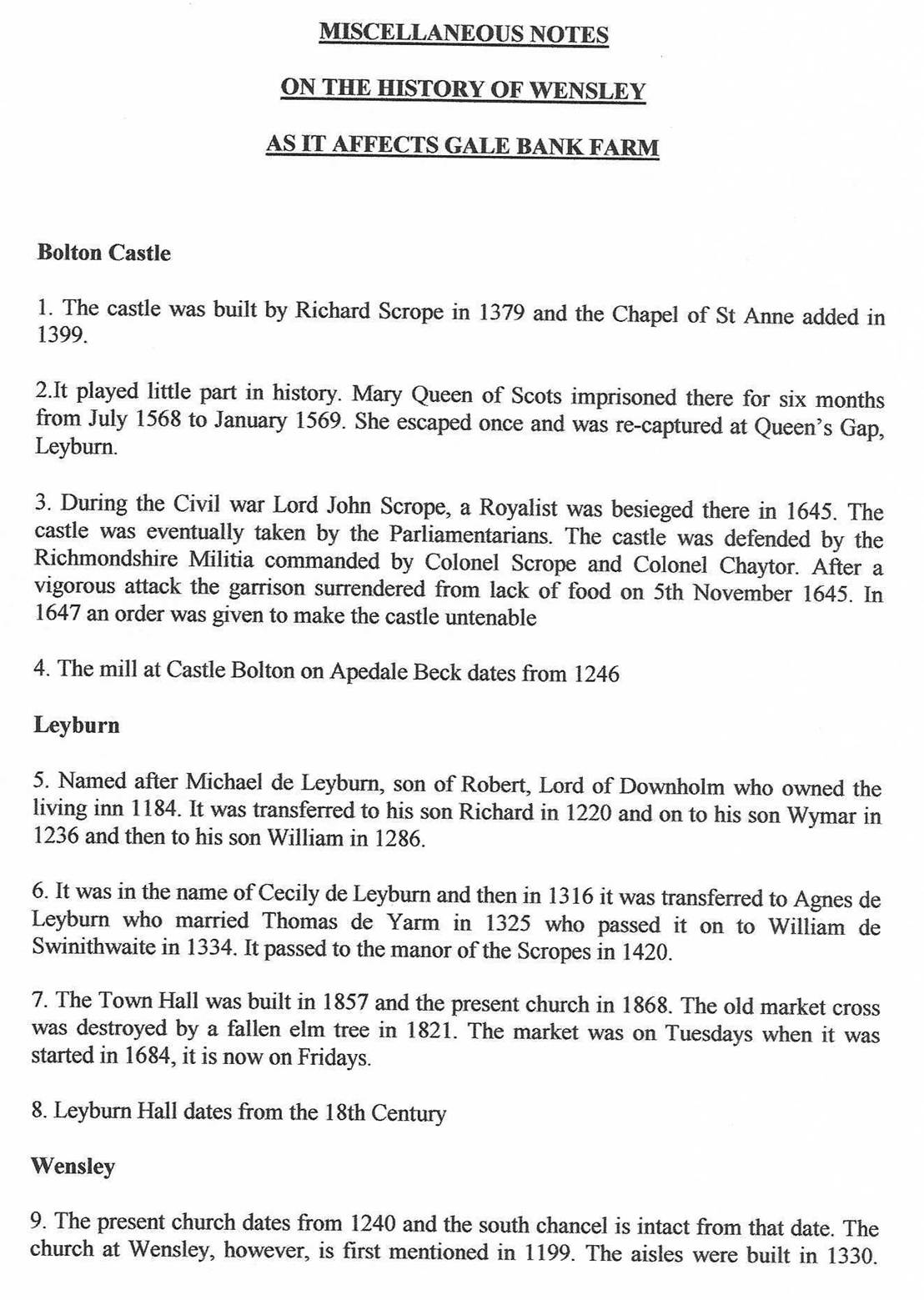
1086
The Domesday Book: To this
manor (West Witton) belongs these berewicks: 2
caracutes at Whitton, 5 caracutes
at Wendreslage (Wensley), 4 caracutes to be taxed together, 14 caracutes,
and there may be ten ploughs. The whole 2 miles long and 2 broad.
The Victoria County History –
Yorkshire, A History of the County of York North Riding: Volume 1 Parishes:
Wensley, 1914: In 1086 there were two berewicks
in WENSLEY, one of 4 and another of 3 carucates, each attached to Count Alan's
manor of East Witton, the overlordship subsequently following the descent of
the honour of Richmond.
1184
Leyburn was named
after Michael de Leyburn, son of Robert, Lord of Downhole, who owned the land
in 1884.
1199
The church at Wensley was first mentioned.
Towards the close of the twelfth century the lord of Wensley was
Niel son of Alexander. He was succeeded by a son Osbert, who from 1203 to about
1207 was engaged in disputes concerning Wensley Church with Hugh Malebiche.
Osbert followed the barons in their rising against John, and was taken
prisoner, but liberated in 1217. He is last mentioned in 1231, and four years
later his son Roger de Ingoldsby was in possession. In 1246 he sub-enfeoffed
Wischard de Charron of 3 carucates in Ulshaw, Thomas
son of Hugh holding a mesne lordship and granting to Roger 60 acres of land in
Wensley (The Victoria County History –
Yorkshire, A History of the County of York North Riding: Volume 1 Parishes:
Wensley, 1914).
1220
The land at Leyburn was transferred to Michael de Leyburn’s son
Richard in 1220, to Richard’s son Wymar in 1236 and to Wymar’s son William in
1286.
1240
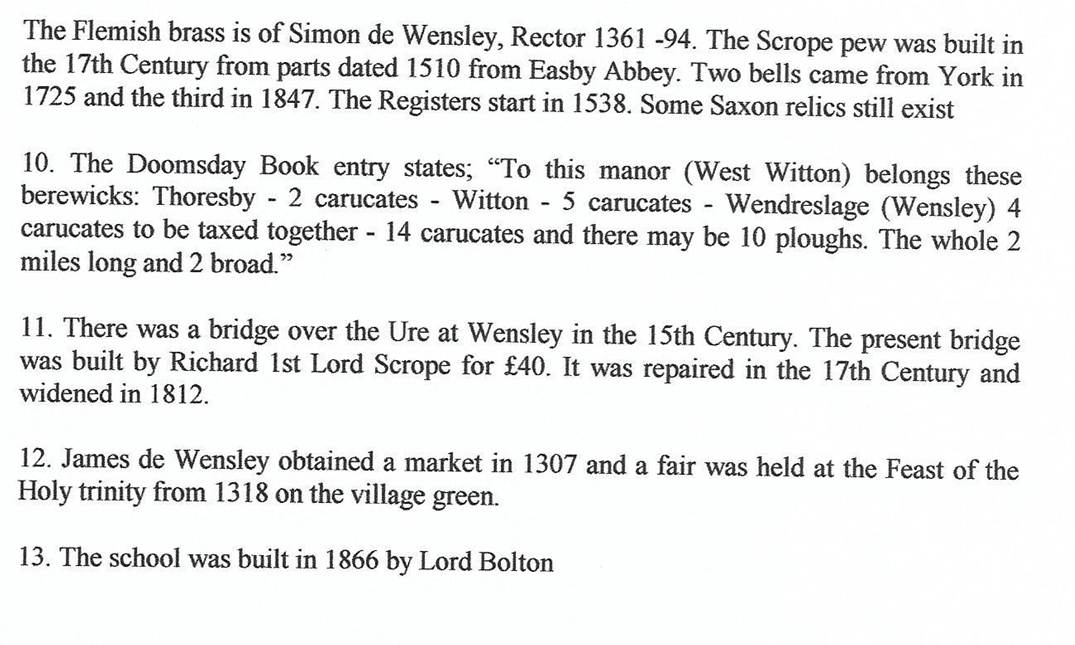
The present Wensley Church dates from 1240. The south chancel is
intact from that date. The Flemish brass is of Simon de Wensley, the Rector
1361 to 1394. The Scrope pew was built in the
seventeenth century.
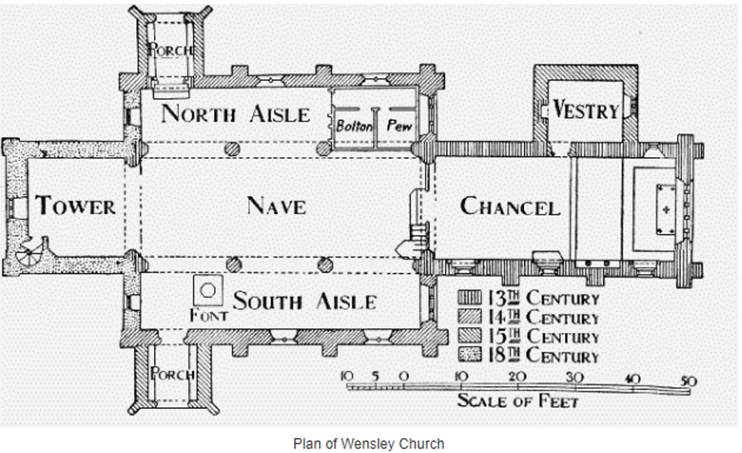
(from the Victoria County History –
Yorkshire, A History of the County of York North Riding: Volume 1 Parishes:
Wensley, 1914)
1246
The mill at Castle Bolton on Apedale
Beck dates from 1246.
1285
The name of Peter son of John de Wensley occurs in 1285, and it is
said to have been as guardian of his son, but probably as trustee for the Scropes, that Geoffrey Luttrell of Irnham
paid the subsidy here in 1301, and was returned as joint lord in 1316. John
Wychard paid subsidy here in 1327–8, his assessment of the same sum as that of
Henry le Scrope being possibly for land in Ulshaw (The Victoria
County History – Yorkshire, A History of the County of York North Riding:
Volume 1 Parishes: Wensley, 1914).
1307
James de Wensley obtained a market at Wensley in 1307 and a fair
was held at the Feat of the Holy Trinity from 1318 on the village green.
1316
Leyburn was in the name of Cecily de Leyburn when it was
transferred to Agnes de Leyburn in 1316. Agnes married Thomas de Yarem in 1325 who passed the land on to William de Swinithwaite ion 1334.
1379
Bolton Castle was built in 1379 by Richard Scrope, 1st Baron Scrope of Bolton (1327 to 1403) an English soldier and
courtier, serving Richard II who fought under the Black Prince at the Battle of
Crecy in 1346. The chapel of St Anne was added in 1399.
1420
Leyburn passed to the manor of the Scropes.
There was a bridge over the Ure at Wensley in the fifteenth
century. It may have been built by Richard, the First Lord of Scrope for £40 (see above). It was repaired in the
seventeenth century and widened in 1812.
1459
In about 1459 Henry le Scrope obtained
from John Wensley a third of certain tenements and 16 oxgangs here in exchange
for the office of bailiff of Eston. The whole of Wensley, thus acquired from
divers sources by the Scropes, followed the descent
of the manor of Castle Bolton, Lord Bolton being the present owner (The Victoria County History – Yorkshire, A History of the
County of York North Riding: Volume 1 Parishes: Wensley, 1914).
1568
Mary Queen of Scots was imprisoned at Bolton Castle for six months
from July 1568 to January 1569.She escaped and was recaptured at Queen’s Gap,
Leyburn.
1645
During the Civil War, Lord John Scrope, a Royalist, was besieged
at Bolton Castle in 1645. The castle was defended by the Richmondshire
Militia, commanded by Colonel Scrope and Colonel Chaytor. After a vigorous attack the garrison surrendered
for lack of food on 5 November 1645.
1647
In 1647 an order was given to make Bolton Castle untenable.
1684
Leyburn market started on Tuesdays.
1723
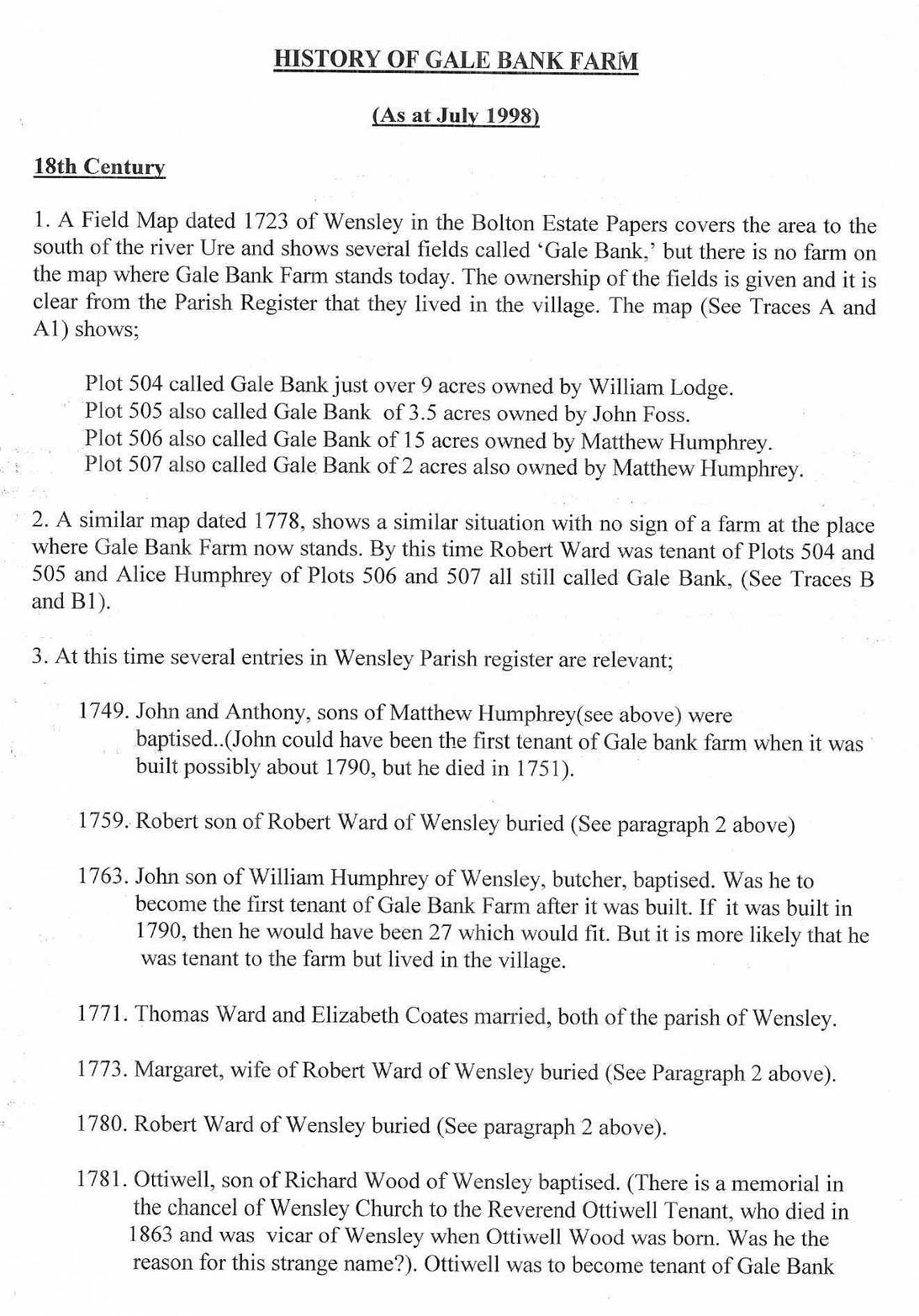
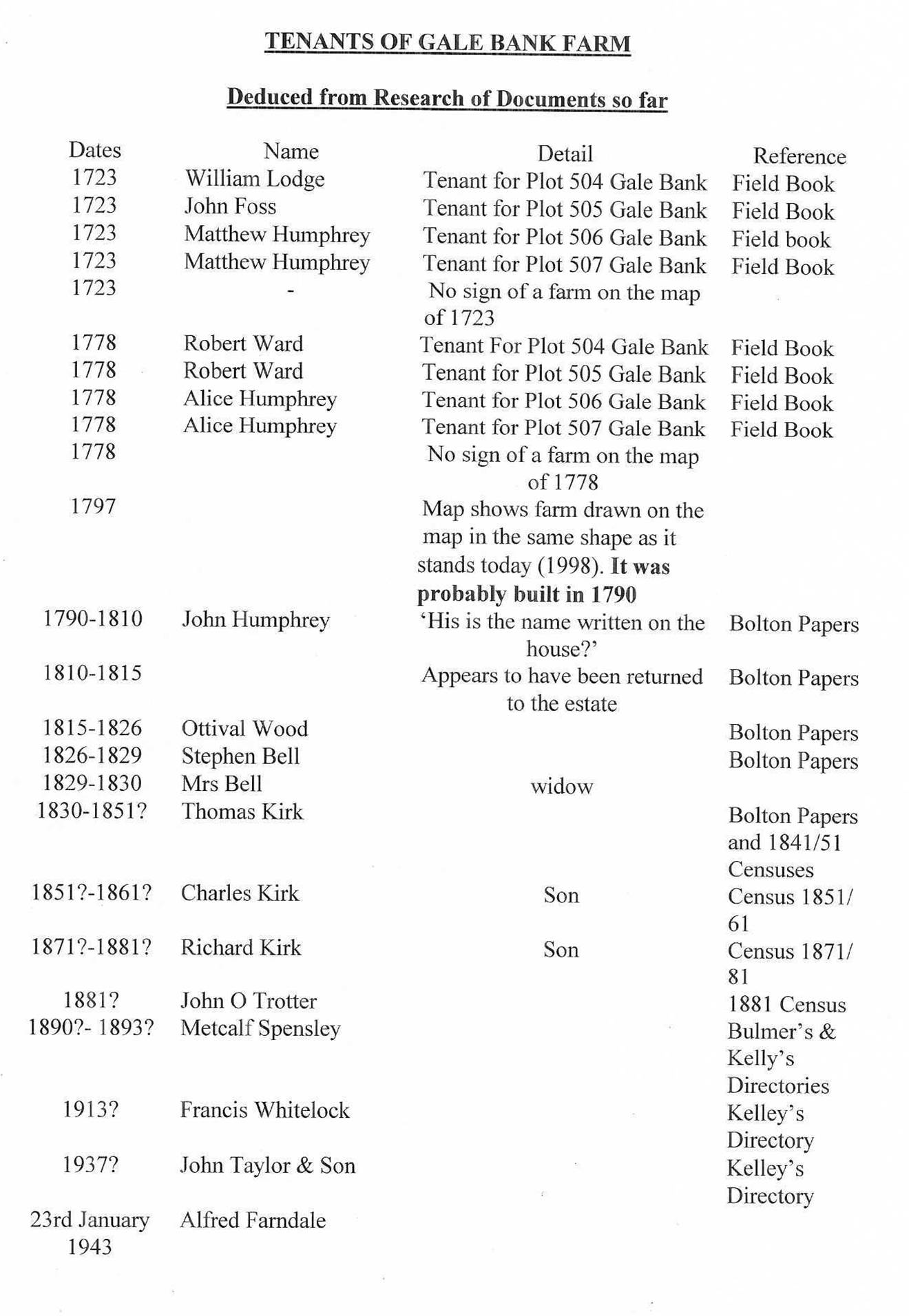
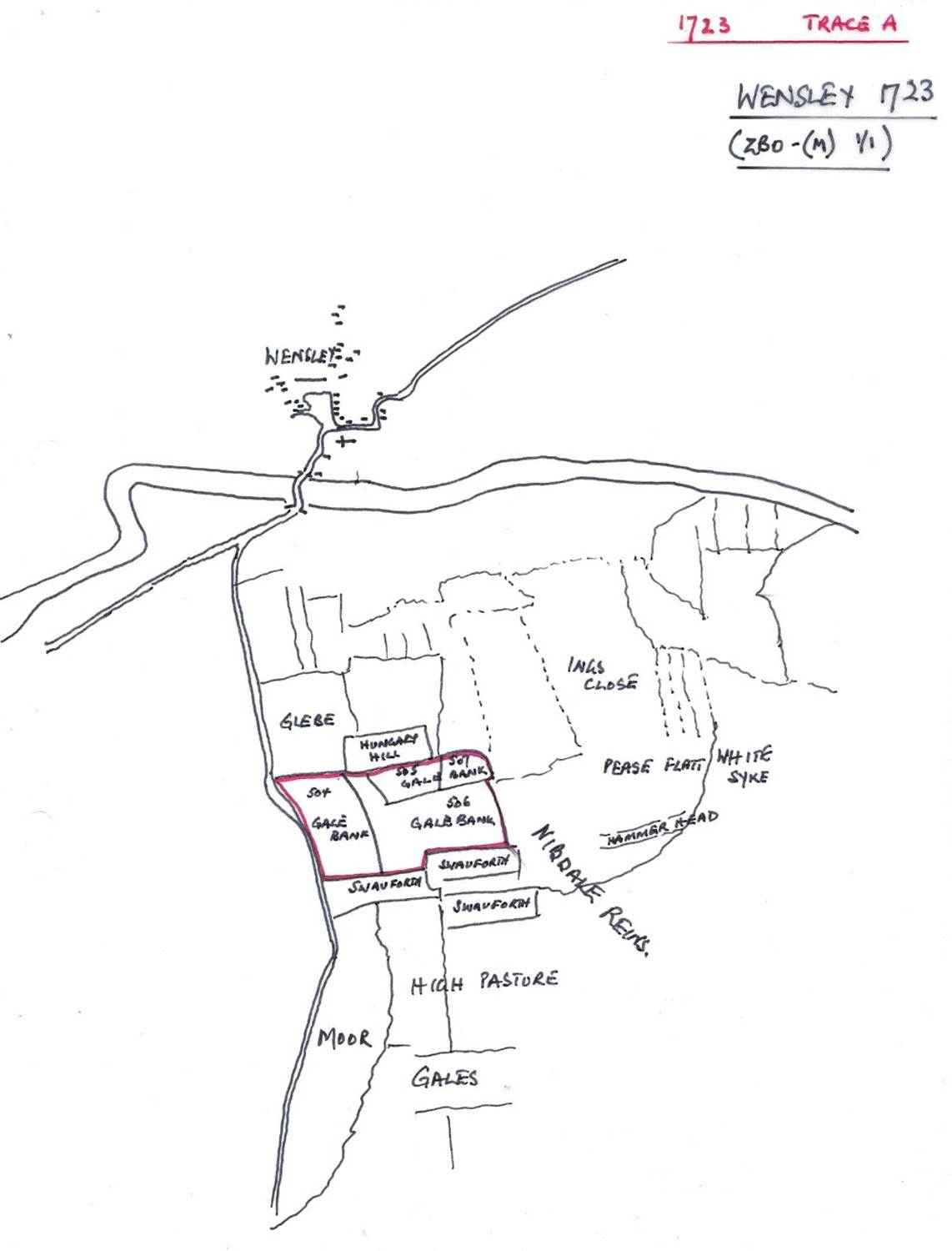
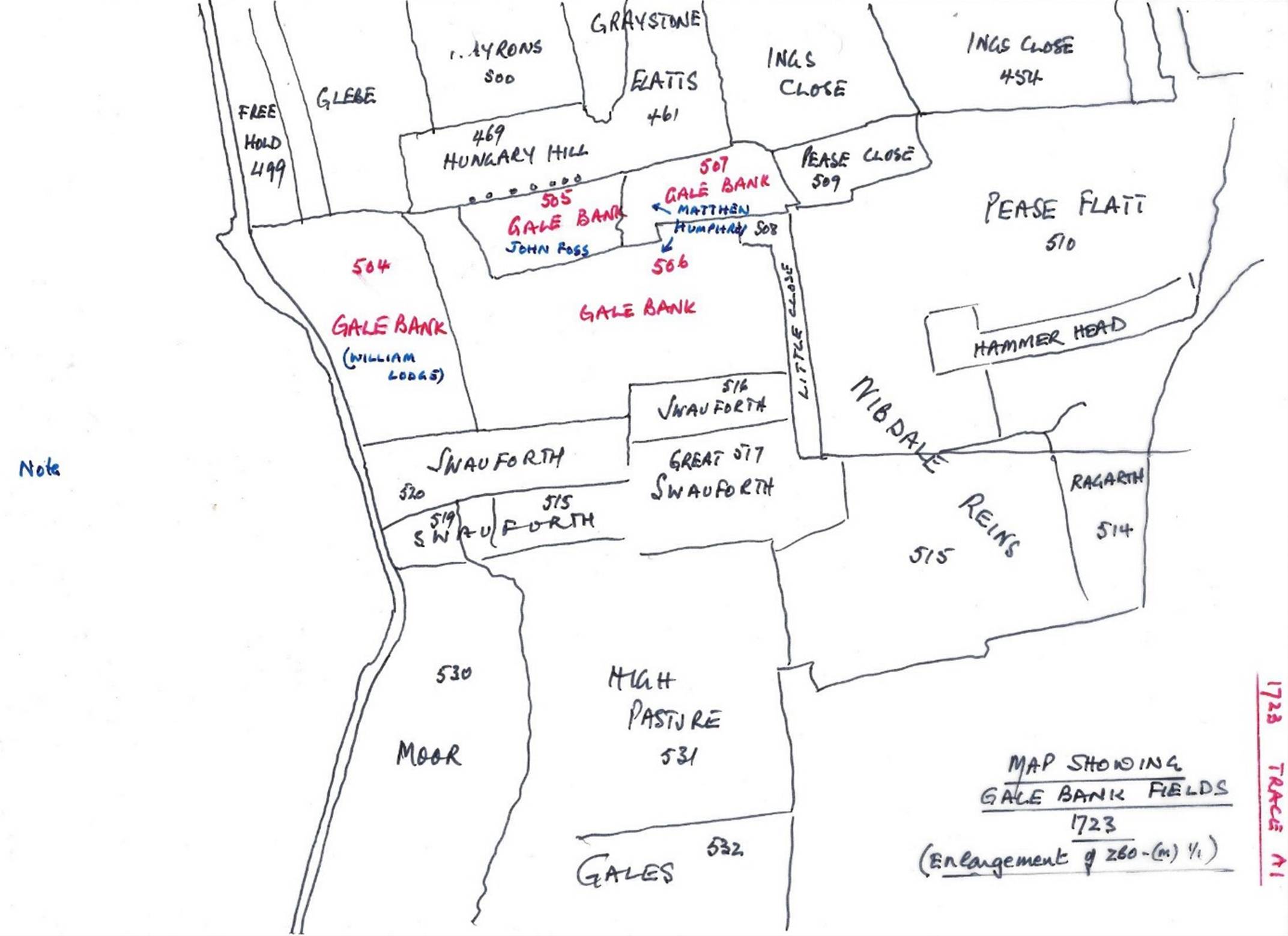
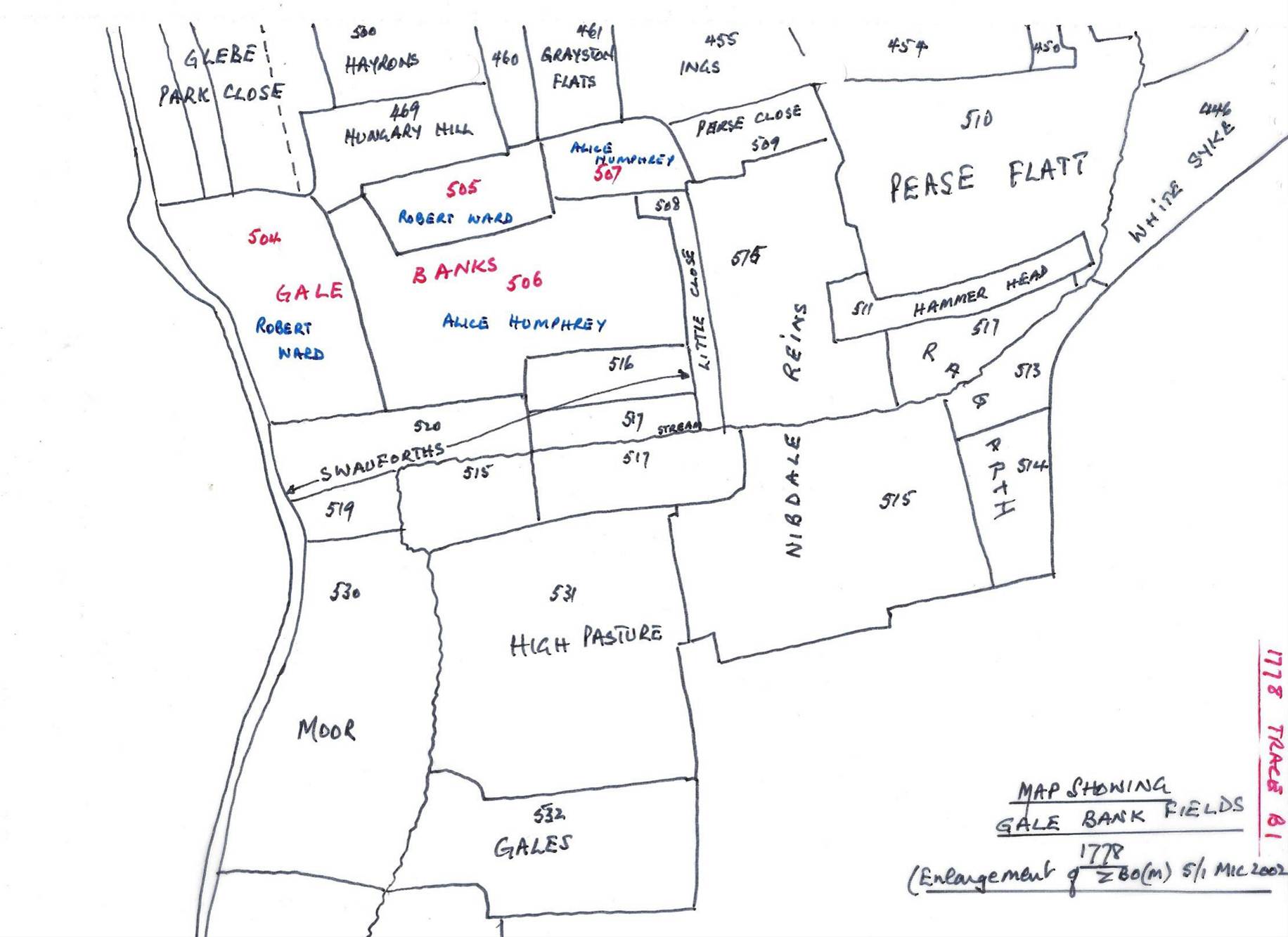
A Field Map dated 1723 of Wensley in the
Bolton Estate Papers covers the area to the south of the river Ure and
shows several fields called Gale Bank but there is no farm on the map where
Gale Bank Farm stands today. The ownership of the fields is given and it is
clear from the parish register that they lived in the village. The map (see
traces A and A1 below), shows that:
·
Plot 504 called Gale Bank just over 9 acres was owned by William
Lodge;
·
Plot 505, also called Gale Bank, of 3.5 acres, was owned by John
Foss;
·
Plot 506 also called Gale Bank of 15 acres was owned by Matthew
Humphrey; and
·
Plot 507 also called Gale Bank of 2 acres was also owned by
Matthew Humphrey.
1775
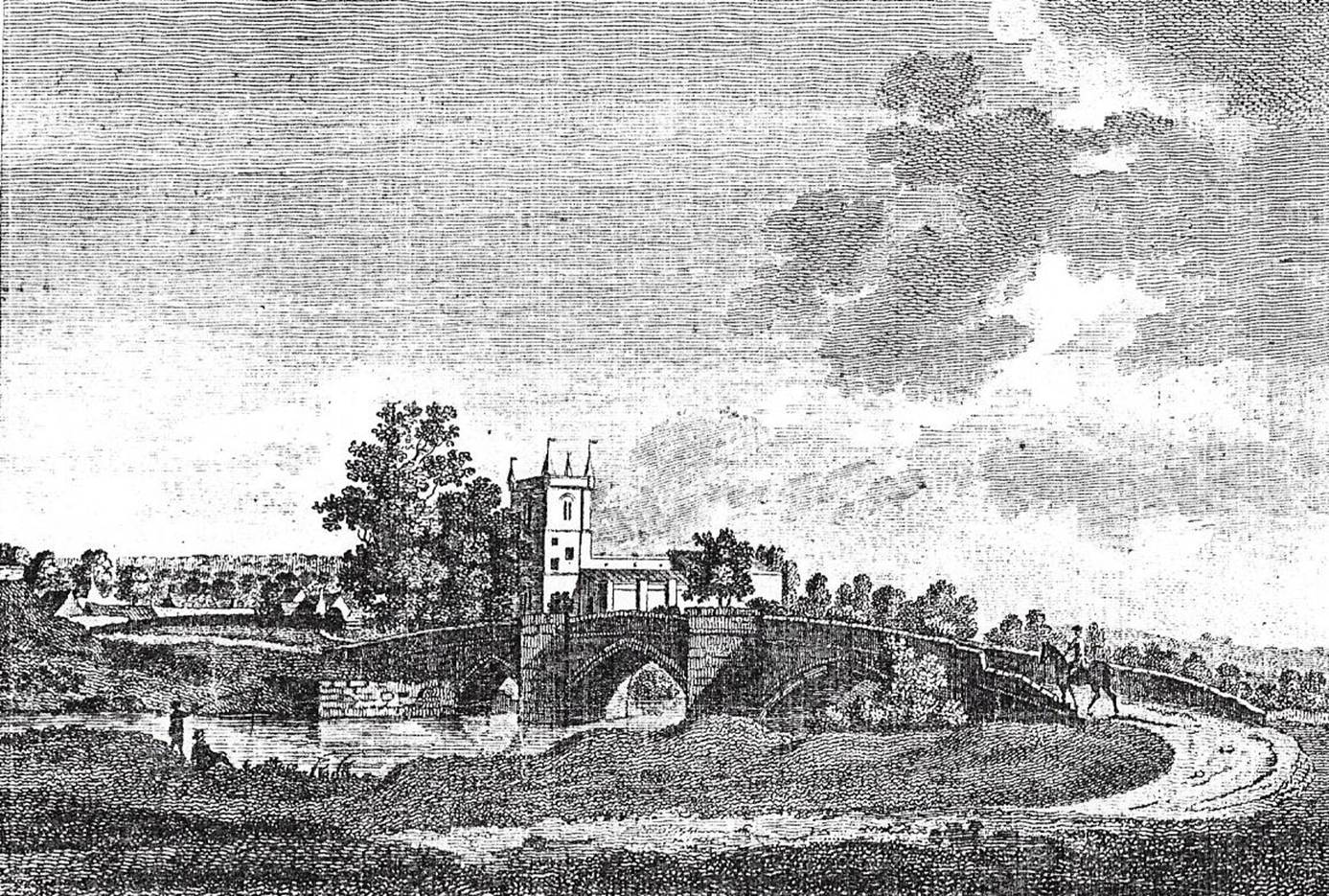
Wensley Church, 26 April 1775, Sam Hooper
1778
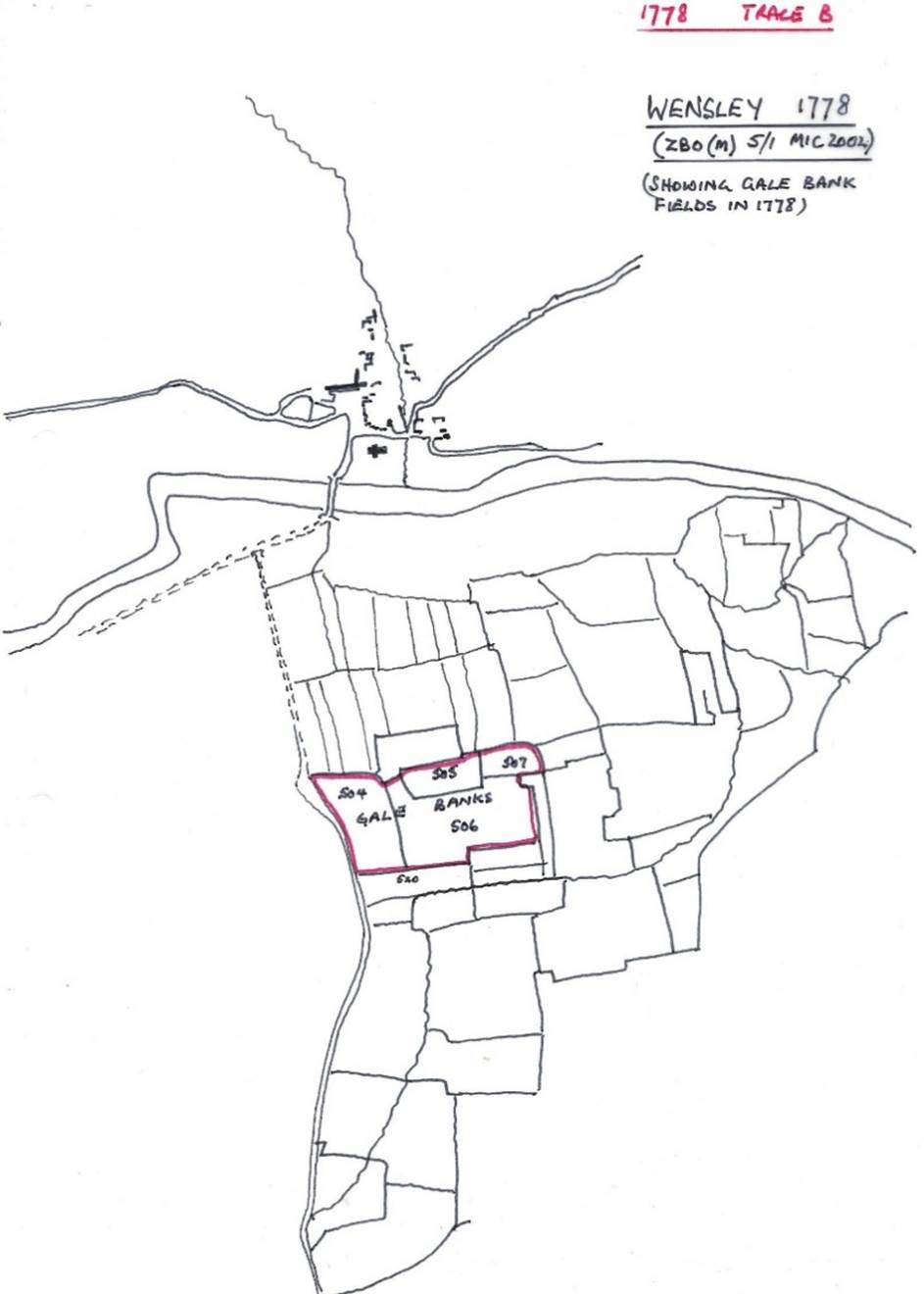
A map dated 1778 in the Bolton Estate
Papers shows a similar situation to that in 1723, with no sign of a farm
at the place where Gale Bank Farm now stands. By this time:
·
Robert Ward was tenant of Plots 504 and 505; and
·
Alice Humphrey was tenant of Plots 506 and 507,
all still called
Gale Bank (see Traces B and B1)
1790
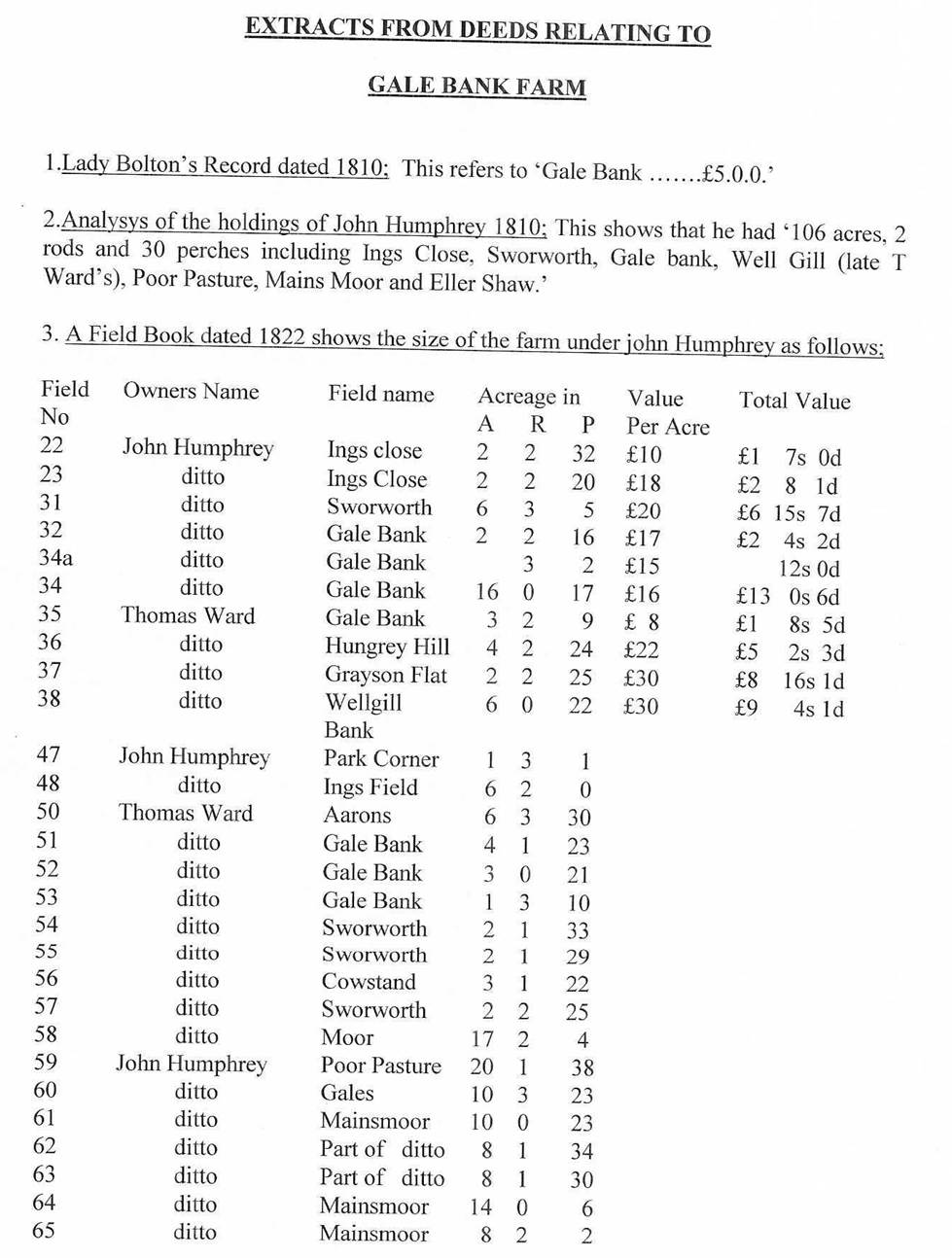
The tenant at Gale Bank Farm from 1790 to 1810 was John Humphrey (Bolton Papers).
The buildings of Gale Bank Farm were probably built around 1790,
at the time of the Enclosure Awards for Wensley.
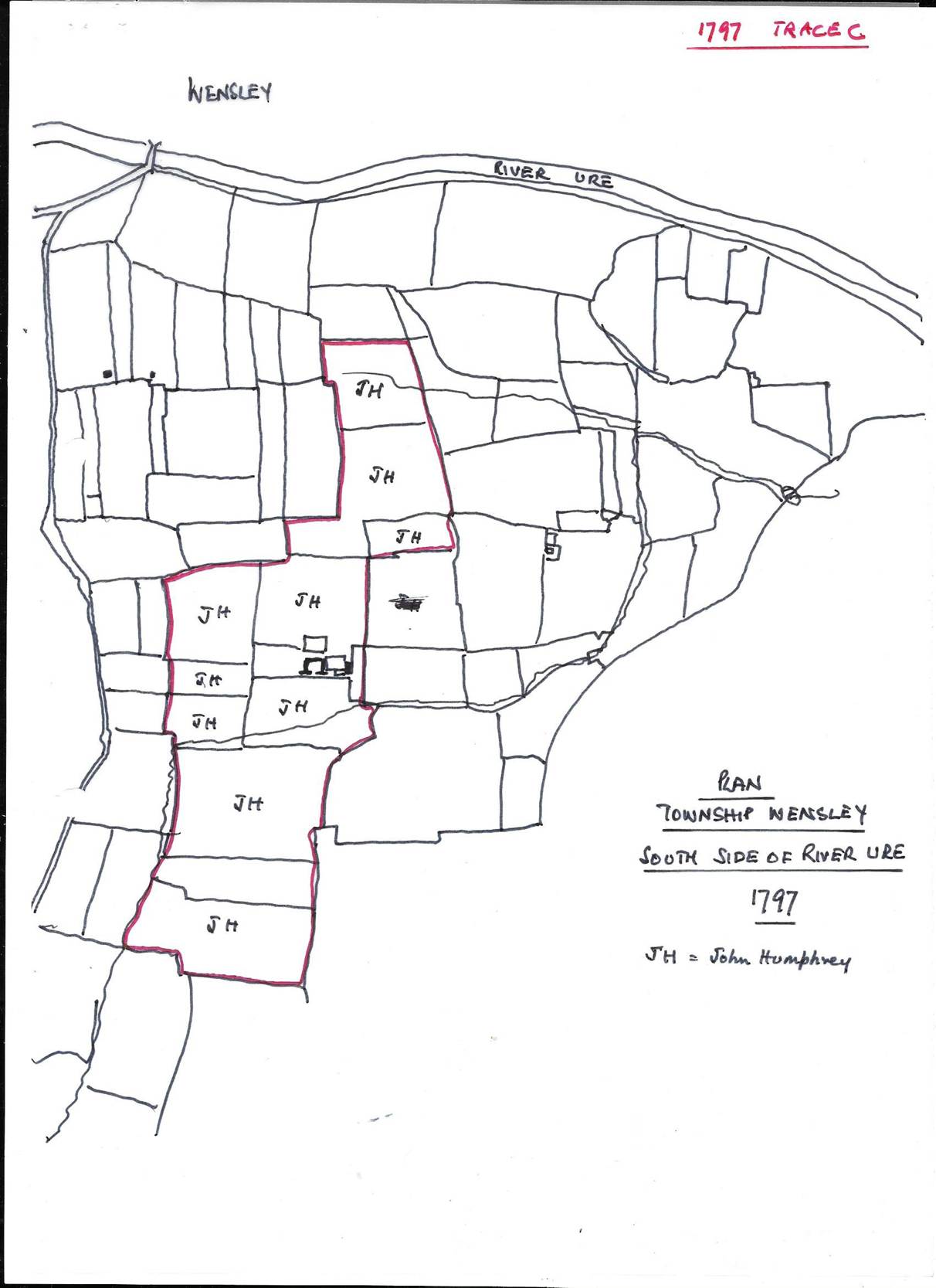
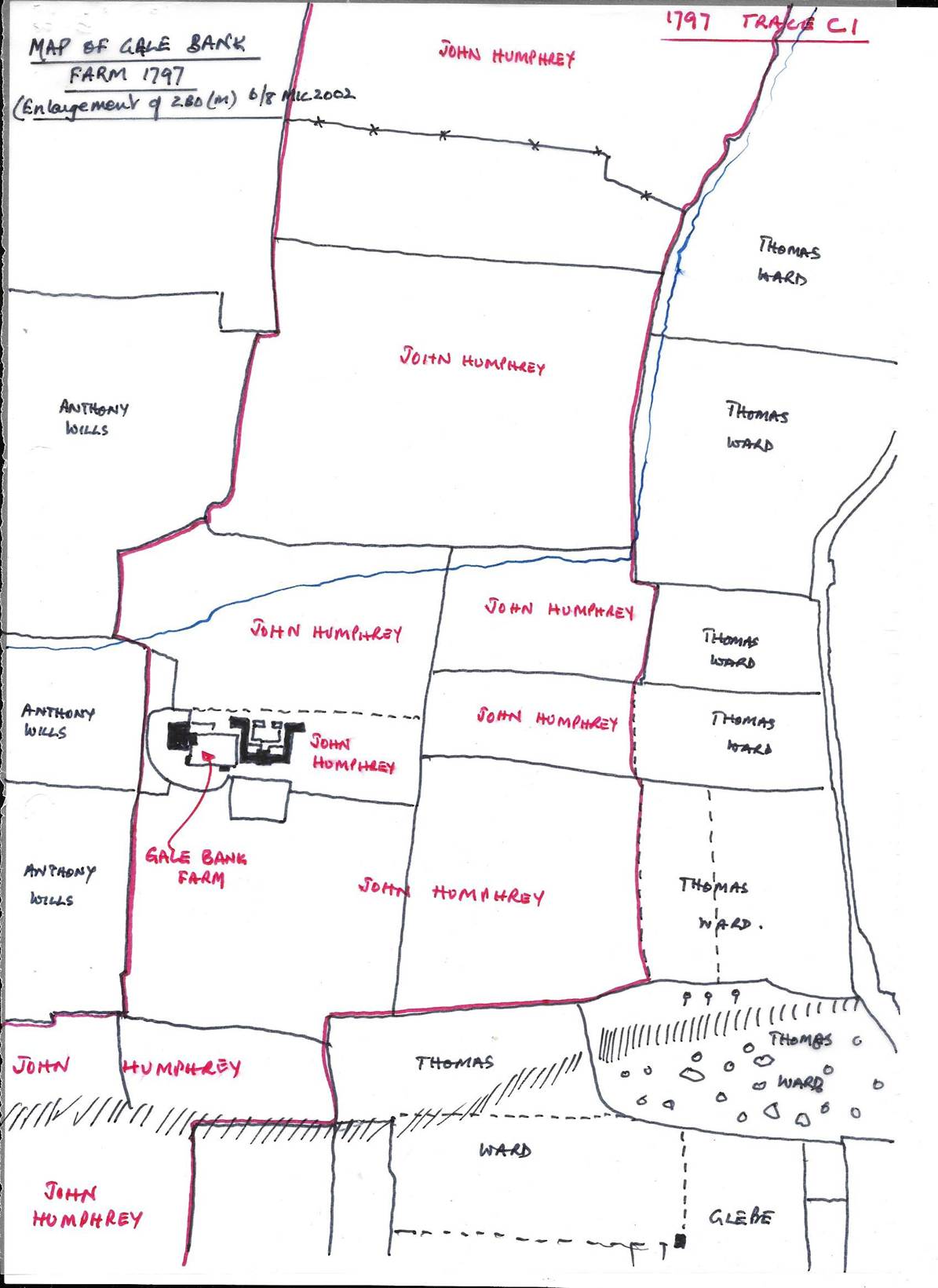
1797
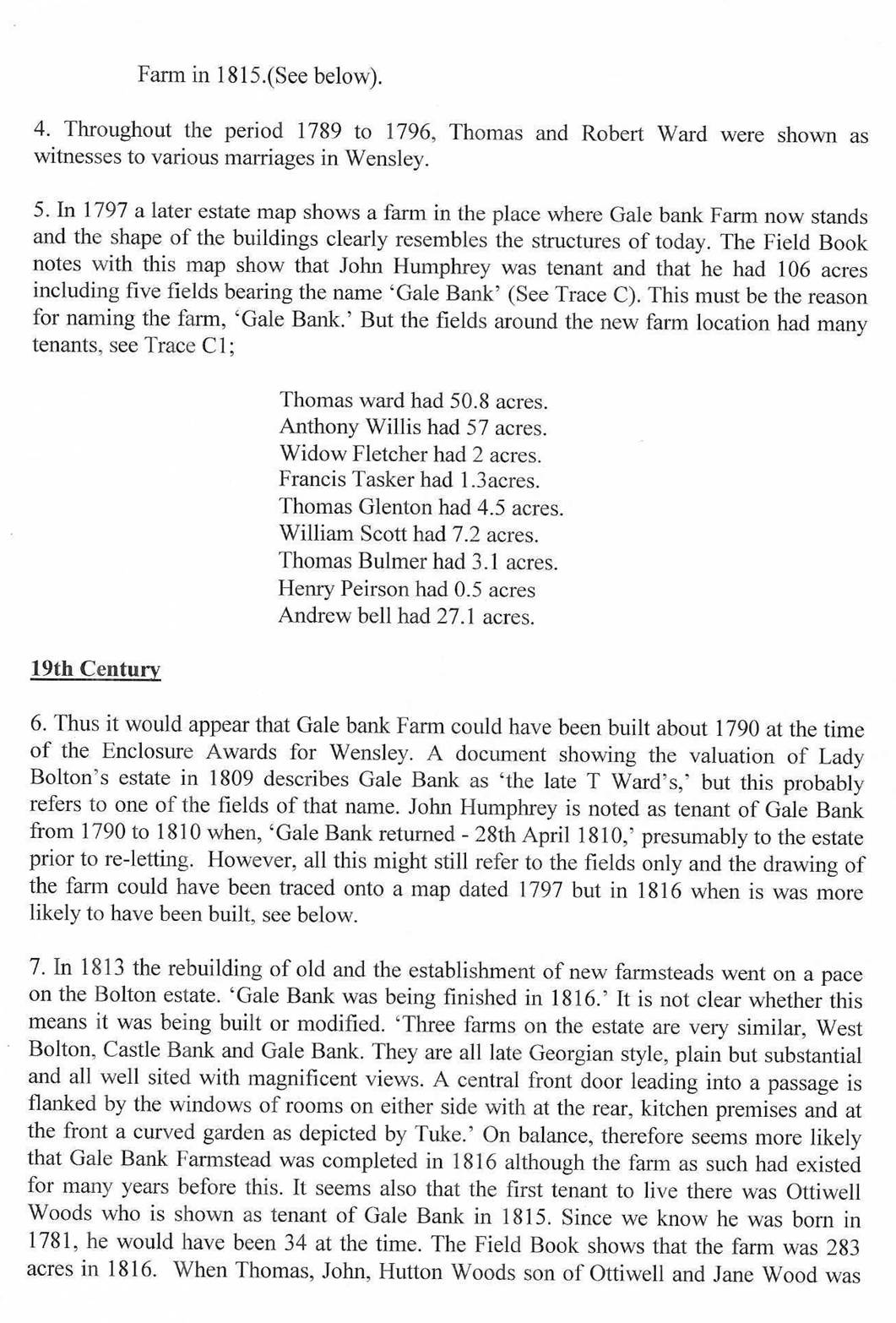
The map in 1797 showed the farm buildings in the same shape as
they were during the early Farndale era. The Field Book notes with the map show
that John Humphrey was tenant and had 106 acres including five fields bearing
the name Gale Bank. The fields around had many tenants – Thomas Ward had 50.8
acres; Anthony Willis had 57 acres; Widow Fletcher had 2 acres; Francis Tasker
had 1.3 acres; Thomas Glenton had 4.5 acres; William Scott had 7.2 acres;
Thomas Bulmer had 3.1 acres; Henry Pierson had 0.5 acres; and Andrew Bell had
27.1 acres.
1810 to
1815
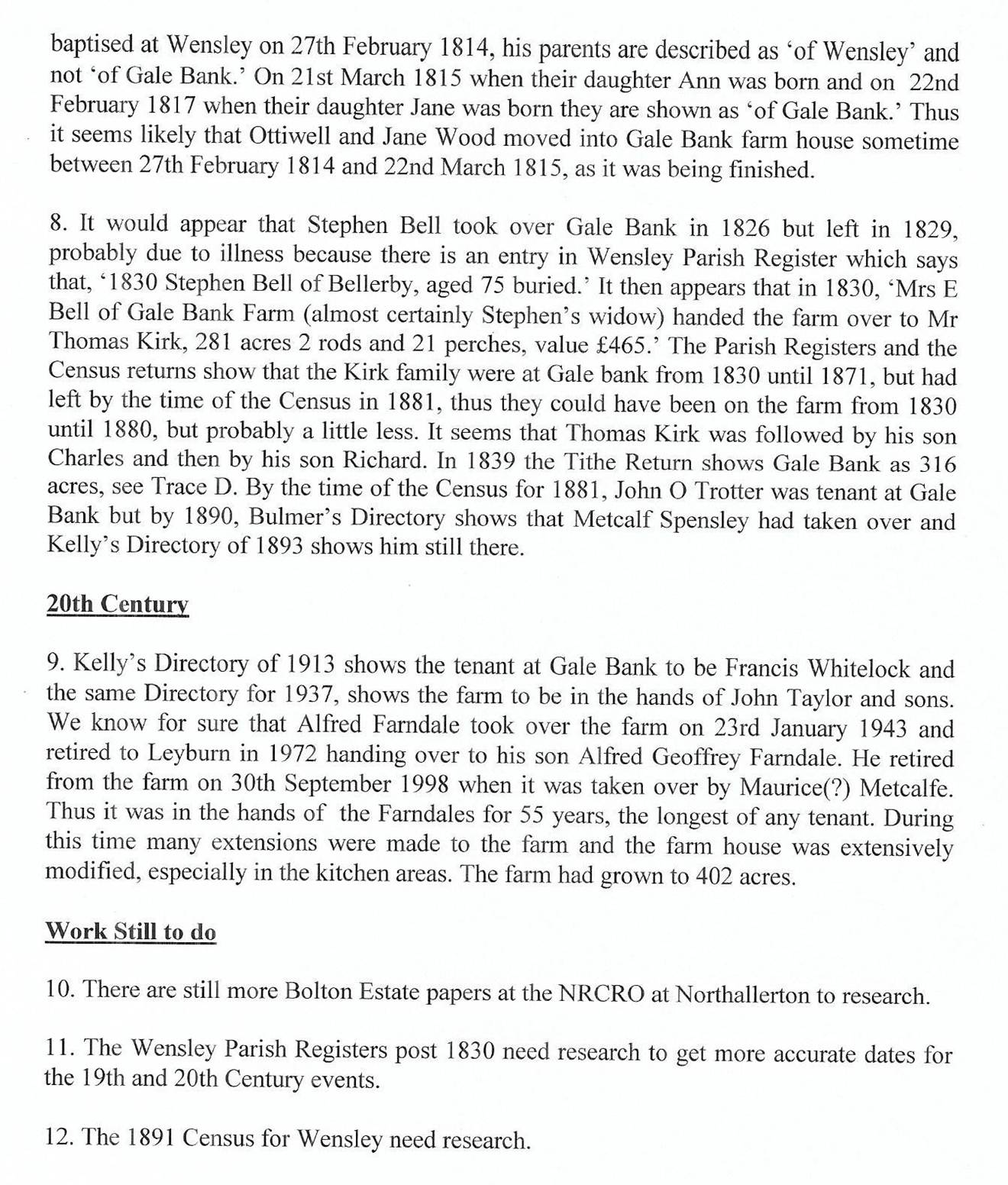
It appears that Gale Bank Farm was returned to the estate at this
stage (Bolton Papers). The papers refer to “Gale
Bank returned – 28th April 1810”.
1815
Ottiwell Wood was the tenant at Gale Bank Farm from 1815 to 1826 (Bolton Papers). Ottiwell was born in 1781, so
would have been 34 when he took the tenancy.
When Thomas John Hutton Wood, the son of Ottiwell and Jane Wood
was baptised on 27 February 1814, they were described as being of Wensley,
so this was presumably just before they moved to Gale Bank. On 21 March 1815,
when their daughter Ann was born and on 22 February 1817 when their daughter
Jane was born, both daughters were described as ‘of Gale Bank’. So
presumably the Wood family moved to Gale Bank between 27 February 1814 and 21
March 1815.
1816
There is reference in the Bolton
Papers to “Gale Bank was being finished in 1816.” This could have
referred to the completion of the new building or the end of a
refurbishment. The record continues: “Three
farms on the estate are very similar, West Bolton, Castle Bank and Gale Bank.
They are all late Georgian style, plain but substantial and all well sited with
magnificent views. A central front door leading into a passage is flanked by
the windows of the rooms on either side with at the rear, kitchen premises and
at the front a curved garden as depicted by Tuke.”
The Field Book shows that Gale Bank Farm was 283 acres in 1816.
1821
The old market cross at Leyburn was destroyed by a fallen elm
tree.
1826
Stephen Bell was the tenant of Gale Bank
Farm from 1826 to 1829 (Bolton Papers).
Stephen Bell may have left Gale Bank in 1829 due to illness. There is an entry
in the Wensley Parish Register: 1830, Stephen Bell of Bellerby, aged 75,
buried.
1829
Mrs Bell, the widow of Stephen Bell, was the tenant of Gale Bank
Farm from 1829 to 1830 (Bolton Papers).
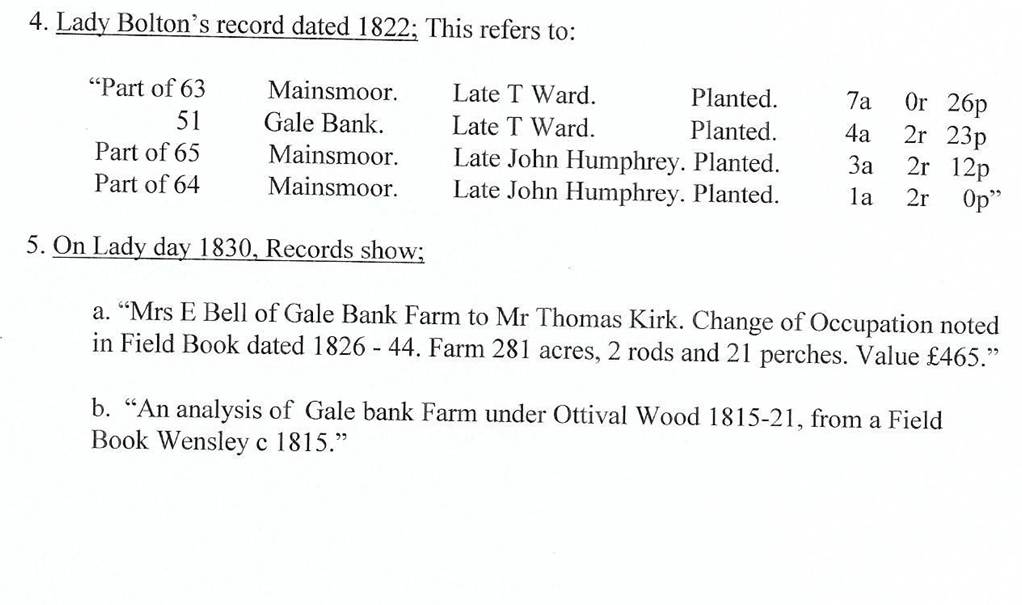
1830
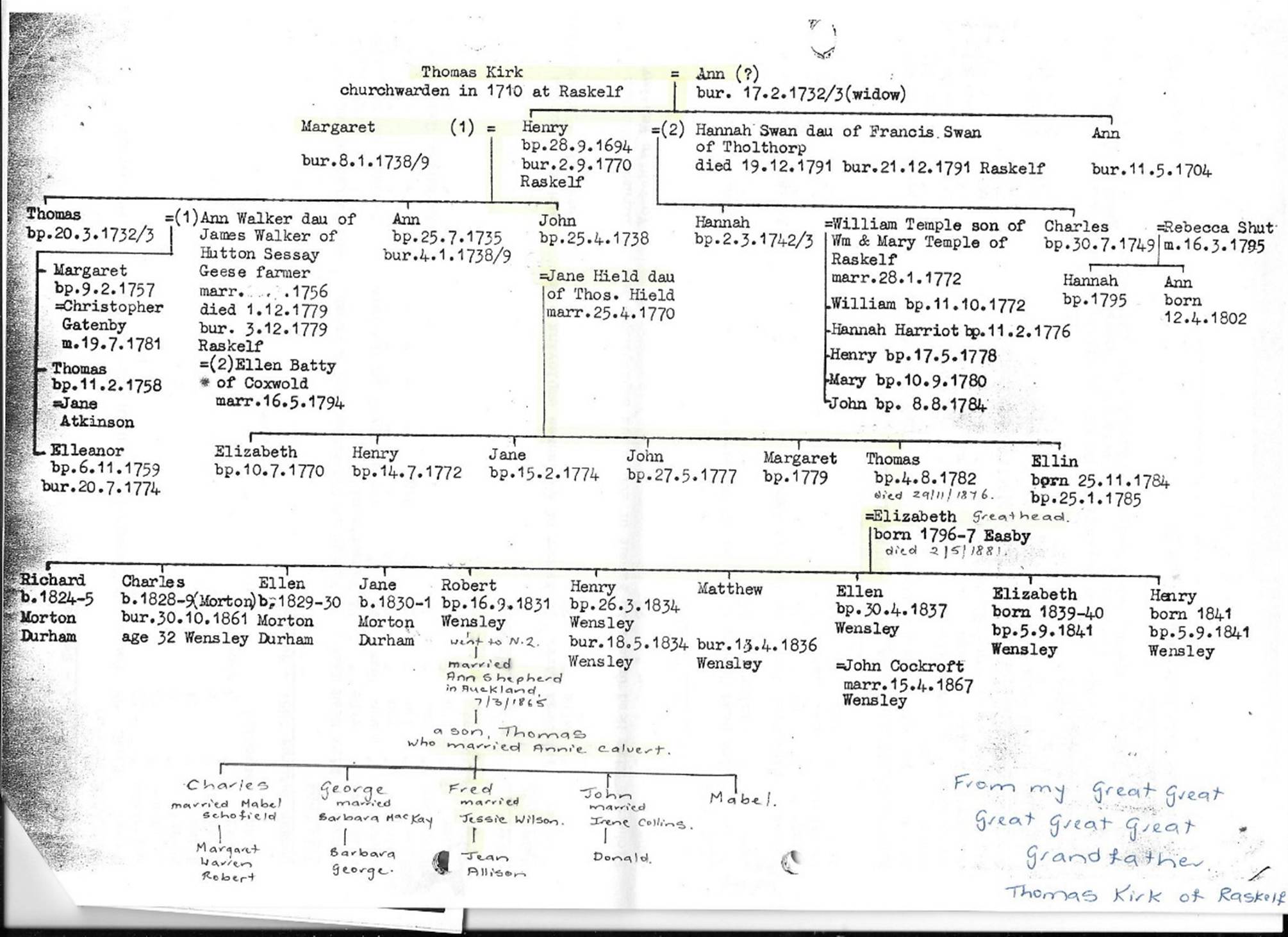
Thomas Kirk was the tenant of Gale Bank Farm from 1830 to 1851 (Bolton Papers and census records). The records
show that in 1830 Mrs E Bell (presumably this was Stephen’s widow), handed
the farm over to Mr Thomas Kirk, 281 acres, 2 rods and 21 perches, value £465.
1838
The York Herald, 22 December 1838:
FATAL ACCIDENT. As Mr. John Calvert, of Masham, was passing along Wensley
Lane, on Saturday night last, he heard the cries of some person in distress, on
the opposite side of the river. Having mentioned the circumstance at the White
Swan in Middleham, it was soon ascertained that a man named Kitty Bell was
missing, and as the night was uncommonly dark, the bellman went round to muster
a number of the inhabitants to go in search of him. Nearly all the lanterns in
the place were put in requisition, and an anxious, yet fruitless search, was
made during the night. About nine o’clock the following morning the poor fellow
was discovered in a stell on the Gale Bank Farm, quite dead, although the water
was not sufficiently deep to cover the body. The corpse having been removed to
Wensley, an inquest was held there on Monday. The deceased was an idiot, about
64 years of age, and it is thought that he had sunk under the combined
influence of terror and cold. He had formed a strong attachment to everything
connected with the parish church at Middleham, and was particularly fond of
ringing the prayer bell, which he has been in the habit of doing every Sunday
for a great number of years.
1840
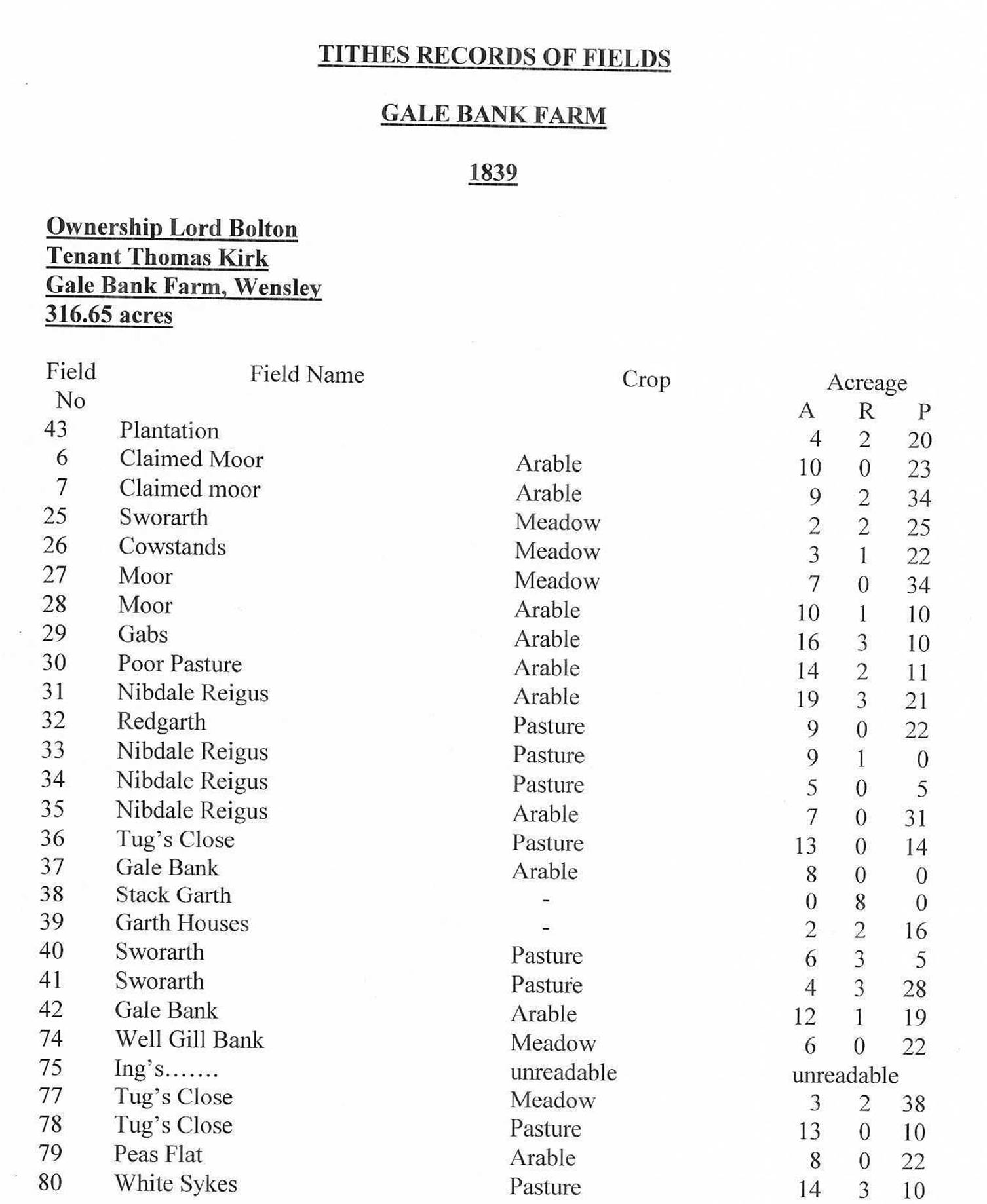
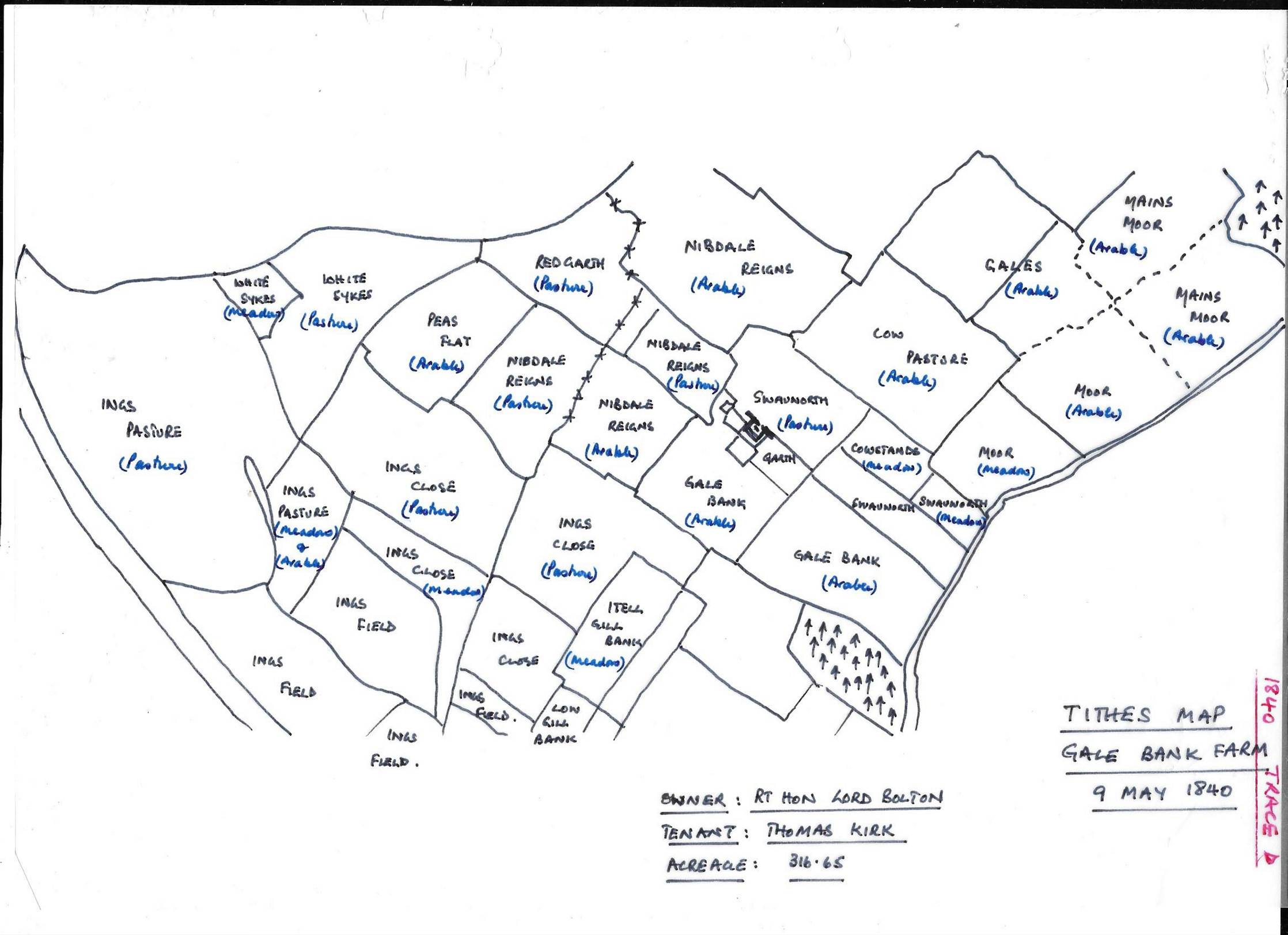
The Tithe Records in 1840 shows
Gale Bank was a farm of 316 acres.
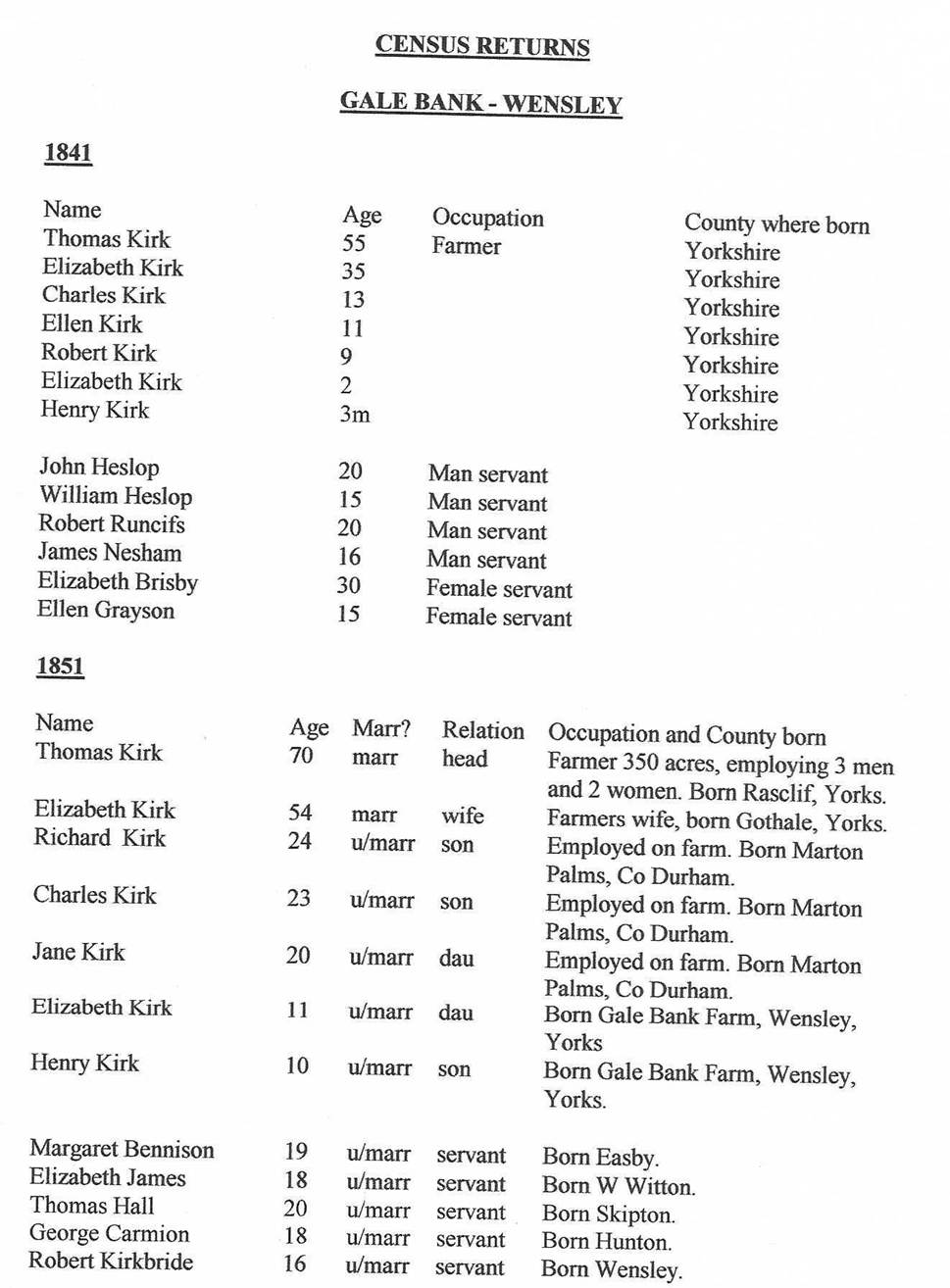
1841
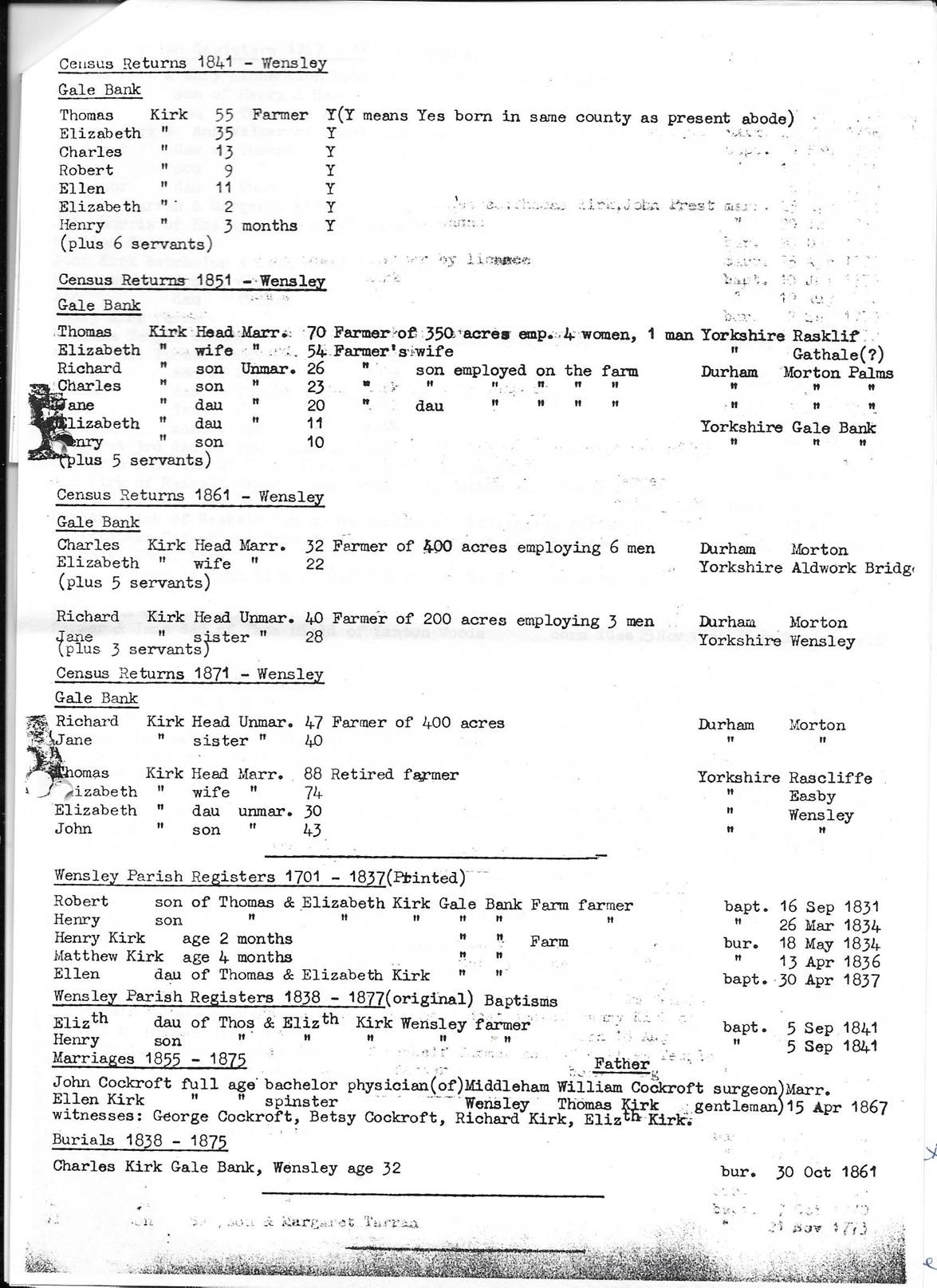
The Census Return for 1841 for
Gale Bank, Wensley listed Thomas Kirk, 55, farmer; Elizabeth Kirk, 35; Charles
Kirk, 13; Robert Kirk, 9, Ellen Kirk, 11; Elizabeth Kirk, 2; and Henry Kirk, 3
months plus 6 servants: Joihn and William Heslop,
Robert Runcifs, James Nesham, Elizabeth Brisby and Ellen Grayson.
1851
The Census return for 1851 for
Gale Bank Farm, Wensley listed Thomas Kirk, married, 70, farmer of 350
acres employing 4 women and 1 man, born at Rasklif,
Yorkshire; Elizabeth Kirk, 54, his wife, born at Gathale,
Yorkshire; Richard Kirk, 26, unmarried, his son, employed on the farm, born at
Morton Palms, Durham; Charles Kirk, 23, unmarried, his son, employed on the
farm, born at Morton Palms, Durham; Jane Kirk, 20, unmarried, his daughter,
employed on the farm, born at Morton Palms, Durham; Elizabeth Kirk, 11, his
daughter, born at Gale Bank; Henry Farndale, son, 10, born at Gale Bank; and 5
servants: Margaret Bennison, Elizabeth James, Thomas Hall, George Carmion and Robert Kirkbride.
Charles Kirk, the
son of Thomas Kirk, was the tenant of Gale Bank Farm from 1851 to about 1870 (Bolton Papers and census records).
1857
Leyburn Town Hall was built.
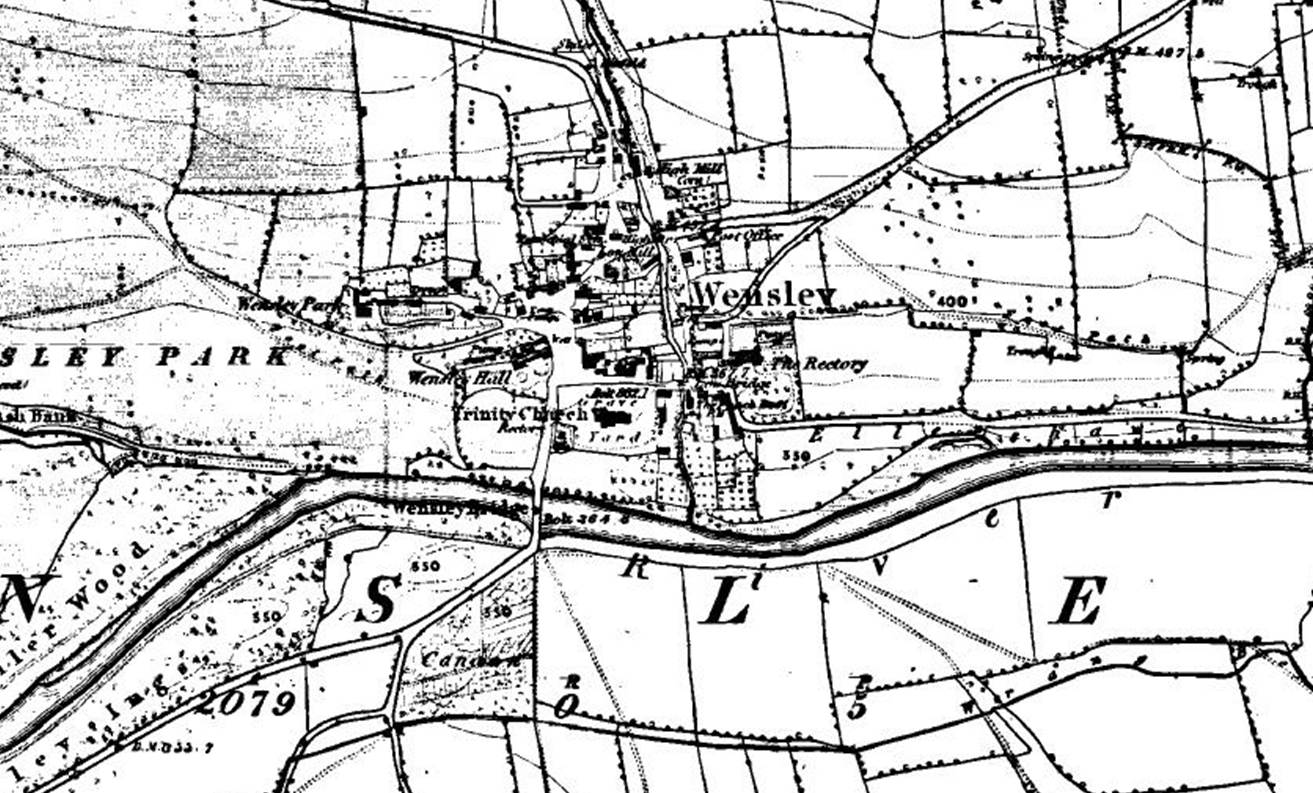
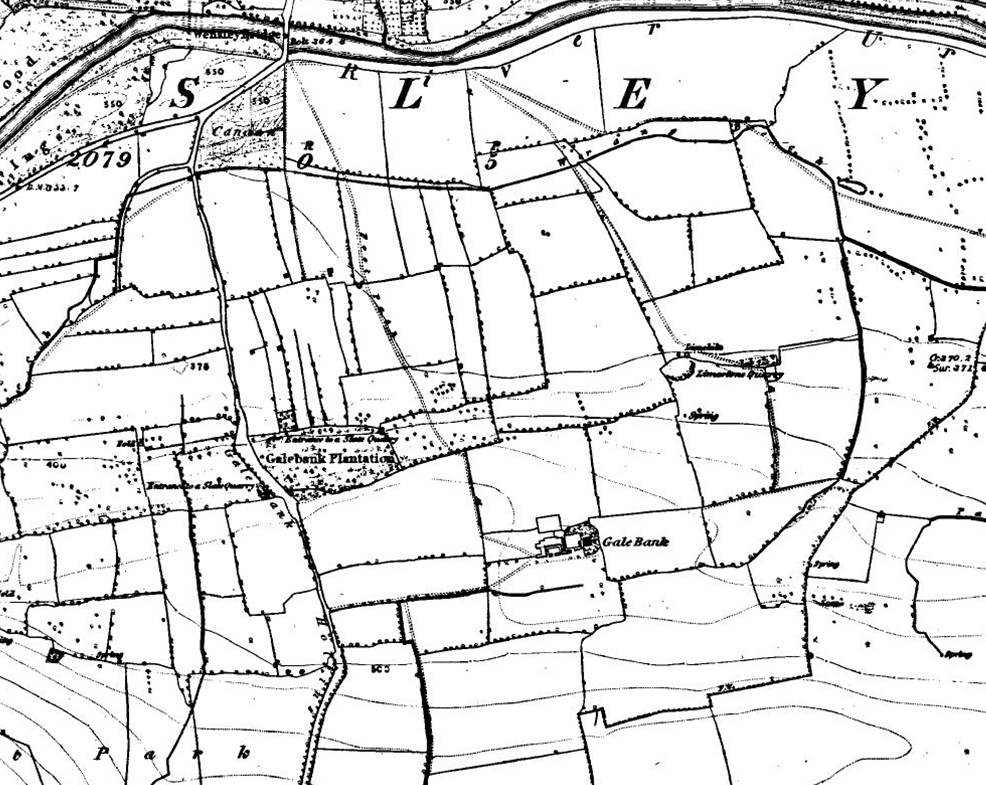
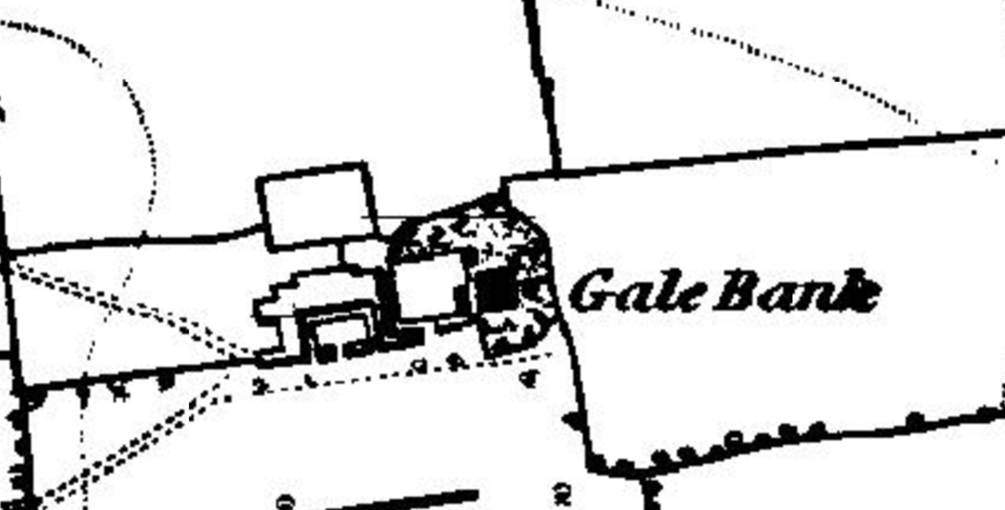
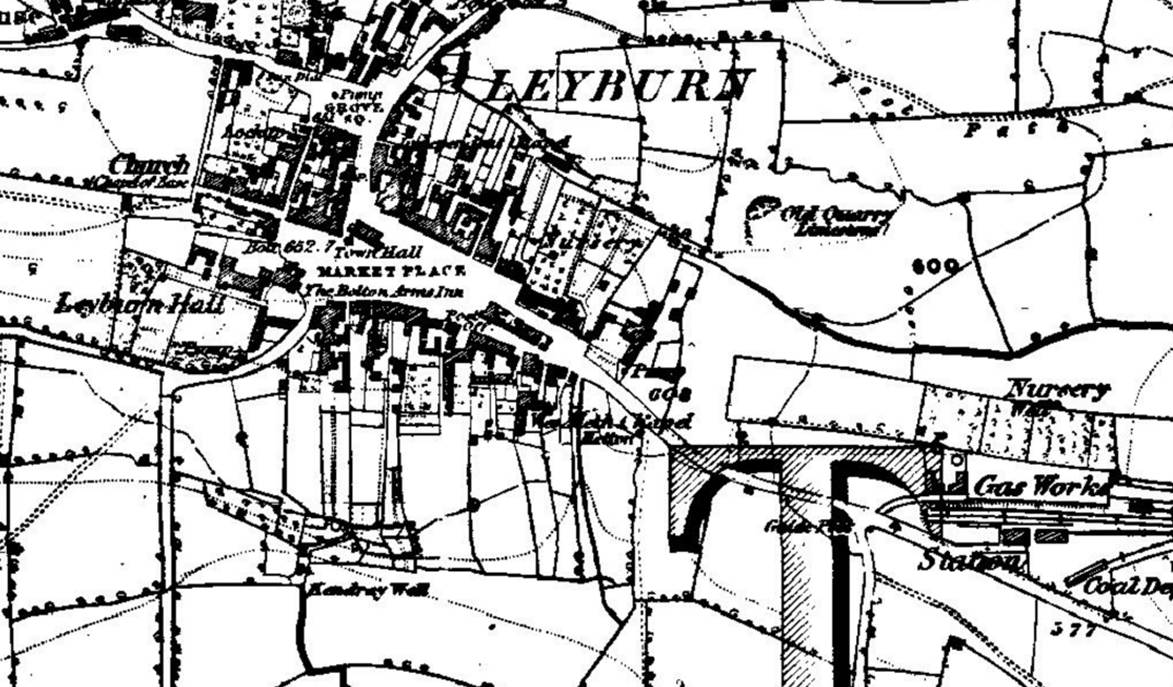
Wensley in 1857
Gale Bank Farm in 1857
Leyburn in 1857
1861
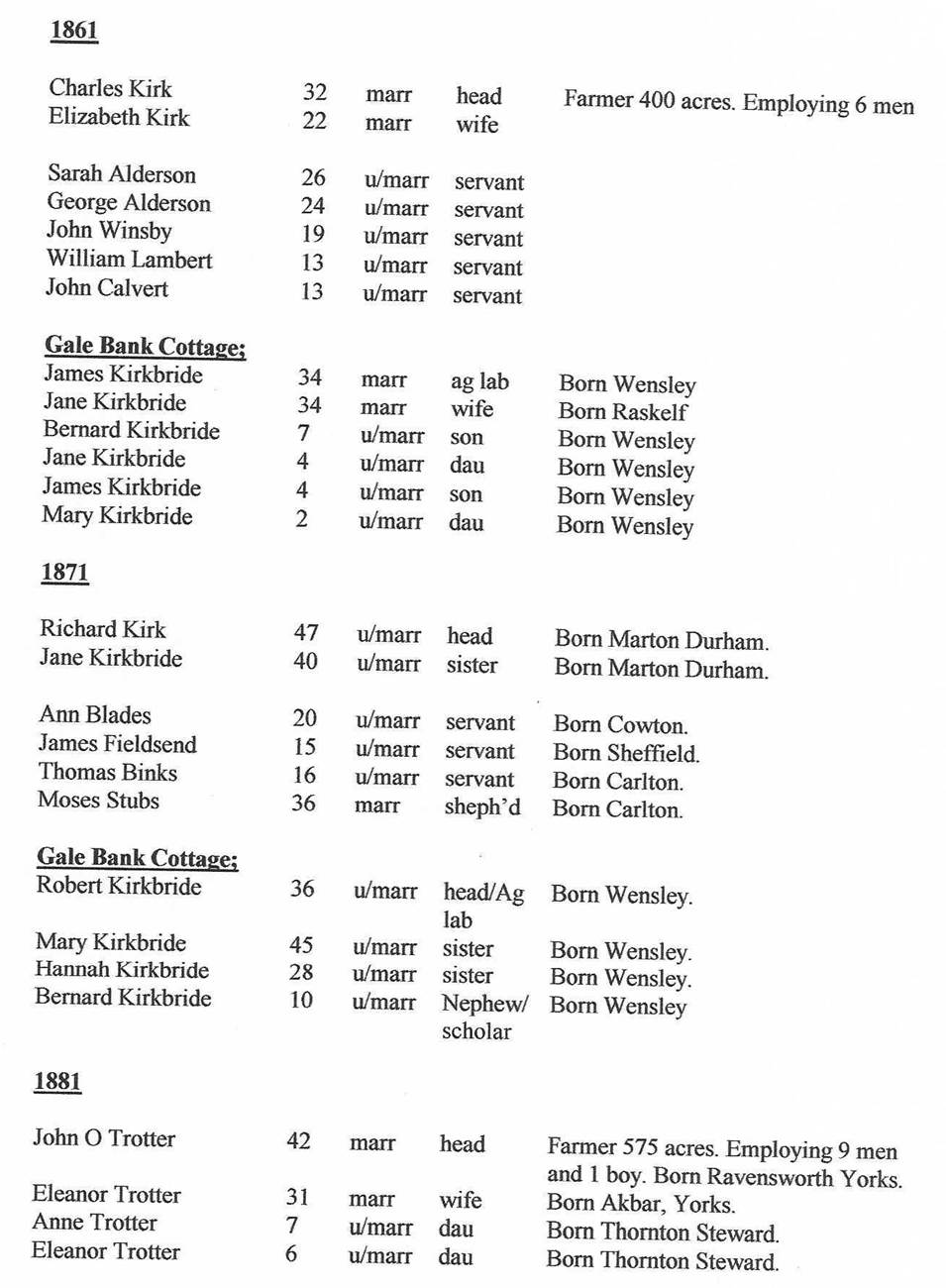
The Census return for 1861 for Gale Bank Farm, Wensley
listed:
· Charles Kirk,
married, 32, farmer of 400 acres employing 6 men, Elizabeth Kirk, 22, his wife,
plus 5 servants (Sarah and George Alderson, John Wisby, William Lambert and
John Calvert);
· Richard Kirk,
married, 40, farmer of 200 acres employing 3 men, Jane Kirk, 28, his sister
plus 3 servants;
· At Gale Bank
Cottage: James and Jane Kirkbride with their children Bernard, Jane, James and
Mary.
1870
Richard Kirk, the
son of Thomas Kirk, was the tenant of Gale Bank Farm from about 1870 to 1881 (Bolton Papers and census records).
1871
The Census return for 1871 for Gale Bank Farm, Wensley
listed Richard Kirk, head, 47, unmarried, farmer of 400 acres; Jane Kirk, 40,
his sister; Thomas Kirk, 88, retired farmer; Elizabeth Kirk, 74; Elizabeth
Kirk, 30 and John Kirk, 43. The Kirkbride family continued to live at Gale Bank
Cottage.
1868
The present Leyburn Church was built.
1879
The Richmond & Ripon Chronicle, 15
March 1879: GALE BANK, WENBSLEY, NEAR LEYBURN: Important sale of
splendid dining and drawing rooms suites in rosewood and mahogany, equal to
new, 8 prime feather beds and good bedroom appointments, carpets, rich tone
cottage pianoforte, blankets, cut glass, china,
plated goods, cutlery, dairy utensils and kitchen requisites. Mr. A Urwin begs
to announce that he is favoured with the instructions from Mr Richard Kirk who
is leaving the neighbourhood, to sell by public auction, at Gale Bank
aforesaid, on Thursday the 20th March 1879, the whole of his very costly
household furniture, horses, and other effects...
1881
John O Trotter
was the tenant of Gale Bank Farm (Bulmer’s and
Keelys Directories and census records).
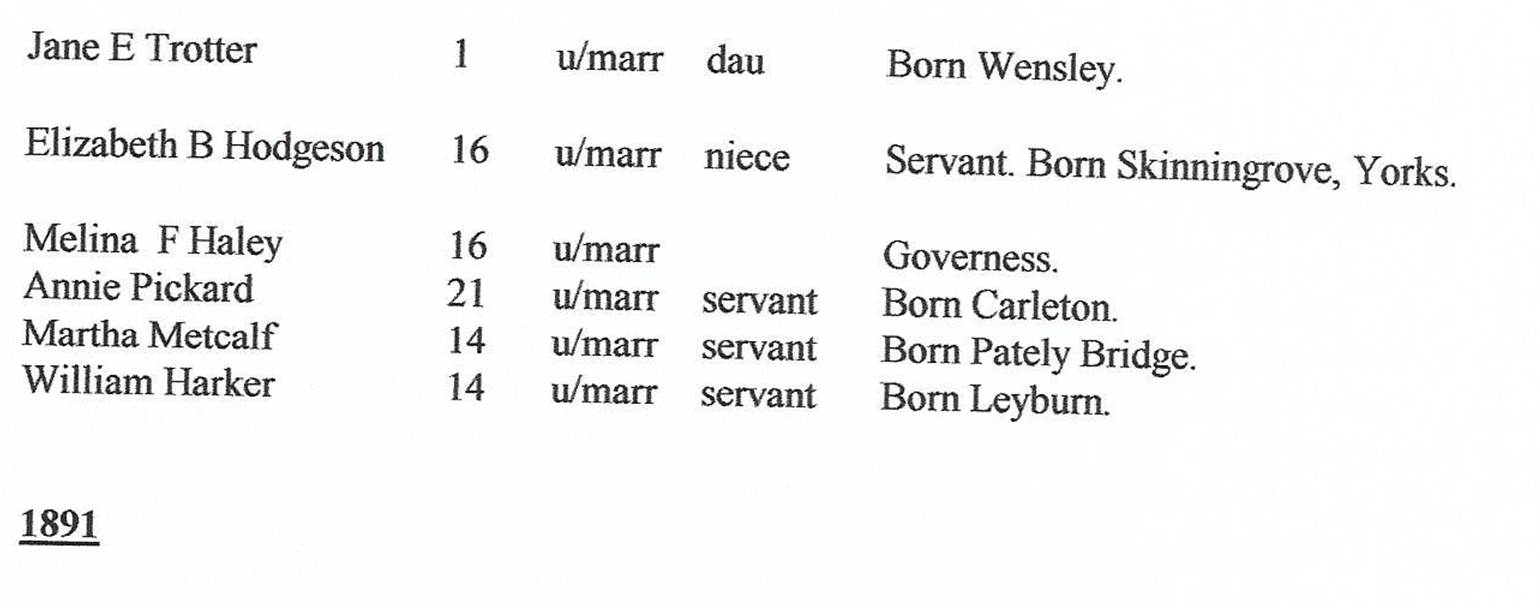
The 1881 Census for Gale Bank listed John O Trotter,
42, married, farmer of 575 acres employing 9 men and 1 boy, born Ravensworth,
Yorkshire; Eleanor Trotter, his wife, 31, born Akbar, Yorkshire; Anne Trotter,
7, born Thornton Steward; Eleanor Trotter, 6, Jane Trotter, 1 and 5 servants.
1883
The Yorkshire Post and Leeds Intelligencer, 8 June 1883 reported
on the Royal Agricultural Show of England and included reference to John
Outhwaite Trotter of Gale Bank, Wensley, who had become a life member of the
Show.
1884
The Boston Spa News, 29 February 1884 included a
lengthy letter to the editor from John Outhwaite Trotter of Gale Bank, Wensley
about foot and mouth disease and allowing foreign animals to come to the
country from ‘diseased countries’.
1890
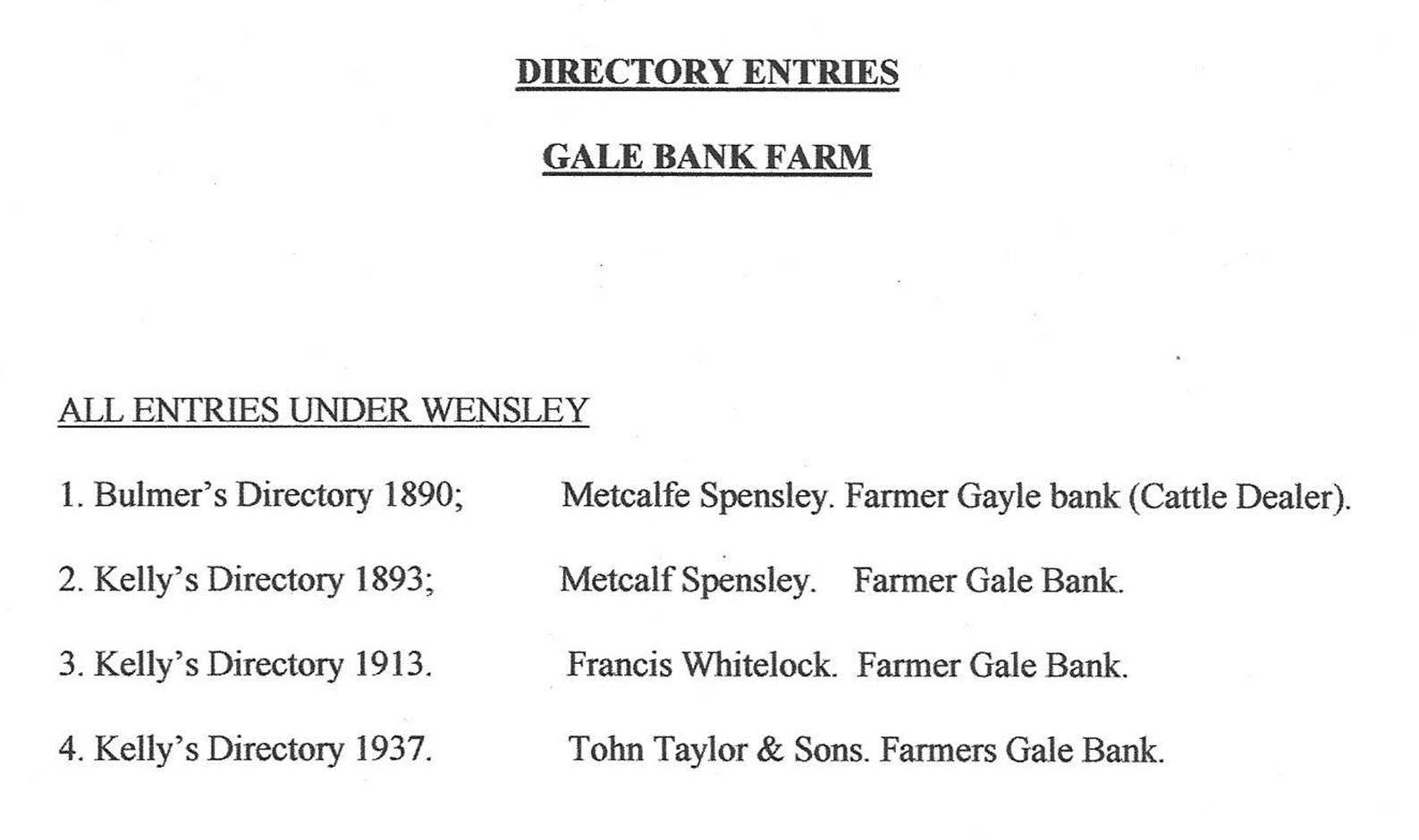
Metcalf Spensley was the tenant of Gale Bank Farm from about 1890.
He was still there in 1893. (Bulmer’s and Kelly’s
Directories). This was probably a reference to Simon Spensley (see census records below).
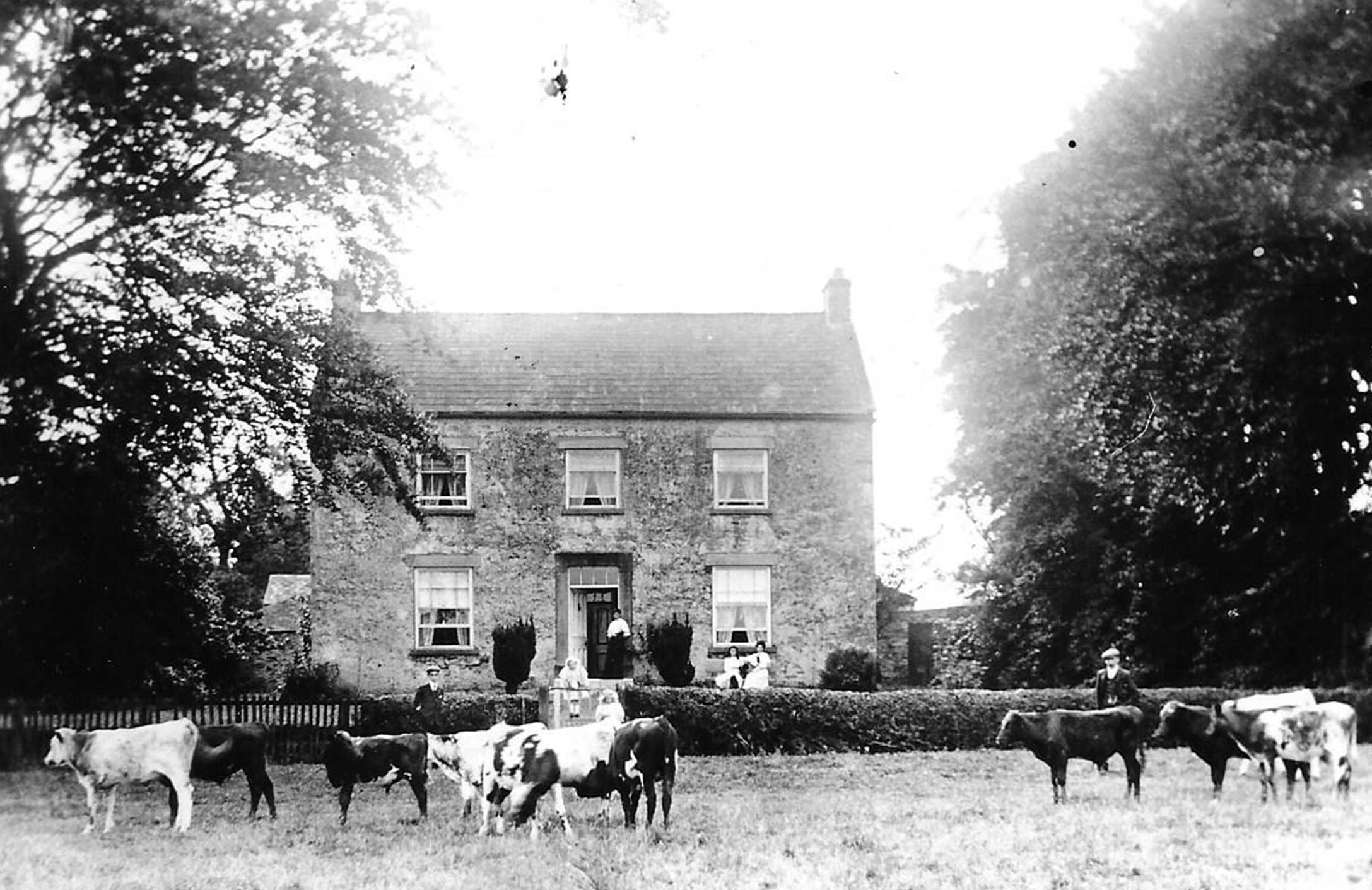
Gale Bank perhaps
about 1890 to 1914. If 1890 to 1901 this may be the Spensley family. If after
1901, then the Francis Whitelock family.
1891
The 1891 Census for Gale Bank Farm, Wensley listed
Simon Spensley, 28, farmer and cattle dealer, single, born Carperby,
Yorkshire with two domestic servants, four farmn
servants and a shepherd and his uncle, Ralph Spensley who worked as a farm
labourer. Simon Spensley was the son of Simon Spensley born about 1814 and they
had previously farmed at Tullis Cote, Wensley.
1901
By 1901 Francis
Whitelock was the tenant at Gale Bank. The 1901
census for Gale Bank listed Francis Whitelock, widower, 30, farmer (born
in Harmby, Yorkshire); with two house servants; a
shepherd, two cowmen and as ploughman.
1911
The Yorkshire Post and Leeds Intelligencer, 21 August 1911 reported
on cattle entries to the Wensleydale show by F Whitelock of Gale Bank Farm.
1913
Francis Whitelock
was the tenant of Gale Bank Farm (Kelly’s Directory).
1921
The 1921 Census for Wensley lists Francis Whitelock,
50, a farmer, now married to Lena Whitelock, 42, with Ivy Whitelock, 18 a
solicitor’s clerk, Margaret E Whitelock, 16, a solicitor’s clerk, Frances Lena
Whitelock, 10 and a boarder, Emma Pearson.
1937
John Taylor &
Son was the tenant of Gale Bank Farm (Kelly’s
Directory).
1939
The 1939 Register for Riverside, Leyburn Road,
Middleham, lists John C Taylor, a dairy farmer (born 10 November 1891) with
Jessie Taylor, his wife.
1943
The Yorkshire Post and Leeds Intelligencer, 23 January 1943:
A NORTH RIDING DISPOSSESSION: Messrs Taylor Brothers, who were dispossessed
of Gale Bank Farm, Wensley, by order of the North Riding War Agricultural
Executive Committee, made a statement on the case yesterday. They said that if
they had been present at the press conference at Northallerton when the
committee's decision was explained, several statements would have been
immediately challenged on the ground of inaccuracy. Messrs Taylor brothers maintained
that it was not too late for the chairman of the executive committee and his
colleagues to meet at the farm now and inspect it, with a neutral body of
farmers. They added, “we strongly reiterate that no warning was ever given to
us by the committee of any hint that anything was wrong, and we got a shock
when, on August 4, we received a notice to terminate all possession on October
11, 1942.”
Alfred Farndale (FAR00683) took
the tenancy at Gale Bank Farm on 23 January 1943 and farmed there until about
1972 when his son Alfred Geoffrey Farndale (FAR00922)
continued the tenancy of Gale Bank Farm. The family moved there on 28 January
1943.
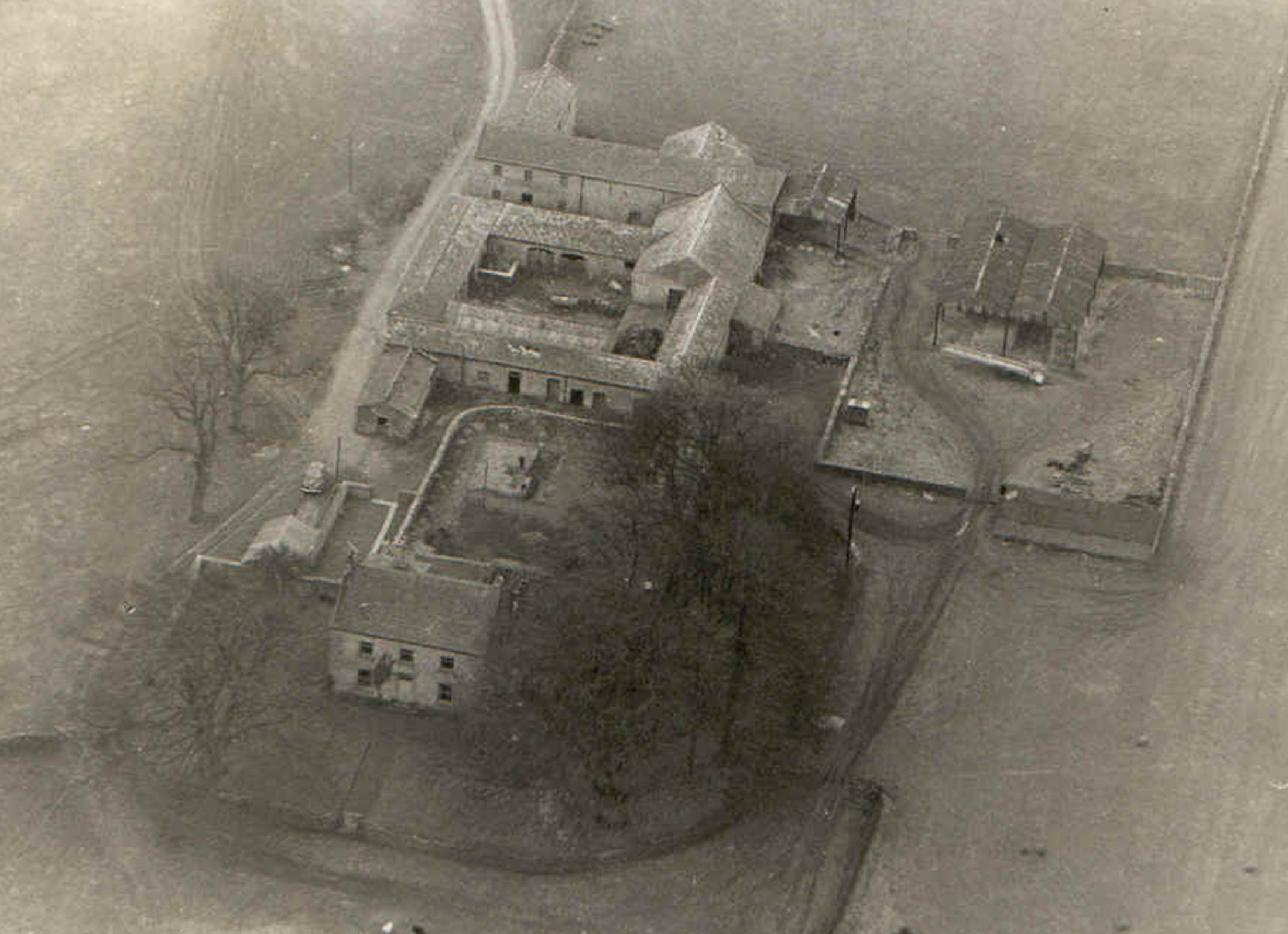
1972
Alfred Geoffrey (“Geoff”) Farndale (FAR00922)
continued the Farndale tenancy of Gale Bank Farm.
Alfred continued to work on the farm almost until he
died in 1987.
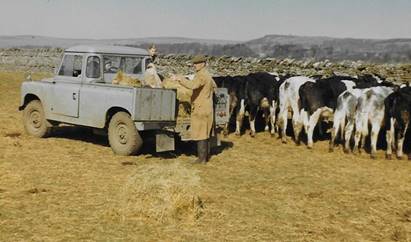
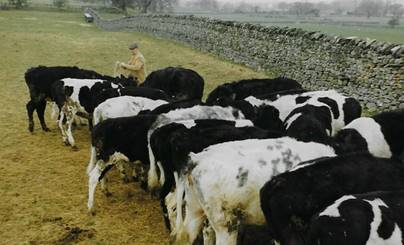
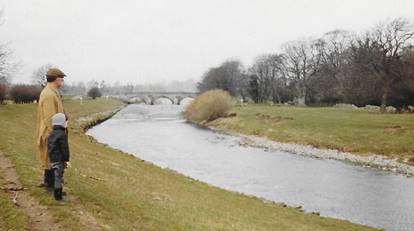
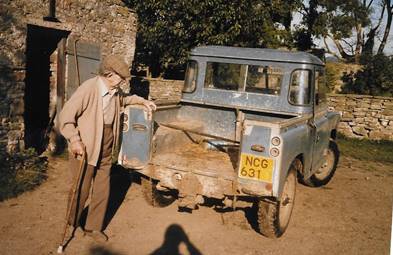
Alfred (“Gran”) feeding the
stock Gran by the River
Ure
Gran and the famous landrover
1990s
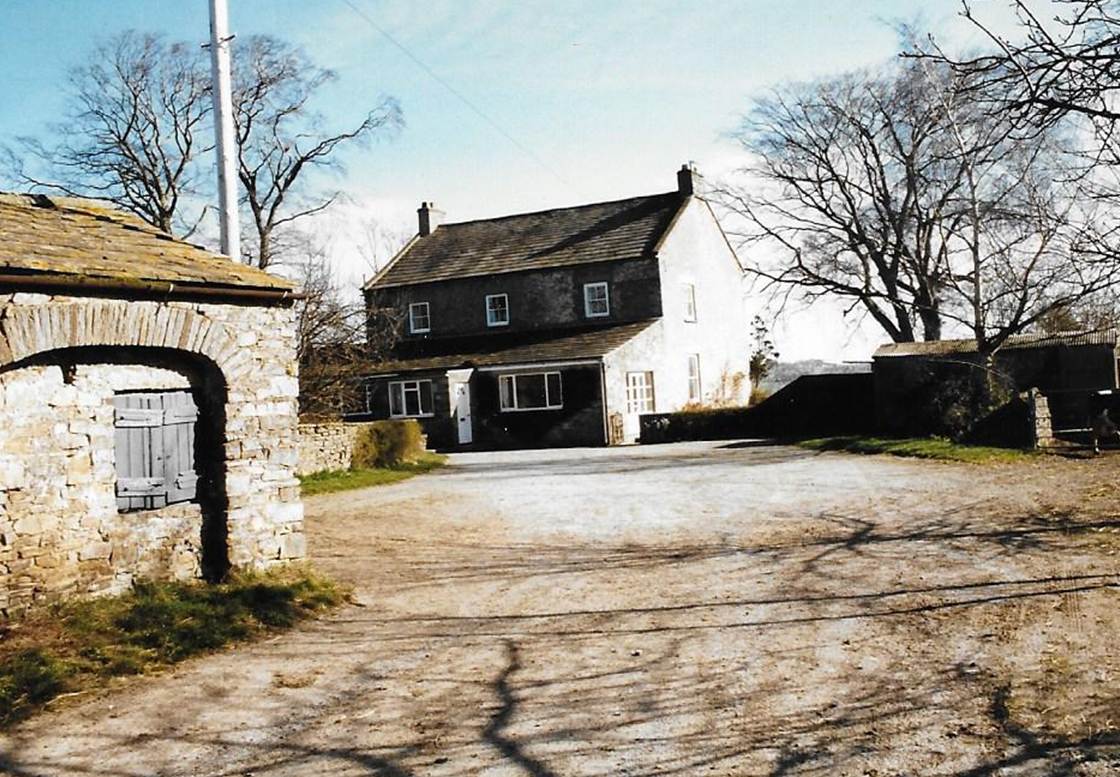
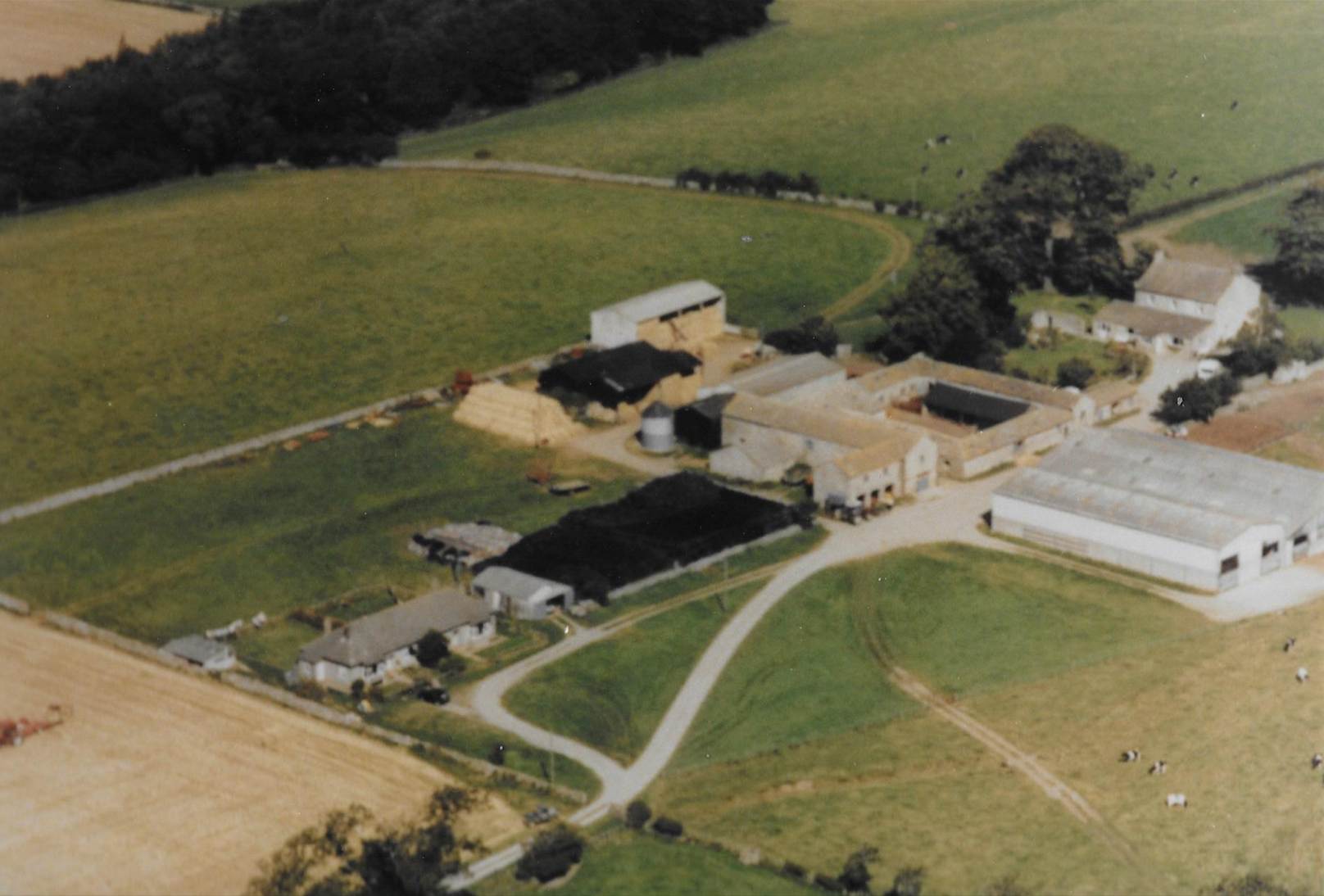
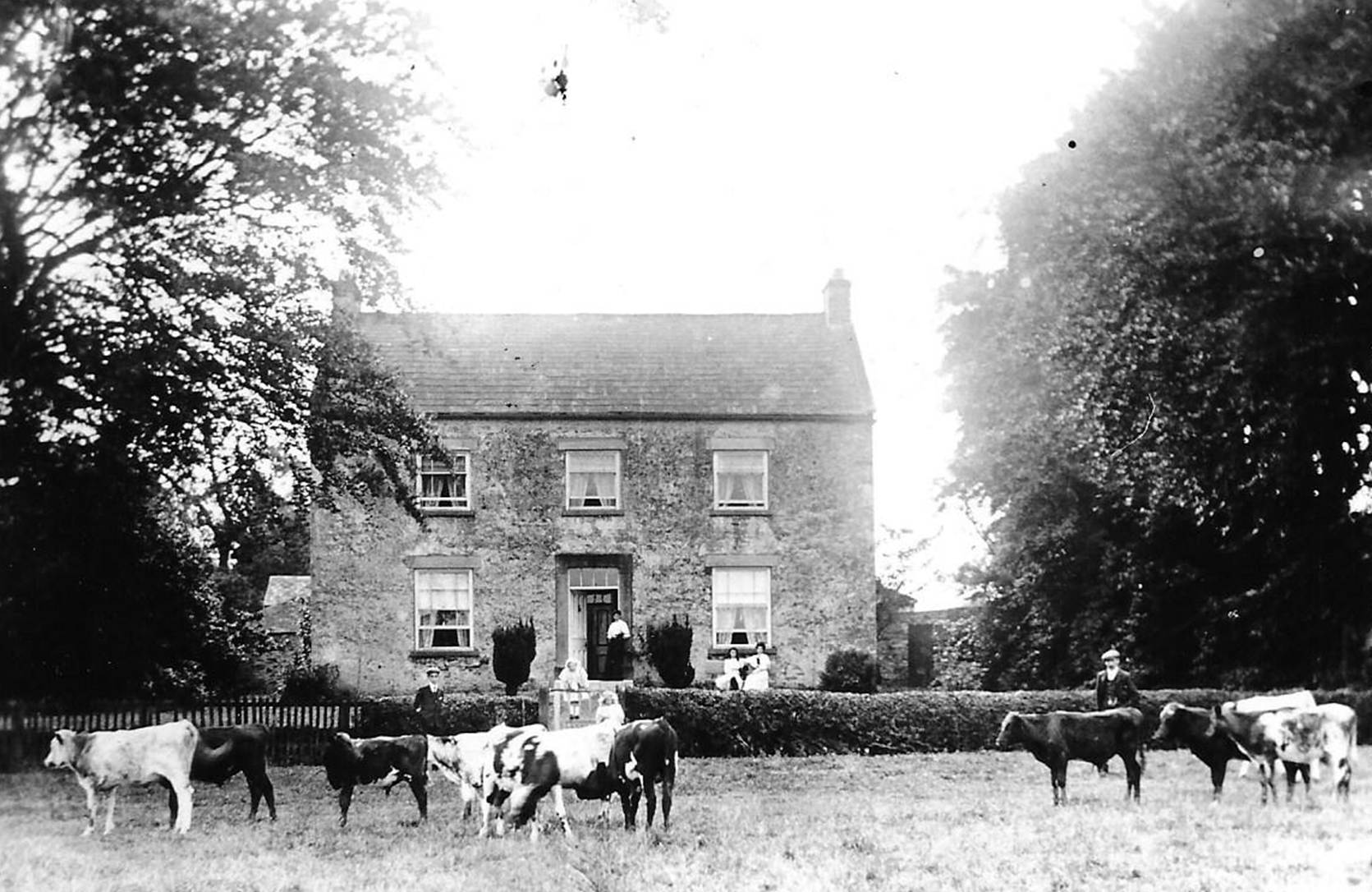
Gale Bank in the
1990s
1
October 1998
Gale Bank was sold to Metcalfe Farms.
The Kirk Family
Martin Farndale’s Research Notes