Northallerton
Historical and geographical information
|
Return to the Home Page of the Farndale Family
Website |
The story of one family’s journey through two
thousand years of British History |
The 83 family lines into which the family is divided.
Meet the whole family and how the wider family is related |
Members of the historical family ordered by date of
birth |
Links to other pages with historical research and
related material |
The story of the Bakers of Highfields, the Chapmans,
and other related families |
Dates are in red.
Hyperlinks to other pages are in dark blue.
Headlines of the history of the Newfoundland
are in brown.
References and citations are in turquoise.
Contextual history is in purple.
This webpage
about the Newfoundland has the
following section headings:
· The Farndales of Northallerton
·
Northallerton
·
Northallerton Timeline
·
Bibliography
The Farndales of
Northallerton
The following
Farndales were associated with Northallerton are Hannah Mary Farndale (FAR00595);
Ruth Farndale (FAR00619);
William Farndale (FAR00639);
William Farndale (FAR00665);
Albert Edward Farndale (FAR00667),
Co-op store manager in Loftus and Northallerton; Sarah Elizabeth Farndale (FAR00693);
Doris M Farndale (FAR00807);
Herbert Farndale (FAR00835);
Bertram Farndale (FAR00855);
Edna Elizabeth Farndale (FAR00868);
Charles Farndale (FAR00875);
Kenneth Farndale (FAR00884);
Leslie Farndale (FAR00885);
Gladys Farndale (FAR00900);
William E Farndale (FAR00908);
Martin Baker Farndale (FAR00911);
Anne Farndale (FAR00915);
Rosamund Farndale (FAR00920);
Geoff Farndale (FAR00922);
John Francis Farndale (FAR00923);
Donald Farndale (FAR00947);
Sheila Farndale (FAR00983);
Keith Farndale (FAR00990);
John Martin Farndale (FAR01033);
Kathleen E Farndale (FAR01059);
Antony W Farndale (FAR001077);
David C Farndale (FAR01081);
Peter H Farndale (FAR01084);
James William Farndale (FAR01239);
Emily Victoria Farndale (FAR01253);
Fiona Christine Farndale (FAR01254);
Harriet Margaret Farndale (FAR01271);
Aimee Lian Farndale (FAR01293);
Stephanie Elizabeth Farndale (FAR01299);
and Alys Rebecca Farndale (FAR01321)
Northallerton
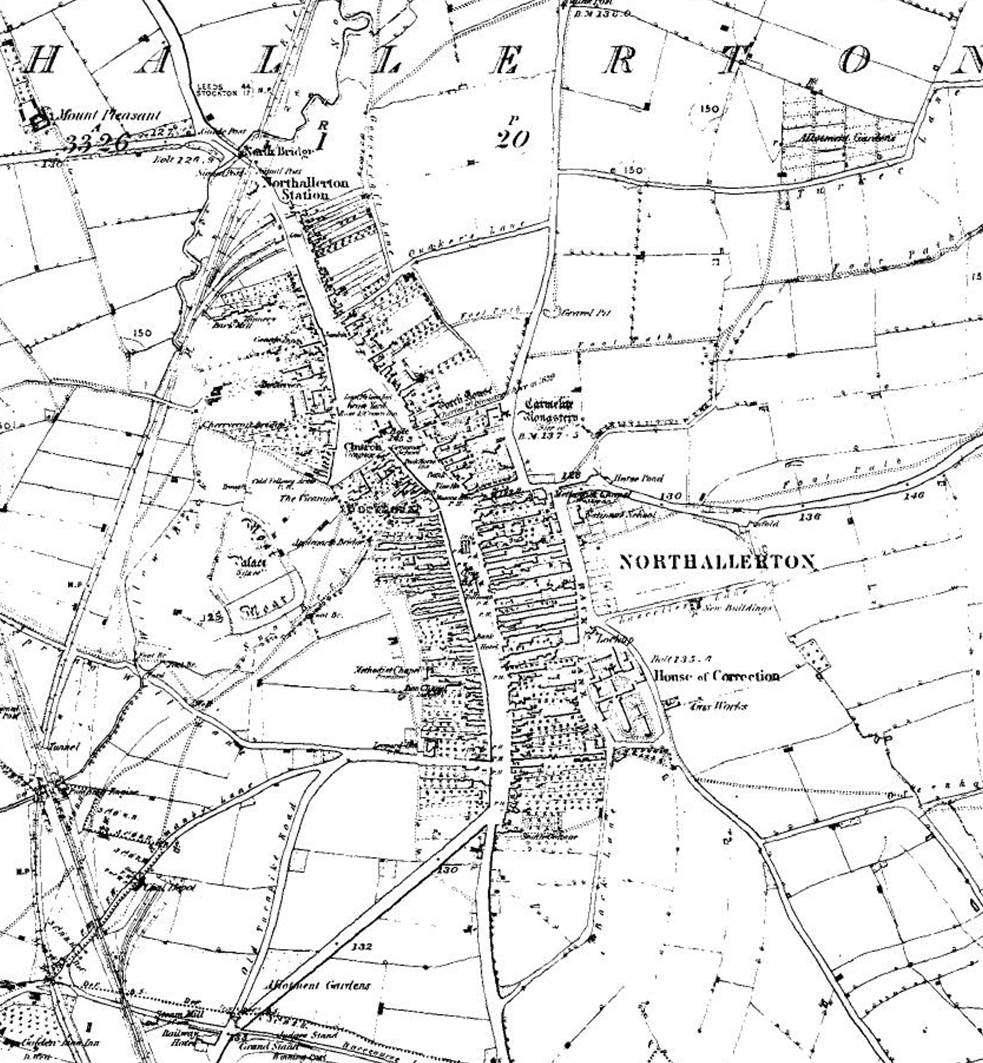
Northallerton is
a market town and civil parish in
the Hambleton district of North Yorkshire. It lies in
the Vale of Mowbray and at the northern end of the Vale of York.
It has served as the county town of the North Riding of
Yorkshire and since 1974, of North Yorkshire. Northallerton is
made up of four wards, North, Broomfield, Romanby and
Central.
Northallerton Timeline
Roman
period
There has been a
settlement at Northallerton since Roman times. There is evidence that
the Romans had a signal station on Castle Hill just to the west of the town as
part of the imperial Roman postal system and a path connecting Hadrian's Wall
with Eboracum (York) ran through what is now the neighbouring village of Brompton.
1069
In 1069, in an
attempt to quell rebellion in the north, the area between the Ouse and the Tyne
was laid waste by the armies of William the Conqueror (the Harrying of the
North). The town of Northallerton was almost totally destroyed or depopulated.
Just a few years later it is described in the Domesday Book as modo est in manu regis et wastum
est (‘put down as waste’).
1086
In the Domesday
Survey, Norman scribes named the settlement Alvertune,
Aluertune and Alretone
and there is a reference to the Alvertune wapentac, an area almost identical to the Allertonshire wapentake of the North Riding, which
was named after the town.
Eleventh
century
Northallerton’s
growth in importance began in the 11th century when King William
II gifted land to the Bishop of Durham. Under the Bishop's authority
Northallerton became an important centre for religious affairs.
1130
In 1130 a castle
was built on the west side of the town adjacent to North Beck by Bishop Rufus
and was expanded in 1142 after William Cumin seized the Bishopric of Durham in
1141. The castle was further expanded in 1173 by Hugh Pudsey and garrisoned by
a group of Flemish soldiers, an act which enraged King Henry II who ordered
that it be razed to the ground in 1177.
1138
It was also a
focus for much conflict in subsequent years between the English and
the Scots, most notably the Battle of the
Standard, nearby in 1138, which saw losses of as many as 12,000 men.
1236
The Victoria County History – Yorkshire A History of the
County of York North Riding: Volume 1 Parishes: Northallerton, 1914: Henry
III twice stayed at Northallerton in September 1236 when going to and returning
from Durham, while Edward I made it his customary stopping-place when on his
way to Scotland, and was here in 1291, 1292, 1293 (when he stayed here three
nights and dined with the bishop), 1296, 1298, 1299 (when the Bishop of Durham
sent him a white palfrey), 1303 and 1304. Edward II rested here in 1312, and
here Edward III stayed in 1327, 1331, 1333 (when he was accompanied by Queen
Philippa) and 1356, a few months after founding the Carmelite Friary here.
1318
In 1318, the town
was destroyed by the Scots, under Sir James Douglas following the Capture of
Berwick upon Tweed.
1354
A Carmelite
priory was founded in 1354, but was demolished soon after the dissolution of
the monasteries in 1538.
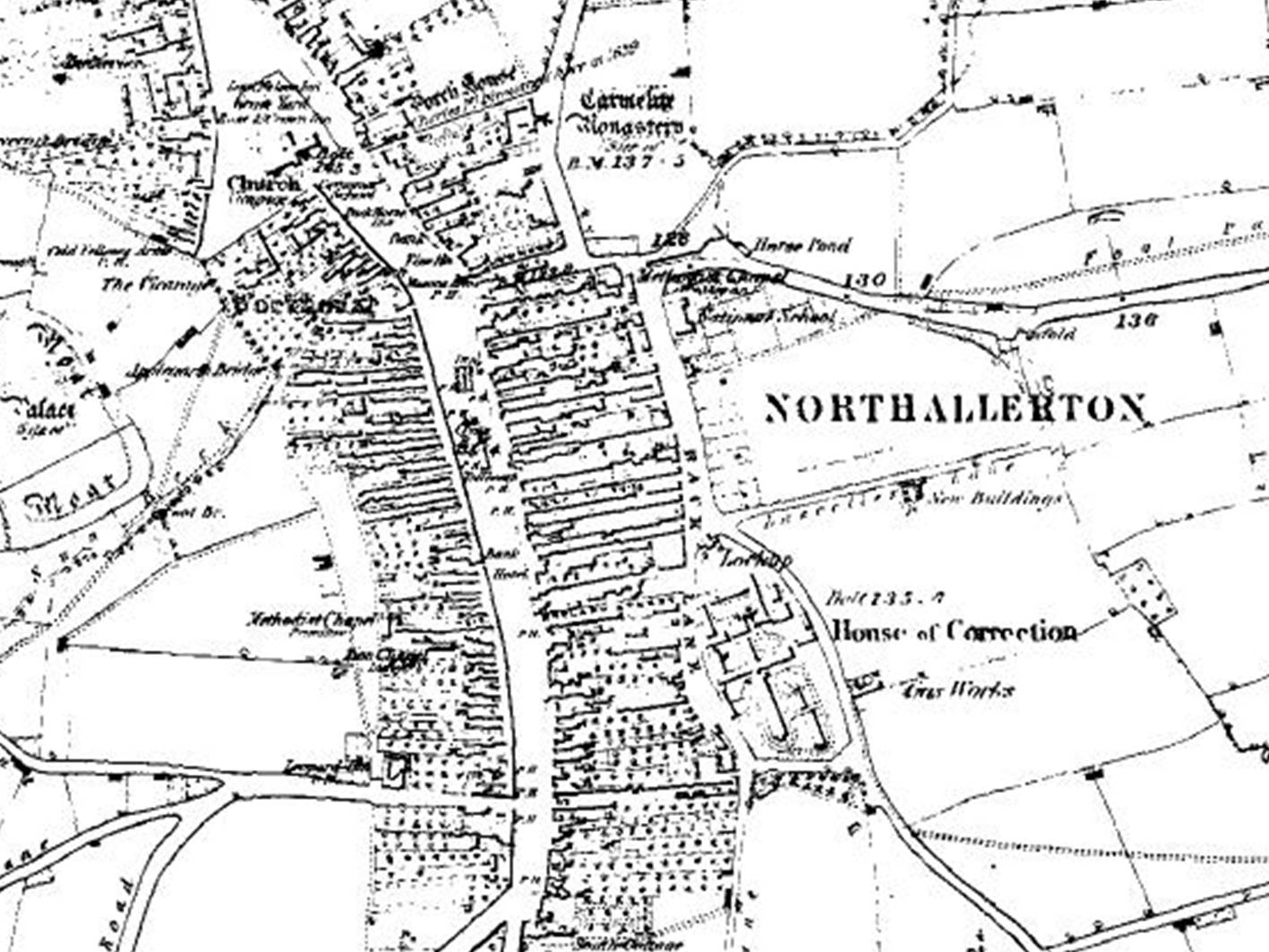
The site passed
to various people and was used for arable farming before a workhouse was built
on the site in 1857. Subsequently, the Friarage
Hospital, which takes its name from the friary, was built.
1800
In the golden age
of coaching, Northallerton had four coaching inns along High Street
serving passengers and horses using several routes to the north.
1823
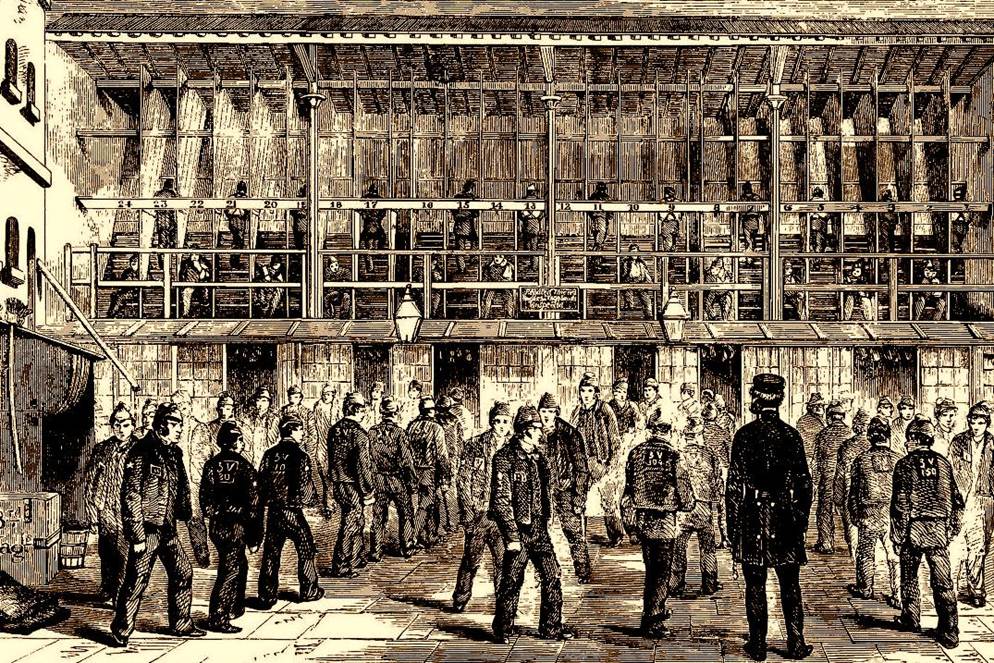
Northallerton
Gaol in 1823
1841
With the arrival
of the railway in 1841 the town maintained its importance as a communications
centre.
1857
Bibliography