Orm Gamalson
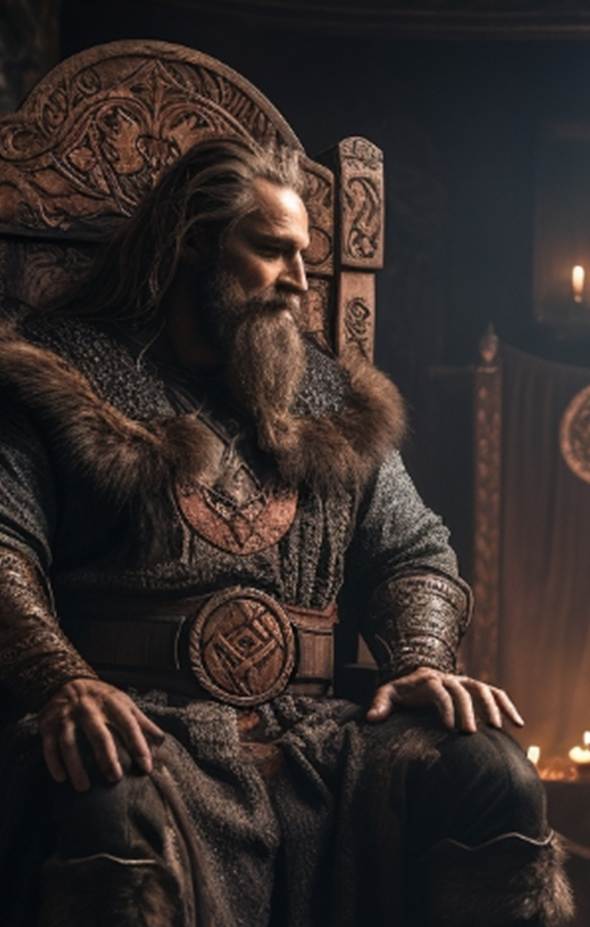
The powerful figure at the
heart of the aristocracy, who rebuilt Kirkdale and put our ancestral lands
firmly onto the national political stage
|
Return to the Home
Page of the Farndale Family Website |
The story of one
family’s journey through two thousand years of British History |
The 83 family lines
into which the family is divided. Meet the whole family and how the wider
family is related |
Members of the
historical family ordered by date of birth |
Links to other pages
with historical research and related material |
The story of the
Bakers of Highfields, the Chapmans, and other related families |
Headlines are in brown.
Dates are in red.
Hyperlinks to
other pages are in dark
blue.
References and
citations are in turquoise.
Context and local
history are in purple.
Geographical
context is in green.
A Scandinavian who
assimilated Anglo-Saxon Christian culture
Orm Gamalson
is an Old Norse name which roughly translates as Dragon Oldson.
His name
appears on the sundial at Kirkdale Minster. Orm the
son of Gamal acquired St Gregory’s Minster when it was completely ruined and
collapsed, and he had it built anew from the ground to Christ and to St Gregory
in the days of King Edward and in the days of Earl Tostig.
His name
appears in the Domesday Book. In Chirchebi, Orm had five caracutes
of land there. There is land for two ploughs. High FitzBaldric
has two ploughs there’ and 10 villans with 3 ploughs.
There is a priest and a church, and 1 mill rendering 4s.
His name
appears in De
Obsessione Dunelmi, On the Siege of Durham
which states that after the Norman Conquest, a thegn of Yorkshire, called Orm,
son of Gamel, married Aetheldryth, one of five
daughters of Earl Eadred, and they had a daughter called Ecgfrida, who by Aelsfsige of Tees, had a son, Waltheof, two other sons and
a daughter, Eda.
Symeon of
Durham’s Historia
Regum recorded that Gamal, the son of Orm, was killed by Earl Tosti in
York in 1063 or 1064.
Orm son
of Gamal had large possessions in the neighbourhood; it is mentioned in
Domesday that one of the two churches at " Chirchebi " or Kirby was
in the manor of Orm, consequently at that time he continued to be Lord of
Kirkdale. His estates extended to Danby, Lofthouse, Lealholme,
Heworth, Layersthorpe, and Hovingham. It is recorded
that he became a vassal of Earl Allan (who had acquired six other of his
manors) to retain his father's lands at Danby. The name " Orm " has
left its impress on the district in many instances, as " Ormesby,"
and " Orm's-Bridge," on the Derwent, mentioned as the spot where Reinfrid, Prior of Whitby, was killed by accident in 1083.
It would appear that Orm was the son of Gamal slain by Tosti, and that Gamal's
father was also named Orm. (Ryedale and North Yorkshire antiquities, George Frank, 1888, page
142).
A landowning
powerhouse
Orm and his
father Gamal were descendants of a family that gained power when the
Scandinavian King Cnut rewarded his followers for their help in the conquest of
England in 1014 to 1016.
His forebears
probably included Thurbrand the Hold, who died in
1024. Thurbrand was a Northumbrian magnate who killed
Uhtred the Bold (the real Uhtred, not the fictional one of King Alfred’s
court), Earl of Northumbria during the war between Sweyn Forkbeard and Cnut the
Great against the English king Æthelred the
Unready. Uhtred was Æthelred’s main Northumbrian supporter. The family were
likely players in multi generational Northumbrian
politics and feuds. They were known political figures in the north. This was a
family who had the wealth to rebuild the Kirkdale church on a significant
scale.
c 1020
Orm was the son
of Gamal (and an unknown mother). He was born in Northumbria in about 1035 (Cawley, 2006), or 1022 (Atkinson, 1891),
but according to Ashworth P. Burke in Family
Records: Spofforth, Orm Gamalson was born circa 965 CE, though this was
more likely to have been his ancestor. Orm’s birth likely occurred following
the annexation of Northumbria into England in 954 CE and shortly before the
term Northumberland was coined in the Anglo-Saxon Chronicle in 1065.
Orm's name is Scandinavian, which suggests that he was of
Scandinavian descent, but by his lifetime, he was very much a Christian, and a
part of the Saxon world.
c 1040
Orm was a
prominent person in Northumbria in the middle years of the eleventh century.
According to the
chronicler, Simeon of Durham, Orm, who was a thane of Yorkshire, married into
the leading aristocratic clan of the region. His wife Aethelthryth was the
daughter of Ealdred, Earl of Northumbria from
1016 to 1038. She
was one of the five daughters of Aldred of Bamburgh (b. before 1006 - d.1039).
His brother in law was Siward, Earl of Northumbria
until 1055, famous for his exploits against Macbeth, the King of Scots, and as the founder of St. Olave's church in York.
His son was
Gamel, son of Orm and he probably had a daughter, Ecgfrida or Ecghfrida, who married Eilsi of Tees. His brother may have been Gamelbar de Spofford who was among the elite families who
rebelled against Tostig’s rule in Yorkshire.
Orm’s son Gamal
was assassinated in 1064. This might suggest an earlier birth date for Orm, on
or before 1022.
Orm was a
considerable landowner in Yorkshire before 1066, as recorded in the Domesday
Book. Among his landholdings in Ryedale was the big and valuable estate based
on Kirkbymoorside or Chirchebi, including
Kirkdale and the adjacent country that included many manors, as well as other
extensive landholdings and manors during the reign of Edward the Confessor (as
recorded in Domesday, 1086).
When his
family came into possession of the estate, isn’t known for sure. In 1066 he
held land across the Vale of Pickering and beyond. He might have held land not
surveyed in the Domesday Book as far as the Tees.
It is
possible to discover a little bit about Orm from the slender documentation
which survives from the eleventh century. Both Orm and Gamal are Scandinavian
names. The sundial at Old Byland church was commissioned by Sumerled
the housecarl, another Scandinavian name, and the housecarls were the elite
troops who formed the backbone of Canute's armies.
The numerous
estates owned by Orm entitled him to the rank of Thane, which was awarded to
the greater nobility, who formed royal alliances and were tenants through
personal service to the king.
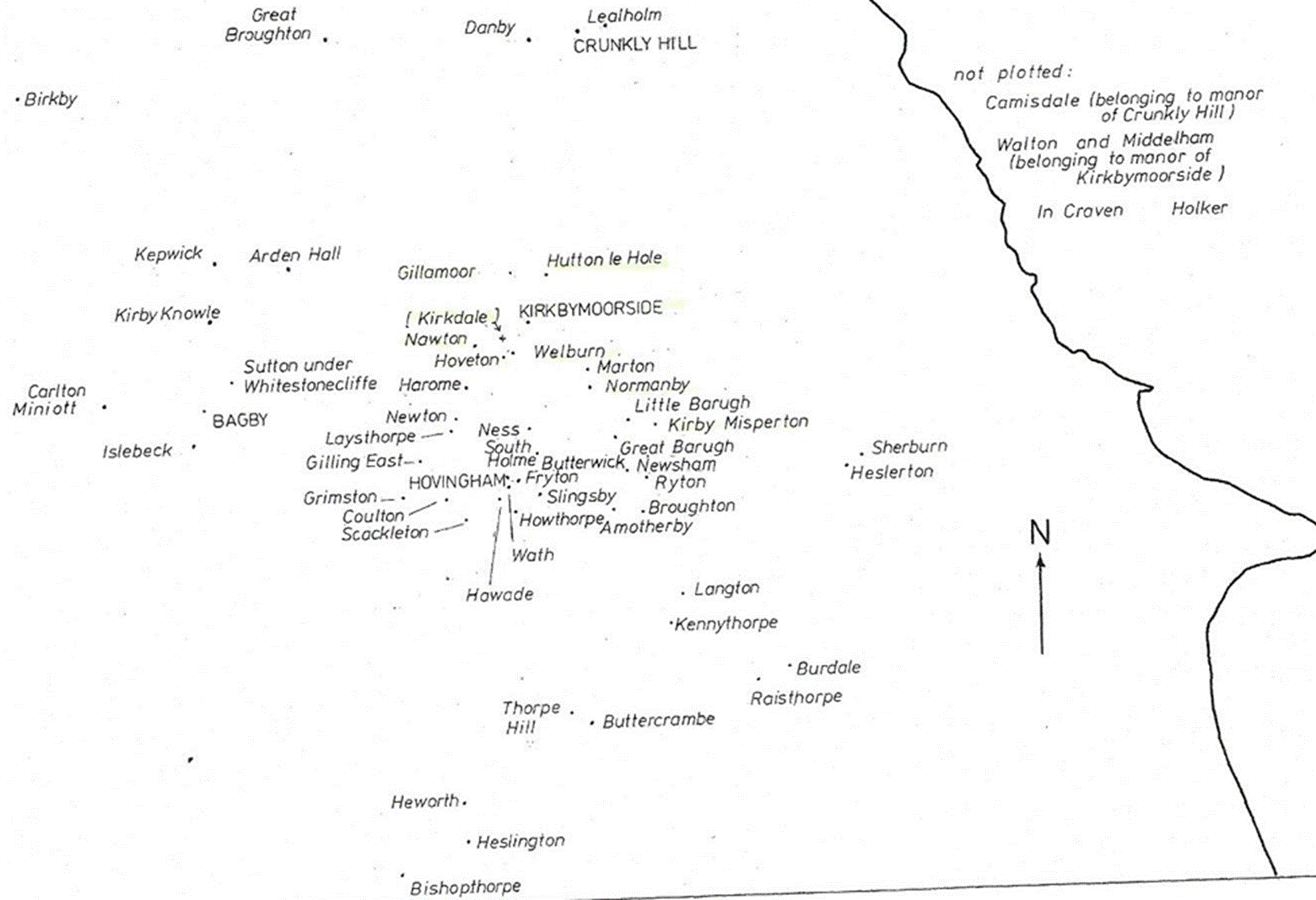
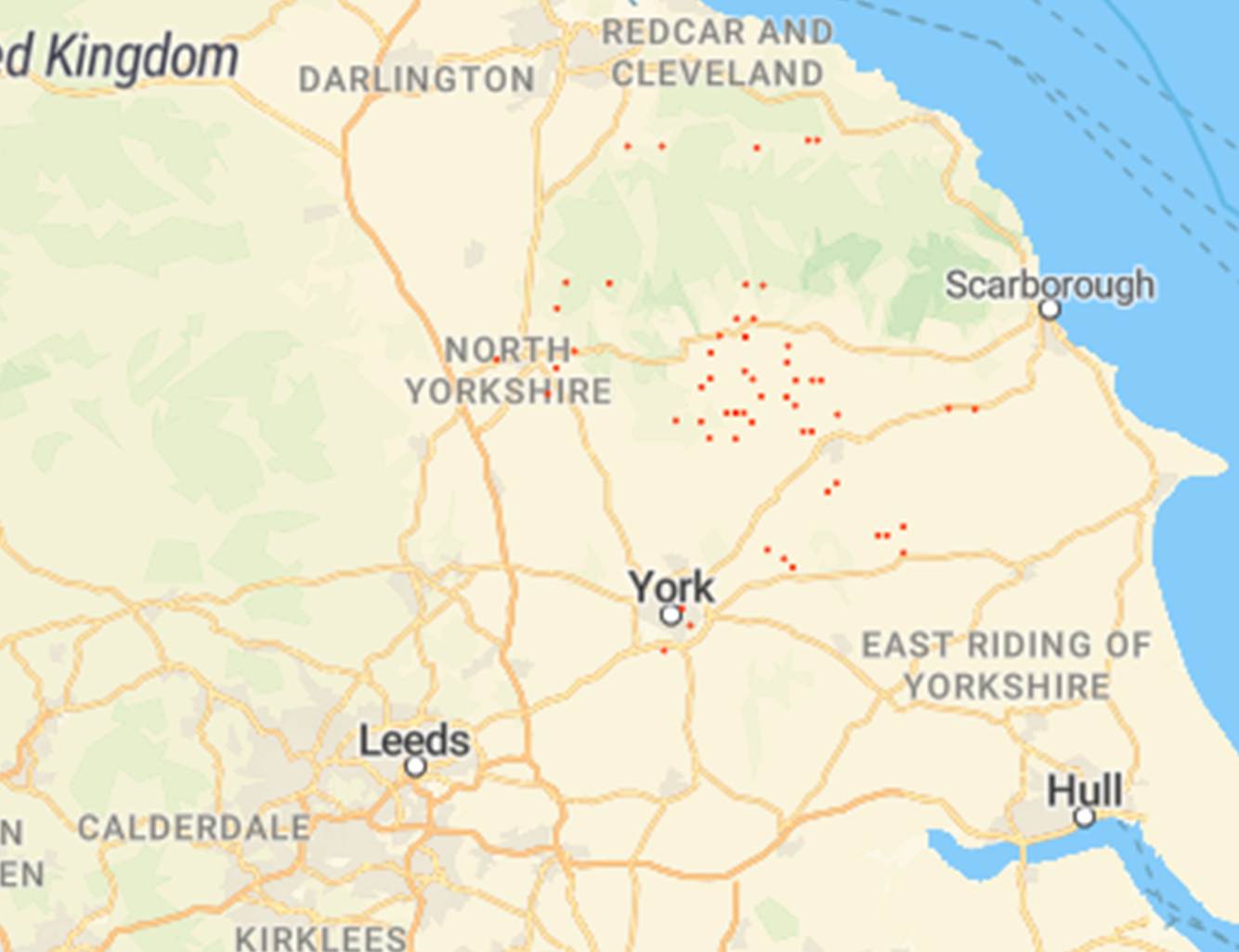
Estates
in Yorkshire held by Orm Gamalson before Hugh Fitz Badric, from the Domesday Book
records
The focus of Orm’s estate was in the Hundred of Maneshou and
included the settlements of Armundrebi (Amotherby);
Broftone (Broughton); Coltune (Coulton); Nesse
(East and
West Ness); Neutone (East Newton); Frideton (Fryton); Gedlinghesmore (Gillamoor);
Berch (Great Barugh); Grimeston (Grimston); Harem (Harome);
Haruade (Hawade); Houetune (Hoveton
- Kirkdale); Hovineham (Hovingham); Hortcorp (Howthorpe Farm);
Hotun (Hutton le Hole);
Chirchebi (Kirkbymoorside);
Lechestorp (Laysthorpe Lodge
or Leysthorpe); Berch (Little Barugh);
Martone (Marton); Middelha; Misperton (Kirby Misperton);
Nagletune (Nawton); Neuhune (Newsham); Normanebi (Normanby); Ritone (Ryton); Slingelbi (Slingsby); Holme
(South Holme);
Walerum (Walton); Wad;
and Wellebrune (Welburn).
The settlements in brown are
those listed in the Domesday Book as forming part of the estate of Chirchebi
(Kirkbymoorside). These locations can be located on Map 1.
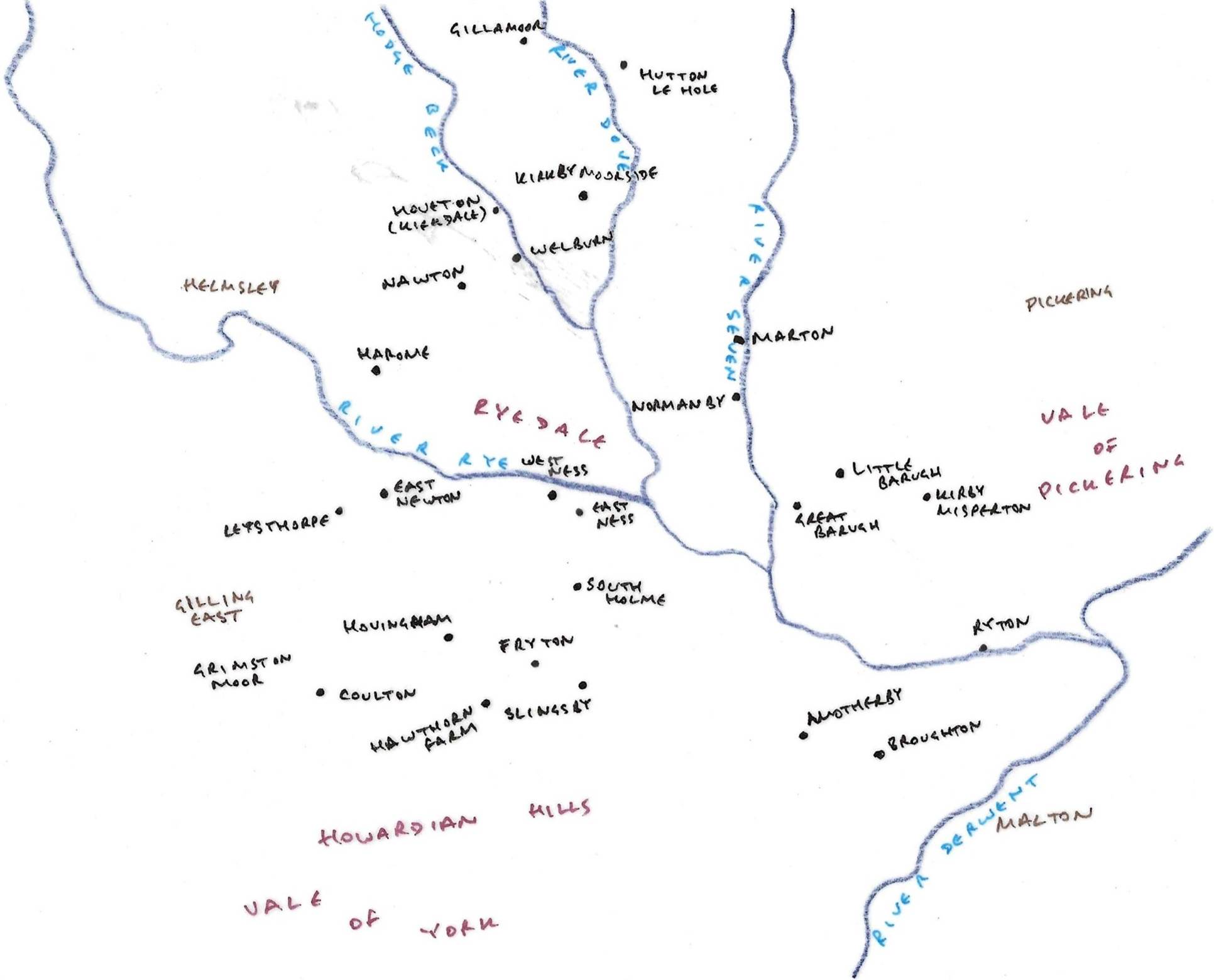
Map 1 - The
settlements (in black ink) belonging to Orm Gamalson in the Hundred
of Maneshou immediately prior to the Norman Conquest
Orm held lands more widely across this
part of Yorkshire.
In the Hundred
of Burton, south of Kirkbymoorside Orm held the settlement of Butruic (Butterwick).
In the Hundred
of Langbaurgh to the north of the North York Moors, Orm held lands which
included the settlements of Camisedale;
Crubcelive (Crunkly Gill);
Danebi (Danby); Broctun (Great Broughton);
and Lelun (Lealholm).
In Hundred
of Yarlestre to the east of modern Thirsk, Orm
held lands which included the settlements of Ardene (Arden Hall); Baghebi (Bagby); Carleton
(Carlton Husthwaite, which I think is more likely to have been the relevant
location than Carlton
Miniott); Iselbec (Islebeck Grange);
Chirchebi (Kirby
Knowle); and Sudtune (Sutton
under Whitestonecliffe).
In the Hundred
of Allerton, north of Thirsk, he held lands which included Kepwick.
In the Hundred
of Scard to the south of Malton, he held lands
at Breddale (Burdale); Cheretorp (Kennythorpe);
and Lanton (Langton).
In the Hundred
of Toreshou to the northeast of Malton, Orm held the settlements of Esrelton (East Heslerton); and Scirefburne
(Sherburn).
In the Hundreds of Bulford and Warter,
between York and Malton, he held land in Haslinton
(Heslington);
Bittecrame (Buttercrambe);
Scacheldene (Scackleton);
and Torp (Thorpe Hill).
In the Hundred
of Acklam to the south of Malton and east of York, Orm held lands in Fridarthorp (Fridaythorpe);
Redrethorp (Raisthorpe);
Scradiztorp; and Syctedale
(Thixendale).
In York, Orm held the area of Heuuarde (Heworth). He lived
there.
In the Hundred
of Ainsty to the south of York, he held the settlement of Badecorpel
(Bishopthorpe).
In the Hundred
of Craven (around Bolton Abbey) near Skipton, he held lands in Brecebi (Birkby Hall) and Holecher (Holker).
It is therefore possible to map out
the wider extent of Orm’s holdings, and this might be a clue to the pattern of
settlement and relationships between settlements in the wider area before the
Norman Conquest.
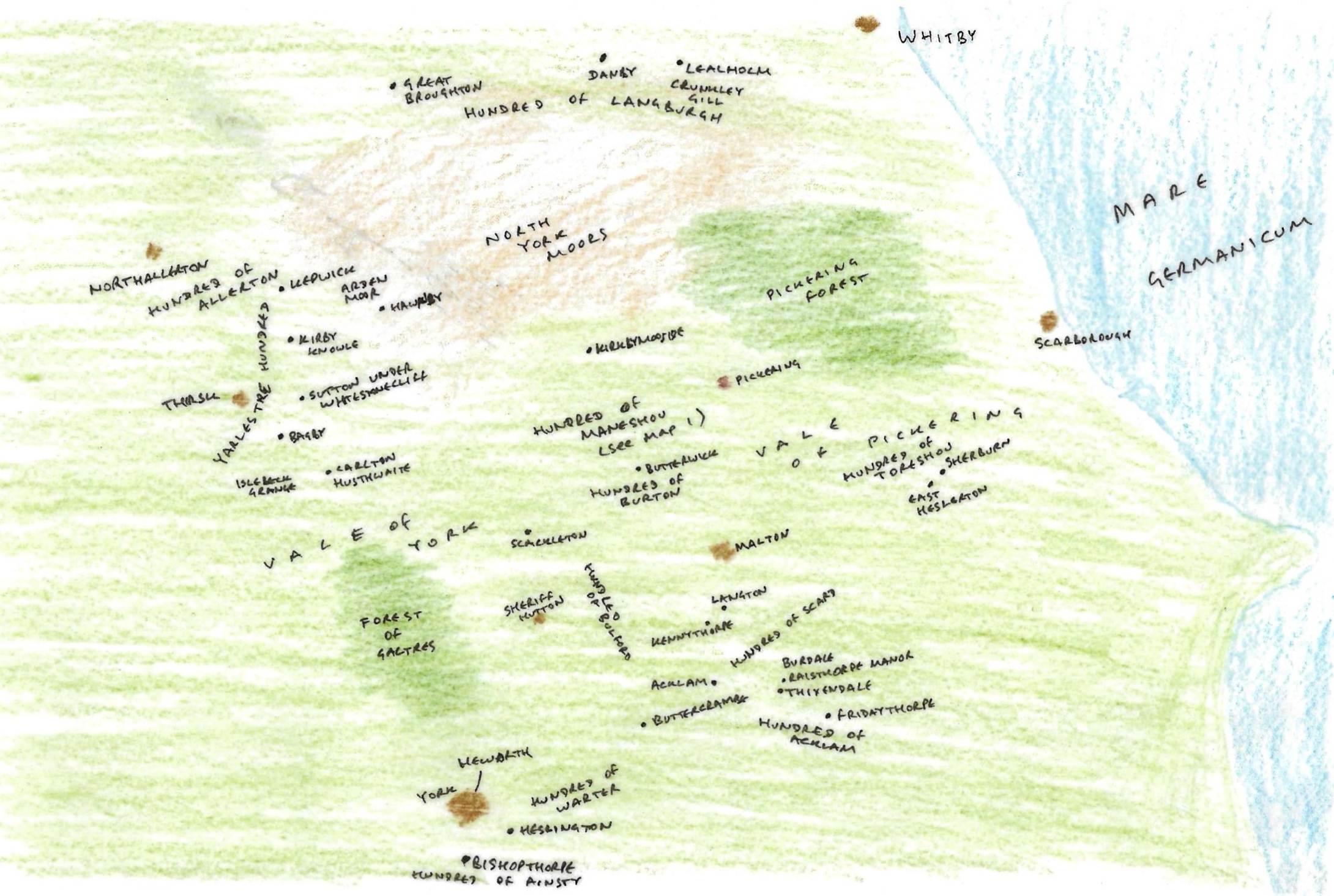
Map 2 – The
Extent of Orm Gamalson’s Holdings immediately before
the Norman Conquest, c 1060
A political force
York was a centre for Tostig Godwinson (1029 to
1066)’s later career, a member of the major West Saxon house under which his
brother Harold Godwinson had gained his kingship. Tostig’s initial role in
Yorkshire, as Anglo Saxon Earl of Northumbria on the death of Earl Siward in
1055, was to strengthen the king’s influence in this unruly land.
Tostig was
the third son of the Anglo-Saxon nobleman Godwin, Earl of Wessex and Gytha Thorkelsdóttir, the daughter of Danish chieftain Thorgil Sprakling. So he had parental associations with
both Godwins and Scandinavians.
Tostig was
banished in 1065 for a variety of crimes, including the murder of Orm's son,
Gamal Ormson in 1063, probably part of the ongoing multigenerational feud.
However he returned with Harold Hardrada, King of Norway, in the following
year. The Norwegian army fought against Tostig's brother, Harold Godwinson,
King of England, at Stamford Bridge, and there both Tostig and his Norwegian
ally were killed. After the battle Harold Godwinson carried out his famous
forced march to Hastings, where he was killed in battle by the Norman army of
William the Conqueror.
Orm Gamalson
was clearly a substantial figure, and the place he chose to articulate his
power was Kirkdale.
Kirkdale
clearly had political significance in this historical episode.
1055
Kirkdale
Church is an Anglo-Saxon church in Kirkdale, near Kirkbymoorside.
It is dedicated
to St. Gregory, who was pope from 590 to 604 CE. A church has occupied this
site since about 750 CE or perhaps even earlier and continues in use to the
present day.
Archaeologically,
the site is an Anglo-Saxon treasure, containing crosses, grave covers in the
nave, and sculptural fragments, which date to circa 750 CE.
By the 11th
century the original church had fallen into ruin. Between 1055 and 1065, it was
rebuilt by Orm, son of Gamal, on the site of the earlier church. The date of
the church's reconstruction is known, as it occurred during the reign of
Tostig, Earl of Northumberland (1055 to 1065), as inscribed on the Anglo-Saxon
inscription now above the door of the church. Known as the Anglo-Saxon Sundial,
this High Middle Ages canonical horologe placed above Kirkdale's
church doors is flanked by two additional panels, containing a rare Anglo-Saxon
inscription in Old English. Discovered during a 1771 renovation, the sundial
memorializes Orm's rebuilding of the dilapidated church.
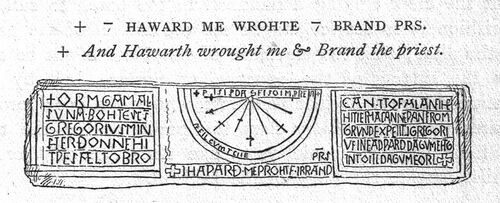
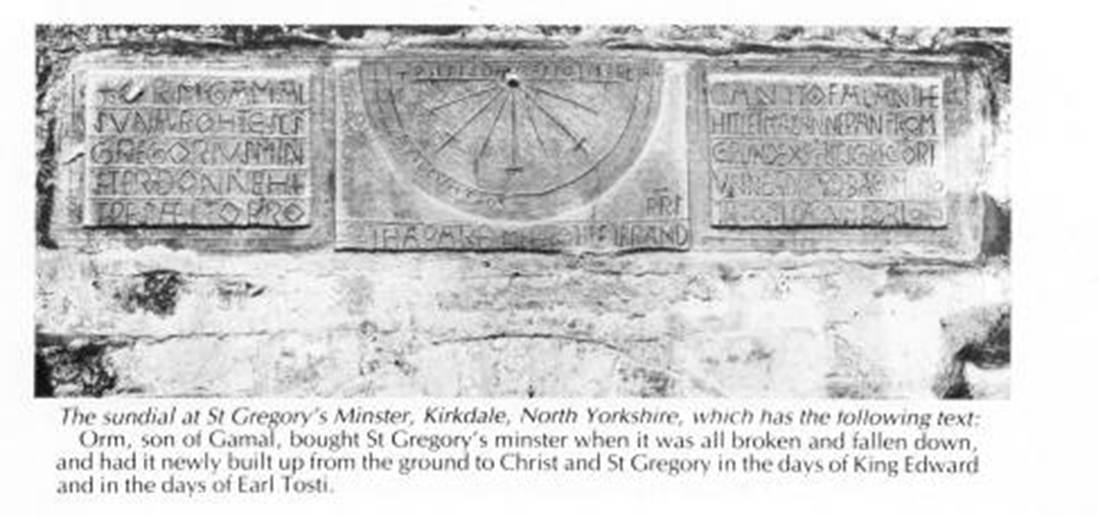
Orm Gamalson bought
St Gregorius minster when it was all to-broken and to-fallen: he it let make
new from the ground, to Christ and S. Gregorius in Edward's days the King and
Tostig's days the Earl. This is day's Sun marker at every tide. And Haworth me
wrought and Brand, priests.
It was during
Tostig's cruel earldom that he had Gamal, son of Orm, assassinated in his
chamber at York over Christmas 1064, so it seems unlikely that Orm would have
included Tostig's name in the inscription following his son's death at the
hands of this murderous earl. It seems possible, therefore, that the church may
have been rebuilt between the years 1055 and late 1064.
1086
Following the
Norman Conquest of England, Orm's landholdings were confiscated and given to
Norman noble, Hugh FitzBaldric. As a result, Orm was among those who were
dispossessed by the Normans and driven northward to the region of
Northumberland, where his name vanished from the historical records of his
time.
Sources have not
been located that reference any facts related to the death of Orm Gamalson.
What is known, is that he died at some date after the earliest potential period
of reconstruction of Kirkdale Church in 1055, and most likely after the Norman
Conquest.