Gilbert de Farndale
c 1235 to c 1300
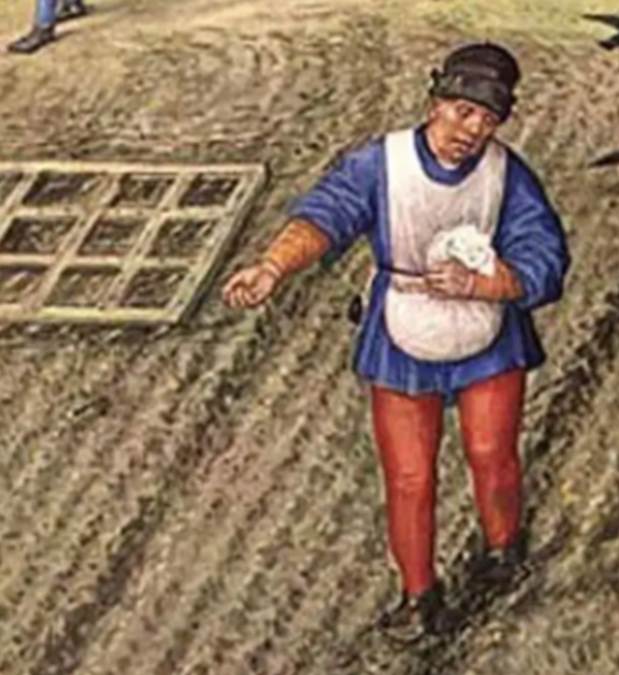
The Medieval
Inhabitants of Farndale
FAR00018
|
Return to the Home
Page of the Farndale Family Website |
The story of one
family’s journey through two thousand years of British History |
The 83 family lines
into which the family is divided. Meet the whole family and how the wider
family is related |
Members of the
historical family ordered by date of birth |
Links to other pages
with historical research and related material |
The story of the
Bakers of Highfields, the Chapmans, and other related families |
Dates are in red.
Hyperlinks to
other pages are in dark
blue.
Headlines are in brown.
References and
citations are in turquoise.
Context and local
history are in purple.
c 1220s
(before Gilbert was born)
Farndale was
first cleared for agriculture from perhaps about 1220 (FAR00004A). So although we
don’t know about Gilbert’s parents, it might be supposed that they were the
hard grafters who first broke up the forest in the dale and started farming. As
Farndale was an extension of the existing estate of Kirkbymoorside, Gilbert’s
grandparents and his ancestors before them, were likely to have come from the
land at the northern edge of the Vale of York, perhaps in the ancient
agricultural lands around Kirkdale. These lands were part of the same
landholdings and estate as Farndale.
1235
Given
the likely age of Gilbert’s son, Roger, Gilbert might have been
born in about 1235. If so, then Gilbert is the oldest Farndale who
we know about from the written record.
1254
Gilbert
might have married in about 1254.
Roger de Farndale (FAR00013A) may
have been born in about 1255, since by 1293 he was involved in a poaching
incident.
By 1276, at the time of the death of Joan Stuteville, about 545
acres of Farndale was under cultivation (see FAR00017). The bonded tenants paid a standard rent of 1s per acre. By that
time there were seven cottars in Farndale and further occupation at Duthenwayt, probably in the area of the Duffin Stone today,
up the western side of the dale. Gilbert was likely to have been part of a community of villeins,
tilling the land, and paying high rents to the Stuteville landowners.
By 1282, on the death of Joan’s son, Baldwin Wake, the cultivated
acreage in Farndale had risen to 768 acres in only six years (FAR000020). There were 90 bondmen by this time in Farndale. This must have
represented a planned campaign of settlement and activity in the
dale must have been noisy and constant at this time. It seems likely that
Gilbert was one of the many folk who tilled the land, and was possibly a tenant
farmer, paying significant rent to the Stuteville landlords.
1300
There is no mention of any person called Gilbert in Farndale in
the 1301 Lay Subsidy (FAR00029). Perhaps he had died by then, and later references to his sons
were by reference to a deceased person. He may have been in his mid sixties by the turn of the century. It is possible that
he had moved out of Farndale and lived a little after 1301. There was for
instance a De Gilberto filio Liolphi
who paid 3s 2d in tax in Egton, though I suspect this was someone else.
3
October 1334
A
hearing of the itinerant Eyre Court (FAR00015B), picking up cases from several decades
previously, took place at Pickering on 3 October 1334 before
Justices Richard Willoughby and John de Hambury (The Duchy of
Lancaster Records, from the North Riding Record Society, The Honour and
Forest of Pickering, Edited by Robert Bell Turton, Volume IV, 1897, page
xiii).
Under medieval forest law, mainpernors were individuals who acted as guarantors for others, ensuring
they appeared in court to answer for alleged offenses against forest law. These
offenses primarily involved the king's hunting rights and the protection of
forest resources like timber and vegetation. Mainpernors
essentially vouched for the accused's future appearance in court, preventing
them from fleeing justice within the forest jurisdiction.
At that
hearing, as mainpernor (guarantor) for John, son of Albe, indicted for hunting, Roger (FAR00013A), son of Gilbert Farndale (FAR00018) was
fined 20d because John did not turn up (The
Great Cowcher of the Duchy of Lancaster, The National Archives, DL42/1 Folio
336).
Yet at the
same time, Nicholas of Farndale (FAR00022),
gave bail for Roger (FAR00013A) son of Gilbert of Farndale (FAR00018) who had been
caught poaching in 1334 and 1335. (North Riding Records
Yorks Volume III, The Honour and Forest of
Pickering)
A number of individuals from Farndale were fined following prior
indictments for poaching in 1334 and not turning up at the Eyre. They paid bail
or had bail paid for them (North Riding Records, Volume IV by the North
Yorkshire Record Society, the Honour and Forest of Pickering, 1897, page 23, 28, and 34 not on line
but I have a physical copy).
|
Date of Hearing |
Notional date of Offence |
Payer |
Guarantor (malpernor) |
Poacher |
Amount of Fine |
|
3 October 1334 |
c 1315 |
Nicholas de Repyngale |
John son
of Abbas (ADA00003) |
1s 8d |
|
|
3 October 1334 |
c 1316 |
Roger (FAR00013A) son of Gilbert
of Farndale |
Thomas Makaunt |
Thomas Makaunt |
1s |
There are further details
of these offences at another webpage.
Nicholas of Farndale
(FAR00022),
gave bail for Roger (FAR00013A) son of Gilbert of Farndale (FAR00018) who had been
caught poaching in 1334 and 1335. Robert (FAR00031) son of Simon the miller of Farndale (FAR00021) and Robert (FAR00012),
son of Peter of Farndale (FAR00008)
were co-offenders.
See details and
research notes.
There is a separate page about poaching in Pickering Forest.