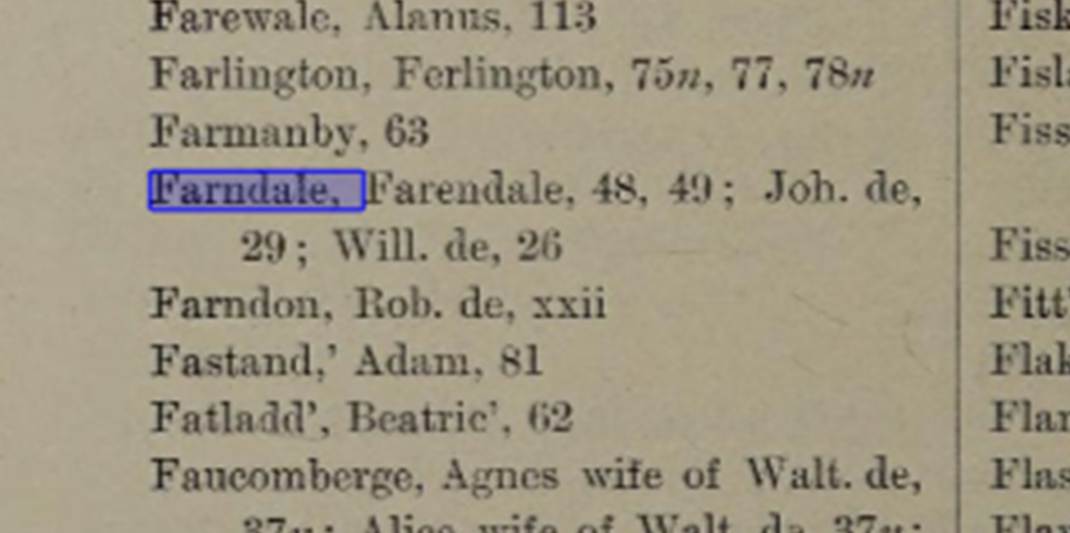
1301 (for Farndale, Egton and Danby), 1327
and 1333 (both for Cropton de Arthoft in Rosedale and
Kirkbymoorside)
A comprehensive record of the inhabitants of Farndale in
1301 from the Yorkshire Lay Subsidy of that year and
further evidence for the movement of folk from Farndale in 1301, 1327 and 1333
FAR00029
|
Return to the Home
Page of the Farndale Family Website |
The story of one
family’s journey through two thousand years of British History |
The 83 family lines
into which the family is divided. Meet the whole family and how the wider
family is related |
Members of the
historical family ordered by date of birth |
Links to other pages
with historical research and related material |
The story of the
Bakers of Highfields, the Chapmans, and other related families |
Dates are in red.
Hyperlinks to
other pages are in dark
blue.
Headlines are in brown.
References and
citations are in turquoise.
Context and local
history are in purple.
Medieval Taxation
Between 1250 and
1500, England's lay subsidies and taxes included the Lay Subsidies (1275-1550),
Tenths and Fifteenths (1334-1623), and Poll Taxes (1377-1381).
The Lay
Subsidy was initially levied on individuals based on the value of their
movable goods and land. After 1334, it became a fixed sum charged collectively
on each township. Tudor governments revived and reformed the Lay Subsidy in the
16th century, with detailed assessments of individuals' wealth. They were
imposed in England in 1275, 1290, 1294, 1301, 1306, 1307, 1313, 1316, 1319,
1322, 1327, 1332, 1334, 1371, 1377, 1378-80 (poll tax), 1404, 1411, 1435,
1439-1487 (levies on aliens), 1449, and the revised Tudor version between
1512-1515, though records don’t survive for Yorkshire for all of these.
The Tenths and
Fifteenths were a form of property tax, often granted to the Crown by Parliament.
They were a fixed sum charged on each town, and the records mainly show the
total amount collected from each area. Whilst it's impossible to list every
single instance due to the large number and complexity of these taxes, some key
years and periods where these were imposed include: during the reign of Edward
I (1272-1307) for his Scottish wars, and in the 14th century for the Hundred
Years' War. Specific dates are difficult to pinpoint without detailed
parliamentary records.
The Poll Taxes
were a per capita tax on individuals, levied on individuals based on their
ability to pay, and were collected three times between 1377 and 1381. The 1377
tax was a flat rate, while the 1379 and 1381 taxes were graded by social class.
These records are valuable for genealogists as they often include names and
relationships of taxpayers.
Those records
which survive for Yorkshire include:
· A Fifteenth
levied in 1225 is the earliest surviving record of a Lay Subsidy in Yorkshire.
I understand there are surviving records of the East Riding of Yorkshire.
·
In 1297 a Lay Subsidy based on a ninth of moveable property value
was imposed. I understand there are only surviving records of the West and
East Riding of Yorkshire.
· In 1301 a Lay
Subsidy based on a fifteenth of moveable property value was imposed. This is
the most valuable record for Yorkshire and is generally referred to as the
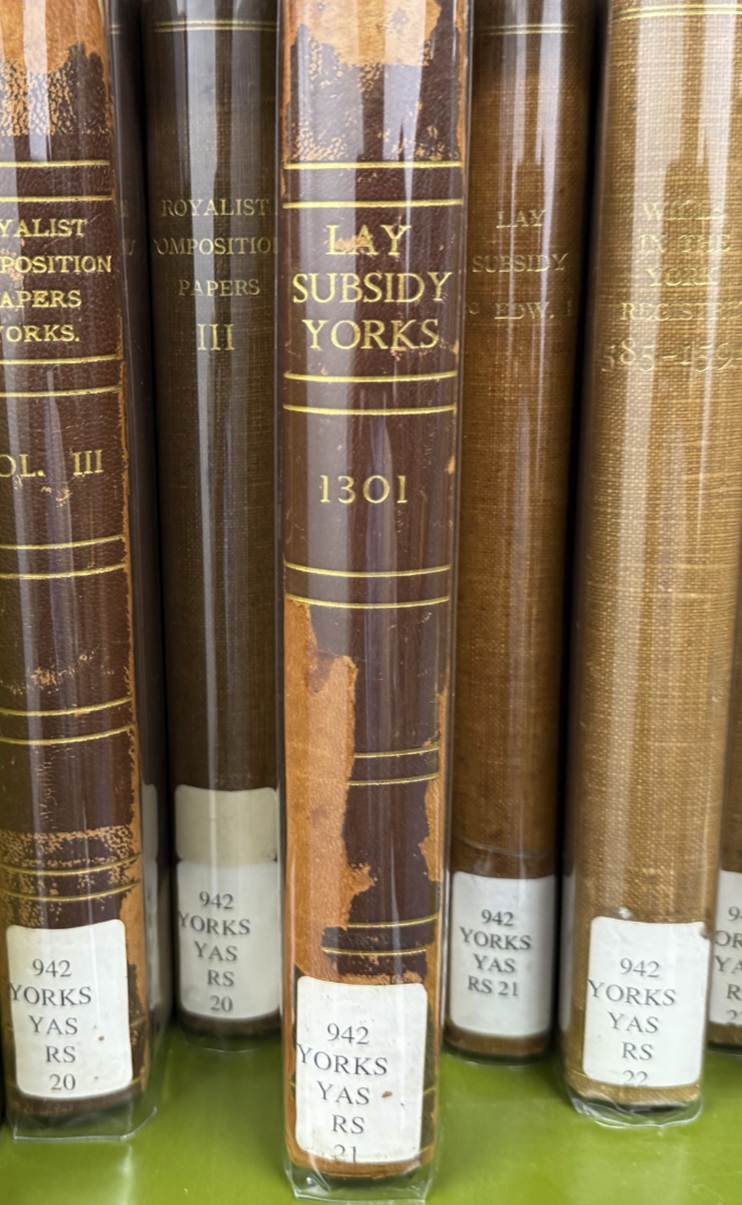
Yorkshire Subsidy. The whole subsidy is reproduced in the Yorkshire Archaeological Society Record Series Volume 21,
1897, ed William Brown.
· The Lay Subsidies
of 1327 and 1333, reproduced in The North Riding Record Series, Volume IV, 1897 from page
131 and 137 (now out of print, but I have a
hard copy).
· The 1379 Poll tax
imposed in Yorkshire.
The National
Archives’ series Exchequer: King's Remembrancer
series E 179 contains detailed
records of lay taxation from approximately 1190 to 1690.
Where a tax was
imposed as a ninth, tenth or fifteenth, the taxable sum can be multiplied by
that number to estimate the individual’s wealth in moveable property. Although
this does not provide a total wealth including heritable property, the
individuals in which we are interested in this research were tenants. As a
guidance to value, the National Archive’s Currency
Convertor is a useful tool to understand how a
person’s wealth in moveable property might translate to today’s value.
It is useful to
remember:
20 shillings = £1
12 pennies = 1
shilling
The medieval
records use both i and j to signify 1,
the j being used when it is the last digit. In the context of a Lay Subsidy
roll from the Middle Ages, the letter j was used as a final i to indicate the end of a Roman numeral. For
example, xviij would be 18 (xviii), and
vj would be 6 (vi). This was done to
avoid confusion when writing numbers, especially when the final i could be mistaken for part of another number.
There
are certainly several documents which can give an excellent picture of
settlement in the fourteenth century. The Poll Tax of 1377 is useful,
especially for its details about town populations, but the North Riding section
of it has been less well preserved than the West Riding. A series of Lay
Subsidies beginning in 1297 and recurring in 1301, 1327, 1334 hold out more
hope. Unfortunately that of 1297 is complete for the East Riding only, and
those of 1327 and 1334 while being comprehensive are rather late for the
purpose and so is Nomina Villarum (1316). Besides,
none of these give full details of the temporal possessions of the monasteries
(This is the disadvantage of Kirkby’s Inquest (c.1284) which is otherwise very
valuable. It does not record, for example, the settlements that Rievaulx and Guisborough
had outside the settled areas.) There remains the Lay Subsidy of 1301. It is
certainly comprehensive enough for the North Riding because in spite of its
title it covers the possessions of the monasteries and so includes granges and
lands which they had inside and outside settled areas. The Subsidy has several
uses too: it gives a clear picture of monastic and lay settlement in 1301; it
shows which areas were the most prosperous because it indicates 1/15 of the
value of moveable goods (i.e. cattle, corn, etc.); and because it lists the lay
contributors for each vill it affords some idea of
the distribution of population in 1301. The most interesting deduction it
allows, however, is the relative importance of monastic settlement in the area,
and the extent to which settlement had expanded or contracted since Domesday. (Monastic
Grange as a factor in the settlement of North East Yorkshire, Bryan Waites,
Yorkshire Archaeological Journal, Volume 40, 1962, page 647).
The 1301 Lay Subsidy for
Yorkshire
Introduction
In 1301 Edward I,
Longshanks, had subdued rebellion in Wales and built castles at great expense
to exercise his control there. He turned his attention to Scotland and required
funds to pay for his campaigns. Among his enemies were the direct descendants of
the Yorkshire de Brus family of Skelton Castle, destined to take the Scottish
throne in 1306.
In 1301 he
therefore imposed a Lay Subsidy valued at one fifteenth of the value of every
person’s moveable possessions. The Yorkshire Lay Subsidy (Yorkshire Lay Subsidy 1301, Yorkshire Archaeological Society Record Series Volume 21,
1897, ed William Brown) provides a remarkable record of the settlement pattern and the
names of individuals and their occupations and locations at the turn of the
fourteenth century.
At the Parliament held at Lincoln in 1301,
with the King, Edward I in attendance, a lay subsidy was authorised. This was a
tax on the whole population which was to be based on a fifteenth part (ie 6.67%) of each person's movable possessions. Edward I,
also known as "Longshanks" had subdued Welsh rebellions and at great
expense build expensive castles to maintain control there. He was now in the
process of attempting the same in Scotland and needed funds to pay for his
campaigns. Among his foes over the border were the direct descendants of the De
Brus family of Skelton Castle, destined to take the throne in 1307.
Just four years previously the people had been
taxed on a ninth part of their movable assets.
The taxmen appointed for the North Riding of
Yorkshire were Alexander de Cave and Robert Gower. What must have been an
enormous administrative task was completed in a year or so and they collected
£1,668 13s. 9d. Nationally around fifty thousand pounds was added to the King's
coffers.
The Yorkshire Lay Subsidy was imposed in the
regnal year 30 Edward I, ie 1301. There is further
description of this particular 1301
lay subsidy. There is also
an explanation
of the purpose of the lay subsidies in general.
The record for
Farndale (Yorkshire Lay Subsidy 1301, Yorkshire Archaeological Society Record Series Volume 21,
1897, ed William Brown, page 48, see also British History
online) listed 39 individuals and the rent
they paid. The Subsidy also recorded some of the places within the dale where
they lived.
There was a
family at Wakelevedy, which is likely to be the
location of Wake Lady Green on the East Daleside
Road. Another lived at Monkegate (Originally the name
of the track up onto Rudland Rigg, Monckgate
suggests an association with monks, but it may drive from mened
cet, ‘forest hill’), where Monket
House provides holiday lets today. There were individuals at Ellescaye, presumably descendants of Adam, likely to be the
location of Eller House on the West Daleside Road
today. Others lived at Westgille, the burn which
flows down from Rudland Rigg into the hamlet of Low Mill. There were others who
had come to the dale from such places as Fadmore and Hoton (probably Hutton-le-Hole).
In 1301 Edward I
levied a tax of one fifteenth of the value of every person's goods, to pay for
his war against the Scots. Collectors were appointed for various parts of the
country, and the returns for the North Riding still exist in their entirety in
the Public Record Office (Yorkshire Archaeological Society Record Series,
Volume 21, page 48). In Farndale, thirty-four men and one woman (a widow)
contributed a total of £3 7s 33d. This may be compared with the £2 3s 83d paid
by 27 inhabitants of Kirkby Moorside (excluding the lord of the manor, John
Wake, who himself paid over two pounds), and the sum of £3 8s 43d. paid by 36
villagers of Helmsley.
That Edward intended the tax to touch even the very poor is shown
by the fact that some of the amounts paid by individuals in the Riding were as
low as 1 ¼ d, meaning that their entire goods were valued at less than
half-a-crown. The lowest amount paid by a Farndale farmer was 3d, and the
highest 7s 9d (by Simon the Miller). Several others paid between three and five
shillings, indicating that their total worldly possessions varied in value
between 45s and 75s. These figures assume greater significance if set against
the value of certain goods at the same period. A short list of some of the
common articles and animals includes:- a cow 5s; a bullock 2s; a cart horse 5s;
a sheep 12 pence; one pound of wool 3s; one quarter of wheat 3s; one quarter of
barley 3s; "two little pigs'' 12d each; a bed 4s; a robe 10s; "a poor
robe" 4s; a brass pot 20d, a clasp of silver 18d.
A villein who paid four shillings tax might, therefore, have
possessed all these things at the time of the levy and some other items
besides. On the other hand a man such as William de Monkegate
(surely the same place as the present day Monket
House), who paid only 34d, could have had few material possessions. Certainly
the fact emerges from even a cursory glance at the Collectors' Returns for
Farndale, that there was quite a range in wealth amongst the inhabitants of the
dale.
This same document is interesting for the names of the tenants it
contains and the likeness of some of these names to those of farms still
occupied in the dale. We have already mentioned William de Monkegate
in this connection. William Wakelevedy might well, one supposes, have lived at
the cottage now known as Wake Lady Green, and Walter de Ellerscaye bore a name
suspiciously like that of the present Ellers House. William de Almeheved (Holm Head in 1782, Elm House to-day) is another
suggestive name, whilst Ralph and William de Westgille, John de Brannordale,
Godfrey de Hoton and William de Fademore quite
clearly proclaim their place of origin.
That there were other tenants in Farndale who for some reason or
other escaped paying Edward's levy (they can hardly have been poorer, surely,
than the persons who paid only threepence) is shown by the appearance of their
names in the lists of those found guilty of forest trespass in the royal forest
of Pickering (North Riding Record Society Volume 2, pages 66,96, 110 to 111,
115, 119), in July 1323, Adam son of Simon the Miller was fined 25s 8d for
taking two hinds. In September 1332, Robert son of Simon of Farndale (whether
the unfortunate miller or not is not stated), in company with four others
"hunted a hart and carried it off''. Robert's
four companions were fined, he himself being outlawed. On another occasion four
Farndale men - Roger del Mulne, Robert son of Peter, Walter Blakhous
and Ralph de Heved - suffered outlawry because ''on a
Monday in January (they) killed a soar and slew a
hart with bows and arrows''. Ralph de Heved is in all
probability the same person as the Ralph de Capite of
the 1301 Lay Subsidy levy. Amongst those people who had been arrested for
poaching but had been let out on bail to appear at the next assizes ''but
neither appeared nor excused themselves as the custom is" were Richard son
of John the Miller of Farndale and Adam son of Simon the Miller of Farndale,
John son of Richard of Westgill and his brother
Robert. In 1336 John, the son of the Farndale blacksmith (Willelmus Fabri) was
outlawed for his part in taking a hind and a calf in the forest.
The imperfect nature of medieval justice is illustrated by the
fact that Lady Blanche Wake, whose tenants all these men were, was also
convicted in 1335 taking a soar and two hinds and
carrying them off for her own use. "Afterward" continues the
document, ''the Earl (i.e. the Earl of Lancaster) directed his Justices to stay
all further proceedings against the Lady Blanche, wherefore they stayed
proceedings".
(Notes on the History of Farndale
in the Middle Ages, Arthur H Whitaker,
Ryedale Historian, Volume 1, 1965, page 12).
A tax levied on 'moveable goods', excluding certain lordly assets but
including the working stock of farmers as well as household goods, which were
few enough, was levied in 1301. Monastic institutions paid as well as people.
In Ryedale, excluding the ecclesiastical liberties that ran into it, only 28
bodies paid over 15s. Only 17 paid between 10s and 15s. The rest formed a clear
pyramid:
0 to 1s – 241
1 to 2s - 153
2 to 3s - 126
3 to 4s – 77
4 to 5s - 49
5 to 6s - 29
6 to 7s – 11
7 to 8s - 7
8 to 9s - 16
9 to 10s – 6
10 to 11s 10
11 to 12s - 2
12 to 13s – 3
13 to 14s - 1
14 to 15s - 1
Over 15s - 28
Incomes are harder to assess since farmers and cottagers alike might
get much, and some most, of their income from the land, without money
transactions. For those cottagers who worked for others, in the 3rd decade of
the 14th century, 12d a day was paid for cocking or mowing hay, sheep washing
and shearing, collecting bracken for thatch, carrying stones or hay, cutting
ivy or lifting for a thatcher. A woman helper might get 1d. Heavier labouring
brought 2d a day, the reward of bough cutters, and also of some responsible
doorkeepers, watchmen and foresters. Breaking stone in a quarry brought 23d.
For food and wage a messenger had 3d a day.
A clear 3d was paid to skilled men such as the carpenter, thatcher,
mason, or those who rolled and repaired wool. Piece rates included 5d a perch
for remaking a fence and 6d a perch for mending a stone wall.
Higher officials might receive no more in cash but could benefit in
kind. A chief forester at 13d made £2 5s 73d in the year. Yet Roger de Mowbray
paid his Hovingham forester a quarter of wheat every ten weeks, gave him a robe
of the livery of his esquires or 20s at Christmas, and allowed him all trees
blown down with their branches and bark in 1297. In the changed conditions of
1385, Sir William de Ayton allowed his servant Henry of the Wardrobe to take on
the supervision of Hutton Bushel wood. The payment was a valet's robe and 6s 8d
a year and a quarter of wheat every ten weeks. Castle chaplains received £2 3s
but might dine in hall. Sir Baldwin Wake could assess his annual returns from
his Kirkby Moorside interests alone at £154 4s 1d. Sir Matthew Louvaine had £6
16s 63d from a Fryton manor with only 16s 3d coming
from the demesne and the rest from rental.
Cash croppers and craftsmen were dependent on prices of goods sold In
the early 1320's, a woolman on a large scale might
get £6 or £7 for a sack of clean wool but it took many fleeces to fill the
sack. Refuse wool was £4 the sack and 40 sheep carcases would bring 5s 3d, 22
lambskins 2s 7d. The carcase of a dead mare could raise a shilling. Wethers and ewes were 1s 8d each. The tax of a fifteenth
levied in 1301 enables some calculation to be made of how little stock most
people must have had.
The local corn-mix for bread, called maslin, was from 4s 4d to 7s 6d
the quarter but oats were 2s 6d to 3s. Salt was 2s 6d the quarter. Four stone
of hemp brought 2s 8d and a quarter of honey was 3d. Craftsmen's work might
bring the smith 1d for a large nail or the same for nails, shoes and shoeing a
horse. A day's keep for the horse was 4d. In 1326 a man was paid 9d for making
300 small nails. A robe cost 10s, a towel 6d and 9 ells of striped cloth 6s. A
horse's headstall and reins were 3d, and a pair of traces 5d. You could get a
wood chest for 2s 10d, so there was little furniture. A stone of tallow was 1s
5d, a gallon of sulphur 4d, a horsecomb 3d and a
nine-gallon bucket 5d.
(Life in Ryedale in the 14th century, J H Rushton, Ryedale Historian,
Volume 8, 1976, page 19).
The Assessment of Farndale in 1301
The
lowest amount paid by a Farndale farmer was 3d and the highest 7s 9d by Simon the Miller of Farndale (FAR00021).
By comparison at that time a cart horse and a cow each would cost
5s; a sheep 12d; a bullock 2s; a bed 4s; a pound of wool 3s and a poor robe
about 4s.
But they were not abject slaves nor living in poverty. When Edward I
levied a tax for the Scottish wars, it was fixed at 1/15th of every
person’s goods over the value of 2s. In Farndale 34 men and one woman paid £3
7s 3d. This may be compared with the 27 inhabitants of Kirkbymoorside who paid
£2 3s 8d and the £3 8s 4d paid by 36 people in Helmsley. Ther lowest amount
paid by a Farndale farmer was 3d, and the highest 7s 9d by Simon the miller.
William de Monkegate (Monket
House), who paid 3 1/2d had few material possessions.
Names mentioned in this document of 1301 include Walter de Ellerscaye
(present Ellers House), and William de Almeheved
(Holme Head in 1782), Elm House today, Ralph and William de Westgille
(West Gill today). Amongst those fined for cattle straying in the forest in
1311 are William de Walde hus (Wold
House) who paid the large sum of £1 4s for 5 oxen, four cows, and 4 stirks;
William and Robert Stibbing de Farndale (Stepin). Robert Smith (fabri)
ironworker or blacksmith is also mentioned. His son was later outlawed for
talking a hind and calf in the forest; so were the sons of the millers Richard
and Adam. Lady Blanch Wake was also convicted of taking a boar and two hinds
but afterwards continues the document the Earl of Lancaster dropped all
proceedings against her.
(Raymond Hayes, Farndale, 1961,
unpublished, page 33 to 34).
The lay subsidy assessments of 1301 afforded a brief glimpse of the settlement pattern, listing
numerous contributors bearing the names of the farms which is still to be found
at Farndale such as ‘Wakelevedy’ (Wake Lady Green), ‘Westgille’
(West Gill), Monkegate (Monket
House) and ‘Elleshaye (Eller House) and which are
scattered all around the dale. Further confirmation of this pattern is provided
by surveys of 1570 and 1610, both of which give the names of many more extent
farms and allow us to identify others from field names.
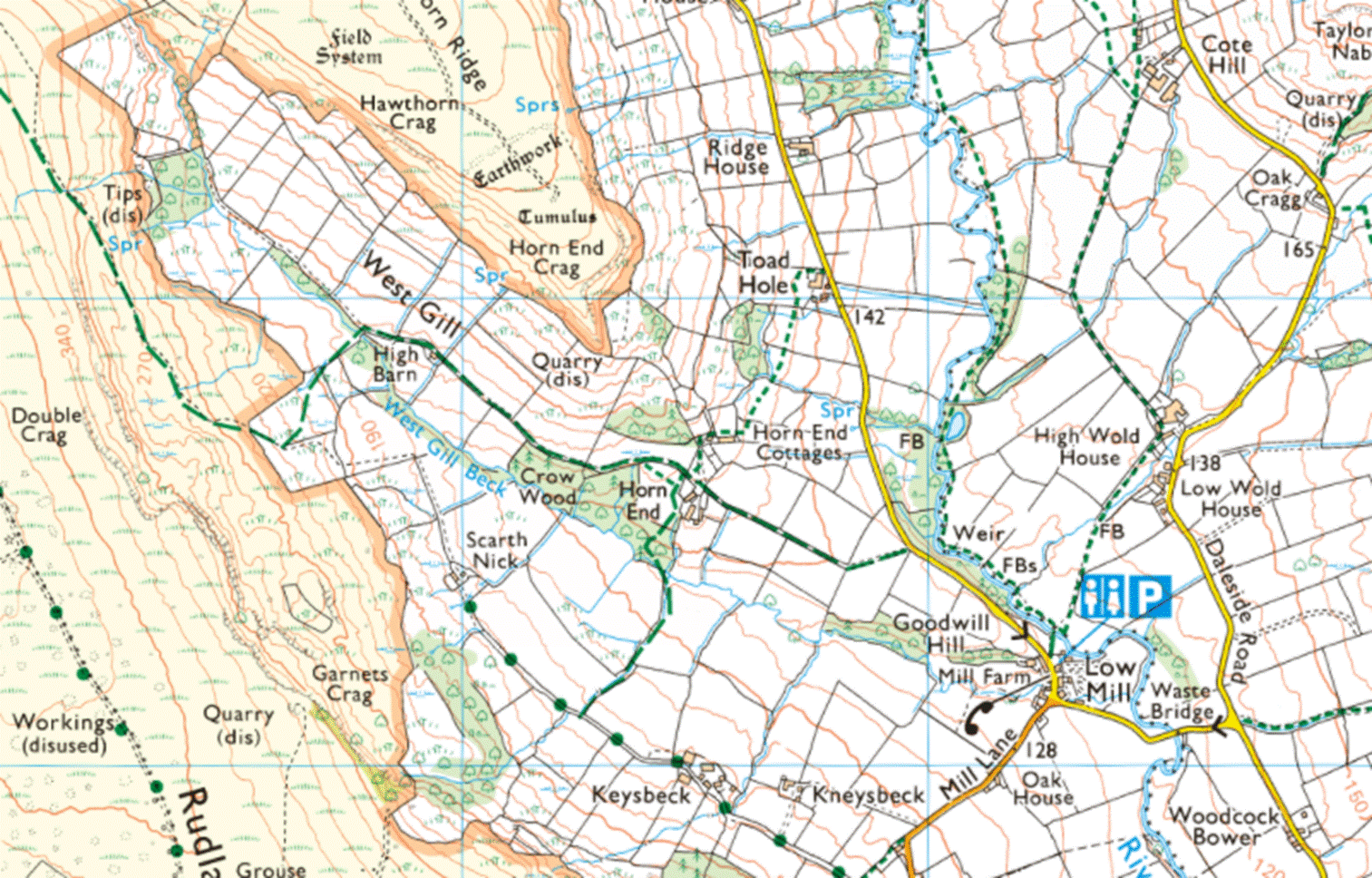
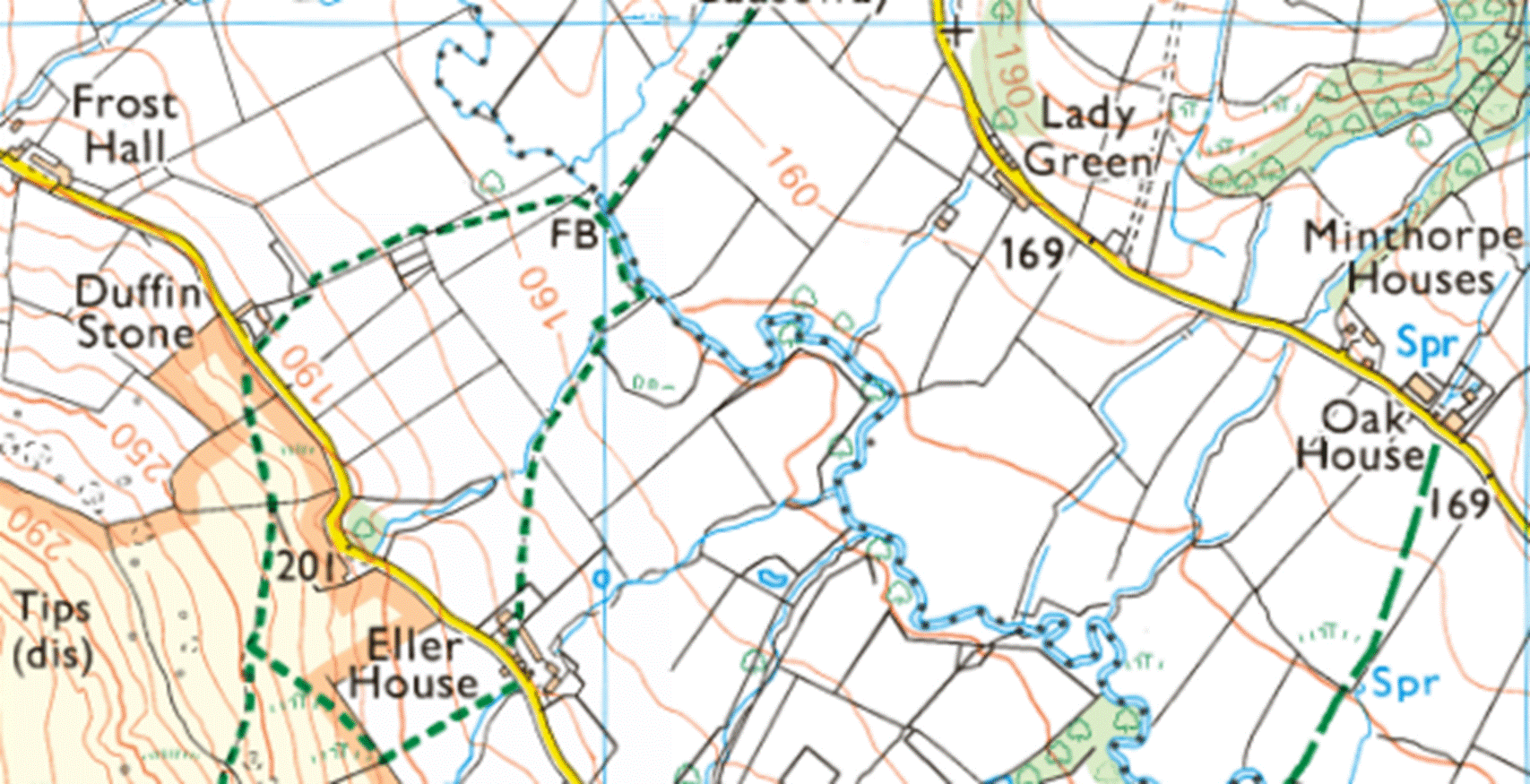
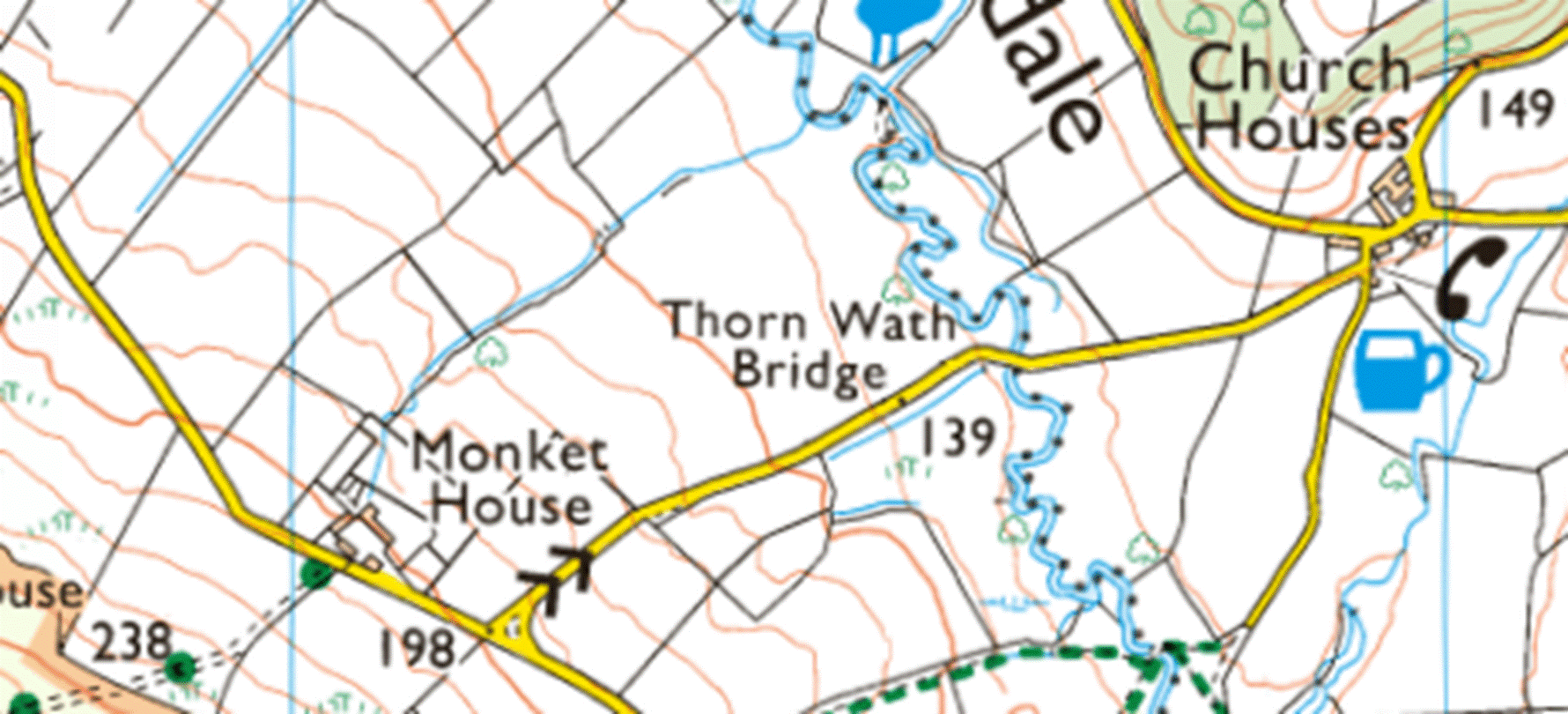
In the fourteenth century, the track
up to Rudland Ridge from Monket House was a route known as Monckgate, which linked Farndale with Bransdale. Monket suggests a
link with monks, but in the absence of monastic associations with the dale it
is more likely to derive from Mened-cet fromn the Welsh Mynydd-coed
meaning forest hill.
(Yorkshire Archaeological Society
Yorkshire Lay Subsidy 30 Ed. I (1301) The Subsidy: Wapentake of Rydale, The
Subsidy: Wapentake of Rydale, Pages 46-56, Yorkshire Lay Subsidy 30 Ed. I (1301))
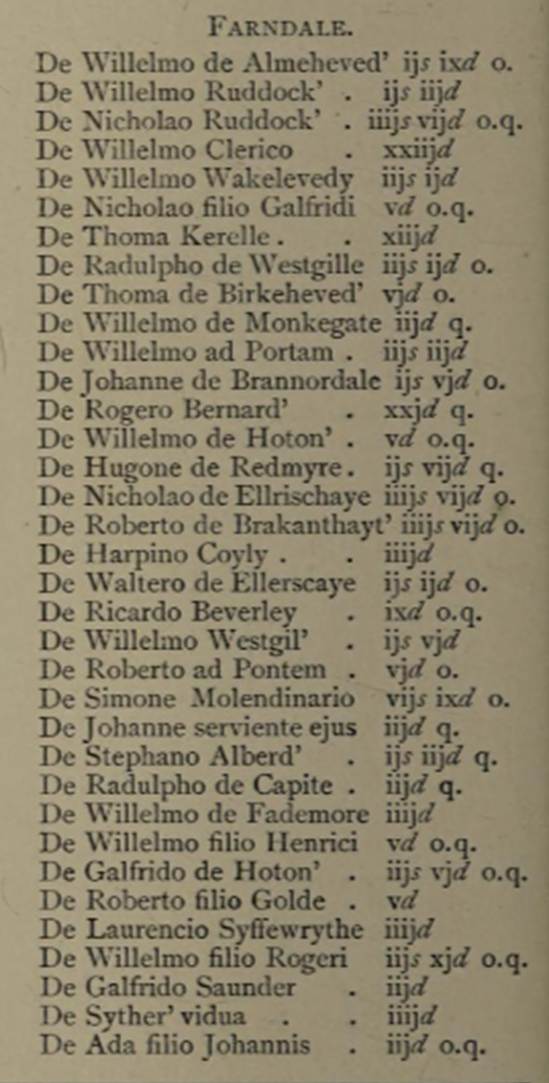
https://archive.org/details/YASRS021/page/48/mode/2up
The tax payers reordered in order of the value of the
tax paid are as follows:
De Simone Molendinario (the
miller) paid 7s 9d and De Johanne serviente ejus (‘his servant’, referring to Simon the miller) paid
3d
Simon
the Miller’s worth in moveable goods was therefore £5 16s 3d. Using the National Archives
Currency Converter, this might be a value of
about £4,200 today or the value of six horses.
De Nicholao Ruddock paid 4s
7d
De Roberto de
Brakanthayt paid 4s 7d
De Nicholao de Ellrischaye paid 4s 7d
De Willelmo filio Rogeri, paid 3s 11d
De Galfrido de Hoton paid 3s 6d
De Willelmo ad Portam (literally, ‘to the
gate’, perhaps living at an important gate or entrance to Farndale) paid 3s 3d
De Willelmo Wakelevedy paid 3s 2d
De Radulpho de Westgille paid 3s 2d
De Johanne de Brannordale paid 2s 6d
De Hugone de Redmyre paid 2s 6d
De Willelmo Westgil paid 2s 6d
De Willelmo de Almeheved paid 2s 9d
De Willelmo Ruddock paid 2s 3d
De Stephano Alberd paid 2s 3d
De Waltero de Ellerscaye paid 2s 2d
De Willelmo Clerico (the
clerk, but perhaps the priest) paid 23d
De Rogero Bernard paid 21d
De Thoma Kerelle paid
13d
De Ricardo Beverley paid 9d
De Thoma de Birkeheved paid 6d
De Roberto ad Pontem
(literally, ‘to the bridge’, perhaps living at the bridge) paid 6d
De Nicholao filio Galfridi paid 5d
De Roberto filio Golde paid
5d
De Willelmo de Hoton paid 5d
De Willelmo filio Henrici paid 5d
De Harpino Coyly paid 4d
De Laurencio Syffewrythe
(Latin for ‘suffocation’) paid 4d
De Syther' vidua paid 4d
De Willelmo de Monkegate paid 3d
De Radulpho de Capite (literally ‘from the head’) paid 3d
De Willelmo de Fademore paid 3d
De Galfrido Saunder paid 3d
De Ada filio Johannis paid 3d
j is an alternative to i. So iijd means 3d, iiijd means 4d and
iijs means 3s.
The
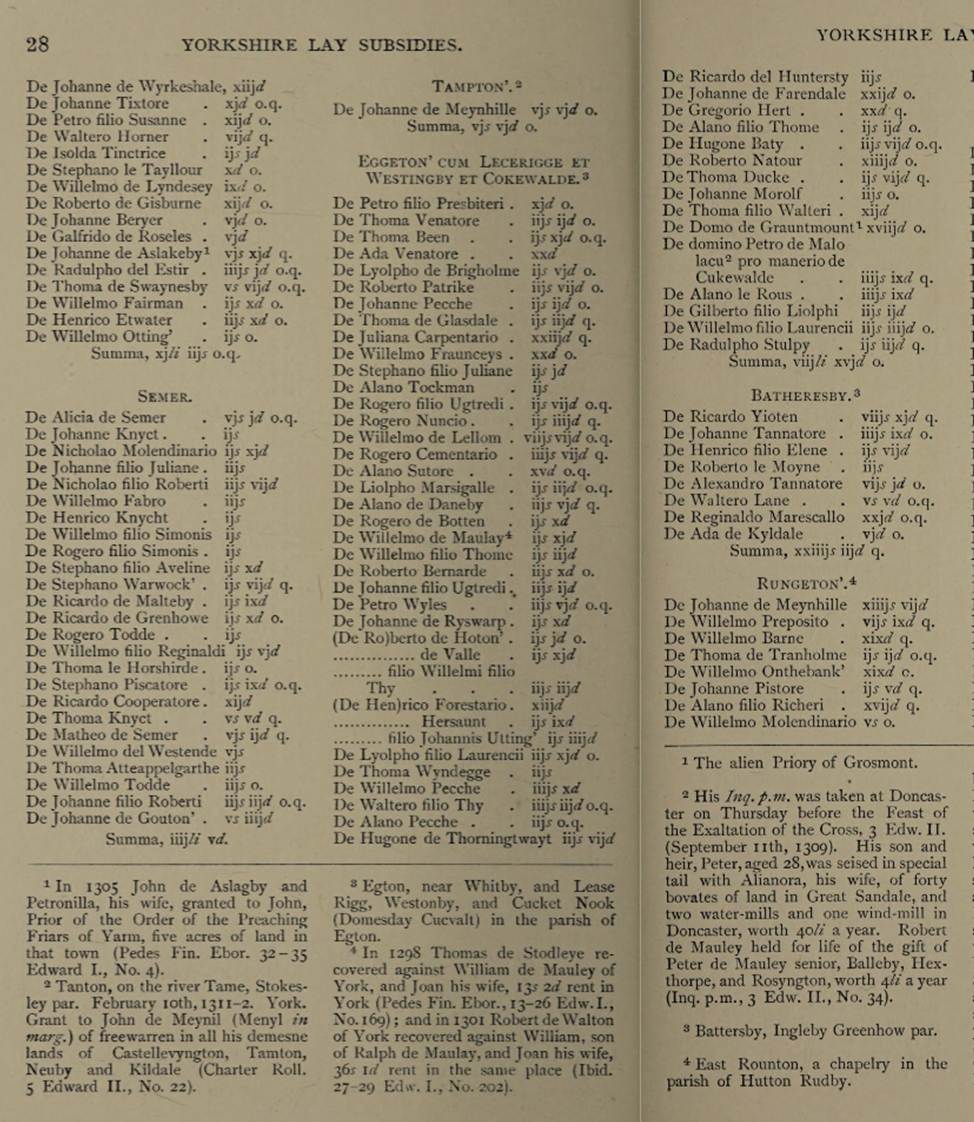
1301 Subsidy for Egton
From the Subsidy: Wapentake of Langbaurgh, Yorkshire Lay
Subsidy 30 Ed. I (1301). Originally published by Yorkshire Archaeological
Society, 1897. 'The Subsidy: Wapentake of Langbaurgh', in Yorkshire Lay Subsidy
30 Ed. I (1301), ed. William Brown 1897, pages 28 to 29,
also British History Online.
Wapentagium de Langeberyghe
Eggeton’ cum Lecerigge et Westingby et Cokewalde
De Johanne de Farendale / xxijd o.

https://archive.org/details/YASRS021/page/28/mode/2up
Egton (Eggeton cum Lecerigge et Westingby et Cokewalde)
De Willelmo de Lellom paid 8s 7d
De Willelmo Pecche paid 4s 10d
De domino Retro de Malo lacu
pro maneriode Cukewalde paid 4s 9d
De Alano le Rous paid
4s 9d
De Rogero Cementario paid 4s 7d
De Waltero filio
Thy paid 4s 3d
De Lyolpho filio
Laurencii paid 3s 11d
De Roberto Bernarde paid 3s 10d
De Roberto Patrike paid 3s 7d
De Hugone de Thorningtwayt
paid 3s 7d
De Hugone Baty paid 3s 7d
De Alano de Daneby paid 3s 6d
De Petro Wyles paid 3s 6d
De Willelmo filio
Laurencii paid 3s 4d
De Roberto filio Willelmi
filio Thy paid 3s 3d
De Thoma Venatore
paid 3s 2d
De Johanne filio Ugtredi
paid 3s 2d
De Gilberto filio Liolphi
paid 3s 2d
De Thoma Wyndegge paid 3s
De Alano Pecche paid 3s
De Ricardo del Huntersty paid 3s
De Johanne Morolf paid 3s
De Thoma Been paid 2s 11d
De Willelmo de Maulay paid 2s 11d
De Roberto de Hoton
paid 2s 11d
De Roberto de Valle
paid 2s 11d
De Rogero de Botten
paid 2s 10d
De Johanne de Ryswarp paid 2s 10d
De Henrico Hersaunt paid 2s 9d
De Rogero filio Ugtredi paid
2s 7d
De Thoma Ducke paid 2s 7d
De Lyolpho de Brigholme paid 2s 6d
De Rogero Nuncio paid 2s 4d
De Henrico filio Johannis Utting paid 2s
4d
De Thoma de Glasdale paid 2s 3d
De Liolpho Marsigalle paid 2s 3d
De Willelmo filio
Thome paid 2s 3d
De Radulpho Stulpy paid 2s 3d
De Johanne Pecche paid 2s 2d
De Alano filio Thome paid 2s 2d
De Stephano filio Juliane paid 2s 1d
De Alano Tockman paid 2s
De Juliana Carpentario paid 23d
De Johanne de Farendale paid 22d
De Gregorio Hert paid 20d
De Ada Venatore paid 20d
De Willelmo Fraunceys
paid 20d
De Domo de Grauntmoun paid 17d
De Alano Sutore paid 15d
De Roberto Natour paid 14d
De Henrico Forestario paid 13d
De Thoma filio
Walter paid 12d
De Petro filio
Presbiteri paid 11d
The
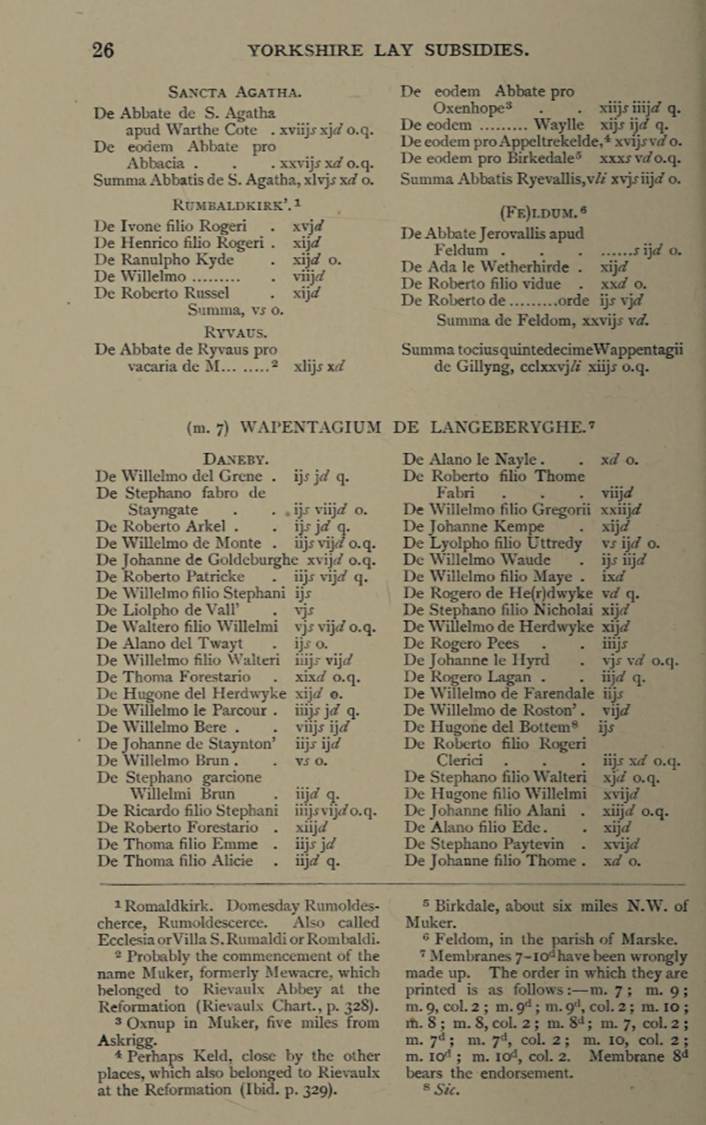
1301 Subsidy for Danby
From the Subsidy: Wapentake of Langbaurgh, Yorkshire Lay
Subsidy 30 Ed. I (1301). Originally published by Yorkshire Archeological
Society, 1897. 'The Subsidy: Wapentake of Langbaurgh', in Yorkshire Lay Subsidy
30 Ed. I (1301), ed. William Brown, 1897, pages 26 to 27, see
also British History Online.
Wapentagium de Langeberyghe
Daneby
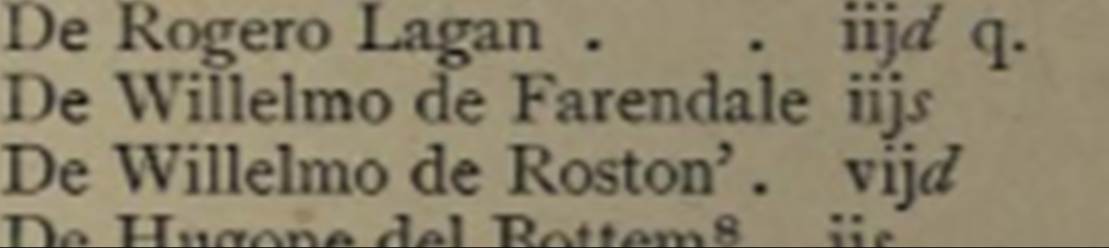
De Willelmo de Farendale iijs
See
more detail about the 1301 Subsidy.
https://archive.org/details/YASRS021/page/26/mode/2up
In Danby (Daneby):
De Willelmo Bere paid 8s 2d
De Waltero filio
Willelmi paid 6s 7d
De Johanne le Hyrd paid 6s 5d
De Liolpho de Vall paid 6s
De Lyolpho filio
Uttredy paid 5s 3d
De Willelmo Brun paid 5s
De Willelmo filio
Walteri paid 4s 7d
De Ricardo filio Stephani paid 4s 7d
De Willelmo le Parcour
paid 4s 1d
De Rogero Pees paid 4s
De Roberto filio Rogeri
Clerici paid 3s 10d
De Willelmo de
Monte paid 3s 7d.
De Roberto Patricke paid 3s 7d
De Johanne del How paid 3s 4d
De Ricardo de Lelom
paid 3s 3d
De Johanne de Staynton paid 3s 2d
De Thoma filio
Emme paid 3s 1d
De Willelmo de Farendale paid 3s
De Stephano fabro de Stayngate paid 2s 8d
De Willelmo Waude paid 2s 3d
De Roberto de Tuphirst
paid 2s 2d
De Willelmo del Grene paid 2s 1d
De Roberto Arkel paid
2s 1d
De Alano del Twayt paid 2s
De Willelmo filio Stephani paid 2s
De Hugone del Bottem
paid 2s
De Willelmo filio
Gregorii paid 23d
De Waltero Waude
paid 21d
De Thoma Forestario
paid 19d
De Johanne de Goldeburgh paid 17d
De Hugone filio
Willelmi paid 17d
De Stephano Paytevin paid 17d
De Roberto Forestario paid 13d
De Johanne filio
Alani paid 13d
De Hugone del Herdwyke paid 12d
De Johanne Kempe paid 12d
De Stephano filio Nicholai paid 12d
De Willelmo de Herdwyke paid 12d
De Alano filio Ede paid 12d
De Rogero filio Lyolphi paid
12d
De Stephano filio Walteri paid
11d
De Alano le Nayle paiud 10d
De Johanne filio Thome paid 10d
De Willelmo filio
Maye paid 9d
De Roberto filio Thome Fabri paid 8d
De Willelmo de Roston
paid 7d
De Rogero de He(r)dwyke paid 5d
De Stephano garcione Willelmi Bruri paid 3d
De Thoma filio
Alicie paid 3d
De Rogero Lagan paid 3d
The 1327 Lay Subsidy
There was a gap in lay subsidy collection during the disastrous
reign of Edward II (1307 to 1327) before the practice began again almost
immediately after Edward III’s accession.
In late 1326 a popular rebellion led by Roger Mortimer, 1st Earl
of March had resulted in King Edward II being deposed and imprisoned. The
King’s closest supporter Hugh le Despenser the elder, who was lord of the manor
of Fairford at that time, was captured and executed. The King’s son was crowned
as Edward III on 25 January 1327 and his father died, probably murdered, while
imprisoned in Berkeley Castle in September of that year. However, as the new
king was only 14 years of age at that time England was in effect ruled by
Mortimer and his lover Queen Isabella, Edward III’s mother. One of the earliest
pieces of legislation of the new reign was passed in September to order a Lay
Subsidy, a nationwide tax of the laity intended to raise money to renew hostilities
against Scotland which Edward II had pursued unsuccessfully for some years.
The Lay Subsidy of 1327 was a flat rate tax of one twentieth (ie
5%) of the value of each person’s moveable goods, hence the tax is also known
as the Twentieth. The majority of moveable goods were cattle, sheep and crops
and therefore the tax fell harder on the rural population than it did on those
in the major towns. Two prominent local men in each county were appointed as
Chief Taxers. They then appointed other local men, known as Subtaxers,
to conduct the assessment and collect the money from people. Those who were
taxed included everyone from the lord of the manor down to his peasant tenants
(both freemen and serfs), traders and craftsmen as long as they had moveable
possessions worth at least 10 shillings. The list of names, the Roll, was drawn
up and sent to the Exchequer in Westminster for approval. The assessment took
some time to complete and it was not until between February and June of 1328
that the money was actually collected.
The Earls, Barons, communities of counties, citizens, burgesses,
and communities of cities and boroughs had granted to the King one twentieth of
their moveable goods as a subsidy towards the defence of the realm against the
Scots, the King’s enemies and rebels, who entered the kingdom in hostile
manner, besieging and taking the castles of the King and his faithful subjects,
and cruelly committing murders, depredations, arsons and oter
crimes. In order that this twentieth might be levied and collected with the
less damage and annoyance to the people, the King appointed … Thomas de
Sheffield and Roger de Nunwick … together with a clerk to be chosen by them,
for whom they were to answer, to assess and tax the twentieth in … the North
Riding of Yorkshire …
The Lay Subsidy for 1 Edward III (1327 to 1328) relating to
Pickering, Whitby Strand and the neighbourhood is reproduced in The North Riding Record Series,
Volume IV, 1897 from page 131 and 137 (I have a hard copy).
For Cropton de Arthoft, in
Rosedale, the whole list of taxpayers (reordered in order of the value of the
tax) was:
Hugone Sutore, 3s, 4d
Ricardo filio Johannis, 3s 3d
Johanne de Clif, 2s 10d
Thoma Abraham, 2s 6d
Ricardo Kynge, 2s
Johanne de Farndale (FAR00030), 2s
Willelmo Fabro, 2s
Elia Cokerell (COK00002), 2s
Abraham Evote, 2s
Petro filio Gelbe,
2s
Henrico del Tunge, 2s
Willelmo del Myre, 20d
Roberto Cokerell (COK00003), 16d
Johanne Styrkherd, 10d
For Kirkbymoorside (Kirkebimoresheved):
Willelmo in le Hirne, 12s
Thomas Wake, 6s
Nicholao de Repingale, 3s 6d
Ricardo de Westgill (WES00001), 2s 6d
Willemo de Donyethueyt, 18d
Willemo Percy, 9d
Willemo de Ampleford, 4d
The 1333 Lay Subsidy
The Law Subsidy for 6 Edward III (1332 to 1333) relating to
Pickering, Whitby Strand and the neighbourhood is produced in The North Riding Record Series,
Volume IV, 1897 from page 131 and 137 (I have a hard copy).
For Cropton de Arthoft, in
Rosedale, part of the Liberty of Pickering, the whole list of taxpayers
(reordered in order of the value of the tax) was:
Hugone Sutore, 2s, 6d
Johanne de Farndale (FAR00030), 2s 1d
Petro filio Gervasii, 2s
Alano Storour, 25d
Roberto Cokerell (COK00003), 15d
Johanne Stirkhird,
18d
De Johanne Kyng,
15d
Thoma Abram, 15d
For Kirkbymoorside (Kirkebimoresheved):
Domino Thoma de Wake, 8s
Alicia in ye Hyrne (presumably the widow of Willelmo
in le Hirne of the 1327 subsidy), 5s 10d
Ricardo de Westgill (WES00001), 2s 6d
Willemo
Percy, 2s 1d
Nicholao de Repingale, 2s 1d
Willemo de Donyethueyt, 18d
Willemo de Ampleford, 15d
The Poll taxes
The poll tax records of 1377, 1379 and 1381 are a helpful resource
recording occupations, and their relationships in late fourteenth-century
England. They were also the precursor to the Peasants’ Revolt.
The 1377 Poll Tax was a levy per head of the lay population, and
each person over the age of 14 was to pay 1 groat irrespective of income and
property holding. By contrast, prior to 1334 lay subsidies had been estimated
taxes of 1/15th or 1/20th of the value of personal property, and in an attempt
to avoid corruption, the collection of taxes in 1334 had been supervised by an exchequer
clerk or an ecclesiastic. Direct assessment was set aside in favour of a
collusive agreement as to the fixed amount, payable locally, and subsequent
parliaments granted subsidies on that understanding. The 1377 tax was therefore
an innovation, and differed from the subsequent Poll Tax of 1381 in that it was
levied at the granted rate, whereas the 1381 tax was to be no more than 20
shillings for each man and his wife, and no less than 4d each, when collected,
although the tax was granted at the rate of 1s per person.
Charles Oman has estimated that only 2/3 of those who contributed
in 1377 made any contribution in 1381, and although a very accurate comparison
is impossible in York, an estimate suggests that there was a decline in the
number of contributors of about 2/5.
(The 1377 Poll Tax Return for the City of York, Jennifer I Leggett, Yorkshire Archaeological
Journal, Volume 43, 1971, page 128).
Bibliography
See also R. E. Glasscock, ed., The Lay Subsidy of 1334 (London, 1975) (Records of Social and Economic History) which includes a listing of the places assessed, and the (fixed)
assessments which applied from 1334
M. W. Beresford, Lay subsidies and poll taxes (Bridge Place, 1963), available at
National Library of Scotland.
Carolyn Fenwick, The
Poll Taxes of 1377, 1379, and 1381 (3 parts, 1998-2005)
(Records
of Social and Economic History New Series 37) which includes transcripts of all
the surviving returns. The third part contains indexes to Wiltshire to Yorkshire, but not to individual taxpayers
M. Jurkowski, C. Smith and D.
Crook, Lay Taxes in England and Wales, 1188-1688 (Kew, 1998)( (Public Record Office Handbooks)),
a comprehensive chronological listing of taxes, with some notes of published
returns