The Cultivation of Farndale and
the early history of the dale
c 1220 to 1400
The lay settlement of Farndale
FAR00004A
|
Return to the Home Page of the Farndale Family
Website |
The story of one family’s journey through two thousand
years of British History |
The 83 family lines into which the family is divided.
Meet the whole family and how the wider family is related |
Members of the historical family ordered by date of
birth |
Links to other pages with historical research and
related material |
The story of the Bakers of Highfields, the Chapmans,
and other related families |
Dates are in red.
Hyperlinks to
other pages are in dark
blue.
Headlines are in brown.
References and
citations are in turquoise.
Context and local
history are in purple.
1225
Whilst land in Farndale had been cleared and used for
ecclesiastical use (see FAR00002 and FAR00004),
particularly by the monks of Rievaulx, the priory of Keldholme and the abbey of
St Mary in York, the dale started to be cleared at scale for lay agricultural
use in the twelfth century and the process probably began in about the 1220s.
By
1225 Nicholas de Stuteville II, the youngest son of Nicholas de Stuteville I,
brought a case against the abbot of St. Mary’s, York, complaining that there
had been a breach of the agreement made in the time of King John (and dating
back to the grant of 1166) between the then abbot, plaintiff, and Nicholas de
Stuteville, Nicholas’s father, whose heir he was. The dispute related to common
of wood and pasture in Hutton le Hole, Spaunton and Farndale. The case
was in progress in 1227. Nicholas complained that the abbot had sold and
destroyed wood to his damage of 40 li (£40), a point in dispute
being whether a perambulation of bounds between the land of the elder Nicholas
and the King’s forest absorbed the common into the latter or not. Eventually the matter appears to have been settled by a final
concord of 15 October 1233, when facilities were given for the cattle of
Nicholas and his men in Kirkby Moorside, Fadmoor, Gillamoor and Farndale. (Early
Yorkshire Charters, Volume 9, Stuteville,
C T Clay, 1952, page 19,
[Yorkshire Fines? Volume 67. The same timber rights
were the subject of a further order by Henry III regarding the Farndale
woodland in 1250, The National Archives, Fine Roll C 60/47, Henry
III Fine Rolls Project). The 1233 resolution
recognised the grazing rights of Nicholas and his tenants provided they do
not tarry in the said pasture, whilst recognising the abbot’s right to
timber.
By 1225 there was therefore tension between prior monastic rights
and the desire by the noble landowners to allow their tenants to graze their
animals. This suggests that Nicholas had tenants who had begun to use the land
by the early thirteenth century.
Assarting is the act of
clearing forested lands for use in agriculture. It was illegal to assart any part of a royal forest without
permission. The process was sometimes undertaken by individuals or groups of
individuals, but in Farndale it was likely to have been instituted by the land
owners as part of a campaign of settlement. Land outwith
the royal forest which had previously been common land, became privately owned
after assarting, so that those in occupation of the land were required to pay
rent and faced new restrictions in land use. Monastic communities, particularly the Cistercians, sometimes
assarted, as well as local lords.
This process of assarting
in Farndale was probably underway by the second or third decade of the
thirteenth century. We can judge the extent of this process, because there are
three recorded snapshots of the progress of cultivation in 1276, 1282 and 1301.
Assarting was clearly proceeding
apace in the middle decades of the thirteenth century, since Lady Joan de
Stuteville successfully prosecuted the Abbot of Saint Mary's, York, for
exceeding her rights of taking wood in Farndale by actually assarting 100 acres
of land.
The tracts of
common field were regularly cultivated according to such typical and customary
crop rotations as oats, beans, and then the fallow, a season of rest for the
soil. …
Until some
accepted limits of the field were reached, or were demarcated by acredikes, there could be some expansion of the cultivated
area, at the expense of common carr or moor. The oxgangs grew larger in acreage if new furlongs,
sometimes called riddings, were cleared at the fringe
of the common fields. About 1185, Keldholme Priory was given the right to break
up moorland at Ingleby, on the far side of Blackamore. A later Cloughton
document specified that if any more land was broken up in the moor, the tenant
would receive the share of one oxgang.
Some other land
newly taken in was not included within the oxgangs. The low grounds of Galtres saw modest intaking amid extensive carrs. New thwaites appeared in the dales, Thackwaite in Bransdale, Hogthwaite
and Duvansthwaite (probably in the area of Douthwaite
Dale to the west of Hutton le Hole or possibly the area of the Duffin Stone, SE
64471 98689) at Farndale, and Stainthwaite
at Levisham. Occasionally some fringe land near
fields, often called of names, wass cleared, measured
in acres and apparently managed separately from oxgangs.
Thwaite is a name
generally associated with fields, particularly in Cumberland, Lancashire and
the North Riding of Yorkshire. The name is usually from Old Norse thveit, but sometimes from Old Danish thwēt, both meaning clearing or meadow.
(The History of Ryedale, John Rushton,
2003, page 87).
Assarting had revived after
disafforestation and added new 'thwaites' and 'riddings'.
It continued into the late 13th century at Sinnington Manithornes
for sowing with Spring Corn, and at Normanby where the Abbot of St. Mary's took
in an 80-acre meadow. A 16-acre waste at Hovingham, then worth 4d a year, was
assigned in 1294 to the Lord of nearby Wath. The greatest reclamations were in
Farndale where the tenantry increased by moving into scattered farms instead of
compact villages. In Bransdale Thackthwaite gained Cocken chapel to serve a smaller group of settlers. The
largest new compact settlement was at Newbiggin just outside the borough of New
Malton.
Monastic granges with outlying cotes,
some specialised for wethers (a male sheep castrated before sexual
maturity), ewes and hoggs (a young sheep that is typically over 12
months old but has not yet cut its first two permanent teeth, usually at around
18 months of age) had taken isolated farmsteads to sheepfold sites. Hexham
Priory's fold on Brawby Moor became a Grange. … Earl
Hugh Bigod planted new sheepfolds that became clearings above Kirkby Moorside
and pressure on common pastures became more intense. Intercommoning continued
above Spaunton but had ceased on Bowforth
Moor. In 1301 William, son of Hugh, complained that the Malton Prior and
Richard Brett were overstocking commons at Aymotherby
and Gilbert, son of Serlo de Newsham, made the same complaint.
(Life in Ryedale in the 14th century, J H Rushton, Ryedale Historian,
Volume 8, 1976, page 19).
The twelfth and thirteenth centuries
were a period of great significance in the evolution of the cultural landscapes
of Great Britain and much of Europe. A frontier movement, involving the
expansion of settlement and cultivation into areas that had been little
developed since the extension clearances of the Iron Age, was accompanied by an
intensification of activity in areas more recently exploited. Such a widespread
colonizing movement may be seen as an outcome of feudalism, with its
organizational powers and its intimate relationship between political
allegiance and exploitation of the land.
We may view the agricultural revolution
of the early Middle Ages as a chief contributory factor. Changes in agrarian
practice and technology, including the development of a three-course rotation
and widespread adoption of the heavy mould-board plough, became increasingly
important from the seventh century onwards. Ultimately, and most important of
all, the frontier movement expressed acute pressure of population on the
perceived and realizable resources of the period.
The process of settlement evolution in
Northern Ryedale is marked by a diversity which reflects the interplay of human
and physical elements within the landscape. An outline of the physical
geography of the area would seem essential if we are to understand in full the
spatial characteristics of medieval colonization. Chiefly upon the basis of
relief, four distinct physiographic units may be recognized. These are (a) the
Ryedale Lowlands, (b) the Tabular Hills, (c) the Moorland Dales, and (d) the
North York Moors. Within such units particular combinations of geological
formation and soil types are to be found.
(Medieval Colonisation in Ryedale, R I Hodgson, Ryedale Historian,
Volume 10, 1980, page 47).
The
early cultivation caused immediate tension with the rights claimed by the Crown
in the royal forest. The lay cultivation also started to compete with the
interests of the previous monastic grants. The lay landowners, by then
realising the commercial value of their holdings, seem to have regretted the
extent of gifting of land to the monasteries, who by this time had started to
hold vast tracts of land. (see FAR00004).
Nicholas
de Stuteville died in 1233, leaving two daughters and co-heirs, Joan wife of
Hugh Wake, and Margaret, whose marriage had been granted to William de Mastac (Victoria County History – Yorkshire, A History of
the County of York North Riding: Volume 1 Parishes: Kirkby Moorside, 1914).
Lady
Joan de Stuteville, heiress of Cottingham, was born in 1216. She was
the daughter of Nicholas II de Stuteville and Devorguilla
of Galloway, wife of Hugh Wake, feudal lord of Bourne and later of Hugh Bigod,
Chief Justice of England. She was the mother of Sir Nicholas Wake; Sir Hugh
Wake; Sir Baldwin Wake III, Lord of Bourne; Joan Burnet; Roger Bigod, 5th Earl
of Norfolk and 2 others. She was the sister of Margaret de Stuteville, the half sister of Nicholas III de Stuteville.
This
Joan, better known as the Lady of Liddell, survived her husband, and,
resuming her maiden name, left the barony to her son, Baldwin de Wake.
The
impression of her seal bore the device of a lady riding on horseback sideways,
a style which she is said to have been the first to adopt.
The
Wake line ended in three co-heiresses, one of whom married the Earl of
Westmoreland, who succeeded to the barony of Kirkbymoorside, and it remained in
the possession of this family until 1570. Joan died on or about 6 April 1276.
1241
Hugh
Wake died in or about 1241 and Joan obtained the custody of his heirs until
their full age. The same Robert of the issues of the lands which were
Eustace de Stuteuill' while he had custody from 18th day of October in the year
25 until the second day of November in the year 26 before he liberated the same
lands to Joan who was the wife of Hugh Wac by the king's writ. He liberated
them in the treasury. (The Great Roll of the Pipe, Henry III (1241 to
1242), page
120).
The process of clearing stretches of land was well
underway in the first half of the thirteenth century.
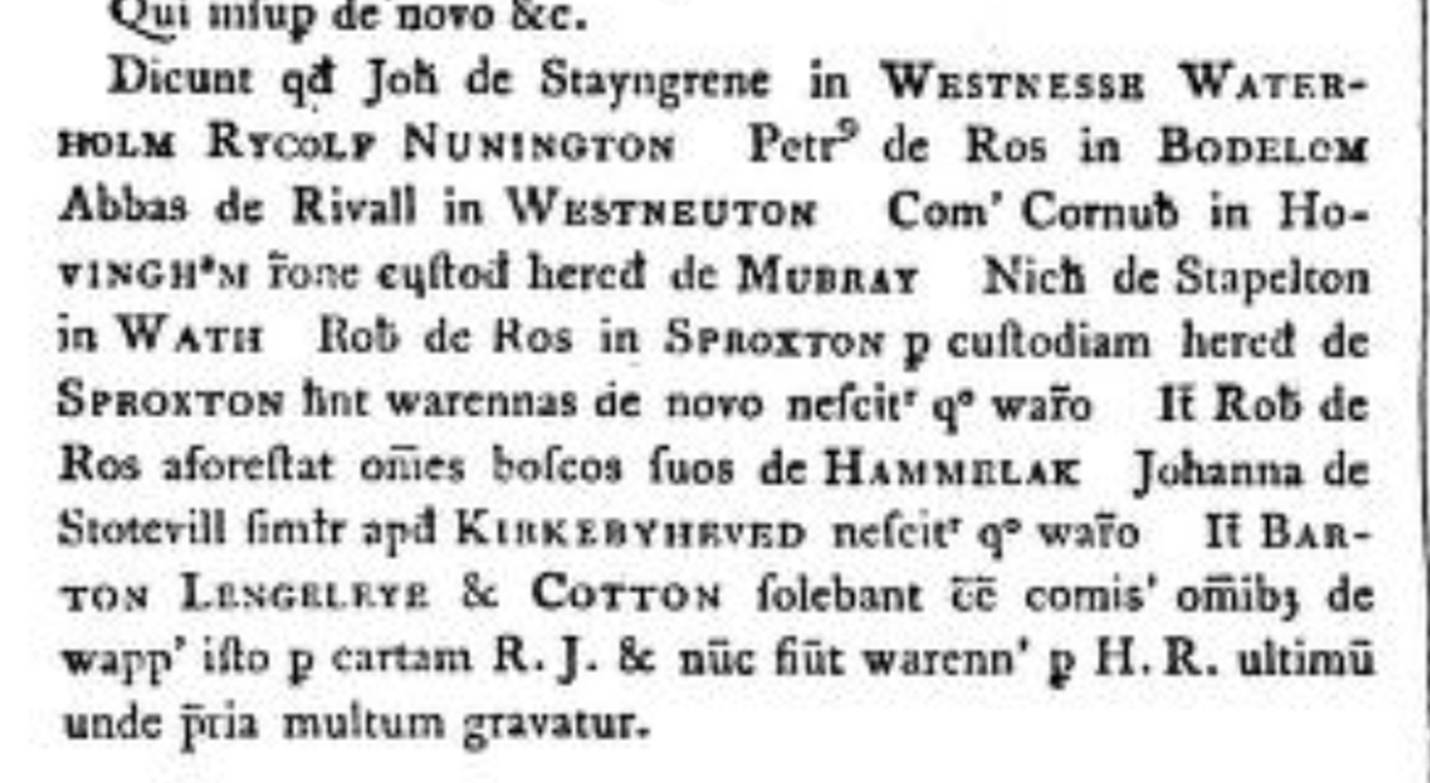
Joan de Stuteville was said to be afforesting her
woods here in the reign of Edward I (1239 to 1307) (Rotuli Hundredorum temp. Hen.
III et Edw. I, edited by William Illingworth and J. Caley (Record Commission,
1812-18), page 117).
In the Wappentake of
Ryedale:
There
is also an undated Yorkshire Deed from about the mid thirteenth century
recording a grant given by Joan de Stotevile to Nicholas Devias for service. It
included a right to rent amounting to 20s from Farndale land held by Adam de Ellerschae (FAR00006B) and eleven marcs from two watermills (FAR00021A) in
Farndale (The Yorkshire Archaeological Journal, Vol 16, 1893, page 92).
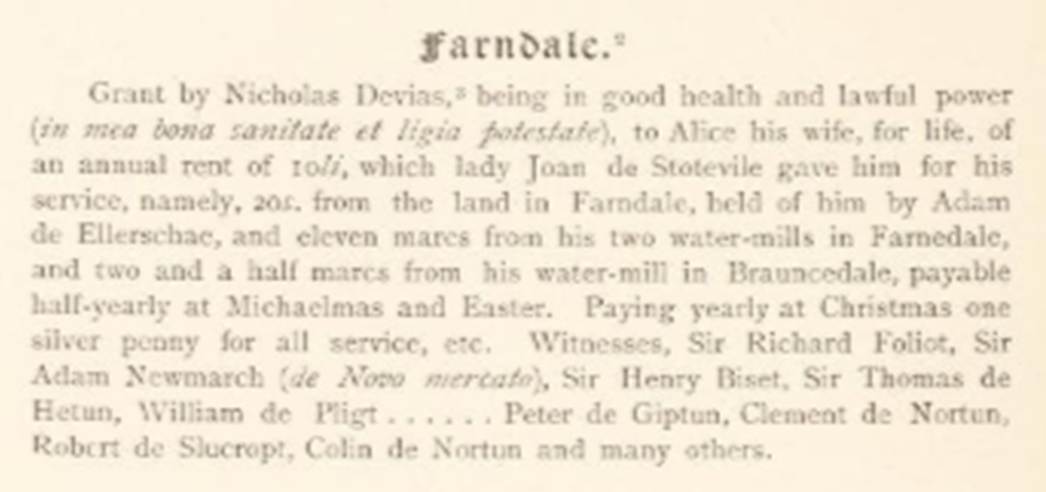
Grant by Nicholas Devias, being in good health and
lawful power (in mea bona sanitate et ligia potestafe) to Alice his
wife, for life, of an annual rent of 10 li, which lady Joan de Stotevile gave
him for his service, namely, 20s. from the land in Farndale, held of him
by Adam de Ellerschae, and eleven marcs from his
two water-mills in Famedale, and two and a half marcs from his water-mill in Brauncedale,
payable half-yearly at Michaelmas and Easter. Paying yearly at Christmas one
silver penny for all service, etc. Witnesses, Sir Richard Foliot, Sir Adam
Newmarch [de Novo mercato), Sir Henry Biset, Sir
Thomas de Hetun, William de Pligt Peter de Giptun, Clement de Nortun, Robert de Slucropt, Colin de Nortun
and many others.
1253
In 1253 the King granted the whole forest
of Farnedala to Joan de Stuteville’s second
husband, Hugh le Bigod until the King returned from Vasconia (Gascony)
where Henry was dealing with an uprising stirred on by the harsh approach taken
by his governor, Simon de Montfort, another costly campaign which left the
Crown heavily in debt (Calendar
of Close Rolls, 37 Henry III page 368).
1254
In
1254 Henry III granted to Hugh le Bigod and Joan his wife a weekly market on
Wednesday at Kirkbymoorside and a yearly fair there on the eve, day and morrow
of the Nativity of St. Mary.
1255
In
1255 Margaret was dead, and Joan Wake had her lands. She married as her second
husband Hugh le Bigod, but as a widow was known as Joan de Stuteville.
Before
her death she enfeoffed in the manor of Kirkby Moorside her son Baldwin Wake,
of whom the King took homage as her heir in 1276.
For Hugh le Bygod. It was ordered
to John de Lexinton, Justiciar of the King's forest beyond Trent, that the
charter which the king caused to be made to Hugh le Bygod
concerning the forestry of the forest of Farendale
he shall make a law before him, and that grant shall be held according to what
is contained in the same charter: and he shall admit the foresters,
greenkeepers and other ministers of the forest for whom the same Hugh is
willing to answer for his presentation in the aforesaid forest. (Calendar of Close Rolls, 39 Henry
III, page
84. Calendar of Liberate Rolls, 39 Henry
III, page
212, Fine Rolls, C39/405, Henry
III Fine Rolls Project).
Widows in such times might wield
considerable power. The last of the Stuteville line who had preceded the Wakes,
Lady Joan, paid a great sum to remarry whom she would, and wed Earl Hugh Bigod.
After his death, she was still known as Lady Joan de Stuteville. John Wake's
wife was the 'Lady of Liddell', in her son's minority. (Life in Ryedale in the 14th century, J H Rushton, Ryedale
Historian, Volume 9, 1978, page 31).
See FAR00004.
The lordly families of Mowbray, Roos,
Vescy, Wake and Stapleton were at the crest of the
Ryedale social pyramid. Some were wealthier outside the dale than within. All
travelled easily between local and distant fiefs. As members of the small
aristocracy of largely Norman and Breton descent, their interests were
nationwide and indeed international (Life
in Ryedale in the 14th century, J H Rushton, Ryedale Historian, Volume 9, 1978, page 29).
The Inquisition Post Mortem taken on the death of Lady
Joan de Stuteville provides evidence of the extent of cultivated land in
Farndale by the mid thirteenth century (FAR00017).
By this time the medieval evidence provides a detailed
record of the burgeoning population
living in Farndale.
Some of the largest farms were at the great demesne manors. The
Stutevilles had five hundred and twenty arable acres at Kirkby Moorside. Roger
de Mowbray’s Hovingham demesne was one hundred and eight seven arable acres and
fifty acres of meadow.
Many townships had officers known as reeves or ‘graves’ in charge
of farming, and where meadow was extensive, employed ‘haywards’. Their first
task was to protect the lord’s interests. Lady Joan Stuteville and others like
her kept a manorial dovecote full of pigeons fattening on their tenant’s corn,
as well as their own, The manor lords could call on their villeins and
cottagers to do customary work on the demesne land, particularly in the busy
seasons, sewing, ploughing, harrowing, reaping or carrying corn as well as
making small renders in kind, although paid labour was becoming more
significant.
(The History of Ryedale, John Rushton,
2003, page 88).
A different farming system expanded into the moorland dales where
common fields were either the modest islands of cultivation at Danby, Egton,
Westerdale and Urrah, or there were no common fields
at all. The twelfth century monastery stock farms called ‘vaccaries’ had led
the way. One at Goathland held twenty cows and a bull. A new freehold cattle
farm with some thirty acres was taken at Allantofts
near Goathland late in the 13th century. Aisled buildings found at Spaunton moor and Dundale amidst the Levisham
moors, may have provided winter housing for stock.
Other new clearings, sometimes called ‘thwaites’, but with a wide
variety of other names, housed single mixed farmsteads which now spread along
the valleys. There was no village. Each farmstead stood within its own modest
arable, meadow and pasture closes, reaching from the valley stream a small way
up to the steeper daleside. The common sheepwalks
above were shared, subject to the oversight of the manor court. Eskdale and its
feeder dales, Farndale and Bransdale, Bickley and Crosscliffe,
part of Rosedale and other valleys not in the hands of the monasteries, slowly
filled with farmsteads along the daleside paths.
Hartoft dale was still being colonised in this way by men from neighbour
villages and dales late in the thirteenth century.
Sometimes dale holdings were assessed in traditional oxgangs to
calculate their renders and taxes, and subjected to similar obligations, Ninety
bondmen in Farndale were bund to do a day or two’s ploughing, some harrowing,
three or four boon days in Autumn, and to cut and cart hay and grain or move
millstones for the new lords of the Wake family. Even where large bonded
pastures had been given to monasteries, and settled with valley granges and
higher sheepcotes, this kind of scattered settlement would eventually replace
them, most extensively in Bilsdale, Baron Hugh Bigod’s sheepfolds, and
Keldholme Priory’s houses on Kirkby Moorside moors could equally develop into
isolated farmsteads.
(The History of Ryedale, John Rushton,
2003, page 89).
Baldwin Wake became the landowner of the estates which included
Farndale after Joan’s death on 6 April 1276. Baldwin married Hawise de Quincy
and had two sons, John and Thomas, and a daughter, Margaret.
1277
The Survey of the County of York by John de Kirkby known
as Kirkby’s
Inquest, the Nomina Villarum for
Yorkshire) was taken in the fifth reign of Edward I (1276 to 1277).
How many villas
are there in the Wapentake of Rydeale, namely, 47, … Fadmore, Gillingmore, Kyrkeby Moresheued, Ediston, Byldesdale … (The survey of the county of York, taken by John de Kirkby, commonly called Kirkby's inquest, 1867, page
110).
At Kyrkbey, the Lord of Wake holds four acres of land; and
answers for a quarter of a part of the military fee; and holds of Roger
Moubray, and Roger of the king in chief. (The survey of the county of York, taken by John de Kirkby, commonly called Kirkby's inquest, 1867, page 118).
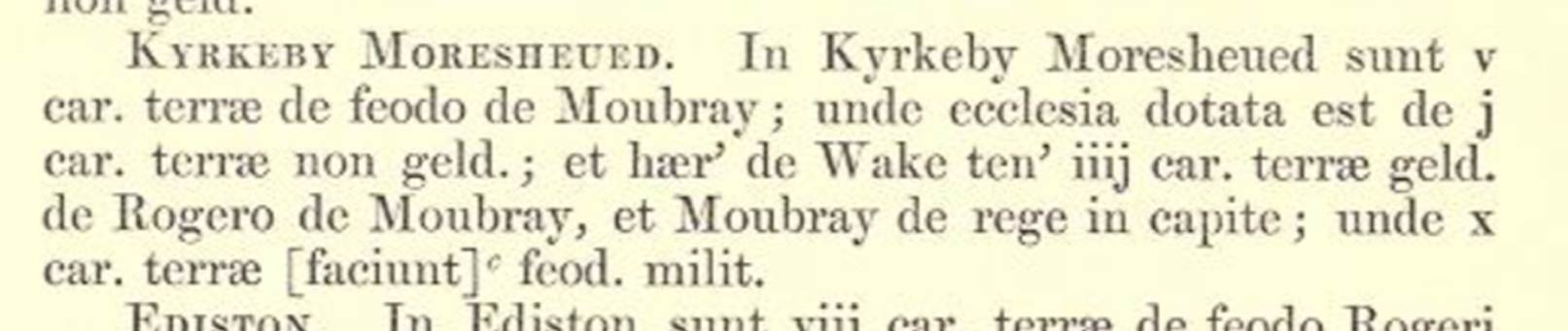
In Kyrkeby Moresheued there are five
caracutes of lands of the fee of Moubray; where the
church is endowed with one caracute of lands not
geld; and the of Wake four caracutes of lands geld,
of Roger of Moubray, and Moubray of the king in chief; where ten caracutes of lands [make] a hundred feod
military. (The survey of the county of York, taken by John de Kirkby, commonly called Kirkby's inquest, 1867, page
121).
Geld (as in danegeld)
means tax based on the number of caracutes of
land which was a significant source of ropal revenue
levied on land ownership. Thomas Wake had to pau but the church didn’t.
Kirkeby Moresheud was under the lordship of Thomas de Wake,
Hovingham under Johannes de Moubray and Muscoates
under Nicholaus de Stapleton (The survey of the
county of York, taken by John de Kirkby,
commonly called Kirkby's inquest, 1867, page
320).
The Inquisition Post Mortem taken on the death of
Joan’s son, Baldwin Wake provides evidence of a rapidly expanding community (FAR000020).
Sir John Wake
became the landowner of the estates which included Farndale after Baldwin’s
death in 1282. Sir John Wake was the first Baron Wake of Liddell. He took part
in military campaigns in Gascony from 1288 to 1297 and against the Scots from
1297 to 1300. He was Joint Captain of the March of Scotland in Cumberland in
1297. He fought at the Battle of Falkirk in 1298.
The
Liddell lordship in Cumberland was a separate entity to the Scottish barony
of Liddel to the north which was centred around Hermitage castle. The history of the English barony seems to
have begun soon after the conquest of the district by King William Rufus in
1092. The English Liddell, presumably with its castle, passed to
Nicholas Stuteville, the first Lord of Lidell (1142 to 1218) on the death of
Turgis Rosedale in 1167. Sometime before
1120 Robert Stuteville had married Erneburga Brundos, a daughter of the first
Turgis Brundos of Liddel, so that Liddel had devolved
upon Nicholas (Liddel, Paul Martin Remfry).
1293
The first recorded poaching incident involving the folk of
Farndale was on a cold Monday in January 1293, when five men, including Roger
the Miller of Farndale (FAR00013A) and Walter Blackhous of Farndale (BLA00001) went hunting in a part of West Rosedale that belonged to St
Mary’s Abbey and at an unknown place in the forest they killed a soar (a sow or
female boar), and a hart (an adult male deer, generally a red deer over five
years old), with bows and arrows. They were all outlawed. (North
Riding Records Yorks, The Honour and Forest of Pickering, 1894, Volume
II at page
110, possibly folio 222 in the Coucher
Book).
The full story of the poachers of
Farndale is told separately.
1297
The Inquisition Post Mortem on the death of Roger de
Mowbray (1257 to 1297) on 26 November 1297 (26 Edward I) included
Kirkbymoorside (Kirkeby Moresheved) in the
theoretical superiority of Roger, though held by Joan Wake by service of 10
knights’ fee (Calendar of Inquisitions Post Mortem, Volume 3, (Edward I,
1291 to 1300), page
356 and 363).


1298
John
Wake enfeoffed the King of his lands in 1298, and they were regranted to him
and his wife, another Joan, in fee simple in the same year.
1300
John Wake died on
4 October 1300 and was succeeded in time by his son Thomas Wake, then three
years old and so in his minority. The custody of Baldwin Wake was granted to
Henry de Percy who transferred it to the Society of the Ballardi
of Lucca.
7
June 1300, Pontefract. Memorandum, that Joan, late the wife of John Wak,
tenant in chief, did fealty to the king, on Tuesday before St. Barnabas, at
Pontefract for all the lands that John lately surrendered to the king and of
which the king afterwards enfeoffed John and her, and she took oath there that
she would not marry without the king's licence ; and the king, in consideration
of the tender age of Thomas, son and heir of John, delivered him to Joan for
custody, on condition that she should always have him ready to deliver to the
king at his will. (Close Rolls of the reign of Edward I, 1296
to 1302, page
401).
As
the 13th century gave way to the 14th, Ryedale was still divided into bounded
townships, the arable, meadow and pasture land of which supported many compact villages,
two small borough towns, monasteries with outlying grange farms and in the
three higher dales scattered single farmsteads. Some of the smallest townships
filled the central Ryedale basin. Some of the largest embraced thousands of
acres of the high moors. Their populousness depended
less on extent than on the quantity and quality of usable arable and good
meadow. More than half the people lived in the springline
villages below the slopes. The rest were divided, with perhaps a quarter in the
vale, and the rest in the limestone crest villages and the few but surprisingly
populous dales.
Large villages like Ampleforth, Appleton le Moors, Gilling, Hovingham,
Kirkby Moorside, Old Malton, Nunnington, Slingsby and
perhaps Oswaldkirk contrasted with many others a half
or a quarter as populous. Yet they were by no means dwarfed by the small
boroughs at Malton and Helmsley. As late as 1377 Malton would have only 354
adult taxpayers, of 14 and over, and perhaps half that number of households.
Among the villages, Kirkby Moorside and Hovingham had shown signs of urban
growth but though their village markets were successful they lacked borough
privileges.
Ryedale was primarily a farming country. Arable fields ringed the
lower slopes around the dale. Others formed blocks atop the northerly
limestone, spanned Howardian valleys or nestled in a few of the deep dales of
the moorland. Hay meadows lined low streams at Ryedale's heart, where the
arable was in chunky clearances amidst broad carrs
and moors. The vast higher moors formed open commons that merged with remaining
valley-side woodland.
Common fields were more often described as single units than as the
named fields familiar later. Strips were grouped in clusters, each with its
name. Wandales at Barugh, Salton, and Cawton, Sucker
flat at Gilling, Bent Butts at Lastingham, Hunger Hills at Kirkby Misperton,
are a few. Meadows bore names like Priest Ing at old Malton, Gildhusdale below Welburn, Scampshon
Ing at Scawton and Hall Ings, Gilling. Low Commons
were extensive, filling land that would later seem promising north of Habton and Old Malton, where monks gathered turf and
heather, and in great areas east of Harome and
south-east of Keldholme.
The Farndale men working scattered holdings tended to have more
beasts, but rarely a full eight. Men combined to make up teams for the heavier
land.
Despite regional differences from high dales to waterless upper
limestone and ill-drained lowland, improved by dykes, specialised farming is
hard to detect outside monastic granges. Shepherds appeared in Farndale.
Yet subsistence farming was being supplemented by cash crops, notably
wool and hides. Some lordly demesnes and rectory tithes brought large quantities
of other crops to market. Returns from the villein farmer's two oxgangs were
more limited depending on its quality and the yield of associated pasture and
meadow rights. A murrain or bad harvest could bring poverty. Wool had long been
exported as well as supplied to Malton's weavers. Foreign demand was still
intense and the home cloth trade growing. Monasteries and merchants acted as
middlemen and incidentally as financiers. The Italian merchant Pergalotti could expect, of the 593 woolsacks from Yorkshire,
that 60 might come from Rievaulx, 45 from Malton, 35 from Byland, 39 from
Kirkham, 13 from Newbrough, 10 from Arden, and at least 12 from Keldholme,
among the monasteries.
Woo! had long been taken out through York, Scarborough and even Hull.
The transport system of the later medieval period reflected the
foundation of routes from much earlier.
Green paths ran from compact villages to flatts
of arable, meadows, woods, commons, mills, watering places and other usable
assets. Longer-distance routes were superimposed on the local system within the
cultivated area but in the commons followed more natural routes, and even
shortcut through fields when crops had been lifted. Many sloping hill paths
were called 'sties', like Holthorpesti at Hovingham
or Hasty in Bilsdale and the great Thurkilsti that
ran from Welburn to Cleveland. Parishes had routes for tithe movement to a
mother church.
Some ‘great ways', and ‘king's highways' linking market towns were
less direct. The King's peace extended along the latter, required to be of
serviceable width for wagons to pass and, since 1285, with the undergrowth cut
back 209 feet on each side. Among them, not always on their modern course, were
the Pickering-Kirkby-Helmsley, Helmsley-Marton-York, York-Kirkby Moorside (the Stanegrave way); Helmsley-Stonegrave
Carr-Hovingham, the road through Trowbridge, and the road Pickering - Howe
Bridge-Malton. The High Ings causeway, raised up at Appleton le Moors, is
unusual, but in the low ground raised causeways were the Middle Causeway at
Malton, the causeway on Normanby-Marton Common, the Great Barugh and Habton causeway to York (Wade's Causeway). The high moors
had a great way from Loose Howe to Shunner Howe, now extinct, and the low road
from Edstone to Kirkoy
Mills is now a mere footpath.
Rigg routes rather than valleys
provided ways whereby packhorses could avoid the soft ground. The Gilling gap
lacked a major route. Long-distance routes focussed on fords called waths. Examples are Hallwath, upper and lower Blawath above Farndale, Yatstainwath
and Gildhuswath south of Welburn. Conversion of waths to bridges came early at Howe, or Friar, Bridge, a
Rievaulx Abbey responsibility on the Pickering-Malton Road (12th Century), and
at Newsham (13th Century), at Malton, where 'pontage'
was charged, at Helmsley (13th Century), at Ho!megarth,
Scawton (12th Century), at Crossow
Bridge over the Dove near Salton (by the 15th Century) and probably at such
places as Trowbridge, Normanby, Kirkby Misperton, Nunnington,
Sinnington, Aplawe, Riccall,
Barugh, Lastingham, Malton, and Tilehouse, before
their first mention in Jacobean times.
(Life in Ryedale in the 14th century, J H Rushton, Ryedale Historian,
Volume 8, 1976, page 19).
On the North York Moors and, more
particularly, in the Moorland Dales, there is no specific mention of settlement
at the time of the Domesday Survey. Colonisation in medieval times began in
earnest after 1150 and reached a peak towards the end of the thirteenth
century. Thus, the evidence of an inquisition post mortem of 1282 suggests that
parts of Bransdale and Farndale which were appurtenant to the discrete manor of
Kirkby Moorside, had total populations of the order of 100 to 125 and 350 to
450 respectively and more important, that such totals may have represented an
increase of 30 to 40 per cent over the preceding six years. While part of such
increase may have been accommodated in small villages or hamlets in the
valleys, these were likely to be only of the size of the smallest village
settlements in the Ryedale Lowlands. To judge from both the nature of the terrain
and the documentary evidence, it would seem that settlement was dispersed, and
certainly by 1300 there is evidence for a scatter of single homesteads within
the Dales. Many of these lay on the edge of the North York Moors, occupying
sites at elevations of 800 feet and above and it is tempting to explain the
expansion of settlement to such heights as a reaction to restricted development
at lower altitudes, particularly in those areas where strong ecclesiastical
control was exercised. On the other hand, it is important to note that by 1300.
It would be nonsense, of course, to
imagine that the township represented anything like a closed system, wherein
all the requirements of a village community were satisfied. Townships on the
free-draining loams of the Tabular Hills must have possessed little good meadow
land. Similarly, some townships in the Ryedale Lowlands must have lacked the
resources of woodland which were to be found on the slopes of the Tabular Hills
escarpment. One must envisage considerable intertownship
movement of people, goods and services during the Middle Ages. In many cases it
must surely have been within the organizational framework of the manorial
system that the deficiencies of individual townships were evened out. This
seems particularly likely of townships in the Moorland Dales whose territorial
extent was considerable and whose agrarian practices were controlled from a
manorial centre based elsewhere. In Bransdale and Farndale settlement was
dispersed and some holdings might have been worked almost in isolation, but most,
probably carried extra-township obligations. It seems that the manor of
Kirkbymoorside, taken as a whole, functioned more successfully as the unit of
economic organisation than the townships of which it was comprised. In addition
to possessions in Bransdale and Farndale, it contained the townships of Fadmoor and Gillamoor on the
Tabular Hills where soils were especially favourable for arable, and the
township of Kirkby Moorside where there were good quantities of meadow land in
the Ryedale Lowlands. Research by Glanville Jones suggests that multiple
estates such as Kirkby Moorside were common in many parts of northern Britain
in the Middle Ages and were of considerable antiquity.
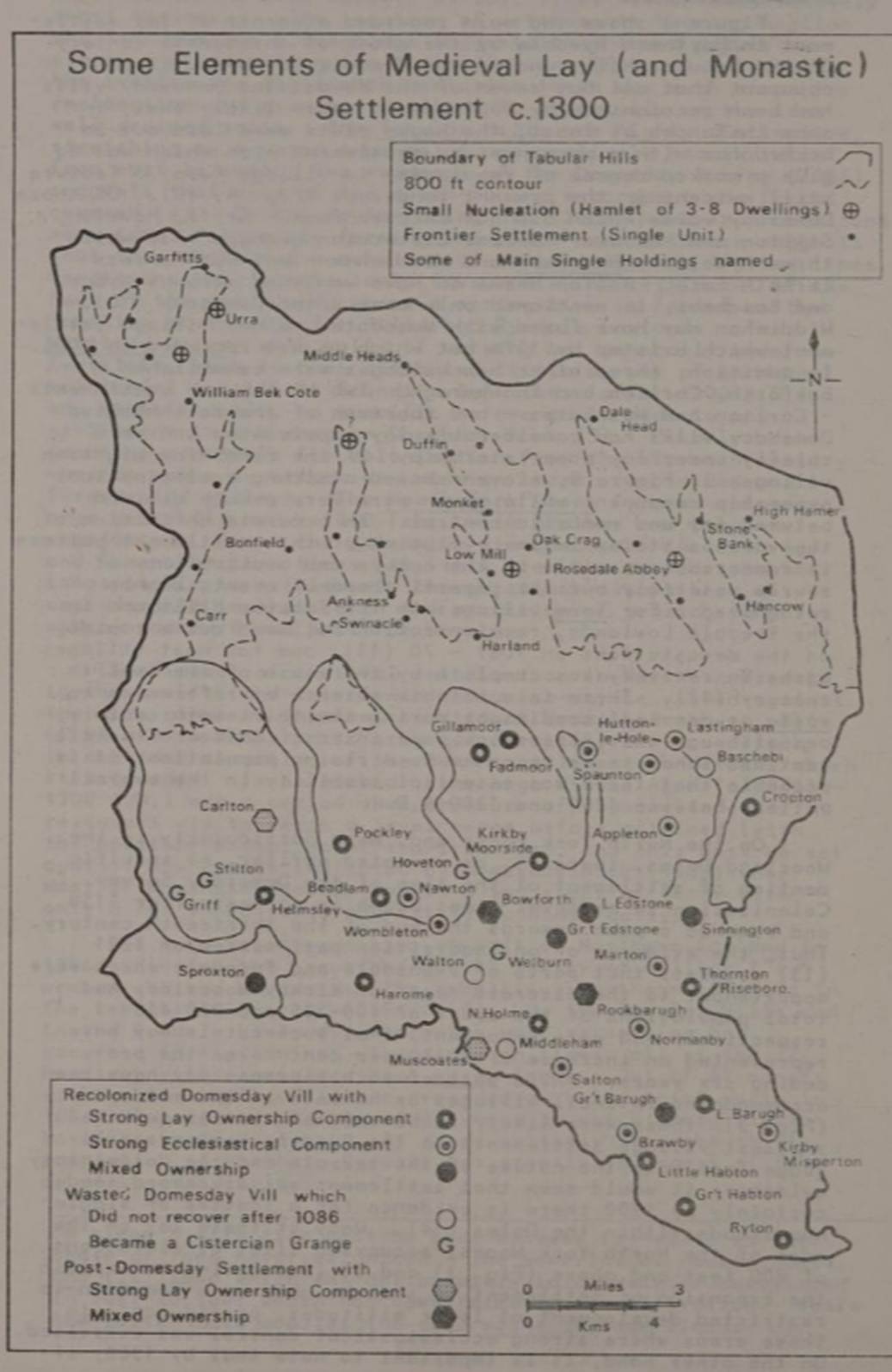
It seems more likely that the
settlement shown at Duffin was in fact at Douthwaite Dale by Hutton le Hole.
(Medieval Colonisation in Ryedale, R I Hodgson, Ryedale Historian, Volume 10, 1980, page
47).
Detailed
evidence of the inhabitants of Farndale is provided by the 1301 Yorkshire
Subsidy, a tax imposed to fund the Scottish Wars (FAR00029).
There are certainly several documents which can give
an excellent picture of settlement in the fourteenth century. The Poll Tax of
1377 is useful, especially for its details about town populations, but the
North Riding section of it has been less well preserved than the West Riding. A
series of Lay Subsidies beginning in 1297 and recurring in 1301, 1327, 1334
hold out more hope. Unfortunately that of 1297 is complete for the East Riding
only, and those of 1327 and 1334 while being comprehensive are rather late for
the purpose and so is Nomina Villarum (1316). Besides, none of these give full details of
the temporal possessions of the monasteries (This is the disadvantage of
Kirkby’s Inquest (c.1284) which is otherwise very valuable. It does not record,
for example, the settlements that Rievaulx and Guisborough had outside the
settled areas.) There remains the Lay Subsidy of 1301. It is certainly
comprehensive enough for the North Riding because in spite of its title it
covers the possessions of the monasteries and so includes granges and lands
which they had inside and outside settled areas. The Subsidy has several uses
too: it gives a clear picture of monastic and lay settlement in 1301; it shows
which areas were the most prosperous because it indicates 1/15 of the value of
moveable goods (i.e. cattle, corn, etc.); and because it lists the lay
contributors for each vill it affords some idea of
the distribution of population in 1301. The most interesting deduction it
allows, however, is the relative importance of monastic settlement in the area,
and the extent to which settlement had expanded or contracted since Domesday.
A comparison of settlements in 1086 and 1301,
introduces an immediate, but not unexpected, contrast. In 1086 the greater part
of the settled area (with notable exceptions, e.g. Seamer) had been waste; in
1301 these places had largely been re-established so that the picture
reproduced a good deal of the pre-devastation pattern of settlement in the
North-East. The centres of population and prosperity were in two main areas:
Cleveland and the Vale of Pickering. This again, reproduced a good deal of what
Domesday has suggested in terms of such relative values. Then, as in 1301, the
Vale and Cleveland had predominated; then, as in 1301, the clearly defined
lines of villages on the north and south margins of the Vale were evidently of
the most significance. But in 1301 the emphasis was multiplied many times. The
whole settlement was clearly rejuvenated and although the degree of continuity
preserved was remarkable its development in terms of settlement, population and
wealth had been considerably strengthened.
A closer inspection of the maps suggests that some
vital changes had occurred by 1301. These comprised an extension of the settled
area. Those areas colonised since Domesday were mainly of two kinds:
in the marshy valelands and in the moorland dales.
In the latter, Bilsdale, Farndale, Bransdale and Eskdale were mainly
concerned. In the former the Vale of Pickering especially in its central part
was affected, but settlement on the limestone dip slope to the north had also
increased (e.g. Skiplam, Carlton).
One outstanding fact is evident — that the monastic
share in the expansion of settlement after 1086 was very great indeed. In
Bilsdale, for example, Byland and Rievaulx between them had settled almost the
whole of the valley by 1301 while lay settlement was confined to a few vills in the north of the valley (e.g. Raisdale,
Broad Fields, Bilsdale) — and these were largely dominated by Rievaulx. In
Eskdale, too, a whole series of new settlements had been established by
Guisborough Priory at Skelderskew, Wayworth, Dibble Bridge, Glaisdale . . . Rosedale was
entirely a monastic settlement although the iron stone in the dale was to
attract lay settlers there by the mid-fourteenth century. Bransdale and
Farndale had apparently been colonised by laymen— although even here
Rievaulx had twelfth century pasture rights which presumably led to some form
of small settlement. At any rate, by 1282 lay settlement here was
considerable. There were, for instance, 90 natives in Farndale and 54
natives and bondmen in Bransdale. Along the north-east fringe of the moors at
Stanghow, Scaling, Sandsend .... and in certain spots deeper in the moors (e.g.
Hartoft) laymen had played a major part in the expansion of settlement.
Significant as the monastic colonisation of
uninhabited areas was it must be remembered that their greatest contribution
was to the development of the already settled areas.
The grange then was the spearhead
of the monastic blitzkrieg—the impact was just as startling; the results just as
overpowering. It contributed to the settlement of areas previously
uninhabited, often unused. Even more important it was the first of a new
type of settlement in the area. The grange was a dispersed form, perfectly
adapted to the development of areas such as the North-East Moorlands, where
nucleated settlements were almost non-existent (N.B. extreme nucleation in
Valeland areas in contrast). In fact, the value of the monastic grange site is
emphasised today by the many isolated farmhouses that are on the same spots.
(Monastic Grange as a factor in the settlement of
North East Yorkshire, Bryan Waites, Yorkshire Archaeological Journal, Volume
40, 1962, page 647).
De Willelmo de Farndale (FAR00013) and De Johanne de Farndale (FAR00030) were the first individuals who took the name of Farndale to live
in other places, Danby and Egton.
We can therefore envisage the transformation of a
forest wilderness during the course of the thirteenth century into a thriving
community, with agricultural activity across eight hundred acres and more of
cultivated land, serviced by two watermills along the river Dove, and populated
by a complex mix of folk whose energy created a new landscape within a
remarkably short timescale.
Recognisable individuals started to become
identifiable at the time when the system of names between non elite communities
had begun to evolve. Individuals started to differentiate between themselves by nicknames, occupations and residence. As
settlements grew in size, names became more discerning. When de Farndale was no
longer sufficient to differentiate between those who all lived in Farndale,
folk were referred to by places within the dale such as Westgille
or by their occupation. In time it was those who left the dale to move to other
places who might use de Farndale as an identifier. As the new practice bedded
in, these names started to become hereditary. Our narrative of the history of
Farndale, is therefore able to enrich its depth with the stories of ordinary
individuals at the very earliest period when this became a possibility.
All the world’s a stage, and all
the men and women merely players. They have their exits and their entrances and
one man in his time plays many parts. His acts being seven ages.
(William Shakespeare, As You Like
It, Act II Scene VII)
The Lay Subsidy of 1301 provides a dramatis
personae. The evidence allows us to bring our nascent dale to life, with
the stories of the actors who lived there eight hundred years ago.
The highest rent was paid in 1301 by Simone
Molendinario, ‘the miller’ (FAR00021) who paid 7s 9d rent,
suggesting a worth in moveable goods of £5 16s 3d. His servant (serviente ejus),
Johanne paid 3d. We might imagine the heart of a community at Low Mill where the
West Gill flows down to meet the River Dove and that this was likely to have
been the location of Simon’s mill.
Simon must have paid a significant rent to the
Stuteville landlord for his state of the art technology. By the turn of the
century this was Thomas Wake, the Second Baron Wake of Liddell. The rent was
eleven marcs (a marc was two thirds of
a pound or 13s 4d) from the two watermills in the
mid thirteenth century and Simon’s mill was likely the more substantial with a
higher rent. We might imagine a model whereby he received an annual income from
operating the mill of say £8, with a deduction of say £4 to pay his rent, and
annoying impositions of national taxes, like his payment of 7s 9d in 1301,
together with the costs of operating the mill, and pay to his servant John. We
will shortly discover that Simon’s sons were the victims of draconian forest
laws, and the imposition of fines that would have further depleted family
resources. Although he may have had a far more substantial turnover than the
other folk of the dale, he may not have been so wealthy in the residue of funds
he had left to feed his family. He was left with a comparative wealth in
moveable comforts, which might equate to a value of about £4,000 today, perhaps
the value of about six horses (a useful tool to provide a ballpark
value of medieval wealth is the National Archive’s Currency Converter), but much of this value may have been in the tools of his trade.
Simon’s servant Johanne in time came to be called John
the Miller (FAR00021B), and it may be that the miller-servant relationship blossomed
into a partnership in time.
Radolpho de Westgille (WES00002) and Willelmo Westgille
(WES00003), who also paid relatively high tax in 1301 in Farndale,
presumably represented a family on the slopes above Low Mill alongside the
beck. It seems likely that their brother was Richard de Westgill
(WES00001) who paid tax in the 1327
and 1333 Lay Subsidies (The Yorkshire Lay Subsidies, The North Riding Record Society, The
Honour and Forest of Pickering, Edited by Robert Bell Turton, Volume IV,
1897, pages 146 and 152) in Kirkebimoresheved
(Kirkbymoorside) amidst a relatively select group, including the Domino
Thomas Wake, suggesting a family that was punching above its weight. Richard’s
sons were trespassers and poachers in Pickering Forest, though such activity
ranged from the only alternative for survival by subsistence levels villeins to
the sporting activity of the elite classes (See for instance The
Poachers of Pickering Forest 1282-1338 by Derek Rivard (Medieval
Prosopography, Vol. 17, No. 2, Autumn 1996, pages 97 to 144).
In medieval Europe, a cleric was often an ordained
person sometimes in minor orders of the clergy. A clericus
was also appointed in lay legal matters by the thirteenth century, including in
the operation of the forest laws (The Duchy of Lancaster
Records, from the North Riding Record Society, The Honour and Forest of
Pickering, Edited by Robert Bell Turton, Volume IV, 1897, page xxxvi). De Willelmo clerico
(PRI00001) who paid 23d in the 1301 subsidy might therefore have been a
priest or an administrator of forest laws. On 19 November 1388, a licence was
given to the inhabitants of fferndall to have
masses celebrated in their chapel (York Archbishop
Registers, Register
14 f.6 (recto) entry 4), so we might imagine that
William was an early religious leader in the dale.
Roberto ad Pontem (PON00001) perhaps lived at a bridge across the Dove and we might imagine
him to have lived around Lowna at the entrance to the
dale where the bridge which crosses the Dove would later inspire the tale of
the fateful entrantress, Sarkless
Kitty.
Syther’ vidua (VID00001), the widow of Syther, paid 4d tax. Robert de Brakeanthayt (BRAK00001, ‘the bracken field’) paid 4s 7d. The Ruddock brothers (RUD00001 and RUD00002)
paid 2s and 4s. Laurencio Syffewrythe (SYF00001,
Latin for ‘suffocation’, but we know not why) paid 4d.
There were others. This was a rich, diverse community.
Early fourteenth century Farndale was a community of
developed social structure, from the infant, mewling and puking to the generation
of the sixth age, turning again toward childish treble, pipes and whistles in
his sound (William Shakespeare, As You
Like It, Act II Scene VII).
Prior to the occupation of Farndale and until the
thirteenth century, the agricultural community of the wider Kirbymoorside
estate was focused on the Minster of St Gregory at Kirkland and stretched to
such places as Welburn, Harome, Nawton,
Great Barugh, Normanby, Kirkby Misperton and Marton, all of which are name
checked in the Domesday record as places of ancient community (see FAR00006A).
The occupation of Farndale from the early thirteenth
century was a continuation of this process, and the first folk of Farndale
brought their own rich cultural and historic identity, and no doubt a deep
rooted agricultural experience.
By the mid thirteenth century Simon the Miller (FAR00021) may have worked the mill in Low Mill, alongside his servant and
later partner, John the Miller (FAR00021B), serving a diverse agricultural community. Robert was the
community’s smith.
In the second generation, Roger the Miller (FAR00013A), who may have worked at High Mill, perhaps the person also known
as De Rogero Bernard (the ‘brave bear’) in 1301, was regularly involved in
poaching activity together with his sons. John the Shepherd of Farndale (FAR00010) had at least 9 oxen and
3 cattle, and a groom, called Roger. John the Miller’s sons, Richard (FAR00016), John (FAR00016A) and Thomas (FAR00023) were all excommunicated for their misdeeds. William the Smith of
Farndale (FAR00037) may have continued the family smithy business of Robert, perhaps
his father.
We are given a sense of a hard working first
generation, who had acquired some comparative wealth by turn of fourteenth
century, and an adventurous, reckless or sometimes desperate younger generation
who came increasingly into contact with the burgeoning royal jurisdiction.
The dale’s early story continued to be one of two
parts, of the ordinary folk who worked the dale and of the elite class who
owned it.
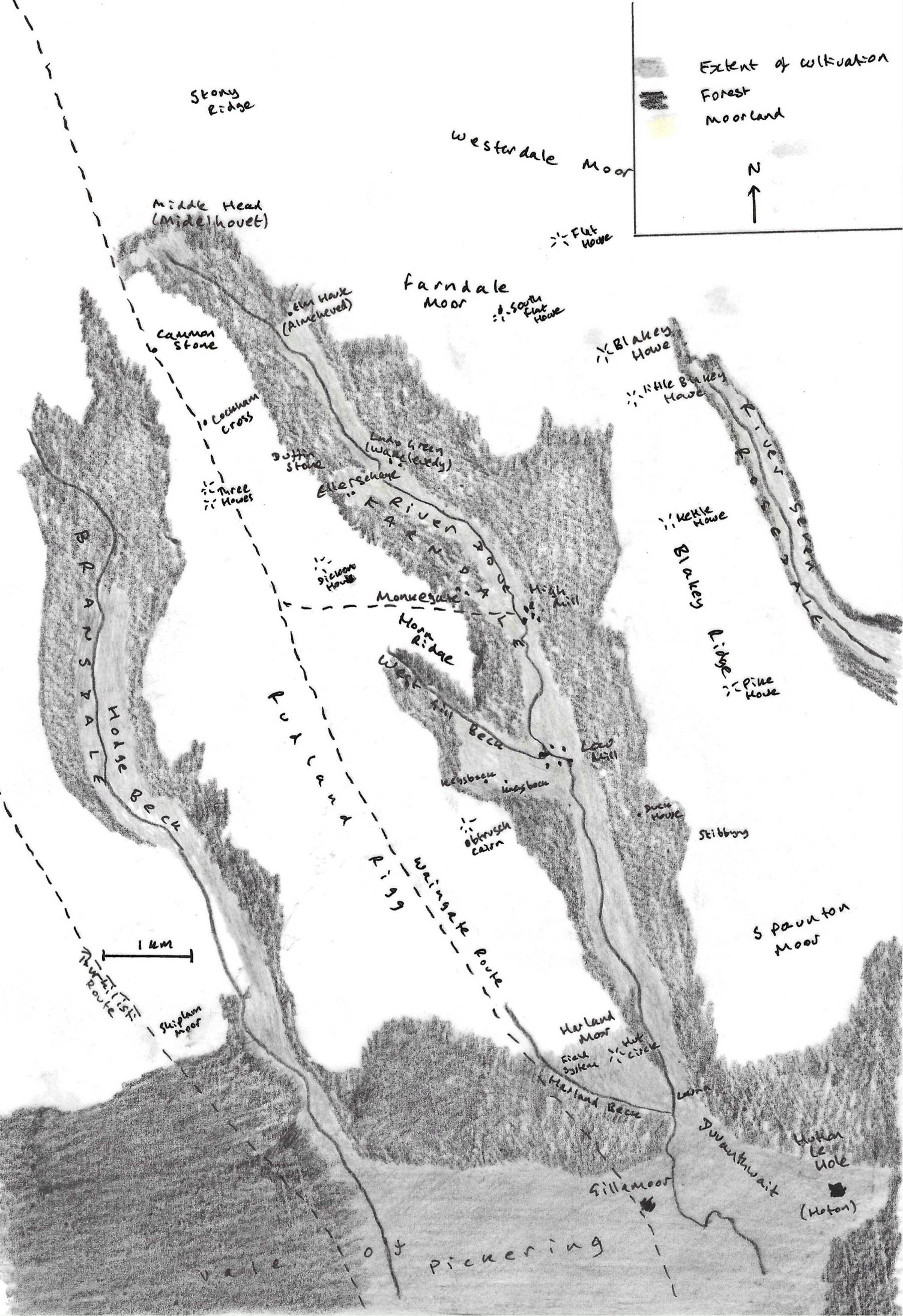
Farndale in about 1301
Farndale as it may have looked at
the end of the thirteenth century showing extent of possible cultivation and
remaining forest and also showing the ancient high moorland monuments which
suggest areas of settlement through Mesolithic, neolithic and Bronze Age
periods, which appear to have been abandoned for low land settlement by the
Iron Age and Roman periods.
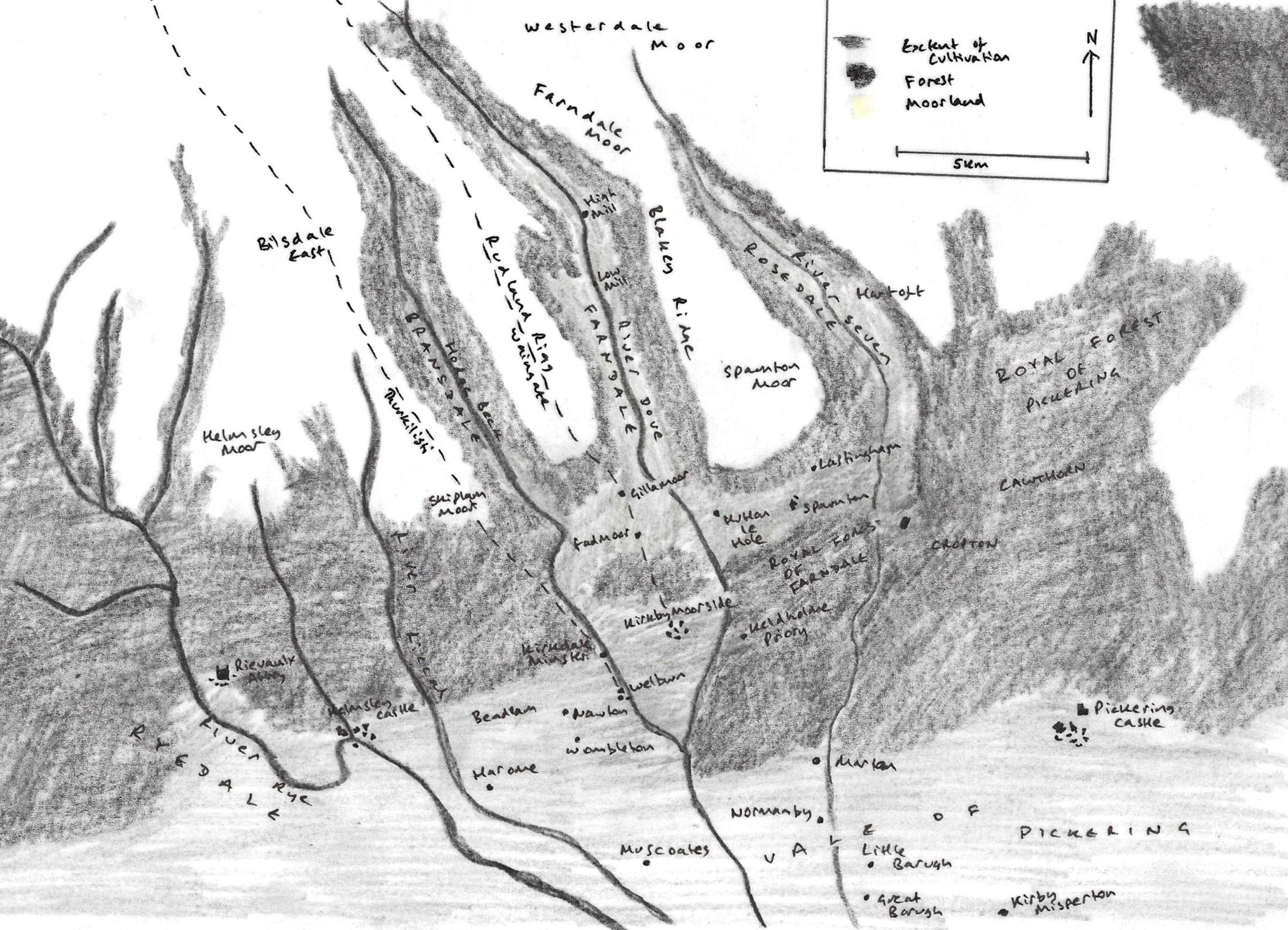
Kirkbymoorside Estate in about
1301
1304
11 October 1304, Birdsall. … the said king granted
that all Hugh's costs and expenses about the custody of the castle of Dover and
in the munition and wardship of the castles of Schardeburgh
and Pykeryng during the time of the disturbance in
England, and the ferm of Pykeryng,
Scalleby and Schardeburgh
… (Close Rolls of the reign of Edward
I, 1302 to 1307, page
177).
1305
In
the Middle Ages and before, the dale heads must have been a happy hunting
ground for the nobility and others. King Edward I intervened in a dispute
between Robert de Clifford, Justice of the Forest beyond the Trent, and the
Abbot of St Mary’s York (1305 to 1306). The Abbot holds in fee in his wood from
the Dovve to the Syvene and
Blakehow Moor, excepting hart, hind, boar and hawk,
which our ancestors preserved for themselves. Dire penalties were fixed for
poaching, but in spite of this poaching took place... Many
references to the forest of Farndale appear in the medieval records, usually
identified with Spaunton Forest, held by the Abbot of St Mary’s York
until 1539 (Raymond
Hayes, Farndale, 1961, unpublished, page 14).
1310
lron was extracted in moorland dales, smiths moving their
bloomeries up the outcrops near water and wood. Rievaulx had early Bilsdale
workings and charcoal burners in Riccall Wood. Robert the
Iron-Smith in Farndale was probably an extractor in 1310-11. (Life in Ryedale in the 14th century, J H Rushton, Ryedale Historian, Volume 8, 1976, page
25).
1312
28 June 1312, York. To Robert de Wodehous,
escheator this side of the Trent. Order to deliver to Thomas Wak, son and heir
of John Wak, tenant in chief of the late king, the manor of Kirkeby Moresheved, which was his father’s, the king having
restored to him although he has not yet proved his age (Close Rolls of the reign of Edward
II, 1307 to 1313, page 428.
1313
10 September 1313, Windsor. To John de Evre,
escheator beyond Trent. Order to deliver to Thomas Wake, son and heir of John
Wake, tenant in chief of the late king, the knights' fees, advotvsons
of churches, and all other appurtenances of the manor of Kyrkeby
Moresheved, in the king's hands by reason of his
minority, which manor the king lately ordered Robert de Wodehous, then
escheator beyond Trent, to deliver to him, the king having restored the same to
him although he has not yet proved his age, and having now restored the
knights' fees, advowsons, etc. pertaining thereto (Close Rolls of the reign of Edward II, 1313
to 1318, page
13).
3 November 1313, Westminster. To John de Evre,
escheator beyond Trent. Order to resume into the king's hands the manor of
Kirkeby Moresheved, and to deliver it to Vannus
Ballardi, John Vanne and their fellows, merchants of the society of the Ballardi of Lucca, to whom the custody thereof was granted
by Henry de Percy, to whom the custody thereof was granted by the king during
the minority of Thomas son and heir of John Wake, which grant to the said
merchants was confirmed by the king, the king having, in forgotfulness
of the premises, caused the manor to be taken into his hands and delivered to
the said Thomas, who is yet under age (Close Rolls of the reign of Edward II, 1313 to 1318, page
22).
The Ballardi or Riccardi
of Lucca were a medieval merchant society in Lucca, Tuscany. At their greatest
extent, they had branches in Rome, Bordeaux, Paris, Flanders, London, York and
Dublin. The Riccardi of Lucca had a long-term banking relationship with King
Edward I of England between 1272 and 1307. The outbreak of war between England
and France in 1294 led to a credit crunch in international money markets. The Ballardi of Lucca between 29 September 1294 and 13 July
1313, lent to Edward I and Edward II £10,074 12s . When Edward sought further
financial support from the Riccardi, they were unable to advance him any funds.
In response, Edward seized the Riccardi’s assets in England, effectively
bankrupting them.
While heirs were under-age,
custody reverted to the overlord. During the minority of Thomas Wake, Henry de
Percy transferred custody of his estates to the merchant house of Ballardi of Lucca, a mortgage for 1200 marks. (Life in Ryedale in the 14th
century, J H Rushton, Ryedale Historian, Volume 9, 1978, page
31).
1317
6 June 1317, Westminster. To Master John Walewayn,
escheator this side Trent. Order to cause Thomas Wake, son and heir of John
Wake, to have seisin of the lands that his father held in chief of the late
king and that his mother Joan held of the present king in chief, although he has
not yet proved his age, the king having taken his homage for the same, as he
wishes to shew him special favour at the request of the king's kinsman Henry de
Lancastre, whose daughter Thomas has married ; saving to those who hold these
lands by the king's demise or grant their corn sown in those lands, and their
other goods and chattels in the same (Close Rolls of the reign of Edward II, 1313 to 1318, page
413).
16 June 1317, Westminster. To the collectors in co.
York of the scutage of the armies of Scotland Westminster, in the 28th, 31st,
and 34th years of the late king's reign. Order to respite until the quinzaine
of Michaelmas the exaction of the scutage due from Thomas Wake because the king
has rendered to him the lands of John Wake and Joan Wake, his father and
mother, tenants in chief, the king having granted him respite until then (Close Rolls of the reign of Edward II, 1313
to 1318, page
420).
1318
25 March 1318, Clare. Enrolment of deed of Bobert
de Fount Fraynt, witnessing that whereas the king lately granted to Isabella,
queen of England, the wardship of the lands of the inheritance of Thomas
Wake, in the king's hands by reason of the minority of Thomas, to have
until he come of age, with knights' fees and all other appurtenances (Close Rolls of the reign of Edward II, 1313
to 1318, page
603).
1322
10 December 1322, Haddlesey. To Thomas, earl of
Norfolk, and marshal of England. Order to be at York at the Purification with
horses and arms in as much power as possible, ready to set out against the
Scotch rebels, who, as the king learns, are preparing to enter the realm about
the Purification. He is ordered to certify the king as speedily as possible
of the number of men-at-arms that he will bring with him, in accordance
with the king's late order to bring as many men-at-arms in addition to his
usual household as possible, which men-at-arms shall be at the king's wages
from the day they come to York. To Thomas Wake. Like order (Close Rolls of the reign of Edward II, 1318
to 1323, page
690).
1323
28 April 1323, Findon. To John de Kilvynton, keeper
of the castle and honour of Pykeryng, co. York. Order
to expend up to £20 in repairing the king's mills at Pykeryng
and the pond of the same, which, the king understands, have been broken down by
ice and floods, the pond being almost entirely carried away (Close Rolls of the reign of Edward II, 1318
to 1323, page
643).
6 March 1323, Knaresborough. To Thomas Wake
and William Latimer. Whereas the king lately appointed them to array all the
fencible men, horsemen and footmen, in the East Riding of co. York between the
ages of sixteen and sixty, and to cause them to be armed according to a form
sent to them sub pede sigilli, wherein it is
contained that the names of the sufficient men shall be put in one roll by
themselves, and the names of those who are insufficient in body in another roll
by themselves, and the king afterwards frequently ordered the said Thomas and
William to cause the said men to be arrayed and armed, so that they should be
ready to come to him when summoned to set out against the Scots, and that they
should send the names of the men in two rolls, and they have done nothing in
the matter ; the king now orders them to certify him in his wardrobe before
Palm Sunday next concerning the premises in two rolls (Close Rolls of the reign of Edward II, 1318
to 1323, page
633).
10 November 1323, Nottingham. To Thomas Wake.
Order to pay to the prior and convent of Newstead in Shirewode
the arrears of 40s. and a quarter of wheat yearly from the manor of Kyrkeby, which belonged to John de Stotevill, for the time
that Thomas has had the custody of the manor by the king's commission, and to
pay the same to them henceforth for so long as he
shall have the custody, as it was lately found by the inquisitions concerning
John's lands that the manor is charged with the aforesaid 40s yearly to buy
wine for the celebration of divine service, and with the said quarter of wheat
for oblations, to be received from the bailiff of the manor, and that the prior
and convent were seised thereof until the time when
the manor was taken into the king's hands by reason of the minority of John's
heir, the king having committed the custody thereof to Thomas during the heir's
minority for a yearly sum to be rendered to the exchequer, by virtue of which
commission Thomas is bound to pay the said sum and quarter of wheat to the
prior and convent, in addition to the sum due to the king (Close Rolls of the reign of Edward II, 1323
to 1327, page
40 to 41). This may refer to Kirkby in Ashfield (see page
82).
1325
In 1325 Thomas Wake asked that the justice of the
forest should be commanded to deliver his wood of
Farndale. The King replied that Thomas should deliver a writ to the justice of
the forest to certify the reason for taking the wood. In a subsequent document,
again Thomas asked that the justice of the forest should be commanded
to deliver his wood of Farndale and added that he had seized it without reason
(National Archives, SC 8/8/358. National Archives, SC
8/174/8667). The King eventually ordered that the official do
justice to Thomas Wake, according to the usage and law of the forest. It
seems that the bureaucracy and the ambiguity of the law was ever thus. Since
every writ made money for the Crown, there was every reason to prolong the
experience. (see FAR00039).
1326
9 March
1326, Marston. To Thomas Wak. Whereas the king has frequently ordered
him by letters of privy seal to come to him to treat of certain of the king's
affairs, and Thomas, as the king learns, has received certain of the said
letters, and has taken care not to receive others, hiding himself so that the
bearers thereof cannot come to him to deliver them, and he has deferred
hitherto coming to the king : the king therefore orders him to be with him in
person on the morrow of the close of Easter next to answer to him concerning
the premises, and to treat with him concerning the said affairs, and do what
reason shall require (Close Rolls of the reign of Edward II, 1323 to 1327, page
549).
10 October
1326, Gloucester. To Thomas Wake of Bliseworth,
one of the leaders and arrayors of men-at-arms and
footmen in the counties of Northampton and Rutland. Order to come to the king
with all his power and force upon sight of these letters, 80 that he be at
Gloucester on 18th October next, as the king lately ordered him and his
fellows, arrayors and leaders of the said men, to
come to the king with all his force with all speed, and to bring with him a
certain number of men-at-arms, hobeleis, archers, and
other fencible men to set out against the king's enemies and contrariants Roger de Mortymer
and other rebels, fugitives and banished men, and aliens who have entered the
realm in force, which he has not done, and he has not come nor sent any men to
the king, to the king's surprise. He is ordered to leave a sufficient person in
his place, in whom he has confidence, to raise and send the people to the king
with all speed, informing all who will not come or are rebellious that the king
will esteem them his enemies and treat them as such. He is enjoined not to
neglect this matter under pain of forfeiture of body and goods. He is to
understand that if he be not with the king at Gloucester on the said day with
all his force, as is aforesaid, the king will consider him disobedient, and
will punish him accordingly (Close Rolls of the reign of Edward II, 1323 to 1327, page
651).
3 December
1326, Ledbury. Memorandum, that on 26 October, in the 20th year of the reign
of king Edward, son of king Edward, upon the said king going away from his
realm of England with Hugh le Despenser, the younger, and Master Robert de
Baldok, enemies of the queen, his consort, and of Edward, his eldest son,
duke of Aquitaine, and other enemies of the queen and duke, the realm being
left without rule, A. archbishop of Dublin, J. bishop of Winchester, J. bishop
of Ely, H. bishop of Lincoln, A. bishop of Hereford and W. bishop of Norwich,
and other prelates, and Sir Thomas, earl of Norfolk, Sir Edmund, earl of Kent,
the king's brothers, and Henry, earl of Lancaster and Leicester, Thomas Wake,
Henry de Bello Monte, William la Zousche of Assheby, Robert de Monte Alto, Robert de Morle, Robert de
Watevill, and other barons and knights then at Bristol, in the presence of the
queen and duke, with the assent of the whole community of the realm there
present, unanimously chose the duke keeper of the realm, so that the said
duke and keeper should rule and govern the realm in the name and right of
the king his father, who was thus absent, and the duke on the same day assumed
the rule of the realm in form aforesaid, and began to exercise the rights under
his privy seal … (Close Rolls of the reign of Edward II, 1323 to 1327, page
655).
Although the great age of
monastery founding and endowing was over, the Lords continued to patronise
them. Sir Baldwin Wake gave £5 annually out of Middleton to Byland Abbey.
Malton Priory gained extensive legal rights from Lord William Vescy. Haltemprice
Priory was founded by Thomas Wake in 1326, his family supported a House
of Friars in Farndale, and his steward sent Cropton Castle timber to the
Scarborough Greyfriars. (Life in Ryedale in the 14th century, J H Rushton, Ryedale Historian, Volume 9, 1978, page
29).
1327
By 1327, Thomas Wake was the King’s keeper of the
Forest north of the Trent (Close
Rolls of
the reign of Edward III, 1327 to 1330, page 185).
1328
Kirkbymoorside
(Kirkeby Moresheved) was held by Thomas le
Wake for seven and a half Knights’ fees of John de Mowbray (Calendar of Inquisitions Post Mortem, Volume 7, (Edward III, 1327 to 1336), page
53).
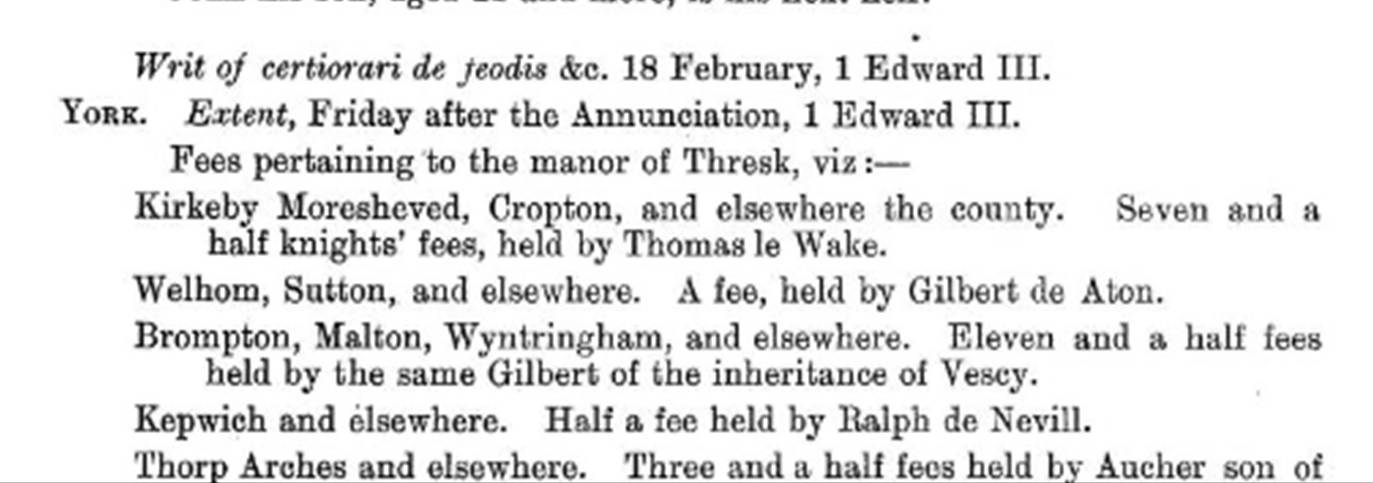
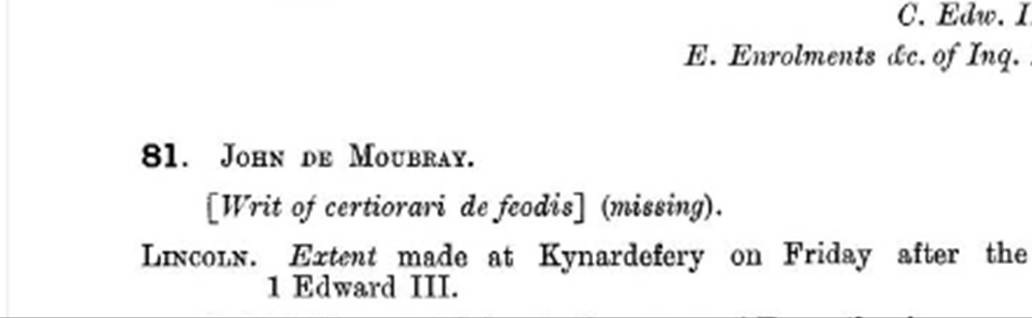
A
knight's fee was a unit of land in feudal England, typically a fief,
deemed sufficient to support a knight and provide the resources for his
military service. It was a variable amount of land, depending on its quality
and location, that would generate enough income to maintain a knight, his
horse, and equipment. The landholding obliged its holder to serve as a knight
in the feudal system.
1329
Hating the favourites of Edward II, Thomas Wake had
joined Queen Isabella in 1326 and was a member of the small council which
advised the young king, Edward III. He then broke away from the queen and her
ally, Roger Mortimer, and in conjunction with his father-in-law, earl of
Lancaster, he joined the malcontent barons, the contrarians. He was possibly
implicated in the plot which cost his brother-in-law, Edmund of Woodstock, 1st
Earl of Kent, his life in 1330, and he fled to France, returning to England after
the overthrow of Isabella and Mortimer.
20 February
1329, York. To the sheriff of York. Order to restore to Thomas Wak of Lydel all his castles, towns, manors, lands, goods and
chattels, which the king lately caused to be taken into his hands, and the
issues received thence. (Close Rolls of the reign of Edward III, 1327 to 1330, page
437).
25 May 1329,
Dover. To the sheriff of Norfolk. Order to restore to Thomas de Camoys his
lands, goods and chattels, which the king caused to be taken into his hands
because he adhered to Henry, earl of Lancaster, and Thomas Wake, then the
king's contrariants, as the king has admitted him
to his good will at the request of J. bishop of Ely and John de Rnos, and has
granted to him his lands, goods and chattels by the mainprise of the bishop and
John for his good behaviour in the future (Close Rolls of the reign of Edward III, 1327
to 1330, page 463).
9 February
1329, Westminster. Thomas
Wake of Lidell acknowledges that he owes to the king 15,000 marks ; to be
levied, in default of payment, of his lands and chattels in co. York. (Close
Rolls of the reign of Edward III, 1327 to 1330, page
529).
4 December
1329, Kenilworth. Memorandum, that the king sent his writ under the privy
seal to the chancellor to this effect; Edward, etc., to J. bishop of
Winchester, our chancellor. Whereas we, on 4 December last, by the assent of
the prelates, earls, barons, and other magnates of the realm in parliament
assembled at Westminster, have pardoned and acquitted Henry, earl of
Lancaster, Thomas Wake, Henry de Beaumont, and Thomas Roscelyn, and all
others of their adherence and company, the sums in which they were bound to its
or their ransoms, because they were lately at Bedeford
with horses and arms with the intention of doing certain thing against the
estate of us and our realm, as was surmised by Roger de Mortimer, our late
enemy : we therefore order the chancellor to cause them to have letters of
pardon and release of their ransoms under the great seal, and to cause the
recognisances made in chancery for security for the said ransoms to be
cancelled at the suit of those who will sue for this against us. Given under
our privy seal, at Westminster, the 12 December, in the fourth year of our
reign. (Close Rolls of the reign of Edward III, 1327 to 1330, page
530).
9 December
1330, Westminster. Order to restore to … all his other lands, goods and
chattels … taken into his hands upon suspicion of his having adhered to Edmund,
laie earl of Kent, and the king deems him guiltless
and has restored his land … To Robert Selyman, escheator this side Treat. Like
order for restitution Westminster, to Thomas Wake of Lidel.
(Close Rolls of the reign of Edward
III, 1330 to 1333, page
77).
In
the time of Edward III it was stated “The forest of Spaunton
and Farndale, between the Dove and the Seven is so confined that deer do not
oft repair thither, except at odd times some harts and hinds; when they enter
the forest and are found they quickly retire to other places outside the forest.” (Raymond Hayes, Farndale, 1961, unpublished, page 32).
There is some possibility that Edward II visited it on one
occasion, but no other monarch seems to have ventured there. The opinion of
John Cromwell, keeper of the King's Forests north of Trent, set down in an
inquisition ordered by Edward III, is that "the forest of Spaunton between the Dove and Seven is so confined that deer do not oft repair
thither, except at odd times some harts and hinds;
and when they enter the forest and are seen and found there they quickly and
quietly retire into other parts of the country outside the forest" (Notes on the History of Farndale in the Middle Ages, Arthur H Whitaker, Ryedale Historian, Volume 1,
1965, page 10).
An inquisition has been taken before John
Cromwell, keeper of the King's Forest on this side of the Trent, by which it
has been found that it will not injure the King or any one
else if the King grants to the Abbot and Convent all the game in the forest of Spaunton between the Dove and the Seven in exchange for the
tithe of venison in the forest of Galtres. It is also
found that the forest of Spaunton between the Dove
and the Seven is so confined that deer do not oft repair thither except at odd
times some harts and hinds, and when they enter the
forest and are seen and found there they quickly and quietly retire into other
parts of the country outside the forest because the forest is so overlooked.
The King has taken the advantage of the Crown into consideration, and seeing,
as he is bound to do, that he suffers no injury, granted to the Abbot the game
in the Forest of Spaunton between the two rivers for
the term of five years, without any obstruction from the King's Justices,
foresters, verderers or other officers, unless he should think fit in the
meantime to decree otherwise reserving to himself the right of sending thither
the keepers of the forest, and all forfeitures for poaching during the term.
The Abbot and Convent after the conclusion of the term are to have the tithe of
venison in the forest of Galtres as they had before,
and in like manner the King is again to have the game in the forest of Spaunton. York, 16 August, 1328 (North
Riding Record Society Volume 2, appendix, pages
266 to 267).
Grant to the abbot and convent of St. Mary,
York, of all the venison in the forest of Spaunton in
Blakhommore between the rivers Donne and Syvene, for five vears (saving to
the king the profits (adventubus) of the keepers of
the forest and the forfeitures of trespassers in venison), in exchange for the
tithe of venison in the forest of Galtres granted to
them by charters of the king's progenitors. Galtres
Forest is extremely burdened by the frequent huntings
therein for the king and others by his licence, and by seizure of the said
tithe. The said abbot has the custody of Spaunton
Forest, wherein the king has no covert or demesne land or aught but venison of hart and hind. It has been found by inquisition ad quod
damnum of John de Crombewell, keeper of the forest this side Trent, not
prejudicial but for the king's advantage to make this grant, and that Spaunton Forest is too confined, with no frequent repair of
deer, except at times {per vices) of hart and hind,
which lightly return beyond the forest, 16 August 1328 (Patent Rolls, 2 Edward III, page
316).
1333
21 March
1333, Pontefract. To Thomas, earl of Norfolk and marshal of England, the
king's uncle. Order to be with the king at Newcastle-upon-Tyne on Trinity next
with all the horses and arms which he can bring with him, to set out thence
with the king against the Scots … The like to the following … Henry, earl of
Lancaster … Thomas Wake of Lidel and 38 others
… (Close Rolls of the reign of Edward
III, 1333 to 1337, page
99).
1334
By the
Forest Eyre of 1334, the inhabitants of Farndale were involved in a large
number of cases concerning poaching in the royal forest and their story is told
in the
poachers of Pickering Forest.
1335
24 October 1335, Roxburgh. To the treasurer and
barons of the exchequer. Order to give Thomas Wake respite until the
quinzaine of Easter nest for all the debts which he owes at the exchequer,
unless the king orders otherwise in the meantime, and to release Thomas from
any distraint made for that cause. (Close Rolls of the reign of Edward III, 1333 to 1337, page
531).
1341
21 January 1341, Westminster. Thomas Wake,
lord of Lidel and Margaret countess of Kent
acknowledge that they owe to William de Monte Acuto,
earl of Salisbury, 3,000 l to be levied, in default of payment, of their lands
and chattels in cos. York and Kent. — John de Stok received the acknowledgment
by writ which is on the files. (Close Rolls of the reign of Edward III, 1339 to 1341, page
662).
1347
On 30 July 1347 Thomas Wake obtained licence for a
grant of a toft and ten acres of land on the moor at Blakenhowe,
then part of Farndale, to the House of the Holy Cross, to allow them to found a
house of their order there, and to build an oratory and dwelling houses (see FAR00039).
In the
countryside, even the Black Death may have seemed a recurrence of stresses that
were too familiar. The murrain had carried off he flocks back in 1275, leading
Rievaulx into debt and Crown custody, and a recurrence 12 years later saw them
borrowing £250. The harvest agilures, earthquakes and
famine of 1315-17, when men spoke of ‘the earness of
the times', preceded two years of wet summers. The Scots aids during the
recurrent war from 1296 to 1346 saw Barton le Street, Rosedale, and
traditionally Helmsley and Salton, devastated. In 1322 Robert de Brus sat in
Malton Castle harrying the countryside, and before he left devastated it, as
well as Rievaulx and Byland. King Edward bought a Rievaulx monk a coat for his
back the next summer. Then came the plague in 1349-50, 1361-2,1369 and 1374. At
Harome they said most of the tenants had died, and
its effects are all too apparent at Barton le Street, Cropton and Kirkby
Moorside. Rents dropped and for a time tofts stood empty. Some moved off to
York, where admissions to the freemen's rolls increase and include some Ryedale
names. Sir William Ayton toured the district trying to apply the new controls
on wages and prices. Yet as the balance of bargaining power changed, some
benefited who hadn't before. Monastic influence visibly decreased as
monasteries turned more and more away from direct farming. Yet society as a
whole carried on, and in time recovered throughout Ryedale. (Life in Ryedale in the 14th century, J H Rushton, Ryedale Historian, Volume 9, 1978, page 45).
1349
Thomas Wake died in 1349 probably due to the Black
Death. On 3 August 1349, there was reference to the heir of Thomas Wake,
tenant in chief (Close Rolls of the reign of
Edward III, 1349 to 1354, page
49) and on 18 August 1349 to Blanche, late the wife of Thomas Wake of
Lydell, tenant in chief (Close Rolls of the
reign of Edward III, 1349 to 1354, page
53).
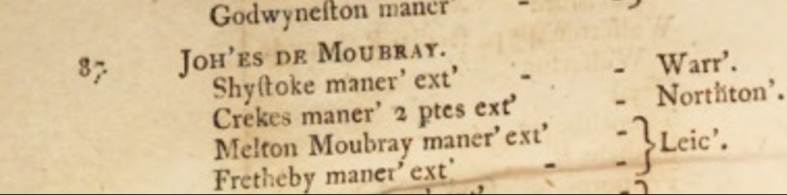
John de Moubray was still the tenant in chief of the
community of Kirkby Moresheved, with a yearly fair,
and still two water mills in Farndale. Thomas Wake held the fee until his death
in 1349 (Calendar of Inquisitions Post Mortem, Volume 9, 23
Edward III, page
203).

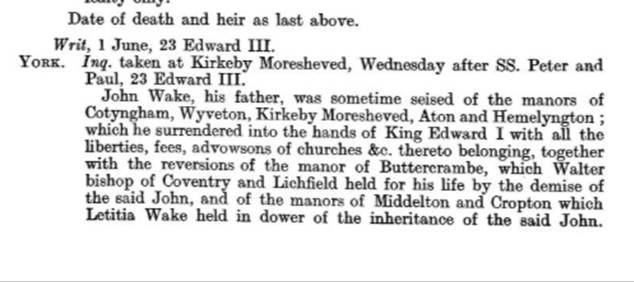
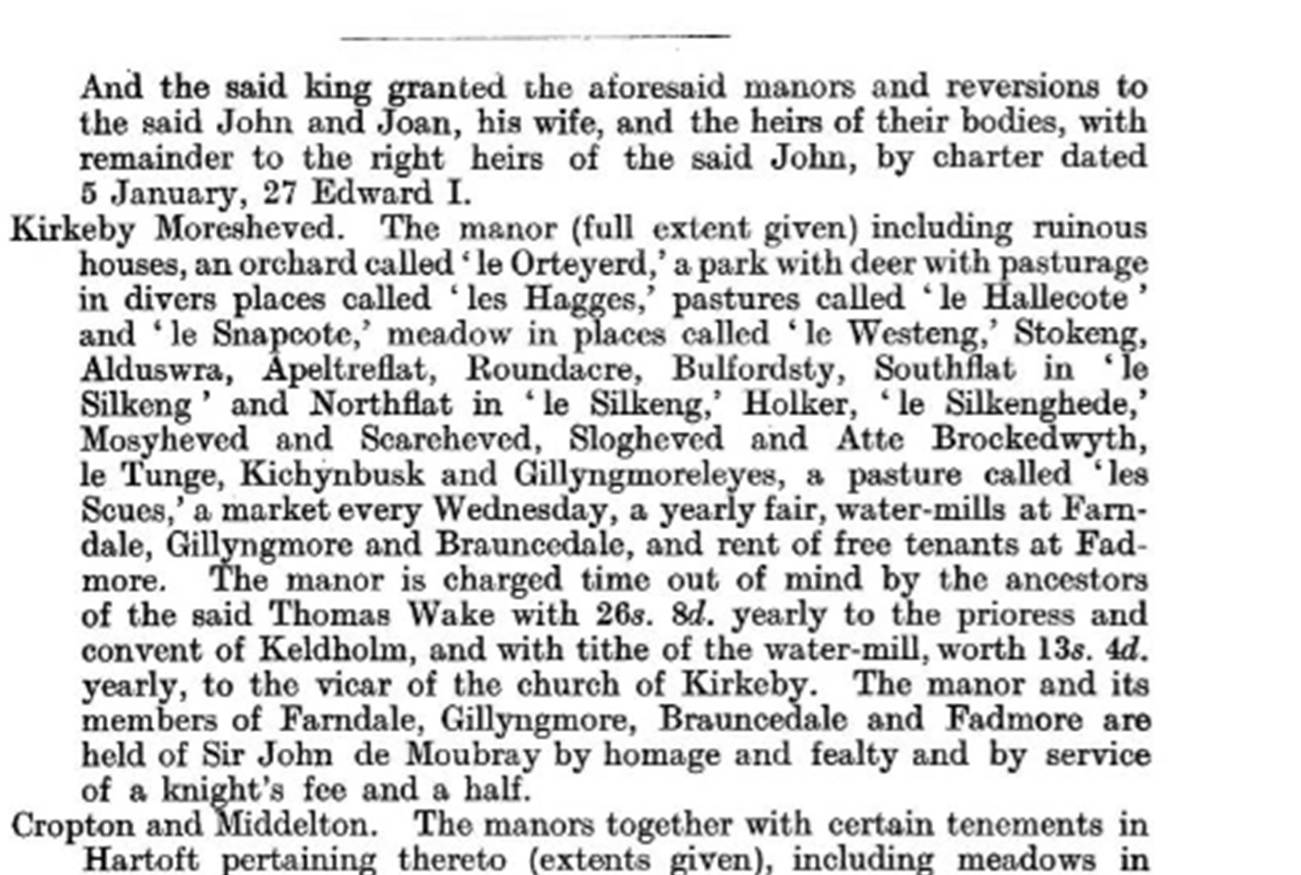
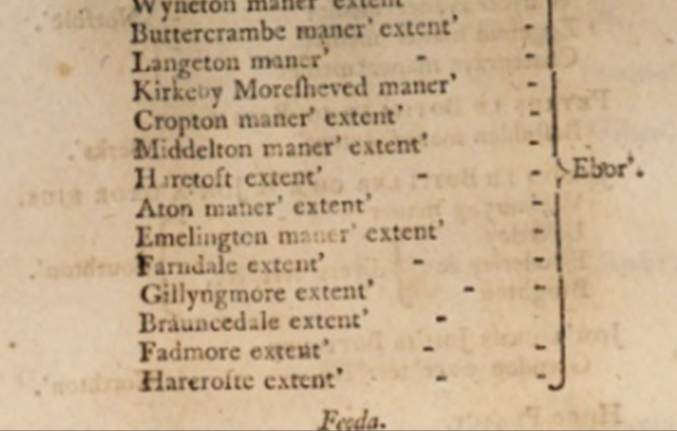
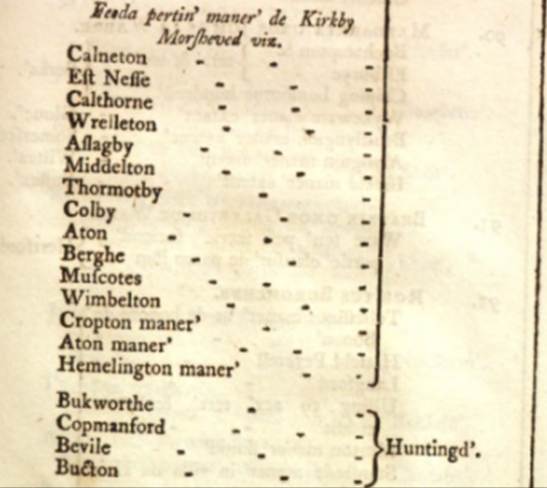
The Inquisition Post
Mortem on the death of Thomas Wake (1297 to 1349) in 23 Edward III (1349 to
1350) listed Farndale and Kirkbymoorside (Kirkby Moresheved)
in his fee (Calendarium inquisitionum post mortem
sive escaetarum, Volume 2 (1327 to 1377), page 152).
Thomas’ sister, Margaret Wake became Lady of the
Stuteville-Wake Estates from 31 May 1349 but died on 29 September 1349 during
the Black Death. Margaret had married Edmund of Woodstock, 1st Earl
of Kent, the youngest son of Edward 1 and Margaret of France, in 1325. Edmund
had rebelled against the Mortimer regime during the minority of Edward III and
had been executed in 1330, but when Edward III assumed personal rule, himself
regaining contril from the Mortimer regime, the
widowed Margaret was restored to royal favour.
The manor of Farndale continued to be held of Sir John
de Mowbray for a knight’s fee and a half and the water mills continued to be
featured (Calendar of Inquisitions Post Mortem, Volume 9, (Edward IIII, 1347 to 1352), page
235 (Folio 234)).
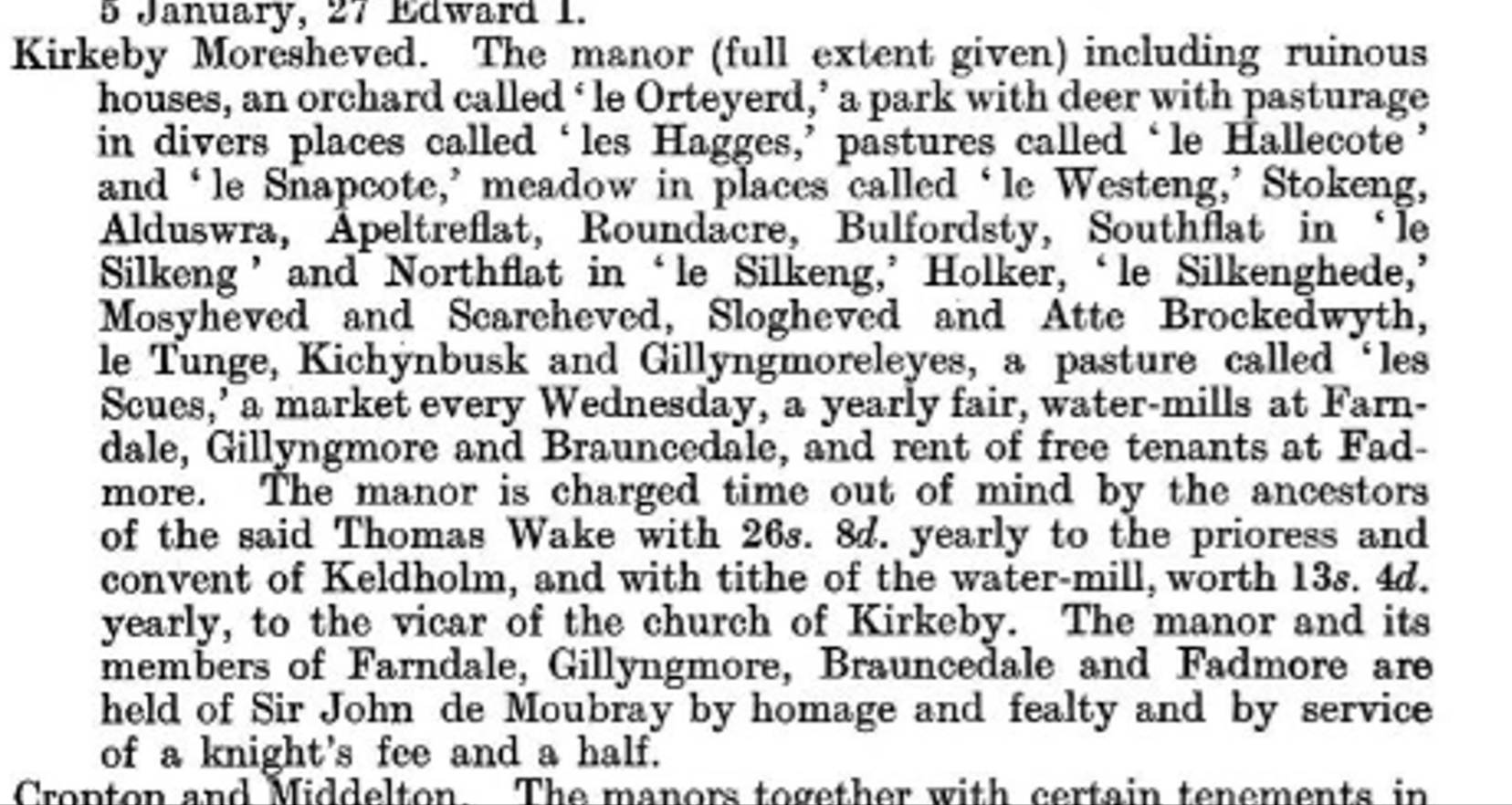

10 October 1350, Westminster. … the rent was taken
into the king's hand at Edmund's death and was afterwards assigned to
Margaret, late Edmund's wife, in dower, and was resumed into the king's
hand after her death, and subsequently the king granted to John all the
lands which belonged to Margaret, to wit, those which she held at her death
of the inheritance of Thomas Wake of Lidel, her
brother, and those which she held of John's inheritance, to hold at ferni until he should come of age, together with the issues
thereof, from the time of Margaret's death, which took place at Michaelmas in
the 23rd year of the reign, as is found by divers inquisitions. (Close Rolls of the reign of Edward III, 1349 to
1354, page
251).
Meantime for context, at Kirby Misperton on 5 December
1349, Westminster, To Gerard Salvayn, escheator in eo.
York. Order not to intermeddle further with the manor of Thornton in Craven and
the advowson of the church there, restoring the issues thereof to Thomas de Roos, son of William de Roos of Hamelak, as the king has learned by inquisition taken by
the escheator that Margaret de Roos at her death held
the said manor and advowson for life of the grant of George de Roos, knight, and of Peter de Rither, late parson of
Kirkeby Misperton church, with remainder to Thomas, by a fine levied in the
king's court, and that the manor and advowson are held of another than the king
by certain services (Close Rolls of the reign of Edward III, 1349 to 1354, page
126).
John Wake, 3rd Earl of Kent became the
landowner of the Kirkbymoorside estate after Margaret’s death, but only until
1352 when he too died.
1352
John Wake, Earl of Kent,
died in 1352 and his Inquisition Post Mortem on 30 December 1352 (in 26 Edward
III), confirmed that Kirkbymoorside and Farndale continued to be held by
service of one and a half knight’s fees of John de Moubray (Calendar of Inquisitions Post
Mortem, Volume 10, (Edward III, 1352 to 1361), page 47 (Folio 46)).
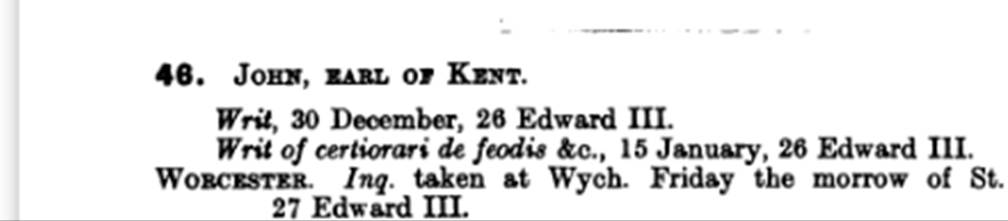
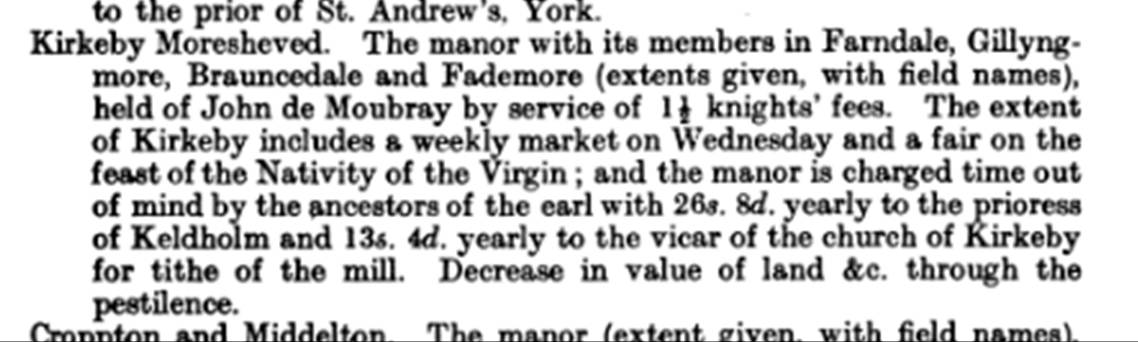
The manor with its members in
Farndale, Gillyngmore, Brauncedale
and Fademore (extents given, with field names), held
of John de Moubray by service of 1½ knights’ fees. The extent of Kirkeby
includes a weekly market on Wednesday and a fair on the feast of the Nativity
of the Virgin; and the manor is charged time out of mind by the ancestors of
the earl with 26s. 8d. yearly to the prioress of Keldholm
and 13s. 4d. yearly to the vicar of the church of Kirkeby for tithe of the
mill. Decrease in value of land &c. through the pestilence.
Joan, Countess of Kent, 4th Countess of Kent, 5th Baroness Wake of
Liddell the Fair Maid of Kent (29 September 1326 or 1327 to 7 August 1385)(see FAR00046A) became Lady of the Stuteville-Wake Estates from 1352 to 1385.
Thomas Holland, Joan’s first wife, became Earl of Kent until he
died in 1360 and his Inquisition Post Mortem on 16 January 1360 included
Kirkbymoorside with lands in Farndale held of John de Mowbray (Calendar of Inquisitions Post Mortem, Volume 10, (Edward III, 1352 to 1361), page 554 (Folio 657)).


1361
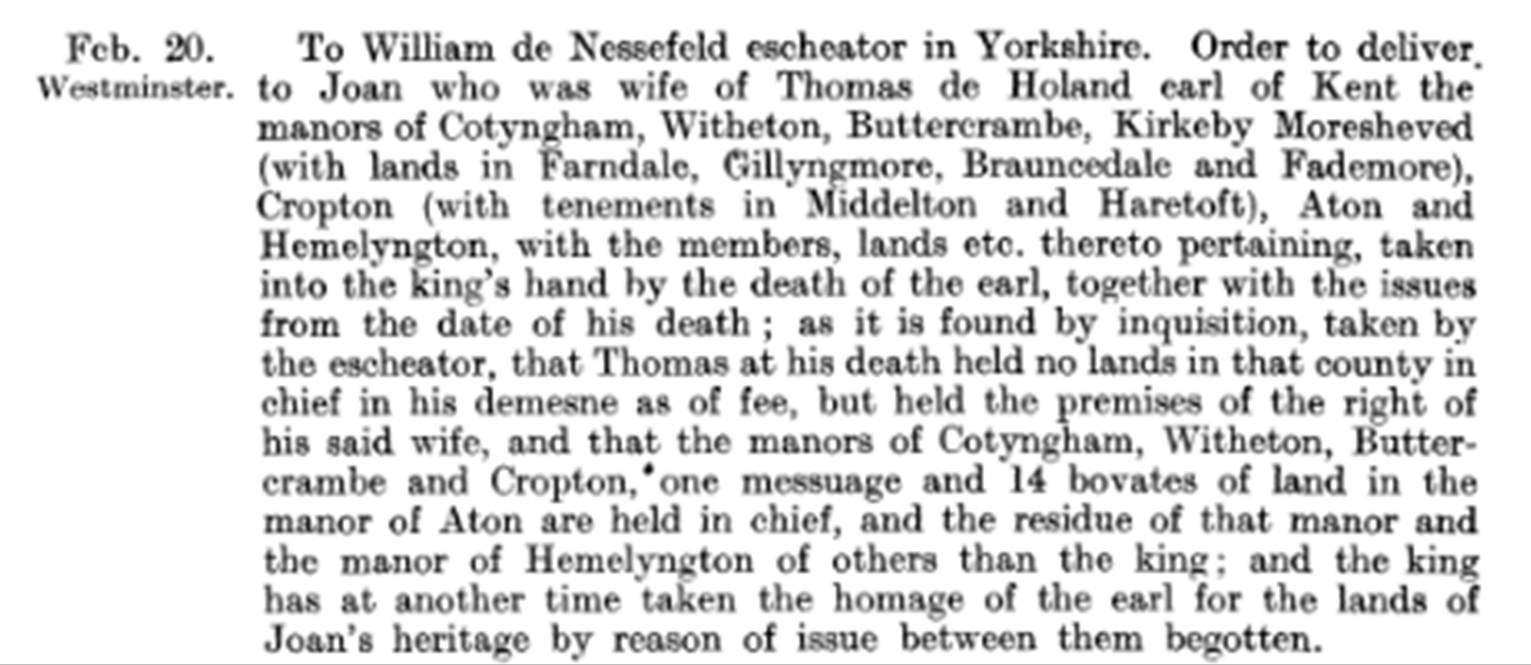
(Close Rolls of the reign of Edward III, 1360 to 1364, page
175)
On 10 October 1361 Joan married the Black Prince.
In
addition to agriculture there was also, at any rate by the middle of the 14th
Century, sheep farming on a scale large enough to make it worthwhile for
Yorkshire wool merchants to collect it. In 1361 two merchants, Roger de
Hovingham and Thomas de Kerr of Ryedale, were arraigned before the justices on
a charge of selling sacks of wool which were underweight. It was stated in the
evidence that the wool came from Rievaulx, Malton, Kirkby Moorside, Helmsley,
Bilsdale, Farndale and Hovingham. It is interesting to note that
neither Bransdale nor Rosedale are mentioned, and this is just one more
indication to be added to a number of others to suggest that Farndale has
always been of more historical importance than its sister dales. (Notes on the History of Farndale in the Middle Ages, Arthur H Whitaker, Ryedale Historian, Volume 2,
1966, page
61).
They also say
[that] Roger de Houingham of York, Hugh de Marton (of
the same), William Grae of the same, Richard de Wateby
of the same, Walter de Kelstern of the sam,e William de Broune of the same, Henry Godebarne of the
same, Roger de Moreton of the same, Nicholas Taverner of the same, William
Couper of the same, William Frankys of the same, Richard de Schirburne of the
same, John de Broune of the same, Gocelinus
del Haghe Esterling of the same, John de Gisburne of
the same, Thomas de Sigeston of the same, Adam Pund
of Hull, William de Touthorp of Malton,
Nicholas de Locketon of the same, William de Knapton
of the same, Thomas del Kerr of Rydale (and) William
de Kaldham of Pykering are common wool merchants and
have been buying wool for the past nine years by pounds weighing twelve pounds
and a half, and sacks weighing thirty pounds, to the impoverishment of many and
in contempt of the King and against a statute issued to the contrary. And they
bought that wool at Ryuaux, Malton, Kirkebimoresheued, Helmsley, Bilsdale, Farndale, Hovingham,
Slingesby, Nonington, Naulton, Bothelom, and Halmby, and elsewhere within the aforesaid Northridingo (Yorkshire Archaelogical Record
Series Volume 100 page 85).
The estate of Kirkbymoorside was held of Edward, the Prince of
Wales, the King’s son, as recorded in the Inquisition Post Mortem of John de Fritheby (Calendar of Inquisitions Post Mortem, Volume 11, (Edward III, 1361 to
1365), page 260 (Folio 323)).
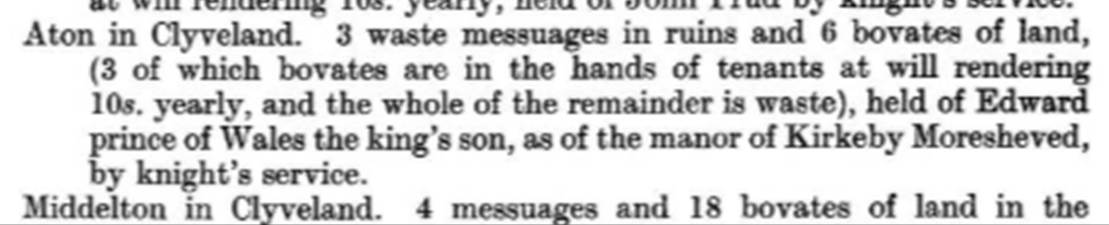
The
Black Prince (1330 to 1376), the son of Edward III (reigned 1327 to 1377), ordered
his keeper of the Farndale wood to deliver a single oak, suitable for shingles,
for the roofing of Gillamoor chapel (John Rushton, The History of Ryedale, 2003, 126, The Black Prince’s Register, Part IV (1351 to 1365), page 517).
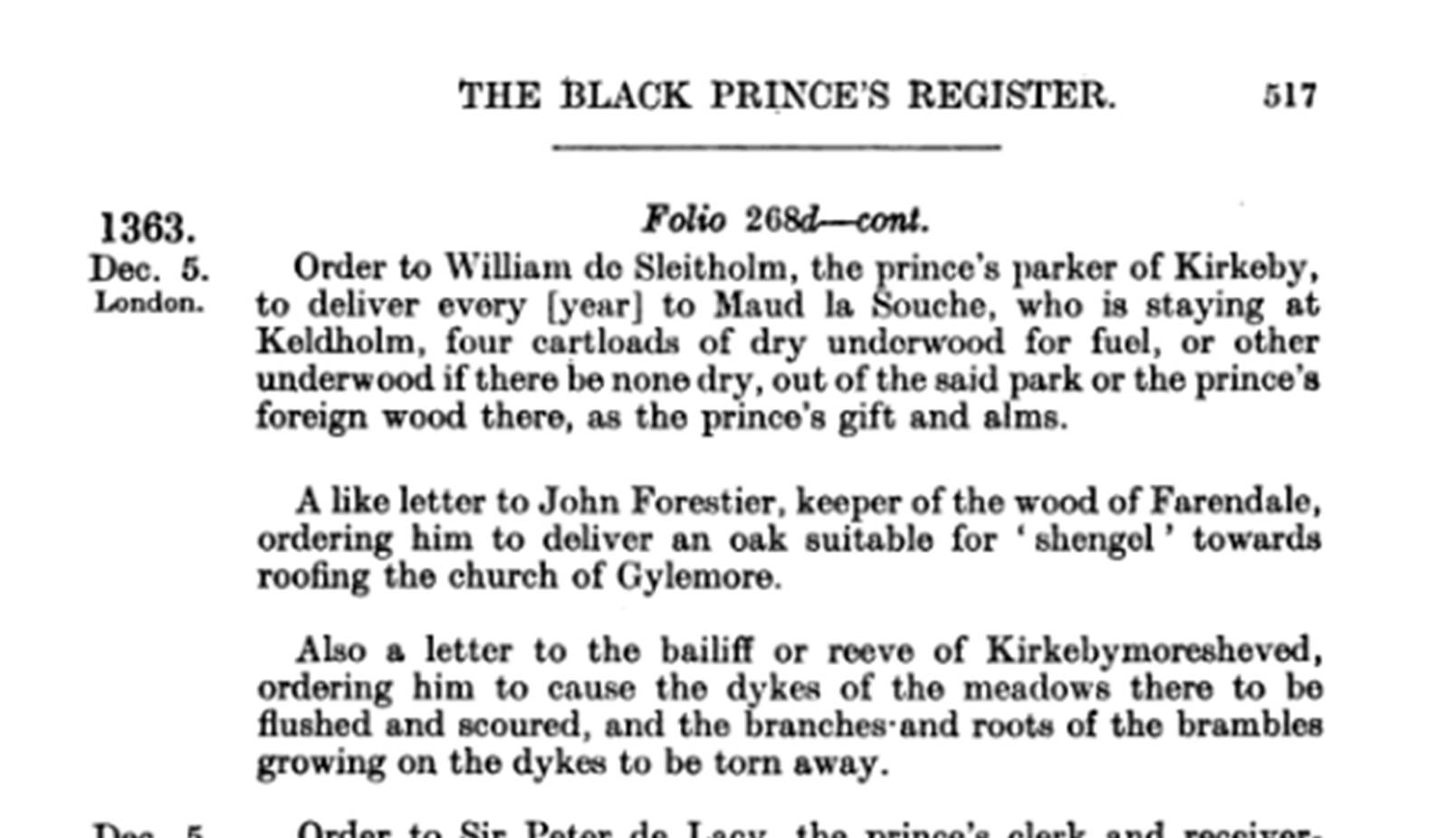
In 1336 (sic) John Forestier,
keeper of the wood of Farndale, had to deliver an oak suitable for shengel for roofing the church at Gillamoor.
He also granted oak trees for ‘crucks’. (Raymond
Hayes, Farndale, 1961, unpublished, page 34).
1365
in 1365 Joan and her new husband, the Black Prince, formally
settled the Kirkbymoorside manor on her son by her former husband, Thomas
Holland, the Second Earl of Kent, and Alice FitzAlan, his wife and their heirs,
with reversion to the prince and herself. So Joan’s direct interest in Farndale
passed on to her Holland sons. Perhaps her elevated lifestyle meant that by
1365 she was not so bothered about retaining her northern lands in her direct
ownership. The Kent and Kirkbymoorside lands thus passed down to the line of
the Hollands.
Westminster. Quindene of Trinity, 39
Edward Ill, 1365. Thomas de Holande and Alesia
daughter of Richard, Earl of Arundell, quer., Edward,
Prince of Aquitaine and Wales and Joan his wife, def., of the manors of Kirkebymoresheved, Bottercramp,
and Cropton: To hold to Thomas and Alesia and the heirs of their bodies, of the
king and his heirs ; reversion to the Prince and Joan and the heirs of Joan.
Thomas and Alesia gave £1,000. This concord was made by precept of the king.
(Feet of Fines for the county of York (1347 to 1377), Edited by W
Pailey Baildon, Yorkshire Archaeological Society Record Series, volume 52,
1915, page 111).
1379
18 November 1379, Westminster … Wilham de Feryby vicar of Kyrkeby Moreshede in Rydale (Close Rolls of the reign of Richard II,
1377 to 1381, page
339).
1384
24 August 1384, London. Thomas de Holland earl
of Kent, John Lovell, Thomas Brewes, Nicholas Sarnesfeld, Thomas
Godelak, Nicholas Dabrichecourt knights and Robert Dynele esquire to the king.
Recognisance for 10,000 marks, to be levied etc. in Yorkshire, Wiltesir, Kent, the county of Suthampton,
Surrey and Sussex. (Close Rolls of the reign of Richard II, 1381 to 1385, page
572).
1385
Joan of Kent died on 7 August 1385.
1388
On 19 November 1388 licence was granted to the
inhabitants of Farndale to have masses celebrated in their chapel (York Archbishop Registers, Register 14 f.6 (recto) entry
4).
Farndale was never part of the
manor of Spaunton, but the east side of the dale was
from an early date part of the parish of Lastingham, and remained so until 1873
when it was joined to Bransdale. The west side of the dale was always in the
parish of Kirkby Moorside. Writing in 1913, the Rev. F.H. Weston says ''the
church of St. Mary (in Farndale) was built about 250 years ago as a chapel of
ease to Lastingham". (Rev.
F.H. Weston History of the Ancient Parish of Lastingham page 61) That there was a chapel in Farndale long before that time,
however, is proved by its being marked on Saxton's
map 1577, and also by reference to it in
the will of William Folancebye made on 3rd May 1537 - ''also I bequethe
to Farnedall chapell ij torches and ij yowes”. (Register
of Wills in the Borthwick Institute, York). This is the earliest
reference to a chapel in the dale which has yet come to light, but one wonders
whether the Willelmus
Clericus (William the Clerk) named in the Lay Subsidy Roll of
1301 may have been the chaplain there.
In addition to this chapel,
whenever it may have been founded, the medieval inhabitants of Farndale could
worship in the chapel of ease at Gillamoor whose
parent church was the parish church of Kirkby Moorside. Until the Dissolution
the Prior and Convent of Newburgh Priory presented priests to both these
churches, and it was for the repair of the church at Gillamoor
that the Black Prince, in December 1363 ordered John Forestier, "keeper of
the wood of Farendale ... to deliver an oak suitable
for 'shengel' towards roofing (it) (The Black Prince's Register part 4, folio 286d). The famous warrior son of Edward III had come into
possession of Farndale through his wife Joan who was the niece of Thomas Wake
referred to above. Her son by Edward the Black Prince was Richard II.
(Notes on the History of Farndale
in the Middle Ages, Arthur H Whitaker,
Ryedale Historian, Volume 2, 1966, page
59).
Parish
churches and their dependent chapels provided religious services to the
villages. Parishes grouped townships to sustain them by payments of tithe on
everything that increased annually, by alterage, fees
and funeral dues. Burials, weddings and baptisms took place at mother-churches
but many vanished village chapels saw offices said. The farmer's year merged in
saintly festivals. Patronal festivals saw dancing, ales and feasts. Good
Friday, the feast of the Annunciation of Mary, Ascension Day, Palm Sunday,
Rogationtide and St. Thomas Day had each their rituals. In a Catholic world Spelcross stood near Kirkdale and there were holy wells at Pockley's Lady Keld, at Easthorpe,at
St. Wilfred's Spring, Gilling, and several more near Lastingham.
(Life
in Ryedale in the 14th century, J H Rushton, Ryedale
Historian, Volume 9, 1978, page
45).
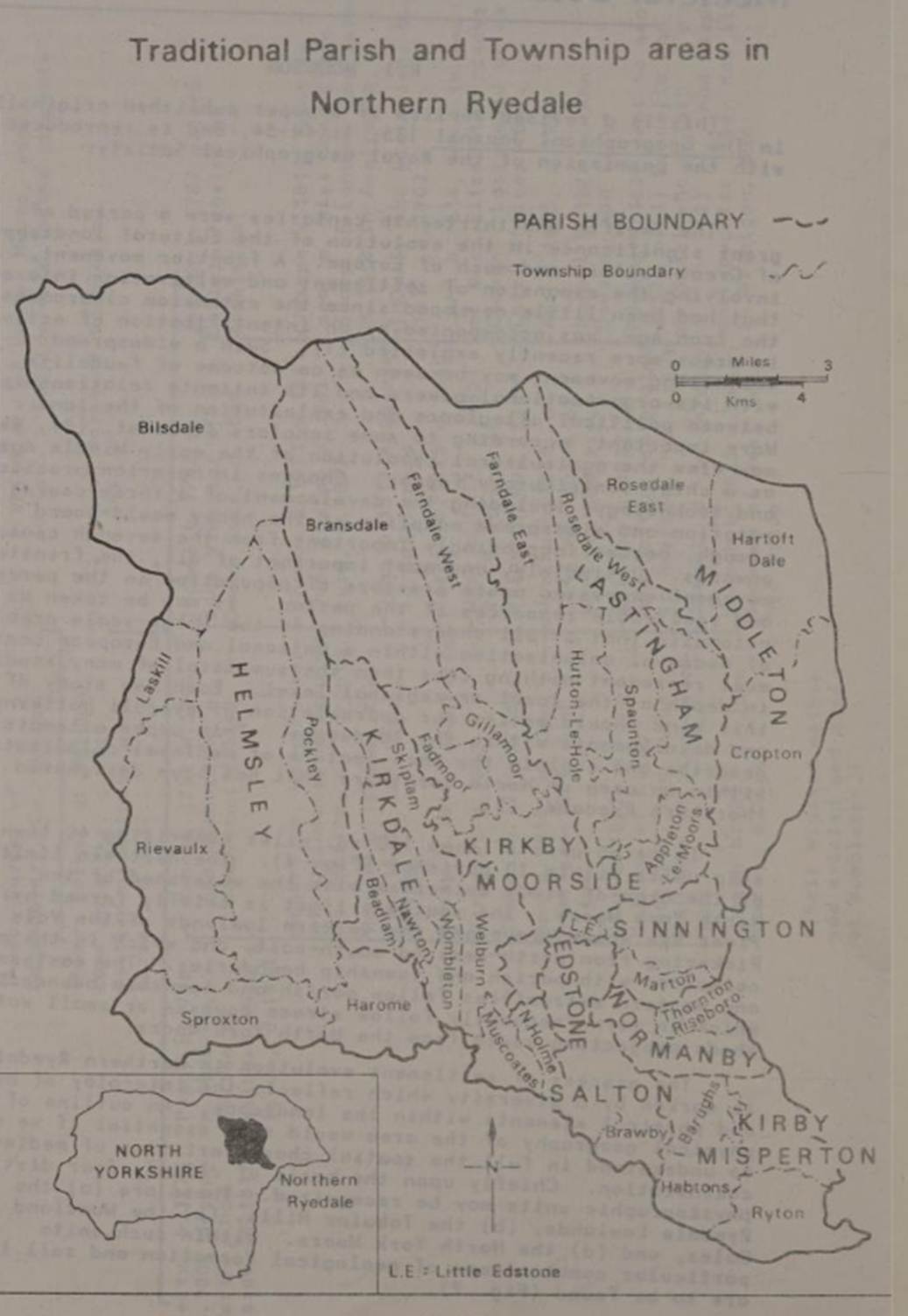
(Medieval Colonisation in Ryedale, R I Hodgson, Ryedale Historian,
Volume 10, 1980, page 47).
By the end of the fourteenth century, the dale was
filled with agricultural activity, from the Duffin Stone, Eller House and Monket House on the west side, to Lady Green to the east,
focused around its mills and with its hub at Low Mill.
1389
In 1389 many members of the nobility, including Thomas
earl of Kent, were summoned to a parliament at Westminster (Close Rolls of the reign of Richard II,
1389 to 1392, page
99).
1390
Thomas de Holland earl of Kent was constable of the
Tower of London (Close Rolls of the reign of Richard II,
1389 to 1392, page
195).
1393
Thomas de Holand was earl of Kent and lord Wake (Close
Rolls of the reign of Richard II, 1392 to 1396, page 111).
1394
22 June 1394, Westminster. Ralph lord Neville to
Thomas de Holand earl of Kent and lord Wake. Recognisance for 3,000 marks to be
levied etc in Yorkshire. Thomas de Holand (as above) to Ralph Neville. Like
recognisance, to be levied etc in Kent. Ralph lord Neville to Thomas de Holand
(as before). Recognisance for 600 marks, to be levied etc in Yorkshire. (Close Rolls of the reign of Richard
II, 1392 to 1396, page 358).
1397
Kirkbymoorside (Kirkby
Moreshed) was part of the fee of Thomas Holland
of Castille, son of Thomas Holland and Joan of Kent, and his wife Alice
FitzAlan until his death in 1397 when the estate was recorded in the Inqisution Post Mortem of 20 Richard II (1396/7) (Calendarium inquisitionum post mortem
sive escaetarum, Volume 3 (1377 to 1413), page
200).
In the report on Thomas’ death, Kyrkebymoresheved. The
manor (extent given), held of the earl marshal by knight’s service and Kirkebymoresheved, Berght,
Muscotes, Wymbilton, Raventhorp, Thirby, Conesby, Calveton, Upsall, Kylvyngton and Thornberght. A
knight’s fee and a half. Keldholm. The advowson of
the abbey of nuns. (Calendar of Inquisitions Post
Mortem, Volume 17, (Richard II, 1392 to 1399), Folio
815, 842).
When Thomas of Kent died, his widow Alice FitzAlan
(1350 to 17 March 1416) was left in possession of his estates for life. Of
Alice’s sons, Thomas the Elder was beheaded as a traitor by the new King Henry
IV on 7 January 1400 (aged 27) after taking part in the Epiphany Rising which
tried to restore Richard II to the throne, and his brother Edmund had died in
1408 before his mother and the earldom of Kent fell into abeyance.
By their daughters, the Kents were the ancestors of
many prominent figures in the Wars of the Roses. Eleanor I Holland married
Roger Mortimer. Joan Holland married Edmund of Langley, 1st Duke of
York. Margaret Holland married John Beaufort and Thomas of Lancaster. Elizabeth
Holland married Sir John Neville and had three sons, Ralph Neville, John
Neville and Thomas Neville and a daughter Margaret Neville.
With the turn of the Century came a radical
change in the ownership of Farndale. For three centuries the Mowbray family had
held it as tenants-in-chief, sub- letting it as we have seen, first to the
Stutevilles and then to the Wakes as heirs of the Stutevilles. In 1397, Thomas
Mowbray, the twelfth baron, was created 1st Duke of Norfolk, but in the
following year he was accused of treason, was banished and his estates were
forfeited. Thus the manor of Kirkby Moorside and with it Farndale reverted into
the king's hands. The de Holand family Earls of Kent, were closely related to
Richard II and it is not therefore surprising to find the manor given to them.
It is in the inquisition post mortem
held into the estates of Alice, late wife of Thomas late Earl of Kent, in 1415,
that we read "The said Alice also held...... the advowson of the chapel of
the Brethren of Holy Charity in Farndale, worth 10s a year.” (Inquisitions
post mortem relating to Yorkshire, of the reigns of Henry IV and Henry V, page 126).
(Notes on the History of Farndale in the Middle Ages, Arthur H Whitaker, Ryedale Historian, Volume 2,
1966, page 60).