The Poachers of Pickering Forest
The inhabitants of Farndale who encountered the Forest Law in
Pickering Forest
|
Return to the Home Page of the Farndale Family
Website |
The story of one family’s journey through two
thousand years of British History |
The 83 family lines into which the family is divided.
Meet the whole family and how the wider family is related |
Members of the historical family ordered by date of
birth |
Links to other pages with historical research and
related material |
The story of the Bakers of Highfields, the Chapmans,
and other related families |
Dates are in red.
Hyperlinks to
other pages are in dark
blue.
Headlines are in brown.
References and
citations are in turquoise.
Context and local
history are in purple.
Individuals from Farndale are shown in
green.
This page is
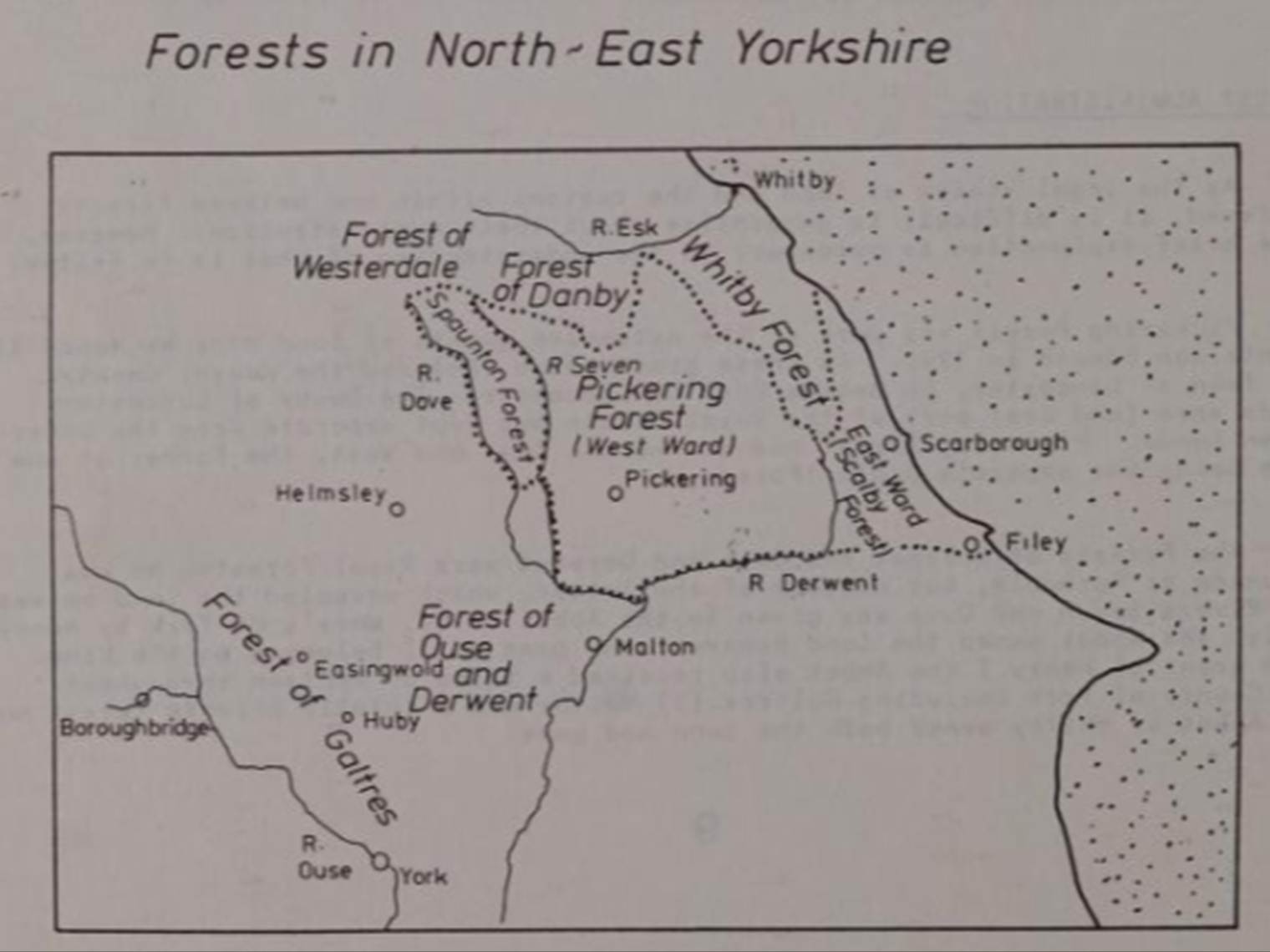
accompanied by a webpage about medieval Forest Law.
And then the justice, in fair round
belly with good capon lin’d,
with eyes severe and beard of formal cut, full of wise saws and modern
instances and so he plays his part.
(William Shakespeare, As You Like It, Act II Scene VII)
On a cold Monday in January 1293,
five men, including Roger the Miller of Farndale (FAR00013A) and Walter Blackhous of Farndale (BLA00001) went hunting in a part of West Rosedale that belonged to St
Mary’s Abbey and at an unknown place in the forest they killed a soar (a sow or
female boar), and a hart (an adult male deer, generally a red deer over five
years old), with bows and arrows. They were all outlawed. (North Riding Records Yorks, The Honour and Forest of
Pickering, 1894, Volume
II at
page
110,
possibly folio 222 in the Coucher Book).
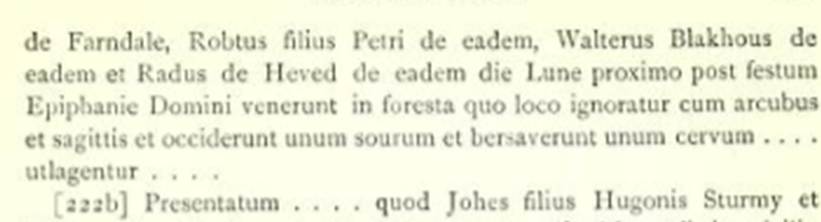

See details and
research notes.
1301
The male taxable inhabitants of Farndale at the turn of
the fourteenth century were listed in the lay subsidy of
1301 (FAR00029). The Subsidies of 1301, 1327 and 1333
provide evidence of the inhabitants of Farndale, and some of their movements,
at the time of these poaching offences, and help to build up a more dynamic
picture of the circumstances.
Grazing
Dues
Not the least of the profits derived from the
possession of a forest was that arising from the agistment of cattle in waste
grounds.
Rights over the common moors of Pickering varied. Some pasturages were reserved
for the use of the King where there was no right in common and here, cattle
were agisted at a fixed price, to be paid to the
bailiff. Agistments were also made on the High Moor. These sums were
collected by the agisters, of whom there were two in each ward, men of
substance by their assessments in the Law Subsidies. (The Duchy of Lancaster Records, from the North Riding
Record Society, The Honour and Forest of Pickering, Edited by Robert
Bell Turton, Volume IV, 1897, page xxvii).
A number of local folk had taken draught beasts into
Pickering Forest in the reign of Edward III in 1310 or 1311, where the beasts
were found and forfeited for a price. Thomas Wake, the Lord of Liddell, whose
tenants they were, said the price had already been paid and the tenants should
be discharged of the matter. Those involved from Farndale were:
|
Draught
animals found in Pickering Forest |
Value
of the beasts agisted |
|
|
1
oxen and 2 stirks (a stirk is a young bull or cow especially between one and
two years old) |
7s
4d |
|
|
Walter (FAR00014A), son
of Robert the Smith of Farndale (FAR00021C) |
5
oxen |
20s |
|
3
oxen |
12s |
|
|
Hugh Laverok of
Farndale (LEV00001) |
1 cow and 1 stirk |
4s 8d |
|
William Stibbyng of
Farndale (FAR00033) |
6 oxen |
24s |
|
William
de Waldehus of Farndale (WAL00001) |
5 oxen, 4 cows and 4 stirks |
38s 8d |
|
4 oxen and 1 stirk |
17s 8d |
|
|
1 cow |
3s |
|
|
6 oxen, 2 bullocks and 2 beasts of
burden |
38s |
|
|
6 oxen and 1 cow |
27s |
|
|
Hugh del Radmire of Farndale (RED00001) |
6 oxen |
24s |
|
William ad Portam of Farndale (POR00001) |
5 oxen |
20s |
|
John the shepherd of
Farndale (FAR00010) |
9 oxen, 1 cow and 1 stirk |
41s 8d |
|
Roger,
the groom of John the shepherd of Farndale (FAR00010) |
1 bullock |
4s |
|
Nicholas de Harland of
Farndale (HAR00001) |
1 ox and 1 bullock |
7s |
|
Alan de Wrelton of Farndale (WRE00001) |
4 oxen and 2 cows |
19s |
|
2 bullocks and 1 ox |
12s |
|
|
4 oxen, 3 bullocks, 1 cow, 2 beasts
of burden and 1 stirk |
38s 8d |
(The Great Cowcher of the Duchy of
Lancaster, The National Archives, DL42/1 Folio 273, 273v, DL
42/1/23/U64 folios 273 to 274v, North
Riding Records Yorks Volume III,
The Honour and Forest of Pickering, 1894, Edited Robert Bell Turton, page 61)
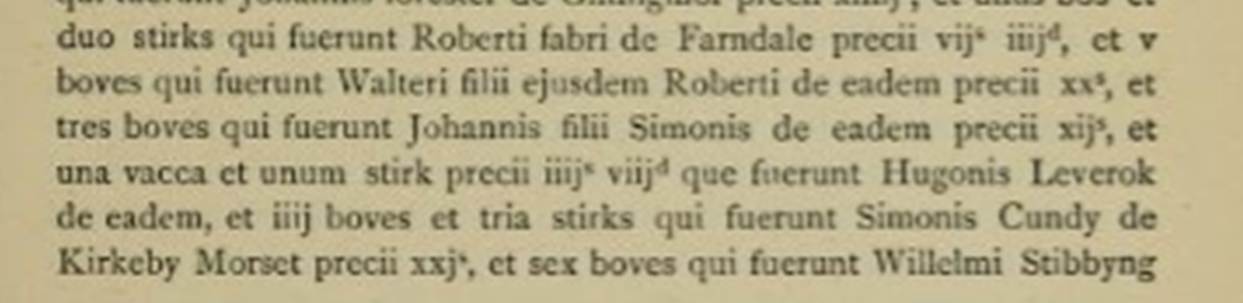
See details
and research notes.
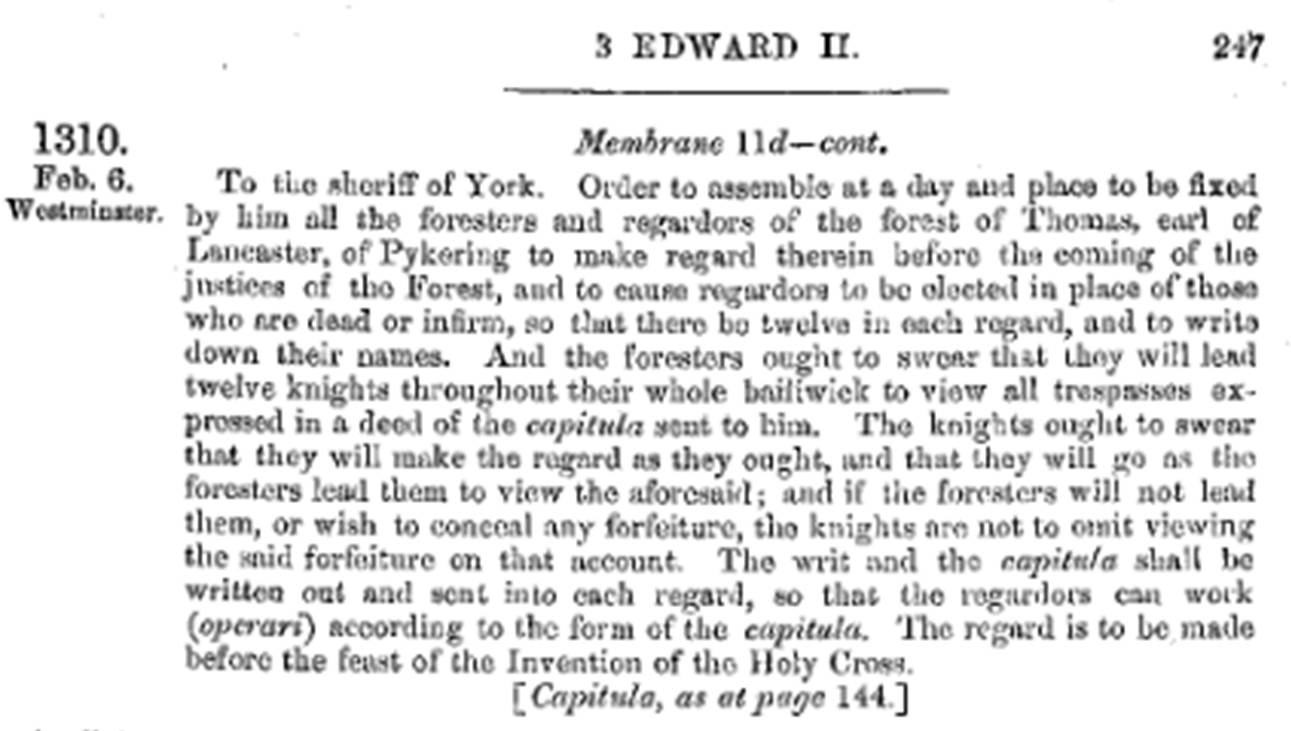
(Close Rolls of the reign of Edward
II, 1307 to 1313, page 247)
In 1315, one of Britain's worst
storms halved the crop yield and half a million perished. As the price of crops
increased many were driven to supplement their diets by hunting. Where
previously common rights were exercised in royal forests, such as Pickering, it
was a criminal offence. Such men must have been skilled bowmen, potentially
also those who may be called upon to fight for their king. However when they
hunted in the royal forests they faced onerous penalties. The hunters were
chased by the king's foresters and were often caught, tried, fined and
sometimes excommunicated or outlawed.
The Poachers
A number of individuals from Farndale
were fined following prior indictments for poaching in 1334 and not turning up
at the Eyre. They paid bail or had bail paid for them. The 1334 Eyre picked up
on offences over several decades, so the offences were likely to have occurred
much earlier.
|
Date of Hearing |
Notional date of Offence |
Payer |
Guarantor (malpernor) |
Poacher |
Amount of Fine |
|
3 October 1334 |
c 1315 |
Nicholas de Repyngale |
John son
of Abbas (ADA00003) |
1s 8d |
|
|
3 October 1334 |
c 1315 |
John Albred |
John Albred |
John de Hutton (HOT00003) |
2s |
|
3 October 1334 |
c 1316 |
Roger son of
Gilbert of Farndale (FAR00013A) |
Roger son of
Gilbert of Farndale (FAR00013A) |
Thomas Makaunt |
1s |
|
3 October 1334 |
c 1317 |
Elias Cokerell (COK00002) |
Elias Cokerell (COK00002) |
Peter son
of Gervase |
2s |
|
3 October 1334 |
c 1317 |
Peter son of
Gervais |
John Cokerell (COK00001) |
Roger merchant
of Pickering |
2s |
|
3 October 1334 |
c 1319 |
Nicholas de
Farndale (FAR00041A) |
Robert Westgyll (WES00005) |
3s 4d |
|
|
3 October 1334 |
c 1319 |
Nicholas de Repyngale |
Nicholas de Repyngale |
John Shepherd
of Farndale (FAR00010) |
3s 4d |
|
3 October 1334 |
c 1319 |
Nicholas de
Farndale (FAR00041A) |
Nicholas de
Farndale (FAR00041A) |
William the
Smith of Farndale (FAR00037) |
2s |
|
3 October 1334 |
c 1319 |
William the
Smith (FAR00037) |
John Alberd |
2s |
|
|
3 October 1334 |
c 1320 |
John Alberd |
John Alberd |
2s |
|
|
3 October 1334 |
c 1320 |
Nicholas de Repyngale |
Nicholas de Repyngale |
William the
Smith of Farndale (FAR00037) |
2s |
|
3 October 1334 |
c 1320 |
John Alberd |
Richard (FAR00016) son of John the Miller of Farndale (FAR00021B) |
3s 4d |
|
|
3 October 1334 |
c 1321 |
John Alberd |
Adam (FAR00025) son of Simon the Miller of
Farndale (FAR00021) |
3s 4d |
|
|
3 October 1334 |
c 1321 |
William the Smith (FAR00037) |
William the Smith (FAR00037) |
2s |
|
|
3 October 1334 |
c 1325 |
Walter Trusseleygh |
Adam (FAR00025) son of Simon the Miller of
Farndale (FAR00021) |
Nicholas de Repyngale |
5s |
(The Duchy of Lancaster Records, from the North Riding Record
Society, The Honour and Forest of Pickering, Edited by Robert Bell
Turton, 1897, page 23 and 28 and 34, North Riding Records, Volume IV by the North Yorkshire Record
Society, the Honour and Forest of Pickering, 1897, page 23 and 28, not on line but I have a physical copy, North Riding Records Yorks, Volume IV, The Honour and Forest of
Pickering).
See details and
research notes.
Richard de Farndale (FAR00016) and
Thomas of Farndale (FAR00023),
were excommunicated for
stealing at Pickering
Castle on 12
August 1316. (Patent Rolls). This relates to Pickering Castle and may have arisen from an
earlier poaching incident.
Sentence of
Excommunication; ‘To the Most Serene Prince, his Lord Edward by the Grace of
God, King of England, illustrious Lord of Ireland and Duke of Aquitaine, his
humble and devoted clerks, the Reverend Dean and Chapter of the Church of St
Peter, York; custodians of the spiritualities of the Archbishopric while the
See is vacant; Greetings to him to serve whom is to reign for ever. We make
known to your Royal Excellency by these presents that John de Carter, William
of Elington, Adam of Killeburn, John Porter, Hugh Fullo, Peter Fullo, John of Halmby, Adam Playceman, John Foghill, Thomas Thoyman,
Robert the Miller, Adam of the Kitchen, Richard Mereschall, John Gomodman, John
Wallefrere, Alan Gage, Henry Cucte, Nicholas of the Stable, John the baker,
Adam of Craven, John son of Imanye, Michael of Cokewald,
Thomas of Morton, John of Westmerland, Thomas of
Bradeford, Adam of Craven, John of Mittelhaue, John
called Lamb, William Cowherd, Simon of Plabay,
William the Oxherd, Henry of Rossedale, John of
Carlton, Peter of Boldeby, Thomas of Redmere, Walter of Boys, William of Fairland, John of Skalton, John of Thufden, Henry
the Shepherd’s boy, John of Foxton, Thomas of Farndale, John of Ampleford, John Boost, Roger of Kerby, John of Stybbyng, William of Carlton, Richard of Kilburn, Adam
Scot, Peter of Gilling, John of Skalton, Stephen of Skalton, Richard of Farndale, Richard of Malthous, John the Oxherd, Robert of Rypon,
Walter of Fyssheburn, Adam of Oswadkyrke,
William of Everley, Hugh of Salton, William Robley, William of Kilburn,
Geoffrey the Gaythirde, John of the Loge, Robert of Faldington,
Nicholas of Wasse, William of Eversley, Robert of Habym,
John of Baggeby and William Boost, our Parishioners,
by reason of their contumacy and offence were bound in our authority by
sentence of greater excommunication, and in this have remained obdurate for 40
days and more, and have up to now continued in contempt of the authority of
the Church. Wherefore we beseech your Royal Excellency, in order that the
pride of these said rebels may be overcome, that it may please you to
grant Letters, according to previous meritorious and pious custom of your Realm,
so that the Mother Church may, in this matter, be supported by the power of
Your Majesty. May God preserve you for His Church and people.’
Given at York 12 August 1316.
See details
and research notes.
1 July 1323
The
Deer Poachers at Petreneldel
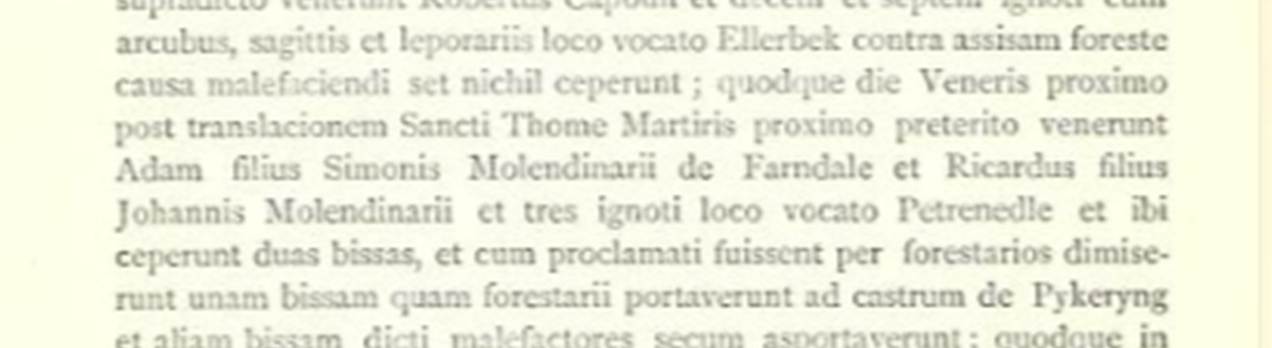
On 1 July 1323 Adam (FAR00025), son of
Simon the miller of Farndale (FAR00021), and Richard (FAR00016), son of
John the miller (FAR00021B), with
three other unknown men, came into Pickering Forest in a place called
Petreneldel, and took two deer. When they had been proclaimed by the forester,
they sent away one deer, which the foresters carried to the castle of
Pickering, but the wrongdoers carried away the other deer with them and
thereupon did their will. They did not come to a hearing on 3 October 1334
and the sheriff was ordered to apprehend them. Later, Adam and Richard came
before the justices and asked to pay for licence to make concord for their
offence so that they could be redeemed. Adam paid 26s 8d and Richard paid 40s
for this licence, and they found mainpernors
(or guarantors) for these amounts (The Great Cowcher of the Duchy of
Lancaster, The National Archives, DL42/1 Folio 217, DL 42/1/23/U22 folios 217 to 218v, Close Rolls 22 August 1323, 17 Edward II page 15 and 16, North Riding Records Yorks, The Honour and Forest of
Pickering, 1894, Volume
II at page page 96, 217
to 218).
See details and
research notes for 1288 and 1323.
The Release from
Excommunication
John de Farndale (FAR00016A) was
released from excommunication at Pickering Castle on 23 February 1324. This may
have related to a prior poaching offence.
Text of Release From Excommunication; ‘To the Most Serene Prince, His Lord Edward,
by the Grace of God, King of England, Lord of Ireland, and Duke of Aquitaine,
William by Divine permission Archbishop of York, Primate of England, Greetings
in him to serve who is to reign for ever. We make known to Your Royal
Excellency, by these presents that William de Lede of Saxton, John of Farndale and John Brand of Howon, our Parishioners, lately at our ordinary invocation,
according to the custom of your Realm, were bound by sentence of greater
excommunication and, contemptuous of the power of the Church, were committed to
Your Majesty’s Prison for contumacy and offences punishable by imprisonment;
and have humbly done penance to God and to the Church, wherefore they have been
deemed worthy to obtain from us in legal form the benefit of absolution. May it
therefore please Your Majesty that we re-admit the
said William, John and John to the bosom of the Church as faithful members
thereof and order their liberation from the said prison. May God preserve you
for His Church and the people.’ Given at Thorpe, next York, 9 April 1324. (The National Archives C 85/181/61).
See details
and research notes.
Poaching at Soterlund
On 23 June 1325 John (WES00004), son of
Richard de Westgil of Farndale (WES00001), and Robert (WES00005), his
brother came
into Pickering Forest in a certain place called Soterlund,
with one mastiff, and bows and arrows, and they took there one fawn and carried
away the game with them and thereupon did their will.
They were ordered to appear at a hearing of the matter on 3 October 1334, but
although they were living in the country, they did not appear. Therefore the
sheriff was ordered to apprehend them. Afterwards John and Robert came before
the justices, and asked to pay for a licence to make concord, in order that
they would be redeemed. They both paid 30s and they found mainpernors
(guarantors) for the fines. It was acknowledged that from henceforth they would
not forfeit anything in the said forest (The Great Cowcher of
the Duchy of Lancaster, The National Archives, DL42/1 Folio 218v, DL 42/1/23/U22 folios 217 to
218v, North Riding Records Yorks,
The Honour and Forest of Pickering, 1894, Volume
II at
page
100).
See details and research notes.
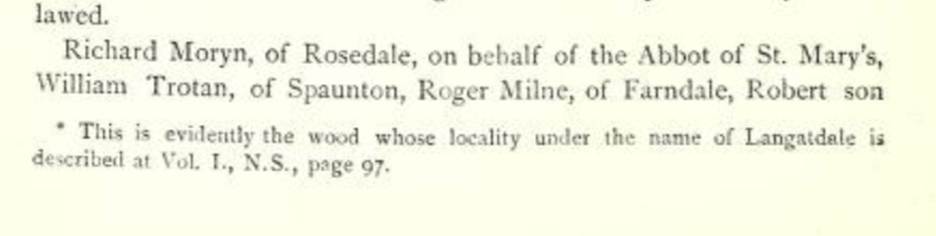
1330
In
1330, Richard Mosyn, of that part of Rossedale which
belongs to the Abbot of S. Mary's (i.e. Rosedale West), William Troten of Spaunton, Roger del Mulne of
Farndale, Robert (FAR00012) son of Peter
(FAR00008) of Rossedale, Walter Blackhous
of Farndale (BLA00001), went on a Monday in January to some unknown
place within the forest and killed a soar and slew a
hart with bows and arrows. All
are outlawed. If we are right about his age, he was about sixty five by then.
A hart is a male deer and a soar is a sow or pig.
The Hart at Leasehow
John (FAR00042A), son of William Fabri (the Smith) of Farndale (FAR00037), and many others captured a young hart at Leasehow, with bows and arrows and hounds.
(The Great Cowcher of the Duchy of
Lancaster, The National Archives, DL42/1 Folio 224, North Riding Records Yorks,
The Honour and Forest of Pickering, 1894, Volume II at page 100).
See details and research notes.
17 to 19 June 1332
Multiple Offences
On or about Monday to Wednesday 17 to 19
June 1332, Roger son of Emma, John de Bordesden, Robert Moryng, John (FAR00042A), son of William the Smith of Farndale (FAR00037), Robert
Stybbyng, and William Bullok had some involvement in offences at Pickering
Forest when
·
One deer and one calf were taken at Rutmoor;
·
One deer calf with one black dog of Thomas de
Hamptwhait and one dun dog of William de Langwath,
were taken at Raindale;
·
One deer was taken at Rawcliffe;
·
One four-year-old stag was caught at at Lesehowe with bows and arrows
and greyhounds;
·
One stag with one black dog were taken at Leshowe; and
·
One stag was hunted at Hartoft and game was
carried away.
(The Great Cowcher of
the Duchy of Lancaster, The National Archives, DL42/1 Folio 224).
See details and
research notes.
Outlaws of Flaskes
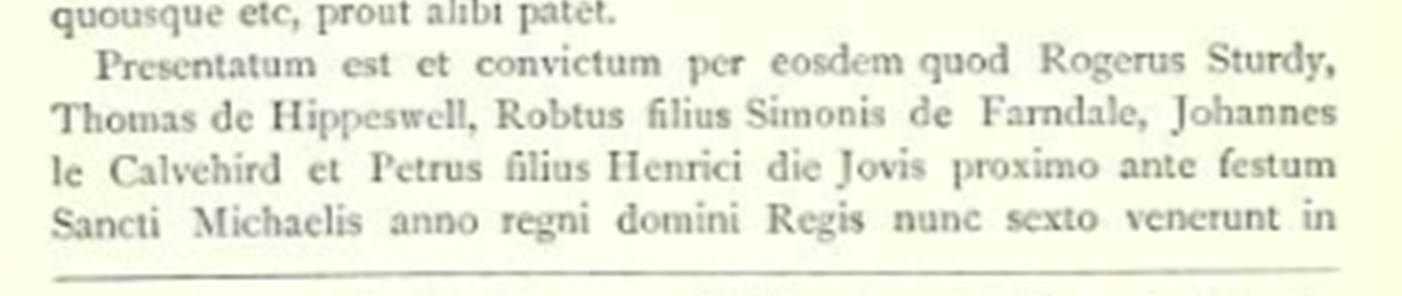
Robert Farndale (FAR00031) son of Simon the miller of Farndale (FAR00021), and Robert Farndale (FAR00012) son of Peter of
Farndale (FAR00008), were fined for
poaching at Pickering
Castle in 1332 Patent Rolls, North Riding Records,
York, The Honour and Forest of Pickering, Volume II, The Coucher Book of the Duchy of Lancaster Records, page 66). Robert was outlawed with others for killing a hart in
the forest. On 24 September 1332, Robert Farndale (FAR00031) son of Simon (FAR00021) hunted a stag at Flaskes in Pickering Forest.
See details and
research notes.
More
Poachers
Nicholas of Farndale (FAR00022), gave bail for Roger
(FAR00013A) son of Gilbert
of Farndale (FAR00018) who had been caught poaching in 1334 and
1335. Robert (FAR00031) son of Simon the miller of
Farndale (FAR00021) and Robert (FAR00012), son of Peter of
Farndale (FAR00008)
were co-offenders.
See details and research notes.
The
Hearing of the Eyre
An
eyre hearing picking up cases over many preceding decades took place at
Pickering on 3 October 1334 (see FAR00015B).
The
eyre justices (the old French word erre, means
journey) were judges who were sent out from the central courts at Westminster
Hall around the counties. Generally they travelled out every seven years, but
the interval changed from time to time. They considered a miscellany of cases,
known as pleas arising during the period since the last eyre. The first eyre
was in 1166, when Henry II appointed Geoffrey de Mandeville and Sir Richard de
Lucy. Henry’s policy of asserting the legal rights of the Crown did not make
him popular. Eyres were sudden, frightening descents that not only tried legal
cases, but generally asserted royal power, including by aggressive imposition
of higher taxes and feudal extractions (Robert Tombs, The English and their History, 2023, page 66). Six eyres were appointed in 1176. The
eyres were the primary source for local justice until the reign of Edward II.
Under
medieval forest law, mainpernors were
individuals who acted as guarantors for others. Mainpernors
vouched for the accused's future appearance in court, preventing them from
fleeing justice within the forest jurisdiction.
A Forest Eyre had
taken place at Pickering under a commission to Alexander de Kirketon and Ralph
de Dacre on 10 June 1280. Since little administration occurred during the
chaotic reign of Edward II, it does not appear that another Eyre took place
until the commencement of the reign of Edward III (1312 to 1377). An eyre
hearing picking up cases over many preceding decades took place
at Pickering on 3 October 1334 (The Duchy of Lancaster
Records, from the North Riding Record Society, The Honour and Forest of Pickering, Edited by Robert Bell
Turton, 1897, page 23 and 28 and 34, North Riding Records, Volume IV by the
North Yorkshire Record Society, the Honour and Forest of Pickering,
1897, page 23 and 28) and
continued to sit at six monthly intervals until 1339. The President of the
Court was Sir Richard Willoughby, a successful lawyer whose legal career had
made him rich. He was briefly Chief Justice between 1338 and 1340, but was demoted and charged with corruption. He threw
himself on the King's mercy and was pardoned on payment of 1,200 marks.
Richard
(FAR00016), son of John the miller of Farndale (FAR00021B) and Adam
(FAR00025), son of Simon the miller of Farndale (FAR00021) had
trespassed and hunted in Pickering Forest, others including Adam (FAR00022A), son of Nicholas de Farndale (FAR00006), and John
(FAR00016A), son of John the miller (FAR00021B) and John
Wraghby of Farndale (WRA00001) mainperned (provided guarantees) for their
appearance (The Great Cowcher of the Duchy
of Lancaster, The National Archives, DL42/1 Folio 227, 227v, DL 42/1/35/U7 folios 337 to 338v).
John (WES00004), son of Richard de Westgille
of Farndale (WES00001) had trespassed and
hunted in Pickering Forest, others including William
le Smyth of Farndale (FAR00037), Richard de Westgill (WES00001), John le Shepherd of Farndale (FAR00010), John Alberd of the same (ALB00002), Nicholas (FAR00041A), son of Walter of the same (FAR00014A), John del Heued of the same (HEU00001), and Robert de Westgill (WES00005) mainperned (provided guarantees) for their
appearance (The Great Cowcher of the Duchy
of Lancaster, The National Archives, DL42/1 Folio 228v).
Robert (WES00005), son of Richard de Westgill
of Farndale (WES00001) had trespassed and
hunted in Pickering Forest, others including William
le Smyth of Farndale (FAR00037), John (FAR00041B), son of Walter of the same (FAR00014A), John Alberd of the same (ALB00002), and Nicholas (FAR00041A), son of Walter of the same (FAR00014A), mainperned (provided guarantees) for their
appearance (The Great Cowcher of the Duchy
of Lancaster, The National Archives, DL42/1 Folio 228v, DL 42/1/23/U29 folios 228 to 229).
John (ADA00003) son of Abba (ADA00002) had trespassed and
hunted in Pickering Forest, others including Roger
(FAR00011A), son of Alfred de Farndale (FAR0008A), Roger (FAR00013A), son of Gilbert of Farndale (FAR00018), Richard de Beverley of Farndale (BEV00001), William Kyng of Farndale (KYN00001), John de Hoton of Farndale (HOT00003), mainperned (provided guarantees) for their
appearance. Roger, son of Gilbert, John de Hoton, had paid the fine due. Roger,
son of Alfred of Farndale, Richard de Beverley of Farndale, and William Kyng of
Farndale had since died. (The Great
Cowcher of the Duchy of Lancaster, The National Archives, DL42/1 Folio 229v, DL 42/1/23/U30 folios 229 to
230v).
Robert (FAR00031), son of Simon of Farndale (FAR00021), Roger del Milne of Farndale (FAR00013A), Robert (FAR00012), son of Peter de Farndale (FAR00008), Walter Blachose (BLA00001), Ralph del Heued (HEU00002), were ordered for
apprehension by the sheriff by Easter 1335 (The Great
Cowcher of the Duchy of Lancaster, The National Archives, DL42/1 Folio 276v to
277v).
Roger (FAR00013A), son of Gilbert Farndale (FAR00018) was fined 20d because John did not turn up (The Great Cowcher of the Duchy of Lancaster, The National
Archives, DL42/1 Folio 336).
John (WES00004), son of Richard de Westgill
(WES00001), indicted for hunting, Robert Westgyll (WES00005) was fined 40d because
John did not turn up on the evidence of Nicholas
de Farndale (FAR00025A) (The Great Cowcher of the Duchy of
Lancaster, The National Archives, DL42/1 Folio 336 to 336v).
John (WES00004), son of Richard de Westgill
(WES00001), indicted of hunting, John le Shephirde of Farndale (FAR00010) was fined 40d because John did not
turn up (The Great Cowcher of
the Duchy of Lancaster, The National Archives, DL42/1 Folio 336v).
The mainpernors (guarantors):
·
for Richard (FAR00016), son of John de Farndale (FAR00021B), indicted of hunting, Alan (FAR00011), son of Nicholas de Farndale (FAR00006) was fined 40d because
Richard did not turn up.
·
Alan (FAR00011), son of Nicholas de Farndale (FAR00006) was also fined 40d as mainpreneur for the hunting offences of Adam (FAR00025), son of Simon the miller of Farndale (FAR00021).
·
Nicholas Laverock was fined 20d as mainpernor of John de Farndale (FAR00016A), also indicted for
hunting.
·
Nicholas Laverock was also fined 20d as mainpernor of Adam (FAR00025), son of Simon the miller (FAR00021), also indicted for
hunting.
·
John (FAR00016A), son of John the miller (FAR00021B) was fined 2s as mainpernor of Richard (FAR00016), son of John the miller of Farndale (FAR00021B), also indicted for
hunting.
·
John (FAR00016A), son of John the miller (FAR00021B) was also fined 2s as mainpernor of Adam
(FAR00025), son of Simon the miller (FAR00021), also indicted for
hunting.
·
William le Smyth of Farndale (FAR00037) was fined 2s as mainpernor of Robert
(WES00005), son of Richard de Westgill
(WES00001), also indicted for
hunting.
·
William le Smyth of Farndale (FAR00037) was also fined 2s as mainpernor of John
(WES00004), son of Richard de Westgill
(WES00001), also indicted for
hunting.
·
Nicholas Brakenthwayt was fined 2s as mainpernor of Richard (FAR00016), son of John the miller of Farndale (FAR00021B), also indicted for
hunting.
·
Nicholas Brakenthwayt was also fined 2s as mainpernor of Adam (FAR00025), son of Simon the miller (FAR00021), also indicted for
hunting.
·
Alan de Braghby was
fined 3s as mainpernor of Richard (FAR00016), son of John the miller of Farndale (FAR00021B), also indicted for
hunting.
·
Alan de Braghby was
fined 2s as mainpernor of Adam (FAR00025), son of Simon the miller (FAR00021), also indicted for
hunting.
·
John de Braghby was fined 20d as mainpernor of Richard (FAR00016), son of John the miller of Farndale (FAR00021B), also indicted for
hunting.
·
John de Braghby was also fined 20d as mainpernor of Adam (FAR00025), son of Simon the miller (FAR00021), also indicted for
hunting.
(The Great Cowcher of the Duchy of
Lancaster, The National Archives, DL42/1 Folios 336v and 337, DL 42/1/35/U6, Folio 335v-336v (not on public record)).
As mainpernor
(guarantor) Richard (FAR00016), son of
John (FAR00021B), and Adam (FAR00025), son of
Simon the miller of Farndale (FAR00021), Nicholas de Rippingale was
fined 5s because they did not turn up.
(The Great Cowcher of
the Duchy of Lancaster, The National Archives, DL42/1 Folios 342v).
In respect of Fines, amercements and
issues of forfeitures at Pikeryng [Pickering] before
Richard de Wylughby [Willoughby], Robert de Hungerford and John de Hambury,
itinerant justices assigned to take the pleas of the forest of Henry, earl of
Lancaster, of Pickering on Monday next after Michaelmas 8 Edw. III (1334 to
1335). Michaelmas is 29 September each year. The next Monday in 1334 was 3
October 1334.
Nicholas
de Repyngale [Rippingale],
one of the mainpernors of Richard (FAR00016), son of John (FAR00021B), and Adam (FAR00025), son of Simon the miller of Farndale (FAR00021), indicted of hunting (The Great Cowcher of the Duchy of Lancaster, The National Archives, DL 42/1/35/U9, Folio 341 to 343v).
John (FAR00042A), son of William le Smyth of Farndon (FAR00037) became mainpernor (guarantor) of 4 individuals (The Great Cowcher of the Duchy of Lancaster, The National
Archives, DL42/1 Folios 342v, North Riding Records Yorks, The Honour and Forest of Pickering,
1894, Volume II at page 148).
Thomas
Wake was summoned to account for fines for straying animals at Middleton on an
unknown date. He claimed that the fines had already been paid. John de Farndale (FAR00041B) gave his pledge in the matter. (The Great Cowcher of the Duchy of Lancaster, The National
Archives, DL42/1 Folio 314v, North Riding Records Yorks Volume III, The Honour and Forest of
Pickering, 1894, Edited Robert Bell Turton, page 161).
See details
and research notes.
The
Buck and the Stag
On 2
January 1335, Roger the Miller of
Farndale (FAR00013A), Robert (FAR00012), son of Peter of Farndale (FAR00008), Walter Blakhous
of Farndale (BLA00001), and Ralph de Heued of Farndale (HEU00002) came into Pickering
Forest at an unknown place with bows and arrows and killed one four-year-old
buck and hunted one stag and carried away with them the game and thereupon they
did their will. They
were ordered to appear at a hearing of the matter on 3 October 1334, but
although they were living in the country, they did not appear. Therefore the
sheriff was ordered to make them come. However the Sheriff failed to apprehend
them, since they had withdrawn into hiding, and so the search was continued
while meantime they were declared to be outlaws (The Great Cowcher of the Duchy of Lancaster, The National Archives,
DL42/1 Folio 222, DL 42/1/35/U9, Folio 221v to 223v).
See details and research notes.
Poachers
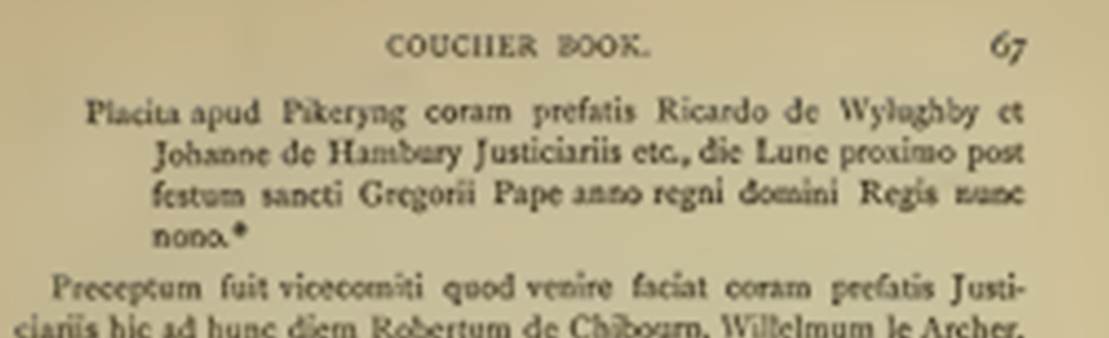
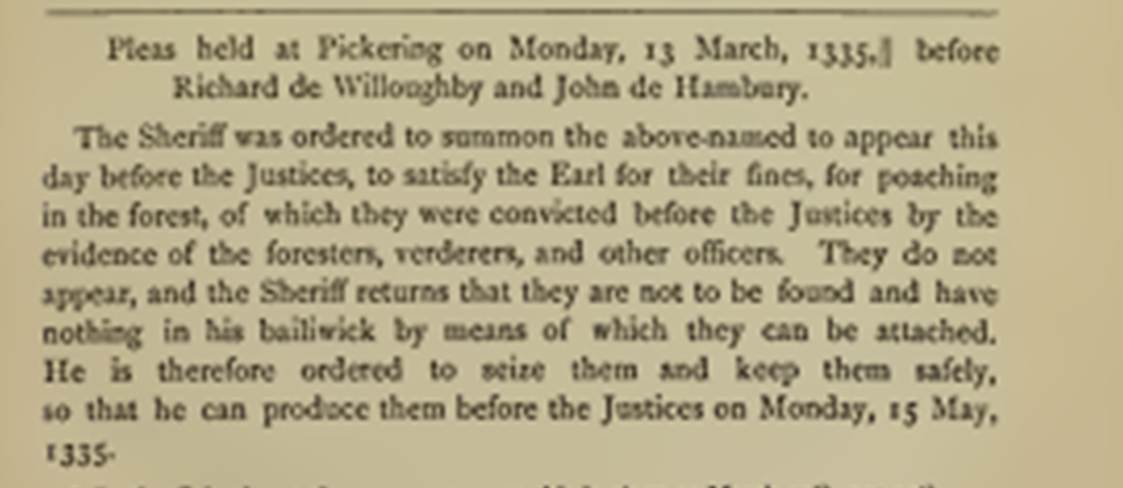
Pleas were held at Pickering on
Monday 13 March 1335, before Richard de Willoughby
and John de Hambury. A long list of names including Robert (FAR00031), son of Simon de Farndale
(FAR00021), Roger del Milne of Farndale (FAR00013A), and Robert (FAR00012), son of
Peter of Farndale (FAR00008) were convicted before the Justices on the evidence of the
foresters, verderers, and other officers. They did not appear, and the Sheriff
gave evidence that they could not be found and had nothing in his bailiwick by
means of which they could be attached. The sheriff was therefore ordered to
seize and secure them, so that he could produce them before the Justices on
Monday, 15 May 1335. There are records of further hearings in the matter on 22
September 1337 and 29 March 1338 when they could still not be found. At a
hearing on 15 September 1338 the sheriff was ordered to search for them
from county to county and they were to be outlaws if they still failed to
appear. Were he to find them the sheriff was ordered to take steps in such a
way that he has their bodies here at this day to make satisfaction to the earl
about their redemption for trespasses of hunting whereof they are convicted
before the said justices by the foresters, verderers and other ministers. (North Riding Records Yorks Volume
III,
The Honour and Forest of Pickering, 1894, Edited Robert Bell Turton, page
67, The National Archives DL 42/1/30/U1 (Folios 284v to 286), DL 42/1/31/U1 (Folios 286 to 287), DL
42/1/32/U1):
See details
and research notes.
In a
case last heard on 3 October 1334, at a hearing at Pickering, again before
Justices Richard Willoughby and John de Hambury at
Easter 1335, a long list of offenders including Robert (FAR00031), son of
Simon of Farndale (FAR00021), Roger del Milne of Farndale (FAR00013A), Robert (FAR00012), son of Peter de Farndale (FAR00008), Walter Blachose (BLA00001), Ralph del Heued (HEU00002), had still not been
apprehended and were ordered for apprehension by the sheriff by the Tuesday
three weeks after Michaelmas 1335 (ie by Tuesday 17
October 1335)(The Great Cowcher of the Duchy
of Lancaster, The National Archives, DL42/1 Folio 277v to 278v).
See details and research notes.
The Rotemir Incident
On about 24 August 1336, during the period when the Eyre of the
mid 1330s was sitting, a number of men including John (FAR00042A), son of William
the Smith of Farndale (FAR00037) took hind and calf
in Rotemir (North
Riding Records Yorks, The Honour and Forest of Pickering, 1894, Volume II at page 115, The Great Cowcher of the Duchy of Lancaster, The National Archives, DL
42/1/35/U26, Folio 223v to 225)
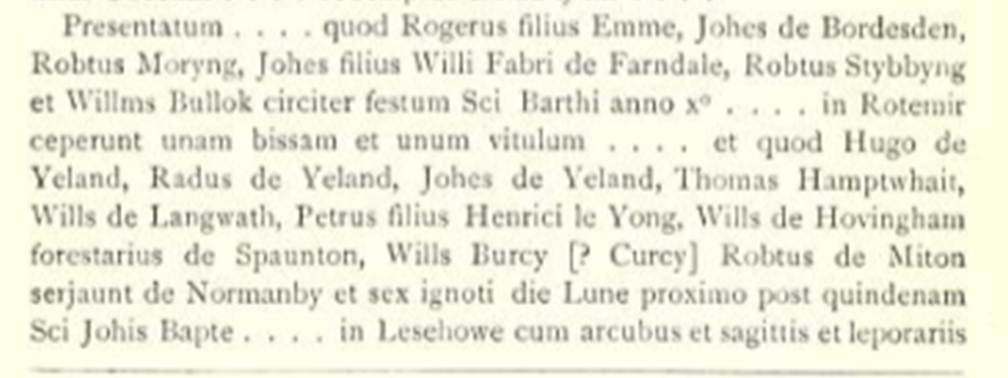
See details and research notes.
The Offences while the Eyre was in
Session
In a list of offences committed since
the commencement of the Eyre, were included Richard (FAR00016) son of John Miller of Farndale (FAR00021B), and Adam (FAR00025) son of Simon Miller of Farndale (FAR00021), John Cockerell of
Cropton (COK00001), John (WES00004) son of Richard Westgill of Farndale (WES00001), Robert (WES00005) son of Richard Westgill of Farndale (WES00001) (The Great Cowcher of
the Duchy of Lancaster, The National Archives, DL42/1 Folio 204v, DL 42/1/23/U14 folios 203 to 205 and North Riding Records Yorks
Volume II, The Honour and Forest of Pickering, page
119).
See details and research notes.
17
October 1335 and 10 February 1337
More
Poachers at Large
In a
case last heard in April 1335, at a hearing at Pickering, again before Justices
Richard Willoughby and John de Hambury at Easter
1335, a long list of offenders including Robert (FAR00031), son of Simon of Farndale (FAR00021), Roger del Milne of Farndale (FAR00013A), Robert (FAR00012), son of Peter de Farndale (FAR00008), Walter Blachose (BLA00001), Ralph del Heued (HEU00002), had still not been
apprehended. As a follow up, on 10 February 1337, the original judicial panel
of Richard Willoughby and John de Hambury were to be
replaced by the King by a new judicial panel comprising two of Richard de la
Pole, Richard, Robert de Hungerford and John de Hambury
(The Great Cowcher of the Duchy of
Lancaster, The National Archives, DL42/1 Folio 279 to 280v).
See details and research notes.
Trespass and Hunting
On 30 November 1336, before Justices
Richard de Willoughby and John de Hambury, John (KNY00002), son of
William Knyth of Farndale (KNY00001) was fined half a mark for a trespass of hunting (The Great Cowcher of the Duchy of Lancaster, The National
Archives, DL42/1 Folio 364, DL 42/1/38/U2
folios 364 to 365v).
In respect of Fines at Pikeryng [Pickering] before Richard de Wylughby
[Willoughby] and John de Hambury on the first Monday
after the feast of St Andrew 10 Edw. III (1336 to 1337).
In 1336, the Feast of St. Andrew in
England was celebrated on 30 November 1336, as it is every year.
John, son of William Knyth
of Farndale was fined half a mark (6s 8d) for a trespass of hunting,
by the pledge of John del Clyff of Haretoft [Hartoft], Alan de Neuton
[Newton], Nicholas de Repinghale [Rippingale]
and Ralph de Morton. (The Duchy of Lancaster Records,
from the North Riding Record Society, The Honour and Forest of Pickering,
Edited by Robert Bell Turton, 1897, page 61).
See details and research notes.
2
December 1336
John de Farndale (FAR00041B) was bailed for poaching on Monday 2 Dec 1336 (Yorkshire Fees).
See details and research notes.
A
long list of names appeared of those who
had been arrested for poaching in the forest and had been let out on bail to
appear at the next assizes, but neither appeared nor excused themselves, as the
custom is, together with the names of the bail. The long list included Adam (FAR00025) son of Simon Miller of Farndale (FAR00021). (North Riding Records Yorks, The Honour and Forest of
Pickering, 1894, Volume II at page 119).
In a
case last heard on 17 October 1335, at a hearing at Pickering, before Justices
John de Hambury and Richard de la Pole on 13 February
1337, a long list of offenders including Robert (FAR00031), son of Simon of Farndale (FAR00021), Roger del Milne of Farndale (FAR00013A), Robert (FAR00012), son of Peter de Farndale (FAR00008), Walter Blachose (BLA00001), Ralph del Heued (HEU00002) had still not been
apprehended. The King ordered at Leicester on 1 October 1337 that a fresh writ
be issued by Monday next after the feast of St Andrew the Apostle (The feast is
on 30 November) with an adjourned hearing to Wednesday next after Ascension (39
days after Easter) 10 Edw. III (The Great
Cowcher of the Duchy of Lancaster, The National Archives, DL42/1 Folio 280v to
282).
See details and research notes.
In a case last heard on 13 February
1337, at a hearing at Pickering, before Justices John de Hambury
and Richard de la Pole on 1 December 1337, a long list of offenders including Robert (FAR00031), son of Simon of Farndale (FAR00021), Roger del Milne of Farndale (FAR00013A), Robert (FAR00012), son of Peter de Farndale (FAR00008), Walter Blachose (BLA00001), Ralph del Heued (HEU00002), had
still not been apprehended. (The Great Cowcher of
the Duchy of Lancaster, The National Archives, DL42/1 Folio 282 to 283v).
See details and research notes.
In a case last heard on 1 December 1337,
at a hearing at Pickering, before Justices Richard Willoughby and John de Hambury on 16 March 1338, a long list of offenders
including Robert (FAR00031), son of
Simon of Farndale (FAR00021), Roger del Milne of
Farndale (FAR00013A), Robert (FAR00012), son of
Peter de Farndale (FAR00008), Walter Blachose (BLA00001), Ralph del Heued (HEU00002), had still not been apprehended.
(The Great Cowcher of the Duchy of
Lancaster, The National Archives, DL42/1 Folio 283v to 284v).
See details and research notes.
21 September 1338
In a case last heard on 16 March 1338, at
a hearing at Pickering, before Justices Richard Willoughby and John de Hambury on 21 or 28 September 1338, a long list of
offenders including Robert (FAR00031), son of
Simon of Farndale (FAR00021), Roger del Milne of
Farndale (FAR00013A), Robert (FAR00012), son of
Peter de Farndale (FAR00008), Walter Blachose (BLA00001), Ralph del Heued (HEU00002), had still not been apprehended. (The
Great Cowcher of the Duchy of Lancaster, The National Archives, DL42/1 Folio
284v to 286).
See details and research notes.
In a case last heard in September 1338,
at a hearing at Pickering, before Justices Richard Willoughby and John de Hambury on 5 April 1339, a long list of offenders including
Robert (FAR00031), son of
Simon of Farndale (FAR00021), Roger del Milne of
Farndale (FAR00013A), Robert (FAR00012), son of
Peter de Farndale (FAR00008), Walter Blachose (BLA00001), Ralph del Heued (HEU00002), had still not been apprehended. (The
Great Cowcher of the Duchy of Lancaster, The National Archives, DL42/1 Folio
286 to 287).
See details and research notes.
16
February 1339, Westminster. To the sheriff of York. Order to cause a regarder for Henry earl of Lancaster's forest of Pykering to be elected in place of William de Bard, who is
blind. (Close Rolls of the reign of Edward III,
1339 to 1341, page 13).
18
February 1339, Westminster. To sheriff of York, Order to cause a regard to
be made in Henry of Lancaster's forest ot Pekeryngg in that county, before Whitsuntide next (Close Rolls of the reign of Edward III, 1339 to 1341, page 91).
12
June 1339, Berkhampstead. To the sheriff of York.
Order to cause a verderer for the forest of Pikerying
of Henry, earl of Lancaster, to be elected ia place
of WiUiam Bard of Osgotby,
who is blind, so that he cannot travail to eserciee
the duties of the office. To the sheriff of York. Like order to
cause a verderer for the earl's forest of Pykerycgton
to be elected in place of John Bulmer of Wrelton,
deceased. (Close Rolls of the reign of Edward III, 1339 to 1341, page
137).
In a case last heard on 5 April 1339, at
a hearing at Pickering, before Justices Richard Willoughby and John de Hambury on 14 or 21 September 1339, a long list of
offenders including Robert (FAR00031), son of
Simon of Farndale (FAR00021), Roger del Milne of
Farndale (FAR00013A), Robert (FAR00012), son of
Peter de Farndale (FAR00008), Walter Blachose (BLA00001), Ralph del Heued (HEU00002), had still not been apprehended. Exacerbated at the lack of progress in
apprehending the gang, the sheriff was ordered to hunt for them from county to
county and if they were still not found, they were to be outlawed (The Great Cowcher of the Duchy of Lancaster, The National
Archives, DL42/1 Folio 287 to 289v).
See details and research notes.
1344
27 January 1344, Westminster. To the sheriff of York. Order to
cause a verderer for the forest of Pykering to be
elected in place of Nicholas Halden, who has no lands within the bounds of the
forest. (Close Rolls of the reign of Edward III, 1343 to 1346, page 270).
The
Egton Raid
On 17 January 1348 at Westminster, there was a commission of
oyer and terminer to a long list of names including William
Smyth of Farndale (FAR00040) the younger and Richard
Ruttok of Farendale for breaking in to the park at Egton, hunting and
carrying away the property of the owner with deer, and for assaulting the
owner’s men and servants causing their inability to work for a long time, for
which the were fined 1 mark (Calendar
of Patent
Rolls,
21 Edward III, Part III, page 472).


A Commission of Oyer and Terminer was a legal
commission issued in England, authorizing judges to hear and determine criminal
cases, particularly those involving serious offenses like treason, felonies,
and misdemeanors. It literally means to hear and determine in
Anglo-French, reflecting its purpose of both investigating and adjudicating
cases. By the commission of oyer and terminer the commissioners (in practice
the judges of assize, though other persons were named with them in the
commission) were commanded to make diligent inquiry into all treasons, felonies
and misdemeanours whatever committed in the counties specified in the
commission, and to hear and determine the same according to law. The inquiry
was by means of the grand jury; after the grand jury had found the bills of
indictment submitted to it, the commissioners proceeded to hear and determine
by means of the petit jury. The words oyer and terminer were also used to
denote the court that had jurisdiction to try offences within the limits to
which the commission of oyer and terminer extended.
See
details
and research notes.
The Danby Raid
Another Commission of oyer and terminor was given to William
de Greystok on 6 December 1353 touching the evildoers, including John Colinman of Farnedale (FAR00043), who lately broke to closes, houses and parks of William
son and heir of William Latymer, tenant in chief at Danby and hunted therein
and carried away deer, and assaulted his men and servants whereby he lost their
service for a great time (Calendar of Patent Rolls,
27 Edward III, Part III, page 541 and index).
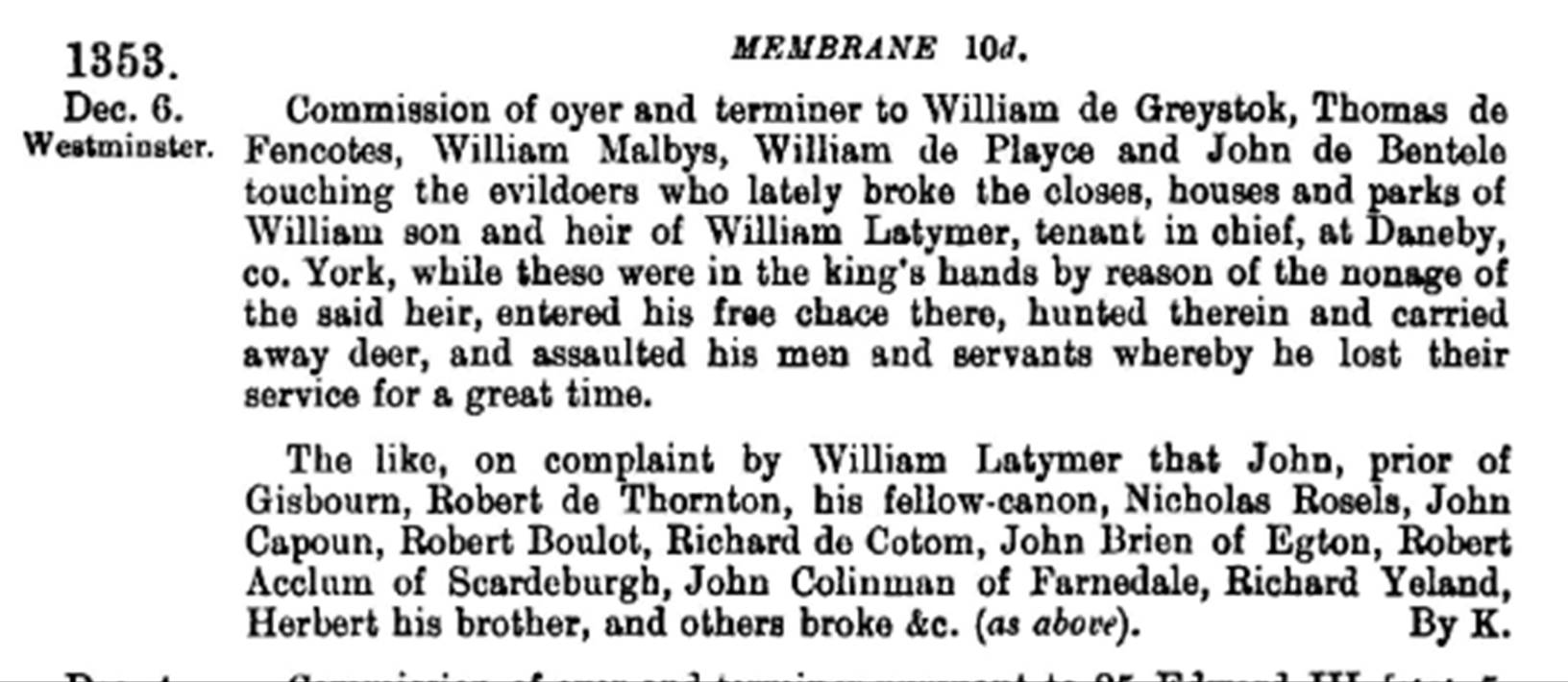
See details and
research notes.
1361
Apart
from the lawless natives of Farndale there were others who made the wild and
lonely moors their haunt of crime. Such were John of Wighall
and John Webster of Beverley who were indicted in 1361 as ''common robbers and
thieves" who "used to lie in wait on Blakey Moor". The list of their crimes included robbing
William Chapman of Battersby, draper, of five marks in silver, robbing John of
Durham, at a spot in the moor near Ingleby Greenhow of 17s and 6d, and other
similar attacks on wayfarers. They were both hanged (Notes on the History of Farndale in the Middle Ages, Arthur H Whitaker, Ryedale Historian, Volume 2,
1966, page 59).
Delivery
of gaol of York Castle before William de Skipwith and William Ryse on
Wednesday, 23 March 1362. Case of John de Wyghall’ and John Webster. Gaol
Delivery Roll. John de Wyghall and John
Webster of Beverley were arrested by indictment made before Marmaduke
Constable, Viscount York, for the fact that they feloniously robbed William
Chapman of Bathersby, draper, on the morgue of
Kildale on the Monday next before the feast of the Nativity of Saint John the
Baptist in the year of the reign of the King now, of five pence of silver
counted in pence; and likewise for the fact that they feloniously robbed John
de Duresme, gardiner, on the morgue of Ingelby near Grenhowe, of seventeen solid six pence of silver counted in
pence on the Tuesday then next following; and likewise for the fact that they
feloniously robbed John Jackson of Kildale on the said Tuesday at Waywath in Kildale of one penny obol of silver; and
likewise for the fact that they feloniously robbed Ralph Draper of Hoton in the field of Gisburn on the aforesaid Monday of
one anguillo, worth seventeen pence; and about the
fact that they are common robbers and plunderers of men; and about the
fact that they held a common position in the mora of Blakhowe
in the thirty-eighth year of the King's reign, now in the summer. Other
indictments follow before the bailiff of the liberty of Richmond. They come led
by the sheriff and addressed individually by the justices as to how they wish
to acquit themselves of the aforesaid felonies imposed on them, they say
individually that they are in no way guilty of it and for this, for good or
evil, they put themselves on the shoulders of their country. Therefore, let
there be a jury. The jurors chosen, selected and sworn for this purpose say on
their oath that the aforesaid John de Wyghall, John Webster and John
Blaunfrount (indicted before the bailiff of Richmond) are guilty of the
aforesaid felonies imposed on them. Therefore, let them be hanged. They
have no chattels, lands or tenements. (Yorkshire
Archaeological Society Record Series Volume 100, pages 148/9).
The Fishing Party
William Blakhose of Farndale (BLA00001), John Cokrell the Younger of Farnedale
(COK00001) and
Hugh Moigne of Farnedale (MOI00001) were all fined 20s for poaching fish in 1366
(Calendar of Patent Rolls, 40 Edward III, Part 1, pages 280 to 281).


See details and research notes.
8
November 1367
Fishing and
Felling of Trees
There
was another Commission of Oyer and Terminer ordered on another complaint by
William Latymer, knight, that various individuals including William of Farndale (FAR00040) and William
Blakehose of Farndale (BLA00001) broke his closes at Danby, Leverton,
Thornton in Pykerynglith, Symnelyngton,
Scampton, Teveryngton and Morhous,
Co York, entered his free chace at Danby and his free
warren at the remaining places, hunted therein without licence, felled his
trees there, fished in his several fishery, took away fish, trees, deer from
the chace, hares, conies, pheasants and partridges
from the warren departured, trod down and consumed
the corn and grass there with certain cattle and assaulted and wounded his men
and servants. (Calendar
of Patent Rolls, 41 Edward III, Part II, page
63).
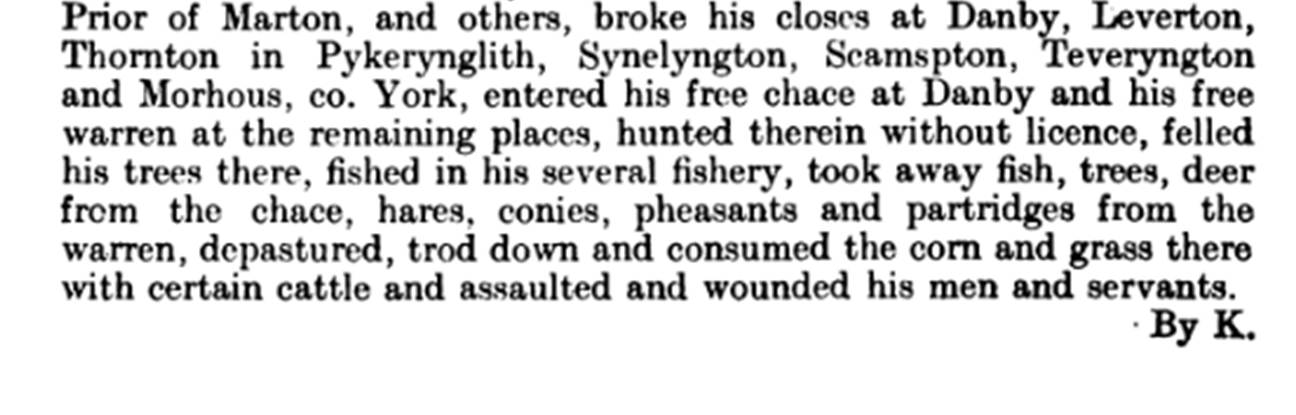

See details and
research notes.
Another Danby Raid
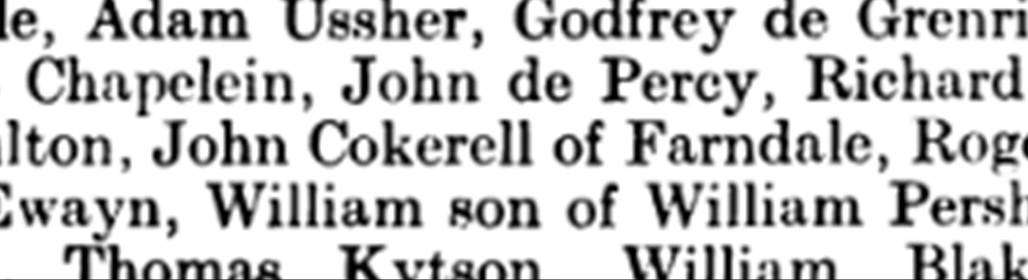
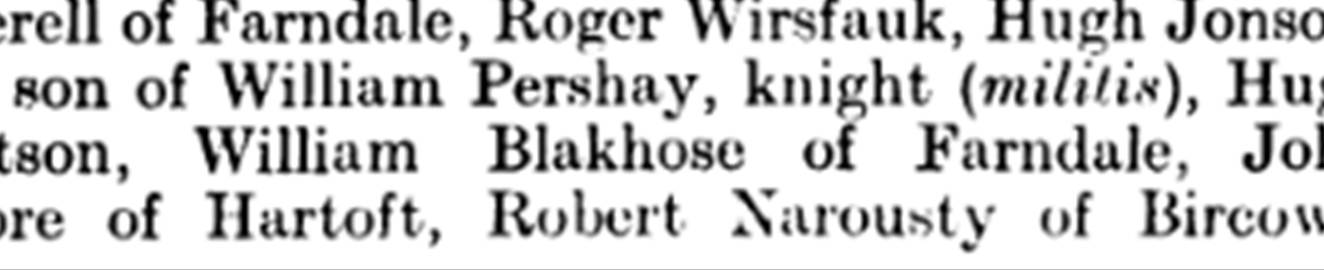
On 6
March 1369 at Westminster, there was an order for another Commission of Oyer
and Terminer on complaint of the hapless William Latymer, knight, that various
individuals including John Cockerell of Farndale
(COK00001) and William
Blakhose of Farndale (BLA00001) broke his closes at Danby, Leverton,
Thornton in Pykerynglith, Symnelyngton,
Scampton, Teveryngton and Morhous,
and entered his free chace at the said town of Danby
and his free warren at the remaining places, hunted in these, felled his
trees there, fished in his several fishery there, carried away his fish,
trees, deer from the chace, hares, conies, pheasants
and partridges from the warren, trode down and
consumed with cattle his crops and assaulted his men and servants (Calendar of Patent Rolls, 43 Edward III, Part I, page 263).
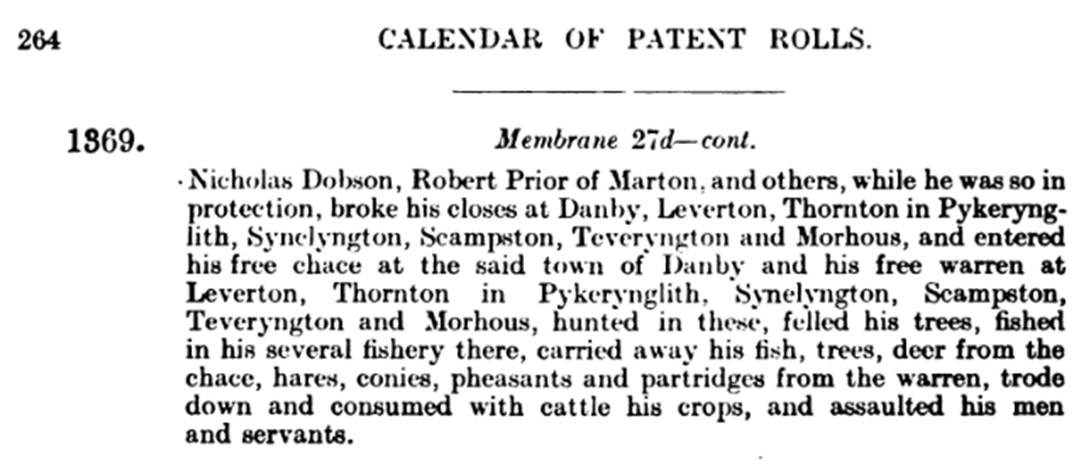
See details and research notes.
Pardon for a death
On 7 May 1370, at Westminster, a pardon
was given to William Farndale of Caleys (FAR00036) for
the death of John de Spaldyngton, whereof he is indicted or appealed, and of
any consequent outlawry (Calendar of Patent Rolls, 44 Edward III – Part I, page
393).

See details
and research notes.
1371
Whatever changes of overlordship
took place, however, the young men of the dale continued to prove an unruly
lot. In 1371, the Prioress of Keldholm entered a
complaint in the Court of Common Pleas against Thomas del Ker of Farndale -
"for breaking her close and houses at Morehous
in Kirkebymoreshead, and taking goods and chattels to
the value of 40s" (Notes on the History of Farndale in the Middle Ages, Arthur H Whitaker, Ryedale Historian, Volume 2,
1966, page
59, De Banco Rolls
Trinity, 45 Edward III).
Another
Danby Raid
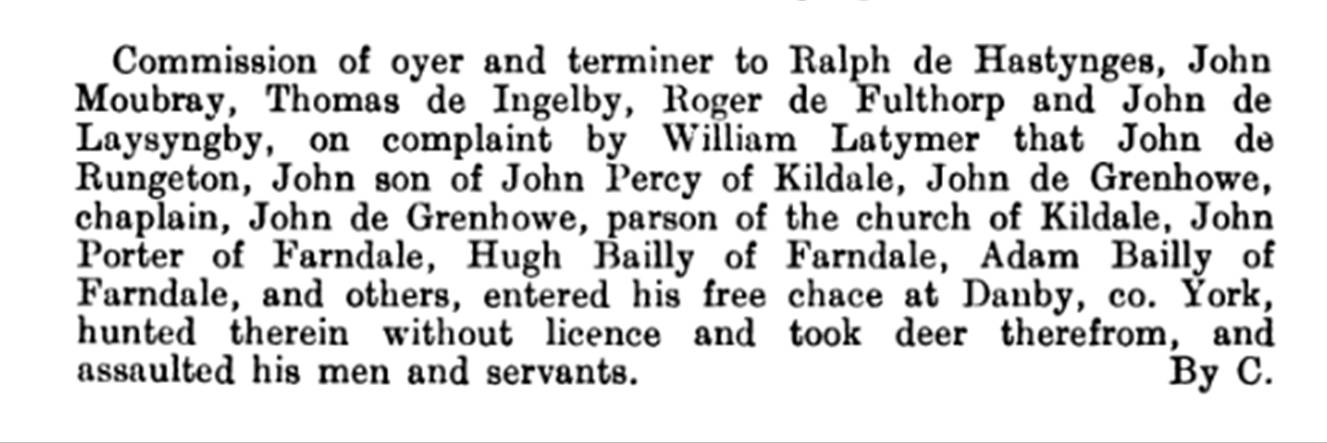
On 20 November 1372, at
Westminster another Commission, again on the complaint by William
Latymer investigated an allegation that a number of individuals including John Porter of Farndale (PORT00001),
Hugh Bailly of Farndale (BAI00001),
Adam Bailly of Farndale (BAI00002),
and others, entered his free chace at Danby co York, hunted
therein without licence and took deer therefrom, and assaulted his men
and servants (Calendar of Patent Rolls, 46 Edward III, Part II, page 243).
In the following year John Porter (a relation
perhaps of the 1301 Willelmus ad Portam), Hugh Bailly
and Adam Bailly, ranging rather farther afield, were accused by William
Latymer, of "entering his free chase of Danby.... hunting therein without
licence and taking deer therefrom and assaulting his men and Servants. (Notes on the History of Farndale in the Middle Ages, Arthur H Whitaker, Ryedale Historian, Volume 2,
1966, page
59, De Banco Rolls
Trinity, 45 Edward III, Calendar of Patent Rolls, Edward II, 1370 to 1374).
See details
and research notes.
10
December 1384 and 21 August 1385
The Cattle Rustlers
There was a
significant cattle and horse rustling expedition in 1384 involving John
Farndale.
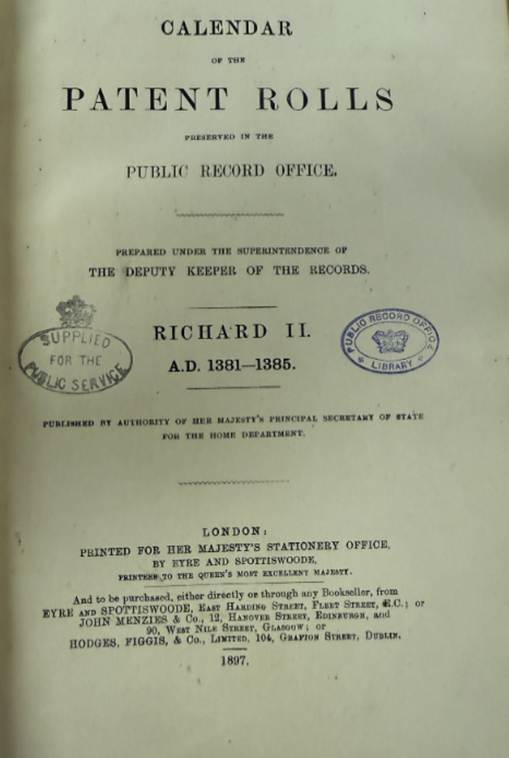
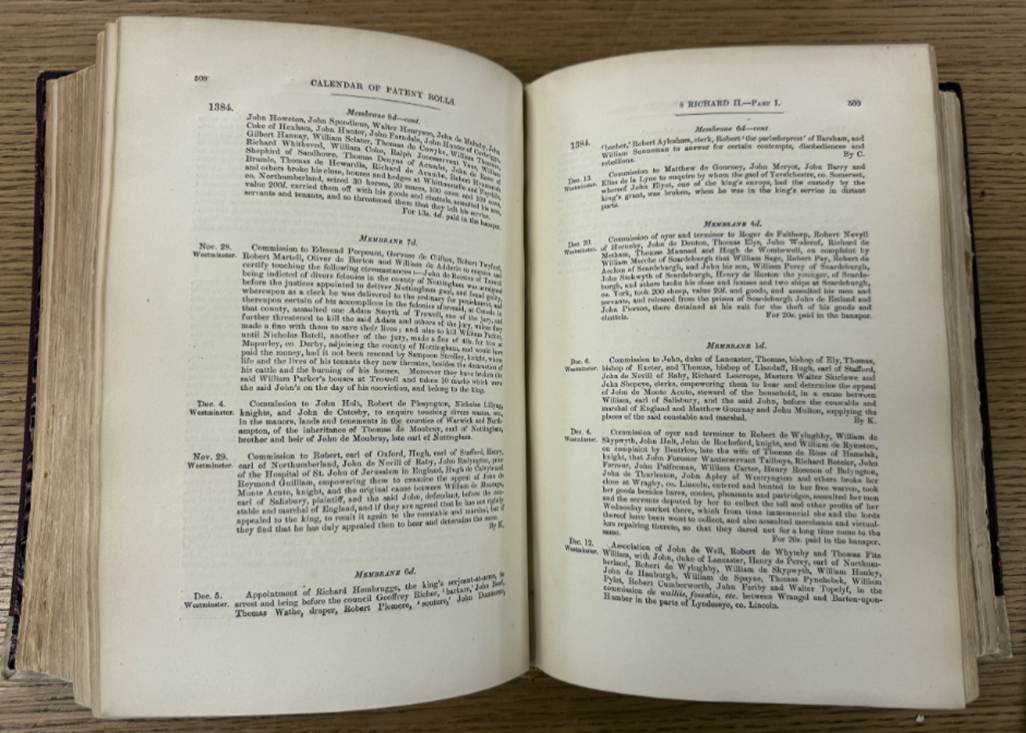
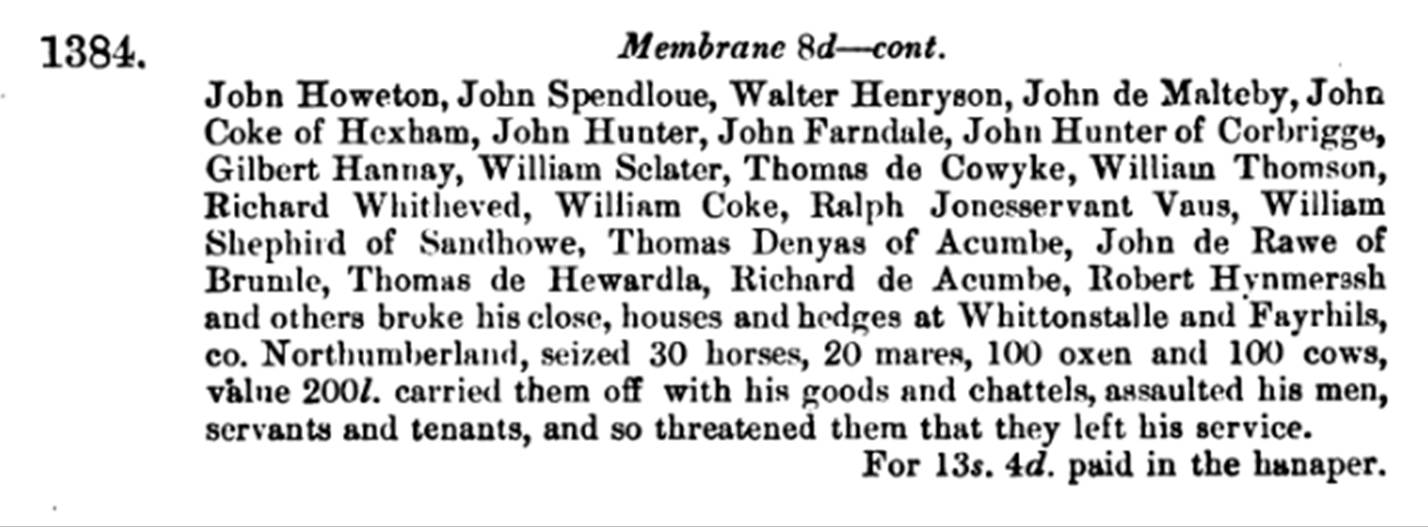
On 10
December 1384, at Westminster, a
Commission of Oyer and Terminer investigated a serious raid in which
various individuals including John Farndale (FAR00042A)
broke their close, houses and hedges at Wittonstalle
and Fayrhils, Co Northumberland and seized 30 horses,
20 mares, 100 oxen and 100 cowes valued at £200 and
carried them off with goods and chattels, assaulted his men, servants and
tenants and so threatened them that they left his service (Calendar
of Patent
Rolls, 8 Richard II, Part I, pages 507 and 508).
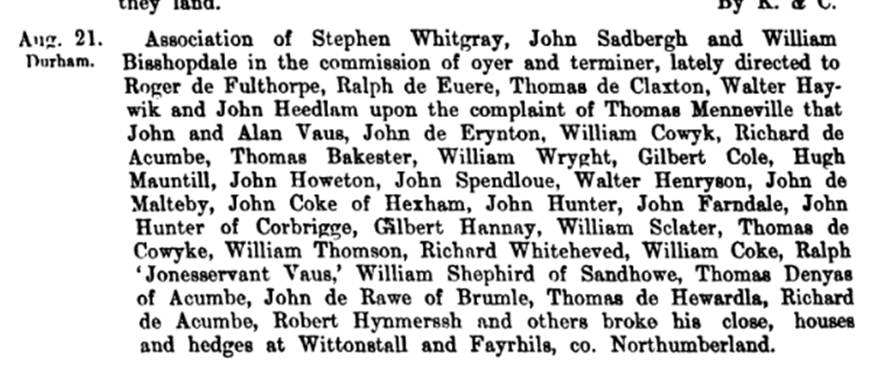
The matter was also the subject of a commission at Durham on 21
August 1385 (Calendar of Patent Rolls, 9 Richard II, page 80,).

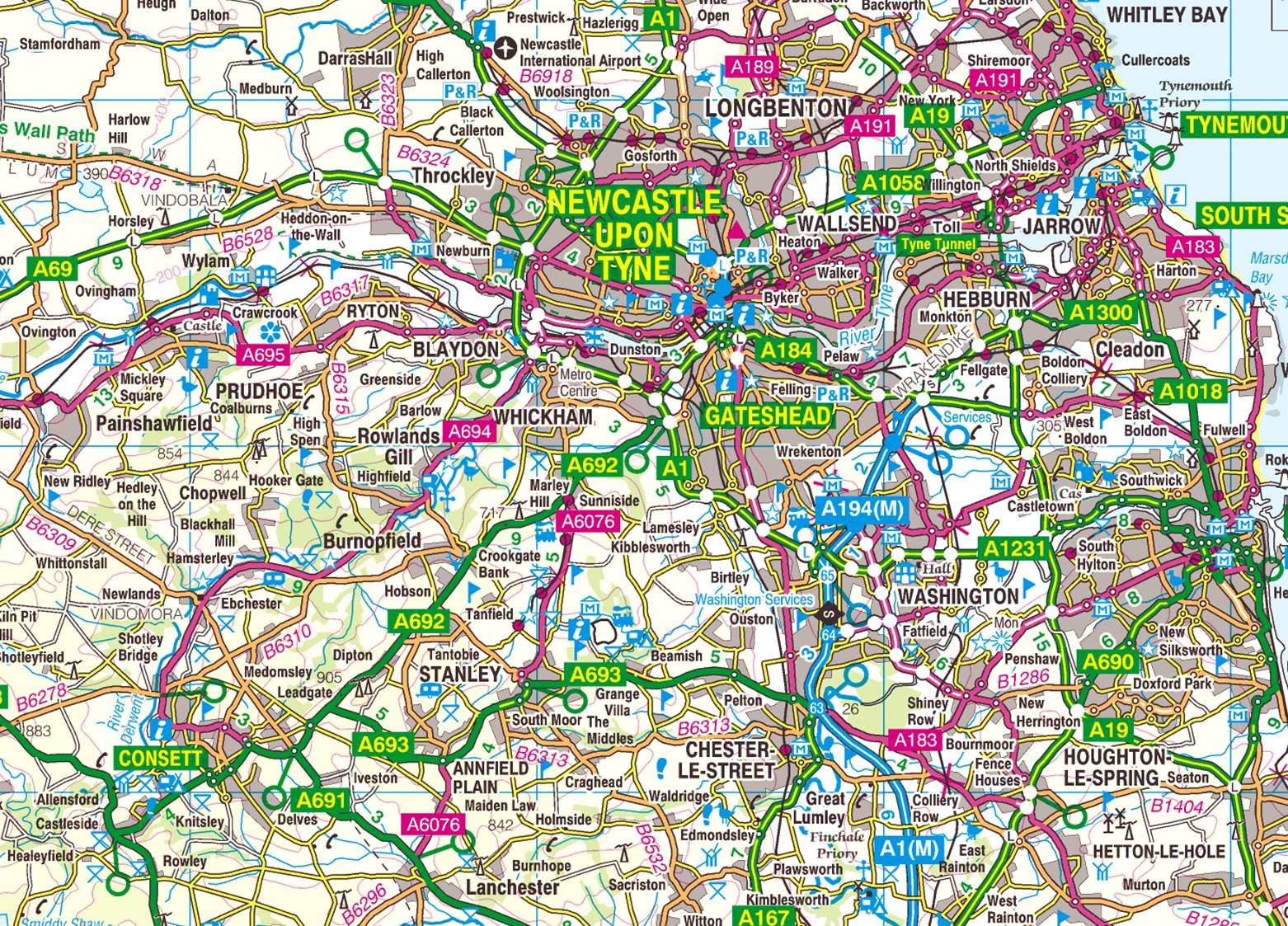
Whittonstall
See details and research notes.
1390
3
March 1390, Westminster. [Order for the election of a verderer] to the sheriff
of York, Thomas Anlagby verderer in the forest of Pykering
being dead. (Close Rolls of the reign of Richard II, 1389 to 1392, page 112).
Pardon
for a Death
On 19 April 1396 a pardon was allowed to Robert de Wodde of Farndale (FAR00053) ,
for the death of John Hawlare of Kirby Moorseved,
killed there on Monday, the eve of the Purification in the 18th year (Calendar of Patent
Rolls, 19 Richard II, Part II, page 695).

See details and
research notes.
In 1396, Robert de Wodde
of Farndale was pardoned for the death of John Hawlare of Kirkby Moorside whom
he killed there ''on Monday the eve of the Purification, in the eighteenth
year''. (Calendar of Patent Rolls, Richard II, 1391 to 1396, page 695). The Wood family appears thus
early in Farndale records and their name occurs regularly on wills throughout
the 16th and 17th centuries and subsequently on the rent rolls and field books
of the Duncombe estate. The name is still quite a familiar one in the district
(Notes on the History of Farndale in the Middle Ages, Arthur H Whitaker, Ryedale Historian, Volume 2,
1966, page 59).
A Serious Armed Robbery
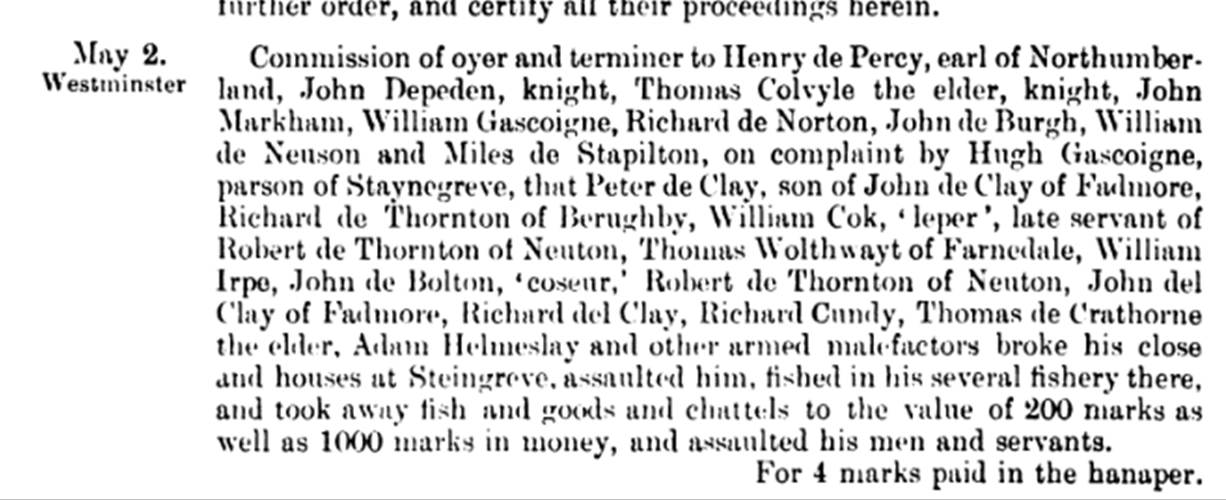
On 2
May 1398 at Westminster, a Commission of Oyer and Terminer was granted to Henry
de Percy, earl of Northumberland, John Depeden, knight, Thomas Colvyle the
elder, knight, John Markham, William Gascoigne, Richard de Norton, John de
Burgh, William de Nenson, and Miles de Stapilton, on a complaint by High
Gascoigne, parson of Staynegreve, that several individuals including Thomas Wolthwayt of Farnedale (FAR00054), and other armed malefactors broke his
close and houses at Steingreve, assaulted him, fished in his several fishery there, and took away his fish and goods and
chattels to the value of 200 marks as well as 1000 marks in money,
and assaulted his men and servants. For 4 marks paid in the hanaper.’ (Calendar of Patent Rolls, 21 Richard II, Part III, page
365).
See details and research notes.
In the closing
years of the 14th century, Thomas Wolthwayt of Farndale was accused
by Hugh Gascoigne, parson of Stone Grave, of breaking into “his close and house
at Stonegrave, assaulting him, fishing in his several
fishponds, and taking away fish and goods to the value of 200 marks, as well as
1,000 marks in cash”. What perhaps astonishes us most is the extent of the
parson’s wealth – one cannot help feeling Thomas could not be entirely to blame. (Raymond Hayes, Farndale,
1961, unpublished, page 34).
About
the same period, in the closing years of the 14th Century, a certain Thomas
Wolthwayt of Farndale was accused by Hugh Gascoigne, the parson of Stonegrave, of breaking into "his close and houses
at Stonegrave, assaulting him, fishing in his several
fishery there and taking away fish and goods and chattels to the value of 200
marks, as well as 1000 marks in money, and assaulting his men and
servants". What perhaps astonishes us as much as anything in this passage
is the extent of the parson’s wealth, and one cannot help feeling that perhaps
Thomas was entitled to a fish or two, at any rate (Notes on the History of Farndale in the Middle Ages, Arthur H Whitaker, Ryedale Historian, Volume 2,
1966, page
59).
1402
21 June 1402, Westminster. Order to the
sheriff of Yorkshire for election of a verderer of the forest of Pykerynge instead of Ralph Rogersoun, who is dead (Close Rolls of the reign of Henry IV, 1402 to 1405, page 210).
1417
1 June 1417, Westminster. To the sheriff of
York. Order concerning a regard in the forest of Pickerynglyth,
so that the same be made before the quinzaine of Michaelmas next (Close Rolls of the
reign of Henry V, 1413 to 1419, page 436).
1427
29 June 1427, Westminster. Order to the
sheriff of Yorkshire, for election of a verderer in the forest of Pykeryng instead of William Bruys of Pykerynge,
who is dead (Close Rolls of the reign of Henry VI, 1422 to 1429, page
300).
Trespass
and the Bishop of Durham
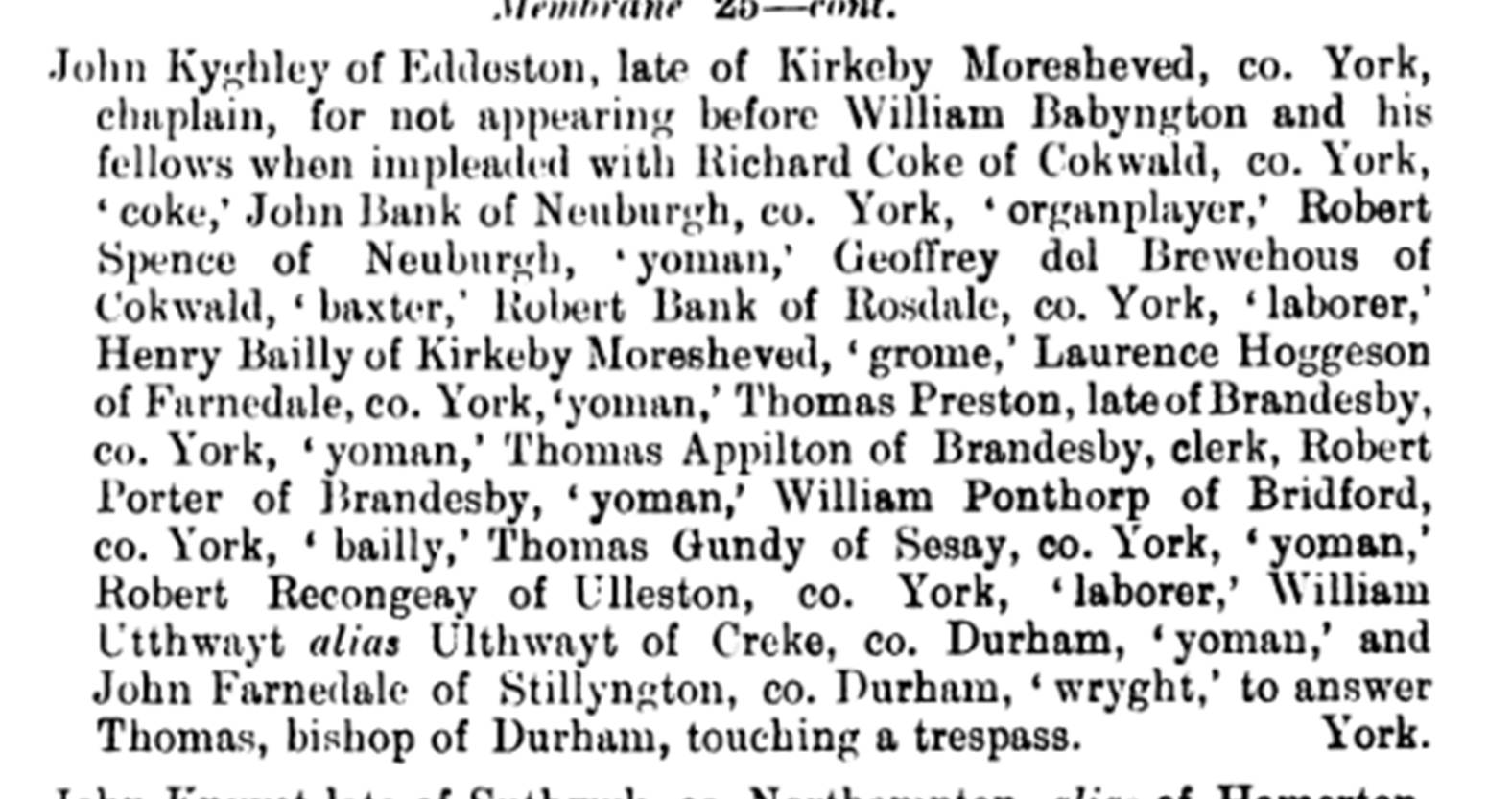
On 16 April 1445 Lawrence Hoggeson of Farndale (HOG00001) and
John
Farndale of Stillyngton, County Durham (FAR00037A),
were to answer the complaint of Thomas Bishop of Durham touching on trespass (Calendar of Patent
Rolls, 28 Henry VI, Part I, page 306).
See details
and research notes.
The Poachers of Pickering
Forest
(Extracted from The Poachers of
Pickering Forest 1282—1338, Derek Rivard, Medieval Prosopography,
Vol. 17, No. 2, Autumn 1996, pp. 97-144)
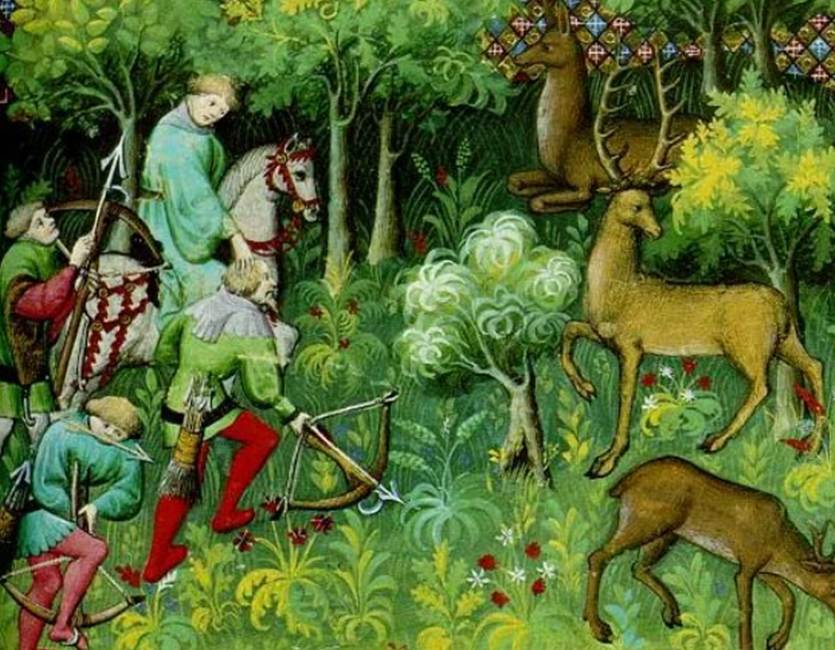
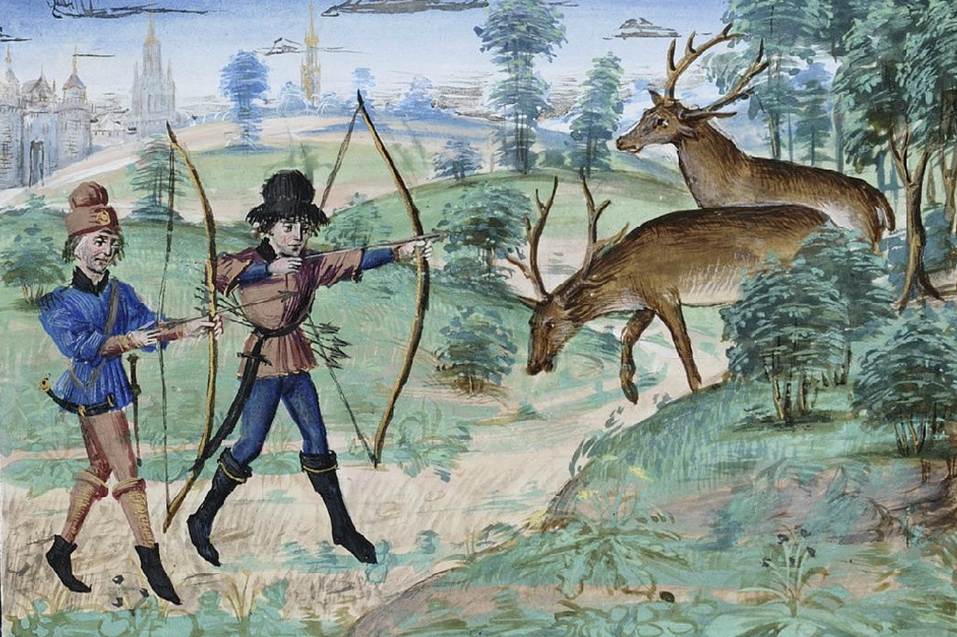
On a chilly
Wednesday, 23 March 1334, Nicholas Meynell led an expedition out upon Blakely
Moor to poach the deer of Pickering Forest. Accompanying this lord of the North
Riding of Yorkshire was a band of at least forty men and boys, including
tenants and under-tenants, clergymen and knights, and even the younger Peter de
Mauley, baron of Mulgrave. Carrying bows and arrows and leading gazehounds that
would track and dismember the prey, this band of "respectable"
criminals slew an astonishing forty-two harts and
hinds in the space of one day. Not content with this breach of the forest law,
the hunters left upon the moor a grisly gesture of defiance for the foresters
of Pickering: the decapitated heads of nine harts,
impaled upon stakes fixed in the ground. One can almost hear the laughter of
the poachers at their jest as they returned home to divide the spoils, but it
is certain the foresters were not laughing: seven months later, the wealthy
members of this hunting party appeared before the Justices of the Forest for
Yorkshire to be amerced, while those among them too poor, or unwilling, to
stand before the court were outlawed.
This incident,
drawn from the records of the 1334 forest eyre, is an important event in the
history of Pickering Forest, a north Yorkshire possession of the earldom of
Lancaster since Henry Ill's reign.1 Although the magnitude of this offense is
out of all proportion to the average poaching case, the incident can
nevertheless serve to illustrate important realities of poaching in the regions
marked off as being under the jurisdiction of the prerogative forest law. The
social profile of poachers cut across lines of status, occupation, and sex.
There were elements of both sport and subsistence involved in poaching, while
the hunt could also serve as an outlet for social tensions. Poaching could
bring serious penalties upon the heads of the guilty; the existing records may
thus reveal details of social and economic standing.
Although it was
an important economic and social activity of the communities within the bounds
of the forest, poaching has been neglected by modern historians of the forest.
Few studies provide data on the identities and motivations of poachers.
This present article will trace the social and economic profile, on an
individual and corporate basis, of the poachers of Pickering Forest as found in
records of the 1334 eyre. Through an examination of the eyre records, the
North Riding lay subsidies of 1301, 1327 and 1332, feudal inquisitions into
knights' fees, the calendars of letters patent and close, inquisitions post
mortem, and other sources, a quantitative and prosopographical
methodology can be used to trace the identities of these criminals. The
poachers of North Yorkshire who emerge from this study are a group
characterized by diversity, arising partly from families of local gentry but
primarily from the near-anonymous men of the soil who entered the forest as
lowly interlopers intent on filling their bellies with Lancastrian (sic, recte Yorkshire?) deer.
Hunting the
elusive stag was an integral part of the lives, consciousness, and literature of the high and
late Middle Ages. Handbooks for both the ritual and practical conduct of
a hunt were composed by members of the elite ranks of society, while lyrical
and epic poetry was composed to describe the chase, which was likened to
martial training, the quest for spiritual perfection, and the pursuit of a courtly
lover. For men and women of the lower social orders the hunt of a deer had a
more sinister aspect, as it was a breach of a complex prerogative law. Deer and
lesser animals within the bounds of designated areas (royal forests) were
protected under this law so that the unsanctioned killing of a beast could cost
the hunter a substantial fine. The fear and suspicion this law engendered
among the populace characterized the issue surrounding these protected
woodlands throughout the later Middle Ages, during which regulation was
expanded and enforced through the perambulation of eyre courts and
the creation of a complex hierarchy of forest officials. Forbidden to
attack game that could freely eat their crops, required to mutilate their dogs
to keep them from hunting within the forests, forbidden even to carry a bow
within the forest, the commoners of this era found that "hunting became
associated with freedom, feasting, and rebellion against the authorities.” By
poaching, the gentry and commoners of Pickering expressed their hatred of the
forest law, their love of sport, and their need for security in times of hardship.
The locale of
this particular group of poachers, Pickering Forest, was a northerly forest
remarkable for the extent of its woodland. For 1086, Domesday Book records
the manor of Pickering as possessing woodland sixteen leagues long by four
leagues wide, covering all of the soke of Pickering. By 1168 the formation
of the honour of Pickering from the manors of Pickering and Falsgrave
(encompassing at that time the parishes of Hackness
and Scarborough) had joined the eastern forest of Scalby (three leagues long by
two leagues wide) to Pickering Forest, creating woodland extending from the
river Severn to the sea. The west ward, embracing the original forest of
Pickering, bordered the forest of Spaunton, which was
in the custody of St. Mary's Abbey, York; the east ward, Scalby, bordered on
the forest of Whitby, which in 1086 embraced over twenty-three square leagues
of forest in the parishes of Whitby, Sneaton, and Hackness, overseen by the verderers of Whitby Abbey. The
majority of this land was forested, and it ranged from the rich vale of
Pickering in the south of that parish to the high moorlands of northern areas
such as Goathland, suitable mainly for sheep grazing.
At the time of
the eyre in question, Pickering and its forest were in the possession of
Henry, third earl of Lancaster. Once belonging to Simon de Montfort,
the honor, castle, manor, and forest of Pickering had
been given in fee by Henry III to his younger son, Edmund, in 1267, the first
earl of Lancaster. Edmund's son Thomas led the rebellion against Edward II, and
following Thomas's execution at Pontefract, Pickering and its adjoining
territories were confiscated by the crown. The forest and its appurtenances
were not restored to Thomas's brother Henry until the ascension of Edward III.
Besides Henry and his various under-tenants, local landholders included
Rievaulx Abbey, the Gilbertine houses of Maltón and
Ellerton Priory, and the Hospitallers, who held lands in the forest confiscated
from the Templars. When the 1334 eyre was called, Henry enjoyed the privilege
(first granted in 1285 by Edward I) of appointing his own justices and
collecting the fines and ransoms gathered there for his own use. In this sense
Pickering was a private forest, but the justices of Lancaster were still
compelled to enforce the crown's forest law; and the pervasive hatred of the
forest law manifested itself in poaching in the same manner as occurred
throughout the crown forests of southern England.
In order to
identify the poachers in their social and economic context, this study draws
heavily on a prosopographical methodology and a
database that contains records selected from a wide variety of sources. From 509
appearances in the eyre records, 399 individuals have been identified, 365
poachers and thirty-four receivers of venison. The cases studied
here occurred between 1282 and the close of the eyre in 1338, a breadth
of time that allows us to examine the patterns of poaching throughout a
turbulent period of English, and particularly northern English, history. A
systematic analysis of poaching and poachers reveals distinct patterns of
activity and three subgroups of poachers: the elite poachers (including the
peerage and greater gentry), the middling poachers (including the lesser
clergy, servants of clergymen, most forest officers, the lesser gentry,
artisans and tradesmen, urban poachers, and receivers), and the largest subgroup,
the lowly poachers (the peasantry). In her study on Midland poachers Jean
Birrell commented that the evidence of poaching from the eyre rolls "does
not lend itself to precise statistics," but the wealth of material present
in the records of Pickering begs for a quantitative analysis, one that
addresses both the numbers and the character of each of these subgroups of
poachers.
Elite poachers formed an
extremely small percentage of the entire corpus of Pickering Forest criminals.
In her study of Midland poaching Birrell has claimed that most poachers were of
gentry status or better, including within their ranks many of the knightly
class,16 but this present study has uncovered only twelve poachers who may
confidently be identified as knights. Peter de Mauley, fourth baron of
Mulgrave, was with Lord Meynell in that notorious hunting party discussed
above. As a member of the peerage and the scion of one of the two great
families within the North Riding, Peter cut an impressive figure; he inherited
his father's lands in 1309 (an estate that embraced at least six knights' fees,
four capital messuages, three parks, and the castle and orchard of Mulgrave). A
pardoned supporter of Thomas, earl of Lancaster, Peter hunted often.20 His
expeditions all seem to have been large, social gatherings, for we find him in
the company of "many others unknown” taking two harts in Wheeldale Rigg - a hunt sporting enough to allow one hart
to be completely devoured by Peter's eager gazehounds.
Another socially
prominent poacher was Sir John Fauconberg, a knight whose taste for Lancastrian
(sic, recte Yorkshire?) deer unfortunately became
entwined with the greedy enmity of Edward II's favorite.
Having taken three deer within the forest of Pickering and the woodlands of
Whitby in 1323 Sir John was arrested by Hugh Dispenser junior, imprisoned, and
fined an outrageous £66 13s.4d. for his offense. In prison, he appealed to the
king's mercy and was released after paying but one-tenth of the fine.23 Sir
John's luck went only so far, for upon his arraignment in 1334 for the third
hind taken in that past expedition, he was committed to prison yet again, a
fine state of affairs for a respectable lord of three manors.
Knights presented for
hunting in Pickering Forest often hunted in poaching parties. Edmund
Hastings, who held four oxgangs in Roxby and the forestership
of Parnell de Kingthorpe in 1334, went out with
members of his household and hunted a hart on Midsummer Eve, perhaps to provide
the maikn course of a seasonal feat. He was caught in
the act and forced to present a letter of pardon from the late Earl Thomas to
secure his release.26 Sir John Percy and his brother Sir William, heirs of the
Percy family of Kildale, a cadet branch of the powerful Percys
Northumberland,
were also present in the expedition of Lord Meynell and the baron of Mulgrave,
for which they suffered the indignity of being imprisoned and ransomed for
£2.27 Sir Thomas of Bolton, lord of the manors of Hutton-upon-Derwent and Hinderskelfe, went poaching with a large party of the
gentry and hounds and downed two hinds.28 Any punishment he received has
vanished from the records.
The greater
gentry's role in poaching was similar in scope to that of the knightly and
baronial hunters. The gentry as a whole was a nebulous, diverse body of
individuals hovering somewhere between peasantry and knighthood. The lack of
solid data on many Pickering individuals makes absolute categories of
"greater" and "lesser" gentry problematical; for this
study, those possessing the title dominus or domina
in the records have been classified as
…
An examination of
the lay subsidies shows that only a small fraction of the poachers ever
appeared to have had adequate wealth to tax. Of the 365 poachers presented by
the eyre, only 11 percent (forty-two) paid the taxes in any of these three
years. This figure falls well below Dyer's standardized figure of 40 percent
and suggests that the majority of Pickering poachers were too poor to pay
the tax. Indeed, the vast majority of assessed poachers possessed goods
valued at £3 or less.65 This figure assumes significance when one remembers two
points: one, that the crown had, as early as 1300, set the minimum income
necessary for knightly status, the distraint of knighthood, at £40 of landed
income; and two, that for the majority of the English population of this era,
an income of £10 yearly may safely be taken as the benchmark of wealth.
Although it is not possible to gauge with certainty how much the fluctuating
valuations of movable property reflected the landed wealth of the poachers, the
small amount of goods they possessed (with £3 or less being less than 10
percent of the yearly income of £40 required by the distraint, and less than a
third of the basic income of wealthy household) suggests that all but the
richest poachers remained not too distant from a very modest standard of
living. The elites figure heavily in this small minority of criminals, however:
seven knights and five lords paid 31 percent of the total of assessed poachers
Table 1 indicates the breakdown of assessed wealth for poachers, and of these
the elites fill all the movable-wealth slots of 100s. and above, as well six of
the nine slots for 60-99s. wealth. The economic standing of poachers can also
be deduced from the fines they paid for their illegal activities. Of the 365
individuals cited in the court records, 143 paid a fine to the eyre … an
examination of the fines levied reveals there was a definite tendency
towards standardised fines: the sums of a half mark (6s 8d), mark (13s 4d), and
pound (20s) were extremely common …
Wealth of
Poachers Assessed in the Lay Subsidy 1301-32
|
Assessed Wealth |
Number of poachers |
% of all assessed |
|
Less than 20s |
3 |
7 |
|
20s to 59s |
24 |
57 |
|
60s to 99s |
9 |
21 |
|
100s to 200s |
4 |
10 |
|
Over 200s |
2 |
5 |
|
Total |
42 |
100 |
Source : Turton,
Pickering
… The artisans
and other tradesmen (urban and otherwise) show a pattern of family
poaching similar to that of the elite gentry. William and Roger Carter,
accompanied by Gascon militiamen from Scarborough Castle, hunted hares. Other
urban artisans from Scarborough were not immune to the allure of free venison,
as we may see by the indictment of Thomas Cobbler of Scarborough and several
others others for the wounding of a deer, the
ill-equipped urban residents relying only on bows and a single beagle. William
Cooper of Scarborough and his apprentice also ventured several miles into the
forest in 1307, taking a stag for their friend William Russell, who provided
the hounds for the hunt and hosted the feast. Hugh the Barker, of Whitby,
hunted a deer in Ellerbeck and was outlawed for his pains; Adam the Spicer was
indicted for hunting in the company of Nicholas Hastings in 1305 and for the
shooting of two deer-calves that the foresters managed to rescue for the table
of Pickering Castle.75 Millers, smiths, and another cooper round out this small
group of poachers, none of whom appear in the lay subsidies, which fact
suggests that they were townsmen of humble standing. Only three managed to pay
fines to the eyre, one of 26s. 8d., one at 13s.4d., and the other of 10s.
Despite these few example of large fines, one is left with an overall
impression that the poachers from towns were of modest means.
The
poacher-receivers and lesser gentry were of slightly firmer economic standing in
their communities than the artisans and tradesmen. Receivers who also poached
such as Thomas the Salter, often paid for their second-hand crime with
significant fines, such as Thomas's 13s.4d., or John Chaplain of Hackness's 26s.8d.76 Lesser gentry, like John Bordesden,
paid similar fines: 10s. in John's case, or the 13s.4d. of John of Speton. Others, such as William Freeman, were outlawed for
their nonappearance …
… Forest
officials, especially the lower-class foresters and woodwards,
are confirmed in their reputation for corruption by their frequent
appearances as poachers. We have already seen several prominent individuals
who, through a close reading of available records, emerge as both poachers and
officers: William Vescey, a justice of the forest; William Latimer, who held
the officer of verderer at the time of the eyre; even the Warden of the Forest,
Ralph Hastings, not without reproach when poaching was the issue. Below these
prominent men fall the majority of the poaching officers, twenty-two men (6
percent of all poachers) employed by the earl, local lords, or the commons to
preserve a resource they themselves regularly exploited.
Two
foresters-turned-poachers were foresters of the abbot of Rievaulx, and both acquired
the unwelcome epithet "confirmed poacher." Birrell has noted
that in the Midlands those who earned this sobriquet seem to have made their
livelihood by poaching, hunting alone or in groups, and thus were regularly
brought before the justices. The frequency with which the epithet appears in
the records of poaching officers suggests that many officers profited from
exploiting both their commoner neighbours and the deer in their charge. The
foresters John Gosnargh and Walter Smith were both branded "common
poachers" and accused of sending venison to John Wintringham, a monk of
Whitby. Besides these cases of habitual offenders, there were other officers
who took advantage of their privileged position. Richard the Forester
accompanied Sir John Fauconberg’s party of 1322, in the hunt that ended with
Sir John being burdened by an extortionate fine demanded by Hugh Dispenser;
only through a payment by Sir John did Richard win a pardon and escape
imprisonment.89 Ingram the Forester found himself arraigned for an incident in
which he resorted to using an ax to slay a young doe
but succeeded only in maiming it, until his dog could track it to the ditch
where the deer expired. The activities of these men, along with their more
prominent counterparts, demonstrate that a severe abuse of power was taking
place in Pickering Forest Although these officers' fines tended to be higher
than those for common poachers, that foresters were conspicuously absent from
the lay subsidies indicates that any recompense they might have had from their
employment must have been small. Although these men enjoyed a salary, and
perhaps the fruits of extorting commoners, it seems likely that their
continuous record of poaching reflects the desire of a common man to
supplement lower-class, meager diet with meat at
least as much as it reflects a simple desire for sport and thrills …
The remaining
poachers of Pickering, those of lowly standing, form the largest single group. Of the 365, 80
percent (293) of poachers fall into this class, the great majority of them
leaving no records save their appearances in the eyre rolls. The only
identifiable group are the garciones, lowly servant
boys who led the hounds in the hunts of the gentry. John Pauling, the lad of
Peter Acklam took part in the hunt of a deer on Yarnolfbeck
in 1322 and of another on Hutton Moor in 1323. Nicholas of Levisham,
lad of Geoffrey of Everley, poached with his master and helped slay three harts and three hinds in Thrush Fen on the Monday before
Whitsunday, no doubt to provide food for his master's holiday table. Thomas
FitzAubrey was part of an expedition in 1311 that missed its quarry yet was
seized by the foresters and had numerous possessions confiscated.103 In all
save one of the cases involving these twelve garciones,
the poaching boy was outlawed. It would seem that loyal service to a local lord
did not save these lowly poachers from the full penalty of the law. Since all
the incidents involving servant boys took place within twenty years of the
commencement of the eyre, and since all of these individuals may be taken to
have been young at the time of offense, it is unlikely that these outlaweries were merely the result of essoins
due to death by natural causes. Instead, it is far more probable that these
boys, who would be men in 1334, were in no position to pay the fines of the
eyre and so avoided the court where their masters might gladly ransom
themselves but not their lowly servants.
The remaining
lowly poachers of Pickering constitute a huge mass of individuals whose low
socio-economic status is apparent from the record of their fines, their absence
from the lay subsidies, and the seasonality of their poaching activities. Most
poachers (61 percent) never paid a fine to the eyre, and were outlawed.
When one considers this figure, it is important to recall the great time lag of
more than thirty years since the previous eyre; many of these
non-appearances must surely have been due to death. The high proportion
nevertheless suggests that at least significant portion of these offenders avoided
the eyre for fear of a fine that might break them. This is supported by the
record of those who did pay fines, as seen in Table above. Of the 143 poachers
who paid, 61 percent rendered fines of 1 mark or less, while a full fourth (26
percent) paid fines of 6s.6d. or less. When we recall that the fines levied by
the eyre operated on an ability-to-pay scale, the relatively low level of those
fines indicates that most Pickering poachers possessed little wealth.
These poachers
were also of such limited means that most never appeared in either the lay
subsidies or other records of inquisitions. . Of the forty-two assessed
poachers, over half (twenty-seven) come from the ranks of the lowly poachers,
and their wealth uniformly fell below 60s. Other records of these poachers'
economic standing may be found among the inquisitions post mortem, John
Kirkby's inquest into knights' fees, and the letters close and patent. Although
these data are too diverse and detailed to be reproduced here in their
entirety, some general observations are possible.
In the larger
picture of northern agricultural life, it seems that most poachers were of low
economic status. Edward Miller in his study of northern peasant holdings has
concluded that 12 percent of the population of Yorkshire could be deemed
rich peasantry, possessing holdings of over thirty acres. On the whole,
this left north Yorkshire peasants at a slight advantage in the size of their
holding in comparison to southern England. The absence of printed records of
landholding for any of these 280 anonymous poachers makes exact calculations
impossible
but if one posits
that the twenty-seven peasants wealth enough to pay the subsidy fit Miller's
definition of "rich," and assuming that a definite relationship
exists between movable wealth and that universal standard of prosperity,
landholding, then only 9.6 percent of poachers can be considered to have been
well endowed with property. Thus the majority of the lowly poachers must be
taken to fall below even the standard of the relatively wealthy northern
peasant. Also, the overwhelming number of those poachers who make no
appearance at all in the subsidies strongly suggests that most were of very meager wealth, if not actually poverty-stricken.
Holding lands of comparative small size, much of which may have been recently
reclaimed from infertile moor and woodland in the assarting boom of the
thirteenth century, these poachers could easily have felt compelled to
supplement their meager produce with the venison of
Pickering. If, as Miller claims, the thirteenth- and fourteenth-century
forest dwellers of Pickering were embarked upon a "journey to the margin”
in their farming, it is quite conceivable that Lancastrian (sic, recte Yorkshire) deer were commonly seen by the poor as a
means of easing the rigors of that journey.
The lowly
economic status of most poachers is apparent in the rise of poaching
activity during periods of hardship. A chronological analysis of the
incidence of poaching between 1282 and 1338 reveals that only thirty-one years
produced poaching cases for the eyre (see Table 4), with the yearly average of
such cases amounting to approximately 14.8 for recorded years and 5.9 when all
years between 1282 and 1338 are counted. Perhaps the most significant events to
affect the region in this period were the great famines of 1315-17 and 1322-
23. In these singularly disastrous years of torrential rain and crop
failure, the price of all grains rose because of the great scarcity of wheat; a
general scarcity of across the countryside. Under such desperate conditions,
one might expect to see a dramatic rise in the number of individuals poaching
for the years 1315-1317, as the humbler hunters sought to provide any sort of
nourishment to their starving households. Yet there was no such increase;
indeed, there are no recorded incidents for the year 1315, and 1316 and 1317
each saw only five cases per year. This is understandable if one turns to the
records of northern farming, and of assarting in Pickering in particular, which
reveal that the major crop of the forest and its surrounding regions was oats.
Of all the crops affected by the rains of these two harvests, only oats
flourished at anything like the normal level of production: in the north,
Bolton Priory estates in the West Riding of Yorkshire produced 80 per-cent of their
normal yield of oats in 1316 and cropped only 11.5 percent of rye and 12
percent of beans.1" A crisis that struck primarily at the staple crops
of wheat and barley although it certainly presented difficulties, may not have
provided a strong enough incentive for northern poachers to increase their
criminal activities in an oats- and pastorally-focused area. Other
hardships did produce notable increases in poaching: the high rates of
1310-11 and 1331-32 coincided with the poor oats harvests recorded on the
estates of the bishop of Winchester for those same years."3 This evidence
suggests that there was a definite link between poaching and the harvest when
that harvest threatened the
livelihood of the
farmers-cum-poachers of Pickering.
Individuals
Poaching per Year in Pickering
|
Year |
Number of persons |
Historical notes |
|
1282 |
5 |
|
|
1292 |
5 |
|
|
1293 |
24 |
|
|
1294 |
14 |
|
|
1304 |
5 |
|
|
1305 |
41 |
|
|
1306 |
13 |
|
|
1307 |
23 |
|
|
1308 |
6 |
|
|
1309 |
6 |
|
|
1311 |
35 |
Poor Harvest |
|
1312 |
17 |
|
|
1313 |
10 |
|
|
1314 |
3 |
|
|
1316 |
6 |
Great famine
and murrain |
|
1317 |
5 |
Great famine
and murrain |
|
1321 |
4 |
Famine |
|
1322 |
20 |
Famine. Death
of Earl Thomas. |
|
1323 |
32 |
|
|
1324 |
12 |
|
|
1325 |
11 |
|
|
1326 |
3 |
|
|
1328 |
7 |
|
|
1329 |
20 |
|
|
1330 |
8 |
Scottish
Campaign begins |
|
1331 |
15 |
Poor Harvest |
|
1333 |
13 |
Beginning of
Eyre |
|
1334 |
45 |
|
|
1336 |
32 |
Scottish
Campaign ends |
|
1337 |
3 |
|
|
1338 |
6 |
|
The famine year
of 1321-22 also witnessed a strong upswing in the number of cited poachers.
Although the cause of the agricultural difficulties that provoked the famine are not known, bad
weather (perhaps drought instead of heavy rains) and the devastating sheep
murrain that struck England from 1315 to 1318 undoubtedly played a role. It
is likely that the political turbulence of the time also contributed. In 1321
there were only four reported poachers;; in 1322, there were twenty. This
increase is explainable when one remembers that in 1322 the master the forest,
Earl Thomas of Lancaster, was defeated at the battle of Boroughbridge,
captured, and executed by Edward II. In the same year Edward was defeated and
fled before the Scots at the battle of Byland. The death of the immediate
overlord of the forest must have provided an irresistible invitation to
poachers to exploit the unprotected deer of Pickering; indeed, a special
commission was appointed by Edward II in this year to investigate the rise in
forest crime in his newly-won, unruly territories. The defeat of the king,
the nominal master of the forest following the death of Thomas, must have only
increased the temptation to avail oneself of the deer at the expense of an
absent, impotent authority.
Political unrest
may also have been responsible for the relatively high rates of poaching in the
years 1330-36 when Edward III actively pursued his campaign against the Scots
from his court at York. Hanawalt has noted the correspondence of violent crime
and the increased demand for resources caused by political unrest, and she has
especially pointed to the high incidence of felony violence in the embattled
Yorkshire of this period. It is quite possible that the disturbances brought
about by a resident army and the imminent threat of invasion inspired an
increase in the rate of poaching. Foraging soldiers and hungry peasants alike
would have sought out the deer in unstable times, when the risk of detection
might seem lessened by the presence of greater enemies to occupy the attention
of the forest authorities.
Repeated Scottish
raiding on the North Riding throughout the last years of Edward II and
the early reign of Edward III also probably contributed to high levels of
poaching. Constant raids carried off many chattels and destroyed property, so
much so that the crown in 1319
found no taxable
property in 128 vills of the North Riding. Such
widespread devastation must surely have had an impact on the high levels of
poaching in the decade of the 1320s, as peasants and lords deprived of their
property took to the forest to ensure that their tables were sufficiently provided
to survive the wintry aftermath of the summer raiding season.
Finally, the
seasonality of poaching offenses in Pickering Forest indicates that the
poachers were not very much concerned with following the recommended practice
of hunting in the "time of the grease," the season for the elite stag
hunt in which the deer were fattest, 24 June to
September. As
Table 5 shows, of the 464 dateable records of poaching, only a third occurred
in the optimum season of the recreational hunt. Although these months were
popular, almost equally so were the spring months particularly March, when the
first break in the upland winter might be perceived, and May, when spring was
in full bloom. These spring months coincided with the final depletion of the
poacher's winter larder, when high grain prices and hunger could drive poachers
to seek Pickering's deer. Winter saw the least activity, because the harsh
weather of the northern winter would have impeded hunting. The overall
picture is one of poaching as a year round activity, the pattern bearing some
correlation to practices of socially-condoned hunting but more flexible in its
aim of exploiting an ever-present resource.
Poaching appears
as a significant element within the complex milieu of English forests, an
activity whose appeal was so great as to cross boundaries of status,
occupation, and gender that stratified medieval society. Poachers were an
integral part of that larger society and so reflect how the lives of
medieval English men and women intersected with the natural resources of
their realm. The vast majority of these poachers has left little trace in the
records, which focus more upon the wealthy, the powerful, the elite, than on
the commoner. When we do catch glimpses of these less powerful men and women,
they are knights and minor lords, small landholders, modest artisans and
townspeople. These individuals were of modest means, paying small fines and
evading the attention of the crown's general taxation. Less than a handful fell
into what we might the ranks of the privileged. Pursuing game in the shadow
of anonymity, the majority of these hunters from the lower classes undoubtedly
sought their game for reasons far more fundamental than the pleasure of
sport or the emotional ties of male bonding, as previous scholars have
asserted. We may conclude that they faced the penalties of the prerogative
forest law for the material security that venison provided, as a
supplement and buttress to their uncertain futures of near-poverty in times of
war, famine, or disease. Operating through ties of family, friendship, and
patronage these poachers supplied meals and camaraderie for themselves, their
associates within the community of the forest and those outsiders eager to
enjoy the earl’s deer.
Fordham
University
Poaching in Later Times
1720s
By the eighteenth
century, on the one hand there was a cultural emphasis on politeness and
cultural achievement. On the other hand, there was ruthless treatment of
criminals and the poor.
In rural areas,
there was harsh punishment of innocuous crimes such as poaching, which in
reality was a symbol of rural inequality in times of enclosure, depriving the
poor of common land for pasture and fuel.
In London, there
was organised crime. More widely there were violent armed gangs, involved in
smuggling, poaching and housebreaking. Dick Turpin later romanticised began his
criminal career as a gang member in Essex.
Most crime
however was petty.
There were few
prisons or ‘police’. Victims generally had to take matters into their own
hands.
Local power depended on deference, but by the early eighteenth
century, deference had to be earned. There was a growing confederacy between
those working on the land who increasingly saw the Squire’s property as fair
booty and who colluded to help each other against punishment. Attempts to
enforce ancient Game Laws
which reserved all game to the lord of the manor, led to serious confrontation.
(Robert Tombs, The English and their History, 2023,
325-328).
The
Duchy of Lancaster Records, from the North Riding Record Society, The Honour and Forest of Pickering, Edited
by Robert Bell Turton
·
Volume I,
1894, pages xix to xiv.
·
Volume II,
1895, pages xxxiii to xl.
·
Volume III,
1896, pages xi to xxvii.
·
Volume IV,
1897, pages xi to xliv.
Medieval Forests in North-East Yorkshire, David Counsell, the Ryedale Historian, Volume 14,
1988, page 9.
The Poachers of Pickering Forest 1282—1338, Derek Rivard, Medieval
Prosopography, Vol. 17, No. 2, Autumn 1996, pp. 97-144.
Elizabeth
C. Wright, Common Law in the
Thirteenth Century English Royal Forests,
Philadelphia, 1928.
Charles
R. Young, The Royal Forests
of Medieval England, Philadelphia, 1979.
The Forest Eyre
in England during the Thirteenth Century,
Charles Young, American Journal of Legal History Volume 18, 1974, pages 321-31.
Raymond
Grant, The Royal Forests
of England, Wolfeboro Falls, 1991.
Jean
Birrell, Forest Law and the Peasantry in the Thirteenth Century,
Thirteenth Century England II: Proceeding of the Newcastle upon Tyne Conference
1987 , edited by Peter R Coss and Simon D Lloyd, Woodbridge, Suffolk, 1988,
pages 149 to 164.
Who
Poached the King's Deer? A Study in Thirteenth Century Crime,
Midland History, 1982, pages 9 to 25.
Hunters and
Poachers: A
Social and Cultural History of Unlawful Hunting in England
1485-1640, Roger B. Manning, August 1993.
Forest Laws from
Anglo-Saxon England to the Early Thirteenth Century,
chapter 19 of The Oxford History of the Laws of England: 871-1216, John Hudson.
Hunters and
Poachers: A Social and Cultural History of Unlawful Hunting in England
1485-1640, Roger B. Manning,
August 1993.
Forest Laws from
Anglo-Saxon England to the Early Thirteenth Century,
chapter 19 of The Oxford History of the Laws of England: 871-1216, John Hudson.
The
Extent of the English Forest in the Thirteenth Century,
Margaret Ley Bazeley, Transactions of the Royal Historical Society, Vol. 4
(1921), pp. 140-172.
A website about
Robin Hood provides its own summary of Forest Law.
The
Ryedale Historian Vol 14, 1988: