De Willelmo de Farndale
c 1279 to c 1340
The Medieval
Inhabitants of Farndale
FAR000013
|
Return to the Home
Page of the Farndale Family Website |
The story of one
family’s journey through two thousand years of British History |
The 83 family lines
into which the family is divided. Meet the whole family and how the wider
family is related |
Members of the
historical family ordered by date of birth |
Links to other pages
with historical research and related material |
The story of the
Bakers of Highfields, the Chapmans, and other related families |
Dates are in red.
Hyperlinks to
other pages are in dark
blue.
Headlines are in brown.
References and
citations are in turquoise.
Context and local
history are in purple.
1279
William
Farndale may have been another son of Simon the Miller of Farndale (FAR00021), who
later left Farndale to seek his fortunes elsewhere, like his brother John
Farndale (FAR00030). He
was perhaps born in about 1279.
1301
In 1301 De Willelmo de Farndale paid 3s in tax, at Danby in the Wapentake of Langburgh, in the levy known as the Yorkshire Lay Subsidy, to fund Edward I’s Scottish wars. The subsidy imposed a one fifteenth
tax, so this suggests that William had a wealth of about 45s or £2 5s, the
equivalent of perhaps £1,700 today, or the value of about five cows. William
was more wealthy than many other members of the Danby community.
Danby was a growing agricultural community
in Danby Dale, southwest of the modern village of Danby, which was seeing a
programme of assarting and land claim for agriculture on a similar scale to
Farndale. It was located on the north side of the moors, on higher ground, but
an area which had seen cultivation since Scandinavian times. It was the only
significant settlement on the moors at that time. Whilst Danby had been part of
the same estate lands as Farndale at the time of the Norman Conquest, by this
time it had become part of the Bruce and then the Latimer estates. So
this must have been a bold move away from William’s homeland and family and
into different estate lands. Assuming he was indeed the smith, then perhaps he
had a transferable skill, which he could easily take to a new place. If I’m
right about his family, it is interesting that it may have been William the
father who emigrated out of Farndale, leaving his son to continue the trade at
home.
De Willelmo de Farendale lived at Danby in
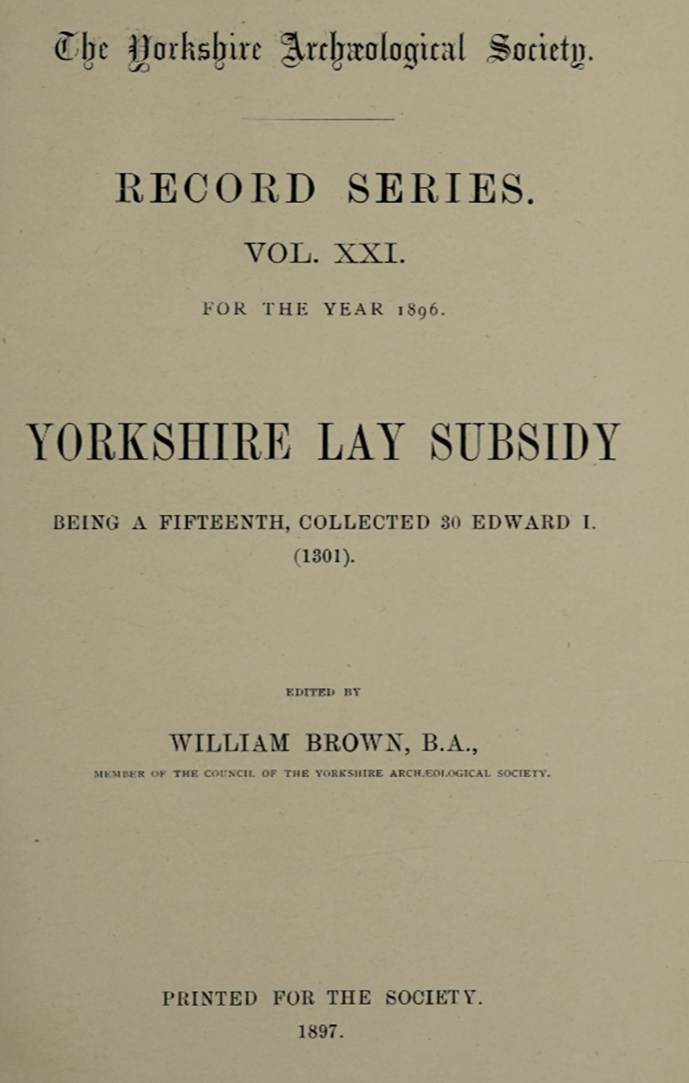
1301, where he paid a tax of 3s (Yorkshire Lay Subsidy 30 Ed. I (1301). Originally
published by Yorkshire Archaeological Society, 1897. 'The Subsidy: Wapentake of
Langbaurgh', in Yorkshire Lay Subsidy 30 Ed. I (1301), ed. William Brown,
1897), page 26,
also British History Online).
See further details at FAR00029.
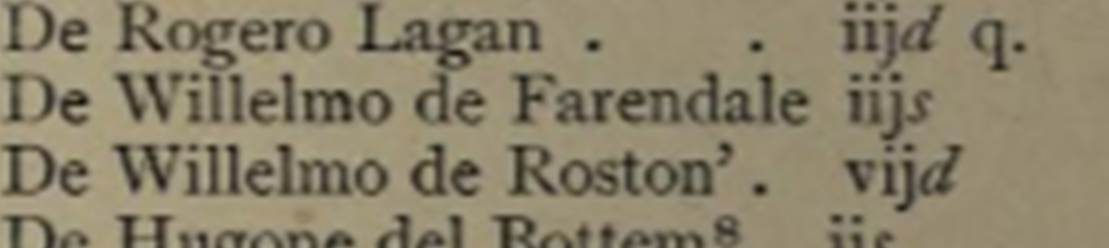
In
the Wapentagium de Langeberyghe
at Daneby, De Willelmo
de Farendale paid iijs.
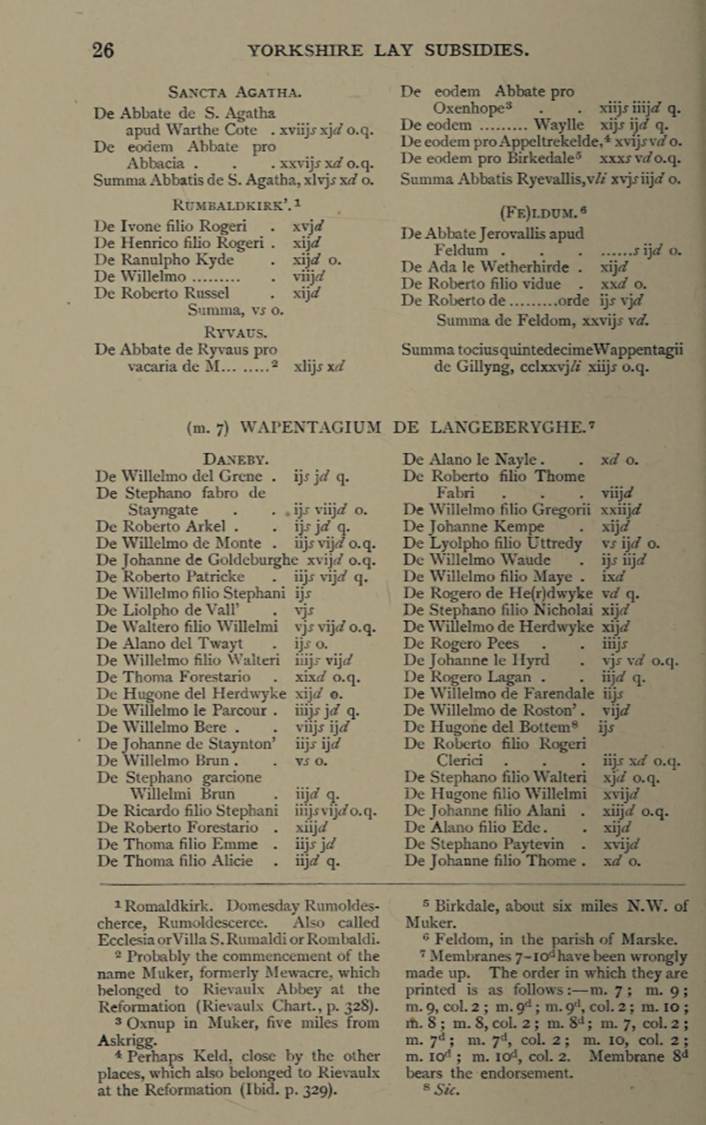
In the full list of the taxpayers of Danby, William paid a relatively large amount in tax
suggesting he was amongst the wealthier tenants there.
In Danby (Daneby):
De Willelmo Bere paid 8s 2d
De Waltero filio
Willelmi paid 6s 7d
De Johanne le Hyrd paid 6s 5d
De Liolpho de Vall paid 6s
De Lyolpho filio
Uttredy paid 5s 3d
De Willelmo Brun paid 5s
De Willelmo filio
Walteri paid 4s 7d
De Ricardo filio Stephani paid 4s 7d
De Willelmo le Parcour
paid 4s 1d
De Rogero Pees paid 4s
De Roberto filio Rogeri
Clerici paid 3s 10d
De Willelmo de
Monte paid 3s 7d.
De Roberto Patricke paid 3s 7d
De Johanne del How paid 3s 4d
De Ricardo de Lelom
paid 3s 3d
De Johanne de Staynton paid 3s 2d
De Thoma filio
Emme paid 3s 1d
De Willelmo de Farendale paid 3s
De Stephano fabro de Stayngate paid 2s 8d
De Willelmo Waude paid 2s 3d
De Roberto de Tuphirst
paid 2s 2d
De Willelmo del Grene paid 2s 1d
De Roberto Arkel paid
2s 1d
De Alano del Twayt paid 2s
De Willelmo filio Stephani paid 2s
De Hugone del Bottem
paid 2s
De Willelmo filio
Gregorii paid 23d
De Waltero Waude paid 21d
De Thoma Forestario
paid 19d
De Johanne de Goldeburgh paid 17d
De Hugone filio
Willelmi paid 17d
De Stephano Paytevin paid 17d
De Roberto Forestario paid 13d
De Johanne filio
Alani paid 13d
De Hugone del Herdwyke paid 12d
De Johanne Kempe paid 12d
De Stephano filio Nicholai paid 12d
De Willelmo de Herdwyke paid 12d
De Alano filio Ede paid 12d
De Rogero filio Lyolphi paid
12d
De Stephano filio Walteri paid
11d
De Alano le Nayle paiud 10d
De Johanne filio Thome paid 10d
De Willelmo filio
Maye paid 9d
De Roberto filio Thome Fabri paid 8d
De Willelmo de Roston
paid 7d
De Rogero de He(r)dwyke paid 5d
De Stephano garcione Willelmi Bruri paid 3d
De Thoma filio Alicie paid 3d
De Rogero Lagan paid 3d
Danby is a Scandinavian
place name, meaning the Dane’s Farm.
His brother may have been de Johanne de Farndale who moved to Egton, not so far away, north of the North York Moors but lower down into
Cleveland. Perhaps the two brothers left Farndale together, to start new lives.
1340
William might have continued to work in
Danby until he died. If he
lived to sixty, then he might have lived to about 1340.
|
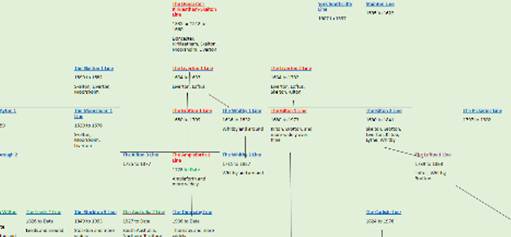
How does De Willelmo de
Farndale relate to the modern family? It is not possible to be accurate about the early family tree,
before the recording of births, marriages and deaths in parish records, but
we do have a lot of medieval material including important clues on
relationships between individuals. The matrix of the family before about 1550
is the most probable structure based on the available evidence. If it is accurate, De Willelmo
de Farndale, was related to the thirteenth century ancestors of the modern
Farndale family, but and perhaps the brother of John who might have been a
direct ancestor of the modern family. |