Melbourne
Historical and geographical information
|
Return to the Home Page of the Farndale Family
Website |
The story of one family’s journey through two
thousand years of British History |
The 83 family lines into which the family is divided.
Meet the whole family and how the wider family is related |
Members of the historical family ordered by date of
birth |
Links to other pages with historical research and
related material |
The story of the Bakers of Highfields, the Chapmans,
and other related families |
Introduction
Dates are in red.
Hyperlinks to
other pages are in dark
blue.
Headlines of the
history of the Lythe are in brown.
References and
citations are in turquoise.
Contextual
history is in purple.
This webpage about
the Lythe has the following section headings:
· Matthew Farndale and
his family
· Melbourne, an
overview
·
Timeline of
Melbourne
Matthew Farndale and his
family
We do not know what it was
that made Matthew Farndale (FAR00225) and
Hannah decide to emigrate to Australia. Perhaps they had been thinking of this
for some time, but whatever the reason it was a major undertaking to look for a
new life at the age of 57 and to leave his family and all that he knew. Before
leaving Kildale their eldest daughter Mary Ann married William Martin of
Kildale who had been a butler at Ingleby Manor.
The Argo left Liverpool on
8 October 1852. Onboard were Matthew (59), Hannah, his wife (45), Elizabeth
(19) their youngest daughter and Mary Ann (23) and her husband William Martin
(23).
The Argo was a chartered American ship on its
first voyage to Melbourne. The voyage lasted 100 days arriving in Melbourne of
19 January 1853. It departed Melbourne on March 25, 1853, for Callas
They must have first spent some time in
Melbourne, first renting a house, hut or tent; there were only a few permanent
buildings. Here they would enquire after land.
They would have heard much of gold - the gold
rush was in full cry. However they decided against it. Someone
advised them to move west to Western Victoria around Colac.
There was not much there; it was a risk; but
they took it. It was a land of bush, huge gum trees, scrub, native wattle huts
and bracken. There were no roads so they must assemble stores, equipment and
prepare to move. They would probably have had a large wagon hauled by bullocks
and a few horses. They would have found their way across country, crossing
rivers where they could, until they came to Geelong - perhaps 60 miles the way
they would have to go - this would have taken about a week. They would camo outdoors
listening to the starnge sounds of a
strange land., particularly the birds. The most unusual would be the kookoburra with its hearty laugh, but magpies would
remind them of Yorkshire. The land and the sky, with the southern cross would
all be new, strange and different. They would see signs of aborigines who still
lived in the area and were not always friendly to the white invaders. The heat
of the day would be much more than anything they had ever experienced before
and the terrible insects and flies. They would have been dirty and weary, the
women in their long skirts sweeping the ground when they rested at Winchelsea.
Then on to Colac where they must have stayed sometime looking for land.
They eventually settled at Birregurra.
Melbourne
Melbourne (Boonwurrung,
Woiwurrung, Narrm
or Naarm) is the capital of the Australian state of
Victoria, and the second-most populous city in Australia, after Sydney. Its
name generally refers to a 9,993 km2 metropolitan area known as Greater
Melbourne.
Melbourne Timeline
40,000 BCE
Indigenous Australians have lived in the
Melbourne area for an estimated 31,000 to 40,000 years.
When European settlers arrived in the
19th-century, under 2,000 hunter-gatherers from three regional
tribes, the Wurundjeri, Boonwurrung and Wathaurong, inhabited the area. It was
an important meeting place for the clans of the Kulin nation alliance
and a vital source of food and water.
1803
The first British settlement in Victoria, then
part of the penal colony of New South Wales, was established by
Colonel David Collins in October 1803, at Sullivan Bay, near
present-day Sorrento.
The following year, due to a perceived lack of
resources, these settlers relocated to Van Diemen's
Land (present-day Tasmania) and founded the city of Hobart. It
would be 30 years before another settlement was attempted.
1835
In May and June 1835, John Batman, a
leading member of the Port Phillip Association in Van Diemen's Land,
explored the Melbourne area, and later claimed to have negotiated a
purchase of 600,000 acres (2,400 km2) with eight Wurundjeri
elders. Batman selected a site on the northern bank of the Yarra River, declaring that "this will be the place
for a village" before returning to Van Diemen's Land.
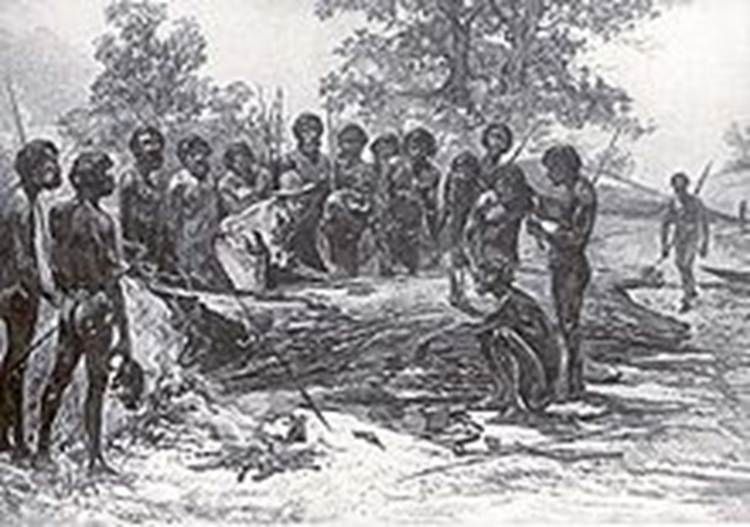
A late 19th-century artist's depiction
of John Batman's treaty with a group of Wurundjeri elders
In August 1835, another group of Vandemonian
settlers arrived in the area and established a settlement at the site of the
current Melbourne Immigration Museum. Batman and his group arrived the
following month and the two groups ultimately agreed to share the settlement,
initially known by the native name of Dootigala.
Batman's Treaty with the Aborigines was
annulled by Richard Bourke, the Governor of New South Wales (who
at the time governed all of eastern mainland Australia), with compensation paid
to members of the association.
1836
In 1836, Bourke declared the city the
administrative capital of the Port Phillip District of New South
Wales, and commissioned the first plan for its urban layout, the Hoddle
Grid, in 1837.
1837
Known briefly as Batmania, the
settlement was named Melbourne on 10 April 1837 by Governor Richard
Bourke after the British Prime Minister, William Lamb, 2nd
Viscount Melbourne, whose seat was Melbourne Hall in
the market town of Melbourne, Derbyshire. That year, the
settlement's general post office officially opened with that name.
Between 1836 and 1842, Victorian Aboriginal
groups were largely dispossessed of their land by European settlers.
1844
By January 1844, there were said to be 675
Aborigines resident in squalid camps in Melbourne. The British Colonial
Office appointed five Aboriginal Protectors for the Aborigines of
Victoria, in 1839, however their work was nullified by a land policy that
favoured squatters who took possession of Aboriginal lands.
1845
By 1845, fewer than 240 wealthy Europeans held
all the pastoral licences then issued in Victoria and became a powerful
political and economic force in Victoria for generations to come.
1847
Letters patent of Queen Victoria,
issued on 25 June 1847, declared Melbourne a city.
1851
On 1 July 1851, the Port Phillip District
separated from New South Wales to become the Colony of Victoria, with Melbourne
as its capital.
The Victorian gold rush

South Melbourne's "Canvas Town"
provided temporary accommodation for the thousands of migrants who arrived each
week during the 1850s gold rush.
The discovery of gold in Victoria in mid-1851
sparked a gold rush, and Melbourne, the colony's major port, experienced
rapid growth. Within months, the city's population had nearly doubled from
25,000 to 40,000 inhabitants. Exponential growth ensued, and by 1865
Melbourne had overtaken Sydney as Australia's most populous city.
1853
Matthew Farndale (FAR00225) and
his family arrived in Melbourne.
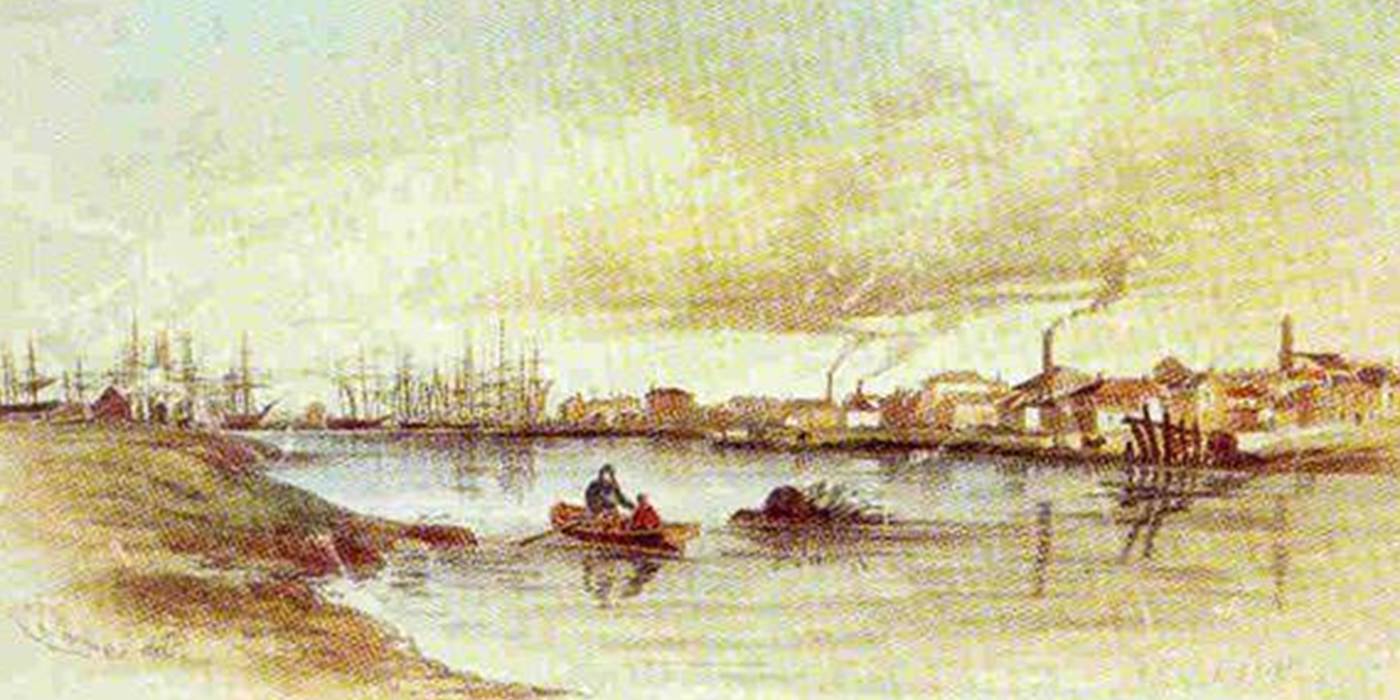
Melbourne, 1853 from below Princes Bridge
An influx of intercolonial and international
migrants, particularly from Europe and China, saw the establishment of slums,
including Chinatown and a temporary "tent city" on the
southern banks of the Yarra.
1854
In the aftermath of the 1854 Eureka
Rebellion, mass public-support for the plight of the miners resulted in major
political changes to the colony, including improvements in working conditions
across mining, agriculture, manufacturing and other local industries. At least
twenty nationalities took part in the rebellion, giving some indication of
immigration flows at the time.

A large crowd outside the Victorian Supreme
Court, celebrating the release of the Eureka rebels in 1855
With the wealth brought in from the gold rush
and the subsequent need for public buildings, a programme of grand civic
construction soon began. The 1850s and 1860s saw the commencement
of Parliament House, the Treasury Building, the Old Melbourne
Gaol, Victoria Barracks, the State Library, University of
Melbourne, General Post Office, Customs House, the Melbourne
Town Hall, St Patrick's cathedral, though many remained uncompleted
for decades, with some still not finished as of 2018.
The layout of the inner suburbs on a largely
one-mile grid pattern, cut through by wide radial boulevards and parklands
surrounding the central city, was largely established in the 1850s and
1860s. These areas rapidly filled with the ubiquitous terrace houses, as well
as with detached houses and grand mansions, while some of the major roads
developed as shopping streets.
1855
In 1855, the Melbourne Cricket
Club secured possession of its now famous ground, the MCG.
1859
Members of the Melbourne Football
Club codified Australian football in 1859, and in 1861, the
first Melbourne Cup race was held.
1861
Melbourne quickly became a major finance
centre, home to several banks, the Royal Mint, and in 1861 Australia's
first stock exchange.
With the gold rush largely over by 1860,
Melbourne continued to grow on the back of continuing gold-mining, as the major
port for exporting the agricultural products of Victoria (especially wool) and
with a developing manufacturing sector protected by high tariffs. An extensive
radial railway network spread into the countryside from the late 1850s.
Construction started on further major public buildings in the 1860s and 1870s,
such as the Supreme Court, Government House, and the Queen Victoria
Market. The central city filled up with shops and offices, workshops, and
warehouses. Large banks and hotels faced the main streets, with fine townhouses
in the east end of Collins Street, contrasting with tiny cottages down laneways
within the blocks. The Aboriginal population continued to decline, with an
estimated 80% total decrease by 1863, due primarily to introduced diseases
(particularly smallpox[25]),
frontier violence and dispossession of their lands.
1864
Melbourne acquired its first public monument,
the Burke and Wills statue, in 1864.
1880

Lithograph of the World
Heritage-listed Royal Exhibition Building, built to host
the Melbourne International Exhibition of 1880
The decade of the 1880s saw extraordinary
growth: consumer confidence, easy access to credit, and steep increases in land
prices led to an enormous amount of construction. During this "land
boom", Melbourne reputedly became the richest city in the world, and
the second-largest after London in the British Empire.
The decade began with the Melbourne
International Exhibition in 1880, held in the large
purpose-built Exhibition Building.
In 1880 a telephone exchange was established,
and in the same year the foundations of St Paul's, were laid.
1881
In 1881 electric light was installed in the
Eastern Market, and in the following year a generating station capable of
supplying 2,000 incandescent lamps was in operation.
1885
In 1885 the Melbourne Tramway Trust built the
first line of the Melbourne cable tramway system, which became one of the
world's most extensive systems by 1890.

Federal Coffee Palace, one of many grand hotels
erected during the boom
In 1885 visiting English journalist George
Augustus Henry Sala coined the phrase "Marvellous Melbourne",
which stuck long into the twentieth century and which Melburnians still use
today.
1888
Melbourne's land-boom reached a peak in 1888,
fuelled by consumer confidence and escalating land-value. As a result of
the boom, large commercial buildings, grand edifices, banks, coffee
palaces, terrace housing and palatial mansions proliferated in the
city.
The establishment of a hydraulic facility in
1887 allowed for the local manufacture of elevators, resulting in the first
construction of high-rise buildings; most notably the APA Building,
amongst the world's tallest commercial buildings upon completion in
1889. This period also saw the expansion of a major radial rail-based
transport network.
In 1888 the Exhibition Building hosted a second
event, even larger than the first: the Melbourne Centennial Exhibition. This
spurred the construction of numerous hotels, including the
500-room Federal Hotel, The Palace Hotel in Bourke Street (both since
demolished), and the doubling in size of the Grand (Windsor).
1890s
A brash boosterism that had typified
Melbourne during this time ended in the early 1890s with a severe economic
depression, sending the local finance and property industries into a period of
chaos, during which 16 small "land banks" and building societies
collapsed, and 133 limited companies went into liquidation.
The Melbourne financial crisis was a
contributing factor in the Australian economic depression of the
1890s and in the Australian banking crisis of 1893.
The effects of the depression on the city were
profound, with virtually no new construction until the late 1890s.
Bibliography