Skelton

Historical and geographical information
|
Return to the Home Page of the Farndale Family
Website |
The story of one family’s journey through two
thousand years of British History |
The 83 family lines into which the family is divided.
Meet the whole family and how the wider family is related |
Members of the historical family ordered by date of
birth |
Links to other pages with historical research and
related material |
The story of the Bakers of Highfields, the Chapmans,
and other related families |
Dates are in red.
Hyperlinks to other
pages are in dark blue.
Headlines are in brown.
References and
citations are in turquoise.
Contextual
history is in purple.
This webpage
about the Skelton has the
following section headings:
·
Farndale
family history and Skelton
· Skelton, overview
· Timeline of
Skelton’s history
· Bibliography
The Farndales of Skelton
The Doncaster Kirkleatham
Skelton Line are the descendants of Nicholas farndaile
(FAR00059).
The Skelton 1 Line are the
descendants of William Farndale (FAR00071).
Other Farndales
associated with Skelton are: Mar Farndale (FAR00084); William
Farndale (FAR00093);
George Farndale (FAR00113);
William Farndale (FAR00123);
William Farndale (FAR00125);
Elizabeth Farndale (FAR00139);
William Farndale (FAR00142A);
Elizabeth Farndale (FAR00155);
George Farndale (FAR00156);
William Farndale (FAR00157);
Mary Farndale (FAR00164);
Ann Farndale (FAR00165);
John Farndale (FAR00167);
John Farndale (FAR00168);
Mary Farndale (FAR00185);
Grace Farndale (FAR00189);
Mary Farndale (FAR00202);
Elizabeth Farndale (FAR00204);
John Farndale (FAR00217);
Elizabeth Farndale (FAR00235);
Anna Farndale (FAR00242);
Hannah Farndale (FAR00245);
Harriet Farndale (FAR00249);
Hannah Farndale (FAR00250);
Martin Farndale (FAR00264);
William Masterman Farndale (FAR00312);
Thomas Farndale (FAR00317);
Elizabeth Farndale (FAR00319);
Teresa Farndale (FAR00325);
Annie Maria Farndale (FAR00334); John
George Farndale (FAR00337);
Elizabeth Farndale (FAR00345);
William Farndale (FAR00356);
Martin Farndale (FAR00364);
John Farndale (FAR00376);
Matthew Farndale (FAR00383);
Charles Masterman Farndale (FAR00429);
Margaret Ann Farndale (FAR00522);
William Farndale (FAR00625);
and Dorothy Annie Farndale (FAR00668).
Skelton
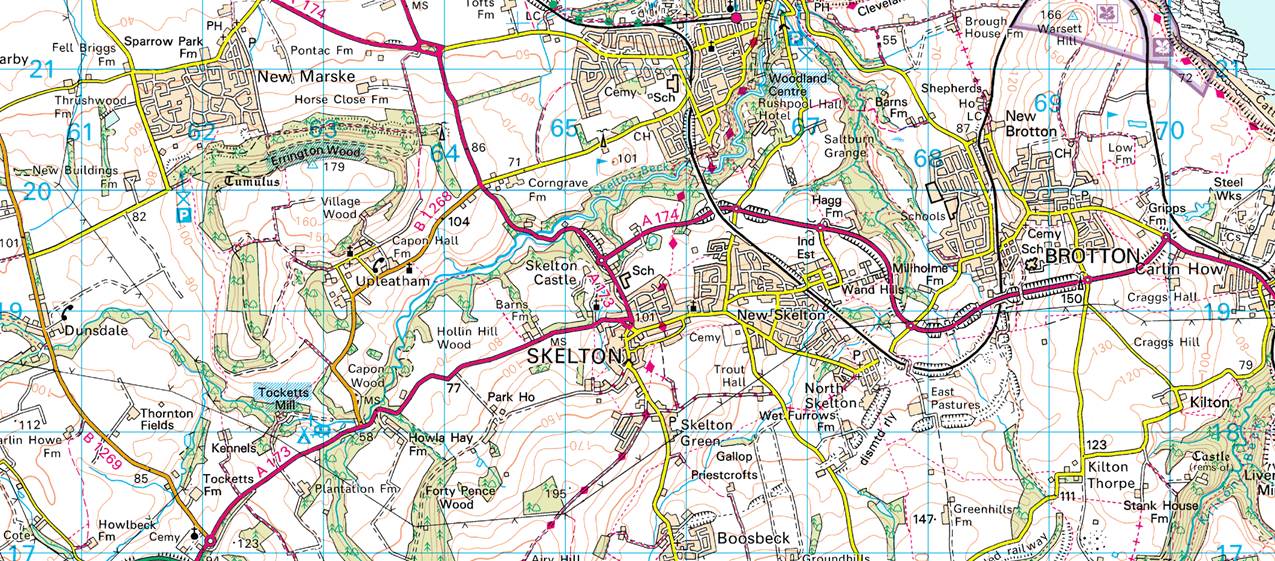
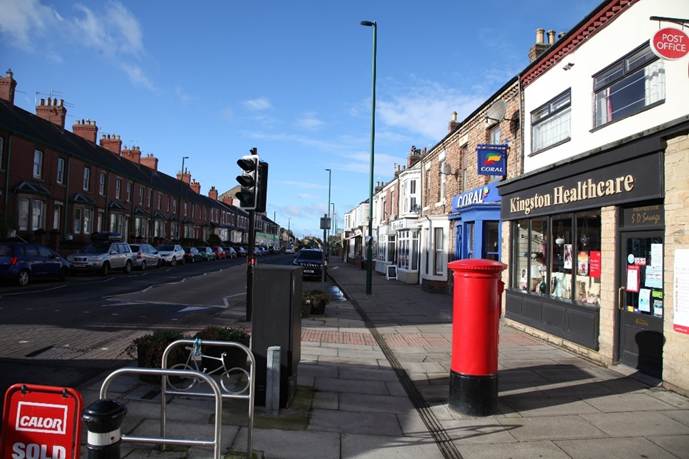
Skelton or Skelton-in-Cleveland is
a small town in the civil parish of Skelton and Brotton in the
borough of Redcar and Cleveland in the North
East. The town lies within the ceremonial county of North
Yorkshire and is governed by the unitary
authority of Redcar and Cleveland. It is situated at the foot of
the Cleveland Hills and about 16 km east of Middlesbrough.
Sceltun, Scheltun (eleventh cebntury); Scelton
(twelfth century); Sceltona, Scheltona, Skeltona
(thirteenth century); Skolton (fourteenth
century).
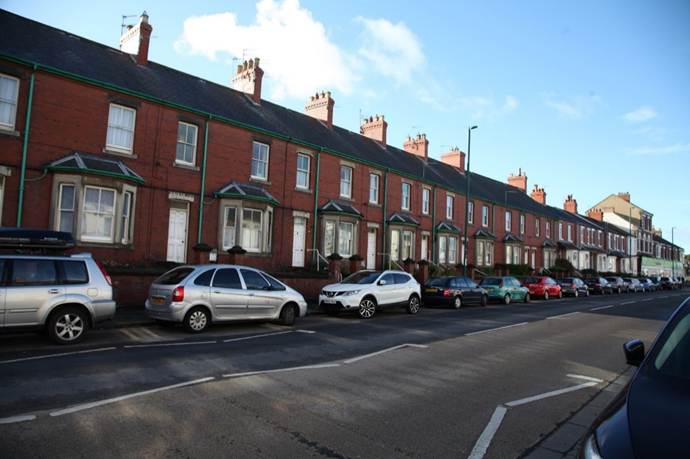
Skelton is made
up of North Skelton, Skelton Green and New Skelton.
Skelton Timeline
7,000
BCE
Skeletons of wild
ox and deer have been found in peat bogs just a few miles from Skelton and have
been dated’ to around this time.
4,000
BCE
Many burial sites
or howes on the hills around Skelton provide the first real evidence of
humans in these parts.
Anglo
Saxon
It is thought
that the people buried at Hob Hill in the Anglo Saxon
period were outlying settlers of the Anglo Saxon
region called Deira and spent their lives in the Skelton area, possibly using
Skelton beck as a water supply.
Anglo
Saxon Scandinavian
A portion of an
inscribed sundial was found in the churchyard of Skelton in Cleveland in 1891,
by T M Fallow. It bears part of the circle and four rays of the dial, two of
which are crossed, with part of an inscription in four lines in quasi-Roman
letters, and of another in one line, in Danish runes.
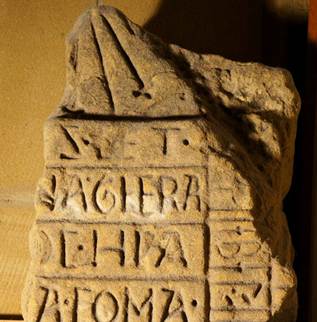
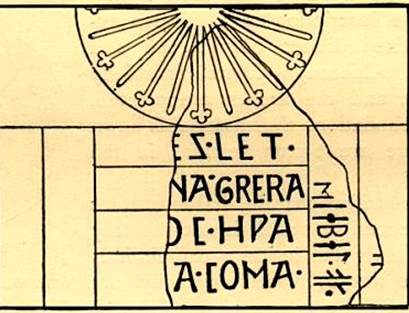
The sundial extract
Possible reconstruction of the whole sundial
The Roman letters
read:
Es let
Na grera (grera is part of the word ‘to
grow’).
C Hwa
A coma (coma is ‘to
come’ or ‘they come’).
The Danish runes
read diebel ok, which is late Danish
for ‘devil and’. It has been suggested that this may be part of a motto
something like ‘When the sun is up the evil spirits are down’.
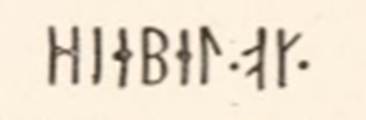
(Runic Sun Dial found at Skelton, Yorkshire Archaeological Journal, Volume 13, 1895, page
189, Skelton in Cleveland, Skelton’s Own
Rosetta Stone).
The sundial
compares to the Kirkdale
Sundial.
1086
The Victoria County History – Yorkshire, A History of the
County of York North Riding: Volume 2 Parishes: Skelton, 1923: In the
reign of Edward the Confessor Uctred had a 'manor' and 13 carucates at Skelton
which in 1086 were held of the Count of Mortain by Richard. They afterwards
became part of the Brus fee and followed the descent of Danby until the division
in 1272 of the lands of the third Peter de Brus, when the castle and manor of
Skelton with five knights' fees passed to Walter de Fauconberg
and his wife Agnes.
The estates were first given to Robert de
Brus, one of the most notable commanders of the Conqueror, who died about 1090 ; his son Robert succeeded him, and founded Guisborough
Priory, where he was buried in 1141. He was probably the builder also
of the stronghold, which stood on an eminence, rendered impregnable by
considerable outworks (Ryedale and North
Yorkshire antiquities, George Frank,
1888, page
21).
The Domesday Book entry records 12 villagers; 7
ploughlands. 1 lord’s plough teams. 3 men’s plough teams. Meadow – 20 acres.
Woodland 2 furlongs mixed measures. The whole manor 5 miles long and 2 broad. Annual value to Lord: 16s in 1086; £2 in 1066. The
Normans had lain waste many areas of the North and the 16s taxable value of
Skelton as compared to 40s prior to 1066 is taken to indicate the extent to
which the village was on the receiving end of this subjugation. Tenant-in-chief
in 1086: Count Robert of Mortain. Lord in 1086: Richard (of Sourdeval).
Lord in 1066:
Uhtred.
William Hornsby (The Domesday
Valets of the Langbargh Wapentake,
Yorkshire Archaeological Journal, Volume 25, 1920, page 334) suggested the Domesday Survey is assessed at the following
rates:
·
A demesne plough at 2.5 times villains' plough.
·
Villains usually 4d, bordars 2d, and sokeman 6d.
·
Meadow at 2d an acre.
·
Other elements at 1s 4d.
It will be found that seventeen of the
twenty-two cases work out according to scale. Of these, Skelton maybe taken as
typical: “On the demesne 1 plough and 12 villains with 3 ploughs and 20 acres
of meadow, wood pasture, valet 16s.”
He therefore suggested the breakdown for
Skelton was:
1 demesne
plough at 3s 4d = 3s 4d;
12
villains at 4d = 4s;
3
villains' ploughs at 1s 4d = 4s;
20
acres of meadow at 2d = 3s 4d;
Wood
pasture at 1s 4d
Total
16s.
1124
A Royal Charter
granted Robert De Brus the Lordship of Annandale in Scotland. This came about
either because Robert De Brus, was a friend and supporter of David, the
Scottish king or that his second son, also called Robert, married the heiress
to Annandale. Thus began the chain of events which would see his direct successor,
Robert the Bruce, take the throne of Scotland two hundred years later.
Robert
de Brus, was founder of the royal line of Scotland, and also
through the Stuarts of the English line (Ryedale and
North Yorkshire antiquities, George
Frank, 1888, page
21).
See
the History of the House Brus and the Brus genealogy, which also traces
the history of the Skelton estate.
There is a story
that Robert De Brus the younger, of Annandale, fought on the side of the Scots
king and was taken prisoner by his own father, Robert De Brus of Skelton.
According to the Chivalry of the time he was handed
over to the king before being returned to his parents.
His elder son
Adam, the third lord, who succeeded him, fought by the side of his father at
the Battle of the Standard (Ryedale and
North Yorkshire antiquities, George
Frank, 1888, page
21).
1140
Skelton castle
was established as the principal seat of the de Brus family early in the 12th
century. The castle is thought to have been built around 1140 and was lived in
by 8 generations of the de Brus family until the death of Peter de Brus III in
1272. At this time the de Brus estates were divided amongst four daughters,
Agnes, Lucia, Margaret and Laderina. The first two daughters
stayed within the Cleveland area. Agnes married into the de Fauconberg
family and inherited Skelton castle and nearby esstates,
whilst Lucia married into the de Thweng family of
Kilton castle.
Architecturally
the medieval castle has not survived.
Robert De Brus of
Skelton Castle was a supporter of Stephen’s cause, but now he had even greater
reason to fight as the Scots were threatening his own lands.He was one of those who tried to mediate with
David I and prevent bloodshed.
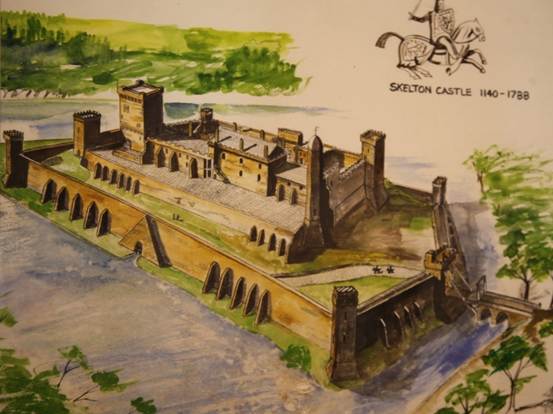
The Victoria County History –
Yorkshire, A History of the County of York North Riding: Volume 2 Parishes:
Skelton, 1923: The castle is situated on high ground near the Skelton Beck in the
north of the parish, and is surrounded by park lands
and woods and on three sides by a moat. The old castle was probably built by
one of the Brus family and was the dwelling-place successively of the Bruses, Fauconbergs, Conyers,
Trotters, Stevensons and Whartons. It seems to have been used as a fortress and
for keeping prisoners in the reign of King John, and in 1265 it was surrendered
to Henry III by Peter de Brus, who was suspected of adherence to Prince Edward.
1141
Death of Robert
de Brus II He was buried in Guisborough Priory. The new lord of Skelton was
Robert’s eldest son, Adam, who was married to Agnes. They had a son, Adam and a
daughter Agatha. Agnes was the daughter of Stephen, the Earl of Albemarle, and the
sister of William, called ‘Le gros’ under whom Adam had fought at the Battle of
the Standard.
1208
In order to obtain the money demanded by King John. Peter de Brus made an
agreement with his Cleveland tenants within Langbaurgh, by which he agreed to
limitations in the exercise of his authority in return for a guarantee that the
knights and free tenants would make up any shortfall in the rent of forty marks
charged by the king. The witnesses were Roger de Lacy, Robert de Ros, Eustachia de Vescy, Walter de
Faucumberge. The Charter was lodged with the Prior of Guisborough. It has been suggested
by some that it was a pre-cursor to Magna Carta, when the Barons strove to
place similar limitations on King John’s powers.
Peter de Brus was
given custody of William de Brus, the son of William, as a hostage of King John
to ensure the behaviour of the King of Scotland.
Peter de Brus
held 11 “knights fees” of the honour of “Skeltone” in
Yorkshire.
1216
From the 8 to 10 February
1216, King John attacked and took Skelton Castle. Peter de Brus’s men were
taken prisoner. On 15 February 1216, John agreed to receive Peter de Brus and
Robert de Ros under safe conduct: ‘with all such as they should bring with
them unarmed, to a conference, to treat with him about making their peace with
him; and the said safe conduct shall hold good for one month from St Valentine’s day. And for greater security our lord the King
wills that …..Archdeacon of Durham, Wydo de Fontibus,
Frater Walter, Preceptor of the Templars in the district of Yorkshire, with one
of Hugh de Bailloel’s retinue, shall go with them in person to the Lord King,
and escort them; and they have Letters Patent from the King to that effect; and
the said letters are the same day handed to the aforesaid parties, Thomas,
Canon of Gyseburn, being further added to their
numbers’ On 26 February 1216 King John issued the following mandate: ‘We
command you that you receive and see to the safe keeping of the prisoners whose
names are underwritten, taken at Skelton Castle, who will be sent to you by
Dame Nicholas de Haya –that is to say, Godfrey de Hoga, Berard de Fontibus, Anketil de Torenton, Robert de Molteby, Stephen Guher, William de
Lohereng, Robert de Normanby, Roger le Hoste, Robert de Gilling, John de
Brethereswysel, Thomas Berard’sman and Ralph de Hoga’
In July and August the King issued further orders that prisoners taken
at Skelton Castle should be ransomed.
King John died
later in 1216 and Henry III became King aged 9. In
1219 Peter de Brus was forgiven for his opposition to King John and recovered
Carlton and other manors in Cleveland, which the Crown had taken from him.
1227
Peter was given
licence to hold a Market at Skelton on Mondays.
1265
Skelton castle
was surrendered to Henry III by Peter III who was suspected of supporting
Henry’s son, Prince Edward. There is a record of the castle being used for
keeping prisoners.
1269
Skelton-in-Cleveland:
Quitclaim by Alice and Helena, Agnes and Hauisia
sisters, to Peter de Bruis the third, of all their land of Scelton
late belonging to Richard, the reeve, (prepositi) their uncle, viz., a toft and
croft at the entrance of the town of Scelton towards
the east late held by Walter Blevent; 1 acre in Scelton
fields lying between the tilled land of Sir Peter de Bruis called Roskeldesik and the half ploughland belonging to the Mills;
an assart late of Wm. Winde, lying between Langhacres and the vale of
meadows of Scelton; 1 acre given by Wm. Cusin to Ralf, son of Wine, lying between Roskeldesic and the half ploughland belonging to the lord’s
mills; and 2 1/2 acres in the territory of Scelton on
Lairlandes; for the rents of 1d. to them and their
heirs, heirs of Wm. Cusin for the acre between Roskeldsic and the half ploughland, 2d. to the same for the
2 1/2 acres on Lairlandes, 1d. to the heirs of Rolf
son of Wine for the acre given to Ralf by Wm. Cusin,
and 1d. to Richard Briton for the assart. Witnesses :- Sir Adam de Hilton, Sir Simon de Bruis, Sir
Stephen de Rosel, Sir Berard de Fontibus, John de
Tocotes, John de Nutel, Wm. Pitwaltel, Robt de Tormodeby, Geoffrey the Cook (Coco) Hugh Hauberger, Matthew
the Clerk (clerico) (Yorkshire
Archeological Journal, Vol XIII, London, 1895, p 52,
“Yorkshire Deeds, Part 4, by A.S. Ellis).
1271
Peter de Brus III
of Skelton Castle died. For nearly two hundred years six generations of the De Brus
family of Skelton Castle had had male heirs and their possessions had grown
through marriage as the Law was that on marriage the property of the wife
becomes the husband’s. Peter de Brus III’s elder sister had pre-deceased him
and both were childless. The de Brus Estates were therefore divided between his
four remaining sisters.
After passing
to the fifth, sixth, seventh, and eighth lords, all of whom bore the name of
Peter, (the last dying without issue, in 1271) his four sisters became heirs to
the property. The eldest, Agnes, who married Walter de Fauconberg, inherited as
her share the barony of Skelton, with the manors of Marsk, Kirkleatham,
Upleatham, and other possessions. (Ryedale
and North Yorkshire antiquities, George
Frank, 1888, page
21).
1272
The Victoria County History – Yorkshire, A History of the
County of York North Riding: Volume 2 Parishes: Skelton, 1923: North of the castle is a mill on the Skelton Beck, probably
representing the site of one of the mills appurtenant to the manor in 1272, and
to the east is a fish-pond also mentioned at that date.
1280
“25th May, 8th Edward I. 1280 No 54. For Walter de Fauconberg. The
King to Archbishops, greeting. Know ye that we have granted, and by this our
Charter confirmed to our beloved and faithful Walter de Faucunberge, that he
and his heirs for ever have free warren in all his demesne lands of Skelton, Stanghow
and Mersk, Uplithum, Redker,
Grenrig and Estbrune in the
County of York. Provided that those lands be not within the bounds of our
forest, so that no one enter those lands to hunt in them, or to take anything,
which may belong to the warren, without the licence and will of him the said
Walter, or his heirs, upon forfeiture to us of £10; wherefore he will….”
1291
A dispute arose
between Skelton Castle and Guisborough Priory over an area of land around what is
now Skelton Ellers, called ‘Swarthy Head’ and then called ‘Swetingheved’.
This was on the edge of the Skelton hunting park which stretched east to the the Castle and South over Airy Hill to Margrove
Park. Walter de Fauconberg agreed to maintain the
hedges and ditches to prevent the deer straying onto the prior’s meadows and
arable land and to pay tithes on the deer themselves.
1301
The
Lay Subsidy of 1301. A Parliament at Lincoln in this year authorised a Lay Subsidy. This was a tax on
the whole population and was based on a fifteenth part of each person’s movable
possessions. Among the taxpayers of Skelton were ‘a merchant, a fuller, a
weaver, a potter, a tanner, a baker, a smith, a butcher, 2 carpenters and 3
carriers [pannierman, wainman
and a carter].’ There were 63 taxpayers in Skelton who paid a total of £5 13s.
Multiplying this by 15 gives the total value of these villagers
possessions as £84 6s. Total taxpayers in other places in the North Riding of
Yorkshire were Guisborough 85, Whitby 96, Marske and Redcar 89, Yarm 72. There
were likely many poorer, labouring people who did not pay tax.
1304
The Victoria County History – Yorkshire, A History of the
County of York North Riding: Volume 2 Parishes: Skelton, 1923: Walter
de Fauconberg died in about 1304 and was succeeded by
his son Walter, who died in about 1318, his heir being John his son. John settled
the manor on himself with remainder to his son Walter, in tail, in 1344; he
died in 1349 and Walter succeeded him.
1325
In the 1840’s the
piece of stone shown here was found in the old Churchyard, near the Castle, by
a Mr T. M. Fallow. It appears to be part of a sun-dial
and must have come from the old Anglo-Saxon Church which was replaced in 1325.
This second church was in turn replaced in 1785 by the present redundant
Church. See above.
A
work by Mrs Margaret Scott Gatty, 1809 – 1873 gives the following explanation of
the Skelton stone: Part of the semicircle remains and 4
hour lines, two of which, viz., midday and 2 p.m
are crossed. Apparently the dial had been divided into
twelve hour spaces. Below these lines there are
portions of 4 lines of an inscription in Old Norse or Danish, with part of a
line of runes down the side. “The runes”, writes Bishop Browne, “I read as
DIEBEL OK, which Mr Magnusson says is good Danish – of latish date – for ‘devil
and’. He tells me that GRERA is part of the word ‘to grow’, and COMA is ‘to
come’. The words ‘devil and’ may well be a pious curse on creatures of that
kind. From the style of the inscription this stone appears to belong to the
early part of the twelfth century.”
1334
The Lay Subsidy of 1334: Skelton was assessed for the
Subsidy at total £2, compared with Yarm £9, Guisborough £4 and Stokesley £1 : 4s.
1349
In 1349 the
castle was described as expensive to maintain.
The Black Death.
The Inquisitiones Post Mortem
23 Edward III, which is a survey of the assets of the Fauconbergs
on the death of John, stated “In demesne, 24 bovates of weak and Moorish
land, each worth 4 shillings…before the mortality of men in these parts this
year. 30 acres of meadow each worth 1 shilling per annum before the Death. 3
water mills of which one is weak and ruinous….worth £4
before the Death.” The castle is described in this year as being difficult
to maintain. There is mention of a “..park of oaks
with game, called ‘le Wespark’ and ‘Maugrey Park with deer.” The area to the west of Skelton
Castle, to Skelton Ellars and over Airey Hill to Margrove
Park was part of the private woodland hunting reserve of Skelton Castle. In
this and the following years the plague killed a half to two thirds of the
population of England. It would seem from the above that most of the population
of Skelton died.
1361
The Victoria County History – Yorkshire, A History of the County
of York North Riding: Volume 2 Parishes: Skelton, 1923: Walter died
in 1361 and was succeeded by his son Thomas, one-third of the manor, however, being
assigned as dower to Isabel widow of Walter. Thomas granted his two-thirds of
the castle and manor and the reversion of Isabel's third, for his lifetime, to
Henry Percy Earl of Northumberland, who held the whole manor on the death of
Isabel in 1401.
1403
The Skelton
estate was taken into the custody of Henry IV, due to the insanity of Thomas Fauconberg.
The Victoria County History – Yorkshire, A History
of the County of York North Riding: Volume 2 Parishes: Skelton, 1923: Thomas
de Fauconberg suffered from intermittent insanity and in 1403 the custody of
the castle and manor were from this cause in the hands of the king, who granted
their custody to Robert and John Conyers. Thomas in 1407 settled the manor in feetail with successive remainders to Walter
son of Sir Roger Fauconberg, kt., and his heirs, and in default to the right
heirs of Thomas. He died in the same year, his heir being his infant daughter
Joan, while his widow Joan had one-third of the manor in dower. The elder Joan
appears to have died in March 1408–9; the custody of the lands was granted by
the Crown to Richard Cheerowe and Thomas Strickland. Joan was an idiot from
birth, but before she was sixteen she married William
Nevill son of Ralph Earl of Westmorland. William Nevill and Joan made a
conveyance of the manor in 1428. William Nevill was summoned to Parliament as
Lord Fauconberg in 1429, and
was created Earl of Kent in 1461. He died in January 1462–3 seised
of Skelton in right of his wife, who being of unsound mind held no lands after
his death.
1407
Owing to the
madness of Thomas Fauconberg, one third of the estate of Skelton was settled on
his wife Joan until her death which occurred in 1409. The other two thirds on
Walter de Fauconberg. In this same year Walter de Fauconberg
died and the estate passed to his daughter Joan. She
had been “an idiot from birth”, but had been married
before she was sixteen to William Nevill, the son of the Earl of Westmoreland.
The Inquisition Post Mortem on Thomas ‘Faucomberge’ shows estate passed to his widow Joan included
“a waste burgage”, “4 waste messuages”, and cottages either ruinous or waste or
“paying nothing.” It is possible that the Black Death which appeared in 1348 and
repeatedly during the previous century had decimated the population of Skelton,
which was about 400 at the beginning of it. Among the long list of possessions,
which also includes the Manor of ‘Mersk’ and Upleatham and many areas of land
with now unrecognisable names is:
In
the town and territory of Skelton in Cleveland: 1 built messuage with garden; 1
croft and 6 bovates held by William Shupherde; 1 built messuage with garden; 2 crofts
and 1 bovate held by John Proctour; 1 waste messuage and 1 bovate by John
Walkere; 2 bovates by John Harpour; 3 waste messuages and 1 bovate by William
Mason senior; 1 burnt messuage, a close called ‘Cadycroft’
and a parcel of land called ‘le Wanles’ by the same;
a third part of a messuage and of a bovate by Roger Homet; with all the
services of these tenants; 4 a. of foreshore at ‘Thilekelde’,
‘Roskeldesyke’ and ‘Grenwalde’
held by John Proctour; 1 close of herbage in ‘Burghgate’
and 1 called ‘Copyncroft’ by John Donaldeson; 1 built
cottage by Thomas de Newsom, and 1 by John Byrde; 1 with garden and croft by
William Whytekyrke; 1 garden and croft with 9 a. by William Syng; 1 built
cottage with 2 crofts by Robert Hogeson, the lord’s villein; 1 ruinous cottage
by Sibota Westland; 1 croft of herbage called ‘Bruyscroft’ by William Westland; 1 built burgage and 1
croft by John Pottere; 1 close of herbage called ‘Kyrkebyclos’
and 1 plot used for making pots (pro ollis inde faciendis) by the same; 2 waste
cottages in ‘Marketgate’ next William Lambard’s tenement on the south, let for
a rent of 12d.; 1 cottage now in the lord’s hands, formerly held by William
Westland for 20d., now paying nothing; In a place called Stanghow 1 built
cottage, 2 waste cottages, 1 bovate and a tenement called ‘Blackhall’ held by
Thomas Carlele; and 1 built messuage, 2 waste messuages and 4 bovates by John
West. Also a third part of 3 watermills in Skelton
with its members, called ‘Holbekmyll’, ‘Saltbornmyll’ and Skinningrove mill;
a
third part of a fulling mill, and of the profits of the oven, toll, market and
fair there, of the assize of bread and ale, of the court of Skelton, of
agistments in pasture and feedings not in severalty, of waste, of casualties
arising in wood or plain, as in hawks, sparrowhawks, falcons, and other birds
of prey or game, of warren and free chase, waifs and strays, etc. and of the
mining of lead, iron, marl and coal and of quarrying of slate and other mines in
the lordship of Skelton and its members.
1490
In 1490 Skelton
Castle was inherited by William Conyers, when it was described as ruinous. From
him it passed into the Trotter family and then by marriage to the Hall family
by the marriage of Joseph Hall to Catherine Trotter. Their son John inherited
and changed his name to Hall-Stevenson after marrying Ann Stevenson. He formed
the "Demoniacks" club who met at the ruins
of the castle for drinking bouts.
The Victoria County History – Yorkshire, A History of the
County of York North Riding: Volume 2 Parishes: Skelton, 1923: At
Joan's death in 1490 the heirs were her grandsons James Strangways, son of her
daughter Elizabeth, wife of Sir Richard Strangways, and William Conyers, son of
her daughter Alice who married Sir John Conyers of Hornby. Apparently
Skelton came to the Conyers, although the Strangways seem to have held some
interest in the manor, which followed the descent of the manor of West Harlsey.
1542
The
Lay Subsidy of
1542: In Skelton well over half the taxpayers assessed for the Lay Subsidy paid
at the lowest rate, on goods valued at less than £1 or 240 d. Lay Subsidy was a
taxation system based in rural areas of a fifteenth part of a person’s moveable
goods including crops. In towns it was a tenth.
1545
After the
dissolution of the monasteries the Church at Skelton was granted to the see of
York. The Archbishop is still patron of the ‘living’,
and therefore controls appointment of local vicar, his payment, vicarage etc.
1556
The Victoria County History – Yorkshire, A History of the
County of York North Riding: Volume 2 Parishes: Skelton, 1923: From
William Conyers this manor descended with Hornby to John Lord Conyers, on whose
death in 1556–7 it was divided among his daughters and co-heirs, three of whom,
Anne wife of Anthony Kempe, Katharine wife of John Atherton and Elizabeth wife
of Thomas Darcy, survived the fourth daughter, Joan (or Margaret), who died a minor
in 1560. Anne Kempe's share of the manor followed the descent of her third of
Hornby until 1575, and was bought in 1577–8 by Robert
Trotter.
1571
The Skelton
Parish Registers for Baptisms start from 1571, Marriages from 1568 and Burials
from 1567.
1576
Anthony Kempe,
the husband of Anne Conyers sold their part of the Skelton Estate to Robert
Trotter. Robert was the son of a Robert Trotter senior of Pickering and married
to Margaret who came from Pudsey. Graves History
states that the remaining two thirds which had been inherited by the other two
Conyers daughters remained in their descendants until the year 1656, when by
exchange or purchase the whole became the property of Robert Trotter and his
descendants.
1603
In the Skelton
area Alum production began from about this time. The
first profitable site in Yorkshire was opened in 1603 at Spring Bank, Slapewath, which was then part of Skelton.
There were some folk of Skelton who were getting themselves into trouble as
‘Papists’. ‘Recusants’ were people who refused the sacraments of the Church of
England. Skelton:- “
William Milner and Allison his wife. Agnes, the wife of Robert Allenbye.
Jane, the wife of Robert Nelson.
Alice,
the wife of John Staynhous. Robert Sawer. Elizabeth Staynhous. Recusants 8 or 9
yeares, but poore laborers. Robert Trotter Esquier, Margaret his wife ; noncommunicants this last yeare.
Private baptisme “Xpofer
Burdon” husbandman had a childe secretly baptised,
where and by whome they know not. “
Robert Allanbye, Joan, the wife of William Nelson. Jane, the wife of
Richard Locke. Jebbs widowe
Burton widowe r Averell wife of Xpofer
Burdon, John Staynehous. Thomas Staynhous, Richard Staynhous. Poore labouring
people which came to church before the xxvth of
Marche 1603 & since are become Recusantes.
1611
The Victoria County History – Yorkshire, A History of the
County of York North Riding: Volume 2 Parishes: Skelton, 1923: Robert
Trotter died in 1611 and was succeeded by his son Henry, who died in 1623.
Henry's son and heir George was succeeded by Edward, who married Mary daughter
of Sir John Lowther, bart., of Lowther, to whom he
conveyed the manor in 1659.
1613
In April 1613, at
the Quarter Sessions held at Thirsk Robert Tose, Curate of Skelton in
Cleveland, was charged with keeping an alehouse there, contrarie
to the statute in such case made and provided.
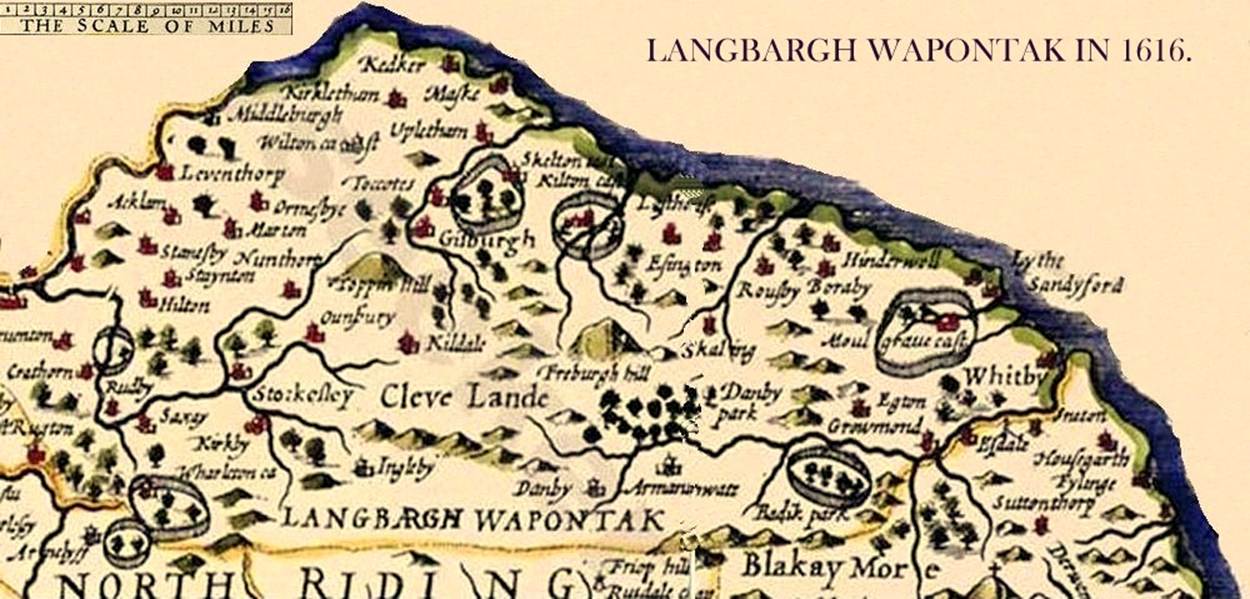
1616, Trinity Ter, 14 Jas 1 John Cam, quer: Wm Beesley and Anne jhis
wife, def. Manor of Skelton and ten messuages, 10 cottages, 2 mills, lands and
rent in Skelton and Morton. (Yorkshire Fines for the Stuart Period, Volume 2 (1614 to 1625), Edited by William Brigg,
Yorkshire Archaeological Society Record Series,
volume 58, 1917,
page
60 (Folio 61)).
1632
The oldest grave-stone
found in the old Church yard at Skelton was placed in September 1632,
commemorating John Slater.
1642
Folklore has it that Cromwell passed close to
Skelton, but missed the Castle hidden in the woods. The locals, however, were
heard and given a good beating on Flowston. A small
skirmish took place somewhere between Skelton and Guisborough between Royalists
under the command of Colonel Slingsby and Parliamentarians under Sir Hugh
Cholmley and Sir Matthew Boynton. Slingsby was taken prisoner and some of his
men killed.
1653
It has been suggested that the brasses on the Fauconberg blue marble stone in the floor of the old church
at Skelton were torn off by the Puritans during the Protectorate.
1670
3 October 1670 at Malton Quarter Sessions: “That
John Tooes of Skelton in Cleveland having been bound to appear at the Sessions
to answere for alluring and entycing’
mens wifes and on other
complaints is to find good sureties for his good behavious
and to appear at next Sessions”.
1681
The Victoria County History – Yorkshire, A History of the
County of York North Riding: Volume 2 Parishes: Skelton, 1923: Edward
Trotter was lord of the manor in 1681.
1708
The Victoria County History – Yorkshire, A History of the
County of York North Riding: Volume 2 Parishes: Skelton, 1923: Edward
Trotter died in 1708, and was succeeded by his grandson Lawson Trotter, son of
his son John. Lawson Trotter still held the manor in 1721 and in 1729, but afterwards
sold it to Joseph Hall, his sister's husband, probably before 1732.
1733
The Victoria County History – Yorkshire, A History of the
County of York North Riding: Volume 2 Parishes: Skelton, 1923: Joseph
Hall died in 1733 and was succeeded by his son John Hall, who assumed the name
of Stevenson in addition to his own. John Hall Stevenson was lord of the manor
till his death in 1785; his son Joseph William, who succeeded him, died a year later,
his heir being his son, another John Hall Stevenson, who assumed the name of
Wharton.
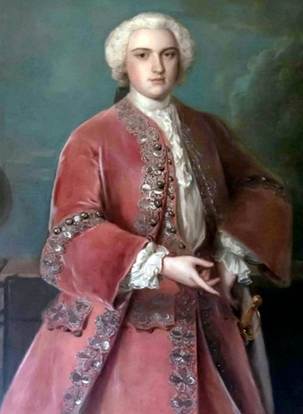
John Hall
Stevenson (1718 to 1785)
1740
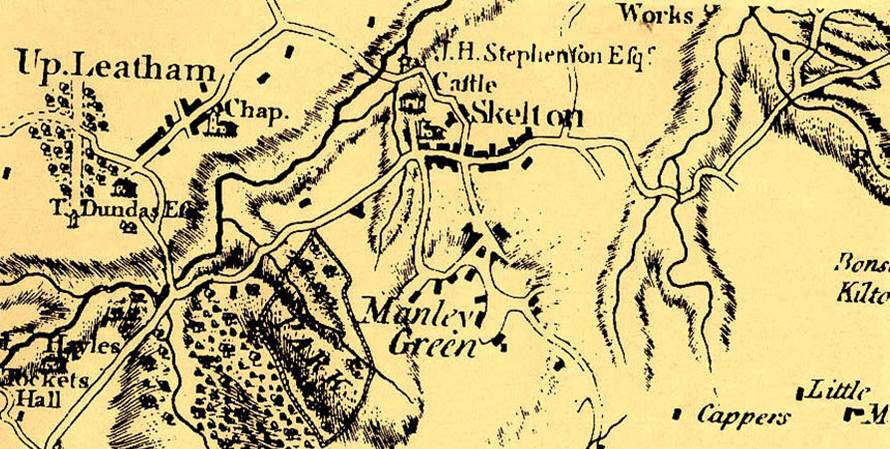
1764
The Archbishop of
York, Robert Hay Drummond, sent out a Questionnaire
to all his Parish priests. The Skelton in Cleveland, Curate, Thomas
Kitching replied as follows:-
Admitted
20 August 1760. Deacon 18 December 1743, [Samuel Chester]. Priest 22 September
1745, Samuel Chester. 1. There are about 240 families, 5 of which are Quakers and
4 are Papists. 2. The Quakers have a meeting house at ‘Moorsholme’,
but whether it is licenced or not I do not know. They assemble there every
Sunday in the morning in small numbers. Their speaker is one Philip Narzleton of Moorsholme
aforesaid. 3. There is no publick or charity school
within this Parish. 4. There is no alms-house or hospital in this Parish. There
are some lands and some cottages belonging to the Church, the profits of which
are ‘applyed’ [and I believe very honestly] to the repairs
of the nave or body of the Church. This Curacy was augmented in the year 1718
by a benefaction of £200 from the Trotter family and others who had connexions
with that family, by £200 more given by the directors of Queen Ann’s Bounty and
by £25 given by the late curate. An estate called ‘Sadler Hills’ in this Parish
was purchased 1735 and the yearly rent is £18. 5. I do reside in the
parsonage-house. 6. I have no curate. 7. I perform divine service at Skelton on
2 Sundays in the mornings and in the afternoons. I attend Brotton, which is
annexed to the curacy of Skelton. On the third Sunday I perform divine service
at Brotton in the morning and in the afternoon I
attend Skelton. I preach twice every Sunday and I make
service at Skelton on holy days. 8. I know of none who come to church that are
not baptized, neither do I know of any of a competent age, who are not
confirmed. I have baptized no adults since your Grace came to be Archbishop. 9.
I catechise at Skelton and Brotton alternately from the beginning of Lent till
Whitsuntide. Many of my parishioners send their children, but very few of their
Servants. At your Grace’s last confirmation, or rather before it, the Servants
did attend me at the times appointed and I did all I could to meke them understand the principles of our holy religion. I
know of no exposition they make use of. 10. The sacrament is administered once
every quarter both at Skelton and Brotton. I give notice of it on the preceding
Sunday in the form appointed by the Book of Common Prayer. The number of
communicants in the parish may amount to 375. At Easter 156 did communicate. At
other times the number is not so great. I have refused the sacrament to none
since I was admitted curate. 11. The chapel at Brotton
is annexed to the cure of Skelton and is served in the manner above specified.
It is distant from Skelton about 3 measured miles. There is no particular endowment belonging to Brotton. We have no chapel
in ruins. 12. There has no public penance been performed since your Grace came
to be Archbishop, neither do I know of any commutations of penance made by any
of my parish within that time.
1770
The castle was
rebuilt in the 1770s and then extended to become a country house in the 19th century.
In the 18th century the house at Skelton Castle was owned by John Hall
Stephenson who was a Cambridge scholar and poet. He entertained other noted
contemporary authors including Laurence Sterne, the author of the book Tristram
Shandy. The house was at the time known as “Crazy castle”.
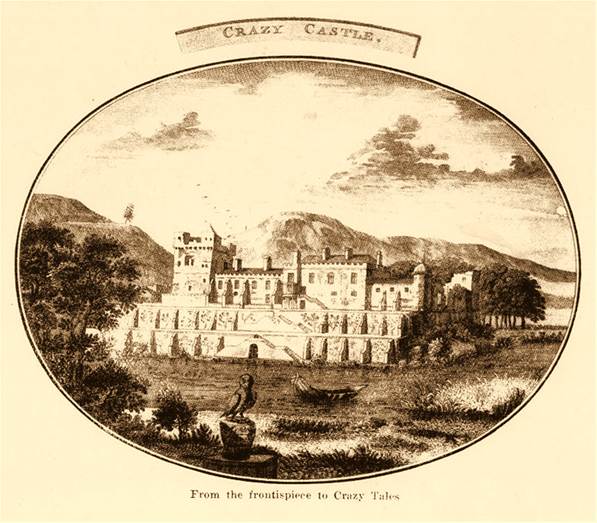
The Victoria County History – Yorkshire, A History of the
County of York North Riding: Volume 2 Parishes: Skelton, 1923: Here
in the 18th century lived John Hall Stevenson (1718–85), the author of Crazy Tales
and a friend of Sterne, who was a frequent visitor at the castle.
On 24 November
1770 William Smith, a Miller, was murdered at night in his bed at home in
Skelton in Cleveland by Luke Atkinson who also lived in the village. On
Sunday evening he told Mr Wharton that he had without the least provocation for
3 weeks before the perpetration of the murder several times a strong
inclination to commit it; but had always got the cruel thought driven from his
mind, till the unhappy night in which he effected it, when he went to bed, but
could not rest; that he arose from out of his bed and fell to prayer, in hopes
of diverting these thoughts; but so irresistible was the impulse, that he at
last went to the house of William Smith armed with a mattock and hatchet, broke
open the door with the mattock, and found him asleep in bed, where he struck
him several times on the head, but whether with the mattock or hatchet he did
not remember; and that afterwards he took the deceased’s purse containing one
half guinea, a quarter guinea, about five shillings in silver and sixpence in
copper. He declared that his wife was ignorant of the murder and died
penitently.
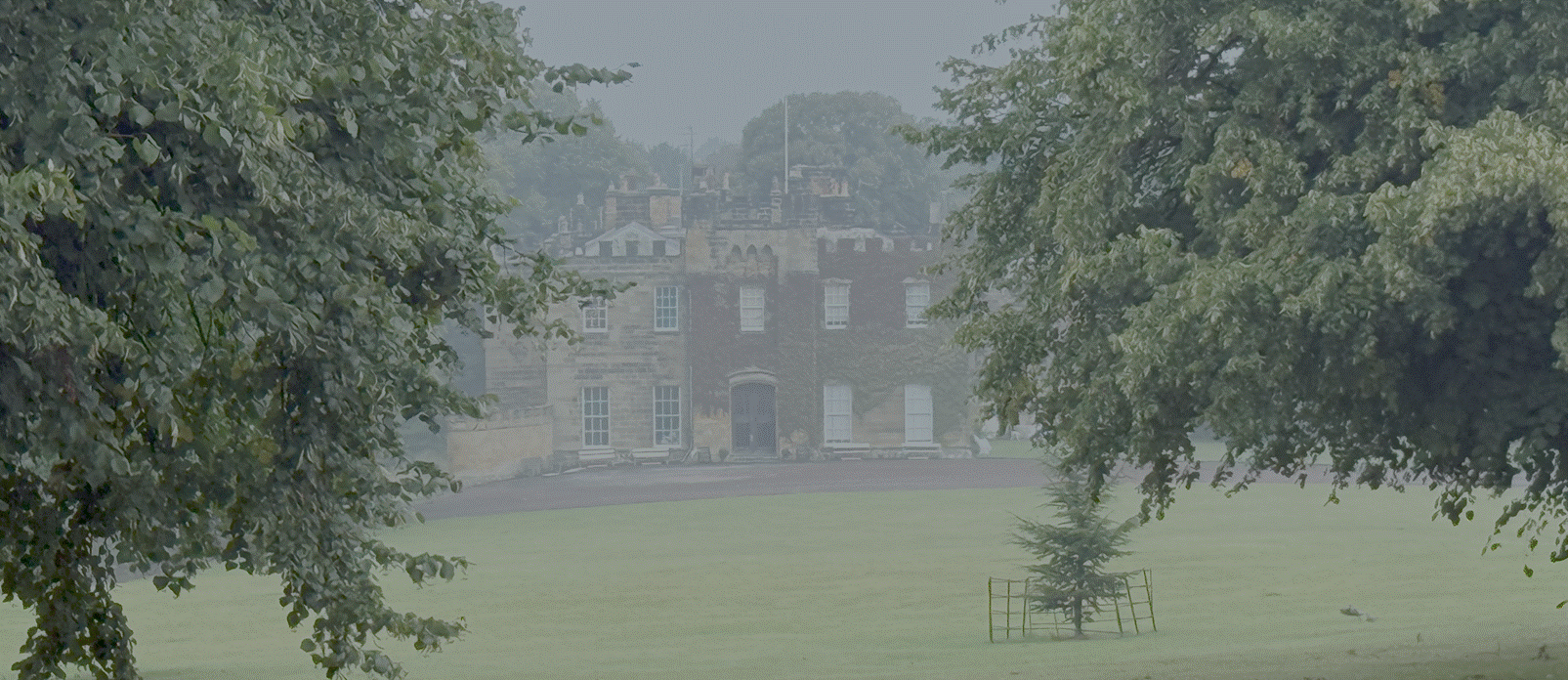
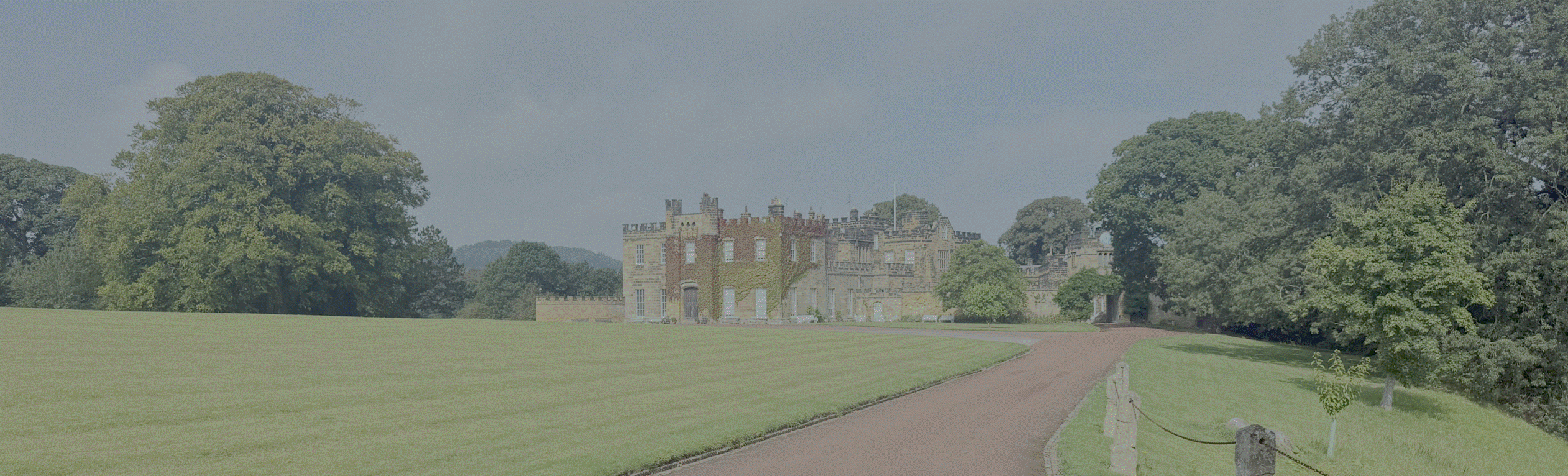
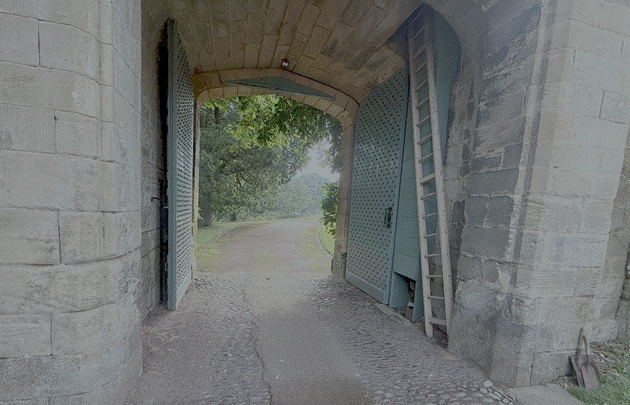
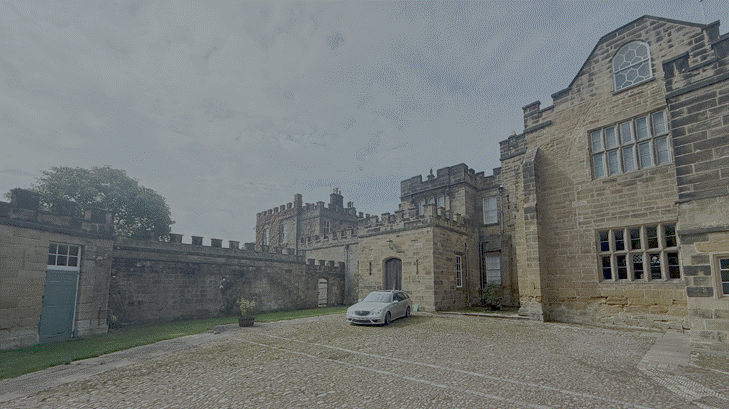
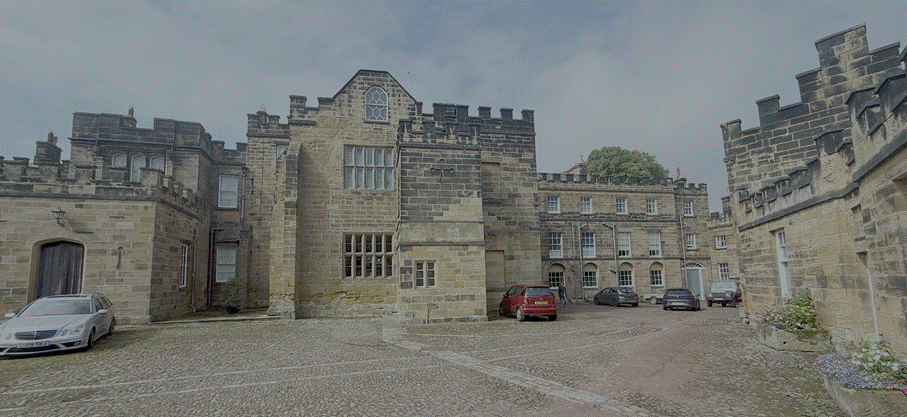
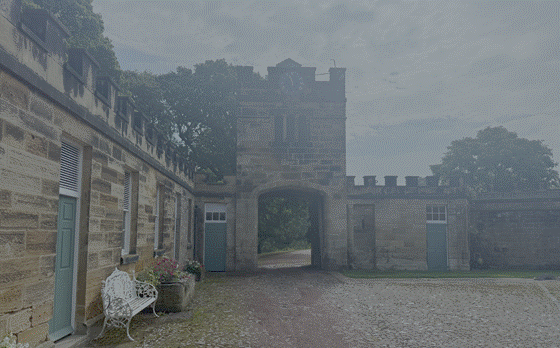
Skelton Castle
2026
1785:
The Victoria County History – Yorkshire, A History of the
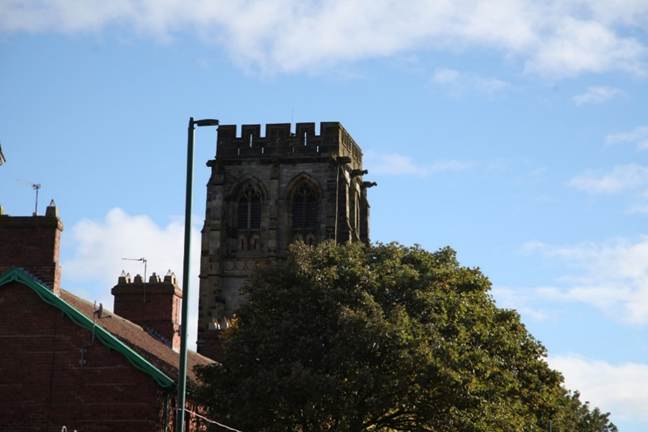
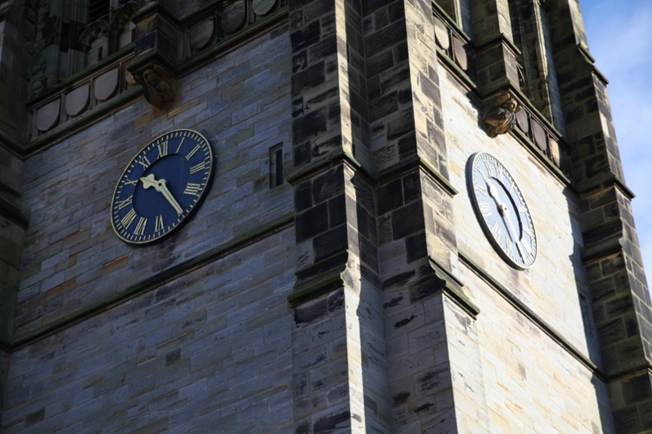
County of York North Riding: Volume 2 Parishes: Skelton, 1923: The
old church of All Saints is a plain structure erected in 1785, consisting of chancel
26 ft. 9 in. by 18 ft. 6 in., nave 61 ft. 6 in. by 25 ft. 6 in., and west tower
9 ft. square, all these measurements being internal. There is also a kind of
transept, forming a pew, in the middle of the north wall, 16 ft. deep by 9 ft.
6 in. wide, with a fireplace at its north end. No record of the former building
has been kept. In 1891 part of a dial stone with an inscription in Anglo-Saxon
uncials and in runes, probably of 11th-century date, was found in the
churchyard, and Ord, writing about 1846, mentions 'a vast number of stone
coffins' having been found to the north-west of the church. Three of these, one
a child's, are preserved, but the others have disappeared.
1788
The present house
is built of dressed sandstone with a roof of Lakeland slate. It is a two-storey
block with a 5-bay frontage. It incorporates some remains of the medieval
castle. It was constructed between 1788 and 1817 for John Wharton, Member of Parliament
for Beverley who had inherited the ruined Skelton Castle from his father Joseph
Hall-Stevenson in 1786. John Wharton had changed his name from Hall-Stevenson
to Wharton to comply with the terms of a legacy. He inherited a considerable
fortune from his aunt, much of which he spent of demolishing the castle and
building his new home.
The Victoria County History – Yorkshire, A History of the
County of York North Riding: Volume 2 Parishes: Skelton, 1923: According
to Ord the demolition of the castle of the Bruses
began in 1788, when practically the whole of the site was cleared and the hill
on which the keep seems to have stood was destroyed. Some terraces which
overhung the moat were also removed. Of the old building no trustworthy account
has been preserved. Ord says it had a 'magnificent tower,' and it is described
in the Cotton MSS. as 'an ancient castle all rent and torn, it seemed rather by
the wit and violence of man than by the envy of time.' It was its ruinous
condition in John Hall Stevenson's time that earned it the title of 'Crazy
Castle.' The new building, a large castellated mansion
in the Gothic style of the day, was erected about 1794, but has since been
modernized; it is now the residence of Mr. William Henry Anthony Wharton.
Internal alterations were made in 1892 and in 1908.
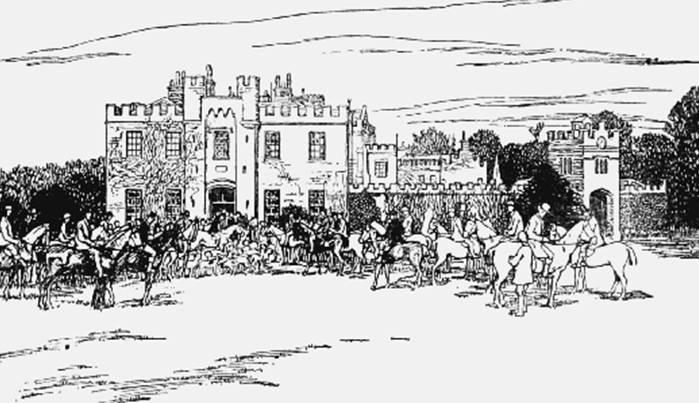
Skelton Castle
1790
John Wharton of Skelton
Castle was returned as the MP for Beverley, beginning a 40
year association with that East Riding town. It was to lead to his
eventual financial downfall. Beverley had the right to send 2 members to Parliament and it was a Nationwide custom to bribe officials
and the electorate. The only people allowed to vote were adult males who owned
land, so called freemen, and Beverley had an above average number of these, as
well as voters who lived outside the area. It became advantageous to have more
than two candidates in order to find out who could
offer the most in sweeteners. As well as making direct payments to the voters,
candidates paid for such things as travel expenses, ribbons, innkeepers fees,
musicians, security guards etc. The expenditure did not end there. The MP prior
to J Wharton paid over £650, including £50 towards flagging the streets in
1786, £20 a year on coal for poor freemen, £10 per year to the master of the
grammar school, £25 for the races, and 5 guineas to the Charity school, besides
providing a buck and a doe for the mayor’s table. John Wharton must have made
an excellent job of this bribery as he received 908 votes from the 1,069
voters, including a high proportion of the working-class and London voters.
Wharton was an active Whig with radical views. In Parliament he was a staunch
supporter of the abolition of slavery and favoured relief for Roman Catholics
and constitutional and Parliamentary reform. His resounding success in the 1790
election gained him a considerable popular following in Beverley and his overt
political position led to the development of clear Whig and Tory factions in
the town. It was said by the Whig grandees, “It is beyond the power of
imagination to conceive the popularity of Wharton here…
.Perhaps it has never happened in the History of Electioneering that out
of 1,050 voters 908 should be on one side in favour of our friend and his
principles.”
1794
John Wharton lost
the election in Beverley after he disagreed with some of his previous
supporters over the war with France. He was made a Captain in the North Riding
of Yorkshire Yeoman Cavalry.
The winter of
1794 to 5 was one of the severest in living memory with hard frosts and snow
from December to March. Snow still lay on the Cleveland hills in May. Bad weather
conditions had a more serious effect on people’s lives then than today. Most
worked in agriculture and those who did not ‘live-in’ could not earn. Fuel was
used up. The fact that the country was at war with France added to the
problems. There was a shortage of corn, which drove up the price of bread and
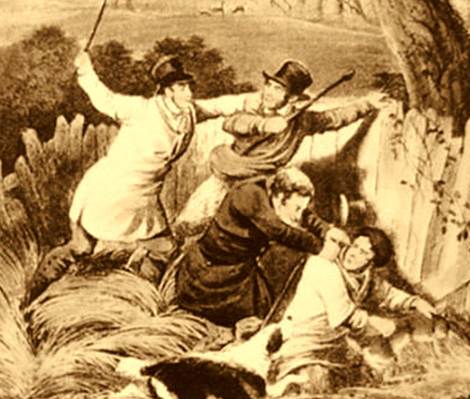
there were riots in some places. Poaching was rife. The landed classes had
always considered that any wild life that moved across
their property belonged to them. From Norman times, and probably
long before, any peasant who trespassed on the Lord’s hunting preserve was
liable to harsh penalties. In these times of dearth these were severe. From
1760 night poachers were liable to 3 to 6 months
prison with hard labour and second offenders given 6 to 12 months with a public
whipping. From 1782 to 1799 there were only 26 convictions for poaching in the
N Riding of Yorkshire. To save a family from starvation the risk was taken in
Skelton.
It is recorded, “by
October 1780 the game upon the manors of John Wharton of Kilton, Skelton and
Brotton was nearly destroyed”.
In 1800 new
legislation made convicted poachers liable to 2 years hard labour and a
whipping. Offenders over 12 could be sent for military service.
1799
John Wharton was
returned to Parliament as the MP for Beverley, coming second in the bye-election
which had been caused by the death of the sitting MP. He now stood as an
Independent and was opposed by J. B. S. Morritt of Rokeby Park in the North
Riding of Yorks. He had mixed success in the elections which followed up to
1826.
1801
The first
national census was carried out by house to house
enquiry, by the local Overseers of the Poor. The population of England and
Wales was estimated to be 9 million. The population of Skelton was 700 – 317
males, 383 females. There were 167 inhabited houses, with 180 families. 6
houses were uninhabited. 171 people worked in agriculture and 279 in trades. In
the 20 years from 1781 to 1801 there were 612 baptisms, 399 burials and 168
marriages.
1817
The “Roxby and
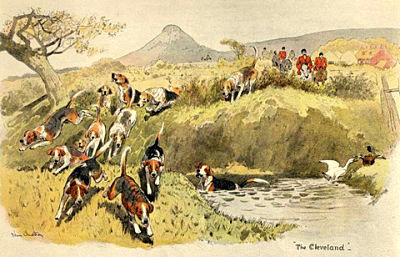
Cleveland Hounds” were formed on 5 June 1817 and John Andrew, the notorious
smuggler, of the White House, Saltburn Lane was made Master.
From ‘The Cleveland Hounds’, by A E Pease: “At the
Angel Inn at Loftus, on a summer’s afternoon, we may picture
John Andrew Snr, Isaac Scarth, Henry Clarke, Henry Vansittart Esq, Thomas
Chaloner Esq and the other signatories to the rules then drawn up, sitting with
their tumblers of punch, making a treaty. “In 1817, Mr John Andrew was
appointed master. The Hounds were taken to Saltburn, then but a fishing hamlet
on the sea-shore, where, for more than fifty years,
the management was in the hands of the Andrew family. They hunted foxes in the
winter, and, with a few of the old Hounds, otters in the summer. A few years
after this the Roxby was dropped from the name of the pack, and they became the
Cleveland. John Andrew hunted them until 1835, assisted by his son, John Andrew
Jun, who took them when his father gave them up. John Jun was master until
1855, when they were taken by his son, Tom, who had them until 1870, having, previous to becoming master, acted as huntsman to his
father. Tom, altogether, hunted the Hounds for thirty-three years, having many
grand runs, and sometimes hunting when the snow was deep on the ground.”
1821
The population of
Skelton Parish was 1235, as recorded by the local Curate, William Close.
Skelton village population was approximately 700.
On 4 August 1821 a
most dreadful storm of thunder and lightning occurred at Marske and Skelton in
Cleveland. At Skelton Mr Mackereth, surgeon of Guisbrough,
was passing from one part of the village to the other, over some fields and in the
middle of the pasture was knocked down and laid insensible for 2 or 3 minutes.
Two women in the adjoining field, making hay, were struck down, but
providentially, the whole three have perfectly recovered.
1822
The Topographical Dictionary of
Yorkshire by Thomas Langdale of 1822 described Skelton Castle: “situated
on the brink of a large sheet of water, in many places 50 feet deep, which
nearly surrounds the castle, except an opening to the south.” Skelton was
described as in the parish of Skelton, east division of the wapentake and
liberty of Langbaraugh, Skelton Castle the seat of John Wharton Esq, 3 ½ miles
from Guisbrough, 11 ½ from Stokesley, 16 from Stockton, population 700.
1823
Baines Directory for 1823 listed the inhabitants of
Skelton, with a population of around 700: Castle: John Wharton MP. Curate:
Rev William Close. Attorney: Thomas Nixon. Blacksmiths: Thos
Crater, Robert Robinson, William Young. Butchers: William Lawson, Isaac
Wilkinson, William wilkinson. Corn Millers: Robert Watson, William
Wilson. Farmers and Yeoman: William Adamson, John Appleton, Thomas
Clarke, James Cole, James Colin, William Cooper, Steven Emerson, John
Farndale, Robert Gill, William Hall, Edward Hall, Jackson Hardon, William
Hutton, Sarah Johnson, William Lockwood, John Parnaby, Thomas Rigg, William
Sayer, William Sherwood, John Taylor, William Thompson, Robert Tiplady, William
Wilkinson, Richard Wilson. Grocer and Drapers: John Appleton, William Dixon, Ralph
Lynass, Thomas Shemelds, John Alater. Flax dresser: McNaughton D. Joiners:
William Appleton, Leonard Dixon, Mark Carrick, Joseph Middleton. Schoolmasters:
Atkinson M, John Sharp. Shoemakers: Robert Bell, Luke Lewis, Thomas
Lowls, George Lynass, Thomas Steele. Stonemasons: Thomas Bryan, John
Pattinson. Straw hat makers: Sarah Sarah, Esther Shimelds. Weavers:
Stephen Edelson, Thomas Dawson, John Robinson, Robert Wilson. Land agent:
John Andrew. Victuallers: William Bean at Duke William, William Lawson at
Royal George. Woodturner: James Crusher. Gamekeeper: Frank
Thomas. Plumber and Glazier: William Gowland. Sadler: Thomas
Taylor. Shopkeeper: Eliza Wilkinson. Carriers: Marmaduke Wilson -
to Guisborough on Tuesday and Friday, departing 8am and returned 4pm; Robert
Wilkinson to Stockton on Wednesday and Saturday, departing 4am and return 8pm,
to Lofthouse on Monday and Thursday departing 9am and return at 6pm; Letters were
brought to Guisborough by coach and thence to Skelton by daily horse post arriving
at 10am and mail taken back at 3pm.
1826
John
Wharton was defeated in the election at Beverley and retired from politics,
heavily in debt.
1831
The
population of Skelton was 781. In the last 30 years an increase of 81. The
national population about 14 million. The number of Females in Skelton was 396.
Males numbered 385. Of these 138 were over 20. An entry in the Parish Register
for this year gives:- 174 Families living in 172 Inhabited houses with 12 uninhabited.
There was no current house building. This record further divided these families
into 100 employed in Agriculture, 42 in Trade/Manufacture and 24 Others.
Agriculture occupiers 1st Class 39, 2nd Class 73 and Labourers 26.
Manufacturers – None. Retail trades and Handicraft – 43. Wholesale and
Capitalists, Clergy, Office Clerks, Professional and other Educated Men – 1
[presumably the Vicar]. Labourers non Agriculture – 15. All other males over 20
– 1. Male servants 20 and over – 18. Male servants under 20 – 10. Female
servants – 22.
1832
The
Voting Reform Acty 1832 extended the right to vote slightly and altered
constituencies. Up to this time only only about 3 percent of householders
qualified to vote, based on land ownership. The new rules were still based on
wealth and now about 5 percent had the vote. Skelton was part of the North
Riding of Yorkshire and there were only 4 representatives for the whole County.
Up to 1821 this had been only 2.
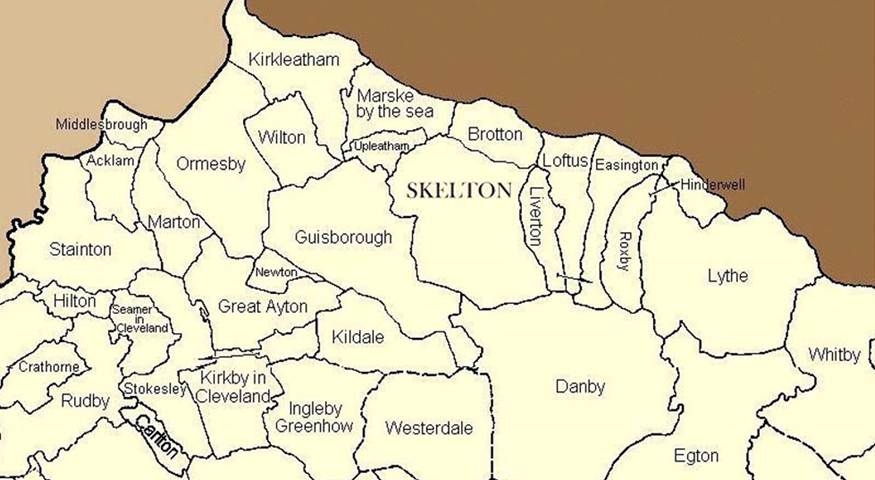
Voting
boundaries in 1832
1837
One
of the longest cold periods, beginning January, with temperatures down to -20
at Greenwich, and lasting some 7 to 8 weeks.
1841
1843
John Wharton died
childless and in poverty in 1843 and Skelton devolved to his nephew John Thomas
Wharton of Gilling.
The Victoria County History – Yorkshire, A History of the
County of York North Riding: Volume 2 Parishes: Skelton, 1923: John
Wharton made a conveyance of the manor in 1796; he died in 1843 without issue
and was succeeded by his nephew John Thomas Wharton, who died in 1900, his heir
being his son William Henry Anthony Wharton, the present lord of the manor.
1844
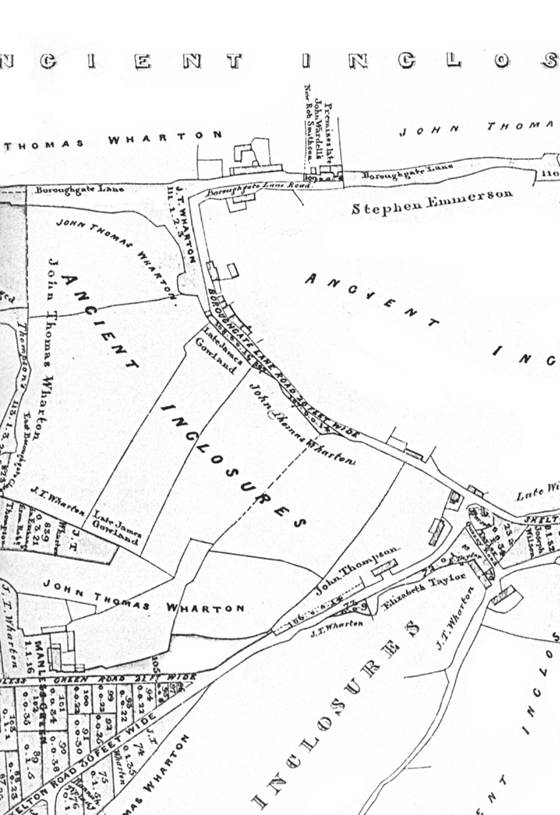
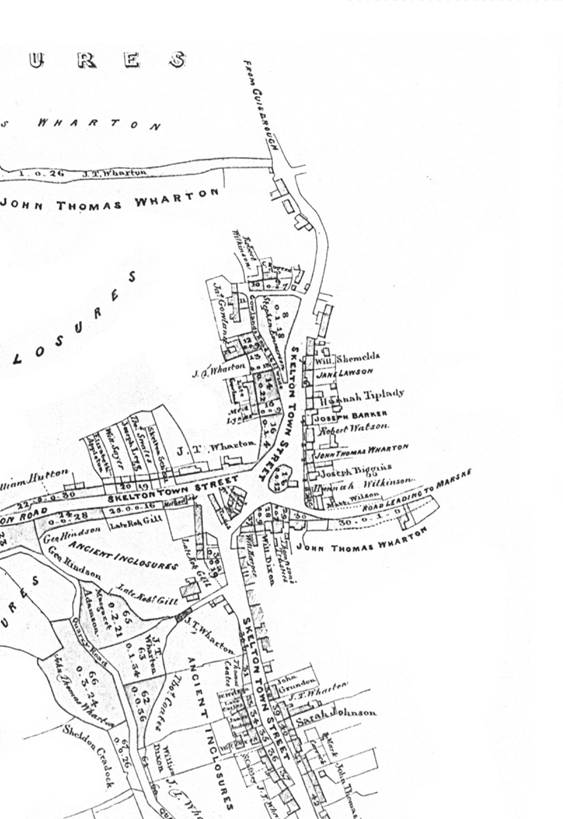
Skelton Tithes Map
1857
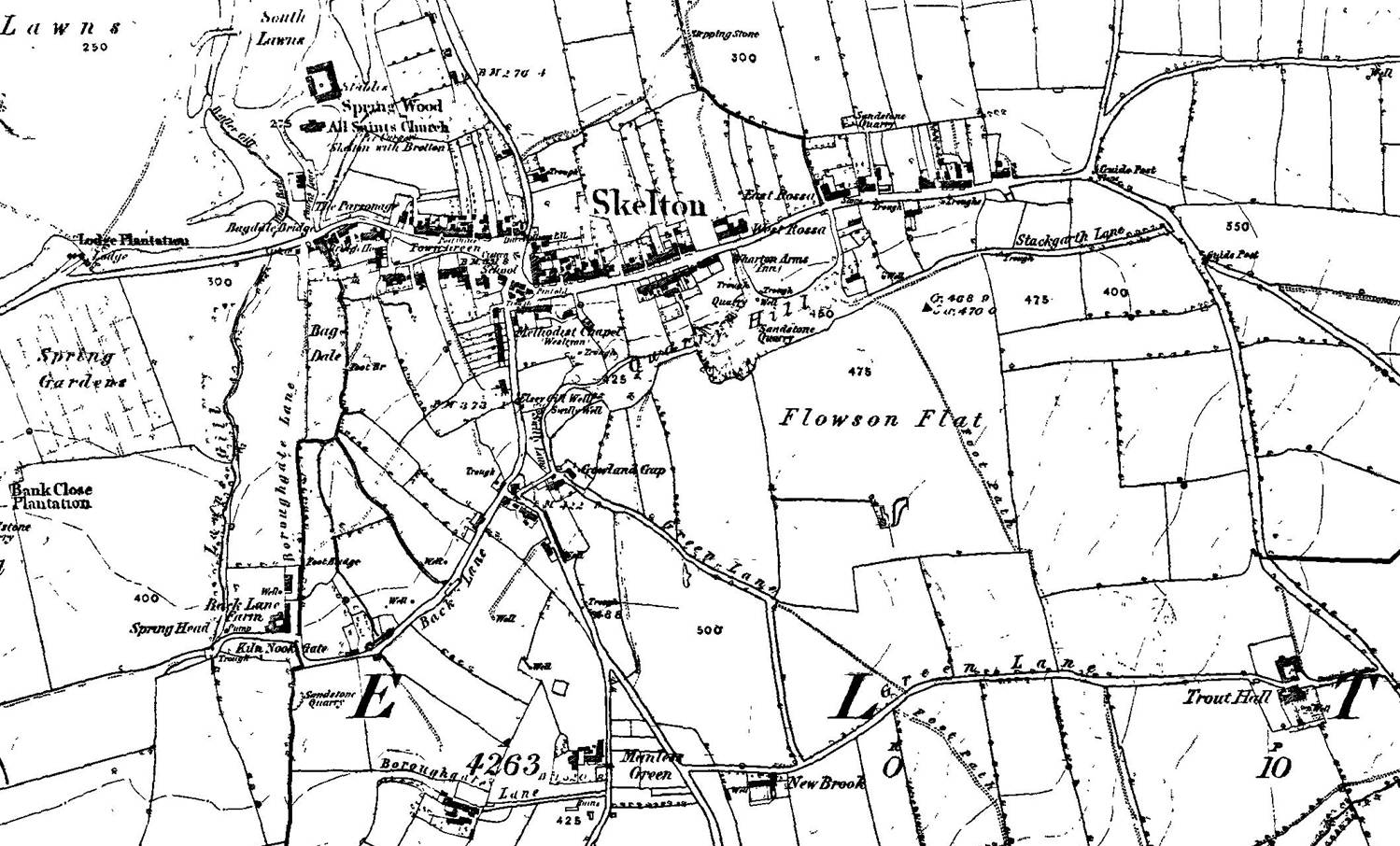
1871
The Victoria County History – Yorkshire, A History of the
County of York North Riding: Volume 2 Parishes: Skelton, 1923: The opening of
various mines having caused a large increase in the population since 1871. The
mining villages of Boosbeck and North Skelton, to the south and southeast of
Skelton village, have stations on the North Eastern
railway; Lingdale, further south, is connected by a
special line with the Kilton Thorpe branch railway, and Charlton Terrace or Slapewath (Slaipwath) has a
tramway running from the mines to the North Eastern
railway line which passes it to the north. Rights of mines and quarries are
mentioned in 1366 and 1632.
1880s
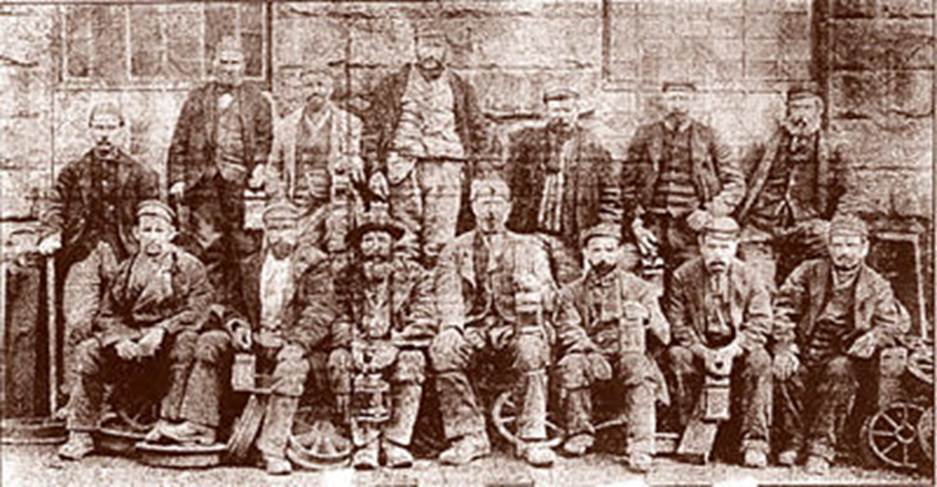
The management of
the Skelton Park pit in the 1880s
1881
The Victoria County History – Yorkshire, A History of the
County of York North Riding: Volume 2 Parishes: Skelton, 1923: There
are Primitive Methodist chapels and a public elementary school which was built
in 1881 and enlarged in 1894.
1905
The Estate
Managers at Skelton and Gilling
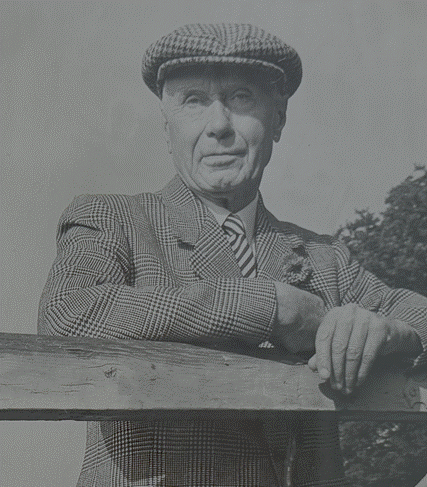
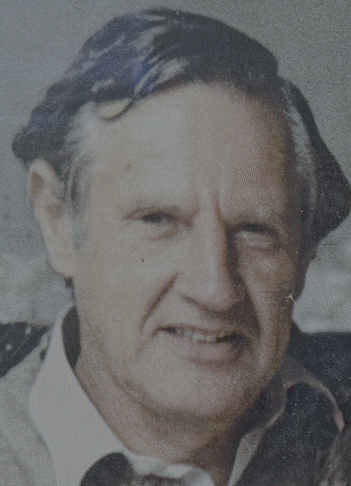
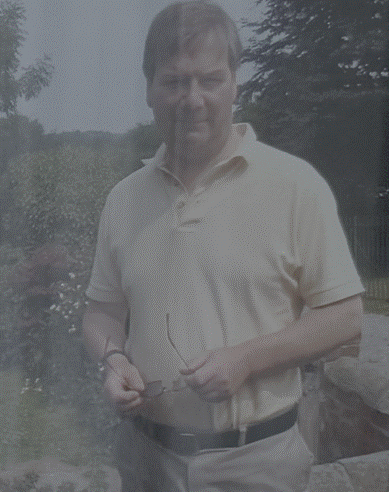
HCR Morris esq
FLAS, 1906 to 1966 W J
Bulmer FRICS, 1966 to 1990
Nicholas Foxwell Raban-Williams MRICS FAAV, 1990 to 2018
1923
The Victoria County History – Yorkshire, A History of the
County of York North Riding: Volume 2 Parishes: Skelton, 1923: The ancient
parish of Skelton, including the townships of Great Moorsholm and Stanghow,
covers 11,803 acres, of which 2,219 acres are arable land, 4,657 acres
permanent grass and 578 acres woods and plantations. The soil is clay, with a
subsoil of Kimmeridge clay, and the chief crops grown are wheat, beans, oats
and barley. In the north the parish forms a kind of peninsula between the
Skelton and Millholme Becks, which have very steep
banks, whence the land slopes downwards, rising again towards the centre and also towards the south of the parish, where there are
wide stretches of moorland. The greatest height is about 975 ft. above ordnance
datum. Skelton village itself is situated on the northern slope. The whole
parish is given up to iron-stone mining, to which the neighbourhood owes its
importance.
The older part of
the village is that nearest the castle. Boroughgate Lane approaches the western
end from the south. The newer village stretches towards the east and is
straggling and uneven; in the north-east on high ground is the new church of
All Saints. There are Wesleyan and Primitive Methodist chapels about the centre
of the village, and in the south is the hospital, with Skelton High Green to
the west, and to the east Skelton Green, where there is a public elementary
school built in 1887 and enlarged in 1892 and 1900.
New Skelton lies to
the east of Skelton and has a school.
Further east is
North Skelton, where there is a church mission-room, Primitive Methodist chapel
and a Friends' burial ground. Boosbeck lies due south of Skelton village; it
was constituted an ecclesiastical parish in 1901 with its church of St. Aidan.
1925
Skelton Castle
descended in the Wharton family to William Henry Anthony Wharton, High Sheriff
of Yorkshire for 1925, and on his death in 1938, to his daughter Margaret Winsome
Ringrose Wharton. She had married Christopher Hildyard Ringrose, a Royal Navy
captain, who had added the additional surname of Wharton to that of Ringrose.
She lived there until at least 1986, by which time her relative, Major Wharton,
actually ran the estate on account of her age.
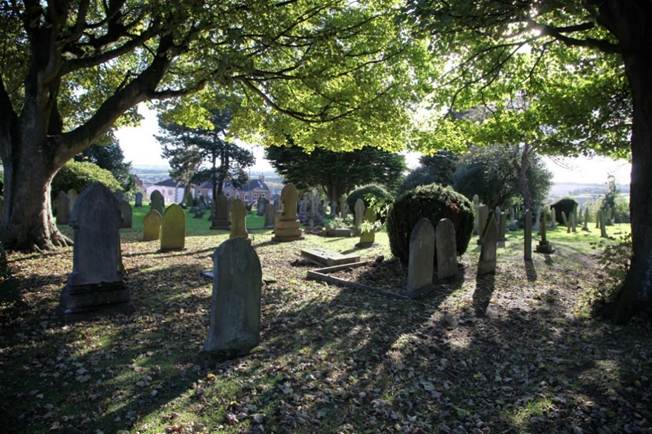
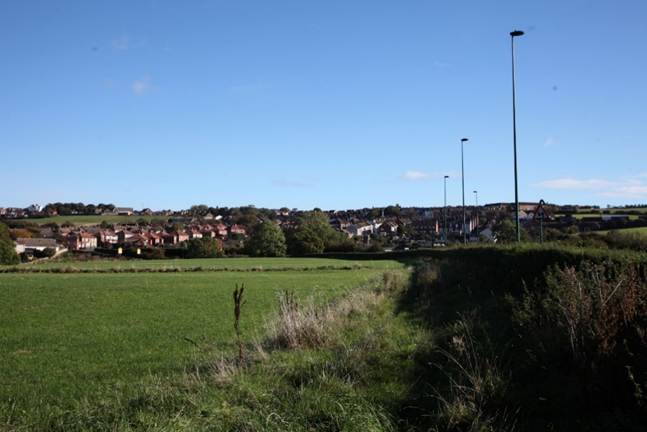
2016
Bibliography
There is an excellent history of Skelton at http://skeltonincleveland.com/
Skelton Parish Records – Baptisms
– Marriages
– Burials
|
|
|