19 September 1845 to 17 January 1928
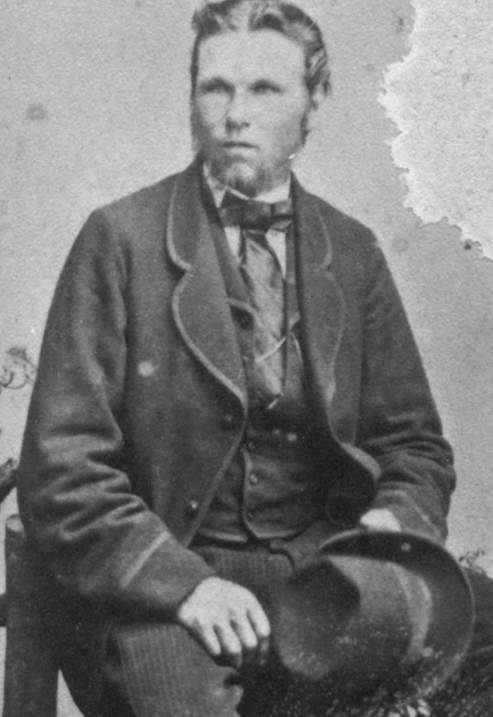
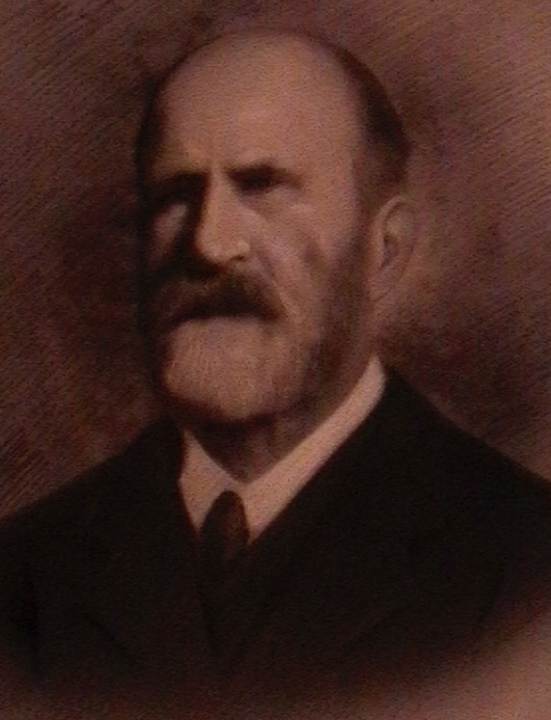
The story of Martin Farndale and
Catherine (nee Lindsay) Farndale, the parents of a remarkable family of
twelve born on a moorland farm, who spread across Britain and North America
FAR00364
|
Return to the Home
Page of the Farndale Family Website |
The story of one
family’s journey through two thousand years of British History |
The 83 family lines
into which the family is divided. Meet the whole family and how the wider
family is related |
Members of the
historical family ordered by date of birth |
Links to other pages
with historical research and related material |
The story of the
Bakers of Highfields, the Chapmans, and other related families |
Farmer of Tidkinhow
Dates are in red.
Hyperlinks to
other pages are in dark
blue.
Headlines of
Martin’s life are in brown.
References and
citations are in turquoise.
Context and local
history are in purple.
1845
Martin Farndale, was born at Fogga Farm near Skelton
on 19 September 1845 the son of Martin and Elizabeth (nee Taylor)
Farndale (FAR00264), a farmer of Fogga. He was baptised on 20 October 1845 (Skelton PR). His birth is
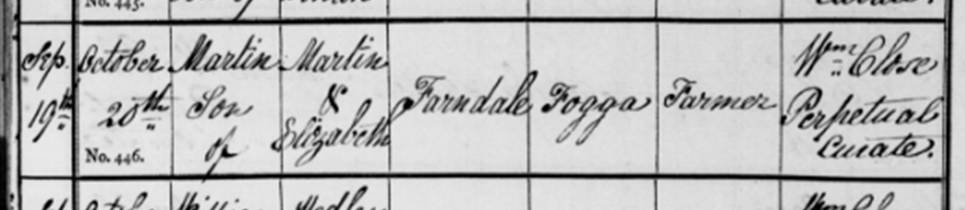
recorded in Skelton Parish Register as "Born September 19th 1845
and baptised on October 20th 1845 as son of Martin
Farndale." Although all his brothers’ births were recorded at Somerset
House, Martin's birth is not recorded there. His family consisted of four boys,
William (born 1842), Martin (born 1845), John (born 1848) and Matthew (born 1850).
Martin was the second son of Martin and Elizabeth, though William died young.
His
father, Martin, was working with James Taylor, his father-in-law. His mother,
Elizabeth (nee Taylor) seems to have been James' only child and
inherited his farm.
In the 1913
parish rate book for Skelton in 1913, Fogga was
described as North Skelton and a George
Harrison made a will regarding Fogga Farm in 1718
indicating the location of a later ironstone mine, formally called Old Fogga on the 1856 ordnance survey map.
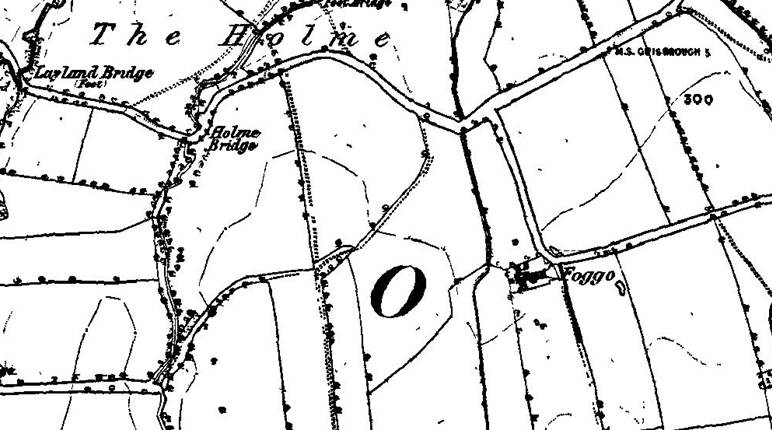
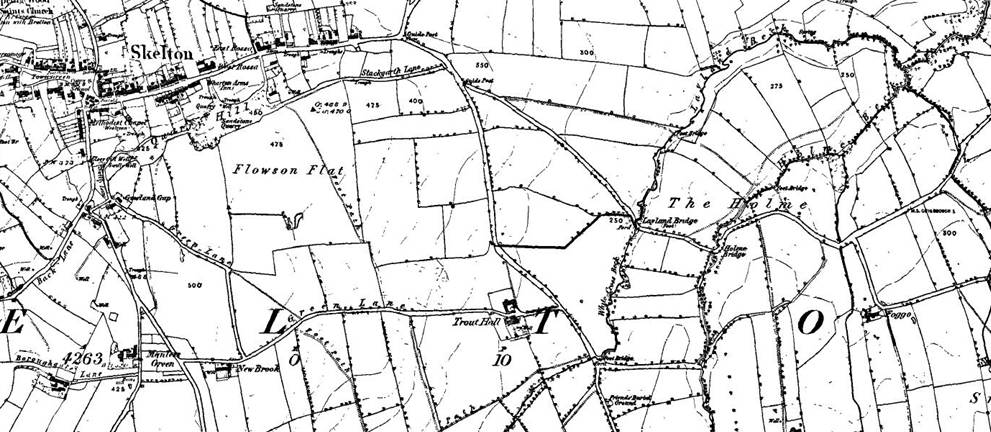
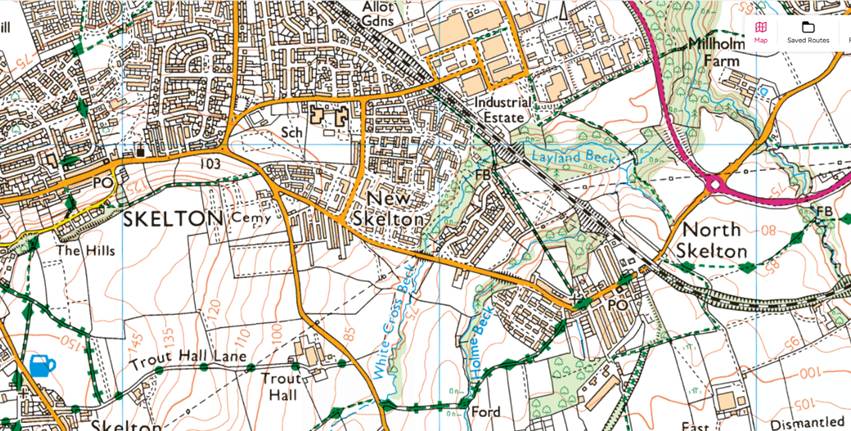
So Fogga farm is where North Skelton (confusingly to the east
of Skelton) now stands.
1851
At
the time of the 1851 census the young Martin Farndale was listed is listed as
grandson to the owner of the house he was living in, that is to James Taylor of
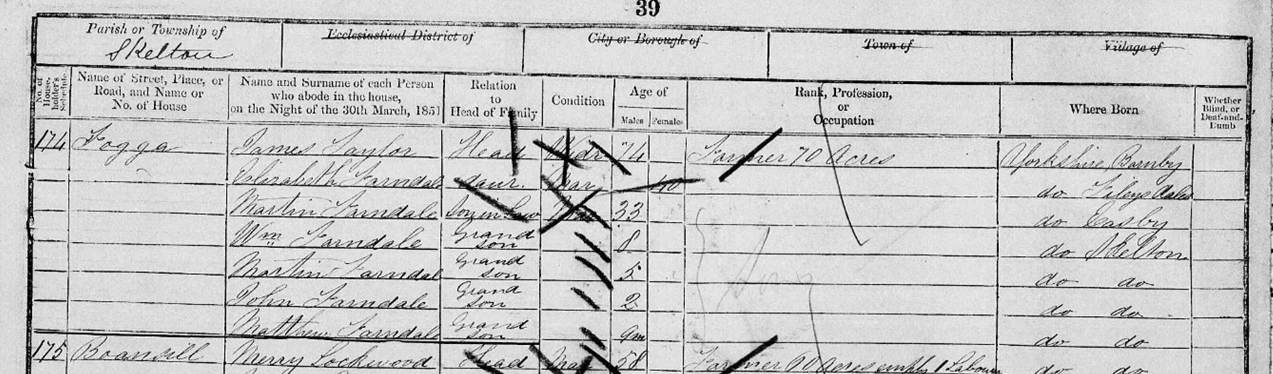
Fogga. The 1851 Census shows the family
at Skelton- Fogga
Farm.
James Taylor,
head, aged 74, widower, born Barnby, farmer of 70 acres
Elizabeth
Farndale, 40, married, daughter of James Taylor, wife of Martin Farndale, born
at Fylingdales
Martin Farndale,
33, married, born Easby, Son-in-law;
William Farndale
(FAR00356), son of Martin,
aged 8, born Skelton, grandson of James Taylor
Martin Farndale, son of Martin
Farndale the Elder, aged 5, born at Skelton, grandson of James Taylor
John Farndale (FAR00376), son of Martin Farndale
the Elder, aged 2, born Skelton, grandson of James Taylor
Matthew Farndale
(FAR00383), son of Martin
Farndale the Elder, aged 9, born Skelton, grandson of James Taylor.
1854
Martin's
eldest brother William died
at Skelton, aged 11, of inflammation of the
chest on 29 January 1854. Martin was aged 9 at this time. Martin was probably going to school at
Skelton.
1861
The Census
of 1861 for 61 Galey Hill, Hutton Lowcross listed Martin and Elizabeth Farndale; John Farndale, aged 12; scholar;
and Matthew Farndale, aged
10; scholar. Martin Farndale Junior, who would then have been aged 16, was not
listed in the census so must have been away for some reason. His father Martin
was by then working as a farm labourer.
The Census of 1861 for 61 Galey Hill, Hutton Lowcross
listed
Martin Farndale,
head; married; aged 42; agricultural labourer;
born Easby (Martin’s father)
Elizabeth
Farndale, his wife; aged 44; born Skelton
John Farndale (FAR00376), son; aged 12; scholar;
born Skelton
Matthew Farndale
(FAR00383), son; aged 10;
scholar; born Skelton.

Martin Farndale
Junior, who
would then have been aged 16, was not listed in the census so must have been
away for some reason.
1862
Martin’s father died at
Guisborough on 12 July 1862 of empyma and at this time Martin
was 17. There is a family story that his father had been kicked by a horse.
For the next 14 years it appears that Martin grew
up in the Skelton /Brotton area. He probably went on
working for his maternal grandfather for some time, taking on some
responsibility for looking after his two younger brothers and his mother. In due course Martin probably started to share an
interest with his father in law, James Taylor and was
variously described as the farmer in his own right and a labourer, presumably
working for or with James Taylor.
1871
The Census
of 1871 for
Brough House, Brotton recorded John Rigg, head, 47; Martin
Farndale, 25, born 1846, agricultural labourer and four others.

1873
By 1873, Martin Farndale
was an ‘in door farm servant’ but also working in the mines. The
Northern
Echo 11 July 1873: THE
CLEVELAND OWNERS AND MINERS. MR RUPERT KETTLE’S AWARD. JUDGEMENT AGAINST ANY
ADVANCE. We are at length in a position to announce the nature of Mr Rupert
Kettle's award in the dispute between the mine owners and the miners of
Cleveland, one which has been looked forward to with eager interest by all
classes of the community. As a prelude to setting forth the text of this
important award, all we need to do is very briefly to recapitulate some of the
leading features of the dispute referred to. In March last an application
was made by the miners of Cleveland for an advance of 2d per ton upon their
output of ironstone, being equal to about 12% upon the rates then current;
a demand being, at the same time, also made by other classes of work when
employed at the mines, for an increase of 10% in their wages. The masters
replied to the men was that, looking at the advances already given, and the
wages earned, as well as the ability of the men to earn more, they could not
accede to the demand. At this, the Cleveland owners formed themselves into
an Association, upon similar a similar basis to what had in 1872 being done by
the collier owners of the county of Durham...
After
much negotiation and I'm sorry to say, a stoppage of production for a
considerable time in this great mining district, it was agreed, at a meeting of
representatives of miners and mine owners, held on the 28th of may, as follows:
“That it be left to an Arbitrator to determine whether the wages of the
Cleveland miners should be advanced or reduced, and to what extent,
measured by the standard of wages now prevailing in such industries in the
north of England as the Arbitrator may deem it reasonable to consider in making
his award.” The contending parties requested me to undertake the duties of Arbitrator;
And all preliminary arrangements having been made, and the case on both sides
prepared, an Arbitration meeting was commenced at Saltburn on the 23rd of June.
Witnesses were examined by each party, and much valuable information was given
on both sides by means of extracts from account books, and by carefully
prepared statistical tables, upon every subject bearing upon the matter in
dispute. At the close of our settings, I was prepared to give my award; but as
trade arbitration law is new to the Cleveland...
There
was also much uncertainty of opinion as to the time which elapses before an
ordinary labourer becomes a thoroughly practical miner.
Upon the main point, however, the workmen's witnesses confirmed, so far as
individual cases can be said to confirm the results of statistics taken over a
wide range, the case made out by the employers. Martin Farndale, an indoor
farm servant seven months ago, was now earning 7s 10d a shift. Richard
Vayro, a farm labourer, after nine months working in the mines, was earning 8s
1d a shift. These were said to be exceptional, because they worked a “Pick
Place”....
The Northern Echo, 25 July 1873: THE
LATE ARBITRATION IN CLEVELAND. To the Editor of the Northern Echo. Sir, will
you kindly allow me space in your paper to say a few words in my defence, in
connection with the late arbitration at Saltburn, as I understand Mr Shepherd
stated at a public meeting at Brotton that if the miners did not get the 2d per
tonne it would be on account of the evidence given by Robert Campbell. It seems
that the part objected to was that I was paying my mate 6s per day, the average
wage in Cleveland being 7s, therefore leaving 8s for me. He contended that this
injured our cause. Now, if the Cleveland miners will read and think for
themselves, they will see that truth did not injure our cause. Mr Shepherd
asserted that our average wage was 5s 11d per day; and the first two witnesses
he called on our side, Mr Farndale and Richard Nayro, those men but a few
months out of a farmyard, the one received 7s 10d per day, and the other 8s
1d, so that the owners could not have called two better witnesses on their
part. Some say I should not have gone there; neither I should, but Mr Shepherd
sent a messenger to Eston on the Monday evening for the witnesses, as he said
that Mr Lee had asserted that the ironstone miner could work with his vest
on, while the collier worked in a state of nudity, and the steam rising out
of his back was greater than the heaviest explosion of powder in the mine ...
1874
In December 1874, Martin
Farndale took a tenancy on a small holding. On 1 December 1874 there
was an Assignment of the Lease from George Coates of Lackenby,
yeoman and John Harrison the younger of Darlington in Duham, to Martin
Farndale of Kilton, of a parcel of land 135 square yards and the four
stone houses built on it as marked on the map for the remainder of the term
of 99 years (Reference U/AA/1/38, Teeside Archives.
(being rehoused in the Dorman Museum))
1877
Martin
was clearly continuing to work as a miner as by 1877 Martin was described as a miner of Brotton on
his marriage certificate.
Martin Farndale married
Catherine Jane Lindsay, daughter of Andrew Lindsay, a shoemaker of Darlington, at
St Cuthbert's Church, Darlington on 7 July 1877 (Darlington PR). He
was aged 31 and she was aged 28. The ceremony was witnessed by James Mattison
and Polly Thompson and the service was conducted by
the Reverend T E Hodgson vicar.
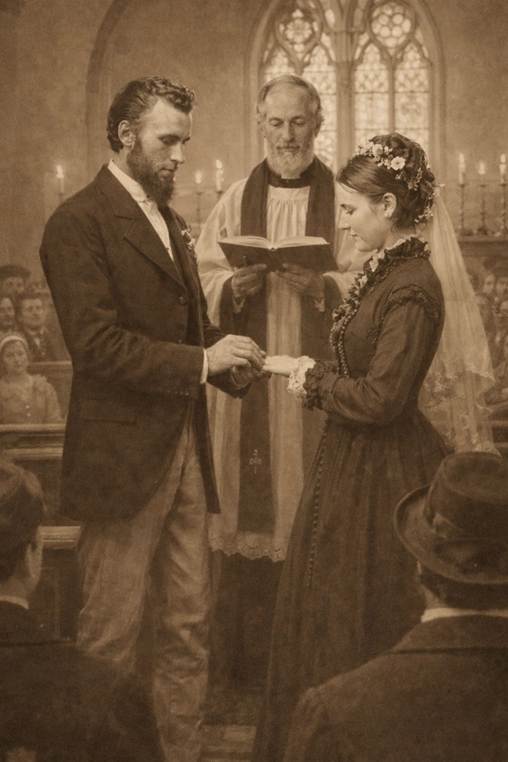
(An AI generated image using original photographs to
recreate the marriage of Martin and Catherine in St Cuthbert Church, Darlington
on 7 July 1877)
Catherine
Lindsey was born at Alnwick, Northumberland on 28 Jul 1854. Her father was a
shoemaker living in Queen's Head Yard, Alnwick. There is more information about
her family at the Lindsey Line. She came from the Scottish Lindsay family.

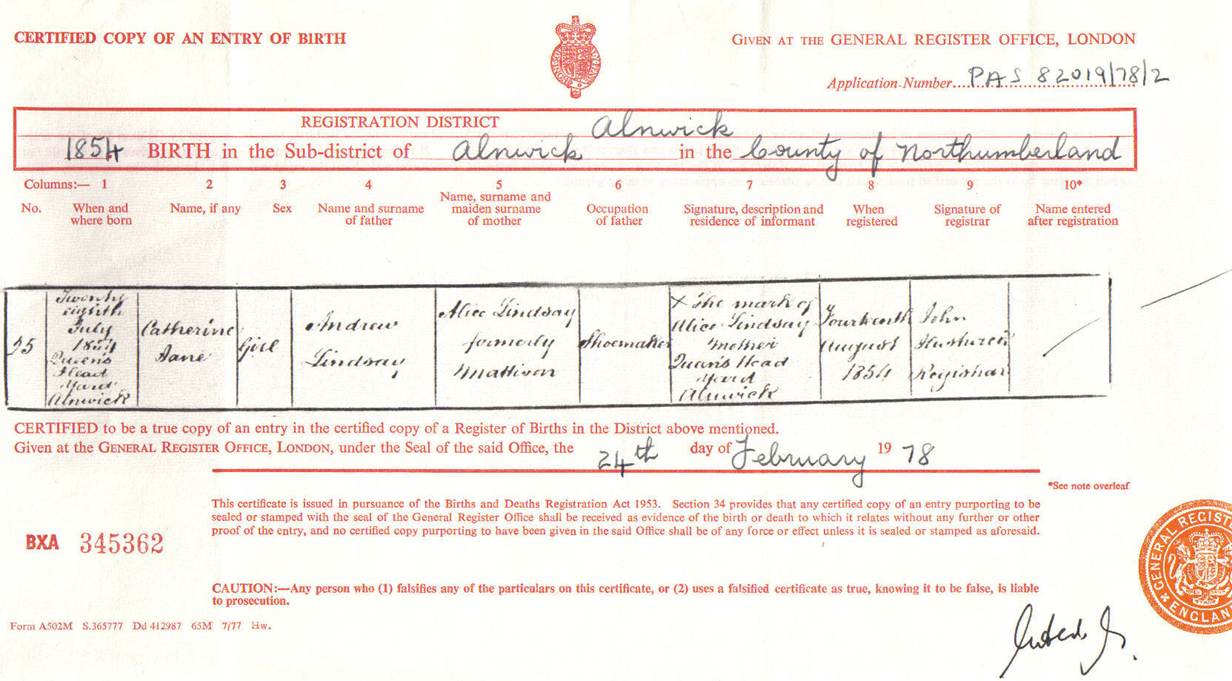
Catherine
Lindsay on 29 October 1875, shortly before her marriage Catherine’s birth certificate
Martin and Catherine
Farndale had a large family of twelve.
The
story of the family is also told in the
Tidkinhow Line.

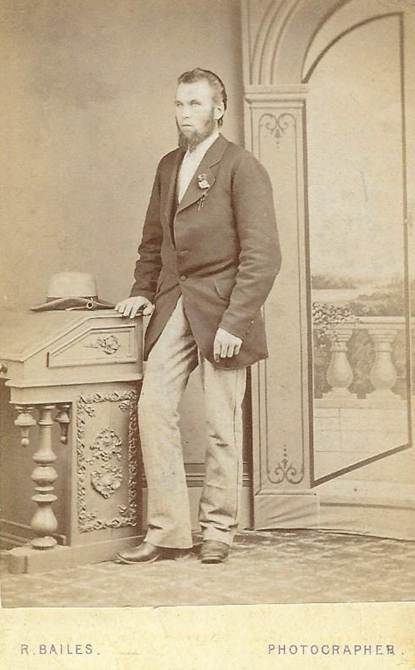
Martin, aged 32, about the time of his marriage
It appears that the newly
wedded couple moved to a cottage at Kilton Thorpe.
Martin and Catherine
Farndale had a large family of twelve. John Farndale was born at Kilton Thorpe on 22 December 1877 and
baptised on 17 February 1878, Martin was still a miner then, presumably working
in the nearby Kilton mines. Elizabeth Lindsay Farndale (always known as Lynn) was born at Kilton Thorpe on 25 January 1880 and baptised at Brotton on 25
January 1850. Martin and Catherine were still living at Kilton Thorpe, but Martin Farndale was now
described as a farmer.
According to Brotton Parish Register, their eldest son John
was baptised on 17 February 1878 having been born 24 December 1877. He was born
"to Martin and Catherine Jane Farndale of Kilton Thorpe, a miner."
1878
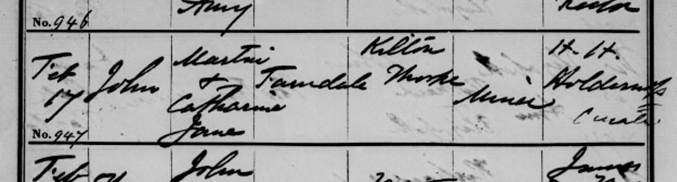
John
Farndale (FAR00553) was born
at Kilton Thorpe on 22 December 1878 and
baptised on 17 February 1879 (GRO Vol 9d page 475, Brotton PR).

1879
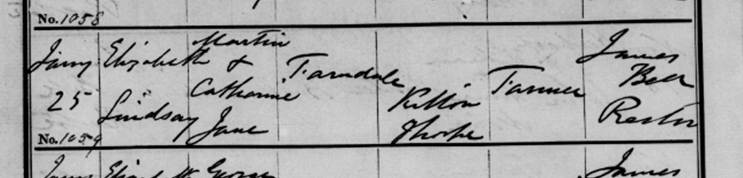
Their next child, a daughter, Elizabeth Lindsay Farndale
(FAR00564) was born two years later at Kilton Thorpe on
11 December 1879 and baptised at Brotton on
25 January 1880 (Brotton PR). Martin and Catherine were still living at Kilton Thorpe,
but Martin Farndale was now
described as a farmer.
1881
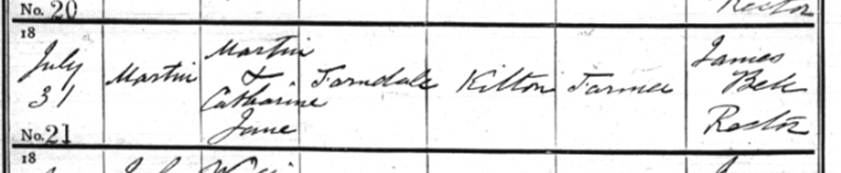
Their third child, Martin Farndale (FAR00571), was born at Kilton
Thorpe on 8 June 1881 and was baptised at Brotton on 31 July 1881 (Brotton PR) and his parents were still at Kilton-Thorpe
and described as farmers.
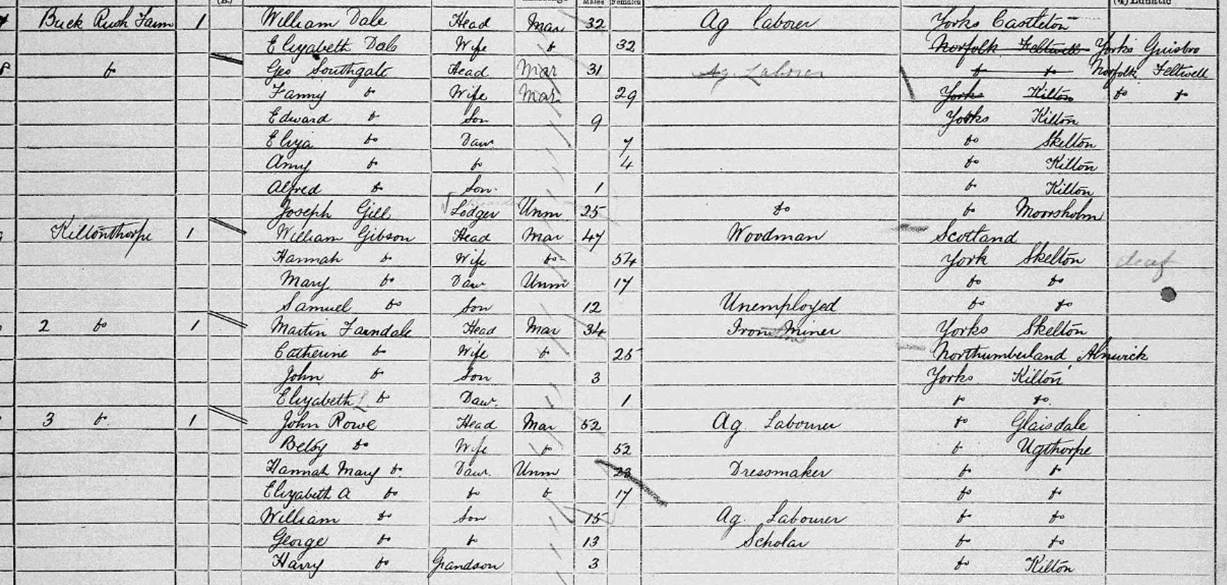
The 1881 Census for 2 Kilton Thorpe, Kilton listed Martin Farndale, head,
married, 34, an
ironstone miner; John Farndale, 3 born Kilton 1878; Elizabeth Farndale, 1,
born Kilton 1880.
Sometime
in the next two years Martin moved to Tranmire Farm near Whitby. Martin and Catherine’s next two
children were born there. There is a family story that Martin asked his brother
Matthew to go to make a bid for Craggs Hall Farm near Brotton. The story goes that Matthew returned saying that he'd taken
the farm - for himself! True or not that is where Matthew went and Martin went
to Tranmire, a farm some ten miles along the road to Whitby - a moor farm
near Ugthorpe situated on Roxby Moor. Martin’s other brother John spent his
life working on the railway at Loftus.
It was at Tranmire that their next
son George was born in January 1882 and also their next daughter, Catherine Jane,
named after her mother and always known as Kate, who was born on 16 June 1884.
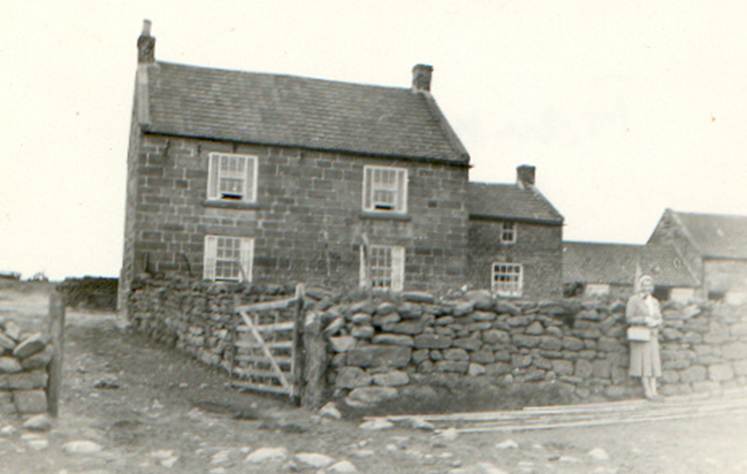
Tranmire
Farm, near Ugthorpe - Martin and Catherine moved here in or about 1883 from Kilton Thorpe.
George Farndale (FAR00588) was
born at Tranmire on 9 January 1882. His birth was registered in Guisborough
District in the first quarter of 1883 (GRO Vol 9d page 498).

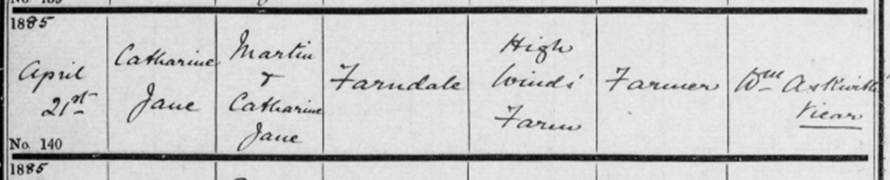
Catherine Jane Farndale (FAR00601) was
born at High Wind’s Farm, Tranmire on 16 June 1884. She was baptised at
Ugthorpe on 21 April 1885 (Ugthorpe
PR).
This suggest that the farm taken by the Farndales at Tranmire was High Whins
Farm, but this does not match the family photograph above.
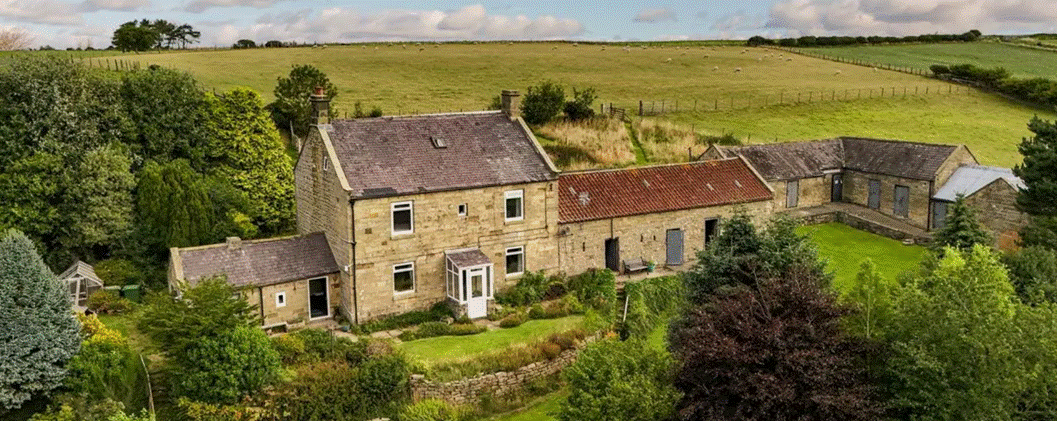
High Whins Farm, Tranmire in 2026
Richard Mickelthwait of Ardsley House bought Low Whins Farm, originally known as Pearson’s Farm, in 1866 and that
family held the land until it was sold in 1977.
It seems more likely that the farm taken by Martin and
his family was High Tranmire Farm above Tranmire Grange. I’m grateful to Michael
Harrison for sharing information about the history of Tranmire, whose family
owned the Tranmire Farms from the 1730s to 1789 before emigrating to Canada.
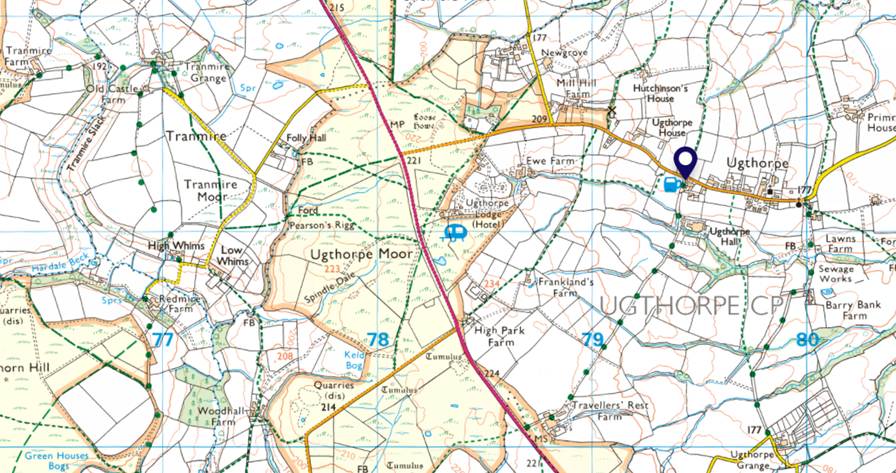
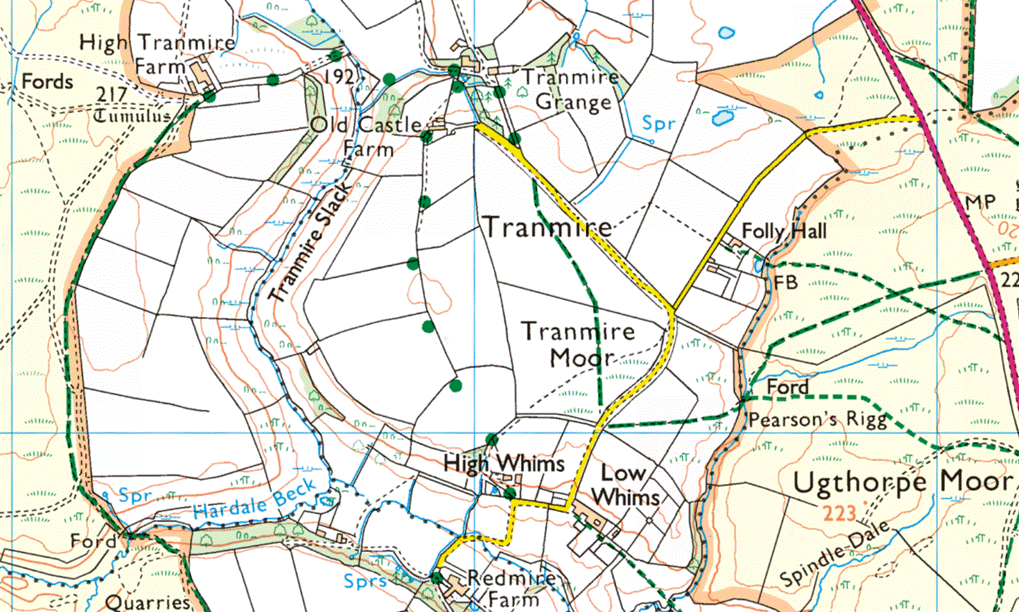
The eldest son John recalled driving sheep from
Tranmire to Tidkinhow when seven years old.
The Yorkshire Herald and
York Herald, 28 November 1885: AYSDALEGATE AND TIDKINHOW FARMS, Slapewath, near Guisborough. The Trustees of the late Wm
Barningham are prepared to receive tenants for the letting of the whole of
these valuable Old Grass Land Farms, comprising together about 2300 acres, with
all their buildings. A grand opportunity either for sheep farmers or dairy
keepers. Immediate possession can be given. For particulars apply to JOHN
WOODFIELD, Springfield, Darlington.
By the time James
was born on 22 December 1885, the family had moved to Tidkinhow farm on Stranghow
Moor near Guisborough, an improvement on Tranmire. The young family were brought up at Tidkinhow
and the other six children were born there.
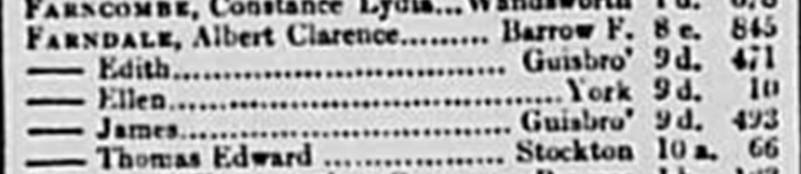
James Farndale (FAR00607) was
born at Tidkinhow Farm
on 22 December 1885. His birth was registered in the first quarter of 1886 (GRO Vol 9d page 493).
1887
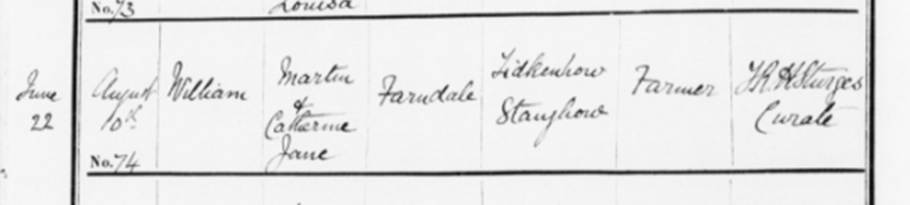
William
Farndale (FAR00625) was
born at Tidkinhow Farm on 22 June 1887
and baptised on 10 August 1887 (Skelton PR), but died only two years later on
19 July 1889.
1889
Mary
Frances Farndale (FAR00634)
was born at Tidkinhow Farm on 22 January
1889. Her birth was registered at Guisborough District in the second quarter of
1889 (GRO Vol 9d page 508).

1891
Another
son also to be called William Farndale (FAR00647), was born at Tidkinhow Farm on 29 January 1891 (GRO
Vol 9d page 503).

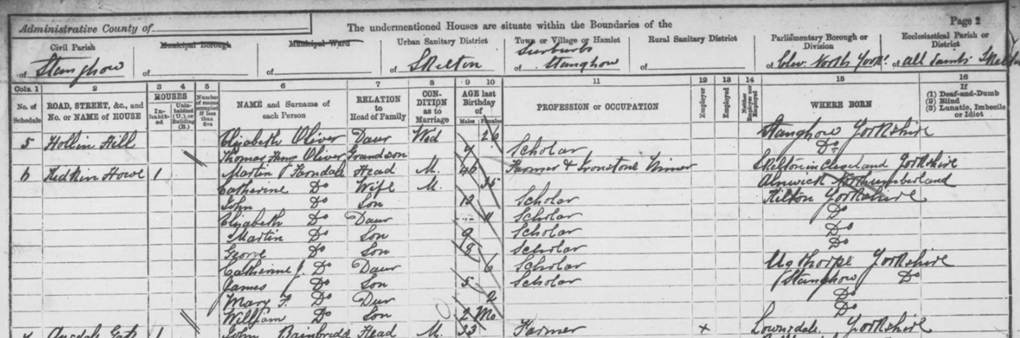
The 1891
Census for Tidkin Howe, Stanghow listed Martin Farndale, 46, farmer and ironstone
miner;
Catherine Farndale, 35; John Farndale, 12, born 1879 at Kilton; Elizabeth
Farndale, 11, born 1880 at Kilton; Martin Farndale, 9, born 1882 at Kilton; George
Farndale, 8, born 1882 at Kilton; Catherine J Farndale, 6, born 1885 at
Ugthorpe; James Farndale, 5, born 1886, Stanghow; Mary F Farndale, 2, born
1889, Stanghow; and William Farndale, 0, born 1891, Stanghow.
The North
Star (Darlington), 26 September 1891: IMPORTANT STOCK SALE IN CLEVELAND. The first of what is
intended to be an annual sale of sheep at Kildale in Cleveland was held
yesterday afternoon, and proved a great success. The
farmers of this important sheep breeding district have hitherto sent their
sheep to Goathland, near Whitby, but, owing to the great distance between the
two places, it was decided at a meeting of farmers two months ago to start a
sheep sale at Kildale. No fewer than 1,200 sheep were entered, the drafts being
from the following farmers: -... Farndale, Tidkinhow ...
1892
At
the Loftus in Cleveland Agricultural Show, the York Herald, 15 July
1892: HORSES … Carting colt or filly foal, by Enterpriser: C
Farndale; 2 R Stephenson; 3 M Farndale …
1893
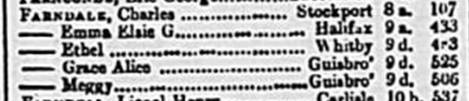
Grace
Alice Farndale (FAR00659),
named after her mother's sister and her mother's mother, Alice Lindsay, was
born at Tidkinhow Farm on 21 April 1893 (GRO
Vol 9d page 525).
1895
Dorothy
Annie Farndale (FAR00668)
was born at Tidkinhow Farm on 24 May 1895
(GRO
Vol 9d page 514).

1897
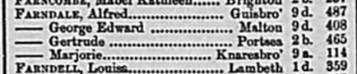
Alfred
Farndale (FAR00683) was born
at Tidkinhow Farm on 5 July 1897 (GRO
Vol 9d page 487).
The North
Star (Darlington), 6 April 1897: THE CLEVELAND AUCTION MART COMPANY LIMITED,
GUISBOROUGH. 8 Scotch Ewes in lamb to a Leicester Tup, from Mr M Farndale
…
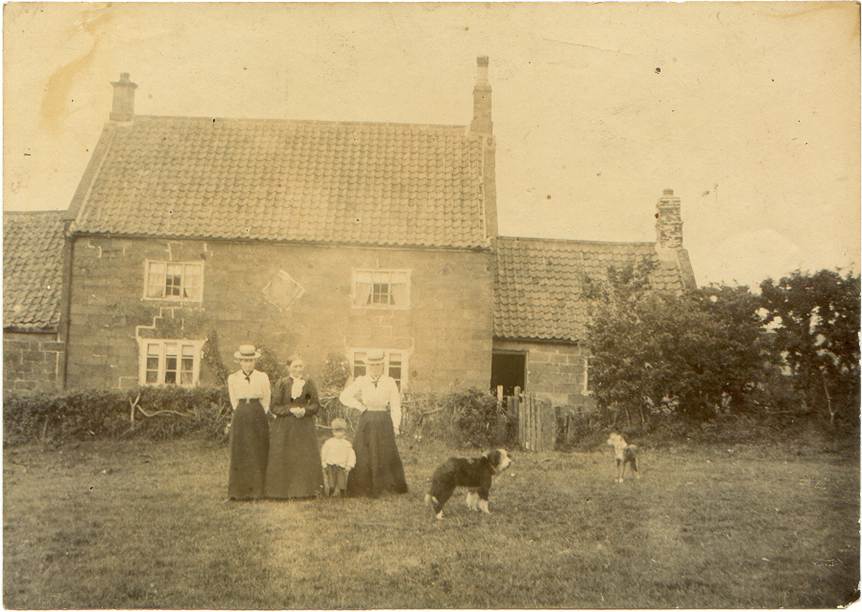
Tidkinhow
Farm, near Guisborough, about 1900 - Kate, Catherine, Alfred and Elizabeth
(Lynn) - Martin and Catherine moved here in about 1885.
By now Martin was 52 and his wife, Catherine still
only 43. They continued to work the farm at Tidkinhow
and the eldest sons and daughters were now starting to work helping to look
after the youngest who were going to school at Boosbeck.
The 1901 Census for Tidkinhow Farm, Stanghow listed Martin Farndale,
head, 55, farmer; Elizabeth L Farndale, 21; Martin Farndale, 19, ironstone
miner underground; Mary H Farndale, 12; William Farndale, 10; Grace A Farndale.
7; Dorothy A Farndale, 6.
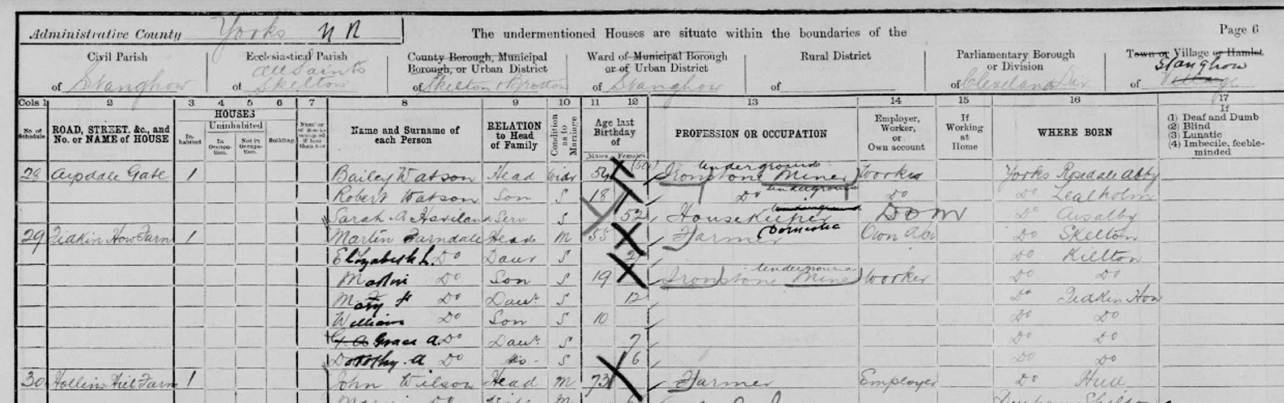
At
the same time, the 1901 Census for
105 Stanhope Street, Westgate, Newcastle listed Alfred Farndale aged 3 shown
with Kate Farndale (born 1855) and the Heslop family from Alwick.
He is shown as their nephew. So this was where
Catherine (Kate) was with Alfred on Census day.
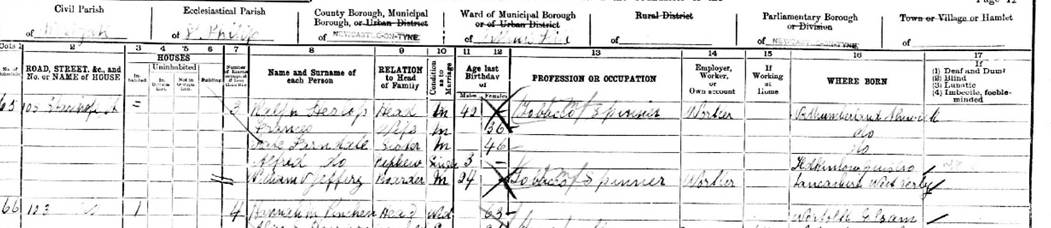
1902
The Whitby Gazette, 5 December 1902: SALE
OF SIR JOSEPH PEASE’S FARM STOCK. On Thursday, last week, the farm stock of the
Hutton hall, Bonsdale and Highcliffe
farms, belonging to Sir Joseph Pease, Bart, MP, was sold by auction on the
Hutton Hall Farm. The weather was fine, and there was a large attendance of
buyers from various parts of North Yorkshire and South Durham. The catalogue
comprised 14 horses, 40 beasts, 550 sheep, about 800 choice poultry, implements
and dairy utensils. Mr Charles Turner was the auctioneer, and a start was made
with the sale shortly after ten o’clock.... The sheep and pigs were next sold,
and the following were the principal buyers:... Mr
Farndale, Guisborough,...
1903
On 23
August 1903 Lynn (Elizabeth Lindsay) married George Barker and went to Tancred
Grange near Scorton to live. John worked on the farm.
Lynn was the
first to marry. She had been working at Tancred Grange
and she was 24 when she married. She was to have six children
and her descendants were still living at Tancred in 1982. On the day after she
was married, her mother wrote to her.
Tidkinhow,
Aug 24 1903
My Dear Daughter
I
received your letter and was glad to hear you arrived all right. I hope you and
your husband are enjoying yourselves and that you are having fine weather. It
is raining here today. John will take your luggage and leave it
at Darlington tomorrow as he is going back to Newcastle. I posted all the boxes
on Saturday night that were addressed and I will send the others to you with
the cake. I gave the postman 2s 6d this morning and he was very pleased. We have to wish you much joy and happiness for him. You must
write after you get home and let me know if you get the luggage all right. I
now conclude with kind regards to you both.
I remain
your affect mother
C J
Farndale
Meanwhile
life at Tidkinhow continued. Weekly shopping expeditions by pony and trap to Guisborough to buy groceries were followed
by elder members of the family going out on Saturdays in Guisborough. They went for lots of walks
and met neighbours. There were horse drawn and later
motor buses and from time to time a break would take them on an outing
to a show somewhere. John was working down the mines, Lynn was married, Martin was described as a bit delicate
as a boy and spent much time at home helping his father. George, the shy one, was working on a local farm. Kate
was at home and James was working as a butcher. His younger
brother, William, was an apprentice butcher at Saltburn and Mary soon went away to learn confectionary. Grace, Dorothy
and Alfred were at home.
Catherine Jane frequently wrote to her children when
they were away. She often visited members of her family, some of whom by then
lived at Bishop Auckland. There were two postcards written to Grace, one from Bishop Auckland on 25 September 1906 which simply wrote Will
be at Bishop Auckland Wednesday by train and the other, on 6 March 1905,
from Etherley Schools where Catherine
Jane had been, saying This is where I went to school a long time since.
I hope you are keeping well.
1905
Life was a
challenge as twelve siblings grew up and considered their futures. It was
becoming more difficult to make a living, let alone realise ambitions. Martin was the first to want to spread his
wings. Many young men in the district were going abroad and there was great
pressure to colonise the western provinces of Canada. He was, however,
concerned at the effect on his mother on leaving and this concern is clearly
reflected in two letters written from SS Tunisian after he had left
without saying goodbye. He seems to have hoped to avoid the worry and concern
of his departure, though leaving without a farewell might not have been the
best approach. He left Liverpool on Thursday 16 June 1905.
June 16th 1905, Friday morning
Dear
Sister
Just a
few more lines. I left Liverpool on Thursday night for Canada on SS Tunisian. I
have had a good night's sleep. I have booked second class on board
and it is very comfortable. We are passing by the north of Ireland. The ship
makes a call here to take on more passengers. This letter will be sent on from
here. I shall not be able to post any more letters till I land at yond side. I
am enjoying the trip well so far. I hope mother will not fret if she get to know before I write. I will send a letter to her as
soon as we land. I am going to do best . I am going a
long way up the country. I am to Calgary in Alberta. It is chiefly cattle farming
there. There is several more young men on ship that
are going out from there. But I have not meet any lady
that is my way yet. You must try and cheer mother up. There is nothing for her
to trouble about. I am as safe here as riding on the railways in England. I
shall be about other 7 days on the water. I will send a few letters off before
I start my land journey. I have not time write more. I want to up on deck. We
are just about to land at Londonderry I believe.
I must
leave hoping you are all well.
M
Farndale
And five
days later he wrote another letter, though it was not posted until he arrived
in Canada.
Letter
cannot be posted for England till we land so you will know if you get this that
I landed all right.
Wednesday
June 21st 1905
Dear
Sister
I shall
soon get my sea trip over now. Land was sighted today Newfoundland I believe. Every body is beginning to lighten
up now. But it will be Saturday morning before we land at Montreal.
I have
enjoyed voyage up to now. I had one day sea sick. It
was awful. I don't want that any more. We have had few
very cold days. It is always cold in this part of the Ocean. We saw a great
iceberg this morning. It was a great sight. This is a great rock of ice. So you must know we were passing through a cold front. This
is a big vessel about two hundred yards long I should think. Every body seem quite happy. There
is a smoke room and a music room. And the best of everything
to eat. Third class seems to be rough quarters. But they are in another part of
the ship. There will be about eight hundred passengers on board all together.
Some men pulling long faces when the vessel left Liverpool. I never thought
anything about it. But I was like the rest. I watched England till it
disappeared out of sight. I hope mother will not trouble about me. I will be
all right. I thought it was my best thing to do. I had nothing to start in
business with in England. I shall be able to get about
£50 per year and board with the farmers out here. If I can stand the climate.
And I can settle. I shall be able to start farming for myself in about two
years.
Thursday
All
letters are to be posted tonight on board so that they will get away as soon as
we land. So all has to be
ready.
First and
Second class are having a Grand On Board tonight. We
shall be quite lively.
I now
finish. Hoping you are all well. And remain your affectionate Bro.
M
Farndale
Martin was
24 years old. These letters start a whole branch of the Farndale family who emigrated to Alberta.
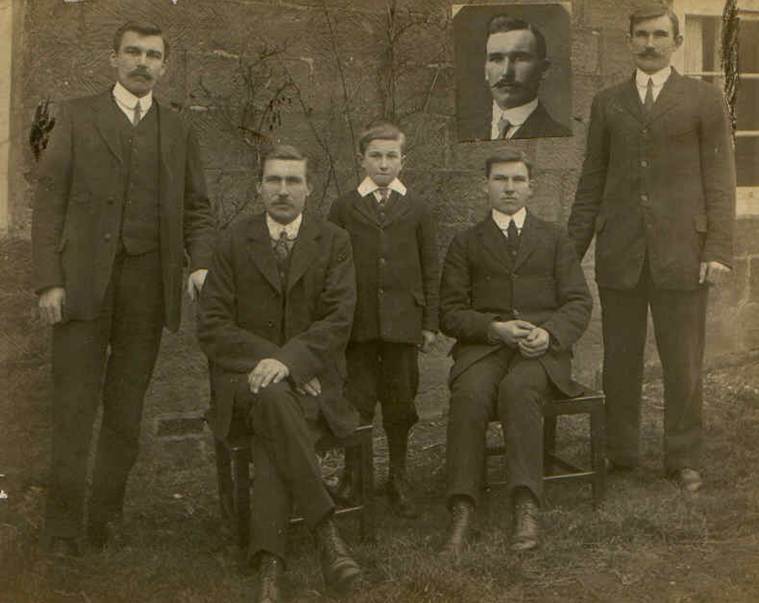
The boys of Tidkinhow in about 1910 - John, James, Alfred, William, George, Martin (inset)
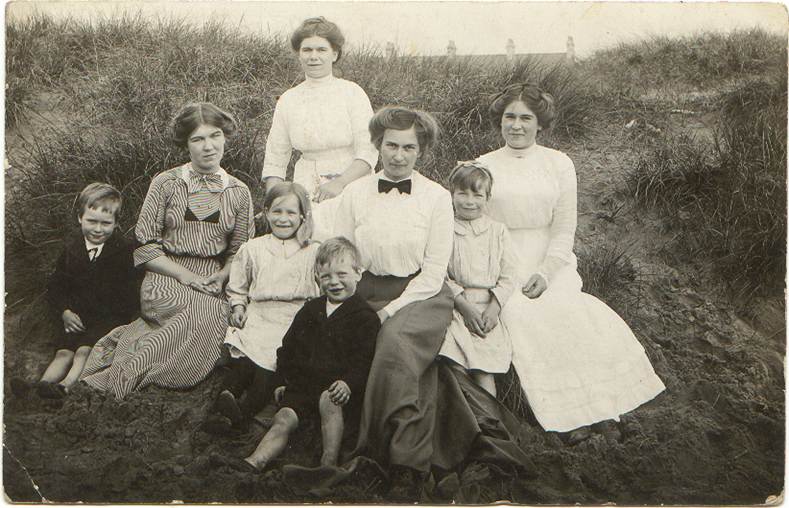
The girl Farndales of Tidkinhow with Barker children - Willie B, Dorothy F, Mary F, Mary B, Kate F, Grace
F, Margaret B, John B - about 1910.
The Whitby
Gazette, 13 January 1911: PLOUGHING
AND HEDGECUTTING COMPETITIONS. The Leadholm and Danby ploughing and hedge
cutting competitions, which were established a year or two ago, and are the
only competitions of the kind which are held in the immediate district, took
place on Wednesday afternoon, at Egton. There was a large attendance
and considerable interest was manifested by agriculturalists and others in the
various events. Dyking was dropped out of the programme this year. The district
includes the parishes of Danby, Glaisdale, Egton, Ugthorpe, Westerdale and
Commondale, and competitors and spectators attended from most of the villages
comprised in the area, and also from other places... The
ploughing competitions were held on the land of Messrs M Farndale, W
Jackson, Tynedale, and W Pearson and, and the hedge cutting on Mr Thomas
Hutchinson 's land. The weather was favourable, and rain held off till the
evening, when a heavy downpour took place. A luncheon was afterwards held at
the Horse Shoe Inn.
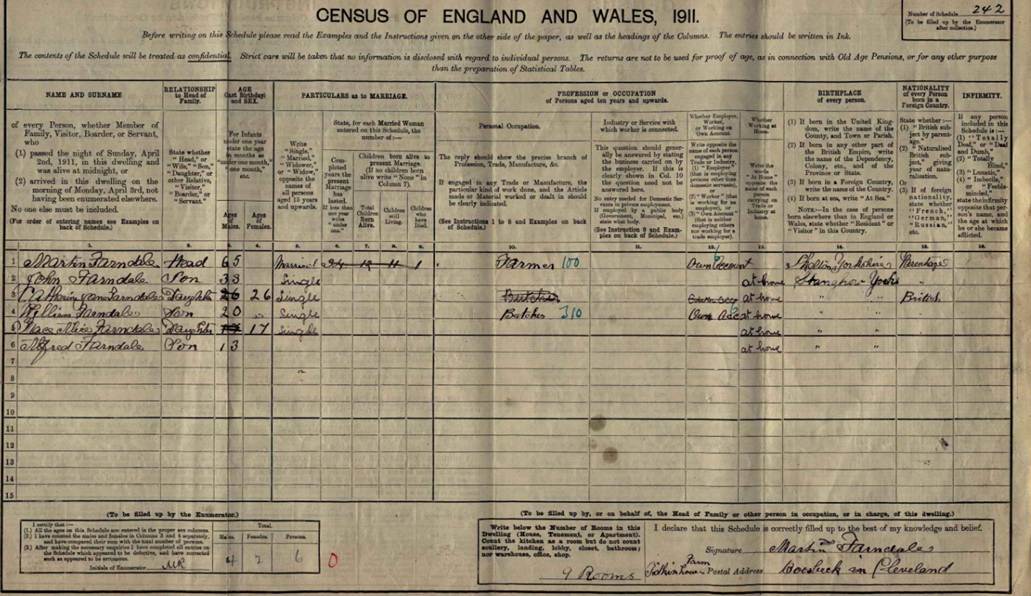
The 1911
Census for
Tidkinhow Farm, Boosbeck, Stanghow listed Martin Farndale, 65, farmer, head,
born Charlton; John Farndale, 33; Catherine Jane Farndale, 26; William
Farndale, 20, butcher; Grace Alice Farndale, 17; and Alfred Farndale, 13.
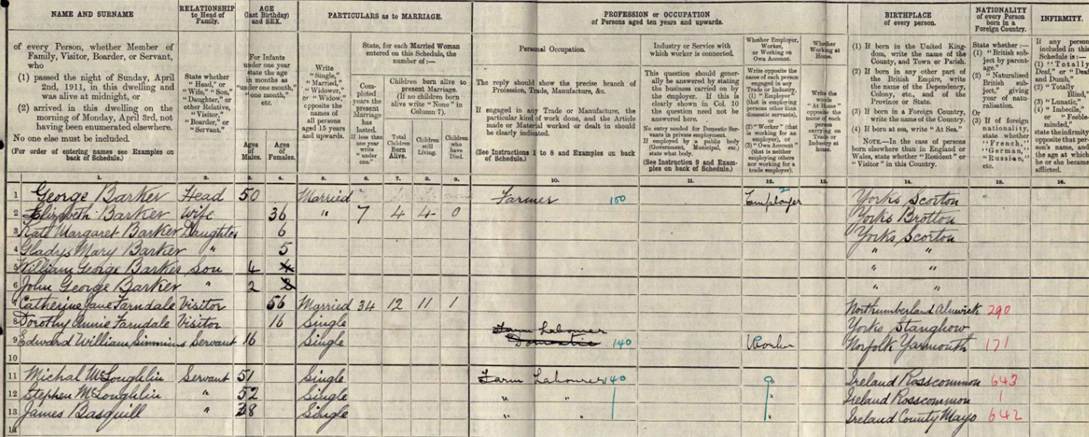
At the same time the 1911 Census for Scorton, Darlington listed George Barker, head, farmer, 50,
born Scorton in about 1861; Elizabeth Barker (nee Farndale), 36; Kate Margaret
Barker, 6; Gladys Mary Barker, 5; William George Barker, 4; John George Barker,
2; Catherine Jane Farndale, born Alnwick in about 1855, 56, married,
visitor; and Dorothy Annie Farndale, born Stanghow in about 1895, 16,
single (FAR00668), visitor.
George and James (“Jim”), at first reluctant to leave home, followed
their brother Martin to Alberta in 1911. Jim would spend his late life in the
United States. Already Kate
wanted to go to look after them, but they all knew that their
mother was ailing.
George and James followed their brother Martin to
Alberta in 1911. James would spend his late life in the United States.
On 14 July 1911, Catherine Jane
Farndale died at Tidkinhow aged
56; she was buried at Boosebeck Parish Church.
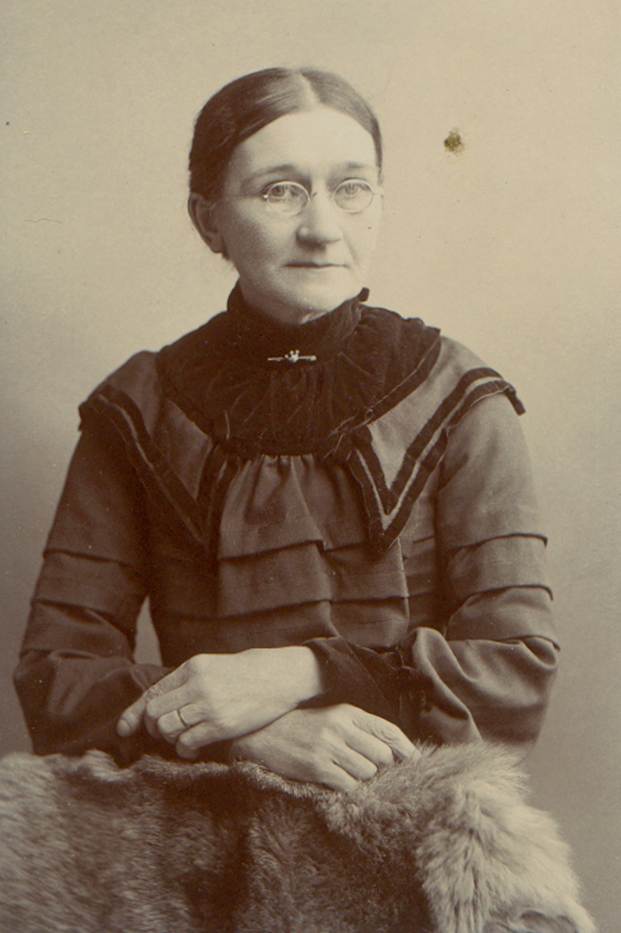
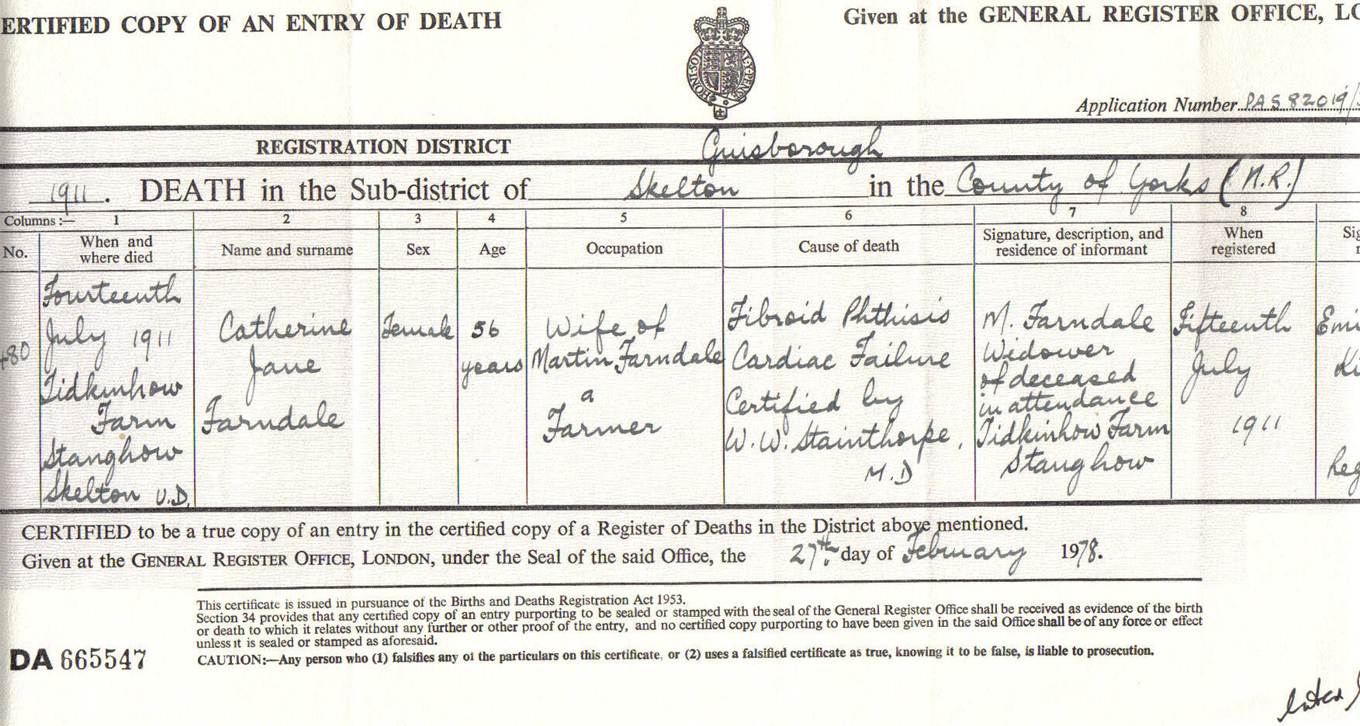
Catherine
Jane Farndale
Her death
certificate shows that her husband, Martin, was with her and that she actually died of fibroid pathesis,
cardiac failure, but she almost certainly had TB. Alfred Farndale later remembered his distress at her
funeral in Boosbeck and being comforted by
his nearest brother William on the way back. There is no doubt
that her untimely death at the age of 56 was a great blow to the family. She is
remembered by them all with the greatest affection. Her life had been hard but she had clearly cared for them all. She was
remembered as kind, intelligent, firm and determined. There was now a great gap
at Tidkinhow and the family had to do their best to fill her place.
Martin
was now alone at the farm, but surrounded by his family, though now five were
in Canada, two (Lynne and Mary) were married and one, the first William, had
died. John the eldest was on the farm and Grace, by now 18 and Dorothy 16 were
there to help bring up the youngest, Alfred, aged 14.
1913
The Canada
bug hit the family hard. Soon after their mother's death William and Kate
followed their two elder brothers to Canada. Jim had already sailed on 31 March 1911.
There is a diary of
his voyage which has been transcribed. Kate went in 1913 to join her brothers. William had become a butcher, but also emigrated to Canada in 1913,
settling in Saskatchewan. Kate and George were never to return to England, but
Martin did twice and William as a soldier. Jim returned as a soldier and visited again
in the 1950s.
Old Martin was now a widower at the farm, but surrounded by his
remaining family, though now five were in Canada, two (Lynn and Mary) were married and one, the first William, had died. John the eldest was on the farm and Grace, by now 18 and Dorothy ,16 helped to bring up the youngest, Alfred, aged 14.
1914
When the war
came in 1914 three of the boys became soldiers. Jim joined the American forces and fought
in France. Soon he was joined by William, serving in the Canadian Army who
was wounded near Ypres in 1917 and then by Alfred who served from 1916 to 1920 as a
British soldier in the Machine Gun Corps in France and Mesopotamia.
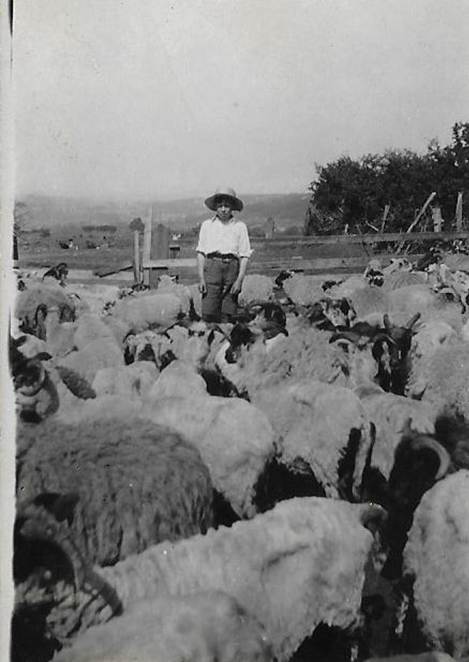
Willie
Barker at Tidkinhow about 1915
1919
By the end of the Great War, the family were well scattered. John was still farming at Tidkinhow. Lynn was still at Tancred Grange near
Scorton. Martin was still a
bachelor in Canada, as was George,
both in Alberta. Kate
had married William Kinsey and was living near her brother in Alberta. After
the war Jim
returned to America where in September 1917, he had married Edna Adams and was
living in San Antonio, Texas. William
returned to Canada where he too intended to marry, but tragically he died on 20
November 1919 from the flu, contracted when he was still weak from his was
wound on the Vimy Ridge. Mary
remained at home until she was married to George Brown in 1920 and went to live
in Leeds. Grace and Dorothy were at
home. Alfred
had returned to Tidkinhow in March 1920,
but George Barker, Lynn
's husband at Tancred Grange had died in about 1920 and their young family were
unable to cope alone, so Alfred spent much time at Scorton helping the Barker
family. Old Martin,
in 1920, was 75 and still living at Tidkinhow.
1920
By 1920 Tidkinhow
was still part of the much
larger estate of the Wharton Family of Skelton Castle and again the
freehold was sold. Part of the Skelton Estate, about 1,359
acres, will be Offered for Sale by Auction at an early date, subject to
conditions being produced. T S Petch, Auctioneer. The Short Particulars
included, in the Moorsholm District, Tidkinhow
and Stanghow Moor Farms,
extending to about 553 acres.
Mary
remained at home until she was married to George Brown in 1920 and went to live
in Leeds.
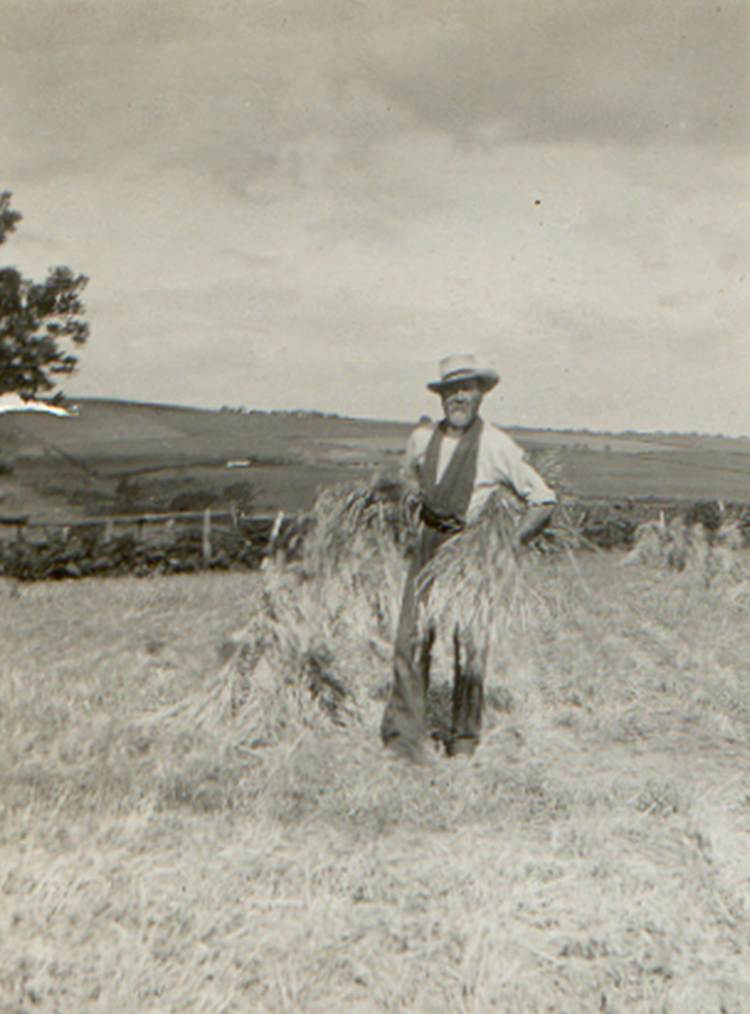
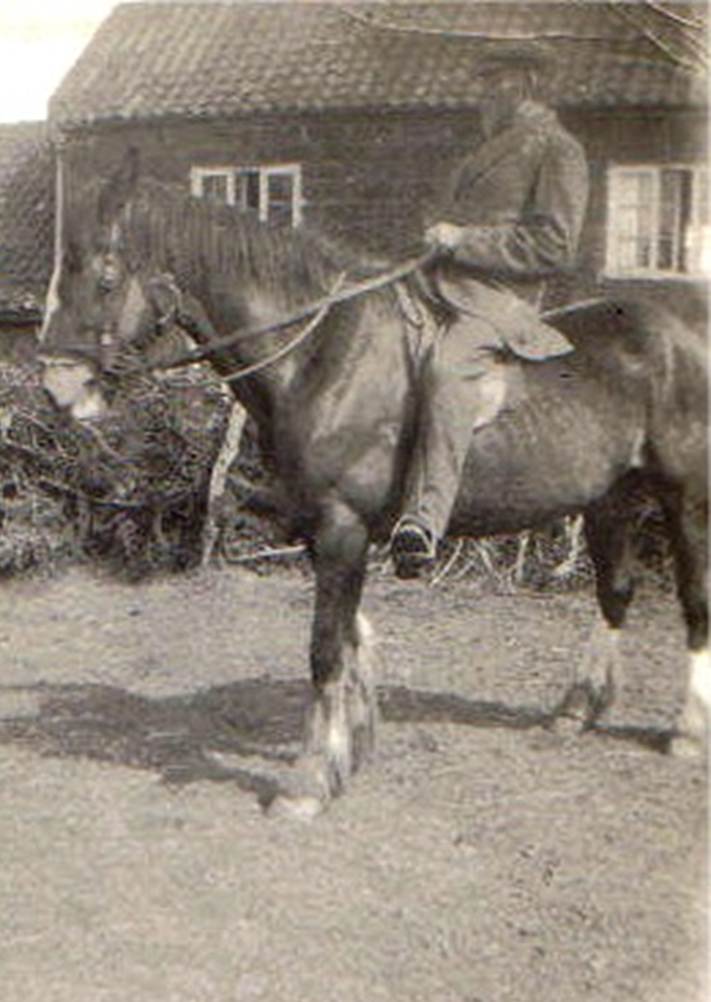
Martin
harvesting at Tidkinhow
about 1920 Martin Farndale
mounted at Tidkinhow in about 1920
1921
Alfred
was helping out at the Barker Farm at Tancred Grange and
stayed until 1921 before he returned home to help at the farm.
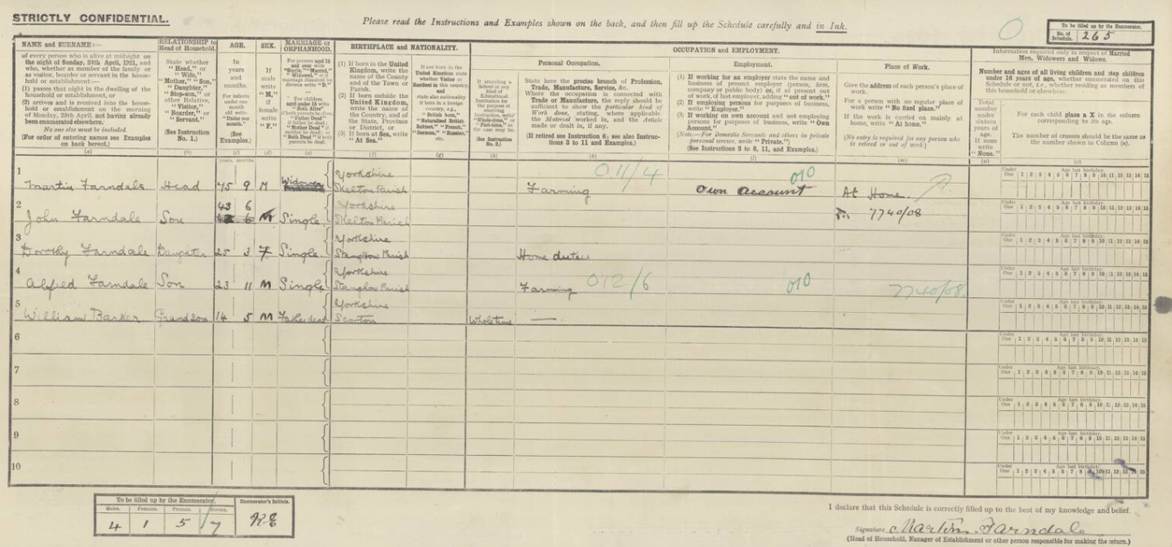
The 1921 Census
listed Martin Farndale, 75, a widower, farming, employed on his own account,
and living at home; John Farndale, his son, 43, single; Dorothy Farndale, his
daughter, 25, single; Alfred Farndale, 23, single, his son, farming; William
Barker, whose father had died, 14 years old, full time at school.

Grace
went away to a job as matron at Monmouth High School for
girls and there met Miss 'Peggy' Baker. Together they left the school in
1924 and went poultry farming first at Scorton and then at Leeming Bar. Peggy was later to marry Alfred and had many trips to Tidkinhow and met old Martin. There is a letter
from old Martin to his daughter Grace, mentioning Peggy, undated, but must have been written in about 1927 just before he died.
Dear Grace
I am doing well. Not much time to
write. Father wishes you a very happy new year & Peggy write her. Quite
well myself. Wanting to get up and abscond from here. from your ** father
1925

Martin
at Tidkinhow Farm
about 1925 (notice sundial between upstairs windows)
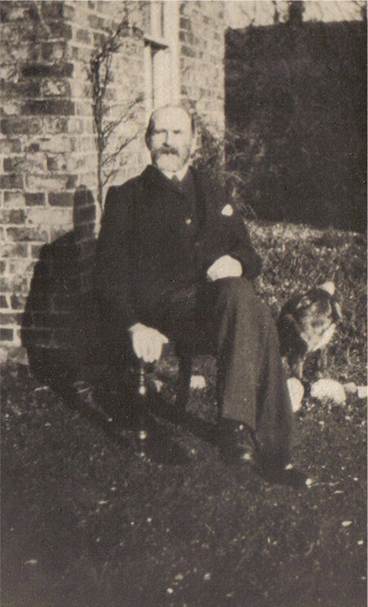
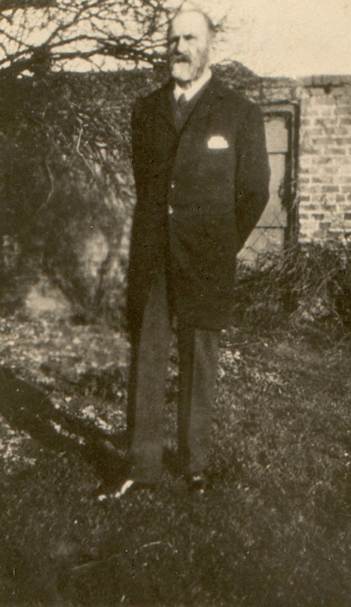
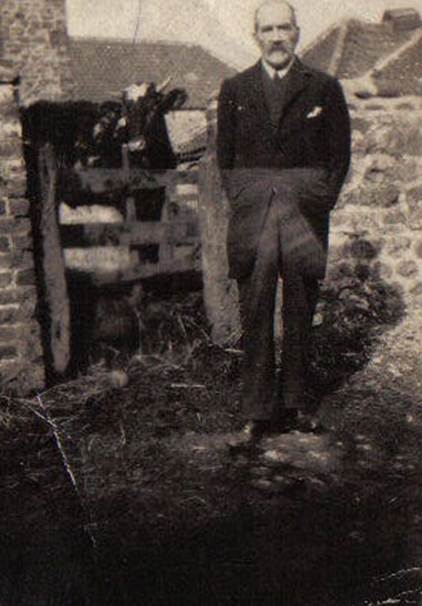
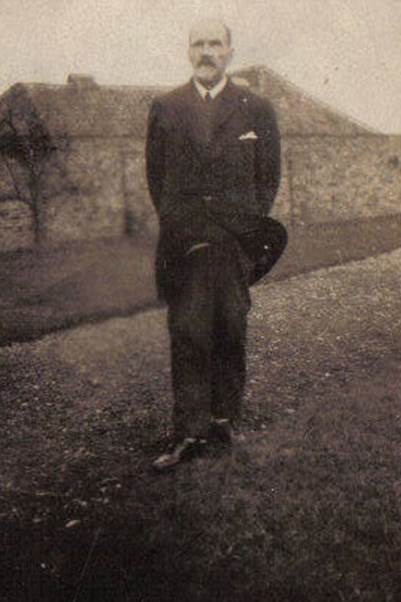
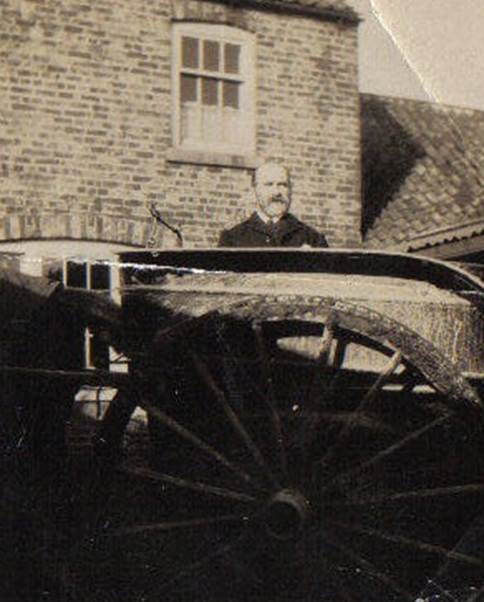
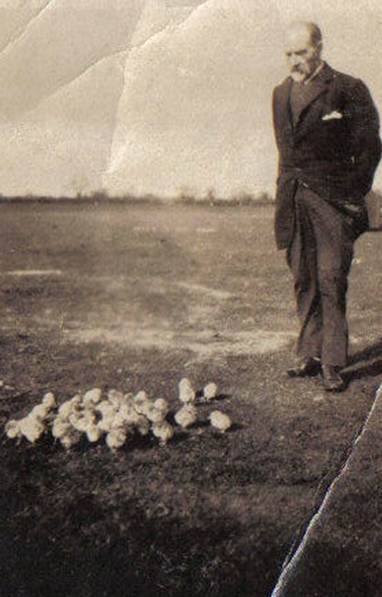
Martin Farndale at Tancred Grange in about 1925 - his
daughter, Lynn Barker, lived there.
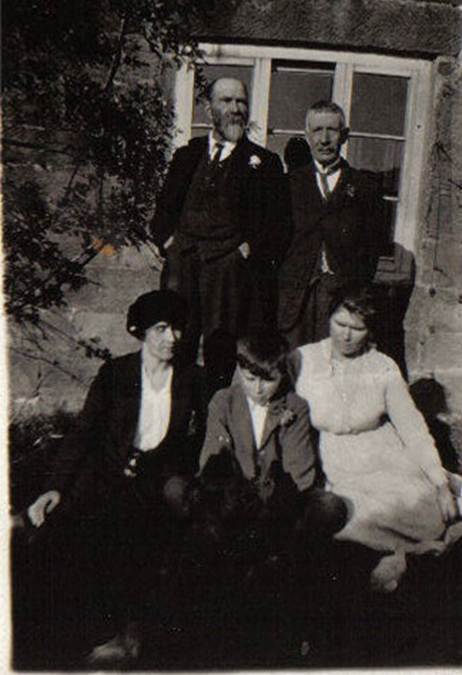
Martin
Farndale, George Brown, Grace Farndale, Willie Barker, and Mary Brown (nee
Farndale)
His son John Farndale continued farming as tenant on Tidkinhow
Farm.
Grace Farndale’s diary touches on Tidkinhow at this time,
before her emigration to Alberta.
1927 was
one of the wettest years I remember. It rained and poured the whole summer and the grain was swept into the rivers in many
places all over the country. The water poured down Burk Brow like a river. The
people at Charlton 's Terrace had to camp upstairs as the water seeped into
their lower quarters. They had planks on the floor to walk about. We were ok on
the hill top at Tidkinhow, for once we had the
advantage! For many years we'd had hot weather during the summers
and everyone blamed the First World War with all that shooting big guns and
small. This must have opened the clouds and the floods came down. The years
were wet at any rate. I suppose we were in for a change of seasons. Nothing was
ever the same again after that terrible war that we can all remember.
Brother Martin came over from Canada during the Christmas of 1927. Father
was very ill and he died in January 1928 at the age of 82. It was the first and
last illness of his life. He had had prostate gland trouble
and they wouldn't operate in those days on the elderly. The doctor said he was
as sound as a bell, except for this trouble. So ended the worthwhile life of a
fine old man. One of the best in his upright, honourable life and outlook. At
that time I was only at home casually as Peggy and
I were at the poultry farmer Leeming Bar. She and Alf had
got engaged to be married in March so that was that! Both father and Martin had discussed the possibility of my going back to Canada
with Martin. I had serious thoughts and I felt I
knew I was going to do just that as I was at a loose end. I had always wanted
to go anyway. Then when Peggy and Alf decided to go that did it.
It was an
exciting and busy time. I was thrilled to bits. Dorothy and
Alf Ross got married. There was so much to do selling our poultry farm etc. ‘We
were all hell bent for election’, to use one of Howard's expressions. One of
our neighbours said he had never seen such an exodus of a family. I guess it
was Gran really, we all stayed as long as he lived, though he never asked us to
do that. We were to do as we wished. After all we were all grown up and we were
all very independent. John stepped into Tidkinhow with the help
of Lynn and did very well for himself during
the Second World War.
There was
a touch of sadness deep down about leaving the old place, for us all I think,
and England. One never does these things lightly. But for me the excitement of
going overseas counterbalanced all that. It had to be done
and I never tried to shirk difficulties. Sometimes I thought I rather enjoyed
the challenge in my quiet way. It made life more interesting. I had already
found out life was far from rosie all the time long ago,
just occasional little glimpses. I was always an optimist and felt that there
was a new life ahead of me. At the time of leaving for Canada, I said I would
stay five years or so.
Dorothy and Alf got
married, just family in a few neighbours and off they went. Peggy
and Alf were
the next. Ditto. A family quiet wedding and they were off to Canada. I was left
to pack up which was a big job. Martin was at the bungalow with me. Lynn
and John
were ensconced at Tidkinhow and Martin went up again. I took as much of our stuff packed in trunks
and everyone packed solid. This chap took me to the train and thought I had
rocks in my baggage. Martin
had asked me to go alone to Liverpool on March 30th as he wanted to go to a big
race at Liverpool - The Grand National. I was a bit nervous really. However, he
didn't go to the race and met me at the train, was I ever glad to see him? I
was a bit of a ‘green horn’ travelling and I was terribly thrilled at going to
Canada. I would have got anyway, whether or not Peggy
and Alf
had. I had made-up my mind.
1928
Alfred
remained at home until Martin died on 17 January 1928, aged 82, of pneumonia.
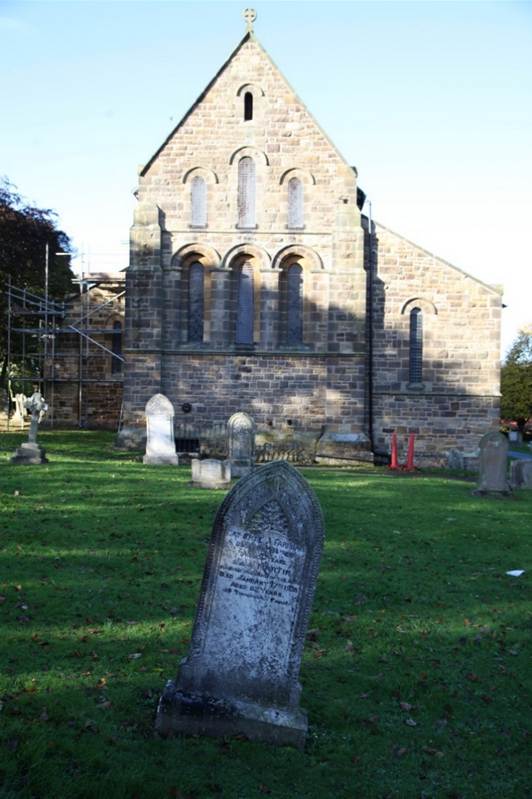
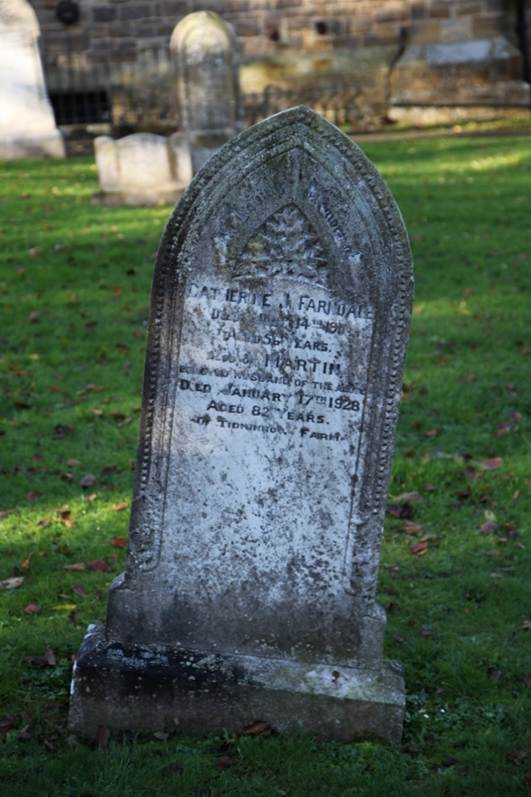
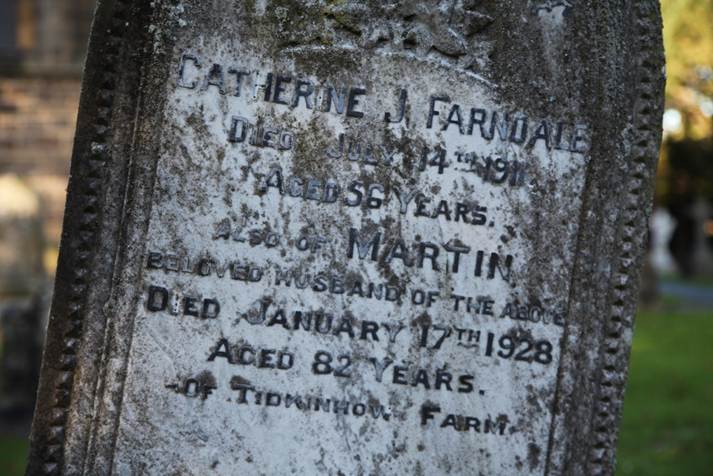
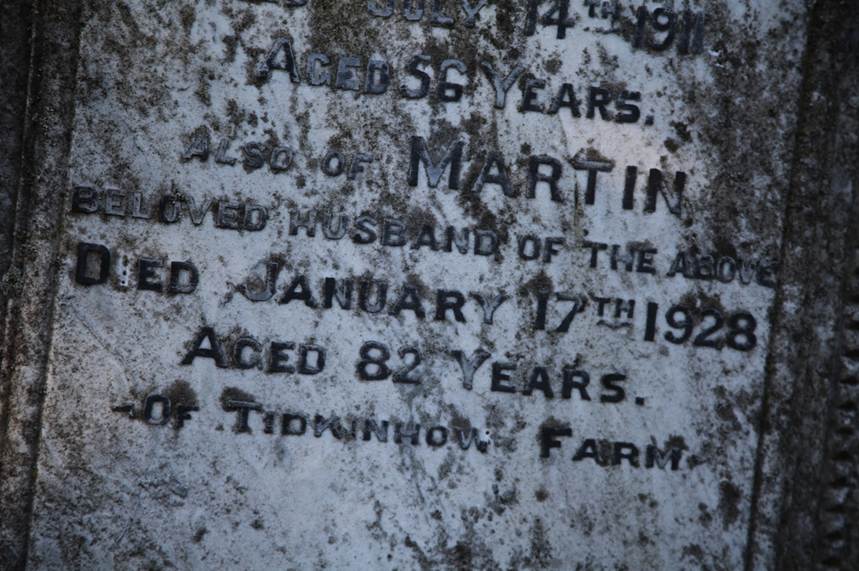
Martin is buried beside Catherine Jane at Boosebeck Parish Church where there
is an inscription which says "Catherine Jane Farndale, Died 14 July
1911 aged 56 years, also MARTIN, Beloved Husband of the above, Died 17 January
1928 aged 82 years of Tidkinhow Farm."
(GRO
Vol 9d page 627 and family knowledge).
From an
undated Newspaper cutting:
‘Farndale; At Tidkinhow
Farm, Boosbeck, on 17th January 1928,
Martin Farndale died in his 83rd year. To be interred at Boosbeck on Friday 21 cortege leaving Residence
at 1.30 pm. Friends kindly invited.’
Gravestone
in Boosbeck St Aidan Churchyard: Catherine
Jane Farndale died 14 July 1911 aged 56 years, wife of Martin Farndale, a
farmer. She died of Fibroid Phthisis, cardiac failure, certified by WW
Stainthorpe MD (Catherine's death certificate) Also Martin, beloved husband of the
above, died 17th January 1928 aged 82 years of Tidkinhow
Farm. (Mon R)
Notice
in The Official Gazette, 2 April 1929, winding up the estate: Re
MARTIN FARNDALE, Deceased. Pursuant to Statute 15 Geo V, c19. Notice is hereby
given that all creditors and other persons having any debts, claims or demands
against the estate of Martin Farndale, later Tidkinhow Farm, Boosbeck, in the
county of York, farmer, deceased, who died on the 17th day of January, 1928,
and whose will was proved in the Principal Registry of the Probate Division of
his Majesty's High Court of Justice on the second day of March, 1928, by
Elizabeth Lindsay Barker, the executrix named therein, are hereby required to
send in the particulars of their claims or demands to us, the undersigned, the
solicitors for the said executrix, on or before the 3rd day of June, 1929,
after which date the said executrix will proceed to distribute the assets of
the said deceased amongst the persons entitled thereto, having regard only to
the claims and demands of which she shall then have had notice; And she will
not be liable for the assets of the said deceased, or any part thereof, so
distributed, to any persons of whose debts, claims or demands she shall not
then have had notice. Dated this 26th day of March 1929. Buchanan Richardson
and Barugh, Town Hall, Guisborough. Solicitors for the said executrix.
FARNDALE, Martin of
Tidkinhow Farm, Boosbeck,. Yorkshire died 17 January 1928.
Probate London, 2 March to Elizabeth Lindsay Barker, widow. Effects £451 15s.