John Farndale
The Author
15 August 1791 to 28 January 1878
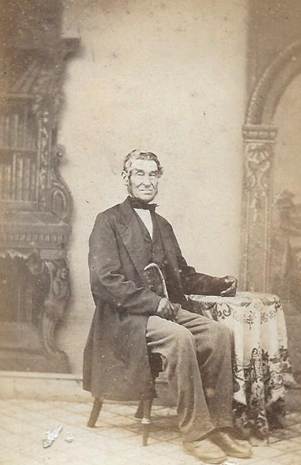
A man of enigmatic complexity who
wrote extensively and has passed down stories of our family and of industrial
change in early Victorian Yorkshire
FAR00217
|
Return to the Home
Page of the Farndale Family Website |
The story of one
family’s journey through two thousand years of British History |
The 83 family lines
into which the family is divided. Meet the whole family and how the wider
family is related |
Members of the
historical family ordered by date of birth |
Links to other pages
with historical research and related material |
The story of the
Bakers of Highfields, the Chapmans, and other related families |


Headlines of John
Farndale’s life are in brown.
Dates are in red.
Hyperlinks to
other pages are in dark
blue.
References
and citations are in turquoise.
Context and local
history are in purple.
John Farndale was
a yeoman farmer of Skelton, insurance agent, and writer, who wrote extensively
about Kilton and Saltburn by the Sea and the transition from a rural to an industrial Britain. The writings
of John Farndale can be
found transcribed on another web page.
Note that there
are some similarities between the lives of this John and John Farndale also of
Long Newton and Stockton (FAR00240). This has given me some challenges
in interpreting the records.
He described
his beloved Kilton
where he was born as of great interest with a great hall, stable, plantation
and ancient stronghold in ruins. It is still a small place he wrote.
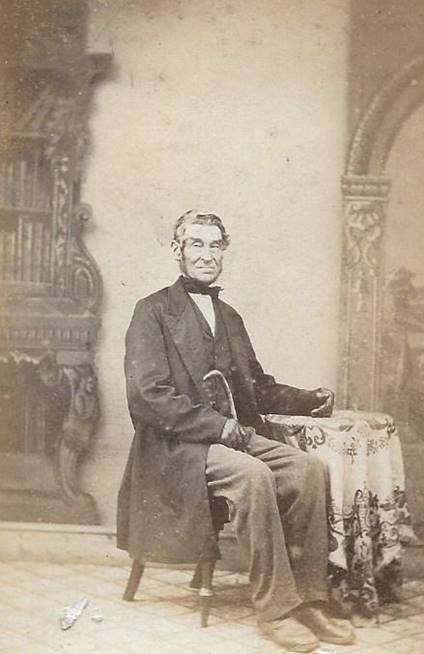
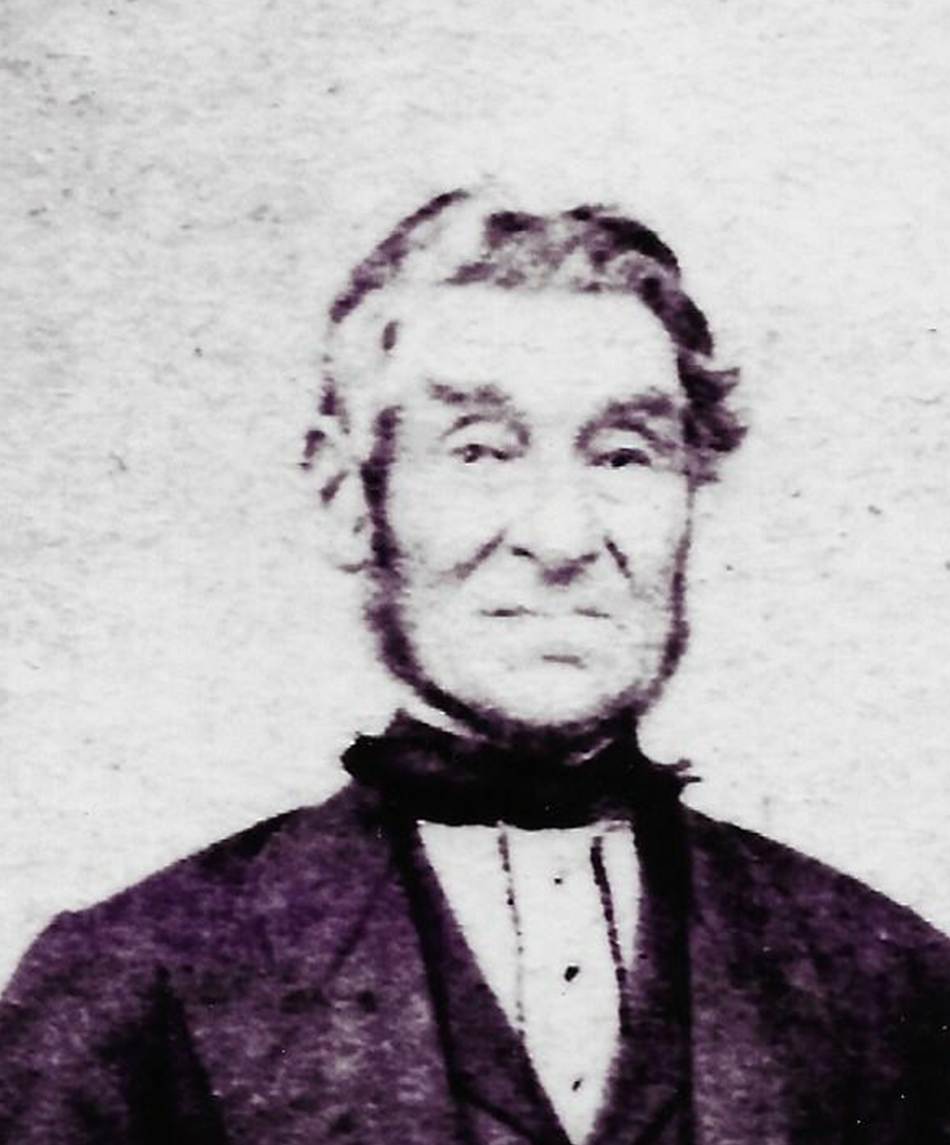
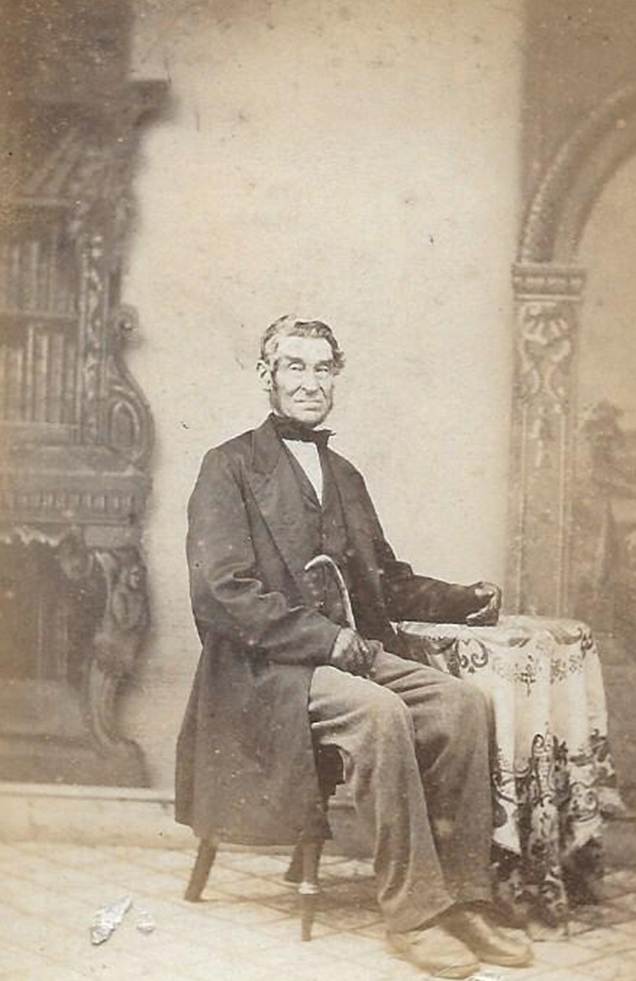
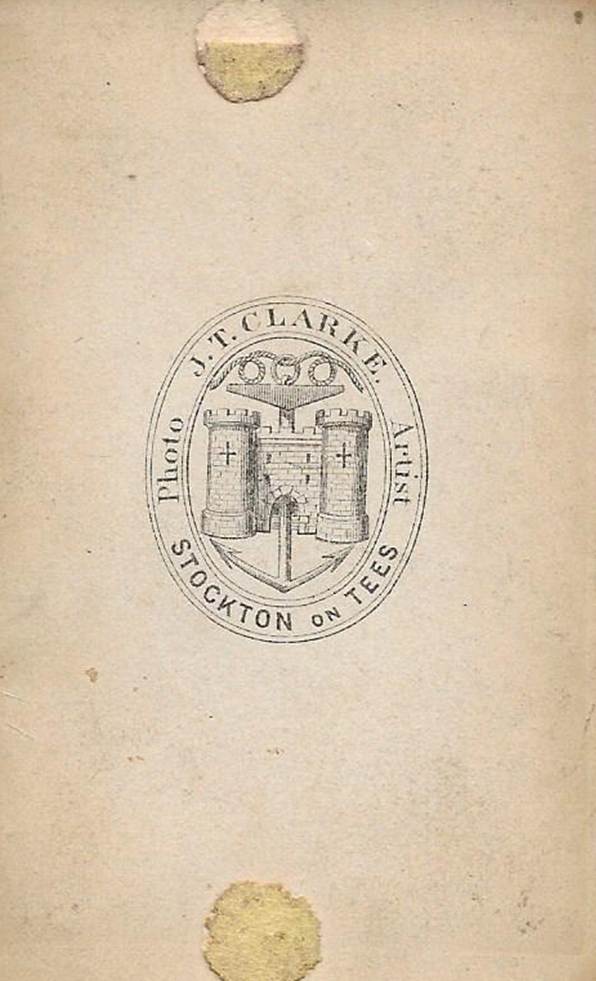
John Farndale
with the photographer’s logo on the reverse
John Farndale
1791
A storyteller is
born
Kilton
John
Farndale was born at Kilton in Cleveland, Yorkshire on 15 August 1791,
second son of William
and Mary (nee Ferguson) Farndale (FAR00183) of Kilton, baptised 9 October 1791, Brotton ( Brotton PR).
His father was a farmer and business person.
1793
In
1870, in The
History of the Ancient Hamlet of Kilton-in-Cleveland, printed by W Rapp, Dundas Street, Saltburn 1870 ,
he later wrote: "My first remembrance began in my nurse's arms when I could not have
been more than 1 1/2 years old; a memory as vivid as if it were yesterday. She
took me out on St Stephen's Day 1793 into the current Garth (a small enclosure)
with a stick and 'solt' to kill a hare. A great day at the time”.
In A Guide to Saltburn by the Sea and the Surrounding District, in 1864, John
wrote When only four or five years of age I remember my father’s father
telling what was done in those days and the old time before them. Many things
then told were deemed most important to those of us who then lived together in a
state of primitive simplicity, far removed from the occurrences which now
surround us. I can refer back to what might have ended in death, but which by
over-ruling Providence was otherwise ordered. It was ordained that even to me
was given an errand to fulfil, which I am at this time feebly endeavouring to
discharge:- namely, to do good in my day and generation.
1805
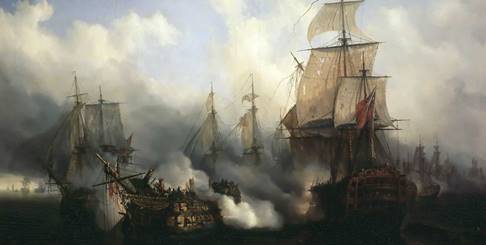
At the age of 14, after celebrating the victory of Trafalgar in 1805, he
was found dangling head foremost down the draw well hanging by the buckle of
his shoe.
I
remember a draw well stood near the house of my father’s foreman. One day I
was looking into this well at the bucket landing, when I fell head foremost.
The foreman perceiving the accident, immediately ran to the well to witness, as
he thought, the awful spectacle of my last end. I had on at the time a pair of
breeches, with brass buckles on my shoes (silver ones were worn by my father and others), and to
his great astonishment, he found me not immersed in water at the bottom of the
well, but dangling head foremost from the top of a single brass buckle, which
had somehow caught hold.
Since this accident I have ever been thankful for my
wonderful deliverance, I am now an old man, yet I hope my humble production
will by many be found worthy of perusal.

Those who descend from John Farndale, including the Ontario 1 Line, and the Richmond Line, would therefore
not exist but for a brass buckle and some protrusion at the head of the well
which caught it.
Mr
John Farndale, grandfather of Mr Charles and Mr Matthew, when a little lad fell
headlong into a deep well. The little boy was discovered suspended by the
buckle of his show. That shoe buckle alone intervened between life and death.
What vast issues hang on the merest trifles! (Wainwright, Greta
(1966), Brotton Methodist Church, 1866 to 1966).
He
went on to describe a very happy childhood and he clearly adored his mother. "At this time I believe I loved God
and was happy." (The History of the Ancient Hamlet of Kilton-in-Cleveland, printed by W Rapp, Dundas Street, Saltburn 1870).
He remembered "an old relation of my father". There were numerous
Farndales in Kilton at that time. He
criticised his elder brother George
as a prodigal son, claiming that John was the son at home with his
father, but this was probably just sibling rivalry. But John describes how he
got up to many frolics and had some narrow escapes, although he was no
drunkard or swearer.
His parents,
he said, were strict Church people and kept a strict look out. I became
leader of the (Brotton) church
signers, clever in music and he immodestly claimed that he excelled his
friends. He had a close friend, a musician in the church choir. One day he
met him and said he had been very ill and had been reading a lot of books
including Aeleyn's Alarum and others which nearly made my hair stand
on end. Alleyn’s Alarm was a pious text from the time, which no doubt follows
a tradition of somewhat threatening alarums
since the seventeenth century.
His friend told him that he was going to alter his way of life and if John
would not refrain from his revelries, he would be obliged to forsake your
company. That was a nail in a sure place. I was ashamed and grieved as I
thought myself more pious than he. Now I began to enter a new life as suddenly
at St Paul's but with this difference, he was in distress for three days and
nights but for me it was three months. He fasted all Lent and described his
torment. How often I went onto the hill with my Clarinet to play my
favourite tune.
John was clearly competitive and determined to be better than his peers at
whatever challenges came his way. He therefore embarked on a phase of competitive
piety. It appears to have been no more than a phase, since we have evidence of
him picking up on his revelries again before long.
His companion lived a mile away, probably in Brotton, and they met half way every Sunday
morning at 6am for prayer. He remembered well meeting in a corner of a
large grass field. George Sayer began and he followed. When they finished
they opened their eyes to see a rough farm lad standing over us, no doubt a
little nervous. Next day this boy said to others in the harvest field
'George Sayer and John Farndale are two good lads for I found them in a field
praying.' On the following Sunday they moved to a small wood and met
under an oak tree and met an old man who wanted to join them. As usual George
began and John continued when the old man began to roar in great distress.
1815
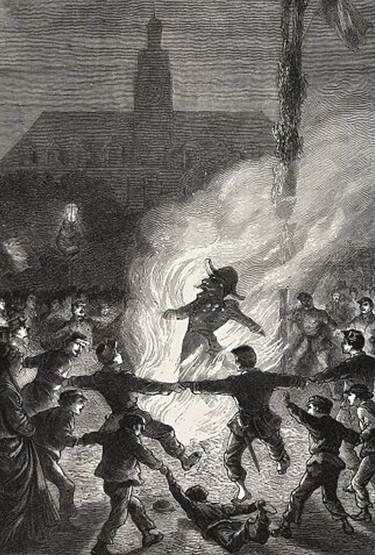
In 1815, by then aged 24, he was celebrating
the victory at Waterloo in Brotton where he led the singing as they burned an effigy of
Napoleon. From Kilton How Hill we have a fine view of the German ocean,
Skinningrove, Saltburn, Huntcliff, Roe-cliff, Eston Nab, Roseberry Topping,
Handle Abbey and Danby beacon. Here, too, at not much distance from each other,
may be seen no fewer than five beacons, formerly provided with barrels of tar
to give the necessary alarm to the people if Buonaparte at that period had
dared to invade our peaceful shores. After the great battle of Waterloo, and Buonaparte
had been taken prisoner, that glorious event was celebrated at Brotton by parading his
effigy through the street and burning it before Mr R Stephenson’s hall, amidst
the rejoicings of high and low, rich and poor, who drank and danced to the late
hour. The author formed one of a band of musicians that played on the occasion,
and he composed a song commemorating the event, which became very popular in
that part of the country. Brotton never before or since saw the like of that
memorable day.
I
am grateful to Dr Tony
Nicholson who has explained that the hall was built by the
Stephenson family in the 1780s after they had made a fortune as woodmongers,
trading in timber as a fuel source, and then when timber became scarce, in
coal. With the money from this trade, Robert bought a third of the manor of
Brotton, and then built ‘Stephenson’s Hall’.
When Robert Stevenson died in 1825, everything
went to his daughter, Mary, who had previously married Thomas Hutchinson, a
master mariner from Guisborough. Mary and Thomas settled in Stephenson’s Hall
which soon became Brotton Hall and over the years they bought various
properties in Brotton. Thomas was a close friend of John Walker Ord, the
historian and poet of Cleveland, and in 1843, Thomas invited Ord to join him on
a picnic to Tidkinhow
which was then part of Hutchinson’s dispersed property. Ord composed a poem in
honour of that day, which is transcribed at the Tidkinhow page.
In
The History of Kilton, With a Sketch of the
Neighbouring Villages, By the Returned Emigrant, Dedicated to the Rev William
Jolley, Toronto, Canada, America, Middlesbrough, Burnett & Hood, “Exchange”
Printing Offices, 1870, Redcar Cleveland Library Book No: R000040114
Classification: 942.854, Book No: R000040114, John Farndale wrote:
The church has been greatly
improved, new slated roof and a most radical change in the interior; the old
pews and pulpit are all gone, and from the walls Our Fathers’ prayer; the
Belief; the ten commandments, in the xx chapter of Exodus, saying “I am the
Lord thy God which brought thee out of the land of Egypt, out of the house of
bondage; thou shalt have none other gods before me.” Had I not seen those well
known tablets of young Squire Easterby, of Skinngrove Hall, and Wm Tulley , Esy
of Kilton Hall, on beautiful white marble, I should have been at a loss to have
known the old church again. I looked at the place where the old pulpit stood,
and I remembered the ministers that once preached Jesus and the resurrection,
among them my old master, the Rev Wm Barrick, of Lofthouse, - he would descend
from the pulpit and join in the chorus of some twenty voices, 57 years gone,
when I had the happiness to be their chieftain. The parishioners had … most
gladly … and paraded down the mid street at the celebration of the great battle
of Waterloo, and burned before Mr Stephenson’s Hall, when barrels of ale were
given to the frantic multitudes, and the old gentlemen danced and sang until
day break, and here we find young Farndale, once dangling at the mouth of
the well, with his bugle and clarionet, the chief musician to the old
gentleman, and who had also composed the following lines for the occasion –
His poem to the celebration of Waterloo went
as follows:
|
Hail! Ye victorious heroes, England’s dauntless saviours, ye Who on the plains of Waterloo, Won that glorious victory. |
It was a day the world may say, When Napoleon boldly stood, Upon the plains of the Waterloo, There flowed rivulets of blood. |
Before the foe he bravely fought, And when he’d all but won the day, Would it were
night, or Blucher up, Our hero Wellington did say. |
But now behold in effigy, Him to whom kings such homage paid, Napoleon mounted on a mule As though he were on grand parade, Behold with joy all England sings,
Brotton too is up and gay, The band, the flag, the ball, the
dance Ne’er ceased till the break of day. |
1820
The
Farmer
Skelton
By the 1820s, John was a Yeoman Farmer
but he left the Kilton farm to his younger
brother, Martin
Farndale (though his son, Charles would take
on the farm in the following generation) and he moved to Skelton and Stockton and
later became a corn and insurance agent, a merchant and an author. His
association with Kilton was during his
childhood, and through his authorship he revealed a nostalgic recollection of
his childhood home.
Yeomen farmers owned land (freehold, leasehold or copyhold).
Their wealth and the size of their landholding varied. The Concise Oxford Dictionary states that a yeoman was "a person qualified by
possessing free land of 40/- (shillings) annual [feudal] value, and who can
serve on juries and vote for a Knight of the Shire. He is sometimes described
as a small landowner, a farmer of the middle classes". Sir Anthony
Richard Wagner, Garter Principal King of Arms,
wrote that "a Yeoman would not normally have less than 100 acres" (40
hectares) "and in social status is one step down from the Landed gentry,
but above, say, a husbandman". Often it was hard to distinguish
minor landed gentry from the wealthier yeomen, and wealthier husbandmen from
the poorer yeomen.
Yeomen were often constables of
their parish
and many yeomen held the positions of bailiffs for
the High Sheriff or for the shire or hundred.
Other civic duties would include churchwarden,
bridge warden, and other warden duties. It was also common for
a yeoman to be an overseer for his parish. Yeomen, whether working for a
lord, king, shire, knight, district or parish, served in localised or municipal
police forces raised by or led by the landed gentry. Some of these roles,
in particular those of constable and bailiff, were carried down through
families. Yeomen often filled ranging, roaming, surveying, and policing
roles. In districts remoter from landed
gentry and burgesses, yeomen held more official power.
1823
Baines Directory for 1823 listed the inhabitants of
Skelton, with a population of around 700:
Castle: John Wharton MP
Curate: Rev William Close.
Attorney: Thomas Nixon.
Blacksmiths: Thos Crater, Robert Robinson, William Young.
Butchers: William Lawson, Isaac Wilkinson, William wilkinson.
Corn Millers: Robert Watson, William Wilson
Farmers and Yeoman: William Adamson, John Appleton, Thomas
Clarke, James Cole, James Colin, William Cooper, Steven Emerson, John
Farndale, Robert Gill, William Hall, Edward Hall, Jackson Hardon, William
Hutton, Sarah Johnson, William Lockwood, John Parnaby, Thomas Rigg, William
Sayer, William Sherwood, John Taylor, William Thompson, Robert Tiplady, William
Wilkinson, Richard Wilson
Grocer and Drapers: John Appleton, William Dixon, Ralph
Lynass, Thomas Shemelds, John Alater
Flax dresser: McNaughton D
Joiners: William Appleton, Leonard Dixon, Mark Carrick,
Joseph Middleton
Schoolmasters: Atkinson M, John Sharp
Shoemakers: Robert Bell, Luke Lewis, Thomas Lowls, George
Lynass, Thomas Steele
Stonemasons: Thomas Bryan, John Pattinson
Straw hat makers: Sarah Sarah, Esther Shimelds
Weavers: Stephen Edelson, Thomas Dawson, John Robinson,
Robert Wilson
Land agent: John andrew
Victuallers: William Bean at Duke William, William Lawson at
Royal George
Woodturner: James Crusher
Gamekeeper: Frank Thomas
Plumber and Glazier: William Gowland
Sadler: Thomas Taylor
Shopkeeper: Eliza Wilkinson
Carriers: Marmaduke Wilson - to Guisborough on Tuesday and
Friday, departing 8am and returned 4pm; Robert Wilkinson to Stockton on
Wednesday and Saturday, departing 4am and return 8pm, to Lofthouse on Monday
and Thursday departing 9am and return at 6pm; Letters were brought to
Guisborough by coach and thence to Skelton by daily horse post arriving at 10am
and mail taken back at 3pm.
John
Farndale, was a yeoman farmer,
living at Kilton (record at Skelton) in 1822
and 1833.
1825
In the Skelton Parish
Church Warden’s Accounts 1825 -1840, assessment for bread and wine at 8s per
house and 12d per oxgang in 1825, John Farndale paid 5s 6d based on 1 Oxgang of
land. In 1826 and 1827 he paid 1s 9d and in 1828, 5s 6d, all based on 4 oxgangs
of land. He continued to hold 4 oxgangs of land in 1829, 1830 and 1831, paying
slightly differing sums. An oxgang or bovate averaged about 20 acres, but
depended on fertility of the soil. Rates altered marginally and John Farndale
paid 3s in 1832; 4s in 1833; 5s in 1834 and 1835; 4s 6d in 1836; 4s in 1837 and
1838; 3s in 1839. His name is crossed out in 1840.
Skelton Parish Church Warden’s Accounts 1825 -1840:
1825 Assessment for bread and wine at 8s per house and 12d per oxgang; John
Farndale @ 1 Oxgang...........5s 6d (Skelton PR).
1826
Skelton Parish Church Warden’s Accounts 1825 -1840: 1826
Assessment @ 2s 6d per house and 1s 8d per oxgang;
John Farndale @ 4 oxgangs.........7s 6d. George Farndale @ 1/2 oxgang...1s 9d (Skelton PR).
1827
Skelton Parish
Church Warden’s Accounts 1825 -1840: 1827 Assessments @ 2s 6d per house
and 1s 3d per oxgang; John Farndale, 4 oxgangs............7s 6d (Skelton PR).
1828
Skelton Parish Church Warden’s Accounts 1825 -1840:
1828 Assessments @ 1s 6d per house and 1s per oxgang; John Farndale, 4
oxgangs............5s 6d (Skelton PR).
1829
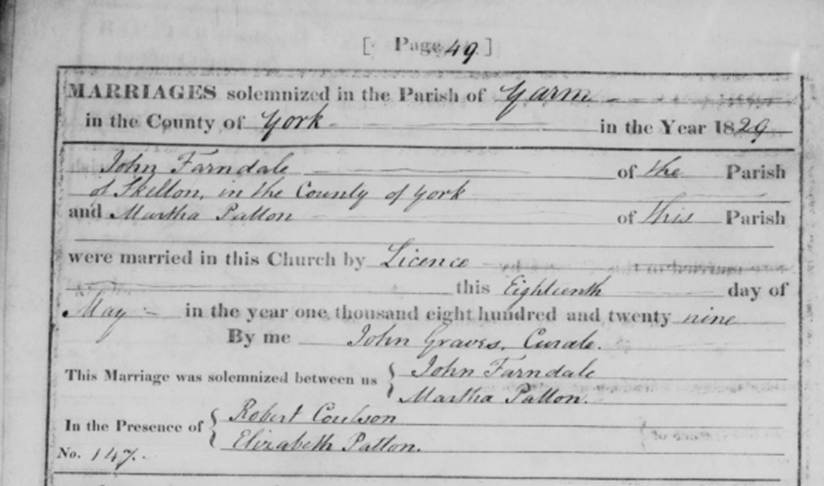
On 18
May 1829, John married Martha Patton of Yarm. The curate was John
Graves and the marriage was witnessed by Rob Coulson and Elzabeth Patton. At
Yarm, near Stockton, on Monday last, Mr John Farndale, of Skelton, near
Guisborough, to Martha, fourth daughter of Masterman Patton, Esq, of Mount
Pleasant, near Yarm. Martha was born in 1800, so she was 29 years old, and
John was 38.
Their first son, William
Masterman Farndale, was born in Skelton 24 March 1831, and
they had seven more children, Mary,
Elizabeth, Teresa, Annie, John,
Charles and Emma.
John
Farndale of the Parish of Skelton and Martha Patton
of this Parish (ie Yarm) were
married by licence with the consent this 18th Day of May in the year 1829 by me
John Graves, Curate. This marriage was solemnised between us, John Farndale and
Martha Patton in the presence of Rob Coulson and Elizabeth Patton.
Martha Patton was baptised on 21 May
1800 at Kirkleatham
and was the daughter of Masterman Patton (who name was passed on to John and
Martha’s first child)(1755 to 1833) and Dorothy (nee Robinson) Patton (1764 to
1812). So she was 29 when they married.

The Durham County Advertiser, 23 May 1829: At
Yarm, near Stockton, on Monday last, Mr John Farndale, of Skelton, near
Guisborough, to Martha, fourth daughter of Masterman Patton, Esq, of Mount
Pleasant, near Yarm.
Skelton Parish Church Warden’s Accounts 1825 -1840:
1829 Assessments @ 1s 6d per house and 6d per oxgang; John Farndale, 4
oxgangs.............3s 0d (Skelton PR). This
was the Year of his marriage.
1830
Skelton
Parish Church Warden’s Accounts 1825 -1840: 1830 Assessments; 1st class
house 1s; 2nd class house 6d and 3d per oxgang; John Farndale
4 oxgangs/2nd class house..........................................1s 2d (Skelton PR).
1831
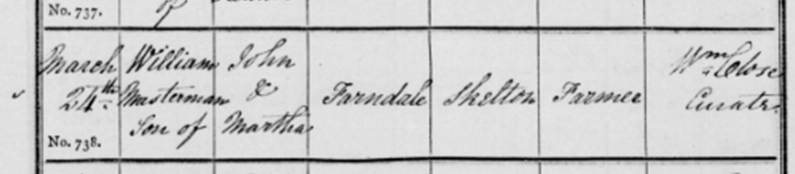
William Masterman Farndale (FAR00312), was born at Skelton and baptised on 24 March 1831 (Skelton PR).
Skelton Parish Church Warden’s Accounts 1825 -1840:
1831 Assessments; 1st class house 1s; 2nd class house 6d and 3d per oxgang;
John Farndale, 4 oxgangs/1st class
house..........................................2s 0d (Skelton
PR).
1832
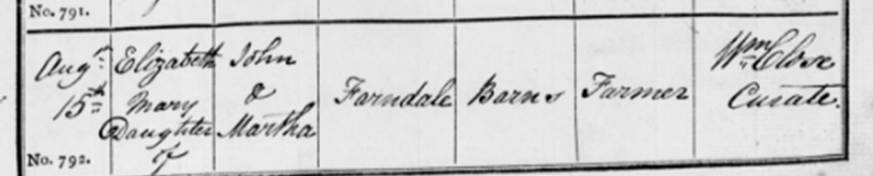
Elizabeth
Mary Farndale (FAR00319)
was born at Skelton and baptised on 15
August 1832 (Skelton
PR).
Rates
altered marginally and John Farndale paid 3s in 1832; 4s in 1833; 5s in 1834
and 1835; 4s 6d in 1836; 4s in 1837 and 1838[ 3s in 1839. His name is crossed out
in 1840. His wife died in December 1839 and he is next shown in the census as
being in Durham (Baines' Directory).
1833
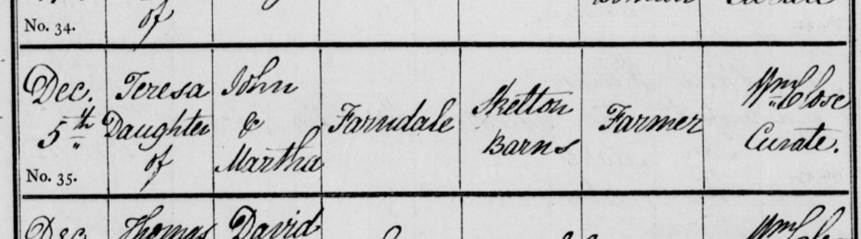
Teresa Farndale (FAR00325)
was born at Skelton
and
baptised on 5 December 1833 (Skelton PR).
1835
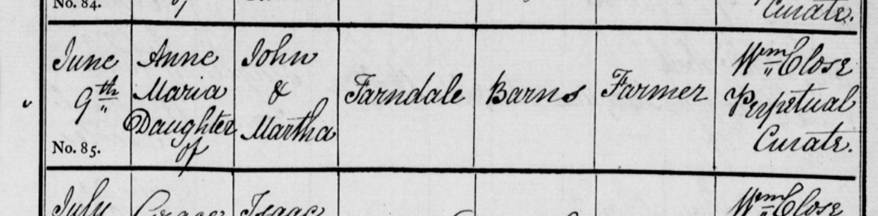
Annie Maria Farndale (FAR00334) was born at Skelton and baptised on 9 June 1835 (Skelton PR).
1836
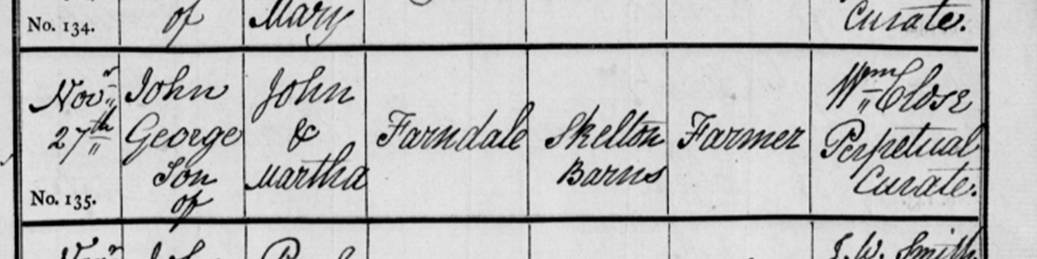
John George Farndale (FAR00337) was born at Skelton and baptised on 27 November 1836 (Skelton PR).
1838
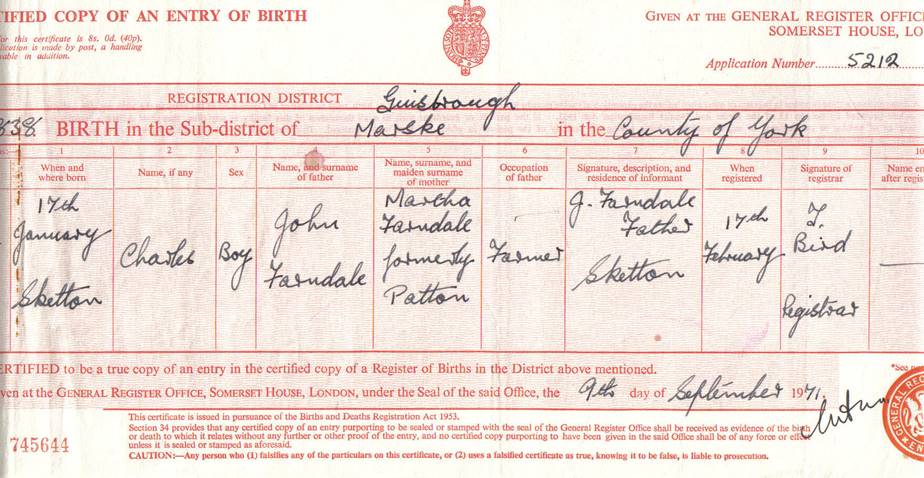
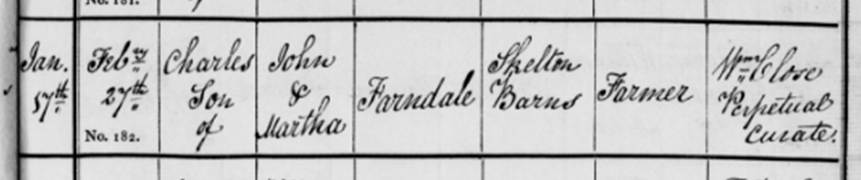
Charles Farndale (FAR00341) was born on 17
January 1838 at Skelton and baptised on 27
February 1838 (Skelton PR).
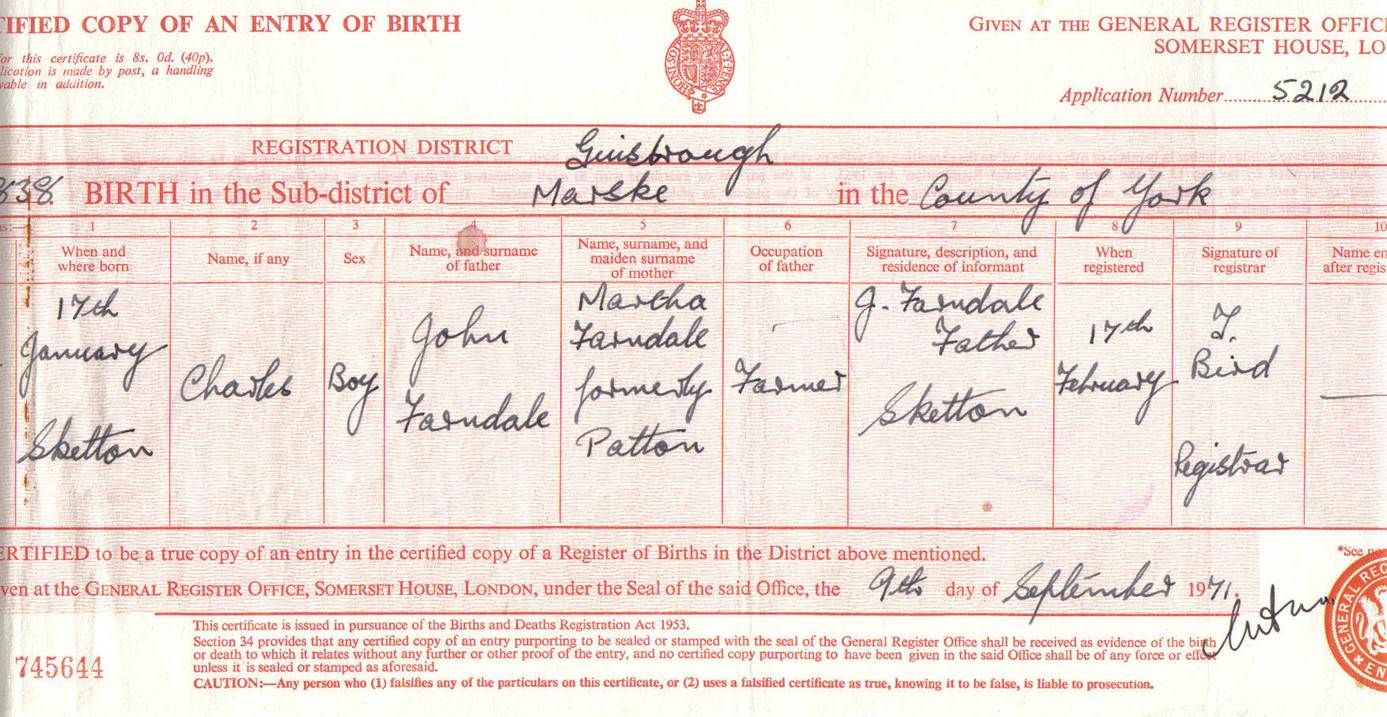
Charles
Farndale's birth certificate in 1838 shows John was then living in Skelton
and occupied as a farmer (Marriage Certificate).
1839
Emma Farndale (FAR00346)
was born at Skelton
in
1839 (Stockton District Records, GRO Vol 24 Page
216).

She
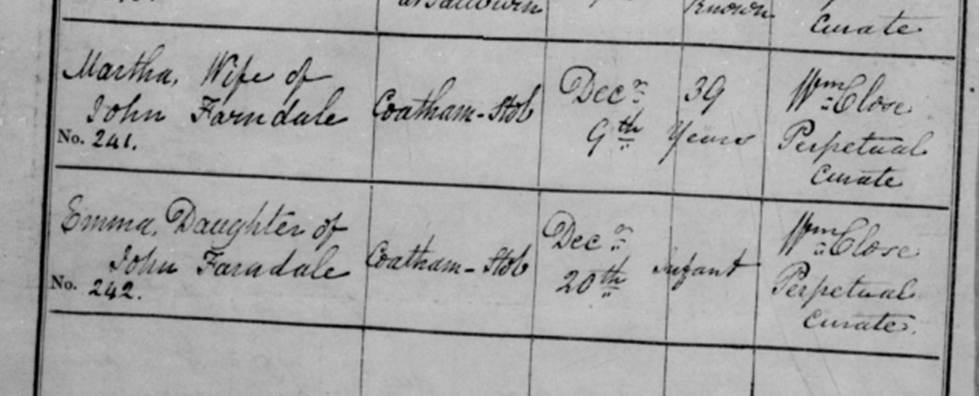
sadly died an infant on 20 December 1839 (Skelton
PR) shortly after her mother, John’s wife, Martha, also died in
childbirth. She was 19 days old when she died. She was buried at St Peter’s,
Brotton.
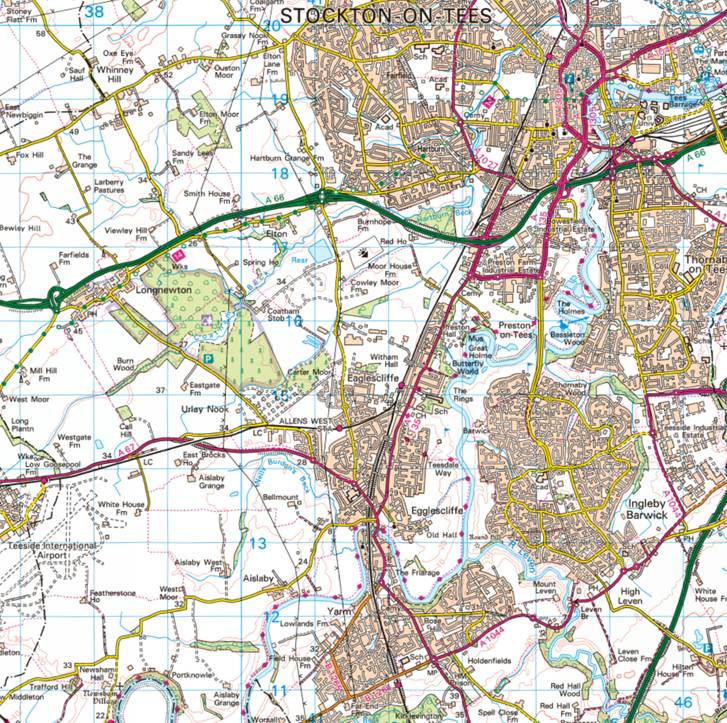
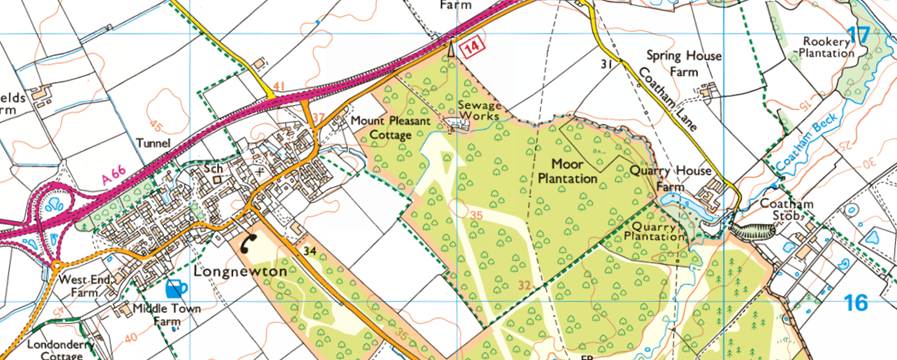
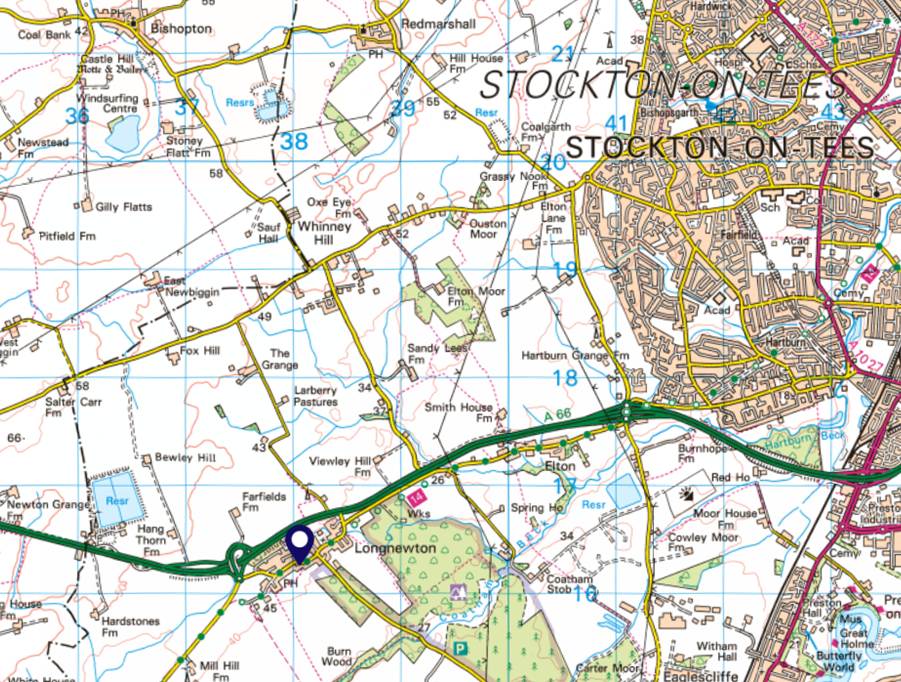
Coatham-Stob, near Longnewton and
Stockton (Martha’s family home)
A decade after they were married, and almost certainly during
the birth of their last child, Emma,
Martha, wife of John Farndale of Coatham-Stob died aged 39 on 6 December and
was buried on 9 December 1839. Their daughter Emma died a few days later, on 20
December 1839.
Martha,
wife of John Farndale of Coatham-Stob died aged 39 and was buried on 9 December
1839. She
was buried with her daughter, Emma and later with John. Therefore Emma had been
born in 1800. It would appear that Martha died from childbirth and their
daughter Emma then died a few days later.
Obituary: ‘Dec 6th. At Coatham-Conyers,
in Stockton Circuit, Matha, the wife of John Farndale. She was truly converted
to God in the twenty sixth year of her age; and from that period she was a consistent
member of the Wesleyan Society. Her death was rather sudden but she was found
ready. Aware of her approaching dissolution she said, ‘This is the mysterious
Providence; but what I know not now, I shall know hereafter.’ Some of her last
words were, ‘Tell my dear husband for his encouragement, that I am going to
Jesus. How necessary it is to live life for God? Oh Lord help me that I may
have strength to leave a clear testimony that I am gone to Jesus.’ It was enquired,
‘Do you feel Jesus present?’ She replied, ‘Yes,’ and soon fell asleep in Him.’
MJ. (Methodist magazine, 1840, page 172)
Martha Farndale's death was registered for
Stockton District in the last Quarter of 1839.
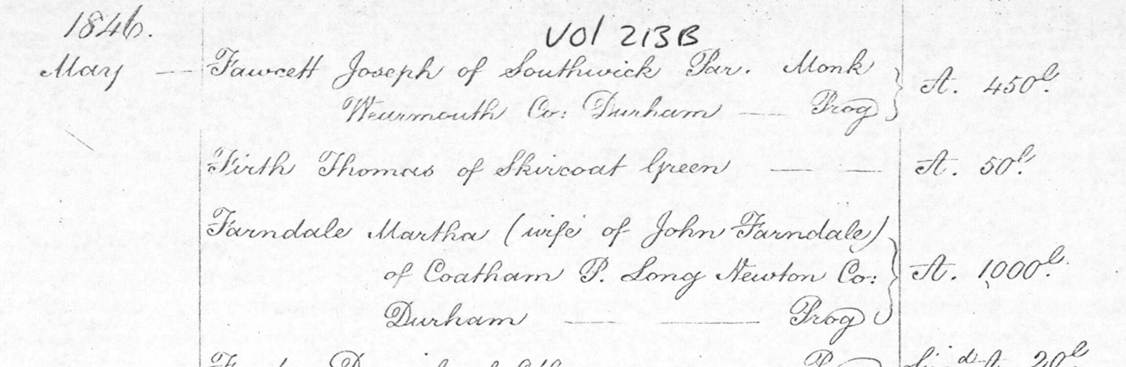
There was an entry for May 1846, Farndale, Martha (wife of John
Farndale) of Coatham Parish, Long Newton, Co Durham showing probation for
£1,000. It is not clear why probation of her will took so long.
However
there is also an entry for May 1846: Farndale, Martha (wife of John Farndale) of
Coatham Parish, Long Newton, Co Durham showing probabation for £1,000. It is
not clear why probabtion of her will took so long. (Borthwick Institute, Document reference vol.213B, f.,
Year 1846, Index reference 1845061847060092/1829, Date 1846, MAY)

At
the age of 48 he was a widower with a large family. He did not remarry.
1840
A
newspaper article in 1904 recorded a case which John
Farndale raised against two cart racers who caused damage to John’s gig and
harness. The Whitby
Gazette, 11 March 1904 recorded: A RACE IN THE DARK. 25th March,
1840. An old Cleveland newspaper gave the following: Stokesley Petty Sessions,
present Edmund Turton and Robert Hildyard, Esquires. Upon the complaint of John
Farndale, of Coatham Conyers, in the county of Durham, against Thomas Hugill,
of Bilsdale, and James S Keen of the same place, for having, on the night of
the 21st January last, at the Township of Stokesley, obstructed the free passage
of a certain highway, by riding a race in the dark, and damaging a gig and
harness driven by J Farndale and James Drummond. Both were fined £2 and costs.
1841
The
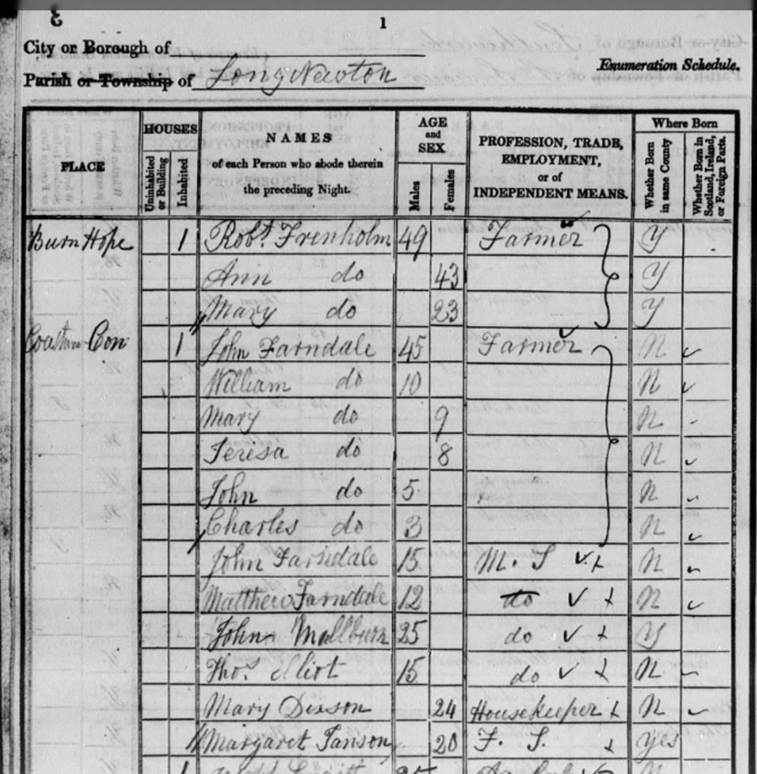
1841 Census, for Coatham Conyers, Long
Newton listed John Farndale, 45, a farmer; William Farndale, 10;
Mary Farndale, 9; Teresa Farndale, 8; John Farndale, 5; Charles Farndale, 3;
John Farndale, 15, male servant; Matthew Farndale, male servant, 12; John Malburn,
25, male servant; Thomas Shirt, 15, male servant; Mary Disson, 24, housekeeper.
It may be that Coatham
Stob was the settlement where Martha’s parents came from.
1842
The following year, in 1842, John was
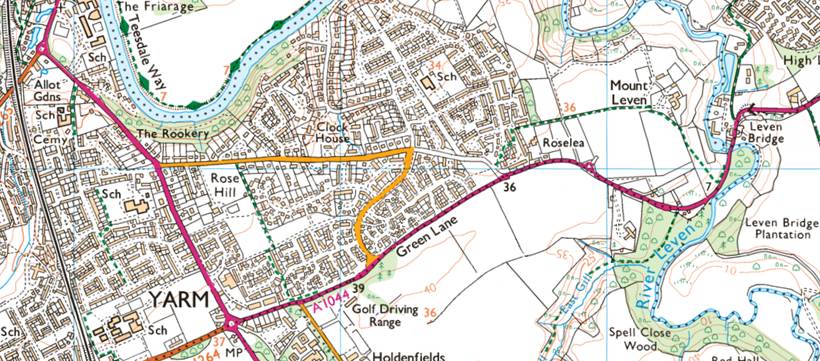
involved in the sale of another farm called Mount Leven.
The
Yorkshire Gazette, 3 September 1842 advertised:
YARM
A
Valuable FARM and also Productive Ings LAND for Sale
TO
BE SOLD BY AUCTION
At
the Vane Arms Hotel, in Stockton, in the county of Durham, on Wednesday, the 14th
day of September, 1842, at Three O’clock in the afternoon.
Mr
J Baker, Auctioneer,
A
very valuable and highly productive freehold farm, called MOUNT LEVEN,
situate at Leven bridge, in the parish of Yarm, in the County of York,
consisting of an excellent farmhouse and outbuildings and of a Hind’s house,
and ONE HUNDRED AND TWENTY TWO acres of land, of which 54 A, 1 R, 30 P, or
thereabouts are excellent Old Grass, 15 acres or thereabouts turnip and barley soil,
and the remainder good wheat and bean land.
The
farm is divided into 15 convenient sized fields or enclosures, all well watered
and fenced, and is now in the occupations of Mr. John Colbeck, as Tenant to the
Trustees of Mr Masterman Patton, deceased, the late owner thereof.
The
property is bounded by the River Leven on the east, and by the highway leading
from Leven bridge to Yarm on the West and South.
And
also, either together with, or separately from the farm, all those Four Acres of
Meadow, lying in a certain common field, called or known by the name of Yarm
Ings, in the Township or parish of Yarm aforesaid; together with all such right
and title of fishing in the River Tees at or near Yarm as has been usually
enjoyed with the said premises. And also together with a Pew or Stall in the
Parish Church appendent or appurtenant to the said premises, or usually enjoyed
therewith.
The
Tenant will send a person to show the properties; and any further particulars respecting
them may be ascertained of Mr Hugill of Eston; Mr. John Farndale of Coatham
Conyers; of the Auctioneers; or of Messrs Wilson and Faber, Solicitors,
Stockton upon Tyne Tees. Stockton, August 10th, 1842.
We know that John later farmed at Mount Leven himself, so perhaps he was
involved with the auctioneers in that sale, and later took the tenancy in the
farm at Mount Leven.
The
Bankruptcy Notice in 1851 suggests that althoguh John is referred to as the
Auctioneer in this notice, he was farming at Mount Leven Farm himself.
In
1864 John Farndale wrote, of about this time, when living in Coatham: How
often here on a fine summer’s eve have I strolled to this most retired and
enchanting retreat, Huntcliff, with my gun, to enjoy a sport of shooting the
sea bird darting up the cliff over-head; an advantageous sport, when an
ordinary marksman need not fail to bag a brace or two. This retreat was part of
my Hunley Hall farm, and is only a short drive from Saltburn-by-the-Sea.
Hunley Hall Farm, Brotton
He then farmed at Hunley Hall Farm, which
is on the north edge of Brotton during these years. So in the 1840s, he
seems to have moved to farm at Hunley Hall Farm, a farm of 476 acres, which is
on the northern edge of Brotton during
these years. So for a while, perhaps shortly after
Martha died, John and his family were back close to Kilton,
where perhaps he could rely on some support from his wider family.
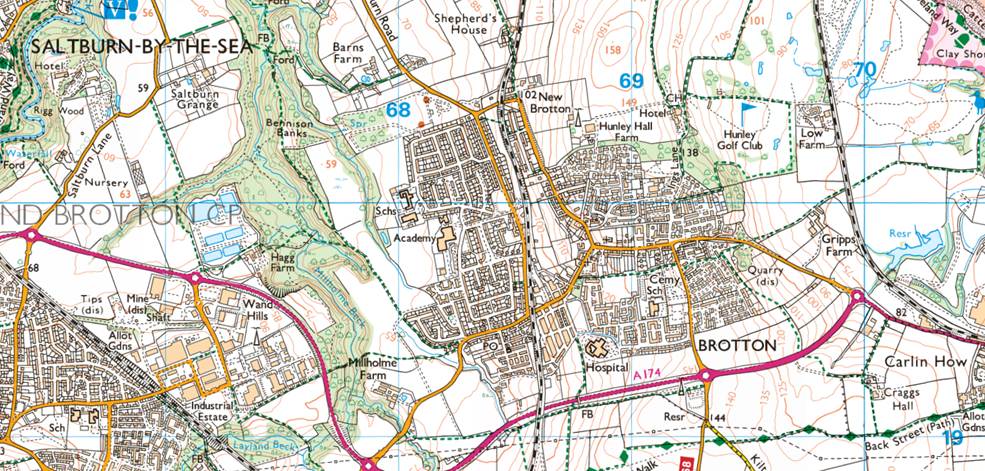
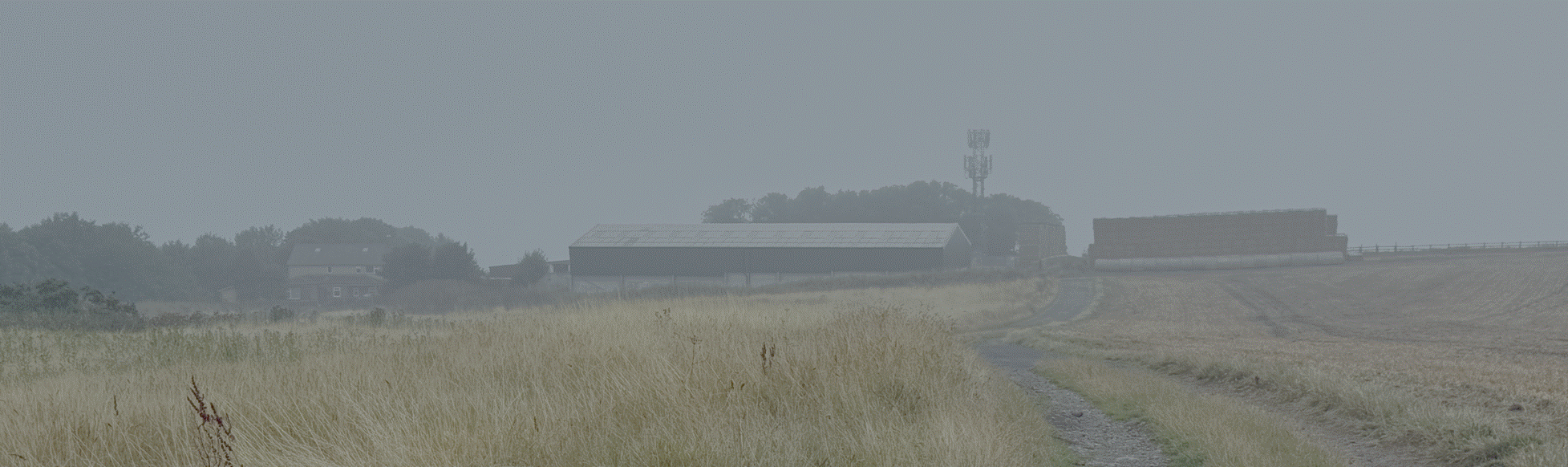
Hunley
Hall Farm, 2026 (by the author)
In 1864, recalling these days, he wrote How often here on a fine
summer’s eve have I strolled to this most retired and enchanting retreat,
Huntcliff, with my gun, to enjoy a sport of shooting the sea bird darting up
the cliff over-head; an advantageous sport, when an ordinary marksman need not
fail to bag a brace or two. This retreat was part of my Huntley Hall farm, and is
only a short drive from Saltburn-by-the-Sea. And on this retired place have
passed many hundred horse loads of smuggled goods; this was the private road of
old. I do not know any place equal for such an extensive view (if you step up
to the beacon above) of sea and land. Here you stand 150 yards above the level
of the sea, and here you stretch your eye on the German ocean from Whitby to
Tynemouth, Sunderland and Hartlepool; and you can here view the counties of Durham,
Westmoreland, and the Yorkshire hills; both sea and land are most interesting
with a glass. From this hill you look down on the dark blue ocean below and you
see a fleet of ships far and near, so near below you as to believe them
sporting on those dangerous rocks, when again they reach away majestically, and
you can hear and see the jolly tars, merrily employed in their dangerous
seafaring life, shifting sail and mainsail, on the great dee below. You here stand
on this mountain ridge apparently safe rom danger, yet danger is always near:
even here I have suffered loss of stock. Once a fine colt somehow trespassed
near the cliff, and fearful to say it bounced down this awful precipice twenty
yards from the base below, its bowels gushing out yards beyond. On these rocks
how many a seaman has found a watery grave, and many a fine ship has been
wrecked.
1847
He seems to have released the tenancy
in Hunley Hall Farm in 1847. The Yorkshire Gazette,
23 October 1847:
Farm
to LET in Cleveland.
To
be entered upon at the usual Times in the Spring of 1848.
Hunley
farm, in the township of Brotton- in-Cleveland, in the County of
York, containing 476 acres of excellent arable, meadow, and pasture land,
with a capital dwellinghouse, and all requisite outbuildings, and
also three cottages in the village of Brotton, all in the occupation
of Mr. John Farndale, or his under tenants.
Further
particulars may be obtained of Mr George Pearson, land agent, Marske, near
Guisborough, who will direct a person to show the farm, or at the offices of Mr
Trevor, Solicitor, Guisborough.
Guisborough,
12th or October 1847
Long Newton
1851
The 1851 Census for
Danby End, Danby listed John Farndale, as household head but living
alone, aged 60, working as an agricultural labourer.
He
was clearly in financial difficulty and in 1851 the Durham County Advertiser, 13
June 1851: DARLINGTON PETTY SESSION, JUNE 9. Before G J Scurfield, H
P Smith, J L Hammkind, and E Backhouse, Esqrs. … John Farndale, farmer, Long
Newton charged by John Etherington with having
discharged him from his service and refusing to pay the wages due to him,
was ordered to pay the sum due and 6s 6d costs.
He
became bankrupt and
in the London Gazette 1851:
WHEREAS a Petition of John Farndale , formerly of Coatham Stob farm, in the
Parish of Long Newton, in the County of Durham, farmer, afterwards
of Mount Leven farm, in the Parish of Yarm, in the County of York, farmer,
afterwards of Hunley Hall Farm, in the Township of Brotton, in
the same county, farmer, late of the Township of Middlesbrough,
in the said County of York, farmer, and now in lodgings at the House of
James Watson, at Middlesbrough, in the said County of York, labourer and
merchant, an insolvent debtor, having been filed in the County Court
of Durham, at Stockton, and an interim order for protection from process having
been given to the said John farndale, under the provisions of these statutes in
that case made and provided, the said John Farndale is hereby required to
appear before the said court, on the 15th day of April next, at ten in
the forenoon precisely, for his first examination touching his
debts, state, and effects, and to be further dealt with according to the
provisions of the said Statutes; And the choice of the creditors’ assignees is
to take place at the time so appointed. All persons indebted to the said John
Farndale, or that have any of his effects, are not to pay or deliver the same
but to Mr John Edwin Marshall, Clerk at the said Court, at his office, at
Stockton, the Official Assignee of the estate and effects of the said
insolvent.
The
entry in 1860 records that he was sent to Durham
Prison for a period of time, for debt.
Stockton-on-Tees
1854
The
Agent of Stockton
Within
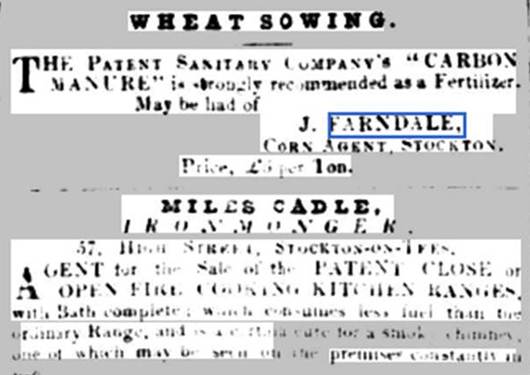
three years after his bankruptcy, he seems to have started to act as a corn
agent in Stockton. The Darlington and Stockton Times, 30 September 1854:
WHEAT SOWING. THE PATENT SANTIARY COMPANY’S ‘CARBON MANURE’ is strongly
recxommended as a Fertilsier. May be had of J FARNDALE, CORN AGENT, STOCKTON.
John’s
son, John George Farndale (FAR00337)
wrote home to his father from the Crimean War. We have his letters home to his father and John George
Farndale’s full story is told in another
webpage.
1855
The
Newcastle Guardian and Tyne
Mercury, 21 April 1855, the Newcastle
Chronicle, 20 April 1855 and other media: TURNIP MANURE. THE “PATENT
SANITARY COMPANY’S NITO-PHOSPHATED CARBON” OR BLOOD MANURE, Price Six Guineas
per Ton; may be had of … MR J FARNDALE, Stockton … The above manure contains upwards of 1300 pounds of dried blood in
every ton! and is only half the price of guano. Four or five cwts per
acre is sufficient for turnips.
1856
Only five years after his bankrupcy, he was back in society, contributing
to a significant statue project, albeit as an agent.
The
Newcastle Journal, 15 March
1856: MONUMENT TO THE MEMORY OF THE LATE MARQUESS OF LONDONDERRY. At
a public meeting of the friends of the late Most Honourable the Marquess of
Londonderry KG, GCB, Lord Lieutenant of the county of Durham, and of those who
respect his memory, held at the town hall, in the city of Durham, on Thursday
the 6th day of March, 1856, to take into consideration the propriety of erecting
a public monument in his honour of that distinguished nobleman. His grace
the Duke of Cleveland KG in the Chair, the following resolutions were
unanimously adopted: moved by F D Johnson Esq of Askley Heads, seconded by the
Right Worshipful the Mayor of Newcastle upon Tyne: (1) That this meeting is of
opinion that the high minded, generous, and benevolent character of the late
Marquess of Londonderry, as a resident nobleman, his indomitable
courage, and brilliant exploits as a soldier, and his bold and successful
efforts to develop and extend the commercial, mining, and maritime resource
is of this County, called for some public momento to hand down his
memory to posterity. Moved by the Worshipful the Mayor of Durham, seconded
by Ralph Carr Esq of Bishopwearmouth. (2) That to accomplish this object, a
suitable monument be erected by subscription, the site and character of
which will be determined at a meeting of the contributors to be hereinafter
convened. Moved by R L Pemberton Esq of Barnes, seconded by Robert White Esq of
Seaham. (3) That the following noblemen and gentlemen be appointed to a
committee to carry out the object of the above resolutions, with power to add
to their number, and to form local committees, viz: His grace the Duke of
Cleveland, the Right Honourable, the Earl of Durham, F D Johnson Esq, William
Standish Esq... The following sums were subscribed at the close of the
meeting: The Duke of Cleveland £200, the Earl of Durham £100, J R Mowbray Esq
MP, £25... LAND AGENT AND TENANTRY ON SOUTH ESTATES.... John Farndale, Long
Newton £1 10s 0d...
1859
By
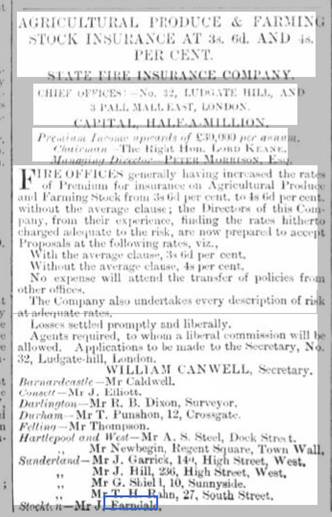
April 1859, he was practising as an insurance agent, operatig in
Stockton:
The
Durham County Advertiser, 8
April 1859: AGRICULTURAL PRODUCE AND FARMING STOCK INSURANCE AT
3s 6d AND 4s PER CENT. STATE FIRE INSURANCE COMPANY. CHIEF OFFICES: NO 32,
LUDGATE HILL, AND 3 PALL MALL EAST, LONDON. Fire officers generally having
increased the rates of premium for insurance on agricultural products and
farming stock from 3s 6d per cent, to 4s 6d percent, without the average
clause; The Directors of this Company, from their experience, finding the rate
hitherto charged adequate to the risk, are now prepared to accept proposals at
the following rates viz. With the average clause, 3s 6d per cent, Without the
average clause, 4s per cent. No expense will attend the transfer of policies
from other offices. The company also undertakes every description of risk at
adequate rates. Losses sent settled promptly and liberally. Agents required, to
whom a liberal commission will be allowed. Applications to be made to the
secretary, No 32, Ludgate Hill, London.... Stockton: Mr J Farndale.
He
was also an agent in the fertiliser and guano trade:
The
York Herald, 16 April 1859:
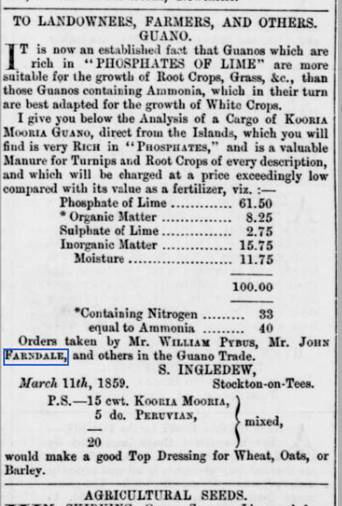
TO LANDOWNERS, FARMERS ANMD OTHERS. GUANO. It is now an established fact
that guanos which are rich in phosphates of lime are more suitable for
the growth of root crops, grass etc than those guanos containing ammonia,
which in their turn are best adapted for the growth of white crops. I give you
below the analysis of a cargo of Korria Mooria Guano, direct from the Islands,
which you will find is very rich in phosphates, and is a valuable manure for
turnips and root crops of every description, and which will be charged at a
price exceedingly low compared with its value as a fertiliser, viz:
Phosphate of Lime 61.50%; Organic Matter 8.25%; Sulphate of Lime: 2.75%;
Inorganic matter 15.75%; Moisture 11.75% - 100%, containing nitrogen 33%, equal
to ammonia 40%. Orders taken by Mr William Pybus, Mr. John Farndale, and
others in the guano trade. S Ingledew, Stockton on Tees, March 11th 1859.
Would make a good top dressing for wheat, oats or barley.
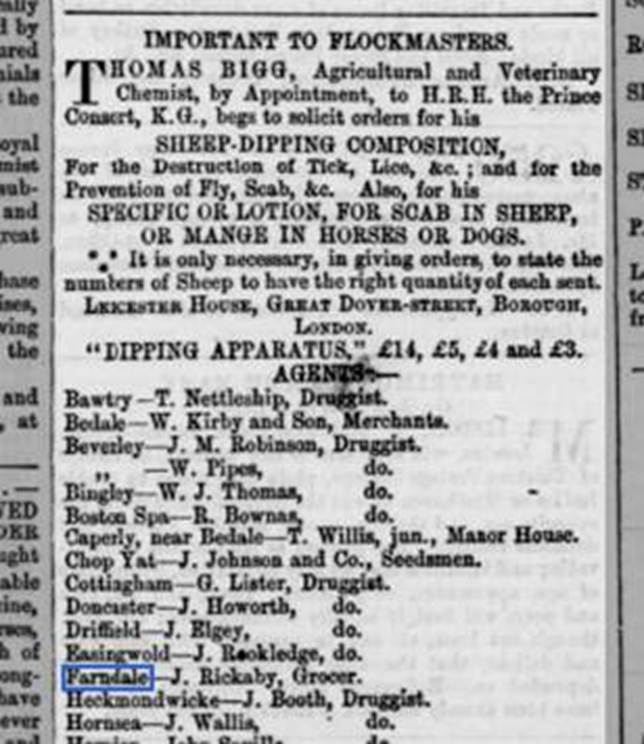
The
York Herald, 11 June and 2
July 1859: IMPORTANT TO FLOCKMASTERS. THOMAS RIGG, Agricultural
and Veterinary Chemist, by Appointment, to HRH the Prince Consort, KG, begs to solicit
orders for his SHEEP DIPPING COMPOSITION, for the destruction of Tick, Lice
etc; And for the prevention of fly, scab etc. Also for his SPECIFIC OR LOTION,
FOR SCAB IN SHEEP OR MANGE IN HORSES OF DOGS. It is only necessary, in giving
orders, to state the numbers of sheep to have the right quantity of each sent.
Leicester House, Great Dover Street, Borough, London. Agents … Farndale
- J Rickaby, Grocer...
1860
In
1860, John Farndale featured as a witness in his capacity as agent in a
trial. The article records that John Farndale had been sent to Durham prison
for debt. John had suffered bankruptcy, so presumably he went to Durham Prison
at that time, although there is a suggestion in the article that it was in 1859
that he went to Durham Prison for debt.
The
Durham Chronicle and Durham
County Advertiser, 9 March 1860: BRAITHWAITE v THE NATIONAL LIVE
STOCK INSURANCE COMPANY. MR DAVISON for The plaintiff, Mr. James QC and Mr
Fowler for the defendants. On the part of the plaintiff it was stated that Mr
Braithwaite was a farmer and a butcher residing at Stockton, occupying land in
the immediate neighbourhood, for which he paid £114 a year rent. The
plaintiff kept dairy cows, and for the last three years passed he had insured
his stock with the National Livestock Insurance Company. The date of the
policy was the 30th of June 1859. According to the regulations of the
Society the cows were put in at a certain price, the plaintiff naming the cow
in question as of the value of £16, though in point of fact she was worth £22.
By the regulations of the policy of an insurer is entitled to recover three
quarters of the value of which any animal is entered. The cow in question was
called the Newsham cow, from the name of the farm on which she was bred, and
the first appearance of illness was on the last day, or very nearly the last
day, in July. Mr Braithwaite sent for Mr Eyre, an experienced veterinary
surgeon, and he, after examining it, gave it his opinion that nothing
particular was the matter with the cow. The cow went on feeding and milking
until the 3rd of August when it was observed that she did not chew her cud.
After Mr Eyre had seen her, the plaintiff gave notice to Mr Farndale,
the local agent of the insurance society. Mr Farndale saw her, but he was
afterwards sent to Durham prison for debt, and did not see her afterwards.
The cow continued to be attended by Mr Eyre until the 29th of August when she
died. A claim of £12 was afterwards made upon the Society...
1861
The 1861 Census for 3 Alma Street, Stockton
recorded that John Farndale, was married, 63 years old, and a corn merchant,
living with Elizabeth Farndale, his wife, 68, born 1793 in Yarm. This is
something of an enigma. Only Martha appears on John’s gravestone as his wife.
The Yarm connection might suggest that Elizabeth was from Martha’s family. It
seems unlikely that Elizabeth was married to John, there being no record of a
wedding and I suspect she might have been from Martha’s family and mistakenly
recorded as John’s wife.
John’s
Works
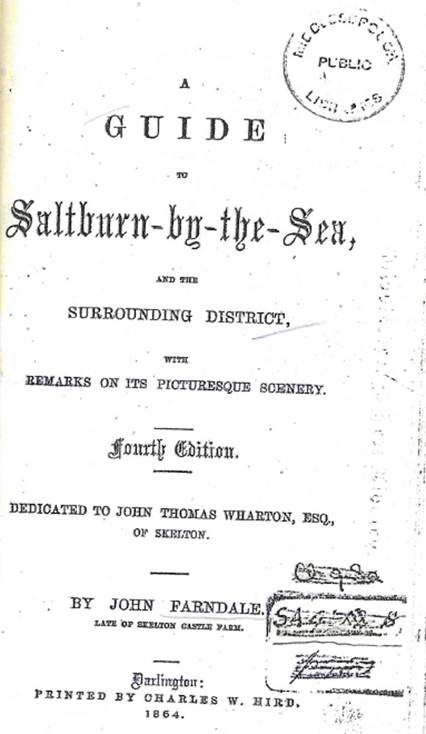
By 1861, John Farndale was writing.
A review of his Guide to Saltburn by the Sea appeared in the Stockton Herald, South Durham and Cleveland Advertiser on
21 December 1861:
By 1861, alongside his agency work, John Farndale was writing. A review of
his Guide to Saltburn by
the Sea appeared in the Stockton Herald, South Durham and Cleveland
Advertiser on 21 December 1861. Review. A Guide to
Saltburn-by-the-Sea by John Farndale. The writer of this little book of
some thirty pages is a native of Kilton, an adjoining village to Saltburn, and as a great
part of the contents refers to this little village the book should be called
“the history of Kilton, near Saltburn by the sea,” of which latter place he had
said little, for what can be said of a place till lately scarcely heard of
beyond its own fields. It is to become a noted place, for he informs his
readers that a hotel is being built to cost £31,000, building sites are freely
offered, and a building society is ready to advance money on easy terms to any
person desirous of speculating in bricks and mortar. The description he gives
of the surrounding country represents some fine scenery of hill and dale; wood
and water, which must tend to make Saltburn by the Sea attractive to visitors.
The writer of the “Guide” makes no pretensions to authorship, and presents his
readers with a sermon at the end, occupying about a third of the book.
Hmm, a bit harsh perhaps.
Although he wrote, I only profess to commit to paper a few thoughts as
they spring up in my mind, but what I relate may probably reduce the reader to
seek other works for further information; my only wish at present being to draw
public attention to this most interesting district in Cleveland, which has
hitherto been little known, comparing modern with things in times of old,
John was a prolific writer and also attempted some poetry of a flowery
Victorian character.
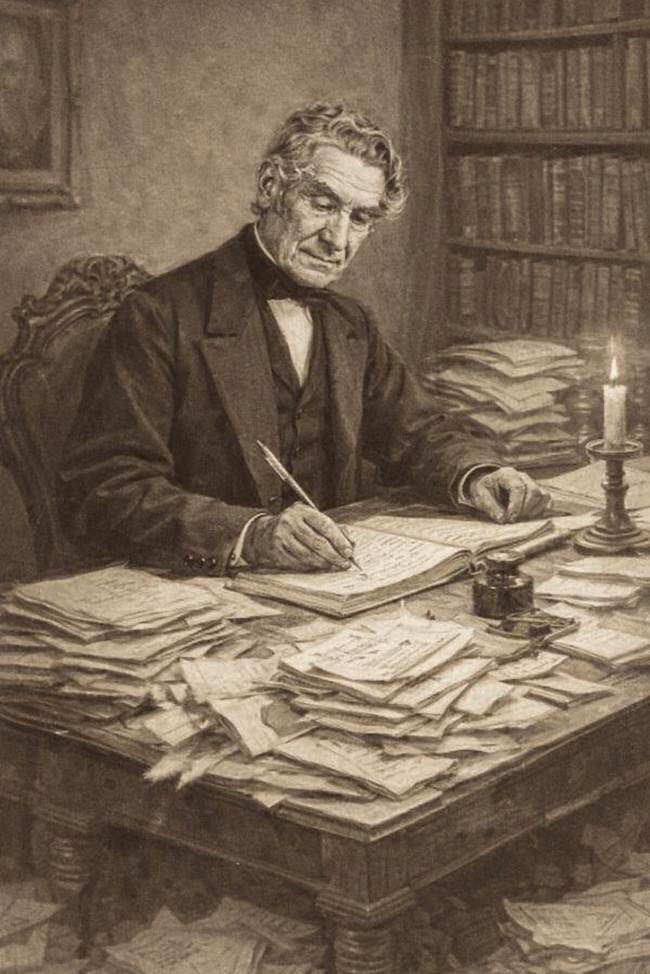
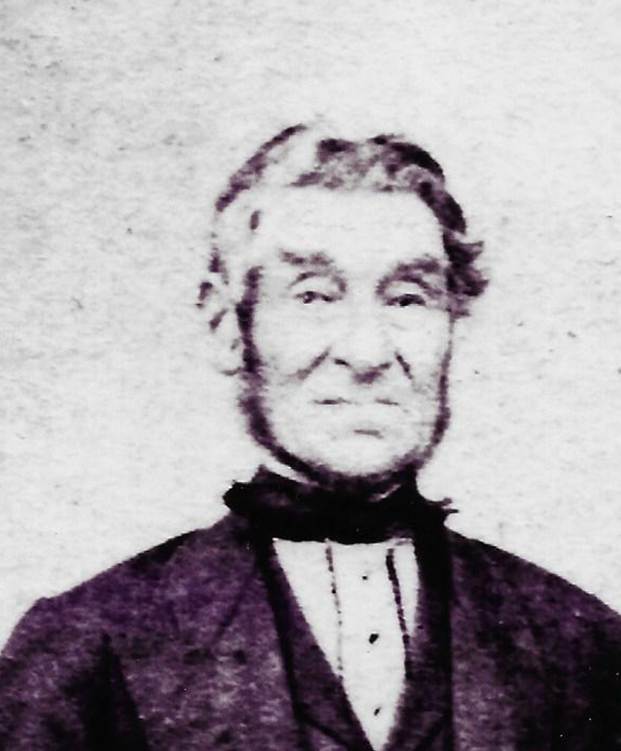
John Farndale, the author (recreated by AI
from original photographs of his image)
1862
An advertisement on 24 October 1862 appeared relating to Bishopton
Lane, Stockton. To be Sold by Private Contract, a Good Dwelling House Situate
in Bishopton Lane, called the Leeds Hotel. Apply to I (sic, recte J)
Farndale, No 5, Stamp St, Stockton on Tees (Stockton Herald, South Durham and Cleveland Advertiser, 24
October 1862). Bishopton Lane is where Robert
Farndale of the Stockton 2
Line operated his grocery business from, so John Farndale of the Kilton 1 Line was working in
the same circles as his relatives of the Stockton 2 Line at this time.
On 24 January 1862 there was another advertisement, To Let. With Immediate
Possession. A Seven Roomed House, 21 Alma Street, Stockton-on-Tees. Apply Mr
John Farndale, 5, Stamp Street (The Stockton Herald, South Durham and Cleveland Advertiser,
24 January 1862), This same property was advertised by Robert Farndale in 1863, so
presumably John Farndale was sellng it as an agent for his relative, Robert.
Although the
first reference is to I Farndale, there were no I Farndales at the time and
this is the address of John Farndale (see below). Bishopton Lane is where Robert Farndale of the Stockton 2 Line operated his
grocery business from. John Farndale of the Kilton
1 Line seems to have work in the same circles as his relatives of the Stockton 2 Line at this time.
1863
The verse he wrote was as follow.
|
Albert
Edward, Prince of Wales, England’s
boast – a Nation’s pride, Son of
the most beloved Prince, Welcome
to England they bride. |
Hail! –
blest Princess of the Danes,- All
hail! – Denmark’s sweetest rose; Albert,
- Alexandria, - hail, - In joy,
and peace t’ repose. |
Blow ye
breezes, soft and fair, Let old
Neptune sweetly smile, Bring
the precious freight he bears To Old
England’s happy Isle. |
Long
live Queen Victoria, Long,
long live the Royal Pair, Long
live each, Prince and Princess. In this,
or other lands to share. |
Once widowed, Queen Victoria had effectively withdrawn from public life.
Shortly after Prince Albert's death, she arranged for Edward, later Edward VII,
to embark on an extensive tour of the Middle East, visiting Egypt, Jerusalem,
Damascus, Beirut and Istanbul. The British Government wanted Edward to secure
the friendship of Egypt's ruler, Said Pasha, to prevent French control of the
Suez Canal if the Ottoman Empire collapsed. It was the first royal tour on
which an official photographer, Francis Bedford, was in attendance. As soon as
Edward returned to Britain, preparations were made for his engagement, which
was sealed at Laeken in Belgium on 9 September 1862. Edward married Alexandra
of Denmark at St George's Chapel, Windsor Castle, on 10 March 1863. He was 21
and she was 18.
The marriage of the Prince of Wales, the eldest son of Queen Victoria and
Prince Albert, and Princess Alexandra of Denmark, took place in St George's
Chapel, Windsor. Thomas was commissioned to paint the official picture.
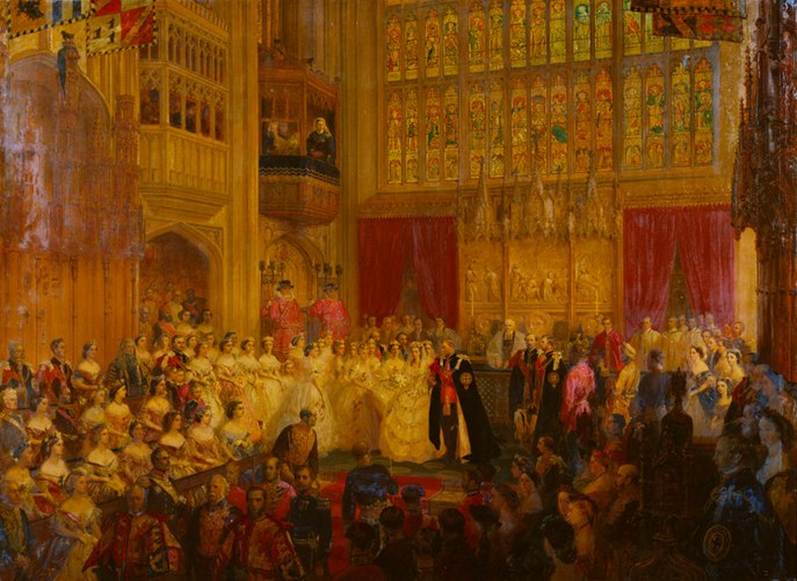
His agency next expanded from
property agency to travel agency. Advertisements appeared in July 1863, the
Stockton Herald, South
Durham and Cleveland Advertiser, 26 June and 3 July 1863: FOR SALE,
A PASSAGE WARRANT TO AUSTRALIA AT HALF PRICE. Open until July, 1863, for a single
eligible young man. Apply (post paid) to JOHN FARNDALE, 20, Park row,
Stockton-on-Tees. John’s
brother, Matthew
Farndale and his family, had emigrated to Australia in 1852, so John was
presumably aware of opportunities in an era of travel across the Empire.
Another review on 4 September 1863 commented
on the second edition of John’s Saltburn book, and the reception was more encouraging. This little
book has now reached a second edition, which we think rather extraordinary. The
author makes no pretensions to a literary production, but has compiled an
amusing book, and given a description of Saltburn and the surrounding country
in his quaint manner. Having been born on a farm in the neighbourhood, and
lived to be an old man, he has called up memories of the departed who had
figured their little day unseen and unknown beyond the village or farm. The
book contains a map of Saltburn, and the country round, with a plan of the
intended town, and a view of Zetland Hotel. To most our of our readers in this
in the distance, Saltburn by the Sea is a name almost unknown. The Stockton and Darlington
railway company have made a line from Redcar to an out of the way place which
possesses some extraordinary natural appearances and fine sea beach. Here they
have erected a very spacious hotel to the east of some £30,000. A plan of the
town has been laid out, and several houses have been erected, with the
intention of making the place a summer resort for sea bathers. The author of
the guide has described the roads around the intended town's drives for
visitors, and has given matters matter which will afford amusement to the
readers. At present Saltburn contains but few buildings, but every inducement
is offered to encourage persons to build. The place is very is a very pleasant
one and may someday become a town when this little book will be in demand (Stockton Herald, South Durham and Cleveland
Advertiser, 4 September 1863).
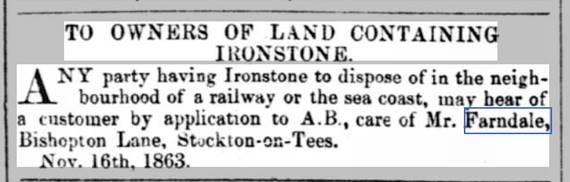
The
Whitby Gazette, 21 November
1863: TO OWNERS OF LAND CONTAINING IRONSTONE. ANY party having
ironstone to dispose of in the neighbourhood of a railway or the sea coast,
may hear of a customer by application to a B, Care of Mr Farndale, Bishopton
Lane, Stockton on Tees. November 16th 1863.
1864
By
1864, John was acknowledged as an author. He wrote a fourth edition to his
small guidebook about
Saltburn by the Sea in 1864, calling Saltburn but an embryo, but he
complimented the Improvement Company, noting that they already made substantial
progress as already the hand of improvement has effected a revolution at this
place. The critics in September 1864 described the fourth edition as enlarged
and with Additional Rambles, and an interesting brief supplement on the science
of the animal, vegetable, and mineral Kingdom in the Cleveland district. May be
had of all booksellers, Messrs Webster and Smith, High Street; And the author,
John Farndale, 20 Park Row, Stockton, NOW READY – FOURTH
EDITION. THE GUIDE TO THE CLEVELAND DISTRICT and SALTBURN BY THE SEA,
enlarged and with Additional Rambles, and an interesting brief supplement on the
science of the animal, vegetable, and mineral Kingdom in the Cleveland district.
May be had of all booksellers, Messrs Webster and Smith, High Street; And the
author, John Farndale, 20 Park Row, Stockton. (Stockton Herald, South Durham and Cleveland Advertiser, 5
August and 16 September 1864).
John
Farndale wrote a fourth edition to his small guidebook about Saltburn by the
Sea in 1864 noting that Saltburn was but an `embryo`, but he complimented the
Improvement Company, noting that they already made substantial progress as “already
the hand of improvement has effected (sic) a revolution at this place”.
The:
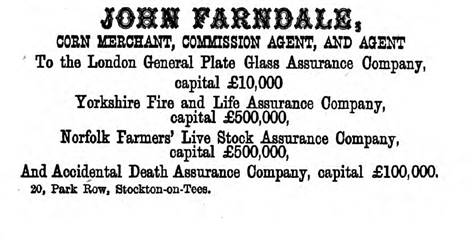
By the 1860s he was an insurance agent and corn merchant. In his book on Saltburn, in
1864, he advertised, John Farndale. Corn Agent, Commission Agent and Agent.
To the London General Plate Glass Assurance Company, capital £10,000. Yorkshire
Fire and Life Assurance Company, capital £500,000. Norfolk Farmers Livestock
Assurance Company, capital £500,000. And Accidental Death Assurance Company,
capital £100,000. 20 Park Row, Stockton on Tees.
So
by the 1860s when he was writing his books, as recorded in the 1871 census, he
was an insurance agent and corn merchant.
A high minded squabble between two authors
In 1865 there was an extraordinary squabble between two authors, John
Farndale, and a man named William White Collins Seymour, a well-known figure in
Middlesbrough in the 1860s, who
published a number of pamphlets deriding members of the Middlesbrough
Corporation. William White Collins Seymour accused John of writing a defamatory
work about him, probably titled Goliah is dead, advertised by a pamphlet
which allegedly declared Shortly will be published the Life of the notorious
Seymour, and then assaulted him in Stockton.
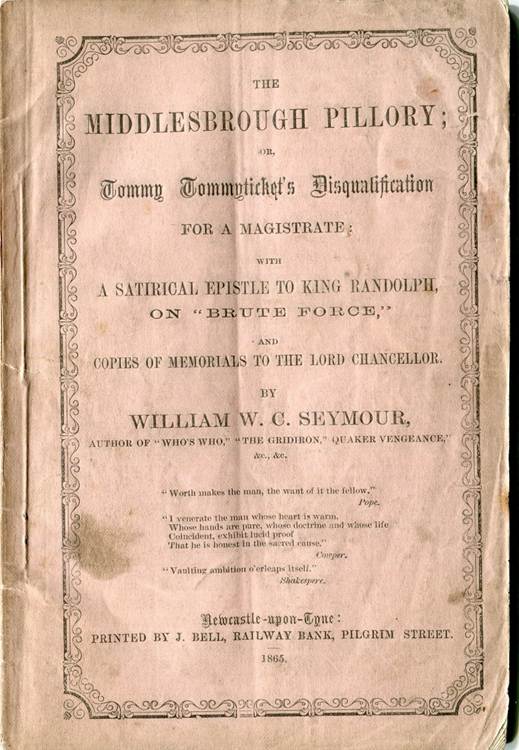
William WC Collins
was the author of The Evil Genius of Middlesbrough or Town Council
Decadence. An epistle to Gabey Tyke and Who’s Who. How is
Middlesbrough Ruled and Governed, 1864 and The Middlesbrough Pillory or
Tommy ticket’s Disqualification for a magistrate with a satirical epistle to
King Randolph on Brute Force, 1965.
Perhaps as a fellow
authors in the same area at the same time, the two struck up a rivalry.
In the Leeds Times, 15 April 1865:
A SQUABBLE BETWEEN RIVAL AUTHORS. At the Stockton
Police Court, on Thursday, William W C Seymour, quack doctor, of
Middlesbrough, author of “Who’s Who?”, “The Gridiron”, and “other “popular
works” was charged with an assault on John Farndale, author of “A Guide
to Saltburn by the Sea” and an unpublished work, to be designated “Goliah is
Dead”.
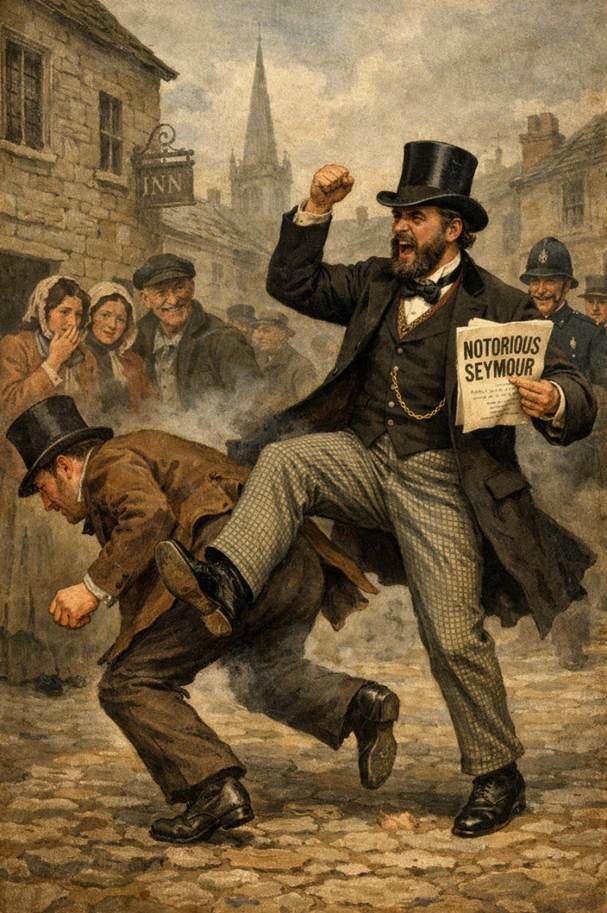
Complainant “wished to say a
dozen lines” but was told the case was closed.
The magistrates, by a majority, decided to
inflict a penalty of 5s and 11s costs, the Mayor
observing that but for the provocation the penalty would have been heavier.
The
Newcastle Daily Chronicle,
8 April 1865:
EXTRAORDINARY
ASSAULT CASE AT STOCKTON. Yesterday, at Stockton, before J Byers, Esq. (mayor),
W Richardson, P Romyn and R Craggs, Esqs., Mr W W C Seymour, a gentleman of
considerable celebrity, was charged by Mr John Farndale, of Stockton, with
assault.
The
plaintiff, in narrating his complaint said that the defendant, a person whom he
had never spoke to in his life, and with whom he had no connection whatever,
assailed him on the previous day in the Market Place. He used the most abusive language to him, charged
him with being the author of a certain handbill entitled “Shortly will be
published the Life of the Notorious Seymour”; alleged also that he had been
actively employed in circulating copies of that bill. Exasperated by the
language which the defendant had used he (the plaintiff) did call him a “wicked
brute”, when he (defendant) lifted his foot and kicked him behind. (Laughter).
Had been labouring in great pain ever since and was almost unable to sit in consequence.
Never gave the man any offence. To the bench: The kick was a severe one. In
fact it had inflicted a wound. (Great laughter). He had undergone a medical
examination that morning, and intended to be examined again. (Roars of
laughter). Defendant charged him with writing some kind of circular but he (the
plaintiff) knew nothing about it. The assault took place at the Shambles ed.
The
plaintiff was further subjected to a severe examination by the defendant, the cross
fire kept up between the two creating considerable merriment in court.
Two
witnesses, William Artian and George M’Naster, were called as witnesses by the
plaintiff, and from their evidence it appeared that an assault had been
committed.
Defendant,
in addressing the Bench, enumerated several grievances, mentioning inter alia
the fact that he (plaintiff) had called him a liar, a monosyllable he would not
take from any man in the country, and he held that the assault, not nearly so severe
as had been alleged, was in some sort excusable.
The
Bench, after consulting for a short time, said they
were of the opinion that the assault had been committed, although doubtless
there had been some provocation, therefore they fined defendant 5s and
costs.
John
Farndale may have been the author of an unpublished publication called Goliah
is Dead.
William
WC Collins was the author of "The Evil Genius of Middlesbrough or Town
Council Decadence. An epistle to Gabey Tyke" and Who’s Who. How is Middlesbrough
Ruled and Governed, 1864 and The Middlesbrough Pillory or Tommy
Tommyticket’s Disqualification for a magistrate with a satirical epistle to
King Randolph on Brute Force, 1965.
Perhaps
as a fellow authors in the same area at the same time, the two struck up a
rivalry.
John
Farndale was a witness to the Will of his sister,
Anna Phillips (nee Farndale),
in which he was recorded as a Corn Merchant: The Will of Anna Phillips late
of Stokesley in the county of York deceased who died 22 November 1867 at
Stokesley aforesaid was proved at York by the oath of John Farndale of Stockton
upon Tees in the County of Durham Corn Merchant the sole Executor.
1868
By
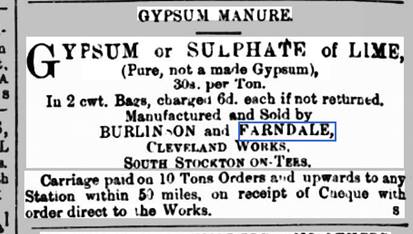
1868, John Farndale was in business with a man named Burlinson.
The Richmond and Ripon
Chronicle, 17 October 1868: GYPSUM MANURE. GYPSUM or SULPHATE of
LIME (Pure, not a made Gypsum), 30s per Ton. In 2 cwt Bags, charged 6d each if
not returned. Manufactured and Sold by BURLINSON and FARNDALE, CLEVELAND
WORKS, SOUTH STOCKTON ON TEES. Carriage paid on 10 Tons Orders and upwards
to any Station within 50 miles, on receipt of Cheque with order direct to the
Works.
The
Darlington & Richmond
Herald, 9 May 1868: STOCKTON ON TEES. TO BE SOLD BY PUBLIC
AUCTION. At the Talbot Hotel, in Stockton, in the county of Durham, on
Thursday, the 21st May, 1868, at six o’clock in the Evening, in the following
or such other lots as may be agreed upon at the time of sale, and subject to
such conditions as shall then be produced. Message Henderson and Hornby,
Auctioneers.... Lot 2. All that copyhold DWELLING HOUSE, situate and being No
5, in Queen Street, Stockton, with the outbuildings and appurtenances, now in
the occupation of Mr John Farndale....
1869
The
Richmond & Ripon
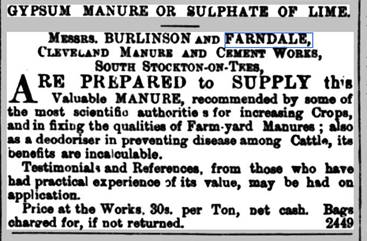
Chronicle, 30 January 1869: GYPSUM MANURE OR SULPHATE OF LIME. Messrs
BURLINSON AND FARNDALE, , SOUTH STOCKTON-ON-TEES, ARE PREPARED to SUPPLY
this Valuable MANURE, recommended by some of the most scientific authorities
for increasing crops, and in fixing the qualities of farmyard manures; also as
a deodoriser in preventing disease among cattle, its benefits are incalculable.
Testimonials and references, from those who have had practical experience of
its value, may be had on application. Price at the works, 30s, per ton, net
cash. Bags charged for, if not retured.
On 24 December 1869, they advertised, Important to Builders,
Contractors and others. Portland and Light Roman Cements and Plaster of Paris
are manufactured of first rate and warranted quality, at the Cleveland Cement
and Plaster Works, South Stockton by Burlinson and Farndale. Also dealers in
Lathes (Patent & Rivers), Cement and Marble Chimney Pieces (of every design
and size) of first class finish, at most reasonable prices. Goods of their
manufacture. Carriage paid in two ton lots. Price lists and terms on
application. Sample orders promptly executed (Northern Weekly Gazette, 24 December 1869).
1870
In 1870 John wrote: The History of the Ancient Hamlet of Kilton-in-Cleveland, printed by W Rapp, Dundas Street, Saltburn 1870;
The History of Kilton dedicated to the Reverend
William Jolley , Returning Immigrant, by John Farndale, The Emigrants Return,
printed by Burnett and Hood, Exchange Offices, Middlesborough, 1870
and a further edition of A Guide to
Saltburn by Sea by John Farndale - Farndale,
John, A Guide To Saltburn By The Sea and the Surrounding District With Remarks
on Its Picturesque Scenery, (Darlington: Hird, 1864)
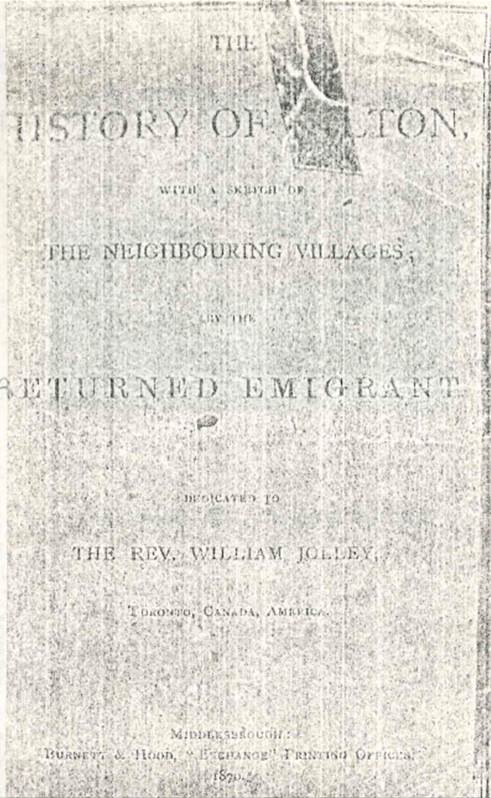
In 1870 John wrote The
History of the Ancient Hamlet of Kilton-in-Cleveland, also called The
Returned Emigrant, by John Farndale and a further edition of A Guide to
Saltburn by Sea. The Returned
Emigrant was written anonymously by a returning traveller. It is not immediately
apparent who this is, as it starts to be written in the third person. The text
records that the Returned Emigrant was born in 1787. That was not the year of
John Farndale’s birth, who was born in 1791. There are no Farndale born on that
date who might have fitted a description of the Returned Emigrant, who also
tells of his travels to America. John did not travel overseas as far as we
know, but this was a time of emigration and his brother Matthew
Farndale had emigrated to Australia in 1853 and his son, John
George Farndale, after fighting in the Crimean War, emigrated to Ontario in
1870, the same year of publication. So it is not difficult to see why he may
have written in the name of a person returned from an overseas adventure. The
text writes extensively of the Farndales, as well as about Kilton. There is little doubt that the author
was John Farndale. Although the text
starts to be written in the third person, of the experience of the Returned
Emigrant, it later turns to the first person. It adopts significant
similarities in the language to the History of Saltburn. In the text in
the first person it also repeats poetry which was written by John Farndale in
his History of Saltburn, for instance the O Why did I ever leave home
poem in this piece was lifted directly from a longer poem authored by John
Farndale in his History of Saltburn.
John’s works have been transcribed
separately and his record of the transition to a new industrial Age is
summarised in Act
17 of the Farndale Story.
A text, Impact of Agricultural Change on the Rural Community - a case
study of Kilton circa 1770-1870, Janet Dowey includes much about
John Farndale and his writings and there are extracts from this at John Farndale’s Writings
page and at the Klton page.
John
Farndale 1791 to 1879
John
and his business partner, Burlinson, seem to have been in financial difficulty
again by 1870. A very large number of similar advertisements appeared
in newspapers in 1869 and 1870. The Northern Weekly Gazette, 21 January 1870: Sales by Auction. South Stockton. To
Farmers, Manure Manufacturers and Others. Messrs Pybus and Son will Sell by
Auction under a distress for rent, on the premises lately occupied by Messrs
Burlinson, Farndale and Co, South Stockton, on Wednesday, January 26, 1870,
about 50 tons of gypsum, in lots to suit purchases. Sale to commence at three
o’clock in the afternoon prompt.
A
Report of the Stockton Board of Health in the Northern
Weekly Gazette on 29 July 1870: Gentlemen, I beg to report that the
levelling, paving, flagging, and channelling of George Street, King Street, and
Thorpe Street have been completed, and I lay before you the amount of
apportionment incurred by the Board amongst the several owners off premises
fronting, adjoining, or abutting there on, as under, viz... Thorpe Street …John
Farndale £3 8s 8 ¾ d.
A notice appeared on 24 October 1870 for non payment of rents. Messrs Burlinson
and Farndale did not answer to a summons charging them with non payment of poor
rate amounting £2 10s 10d. An order for the amount and costs was made, in
default distress (Daily Gazette for Middlesbrough, 24 October 1870).
Stokesley
1871
By
1871 John Farndale was continuing to work as an insurance broker, and was
living on his own in Stokesley.
By 1871 John Farndale was continuing to work as an insurance broker, and
was living on his own in Stokesley. The
1871 Census for 49 Back Lane, Stokesley listed John Farndale, a widower, aged
79, insurance agent living with Joseph Blackburn, his grandson, aged 9. Joseph
Blackburn was the son of his daughter Elizabeth nee Farndale and
Joseph Doutwaite Blackburn.
The
1871 Census for 49 Back Lane, Stokesley
listed John Farndale, a widower, aged 79, insurance agent living with
Joseph Blackburn, his grandson, aged 9. Joseph Blackburn was the son of his
daughter Elizabeth nee Farndale (FAR00319) and Joseph
Doutwaite Blackburn.

1873
John’s
last years in Kilton
In 1873, he left Stockton to return to Kilton. On 21 February
1873, Back Lane, Stokesley. Mr Watson, of Guisborough, is instructed by Mr
John Farndale, who is leaving the place to sell by auction, on Saturday,
February 22nd, 1873, the following modern household furniture and effects:
Eight days Clock in Mahogany case, Half chest of Mahogany Drawers, four
Mahogany Chairs and one Arm ditto, pianoforte, Mahogany Desk and Drawers,
Centre Table, 2 Oak Tables, Weather Glass, American Clock, four Kitchen Chairs
and cushions, Secretaire and Bookcase, Camp Bedstead and mattress, Iron
Bedstead and mattresses, Iron bedstead and mattress, Prime feather Bed, bolster
and pillows, blankets, sheets, counterpanes, oak Washstand and Chamber service,
Carpets, Druggets, Ma’s, Pier Glass, Dressing glasses, Stair carpets, and Brass
rods, fenders and fire irons, several engravings, Rollin’s
Ancient History, Wesley’s
works, Fletchers works, Benson's
commentary on the scriptures, Josephus
on the History of the Jews, and a variety of other valuable works, Kitchen
table with bottle rack attached, tea and breakfast services, plates and dishes,
scales and weights, small anvil, garden tools, and a quantity of sacks and bags.
The house to be let, and may be viewed on application to Mr F B Martin, and
possession given immediately after the sale. Sale punctually at one o’clock.
Cleveland sale offices, Guisborough, Redcar, and Stokesley (Northern Echo, 21 February 1873).
1874
On his 84th birthday, in 1874, he wrote his Memoirs when he said he was in good health.
1877
He seems to have retained some interest in
his old life in Stockton, for in May 1877 he intervened to prevent a domestic
assault. On Saturday James Moss, Taylor, was brought up charged with assaulting his
wife, Elizabeth, on the preceding day. Prosecutrix stated that her husband
arrived home about three o’clock in the afternoon in a state of drunkenness,
and after abusing her followed her into a neighbour’s house on the gallery,
where he assaulted her. Prisoner was further charged with being drunk and
disorderly at the magistrate clerks office at the same time. Mr Jennings,
deputy magistrates clerk, deposed to the prisoner’s wife entering the office
for protection followed by her husband, who made a great disturbance and
attracted a crowd of people. Mr Farndale forcibly ejected him, when he
pulled his coat off and wanted to fight. He was very drunk at the time. For assaulting his
wife he was fined 10s 6d and 9s 6d costs, or in default of payment a month imprisonment;
And for the second charge fined 5S and 4S6D costs, or seven days imprisonment (Northern Echo, Monday 14 May 1877).
The by then octogenarian seemed up for a fight or two in his old age.
1878
Kilton
He had returned to Kilton to live out
his final years, and his son Charles Farndale
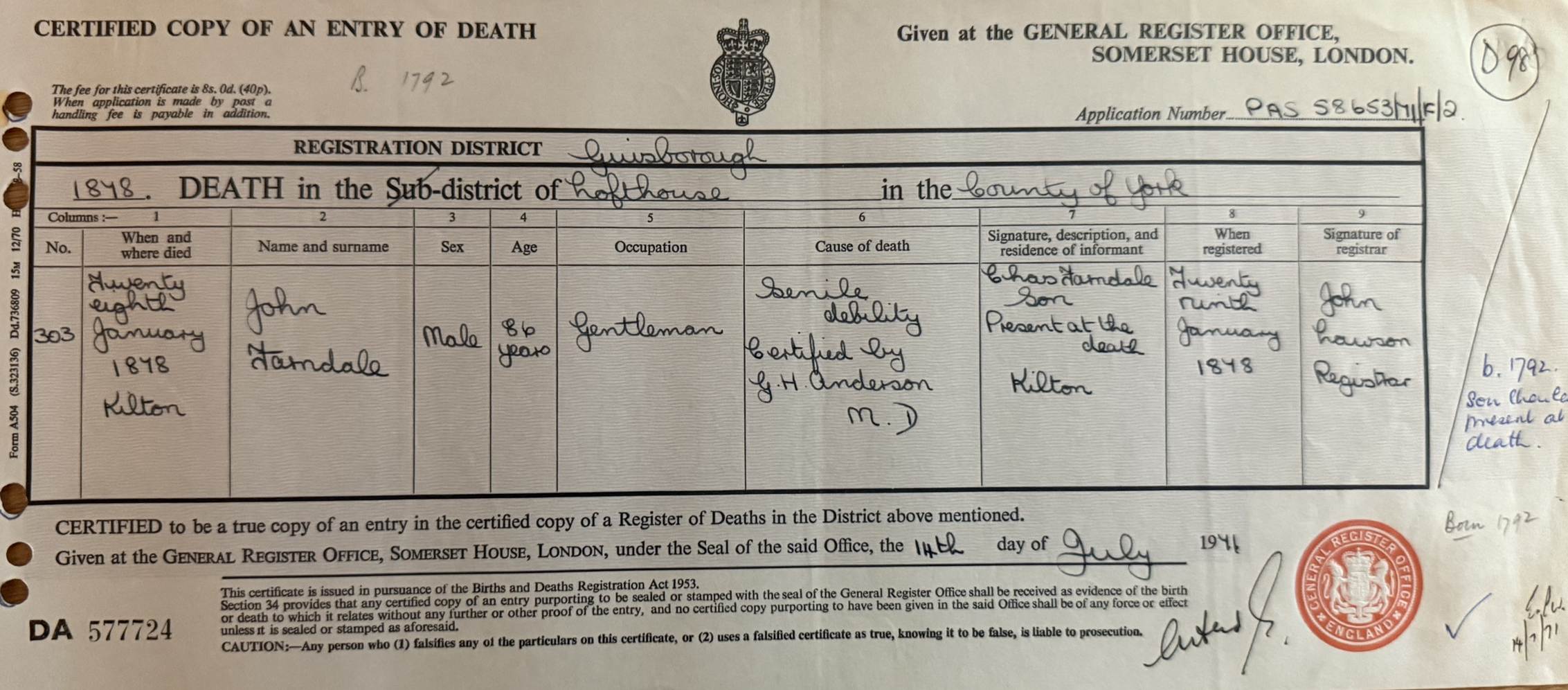
was with him when he died of senile debility, aged 86 on 28 January 1878. He
was buried at Brotton Old
Churchyard on 31 January 1878. January 28th, at Kilton, aged 86 years,
Mr John Farndale.
John Farndale aged 86 years, Gentleman, died of senile debility at Kilton. Charles Farndale, his son
was present at the death 28 January 1878 (Death
Certificate, Brotton PR) He was buried at Brotton on 31 January 1878. The York Herald, 1 February 1878:
DEATHS. FARNDALE – January 28th, at Kilton, aged 86 years, Mr
John Farndale.
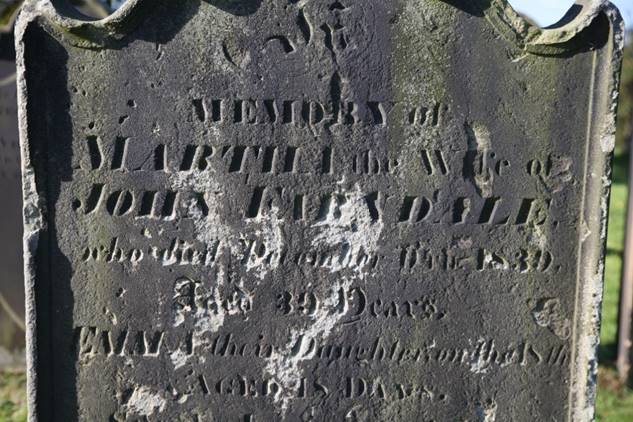
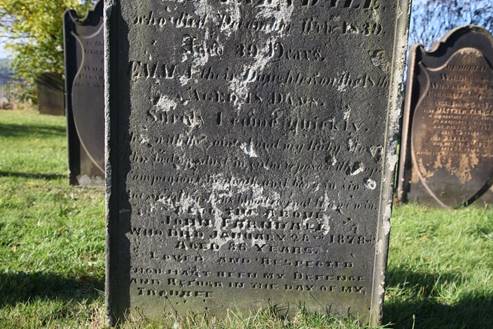
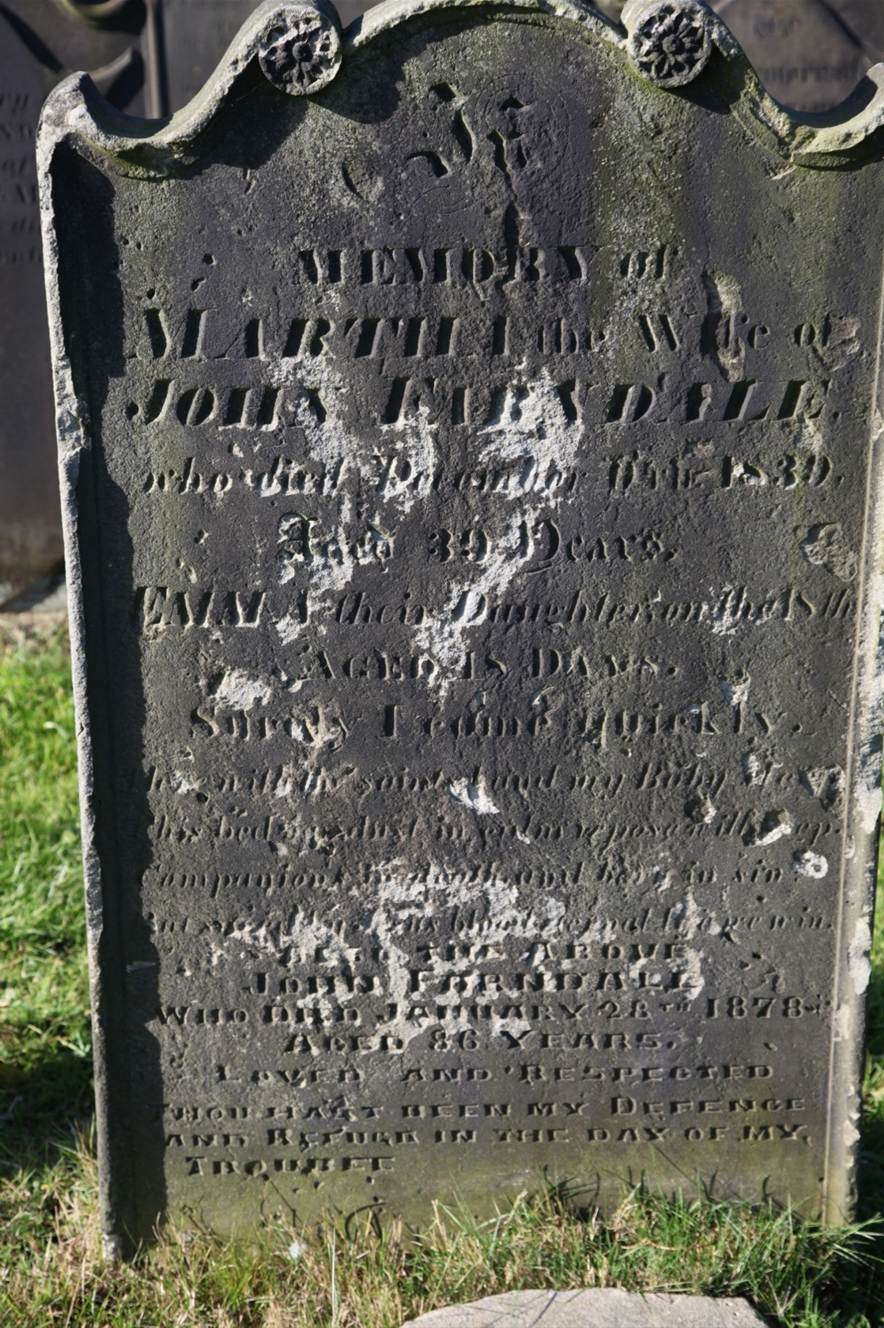
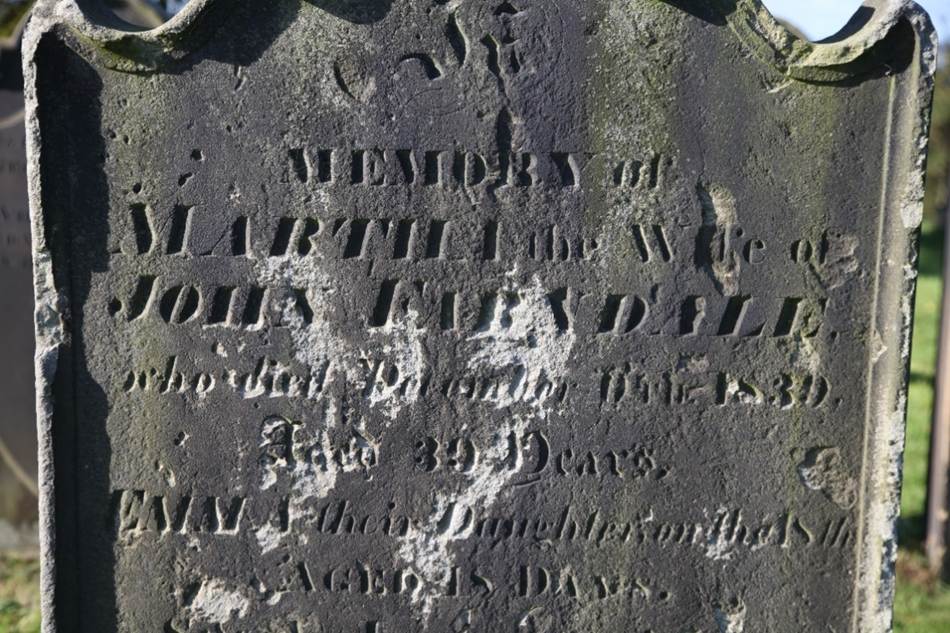
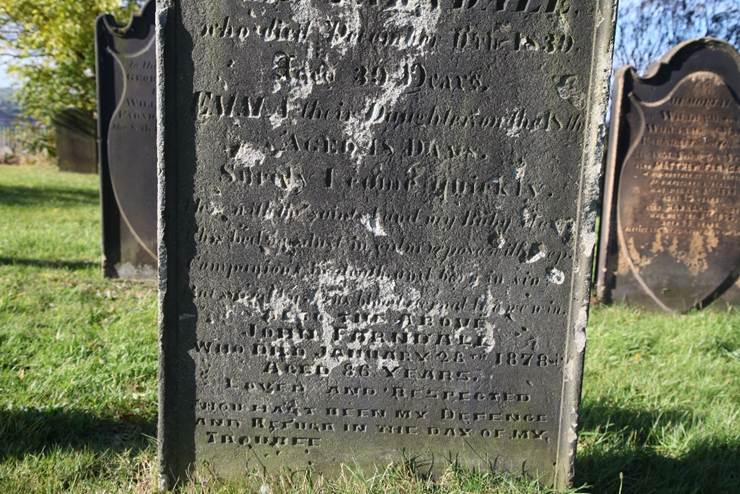
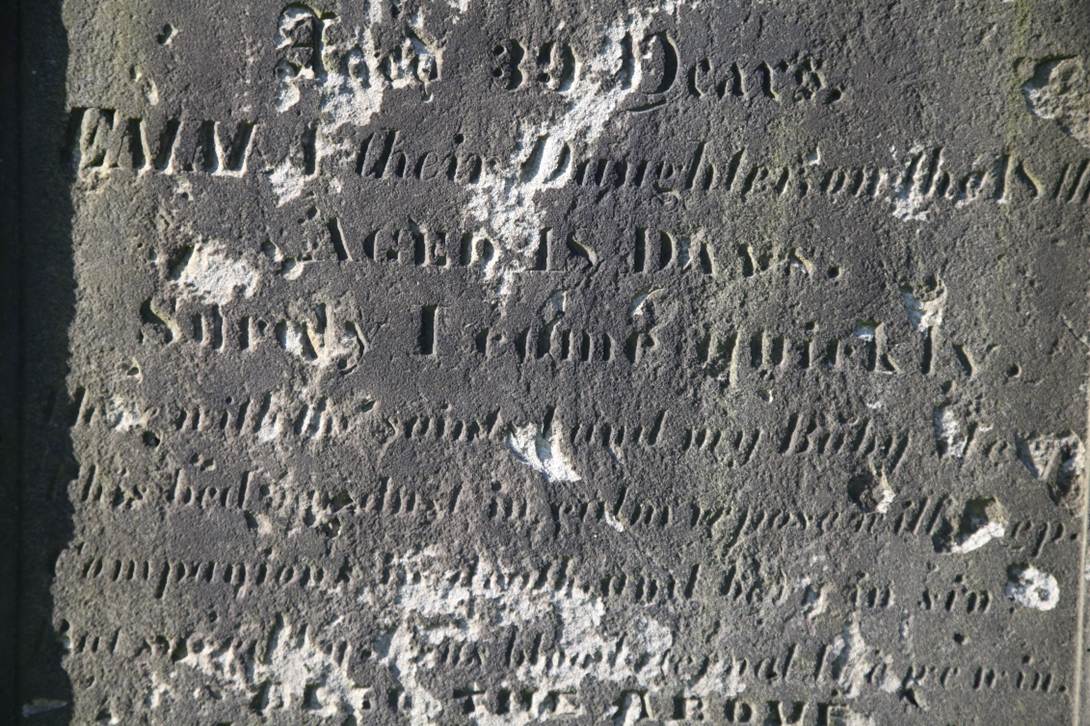
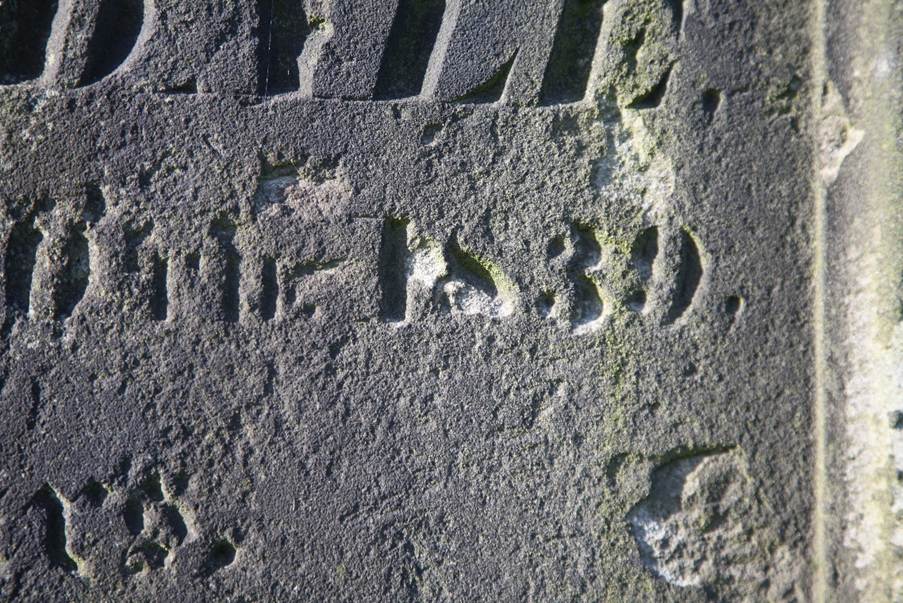
His gravestone Old Brotton
Churchyard: In memory of Martha the wife of John Farndale who died 6th
December 1839 aged 39 years. Emma their daughter on the 18th aged 18 days.
Verse. [unreadable]. Also the above John Farndale who died 28th January 1878
aged 86 years, loved and respected. Thou hast been my Defence and Refuge in the
Days of my thoughts.
|
|