Loftus
Historical and geographical information
|
Return to the Home Page of the Farndale Family
Website |
The story of one family’s journey through two
thousand years of British History |
The 83 family lines into which the family is divided.
Meet the whole family and how the wider family is related |
Members of the historical family ordered by date of
birth |
Links to other pages with historical research and
related material |
The story of the Bakers of Highfields, the Chapmans,
and other related families |
Dates are in red.
Hyperlinks to other pages are in dark blue.
Headlines of the history of the Loftus are in brown.
References and citations are in turquoise.
Contextual history is in purple.
This webpage
about the Loftus has the following section headings:
·
The
Farndales of Loftus
·
Loftus, an
overview
· Timeline of Loftus
· Notable people of
Loftus
The Farndales of Loftus
The Loftus
1 Line are the descendants of William
Farndale (FAR00152),
1739 to 1813 who was a constable in Loftus and a freeholder. The Loftus
2 Line are the descendants of George
Farndale (FAR00350C),
1843 to 1917 who was a farmer in Brotton and Iron miner of
Loftus. The Loftus
3 Line are the descendants of William
Farndale (FAR00378),
1849 to 1894, a farm servant of Loftus, Whitby and Egton.
Loftus
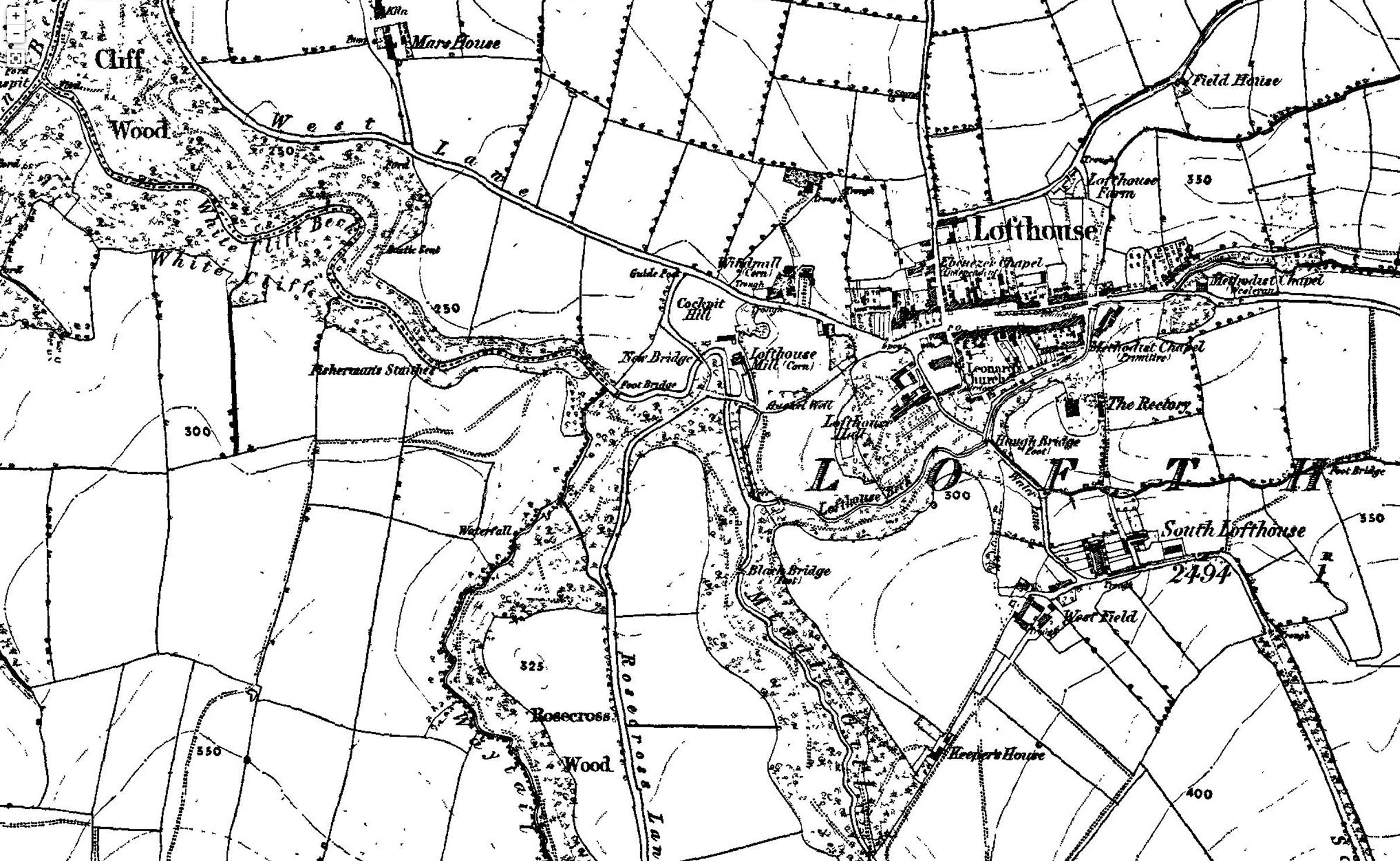
Loftus is recorded as "Lcotvsv" in the Domesday book, from Laghthus meaning low houses. Loctushum, Locteshusum
(eleventh century); Lofthusum (twelfth
century); Lofthus (twelfth to fifteenth centuries); Loftous,
Loftos (thirteenth century); Lofthouse
(thirteenth and fourteenth centuries).
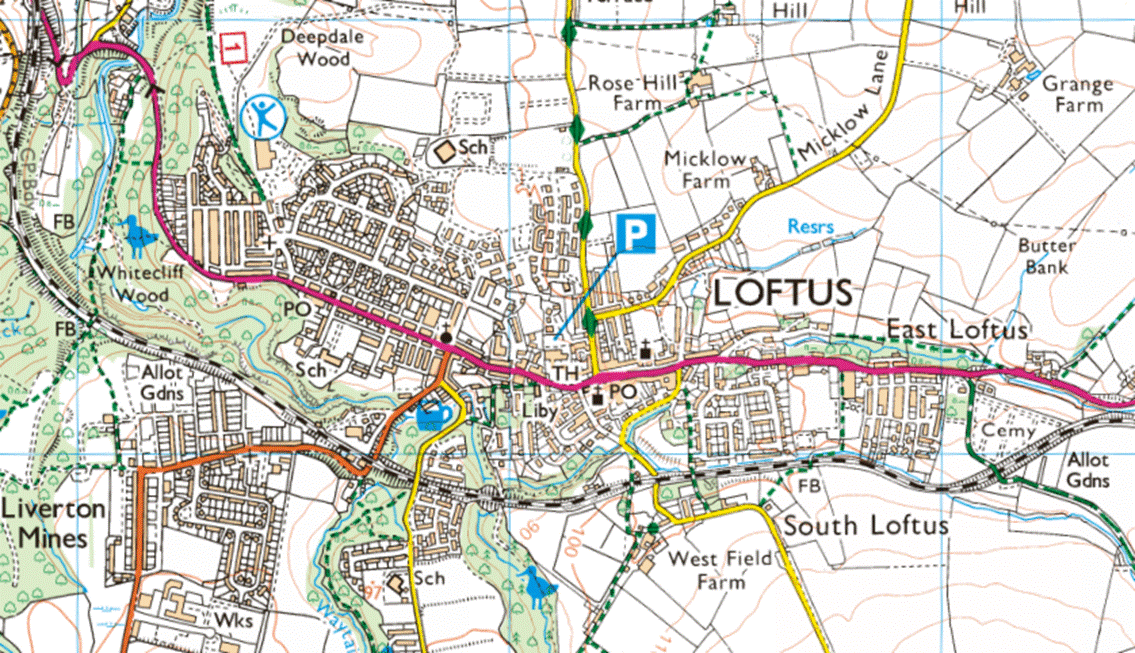
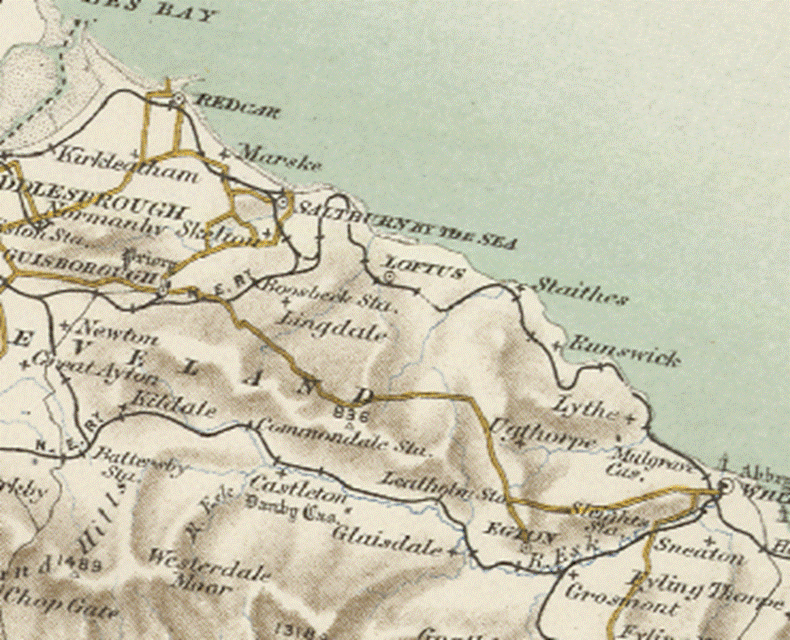
Loftus is a town
and civil parish located in the borough of Redcar and
Cleveland in the North East of England. The town lies within
the ceremonial county of North Yorkshire and is governed by
the unitary authority of Redcar and Cleveland. It lies in a
region between Saltburn-by-the-Sea and the North York Moors. It
was formerly known as Lofthouse. The population of the Loftus ward of
the Redcar and Cleveland unitary authority taken at the 2011
census was 6,382.
The Victoria County History – Yorkshire, A History of
the County of York North Riding: Volume 2 Parishes: Loftus, 1923: The parish contains the
market town of Loftus, and to the south the isolated farms of High and Low
Wapley, with Gallihowe, Deepdale and Street Houses to
the north. Its area is 3,744 acres, of which 137 acres are foreshore, 6 acres
are covered by inland waters, 885 acres are arable land, 1,741 acres permanent
grass and 457 acres woods and plantations. The whole township is called Loftus,
but, as in 1308–9, it is divided by a stream into North Loftus and South Loftus.
The Methodist preacher John
Wesley is known to have preached in Loftus. More recent history is
dominated by the ironstone mining industry and many inhabitants that live
in Loftus can trace lineage back to ironstone miners.
Loftus Timeline
200 CE
A Roman Villa has
been unearthed on the coast near Loftus.
Seventh
Century
The Loftus area has been inhabited
since at least the 7th century, and although folkloric evidence includes a
house owned by Sigurd the Dane, who features in Macbeth as
Siward, real evidence has been unearthed in recent times to support the picture
of ancient settlement in the area.
The only
known Anglo-Saxon royal burial site in north-east England is near
Loftus. Artefacts were discovered there from excavations which took place
between 2005 and 2007. Finds include pieces associated with a rare bed burial in
which a decorated female body is laid out on a decorated wooden bed accompanied
by fine gold jewellery. The finds include a gold pendant, which would have
belonged to a princess. as well as glass beads, pottery, iron knives, belt
buckles and other objects. The finds, which date back nearly 1400 years were
discovered by members of the Teesside Archaeological Society, led by Dr Steve
Sherlock, in a 109-grave site at Street House, Loftus. They are presently on
show at the Kirkleatham Old Hall Museum.
In 2008 the local Archaeologist,
Dr Stephen Sherlock, discovered an Anglo-Saxon burial ground on the coast near
Loftus.
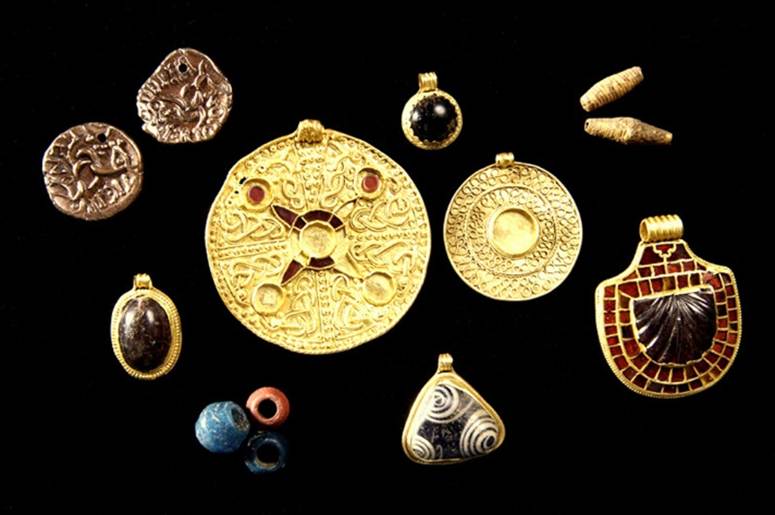
Items from an Anglo Saxon burial
site at Loftus
1086
There were two vills
of Loftus in 1086, each composed of 4 carucates of land. Before the Conquest
Siward Earl of Northumberland held 4 carucates here as a 'manor,' then worth
£48, but in 1086 waste.
A considerable portion of
the lordship of Locthusum (Lofthouse) was granted,
soon after the Survey, by the then owner, the Earl of Chester, to William de
Percy, and the soke of South Lofthouse, which from the Percy feoclary appears to have contained six carucates of land,
was, at an early date, incorporated in the fief of Kilton. (Kilton
Castle, William M L’Anson, Yorkshire Archaeological Journal, Volume 22, 1913,
page 59).
See also The Origin and Early History of the
Kilton Fee, W Hebditch,
1939, Yorkshire Archealogical Journal, Volume 34, page 298.
The Guisborough
Chartulary tells us that Richard Bard
was the first lord of this vill after the Conquest and he was succeeded by
Geoffrey Bard berfore William Sauchay held these lands.
1205
Peter de Brus offered 25 marks and
a “palfrey” to have the seisin (conveyance of ownership) of Lofthouse of the
honour of Chester.
1615
The Victoria County History
– Yorkshire, A History of the County of York North Riding: Volume 2 Parishes:
Loftus, 1923: Between 1615 and 1633 all the
arable, meadow and pasture land in the common fields and 'ings'
of North Loftus was partitioned among the farmers who had purchased the manor.
1657
The Victoria County History – Yorkshire, A History of
the County of York North Riding: Volume 2 Parishes: Loftus, 1923: Alum rock was mentioned in a
letter to Sir Thomas Chaloner in 1603–7, and alum works had been started
shortly before 1657–8 when the mine was let on a lease by the lord of the
manor, who leased it to the Crown for £400 yearly in 1665 and refused to abate
the rent to £300 per annum, despite the threats of Sir Anthony Ashley Cooper.
1791
The Victoria County History – Yorkshire, A History of
the County of York North Riding: Volume 2 Parishes: Loftus, 1923: In 1791 Thomas Richardson of Handale Abbey was rewarded by the Society of Arts for
having planted 40 acres of land with mixed timber which still flourishes.
1808
The Victoria County History – Yorkshire, A History of
the County of York North Riding: Volume 2 Parishes: Loftus, 1923: It was stated in 1808 that a
weekly market had been started recently and was a convenience to the alum
workers.
1831
The Victoria County History
– Yorkshire, A History of the County of York North Riding: Volume 2 Parishes:
Loftus, 1923: A decrease of 140 in the population in 1831
was ascribed to the depreciated state of the alum works and consequent
emigration to America.
1857
1861
The Victoria County History – Yorkshire, A History of
the County of York North Riding: Volume 2 Parishes: Loftus, 1923: The population is said to have
more than doubled in 1861–71 owing to the commencement of the iron industry.
1874
The Oddfellows Hall, in Loftus,
was built in 1874 as the offices and meeting place of the
local Oddfellows society. The Loftus Oddfellows would raise money for
their members.
Oddfellows were friendly or
mutual societies, set up and organised by people from different guilds representing various
trades. Other societies existed for single trades, but when there were not
enough people from one trade, especially in smaller towns, societies would be
formed from an "odd" mixture of people, so giving the name
"Oddfellows".
1875
Loftus railway station opened in
1875. It closed to passengers in 1960. The line still operates through the
station site, with freight services for Boulby Mine,
and occasional passenger 'specials' for rail enthusiasts.
1879
Loftus Town Hall was built by the
Earl of Zetland, erected by a Thomas Dickenson of Saltburn, and was first
opened in 1879. The Town Hall clock has faces north, east and west, but no face
to the south as the residents of South Loftus were reluctant to contribute to
the cost.
1894
The Victoria County History – Yorkshire, A History of
the County of York North Riding: Volume 2 Parishes: Loftus, 1923: The urban district formed under
the Local Government Act of 1894 comprises the parishes of Loftus, Liverton and
Skinningrove. A pretty town, in spite of its mining industry, it has grown up
round its old High Street, in the centre of which are the Town Hall and church
of St. Leonard.
1962
To the north of the village there is a
disused nuclear bunker. The bunker was opened in
1962 and closed 1968.
Notable people of Loftus
Lewis Hunton (1814–1838),
geologist.
Bibliography