Coatham
Historical guide to Coatham with a focus on the aspects relative
to the Farndale family history
|
Return to the Home Page of the Farndale Family
Website |
The story of one family’s journey through two
thousand years of British History |
The 83 family lines into which the family is divided.
Meet the whole family and how the wider family is related |
Members of the historical family ordered by date of
birth |
Links to other pages with historical research and
related material |
The story of the Bakers of Highfields, the Chapmans,
and other related families |
Introduction
Dates are in red.
Hyperlinks to
other pages are in dark
blue.
Headlines of the
history of the Coatham are in brown.
References and
citations are in turquoise.
Contextual
history is in purple.
This webpage about
the Coatham has the following section headings:
·
The
Farndales of Coatham
·
Coatham, an
overview
· Timeline of Coatham
The Farndales of Coatham
The
Coatham Line are the descendants of Matthew
Farndale (1828 to 1905) (FAR00297) who married Ann Readman and was
an agricultural labourer and then Foreman at East Coatham - Matthew
lived with John (FAR00217) as a servant at age 12.
Many of his descendants are
associated with Coatham including as dressmaker, laundress, labourer, pipe
layer, and estate land drainer.
(John) Richard Farndale (1897 to
1917) FAR00681) of Coatham, joined the Army as a
private in the Yorkshire Regiment and Green Howards, and died of pneumonia on
Western Front, WW1.
George William Farndale (born
1890) (FAR00643) emigrated from Coatham to USA and
established the
American 2 Line.
Other Farndales
associated with Coatham are John Farndale (FAR00230);
Matthew Farndale (FAR00297);
Jane Farndale (FAR00340);
and Peter Farndale (FAR00373).
Coatham
Coatham is a
district of Redcar the county of North
Yorkshire.
Coatham began as
a market village in the fourteenth century to the smaller adjacent fishing port
of Redcar.
Though Coatham is now only a mile-wide district in the town of Redcar, the need
for definition was strong enough to warrant the western boundary being marked
by a fence which
ran the length of West Dyke Road and West Terrace.
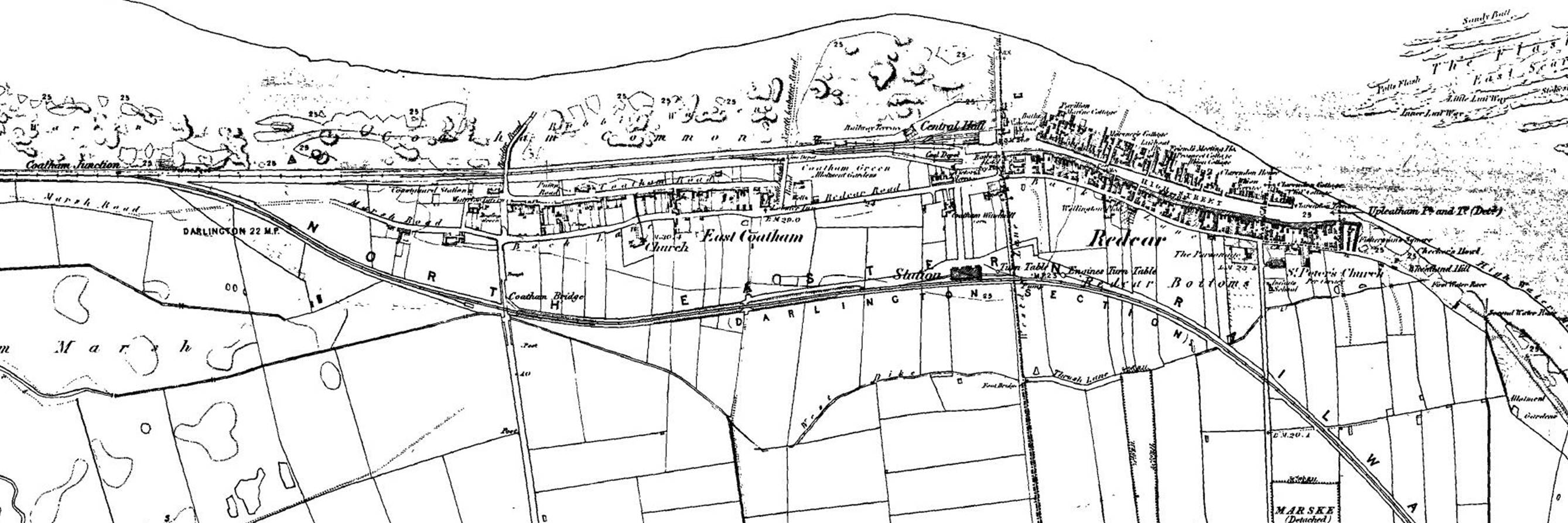
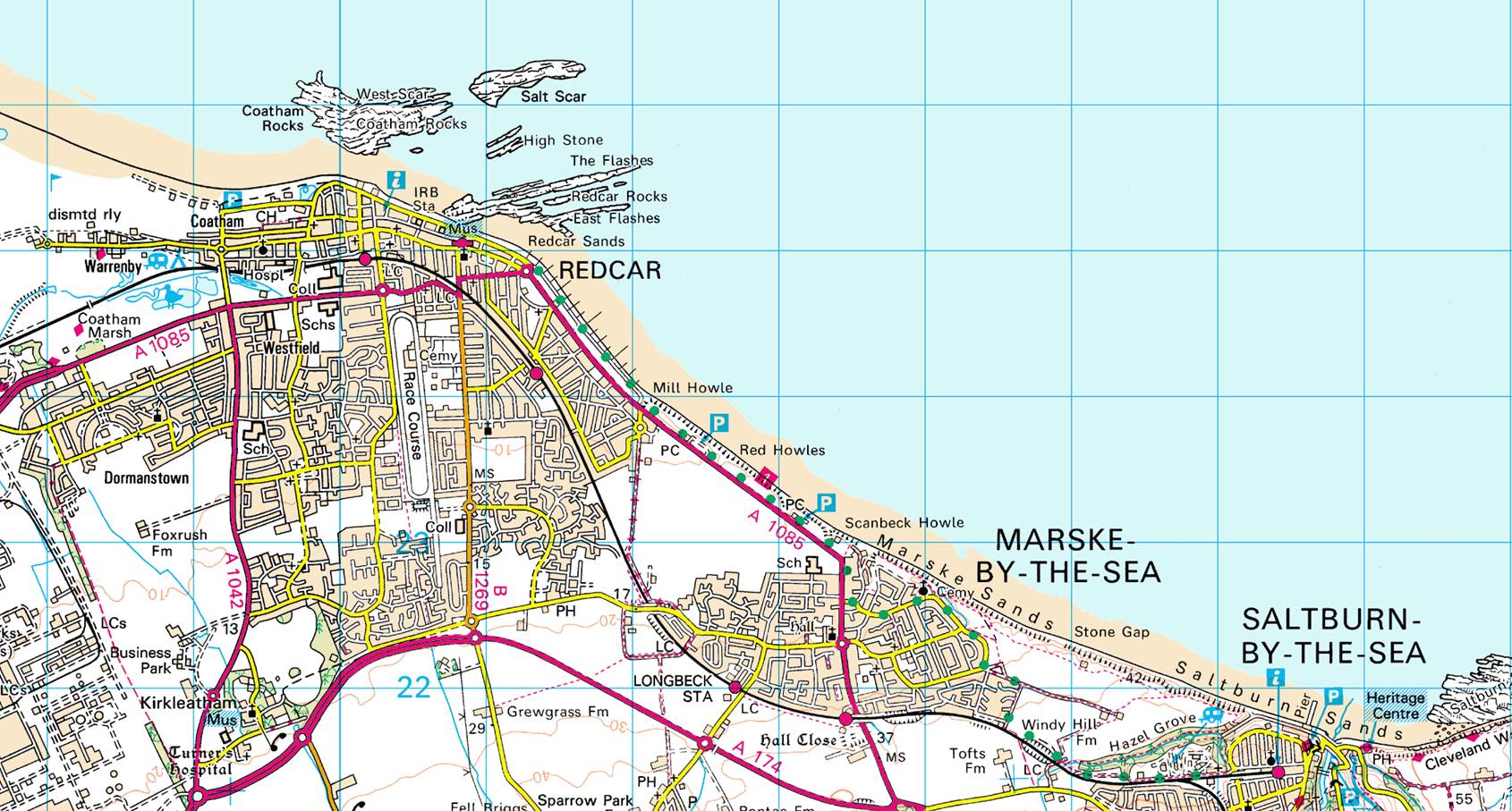
Coatham, 1857
Coatham Timeline
1066
In Domesday Book
COATHAM (Cotum, in the twelfth and thirteenth centuries) is possibly
represented by a holding of 3 carucates in Kirkleatham, formerly the 'manor' of
Leising and then in the king's hands (Victoria
County History – Yorkshire, A History of the County of York North Riding:
Volume 2 Parishes: Kirkleatham).
1070
William I brought
troops to Coatham marshes in pursuit of rebels who had hidden there.
Twelfth
century ownership and thereafter
The de Brus
family of Skelton held most of Cleveland in the 12th century, including
Coatham. By 1257, East Coatham was in the hands of the Thweng family. From the
late 14th century to the late 16th century the Lumleys were lords of East
Coatham. Throughout the later Middle Ages and up to 1558 the Bulmer family held
West Coatham.
The Victoria County
History – Yorkshire, A History of the County of York North Riding: Volume 2
Parishes: Kirkleatham, 1923: In the Middle Ages many salt-pits were
dug there. In the latter part of the 12th century Roger son of William de
Tocketts gave a salt-pan in 'Cotum' to Guisborough Priory and Hugh son of Ralph
Deblel two salt-pans. Alan de Wilton early in the 13th century granted to the
canons of Ellerton 5 skeps of salt from his salt-pits of West Coatham; the Brus
lords of Skelton had the right of taking a skep of salt from every salt-pan in
Coatham Marsh, and salt-pits in Coatham belonged to their descendants in the 14th
century and later. It is probably the excavations necessary for these that
caused the hillocks to the south of the North Eastern railway between East and
West Coatham.
1204
The trade of the
port of Coatham was assessed as more than the port of Whitby. The Great Roll of the Pipe for the sixth
year of the reign of King John (1204), contains tax records for ports on the
east coast and the south coast of England. The tax was levied at the rate of
one fifteenth of the value of the goods traded over and eighteen month period.
The assessment was transcribed in “Domesday Book to
Magna Carta” R.L.Poole (1951). It includes: Newcastle, £158 5s 11d;
Yarm, £42 17s 10d; Coatham 11s 11d; Whitby 4s 0d …
1257
Coatham had a
weekly market and an annual fair.
1301
The Lay Subsidy of 1301 divided Coatham into two
parts. The tax returns for West Coatham were lumped together with Wilton, while
the East Coatham returns were lumped together with Kirkleatham and Yearby. The
Coatham taxpayers can’t be distinguished from the rest. Thomas Mercator, may
have been Thomas the Merchant from the small port of Coatham.
1422
An inquisition
held in this year mentioned four saltworks at Coatham.
1673
In the Hearth Returns, West Coatham was described as
having 4 houses with 2 hearths. East Coatham was not identified in the tax
returns.
1770
“A
Description of England and Wales” vol.10, F.Newbery and T.Carnan (1770): “A
collection of little mean ale-houses, which encouraged idleness and drunkenness
among the villages and were the receptacles of the smugglers that frequented
the west, he (Charles Turner of Kirkleatham Hall) caused to be demolished,
and erected two very handsome inns, one in the new village above
mentioned (Kirkleatham), and the other in a little fishing town (Coatham),
a part of his estate on the coast; and as the inn at the fishing town is near one
of the finest beaches in England, he raised a house with handsome
apartments, and built bathing machines, that his own company, and
the gentlemen and ladies of the neighbourhood, might have the convenience of
bathing, without the trouble and expence of going to Scarborough.”
1772
The New Inn was
built at East Coatham “for the accommodation of sea bathers”.
1840
White’s
Directory of 1840 noted that Coatham had been “a noted bathing place” at an
earlier date, “but the neighbouring fishing town of Redcar robbed it of its
celebrity status as a bathing place many years ago”. The Directory listed
the Lobster Inn, a beerhouse, 3 shopkeepers, 3 tailors, a shoemaker, a joiner,
a corn miller, 3 farmers, a solicitor, an academy and a free school.
1846
The Stockton and
Darlington Railway was extended from Middlesbrough. The line went through
Coatham to a terminus on what is now Queen Street, not far from Redcar town
clock.
1854
Christ Church was
consecrated.
1858
The Redcar and
Coatham Cricket Club was founded with their ground in Coatham.
1860
The majority of
modern Coatham is Victorian housing, most notably at its
northern tip by the Coatham Hotel built
in 1860.
Coatham Hotel
1861
As the railway
was extended to Saltburn,
the line took a new route and the line through Coatham became redundant.
1867
The Kirkleatham
Estate commissioned a development plan to create a high-class suburb of grand
villas around the cricket ground.
1869
Sir William
Turner’s Grammar school opened on 1 August 1869; having been moved from
Kirkleatham.
Coatham Wesleyan
Methodist chapel was dedicated.
1873
Coatham Ironworks
was established.
1875
Between 1875 and
1898, Coatham had a leisure pier. It was intended to extend 610 metres
into the sea, but damage in the building stage from shipping and storms
curtailed the distance to 550 metres. In October 1898, the pier was struck
by the 757 tonnes Finnish freighter Birger. The ship had
developed trouble during a storm in the North Sea and
despite passing Grimsby, Scarborough and Whitby,
she carried for South Shields. During a ferocious storm she
crashed onto the rocks at Coatham and wrecked a 60 feet (18 m) section of
the pier in the middle. Only two members of her crew of 15 were rescued; the
pier collapsed a year later.
1899
Coatham and Redcar were merged to form Redcar Urban District.
Coatham was created a civil parish, from Kirkleatham, by Local Government Board
Order, No. 38,693, dated 1 April 1899.
1900
Coatham cricket ground was laid out.
1901
The census
recorded a population of 4,490.
1917
201065 Private
Richard Farndale (FAR00681)
aged 20 of the 1/4th Battalion The Yorkshire Regiment died at 21st CCS in
France of broncho-pneumonia on 25th February 1917. He enlisted at Redcar,
resident at Coatham. He died in France on 25 Feb 1917 with the 1/4th (TA)
Battalion of the Princess of Wales’ Own Yorkshire Regiment, also known as the
Green Howards. The battalion served with the York and Durham Brigade of the
Northumbrian Division, renamed in 1915, the 150th Infantry brigade of the 50th
Division. At the time of his death the battalion was not in the line but in
reserve at Proyart. On 31 Dec 1916 it was at Bazentin le Petit and in reserve
at Flers on 7 Jan 1917. On 11 Jan the battalion moved to the front line at
‘Hexham Road.’ It was again in the front line from 30 Jan to 11 Feb at
Genercourt. The battalion moved to Proyart on 19 Feb 1917. He was awarded the
British War Medal and the Victory Medal posthumously on 21 Jan 1921. He was
presumably badly wounded at Hexham Road or Genercourt or Proyart and evacuated
to No 21 Casualty Clearing Station at La Neuville, where he later died of
pneumonia.
In April 1916, No
21 Casualty Clearing Station came to La Neuville and remained there throughout
the 1916 Battles of the Somme, until March 1917. La Neuville British Cemetery
was opened early in July 1916, but burials were also made in the communal cemetery.
Most of them date from this period, but a few graves were added during the
fighting on the Somme in 1918. The communal cemetery contains 186 Commonwealth
burials of the First World War. The graves form one long row on the eastern
side of the cemetery.
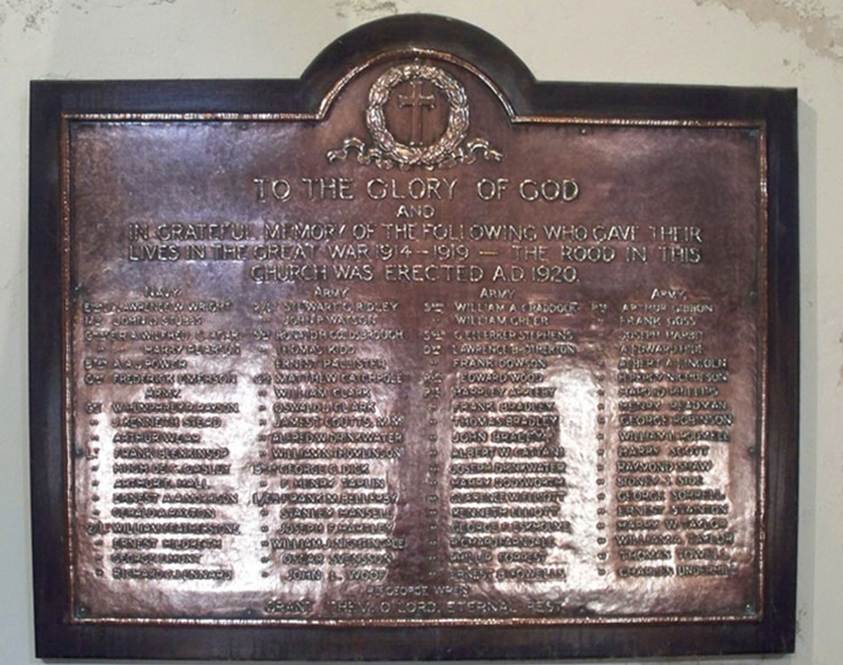
He was buried at
La Neuville Communal Cemetery, Corbie, Somme and commemorated at Coatham Christ
Church War Memorial 1914 -1919; Army - Private Richard Farndale.
|
TO THE GLORY OF GOD |
|
NAVY |
ARMY |
ARMY |
ARMY |
|
LIEUT LAWRENCE V WRIGHT ARMY CAPT. W HUMPHREY R RAYSON |
2/LT.
STEWART G RIDLEY |
SPR. WILLIAM A CRADDOCK |
PTE ARTHUR GIBBON (*) |
|
PTE GEORGE WREN |
1923
In 1923, Coatham was described in the Victoria
County History – Yorkshire, A History of the County of York North Riding:
Volume 2 Parishes: Kirkleatham:
Coatham was originally nothing but a small
fishing hamlet, but there are now many well-built houses which command
extensive views of Yearby Bank, Eston Nab and the Cleveland Hills, and the
sands permit of good and safe bathing.
The town is lighted with gas by the Redcar,
Coatham, Marske and Saltburn Gas Company.
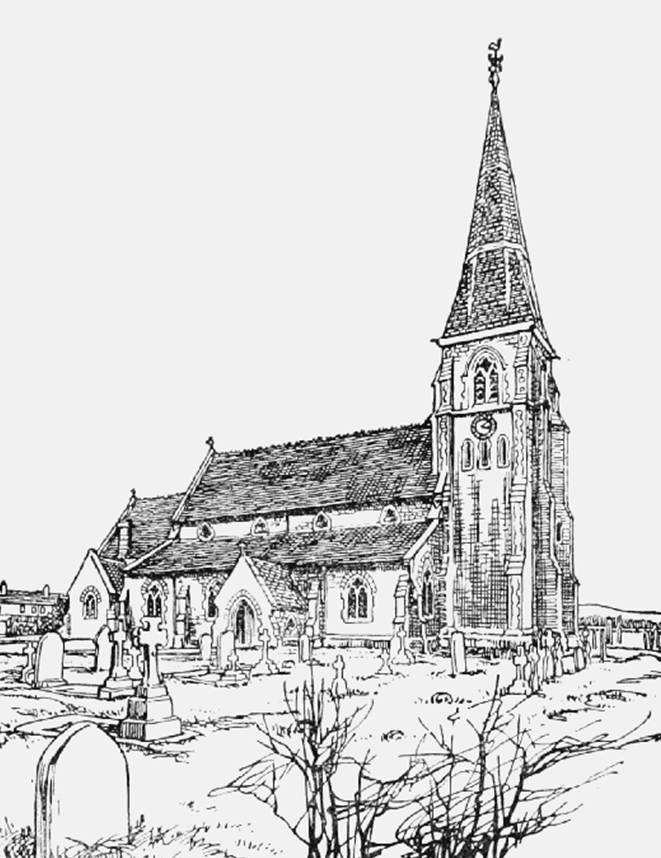
Christ Church, founded and endowed by Mrs.
Teresa Newcomen, of Kirkleatham Hall, and consecrated in August, 1854, is a
building of sandstone, with Bath stone dressings, in the Early English style,
consisting of chancel, nave, aisles, north porch and a western tower with spire
containing one bell: all the windows are stained: the pulpit, font and reredos
are of Caen stone: … The Catholics at present hold services in the school room
in Lobster road. Here is a Wesleyan Methodist chapel, built in 1869, and a Friends’
meeting house.
The Central Hall, built by the North Eastern
Railway Co. in 1846 for a station, but now used for entertainments and public
meetings, will hold 1,000 persons. Station Road Hall is now used as a chapel by
the Primitive Methodists.
The Board of Trade have a Rocket Life saving
Apparatus here, and there is also a Coast Guard station.
The Convalescent Home, established in 1861, is
for the reception of 50 respectable persons recovering from sickness and
requiring change of air and sea-bathing: the original site was acquired, and
the first portion of the Home erected and furnished, at a cost of upwards of
£4,500, by the late Rev. John Postlethwaite; an additional wing was added in
1869, and the Home now holds 164 patients, who are received from all parts of
England, upon an order from a subscriber, which entitles the holder to medical
attendance and board for one month, or longer, should the medical officer deem
it necessary: the nursing of the patients is attended to by the Sisters of the
Home of the Good Samaritan: …
There is a good cricket ground on Coatham
road, and golf links of 18 holes.
The trustees of the Kirkleatham Settled Estate
are lords of the manor and principal landowners.
The population of Coatham in 1881 was 3,898,
in 1901, 4,490, and in 1911 was 4,744 in the civil and 4,683 in the
ecclesiastical parish; area, 1,483 acres of land, 29 of inland water and 1,218
of foreshore; rateable value, £34,196.
1929
In 1929 Coatham Pier's glasshouse was replaced by the New Pavilion
theatre. After the war, comedian and entertainer Larry Grayson coined his
catchphrase "Shut that Door!" while performing there, since
the stage door was open to the cold North Sea breeze
1937
Kelly’s Directory of 1937 listed
2 grocers, 4 butchers, 2 fruiterers, a baker, a confectioner, 2 chemists, a
draper, a bootmaker, a milliner, 2 stationers, a wine and spirits dealer and 2
watchmakers.
1941
15 people were killed when the Zetland Club was hit by bomb during
an air raid.
Bibliography
Cleveland and
Teeside Local History Society page
about Coatham.
A Trip to Coatham: A Watering Place in the
North Extremity of Yorkshire,
W.Hutton (1810)
The Victoria History of the Counties of
England: Yorkshire North Riding vol.2 W.Page (1923)
Redcar and Coatham: A History to the End of
the 19th Century, J.Cockroft (1974)
The Port of Coatham 1789 to 1808
D.W.Pattenden, Bulletin of the C.T.L.H.S. no.11 (1970)