Bradford, Shipley, Clayton, Salt’s Mill and the Worth
Valley
A history of the locations in and around Bradford which are
associated with the history of the Farndale family
|
Return to the Home Page of the Farndale Family
Website |
The story of one family’s journey through two
thousand years of British History |
The 83 family lines into which the family is divided.
Meet the whole family and how the wider family is related |
Members of the historical family ordered by date of
birth |
Links to other pages with historical research and
related material |
The story of the Bakers of Highfields, the Chapmans,
and other related families |
Introduction
Dates are in red.
Hyperlinks to
other pages are in dark
blue.
Headlines of the
history of Bradford are in brown.
References and
citations are in turquoise.
Contextual
history is in purple.
This webpage about
Bradford has the following section headings:
·
The
Farndales of Bradford
·
Bradford
·
Salts Mill,
Saltaire
·
Shipley
·
Worth Valley
·
Clayton
· Greater Bradford
Timeline
The Farndales of Bradford
John Farndale (FAR00379) of the Bishop Wilton Line was a
groom who moved to Clayton, west of Bradford by 1881. His family established
another group in and around Bradford. His fourth child was James Arthur
Farndale (FAR00555)
who became Worsted Drawing Foreman at the Saltaire Mills of Sir Titus Salt.
James’ son Wilfred Farndale (FAR00766) was a
locally renown cricketer and became the Sanitary Inspector for Shipley.
Wilfred’s descendants are the
Bradford 2 Line.
Joseph Farndale (FAR00463) was
the Chief Constable of Bradford from 1 August 1900 to 31 December 1930.
Henry Farndale (FAR00495) of the Hartlepool 1 Line, was born
in Hartlepool, and worked as a sailor and shipwright’s labourer. By 1939, he
had settled in Bradford and most of his nine children were also in Bradford.
James Armin Farndale (FAR00778)
was a general labourer in Bradford whose family settled there. Robert George
Farndale (FAR00755)
was working as a french polisher in Bradford by 1934
and his descendants are the
Bradford 1 Line.
Henry Stewart
Farndale (FAR00832)
was born in Leeds in 1916 and married Maria Patchett in Bradford in 1940. He
died in a Tiger Moth accident when under training in 1945. His family are the Bradford 3 Line.
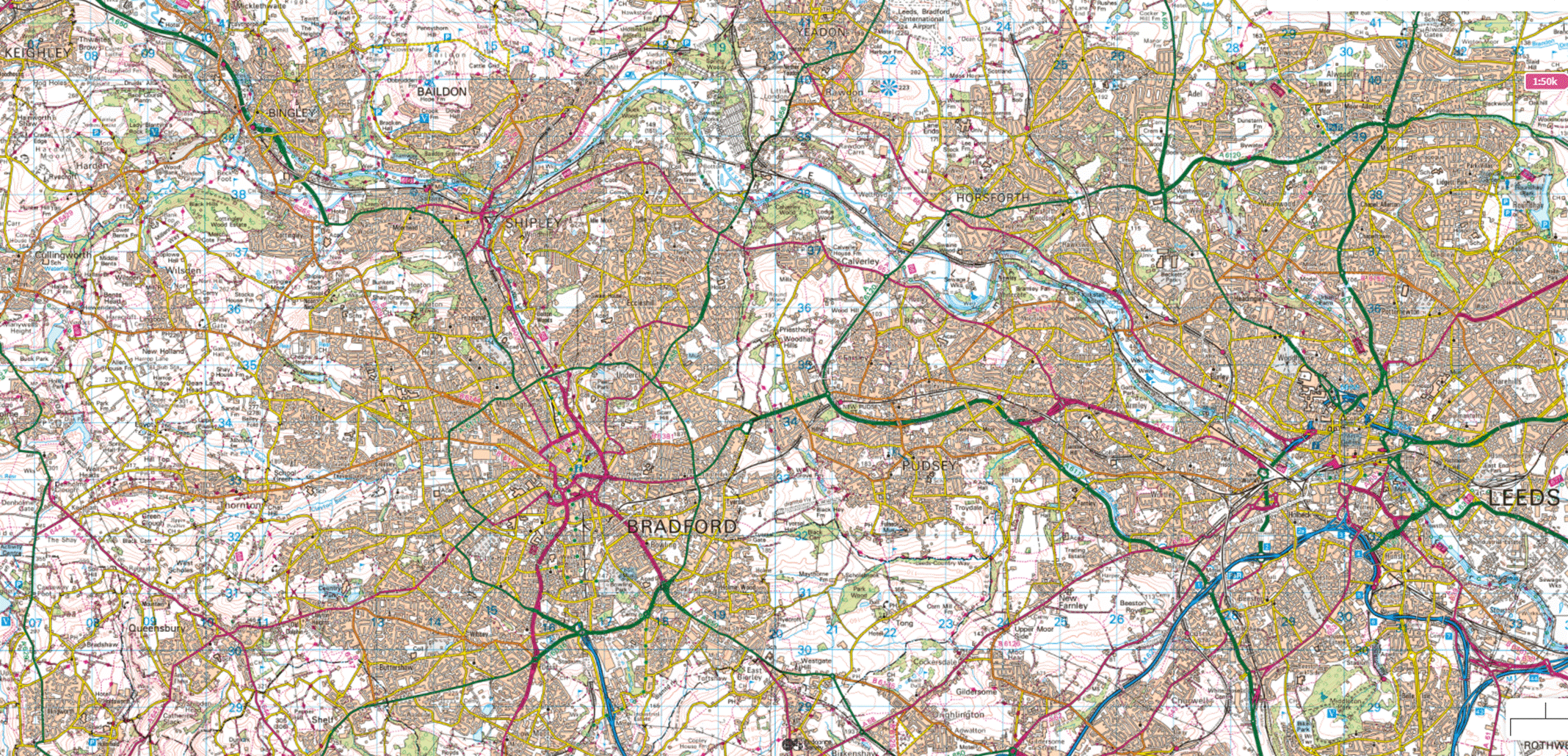
Bradford
Bradford is
a city in West Yorkshire, in the foothills of the Pennines.
It is 14 km west of Leeds, and 26 km north-west of Wakefield.
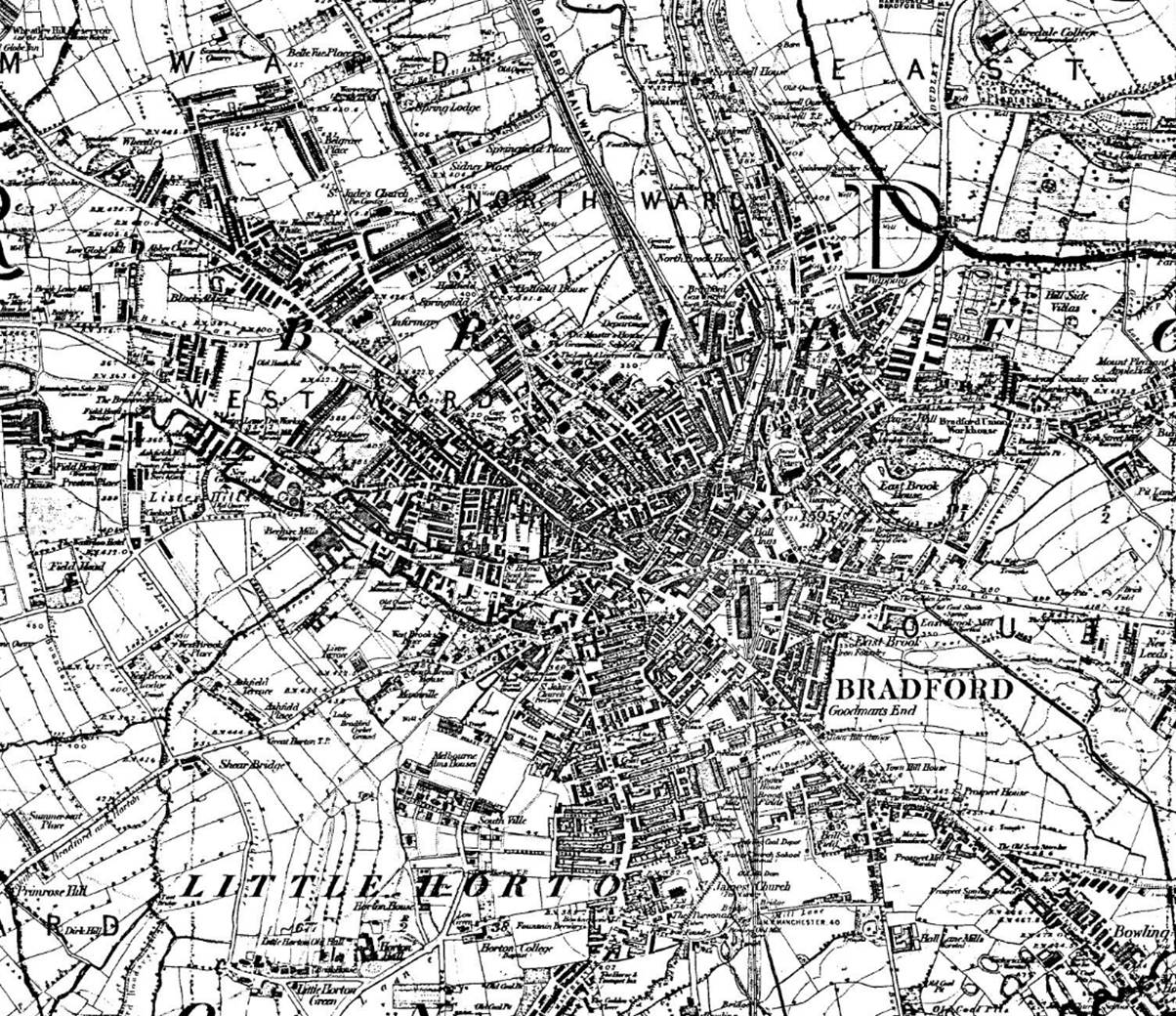
Bradford 1857
Historically part
of the West Riding of Yorkshire, Bradford rose to prominence in the
nineteenth century as an international centre of textile manufacture,
particularly wool. It was a boomtown of the Industrial
Revolution, and amongst the earliest industrialised settlements. It
rapidly became the "wool capital of the world". There was close
access to supplies of coal, iron ore and soft water. As textile manufacturing
grew, there was an explosion in population. This became a stimulus to civic
investment. Bradford has a large amount of listed Victorian
architecture including the grand Italianate City Hall.
The textile
sector in Bradford fell into decline from the mid-20th century.
Shipley
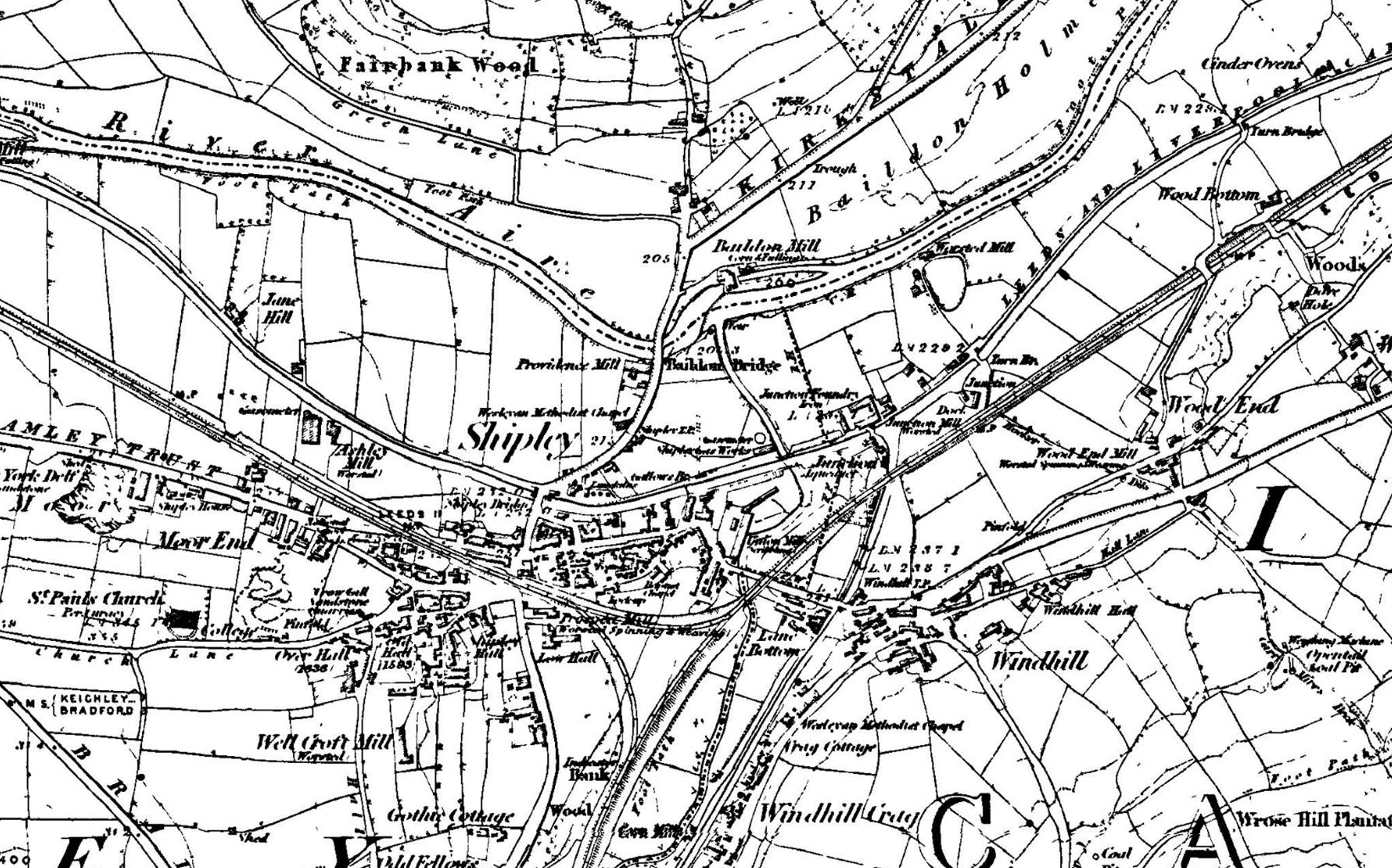
Shipley 1857
The place-name
Shipley derives from two words: the Old English scīp
'sheep', and lēah meaning either 'a forest,
wood, glade, clearing' or, later, 'a pasture, meadow'. It has therefore been
variously defined as 'forest clearing used for sheep' or 'sheep field'.
Shipley was
shaped largely by the Industrial Revolution, especially the textile industry.
Textile manufacture dates from pre-industrial times. As the place name
indicates, Shipley had a history as sheep grazing land, so wool was plentiful,
and the River Aire was a ready source of water for powering water mills and
cleaning processes.
There was a
fulling mill in Shipley by 1500 and two more by 1559. Another mill was built by
the Dixon family on the banks of the Aire in 1635. New Mill on the far side of
Hirst Wood was built in the 1740s and by the late 18th century between 9,000
and 10,000 pieces of broadcloth were being fulled
annually at Shipley's mills.
Much of the work
was undertaken in workers' cottages which had 'loom shops' for spinning yarn.
Home workshops were once a common sight along the River Aire and often had
external flights of steps.
The industrial
era ended cottage industry. Providence Mill, was one of the first steam-driven
mills built for Denby Brothers in 1796. Other spinning mills followed,
including Ashley Mill, Prospect Mill, Red Beck Mill on Heaton Beck (c. 1815),
Well Croft Mill (c. 1840s) and Whiting Mill on Briggate.
The smaller mills
gave way to larger premises which could combine all the processes of worsted
production on one site. The first was Joseph Hargreaves' Airedale Mills, Salts
Mill (built 1853), an enlarged Well Croft Mill and Victoria Mills near the
canal.
Hargreaves
employed 1,250, Salt initially 2,500 and by 1876 total employment in the mills
was 6,900.
The growth in
textile production stimulated the growth of associated supply industries. Other
local employers included loom makers, Lee and Crabtree, WP Butterfield's
galvanised containers and J. Parkinson and Sons machine tool makers.
The other major
effect of industrialisation was the vast expansion in housing stock. Titus
Salt's Saltaire is an example of a model village, and Hargreaves had cottages
built for his workers around the town centre and his mill. He built 92
back-to-back houses along Market Street and Central Avenue in an area which
came to be called Hargreaves Square or The Square. The houses were built by
filling in the old courtyards.
The population of
the township grew from 1,214 in 1822 to just over 3,000 in 1851 to 10,000 by
1869.
The landowning
families took advantage of the demand for housing by selling their less
productive land on Low Moor and High Moor. Houses for the better off were built
in Sunny Bank and Hall Royd in the 1840s, 1850s and 1860s. Kirkgate was lined
with villas from the 1860s, some of which still stand. Middle-class houses were
built in the Nab Wood and Moorhead districts. In 1870 a tranche of land in
Moorhead was sold by the Countess of Rosse to build five streets of terraces.
The public house on Saltaire Roundabout that bears her name dates from that
time.
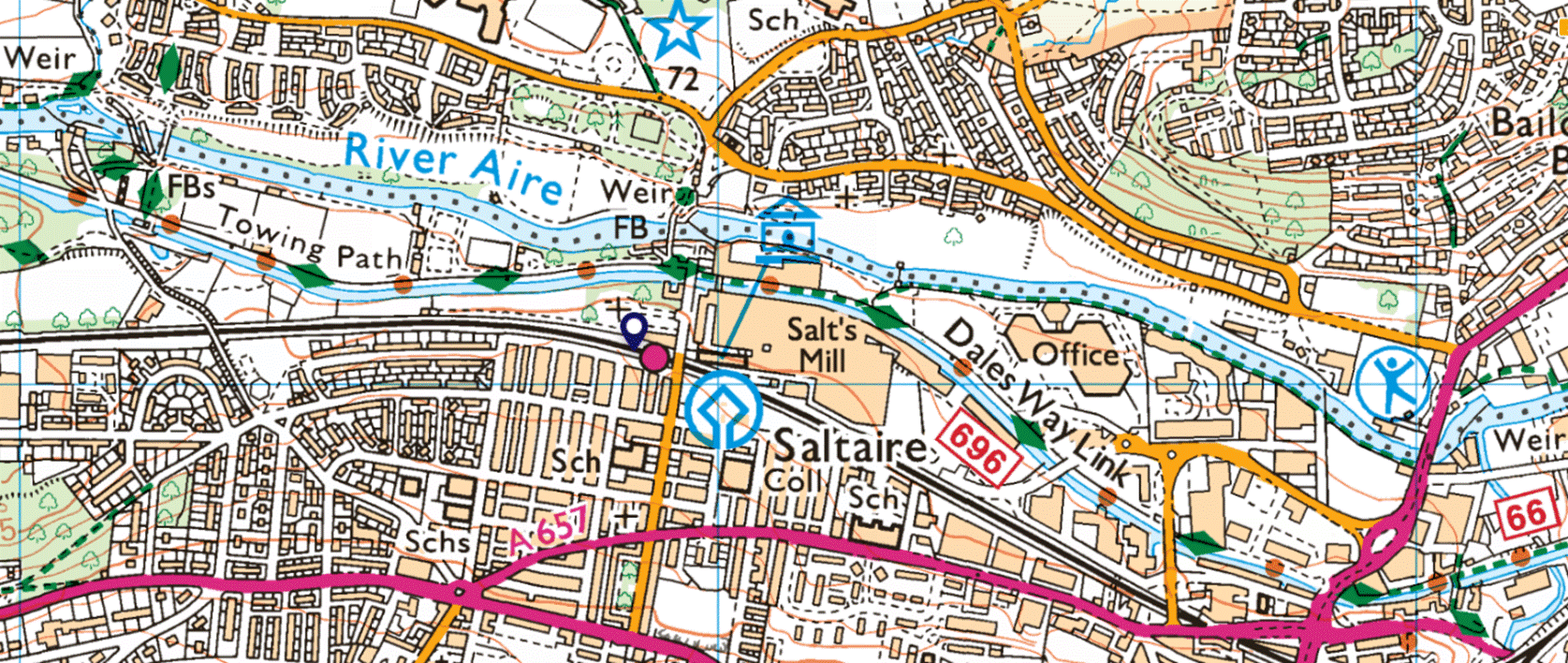
Salt’s Mill, Saltaire
A major employer
was Titus Salt who in 1833 took over the running of his father's
woollen business specialising in fabrics combining alpaca, mohair,
cotton and silk.
By 1850 he had
five mills. However, because of the polluted environment and squalid conditions
for his workers Salt left Bradford and transferred his business to Salts
Mill in Saltaire in 1850, where in 1853 he began to build the
workers' village which has become a UNESCO World Heritage site.
Worth Valley
Worth
Valley is a ward in the City of Bradford. It is named after
the River Worth that runs through the valley to Keighley.
The Valley
contains the Keighley villages
of Oakworth, Oldfield, Haworth, Cross
Roads, Oxenhope and Stanbury; areas of farmland; and large
expanses of moorland.
Its attractive villages, particularly Haworth and its Pennine
landscape are at the heart of Brontë Country. The Brontë Sisters,
lived in the village of Haworth - Anne. (1820–1849), Novelist; Charlotte,
(1816–1855), Novelist; Emily, (1818–1848), Novelist; Branwell Brontë,
(1817–1848), painter and poet; Rev Patrick Brontë, (1777–1861), clergyman
and writer
The Worth Valley
has the Keighley and Worth Valley heritage railway running
through it from Keighley to Oxenhope and has been used in several films,
including The Railway Children.
Clayton
The village of
Clayton lies three miles west of Bradford. Claitone
probably derives from claeg meaning clay and tun,
meaning farmstead, and so meant farmstead on clay. The village was privately
owned from 1160 to 1866 when a local board was formed to manage the village.
During the 1870s "the wells", on the central village roundabout, was
used as a site for open air preaching
Since the
eighteenth century hand loom weaving and spinning had been carried out in the
homes of the villagers, as had shoe making and mending.
During the
nineteenth and early twentieth centuries, Clayton's main industry was worsted
manufacturing. Alfred Wallis, Asa Briggs and Joseph Benn were the principal
manufacturers at Oak Mills and later Joseph Benn and Sons at Beck Mill.
Other businesses
included quarrying, coal mining, brewing and maltsters and Clayton Fireclay
Works, owned by Julius Whitehead at Hole Bottom.
In the centre of
the village is Victoria Park, which was opened on 23 July 1898 on land that had
previously been the village green. The opening by Asa Briggs J.P. attracted a
large crowd and the park became a popular meeting place.
Clayton was well
served by public transport from the late nineteenth century. In October 1874
the Great Northern Railway opened to Clayton, followed in October 1878 by the
Bradford – the Keighley and Halifax lines.
The population
has increased from 2,040 in 1801 to over 9,000 by 2005.
Bradford Timeline
1616
A constable of
Bradford is mentioned in 1616 (Victoria County
History – Lancaster, A History of the County of Lancaster: Volume 4 Townships:
Bradford).
1666
The hearth tax return of 1666 gave a total of
twenty-seven hearths; the largest house was that of Edward Charnock with five
hearths (Victoria County
History – Lancaster, A History of the County of Lancaster: Volume 4 Townships:
Bradford).
1780
The population of
Bradford was about 4,500.
1788
Blast
furnaces were established in about 1788 by Hird, Dawson Hardy at Low
Moor.
1801
In 1801, Bradford
was a rural market town of 6,393 people, where wool spinning and
cloth weaving was carried out in local cottages and farms. Bradford was thus
not much bigger than nearby Keighley, with a population of 5,745 and was
significantly smaller than Halifax which had a population of 8,866
and Huddersfield. Bradford was then a hub for three nearby townships
– Manningham, Bowling and Great and Little
Horton, which were separated from the town by countryside.
1825
The population in England grew from 8.6M in 1801 to 17M in 1851,
about 98%. The urban population tripled in the same period. In the 1820s alone
London doubled, Bradford grew 78%.
In 1825 the
wool-combers union called a strike that lasted five-months but workers were
forced to return to work through hardship leading to the introduction of
machine-combing.
1833
Titus
Salt took over the running of his father's woollen business specialising
in fabrics combining alpaca, mohair, cotton and silk.
1841
The population of
the township in 1841 was 34,560.
1844
A permanent
military presence was established in the city with the completion
of Bradford Moor Barracks in 1844.
Industrial
Revolution led to rapid growth, with wool imported in vast quantities for
the manufacture of worsted cloth in which Bradford specialised, and
the town soon became known as the wool capital of the world.
1847
Bradford became a
municipal borough in 1847 and received its charter as a city in 1897.
When the
municipal borough of Bradford was created in 1847 there were 46 coal mines
within its boundaries. Coal output continued to expand, reaching a peak in 1868
when Bradford contributed a quarter of all the coal and iron produced in
Yorkshire.
1850
Bradford had
ample supplies of locally mined coal to provide the power that the industry
needed. Local sandstone was an excellent resource for building the
mills, and with a population of 182,000 by 1850, the town grew rapidly as
workers were attracted by jobs in the textile mills.
By 1850 Titus
Salt had five mills. However, because of the polluted environment and squalid
conditions for his workers Salt left Bradford and transferred his business
to Salts Mill in Saltaire in 1850, where in 1853 he began
to build the workers' village which has become a UNESCO World Heritage
site.
1854
A desperate
shortage of water in Bradford Dale was a serious limitation on
industrial expansion and improvement in urban sanitary conditions. In 1854
Bradford Corporation bought the Bradford Water Company and embarked on a
huge engineering programme to bring supplies of soft water from Airedale,
Wharfedale and Nidderdale. By 1882 water supply had radically
improved.
1868
Widening the
franchise in 1867 began years of electoral corruption and a gilded age of
bribery. A common practice was to hire ‘committee’ rooms’ in public houses with
free refreshments and cash for expenses. Electoral turnout could be encouraged uyp to 90%. The Liberal candidate for Bradford in 1868 hired rooms in 158 pubs and
spent £7,000 (well over £1M today).
1880
Henry
Ripley was a younger contemporary of Titus Salt. He was managing partner
of Edward Ripley & Son Ltd, which owned the Bowling Dye Works. In 1880 the
dye works employed over 1000 people and was said to be the biggest dye works in
Europe. Like Salt he was a councillor, JP and Bradford MP who was deeply
concerned to improve working class housing conditions. He built the
industrial Model village of Ripley Ville on a site in Broomfields, East Bowling close to the dye works.
Samuel
Lister and his brother were worsted spinners and manufacturers
at Lister's Mill (Manningham Mills). Lister
epitomised Victorian enterprise but it has been suggested that
his capitalist attitude made trade unions necessary.
Unprecedented
growth created problems with over 200 factory chimneys continually churning out
black, sulphurous smoke, Bradford gained the reputation of being the most
polluted town in England.
There were
frequent outbreaks of cholera and typhoid, and only 30% of children born to
textile workers reached the age of fifteen. This extreme level
of infant and youth mortality contributed to a life expectancy for
Bradford residents of just over eighteen years, which was one of the lowest in
the country.
1890s
Meanwhile, urban
expansion took place along the routes out of the city towards the Hortons and
Bowling and the townships had become part of a continuous urban area by the
late nineteenth century.
1893
The Independent Labour Party
was founded in Bradford, a non Marxists Socialist party. It attracted future
politicians including James Keir Hardie and James Ramsay MacDonald.
The city played
an important part in the early history of the Labour Party. A mural on the back
of the Bradford Playhouse in Little Germany commemorates
the centenary of the founding of the Independent Labour Party in
Bradford in 1893.
1900
Iron was worked
by the Bowling Iron Company until about 1900. Yorkshire iron was used
for shackles, hooks and piston rods for locomotives, colliery cages and other
mining appliances where toughness was required.
1916
The Bradford
Pals were three First World War Pals
battalions of Kitchener's Army raised in the city. When the
three battalions were taken over by the British Army they were officially named
the 16th (1st Bradford), 18th (2nd Bradford), and 20th (Reserve)
Battalions, The Prince of Wales's Own (West Yorkshire Regiment).
On the morning of
1 July 1916, the 16th and 18th Battalions left their trenches in Northern
France to advance across No Man's Land. It was the first hour of the First
day of the Battle of the Somme. Of the estimated 1,394 men from Bradford and
District in the two battalions, 1,060 were either killed or injured during the
ill-fated attack on the village of Serre.
Other Bradford
Battalions of The Prince of Wales's Own (West Yorkshire Regiment) involved in
the Battle of the Somme were the 1st/6th Battalion (the
former Bradford Rifle Volunteers), part of the Territorial Force,
based at Belle Vue Barracks in Manningham, and the 10th
Battalion (another Kitchener battalion). The 1/6th Battalion first saw
action in 1915 at the Battle of Aubers Ridge before moving north to
the Yser Canal near Ypres. On the
first day of the Somme they took heavy casualties while trying to support
the 36th (Ulster) Division. The 10th Battalion was involved in the
attack on Fricourt, where it suffered the
highest casualty rate of any battalion on the Somme on 1 July and perhaps the
highest battalion casualty list for a single day during the entire war. Nearly
60% of the battalion's casualties were deaths.
The 1/2nd and
2/2nd West Riding Brigades, Royal Field Artillery (TF), had
their headquarters at Valley Parade in Manningham, with batteries at
Bradford, Halifax and Heckmondwike. The 1/2nd Brigade
crossed to France with the 1/6th Battalion West Yorks in April 1915. These
Territorial Force units were to remain close to each other throughout the war,
serving in the 49th (West Riding) Division. They were joined in 1917
by the 2/6th Battalion, West Yorks, and 2/2nd West Riding Brigade,
RFA, serving in the 62nd (2nd West Riding) Division.
1929
The Low Moor
Company also made pig iron and the company employed 1,500 men in
1929.
1974
Following local
government reform in 1974, city status was bestowed upon
the City of Bradford metropolitan borough.
Bibliography