Doncaster
Historical and geographical information
|
Return to the Home Page of the Farndale Family
Website |
The story of one family’s journey through two
thousand years of British History |
The 83 family lines into which the family is divided.
Meet the whole family and how the wider family is related |
Members of the historical family ordered by date of
birth |
Links to other pages with historical research and
related material |
The story of the Bakers of Highfields, the Chapmans,
and other related families |
Hyperlinks to
other pages are in dark
blue.
Headlines of the history
of the Doncaster are in brown.
References and
citations are in turquoise.
Contextual
history is in purple.
This webpage about
the Doncaster has the following section headings:
·
The
Farndales of Doncaster
·
The History
of Doncaster
· Doncaster Timeline
See also the History of the Parish of Doncaster and Loversall and Campsall.
The Farndales of
Doncaster
The following
Farndales are associated with Doncaster:
(Sir) William
Farndale (FAR00038), was Vicar of Doncaster between about 1396 and 1403. We
first see his name in a grant of land in Latin by Walter de Thornton, the vicar
of Doncaster, and Wm de Farndell, his chaplain on 11 April 1355. Perhaps
William may have been about twenty then, so perhaps he was born in about 1335.
The Black Death had ravaged Doncaster from about 1349, and its population had
been reduced to about 1,500. So William must have survived the Black Death.
Perhaps he was already a chaplain then, experiencing the horrors with pastoral
responsibilities. Or perhaps it was his survival of those horrors that was his
path to the church. We then spot him again in the patent rolls
of 1358. On 7 December 1368, Robert Ripers transferred five acres of land at Lovershall (just south of Doncaster) to Sir William
Farndale, still chaplain. The term ‘sire’ was used as an address to religious
men such as priests, it does not denote a knight. ‘Know men present and to
come that I Robert Ripers of Loversall have given, granted, and by this my
present charter confirmed to Sir William Farndale, chaplain, 5 acres of land
with appurtenances lying in the fields of Loversall, extending from the meadows
of the Wyke to the Kardyke, of which 1 acre 1 rood
lie in Wykefield between the land of Robert son of
John son of William, son of Robert on both sides. And 2 1/2 acres lying in the Midelfild between my own land on the west and the land of
Richard son of Robert on the east. And 1 rood lying in Wodfild
between my own land on the west and the land of John of Wakefield on the east.
To have and to hold the said 5 acres of land with appurtenances to the said
William and his heirs and assigns, freely, quietly, well and in peace, from the
chief lords of the free by the services then owed and customary by right. And
I, said Robert, and my heirs, will warrant the said 5 acres with appurtenances
to the said Sir William, his heirs and assigns against all men for ever. In
witness whereof I have affixed my seal to this present charter. These being in
witness; Sir John of Loversall, Chaplain; William Vely, Robert Clerk, Richard
Rilis, John son of William son of Roger and others. Given at Loversall on
Thursday after the Feast of St Nicholas, 42 Edward III. (7 Dec 1368).’ Sir
William Farndale then became the Vicar of Doncaster from 8 January 1397 (aged
about 61) to 31 August 1403 (aged about 68) when he resigned.
William transferred his land at Lovershall
to John Burton in 1402; “‘Know men present and to come that I, William
Farndalle, Vicar of the Church of Doncastre, have
given, granted and by this present charter confirmed to John Burton of Waddeworth, his heirs and assigns 5 acres of land with
appurtenances lying in the fields of Loversall. Viz, those 5 acres of land
which I had as gift and feoffment of Robert Ryppes of Loversalle
and which extend from the meadows of the Wyke to the Kardyke
as the charter drawn up for me by Robert Ryppes more fully sets out. To have
and to hold the said 5 acres of land with appurtenances to the said John
Burton, his heirs and assigns from the chief of the lords of the fee by the
services thence owed and customary by right. And I William Farndalle and my
heirs will warrant the said 5 acres of land with appurtenances to the said John
Burton, his heirs and assigns against all men for ever. In witness whereof I
have affixed my seal to this present charter. These being witnesses; John Yorke
of Loversalle, Robert Oxenford of Loversalle,
William Ryppes of the same, John Millotte of the same, William Clerk of the
same and many others. Given at Loversalle 6 April 3
Henry IV. (6 April 1402).”
In 1403 we see the installation of William Couper as the vicar of
Doncaster, on William Farndale’s resignation.
On 29 October 1564 a wedding took place
between a William
Farndell and a Margaret Atkinson in the Church of St Magdalene in the
village of Campsall, which is only a few miles north of Doncaster. So on a
balance of probabilities, it seems more likely than not that William Farndell
who married in 1564 came from the same line of Farndales as William Farndale,
the vicar of Doncaster. There must have been a generation or two between them.
It is possible that William the Younger was descended from a brother of William
the Elder, or perhaps he was a direct descendant.
It is believed that Nicholas Farndale (FAR00059)
and Agnes Farndale (FAR00060),
who both died in Kirkleatham, were born in Campsall or thereabouts, around
Doncaster, perhaps in about 1512 and 1516 respectively. If so, they were likely
descended from William Farndale (FAR00038),
the Vicar of Doncaster, or at least from his wider family (his brother
perhaps). William Farndale junior (FAR00063)
was born in say 1538, and Jean Farndale (FAR00064)
in say 1540 to Nicholas and Agnes. William Farndale married Mary Atkinson at
the Church of St Mary Magdalene in Campsall in 1564. Between 1564 and 1567, the
family moved to Kirkleatham. We don’t know why. Maybe that was Agnes’ ancestral
home. Perhaps more likely Jean had met Richard Fairly, a relatively well
established fellow, whose family were Scottish, but who had more recently
become associated with Cleveland and Kirkleatham. Perhaps the family saw
opportunities by a move north. On 16 October 1567, Jean married Richard Fairley
in Kirkleatham. The family lived generally at Kirkleatham until Nicholas and
Anne’s death in 1572 and 1586, though William had by then realigned slightly
eastward, to Skelton. This established the family tree
for the Doncaster-Kirkleatham-Skelton
Line of Farndales.
Others associated
with Doncaster were William Farndale (FAR00063);
Thomas Farndale (FAR00474);
James Farndale (FAR00669)
who worked in animal husbandry and served with animals in both world wars.
The History of
Doncaster
The Deanery of Doncaster is one of three historic divisions of the
old West Riding of Yorkshire. This is an area rich in coal and iron. Modern Doncaster is
strongly characterised by its industrial past. However the Doncaster of
relevance to the history of the Farndale family was a very different place.
It was the place of a significant Roman Fort. After the Norman
Conquest, Nigel Fossard had built a Norman Castle. By
the thirteenth century, Doncaster was a busy town. In 1194 Richard I had given
the town recognition by bestowing a town charter. There was a disastrous fire
in 1204 (fires seem to feature heavily in Doncaster’s history) from which the
town slowly recovered.
In 1248, a charter was granted for Doncaster Market to be held in
the area surrounding the Church of St Mary Magdalene, which had been built in
Norman times. But over time the parish church was transferred to the church of
the old Norman castle, the castle which by then was in ruin. The new parish
church was the
original Church of St George. During the 14th century, large numbers
of friars arrived in Doncaster who were known for their religious enthusiasm
and preaching. In 1307 the Franciscan friars (Greyfriars) arrived, as did
Carmelites (Whitefriars) in the mid-14th century. Other major medieval features
included the Hospital of St Nicholas and the leper colony of the Hospital of St
James, a moot hall, a grammar school and a five-arched stone town bridge with a
chapel dedicated to Our Lady of the Bridge.
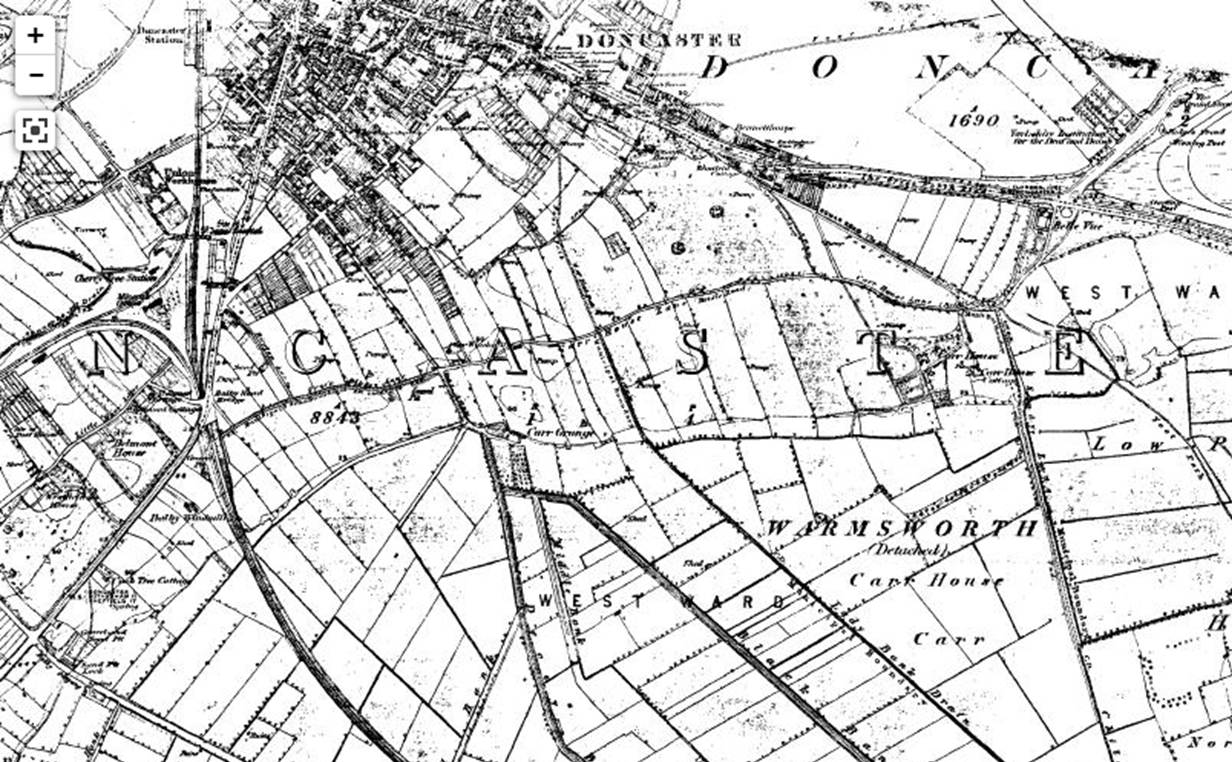
Doncaster 1857
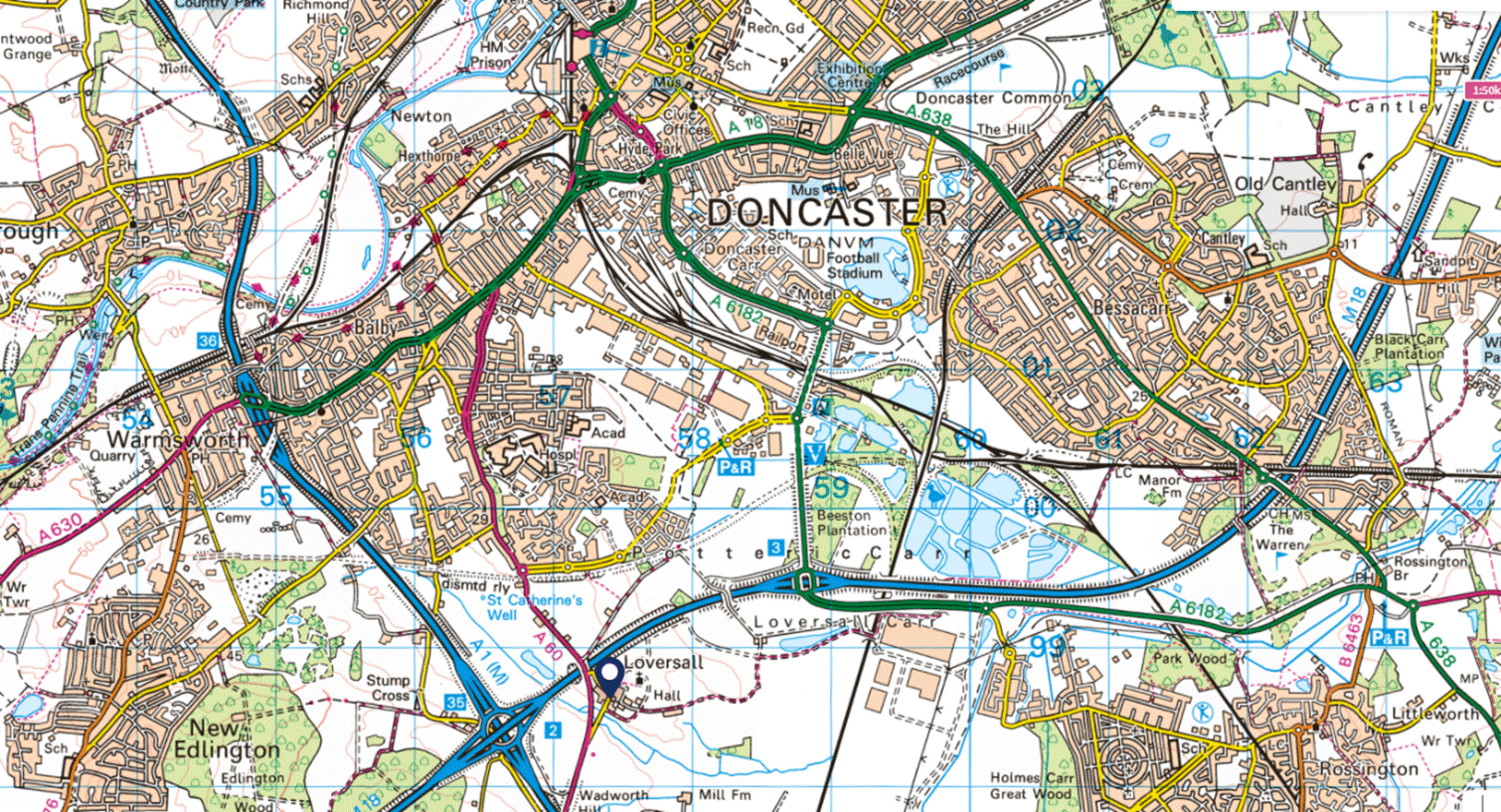
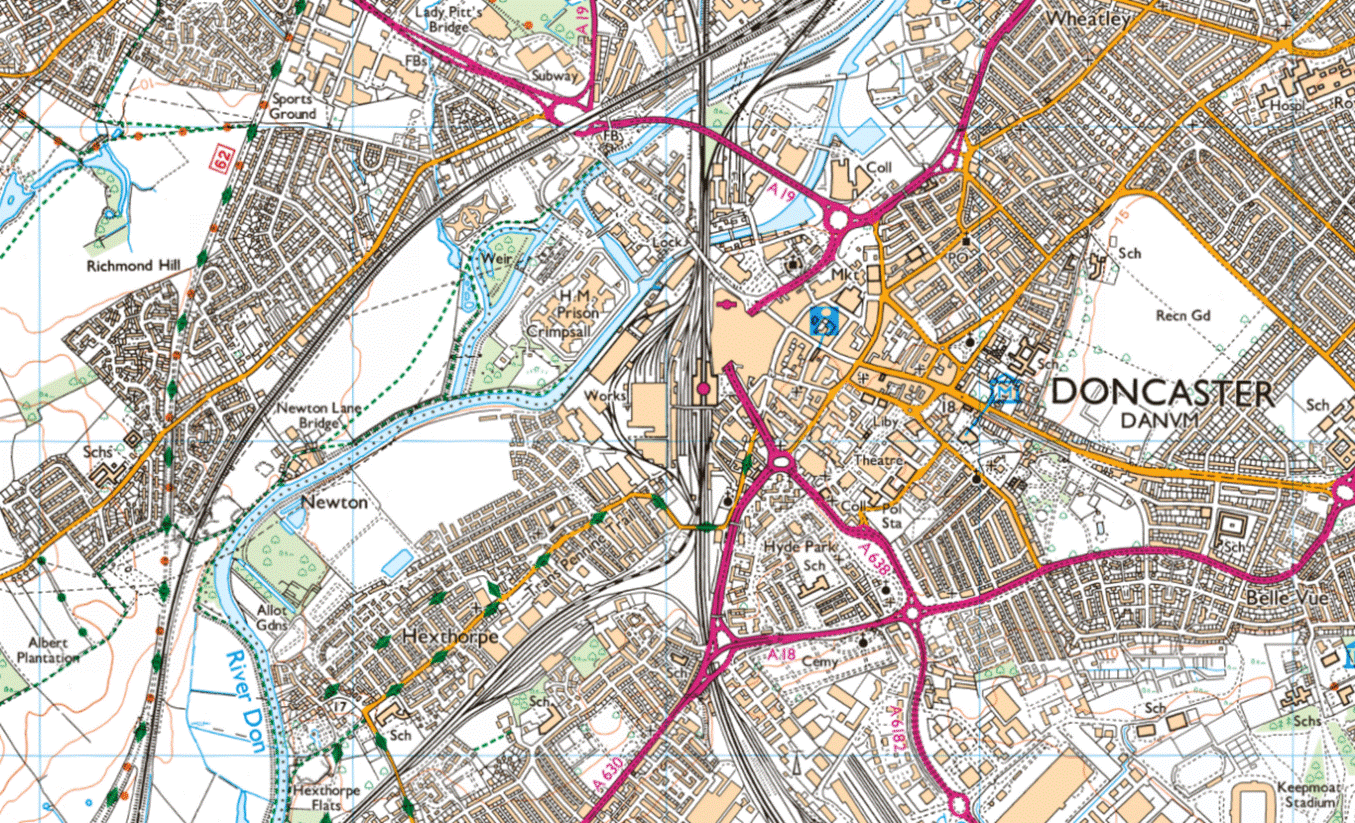
The first element of the name Doncaster may be
the direct descendant of the Celtic form of Danum, the official Roman name of
the place, and A. H. Smith in his brief discussion seems to assume this. The
river name is of course of British (ie. Celtic) or
earlier origin, a Dana, and was the source of Danum, the name of the fort.
However, there are examples (Colchester, Lancaster) where a river-name of
pre-English origin was affixed to the Old English word caester
meaning ‘a Roman fort’, but where the river in question had not supplied the
Romano-British name of the place. Hence continuity of name cannot be proved,
though the survival of Cair Daun in Welsh tradition
makes it likely. The forms Donacester (Symeon) and Donacestir (Howden) have the status of late copies of good
Old English spellings and a such should be added to the list given by Smith.
Clearly Doncaster had the ancestor of its present name in the English speech of
the eighth century". (Some
Notes on the pre-Norman History of Doncaster,
M S Parker, Yorkshire Archaeological Journal, Volume 59, 1987, page
41).
Doncaster Timeline
The true origin of Doncaster is evidently to
be found in the necessity for some means of crossing the Don at this place. The
sixteenth century historian, John Leland,
wrote I marked that the North parte of Dancaster tonne standith as an
isle: for Dun river at the West side of the towne castith oute an arme, and sone
after at the Este side of the town cummith into the
principal streame of Dun again. The fluvial
islands probably attracted early settlement and the islands might have been the
home of the ferry man. The island and the relatively low banks might have been
the best place for a road to cross in time. (South
Yorkshire, the History and Topography of the Deanery of Doncaster in the
Diocese and County of York by Rev Joseph Hunter, 1828, page 1).
The Don was the
approximate southern boundary of the Celtic, Brigantes, dividing them from the Coritani to the south. At the passage over the Don where
Doncaster now stands, it is probable that the Brigantes had a settled residence
(South Yorkshire, the
History and Topography of the Deanery of Doncaster in the Diocese and County of
York by Rev Joseph Hunter, 1828, page iii).
43 CE
From the year 43
CE, Roman influence had transformed the way of life of people in southern and eastern
Britain. The emperor Claudius commanded a force of some 40,000 men, with
elephants to boot. They were grouped into four legions supported by
auxiliaries.
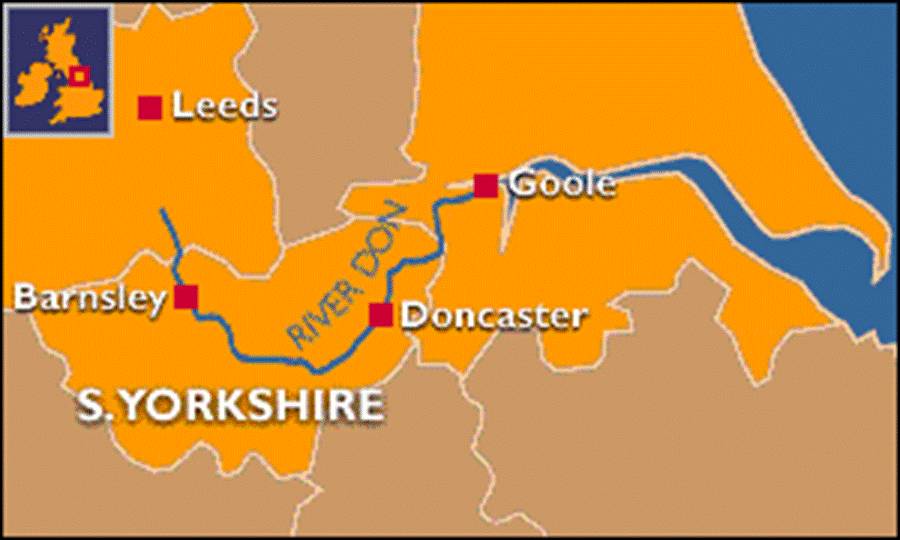
Initially
the Romans did not venture north of the line of the Humber and Don, but traded
with the Parisii, though the Brigantes generally remained hostile.
54 CE
The Romans built a series of advanced forts at Derby, Templeborough and Castleford to support Cartimandua, the
Brigantes’ Queen. The rectangular fort at Templeborough
stood on the south bank of the Don, about 12 miles southwest of the site of
modern Doncaster, where Rotherham now stands. 800 soldiers of the 4th
Cohort of Gauls were stationed there until 69 CE, after which Venutius overthrew the Brigantes queen. This led to the
Romans consolidating their position by moving the Ninth Legion from Lincoln to
York in 71 CE. At Templeborough the timber fort was
replaced with a new sandstone fort. (The Making of
South Yorkshire, David Hey, 1979, p13).
71 CE
In 71 CE the
newly appointed Roman Governor, Petillius Ceralius marched north to occupy
Brigantes and Parisii territory. The Ninth Legion perhaps
erected a large camp near where Malton, northeast of York, stands today.
A
significant military camp was founded by the Romans as Eboracum (modern day York) in 71 CE.
The passage over the Don at the Doncaster site would require
protection. This was also the site of the limit of inland navigation for
coastal vessels. The local of the modern St George’s Minster was favourable for
a Roman castrum. The establishment of a castrum and a company of
soldiers was an inducement to settlers.
A fort at Danum
(modern Doncaster) was established soon after 70 CE and was large, stretching
to about nine and a half acres, with timber buildings and a cobbled road. This
original fort was abandoned at the time of the building of Hadrian’s Wall in
122 CE and rebuilt on a smaller scale from 160 CE, then stretching to about
5.85 acres surrounded by a stone wall which was 8 feet wide. (The Making of South Yorkshire, David Hey, 1979, p13).
More substantial settlement on the Doncaster site grew up around
the Roman fort known as Danum of the 1st century CE. This was within the
Roman province of Maxima Caersariensis. Strictly Danum
was the Roman name for the river and the Roman’s referred to the place as Castrum
ad Danum. Around Roman Danum emerged building to the south side of the
river, based on the favoured plan of two streets intersecting at right angles.
The town was thus divided into four quarters and the island in the Don. In one
quarter was the castrum and its praetorium (headquarters) and in another
quarter there would have been a market. There were two gates, the Sepulchre
Gate and Baxter Gate. Excavations in 1976 revealed that the civilian settlement
was much larger than originally thought.
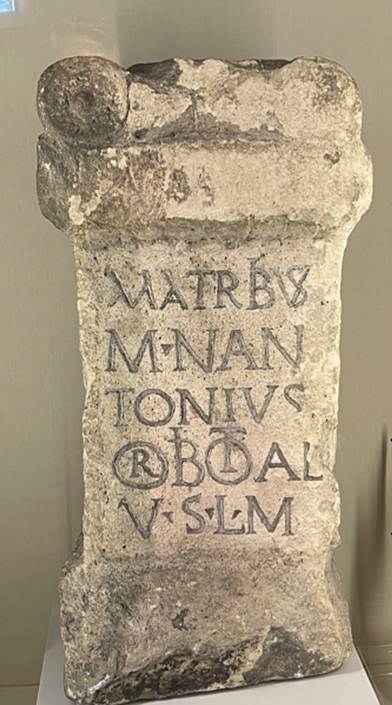
The Doncaster altar (to be seen today at the Doncaster library)
was found at the Sepulchre Gate and was inscribed To the Mother Goddess. Nonnius Antonius has freely and deservedly fulfilled his
vow. There have also been finds of a coin hoard and pottery and glass.
Danum rose where Icknield (or Ricknield) Street, which ran from Bourton to Eboracum
crossed the Don. The Romans adapted much of this road from a prehistoric route.
The main road from Lincoln approached Danum from the south with a minor
crossing at Rossington Bridge, just south of Doncaster, in the approximate area
of Loversall. There is considerable evidence of
Iron Age and Roman field systems in this area. The road then continued to cross
the Don at Danum. From Danum the road then continued joining the line of the A1
and passing near to Campsall, through the forest of
Barnsdale. (The Making of
South Yorkshire, David Hey, 1979, p14 to 16).
Four miles south of Doncaster and in the vicinity of the fort at
Rossington Bridge, the rich farm lands encouraged wealthy Roman Britons to
build their villa at Stancil, which was later the place of a medieval village.
A wide range of vessels have been found in this area which evidence trade as
far north as lowland Scotland.
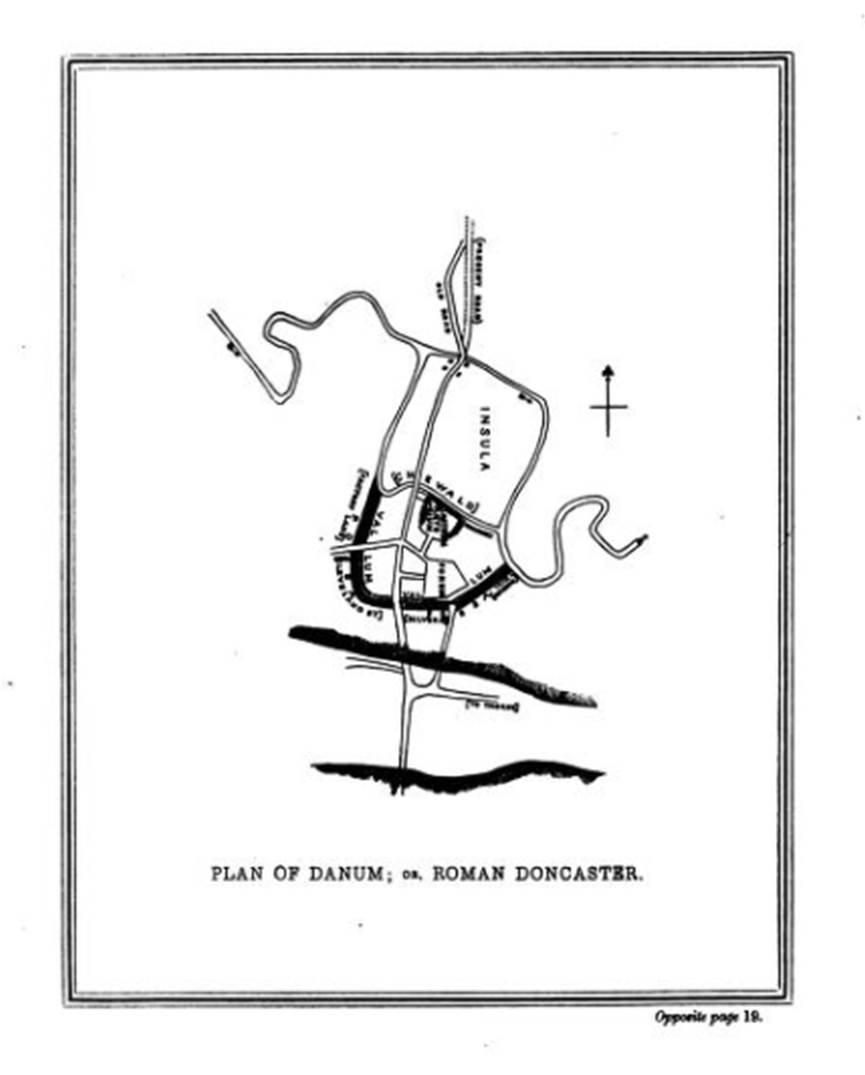
In Roman Doncaster, the present market-place
was in all probability used then for the same purpose that it is now. It would
also contain, as most Roman market-places did, the public Temple. At all
events, on whatever other site such Temple may have stood, it could hardly have
been on that of the Church of St. George; for, in the times of which we are
speaking, that site was unquestionably the true Castrum, or Pretorian Camp, a
military fortress, or barrack, enclosed within special defences of its own
(from Rev Jackson, History of the
ruined church of Mary Magdalene, 1853)
The Roman fort was regarrisoned and was occupied until at least 390
CE, towards the end of the Roman period. There seem to have been town defences
by the end of the Roman era.
I need not tell the reader that Danum was an
important military station on the great road from south to north (the remains
of which are locally designated “Roman-Rig”), that here was stationed a Prefect
of the Crispian Horse, or that here the Romans built their castrum , at the
junction of Don's triple arms, all this is matter of history. But I would give
prominence to the inference that on the site of a Roman town we may naturally
expect on any extensive excavation to discover more or less of ancient remains.
In St. Sepulchre-gate, about 200 yards from the “find” just described, was dug
up a Roman altar, dedicated to the Deae; Matres,
which inscribed stone is now deposited in the York Museum. I have myself
inspected some half dozen specimens of Roman art exhumed at Doncaster (several
of them noteworthy), but have a strong conviction that many interesting remains
are thrown up, and then re-buried or destroyed, with total disregard of their
merit or meaning. To the vulgar mind coins only are esteemed; but when of
bronze or brass, even these are thrown aside like a bad halfpenny. (A waif of Roman Danum,
John Tomlinson, Yorkshire Archaeological Journal, Volume 8, 1883, page 158 to 159).
Doncaster seems to have been quite an
important market centre in the late Roman period. Romano British internal trade
and transport are best evidenced by bulk products such as pottery, which was
carried on the river systems of the Humber Basin. Dalesware,
probably produced in the Scunthorpe district, was apparently shipped to
Doncaster along the Trent and the Old Don. From there it seems to have been
marketed, producing a characteristic secondary distribution pattern around the
market centre. The products of the Rossington kilns south of the town seem to
have been intended for exports to the military of the Northern Front frontier.
The Reason for Doncaster's importance must
have been its position at the highest point on the river Don, navigable to
coastal commercial traffic, and at a major road crossing. Certain Roman
settlements, for example near Torksey on the Trent
and at Broomfleet on the Ouse, seem to have been
industrial in character and engaged in the river trade. Doncaster may have
benefited further from its position on the river system, for it has been
suggested that it could have become a local capital, administering an area
centred in the Humber basin.
The Fort seems to have been re occupied in the
late 3rd or early 4th century, after a period of neglect, and at this time it
was defended with a stone wall. The mention of Doncaster as Danum in the
Antonine Itinerary may belong with this phase rather than with the earlier use
of the site. It is suggested that the vicus may have been walled in the late
Roman period. Doncaster was thus a defended site at the centre of an area of
intense agricultural exploitation including the Magnesian Limestone belt, the
planned landscapes south-east of the town and in a large area of
Nottinghamshire, and the Isle of Axholme, where
evidence of Romano-British settlement is now becoming more plentiful.
(Some Notes on the pre-Norman
History of Doncaster, M S Parker,
Yorkshire Archaeological Journal, Volume 59, 1987, page 29).
Sixth Century
As the end of the Roman occupation is
approached, the evidence becomes at the same time less plentiful and harder to
understand. In the later fourth century, the area of the Doncaster fort was
occupied by timber buildings arranged without any overall plan and spreading up
to its walls. The roads were neglected and deposits of black silt with bone and
pottery began to build up. Coin evidence ends around 390 AD. After the middle
of the fourth century the pottery industries east and south of the town ceased
to function, and at a similar date the planned landscapes of the Bunter
Sandstone went out of use. All this decline seems to have been complete by the
end of the Roman period and has not been explained, though if the Bunter
Sandstone land were ‘marginal’ and its use stimulated by the wealth of the
Trent and lower Don trade area, or equally if it had been a government project,
then the decline of the monetary economy would seem a likely cause.
Soon after the end of the Roman period markets
generally seem to have ceased to function in Britain, and towns as such no
longer existed, though some of them continued as important settlements through
being residences of Anglo-Saxon or native British kings or other leaders.
The English (ie Anglo-Saxons) had arrived by the later sixth century,
since the aceramic late or post-Roman occupation in the fort near St. George’s
church was succeeded by a structure with a hearth and a decorated sixth-century
Anglian sherd. A plain sherd of similar date was found in the same area, unassociated with a structure. Other early finds are a
Byzantine bronze follis of Anastasius (491-518) which may be a medieval or
modern loss and so irrelevant, and a banded green glass bead.
(Some Notes on the pre-Norman
History of Doncaster, M S Parker,
Yorkshire Archaeological Journal, Volume 59, 1987, page 31).
The Don became the boundary between Deirans (later the
Northumbrians) and the Mercians to the south.
The old Roman roads continued in use, but settlements tended to
develop in more secluded places, some distance away from the roads.
627 CE
From the seventh century onwards urban
settlements re-appeared though they were not numerous until the later
Anglo-Saxon period.
The earliest archaeological evidence for
English South Yorkshire has come from Doncaster itself, but is very slight. The
archaeology of the entire Anglo-Saxon period of the areas west of the Vale of
York and lower Trent valley is notoriously obscure, largely because the pottery
of the period appears to be very rare or absent in these areas. However, useful
historical references to Doncaster do exist, and suggest its re-emergence as a
town at the latest by the early tenth century, despite the fact that it has not
previously been considered as an Anglo-Saxon urban centre. There are four
pre-Norman historical references to Doncaster, three of them by name.
The first is the so called Historia Brittonum, attributed to Nennius, a ninth century compilation mainly
relating to the period of the Anglo-Saxon invasions, and of a variety of
origins. The context within Nennius’ work is a list of names of ‘the
twenty-eight cities in Britain’. Some of
the ancestors of these names are recorded in sources relating to Roman Britain,
but here they are given in forms appropriate to the Old Welsh language
of the ninth century. Thus Cair Daun for Doncaster is
the direct descendant of the Celtic form of Danum. This indicates that the
memory of these names had been preserved to some degree in an oral rather than
a written source, and no Celtic language can have been spoken near to some of
them for two or three hundred years. The figure twenty-eight is derived by
Nennius or his source from Gildas, the sixth-century Welsh author, and Bede,
neither of whom gives a list. Why Doncaster, which originated as a fort, should
have been included is uncertain, but if, as seems likely, its vicus was large
and even walled, the place may have
continued to be of some significance after the last time that the fort went out
of commission. The antiquity of the traditions behind the list is suggested by
the fact that many of the names in it were of places which were of little or no
importance by the time that Nennius wrote, and some of them are so obscure that
they have never been identified. The inclusion of Doncaster suggests that it
should be added to Faulks list of early royal sites in Yorkshire.
(Some Notes on the pre-Norman
History of Doncaster, M S Parker,
Yorkshire Archaeological Journal, Volume 59, 1987, page 31).
Edwin of Northumbria (586 to 633) was baptised in York about 15 years after the death of Augustine.
When Augustine came to Britain, he does not appear to have
attempted to bring his mission to Northumbria. However Edwin, King of
Northumbria, married the daughter of Ethelbert, the converted king of Kent and
it was agreed that she should freely exercise her religion. She was accompanied
by a zealous pupil of Augustine, Paulinus, and this provided the basis for
Edwin’s conversion. From that time, Paulinus was increasingly employed in
conversion across the region of Northumbria. One of the areas of Paulinus’ conversion
was on the banks of the Gleni and the Swale and at Campodonum
(South Yorkshire, the History and Topography of the
Deanery of Doncaster in the Diocese and County of York by Rev Joseph Hunter,
1828, page xiv, Bede’s Ecclesiastical
History, Chapter 9, 14).
Bede describes the catechizing and baptising of Paulinus
during times when he instructed crowds in Bernicia and in Deira. He often
followed river courses and baptised along the river Swale, where it flows
beside the town of Catterick and in Cambodonum,
where there was also a royal dwelling, he built a church which was
afterwards burnt down, together with the whole of the buildings, by the heathen
who slew Edwin [this was when Penda defeated Edwin at Hatfield in 633 CE].
In its place later kings built a dwelling for themselves in the region known as
Loidis. This altar escaped from the fire because it
was of stone, and is still preserved in the monastery of the most reverend
abbot and priest Thrythwulf, which is in the forest
of Elmet. (Bede’s Ecclesiastical History,
Chapter 14). Loidis is modern Leeds. Cambodonum has been interpreted as various locations
in the West Riding, but it probably derives from “Field of the Don” and is more
likely a reference to Doncaster.
So, it is likely that a church was erected in the place of modern
Doncaster at this time. If this is correct, then Paulinus also tells us that
Edwin had a royal residence (villa regia) at Campodonum.
The praetorium of the Roman Castrum might have been an ideal site for an
occasional royal residence. This would suggest that the church at Doncaster was
burnt down by Penda after the Battle of Hatfield Chase in 633 CE.
Bede’s work also suggests that a second Christian church, after
the church at York in 627 CE, was built in Doncaster under Paulinus’
supervision.
(South Yorkshire, the History and
Topography of the Deanery of Doncaster in the Diocese and County of York by Rev
Joseph Hunter, 1828, page 4 to 5)
Edwin
was killed by the pagan Penda of Mercia and Cadwallon from North Wales at the
heath field which probably took place at on Hatfield Chase, 10 km northeast of
Doncaster. It appears that Penda immediately attacked Doncaster and destroyed
the church, and probably the royal residence, as we don’t hear of Northumbrian
kings returning. However the altar was preserved in a monastery in the wood at Elmet,
around modern Leeds. There is a debate as to whether the site of the battle was
in fact in Nottinghamshire where a mass grave was found, but the marshy land of
Hatfield Chas is still generally regarded as the site of the battle.
After
the battle whilst Oswald revived Christian Northumbria two years later, this
part of the Kingdom was ruled over by the Mercians until Penda was killed in
654 CE when it reverted to Northumbrian rule.
Celtic
Christianity was much weaker in South Yorkshire, so it did not fall so clearly
into the debate that led to the Synod of Whitby between Roman and Celtic
traditions.
764 CE
In 764 the chronicler Symeon of Durham
in his Historia Regum groups York with London, Doncaster, and other places, repentino igne vastatae (destroyed by a
sudden fire). (A History of the County of York: the
City of York. Originally published by Victoria County History, London, 1961).
Multae urbes, monsteriaque,
atque villae, per diversa loca necnon
et regna, repentino igne vastatae sunt; verbi gratia, Stirburgwenta civitas, Homunic, Lundonia civitas, Eboraca
civitas, Donacester, aliaque
multa loca illa plaga concepit.
Many cities, towns, and villages, in different
places, as well as kingdoms, were destroyed by a sudden fire; for example, the
city of Stirburgwent, Homunich,
the city of London, the city of York, Doncaster, and many other places were
conceived by that plague.
There is evidence of fire in the area of the
Roman castrum, but these marks may have been the result of the devastation by
Penda.
The
second historical mention of Doncaster is found in Symeon of Durham’s Historia
Regum. This is a
collection of sources of various ages assembled in the twelfth century but with
its constituent parts left almost exactly as they were found. The oldest of
these parts is a chronicle of mainly Northumbrian events from 732 to 802 AD.
Independent versions of the annals preserved by Symeon exist in a text called
the Historia Post Bedam and in Roger of Howden’s chronicle. Through variously
altered, the early chronicle is an original record of contemporary authority
from about 750. Doncaster is mentioned in the entry for 764 AD:- “. . . in the
same year many towns (urbes), monasteries and
villages (villae) throughout various districts (loca) and indeed kingdoms, were suddenly devastated by
fire, for example Stretburg, Venta civitas, Homwic, Londonia civitas, Eboraca civitas, Donacester, and
it troubled many other places in that region, so that what is written might be
fulfilled — ‘the earth will be moved’”.
Although
Doncaster finds itself in exalted company with Strasbourg, Winchester,
Southampton, London and York as a victim of the year of fires, the chronicler
was not including an uninhabited ruin or a collection of huts huddling behind
grass grown Roman walls, but a functioning place of some importance, even if we
have no evidence to define it as a town in the strict economic, i.e.
commercial, sense. Doncaster was still the highest navigable point on the Don
and the lowest easy ford. It was probably these facts which determined the
nature of the final two references.
(Some Notes on the pre-Norman History of Doncaster, M S Parker, Yorkshire Archaeological Journal, Volume
59, 1987, page 32).
This was a time when Alcuin of York, in the Kingdom
of Charlemagne, was despairing of the fate of his homeland.
793 CE
The Viking attack
on Lindisfarne.
813 CE
Alfred of Beverly
recorded the destruction of the monastery at the mouth of the Don, which may
have been a reference to Doncaster – Monasterium
ad ostium Doni amnis precaverunt,
sed non impune; “They
prayed to the monastery at the mouth of the river Don, but not with impunity”.
833 CE
By 833 CE the
Danes were dominating the lands around the Humber estuary. King Ecgbert of
Wessex had some success in resisting the Danes and appears to have had some
success in a battle at Doncaster. The story of this encounter was told in the
thirteenth century in a rhyme by Peter Langtoft, an Augustine canon and
chronicler from the village of Langtoft in the East Riding of Yorkshire.
What
did king Egbriht? Without any summons.
And
withouten asking of Erles or barons …
…Right
unto Doncastre ye Danes gan
him chase …
… At Donkastre mot men se manyon to batale ride …
(South Yorkshire, the History and Topography
of the Deanery of Doncaster in the Diocese and County of York by Rev Joseph
Hunter, 1828, page 6)
866 CE
In 866 CE, when
Northumbria was internally divided, the Vikings captured York.
The Danes changed the Old English name for York from Eoforwic, to Jorvik. The Vikings
destroyed all the early monasteries in the area and took the monastic estates
for themselves. Some of the minster churches survived the plundering and
eventually the Danish leaders were converted to Christianity. Jorvik became the
Viking capital of its British lands and it would reach a population of 10,000.
Jorvik became an important economic and trade centre for the Danes. Saint
Olave's Church in York is a testament to the Norwegian influence in the area.
Jorvik perhaps prospered from its trade with Scandinavia.
The skeleton of a
first generation Scandinavian woman was found at Adwick-le-Street
just north of Doncaster, aged about 33 years. She was wearing the clothes of
a free born Scandinavian, consisting of a full length chemise under a strap
dress which was held in place by two tortoise shaped brooches. Dr Paul Budd of
Durham University was able to carry out stable isotope analysis of her tooth
enamel. This technique allows scientists to pinpoint where a person grew up,
because tooth enamel ceases to be formed after the age of 12, and while it is
being laid down, it incorporates certain characteristics of the local water,
which can in turn be mapped using modern sources of information. Paul showed
that the woman with the two brooches spent her childhood in Norway, possibly in
the Trondheim area. She had been given a pagan burial with grave goods that
included a bronze bowl, an iron knife and a latchkey, a symbol that she was a
married woman. The find is evidence of women travelling long distances. (Britain in the Middle Ages, An Archaeological History, Francis Pryor, 2007, page 100).
The invasion of
South Yorkshire seems to have been made by Guthrum from the East Midlands. A
number of settlements in the lower Don valley have Scandinavian names.
Late Saxon Period
Modern Doncaster is generally identified with Cair Daun listed as one of 28 British cities
in the Ninth century History of the Britons traditionally
ascribed to Nennius.
It
was certainly an Anglo-Saxon burh, and in that period received its
present name: Don (Old English: Donne) from the settlement and river and
caster (ceaster) from an Old English
version of the Latin castra (military camp; fort).
The
area of modern Doncaster was likely not open land, but forested until it
started to be cleared in the late Saxon period. It has been described as the
Great Brigantian Forest. At some stage perhaps from
late Saxon times, areas were cleared for settlement in the process called
assarting. The growth of population and villages, including Campsall and Loversal, by the time of Edward the Confessor suggest
that assarting had been pursued vigorously by that time (South Yorkshire, the History and Topography of the
Deanery of Doncaster in the Diocese and County of York by Rev Joseph Hunter,
1828, page ix).Joseph Hunter lists 170 vills
of human settlement by the late Saxon period. He suggested that settlement
might have been influenced by the need to cross a watercourse, but often may
have been the inclination of a family to settle on land, which larger grew into
a larger habitation. However he recognises that this informal process was soon
replaced by recognition of rights of occupancy from the lands of the elite
class who owned large estates. It therefore ceased to be open to every citizen
to clear woodland for his own use, but by the Doomsday record, a right had been
recognised in overlordship.
Thus
Saxon lords came to surround themselves with dependents who held portions of
land from him, in return for rendering services. This is reflected in culture
such as Beowulf, which provided an encouragement to live
within the protection of the elite class, as protection against the perils of
unsettled places.
1003
It
was Conisbrough, within the modern city of Doncaster,
which appeared as the dominant estate in Anglo-Saxon and Viking South
Yorkshire. It was mentioned in the 1003 will of Wulfric Spott, a wealthy
Mercian nobleman who founded Burton Abbey. By the Conquest it was owned directly
by Harold. It was then the centre of a large former royal estate which reached
to Hatfield Chase. Conigsborough was head of an
extensive fee. The Saxon lords of Doncaster, Laughton and Hallam also had many
dependencies. It was also an early ecclesiastical centre.
Dadesley (now Tickhill) and Doncaster emerged as
burgesses. Other centres were emerging including Campsall,
which was valued at £5 in a census of Edward the Confessor, being one of the
larger settlements.
The
larger seats of population came to be governed under the authority of a bors holder who was elected at a general
assembly. Townships were grouped in tens under a hundreder,
a superior officer who held courts. These hundreds came to be called wapentakes
in the areas to the north. Doncaster came to fall within the wapentake of
Strafford. Doncaster and Loversall fell
within the Wapentake of Strafford. Campsall fell
within the Wapentake of Osgodcross.
(South Yorkshire, the History and Topography of the
Deanery of Doncaster in the Diocese and County of York by Rev Joseph Hunter,
1828, page xi).
Anglo-Saxon
Doncaster is last mentioned by name in the will of Wulfric Spott (1002-4 AD),
when it was the centre of an estate which is not otherwise described. The will
records that Wulfric bequeathed his Doncaster property to a certain Morcar, who is also mentioned in the Anglo-Saxon Chronicle
under 1015:- “In this year there was a great council at Oxford, and it was
there that Ealdorman Eadric betrayed Siferth and Morcar, the chief thegns belonging to the Seven Boroughs,
by enticing them into his chamber, where they were basely done to death. The
king (Aethelred the ‘Unready’) then confiscated all their property, and ordered
Siferth’s widow to be seized and brought to Malmesbury. Then after a short
while, Prince Edmund came and abducted the woman against the king’s will, and
made her his wife. Then before the nativity of St. Mary (8 September), the
prince proceeded from the west and went north to the Five Boroughs, and
thereupon seized all the property of Siferth and Morcar and all the people submitted to him”.
The Five
Boroughs were a group of north-east midland towns fortified by the Danes.
They are mentioned a few times in the Anglo-Saxon Chronicle and in sources
dependent on it, and we gather that they were Derby, Nottingham, Leicester,
Stamford and Lincoln. These boroughs (burh is the ancestor of the word
‘borough’ but in this context denoted a large fort or a fortified town) are
supposed to have been centres for the Danish armies of the period of
settlement, from the late ninth century onwards, although they are not
mentioned with this title until the mid tenth. Apart
from the Chronicle references we are almost entirely ignorant of the Five
Boroughs and their organisation. It is possible that the counties of Leicester,
Nottingham and Derby came into being as the areas dependent on the armies based
at those places.
Stenton
suggested that one was Torksey (a Domesday ‘borough’,
though in Domesday studies the word does not have the same meaning) and the
other ‘presumably York’. But since we suspect that Doncaster was something of a
town in the eighth century, and given that there is a concentration of Danish
place-names in its vicinity, and that the site was refortified in the manner
characteristic of other burh sites at the right period (below), inspiring the
use of the word burh on that ground alone, and that Morcar,
who held land in these ‘Seven Boroughs’ at the time of his death, had inherited
the Doncaster estate of Wulfric Spott just ten years before, we would be
perverse not to accept that Doncaster was part of the property involved in this
story, and one of the Seven Boroughs mentioned in it.
Further
proof is provided by a less reliable reference, the second of two mentions of
Doncaster in the French verse chronicle of the Yorkshireman Peter Langtoft
(composed c. 1307), which draws on late and legendary material. There seems to
be local information in his slightly garbled account of 1014-16. He supposes
that Eadric Streona, Earl of Mercia, the treacherous advisor to Aetheldred the
‘Unready’, who is mentioned in the Chronicle passage (above), had privately
arranged the deaths of Siferth and Morcar. He says that Siferth’s wife was captured at
Manchester, whereas the Chronicle only tells us that she was brought to king
Aethelred. His next statement, that Edmund Ironside then expelled Earl Eadrich
from the lands of the ‘two brothers’, corresponds to the Chronicle mention of
Edmund’s move to the territory of the Five Boroughs and seizure of Siferth’s and Morcar’s lands.
Next he mentions Aethelred’s illness. According to the Anglo-Saxon Chronicle
Cnut arrived in England at this time, and Edmund, who was still in the north,
gathered forces to join with Eadric in resisting him, but they soon divided.
Eadric with forty ships went over to Cnut. Cnut’s forces harried in the north
in 1016; before that he had been in the south and midlands.31 Langtoft telescopes
this information, placing Cnut’s arrival later so as to make the infamous Earl
Eadric’s defection immediate and more treacherous: Eadric invites Cnut, who
arrives as his ally.
“Cnut
and Earl Eadric have taken by treason Buckingham and Bedford, the town of
Huntingdon, Lincoln and Nottingham, the tower of Northampton, they go from
Doncaster as far as Alverton”.
If
this is right and the two narratives may be combined, Doncaster must have
remained in the hands of Edmund and his supporters until 1016, when it passed
to Cnut during the campaign mentioned in the Chronicle. It is interesting that
there is a mention of Doncaster in a late version of the story which, as I have
argued, contains a disguised reference to the town. However, Langtoft’s muddled
account was written almost three centuries after the date to which it refers
and could not be relied on alone.
(Some Notes on the pre-Norman
History of Doncaster, M S Parker,
Yorkshire Archaeological Journal, Volume 59, 1987, page
33).
Although
Doncaster was clearly an important settlement in the regional hierarchy, it is
impossible without archaeological evidence to determine whether it was a
commercially active site and therefore a town according to the strict economic
definition of the word", though the fact that there was commercial
activity on the sites of the Five Boroughs suggests that it was indeed a town
in this sense. Medieval evidence shows that a variety of tradeable goods was
produced in the country between York and Lincoln, some clearly already in 1086.
There is also evidence for transport in the Humber river system, including the
Don, in later medieval times. Minor markets arose at Crowle, Thorne and Stainforth, clearly stimulated by riverside locations"
. Of these Stainforth is specifically recorded as
having strong economic ties with Doncaster, and if, as seems possible, Stainforth township was the location of the Anglo-Saxon
monastery Donemutha, the settlement of traders and boatmen
there could have been of pre-conquest origin. Unfortunately the location of the
monastery has not yet been identified with certainty. However a possible clue
to pre-Norman origins for this river trade and the settlements dependent on it
is a number of non-standard words of Scandinavian origin preserved in the
occupational dialect of the river and canal boatmen who still five at Stainforth and Thorne, and elsewhere.
The
rediscovery of pre-Norman Doncaster has various implications for local and
Anglo-Saxon history. Firstly the place was clearly a centre of some importance and
one of the few in the north for which there is any evidence at all. But
Doncaster has never previously been so considered and therefore such a recent
reference work as the Atlas of Anglo-Saxon England has no reference to
Doncaster as the site of a town. This begs the question of how many more such
places can have escaped the historical net. Secondly the rediscovery has
implications for local tenurial and territorial history. In the 1970s it was
frequently suggested by historians that the estates of the Yorkshire Domesday
records known as sokes, and their equivalents
elsewhere in England, were territorial units of very great antiquity. The local
subject of this theory was the soke of Conisbrough,
also a property of Wulfric Spott in 1002-4, to which in 1086 a large part of
the Don Valley and the land immediately on its south belonged. The Anglo-Saxon
church at Conisbrough was in the twelfth and
thirteenth centuries the mother church of a large number of subsidiary churches
or chapels and tithe areas extending from south of Rotherham to Thorne, a
‘parish’ very similar in area to the soke. The suggestions that a major centre
and great estate existed there as large as or larger than that recorded in
1086, and in addition that Conisbrough was the centre
of an Anglo-Saxon political unit incorporating the two Doncaster sokes and that of Laughon en le
Morthen as well as the recorded Conisbrough lands
(all these territories were probably bequeathed in Wulfric Spott’s will),
depend implicitly on the non-existence of an important centre at Doncaster. The
actual importance of early Doncaster is one of several specific grounds for a
rejection of the Conisbrough hypothesis and for
believing that the estate centred there, which later became the medieval Honour
of Conisbrough held by the Warenne
family, was a new creation of the second half of the tenth century.
(Some Notes on the pre-Norman History of Doncaster, M S Parker, Yorkshire Archaeological Journal, Volume
59, 1987, page 41).
1015
After
1015 to 1016 Doncaster’s history sinks into obscurity. Conventional evidence
for a town there, such as Domesday borough or coins from a late Anglo-Saxon
mint, is entirely lacking. However a possible explanation for this lies in the
nearby Domesday borough of Dadsley (Tickhill). In
1086 there were 31 burgesses (a type of tenant whose presence implies a town)
at Dadsley. After 1086 this place was represented by
Tickhill, while Dadsley Well Farm in Tickhill
township is all that remains of the former name. Very likely the town had been
founded at Tickhill not long before 1066 and was listed under the name of Dadsley because it was not yet fully incorporated into the
tenurial and territorial system. Alternatively the site could have been moved
from Dadsley to near Tickhill castle at some time
between 1086 and the early twelfth century. (Some Notes
on the pre-Norman History of Doncaster,
M S Parker, Yorkshire Archaeological Journal, Volume 59, 1987, page 36).
1050
Just before the Conquest, the area was probably covered in native
forest, which was not dense, so that sheep and oxen rove among the trees.
Islands of land were cultivated, varying from 200 to 2,000 acres, where
agriculture was undertaken and sometimes these settlements had mills, and
Christian places of worship. Doncaster and Tickhill, and perhaps Rotherham, had
by this time become small towns.
The lands of Doncaster were held by Tostig (Tosti), of Godwin
descent, who rebelled against his brother Harold, and died alongside the Dane
Harold Hardrada at the Battle of Stamford Bridge. He was a man of blood, and
perished by the sword at the battle of Stamford Bridge just before the conquest
(South Yorkshire, the History and Topography of the
Deanery of Doncaster in the Diocese and County of York by Rev Joseph Hunter,
1828, page 8).
1066
The Battle of Stamford Bridge near York
followed by Hastings.
1070
The Harrying of the North.
The Domesday Book records that the value of the lands in this area
had declined, and there were many areas of wasteland.
Thereafter the area, along with the nation of which it was a part,
fell under the Norman Yoke.
1086
By the Norman Conquest, 28 townships in what is now South
Yorkshire belonged to the Lord of Conisbrough.
William the Conqueror gave the whole lordship of Conigsbrough to William de Warenne. Shortly after the
Norman Conquest, Nigel Fossard refortified the town
and built Conisbrough Castle.
Joseph Hunter tells us that the wider lands of the Deanery of
Doncaster were distributed in very unequal parts to twelve persons, including
Nigel Fossard and William de Warren, William de Perci, Ilbert de Laci and
others (South Yorkshire,
the History and Topography of the Deanery of Doncaster in the Diocese and
County of York by Rev Joseph Hunter, 1828, page xv).
By the time of Domesday
Book, Hexthorpe in the wapentake of Strafforth
was said to have a church and two mills.
“In Estorp, Earl Tosti had one manor
of three carucates for geld and four ploughs may be there. Nigel has [it] of
Count Robert. In the demesne, one plough and three villanes
and three bordars with two ploughs. A church is there, and a priest having five
bordars and one plough and two mills of thirty two shillings [annual value].
Four acres of meadow. Wood, pasturable, one leuga and
a half in length and one leuga in breadth. The whole
manor, two leugae and a half in length and one leuga and a half in breadth. T.R.E., it was woth eighteen pounds, now twelve pounds. To this manor
belongs this soke – Donecastre (Doncaster) two
carucates, in Wermesford (Warmsworth)
on carucate, in Ballebi (Balby) two carucates, in Geureshale (Loversall)
two carucates, Oustrefeld (Austerfield) two carucates
and Alcheslei (Auckley) two carucates. Together
fifteen carucates for geld, where eighteen ploughs may be. Now [there is] in
the demesne one plough and twenty four villanes and
thirty seven bordars and forty sokemen. These have twenty seven ploughs, wood,
pasturable in places, in places unprofitable”
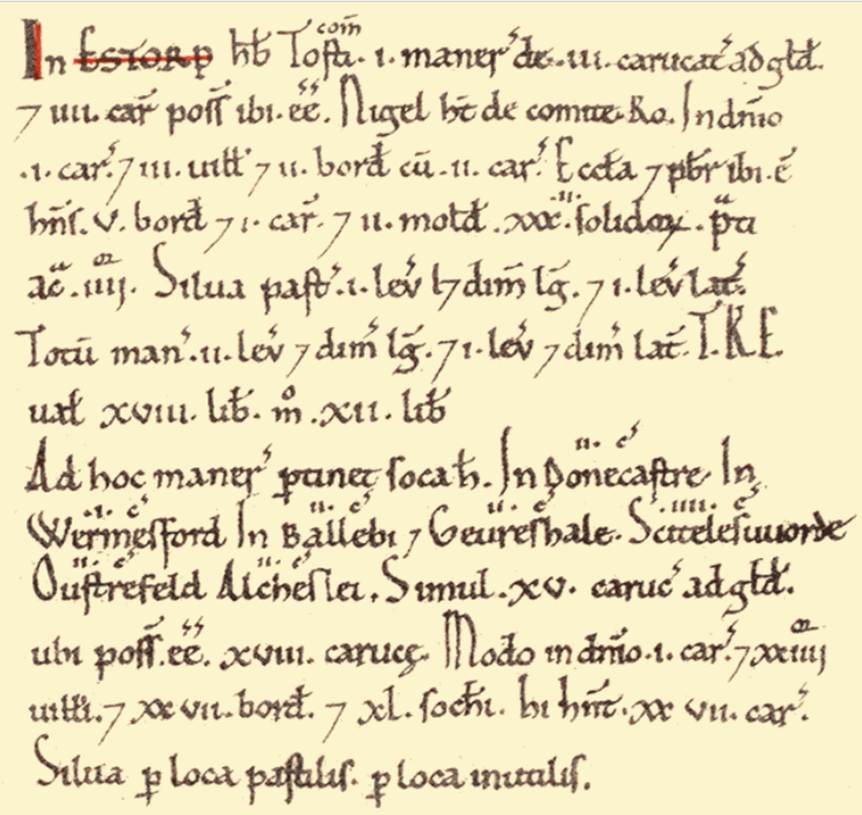
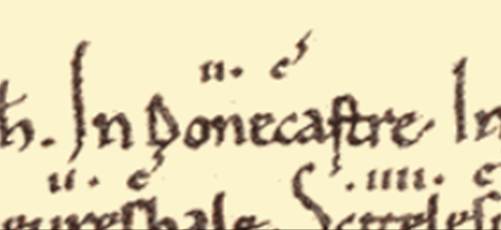
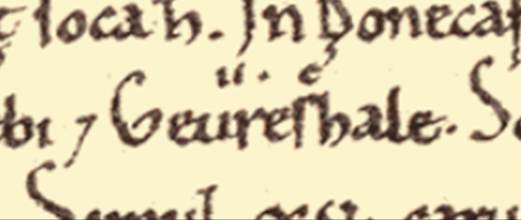
The historian David Hey says these facilities represent the
settlement at Doncaster. He also suggests that the street name Frenchgate indicates that Fossard
invited fellow Normans to trade in the town.
Estorp (Hexthorpe) is a
small village now part of Doncaster and at the time about a mile downstream
from the town became an insignificant place after the Conquest and comprises
three caracutes of land. However to Hexthorpe were
appended an extensive soke which included Doncaster and Loversall
and other places. Doncaster comprised two caracutes
which have been assessed by historians as about 200 acres of arable land; two mills;
40 soke men, villeins and borderers who cultivated the soil. There was no doubt
a church there. The value of the soke at the time of the Conquest was £18 but
only £12 by the time of the survey, which suggests the devastation of the
harrying of the North. The lands had been held by Tostig before the conquest,
but passed after the Conquest to Robert, the Earl of Mortain, who was King
William’s half brother. An interest in the lands was
also held by Richard the Deaf.
A sokeman belonged to a class of tenants,
found chiefly in the eastern counties, especially the Danelaw, occupying an
intermediate position between the free tenants and the bond tenants, in that
they owned and paid taxes on their land themselves. Forming between 30% and 50%
of the countryside, they could buy and sell their land, but owed service to
their lord's soke, court, or jurisdiction.
The carucate was a medieval unit of land area
approximating the land a plough team of eight oxen could till in a single
annual season.
Tickhill 10km south of Doncaster, was referred to as Dadsley
in the Domesday Book. Its ownership passed from Also, son of Karski to
Roger the Bully and it comprised 54 villagers, 12 smallholders, 1 priest, 1 man
at arms and 31 burgesses, with 8 poloughlandsm 7
Lord’s plough teams and 26.5 men’s plough teams. It had two acres of meadow,
woodland, 3 mills and a church. It was valued at £14. Dadsley
was an Anglo Saxon settlement meaning Daedi’s
clearing.
The Domesday survey throws little light on
Doncaster’s urban history. Hunter rightly remarked that it appears less
important in Domesday Book than either before or since. Although Wulfric
Spott’s will mentions the estate ‘aet Doneceastre’ in 1002-4, by 1066 there were three separate
holdings in Doncaster with a number of attached properties which were
intermingled with those of the honour of Conisbrough.
Oddly however, Doncaster is listed not as the head but as a component in the
most important holdings, one centred at Wheatley, the other at Hexthorpe. A
church and a priest are listed under the Hexthorpe portion, as are two mills.
The church is the only one in the later Deanery of Doncaster to have its
property separately assessed. These assets were clearly in Doncaster, not
Hexthorpe, which heads the estate probably because it was the local residence
of the lord. There are parallels for this situation. In 1086 Chesterfield
(Derbyshire), which was subsequently to develop into a town, was listed as an
appendage of Newbold, a neighbouring hamlet. At an earlier date the site of the
Roman fort at Templeborough had been abandoned and a
local centre had grown up at Rotherham, a process of settlement shift which is
well evidenced elsewhere, so possibly the situation at Chesterfield and
Doncaster in 1086 represented an incipient settlement shift that failed because
the places were nascent towns. Before 1066 the
Hexthorpe portion of Doncaster was in the hands of Tosti, perhaps in his
position as Earl of Northumbria. Most of the properties of the Doncaster
estates seem to have been part of the Doncaster parish in early times. The
holding at Rossington, for example, remained in Doncaster parish until the
thirteenth century, and Loversall remained so until the nineteenth century. (Some Notes on the
pre-Norman History of Doncaster, M S
Parker, Yorkshire Archaeological Journal, Volume 59, 1987, page 37).
The Feudal Landholders after the
Conquest
Robert, Count of Mortain in
Normandy and Earl of Cornwall in England was handsomely rewarded for his
service at Hastings. Robert's
contribution to the success of the invasion was clearly regarded as highly
significant by the Conqueror, who awarded him a large share of the spoils; in
total 797 manors at the time of Domesday. In 1088, he joined with his brother
Odo in revolt against their nephew William Rufus. William Rufus returned the earldom of Kent to
Odo but it wasn’t long before his uncle was plotting to make Rufus’s elder
brother, Robert Curthose, king of England as well as Duke of Normandy. Rufus attacked Tonbridge castle where Odo was
based. When the castle fell Odo fled to
Robert in Pevensey. The plan was that
Robert Curthose’s fleet would arrive there, just as William the Conqueror’s had
done in 1066. Instead, Pevensey fell to
William after a siege that lasted six weeks. William Rufus pardoned his uncle
Robert and reinstated him to his titles and lands. He died in Normandy in 1095.
Nigel Fossard was not a tenant in chief, but held lands
from the Earl of Mortain. He was one of the principal under-tenants of Count
Robert, of whom he held some 91 manors (much of the Mortain lands). Hexthorpe
was his chief holding in Yorkshire. It appears highly probable that on the
forfeiture of Count Robert’s estates, Nigel was advanced to the dignity of a tenant
in capite, that is, to hold his lands directly
from the King, and not through a second person as he had previously done.
Fossard thus came to
possess the lands formerly held by Tostig, including the feudal superiority of
Doncaster. Fossard had a house at Doncaster, but his
principal residence was at Mulgrave Castle. His descendants held Doncaster
until the reign of Henry VI, though not directly through the male line after
William Fossard.
He appears to have been a generous man. Included in his gifts to
the Abbot and Convent of St Mary, York, was the gift of the church of Doncaster
and neighbourhood. He was succeeded by his son Adam, who founded the priory of
Hode (Hood Grange, Yorkshire).
Robert Fossard, who succeeded him paid a fine of 500
marks to the King to repossess the Lordship of Doncaster, “which he had
parted to the King to hold in demesne for twenty years”. The reason for the
surrender to the King and the high price for the repossession is not apparent.
It has been suggested that Robert had not paid the whole of the fee due to the
King on his succeeding to the patrimonial inheritance, hence the lease and
release; but it was not unlikely that it was a transaction to enable the King
to raise some needed cash.
William Fossard, his son and heir, succeeded him. He
was the last of the Fossards in the male line. He was
one of the northern barons who fought against the Scots in the Battle of the
Standard. In 1142 he was with Stephen’s forces against the Empress Maude at the
Battle of Lincoln and was taken prisoner. On the collection of scuttage, a tax paid in lieu of Military service etc, by
those who held land by Knights service, he paid £12, a fairly large sum in
those days, at other times he paid £21 and a further sum of £31 10s, the last
amount was levied upon him because he was not in the Irish Wars. He was
especially exempted from contributing for the redemption of King Richard I. He
left a daughter, Joan, who was married to Robert de Turnham.
Robert de Turnham had two sons,
Robert and Stephen. It was Robert the younger
who married Joan Fossard. He was a crusader,
and was reputed to be a powerful and valiant man. Some historians say that he
died on an expedition to the Holy Land but there is no evidence for this
statement. He appeared to be with the King in the Holy Land, and was entrusted
to bring the King’s harness back to England. For the services on that journey
he was discharged from the payment of scuttage levied
for the Kings ransom. Being in the King’s confidence he probably exerted
himself in obtaining from the king, a charter confirming to the burgesses of
Doncaster whatever ancient privileges they then possessed. He obtained a grant
of two more days to be added to the fair that had anciently been kept at his
manor of Doncaster in County Ebor, upon the eve and day of St James the
apostle. At his death in 1199, the yearly value of the lands held by him in
right of Joan, his wife, was entered at £411. 9s. 2d.
He left a daughter, Isabell,
who became a ward of the King. She married Peter de
Mauley, a Poictevin.
A long line of Peter de Mauleys,
claiming descent from Nigel Fossard, successively held the Lordship of
Doncaster. The first of these is said to have committed an infamous crime at
the instigation of King John. On the death of King Richard, his brother John, “knowing
that he could not succeed him by reason that Arthur, son of Geoffry of
Brittany, was alive, got Arthur into his power and implored Peter de Mauley,
his esquire, to murder him and in reward gave him the heir of the barony of Mulgref”. Some doubts have arisen as to the
truthfulness of this statement. If Mauley really did commit the act at the
instigation of John, and was led to expect that he would receive the King’s
ward to marry with the free enjoyment of her lands, he was decieved;
for Peter de Mauley paid a fine of 7000 marks “for entrance to the
inheritance of the daughter of Robert de Turnham”. He gave the body of his
wife to be buried at the Abbey of Meux, Holderness, endowing the Abbey with a
rent of Sixty shillings per year. He died before 1241. In 1247 the King took
the homage of his heir, Peter, for all his fathers
lands. Some six years later this Peter de Mauley obtained a charter of Free
Warren in his demesne lands, which included Doncaster. He died in 1279.
The next Peter de Mauley paid
£100 relief for all lands held of the King in capite
of the inheritance of William Fossard. From a document from 1279 we catch a
glimpse of a part of the Mauley holdings for which the above relief was paid.
He married Joan, the daughter of Peter Brus of Skelton.
There followed another six Peter de
Mauleys (see South Yorkshire, the History
and Topography of the Deanery of Doncaster in the Diocese and County of York by
Rev Joseph Hunter, 1828, page 12 to 13 for a fuller description).
Alongside the Mauleys, other descendants of Nigel Fossard had
interests in Doncaster.
There was significant building of monasteries and parish churches
during this period.
The building of churches was attractive since
this allowed the lords to extract tithes from distant churches to which it had
been paid and settle it on churches of their choosing, perhaps closer to their
own residence. During this period churches were built at places including
Coningsborough, Campsall, and Doncaster. Joseph Hunter lists 60 places where
Churches were built.
Most of these churches had one officiating
minister at their foundation, the persona or rector. The churches
were often placed under the patronage of monastic institutions.
The church at Doncaster was distinguished from
others by being given the title of dean.
Certain of these churches were parish churches
in form, but were also referred to as chapels, which meant that they were given
rights of baptism, nuptial benediction and of sepulture,
but were not able to participate in tithes from the lands around them. These
churches included St Mary Magdalene at Doncaster and the chapel at Loversall.
At Doncaster there was a college, for the
residence of chantry priests, so that they need not mingle with the public.
This was built near the parish church and the priests officiated in the parish
church and at St Mary Magdalene chapel, living a collegiate life as it was felt
inappropriate for their social character to mix too freely with the people of
the town.
(South Yorkshire, the History and Topography of the
Deanery of Doncaster in the Diocese and County of York by Rev Joseph Hunter,
1828, page xvi to xx,
11, Doncaster
History, The Lords
of Doncaster).
A borough was created at Doncaster after the
soke had been granted directly to Nigel Fossard on the banishment of William’s half brother Robert, Count of Mortain. [Still to
check - was this the temporary banishment after his rebellion against William
II and then remained permanent here?].
The Roman fort at Danum was superceded by an Anglo Saxon burh (fortified
settlement) before a Norman castle was built. The castle has long disappeared. The
motte of the Norman Castle has been located to be under the east end of St
George’s Minster.
Early
in the reign of William II (William Rufus), Nigel Fossard was amongst the
benefactors who founded the abbey of St Mary in York. Fossard gave the
church of Doncaster to the new abbey as well as lands in the area.
1136
Doncaster was ceded to Scotland in the Treaty of Durham and never
formally returned to England. The first treaty of Durham was a peace treaty
concluded between kings Stephen of England and David I of Scotland on 5
February 1136. In January 1136, during the first months of the reign of
Stephen, David I crossed the border and reached Durham. He took Carlisle, Wark,
Alnwick, Norham and Newcastle-upon-Tyne. On 5
February 1136, Stephen reached Durham with an imposing troop of Flemish
mercenaries, and the Scottish king was obliged to negotiate. Stephen recovered
Wark, Alnwick, Norham and Newcastle, and let David I
retain Carlisle and a great part of Cumberland and Lancashire, alongside
Doncaster.
In February 1136, Henry, prince of Scotland, did homage to Stephen
for Doncaster and the honour of Huntingdon.
Tickhill acquired markets and fairs long before the system of
royal licences started in the late twelfth century. The town grew rapidly.
1157
But the story of Doncaster is not only told through the history of
the noble families. The burgesses and inhabitants of the town followed the 40
soke men referred to in Domesday book, and came to enjoy increasing privileges.
The earliest record might be the Pipe Roll
of 3d Henry II, when Adam Fitz Swein was discharged of £60 due for the rent of
Doncaster. Adam Fitz Swein owed £45 of rent for Doncaster and £15 had been paid
for a quarter part of the year. It appears therefore that the burgesses held
Doncaster from the King for a rent of £60 per annum and an individual was
appointed to account for it.
In 1157 Malcolm, King of Scotland, did homage to Henry II for
Cumberland, in Doncaster.
1163
Malcolm of Scotland was again in Doncaster to do homage and fell
dangerously ill there.
1191
In Richard I’s absence on crusade, John seized the castles of
Tickhill and Nottingham.
1194
Richard I had given the town recognition by bestowing a town
charter. It seems that Richard I placed the right of the burgesses at
Doncaster onto a formal footing by providing a royal charter. The charter was
the first article of the Miller’s Appendix and declared that the King had
granted to the burgesses of Doncaster the soke and town of Doncaster to hold by
the ancient rent and 25 marks of silver more to be paid into the exchequer with
all liberties and free customs. The burgesses paid 50 marks to the king for the
charter. It seems that the burgesses must have gained something mor tangible
from the charter, but it is not clear exactly what. However it appears that
amongst the privileges gained, was the right to hold a fair and market held at
St James’ Tide.
(South Yorkshire, the History and
Topography of the Deanery of Doncaster in the Diocese and County of York by Rev
Joseph Hunter, 1828, page 10)
Doncaster had by this time become the dominant settlement in the
region. It’s position on the great road from London to York, and en route to the Scottish border, made it a
place where strangers rested.
The area around Doncaster appears to have enjoyed relative peace
after Norman rule had been established. Coningsborough never endured a siege
and Pontefract Castle, which was seen as the key of the North, was not attacked
until the English Civil War.
In the time of the Fossards, Doncaster
consisted of a few public buildings of stone, amidst a town of wooden houses.
The original public building was the castle which stood at the location of the
present Doncaster Minster. Leland (1503 to 1552) recorded: The Church stands
in the very area where ons the castelle
of the towne stoode, long
sins clene decayed. The dikes partely
yet be scene, and the foundation of partte of the waulles. The Wall of the Castle is mentioned in a grant
of 1416.
Beside the parish church was the church or chapel of St Mary
Magdalene, which was founded before the year of King John. There were hospitals
of St James (with a chapel annexed) and St Nicholas (which had lands at Loversall), which would have provided some relief to
the poor and the aged. There were also public mills on the Don. This was the
town as it must have appeared before the great fire of 1204.
There was a chapel of our lady at the bridge.
(South Yorkshire, the History and
Topography of the Deanery of Doncaster in the Diocese and County of York by Rev
Joseph Hunter, 1828, page 11, 19)
1199
When John seized the throne, he acquired Tickhill and during his
reign he spent over £300 strengthening its defences.
There
was a disastrous fire in 1204 which appears to have completely destroyed the
town, from which the town slowly recovered.
The
revival of the town after the fire is first recorded in a warrant of King John
addressed to the bailiffs of Peter de Mauley, who had married Isabella de
Turnham, their heiress of Doncaster. The bailiff was instructed to enclose the
town along the course of a ditch and to fortify the bridge. This appears in the
Close Rolls. It appears therefore that Doncaster was
protected by a ditch and possibly a mound and Leland later indicates that
Doncaster did not become a walled town. Doncaster continued to comprise mainly
wooden buildings at least until the time of Henry VIII. Only the public
buildings were of stone.
1215
By
1215 the whole town was enclosed by an earthen rampart and ditch, which was
filled with water from the Cheswold, the original
course of the Don. By this time it had four substantial stone gates as
entrances at St Mary’s Bridge, St Sepulchre Gate, Hall Gate and Sun Bar.
An
order of King John to Peter de Maulay, lord of Doncaster, dated 1215 read, We
command ye cause the Toune of Doncaster to be inclosed
with hertstone and pale, according to the ditch that
is made doth require ; and that ye make a brecost or
barbican upon the bridge to defend the toune, if need
shall be.
1248
In 1248, a
charter was granted for Doncaster Market to be held in the area surrounding the
Church of St Mary Magdalene, which had been built in Norman times.
The burgesses
grew their wealth and significance during this period. A principal class of
merchants appeared and the Don was gradually made navigable. Many merchants
marks were made on the old parish church and the richness of its development
evidences the increasing opulence of the merchant class.
Doncaster became
the most prosperous medieval town in South Yorkshire.
Urban expansion in
the early medieval period was accompanied by an increase in the size of the
rural population and colonisation of new lands.
The Survey of the County of York by John de Kirkby known as Kirkby’s Inquest, (the Nomina Villarum for Yorkshire)
was taken in the fifth reign of Edward I, with some reference to Doncaster and
its vicinity on pages 281 to 282.
1285
Early during the reign of Edward II there was a feud between the
Earl of Warren at Coningsborough and the Earl of Lancaster at Pontefract. The
Earl of Lancaster called his followers together at Doncaster and attacked
Tickhill Castle, but the enterprise came to nothing (South
Yorkshire, the History and Topography of the Deanery of Doncaster in the
Diocese and County of York by Rev Joseph Hunter, 1828, page xxii, 10).
1290
In the thirteenth and fourteenth centuries, a new religious order
of friars arrived in Doncaster, who were itinerant and applied themselves to
instruction and religious edification. There was a house of Augustinian friars
at Tickhill and houses if Franciscans and Carmelites at Doncaster. The friars
achieved literary knowledge and were centres of literature in the middle ages.
Therefore to the public buildings there were added the houses of the Carmelite
and Franciscan friars.
The establishment of the two societies of friars and their
educational achievements further enhanced the growth of the town as a place of
significance.
The Franciscans or Grey Frairs
He Franciscans in
England were divided into seven wards or custodies. The Custody of York
included Doncaster.
A
History of the County of York: Volume 3. Originally published by Victoria
County History, London, 1974: THE GREY FRIARS OF DONCASTER
The Friars Minors
established themselves at this town on an island formed by the rivers Cheswold and Don, at the bottom of French or Francis
gate, at the north end of the bridge known as the Friars' Bridge, some time in the 13th century. Nicholas IV, 1
September 1290, granted an indulgence to those who visited their church, which
was of the invocation of St. Francis. Archbishop Romanus in 1291 enjoined the
friars of this house to preach the Crusade at Doncaster, Blyth (Notts.), and
Retford.
In 1299 Edward I
gave the friars 10s. through Friar Edmund de Norbury, on the occasion of his
visit to Doncaster, 12 November: in January 1299-1300 he gave them 20s. for two
days' food and 6s. 8d. for damages to their house when he was at Doncaster, by
the hand of Friar de Portynden. On 8 June 1300 his
son Edward gave them 10s., and the king in January 1300-1 gave them 10s. for
the exequies of Joan, nurse of Thomas of Brotherton. The
friars at this time numbered thirty.
In 1316 Sir
Peter de Mauley, lord of the town of Doncaster, granted the Friars Minors a
plot of land, 14 p. by 6 p., adjacent to their dwelling-place.
In 1332 Thomas de
Saundeby, the warden, and Friars Nicholas de Dighton, Thomas de Moubray,
William de Halton, and John de Brynsale, were sued by John de Malghum for having seized and imprisoned him. In 1335 the
king pardoned them for acquiring in mortmain without licence in the time of
former kings divers plots in Doncaster, now inclosed
with a wall and dyke, whereon they had built a church and houses. Between 1328
and 1337 the number of the friars varied between eighteen and twenty-seven, as
is proved by the royal alms granted to them by the hand of Friars John de
Bilton, Nicholas de Wermersworth, and others.
Sir Hugh de
Hastings, kt., in 1347 left the friars 100s., 20 quarters of corn and 10
quarters of barley. A friar of this house, Hugh de Warmesby, was authorized in
1348 to act as confessor to Lady Margery de Hastings, Sir Hugh's widow, and her
family. Her son Hugh was buried in the church of St. Francis at Doncaster,
1367. Another Sir Hugh Hastings in 1482 left a serge
of wax to be burned here in honour of the Holy Rood, and a quarter of wheat
yearly for three years.
Among the
bequests may be mentioned that of Roger de Bangwell, rector of Dronfield, of
20s. to the convent and 12d. to each friar in 1366. Thomas Lord Furnival of
Sheffield, 1333, and Sir Peter de Mauley, 1381, were buried in the church; the
latter left his best beast of burden as mortuary and 100s, to the convent. …
…Friar Thomas
Kirkham was admitted D.D. of Oxford in July 1527, his composition being reduced
to £4 'because he is very poor'; in November he was dispensed from the greater
part of his necessary regency because he was warden of the Grey Friars of
Doncaster and could not continually reside in Oxford. Thomas Strey, a lawyer of
Doncaster, left 20 marks to the convent in 1530 and 26s. 8d. to buy the warden
a coat.
… The house was
quietly surrendered 20 November 1538 by the warden and nine friars, three of
them novices, to Sir George Lawson and his fellows, who were 'thankfully
received.' …
A manuscript of
the chronicle of Martin of Troppau formerly belonging to this friary was in the
possession of Ralph Thoresby in 1712.
(See also South Yorkshire, the History
and Topography of the Deanery of Doncaster in the Diocese and County of York by
Rev Joseph Hunter, 1828, page 17).
The House of Grey Friars at Doncaster appears
to have been founded during the 13th century, in the earlier part of which, the
order of Franciscans, or Grey Friars, was founded by S. Francis of Assissi, and sanctioned by Pope Innocent III. By the
Franciscan Order of Friars, England was divided into 7 Custodies or
Wardenships, viz., London, York, Cambridge, Bristol, Oxford, Newcastle, and
Worcester. Within the wardenship of York, there were 7 convents, of which that
at Doncaster was one ; the others being York, Lincoln, Boston, Beverley,
Scarborough, and Grimsby. As was the rule of the Order, the Priory in Doncaster
was in the poorest and worst part of the town —in Marsh Gate. Marsh Gate runs
out of Doncaster to the north-west, across an island formed by the rivers Cheswold and Don. The Priory was built on a piece of ground
containing 7 acres, 2 roods, and 6 perches, at the south-east extremity of the
island.
In 1291 Archbishop Romanus wrote to each house
of Friars Minors, and Preachers, within the diocese to send out two or three
friars to as many different places to preach the crusade, which, however,
proved abortive and granted 100 days’ indulgence to all who favoured the
crusade with gifts, or who joined it. The Friars Minors of Doncaster were to
send out one in Doncaster, one at Blyth, and a third at Retford.
In 1307 Sir John Grey did homage to the
Archbishop of York, for lands held of him, in the church of the Friars Minors
of Doncaster.
In 1347, Hugh de Hastyngs, Knt., buried at
Elsing in Norfolk, where his brass still remains, mutilated, left by will to
the Friars Minors of Doncaster 100 shillings, 20 quarters of corn, and 10
quarters barley, to celebrate for his soul.
In 1348, Nov. 16, Hugh de Warmesby, a Friar
Minor of Doncaster, was authorised to act as confessor, by the Archbishop of
York, to Dame Margery de Hastinges and her family for
a year. She was widow of Sir Hugh de Hastings and executrix.
In 1381, Peter de Maulay the Sixth,
desired by will to be buried in the church of the Friars Minors of Doncaster
with his best animal as his mortuary, and 100 shillings to the Friars to pray
for his soul.
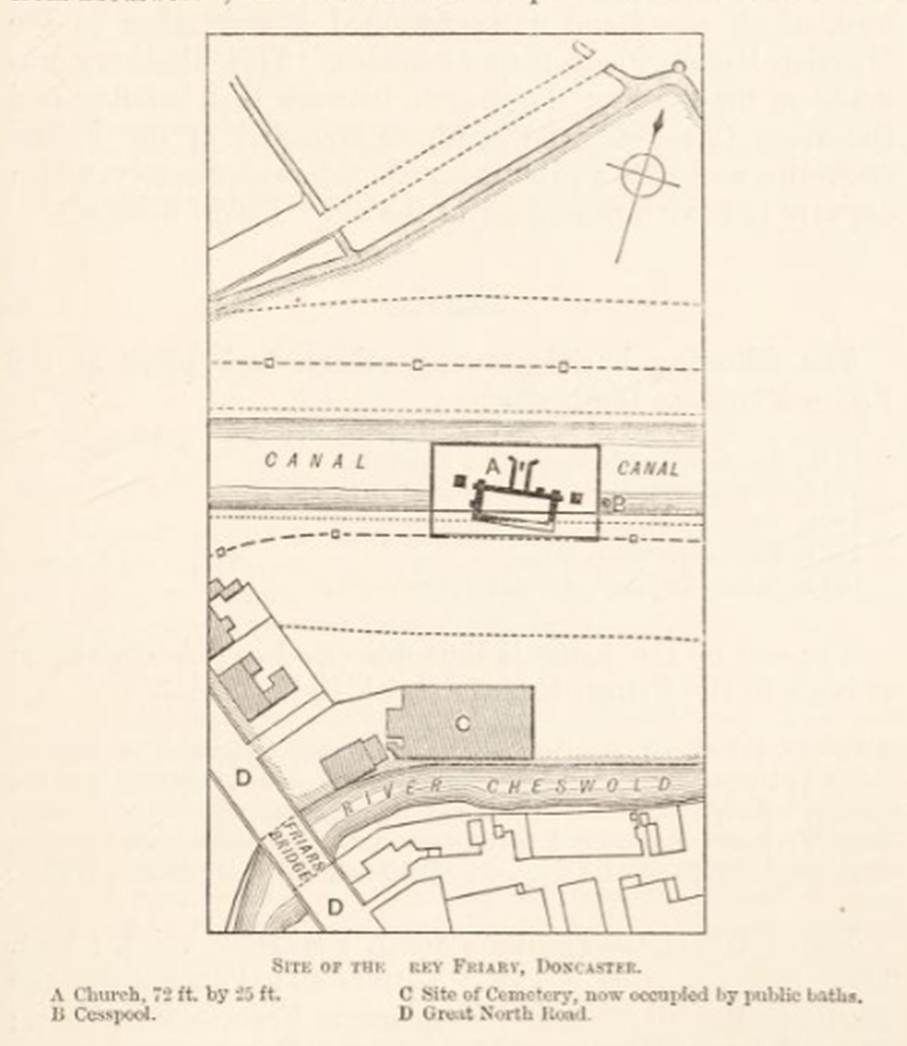
In 1842 during the cutting of the canal, the remains of the church
were discovered.
(The House of Grey Friars, Doncaster,
Yorkshire Archaeological Journal, Volume 12, page 481 to
486).
1307
During the 14th
century, large numbers of friars arrived in Doncaster who were known for their
religious enthusiasm and preaching.
In 1307 the
Franciscan friars (Greyfriars) arrived, as did Carmelites (Whitefriars) in the
mid-14th century.
1316
Nomina Villarum (“Names of Towns”) was a survey carried out in
1316 and contains a list of all cities, boroughs and townships in England and
the Lords of them.
In these Inquisitions
Nonarum during the reign of Edward III, eight
merchants were said to be residing in Doncaster, which was more than in other
similar towns. At Tickhill there were seven merchants so this was an are of commercial significance. There is rare evidence of
summons being sent to Doncaster and Tickhill directing them to send burgesses
to Parliament. (South
Yorkshire, the History and Topography of the Deanery of Doncaster in the
Diocese and County of York by Rev Joseph Hunter, 1828, page xxi).
1321
In late 1321
Thomas, Earl of Lancaster, the great baron at Pontefract, opposed royal
authority and called on many barons to meet at Doncaster. On 12 November 1321
the King forbade this meeting on penalty of forfeiture of their lands. An open
rebellion ensued, joined by Lord Mowbray,
On 18 March 1322 the King was in Doncaster and the Battle
of Boroughbridge was fought on 17 March 1322 when the rebels were defeated
and Thomas was executed at Pontefract (South
Yorkshire, the History and Topography of the Deanery of Doncaster in the
Diocese and County of York by Rev Joseph Hunter, 1828, page 15).
1334
In 1334 the
inhabitants of Doncaster contributed £17 in taxes, compared with £12 10s 0d in
Tickhill and £7 3s 4d from Sheffield. Doncaster owed its wealth mainly to its
weekly markets and its annual fairs, which had become nationally famous. There
was a huge market place in the south east corner of the medieval town, and as
was common, it was an extension of the churchyard.
Doncaster now had
two churches – St George’s still within the bounds of the castle, and St Mary
Magdalene, which stood at the market place. It is now generally accepted that
St Mary Magdalene was the original parish church. However as the castle fell
into disuse, and pressure for space at the market had increased, the old church
was abandoned in favour of St George’s. St Mary Magdalene was reduced to the
status of a chapel, and later a chantry. After the Reformation it became a town
hall and school.
1360
The Carmelites or White
Friars
A History of the County of York: Volume 3. Originally published
by Victoria County History, London, 1974: THE
HOUSE OF WHITE FRIARS, DONCASTER
Founding in 1350
The Carmelite
friary—' a right goodly house in the middle of the town ' (Leland, I tin. i, 36. See F. R.
Fairbank, 'The Carmelites of Doncaster,' in Yorks. Arch. Journ.
xiii, 262-70) —was founded in 1350 by John son of Henry Nicbrothere of Eyum with Maud his wife and Richard Euwere of Doncaster,
who gave the friars a messuage and 6 acres of land. The priors of the order
asked permission of the Archbishop of York to have the place consecrated in
1351. The earliest bequest to them recorded was made by William Nelson of
Appleby, vicar of Doncaster, in 1360. (Yorks.
Arch. Journ. xiii, 191) In 1366 Roger de
Bangwell, formerly rector of Dronfield, made his will in the house of these
friars, in whose church he wished to be buried; … A provincial chapter was held
at this friary in 1376. (Tanner, Bibliotheca, 562)
The friars in 1397 received the royal pardon, on paying 20s., for acquiring
without licence several small plots, worth 12s. 6d. a year, 'for the
enlargement of the entrance and exit of their church. (a
Pat. 20 Ric. II, pt. ii, m. 22) Two friars of the house, John Slaydburn
and John Belton, were appointed papal chaplains in 1398 and 1402. (Cal of Papal Letters, iv, 305, 315).
John of Gaunt was
regarded as one of the founders, and his son Henry of Bolingbroke on his
journey from Ravenspur in July 1399 lodged at the
friary, (Hardyn, Chron. (ed. Ellis), 353) where also Edward IV was entertained in 1470, Henry VII in
1486, and the Princess Margaret Tudor in 1503. Edward IV in 1472 conferred the
privileges of a corporation on the convent, 'which is of the foundation of the
king's progenitors and of the king's patronage,' and licensed the friars to
acquire lands to the yearly value of £20. At the beginning of the 16th century
the Earl of Northumberland claimed the title of founder of the house.
Writing
Several members
of the house attained some distinction as writers. Such were John
Marrey, who died in 1407, John Colley who flourished c. 1440, John Sutton,
provincial prior 1468, and Henry Parker, who got into trouble by preaching on
the poverty of Christ and His apostles and attacking the secular clergy at
Paul's Cross in 1464; he is probably the author of the dialogue entitled Dives
et Pauper which was printed both by Pynson and by Wynkyn de Worde at the end of the 15th century. John
Breknoke, keeper of the Dragon Inn at Doncaster, left the friars some books in
1505.
The House of the Carmelites
was a college of learned men. These included John Marr who later went to
Oxford; John Colley; Henry Parker and John Sutton.
Sixteenth century
… On 15 July 1524
William Nicholson of Townsburgh attempted to cross
the Don with an iron-bound wain in which were Robert Leche and his wife and
their two children; being overwhelmed by the stream they called on our Lady of
Doncaster and by her help came safely ashore; they came to the White Friars and
returned thanks on St. Mary Magdalen's Day, when 'this gracious miracle
was rung and sung in the presence of 300 people and more.' (Yorks. Arch. Journ. xiii, 558;
Hist. MSS. Com. xiv, App. iv, 1)
On the eve of the
Dissolution the house was divided against itself. The famous John Bale, about
1530, being then a friar at Doncaster, and perhaps prior, taught one William
Broman 'that Christ would dwell in no church made of lime and stone by man's
hands, but only in heaven above and in man's heart on earth.'
In the Pilgrimage
of Grace, though the lords used the White Friars as their head
quarters while negotiating with Robert Aske at Doncaster, the prior,
Lawrence Coke, supported the rebellion. He was imprisoned in the Tower and in
Newgate, condemned by Act of Attainder a few days before Cromwell's fall, but
pardoned on 2 October 1540; it is not clear whether the pardon was issued in
time to save him from execution.
The house was
surrendered by Edward Stubbis, the prior, and seven friars, on 13 November 1538
to Hugh Wyrrall and Tristram Teshe, who 'made a book of the property' and
notified to Cromwell that the tenements in Doncaster were in some decay, and
that the image of our Lady had already been taken away by the archbishop's
order. The plate sent to the royal jewel house was considerable; 25 oz. of gilt
plate, 109½ oz. parcel gilt, and 48½ oz. white plate. The net profit from the
sale of the goods seems to have been £21 18s. 4d. The site with dovecot and
other houses, a garden and orchard all surrounded by a stone wall and
containing 2½ acres, was let to Wyrrall for 10s. a
year. The tenements in Doncaster included an inn called 'Le Lyon' in Hallgate, already let by the prior to Alan Malster for
forty-one years at 40s. a year in 18 August 1538, a messuage in Selpulchre Gate similarly leased on 2 September 1538 to
Emmota Parsonson for 12s., and various tenements, shops, and cottages, the
whole property bringing in £10 17s. 4d. a year.
Towards the end of the fourteenth century, Edmund Duke of York
attempted to raise Stainford (Stainforth),
further down the Don into commercial importance.
1392
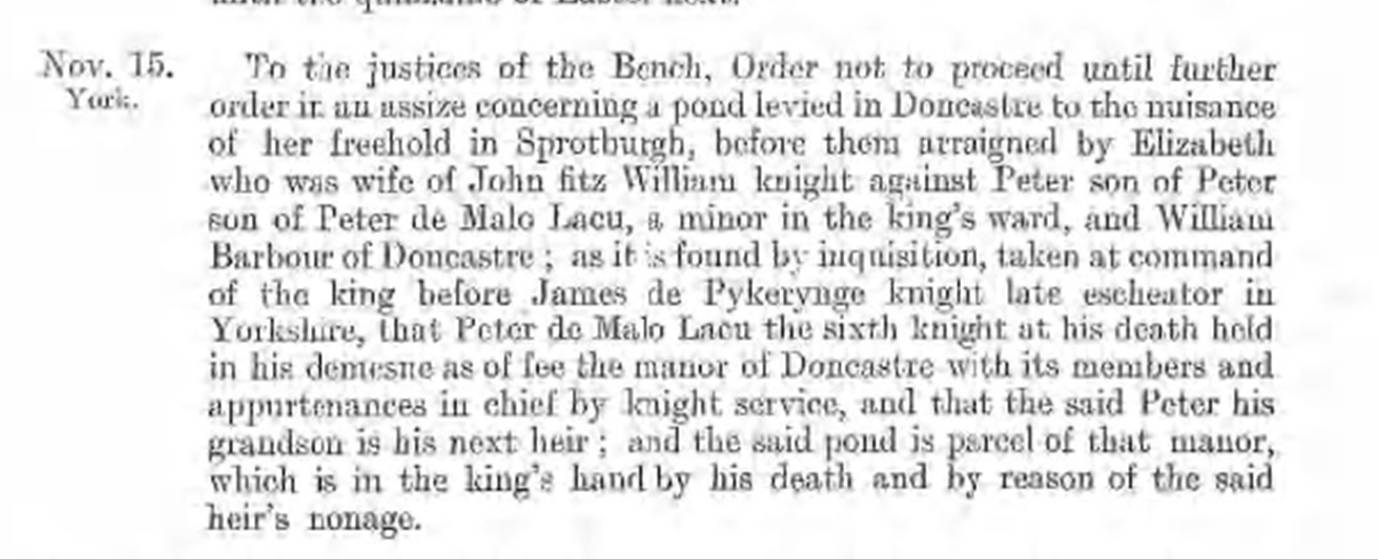
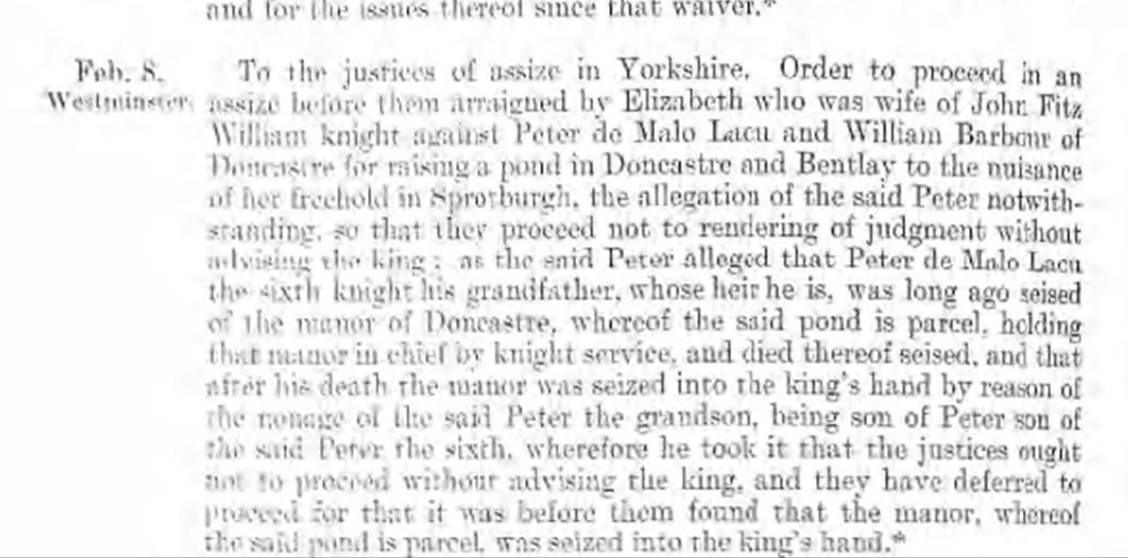
(Close Rolls of the reign of
Richard II, 1392 to 1396, page 27 (Folio 33) and page 334 (Folio 340)),
1398
Henry Bolingbroke (later Henry IV) swore at Doncaster that he came
only to recover lands of inheritance as Duke of Lancaster, during his dispute
with Richard II. Bolingbroke landed at Ravenspurn
with 100 men at arms. They reached Pickering Castle
and stayed there for two days before marching south. He then marched via
Pontefract to Doncaster, where he lodged with the Carmelites. By this time it
is said that he commanded 30,000 men. While there he took the oath, which he
was later said to have broken. By 13 October 1399, having imprisoned Richard II
(who died in prison probably of starvation) Henry was crowned Henry IV.
(South Yorkshire, the History and
Topography of the Deanery of Doncaster in the Diocese and County of York by Rev
Joseph Hunter, 1828, page 15).
1407
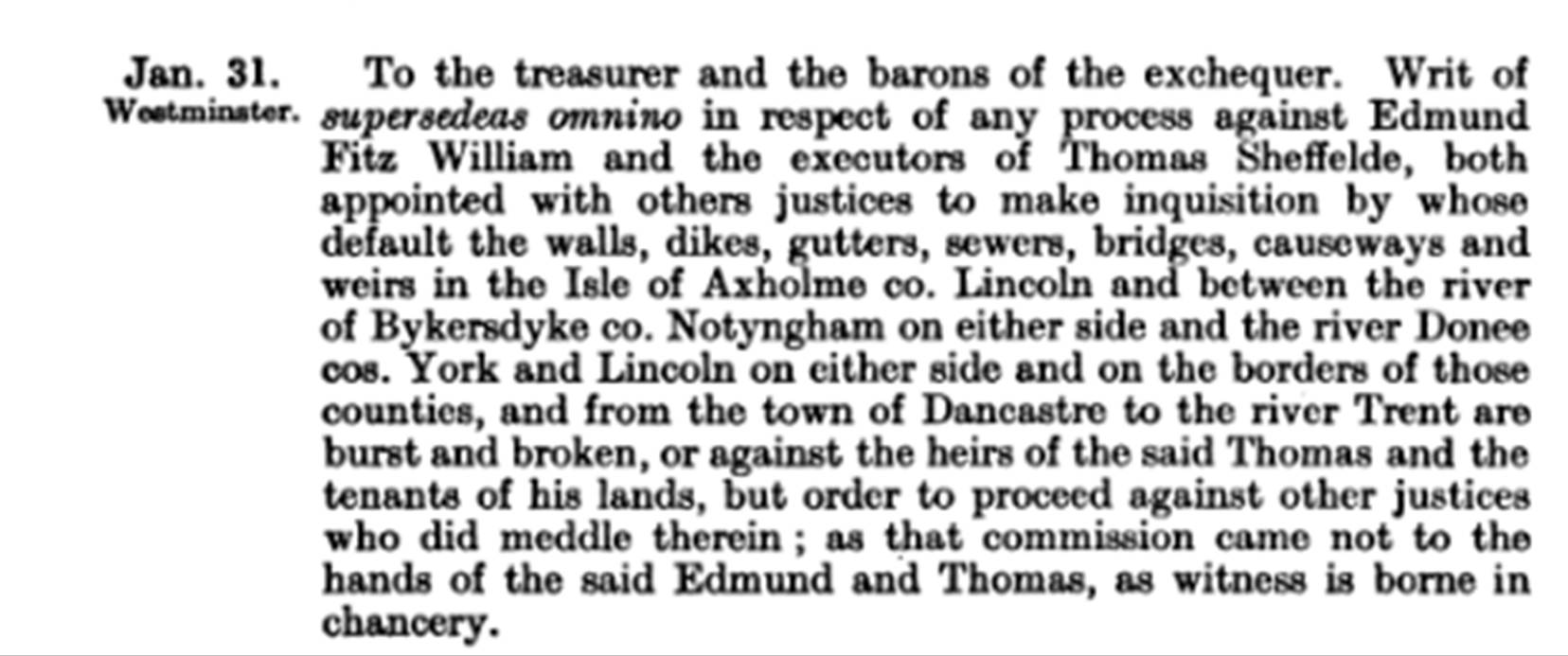
(Close Rolls of the reign of Henry IV, 1405 to 1409, page
359)
1438
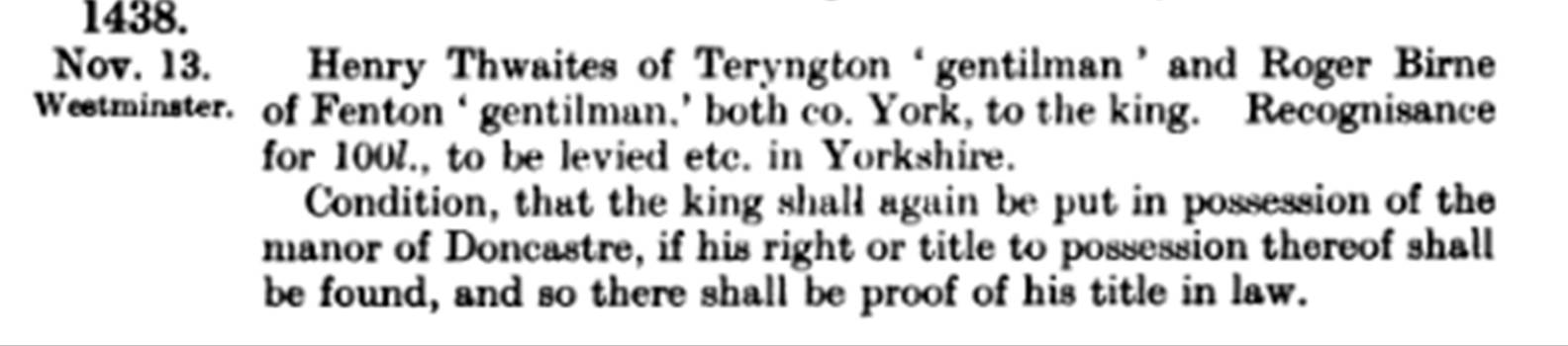
(Close Rolls of the reign of Henry VI, 1435 to 1441, page
236)
1450
Edward IV granted a further charter to the burgesses recognising
their rights and privileges. They were empowered to choose a mayor annually and
two sergeants at mace, to have a common seal and to hear pleas of trespass,
debt and other matters in the Guild Hall.
1455 to 1487
During the War of the Roses, Doncaster was a place through which
the contending armies passed and repassed.
In 1470 there was an attempt to seize the throne from King Edward
after the Battle of Stamford, when the King came to Doncaster.
1467
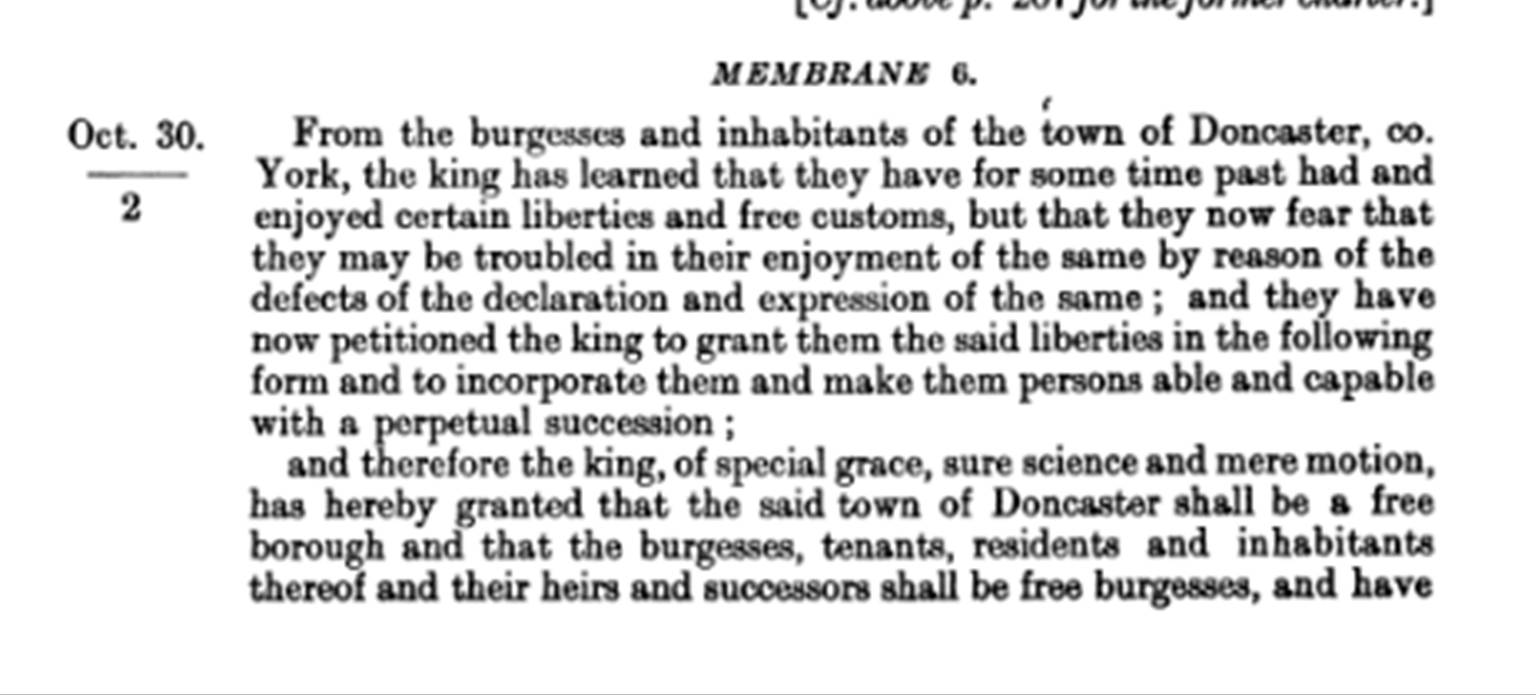
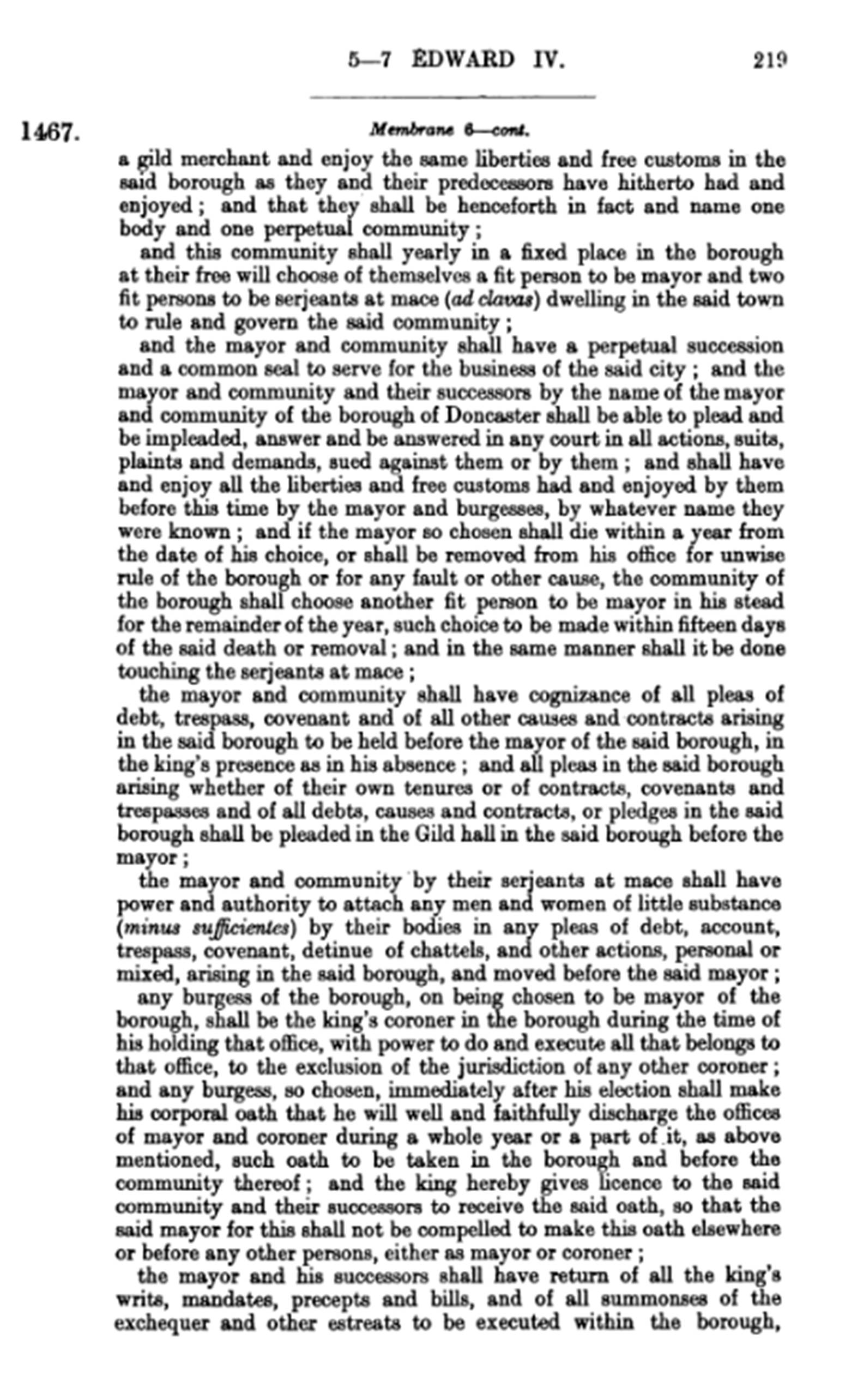
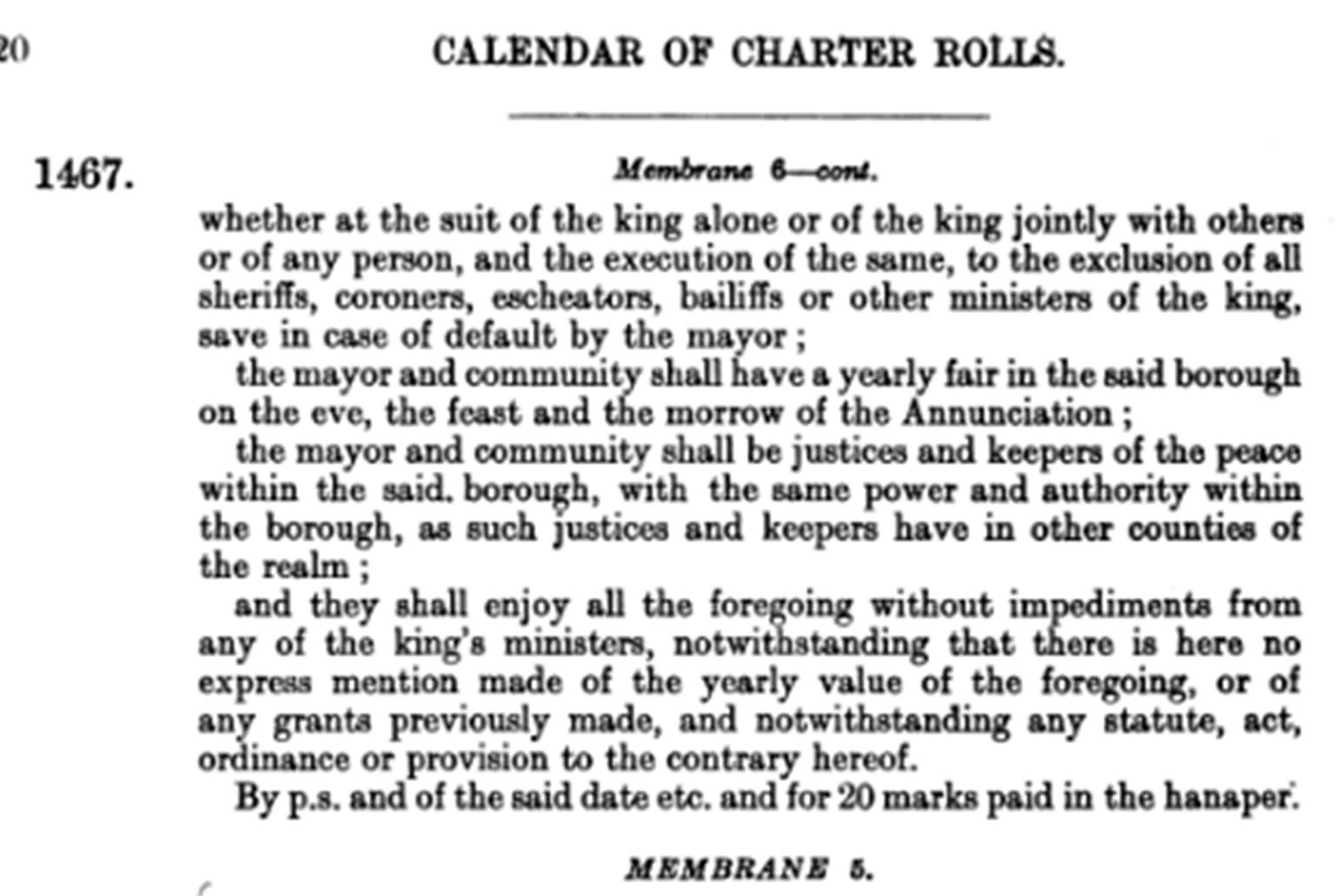
(Calendar of
Charter Rolls, Volume
6, Henry VI to Henry VIII, 1427 to 1516, page
218 to 220).
1508
Doncaster acquired the right to hold courts leet and view of
frankpledge by explicit mention in a charter of Henry VII, dated 1508, though
there are grounds for a belief that such powers had by implication been given
to the town in 1467, under a charter of Edward IV (Extracts
from a Doncaster Court Roll of the Sixteenth Century, Chas H Theobald,
Yorkshire Archaeological Journal, Volume 35, page 288).
1536
The dissolution of the monasteries. The consequence was the
transfer of significant wealth and power from ecclesiastical to private lay
proprietors of manors, lands and estates. Part of these lands fell directly
into control of previous owners of feudal interests, but often the new owners
were new people who would themselves become founders of considerable families.
A new order of gentry replaced many of the old feudal interests. The
depreciation of money also had the effect of favouring a new guard. Joseph
Hunter lists the new gentry families. They included Thomas Wray of Adwick in
the Liberty of Tickhill and William Fletcher of Campsall.
The churches were generally respected. The chapel of St Mary
Magdeleine in Doncaster fell at this time. The fall of the Carmelite house at
Doncaster likely diffused significant literary accomplishment.
The Pilgrimage of
Grace was a backlash to the Reformation and the insurgents took Pontefract
Castle and gathered in significant numbers at Scawsby Lees near Doncaster. The
sudden rising of the Don prevented a bloody engagement.
(South Yorkshire, the History and
Topography of the Deanery of Doncaster in the Diocese and County of York by Rev
Joseph Hunter, 1828, page xxiii, 16).
But the Pilgrimage
of Grace was already afoot in West Yorkshire, and the movement soon
spread into the northern part of Lancashire. In the course of October the
commons of Cartmel restored the canons to the priory. The prior, however, more
prudent or less staunch than his brethren, stole away and joined the king's forces
at Preston. This was before he heard of the general pardon and promise of a
northern Parliament granted to the rebels at Doncaster on 27 October. (A History of the County of Lancaster: Volume 2.
Originally published by Victoria County History, London, 1908).
The royal
stronghold at Tickhill prevented the rebels from marching south and the revolt
petered out after an uneasy truce was signed at Doncaster.
1563
Eleven people
died on the plague in 1563 and Doncaster seems to have suffered badly from
plague in 1582 and 1583. There appears to have been a Pesthouse to which people
infected were interred.
1569
There was a
rebellion by the Earls of Westmoreland and Northumberland and Doncaster was
secured by Lord Darcy.
1567
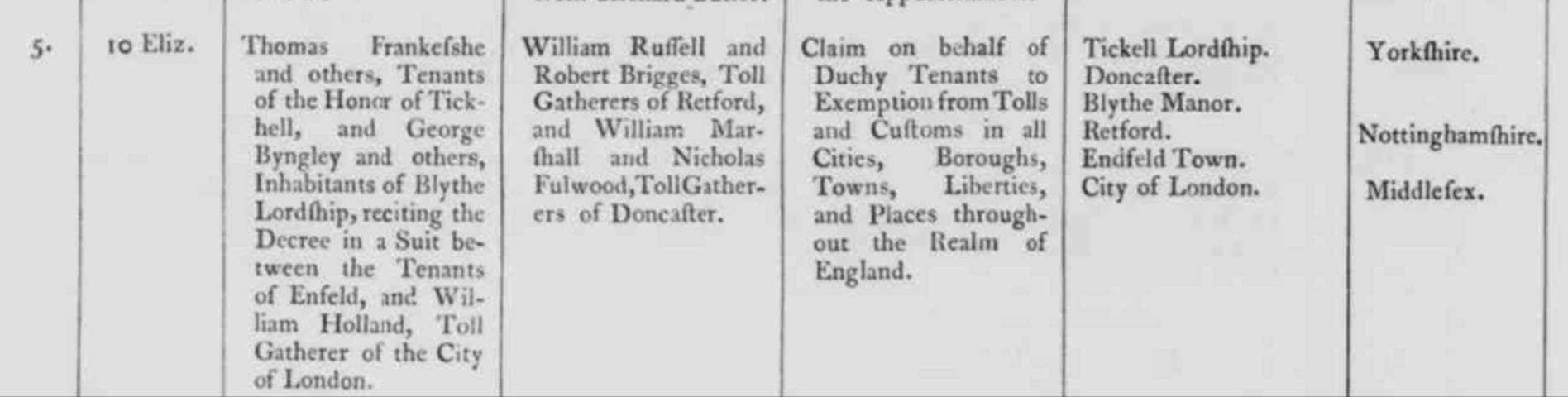
(Ducatrus Lancastriae, Part 3, Calendar of Pleadings, Depositions etc, Henry
VII to 13 Elizabeth I, page 362).
1568

(Ducatrus Lancastriae, Part 3, Calendar of Pleadings, Depositions etc, Henry
VII to 13 Elizabeth I, page
374).
1582
The Doncaster Chronicle provides some record of
events, for instance that there were 30 marriages at the church in Doncaster
from September 1582 to September 1583.
(See also South Yorkshire, the History
and Topography of the Deanery of Doncaster in the Diocese and County of York by
Rev Joseph Hunter, 1828, page 21).
1588
During the period of threat from the Spanish Armada, the Earl of
Huntingdon was at Doncaster raising and training soldiers.
Bibliography
South Yorkshire, the History and Topography of the
Deanery of Doncaster in the Diocese and County of York by Rev Joseph Hunter, 1828.
The Making of South
Yorkshire, David Hey, 1979
A History of
Yorkshire, “County of the Broad Acres”, 2005, David Hey
A
History of Yorkshire, F B Singleton and S Rawnsley,
1988
A History of
Yorkshire, Michael Pocock, 1978
A waif of Roman
Danum,
John Tomlinson, Yorkshire Archaeological Journal, Volume 8, 1883, page 158 to 159
For further review:
D Hey, Medieval South Yorkshire,
Ashbourne, 2003, page 130.
The
Archaeology of Doncaster 2: The Medieval and Later Town, British Archaeological Reports British
Series, 202, 1989, pages 49 to 50 and especially page 52.
From
Conquest to Corporation, PJP
Goldberg, in G. Martin and others, Doncaster: A borough and its charters,
Doncaster, 1994, pages 55 to 57.
The
Oxford Dictionary of National Biography, volume 21, 2004, pages 775-91.
The
History and Antiquities of Doncaster, E Miller, Doncaster, 1804, page 71.