Risings in the North
Revolution in Yorkshire through the period of the
English national story
|
Return to the Home
Page of the Farndale Family Website |
The story of one
family’s journey through two thousand years of British History |
The 83 family lines
into which the family is divided. Meet the whole family and how the wider
family is related |
Members of the
historical family ordered by date of birth |
Links to other pages
with historical research and related material |
The story of the
Bakers of Highfields, the Chapmans, and other related families |
Headlines are in brown.
Dates are in red.
Hyperlinks to
other pages are in dark
blue.
References and
citations are in turquoise.
Context and local
history are in purple.
Geographical
context is in green.
The Rising in the North
against Tostig, 1065
On Siward's death in 1055, Edward
the Confessor, chose a West Saxon to govern Yorkshire, in place of Siward's
son, Waltheof. Edward's choice, Tostig Godwinson, was unpopular with locals. In 1055 Tostig
had been given in 1055 the earldom of Northumbria, on the demise of the noble
and brave Siward, whose little son, the rightful heir, was thus wickedly
deprived of his patrimony (The Battle of Stamford Bridge, A D H Leadman, Yorkshire Archaeological Journal, Volume
11, page
132).
Tostig was the third son of the
Anglo-Saxon nobleman Godwin, Earl of Wessex and Gytha Thorkelsdóttir,
the daughter of Danish chieftain Thorgil Sprakling.
In 1051, Earl Godwin's opposition to Edward's policies had brought England to
the brink of civil war. The Godwins' opposition
convinced Edward to banish them in 1051. The banished Godwin family, including
Gytha and Tostig, together with Sweyn and Gyrth,
sought refuge with his brother-in-law the Count of Flanders. They returned to
England the following year with an armed force. They gained support and
demanded that Edward restore Tostig's earldom.
Tostig was not popular with the
Northumbrian ruling class, who descended from Danish invaders and Anglo-Saxon
survivors. He was heavy handed with those who resisted his rule, and murdered
several members of leading Northumbrian families.
In late 1063 or early 1064, Tostig
had Gamal son of Orm and Ulf son of Dolfin
assassinated when Gamal visited him under safe conduct.
The Vita Edwardi,
otherwise sympathetic to Tostig, records that he had repressed the
Northumbrians with the heavy yoke of his rule. He was often absent and may
have shown a lack of leadership against the raiding Scots. Their king was a
personal friend of Tostig, and Tostig's unpopularity made it difficult to raise
local levies to combat them. He resorted to using a strong force of Danish
mercenaries (housecarls) as his main force, an expensive and resented
policy. The housecarls' leaders were later slaughtered by rebels.
On 3 October 1065, the thegns of
York and the local nobility descended on York and occupied the city. They killed
Tostig's officials and supporters, then declared Tostig outlawed for his
unlawful actions. They replaced him with Morcar,
brother of Edwin of Mercia.
The Northern Barons, 1215
On 5 May 1215
some of the rebellious barons formally renounced their fealty and duty of
homage to King John, rejecting him as their king. They were led by Eustace de
Vesci and Robert Fitzwalter, Marshal of the army of God and included
William de Mowbray, Richard de Percy and Roger de Montbregon, lord of Hornby in
Lancashire. They were tied closely by kinship, marriage and territorial
proximity, and their dislike of John’s regime.
This was civil
war and the rebels and the Earl of Salisbury each made a dash for London. The
rebels reached London on 17 May 1215 where the rich citizens supported them and
the poor ones were afraid to murmur against them (Roger de Wendover). Yet John was still King, and
now with papal support.
On 10 June 1215
baronial envoys agreed the Articles of the
Barons as
the basis for negotiation, comprising 49 provisions relating to justice and
feudal process.
Magna Carta
On 19 June 1215,
the barons started to renew their homage to the King who wore the regalia of
the Empress Matilda to stress the ancient status of the Plantagenet line. In
return John and his allies began to endorse terms of an agreement drawn up by
the barons.
King John signed Magna Carta at Runnymede in
June 1215. It included a resolution of countless grievances of the day, but it
also embraced some fundamental legal principles which have passed through to
contemporary legal doctrine, including that:
· No Freeman shall
be arrested, or imprisoned … but by lawful judgment of his peers (Article 39, see also Article 21);
· We will not sell,
or deny, or delay right or justice to anyone (Article 40);
· The English
Church shall be free (Article 1);
· The City of
London is to have its ancient liberties (Article 13);
· It is to be
lawful in future for every man to depart from our kingdom, and to return to it,
safely and securely, by land and water, saving our allegiance, except in time
of war for some short time, for the sake of the common utility of the kingdom (Article 42);
· Men who reside
outside the forest are not in future to come before our forest justices upon
common summonses, unless they are involved in pleadings, or are the pledges of
a person or persons who have been attached for forest business (Article 44);
· All the forests
which have been afforested during our reign are to be disafforested
immediately, and the same is to be done with regard to rivers which have been
fenced off by us in our time (Article 47);
together with
lengthy more detailed provisions relating to the nuances of English customs and
feudal duties.
· Imposed restraints
on monarchy;
· Might be taken as
the first example of a written constitution, which was unusual across Europe at
that time;
· Represented a
contract between monarchy and the community of the realm, which started to
emerge as a distinct legal entity.
William
de Mowbray was on the council of 25 barons set up under
Magna Carta.
There is an In Our Time podcast on
Magna Carta.
Yet this was nothing more than a contractual basis for civil war.
Stating that a king should govern according to the law and making sure that he
did so were, it turned out, quite separate matters. These questions would lie
at the heart of every major disagreement between king and country for the rest
of the Plantagenet years. (The Plantagenets, The
Kings who made England, 2012, Dan Jones,
page 214).
In less than 2 months John annulled the terms of the Charter. John
in desperation declared the Pope the feudal overlord of England and asked him
to annul Magna Carta.
Thomas of Lancaster and the
Contrariants, 1316
Lancaster was appointed as head of the King’s Council
in 1316. His quasi regency was a disaster, and collapsed after a few months. He
had a one track obsession to enforce the Ordinances, to the detriment of any
other process of government. By April 1316, he had retreated to Pontefract
Castle.
In the void, Edward retrieved his latest group of
favourites, headed by the Despensers, and bolstered by Hugh Audley the Younger,
Roger Damory and William Montagu. For those less loyal, Edward resorted to
paying for their loyalty. The Despensers were given royal grants of land mainly
in Wales and the Marches.
Crisis deepened in 1317. In the north Edward faced the
Scottish threat and the assembly of an army by Lancaster, who attacked the
castles of the King’s favourites. Civil War loomed once again.
A pretender John Powderham claimed to be Edward I’s
son and rightful successor, and though he didn’t live long he raised doubts of
Edward’s royal lineage.
A fragile peace was agreed with Lancaster in 1318.
Armed rebels loyal to the Marcher lords crossed the
border into England in May 1321 to destroy lands recently given to the
Despensers. Edward now faced rebellions amongst the Marcher lords to the west
and the northern lords around the Earl of Lancaster who built a coalition of
northern lords. This opposition came to be known as the Contrariants.
In August 1321 a parliament at Westminster drew up a
list of accusations against the Despensers and demanded their exile. Edward was
angry. Walter Reynolds, Archbishop of Canterbury wrote of the risk of shipwreck
of the realm. Hugh Despenser the Younger was recalled only a few weeks after
his exile. Edward still had allies including Thomas Brotherton, Earl of Norfolk
and Edmund of Woodstock, Earl of Kent as well as the native lords of Wales,
Rhys ap Gruffudd and Gruffud Llwyd.
Edward began to attack Lancaster’s castle in February
1322, and took some of them, including Kenilworth. He combined this with a
propaganda campaigning, claiming Lancaster’s treason and collaboration with the
Scots. He claimed that Lancaster had invited the Scots to invade England. The
alliance of the Contrariants crumbled and the rebels were rounded up at
Boroughbridge in Yorkshire. Thomas of Lancaster was taken from York to
Pontefract and imprisoned in a tower he had built in the hope of containing Edward.
He was sentenced to be hung, drawn and beheaded, mitigated to a beheading,
which took place at once.
John de Mowbray, Roger Clifford and Jocelin d’Eyville were hanged the following days and their corpses
placed on a gibbet in York. More executions followed. The King hated all the
magnates with such mad fury that he p[lotted the complete and permanent
overthrow of all the great men of the realm (Flores Historiarum,
Roger of Wendover). A death sentence on two Roger Mortimers, Marcher lords
involved in the Dispenser attacks, was commuted to life imprisonment.
The Ordinances were repealed.
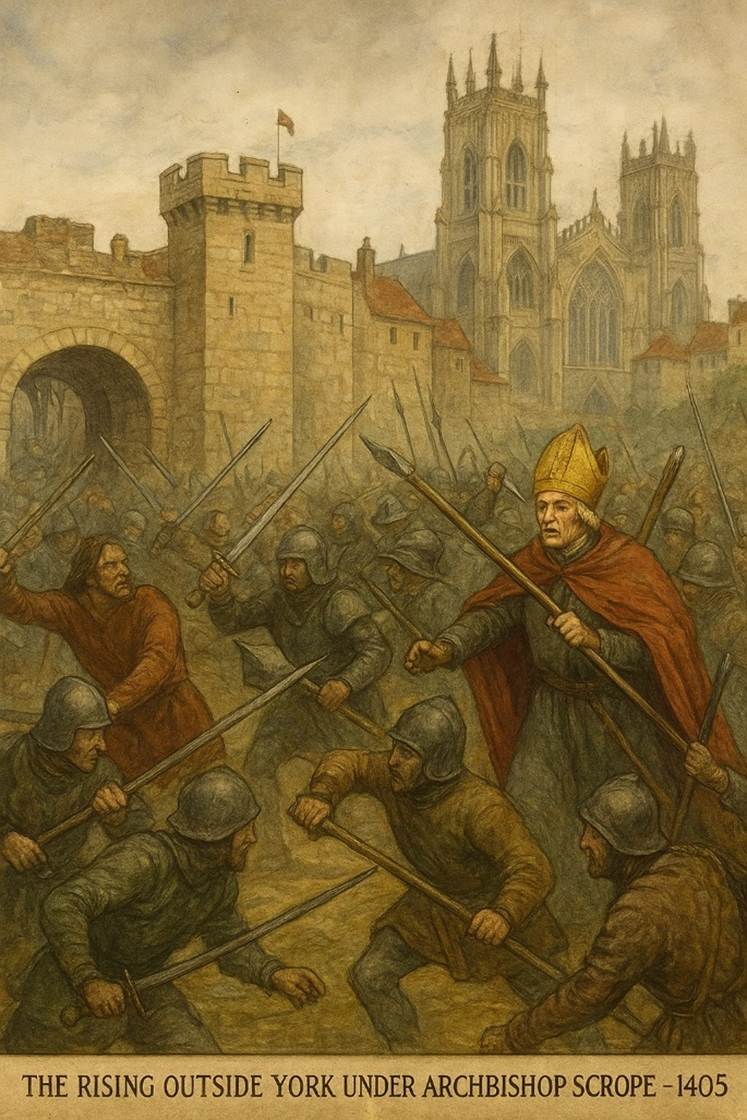
The Percys, Archbishop Scrope, Thomas Mowbray versus Henry IV, 1405
In May 1405, the
Earl of Northumberland, bruised and brooding over the death of his son Hotspur,
began a fresh revolt in the north. His initial move was to seize his rival,
Ralph Neville, the Earl of Westmoreland, but Neville and escaped and Percy fled
to the safety of Berwick, leaving his allies and sympathisers in Yorkshire
unsupported, led by the teenager Thomas Mowbray and Richard Scrope, the 55
years of Archbishop of York. Scrope had been
apparently loyal to Henry since his coronation. His resistance began with a
sermon at York Minster which denounced the bad governance in the kingdom
with its harsh regulations and unmanageable taxes. Yorkshire was
Percy country and York’s people were stirred by a manifesto so rousingly vague
as to be all encompassing. The archbishop found the city in uproar around him.
On 27 May 1405
Mowbray and Scrope led a force of 8,000 men onto
Shipton Moor just outside the city. They waited for support from
Northumberland, but instead watched an approaching royalist army under Ralph
Neville and Henry’s young son, John of Lancaster. Ralph Neville indicated his
willingness to have the rebels’ complaints addressed, but when they cleared the
field, he arrested Scrope and Mowbray.
Henry IV
approached too, his patience worn. On 6 June 1405 the people of York streamed
towards him through its gates in supplication, barefooted and bareheaded,
wearing filthy rags. Archbishop Arundel of Canterbury begged the king to
have mercy on his fellow archbishop.
The King and
Thomas Beaufort arranged a summary trial. Archbishop Scrope
and Thomas Mowbray were
found guilty of treason and executed in a barley field outside the city.
The parallel with the death of Thomas Becket now questioned the justice which
had set Henry’s rule apart from his predecessors.
Henry then moved
north to attack the Percy castles including Berwick and Warkworth,
in the north east, taking siege engines and cannon. He called one of his guns
the King’s Daughter and took technical interest in their design. The city of
York lost its liberties. The king had also killed one archbishop and alienated
another.
(The Eagle and the Hart, The Tragedy of Richard II and
Henry IV, Helen Castor, 2025, page 411
to 412).
The Yorkshire Rebellion,
1489
The Yorkshire
Rebellion in 1489 was a protest against heavy taxation by Henry VII. The
Earl of Northumberland was killed by rebels after telling them the king would
not back down on the tax. The uprising was short lived and suppressed by the
Earl of Surrey in May.
The Pilgrimage of Grace,
1536
The Pilgrimage
of Grace in Lincolnshire and East Riding of Yorkshire was in opposition to
the dissolution of the monasteries. Led by Robert Aske, the rebels, calling
themselves pilgrims, also sought the return of the Pope's authority, the
dismissal of Thomas Cromwell, and the repeal of new taxes and laws. Despite the
rebels' initial success in occupying cities and negotiating, the King
eventually suppressed the uprising, though it highlighted significant
discontent with his rule. Many of the leaders of the rebellion were executed,
including Robert Aske.
Although
monasteries and nunneries were not widely popular, their suppression by Henry
VIII was the spark for to an uprising in October 1536 which began in
Lincolnshire, particularly as commissioners had instructions to quash
superstitious practices of a popular cult of saints. The rebellion then spread
to a more formidable rising in the East Riding of Yorkshire which spread from
the Rover Don to the Scottish border. It came to be led by Robert Aske. The
underlying causes of the rebellion were mixed and it evolved into a rebellion
against change, focused on taxation.
Over 30,000 folk
carrying religious banners demanded a reversal of religious change, the
overthrow of the heretical king’s councillors, the repeal of the laws against
the legitimacy of Mary, an end to the closure of religious houses and the
prevention of the merging of parishes and closing of churches. They also
protested against taxation.
They began to see
Princess Mary as the champion of traditional religion, embodying resistance to
the break with Rome.
The protestors
began to repair and reopen monasteries themselves.
It came to be
known as the Pilgrimage
of Grace from their banner showing the five wounds of Christ. On
16 October rebel nobility, gentry, clergy and commoners entered York under
their badge of the five wounds of Christ. On the 19th, Hull capitulated. With
over 30,000 people involved the Pilgrims were too powerful to be defeated in
battle. Henry bought them off instead with promises of pardons and the
answering of grievances. It was a humiliation for the King, but Henry was
biding his time to gain revenge. (Tudor, the
Family Story, Leanda de Lisle, 2014,
page 214). They occupied York and Hull
and reached Doncaster.
Sir Thomas Percy
of Seamer may have been a significant leader and Sir Nicholas Fairfax of
Gilling appears to have joined in, along with many from Cleveland.
Henry ordered the
Duke of Norfolk to overcome the challenge, but Norfolk negotiated with them and
promised them pardons. When the rebellion had subsided, Henry VIII renounced
the concessions and ordered widespread executions.
There was a
second more localised rising in January 1537, called Bigod's Rebellion, under
Sir Francis Bigod, of Settrington, amidst rumours of taxes, when Cleveland was
in a ferment.
By February 1537,
the rebellions were over.
In spring 1547
the gentry leaders were brought to London for trial. There followed over 144
executions in London, with more in the north. Henry demanded that the
inhabitants of every town, village and hamlet that have offended should
suffer dreadful deaths as they may be a fearful spectacle to all others
hereafter.
The Rising in the North,
Rebellion of the Northern Earls, 1569
The Northern
Rebellion was a failed attempt by Catholic nobles, led by the Earls of
Northumberland and Westmorland, to depose Queen Elizabeth I in 1569 and replace
her with Mary, Queen of Scots. The revolt was driven by religious and political
grievances, including resentment of Elizabeth's Protestant government and the
interference of the English crown in the powerful northern counties. The
rebellion was swiftly suppressed by royal forces, with many rebels executed and
the leaders either executed or forced to flee.
The rebellion was
a Catholic response to the Protestant government, which included forcing the
use of the English Book of Common Prayer. The rebels captured Durham Cathedral,
tore up Protestant prayer books, and held a Catholic mass, which was illegal at
the time.
The Earls were
powerful Catholic nobles who felt that Elizabeth's government was undermining
their authority and interfering with their lands from a distant London.
The presence of
Mary, Queen of Scots, in England provided a focal point for Catholic
opposition. The rebels planned to free her from imprisonment, marry her to the
Duke of Norfolk, and make her the queen.
Economic
instability, including high taxes, debt, and a bad harvest, contributed to the
general discontent among the northern nobility.
The rebellion was
severely punished. Over 800 rebels were executed, and the Earl of
Northumberland was executed for treason.
The failure of the
rebellion solidified Elizabeth's power but also increased religious and
political tensions in England.
Following the
rebellion, the definition of treason was broadened to include actions like
circulating papal bulls, a measure that would have major consequences for
future plots against Elizabeth's reign.
Bibliography
South
Yorkshire, the History and Topography of the Deanery of Doncaster in the
Diocese and County of York by Rev Joseph Hunter, 1828, page 16.