Beowulf
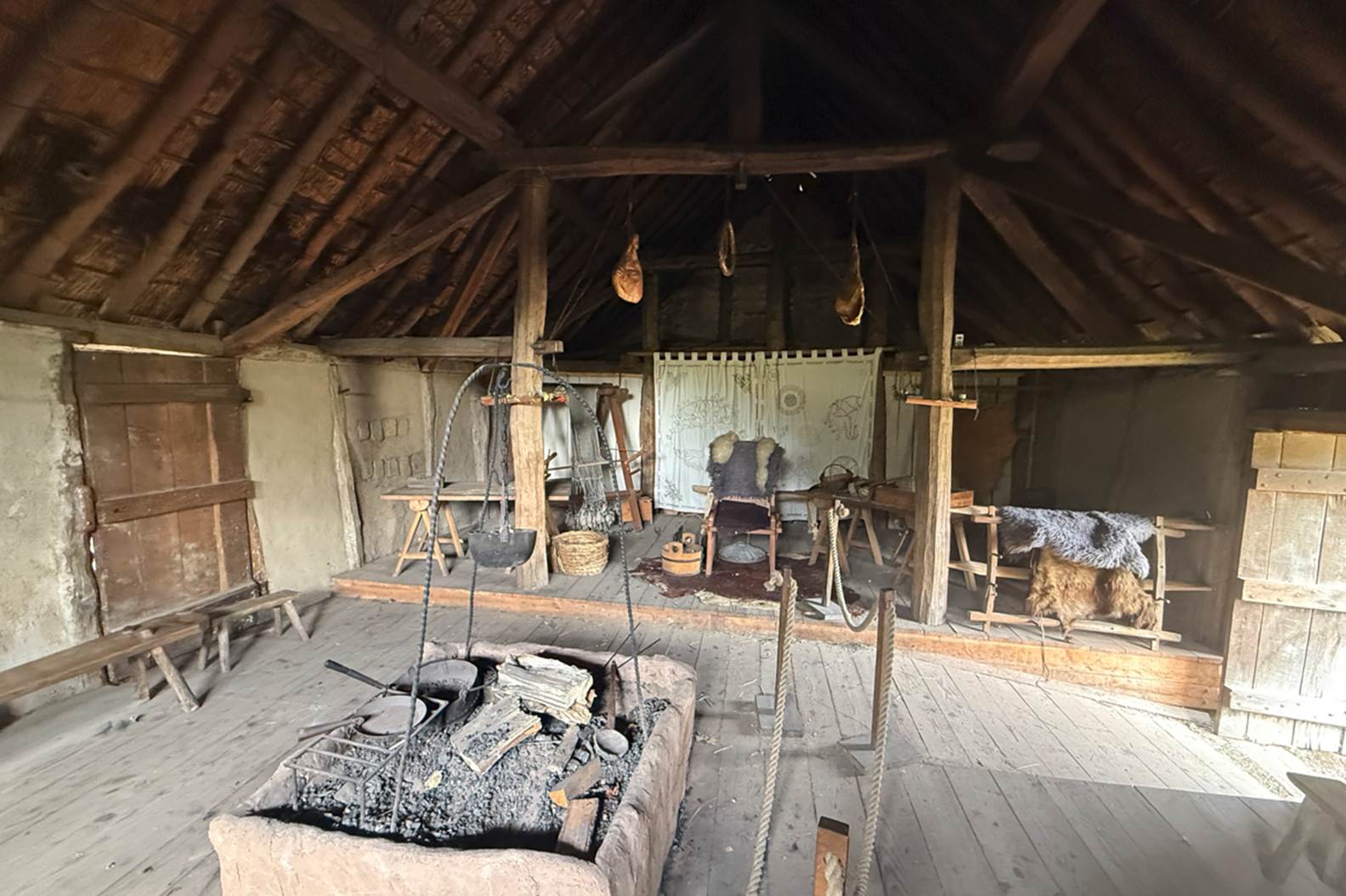
A reproduced Anglo Saxon Hall at
Jarrow Hall
The Old English Anglo
Saxon epic poem as a
clue to the Anglo Saxon World
|
Return to the Home Page of the Farndale Family
Website |
The story of one family’s journey through two
thousand years of British History |
The 83 family lines into which the family is divided.
Meet the whole family and how the wider family is related |
Members of the historical family ordered by date of
birth |
Links to other pages with historical research and
related material |
The story of the Bakers of Highfields, the Chapmans,
and other related families |
Headlines are in brown.
Dates are in red.
Hyperlinks to
other pages are in dark
blue.
References and
citations are in turquoise.
Context and local
history are in purple.
Geographical
context is in green.
Introduction
Beowulf is one of
the most important works of Old English literature. The author of the poem is
anonymous and generally referred to as the Beowulf poet.
Although
the great Anglo Saxon poem Beowulf, written at some point between the seventh
and tenth centuries, is an epic fantasy of a monster slaying hero, its vision
of ceorls (free warriors) feasting in the great timbered hall of their
‘ring-giving’ lord could not have been far from the truth (A History of Britain, At the Edge of the World, 3,000 BC
to AD 1603, 2009, Simon Schama, page 46).
Date
The only
manuscript which survived dates to 975 to 1025 CE and was badly damaged by fire
in 1731. There were likely to have been other manuscripts and the poem probably
originated in the
oral tradition. There is therefore uncertainty as to the date when the poem
was first created.
The events
described in the poem date to the fifth and sixth centuries CE.
It has been
suggested that it might have originated in the seventh century in East Anglia,
as the Sutton Hoo ship burials show connections with Scandinavia in this pre
Viking age. It has also been associated with King Alfred (ruled 871 to 899) and
to Cnut (1016 to 1035).
It might
therefore have been a part of the cultural world of Kirkdale
(probably first built around 685 CE), Bede (673 to 735),
and Alcuin (735 to 804).
The Story
The
story is set in pagan Scandinavia in the Sixth century CE. It is a story of
the lands of the invading Jutes, Angles and Danes, but written in the lands of
England where they settled. It has been suggested that Rendlæsham
(Rendlesham) was the site where Beowulf was first composed and performed. Rendlæsham was an East Anglian royal seat of
authority, close to the burial site of Sutton Hoo.
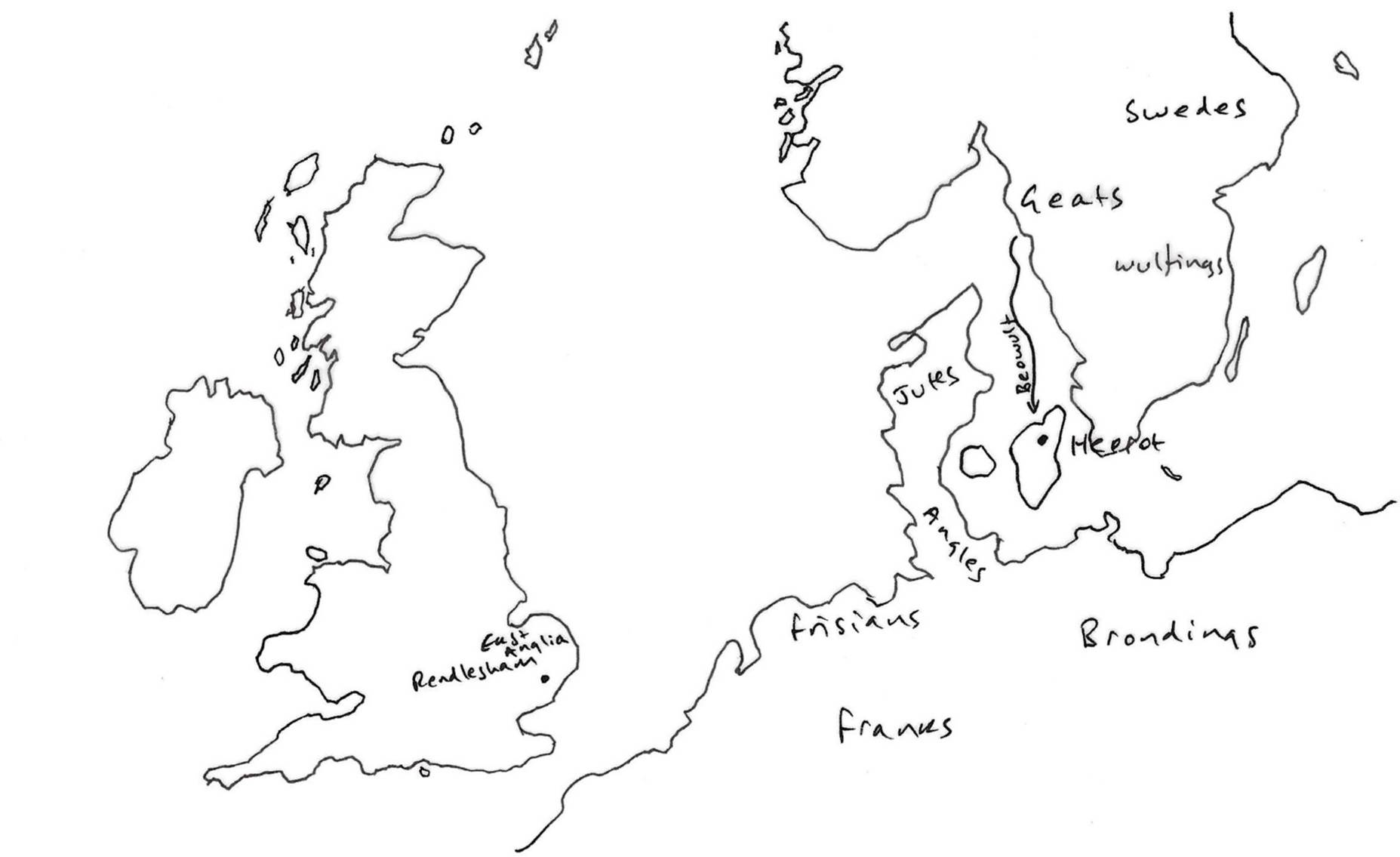
Beowulf is the
hero from the lands of King Hygelac of the Geats of southern Sweden.
In the first
part, Beowulf arrived as a stranger in the lands of Hrothgar, the king of the
Danes, whose recently constructed Great Mead Hall called Heorot had been
under attack for twelve years from the monster called Grendel.
Then the work I
find afar was assigned
To many races in
middle-earth’s regions,
To adorn the
great folk-hall. In due time it happened
Early ’mong men,
that ’twas finished entirely,
The greatest of
hall-buildings; Heorot he named it
Who wide-reaching
word-sway wielded ’mong earlmen.
His promise he
brake not, rings he lavished,
Treasure at
banquet. Towered the hall up
High and
horn-crested, huge between antlers.
(Beowulf,
Part II)
When Grendel
attacked the hall on the night of Beowulf’s arrival, Beowulf killed Grendel,
heroically unarmed with a sword.
In the second
part, as the hall celebrated Beowulf’s success, Grendel's mother took revenge
and was in turn defeated in her lair under a lake.
Beowulf returned
to Geatland where he was rewarded by King Hygelac
with 7,000 hides of land. When the old King died, Beowulf succeeded him and
became king of the Geats.
In the third
part, fifty years later, Beowulf’s kingdom was ravaged by a dragon. Beowulf
defeated a dragon angered by the stealing of its cup, but was mortally wounded
in the battle. After his death, his attendants cremated his body and erected a
barrow on a headland in his memory.
The story is
fiction, but blends with historical elements. King Hroðgar and the Scyldings and the Battle on the Ice of Lake Vänern between Eadgils and Onela were probably based on historical characters and
events.
The importance of the story
Beowulf provides
a unique perspective on Anglo Saxon culture.
Beowulf is all
but useless in illuminating the society of the earliest Anglo-Saxon Kings and
their subjects. However it vividly brings to life a world in which kings dwell
in great wooden halls, feasting with their followers, drinking med, and
listening to poets harping about the heroes of old; an era of restless warrior
bands in search of adventure, and wandering royal exiles, hoping one day to win
back their ancestral thrones. They carry swords richly worked with precious
metals, to which they give names and ascribe mystical protective powers. They
fight against each other for glory, but especially for gold, which they prize
above all else. A great lord like Hrothgar will deck the interior of his hall
with golden tapestries, and decorate its exterior with a golden roof. He will
reward his loyal followers with golden war-wear and gold torques. He will be a
giver of gold rings. (The Anglo Saxons, A History of the Beginnings
of England, Marc Morris, 2021, page 46)
The story
encourages dependence upon the stability of noble overlordship; the safety of
the Great Hall; and a perception that venturing into the wild lands outside
noble protection is best left to heroes like Beowulf.
It was an
inspiration for J R R Tolkien, a Professor of Anglo
Saxon history at Oxford who translated Beowulf himself. He drew heavily on
Beowulf for inspiration for the Lord of the Rings.
Behind Anglo
Saxon society there lurked the undefinable presence of wynd, an
Anglo-Saxon concept of fate or personal destiny, which is also ancestral to the
modern English word ‘weird’. It was a powerful force in Anglo-Saxon and Norse
cultures that represented the complex, interconnected web of happenings and
events in life, rather than an unchangeable, predetermined path. The term
implies that while some outcomes may be fated, personal choices and actions
also play a significant role in shaping one's destiny.
The world of Beowulf
heroism and legend underlay the creation of a state structure.
(A Brief History of the Anglo Saxons, The Beginnings of
the English Nation, 2006, Geoffrey
Hindle, page xli).
Bibliography
Beowulf, translated by
Lesslie Hall, 1892
A Brief History of the Anglo Saxons, The
Beginnings of the English Nation, 2006, Geoffrey Hindle, page xli.