The Venerable Bede
672 to 26 May 735
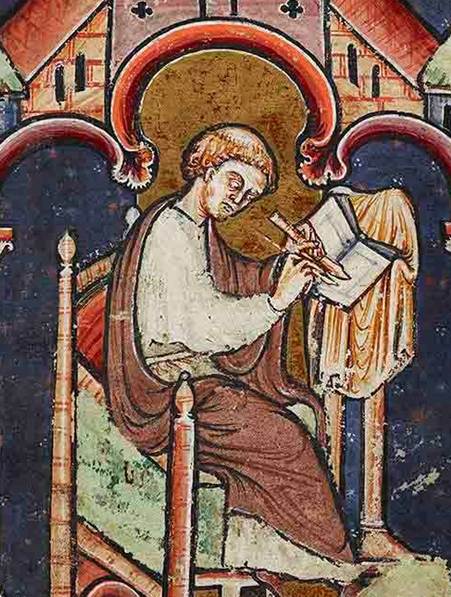
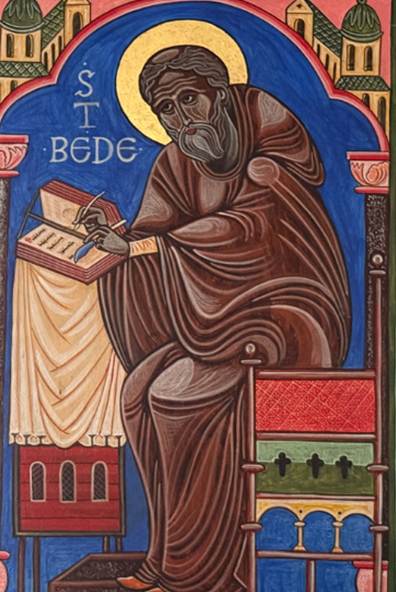
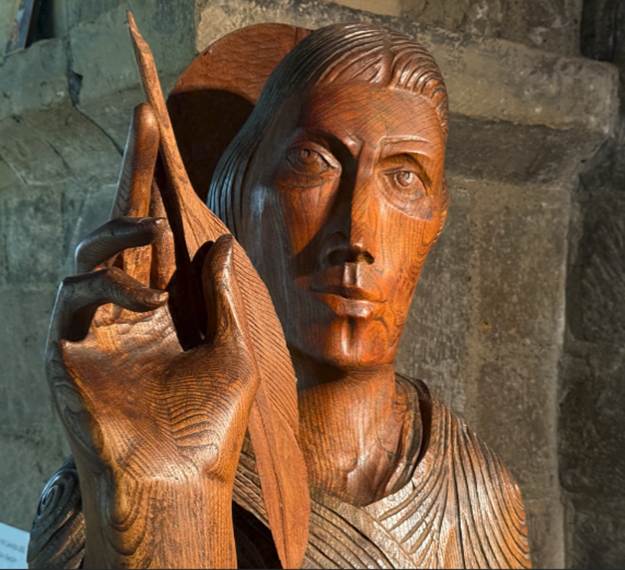
The
life of Bede and the History of Monkwearmouth-Jarrow
|
Return to the Home Page of the Farndale Family
Website |
The story of one family’s journey through two
thousand years of British History |
The 83 family lines into which the family is divided.
Meet the whole family and how the wider family is related |
Members of the historical family ordered by date of
birth |
Links to other pages with historical research and
related material |
The story of the Bakers of Highfields, the Chapmans,
and other related families |
Headlines are in brown.
Dates are in red.
Hyperlinks to
other pages are in dark
blue.
References and
citations are in turquoise.
Context and local
history are in purple.
Geographical
context is in green.
The Kings of Deira,
Bernicia and Northumbria and their conversion to Christianity
A Genealogy
of the Deira and Bernician Kingdoms and the chronology of the Kingdom of
Northumbria is an aide to the early kings of Deria and Bernicia.
604 CE
Æthelfrith of
Bernicia gained control of Deira in about 604 CE. The details are not known but
he probably conquered Deira since Edwin, son of the former King Ælla, was exiled. It is though possible that this was the
formalisation of some existing relationship between the two Kingdoms, a
burgeoning larger Kingdom of Northumbria.
Edwin took refuge
with Rædwald, King of East Anglia.
616 CE
Æthelfrith was
killed at the Battle of the River
Idle by Rædwald. Edwin became King of Northumbria.
Æthelfrith's sons
Eanfrith, Oswald, and Oswy fled northwards to the Gaelic kingdom of Dál
Riata.
625 CE
Edwin married
Æthelburh, a Christian Princess from Kent in 625 CE. She was the sister of
Eadbald of Kent who required as a condition of the marriage that Edwin
converted to Christianity.
Æthelburh was accompanied
by Paulinus, a member of the Gregorian mission to Northumbria.
627 CE
Edwin converted
to the Christian religion, along with his nobles and many of his subjects in
627 CE and was baptised at Eoforwic where he
built the first wooden church amidst the Roman ruins which was later replaced
by a larger stone church.
Paulinus then
converted many of Edwin's subjects, including the future saint, Hild who would
found Streanæshealh. Paulinus built churches.
633 CE
Edwin was killed
at the Battle
of Hatfield Chase, near Doncaster, on
12 October 633 CE by Cadwallon of Gwynedd and Penda of Mercia. Æthelburh and Paulinus
fled to Kent. Christianity had not yet taken root in Northumbria.
Edwin was
succeeded by Osric, son of Edwin's paternal uncle Ælfric,
in Deira. He reverted to paganism, but was killed by Cadwallon.
Oswald, son of
Æthelfrith, then defeated and killed Cadwallon and united Northumbria once
more. Oswald had converted to Christianity under Celtic influence whilst in
exile at Iona and Dál Riata.
Oswald spread the
Celtic form of Christianity in his traditionally pagan lands. Although Edwin
had first converted, it was Oswald who spread the religion widely through the
northern Kingdom. He asked the Irish of Dál Riata to send a bishop to
help the conversion of his people. The Irish first sent an austere bishop, who
had little success.
635 CE
The Irish later
sent Aidan, who brought a gentler approach. Oswald gave the island of
Lindisfarne to Aidan as his episcopal see.
Oswald and his
successors came to see themselves as protectors of the church and found that
the Church could provide authority to their rule.
642 CE
Oswald was killed
at the Battle of Maserfield by Penda, King of Mercia
in 642 CE. He was venerated as a saint after his death.
Oswiu was another
son of Æthelfrith who had been exiled with his brother Oswald to the Irish
kingdom of Dál Riata.
In about 642 CE,
Oswiu married Eanflæd, Edwin’s daughter.
Oswiu initially
struggled to exert authority over Deira. He ruled Bernicia, but Deira was ruled
independently.
At that time,
because there were not many monasteries founded in England, numbers of people
from Britain used to enter the monasteries of the Franks or Gauls to practice
monastic life (Ecclesiastical
History of the English People, Bede, Book 3,
Chapter 8).
648 CE
Hild, St Hilda,
the daughter of Hereric, nephew to King Edwin of Northumbria, was granted one
hide of land on the north bank of the River Wear by Aidan, Bishop of
Lindisfarne. She established a small monastic community there and stayed for
about a year before she became Abbess of Hartlepool monastery (founded in about
650 CE) and founder of Streanæshealh (Whitby) from about 657 CE.
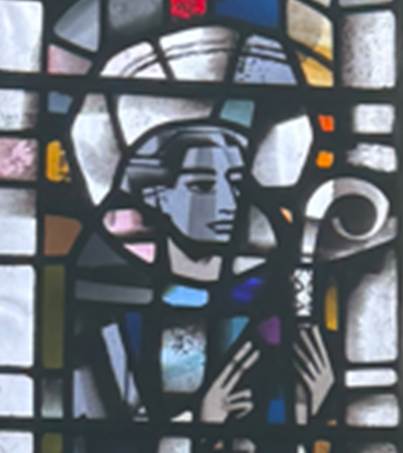
Benedict Biscop
653 CE
Biscop Baducing (known as Benedict Biscop), born into an
aristocratic Northumbrian family, visited Rome six times, first in about 653 CE
at the age of 25. He collected books and brought revolutionary ideas back to
England. He travelled with another Northumbrian nobleman, Wilfred who later
founded the monastery at Hexham.
There is some
mystery about Benedict Biscop’s name. He is called Biscop Baducing
by Eddius Stephanus,The Life
of Bishop Wilfred, Chapter 3, but never by Bede. Margaret
Deanesly (The Pre Conquest Church in England, 1961, page
111) thought the name Biscop or Biscopus
pointed to a Romano-Christian ancestry and could not possibly be Anglo Saxon.
We do not know when or why the cognomen Benedict was acquired. It was not used
by Eddius Stephanus. It was presumably a tribute to
the memory of St Benedict. (Benedict Biscop, Eric Fletcher LLD, FSA, Jarrow Lecture 1981, page 3).
He occupied a
prominent official position in the Royal Household of King Oswy who endowed him
with sufficient land to enable him to maintain himself in a style suitable to
his rank (Benedict Biscop,
Eric Fletcher LLD, FSA, Jarrow Lecture 1981, page 3).
On their journey
Benedict Biscop and Wilfred no doubt used as staging posts some of the Gallic
monasteries on their route (Benedict Biscop, Eric Fletcher LLD, FSA, Jarrow Lecture 1981, page 4).
654 CE
There is a gap in
our knowledge of Benedict Biscop’s movements during the next eleven years
between 654 and 665 CE (Benedict Biscop, Eric Fletcher LLD, FSA, Jarrow Lecture 1981, page 4).
655 CE
In 655 CE, Oswiu
killed Penda at the Battle of the Winwaed, which gave
the Northumbrian King control the Kingdom of Mercia.
After 655 CE he
had become one of the most powerful rulers in Britain. He secured control of
Deira and his son Alhfrith served as a sub-king. For three years, Oswy’s power
over Mercia earned him recognition as Bretwalda, an Overlord of the
Anglo Saxon Kingdoms.
Biscop Baducing during this time studied the customs and
institutions of monasteries in Italy and Gaul.
660 CE
Ceolfrith entered
the monastery of Gilling, in Ryedale, where his brother Cynefrith was abbot.
664 CE
Oswiu presided
over the
Synod of Whitby at Streanæshealh (Whitby) in 664 CE. Oswiu after listening
to the debate decreed that Roman practices should be adopted and his Kingdom
became linked to Rome and its artistic and cultural influences.
665 CE
Biscop’s sojourn
at Lérins from 665 to 667 was the most significant
for his future career and influence. He joined the community of monks, received
the tonsure and, having taken the vow, observed regular discipline with due
solicitude. (Benedict Biscop,
Eric Fletcher LLD, FSA, Jarrow Lecture 1981, page 4). Monasticism
flourished in Gaul in the 5th and 6th centuries at
centres such as Ligugé, Marseilles, and Lérins. The monastery of Lérins is built on a small Mediterranean
island off the coast from Cannes. Reform of the monastery by Abbot Aigulf transformed the monastery into a coenobitic or
communal establishment.
667 CE
Benedict Biscop
had intended to spend the rest of his days in the monastery at Lérins but in 667 he could not resist the temptation of
making another visit to Rome … Biscop was enjoined by the Pope to abandon his
monastic life at Lérins and return to England as an interpreter for Archbishop
Theodore and Hadrian his companion. (Benedict
Biscop, Eric Fletcher LLD, FSA, Jarrow
Lecture 1981, page 6).
670 CE
Oswiu died from
illness in 670 CE and Deira and Bernicia was divided between two of his sons.
671 CE
Biscop made
another visit to Rome in 671 CE, his fourth. His purpose was academic, to
collect books and visit friends.
Benedict Biscop
was essentially a scholar, a collector of books, a lover of literature and
academic interests and concerned to inaugurate here in the north a school of
learning and scholarship modelled on Lérins
and Canterbury. (Benedict Biscop, Eric Fletcher LLD, FSA, Jarrow Lecture 1981, page 9).
Although Wilfred
claimed to have been the first to introduce the Rule of St Benedict into
England, the real founder of Benedictine life in England was Benedict Biscop.
It was he (not Wilfred) who stressed the importance of stability, the
obligation to remain in the monastery, as one of the main tenets of Benedictine
life, and we may be thankful that the Venerable Bede was a conspicuous observer
of this precept. One can agree with the conclusions of Patrick Wormald (Bede and Benedict Biscop, Famulus Christi, 1976, pages
141 to 169) that “one of Biscop’s legacies to Bede could have been as
concentrated a dose of Benedictinism as was available
anywhere in the seventh century. (Benedict
Biscop, Eric Fletcher LLD, FSA, Jarrow
Lecture 1981, page 9).
Bede or Bēda
Bede was born on lands belonging to the monastery of Monkwearmouth
in the Kingdom of Bernicia, in about 672 CE (since he was in his 59th
year when he completed his Ecclesiastical History). In the Historia, Bede gave his birthplace as "on the lands of this
monastery".
Having been born
in the territory of that same monastery, I was given, by the care of kinsmen,
at seven years of age, to be educated by the most reverend Abbot Benedict, and
afterwards by Ceolfrid, and spending all the remaining time of my life a
dweller in that monastery. I wholly applied myself to the study of Scripture;
and amidst the observance of monastic rule, and the daily charge of singing in
the church, I always took delight in learning, or teaching, or writing. In the
nineteenth year of my age, I received deacon's orders; in the thirtieth, those
of the priesthood, both of them by the ministry of the most reverend Bishop
John, and at the bidding of the Abbot Ceolfrid. From
the time when I received priest's orders, till the fifty-ninth year of my age,
I have made it my business, for my own needs and those of my brethren, to
compile out of the works of the venerable Fathers, the following brief notes on
the Holy Scriptures, and also to make some additions after the manner of the
meaning and interpretation given by them. (Ecclesiastical
History of the English People, Book 5, Chapter
24).
King Ecgfrith of Northumbria, impressed by Benedict Biscop’s
account of his travels, gave him 70 hides of land on the north bank of the
River Wear to found a monastery.
674 CE
Benedict Biscop founded the monastery of St Peter’s at Wearmouth
on land endowed by King Ecgfrith, under the Pope’s protection.
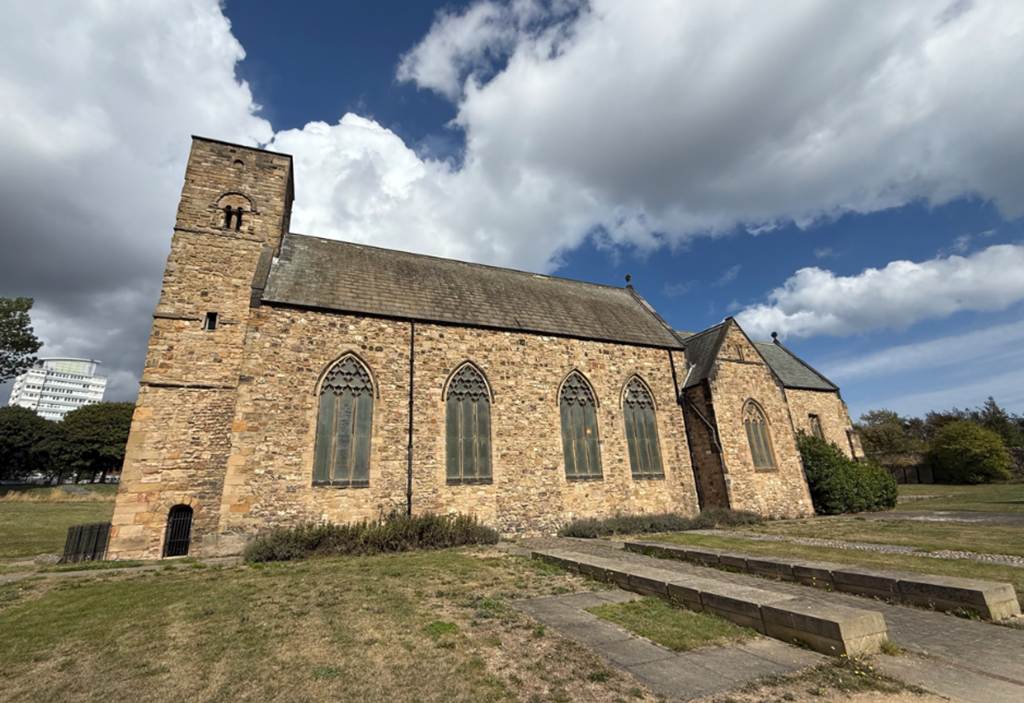
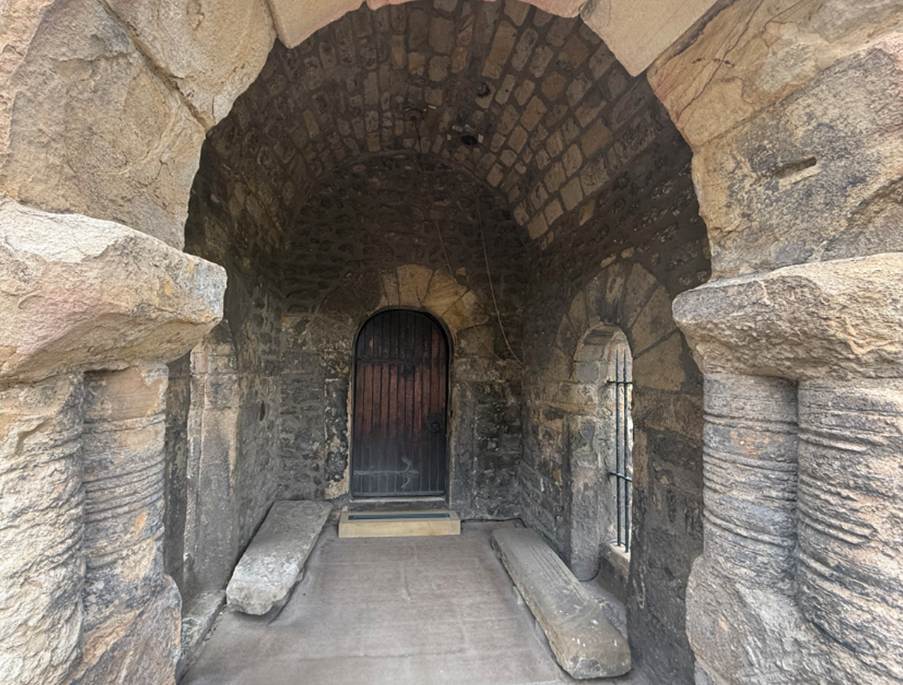
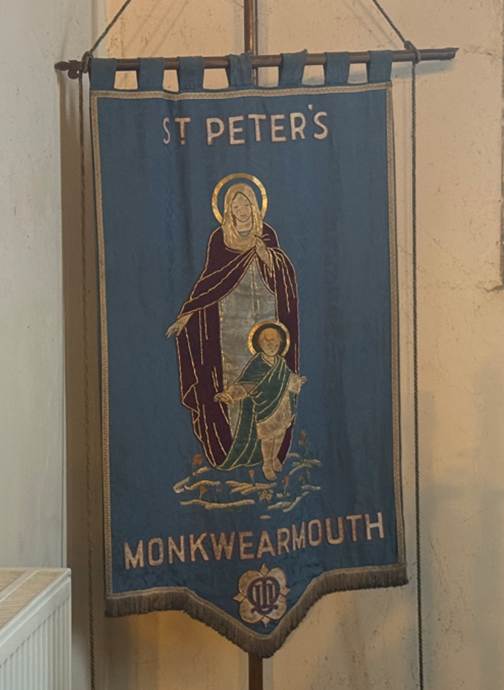
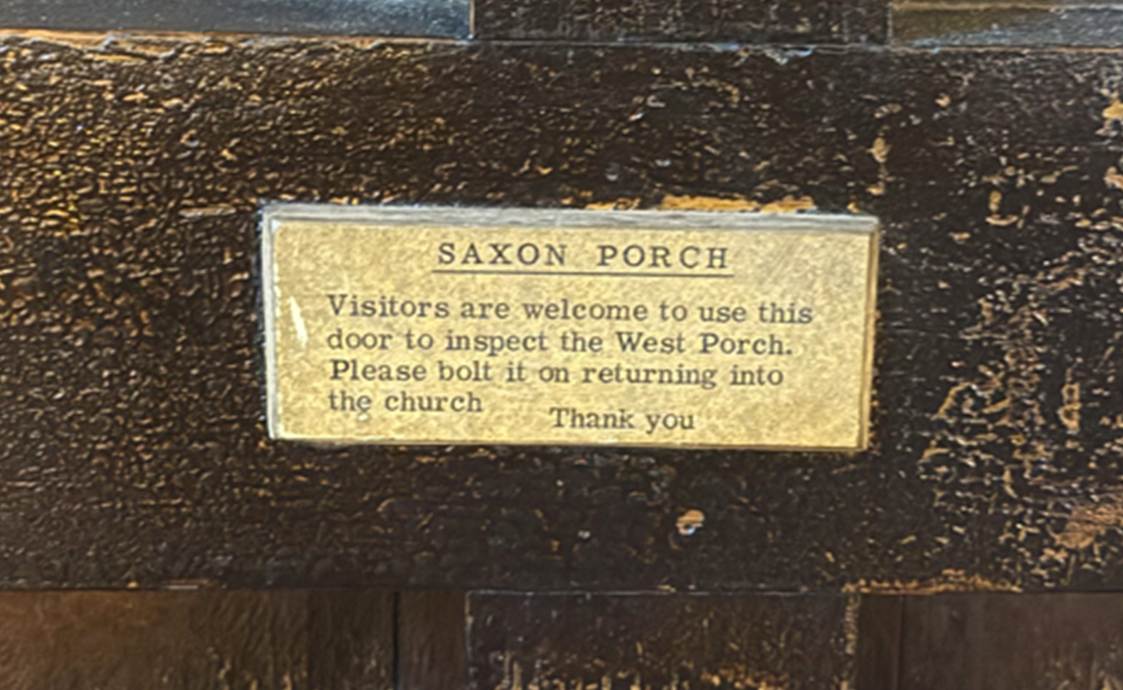
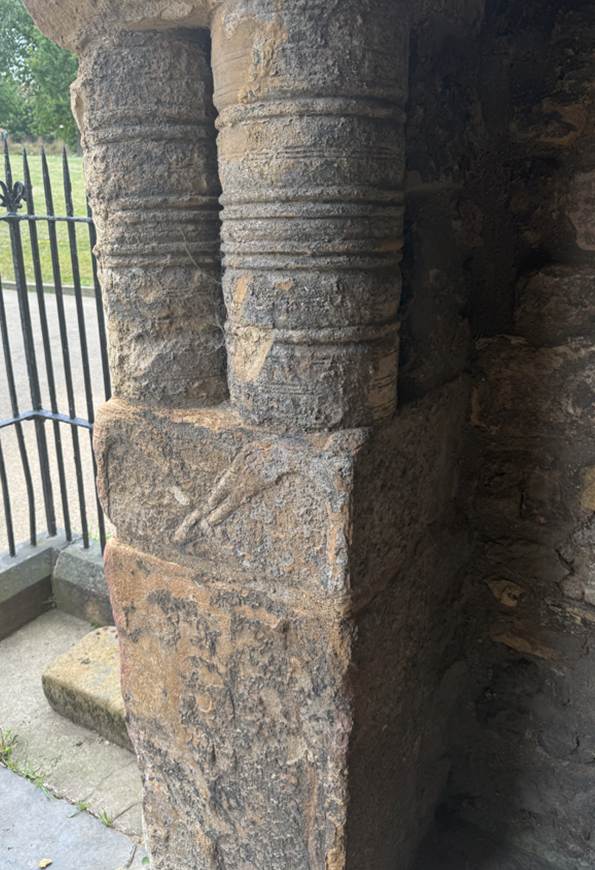
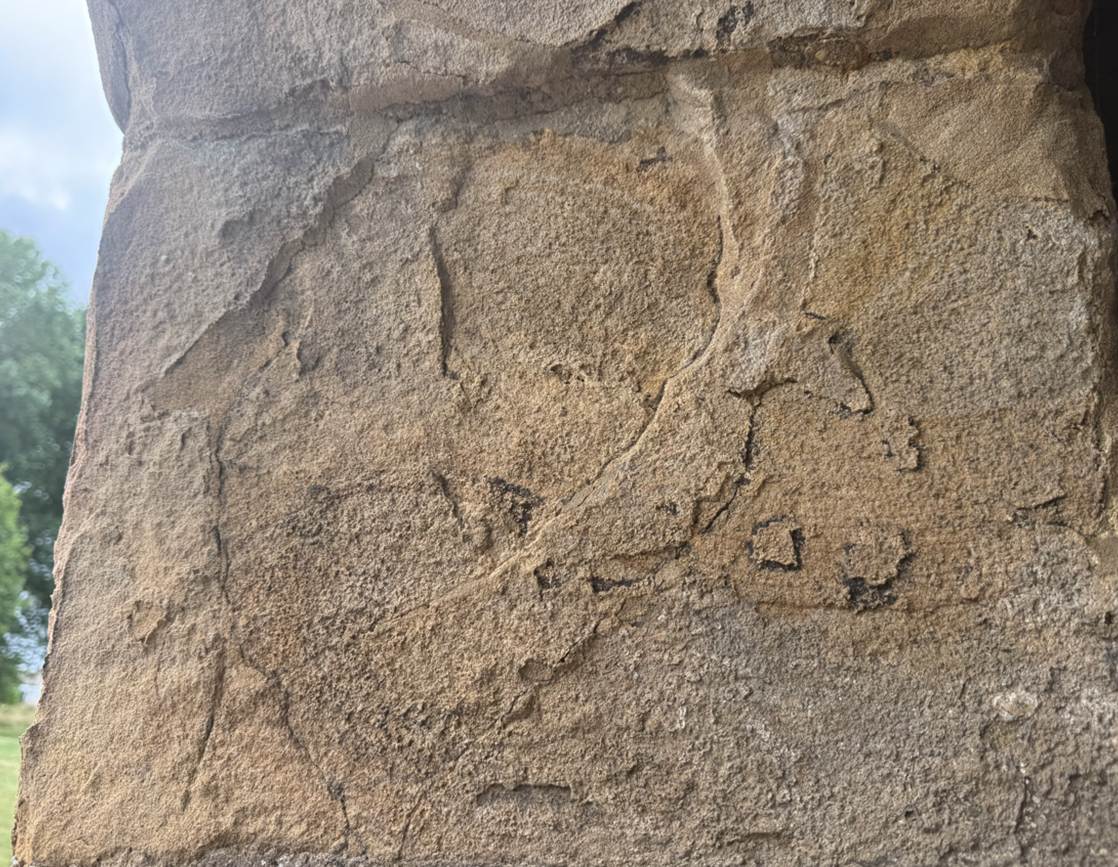
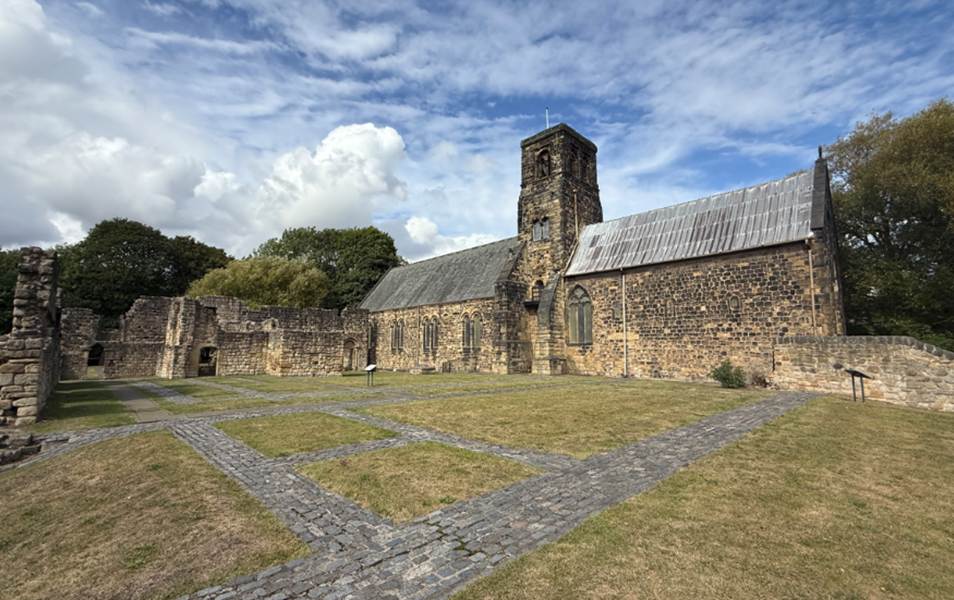
St Peter’s at
Wearmouth
Bede was sent to the monastery of St Peter at Monkwearmouth at the
age of seven as puer oblatus.
He was initially educated under Benedict Biscop.
It must have been
a shock, at the age of seven, to be sent away for ever. He was to join a world
more dynamic and glamorous than anything he had ever known. This was a
pioneering experiment, backed by the wealthy and powerful. Seven year old Bede,
with his muddy fingernails and bony frame, was to be sent to a monastery. What
a moment for a child to bid goodbye to everything they had known. Did a tear
trickle down Bede’s cheek as he clung to his parents in a final embrace? (Bede, Chapter 1, Eighteen,
Alice Loxton, 2025).
To what extent
did Bede benefit from Benedict Biscop’s teaching and knowledge? It would be
tempting to think that during the ten formative years of Bede’s life from the
age of seven to seventeen, following his admission to Monkwearmouth until
Biscop’s death in 690, he profited as a pupil under Biscop as a teacher and
instructor. During much of this time, however, Biscop was occupied in the
foundation and establishment of his second monastery at Jarrow, and was absent
abroad, engaged in furnishing it with its library and obtaining decorations and
fittings for the church. (Benedict Biscop, Eric Fletcher LLD, FSA, Jarrow Lecture 1981, page 7).
Biscop had
travelled to Rome on at least five occasions and brought back books to form a
small library, to which Bede had access. Biscop and Ceolfrith travelled to Rome
in 679 CE and returned with a single volume pandect of the old Latin
translation of the whole Bible. This may have been the Codex Grandior, a sixth century Bible produced for the
library of the Biblical scholar, Cassiodorus (490 to 585 CE).
King Ecgfrith gave 40 hides of land at Jarrow to Benedict Biscop.
In 681 CE a sister monastery to Monkwearmouth was founded at Jarrow by Abbot
Ceolfrith with a group of 17 or 22 brethren.
Although two different sites, they functioned as a single monastery.
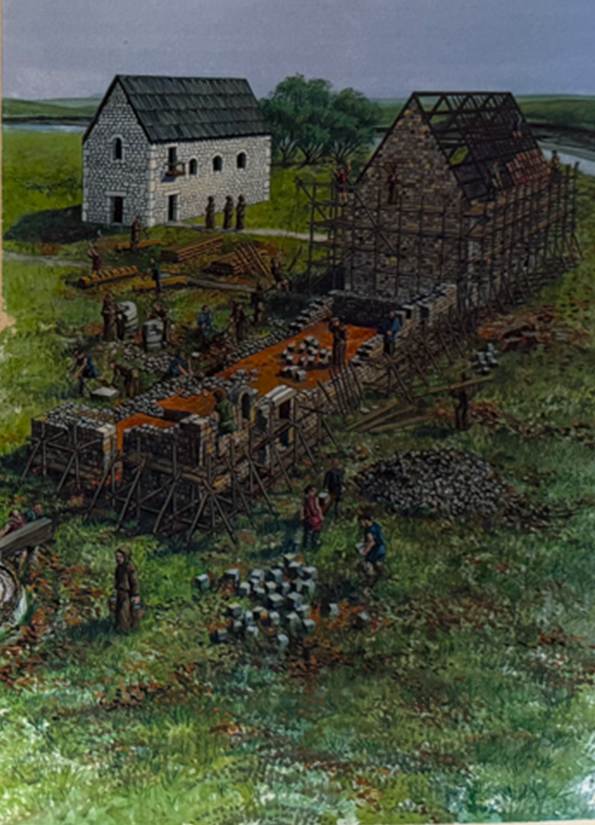
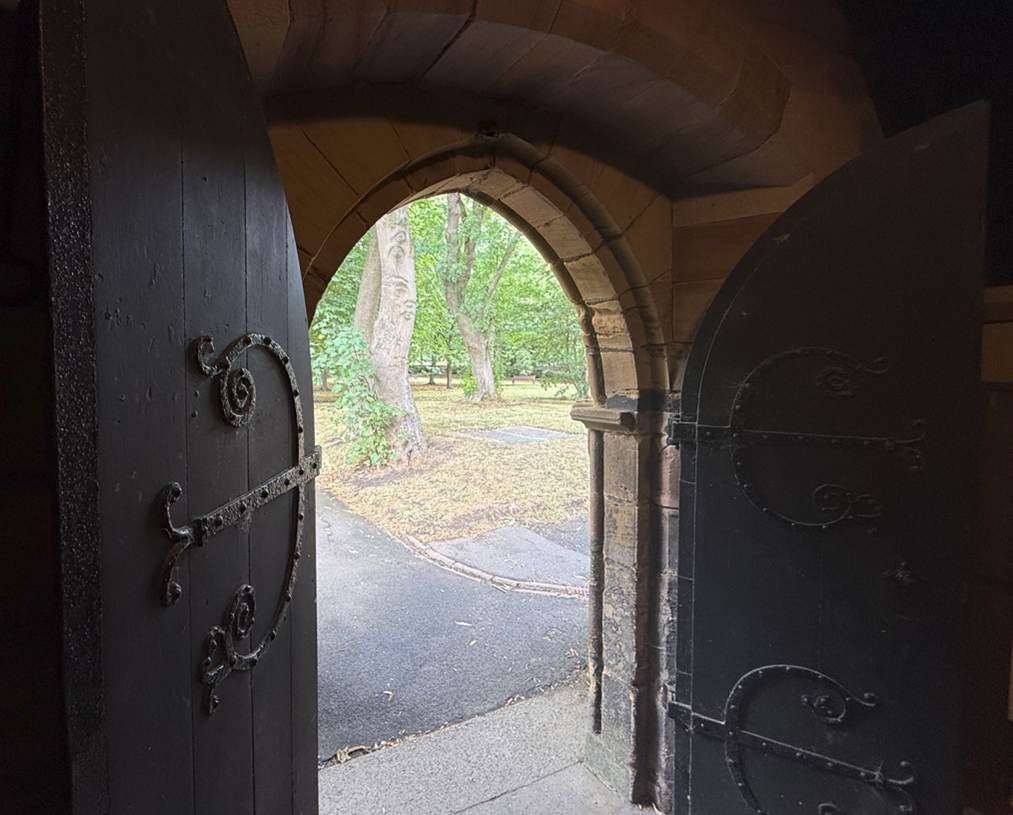
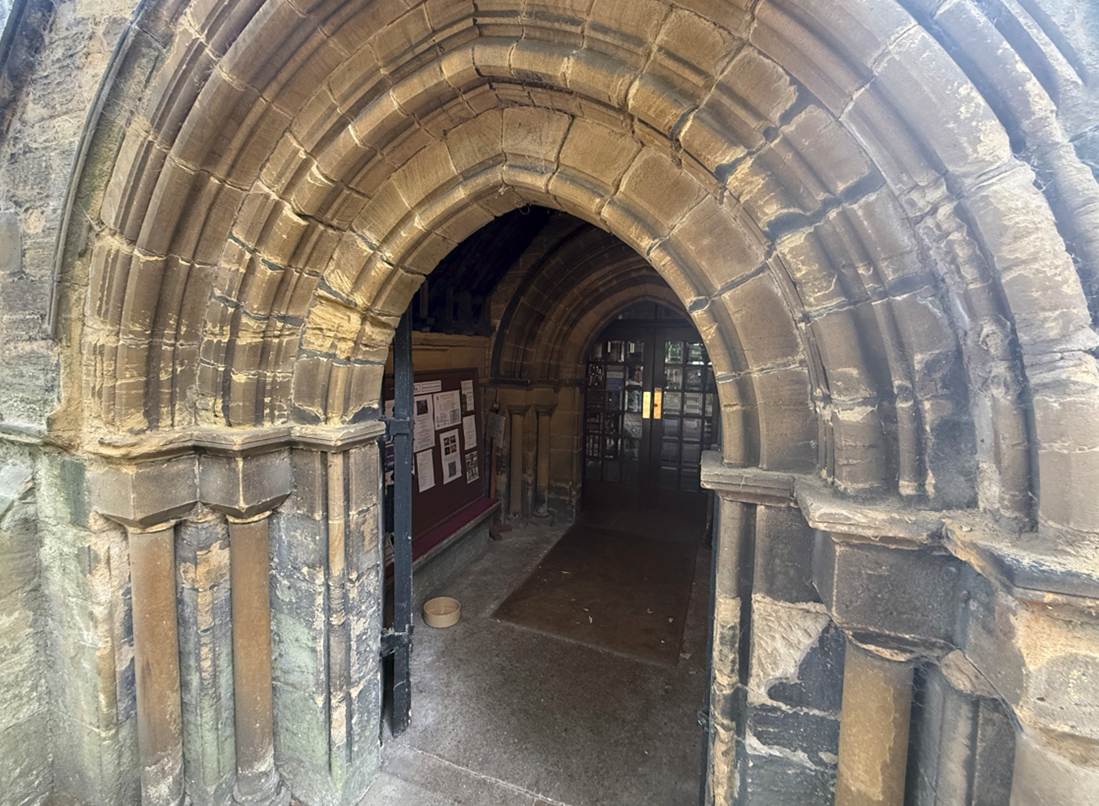
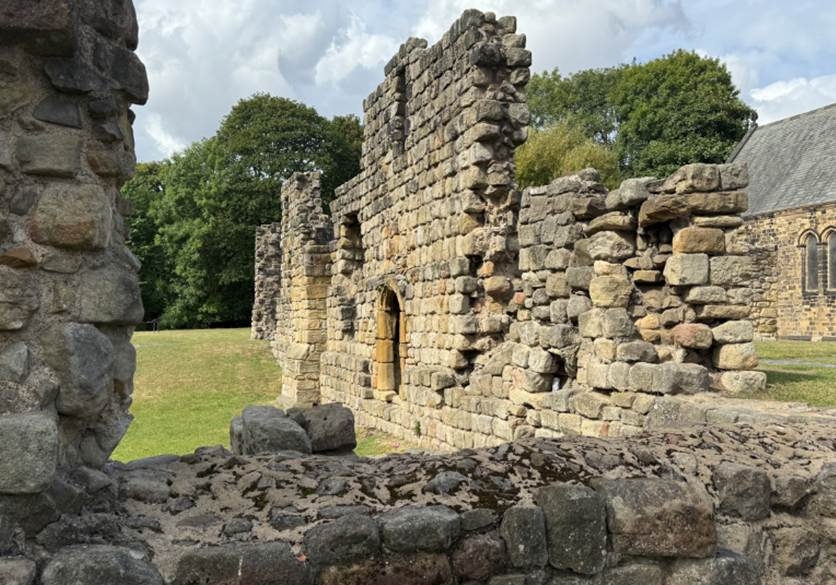
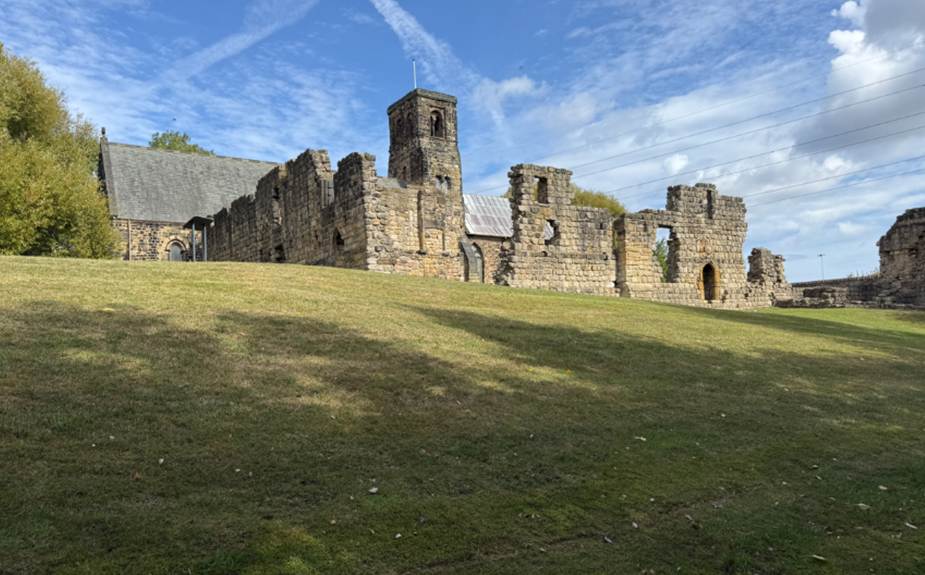
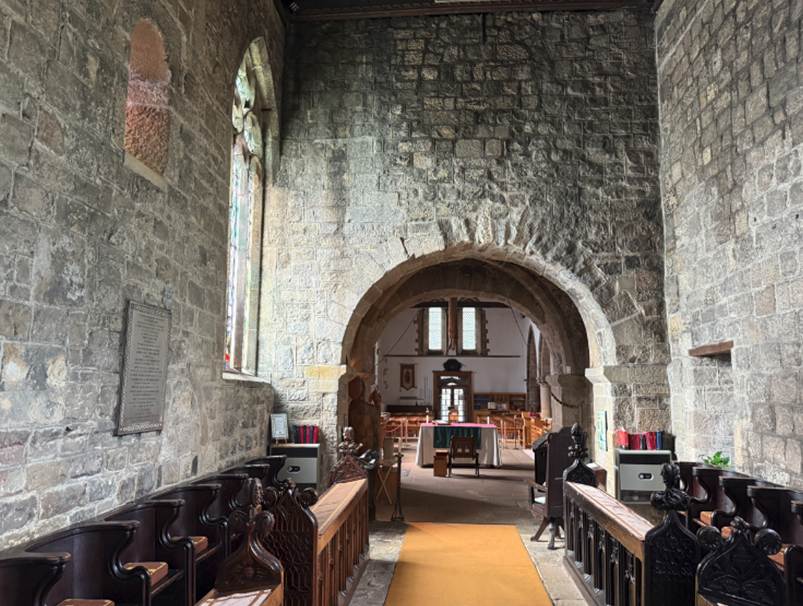
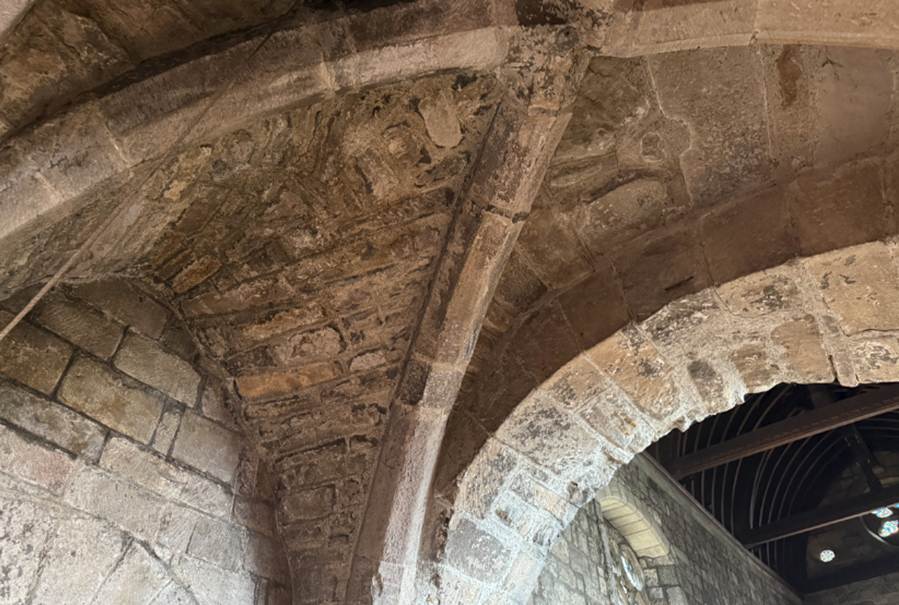
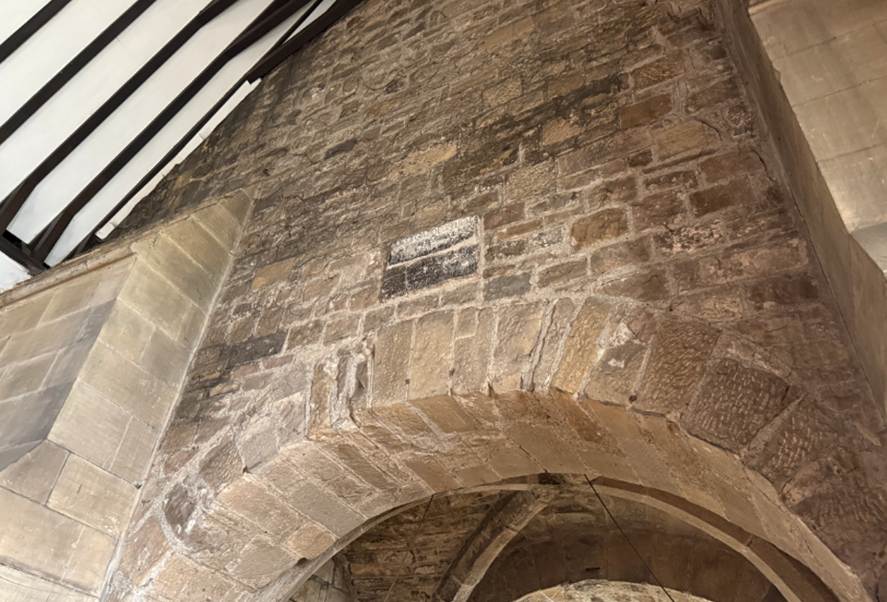
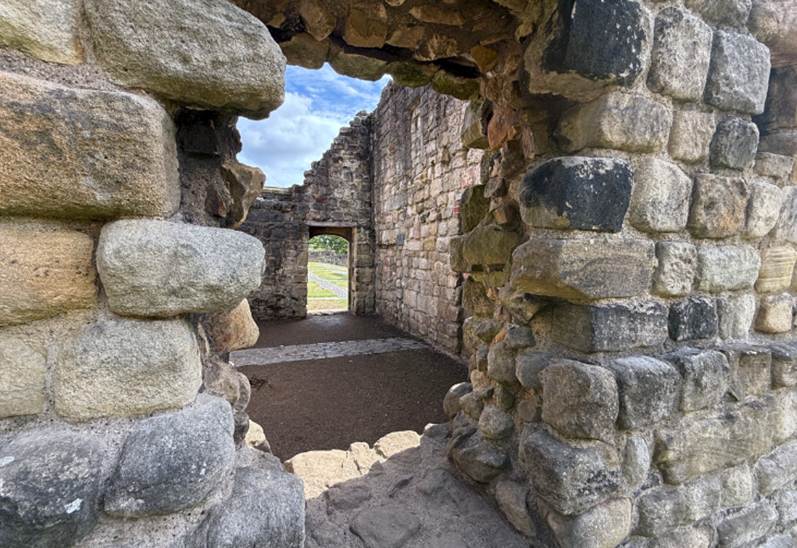
Construction of
St Peter’s
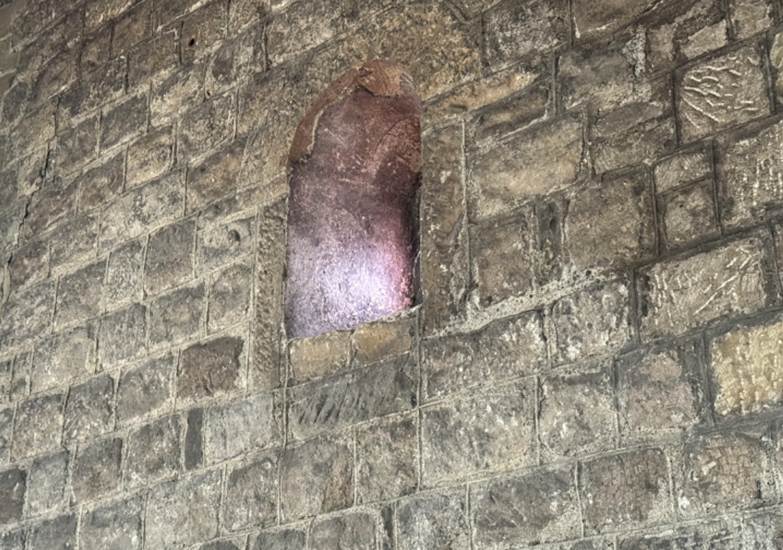
The door through which Bede walked
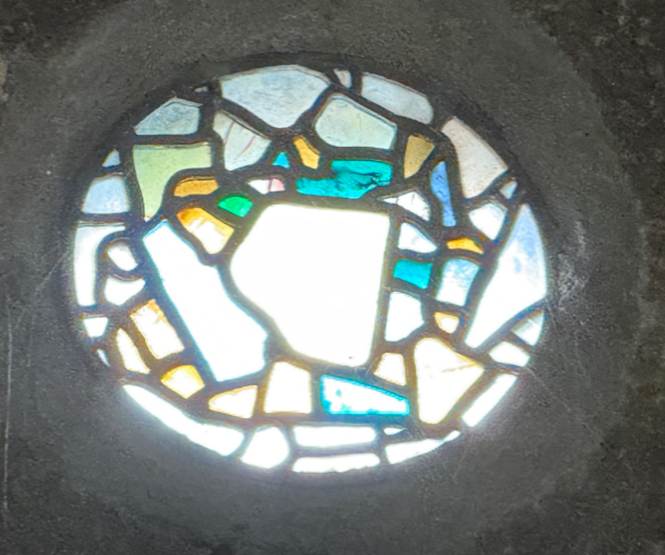
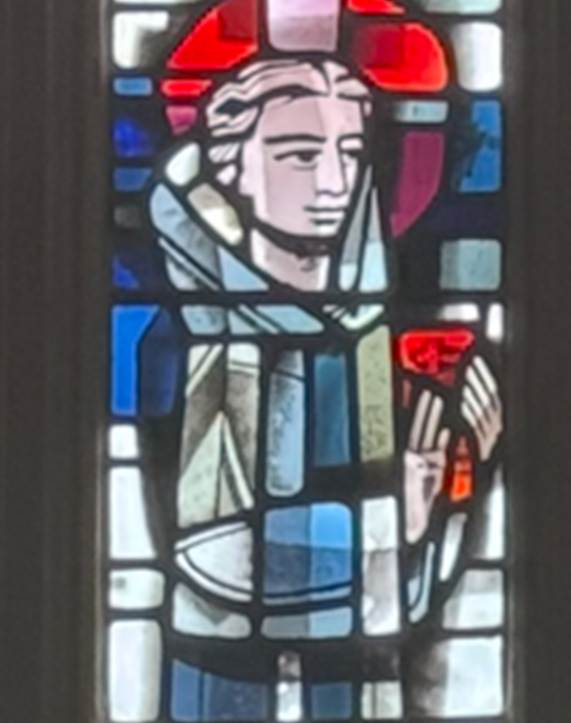
Stained glass
from coloured glass artefacts found on the site
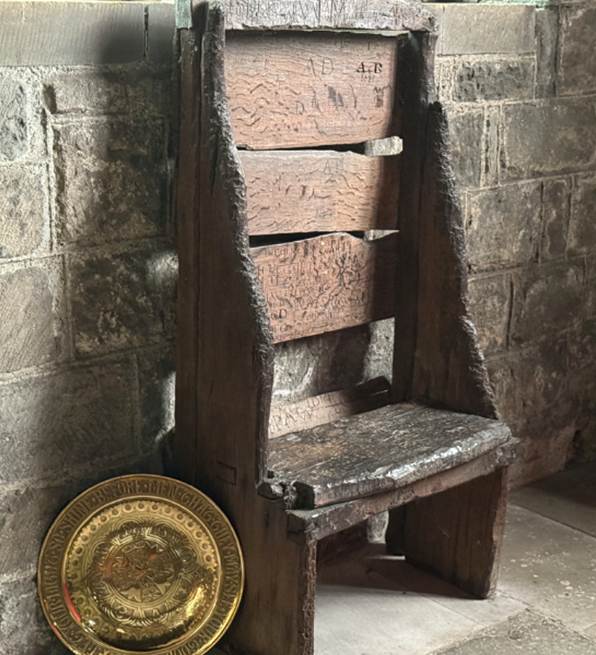
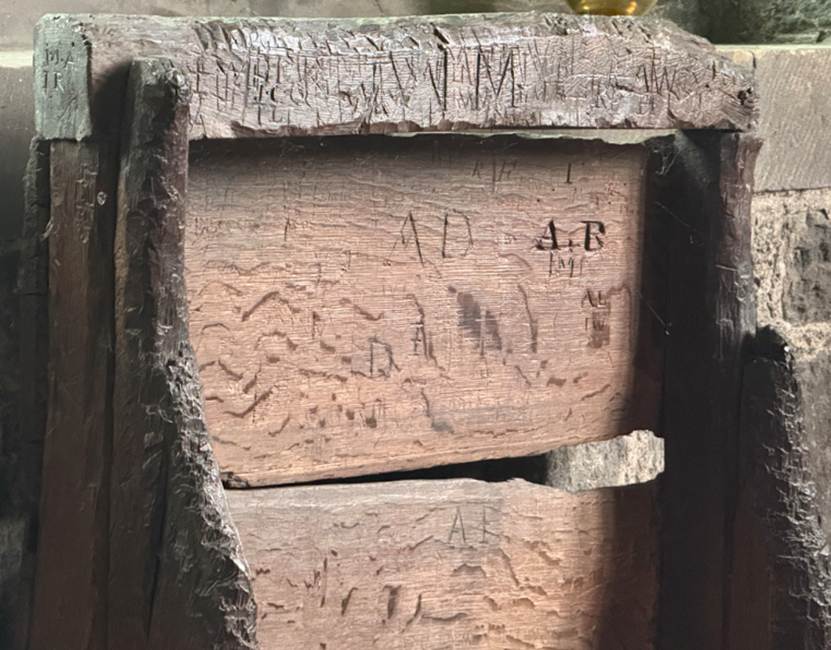
Bede’s chair from
which carvings have been carved over centuries, now found to be of a later date
by carbon dating
Bede joined Abbot
Ceolfrith at Jarrow.
The establishment
of a twin foundation forming an integral part of a single monastery and yet
separated by a distance of some seven or eight miles must have presented some
unusual problems of administration. (Benedict
Biscop, Eric Fletcher LLD, FSA, Jarrow
Lecture 1981, page 8).
Wearmouth-Jarrow
became, as was intended, the model of what a monastery should be, the
embodiment of all that Benedict had learned in Rome, Gaul, and Canterbury. It
became, in fact, the most flourishing foundation in the island. Let us see
wherein lay its superiority. Firstly in size, we know of no other monastery in
England which could compare with its six hundred inmates. Then in buildings, if
it was surpassed (as is probable) by the churches of Wilfrid, none the less it
was largely built of stone ‘in the Roman manner’, with the help of masons whom
Biscop brought with him from Italy. In equipment and ornament, it had the best
that industry and money could procure. The windows were glazed by alien
workmen; ‘spiritual merchandise’ was carried back from Gaul and Italy on each
of his six continental journeys: books, relics, pictures of biblical history —
these last to adorn his churches from wall to wall, ‘so that all who entered
the church, even if they could not read, wherever they turned their eyes might
contemplate the lovable countenance of Christ and of His saints (History of the Anglo Saxons, R H Hodgkin, 1939, page
348).
685 CE
The new church
was dedicated on 23 April 685 CE.
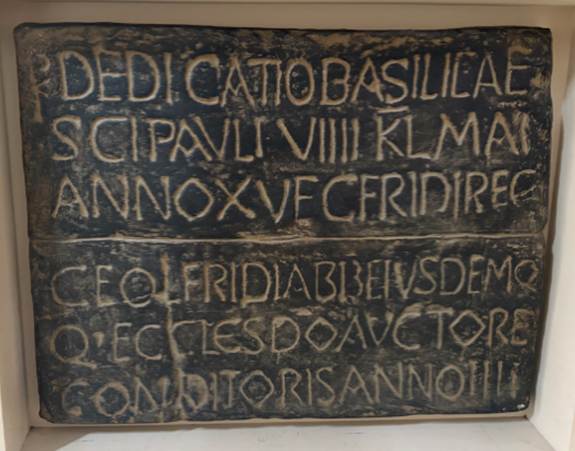
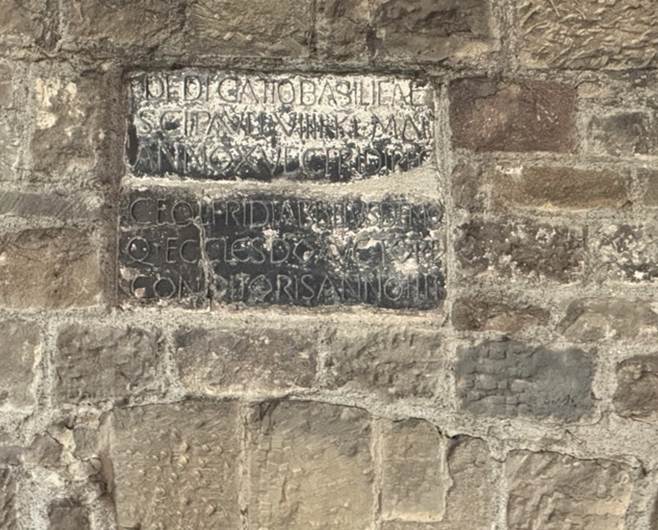
Reproduction of
the Dedication Stone The
original dedication stone in the church today
The dedication
stone reads: The dedication of the basilica of St Paul on the 9th
day before the kalends of May in the 15th year of King Ecfrid and in the 4th year of Abbot Ceolfrid,
found, by the guidance of God, of the same church.
In 686, plague broke out at Jarrow. The Life of Ceolfrith, written in about 710, records that only two surviving monks were
capable of singing the full offices. One was Ceolfrith and the other a young
boy, who according to the anonymous writer had been taught by Ceolfrith. The
two managed to do the entire service of the liturgy until others could be
trained. The young boy was almost certainly Bede. Bede survived the plague.
One by one, the
monks discovered their gruesome symptoms: enormous buboes on the groin and the
glands. Then, for the next seventy two hours, they would writhe and squirm in
agonising pain … It was small mercy for the end to finally come, for the soul
to escape its tormented body. Such terrors, caused by sweeping plagues, were
endured by millions throughout Europe in the sixth and seventh centuries.
Entire swathes of the population were wiped out, as recorded by Paul the
Deacon, a Benedictine monk, in his work History of the Lombards. “You might see
the world brought back to its ancient silence: no voice in the field; no
whistling of shepherds; no lying in wait of wild beasts among the cattle; no
harm to domestic fouls … pastoral places had been turned into sepulchres for
men, and human habitations had become places of refuge for wild beasts”. For
those who lived in close confinement, such as in monasteries, disease spread
like wildfire … Only two survived, “the abbot himself and a lad who had been
brought up and educated by him”. This lad, it’s believed, was Bede. In those
final months of plague, as the last of their brethren succumbed, Bede and the
abbot continued their duties … “Why am I still here? Why Me?” Bede must have
been wondering. (Bede, Chapter 1, Eighteen, Alice Loxton, 2025).
Bede spent most
of his life in the monastery. He travelled to several abbeys and monasteries
across the British Isles, even visiting the archbishop of York and King
Ceolwulf of Northumbria.
Ceolfrith was appointed abbot of the combined Wearmouth-Jarrow
monastery. He doubled the number of books in the libraries of the monastery.
When Bede was about 17 years old, Adomnán, the abbot of Iona
Abbey, visited Monkwearmouth and Jarrow. Bede would probably have met the abbot
during this visit, and it may be that Adomnán sparked
Bede's interest in the Easter dating controversy.
Benedict Biscop died.
692 CE
In about 692 CE,
at the age of only 19, Bede was ordained a deacon by his diocesan bishop, John,
bishop of Hexham. The usual canonical age for the ordination of a deacon was
25.
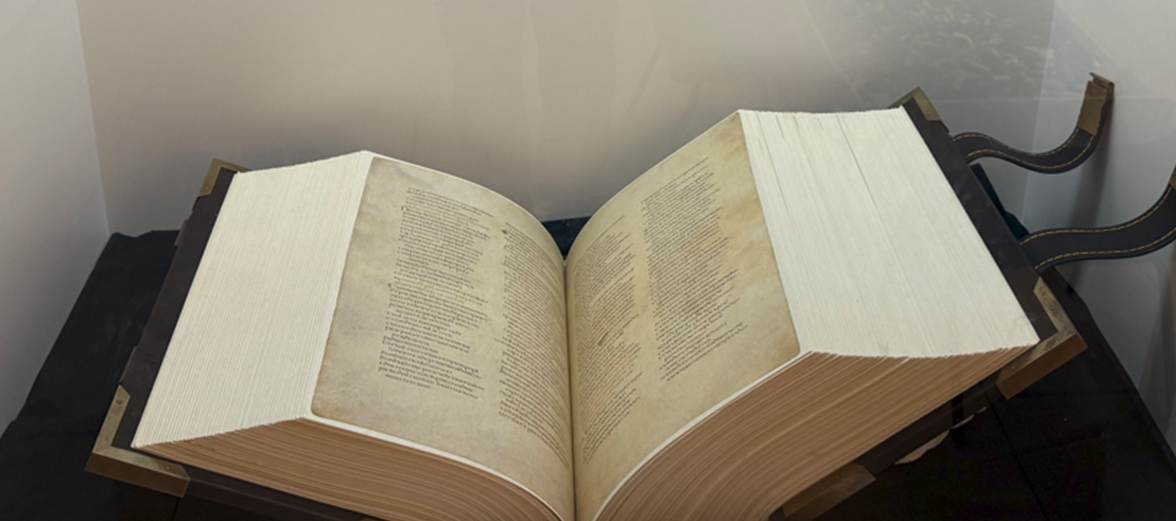
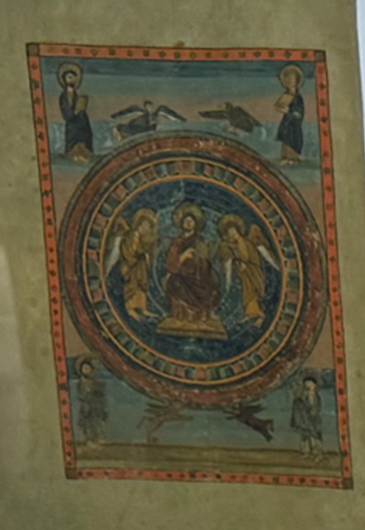
Ceolfrith instructed the monks of Jarrow and Wearmouth to make
three copies of the pandect of the Bible into one great volume. Two
copies made for Wearmouth and for Jarrow have been lost but one, the Codex Amiatus (after the location where it was later found),
was delivered to Rome and survives, now in Florence.
Bede wrote his first works, De Arte Metrica
and De Schematibus et Tropis; both were
intended for use in the classroom.
702 CE
Bede became
a priest.
In 708 CE, some monks at Hexham accused Bede of having committed
heresy in his work De Temporibus. The standard theological view of world
history at the time was known as the Six Ages of the World. In his book, Bede
calculated the age of the world for himself, rather than accepting the
authority of Isidore of Seville, and came to the conclusion that Christ had been
born 3,952 years after the creation of the world, rather than the figure of
over 5,000 years that was commonly accepted by theologians.
Nectan Mac Der Ilei, King of the Picts, became a monk and asked
the Wearmouth-Jarrow monastery to help him reform the Pictish
Church, asking Ceolfrith for advice on the calculation of easter and the Roman
tonsure, and the building of churches in the Roman style.
716 CE
The
Wearmouth-Jarrow monastery had over 600 monks and 15 hides of land and had
become a centre of learning, renown through Europe.
Bede completed his Historia Gentis Anglorum Ecclesiastica,
the Ecclesiastical History of the English People and other
historical works including History of the Lives of the Abbots.
He also compiled a list of his books including commentaries on the
books of the Bible. His works include treatises on grammar, orthography
(spelling), metrics, computus (the
mathematical and astronomical calculation of time), and natural history.
He popularised the system of dating years after the birth of
Christ.
He produced handbooks on Latin grammar, spelling and composition
of verse.
Bede travelled to York to visit Ecgbert, then bishop of York. The See of York was
elevated to an archbishopric in 735, and it is likely that Bede and Ecgbert
discussed the proposal for the elevation during his visit. Bede hoped to visit
Ecgbert again in 734 CE but was too ill to make the journey.
Bede also
travelled to the monastery of Lindisfarne and at some point visited the
otherwise unknown monastery of a monk named Wicthed,
a visit that was mentioned in a letter to that monk. Because of his widespread
correspondence with others throughout the British Isles, and because many of
the letters imply that Bede had met his correspondents, it is likely that Bede
travelled to some other places, although nothing further about timing or
locations is known. One can imagine
Bede perhaps at the refectory table of the guest house at Jarrow making the
occasional jotting as he listened to the news of a visiting nobleman or
distinguished traveller from abroad. He drew on a wide selection of books
that evidenced the richness of the monastery’s library. (A Brief History of the Anglo Saxons, The Beginnings of
the English Nation, 2006, Geoffrey
Hindle, page xxxvii).
734 CE
Bede’s last known
work was a letter to Bishop Ecgbert of York.
Bede died on the Feast of the Ascension, Thursday 26 May 735, on
the floor of his cell and was buried at Jarrow.
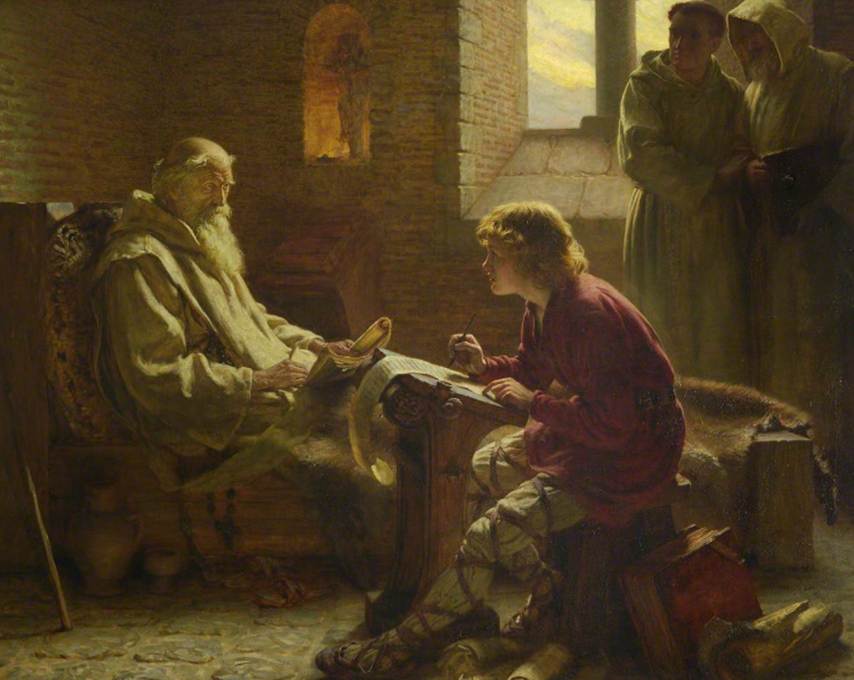
The Last Chapter,
James Doyle Penrose, 1905
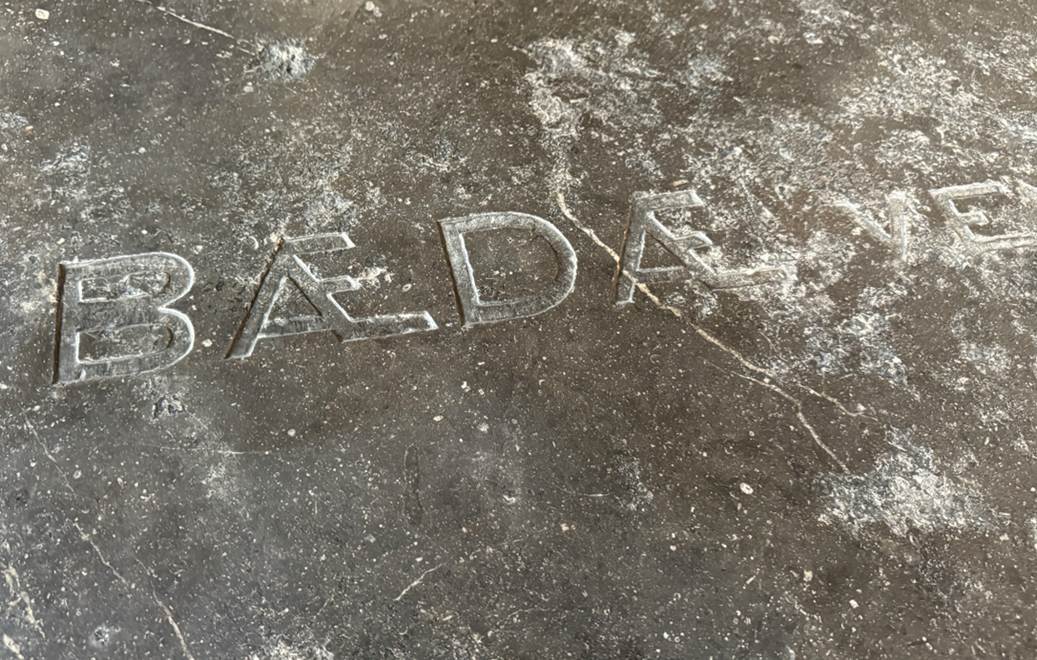
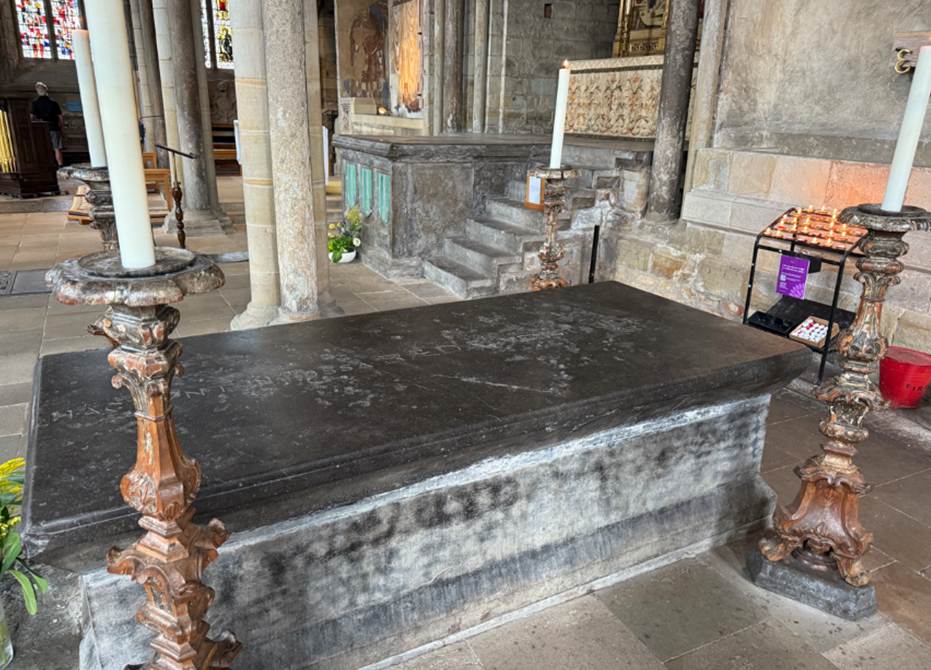
There is a
memorial to Bede at Durham Cathedral, where his bones are said to be buried,
having been moved to Durham in about 1022, but the team at St Paul’s, Jarrow
believe that his bones remain in Jarrow.
The Vikings raided the north east monasteries and may have damaged
Monkwearmouth-Jarrow. By the mid ninth century, there is evidence of fire destruction
and the community was probably evacuated.
The Ecclesiastical History
The Ecclesiastical
History of the English People (“EH”) is divided into five books.
· The first book
spans six and a half centuries from the days of Julius Ceasar and Claudius to
the end of the sixth century CE.
· The second book
is a more detailed record of only 27 years from the death of Pope Gregory to
the death of Edwin.
· The third book is
a record of the following 35 years.
· The fourth book
covers 20 years to the death of Cuthbert in 687 CE.
· The fifth book
extends from 687 to 731 CE into the time when Bede himself lived.
Roger of Wendover
claimed that Bede began to write EH in 725, but there is no independent
evidence of this. EH itself indicates that at least part of EH was completed by
731 CE.
A work which
begins with the times of Julius Ceasar and ends with the author’s own age will necessarily
be based on widely differing sorts of material…. Apart from lesser extracts
taken from a variety of scattered sources, he used three principal authorities
for that part of his first Book which extends from Julius Caesar to the times
of Augustine, the
History of Orosius, the de
Excidio et Conquestu Brittaniae (‘On the Ruin and Conquest of Britain’) of
Gildas and the Vita Germani of Constantius. (Bede’s
Ecclesiastical History of the English Nation and its Importance today, Peter Hunter Blair MA, Fellow of Emmanuel College,
Cambridge, Jarrow Lecture 1959, page 7).
The chronological
framework for his Northumbrian narrative rested in part upon the regnal lists
which are known to have been kept in his day, and perhaps long before his day,
in Northumbria and which contained the names of kings in due order together with
information about the length of each king’s reign. (Bede’s Ecclesiastical History of the English Nation and
its Importance today, Peter Hunter Blair
MA, Fellow of Emmanuel College, Cambridge, Jarrow Lecture 1959, page 8).
Scholars have
rightly been impressed with Bede’s chronological expertise; he successfully
converted into AD years events which his sources had dated by many different
systems (Bede and the English,
Nicholas Brooks, Professor of Medieval History, University of Birmingham,
Jarrow Lecture 1999).
Bede was able to
draw upon the memories of his elders (Bede’s
Ecclesiastical History of the English Nation and its Importance today, Peter Hunter Blair MA, Fellow of Emmanuel College,
Cambridge, Jarrow Lecture 1959, page 9).
Along with
Lindisfarne, Jarrow and Wearmouth a surprising number of ports and monasteries
on or near the North Sea are 23 loci for historical and hagiographical accounts
in EH. Some of those stories must derive from local persons who were informed
about coastal life upon which they all depended and who augmented the author’s
communication network during several decades. (Bede’s
Scientific Achievement, Wesley M
Stevens, Professor of Medieval History, University of Winnipeg, Jarrow Lecture
1985, page 15).
The number of
surviving manuscripts of the History is more than one hundred and fifty, a
figure which is proof enough of the popularity of the work throughout western
Europe in the middle ages. When we recall how many of the monastic libraries of
England were destroyed during the Viking attacks, we may realise that even this
large figure must fall very far short of the total number of copies that were
made. (Bede’s Ecclesiastical History of the English Nation and
its Importance today, Peter Hunter Blair
MA, Fellow of Emmanuel College, Cambridge, Jarrow Lecture 1959, page 11).
Scientific and educational
influence of Bede
The monk Beda
found coherence in the same tradition of nature, reason and experience as did
Augustine; but he showed a greater interest in natural experience … Beda’s
accounts of natural phenomena and of the times have attracted the attention of
many scholars to separate topics. (Bede’s Scientific Achievement, Wesley M Stevens, Professor of Medieval History,
University of Winnipeg, Jarrow Lecture 1985, page 4).
What Bede wanted
to do and did superbly was educate, soberly, quietly, discreetly … Bede’s
personal qualities, transformed by a quietly fervent monastic asceticism,
formed the basis of his teaching profession. His own sharp intelligence,
formidable memory, scholarly penchants and educational zeal were subject
throughout his monastic career, from oblate to senior magister, to the virtue
of discretion. (Bede the Educator, George Hardin Brown, Professor of English and Classics
at Stanford University, Jarrow Lecture 1996, page 1).
Bede had
fortunate resources, the routine of a well ordered monastery with supportive
superiors, a sensible rule, and at least some promising students, producing
alumni such as Ecgbert, the future bishop and archbishop of York … Because the
first abbots Benedict and Ceolfrith had procured choice educational books,
which the scriptorium amplified, Bede was assured a supply of major texts for
his research, writing and teaching… Bede had access to other books and
documents made available by monastic inter library loan (Bede the
Educator, George Hardin Brown, Professor
of English and Classics at Stanford University, Jarrow Lecture 1996, page 2).
Since Bede was
exposed to some of the delights of pagan literature through the examples of
grammarians and quotations by the Fathers, he clearly understood the beauty and
allure of Latin eloquence … It has been argued that Bede’s expression Tullianae lectonis implies that
he knew Cicero’s rhetorical works. (Bede the
Educator, George Hardin Brown, Professor
of English and Classics at Stanford University, Jarrow Lecture 1996, page 12,
13).
One of his
letters concerned the Bissextile or extra day of every fourth year (leap year)
which is only the simplest of many calculations and corrections required to
keep the Julian calendar in close accord with the actual course of the sun and
moon. Another letter explained how the circle of the sun itself moves through
the heavens, tilting 23 ½ degrees to the north and 23 ½ degrees to the south of
the celestial equator, twice annually passing a mid point
at which they can be observed simultaneously anywhere on the face of the earth
that the hours of light and the hours of darkness are the same: the equinox. (Bede’s Scientific
Achievement, Wesley M Stevens, Professor
of Medieval History, University of Winnipeg, Jarrow Lecture 1985, page 3).
In his book, On
the Nature of Things, Beda affirmed that the universe was created by God, as
told in Genesis … Yet he also noted that All things of our earth and atmosphere
move naturally towards the centre of the earth, and the earth lies in the
centre of a whole universe with stars in the heavens circling around it
(chapters 3, 5 to 9). The earth itself could be described overall as a globe
banded by five circular zones: it was extremely hot around its middle (torridus) but extremely cold in the north and in the south
(frigore), while the central zones both north and
south were temperate and habitable (chapter 9)… The stars are at different
distances from the earth, according to Beda (chapter 6), and they are made of
various sorts of matter … All the stars reflected light from the sun … Eclipses
of both sun and moon were clearly presented in terms of the relative positions
of the sun and moon as observed from the earth (chapters 20 and 22). (Bede’s
Scientific Achievement, Wesley M
Stevens, Professor of Medieval History, University of Winnipeg, Jarrow Lecture
1985, page 5).
Bede understood
the shape of the earth as a globe. Most people who have crossed England more
than once, who have lived by the sea, or who have ever crossed the sea in any
direction would develop some concept of dimensions and shape of the surface ..
evidence for ideas of the notion of a flat earth among early peoples has often
been asserted but rarely found … Yet it is one thing to receive a tradition
from the Mediterranean world on the continent or in Anglo Saxon England, quite
another to understand it. In his later and more sophisticated Account of Times,
Beda composed chapters 31 and 32 to explain the different lengths of days and
nights and the variation of shadow lengths cast on the earth’s surface at
different times during the year. He began by simply stating that the reason for
the unequal length of days is the globular shape of the earth. (Bede’s Scientific Achievement, Wesley M Stevens, Professor of Medieval History,
University of Winnipeg, Jarrow Lecture 1985, page 7).
One consequence
is that Beda thought of the globe as populated on all sides, and he spoke of
the sun passing over those who inhabit the southern side of it … Another
consequence is that latitude of the surface of the sphere may be determined
rather well by either of two methods. (Bede’s Scientific Achievement, Wesley M Stevens, Professor of Medieval History,
University of Winnipeg, Jarrow Lecture 1985, page 8).
The Effective
Power of the Moon is discussed in Bedae De temporum ratione chapter 27, in which he relates several
stories about the moon’s forces on human, animal and physical life. (Bede’s Scientific Achievement, Wesley M Stevens, Professor of Medieval History,
University of Winnipeg, Jarrow Lecture 1985, page 10).
All his learning
and scholarship was directed towards instruction, and that instruction
encompassed far more than specific academic disciplines, even theology, history
and literature. (Bede the Educator, George Hardin Brown, Professor of English and Classics
at Stanford University, Jarrow Lecture 1996, page 3).
Bede disliked
Fake News. Bede was a monastic, as opposed to a scholastic educator … his
educational method is discursive, meditative … Unlike the Irish and the
Carolingians later, Bede did not use the dialogic or question and answer
format. Bede was keen on instilling truth and exterminating error … “I cannot
have my children learning what is not true (medacium)
… Bede had no patience for silliness … (Bede
the Educator, George Hardin Brown,
Professor of English and Classics at Stanford University, Jarrow Lecture 1996,
page 6).
Bede was a poet
of great refinement and subtlety. But he deliberately chose to write in a
plain, unadorned (meretricious even) style, in which he avoided utterly the
recherche vocabulary and verbal pyrotechnics affected by some of his
countrymen. The simplicity of his diction masks metaphorical structure of
unusual sophistication. (Bede the
Poet, Michael Lapidge, Jarrow Lecture
1993).
Though his pupils
at an early stage became psalterati (that is literate
in reading, grammar and reciting the Psalter), trained in memory and the basic
of grammar, Bede’s texts challenged their linguistic and intellectual abilities
… De temporibus, he realised from the reaction of his
students it was too condensed for them
to absorb. Bede remedied this by producing a new, revised and augmented
version, De temporum ratione. (Bede the Educator,
George Hardin Brown, Professor of English and Classics at Stanford University,
Jarrow Lecture 1996, page 5).
In conclusion may
I return to that greatest scientific accomplishment of Beda, so often
acknowledged even if not very well understood: his creation of the western
calendar … no pope could understand the problems about finding a proper date
for Easter … Beda proceeded without any papal or canonical authority: he
explained natural phenomena on the basis of observation and reason, adjusted in
practice to human experience. It was Beda’s science which convinced rational
men in the medieval centuries as to how much they should give a dependable time
structure to experience and memorable events and which demonstrated how the
regular motions and powers of sun, moon and stars contributed to a better
understanding of their experience. (Bede’s
Scientific Achievement, Wesley M
Stevens, Professor of Medieval History, University of Winnipeg, Jarrow Lecture
1985, page 18, 19).
The Birth of the English
Nation
Bede’s concept of
a single English people, gens Anglorum, was a bold and innovative one. Bede’s
particular genius as a historian was to conceive and to write a work in which
‘ecclesiastical’ history, in the tradition of the fourth century Church by Eusebius,
was combined with a national history (Bede
and the English, Nicholas Brooks,
Professor of Medieval History, University of Birmingham, Jarrow Lecture 1999,
page 2).
Bede wove complex
stories of the conversion of some twelve different Anglo-Saxon kingdoms, and
their ecclesiastical and political fortunes, into a single narrative, whose
unity he enhanced by relating events throughout the book to a single time scale (Bede and the English,
Nicholas Brooks, Professor of Medieval History, University of Birmingham,
Jarrow Lecture 1999, page 3).
Gentes (‘races’
or ‘peoples’) were not, as a rule, the products of large scale tribal invasions
by communities of ethnically and linguistically pure warriors, whose
descendants inherited an ethnically cleansed landscape. Early medieval peoples
should rather be seen as artificial creations, forged when some of the
following factors were in existence:
· A dominant
military group asserting its military and political interests;
· Identification of
a group with a territory or homeland;
· Acceptance of a common
history;
· Adoption of a common
language;
· A collective amnesia
of awkward facts.
Bede’s EH provides
many of these crucial components necessary for ethnogenesis.
(Bede and the English,
Nicholas Brooks, Professor of Medieval History, University of Birmingham,
Jarrow Lecture 1999, page 5).
Bede’s
achievement is more remarkable when we consider that modern English makes a
distinction between ‘Angles’ and the ‘English’ where Bede’s Latin knew only Angli. Bede used Angli
179 times in EH, of which 78 must mean English; 27 refer to the English
language, 44 mean Northumbrian, only 7 mean Angle as a
contrast to Saxon, and 21 uses are ambiguous. (Bede
and the English, Nicholas Brooks,
Professor of Medieval History, University of Birmingham, Jarrow Lecture 1999,
page 6).
We can in fact
watch Bede’s practice changing in the course of Book 1. From speaking of
‘Saxons’ at the start (chapters 1 to 14), Bede has a period of vacillation
between chapters 15 and 22, before he settles on the ‘English’ throughout the
rest of the volume. (Bede and the English, Nicholas Brooks, Professor of Medieval History,
University of Birmingham, Jarrow Lecture 1999, page 15).
Comparing the
usage of other writers, we may see just how remarkable and how artificial
Bede’s construct of pagan ‘Saxons’ but Christian ‘English’ was. (Bede and the English, Nicholas Brooks, Professor of Medieval History,
University of Birmingham, Jarrow Lecture 1999, page 16).
Another
characteristic of Bede’s EH is his interest in English government. Throughout
his work he found occasion to refer to the assessment of particular regions or
provinces in terms of ‘hides’, that is the amount of land that would support a
peasant family (terra unuis familiae). At least from
the later seventh century, this assessment had proved to be a flexible and
effective means for kings to assess subject territories for a variety of
military, fiscal and administrative purposes. (Bede
and the English, Nicholas Brooks,
Professor of Medieval History, University of Birmingham, Jarrow Lecture 1999,
page 10).
Most of the kings
mentioned in EH are described by Bede as kings of their own particular people,
that is of the men of Kent, of the East, South or West Saxons, of the Mercians,
the Lindsey people or the Northumbrians and so on. But a small number of rulers
are styled ‘king of the English (rex Anglorum) … In styling two of these kings
(Aethelberht of Kent and Edwin of Northumbria) as rex Anglorum Bede was
following the example of letters of Pope Gregory I and Boniface V. (Bede and the English,
Nicholas Brooks, Professor of Medieval History, University of Birmingham,
Jarrow Lecture 1999, page 10).
Non royals are
characterised by Bede as being of ‘English’ race (natione
or gente Anglorum) when their activities are recorded
overseas or among communities of foreign origin or language, that is at Rome,
in Frankish Gaul, in ‘Old’ or continental Saxony, or among the Scotii (the Gaels of Ireland and Britain). (Bede and the English, Nicholas Brooks, Professor of Medieval History,
University of Birmingham, Jarrow Lecture 1999, page 10).
In EH Book 1, Chapter
15, Bede wrote that the English people came from three very powerful
Germanic tribes, the Saxons, Angles and Jutes. From the Jutes are descended the
people of Kent, and of the Isle of Wight, including those in the province of
the West-Saxons who are to this day called Jutes, seated opposite to the Isle
of Wight. From the Saxons, that is, the country which is now called Old Saxony,
came the East-Saxons, the South-Saxons, and the West-Saxons. From the Angles,
that is, the country which is called Angulus,87 and which is said, from that
time, to have remained desert to this day, between the provinces of the Jutes
and the Saxons, are descended the East-Angles, the Midland-Angles, the
Mercians, all the race of the Northumbrians, that is, of those nations that
dwell on the north side of the river Humber, and the other nations of the
Angles.
It is the only
place in EH where Bede explicitly contrasts the Angli
with the Saxons and the Iutae within Britain. It has
long been suspected that this whole passage in which Bede derives the
Anglo-Saxon peoples and kingdoms of his own day from ‘three of the more
powerful peoples (populi) of Germany’ and indicates their north German
homelands, is an afterthought inserted into Bede’s text. Bede was not
the first author of this important passage, but he gave it his endorsement by
incorporating it into his text. (Bede and the
English, Nicholas Brooks, Professor of
Medieval History, University of Birmingham, Jarrow Lecture 1999, page 11-12).
Bede’s concept
that there was one ‘English’ people, his assertion of the ethnic identity and
homogeneity of the Angli was, we may suspect, most
important when he was speaking of the church. … Bede makes it clear that there
is one ‘church’ of the English’. (Bede and the
English, Nicholas Brooks, Professor of
Medieval History, University of Birmingham, Jarrow Lecture 1999, page 12).
Bede stands
within a tradition, earlier witnessed by Pope Gregory I himself, then by
subsequent writers in Rome and already too by the Northumbrian house where
Gregory’s cult was maintained: namely a tradition of regarding the Germanic
peoples of the island of Britain as a single English people. (Bede and the English,
Nicholas Brooks, Professor of Medieval History, University of Birmingham,
Jarrow Lecture 1999, page 14).
The Northumbrian
origin of the English national identity
By the seventh
century, the Christian bug had spread to Northumbria, by now the most powerful
of the Anglo Saxon Kingdoms. The monks from Iona founded a monastery on the
island of Lindisfarne, and by the 670s there were plans for another at Wearmouth. (Bede, Chapter 1, Eighteen,
Alice Loxton, 2025).
In EH Book 2, Chapter
1 Bede tells of the famous encounter of Pope Gregory and the apocryphal
story of the birth of the English. Nor must we pass by in silence the story
of the blessed Gregory, handed down to us by the tradition of our ancestors,
which explains his earnest care for the salvation of our nation. It is said
that one day, when some merchants had lately arrived at Rome, many things were
exposed for sale in the market place, and much people resorted thither to buy:
Gregory himself went with the rest, and saw among other wares some boys put up
for sale, of fair complexion, with pleasing countenances, and very beautiful
hair. When he beheld them, he asked, it is said, from what region or country
they were brought? and was told, from the island of Britain, and that the inhabitants
were like that in appearance. He again inquired whether those islanders were
Christians, or still involved in the errors of paganism, and was informed that
they were pagans. Then fetching a deep sigh from the bottom of his heart,
“Alas! what pity,” said he, “that the author of darkness should own men of such
fair countenances; and that with such grace of outward form, their minds should
be void of inward grace.” He therefore again asked, what was the name of that
nation? and was answered, that they were called Angles. “Right,” said he, “for
they have an angelic face, and it is meet that such should be co-heirs with the
Angels in heaven. What is the name of the province from which they are
brought?” It was replied, that the natives of that province were called Deiri. “Truly are they De ira,”
said he, “saved from wrath, and called to the mercy of Christ. How is the king
of that province called?” They told him his name was Aelli; and he, playing
upon the name, said, “Allelujah, the praise of God
the Creator must be sung in those parts.”
In both of the extant
versions of this story, namely in the Whitby Life and EH, it is clearly of Deiran origin. That is shown by
Gregory’s subsequent puns, reported in both accounts, on the names of the
Kingdom of the Deire (who would be delivered ‘from
the wrath of God’: de ira Dei) and of their king
Aelle (in whose lands Alleluia would be sung). The whole elaborate tale
establishes that by the early eighth century the Deirans certainly did think of
themselves as part of a larger ‘English’ nation. (Bede and the English,
Nicholas Brooks, Professor of Medieval History, University of Birmingham,
Jarrow Lecture 1999, page 19).
We cannot be
certain how this and other Deiran stories known to the Whitby author reached
Bede. But Ceolfrith, the revered abbot of Jarrow from its foundation in 685
until his departure to Rome and his death en route at
Langres in 716, was indeed of noble Deiran stock (Vita S Ceolfridi, ed C Plumer, Ven Baedae
op hist, pages 388 to 404, Judith McClure, Bede and the Life of St Ceolfrid,
Peritia 3, 1984, pages 71 to 84). His early training had been in his
family’s monastery at Gilling (Yorkshire North Riding), and when plague had
struck that house, he had been invited to Wilfred’s tutelage at Ripon, where at
the age of 27 he had been ordained a priest; after periods studying the regular
life in East Anglia and in Kent, Ceolfrith had hitched his star to that of the
Northumbrian nobleman, Benedict Biscop, and had assisted him in setting up the
monastery at Jarrow, where Bede was amongst the first novices. With such a
background, Ceolfrith is surely likely to have had access to Derian (and
Kentish) stories of the mission of Poper Gregory and of Paulinus and to have
enjoyed passing them on to Bede and the other boys being trained at Jarrow. (Bede and the English,
Nicholas Brooks, Professor of Medieval History, University of Birmingham,
Jarrow Lecture 1999, page 20). Thus Bede had indeed spent his
formative years being trained by an abbot who thought of them both as being
‘English’.
After 731 the
dissemination of EH and of Bede’s other works went on as fast as the scriptoria
of Monkwearmouth-Jarrow and doubtless other Northumbrian and Kentish houses
could produce copies. But in an age where one copy of EH might take a monastic
scribe many months to write, the dissemination of Bede’s idea of Englishness
inevitably took time to take strong root. … His masterpiece, EH, provided a
national church with a national agenda and with a clear ethnic terminology. It
was a message deriving from the ethnic concepts of the Deiran churches, which
prized their links with Kent. With Bede’s powerful aid, they were enabled to
realise the seventh century Gregorian vision of an ‘English’ race and of an
English church with two ecclesiastical provinces. (Bede and the English,
Nicholas Brooks, Professor of Medieval History, University of Birmingham,
Jarrow Lecture 1999, page 22).
Bibliography
Almost everything
that is known of Bede's life is contained in the last chapter of his Bede’s
Ecclesiastical History of the English People.
The Venerable Bede, Charles J
Stranks, 1974.
The Venerable Bede, Rev G F Browne
MA, 1879.
The Cambridge Companion to Bede, 2010.
The Age of Bede, 1983.
There is an In Our Time podcast about
the Venerable Bede and a Podcast Essay on Bede, the Father of English
History.
The Bede Museum at Jarrow Hall, Jarrow tells the story of Bede
and his time. St
Paul’s Monastery, Jarrow is a short walk from the museum.
St
Peter’s Monastery, Monkwearmouth is in Sunderland.
Benedict Biscop, Eric Fletcher
LLD, FSA, Jarrow Lecture 1981.
Bede the Educator, George Hardin
Brown, Professor of English and Classics at Stanford University, Jarrow Lecture
1996.
Bede and the
English,
Nicholas Brooks, Professor of Medieval History, University of Birmingham,
Jarrow Lecture 1999.
Bede’s Scientific Achievement, Wesley M Stevens, Professor of Medieval History, University of
Winnipeg, Jarrow Lecture 1985.
Bede’s
Ecclesiastical History of the English Nation and its Importance today, Peter Hunter
Blair MA, Fellow of Emmanuel College, Cambridge, Jarrow Lecture 1959.
Bede the Poet, Michael
Lapidge, Jarrow Lecture 1993.
Bede, Chapter 1, Eighteen,
Alice Loxton, 2025.