Alcuin of York
c735 to 19 May 804
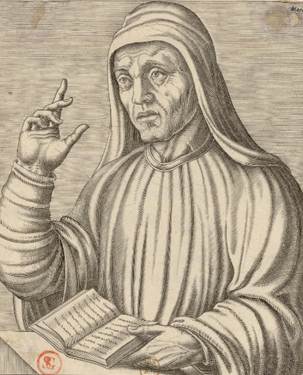
The world of Ecgbert and Aethelbert,
successors to Bede, and their pupil Alcuin, who took York’s powerhouse of knowledge
to the court of Charlemagne to pioneer the European educational system
|
Return to the Home Page of the Farndale Family
Website |
The story of one family’s journey through two
thousand years of British History |
The 83 family lines into which the family is divided.
Meet the whole family and how the wider family is related |
Members of the historical family ordered by date of
birth |
Links to other pages with historical research and
related material |
The story of the Bakers of Highfields, the Chapmans,
and other related families |
Headlines are in brown.
Dates are in red.
Hyperlinks to
other pages are in dark
blue.
References and
citations are in turquoise.
Context and local
history are in purple.
Geographical
context is in green.
The Teacher of York
Alcuin
of York was a scholar, clergyman, poet, and teacher from York, then part of
the Kingdom of Deira, later Northumbria. He was influential as a writer, as a
mathematician, and in his writing. His work gave rise to the revival of
intellectual life in the area around York which extended across Europe. He is
sometimes referred to as Ealhwine, Alhwin, or Alchoin.
He brought the
educational traditions and teaching methods from York to the court of
Charlemagne, extending those traditions across Europe. He laid the foundations
of the educational system, focused on monasteries and cathedral schools north
of the Apls, which prevailed until the emergence of universities in the twelfth
century.
There is an In Our Time podcast on Alcuin, the cleric,
educator and poet from York who put learning
for its own sake at the heart of the Carolingian Renaissance. Another Podcast
in the BBC Series Anglo Saxon Portraits, is an essay on Alcuin, the Scholar by
Mary Garrison.
Humber
Alcuin was born in Northumbria,
probably sometime in the 730s. Little is known of his parents, family
background, or origin. The Vita Alcuini
suggests that Alcuin was "of noble English stock". His descendants
possibly owned land to the east of York, possibly in the area
of the Humber. Alcuin's own work only mentions his wider kinsmen as Wilgils, father of the missionary saint Willibrord; and Beornrad (also spelled Beornred),
abbot of Echternach and bishop of Sens. Willibrord, Alcuin and Beornrad were probably related by blood.
In his Life of
St Willibrord, Alcuin writes that Wilgils, called
a paterfamilias, had founded an oratory and church at the mouth of the
Humber, which had fallen into Alcuin's possession by inheritance. Since early
Anglo-Latin writing paterfamilias ("head of a family,
householder") usually referred to a ceorl ("churl"), Donald A. Bullough suggested that Alcuin's family
was of cierlisc ("churlish") status, that
is a freeman of low nobility, but
subordinate to a noble lord, and that Alcuin and other members of his family
rose to prominence through beneficial connections with the aristocracy.
Alcuin's origins appear to lie in the southern part of the Kingdom of Deira.
Alcuin
is the first Northumbrian whose likeness has been preserved, at least, it was
made within a decade or so of his death, as a grey bearded, slightly stooped
figure, presenting one of his works to the Archbishop of Mainz. His family were
members of the Deiran elite, holding land near Spurn Point at the bleakly
exposed mouth of the Humber estuary. Alcuin, born in about 732, was schooled
under Archbishop Ecgberht at York. (Northumbria AD 367-867,
Max Adams and Colm O’Brien, 2025, page 274).
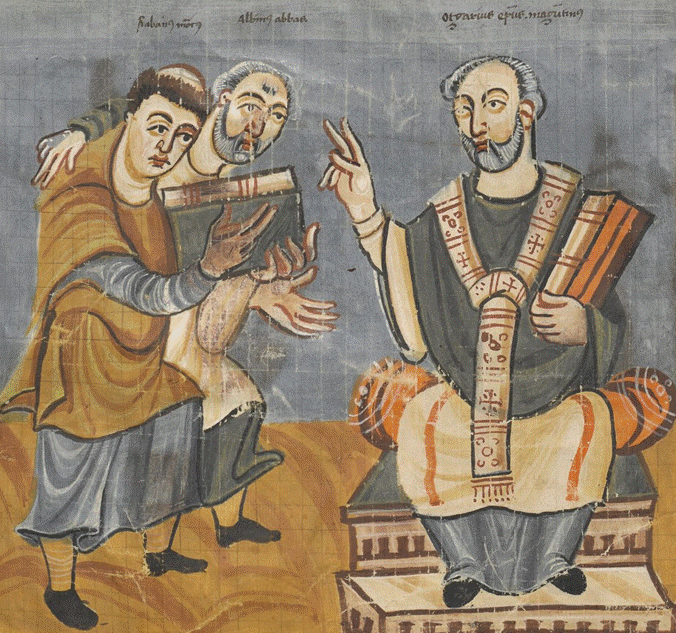
Carolingian
manuscript, c. 831. Rabanus Maurus (left), with Alcuin (middle),
dedicating his work to Archbishop Otgar of Mainz (right)
York
Renaissance
735
The Venerable Bede died in
Jarrow in 735 CE, having established a renaissance of learning
following the chaotic centuries since the end of the Roman empire, leaving fresh Anglo Saxon learning
centred on the Benedictine study of the Bible. Bede had introduced an
educational system based upon training in Latin and loosely on the liberal arts (liberalia
studia), the basic literary and numerical studies adopted from Roman
education.
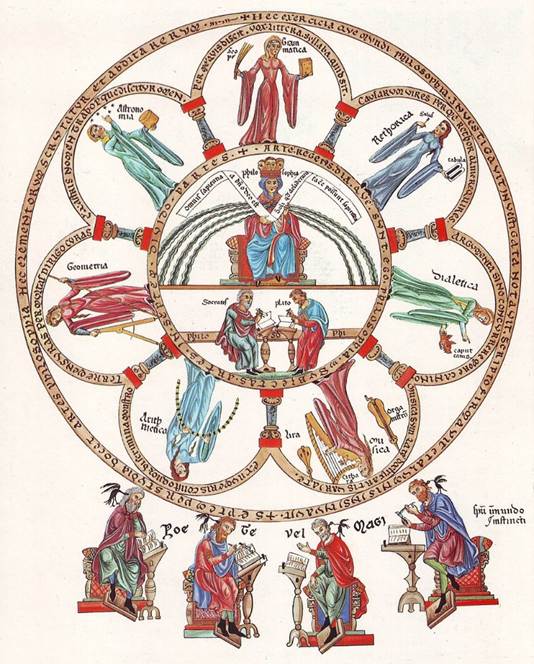
Pythagoras had speculated that there was a
mathematical and geometric harmony to the cosmos or the universe and his
followers linked the four arts of astronomy, arithmetic, geometry, and music
into one area of study to form the "disciplines of the medieval quadrivium".
Over time, rhetoric, grammar, and dialectic (or logic) became the educational
programme of the trivium. Together the quadrivium and the trivium
came to be known as the seven liberal arts. Bede did not wholly embrace the Liberal Arts
himself, but his monastic endeavours created the philosophical landscape for
their revival not so far from the coast at Whitby.
The Benedictine monasteries had become the main
focus of learning by the sixth century, following the disintegration of
the Roman empire. Benedictine monasteries were repositories of learning as they
focused on prayer, study and manual labour. Study was intended to assist an
understanding of the Bible through copying scripts alongside a learning of the
liberal arts. Roman knowledge through an understanding of Latin was an
instrument to assist Christian understanding. Over time, this became the basis
of early education.
Among Bede’s pupils was Ecgbert, brother of
the Northumbrian King Eadberht (who reigned from 737 CE to 758 CE). When King
Eadberht founded an archbishopric at York, Ecgbert urged his
brother to raise York to an archbishopric and Ecgbert
became Archbishop of York in the year of Bede’s death. It was at York,
that Ecgbert continued Bede’s work.
Ecgbert founded a school attached to the cathedral for the sons of local nobles.
Education
provided moral teaching to support the aims of Augustine’s Christian Doctrine.
Augustine advocated the harnessing of education to Christian ends.
741 CE
Alcuin may have been a witness to the burning of the Minster by
the Mercian forces in 741.
As Ecgbert’s responsibilities increased, he entrusted the running
of the school to his kinsman and pupil, Aethelbert.
The fame of the school grew under Aethelbert and pupils came from across the country
and from overseas. Aethelbert travelled to the Continent to collect books and he spread knowledge of the school. He made it his
mission to collect books from across Europe and used his own private wealth to
amass a remarkable library. Alcuin, in his longest poem, later included a bibliography of
this remarkable library.
Where books are
kept
Small roofs hold
the gifts of heavenly wisdom;
Reader, learn
them, rejoicing with a devout heart.
The Wisdom of the
Lord is better than any treasures
For the one who
pursues it now will have the pathway of light
(Alcuin, Carmen, 105, i: Dümmler
1881, p. 332)
Aethelbert saw wisdom as part of human godliness. He was primarily
a scientist. Because York was a cathedral, and not a monastery like Bede’s
Jarrow, students came from far places such as Ireland and Freisland, and then left
again with their learning. A cathedral school was able to attract bright
individuals from afar. He attracted young men Indolis
egregiac iuvenes quoscumque videbat Hos sibi coniunxit,
docuit, nutrivit, amavit, “of "distinguished talent, attaching them
to himself by his teaching, his affectionate, his fatherly care."
Prior to this
period of Renaissance at York, Education had contracted to a narrow range of
studies, for purely religious purpose. What stands out at York was the
evolution of a range of learning far wider than a focus on salvation and the
saving of souls. Aethelbert was particularly interested in natural science and
studied plants and animals. His view was that the rationality of the universe
had been divinely created, and so human activity to understand it was also
theologically justified. He believed that reason had a divine purpose and
envisaged the five zones of heaven – the seven planets; the regular motions of
the stars; the rising and setting of celestial objects; movement of the air and
tremors of earth; and the nature and diversity of men, livestock, and wild
beasts and birds.
The young Alcuin therefore came to the cathedral church of York during the
golden age of Archbishop Ecgbert and his brother, the Northumbrian King
Eadberht. King Eadberht and Archbishop Ecgbert oversaw the re-energising and
reorganisation of the English church, with an emphasis on reforming the clergy
and on the tradition of learning that Bede had begun. Ecgbert was devoted to
Alcuin, who thrived under his tutelage.
York became an exceptional centre of learning during the second
half of the eight century.
Ecgbert promoted learning for its own sake at York, beyond merely
religious learning.
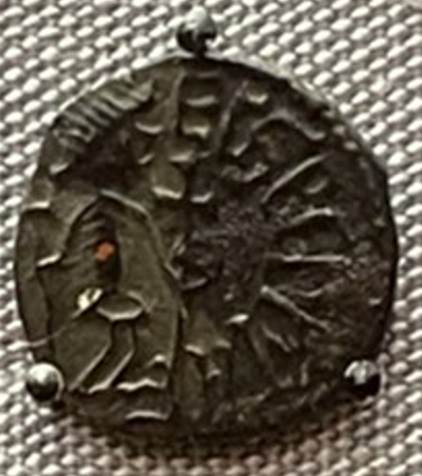
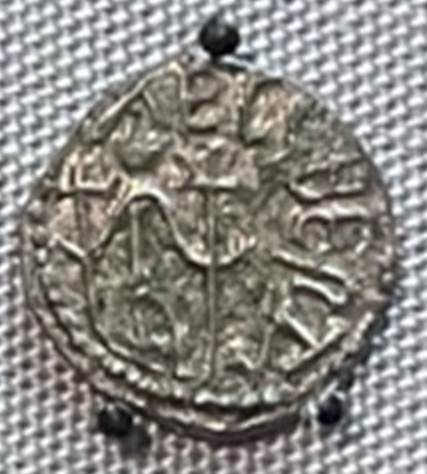
Silver coin of
King Eadberht and Archbishop Ecgbert from Fishergate, York, circa 758 CE (Yorkshire Museum)
Inspirer of
knowledge
Alcuin had a
profound love of poetry. He studied the liberal arts and Latin authors such as
Pliny (for natural history), Cicero (for rhetoric), the Anglo Saxon Aldhelm
(for grammar) and poets including Virgil, Lucan and Statius. He studied the
Bible, and the works of Gregory the Great, Cassiodorus and Bede. The study was
not particularly original, but aimed at conserving and
digesting the heritage of the past into handbooks for the survival of
established teaching as a tool for Christian knowledge.
Alcuin
accompanied Aethelbert on his travels at least once, and as Aethelbert grew older,
Alcuin became involved in teaching.
Alcuin graduated
to become a teacher during the 750s by which time Alcuin taught an
extraordinarily wide curriculum.
The York school
was renowned as a centre of learning in the liberal arts, literature, and
science, as well as in religious matters. From here, Alcuin drew inspiration
for the school he would lead at the Frankish court. He revived the school with
the trivium and quadrivium disciplines, writing a codex on the trivium,
while his student Hraban wrote one on the quadrivium.
766
It was during this time in 766 CE
that Charles I became King of the Franks.
767
Aethelbert succeeded Ecgberht as Archbishop on 24 April 767.
Alcuin’s ascendancy to the headship of the York school, the
ancestor of St Peter's School, began after Aethelbert became Archbishop of
York. Around the same time, Alcuin became a deacon in the church. He was never
ordained a priest and there is no evidence that he took monastic vows, though
he lived as if he had. Religious boundaries were fluid at that time without a
sharp division between disciplines. Alcuin thus became master of the monastic
school at York and its magnificent library.
Alcuin taught the seven Liberal Arts.
He stressed the correct use of Latin
and wrote textbooks in Latin. He followed Bede’s method of question and answer.
He promoted the study of the calendar,
the computus, and especially the once
controversial calculation of the date of Easter.
He gave elementary instruction in music,
arithmetic and geometry.
He enjoyed riddles, jokes and puns
in his teaching methods. He made arithmetical puzzles and seems to have been an excellent communicator. This was a very
Anglo Saxon teaching technique. The BBC Discovery
podcast, Alcuin of York, is an examination by Philip Ball of Alcuin’s famous river
crossing riddle.
Alcuin developed a friendly literary circle where its members had nicknames, Alcuin was called Flacchus and a
favoured pupil, Sigewulf, was known as Vetulus,
‘little old fellow”.

Alcuin wrote
about the beautiful inscriptions given to the Church in York by Bishop Wilfred
– this one reads “Hail, gracious priest, on account
of your merits”, from St Mary’s Church, Bishophill,
York (Yorkshire Museum)
The minster was
rebuilt at this time.
|
My heart is set
to praise my home And briefly
tell the ancient cradling Of York's famed
city through the charms of verse. It was a Roman
army built it first , High-walled and
towered, and made the native tribes |
Of Britain
allied partners in the task – For then a
prosperous Britain rightly bore The rule of
Rome whose sceptre ruled the world – To be a
merchant-town of land and sea, A mighty stonghold for their governors, |
An Empire's
pride and terror to its foes, A haven for the
ships from distant ports Across the
ocean, where the sailor hastes To cast his rope
ashore and stay to rest. The city is
watered by the fish-rich Ouse |
Which flows
past flowery plains on every side; And hills and
forests beautify the earth And make a
lovely dwelling-place, whose health And richness
soon will fill it full of men. The best of
realms and people round came there |
In hope of
gain, to seek in that rich earth For riches,
there to make both home and gain |
|
Alcuin’s
letters are
a rich historical record of a time of profound historical change in Europe. He
revealed his inner thoughts and longing for Northumbria. They tell much of the
history of Northumbria. Alcuin’s letters make the late eighth century the most
documented period of this era. We learn personal information about Alcuin from
his letters, such as his favourite food which was porridge with butter and
honey.
Eanbald became Archbishop of York and Alcuin became sole head of
the school (Historia Regum, Symeon of Durham, edited by Thomas Arnold, page 47).
Rome
781
In 781, King Elfwald sent Alcuin to Rome
to confirm the election of the new archbishop, Eanbald I through the collection
of his vestment, pallium. He had already been to continental Europe at
least once, and probably had previously met
Charlemagne.
On his way home, on 15 March 781, he met Charlemagne, this time in
the Italian city of Parma. At this time, Charlemagne was King Charles of the
Franks, but he later became Charlemagne, the Great, after his coronation as
Holy Roman Emperor in 800.
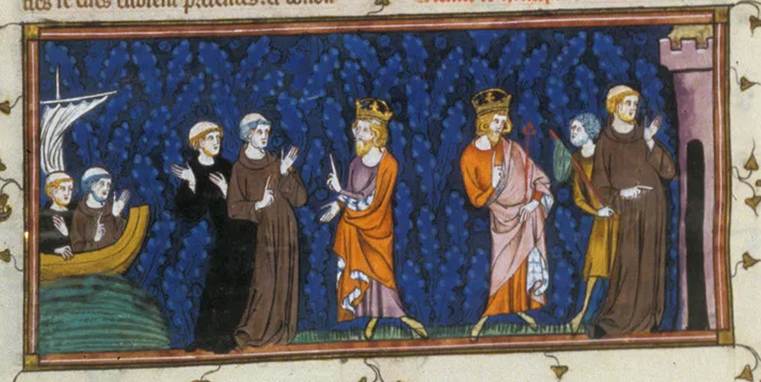
Charlemagne
meeting Alcuin (British Library, MS Royal 16 G VI f
153v)
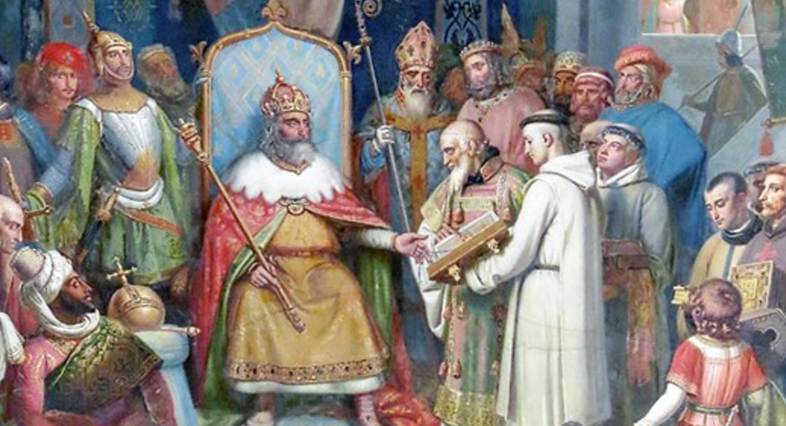
Charlemagne had
already gathered a circle of poets and scholars and asked Alcuin to direct the
education of the royal and noble children. Charles I
had conquered the Lombards, so the first scholars he gathered were generally
Italian. Charles was first a warrior, but also sought
to grow the cultural authority of his kingdom: fortitudo
et sapientia, wisdom and might, an idea derived
from the Virgilian hero. At the invitation of Charlemagne, Alcuin became a
leading scholar and teacher at the Carolingian court, where he remained a
figure in the 780s and 790s.
Since the
beginning of his reign, Charles had been focused on successfully fighting
Lombards, Saxons, and Saracens. In boyhood he would have been engaged in the
usual routine of hunting, riding, swimming, and the use of weapons. Yet he had
an eye for scholarship and the development of national culture.
Alcuin later
wrote to Charlemagne "I knew how strong was the
attraction you felt towards knowledge, and how greatly you loved it. I
knew that you were urging everyone to become acquainted with it and were
offering rewards and honours to its friends in order to induce them to come
from all parts of the world to aid in your noble efforts."
Aachen, Francia
Alcuin left York for Charlemagne’s court in 782. There is a
suggestion that he was in York for a while longer and didn’t leave for
Charlemagne’s court until 786.
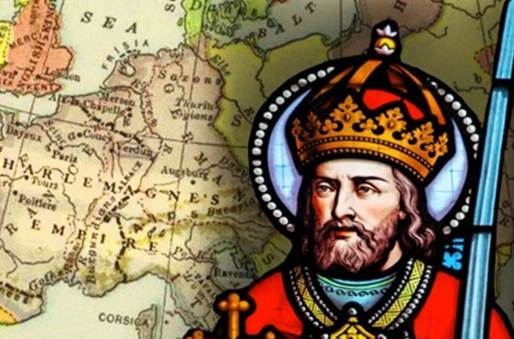
Alcuin's joined an illustrious group of scholars whom Charlemagne
had gathered around him, the mainsprings of the Carolingian Renaissance: Peter of Pisa (Latin
Grammarian), Paulinus of Aquileia, Rado, and Abbot Fulrad, Paul the Deacon (a Lombard historian). Alcuin would later write, "the
Lord was calling me to the service of King Charles".
Charlemagne gathered the best
scholars from across his Kingdom and beyond, so that his realm became more than
just a centralised state, but adopted ideas from afar.
It seems that he made many of these men his closest friends and counsellors.
They referred to him as David, a reference to the Biblical king David.
Alcuin soon found himself on intimate terms with Charlemagne and the other men
at court, where pupils and masters were known by affectionate and jesting
nicknames. Alcuin himself continued to be called Flaccus and sometimes Albinus.
While at Aachen, Alcuin bestowed pet names upon his pupils, derived mainly from
Virgil's Eclogues. Alcuin loved Charlemagne and enjoyed the king's esteem,
but his letters reveal that his fear of him was as great as his love.
Alcuin became master of the Palace
School of Charlemagne in Aachen (Urbs Regale) in 782. It had been
founded by the king's ancestors as a place for the education of the royal
children (mostly in manners and the ways of the court). However, Charlemagne
wanted to include the liberal arts, and most importantly, the study of
religion.
Alcuin continued
and built upon his methods of teaching which had been developed at York. He brought his Anglo Saxon teaching techniques, including his riddles to
liven up the rather dry Lombard teaching methods. He made learning attractive.
The collection of mathematical and logical word problems, Propositiones
ad acuendos juvenes ("Problems to Sharpen Youths") has
been attributed to Alcuin.
|
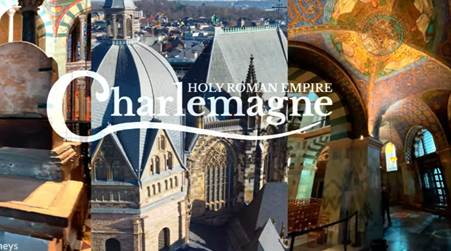
The
centre of Charlemagne’s world into which Alcuin stepped. |
789
Alcuin helped
Charlemagne to write official decrees, including those aimed at the development
of literacy across the Kingdom. He pioneered Charlemagne's Admonitio
generalis, a collection of legislation issued in 789, which covered
educational and ecclesiastical reform within the Frankish kingdom. This framed
what Charlemagne sought to achieve, including the establishment of schools
throughout Francia.

It was generally
felt that a successful kingdom required warriors, workers, and those who would
pray and converse with God, through an understanding of wisdom, including by
understanding Latin. Alcuin was called upon to lead the development of the
third of these requirements.
Alcuin became
interested in Aachen in logic and abstract
philosophical reasoning, which were applied to theological questions,
such as proving God’s existence or defining his nature. He wrote a text on
logic and revised the study of Boethius’ works.
Alcuin engaged with women in the court through his
letters, in Francia, Northumbria and Mercia. He saw engagement with women in
correspondence as a means to influence those in places
of power. He engaged in correspondence on scholarly matters and they exchanged
gifts. These letters tell us about the politics of the court. Women were also
his pupils.
He wrote poems. They were not always of the highest
standard. They were often long poems. He also wrote private poems in his
letters.
He also focused
on theology and wrote treatises, including
two against the Adoptionist heretics in Spain; and on the Trinity. He
revised the Latin version of the Bible. There was a revision of the liturgy.
Alcuin
established a new curriculum and teaching methods,
which were then adopted across Charlemagne’s empire. Royal decrees founded
schools in each diocese and monastery. There was a standardisation of
handwriting through the adoption of the new Carolingian miniscule.
He continued the question and answer technique of learning, exemplified in
"The Disputation of Pepin the most Noble and Royal Youth with Albinus the
Scholastic,"
"What is
Language? "The Betrayer of the Soul." "What generates language?
"The tongue." "What is the tongue? "The Whip of the
Air." "What is Air? "The Guardian of Life." "What is
Life? "The joy of the happy; the expectation of Death." "What is
Death? "An inevitable event; an uncertain journey; tears for the living;
the proving of wills; the Stealer of men." "What is Man? "The
Slave of Death; a passing Traveller; a Stranger in his place."
Alcuin helped
Charlemagne to lay the foundations for a European
system of education, which kept learning alive during the turbulent
ninth and tenth centuries.
Alcuin was "The
most learned man anywhere to be found", according to Einhard's Life of
Charlemagne (c. 817–833). Alcuin is considered among the most important
intellectual architects of the Carolingian Renaissance.
Among his pupils
were many of the dominant intellectuals of the Carolingian era.
Alcuin
established a great library at Aachen, for which Charlemagne obtained
manuscripts from Monte Cassino, Rome, Ravenna and other places. Books are
naturally attracted to centres of power and influence, like wealth and works of
art and all that goes with a prosperous cultural centre.
During this
period, he perfected Carolingian minuscule,
an easily read manuscript hand using a mixture of upper and
lower case letters. Carolingian minuscule was already in use before
Alcuin arrived in Francia. However there was a
diversity of script between monasteries. Most likely Alcuin was responsible for
copying and preserving the script while at the same time restoring the purity
of the form. Alcuin spread correct Latin learning and common script which was
mutually legible. The script is the basis for the script used today and Times
New Roman font has origins in the common text developed at this time. Each
letter is distinctly formed, separated and unique from another, so it became
the tool for print many centuries later.
"The use.
. . of a script more compact in the body and needing less time to write, may
have been decided upon in view of the plans to proceed with a State educational
project, the greatest ever undertaken in the West, or perhaps anywhere at any
time in the Roman Empire. For such an enterprise the employment of an
accelerated script would become an interest of State, or,
to be accurate, of State and Church" (Morison,
Politics and Script. . . . Barker ed. [1972] 143).
The
Carolingian Miniscule script needed less time to write, and
was probably an adjunct of the new State educational project, the greatest ever
undertaken in the Western World. For such an enterprise the employment of an
accelerated script was an important element.
Alcuin wrote many
theological and dogmatic treatises, as well as a few grammatical works and a number of poems.
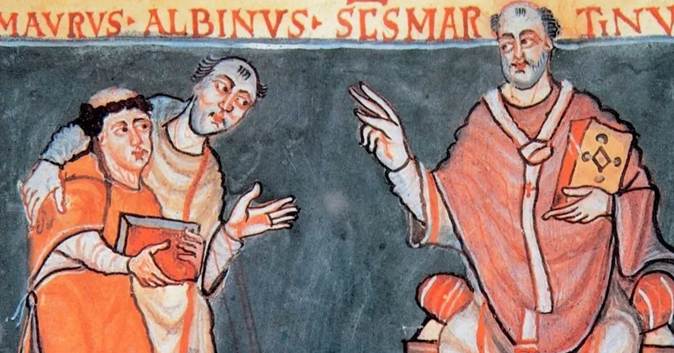
Rabanus Marus
(left), Alcuin (middle) and Archbishop Odgar of Mainz (right) (Carolingian manuscript)
At Aachen, Alcuin
composed a trialogue between a master, a 14 year of Frank and a 15 year old Anglo Saxon. He also compiled a textbook of
synonyms.
From 782 to 790,
Alcuin taught Charlemagne himself, his sons Pepin and Louis, as well as young
men sent to be educated at court, and the young clerics attached to the palace
chapel. Bringing with him from York his assistants Pyttel,
Sigewulf, and Joseph, Alcuin revolutionised the
educational standards of the Palace School, introducing Charlemagne to the
liberal arts and creating a personalised atmosphere of scholarship and
learning, to the extent that the institution came to be known as the school
of Master Albinus.
In this role as
adviser, he dissuaded the emperor's policy of forcing pagans to be baptised on
pain of death, arguing, "Faith is a free act of the will, not a forced
act. We must appeal to the conscience, not compel it by violence. You can force
people to be baptised, but you cannot force them to believe." His
arguments seem to have prevailed. Charlemagne abolished the death penalty for
paganism in 797 CE.
Charlemagne
gathered the best men of every land in his court, and
became far more than just the king at the centre. It seems that he made many of
these men his closest friends and counsellors. They referred to him as 'David',
a reference to the Biblical king David. Alcuin soon found himself on intimate
terms with Charlemagne and the other men at court, where pupils and masters
were known by affectionate and jesting nicknames. Alcuin himself was known as
'Albinus' or 'Flaccus'. While at Aachen, Alcuin bestowed pet names upon his
pupils – derived mainly from Virgil's Eclogues. According to the Encyclopædia Britannica, "He loved Charlemagne and
enjoyed the king's esteem, but his letters reveal that his fear of him was as
great as his love."
Alcuin’s was not
an original mind (he adopted Albinus from a second century AD Greek summariser
of Plato as his nickname), in fact Latin grammar was his chief expertise. But
this suited the times. Charles was less interested in thinkers who could open up new directions in philosophy than scholars who could
help run his programme for the revival and consolidation of classical learning.
A master of Latin literature and correct written Latin he was ideally qualified
for a top position at the palace school which soon became known as ‘the school
of Master Albinus’. (A Brief History of the Anglo
Saxons, The Beginnings of the English Nation,
2006, Geoffrey Hindle, page 165).
York
789
Alcuin returned
briefly to York.
790
In 790, Alcuin
again returned from the court of Charlemagne to York, and he lived at York
until 793 CE.
Francia
793
Charlemagne
invited Alcuin back to help in the fight against
the Adoptionist heresy, which was at that time
making significant progress in Toledo, the old capital of the Visigoths and
still a major city for the Christians under Islamic rule in Spain. He is
believed to have had contacts with Beatus of Liébana, from
the Kingdom of Asturias, who fought against Adoptionism.
Alcuin had been
reluctant to leave York, but the first Viking attack at Lindisfarne in 793 CE,
followed by Jarrow in 794 CE and mounting anarchy culminating in the murder of
the Northumbrian King Ethelred in 796 CE caused him to remain in Francia, under
the strong rule of Charlemagne. His distress and
horror at the fate of Lindisfarne in 793 comes over very strongly in his
letters both to the Bishop of Lindisfarne and the Northumbrian king. Having
failed during his stay in Northumbria to influence King Æthelred in the conduct
of his reign, Alcuin never returned home.
He returned to
Charlemagne's court and wrote a series of letters to Æthelred, to Hygbald, Bishop of Lindisfarne, and to Æthelhard,
Archbishop of Canterbury in the succeeding months, dealing with the Viking
attack on Lindisfarne in July 793. These letters and Alcuin's poem on the
subject, De clade Lindisfarnensis monasterii, provide the only significant contemporary
account of these events. In his description of the Viking attack, he wrote:
"Never before has such terror appeared in Britain. Behold the church of
St Cuthbert, splattered with the blood of God's priests, robbed of its
ornaments."
In his letter to Hygbald, Bishop of Lindisfarne he
wrote, When
I was with you, the closeness of your love would give me great joy. In
contrast, now that I am away from you, the distress of your suffering fills me
daily with deep grief, when heathens desecrated God's sanctuaries, and poured
the blood of saints within the compass of the altar, destroyed the house of our
hope, trampled the bodies of saints in God's temple like animal dung in the
street ...
(Letter from Alcuin to Hygbald, Bishop of
Lindisfarne).
Alcuin saw the
Viking horrors as divine retribution for the moral decline of the Northumbrian
people.
In his letter to Hygbald he
wrote, What security is there for the churches of Britain if St Cuthbert with
so great a throng of saints will not defend his own? Either this is the
beginning of greater grief or the sins of those who live there have brought it
upon themselves. (Letter from Alcuin to Higbald,
Bishop of Lindisfarne).
794
At the Council of
Frankfurt in 794 CE, Alcuin upheld the orthodox doctrine against the views
expressed by the heretic, Felix of Urgel.
795
Alcuin was
pressured to return to York by the Archbishop of York in 795. However Alcuin saw 796 as a year of misery and the death of
Kings. Ethelred’s successor was expelled after only a month. Charlemagne
perhaps later gave Tours to Alcuin as compensation for his lands in
Northumbria.
Tours
Alcuin’s lonely end
Upon the death of Abbot Itherius of
Saint Martin at Tours, in 796 CE, a year of devastation in Northumbria,
Charlemagne appointed Alcuin to be abbot of Marmoutier
Abbey, in Tours, in Western Francia, near Orleans, where he remained until his
death. Charlemagne did so with the understanding that Alcuin should be
available if the King ever needed his counsel.
In 796, Alcuin
was probably in his sixties.
Tours was
very well resourced. It was there that Alcuin encouraged the work of the monks
on the beautiful Carolingian minuscule script, ancestor of modern Roman
typefaces.
Whilst at
Tours Aluin wrote further works on the Trinity and another revised version of
the Bible. There was concern that the Bible text was becoming less pure. Tours
started to produce complete volumes of the Bible in one volume.
Much of the
surviving written material about Alcuin, including two thirds of his letters,
come from his period at Tours.
He was
increasingly drawn to a monastic life of prayer, fasting and stricter
observance.
Alcuin
suffered from fever (malaria), failing eyesight, and arthritis. His old friend
Eanbald died that year. There is a suggestion of melancholy in Alcuin’s years
at Tours. His letters suggest a sense of isolation. There is a sense of longing
for his former home. He wrote of struggling with the uncultured minds of
Tours and of boys pesting me with their little
questions.
He wrote the
rather sad poem:
All the beauty of
the world is quickly upturned,
And all things in
their time are transformed.
For nothing
remains forever and nothing is immutable,
Dark night
obscures even the clearest day.
A freezing winter
cold strikes down gorgeous flowers,
And a bitter wind
unsettles calm seas.
On fields where
the pious boy once hunted deer,
A tired old man
now stoops with his walking stick.
Why do we
wretched ones love you, O fleeing world?
Always crashing
down, you still flee from us.
Whilst at Tours
Aluin wrote further works on the Trinity and another revised version of the
Bible. There was concern that the Bible text was becoming less pure. Tours
started to produce complete volumes of the Bible in one volume.
Much of the
surviving written material about Alcuin, including two thirds of his letters,
come from his period at Tours.
He was
increasingly drawn to a monastic life of
prayer, fasting and stricter observance.
After the death of Pope Adrian I, Alcuin was commissioned by
Charlemagne to compose an epitaph for Adrian. The epitaph was inscribed on
black stone quarried at Aachen and carried to Rome where it was set over
Adrian's tomb in the south transept of St Peter's basilica just before
Charlemagne's coronation in the basilica on Christmas Day 800.
Charles became Emperor of the Holy Roman Empire on Christmas Day
800. Alcuin
was at Tours, which was distant from Charlemagne’s court. Charles had been
peripatetic as other kings of that time, but by about 795 CE he invested in his
centre of power at Aachen. In the build up to his coronation. Charlemagne
toured his Kingdom and went to Tours where he spent a considerable period of time with Alcuin. So at
this pivotal moment, Charles sought Alcuin’s advice, although Alcuin did not
travel with Alcuin to Rome as his health was failing.
The idea of
reviving the Western Empire, since the end of the Roman Empire and the
emergence of an empire in the East, must have been in the minds of both Pope
and King long before the stirring events of the year 800 CE. Alcuin, as adviser
both in temporal and spiritual affairs to the Frankish Court, was well aware of the intended project.
The folk of Ryedale and the lands around York, shared vicariously through Alcuin
in another pivotal moment in the evolution of western civilisation.
804
Alcuin died on 19 May 804 and was buried at St. Martin's Church. His epitaph was
composed by Alcuin himself:
"O thou who passest by, halt here a while, I pray, and write my
words upon thy heart, that thou mayst learn thy fate from knowing mine.
What thou art, once I was, a wayfarer not unknown in this world; what I am now,
thou soon shalt be. Once was I wont to pluck earthly
joys with eager hand; and now I am dust and ashes, the food of worms. Be
mindful then to cherish thy soul rather than thy body, since the one is
immortal, the other perishes. Why dost thou make to thyself pleasant abodes?
See in how small a house I take my rest, as thou shalt do one day. Why wrap thy
limbs in Tyrian purple, so soon to be the food of dusty worms? As the flowers
perish before the threatening blast, so shall it be with thy mortal part and
worldly fame. O thou who readest, grant me in
return for this warning, one small boon and say: 'Give pardon, dear Christ, to
thy servant who lies below.’ May no hand violate the sacred law of the grave
until the archangel's trump shall sound from heaven. Then may he who lies in
this tomb rise from the dusty earth to meet the Great Judge with his countless
hosts of light. Alcuin, ever a lover of Wisdom, was my name; pray for my
soul, all ye who read these words.”
Legacy
814
Charlemagne died
and was succeeded by Louis the Pious, who had been influenced by Alcuin’s
teachings.
866
The Great Library of York was either exported to
mainland Europe or destroyed in the devastating Viking attacks on York and
Northumbria in 866 and 867. The school and library of York were the finest in
eighth-century Europe.
Bibliography
The
majority of details on Alcuin's life come from his letters and poems. Also,
autobiographical sections are in Alcuin's poem on York
and in the Vita Alcuini, a hagiography written for
him at Ferrières in the 820s, possibly based in part
on the memories of Sigwulf, one of Alcuin's pupils.
Alcuin of York
and the Foundations of Medieval Education, Gordon Leff, Kirkdale Lecture 1994.
Alcuin, Ethel Mary Wilmot Brown, 1922.
Alcuin of York, Lectures delivered at
Bristol Cathedral, 1907 and 1908.
Two Alcuin Letter Books, edited by Colin
Chase, 1975.
The Life of Alcuin, 1837, Dr Frederick
Lorenz, translated by Jane Mary Slee.
Alcuin of York, his life and letters,
Stephen Allott, 1974.
Alcuin and Beowulf, an Eighth century View,
W F Bolton, 1978.
A Brief History
of the Anglo Saxons, The Beginnings of the English Nation, 2006, Geoffrey
Hindle, Alcuin of York and the Continuing Anglo Saxon
Presence on the Continent, pages 150 to 175.
The Canadian
Literary society, the Alcuin
Society, was founded in Vancouver in 1965, inspired by Alcuin’s story.
Alcuin wrote 'Oh how sweet life was when we sat quietly... midst all these
books'.
This was the age
of Beowulf.