Campsall
Campsall, north of Doncaster
|
Return to the Home Page of the Farndale Family
Website |
The story of one family’s journey through two
thousand years of British History |
The 83 family lines into which the family is divided.
Meet the whole family and how the wider family is related |
Members of the historical family ordered by date of
birth |
Links to other pages with historical research and
related material |
The story of the Bakers of Highfields, the Chapmans,
and other related families |
Introduction
Dates are in red.
Hyperlinks to
other pages are in dark
blue.
Headlines of the
history of Bradford are in brown.
References and
citations are in turquoise.
Contextual
history is in purple.
Campsall
Ninth Century
The area of modern Doncaster was
likely not open land, but forested until it started to be cleared in the late
Saxon period. At some stage perhaps from late Saxon times, areas were cleared
for settlement in the process called assarting. The growth of population and
villages, including Campsall and Loversal,
by the time of Edward the Confessor suggest that assarting had been pursued
vigorously by that time (South Yorkshire, the
History and Topography of the Deanery of Doncaster in the Diocese and County of
York by Rev Joseph Hunter, 1828, page ix).Joseph
Hunter lists 170 vills of human settlement by the
late Saxon period. He suggested that settlement might have been influenced by
the need to cross a watercourse, but often may have been
the inclination of a family to settle on land, which larger grew into a larger
habitation. However he recognises that this informal
process was soon replaced by recognition of rights of occupancy from the lands
of the elite class who owned large estates. It therefore ceased to be open to
every citizen to clear woodland for his own use, but by the Doomsday record, a
right had been recognised in overlordship.
Thus Saxon lords came to surround themselves
with dependents who held portions of land from him, in return for rendering
services. This is reflected in culture such as Beowulf,
which provided an encouragement to live within the protection of the elite
class, as protection against the perils of unsettled places.
1003
Dadesley (now Tickhill)
and Doncaster emerged as burgesses, which in time would become Doncaster. Other
centres were emerging including Campsall,
which was valued at £5 in a census of Edward the Confessor, being one of the
larger settlements.
The larger seats of population came to be governed under the
authority of a bors holder who was
elected at a general assembly. Townships were grouped in tens under a hundreder, a superior officer who held courts. These
hundreds came to be called wapentakes in the areas to the north.
Doncaster came to fall within the wapentake of Strafford and Tickhill.
Doncaster and Loversall fell within the Wapentake
of Strafford. Campsall fell within the Wapentake of Osgodcross.
(South Yorkshire, the History and
Topography of the Deanery of Doncaster in the Diocese and County of York by Rev
Joseph Hunter, 1828, page xi).
From early times
the parish of Campsall consisted of six townships or hamlets; Campsall, Askern,
Fenwick, Moss, Norton and Sutton.
1086
At the time of
the Domesday survey in 1086, the area was in the possession of Ilbert de
Lacy, the founder of Pontefract Castle. Campsall appears twice and both
times is referred to as Cansale. Before the
conquest Alsi had two and a half caracutes
there. There was pasturable wood. Ilbert took four caracutes,
with two villeins and three borders. It was rated at £4 before and after the
Conquest.
The fact that
Domesday does not mention a church here is no proof that such did not exist,
since cases are to be found where there is similarly no such reference. Yet the
existing church contains work of pre-Conquest date; there may have been merely
a chapel attached to the manor without parochial rights. The earliest existing
work in the church is of twelfth century date.
The manor of
Campsall thrived after the Conquest, rather than retracting, and was largely
owned directly by Ilbert de Lacy (Hunter 1831, 463).
Ilbert de Lacy was given a broad belt of land across what became
the West Riding of Yorkshire. He took the whole wapentakes of Staincross and Osgodcross.
Pontefract was head of his fee, so his estate was called the honour of Pontefract .
(South Yorkshire, the History and
Topography of the Deanery of Doncaster in the Diocese and County of York by Rev
Joseph Hunter, 1828, page xvii, Vol 2 463).
Twelfth century
Campsall Priory
was an Augustinian priory founded in the 12th century. The priory played a
significant role in the local community and religious life. Only ruins remain
today.
Eisdem loco et die. Inter Henricum de PuTEACO,^ et DiONisiAM uxoREM EJUS, pet., per Radulphum
de Coleviir positum loco suo
etc., et Adam de Rennevill' ten., de advocatione medietatis ecclesi^ de Camsal'. Unde placitum fuit etc., scil. quod predicti Henricus et Dionisia recognoverant
et coucesserunt advocationem
illius medietatis esse jus ipsius Adse, et illam remiserunt et quietam clamaverunt de se et her. ipsius Dionisife predicto Adge et her.
suis imperp. Et pro hac recognitione
etc. idem Adam concessit et quietum
clamavit predictis Henrico
et Dionisias totum jus etc.
in advocatione medietatis capellae de Fenwic,^ ita quod tota
advocatio illius capelte remaneat ipsis Henrico et Dionisia), et her. ipsius
Dionisire, quieta de ipso Ada et her. suis imperp. Et idem Adam de heredes sui warantizabunt
ipsi Henrico et Dionisiee,
et her. ipsius DionisiiB, advocationem
illius medietatis capella), quam ipse Adam ois concessit et quietam clamavit imperp. versus omnes homines (Yorkshire
Feet of Fines, Pedes Finium Ebor, regnante
Johanne (1199 to 1214), Edited by W. Brown, Surtees Society, volume 94,
1897, page 139).
This
is a mutual exchange of church patronage rights. Henry de Putteaco
and his wife Dionisia give Adam de Rennevill the
right to present clergy to half the church of Campsall, and in return Adam
gives them the right to present clergy to half the chapel of Fenwick, with
mutual guarantees forever. The chapel of Fenwick, in the parish of Campsall has long since
been destroyed.
St Mary Magdalene at
Campsall
St Mary
Magdalene, Campsall is a large church with at least two main phases of twelfth
century building identifiable: at first it had a
cruciform plan; later, nave aisles enclosing a west tower were added. Pevsner 1967, 154, says Campsall church has ‘the
most ambitious Norman west tower of any parish church in the Riding’. Subsequently,
alterations were made to the aisle arcades, windows, chancel and south doorway.
The church was restored between 1871 and 1877 by G. G. Scott (Borthwick Institute Faculty Papers 1871/2 with plan)
and piecemeal after. Restoration of stonework on the tower was in progress in
2005. Romanesque sculpture is on the west doorway and tower; one chancel window
(inside and out); arches at the crossing; and numerous loose and reset
fragments.
By the reign of Richard I (1189 to 1199) Adam de Reineviles
had recovered seizin of half the church of Camsale
against Henry de Puteaco and Dionysia, his wife. This
is the earliest mention of a church at Campsall, which was probably erected
sometime before on the patronage of the Reineviles
and the Lacis, as patrons.
Hunter
1831, 460,
says 'Campsal church was the joint work of the
Lacis, the chief lords, and the Reineviles,
the subinfudatories. It exceded
[the churches of Bramwith, Owston and Burgh] in magnificence
as much as it did in the extent of country that was attached to it'
The Lacis and the Reinvilles thus united
in the foundation of the church at Campsall, and there were originally two
rectors, one appointed by each family; and this continued until about the time
of Henry III . Much of the church of Campsall is the
church erected at this time.
(Hunter 1831, 463, South Yorkshire, the History and Topography of the
Deanery of Doncaster in the Diocese and County of York by Rev Joseph Hunter, 1828,
Vol 2 page 467, 468).
The Reinevilles appear to have been succeed by the Newmarches.
There is a podcast on BBC Sounds, 9 August 2026, Secret South Yorkshire: Did
Robin Hood get married in Doncaster?
1285
Calendar
of Patent Rolls, Edward I: Volume 2, 1281-1292, in 1285: to deliver the gaol of
Oxford of William de Campsale, who was put in exigent …
1291
The benefice was
in the Taxatio of Pope Nicholas IV (1291) and
had an annual value of £66 13s. 4d. By a curious arrangement, the chapel of St.
Clement in Pontefract Castle had a one ninth share in tithe. The probable explanation
of this anomaly is the fact that Ilbert de Lacy and his successors held both
estates and adopted this method of supporting the chapel which was an important
foundation in its own right.
Henry de Laci, earl of Lincoln, in the reign of Edward II, left a
daughter, who was the wife of Thomas earl of Lancaster, the grandson of Henry
III. On the accession
of the House of Lancaster to the throne, the estates of the Lacis
came to be held directly by the Crown, but were held by subinfeuded
persons (South Yorkshire, the History and Topography of the
Deanery of Doncaster in the Diocese and County of York by Rev Joseph Hunter,
1828, page xvii).
1293
In the reign of
Edward I Henry Lacy, Earl of Lincoln, Lord of the Honour of Pontefract,
obtained a royal charter for a market at Campsall, which would
suggest that it was a place of some consequence by that time. This charter
entitled the village to hold a weekly Thursday market and an annual four-day
fair each July during the festival of St Mary Magdalene.
The fair
continued until 1627.
Circa 1308
Richard of
Campsall
Richard of
Campsall (Ricardus de Campsalle) (c.1280 to c.1350)
was a secular theologian and scholastic philosopher at the University of Oxford
in the early fourteenth century. He was arguably one of the most important
philosophers there just prior to William of Ockham. Recent research reveals that
several views described as Ockhamist by the end of the fourteenth century possibly
originated with Campsall. A fellow of Balliol College prior to 1306, in 1306
Campsall became a fellow of Merton College. By 1308 he was a regent master of arts. He probably read the Sentences at Oxford in
1316-17 (prior to Ockham). From 1322 to 1324 he was regent master
of theology and in 1325-6 he served as ocum
tenens for the chancellor. How long he lived is open to question, but Synan argues that he lived until about 1350 or
1360.
He was a Fellow of
Balliol College and then of Merton College. He is now considered a possible
precursor to the views usually associated with William of Ockham.
He commented on
Aristotle's Prior Analytics, with emphasis on "conversion" and
"consequences". He is an apparent innovator in speculation about
God's foreknowledge, particularly concerning future contingents, around 1317.
Campsall’s extant
works include his Quaestiones super librum Priorum analeticorum (ca.
1308), the Contra ponentes naturam (on universals),
a short treatise on form and matter (Utrum materia possit esse sine forma),
and Notabilia de contingencia et presciencia Det, all of which were probably written
about 1317 or 1318 (Tachau 1987, p. 110).
Campsall’s Sentences commentary is not extant, but Walter Chatton, Adam of Wodeham, Rodington, Robert
Holcot, and Pierre de Plaout cite him in their
Sentences commentaries.
In the Questions
on the Prior Analytics Campsall maintained that training in logic is the basis
for all other sciences. He discussed three major topics: syllogism,
consequences, and conversion. The subject of logic is the syllogism, and
knowledge of consequences and conversion is necessary for the study of
syllogism, especially for converting “imperfect” syllogisms into “perfect”
syllogisms (1968, pp. 21-2). In the area of
supposition theory, Campsall proposed views usually first attributed to Ockham,
for example, his distinction between simple and other types of supposition. For
Campsall, a word has “simple” supposition when it stands for a concept in the
mind. His conception of supposition was important for another innovation
regarding paralogisms involving the Trinity and the insufficiency of
Aristotelian logic for dealing with such problems. Gelber has elucidated this issue, and was the first to draw attention to Campsall’s use
of “Anselm’s rule.” Utilizing this rule, Campsall maintains that the result in
trinitarian paralogism is the fallacy of accident, a view also maintained by
Ockham. Campsall’s use of “Anselm’s rule” greatly influenced Holcot in his decision to complement Aristotelian logic
with the “logic of faith,” which makes up for the insufficiencies of
Aristotle’s logic (Gelber 1974, pp. 260-70).
Campsall proposes
an “Ockhamist” view regarding universals. He argues that universals are not
part of existing things, but are singular intentions
in the intellect. Campsall, as a conceptualist, maintains that “the relationship
of a universal intention to many singulars is not grounded in the structure of
those singulars but in the capacity of one universal sign to represent many
singulars” (1982, p. 12).
Campsall’s views
on intuitive and abstractive cognition are a response to John Dun’s Scotus, and were adopted by Rodington
and Holcot. Campsall argued that “intuitive” and
“abstractive” cognition are two terms for the same cognition, depending on
whether the object is present (intuitive) or absent (abstractive) (Tachau 1982, pp. 194—5).
(1968),
The Works
of Richard Campsall, vol. 1: Questiones super librum Priorum Analeticorum: MS Gonville and Caius 668, ed. Edward A.
Synan, Toronto: Pontifical Institute of Mediaeval Studies. (1982), The Works of
Richard Campsall, vol. 2, ed. Edward A. Synan, Toronto: Pontifical Institute of
Mediaeval Studies.
1320s
The Earl of
Lancaster owned windmills at his manors, including Campsall, in the 1320s (Mills
of Medieval England, Richard Holt, 1988, page
31).
).
1324
Writing to the
Dean of Doncaster, on 14 July 1324, the archbishop directed the prioress to
make Thomas de Raynevill undergo the penance imposed upon him for
committing the sin of incest with Isabella Folifayt, nun of Hampole.
The penance was that on a Sunday, while the major mass was being celebrated in
the conventual church of Hampole, Thomas de Raynevill
was to stand, wearing a tunic only and bare-headed, holding a lighted taper of
a pound weight of wax in his hand, which after the offertory had been said he
was to offer to the celebrant, who was to explain to the congregation the cause
of the oblation. Also that on two festivals more penitencium he should be beaten (fustigetur)
round the parish church of Campsall (A
History of the County of York: Volume 3. Originally published by Victoria
County History, London, 1974).
1328
Calendar
of Patent Rolls, Edward III: Volume 1, 1327-1330, in 1328: Meldon, parson of the
church of Campsale. July 14. Wenlock. Licence …
1334
The folk of
Campsall paid £7 2s 0d in taxation, the fourth highest contribution in South
Yorkshire.
1335
There was a composition under the sanction of William, archbishop
of York, in the time of Thomas de Bracton, rector and William de Mundene,
prebendary of the prebend in the chapel, by which 100 shillings was paid
annually by the rector in lieu of tithe (South Yorkshire,
the History and Topography of the Deanery of Doncaster in the Diocese and
County of York by Rev Joseph Hunter, 1828, Vol 2 p 467).
Close
Rolls, Edward III: June 1335, Calendar of Close Rolls, Edward III: Volume 3, 1333-1337,
Newcastle-on-Tyne. Thomas de Brayton, parson of Campsale
church, diocese of York.
1336
In 1336 there was
a composition under the sanction of the Archbishop of York in the name of
Thomas de Bracton, Rector of Campsall, and William de Mudene, Prebendary of the
chapel, by which one hundred shillings was to be paid by the Rector in lieu of
the tithe.
1379
The 1379 Poll Tax
suggest some trading for a chapman (or ‘middleman*) and twelve craftsman. However the town did not
become more than a local trading centre.
A Survey in 1627
recorded that The towne
of Campsall had in tymes past the priviledge
of a market, which is now decayed and lost by discontinuance’.
A map of 1740
shows Market Flatt to the north of the village, which was probably the
site of the market.
(The Making of South Yorkshire, David Hey, 1979, p67 to 68).
1391
Market
Privileges 1391-1395, (British History on Line) 19/10/1391,
London, Boston (Lincolnshire), Campsall (Yorkshire), Aldborough (Norfolk) -Pardon
of outlawry to John Wayte, parson of Campsall, alias of Aldborough, for
non-appearance to answer Roger Broun of Boston, or Walter Godard, citizen and
brewer of London, for debts of £34. and £33. 2s. respectively. [CPR 1388-92,
452]
1415
Calendar
of Papal Registers Relating To Great Britain and Ireland:
Volume 6, 1404-1415, Camporegali, A. de, 100. Campsall, Campsale [co. York, W.R.], 384, 411. Camus ... Corryngham, Coringam, Coringham, Coryngham, John,
rector of Campsall, 384, 411.
J.
L. Kirby, 'Index of Persons and Places: A', in Calendar of Inquisitions Post Mortem: Volume 18, Henry IV (London, 1987), pp. 414-418, John, parish
clerk of Campsall, 854
1427
Calendar
of Papal Registers Relating To Great Britain and
Ireland: Volume 8, 1427-1447. Campsall, St. Mary Magdalen, Campsale
[co. York, W.R.], 16, 662. … Corngham, John, canon of
Windsor, rector of Campsall and St. Michael le Querne,
London, afterwards of Clewer and St. Michael le Querne,
London, 662.
1425
Robert Dykes
became rector until he died, presented by Henry VI.
1429
John Okham became
Rector, presented by Henry VI and resigned to go to the church of Menstoke in Winchester. William Normanton then became
Rector until he resigned.
1443
Robert Ayscough
became Rector on 3 March 1443 until he resigned.
1466
Robert Addy became
chaplain of Campsall to the archbishop on 24 May 1466, presented by Edward IV.
1481
A great change
took place in 1481 when Edward IV (in his second period of reign) granted the
rectory of Campsall to the Priory of Wallingwells in
Nottinghamshire, a small house of Benedictine nuns. It was a poor foundation
before this gift.
1483
Peter Wylde was
presented as vicar of the church on 18 October 1483, presented by the
University of Cambridge.
1482
In the following year
Thomas Rotherham, Archbishop of York, appropriated it to this purpose and
decreed that henceforth the benefice should be served by a Vicar, and
gave the appointment to Cambridge University.
This meant that
the church at Campsall was appropriate to external influences, and the local
people were deprived from having a person from their own community.
(South Yorkshire, the History and
Topography of the Deanery of Doncaster in the Diocese and County of York by Rev
Joseph Hunter, 1828, vol 2 page 467).
1505
Richard
Balderstone was presented as vicar of the church on 13 October 1505, presented
by the University of Cambridge and died while vicar.
1507
Henry
Swaynborough became vicar on 26 May 1507.
1536
After the
dissolution of the monasteries under Henry VIII the rectorial
tithes passed into lay hands.
1552
John Lommas BA
became vicar on 16 July 1552 until he died in 1574.
1557
Robert Middleton
held the tithe of Campsall as tenant to the Hastings family of Fenwick.
1564
William Farndell
(FAR00063)
married Margaret Atkinson at Doncaster Campsall on 29 October 1564.
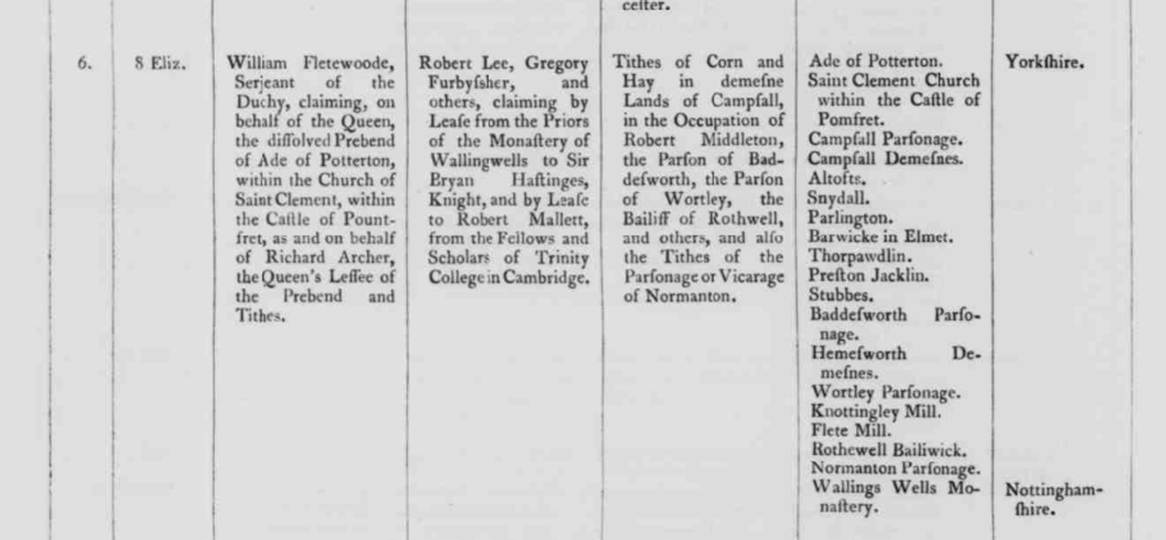
(Ducatrus Lancastriae,
Part 3, Calendar of Pleadings, Depositions etc, Henry VII to 13 Elizabeth I, page
342)
1574
John Brooke
became rector on 27 March 1574, appointed by the archbishop, possibly because there
were questions by then about the ownership of the university regarding the
right to present vicars.
1579
The rectory of
Campsall was granted to Sir Christopher Hutton.
1585
Sir Christopher
Hutton conveyed the rectory to Edward Heron of Stamford.
1594

(Ducatrus Lancastriae, Part 4, Calendar of Pleadings, 14 to 45 Elizabeth
I, page 327)
1848
A Topographical Dictionary of England. Originally published
by S Lewis, London, 1848: CAMPSALL (St. Mary Magdalene), a parish, in
the union of Doncaster, Upper division of the wapentake of Osgoldcross,
W. riding of York; containing 2149 inhabitants, of whom 385 are in the township
of Campsall, 8 miles (N. N. W.) from Doncaster. The parish consists of the
townships of Askerne, Campsall, Fenwick, Moss,
Norton, and part of Sutton; and comprises by computation 9700 acres, of which 1470
are in the township of Campsall, including the hamlet of Barnsdale. The village
is pleasantly situated on a gentle acclivity, about seven miles distant from
the river Don on the south, and on the north the same distance from the Aire.
Stone of good quality is quarried. Camps Mount, the seat of George Cooke
Yarborough, Esq., is an elegant mansion, standing at
the head of a fine lawn, and embowered in luxuriant foliage; and Campsall Park
is also a handsome residence. The living is a perpetual curacy, valued
in the king's books at £16. 16. 8.; net income, £128; patron and impropriator,
Mr. Yarborough. The tithes were commuted for land in 1814. The church is a
large ancient edifice, and has some fine specimens of
Norman architecture. The remains of a Roman road may be traced.
1857
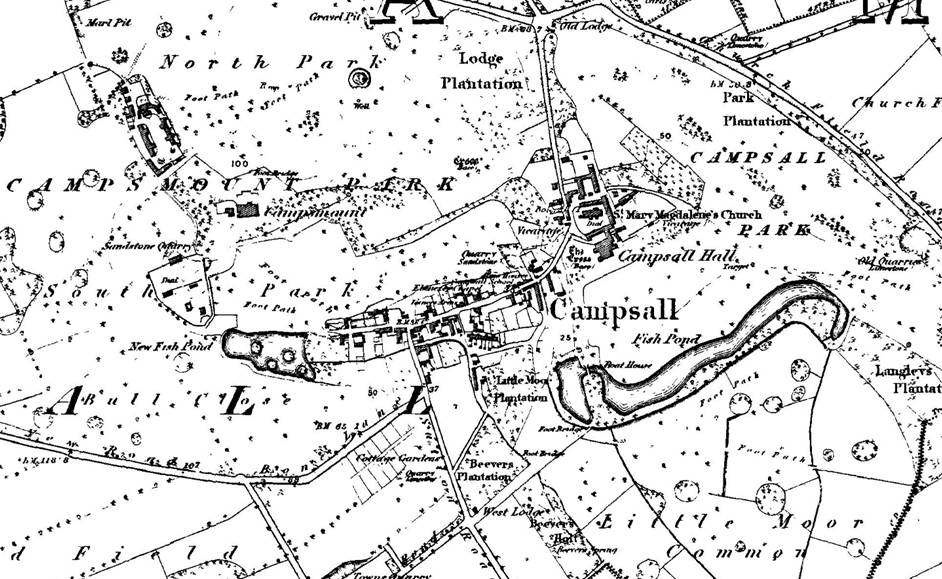
Campsall 1857
Sources
St Mary Magdalene Campsall Parish Records, 1563 to 1992, held by
Doncaster Archives, Reference GB 197 P15, 58 Boxes
Registration: Registers of Baptisms 1563-1979, Registers of Marriages
1564-1990, Registers of Burials 1563-1974, Registers of Banns 1981-1995,
Registers of Services 1902-1992; Incumbent 1736-1939; churchwardens: terriers
(5) 1770-1912, other records 1832-1988 and deeds for various places unrelated
to the parish 1682-1795; PCC minutes 1920-1994 and accounts 1937-1947; schools
(miscellaneous) 1861-1940; other records 1756-1983 including returns for the
1831 census (statistics only); Tithe approtionment and
map for Sutton 1838; altered apportionments, Sutton and Owston 1852.
P15/1/A: Composite Registers
P15/1/B: Registers of Baptisms
P15/1/C: Registers of Marriages
P15/1/D: Registers of Burials
P15/1/F: Registers of Services
P15/1/G: Miscellaneous
P15/2/A: Clerical Papers from c16th
Also available: Index : Bapt 1563-1850
Marr 1563-1837 Bur 1563-1871
The parish library, a collection of 126 volumes from the period
1573 to 1719 now deposited at Doncaster Archives, is the subject of M Gallico, 'A
Catalogue of the Library of Campsall Church', (unpublished MA dissertation,
University of Sheffield, 1980). A copy is available in the departmental library
of Doncaster Archives.
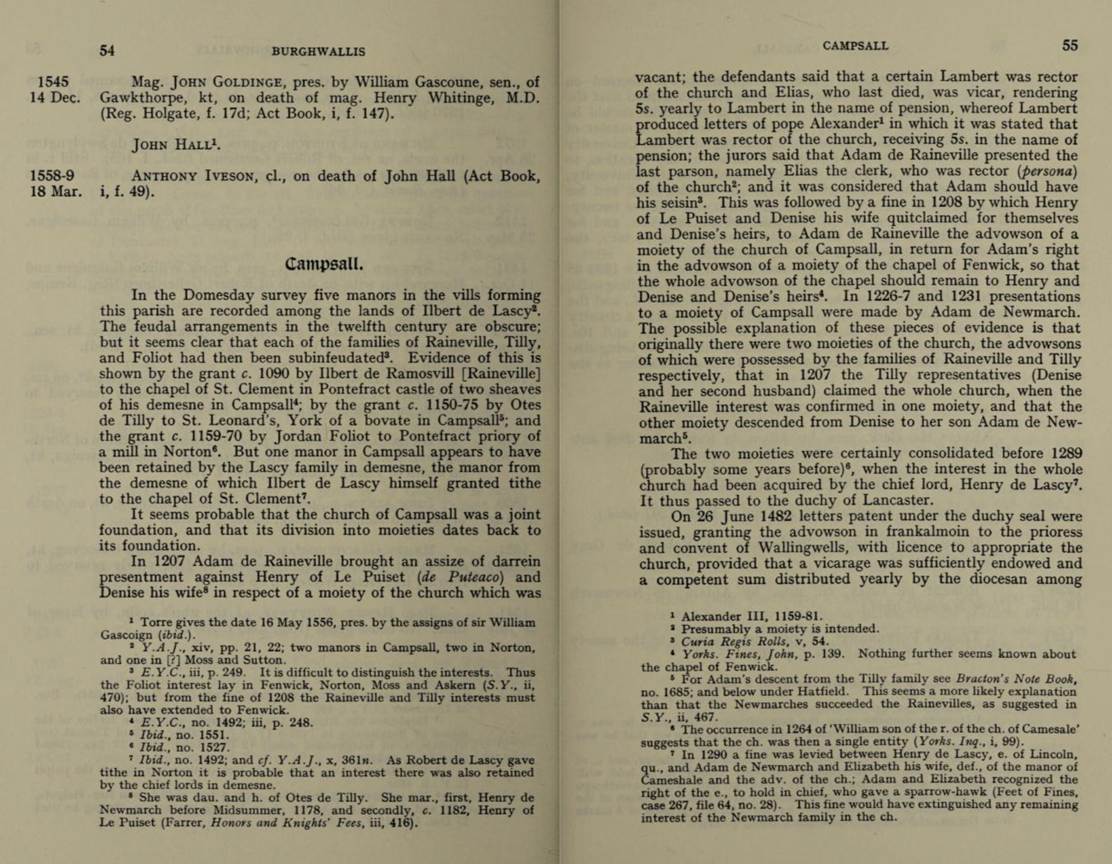
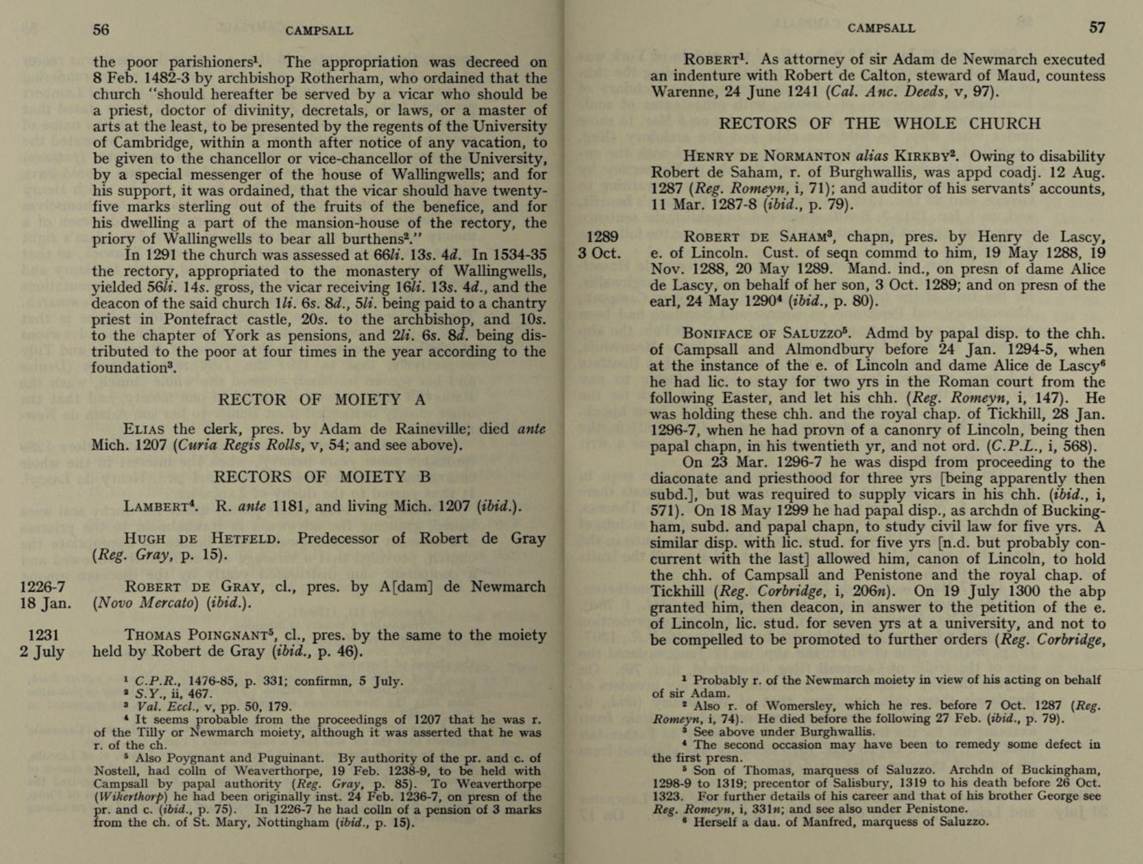
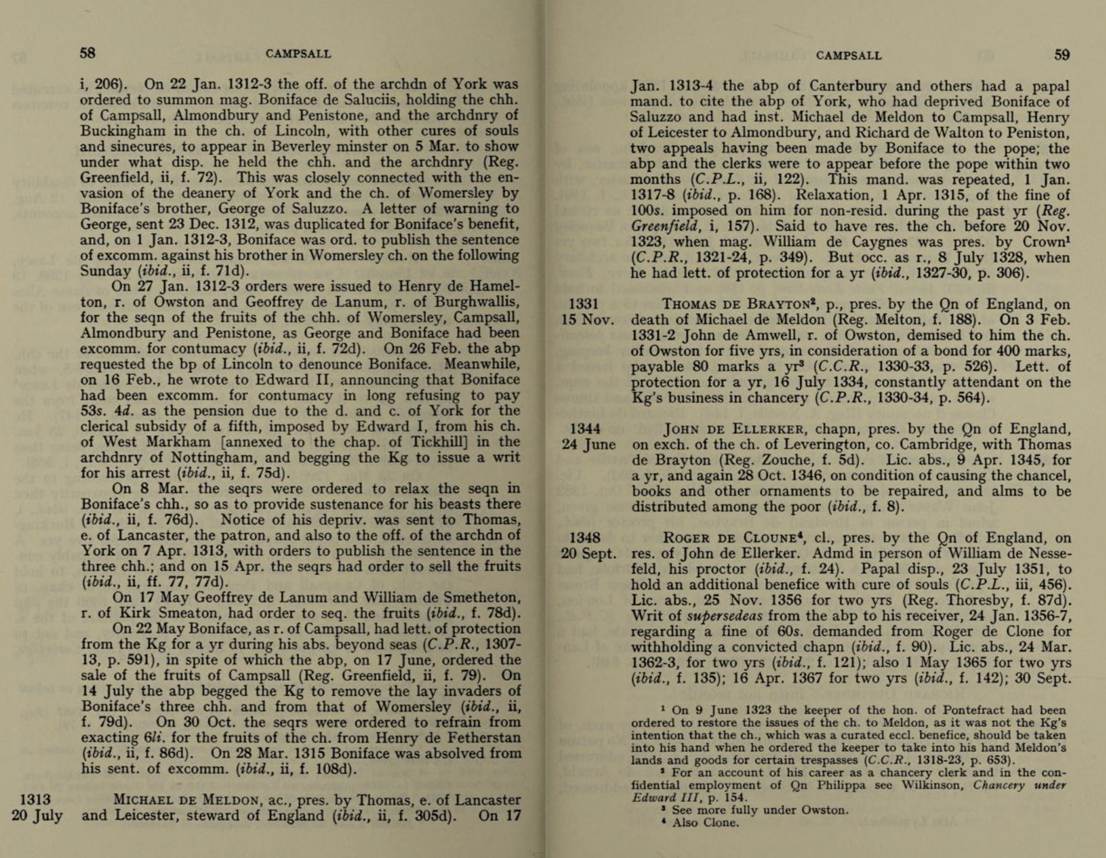
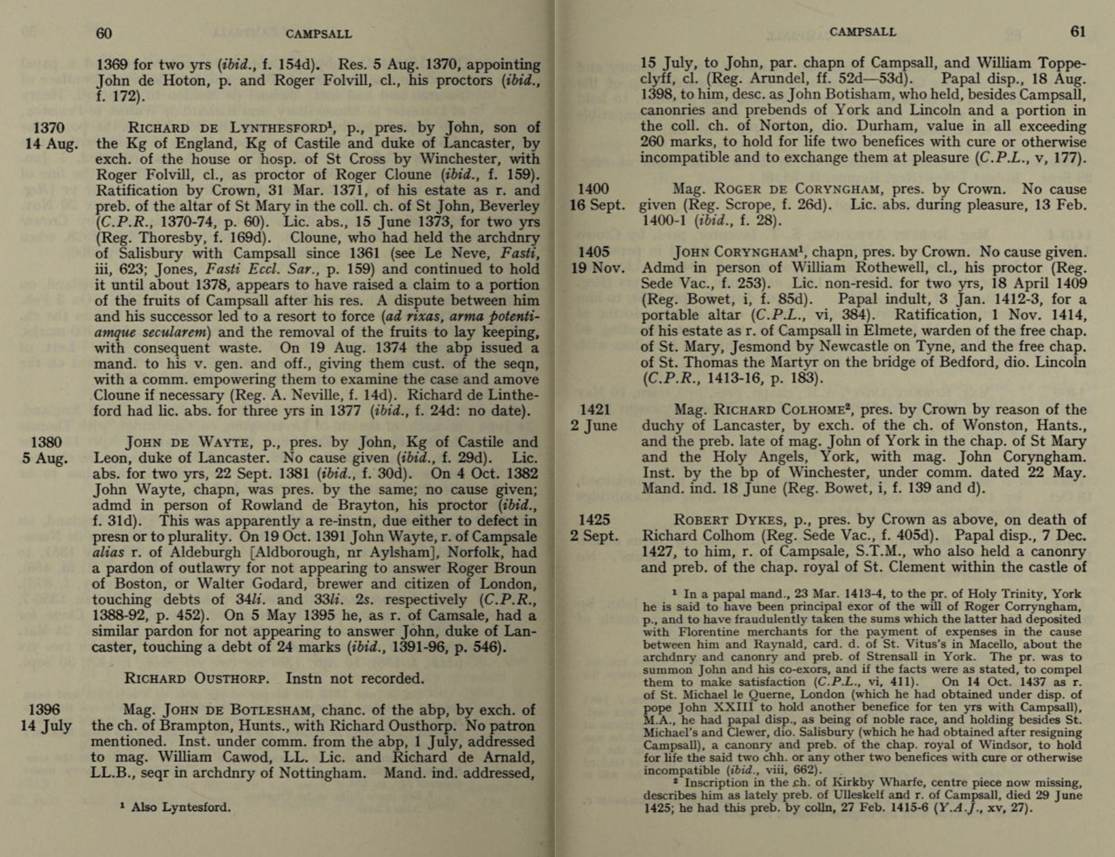
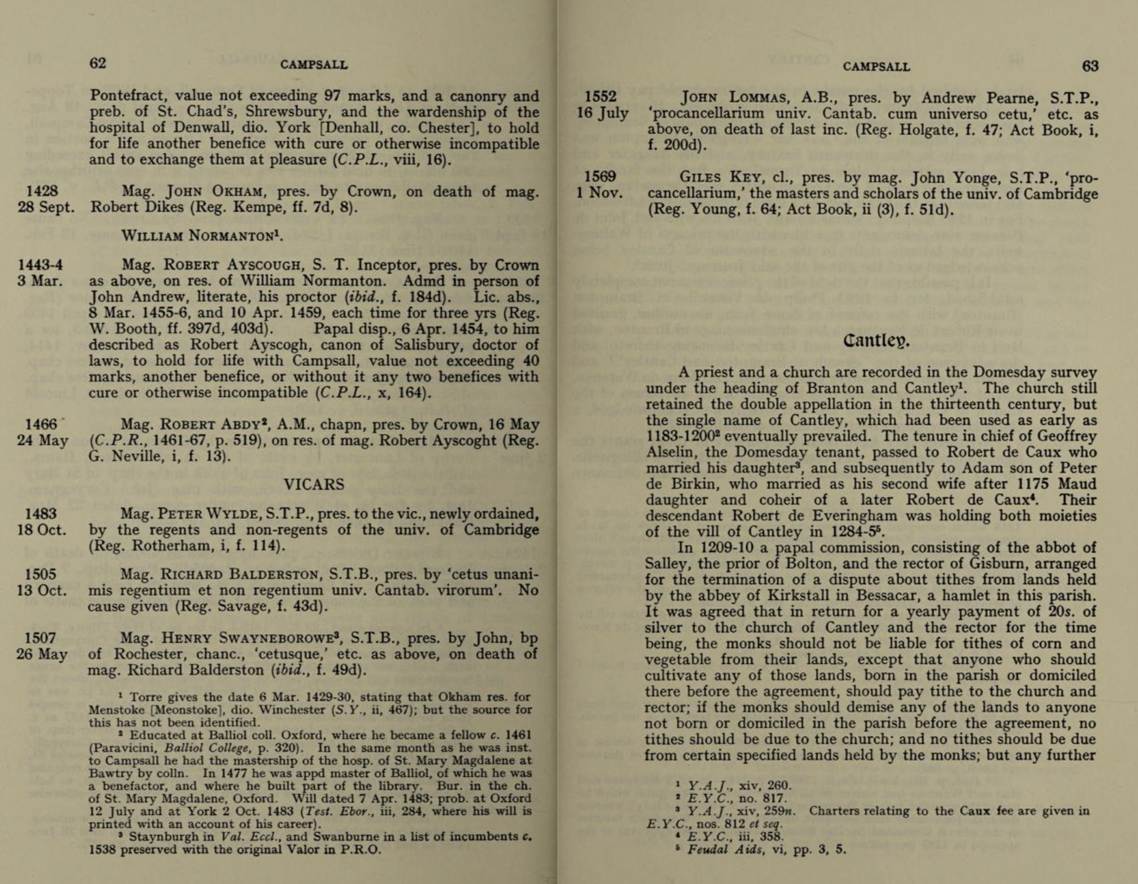
(Fasti Parochiales Volume 1 (Yorkshire Archaeological Journal Volume 85),
page 54, Campsall)