The Merchant Adventures of John Christopher Farndale
the Elder
(FAR00244)
Master Mariner of Whitby (1802 to 1837)
|
Return to the Home Page of the Farndale Family
Website |
The story of one family’s journey through two
thousand years of British History |
The 83 family lines into which the family is divided.
Meet the whole family and how the wider family is related |
Members of the historical family ordered by date of
birth |
Links to other pages with historical research and
related material |
The story of the Bakers of Highfields, the Chapmans,
and other related families |


John Christopher Farndale the Elder was probably the grandson of
John Farndale (FAR00136)
who sailed colliers with James Cook out of Whitby. It is likely John
Christopher Farndale was the son of Robert Farndale, also a master mariner, and
buried in the churchyard of Dracula fame at Whitby.
John Christopher Farndale the Elder was a painter when he married
Ann Ling in 1825 and until the birth of his third son in 1830. But by 1836, he
was a master mariner of Whitby, captaining a coal brig called the William
and Nancy with cargos of coal largely between Whitby and the north east and
Wisbech in Cambridgeshire and the southeast.
Of his family of five, John’s eldest son, William Farndale (FAR00289) also
became a master mariner and continued to captain the William and Nancy.
The third son, John Christopher Farndale the Younger (FAR00308)
captained other ships. They all lived lives of adventure, perils at sea, and
travel. His second son, Thomas Farndale was a ship’s broker’s clerk who died
aged only 31. His daughter, Mary Farndale, was a straw bonnet maker and married
a master mariner in Whitby. His fifth child, James Farndale, died an infant.
This was a family of mariners at the heart of the maritime coal industry in the
mid Victorian era. The second generation ventured widely around the North Sea
(often called the German sea at the time) and the Baltic and further south. But
John died young, at the age of only 35.
A brig is a type of sailing vessel defined by its
rig. It had two masts which were both square-rigged. Brigs originated in the
second half of the eighteenth century and were a common type of smaller
merchant vessel or warship from then until the latter part of the nineteenth
century. In commercial use, they were gradually replaced by fore-and-aft rigged
vessels such as schooners, as owners sought to reduce crew costs by having rigs
that could be handled by fewer men. In Royal Navy use, brigs were retained for
training use when the battle fleets consisted almost entirely of iron-hulled
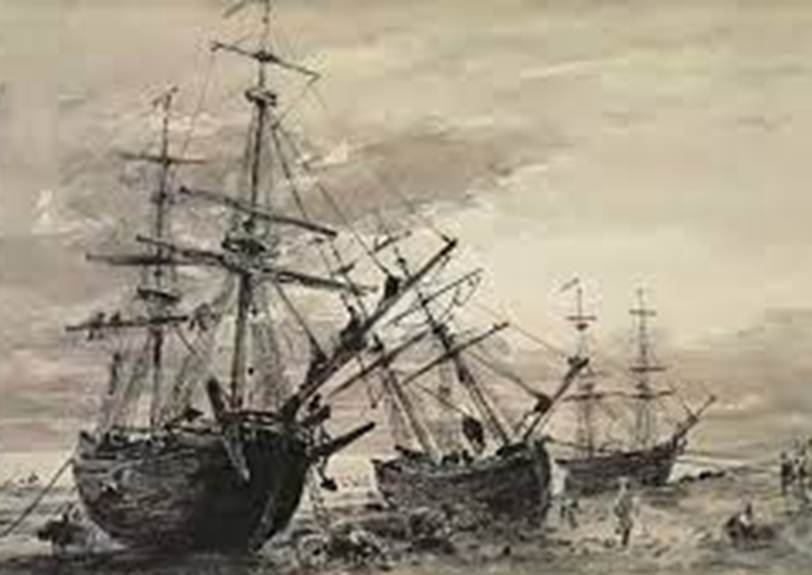
steamships. Brigs were prominent in the coasting coal trade of British waters.
4,395 voyages to London with coal were recorded in 1795. With an average of
eight or nine trips per year for one vessel, that is a fleet of over 500
colliers trading to London alone. Other ports and coastal communities were also
be served by colliers trading to Britain's coal ports. In the first half of the
nineteenth century, the vast majority were rigged as brigs, and that rig was
retained for longer in the northeast of England.
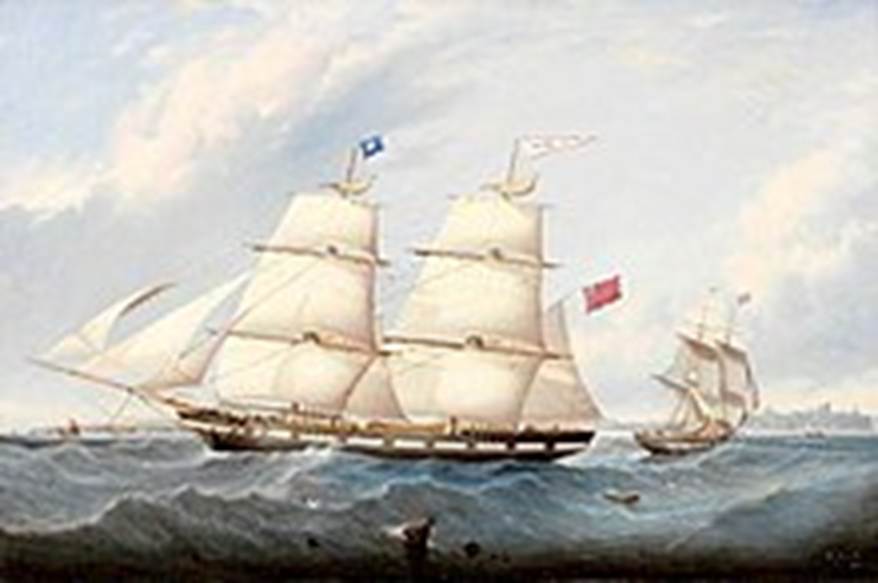
The Mary, a Brig of South Shields painted in 1855
The following articles all relate
to “William and Nancy, Farndale” sailing generally between Whitby or to the
northeast and Wisbech in Cambridgeshire. In the following newspaper extracts,
personal names after Ship Names are the names of the ships' captains. A later
article evidences that this was the older Captain John Christopher Farndale
(born 1802) who became a master mariner in Whitby who died aged 35 in 1837. His
son. John Christopher Farndale Junior, later settled in the Wisbech area.
1826
The Cambridge Chronicle and Journal, 18 August 1826: WISBECH
SHIP NEWS. ARRIVED … William and Mary, Farndale … from
Sunderland, with coals.
The Bury and Norwich Post, 23 August 1826: WISBECH,
AUGUST 21. ARRIVED. … William and Nancy, Farndale … from Sunderland, all
with coals.
The Cambridge Chronicle and
Journal, 6 October 1826: WISBECH SHIP NEWS. ARRIVED …
William and Nancy, Farndale… from Sunderland, with coals.
The Stamford Mercury, 6 October 1826: WISBECH SHIP NEWS to the 4th
October. ARRIVED … William and Nancy, Farndale … from Sunderland,
all with coals.
1828
Thomas Farndale, son of John Christopher and Ann
Farndale, painter of Whitby baptised 3 Mar 1828 (FAR00300) (Whitby PR).
The
Stamford Mercury, 5 September 1828: WISBECH SHIP NEWS to the 3rd
September. ARRIVED … William and Nancy, Farndale … from Sunderland,
all with coals.
The
Huntingdon, Bedford and Peterborough Express, 6 September 1828: WISBECH SHIP NEWS. ARRIVED …
William and Nancy, Farndale … from Sunderland, with coals.
The Cambridge Chronicle, 10 October 1828: WISBECH SHIP NEWS. ARRIVED. …
William and Nancy, Farndale … from
Sunderland, with coals.
The Cambridge
Chronicle and Journal, 19 June 1829: WISBECH SHIP NEWS.
ARRIVED. … and William and Nancy, Farndale, from Sunderland with coals …
The Huntingdon,
Bedford and Peterborough Express, 19 September 1829: WISBECH SHIP NEWS.
ARRIVED. … William and Nancy, Farndale … from Sunderland, with coals.
1830
The
York Herald, 13 February 1830: WHITBY SHIPPING. COASTERS
ARRIVED … and William and Nancy, Farndale, from Stockton …
At Yarmouth on 14 June 1833, The William and
Nancy, of Whitby, slipped anchor and chain, lost stern boat, and received
other damage, off the North Foreland on Tuesday. The Morning
Advertiser, 17 June 1833: YARMOUTH, JUNE 14. The
William and Nancy, Farndale, of Whitby, slipped anchor and chain, lost stern
boat, and received other damage, off North Foreland, on Tuesday … Bell’s New Weekly Messenger, 23 June 1833: YARMOUTH, 14th June.
The ‘William and Nancy’, Farndale, of Whitby, slipped anchor and chain, lost
stern boat, and received other damage off the Foreland on Tuesday …
In August 1833, John captained a brig called the
Felicity off the west coast. The Sun, London, 24 August 1833: LANCASTER, OCT 22.
Arrived the Felicity, Farndale, and Fame, Wright, from Archangel.
The
Morning Post, 25 March 1835: DEAL, March 23 – NE fresh
breezes. … Arrived, the William and Nancy, Farndale, from Newcastle, and
remains. The Evening
Chronicle, 24 March 1835: SHIPPING INTELLIGENCE. THIS
DAY. DEAL, MARCH 23. Wind NE, fresh breezes … Arrived, the William and Nancy,
Farndale, from Newcastle, and remains. The Morning Advertiser, 25 March 1835: FROM LLOYD’S BOOKS OF MARCH 24,
1835. … Arrived, the William and Nancy, Farndale, from Newcastle, and
remains.
The
Dover Telegraph and Cinque Ports General
Advertiser, 28 March 1835: SHIPPING INTELLIGENCE. DOVER.
Arrived … William and Nancy, Farndale, from Shields …
The London Courier
and Evening Gazette, 6 June 1835: SHIP NEWS (From
Lloyds). DEAL. June 5. Wind, NNW. … Arrived and remain, the William and Nancy,
from Stockton …
The Morning Advertiser, 8 June 1835: DEAL JUNE 5. …
Arrived and remain the William and Nancy, Farndale, from Stockton …
The Sun, London, 14 July 1835: FROM LLOYDS. DEAL
JULY 11 AND 12. Wind WSW, fine … Arrived … William and Nancy, Slacklin for Deal …
1836
By
this time John Christopher Farndale Senior was described
as a farmer and Master Mariner, formerly a painter, of Cragg, Whitby. The Cragg
is an area along the waterfront on the River Esk in Whitby.
1837
The York Herald, 4 February 1837: On Wednesday, at
Whitby, Captain John Farndale, master and owner of the William and Nancy, in
the prime of his life. John Christopher Farndale Senior, aged 35, was buried at St
Mary’s, Whitby on 5 February 1837.
The Traditional Song, the Collier Brig:
Oh, the worst old ship that ever set sail,
Sailed out of Harwich on a windy day.
Chorus: Stormy weather, boys, stormy weather, boys,
When the wind blows the barge will go.
She was built in Roman style,
Held together with bits of twine.
Skipper’s half Dutch and he hasn’t got a clue,
The crew were fourteen hands too few.
Cook spilt the dinner on the galley floor,
Skipper caught his hand in the wheelhouse door.
Off Orford Ness we sprang a leak,
Hear our poor old timbers creak.
We steered our way round Lowestoft next,
The wind backed round to the sou-sou-west.
Through the Cockle to Cromer Cliff,
Steering like a wagon with a wheel adrift.
Up The Humber and up to town,
Pump, you devils, pump or drown.
Then on a sandbank we got stuck,
Skipper’s drunk in the Dog and Duck.
Up come a mermaid covered in slime,
We took her down the hold and we had a good time.
We kept on course all through the night,
Nearly went aground at the Apex light.
Coal was shot by a Keadby crew,
Bottom was rotten and it went right through.
So when we saw the brig was sunk,
We went to the Barge and we all got drunk.