Geelong, Australia
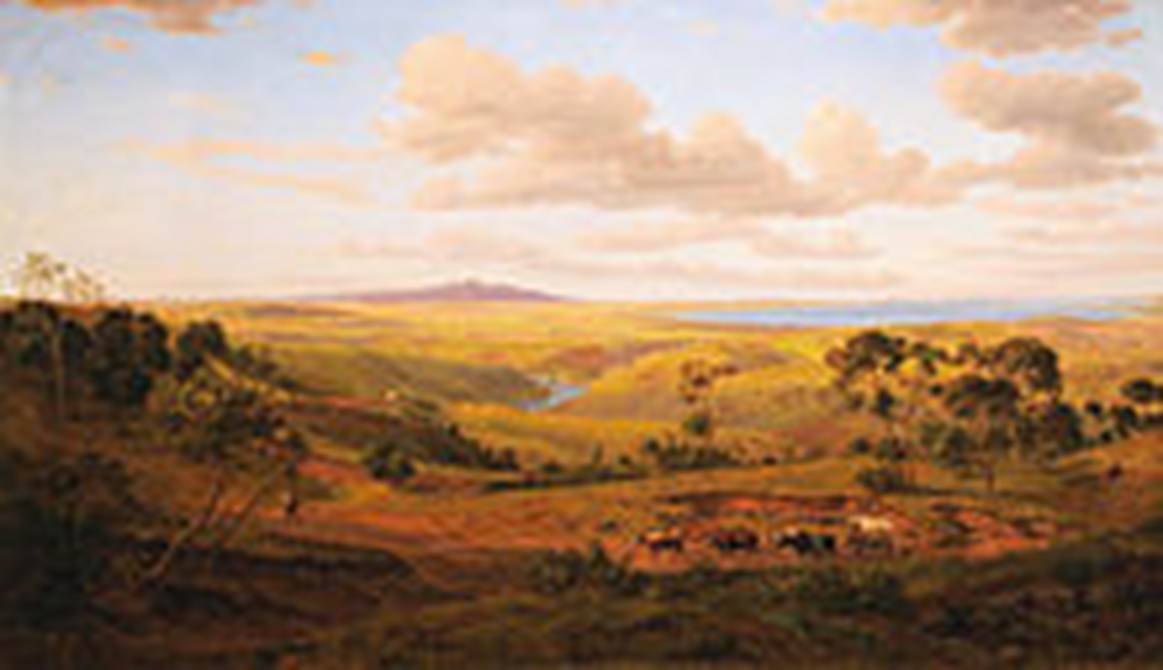
The town which served early Farndale migrants to southern
Australia
|
Return to the Home Page of the Farndale Family
Website |
The story of one family’s journey through two
thousand years of British History |
The 83 family lines into which the family is divided.
Meet the whole family and how the wider family is related |
Members of the historical family ordered by date of
birth |
Links to other pages with historical research and
related material |
The story of the Bakers of Highfields, the Chapmans,
and other related families |
Hyperlinks to other pages are in dark blue.
Headlines are in brown.
References and citations are in turquoise.
Context and local history are in purple.
The Farndale Family and
Geelong
Matthew Farndale
and his family (FAR00225)
settled at Birregurra – see also the Birregurra
(Australia 1) Line, the Australian
Farndales and the Martin
Family.
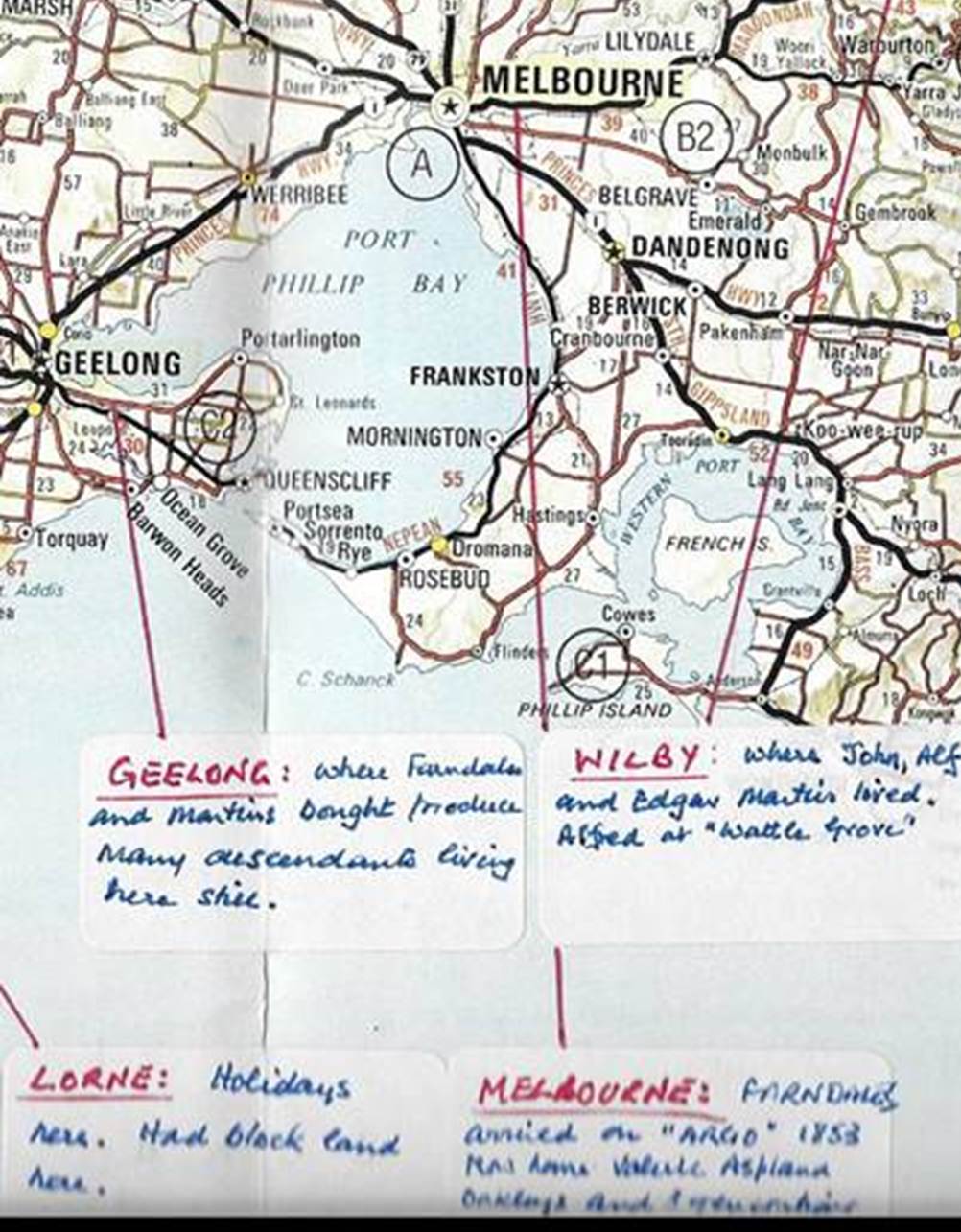
Geelong was the
centre from where the Farndales and the Martins and their descendants bought
supplies.
Geelong
Geelong is a port
city located on Corio Bay and the Barwon River, in
the state of Victoria, Australia. It is 75 km south-west
of Melbourne and the second largest Victorian city, with an estimated
urban population of 192,393 in 2016.
Geelong runs from
the plains of Lara in the north to the rolling hills of Waurn Ponds to the south, with Corio Bay to the east
and hills to the west. Geelong is the administrative centre for the City
of Greater Geelong municipality, which covers urban, rural and coastal
areas surrounding the city, including the Bellarine Peninsula.
Geelong was named
in 1827, with the name derived from the local Wathaurong Aboriginal name
for the region, Djillong, thought to mean
"land" or "cliffs" or "tongue of land or
peninsula". Geelong City is also known as the 'Gateway City' due to
its central location to surrounding Victorian regional centres
like Ballarat in the north west, Torquay, Great Ocean
Road and Warrnambool in the
southwest, Hamilton, Colac and Winchelsea to the west,
and the state capital of Melbourne in the north east.
The area was
first surveyed in 1838, three weeks after Melbourne. The post office was open
by June 1840 (the second to open in the Port Phillip District). The first woolstore was erected in this period and it became the port
for the wool industry of the Western District.
During
the gold rush, Geelong experienced a brief boom as the main port to the
rich goldfields of the Ballarat district. The city then
diversified into manufacturing, and during the 1860s, it became one of the
largest manufacturing centres in Australia with its wool mills, ropeworks,
and paper mills.
Geelong was
proclaimed a city in 1910, with industrial growth from this time until the
1960s establishing the city as a manufacturing centre for the state, and the
population grew to over 100,000 by the mid-1960s. During the city's early
years, an inhabitant of Geelong was often known as a Geelongite, or a Pivotonian,
derived from the city's nickname of "The Pivot", referencing the
city's role as a shipping and rail hub for the area.
The 1850s Gold Rush
Gold was
discovered in nearby Ballarat in 1851, causing the Geelong population
to grow to 23,000 people by the mid-1850s. To counter this, a false map
was issued by Melbourne interests to new arrivals, showing the quickest road to
the goldfields as being via Melbourne. The first issue of the Geelong
Advertiser newspaper was published in 1840 by James Harrison, who
also built the world's first ether vapour compression cycle ice-making
and refrigeration machine in 1844, later being commissioned by a
brewery in 1856 to build a machine that cooled beer.
A paddle steamer
approaches Geelong Harbour in 1857
The Geelong
Hospital was opened in 1852, and construction on the Geelong Town
Hall began in 1855. Development of the Port of
Geelong began with the creation of the first shipping channel in
Corio Bay in 1853. The Geelong to Melbourne railway was built by
the Geelong and Melbourne Railway Company in 1857.
Rabbits were introduced
to Australia in 1859 by Thomas Austin, who imported them from England
for hunting purposes at his Barwon Park property
near Winchelsea.
One of Geelong's
best-known department stores, Bright and Hitchcocks,
was established in 1861, and the H M Prison Geelong built using
convict labour, was opened in 1864.
In
1866, Graham Berry started a newspaper, the Geelong Register, as
a rival to the established Geelong Advertiser. When this proved
unsuccessful, he bought the Advertiser and made himself editor of the
now-merged papers. Using the paper as a platform, he was elected
for West Geelong in 1869. In 1877, he switched to Geelong, which he
represented until 1886, and served as Victorian Premier in 1875, 1877
to 1880, and 1880 to 1881. On the Market Square in the middle of
the city, a clock tower was erected in 1856, and an Exhibition Building was
opened in 1879.
Geelong in 1856
1860s: The 'Sleepy
Hollow'
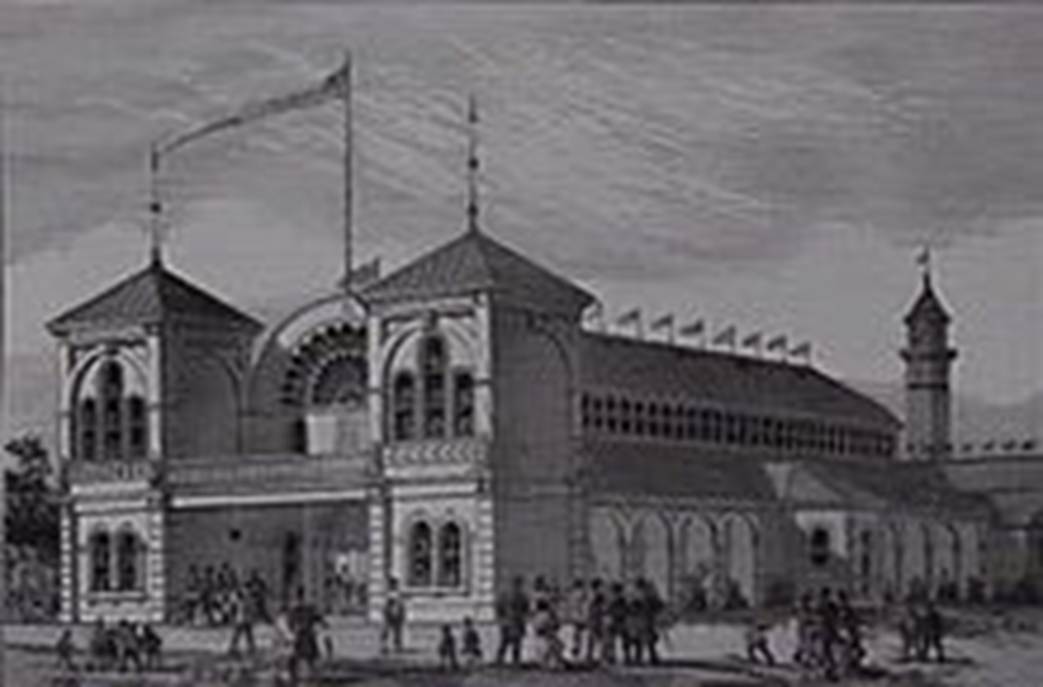
Exhibition
Building and Market Square Clocktower in 1879 (both since demolished)
The gold rush had
seen Ballarat and Bendigo grow larger than Geelong in terms
of population. Melbourne critics dubbed Geelong 'Sleepy Hollow', a tag
that recurred many times in the following years. A number of industries became
established in Geelong, including Victoria's first woollen
mill at South Geelong in 1868. In 1869, the clipper Lightning caught
fire at the Yarra Street pier and was cast adrift in
Corio Bay to burn before finally sunk by artillery fire. Improvements to
transport saw Geelong emerge as the centre of the Western District of
Victoria, with railway lines extended towards Colac in 1876, and
to Queenscliff in 1879. Construction
of the Hopetoun shipping channel began in 1881 and completed in 1893.
The Geelong
Cup was first held in 1872, and Victoria's first
long-distance telephone call was made from Geelong to Queenscliff on 8 January 1878, only one year after the
invention of the device itself. Geelong was also the home of a prosperous
wine industry until the emergence of the grapevine-eating
insect Phylloxera vastatrix in 1885,
which killed the industry until the 1960s. Between 1886 and 1889,
the central business district's major banks and insurance companies
erected new premises in a solid and ornate character. The
existing Geelong Post Office was built during this time and
the Gordon Technical College was established. Further industrial
growth occurred with the Fyansford cement
works established in 1890.
The town became
known as 'the Pivot' in the 1860s owing to its being a central rail and
shipping hub to Melbourne, Ballarat, and the western district.