The House of Normandy
1066 to 1154
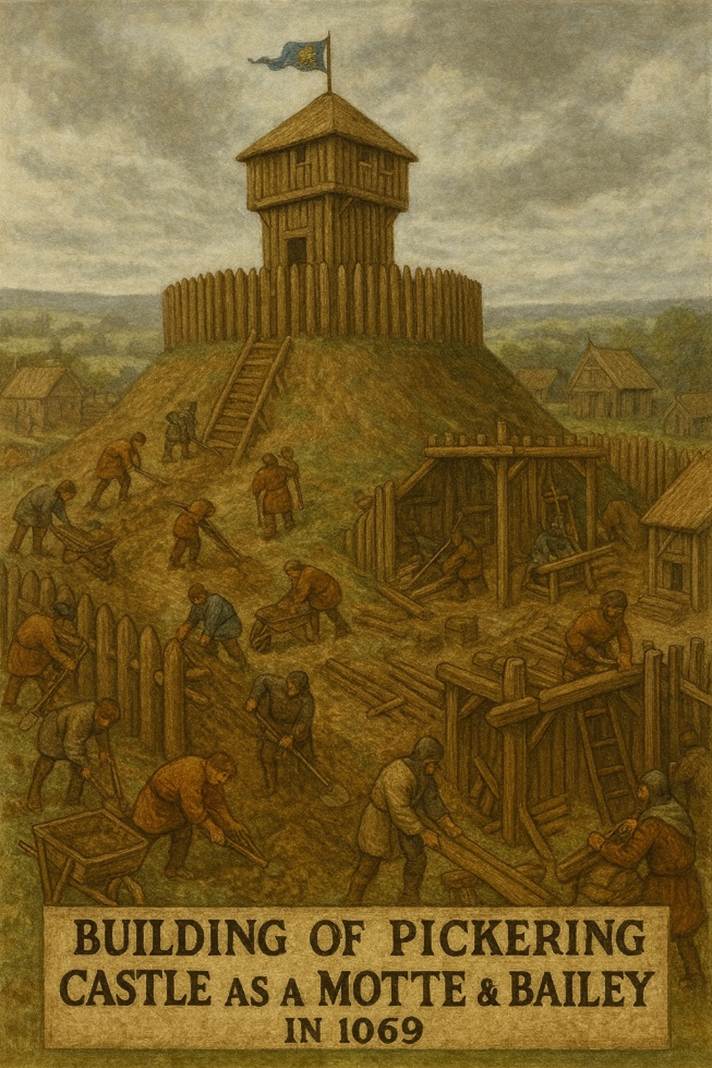
A
chronology of English history at the time of the Normans
|
Return to the Home Page of the Farndale Family
Website |
The story of one family’s journey through two
thousand years of British History |
The 83 family lines into which the family is divided.
Meet the whole family and how the wider family is related |
Members of the historical family ordered by date of
birth |
Links to other pages with historical research and
related material |
The story of the Bakers of Highfields, the Chapmans,
and other related families |
Headlines are in brown.
Dates are in red.
Hyperlinks to
other pages are in dark
blue.
References and
citations are in turquoise.
Context and local
history are in purple.
Geographical
context is in green.
|
The Normans and
Plantagenets Genealogy
|
Go back to the last Anglo Saxons.
The Later Medieval Period
or the Middle Ages, 1066 to 1550
The Early Middle Ages, 1066
to 1350
William I (The Conqueror)
1066 to 1087
On 24
September 1066, Harold reached Tadcaster and marched on York the following day,
to defeat Hardrada and Tostig (who were both killed) at Stamford Bridge.
Harold then marched south to meet the Norman invaders who had
landed without opposition at Pevensey on 29 September 1066. Harold was defeated
and killed at the Battle of Hastings on 14 October 1066.
The English
magnates did not immediately surrender to William, but elected Edgar Ætheling,
the son of Edward the Exile and the last surviving descendant of the House
Wessex. William marched north to London and began a campaign of terror. He
secured Dover, parts of Kent, and Canterbury, and sent a force to capture
Winchester, and the royal treasury.
Archbishop Stigand submitted to William at Wallingford on the Thames,
and when the duke moved on to Berkhamsted soon afterwards, Edgar the Ætheling, Morcar, Edwin, and
Ealdred also submitted. William then sent forces into London to construct a
castle.
William was
crowned on Christmas Day 1066 at Westminster Abbey.
The
new king tried to reconcile with the English magnates. Eadwine, Earl of Mercia,
his brother Morcar, Earl of Northumbria, and Waltheof, Earl of Northampton, were
initially confirmed in their lands and titles.
Ecclesiastical offices continued to be held by the same bishops as
before the invasion, including the uncanonical Stigand.
William continued to put down rebellions with increasingly violent
means.
There is an In
Our Time podcast, ‘The
Norman Yoke’
– the idea that the Battle of Hastings sparked years of cruel Norman oppression
for the Anglo Saxons.
William levied taxes to pay off his mercenaries.
By March 1067, William was secure enough to return to Normandy,
but he took with him Stigand, Morcar,
Eadwine, Edgar, and Waltheof.
Castles
The north rose up
again, led now by Merleswain, Eadwine and Morcar. William led an army to York and the rebels flew
into Scotland. York submitted and the Normans built a castle. He left 500 men
at York under William Malet and Richard FitzRichard.
William returned
to England in December 1067 and marched on Exeter, which he besieged. The town
held out for 18 days. After it fell to William he built a castle to secure his
control. Harold's sons were meanwhile raiding the southwest of England from a base
in Ireland. Their forces landed near Bristol but were defeated by Eadnoth.
1068
William’s wife Matilda was crowned at Winchester in May 1068.
In 1068 Eadwine
and Morcar rose in revolt,
supported by Gospatric, Earl of Northumbria. The king
marched through Edwin's lands and built Warwick Castle. Edwin and Morcar submitted.
William continued
on to York, building York and Nottingham Castles before returning south. On his
southbound journey, he began constructing Lincoln, Huntingdon, and Cambridge
Castles. William placed supporters in charge of these new fortifications, among
them William Peverel at Nottingham and Henry de Beaumont at Warwick.
William returned
to Normandy late in 1068.
1069
Early in 1069,
Edgar Ætheling revolted and
attacked York. Although William returned to York and built a second castle,
Edgar remained free.
In the autumn
Edgar Ætheling joined up with King Sweyn of Denmark
who brought a large fleet to England and attacked York, Exeter and Shrewsbury.
York
was captured by the combined forces of Edgar and Sweyn. Edgar was proclaimed
king by his supporters.
William bought
off the Danes, retook York and symbolically wore his crown in the ruins of York
on Christmas Day 1069.
The Harrying of
the North
William marched
to the River Tees, ravaging the countryside as he went. He suppressed northern England in the Harrying of the North and started a
period of ruthless
domination.
One writer
described how livestock and carefully harvested crops in every settlement were
brought together and burned, and stated that, as a result, more than 100,000
people perished in the famine. The data in Domesday Book suggests that the true
death toll was probably even higher. (The
Anglo Saxons, A History of the Beginnings of England,
Marc Morris, 2021, page 403).
1070
In 1070 William also founded Battle Abbey, a new monastery at the
site of the Battle of Hastings, partly as a penance for the deaths in the
battle and partly as a memorial to the dead.
Sweyn of Denmark returned in early 1070, raiding along the Humber
and East Anglia toward the Isle of Ely, where he joined up with the thegn
Hereward the Wake. Hereward's forces captured and looted Peterborough Abbey.
1071
Eadwine, Earl of Mercia and Morcar, Earl
of Northumbria joined a final desperate rebellion in 1071, where they were
killed. The last of the Godwinsons had been killed.
The old English elite were wiped out. Of about a thousand noblemen who held
land in 1085, only 13 were of Anglo-Saxon blood.
1072
In 1072 William invaded Scotland, defeating Malcolm, who had
recently invaded the north of England. William and Malcolm agreed to peace by
signing the Treaty of Abernethy, and Malcolm probably gave up his son Duncan as
a hostage for the peace. William required Malcom to acknowledge him as his
overlord.
1073
William returned to Normandy in 1073 and spent all of 1074 there, to
deal with an invasion of Maine. This suggests that England was becoming more
secure in its new Norman rule.
1075
In 1075, during William's absence, Ralph de Gael, the Earl of
Norfolk, and Roger de Breteuil, the Earl of Hereford, conspired to overthrow
William in the Revolt of the Earls. Ralph was bottled up in Norwich Castle by the combined efforts of
Odo of Bayeux, Geoffrey de Mowbray, Richard FitzGilbert, and William de
Warenne.
A mission arrived
from Evesham Abbey Mercia in York, were joined by Stephen of York and
established a Benedictine monastery in the old ruins at Whitby. Some of the monks went to Lastingham
and they partly build a large church there.
1079
In August and
September 1079 King Malcolm of Scots raided south of the River Tweed,
devastating the land between the River Tees and the Tweed in a raid that lasted
almost a month. The lack of Norman response appears to have caused the
Northumbrians to grow restive, and in the spring of 1080 they rebelled against
the rule of Walcher, the Bishop of Durham and Earl of Northumbria. Walcher was
killed on 14 May 1080. In the autumn the King’s son Robert was sent on a
campaign against the Scots. Robert raided into Lothian and forced Malcolm to
agree to terms, building the new castle at Newcastle upon Tyne on his
return.
1075
Edith, the Queen
Mother, widow of Edward the Confessor, died at Winchester and was buried at
Westminster.
1086
The
Domesday Book. There is an
In Our Time podcast, the
Domesday Book.
The Domesday Book had counted a population of
268,863 in 1086, but this number ignored many more souls than it included. (Realm Divided: a Year in the Life of Plantagenet England, Dan Jones, 2016, page 18).
William had
redistributed the old estates to his supporters. There was a new aristocracy of
Norman, Breton and Flemish landowners.
At this time:
· King William held
a small number of estates, including Pickering and Malton, directly himself
· High son of
Baldric held lands including Kirkbymoorside and the Coxwold area.
· The importance of
Gilling was replaced by Richmond when a Norman castle
was built there.
Large swathes of
land were emptied of the villein classes, including Pickering Forest whereas
some places, like Pickering itself and Coxwold were heavily populated by
villein folk.
There were some 10 active villein farms at
Kirkbymoorside in 1086 and 36 in the wider area. There were some 16 villein
farms around Huttons
Ambo under the
Lordship of Tosny. (John Rushton, The History of Ryedale, 2003, 40).
Norman authority
was consolidated by castles, knights and the Church.
Social structure
In rural areas of
England, there were changes in the make-up of the ruling classes and the way
that ordinary people were governed. Certainly much did remain as it had before:
manorial courts and nucleated villages remained, and in certain places the process
of nucleation continued after the Norman Conquest. But although the fundamental
system of rural government remained substantially the same, the people doing
the governing changed. Land ownership was concentrated in the hands of a small
Norman aristocracy who ruled their estates by way of the manorial system that
had been established, in places, up to two centuries earlier. (Britain in the Middle
Ages, An Archaeological History, Francis
Pryor, 2007, page 229).
The system is
probably better described as feudalism, rather than The Feudal
System, as there was no single system. Rural society in the Middle Ages was
based on reciprocal obligations. As the population grew from the 11th to the
14th centuries, rents continued to pour in and land owners became ever more
prosperous. By the same token, those towards the foot of the social tree found
their bargaining position becoming weaker. Labour, in other words, was becoming
cheaper. Viewed from the perspective of a landowner, it was a buyers’ market,
and they possessed the cash with which to drive hard bargains. The
landlord-labourer balance was dramatically altered by the Black Death. Again from the
point of view of somebody buying labour, it now became a sellers’ market. One
might suppose that the changes brought about by such a sudden and catastrophic
population decline would have been instantaneous, but in fact they took some
time to happen, because feudalism was not a simple market arrangement. It
involved a variety of other social ties, obligations and institutions, and
these took time to change. There were also other and unforeseen consequences of
the plague. (Britain in the Middle Ages, An
Archaeological History, Francis Pryor,
2007, page 231).
As the system
evolved over the following centuries:
The rural
villages where most Englishmen and their families lived were grouped into
clusters known as manors, ruled over by a Lord, who would often hold several
manors that one time. The villagers who were categorised as villeins or
serfs were unfree and owed their Lord several days labour a week in return
for their right to live on a patch of land. Those who were freeman
worked for a wage, paid their rents in cash and, crucially, had access to the
royal courts to pursue legal disputes, a privilege denied to the unfree, who
were bound only to plead and be judged in the private courts of their Lords.
The pattern and proportion of landholding varied markedly across the country,
with the east being generally freer than the west.
Over these
ordinary people ruled a class of rich, powerful and educated men of two
distinct sorts. The English church was endowed with significant land
through the seventeen bishoprics of England and Wales and numerous monastic
houses. Abbots, bishops and archbishops were generally of aristocratic and even
royal stock.
Out of the
population of several million, there were about 10,000 lords of a minor sort,
who might earn a manor or two, be active in local politics and perhaps hold
public office in the shires.
Above them were
around 1,000 knights, an office that still implied a military outlook
and training, but which also had a political role by virtue of the large amount
of land that was required to sustain a man in knightly status.
Above these men
were England’s elite, the barons, of whom there were about a hundred.
These were lords of massive wealth, military power and prestige, largely to
descended families, including the royal family, that had come to England with
or since the Norman Conquest.
Elite barons held
the title of earl and ruled over huge tracts of countryside, with the
states that covered scores of manors, political interests that might stretch
across hundreds of miles, and a direct personal relationship with the king. It
was with these men that the king was informally expected to consult,
collaborate and consult as he went about the business of ruling England. It
will also with these men, that a king who ruled the kingdom incompetently or
unjustly could expect to clash.
(Realm Divided: a Year in the Life of Plantagenet England, Dan Jones, 2016, page 19).
Slavery
However William
banned the export of slaves and the unfree population of England fell by about
a quarter during William’s reign and was almost extinguished over the next
century. They also curbed political killings and discouraged purges, tending
towards imprisonment of defeated enemies, at least following the violent early
phase of William’s reign.
Architecture
Renaissance
The Normans
undertook a significant rebuilding programme, demolishing ancient minsters and
replacing them with massive, uniform Romanesque buildings. This included the
reforming of St Hild’s abbey in Whitby, and Bede’s Monkwearmouth-Jarrow.
William next
invented a system according to which everybody had to belong to someone else,
and everybody else to the King. This was called the Feutile
System, and in order to prove that it was true he wrote a book called the
Domesday Book which contained an inventory of all the Possessions of all his
subjects; after reading the book through carefully William agreed with it and
signed it, indicating to everybody that the Possessions mentioned in it were
now his (1066 and all
that, Walter Sellar and Robert Yeatman, 1930).
William II (“William
Rufus”), 1087 to 1100
1087
William the Conqueror died at Rouen on 9 September 1087.
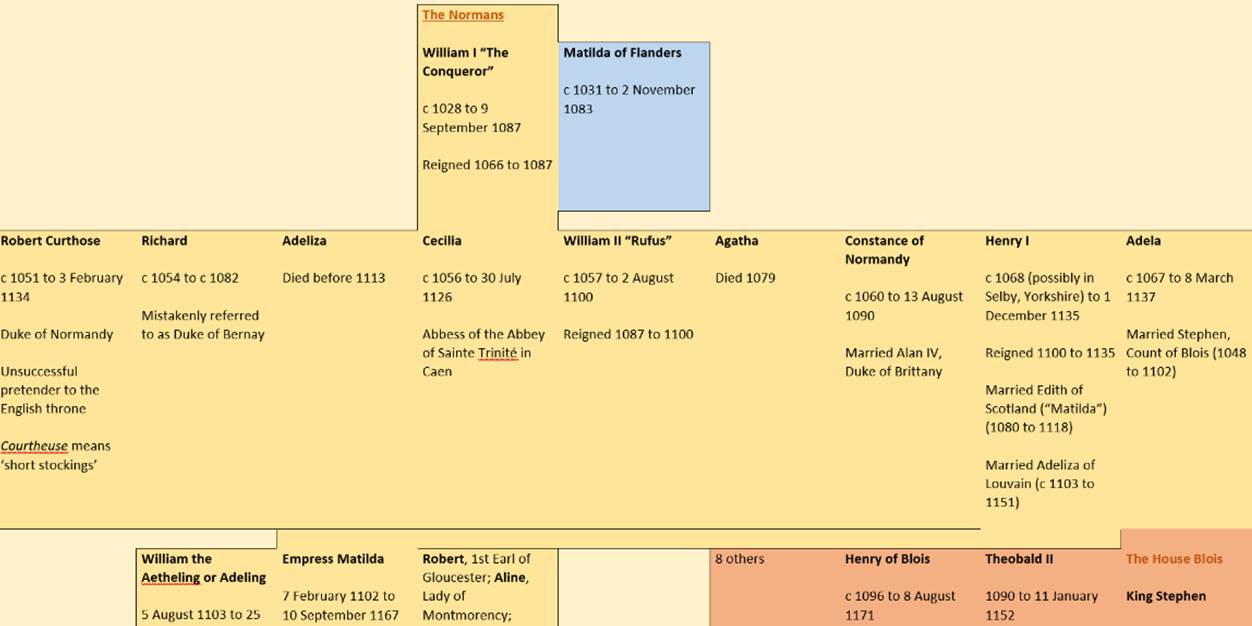
William Rufus was William I’s second son. The eldest son was
Robert Curtose who took the dukedom of Normandy.
Another Scottish
force under Malcolm Canmore attacked the north of England again. Roger de Mowbray was made Earl of
Northumberland.
The monks led by Stephen of York built St Mary’s Abbey from 1088
to 1089.
1096
The First Crusade
(1096 to 1099) was called by Pope Urban II, to recapture Jerusalem. Responding
to an appeal from the Byzantine Emperor for help against the Seljuk Turks,
Urban II rallied a large Christian army. The crusade culminated in the brutal
capture of Jerusalem in 1099 and the establishment of the Crusader states,
including the Kingdom of Jerusalem.
1100
The population of
England in 1100 was likely to have been around 2 million, based on estimates
from the Domesday Book in 1086 and subsequent growth. While precise figures are
unavailable, historical records suggest the population was between 1.5 million and
2 million in 1086 and began growing significantly in the twelfth century,
possibly reaching 3 million by 1200.
The Medieval Warm
Period (“MWP”) was a period of unusually warm climate, primarily in the North
Atlantic area, between about 950 to 1250 CE. Warmer temperatures allowed
improved crop yields and population growth
William Rufus was
killed in mysterious circumstances in the New Forest in 1100.
There is an In Our Time podcast on The Davidian Revolution
and the great changes in Scotland associated with David I (c 1084 to 1153),
from the founding of trading towns such as Edinburgh to new monasteries and new
ways of governing.
Henry I, 1100 to 1135
Henry I was
William I’s younger son.
To
secure support he agreed in his coronation charter that he would restore the
laws of Edward the Confessor and he
married Matilda in a sign of restoration of the more ancient line of kings. Carta
Libertatum, the Charter of Liberties, was a royal
proclamation issued upon his accession to the throne to reform abuses of power
by William Rufus and to secure support from the church and barons. It is
considered a landmark document and a precursor to Magna Carta, as it
established the principle that the king was bound to certain laws and promised
to restore the laws of Edward the Confessor and William the Conqueror. Key
promises included an end to feudal abuses, unfair taxation, and simony, but
many of these promises were later ignored by the king once his position was
secure.
The early part of Henry I’s reign was dominated by struggle with
his older brother Robert Curtose, which took him to Normandy for much of his
time, leaving Matilda and Roger, Bishop of Salisbury, to administer the English
Kingdom.
The succession issue
was becoming problematic with more claimants to the throne.
The start of the
Guild system to protect trade, set prices and offer apprenticeships.
The English
Population reached about 2 million.
Henry I defeated his elder brother and rival Robert Curthose at
the Battle of Tinchebrai.
After his victory
he visited York and Pickering. Henry I redistributed land from
Robert Curtose’s supporters, including Robert de Stuteville to his new men, including Nigel d’Albini, ancestor of the Mowbray family and Robert de Brus.
The new barons
resettled the landscape with freeholders, villeins and cottagers. The bondsmen
were settled as unfree men, sometimes referred to as serfs or villeins. The
Norman, Fleming and Breton landowners formed a new ruling class of manor lords.
Freemen were sometimes created in return for
service. Roger de Mowbray
settled freeholds near Thirsk on his butler, usher, cook, baker and musicians (John Rushton, The History of Ryedale, 2003, 49).
1120
The White Ship
incident – succession crisis
William the Aetheling was the only legitimate son of Henry I (the
English King and Duke of Normandy) and Edith of Scotland (known as Matilda). Aetheling was an Anglo Saxon title for a potential
claimant rather than direct heir to the throne, but there was little doubt that
William was Henry’s intended heir. Some 200 young noblemen were partying in the
harbour at Barfleur on a state of the art white
longship, excellently fitted out and ready for royal service, lent to
the family by Thomas Fitzstephen, its wealthy owner. When Henry I sailed home
in a different vessel across 70 miles of the Channel, the young continued their
party until much later into the night. A well oiled Fitzstephen started to boast that his speedy ship had
plenty of time to catch up with the King’s. When they finally left, the White
Ship almost immediately faltered on a rocky outcrop at the mouth of the
harbour. William was drowned. Instead of wearing a crown of gold, his head
was broken open by the rocks of the sea. Instead of gaining the heights of
kingly rule, he was buried in the bellies of fish at the bottom of the sea.
(Henry of Huntingdon).
The King’s
cousin, Stephen of Blois left the party early, suggesting he was ill, and
survived the wrecking of the White Ship.
There was a
succession crisis. Henry’s radical solution was to name his only other
legitimate child as his heir, his daughter, the Empress Matilda. There were few
precedents for female rule. Matilda had been in Germany for a decade, the wife
of the Holy Roman Emperor, Henry V. There she lived in the influential sphere
of the European courts, and took a direct role as regent when her husband was
away.
1125
In 1125 the Empress
Matilda was widowed with no children. The dowager Empress returned to England
to adopt a new role as heir apparent.
In 1128, the dowager Empress of the Holy Roman Empire, Henry I’s
daughter, Matilda, married Geoffrey, Count of Anjou a handsome, belligerent,
red haired young man born in 1113, who wore a sprig of yellow broom blossom in
his hat and decorated his shield with lions. It was from the Latin name (planta
genista) of the broom that the name Plantagenet derived (The Plantagenets, The Kings who
made England, 2012, Dan Jones, page xxvii).
Geoffrey himself had little interest in England which he never visited.
First Cistercian abbey at Waverley.
Henry I decreed that a huge area from York to the
coast, including Ryedale and Pickering,
should be reserved as Royal Forest, where hart, hind, wild boar and hawk were
preserved solely for the King. Officers were appointed to guard the royal
forests and new administrators were appointed such as the fee foresters and serjeantes. Some of these officers were able to held
their land rent free in return for the service as a forester. When Henry I
established the Forest of Pickering as a deer preserve he gave Guy the Hunter
half the Aislaby estate, in return for training a
royal hound. Legend claims that two brothers were given a falcon’s flight of
land, for repelling a Scots invasion. Perhaps the other brother was William of Aislaby, who had the other half.
1130
Financial records
kept by the Exchequer for the Crown, known as the Pipe Rolls, recording
Exchequer payments and names of tenants.
Surnames began to
be used more widely to assert rights to hereditary property.
1135
When Henry I
died, the succession crisis was refired and led to a period of civil war in
England.
The House Blois
King Stephen, 1135 to 1154
The Anarchy
In December 1135
Matilda’s cousin, Stephen of Blois, swiftly left Boulogne and sailed to
England. On 22 December 1135 he arrived in Winchester, where he seized the
royal treasury and had himself anointed king by the archbishop of Canterbury.
Matilda was
pregnant with her third child and much further away and had fallen out with her
father over promised Norman border castles.
Succession was still
not directly decided by blood alone; there was an elective element to
coronation. It was still a period when the first to act and take possession of
the Crown had a good chance to succeed. This was dressed up by his anonymous
biographer: There was no one else at hand who could take the king’s place
and put an end to the great dangers threatening the kingdom (Gesta Stephani, page
8).
Yet Stephen did
not find rule so easy as seizure of the Crown. He did not have the same
political skills as Henry I and did not impose his will over the barons. The
moment Stephen came to the throne it was realised that he was a mistake and had
been christened wrong; thus everything was thrown into confusion. Stephen
himself felt quite uncalled for, and even his Aunt Matilda was able to take him
in when she began announcing that she was the real King (1066 and all that,
Walter Sellar and Robert Yeatman, 1930).
This
was a period of breakdown in Royal authority, the period often being called
‘The Anarchy’.
As England descended into twenty years of brutal civil war,
Scotland under David I (c 1124 to 1153) had begun a medieval renaissance (Robert the Bruce, the Champion of a Nation, Stephen Spinks, 2024 page 19).
1136
The legend of Arthur had been circulating since the ninth century
CE, relating to a native Briton who fought against the Romans and the Anglo
Saxons. It was a fluid, oral story until Geoffrey of Monmouth’s Historia
Regnum Britaniae, The History of the Kings of
Britain, written in about 1136. When Glastonbury Abbey was destroyed by fire in
1184, Henry II recorded a discovery of the tomb of Arthur and Queen Guinevere.
By 1272 on the accession of Edward I to the throne, the Arthurian legend became
a template for his kingship. (The Plantagenets,
The Kings who made England, 2012, Dan
Jones, page 298).
It is in Geoffrey of Monmouth’s Historia Regnum Britaniae that the legend of Arthur accompanies the
story of King Lear and the legendry story of Brutus, the founder Britain. According
to Monmouth, in ancient Britain, long before Julius Caesar set foot on the
shores of the south coast, the brothers Belinus and Brennius, after years of
warring against one another for the right to rule the whole of Britain,
eventually made peace, and through the diplomacy of friends agreed to divide
the kingdom in two. Belinus, the elder of the two, would inherit Loegria, Kambria and Cornwall, the lands south of the
Humber, that is England and Wales. Brennius meanwhile would possess the lands
north of that great river as far as Caithness, essentially outlining Scotland.
Whilst the story is a medieval fable, it was the foundation of an idea of
England’s right to dominate the northern lands, including the conquest of
Scotland. (Robert the Bruce, the Champion of a
Nation, Stephen Spinks, 2024 page 19).
In 1136 the Scottish king David intervened in the civil war and
invaded Northumbria several times.
1138
In 1138 Matilda’s
half brother, Robert Earl of Gloucester, defected
from Stephen’s supporters.
David of Scotland
took up arms to support Empress Matilda in 1138. Also known as the Battle of
Northallerton, the Battle
of the Standard (named after a wagon with a mast carrying a crucifix and
silver pyx) , was one of two major battles fought during the Anarchy. The
younger Brus joined David, but the bulk of the Norman
barony remained loyal to the new King Stephen. The Scottish army was repelled,
despite its size and suffered heavy losses.
David escaped to
Carlisle and despite the English victory, Northumbria was significantly
weakened, and in the ensuing peace treaty, a large portion was ceded to
Scotland. David I gained control of Northumberland, though English control was
maintained over the castles at Bamburgh and Newcastle, and Hexhamshire
remained the territory of the Archbishops of York. This marked a shift in the
power balance, as the English king's authority in Northumbria was reduced.
There
is an In Our Time podcast, The Davidian
Revolution and the
great changes in Scotland associated with David I (c 1084 to 1153), from the
founding of trading towns such as Edinburgh to new monasteries and new ways of
governing.
Matilda appealed
her case to Rome and landed herself with an invading force in 1139, and she set
up an alternative seat of government at Bristol. The civil war had now started
in earnest.
1141
Fortunes started
to turn for Matilda when Ralulf, Earl of Chester, joined opposition to Stephen
and took the castle at Lincoln. As Stephen sought to retake it, Robert, Earl of
Gloucester, routed the royal troops and Stephen was captured. Many English barons
abandoned Stephen.
However Empress
Matilda couldn’t press home her advantage when Stephen’s Queen, Matilda of
Boulogne reorganised the defence of the realm.
Londoners did not
take up Empress Matilda’s cause when she declined financial concessions and she
was chased out the city in June 1141. When Robert of Gloucester was captured at
Winchester, Matilda was forced into a prisoner swap for Stephen and her advantage
was lost.
1142
By November 1142,
Empress Matilda was besieged in Oxford’s castle. At Christmas, dressed in a
white cloak, she slipped out of the castle and reached Abingdon. She fled to
the safety of the west. She set up her headquarters at Devizes and the Kingdom
was split into two, one part run from Westminster and the other from Devizes.
1143
Robert of
Gloucester started to rally a fightback. The war reached another point of
stalemate. The rule of law dissolved. In the north David I of Scotland ruled
Westmorland, Cumberland and Northumberland.
The King set
himself to lay waste that fair and delightful district, so full of good things,
round Salisbury … They raged with this bestial cruelty especially round
Marlborough, they showed it very terribly round Devizes. (Gesta Stephani)
1144
In Normandy, the
civil war also raged and by 1144 Geoffrey Plantagenet had captured Rouen and
been recognised as Duke of Normandy.
1148
In 1148 Matilda
left England, effectively abandoning the fight. She lived out the remaining 19
years of her life in comfortable retirement. However her 16 year old son,
Henry, was ready to take up the fight.
Go forward to The Plantagenets.
Bibliography
The Plantagenets, The Kings who
made England, 2012, Dan Jones.
The Bayeux Tapestry.