The Last Anglo Saxon Kings immediately before the
Norman Conquest
1042 to 1066
The
build up to the Norman Conquest
|
Return to the Home Page of the Farndale Family
Website |
The story of one family’s journey through two
thousand years of British History |
The 83 family lines into which the family is divided.
Meet the whole family and how the wider family is related |
Members of the historical family ordered by date of
birth |
Links to other pages with historical research and
related material |
The story of the Bakers of Highfields, the Chapmans,
and other related families |
Headlines are in brown.
Dates are in red.
Hyperlinks to
other pages are in dark
blue.
References and
citations are in turquoise.
Context and local
history are in purple.
Geographical
context is in green.
Go back to the
Anglo-Saxon Scandinavian Period.
The rule by Cnut from 1016
to 1042 as part of the Scandinavian empire, and then the restoration of the
House Wessex with the accession of Æthelred’s son Edward the Confessor resulted
in changes in dynasty which made life for England’s ruling elite extremely
complicated: ancient loyalties were eroded, identities were called into
question, and deep divisions were sown, with ultimately fatal consequences.
(The Anglo Saxons, A History of the Beginnings
of England,
Marc Morris, 2021, page 362).
Edward the Confessor
1042
Edward
was the seventh son of Æthelred the
Unready, and the first by his second wife, Emma of Normandy. He was born
between 1003 and 1005 in Islip, Oxfordshire, and is first recorded as a
'witness' to two charters in 1005. He had one full brother, Alfred, and a
sister, Godgifu. In charters he was always listed behind his older
half-brothers, suggesting that he ranked beneath them. His sobriquet The
Confessor was first used in association with his sainthood in 1161.
Edward started his reign on 8 June 1042.
After years of exile in Normandy, he lacked allies to solidify his
rule. He therefore depended on Godwin, even though not a natural ally as the
killer of his brother Alfred. Godwin was earl of Wessex and controlled the main
power base of the realm. Godwin though weary of the consequences of the killing
of Alfred, may have seen advantage in Edward as an easier monarch to control.
1043
Edward was
crowned on 3 April 1043.
1045
Edward
married Godwin’s daughter Edith.
1051
The Fall of the
Godwin Family
|
The family tree of Earl Godwin and his sons |
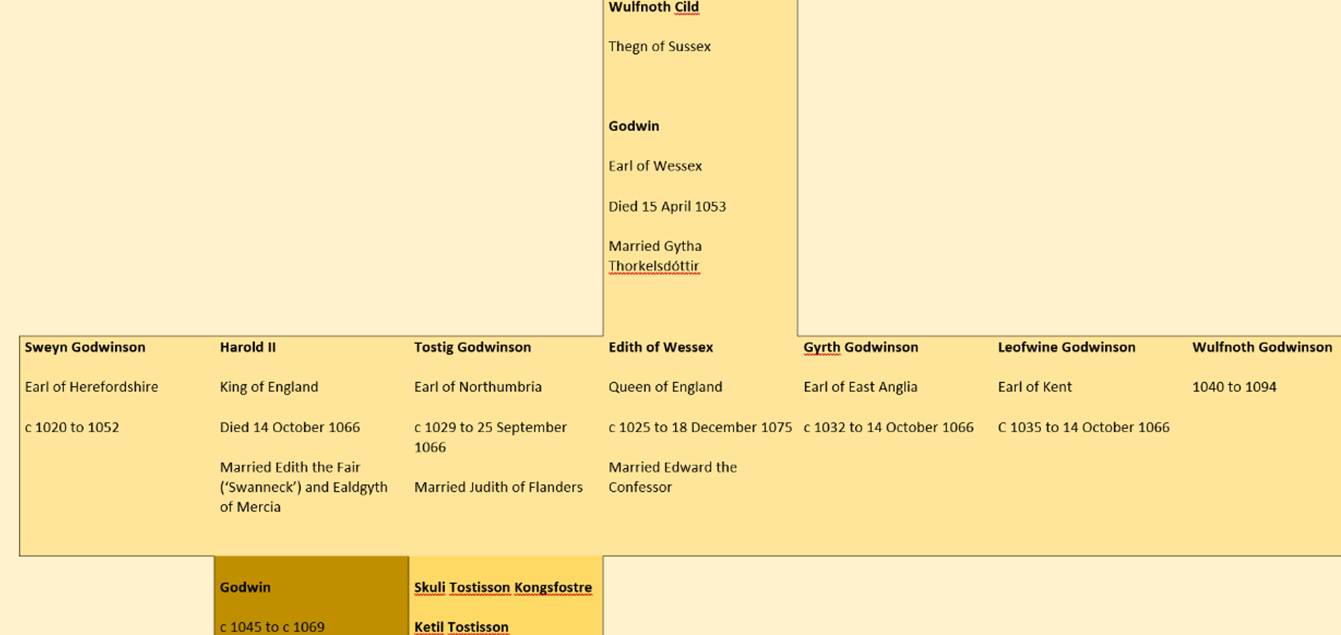
In time
there were three points of tension between Godwin and Edward.
First, Edward started to distance himself from the Danish
association with England, while Godwin sought to preserve close relations with
Denmark. In 1047 Swein Estrithson,
Denmark’s king, asked for English support against Norway, but Edward refused.
Second in 1050, Edward rejected Godwin’s recommendation for the
new archbishop of Canterbury and appointed is friend, a Norman, Robert of Jumiège.
Third, Edward had scuppered Godwin’s ambition that his daughter
Edith would give birth to a Godwin descendant as future king of England by
failing to produce a child, perhaps due to Edward’s celibacy. In 1051, Edward
had identified an alternative source for the succession in his cousin, William,
Duke of Normandy, who had proved himself in establishing control of his duchy.
The prospect of a Norman succession was a disaster for Godwin’s own ambitions.
The trigger for a rift was a dispute between a returning
ambassador, the Count of Boulogne who squabbled with the folk of Dover. Edward
ordered Godwin to punish the folk of Dover, but Godwin refused, it being part
of his earldom.
Godwin and his family turned to force against the king. Edward
summoned Leofric of Mercia and Siward of Northumbria to respond. The armies met
in Gloucestershire, but at a parley agreed to resolve their differences back in
London. By the time they returned to London, much of Godwin’s support had
evaporated and the emboldened Edward turned against the Godwin family. Two
Godwin sons fled to Ireland, the rest to Flanders. Edith did not escape and was
sent to a nunnery.
The Godwin earldoms were redistributed.
If any Englishman had been told that events would take this turn,
he would have been very surprised for Godwin had risen to such great eminence
as if he ruled the king and all England (The Anglo-Saxon Chronicle).
In 1051, Earl Godwin's
opposition to Edward's policies had brought England to the brink of civil war.
The Godwins' opposition convinced
Edward to banish them in 1051. The banished Godwin family, including Gytha and
Tostig, together with Sweyn and Gyrth, sought refuge
with his brother-in-law the Count of Flanders. They returned to England the
following year with an armed force. They gained support and demanded that
Edward restore the Godwins’ earldoms.
Edward summoned William of Normandy to England, presumably to
affirm his plans for succession. He received William as a vassal, and may have
hoped that Normandy would come to his aid in the event of further trouble with
the Godwins.
1052
The Return of the
Godwin Family
The Godwins planned an armed return. There was an upsurge of support for the Godwin
family, perhaps owing to the preference of William of Normandy in Edward’s
succession plan. The Godwins arrive with a large
fleet and army and Edward was unable to resist them. His surrender was
presented as a reconciliation. The Godwins were returned to their former earldoms. Edith was
restored to Edward’s queen.
Some of the king’s Norman friends in England fled north and some
entered the service of Macbeth. The plan for Norman succession seemed to be
over.
1053
Earl
Godwin died of a seizure on Easter Monday 1053. Godwine, the most accomplished
statesman of his day, died in 1053, leaving two sons, Harold, who, by a
combination of circumstances and many intrigues, had raised himself to the
proud position of king ; and Tostig. (The Battle of
Stamford Bridge, A D H Leadman, Yorkshire Archaeological Journal,
Volume 11, page 131).
Godwin’s older son Sweyn had died in September 1052 on return from
a pilgrimage to Rome. His reputation was not promising, having abducted the
abbess of Leominster and murdered his cousin.
Godwin’s successor as Earl of Wessex was therefore Harold
Godwinson. A true friend of his people and the country, he wielded his
father’s powers even more actively and walked in his ways of patience and mercy
(The Life of King Edward).
Edward seems to have been a Godwin puppet from 1052. His returned wife
Edith seems to have controlled him and stage managed his public appearances.
An ecclesiastical anti-Reform movement
Edward’s sympathies clearly lay with the monastic reform begun by
Dunstan and Æthelwold in the mid tenth century. He
had embraced Benedictine monasticism whilst exiled in Normandy. His devotion
was physically embodied in his rebuilding the church at Westminster in the
Romanesque style.
Robert of Jumiège had fled on the return
of the Godwin family and the archbishopric of Canterbury was awarded to Stigand, a secular priest and not a monk, who was a worldly
cleric with contempt for the ideals of reform.
The English population had, since the Danish invasion, retained
their piety, but discarded the more extreme forms of moral purity.
Harold was a benefactor of Benedictine monasteries, but primary
interested in a non monastic church at Waltham in
Essex, which he rebuilt in a lavish style and re-founded it as a college of
secular canons, a new form that had become popular on the Continent.
This was a trend because Leofric of Mercia established a college
of secular canons at St Mary, Stow in Lincolnshire. Siward, earl of Northumbria
founded the secular minster of St Olaf (a former Norwegian King) in York. Earl Odda commissioned a chapel in Deerhurst, Gloucestershire.
All across the country in Edward’s reign, prosperous thegns were
either founding new parish churches on their estates, or rebuilding old wooden
ones in stone (The
Anglo Saxons, A History of the Beginnings of England,
Marc Morris, 2021, page 389).
Whilst the 1040s were an age of harsh winters, storms and
pestilence, the 1050s were blossoming into a golden age, with a reform of the
coinage. At least according to the Godwin propaganda piece, the whole
country settled down in peace and tranquillity (The
Life of King Edward).
1054
In the early 1050s, Siward
turned against the Scottish King Mac Bethad mac Findlaích ("Macbeth"). Despite the death of his
son Osbjorn, Siward defeated Mac Bethad in battle in 1054. This was later
immortalised in William Shakespeare's Macbeth.
1057
But beneath this economic success there were deep political
divisions, an enduring legacy of the Danish Conquest. Some people in the
country were committed to the ancient royal house of Wessex, and wanted to see
it continue, in spite of Edward’s failure to father a successor (The
Anglo Saxons, A History of the Beginnings of England,
Marc Morris, 2021, page 389).
There was still some hope
in Edward’s nephew, the son of Edmund Ironside, who Cnut had sent to Sweden to
be dealt with, but who had been sent in pity to Hungary. One of the nephews,
Edmund, had died, but the other, Edward the Exile had survived. Delegates had
been sent to persuade his return since 1054, and he was persuaded to return to
England in 1057. He died almost immediately upon his arrival. We do not know
the reason that it was brought about that he could not visit his kinsman King
Edward (The Anglo-Saxon Chronicle).
There was still some hope, since Edward the Exile had a son
himself, Edgar, aged about 5 and he came to be known as Edgar Ætheling.
However the Danish Conquest had dissolved long established
loyalties and there were many who did not crave a return of the House Wessex.
The Godwin family had other ambitions.
1055
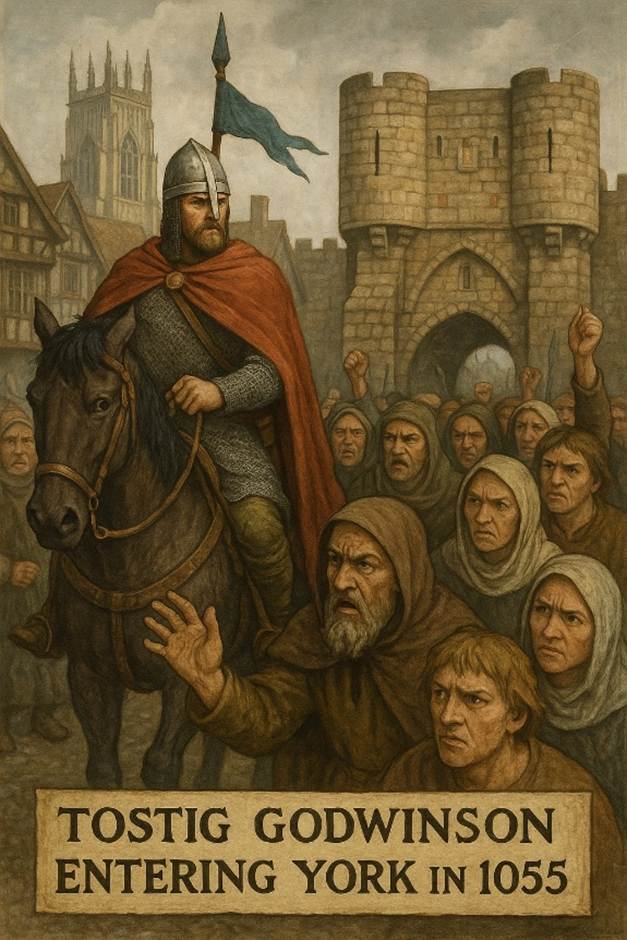
Tostig Godwinson
Earl Siward of Northumbria
died in 1055, leaving one son, Waltheof. The expected line of succession did
not come to pass because Harold engineered the appointment of his brother
Tostig to the earldom of Northumbria. With all but
one of England’s major earldoms under their control, the Godwinsons seemed unassailable (The
Anglo Saxons, A History of the Beginnings of England, Marc Morris, 2021, page 391).
On Siward's death in 1055, Edward the
Confessor, chose a West Saxon to govern Yorkshire, in place of Siward's son,
Waltheof. Edward's choice, Tostig Godwinson, was unpopular with locals. In 1055 Tostig had been given in 1055 the earldom of Northumbria,
on the demise of the noble and brave Siward, whose little son, the rightful
heir, was thus wickedly deprived of his patrimony (The Battle
of Stamford Bridge, A D H Leadman,
Yorkshire Archaeological Journal, Volume 11, page 132).
Tostig was the third son of the
Anglo-Saxon nobleman Godwin, Earl of Wessex and Gytha Thorkelsdóttir,
the daughter of Danish chieftain Thorgil Sprakling.
Earl Tosti. Tosti
or Tostig, who became Earl of Northumberland in 1055, was banished in 1065 for
a variety of crimes, including the murder of Orm's son, Gamal Ormson in 1063,
but returned with Harold Hardrada, King of Norway, in the following year. The
Norwegian army fought against Tostig's brother, Harold Godwinson, King of
England, at Stamford Bridge, and there both Tostig and his Norwegian ally were
killed. After the battle Harold Godwinson carried out his famous forced march
to Hastings, where he was killed in battle by the Norman army of William the
Conqueror.
Tosti, Earl of Northumberland, was brother of King Harold who
ruled England, and had large possessions at Falsgrave, near Scarborough; he had fifteen carucates of land, to be tilled
by eight ploughs, which he held as one manor.
It was in 1064 that " Tosti " murdered Gamal the son of
Orm, who had married AEthelthryth, daughter of Earl Ealdred; Ulf, who was
grandson of Siward, the great Earl, also fell a victim to this monster of
treachery. The following year, at the instigation of his sister Edgitha, Queen
of England, his perfidy culminated in the murder of Cospatric
at the court of his monarch; by this last act his cup of blood was full to
overflowing, and retribution was at hand, for Gamalbar,
a relative of the murdered Orm, with a strong force despoiled Tosti's
household, slew 200 of his retainers, and demanded from Harold his expulsion,
which he obtained.
Thirsting for revenge upon a foreign shore, it was not likely such
a character would be easily baulked, and he engaged the services of Harfagar, King of Norway. Arriving off Riccall,
on the Humber, with 200 ships, he landed troops and defeated the King's army at
Fulford, pillaging the country including the City of York; Harold procuring
reinforcements, Tosti and his ally were slain at the Battle of Stamford Bridge,
Tosti being afterwards buried in the Minster. A large lead box was dug up near
the scene of these battles in 1807, containing 270 silver coins and about two
pounds weight of silver, composed chiefly of the trappings of horses, noting
which, and also that the coins were all struck at York, and in fresh condition,
it has been conjectured they formed part of the loot of the City, and were
hidden during the battle. This must have been one of the most bloody encounters
on record, from the supposition that it took 200 ships to bring Tosti and his
army, while twenty conveyed the survivors to their own country ! The booty was
also in proportion to the slain, for Camden says " that in gold alone,
Harold captured as much as twelve men could carry on their shoulders,"
(Ryedale and North Yorkshire
antiquities, George Frank, 1888, page 140).
1060
The Archbishop of York died in
1060 and was replaced by Harold’s friend, Bishop Ealdred of Worcester.
1061
In 1061 Tostig visited
Pope Nicholas II at Rome in the company of Ealdred, archbishop of York.
In 1064 Harold decided to visit
William of Normandy. The visit is depicted at length in the Bayeux Tapestry. It was suggested in Norman
records that Harold’s visit was on the orders of Edward to confirm the Norman
succession, but that is unlikely, given the power of the Godwinsons.
It is more likely that his purpose was to secure the release of two Godwin
relatives, held as hostages. En route to Normandy, he was blow off course to Porthieu where he was taken prisoner, but released with
William’s intervention. He seems to have joined William on campaign and
acquitted himself well. William made it clear that he had no intention of
abandoning his claim to the English throne, and made Harold swear an oath on
holy relics that he would ensure the smooth transition to William. Tostig was
not popular with the Northumbrian ruling class, who descended from Danish
invaders and Anglo-Saxon survivors. He was heavy handed with those who resisted
his rule, and murdered several members of leading Northumbrian families.
In late 1063 or early 1064, Tostig
had Gamal son of Orm and Ulf son of Dolfin
assassinated when Gamal visited him under safe conduct.
The Vita Edwardi, otherwise sympathetic to Tostig,
records that he had repressed the Northumbrians with the heavy yoke of his
rule. He was often absent and may have shown a lack of leadership against
the raiding Scots. Their king was a personal friend of Tostig, and Tostig's
unpopularity made it difficult to raise local levies to combat them. He
resorted to using a strong force of Danish mercenaries (housecarls) as
his main force, an expensive and resented policy. The housecarls' leaders were
later slaughtered by rebels.
The imposition of a Godwinson as their
governor had displease the Northumbrians from the start, and Tostig had done
little to ameliorate matters in the intervening decade. According to
unsympathetic chroniclers the earl had raised taxes, robbed the Church, killed
his enemies and seized their lans. Even the Life of King Edward, composed to
sing the Godsinsons’ praises, admits that Tostig was ‘occasionally a little too
Zealous in attacking evil’, and reports that his critics charged him with being
excessively cruel. In 1064 the earl had invited two of his rivals to a peace
conference in York, only to have them treacherously slain. When their lord came
south to complain at the Confessor’s Christmas court, he was in turn murdered
on the orders of Tostig’s sister, Edith. (The Anglo Saxons, A History of the Beginnings
of England,
Marc Morris, 2021, page 393 to 394).
1065
The Rising in the
North against Tostig. On 3 October 1065, the
thegns of York and the local nobility descended on York and occupied the city.
They killed Tostig's officials and supporters, then declared Tostig outlawed
for his unlawful actions. They replaced him with Morcar,
brother of Eadwine of Mercia.
In Autumn 1065 200 armed men
attacked York, killed Tostig’s housecarls, and raided the treasury and armoury.
The whole region was soon in rebellion with a similar slaughter in Lincoln, It
stretched into the countryside. Anyone associate with the Godwinsons
was murdered. The rebellion intended to replace Tostig with Morcar, son of Earl
Æfgar, the late Earl of Mercia. Supporters from Wales and the
Midlands joined the rebellion. It was growing into a broader coalition against
Godwinson rule.
Tostig was in
Wiltshire at the time of the uprising.
Harold met the
rebels and told them that the king ordered that they stand down and that their
grievances would be addressed. This was rejected by the rebels who demanded
Tostig’s exile.
Edward’s court
were angry that Tostig had brought about this rebellion. The magnates around
Edward stressed the impossibility of raising an army against the rebellion so
late in the year. Edward ordered the exile of Tostig, seemingly reluctantly and
his anger at being forced into the situation resulted in a winter illness.
All along the coasts of Norfolk and Lincolnshire did Tostig ravage
both town and village! He entered the Humber, and continued his piratical
excursions into both Yorkshire and Lincolnshire, where he devastated the
district of Lindsey with fire and sword.
(The Battle of Stamford
Bridge, A D H Leadman, Yorkshire
Archaeological Journal, Volume 11, page 132).
Morcar
The northerners choice of new earl
was accepted by Edward. Morcar was Earl of
Northumbria from 1065 to 1066.
1066
January
On 6 January 1066, Edward the Confessor died. After Edward the
Confessor's death in 1066, Tostig’s brother, Harold Godwinson became King of
England. He visited York early in his reign and according to the Anglo-Saxon Chronicle returned to Westminster at
Easter 1066.
Harold was crowned King in Westminster Abbey also on 6 January
1066. Pro Godwin sources suggest Harold was nominated by Edward in his dying
moments. Alternative sources suggest he was merely entrusted with the
kingdom’s future. Yet most of the English magnates supported his coronation.
His support was widespread through the kingdom from the earldoms to both
archbishops. He almost certainly had to negotiate an agreement with Eadwine,
Earl of Mercia and Morcar, Earl of Northumbria.
Indeed Harold, although already married to Edith the Fair (“Swan-neck”) married
the sister of Morcar and Eadwine, Ealdgyth of Mercia.
April
His immediate concern was an invasion by William of Normandy who
quickly started to make preparations. Fears were stoked by the passing of
Halley’s Comet in April 1066, depicted in the Bayeaux Tapestry.
Yet the initial threat came from Harold’s brother Tostig, who
plundered the Isle of Wight and attacked the south coast all the way round to
Sandwich. Harold’s forces chased him north to the Humber, and then Morcar and Eadwin’s forces chased him north again, where he
took refuge with Malcolm III, King of Scotland. Tostig spent the summer there.
Harold continued to assemble an army and ships along the south
coast to deal with the Norman threat. He gathered together greater naval and
land levies than any king in this country had ever gathered before (The Anglo-Saxon Chronicle). Yet bad weather
held back the Norman invasion.
September
Armies could not be held together for lengthy periods,
particularly as the harvest approached, and on 8 September 1066, Harold was
forced to disband his army.
It was at this point that Tostig, along side
Harold Sigurdson (Hardrada, Hard Ruler) of Norway invaded northern
England and took York. In late summer Tostig had left Scotland and crossed the
North Sea to Harold Sigurdson. One of the sagas claims that he sailed for
Norway, and greatly impressed the Norwegian king and his court, managing to
sway a decidedly unenthusiastic Hardrada, who had just concluded a long and
inconclusive war with Denmark, into raising a levy to take the throne of
England. There is indeed no suggestion that Hardrada had any intention of
seizing the English throne previously. An expedition had left Norway in August
and joined Tostig with a smaller force on the Tyne before the whole force
landed at Riccall on the Humber. His arrival was unwaran, unexpected (The
Anglo-Saxon Chronicle).
The Battle of
Fulford
On 20 September 1066, Eadwine and Morcar
faced the invasion near York, and both sides suffered heavy losses, but
Hardrada’s army held firm and entered York after the battle reaching an
agreement with the folk of York who seem to have agreed to join the invading
force.
Meanwhile the
king of Norway's promised aid was completed, and from the many fiords of that
rugged coast sailed some five hundred ships filled with warlike Norsemen
chanting their weird battle-songs. They sailed to the Tyne, and in its mouth
they anchored, waiting for Tostig, who soon joined them, bringing with him some
assistance from Scotland and the Orkney Isles. The combined fleets then set
sail for the Humber, which they entered unmolested, and continued their course
up the Ouse as far as Riccall, a village ten
miles to the south of York, where, leaving their boats, the allied forces
landed and pushed on to that city, which they intended to take by storm. On
their march thither the country-people fled panic-stricken.
The earls Edwin
and Morcar were again on the alert. Citizens and men
of the surrounding district joined their ranks, the garrison of York turned out
to help, nay even priests armed for the fight, so determined was everyone to
resist the invaders and defend their dearly loved city. They met the Norsemen
at Fulford, a village on the northern bank of the Ouse, a mile and a half to
the south of York. There was hard fighting, and fortune, though at first
favouring the English, later on veered round to their opponents, and then the
war-song of the Norseman was heard that he was triumphant on that day. Many on
both sides perished, but the loss on the part of the English was by far the
heaviest. Numbers were drowned by having been forced back into the waters of the
Ouse, whilst of priests it is said more than one hundred stark corpses were
left on that fatal field. This calamitous event took place on Wednesday, 20th
September, 1066, the eve of S. Matthew.
(The Battle
of Stamford Bridge, A D H Leadman,
Yorkshire Archaeological Journal, Volume 11, page 133).
Harold had meantime swiftly reassembled his recently disbanded
army and marched north, reaching Tadcaster by 24 September 1066.
Learning of Harold’s arrival, Hardrada’s army marched to Stamford
Bridge. One account suggest that since the weather was hot, they didn’t wear
their mail shirts.
At the Battle of Stamford Bridge on 25 September 1066, Harold
defeated and killed Harold Hardrada and Tostig. Alas, those brothers, hearts
too hard! This murderous page will hardly please their sister, the queen (The Life of King Edward).
The Battle of
Stamford Bridge
But news had
arrived that Harold of England was rapidly approaching, so Tostig and his Norse
allies marched across country from Ricall to Stamford
Bridge, where they secured a very strong position, and forthwith set about to
dispose their forces on the defensive.
At this place the
river Derwent is about twelve to fourteen yards in width, and runs almost due
north and south. The village of Stamford is divided by it into two unequal
portions. On the west bank there is a tract of level ground, and at some
distance from the river arises a gentle slope, and when you are standing on the
highest ridge of this you can see for some distance over a flat country. On the
east bank in and just behind the village is a continuous crest of higher
ground, rising at once from the water’s edge, but when you walk over the edge
of the crest there is a dead level, and here are the fields still called the “
Battle Flats.” The river at Stamford Bridge is sluggish and not fordable, and
at the period of the battle was crossed over by a wooden bridge about five
hundred yards above the present structure.
(The Battle
of Stamford Bridge, A D H Leadman,
Yorkshire Archaeological Journal, Volume 11, page 134).
“A fierce battle
took place,” “ than which a greater has never been. No quarter was given and
none was asked — to kill was the order of the day. From dawn to midday, from
seven in the morning until three in the afternoon, the battle raged with fatal
significance (The Battle of Stamford
Bridge, A D H Leadman, Yorkshire
Archaeological Journal, Volume 11, page 136).
There is an In Our
Time podcast, The
Battle of Stamford Bridge,
the decisive English victory over Viking forces which took place in September
1066.
The defeated Norwegian army fled back towards Riccall,
but were slaughtered by the English.
On 28 September 1066 William of Normandy invaded southern England.
October
The Battle of
Hastings
On 14 October 1066 Harold was defeated and killed by William at
the Battle of Hastings. The Godwinsons were all
killed, Harold, Tostig, Leofwine and Gyrth. Their
mother Gytha, was exiled.
It took several years for
the Normans to consolidate their rule over England. It is likely that the Conqueror
exercised little authority north of the Humber during 1067.
Go forward to the Normans.
Bibliography
The Anglo
Saxons, A History of the Beginnings of England, Marc Morris, 2021.
The Battle of
Stamford Bridge, A D H Leadman, Yorkshire Archaeological Journal, Volume 11, page 131.
The Anglo
Saxon Chronicle, translated by Michael Swanton, 1996.
Life of King
Edward.