The Church
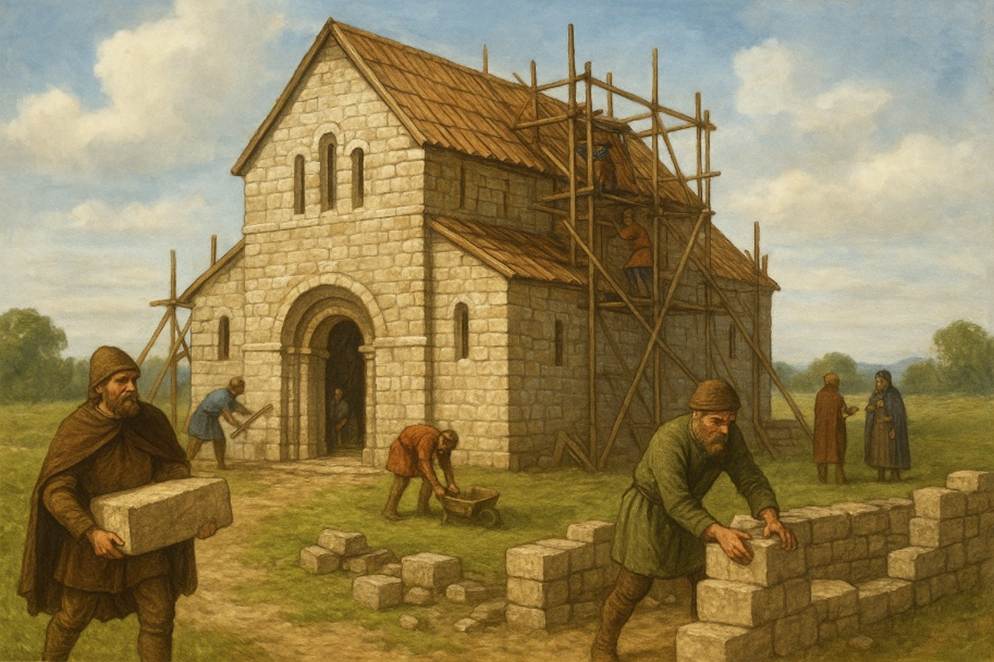
The evolution of the Church as it impacted on
northern England
|
Return to the Home
Page of the Farndale Family Website |
The story of one
family’s journey through two thousand years of British History |
The 83 family lines
into which the family is divided. Meet the whole family and how the wider
family is related |
Members of the
historical family ordered by date of birth |
Links to other pages
with historical research and related material |
The story of the
Bakers of Highfields, the Chapmans, and other related families |
Headlines are in brown.
Dates are in red.
Hyperlinks to
other pages are in dark
blue.
References and
citations are in turquoise.
Context and local
history are in purple.
Geographical
context is in green.
See also the Farndales and religion.
563 CE
The
Hiberno-Scottish mission was a series of expeditions in the 6th and 7th
centuries by Gaelic missionaries originating from Ireland that spread Celtic
Christianity in Scotland, Wales, England and Merovingian France. Celtic
Christianity spread first within Ireland. Since the 8th and 9th centuries,
these early missions were called 'Celtic
Christianity'.
Columba was an
Irish prince born in 521 and educated at the Bible school at Clonard. At the
age of 25, Columba’s first mission involved the establishment of a school at
Derry. Following this, Columba spent seven years allegedly establishing over
300 churches and church schools.
In 563, Columba
came to Iona from Ireland with twelve companions, and founded a monastery. It
developed as an influential centre for the spread of Christianity among the
Picts and Scots.
580 CE
The historian Procopius
(500 to 565 CE) described the people of Brittia
as Angiloi to Pope Gregory the Great, Gregory
had seen fair haired slaves for sale and replied that they were not Angles,
but angels. His pun is sometimes taken to define the origin of the English
and Gregory continued to class them as a single peoples.
Hence there grew
a single and distinct English church. It adopted Roman practices in its dogma
and liturgy (as later confirmed at the Synod of Whitby in 663 CE), but it
venerated English saints and developed its own character.
597 CE
Pope Gregory sent
Augustine, prior of a Roman monastery to Kent on an ambassadorial and religious
mission to convert the Angli, and he was welcomed by
King Aethelberht.
The English
church would come to own a quarter of cultivated land in England and it brought
back literacy. English identity began in a religious concept.
627 CE
Edwin converted
to the Christian religion, along with his nobles and many of his subjects, in
627 and was baptised at Eoforwic. Edwin built the first church at Eoforwic (York) amidst the Roman ruins and it was
later replaced by a larger stone church.
Stone crosses or spelhowes/spel crosses started to appear in the landscape,
which seem to have been meeting places of early local government. There is a
story that Kirkdale church was first built on the site of such a stone cross.
634 CE
Edwin's successor, Oswald, was sympathetic to the Celtic church and around 634
he invited Aidan from Iona to found a monastery at Lindisfarne as a base for
converting Northumbria to Celtic Christianity.
Aidan soon
established a monastery on the cliffs above Whitby
with Hilda as abbess.
Further monastic sites were established at Hackness
and Lastingham and Celtic Christianity became more influential in Northumbria
than the Roman system.
There is a
traditional story that a monastery was built at Oswaldkirk
in Ryedale, but was never finished.
659 CE
Christianity in
Ryedale and the stone crosses of the Ryedale School
Many local churches
in Ryedale date back to the Anglo-Saxon period. The churches are not the
earliest evidence of the arrival of Christianity to the north of England. The
first evidence was the establishment of a chain of monastic sites from
Lindisfarne down the coast to Whitby, their influence then extending
inland to Crayke, Lastingham and Hackness.
The Venerable Bede recorded that in 659 CE the monk Cedd hallowed an
inauspicious site at Lastingham and established there the religious observances
of Lindisfarne where he had been brought up. By the time Bede was writing in
circa 730 CE, there was a stone church at Lastingham.
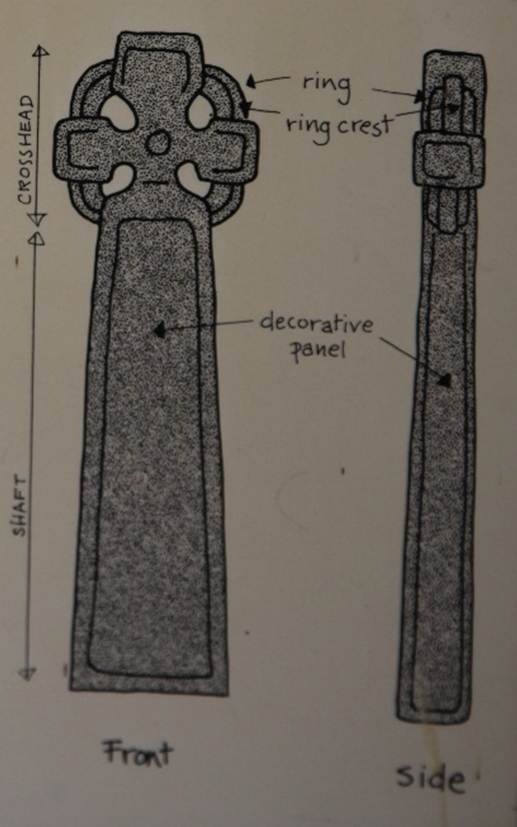
Christianity was
spread through the work of missionaries who travelled the countryside, often
erecting preaching crosses. They were originally made of wood, but with the re introduction of building in stone, stone crosses became
the norm. These preaching crosses depicted scenes from the Bible and were often
elaborately decorated with motifs from the Mediterranean. The carvings may have
originally been painted in bright colours. In the central part of Ryedale there
were local Craftsman who produced such crosses which were unique in their
design. A typical Ryedale School cross was about 6 feet tall with a slightly
tapering, flat, oblong section shaft. The style occurs in Kirkbymoorside, Levisham and Middleton. The Ryedale dragon is an
ornamentation on the back panel of the cross shaft. A single beast, often in an
S shape, filled the whole panel.
Yet Yorkshire
folklore remains rooted in Anglian and Norse paganism including tales of the
erection of Freeborough Hill by the devil
and of hobs. Dragons hunted in
Cleveland, with tales in Loftus.
663 CE
The competing
influences of the Roman Church and the Celtic Christianity originating from
Iona caused conflict within the church until the issue was resolved at the Synod of Whitby
in 663 by Oswiu of Northumbria opting to adopt the Roman system.
The schism had
come about because the church in the south were tied to Rome, but the northern
church had become increasingly influenced by the doctrines from Iona. The Synod
was held in the monastery at Streoneschalch near to
Whitby.
665 CE
Cuthbert of Lindisfarne
(c. 634 – 20 March 687) was an Anglo-Saxon saint of the early
Northumbrian church in the Celtic tradition. He was a monk, bishop and hermit,
associated with the monasteries of Melrose and Lindisfarne in the Kingdom of
Northumbria, today in north-eastern England and south-eastern Scotland. Both
during his life and after his death, he became a popular medieval saint of
Northern England, with a cult centred on his tomb at Durham Cathedral. Cuthbert
is regarded as the patron saint of Northumbria.
Cuthbert grew up
in or around Lauderdale, near Old Melrose Abbey, a daughter-house of
Lindisfarne, today in Scotland. He decided to become a monk after seeing a
vision on the night in 651 that Aidan, the founder of Lindisfarne, died, but he
seems to have experienced some period of military service beforehand. He was
made guest-master at the new monastery at Ripon, soon after 655, but had to
return with Eata of Hexham to Melrose when Wilfrid was given the monastery
instead. About 662 he was made Prior at Melrose, and around 665 went as Prior
to Lindisfarne. In 684 he was made bishop of Lindisfarne, but by late 686 he
resigned and returned to his hermitage as he felt he was about to die. He was
probably in his early 50s.
685 CE
By about 685 CE,
the early church at Kirkdale was dedicated to St Gregory. There are two elegant
tomb stones within its grounds which are once said to have borne the name of
King Oethelwald. More recent excavations tend to
suggest that the church at Kirkdale was important.
The origin of
parish churches emerged at about this time. A parish was a district that
supported a church by payment of tithes in return for spiritual services. Some
churches were linked to manor houses and others originated as the districts of
missioning monasteries. The church at Whitby was near a major settlement,
whilst the church of St Gregory’s at Kirkdale was located remotely in a dale.
By 1145, Kirkdale was described as the church of Welburn.
Pope Gregory had encouraged
the conversion of pagan holy places to Christianity and the church at
Kirkbymoorside is near a large burial mound.
731 CE
The
Venerable Bede (672 or 673 to 26 May 735) (“Saint Bede”) was an English monk
and an author and scholar who wrote the Ecclesiastical History of the English
People which he completed in about 731 CE. He was one of the greatest teachers
and writers during the Early Middle Ages, and is sometimes called "The
Father of English History". He served at the
monastery of St Peter and its companion monastery of St Paul at Monkwearmouth
and Jarrow in the Anglian Kingdom of Northumbria.
The Life of the Venerable Bede, on the state of
Britain in the seventh century, begins: In the seventh century of the
Christian era, seven Saxon kingdoms had for some time existed in Britain.
Northumbria or Northumberland, the largest of these, consisted of the two
districts Deira and Bernicia, which had recently been united by Oswald King of
Bernicia ... The place of his birth is said by Bede himself to have been in the
territory afterwards belonging to the twin monasteries of Saint Peter and Saint
Paul at Weremouth and Jarrow. The whole of this
district, lying along the coast near the mouths of the rivers Tyne and Weir,
was granted to Abbot Benedict by King Egfrid two years after the birth of the
Bede.... Britain, which some writers have called another world, because from
its lying at a distance it has been overlooked by most geographers, contained
in its remotest parts a place on the borders of Scotland, where Bede was born
and educated. The whole country was formed formerly studded with monasteries,
and beautiful cities founded therein by the Romans, but now, owing to the
devastations of the Danes and Normans, has nothing to allure the senses.
Through it runs the Were, a river of no mean width, and of tolerable rapidity.
It flows into the sea and receives ships, which are driven thither by the wind,
into its tranquil bosom. A certain Benedict built churches on its banks, and
founded there two monasteries, named after St Peter and St Paul, and united
together by the same rule and bond of brotherly love.
Bede gave
intellectual and religious significance to as burgeoning nation at Jarrow from
where many centuries later John
William Farndale was the youngest member of the Jarrow marchers. Bede first
defined an English identity. Bede produced the greatest volume and quantity of
writing in the western world of his time. At his monastery at Jarrow he had
access to a university library with more books than were in the libraries of
Oxford or Cambridge 700 years later. (Robert Tombs,
The English and their History, 2023, 24, 26).
871 CE
Alfred the Great (871 to 899 CE) has been
remembered in history as educated and practical, a Christian philosopher king.
959 CE
There was an
English church and English saints.
1009
This was the time
of Archbishop Wulfstan was very involved in the reform of the English church,
and was concerned with improving both the quality of Christian faith and the
quality of ecclesiastical administration in his dioceses (especially York, a
relatively impoverished diocese at this time). He urged the casting out of
heathen practices, witchcraft and idols. He wanted to see the observation of
Sundays.
There was some
revival of the Church in the later Scandinavian period and this may have been a
time of some church building, especially in places called Kirkby.
1030
The Horn of
Ulph is an eleventh-century oliphant (a horn carved from an
elephant's tusk). It is two feet four inches long, and has a diameter at the
mouth of five inches. Given its size and condition, it is a particularly good
example of a medieval oliphant. Tradition holds that it is a horn of tenure,
presented to York Minster by a Norse nobleman named Ulph sometime around 1030.
This suggests that a powerful Scandinavian nobleman was willing to donate a
very valuable object to the Christian church by this time.
1053
It is not clear
how strongly held Christian belief were at a local level. Many pagan customs
continued. The days Tuesday through to Friday are still named after Anglian and
Norse Gods. Hills remained dedicated to the Norse Gods Odin and Woden, Much Yorkshire folklore remains rooted in Anglian
and Norse traditions. Hobs
and boggles remained in field names. However masonry at churches evidences
Christian assimilation. The settlement at Chirchebi that would be the
burgeoning lands of Kirkbymoorside was a small rural community focused around
the church of St Gregory and its priest. The eleventh century sundial at
Kirkdale is the best preserved of several including others at Edstone and Old Byland.
1078
A mission arrived
from Evesham Abbey Mercia in York, were joined by Stephen of York and
established a Benedictine monastery in the old ruins at Whitby. Some of the monks went to Lastingham
and they partly build a large church there.
The monks led by
Stephen of York built St Mary’s Abbey from 1088 to 1089.
1100
After the
Norman Conquest, the church remained a powerful force.
The Normans
reorganised the local church. Many parish churches were rebuilt in stone.
The Rectors
received regular tithe incomes, a tenth of any increase of crops or stock
within the whole parish area.
Oral teaching was
mainly in English (in order to converse with the indigenous population), but
they wrote in Latin and Franch (with some English). Some English religious and
cultural traditions continued.
1128
First Cistercian
abbey at Waverley.
Monastic
orders, such
as Rievaulx
in 1128 arrived in England. They became important agricultural communities and
sometimes were involved in iron and coal mining.
Some chose
different routes to their religious goals and hermits
started to appear in the records, often the first known residents of more
remote places, such as Edmund the Hermit of Farndale.
Cuthbert had
retired in 676, and moved to a more contemplative life. With his abbot's leave,
he moved to a spot which Archbishop Eyre identifies with St Cuthbert's Island
near Lindisfarne, but which Raine thinks was near Holburn,
at a place now known as St Cuthbert's Cave. Shortly afterwards, Cuthbert moved
to Inner Farne island, two miles from Bamburgh, off
the coast of Northumberland, where he gave himself up to a life of great
austerity. At first he received visitors, but later he confined himself to his
cell and opened his window only to give his blessing. However he could not
refuse an interview with the holy abbess and royal virgin Elfleda, the daughter
of Oswiu of Northumbria, who succeeded St Hilda as abbess of Whitby in 680. The
meeting was held on Coquet Island, further south off the Northumberland coast.
This was an age
of giving to religious orders and the barons had vast empty lands which they
could easily donate. This was a form of insurance policy and generally gifts of
land were rewarded by monks’ prayers to help the passage of the nobility into
the after life.
· Robert de Brus gave most of his lands at Guisborough to form a priory
in about 1119 to 1124.
· Walter Espec
founded Kirkham Priory in 1121 to 1122.
1131
Walter
Espec encouraged the founding of the Cistercian abbey at Rievaulx in 1131. These
austere monks sought detachment from the world, in contrast to the Benedictines
and the Augustinians.
A breakaway group from St Mary’s Abbey in York established
Fountains Abbey and Kirkham Priory.
Monastic Farming
The Cistercian way of life was simple. The Cistercian abbots
accepted donations of land but generally avoided settled areas, or cleared them
(as at Hoveton and Welburn near Kirkbymoorside).
Significant
land grants were given to the monasteries. Rievaulx soon
had a great swathe of properties, throughout Ryedale and stretching to Teesmouth and Filey. At its peak it had 140 monks and 400
lay brothers. They tended to site their granges away from villages. Monastic
farms were a separate economic force. The sheep grange was dominant in
Yorkshire with many examples, including at Farndale, of donations of rights to
pasture a fixed number of sheep.
Nunneries
The Cistercians opposed the establishment of religious houses for
women until the early thirteenth century.
Robert de Stuteville gave a tract of land to the east of
Kirkbymoorside for the establishment of a nunnery at Keldholme Priory.
1200
By 1200 the
organisational structure of the church had been established:
· The provinces of
Canterbury (primacy established by 1353) and York;
· 9,500 parishes
The parish had
existed before the Norman Conquest. Parishes had their own guilds and
associations and provided social cohesion through feats and charitable affairs.
Church wardens were elected from the thirteenth century.
The Church,
perhaps along with professional lawyers, was an avenue for a person to rise to
wealth within a generation.
1220s
The
preaching orders of friars arrived, including the Franciscans or Greyfriars and Dominicans or
Blackfriars. Towns
started to see a growth of religious houses.
1221
Dominicans (black
friars) began to arrive in England.
There is an In Our Time podcast on
the religious orders of the Dominicans and the Franciscans, the Blackfriars and Greyfriars,
who were a great force for change in Catholic Europe.
1224
Franciscans (grey
friars) began to arrive in England.
1300
By the fourteenth
century, the Church remained the second most powerful institution.
Tithes were an
important part of church revenue. Local priests gained a secure living with a
definite income and sometimes even a pension. Some clergymen became wealthy.
The vicar of Kirkbymoorside was able to go on pilgrimage to Compostella in
Spain.
An important role
of vicars was moral leadership. There was a focus on the Seven Deadly Sins.
Even the nobility were not exempt from reprimand. Occasionally criminals might
find sanctuary in churches. The church became a focus of regular patterns of
local life and important events such as baptisms, marryings,
the churching of women, and funerals, were administered by the church.
1400
John Wycliffe was an
Oxford theologian who, with his followers, nicknamed the
Lollards, or the mumblers, translated the
Bible, seeing this as a return to the traditions of Bede. It coincided with a
wish by lay people to become more actively invested in religious life.
There was however
concern about the use of English, no longer seen as ‘angelic’, accentuated by
attempts to translate wine as cider.
In 1401, heresy
was made a capital offence.
The Constitutions of Oxford
1408 started an unprecedented period of the policing of belief. The
translation of the Bible into English was forbidden.
(Robert Tombs, The English and their History, 2023,
130).
1450s
The discipline of
philology (the study of words, especially the history and development of the
words in a particular language or group of languages.) led to a rejection of
ideas deriving from the fourth century Doctrine of Constantine.
Besides natural
colour, life was monotone, except in the churches where painted walls and cloth
added colour to drab worlds. The wall paintings at
Pickering Church shared stories of
religious belief in the fifteenth century.
By this time,
there was a trend away from donations to monasteries towards abstinence and
piety and less worldly involvement.
However saints
and their shrines remained powerful talisman. For instance a girl from
Ampleforth contracted marriage before the tomb of St William of York.
The priest was
expected to teach the creed, then ten commandments, the seven deadly sins, the
sacraments, the lord’s prayer.
(Robert Tombs, The English and their History, 2023,
144, 145).
1466
Printing from the
1430s and cheaper paper gave opportunities for a wide distribution of new forms
of the Bible. Printed Bibles appeared in German (1466), Italian, Dutch, French,
Spanish, Czech in the 1470s.
1509
The European
context in 1509 was challenging:
· Geopolitical
crises were tearing Europe apart
· Western
civilisation was challenged
· Portends of the
end of the world were rife
· After the capture
of Constantinople, Muslim forces were threatening Europe
· 1494 – War between
France and the Hapsburg Holy Roman Empire
· 1495 - Savonarola, a
Dominican friar, established a theocratic dictatorship in Florence
· 1527 – Rome was
sacked by the Hapsburgs
· 1530 to 1527 – Muslim raiders took a million Europeans
into slavery
· 1618 to 1648 – the Thirty Years War
In this context
there grew a new interest in Greek and Roman antiquity, and classical styles of
literature.
This was taught
by the umanisti, the humanists, who started to
mock tradition religious teaching. Humanists included:
· John
Colet, Dean of St Pauls
· Thomas
More, lawyer
There is an In Our Time podcast on Humanism.
Traditional
religious teaching was marked by ceremony, ritual, pilgrimage and indulgences
(the remission of punishment of sin by payment of cash donations to the
church).
In England anti
Lollard legislation hampered challenges to traditional medieval Christianity.
However there was a new desire to focus on what God said, rather than rely on
traditional interpretations of what God meant. There was increasing
intellectual scepticism.
1516
Erasmus of
Rotterdam produced a Greek New Testament in Latin with changes in wording.
1517
Martin
Luther, an
Augustinian friar, openly challenged the established church and its practice of
indulgences, and nailed his critique of the religious authorities to a church
door in Wittenburg.
The established
church came to be criticised as hopeless, itself blasphemous, and ruled by
corruption.
Luther’s idea
initially appealed to educated folk in German and Swiss towns. The nobility
took to his ideas as a challenge to their natural rivals in the Church.
Soon statues were
smashed in churches.
1524
The Peasants’
War swept across Europe.
1526
William
Tyndale, an
Oxford scholar printed copies of his English translation of the New Testament
from Greek from his base in Cologne. 16,000 copies were smuggled into England.
1527
After failed
attempts to negotiate with the Pope regarding his marriage to Catherine of
Aragon, Henry began to question whether the Pope had the authority to interpret
God’s law and whether he was superior to a Christian King. These were the
underlying issues debated in the 1520s and 1530s.
1529
Henry dismissed
Wolsey and confiscated his property, including Hampton Court.
1530s
In the 1530s
fierce debates raged regarding the positions of the sun and the earth. The
discovery of the Americas from 1492 led to a discovery of new worlds. This all
led to a re-examination of traditionally held beliefs.
1533
Henry appointed
Thomas Cranmer as Archbishop of Canterbury.
There followed a
succession of parliamentary acts to remove the English church from papal
jurisdiction.
The Act
in Restraint of Appeals 1533 ended legal recourse to Rome. England was
declared an empire.
1534
The
Reformation
The First
Act of Succession 1534 declared Catherine’s marriage ended and conferred
the succession on Anne’s issue.
Two Acts of Supremacy
confirmed that Henry was the only supreme head of the Church of England, under
pain of treason. Every man in the Kingdom was required to take an oath to
accept the new law.
This was a sudden
and dramatic change in the affairs of the Church.
To most ordinary
folk, these issues were remote and caused little issue.
Henry’s own
religious doctrine remained conservative. He insisted on the transubstantiation
(the conversion of the body and blood of Christ into bread and wine). He felt
that salvation came from good work. He was inclined to a degree of moderation
in his views of the established church.
1535
Tyndale was
tracked down to Antwerp and burned for heresy.
However from
1835, Henry, wishing to prevent the likes of More and Fisher becoming modern
Thomas a Beckets, had the shrine of Becket destroyed and a process started of
visitations and stocktaking of religious houses.
Commissioners were appointed to assess the wealth of churches. One
commissioner, Thomas Layton wrote of ‘great corruption among religious
persons’ in Yorkshire. The commissioners sacked
Prior Cockerill of Guisborough. (John Rushton, The History of Ryedale, 2003, 167).
1536
The Dissolution
of the monasteries 1536 to 1539.
Rievaulx Abbey had 27 buildings in two
courtyards, as fulling mill, iron smithy, corn mill, tannery, houses for
craftsmen.
The Earl of
Rutland took over Rievaulx and expended its iron workings
Byland Abbey had
1,500 ewes. It had 4 watermills, a fish house and 3 fulling mills.
The churches at
the monasteries were stripped of their lead rooves.
Henry started to
accumulate chests of gold stored in his bed chamber. There was vast looting and
thousands of objects and works of art taken, and often melted down.
Some historical
material was preserved, for instance by Matthew Parker, Master of Corpus
Christi, Cambridge, who saved many ancient documents.
The significant wealth
accumulated from the Church by the monarchy was spent on creating a new navy
and on a futile war with France in 1544.
The Pilgrimage of Grace.
1538
It was ordered
that the English Bible should be put into every parish church.
1544
In May 1544, war
with France gave rise to the first officially approved church service in
English and to the litany in the Book of Common Prayer. It was written by
Cranmer to encourage prayers for victory.
1547
The six year
reign of Edward VI was a period of religious consistency.
· The reformist
Archbishop Cranmer was able to take greater control over religious affairs
· There was a
tendency for the evangelists across Europe and in England to become stricter
· There was an
extension of the use of English in services
A 1547 edict
required the removal of shrines, candlesticks, effigies and paintings. Poor
boxes were to be placed into churches.
The Book of Common Prayer became the compulsory liturgy. This
would also become the focus of the growth of the English language, and many
phrases which came into common use derived from it.
1552
A more reformist
version of the Book of Common Prayer was adopted.
1553
Queen Mary (1553
to 1558) wanted to restore the authority of Rome in the
Counter Reformation.
1556
At first Mary had
used subtlety hoping to encourage a return to the Papal fold. She appointed her
cousin, Cardinal Reginald Pole to negotiate with Rome as legate, and procure a
forgiveness of past sins and a return to the Roman Church.
However Cardinal
Pole was not trusted in Rome and Pope Paul; IV rejected him and revoked his
legacy.
Ironically Mary
found herself using her royal; power over the English church to defy the wishes
of Rome.
There were also
practical difficulties in returning to the traditional church, since religious
objects had been disposed of and religious buildings now used for other
purposes.
The Evangelicals
continued to meet and resist the changes.
And so it was
that Mary and Cardinal Pole turned to force, earning Mary the nickname Bloody
Mary
· There followed
the most intense persecution of the time in Europe
· 280 Protestants
burned at the stake.
· Possession of
heritable literature was subject to the death penalty
· The Heresy Laws
were reenacted in 1554
· Bishop Latimer of
Worcester, Bishiop Ridley of London and Archbishop Cranmer were burned at the
stake.
In London there
was some sympathy for stamping down on heresy. However there was increasing
sympathy for the victims of the persecution.
The Reformation
and the Counter Reformation:
· Led to the
destruction of significant artistic expression
· Whilst mass
slaughter was prevented by a royal tendency to keep things in bounds,
nevertheless some 1,000 executions for heresy (perhaps a fifth of the
executions across Europe at the time)
· England began to
see herself as an Empire, under rulers with proclaimed rights from God
· However much
power was increasingly influenced by parliaments who adopted increasing
functions dubbed omnicompetence
· A national
consciousness emerged distinct from the rest of Europe which was centred on
Rome – religion became nationalised with its English bible and prayer book
1558
Elizabeth
annulled Mary’s counter reformation. As the daughter of Anne Boleyn, she relied
on royal supremacy and the reformist principles of her father:
· The Act of Supremacy 1558, An
Acte restoring to the Crowne thauncyent
Jurisdiction over the State Ecclesiasticall and Spirituall, and abolyshing all Forreine Power repugnaunt to the
same
· The Act
of Uniformity 1559, authorising a book of common prayer which was similar
to the 1552 version but which retained some Catholic elements
· The Thirty
Nine Articles 1563
This was the
foundation of a unique religion which was later called Anglicanism.
“It looked Catholic and sounded Protestant.” It was a religious middle
way. It was a compromise and perhaps the foundation of the British spirit of
compromise. It contrasted to a time of polarisation in Europe, when the badges
of Catholic and Protestant started to be used for the first time (prior to
that, the evolution of the church was seen more as turbulent schisms occurring
within a single Christian church).
· Elizabeth
promoted choral music – she retained the choir of King’s College Cambridge
which had been restored by Mary
· She promoted bell
ringing which purists considered to be sinful
· She had no
sympathy for hardliners from either wing of the religious divide
· She stopped
heresy trials
1630
Charles faced a
serious religious challenge., with a growing intensity of feeling about
religion.
The parish had
become the social cohesion of local communities, about 500 to 600 folk bound
together, which reflected the social and political as well as religious
hierarchy.
Puritanism was the name
given to the ‘godly’ by their opponents. Mostly Calvinists who believed in
predestination and that God had chosen an elect for salvation, God controlled
everything that happened.
· Their beliefs
caused psychological stress.
· In some ways they
reinforced existing hierarchies and elect gentry imposed strict order on the
idle and drunk
· They also
appealed to subversives, who saw themselves as godly with a right to oppose and
reprimand their ungodly superiors
Arminianism took its name
from Jacobus Arminius, and favoured free will, in direct opposition to the
Puritans. They did not see the Catholics as a false religion. This was the
focus of Charles I and William Laud, the Archbishop of Canterbury.
There were fears
that Charles was getting to close to Catholicism and this was reinforced by his
Queen Henrietta Maria’s practice of her Catholicism.
Charles tended to
be tolerant of religious matters and no one burned for heresy during his reign.
Indeed 1569 to 1642 was a time when there was no rebellion.
Meantime
Scotland, a more turbulent and militarised society, was left to govern itself
since 1603 and there was a growth of a Calvinist model of Scottish
Presbyterianism, run by committees of lay elders and clergy and without the
rule of bishops.
In 1636,
Archbishop Laud ordered the use of a Scottish remodel of Cranmer‘s Book of
Common Prayer. In July 1637, there was outrage and resistance at St Giles in
Edinburgh.
By 1638 a committee
of lairds, burgesses and ministers had drafted a Covenant to uphold the
Scottish kirk and resist popery. The Covenanters
were seen as rebels by Charles.
1688
After the
Glorious Revolution, the Church of England became more and more central to
everyday life from feeding the poor to repairing roads.
The Act
of Toleration 1689 allowed dissenters a freedom to worship separately,
though not yet extended to Catholics and Jews.
Dissenters could
vote and become MPs, but the Corporation and Test Acts 1661 and 1672 required
holders of public office to be communicant members of the Church – in practice
many took communion occasionally just to qualify.
The Whig-Tory
divide manifested itself in the church, with festive, communal, royalist Tories
and puritanical, capitalistic, parliamentarian Whigs developing there own
separate cultures. Merchants and urban businessmen were often Whigs and
dissenters and a non conformist society emerged, with
even the once feared Quakers becoming rooted in the wealthy merchant class.