The Harrying of the North
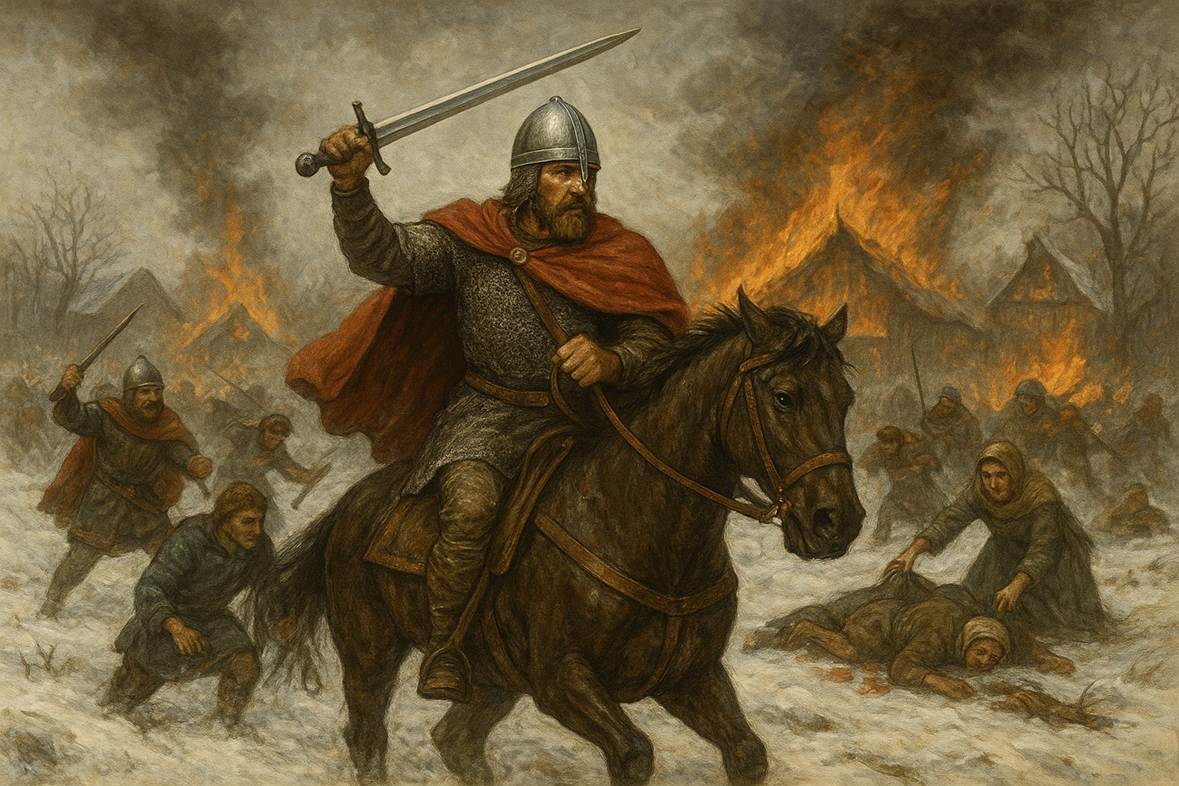
The
plundering of the northern lands of England after the Norman Conquest
|
Return to the Home
Page of the Farndale Family Website |
The story of one
family’s journey through two thousand years of British History |
The 83 family lines
into which the family is divided. Meet the whole family and how the wider
family is related |
Members of the
historical family ordered by date of birth |
Links to other pages
with historical research and related material |
The story of the
Bakers of Highfields, the Chapmans, and other related families |
Headlines are in brown.
Dates are in red.
Hyperlinks to
other pages are in dark
blue.
References and
citations are in turquoise.
Context and local
history are in purple.
Geographical
context is in green.
1066
The battle in
which William I, Duke of Normandy killed Harold Godwineson and defeated his
army on Saturday 14 October 1066 about seven miles from Hastings is a profound
turning point in English history.
After his
Conquest of England, the English magnates did not immediately surrender to
William, but elected Edgar Ætheling, the son of Edward the Exile and the last
surviving descendant of the House Wessex. William marched north to London and
began a campaign of terror. He secured Dover, parts of Kent, and Canterbury,
and sent a force to capture Winchester, and the royal treasury.
The aristocracy
and clergy in southern England, rallied to William. Indeed the Archbishop of
York, Ealdred, also supported William’s claim. William was crowned at Edward’s
the Confessor’s newly built Westminster Abbey on Christmas Day 1066. That might
have been that.
The new king
tried to reconcile with the English magnates. Eadwine, Earl of Mercia, his
brother Morcar, Earl of Northumbria, and Waltheof,
Earl of Northampton, were initially confirmed in their lands and titles.
However William
had to reward his army. He started to build wooden castles across the
countryside and they levied taxes and sometimes robbed the indigenous
population. This gave rise to resistance in the west and in the north.
1067
In 1067 the north
rose up under Merleswain, Eadwine and Morcar. William led an army to York and the rebels flew
into Scotland. York submitted and the Normans built a castle.
He left 500 men at York under William Malet and Richard FitzRichard.
William continued
to put down rebellions with increasingly violent means. There is an In Our
Time podcast, ‘The Norman Yoke’
– the idea that the Battle of Hastings sparked years of cruel Norman oppression
for the Anglo Saxons. The Normans built
castles far and wide throughout the land (The
Anglo-Saxon Chronicle). Castles were built wherever Norman barons
took ownership of land. Within a couple of generations there were about 500
castles across the land, to keep the population in check.
1068
In 1068 Eadwine
and Morcar rose in revolt again, supported by Gospatric, the new Earl of Northumbria. The King marched
through Eadwin's lands and built Warwick Castle. Edwin and Morcar
submitted.
William continued
on to York, completing York and Nottingham Castles before returning south.
William returned
to Normandy late in 1068, feeling his new kingdom was secure.
1069
Early in 1069,
Edgar Ætheling revolted and attacked York. Although
William returned to York and built a second castle, Edgar Ætheling
remained free. And King William came upon them by surprise from the south
with a streaming raiding army and put them to flight, and then killed those who
could not flee, that was several hundreds of men; and ravaged the town and made
St Peter's minster a disgrace, and also ravaged and humiliated all the others.
And the Ætheling went back again to Scotland. (The Anglo Saxon Chronicle).
In the autumn
Edgar Ætheling joined up with King Sweyn of Denmark
who brought a large fleet to England and attacked York, Exeter and Shrewsbury.
York was captured
by the combined forces of Edgar and Sweyn. Edgar was proclaimed king by his
supporters.
This was the last
invasion by the Danes. Indeed this was the only time when a Norman castle was
subdued. The local population welcomed the Danes.
William was
furious. He decided to adopt a scorched earth policy, and this has become known
as the Harrying of the North. Then when the king learned this, he went
northward with all of his army which he could gather, and wholly ravaged and
laid waste the shire. (The Anglo Saxon
Chronicle).
William bought
off the Danes, retook York and symbolically wore his crown in the ruins of York
on Christmas Day 1069.
The Harrying of the North
William marched
to the River Tees, ravaging the countryside as he went. He suppressed northern
England and started a period of ruthless domination.
One writer
described how livestock and carefully harvested crops in every settlement were
brought together and burned, and stated that, as a result, more than 100,000
people perished in the famine. The data in Domesday Book suggests that the true
death toll was probably even higher. (The
Anglo Saxons, A History of the Beginnings of England,
Marc Morris, 2021, page 403).
The English
Chronicler and Benedictine monk, Orderic Vitalis (1072 to
1142), wrote the Historia Ecclesistica.
He wrote about the Harrying of the North, and his account described the
campaign as a brutal act of cruelty that punished the innocent with the guilty.
Helpless children, young men in the prime of life, and hoary grey beards
alike were perishing of hunger. He made no effort to restrain his fury
and punished the innocent with the guilty. In his anger he commanded that all
crops, herds and food of any kind be brought together and burned to ashes so
that the whole region north of the Humber be deprived of any source of
sustenance.
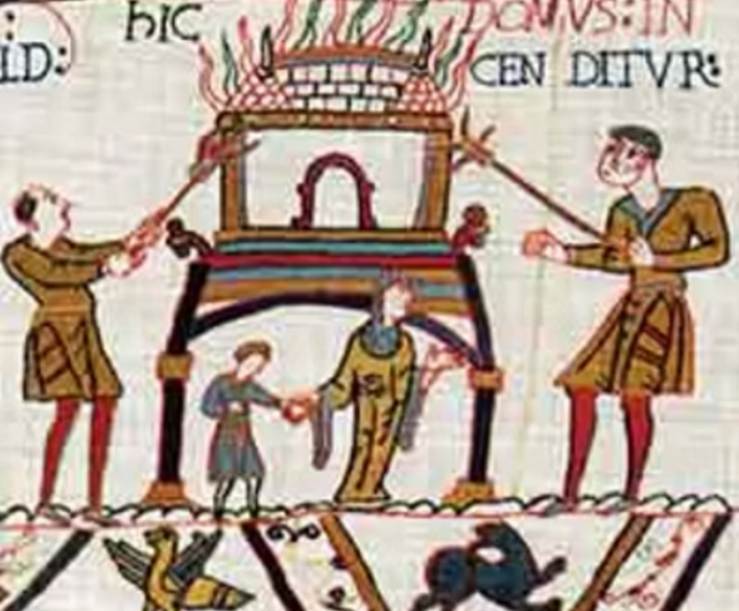
The Harrying of
the North included recorded destruction in the City and Minster of York, and it
has been reasoned that the destruction extended north and south from the city,
at least in the lowlands. Other rebellions against the Normans are also recorded,
such as around Ely in 1070, and in the Durham area in 1080, but the Yorkshire
experience seems to have been the most severe, with lasting disruption here
being mentioned by the chroniclers even fifty years later. There has been more
recent discussion about of the variable nature of both the Conquest and any
recovery, identifying not just the difference between the north and the south,
but the multiplicity of regional variations in that process.
(Stone Fonts as Indicators of Recovery following the Harrying of
the North, Rita Wood and Jeffrey Craine, Yorkshire Archaeological
Journal, 2025, Volume 97 No 1, page 64).
Whilst there can
be no doubt that parts of the North Riding suffered the consequences of the
Harrying as much as other areas of Yorkshire, its long coastline and more
northerly position left it open to other, additional forms of danger. It is
known that the Danish fleet was anchored in the Humber during the winter of
1070.
(Stone Fonts as Indicators of Recovery following the Harrying of
the North, Rita Wood and Jeffrey Craine, Yorkshire Archaeological
Journal, 2025, Volume 97 No 1, page 74).
He then gave orders for the towns and fields
of the whole region to be devastated, and the fruit and grain to be ruined by
fire or water, especially near the sea, partly because of his recent anger, but
also since a rumour had spread that Cnut king of the Danes, son of Swein, was
approaching, the purpose of this order being to leave nothing near the seashore
which a raiding pirate could find and carry off if he had to make a rapid
return home, or use for food if he thought he could stay longer. Thus a province
once fertile and a nurse of tyrants was hamstrung by fire, rapine, and
bloodshed; the ground for sixty miles and more left entirely uncultivated, the
soil quite bare even down to this day. As for the cities once so famous, the
towers whose tops threatened the sky, the fields rich in pasture and watered by
rivers, if any one sees them now, he sighs if he is a stranger, and if he is a
native surviving from the past, he does not recognize them. (Gesta Regum Anglorum, the History of the English Kings, William of Malmesbury, Clarendon Press, Oxford, Volume
1, 1998, page
465).
During the
Harrying of the North, the Normans destroyed the sources of power, destroying
crops and livestock and killing the peasantry. This led to famine. A Norman
force ravaged Northallerton, which was almost totally destroyed. The Domesday
Book, compiled a few years later in 1086, described the manor of Aluertune (Northallerton) as waste.
1070
The Harrying continued
until about April 1070. Sweyn of Denmark returned in early 1070, raiding along
the Humber and East Anglia toward the Isle of Ely, where he joined up with the
thegn Hereward the Wake. Hereward's forces captured and looted Peterborough
Abbey.
The extent,
nature and lasting effects at the Harrying of the North are still topics for
speculation. There is no record left by an unbiased or contemporary reporter,
nor has primary evidence of fire and slaughter been turned up by archaeologists
and although planned villages seem credible evidence for reconstruction, they
are not found only in the north. In addition, it would have been impossible for
William’s troops to have ravaged all of England north of the Humber, or even
the whole county of York, in one winter. Since the lowlands would have been the
easiest country for horsemen to enter and dominate, the lowlands would surely
have borne the brunt of the destruction of harvest stores, lives and property,
though conversely they may have recovered more quickly.
(Stone Fonts as Indicators of Recovery following the Harrying of
the North, Rita Wood and Jeffrey Craine, Yorkshire Archaeological
Journal, 2025, Volume 97 No 1, page 79).
1071
Eadwine, Earl of
Mercia and Morcar, Earl of Northumbria joined a final
desperate rebellion in 1071, where they were killed. The last of the Godwinsons had been killed. The old English elite were
wiped out. Of about a thousand noblemen who held land in 1085, only 13 were of
Anglo-Saxon blood.
1072
In 1072 William
invaded Scotland, defeating Malcolm, who had recently invaded the north of
England. William and Malcolm agreed to peace by signing the Treaty of
Abernethy, and Malcolm probably gave up his son Duncan as a hostage for the
peace.
1073
William returned
to Normandy in 1073 and spent all of 1074 there, to deal with an invasion of
Maine. This suggests that England was becoming more secure in its new Norman
rule.
1078
A mission arrived
from Evesham Abbey, Mercia in York, were joined by Stephen of York, and
established a Benedictine monastery in the old ruins at Whitby. Some of the monks went to Lastingham and they partly build a
large church there.
1079
In August and
September 1079 King Malcolm of Scots raided south of the River Tweed,
devastating the land between the River Tees and the Tweed in a raid that lasted
almost a month. The lack of Norman response appears to have caused the
Northumbrians to grow restive, and in the spring of 1080 they rebelled against
the rule of Walcher, the Bishop of Durham and Earl of Northumbria. Walcher was
killed on 14 May 1080. In the autumn the King’s son Robert was sent on a
campaign against the Scots. Robert raided into Lothian and forced Malcolm to
agree to terms, building the new castle at Newcastle upon Tyne on his
return.
1086
The
Domesday Book recorded the
values of lands through the kingdom before the Conquest and in 1086.
The comparison in value of the lands in Yorkshire (with many turned from
valuable land to wasteland) reveals the extent of the devastation from the
Harrying of the North. The considerable drop in the value of estates in the
region between 1066 and 1086, as recorded in the Domesday Survey, provides
clear evidence of widespread impoverishment (Stone Fonts as Indicators of Recovery following the Harrying of
the North, Rita Wood and Jeffrey Craine, Yorkshire Archaeological
Journal, 2025, Volume 97 No 1, page 63). There is an In
Our Time podcast, the Domesday
Book.
Thomas of Bayeaux, Archbishop of York (1070 to
1100) appears to have begun to rebuild his diocese after the Harrying of the
North, first with a flagship cathedral before he and his successors encouraged
the recovery of churches across the ravaged communities. This included for the
provision of fonts and altars in simple buildings, which is the subject of a
recent study to evidence the extent of recovery after the devastation. (Stone Fonts as Indicators of
Recovery following the Harrying of the North, Rita Wood and Jeffrey Craine,
Yorkshire Archaeological Journal, 2025, Volume 97 No 1, page 64).
There
was one major project in the north which definitively did get started despite
the Harrying, and that was the building of a new cathedral in York. It was
begun by Archbishop Thomas perhaps around 1075, after the last recorded Danish
incursion, and was completed by about 1100. The effort was in step with the
rest of the English Church, but in the northern province the only cathedrals
begun were in York (c 1075) and Durham (1093), any project at Durham being
delayed by the murder of Bishop Walcher in 1080. In comparison, in the southern
province, at least ten cathedrals were begun before the end of the 11th
century. The York Minster, built by Thomas of Bayeaux, was as ambition in
design and construction as any other new cathedral: it was a huge aisleless,
cruciform building, a plan unusual for a cathedral, but one commonly chosen for
communities of regular cannons. The design must have been decided early, since
the whole structure was based on a timber ‘grillage’ of the same plan
underlying the stone foundations. On his arrival in York, Archbishop Thomas had
taken over a Minster staffed by the remnant of a community of secular canons;
he built their dormitory and refractory and reroofed whatever was left of their
church. (Stone Fonts as Indicators of
Recovery following the Harrying of the North, Rita Wood and Jeffrey Craine,
Yorkshire Archaeological Journal, 2025, Volume 97 No 1, page 80).
Bibliography
Stone Fonts as
Indicators of Recovery following the Harrying of the North, Rita Wood and
Jeffrey Craine, Yorkshire Archaeological Journal, 2025, Volume 97 No 1, pages
63 to 87.
The BBC 2025
documentary Lucy
Worley Investigates William the Conqueror explores the Harrying of the
North.
After
1066: The Harrying of the North, Gone Medieval podcast.