Redcar

Historical and geographical information
|
Return to the Home Page of the Farndale Family
Website |
The story of one family’s journey through two
thousand years of British History |
The 83 family lines into which the family is divided.
Meet the whole family and how the wider family is related |
Members of the historical family ordered by date of
birth |
Links to other pages with historical research and
related material |
The story of the Bakers of Highfields, the Chapmans,
and other related families |
Introduction
Dates are in red.
Hyperlinks to
other pages are in dark
blue.
Headlines are in brown.
References and
citations are in turquoise.
Contextual
history is in purple.
This webpage
about the Redcar has the
following section headings:
· Redcar, overview
· Timeline of
Redcar history
· Bibliography
The Farndales of Redcar
The Farndales of
Recar were Matthew Farndale (FAR00297);
George Farndale (FAR00451);
John Thomas Farndale (FAR00473),
estate land drainer of Redcar; Robert W Farndale (FAR00490);
George Farndale (FAR00540).
Farmer of Kilton Hall Farm. The last Farndale to live at Kilton Hall farm. He
never married and lived there with his sister Grace Farndale who also never
married. They lived much of their lives at Kilton Lodge. They retired from
Kilton in 1940 and went to live at Redlands; Grace Farndale (FAR00566); George
William Farndale (FAR00643);
John Richard Farndale (FAR00681),
killed in action in World War 1; Terrance S Farndale (FAR01008).
Redcar
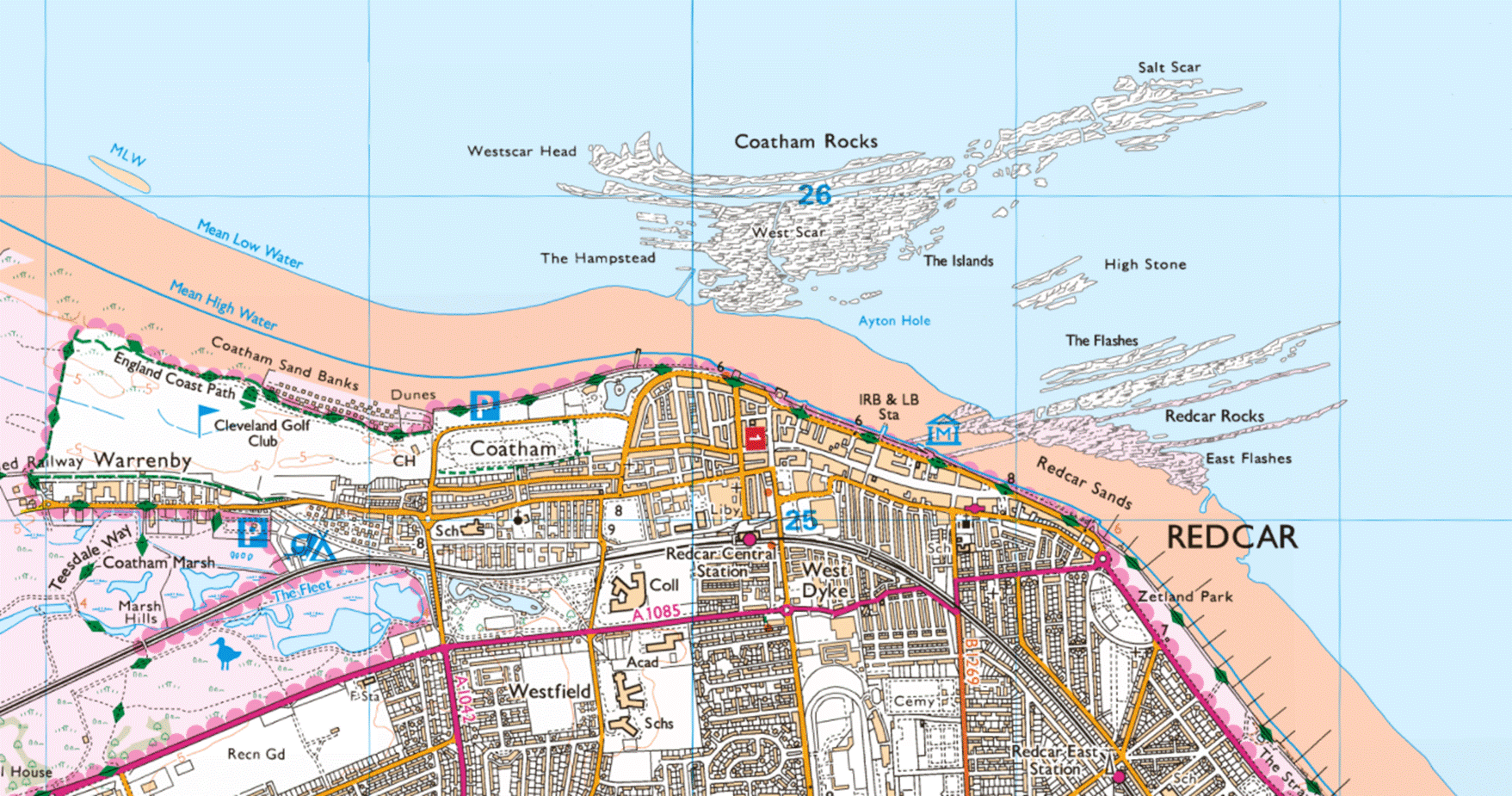
Redcar is
a seaside resort and town located in the borough and unitary
authority of Redcar and Cleveland in the North East of
England and ceremonial county of North
Yorkshire. Historically part of the North Riding of Yorkshire,
it lies 12.1 km east-north-east of Middlesbrough on
the North Sea coast. The combined population of the wards
of Coatham, Dormanstown, Kirkleatham,
Newcomen, West Dyke and Zetland was 36,610 in the 2001
census decreasing to 35,692 in the 2011 census. It is part of
the Teesside conurbation.
Redcar timeline
1170
The Victoria County History – Yorkshire, A History of the
County of York North Riding: Volume 2 Parishes: Marske, 1923: Redcar
occurs by name in a charter of William de Argentein
granting land there to Albert de Craster (Craucestria)
as the marriage portion of his sister Cristiana. Albert's sons William and Ivo were grown up
before 1192, so that William's grant cannot be much later than 1170. Little is
known of the place in early times.
1231
The Victoria County History –
Yorkshire, A History of the County of York North Riding: Volume 2 Parishes:
Marske, 1923: At the beginning of the 13th century three religious houses at
least had land there, Fountains, Rievaulx and Guisborough, the last being given
43 acres more in 1231 by Ivo de Redcar. Rievaulx Abbey received permission from
the third Peter de Brus to buy fish at Redcar apparently free of the toll which
was one of the profits of both Brus and Fauconberg.
Fifteenth
century
The Victoria County History – Yorkshire, A History of the
County of York North Riding: Volume 2 Parishes: Marske, 1923: The
dues from the boats of Redcar, known in the 15th century as 'Colybferne' or 'Colysferme,' were
another source of income to the lords of Marske in the Middle Ages, and the
market which in 1366 existed at Redcar had arisen, no doubt, mainly through the
fishing.
Sixteenth
century
The Victoria County History – Yorkshire, A History of the
County of York North Riding: Volume 2 Parishes: Marske, 1923: In the
16th century the fishermen are described as venturing out to sea through the
openings in the dangerous reef of rocks in 'cobbles' and selling a boatload of
fish for 4s. or 5s. It was their custom then to change their fellows every year
for luck, and to give a feast on St. Peter's Day, and in Ord's time the
fishermen still held a fair or festival every year, but on the two days following
Trinity Sunday.
1810
The Victoria County History – Yorkshire, A History of the
County of York North Riding: Volume 2 Parishes: Marske, 1923: The
place was beginning to be known in 1810 as a health resort; it had then,
indeed, twelve bathing machines, but it was still mainly a fishing village of
about 160 houses built down both sides of one street which was always covered
with heaps of drift sand.
1828
The Victoria County History – Yorkshire, A History of the
County of York North Riding: Volume 2 Parishes: Marske, 1923: Redcar,
since 1828 a chapelry of Marske, and created in 1867 an ecclesiastical parish
out of Marske and Upleatham, covers 881 acres, of which 176 acres are foreshore.
1841
Redcar had 794
inhabitants.
1846
After the opening
of the Middlesbrough to Redcar Railway in 1846 Redcar became a
regular destination for Victorian tourists. The Victoria
County History – Yorkshire, A History of the County of York North Riding:
Volume 2 Parishes: Marske, 1923: Owing to the extension here in 1846
of the Stockton and Darlington branch of the North Eastern railway it developed
rapidly as a fashionable watering-place of a quiet kind.
1850
Redcar's
population expansion corresponded with Middlesbrough's, with the discovery in
1850 of iron ore in the Eston area of Cleveland Hills.
Redcar prospered
as a seaside town drawing tourists attracted by eight miles of sands stretching
from South Gare to Saltburn-by-the-Sea.
1857
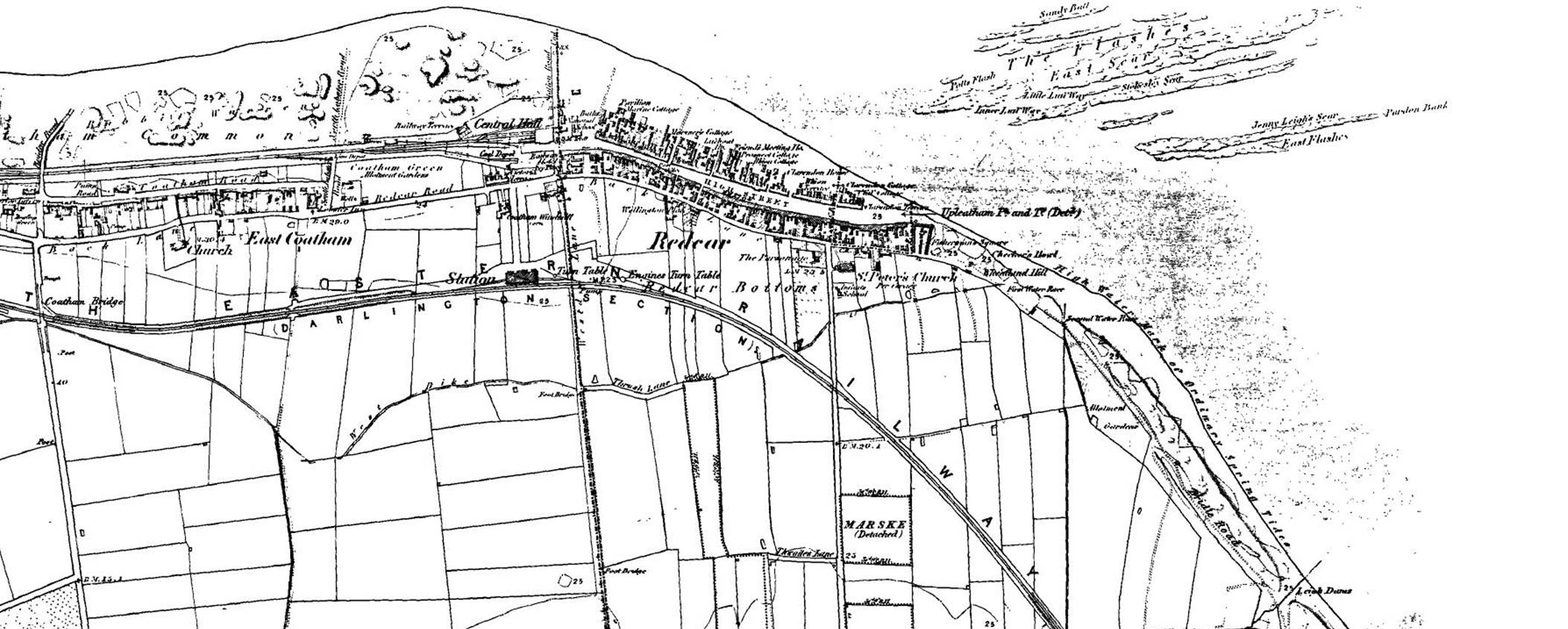
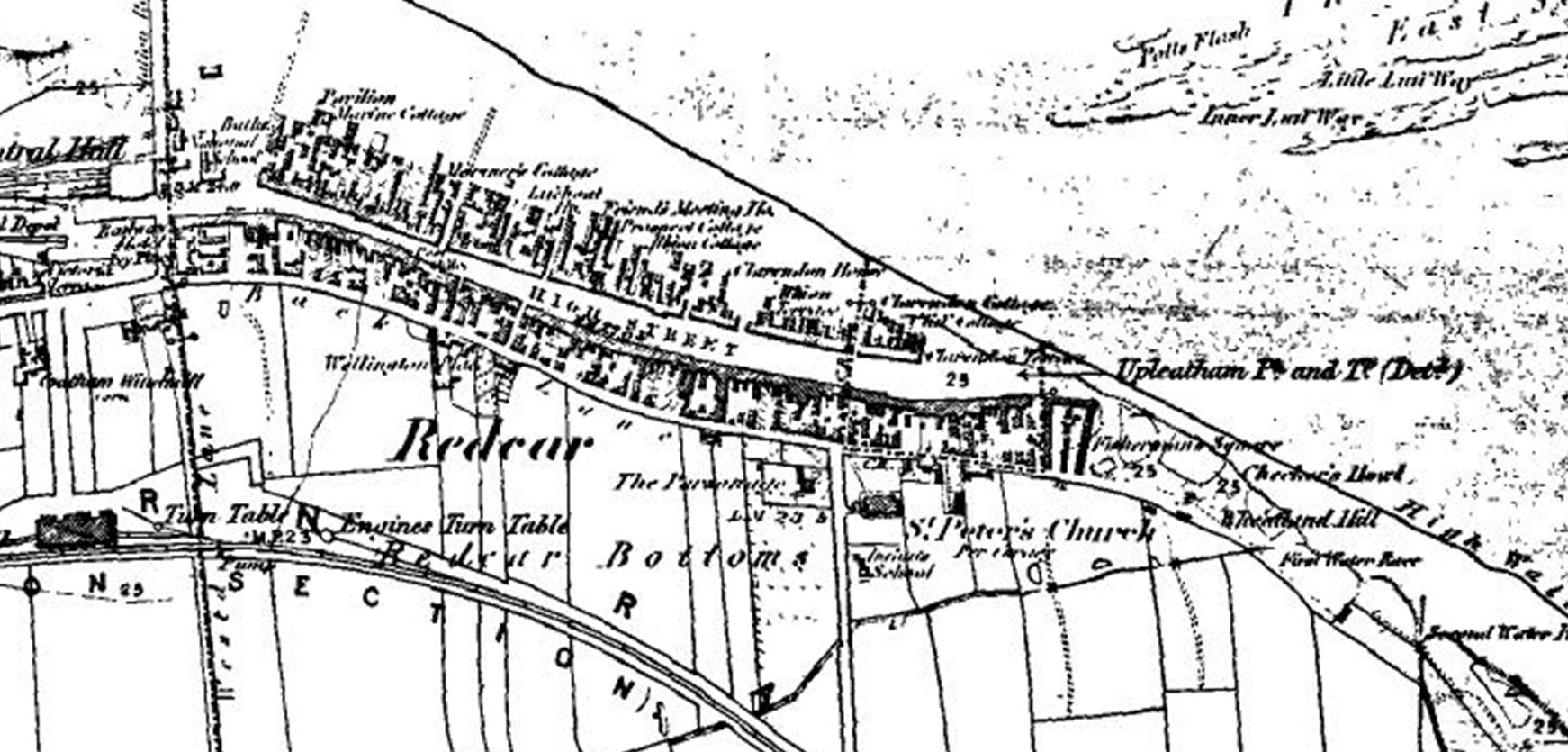
1859
The Victoria County History –
Yorkshire, A History of the County of York North Riding: Volume 2 Parishes:
Marske, 1923: Nathaniel Hawthorne lived at Redcar from July to October 1859
after his return to England from Italy, and here re-wrote and elaborated The
Marble Faun.
1866
Plans for a pier
were drawn up in 1866, but lay dormant until prompted by the announcement of
plans to build a pier at Coatham in 1871.Coatham Pier
was wrecked before it was completed when two sailing ships were driven through
it in a storm. It had to be shortened because of the cost of repairs and was
re-opened with an entrance with two kiosks and a roller-skating rink on the Redcar
side, and a bandstand halfway along its length.
1875
Redcar Racecourse
was created in 1875. Redcar Pier, another pier as well as Coatham Pier, was
built in the late 1870s. In October 1880 the brig Luna caused £1,000 worth of
damage to this pier. In New Year's Eve 1885 SS Cochrane demolished the
landing stage and in 1897 the schooner Amarant went through the pier. A
year later, its head and bandstand burned down.
1898
In October 1898
the Coatham Pier was almost wrecked when the barque Birger struck it and
the pier was thereafter allowed to disintegrate. An anchor from the Birger can
be seen on the sea front pavement close to the Zetland Lifeboat Museum.
1907
In 1907 a
pavilion ballroom was built on Redcar Pier behind the entrance kiosk
1917
The town's main
employers in the post-war era were the nearby Teesside
Steelworks at Warrenby, founded by Dorman Long in 1917, and
the ICI Wilton chemical works. The steel produced at Dorman
Long was used to build the Sydney Harbour Bridge, Tyne
Bridge, Auckland Harbour Bridge and many others.
1923
The Victoria County History –
Yorkshire, A History of the County of York North Riding: Volume 2 Parishes:
Marske, 1923: The main streets of the town, like those of East Coatham, of which they form the eastern half, run east
and west: the esplanade along the sea-front is thus the continuation of
Newcomen Terrace in Coatham and High Street of Queen Street West, while Coatham
Road has the same name in both places. From this last Redcar Lane leads south
to the road running from Marske to Kirkleatham. St. Peter's Church, the
vicarage and the British schools, which were built in 1857 principally at the
expense of the Earl of Zetland, are all situated at the northern end of Redcar
Lane, the cemetery made in 1872 being further to the south. The Roman Catholic
chapel of the Sacred Heart, erected in 1877, lies a little north-west of the
cemetery. Still further to the west and close to the parish boundary is the
race-course. The pier, constructed in 1871–3, is at the east end of the town
near the Redcar Rocks, which here extend from the sands eastward into the sea.
The Presbyterians have a chapel in High Street which formerly belonged to the
Wesleyans and dates from 1872, while the Congregationalists in 1855 and the
Primitive Methodists in 1860 built chapels in Lord Street.
Bibliography