A Brief History of Time in the lands around the dale
that would become known as Farndale

A portal
to the earliest history of the land that would become Farndale before 1154,
when the name first appeared in historical records.
FAR00001
|
Return to the Home Page of the Farndale Family
Website |
The story of one family’s journey through two
thousand years of British History |
The 83 family lines into which the family is divided.
Meet the whole family and how the wider family is related |
Members of the historical family ordered by date of
birth |
Links to other pages with historical research and
related material |
The story of the Bakers of Highfields, the Chapmans,
and other related families |
Dates are in red.
Hyperlinks to other pages are in dark blue.
Headlines are in brown.
References and citations are in turquoise.
Context and local history are in purple.
BCE - Before the common or current era. The contemporary equivalent of
BC.
CE - Common or current era. The
contemporary equivalent of AD.
kya – abbreviation for a thousand years
YBP – Years before present
A traveller in the mid twelfth century who looked down from the
moorland on Blakey Ridge into the wilderness that would soon become known as
Farndale would have seen the canopy of an expanse of forest that filled the
valley and continued southward to the edge of the Vales of Pickering and York.
This was frontier country at the edge of civilisation. Human encounters with the dale over eons of time were observations
made from above the dale and not the experience of folk who lived there.
Yet the immediate vicinity of the dale has a rich prehistory.
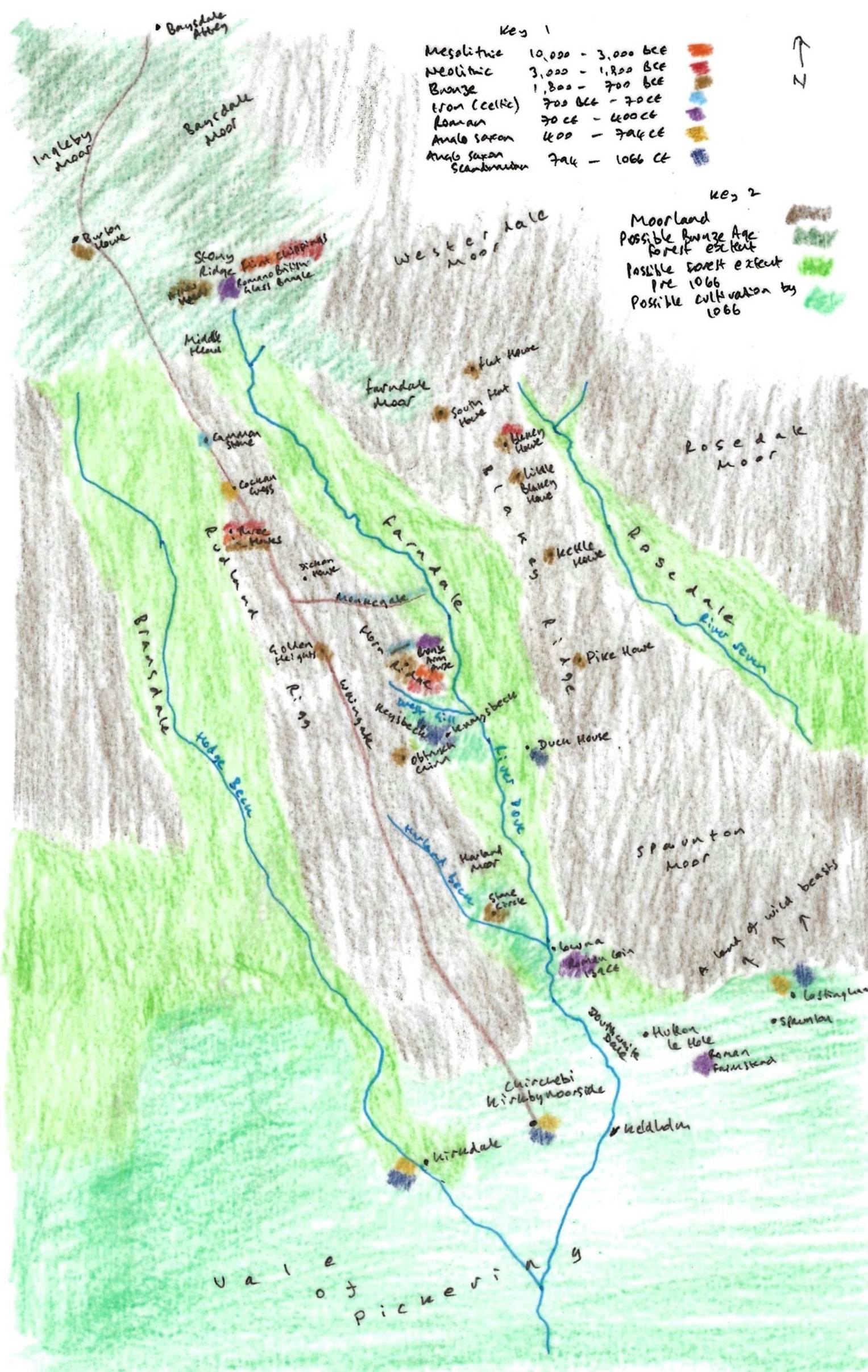
A representation of Farndale and its vicinity prior to
1066
Key 1 is a colour code for archaeological finds around
Farndale and the period of time with which they are associated, giving an
indication of settlement patterns around Farndale through time. Key 2 shows the
possible extent of moorland, woodland up to the Bronze Age and woodland up to
1066 and beyond, and the area of cultivation at the edge of the Vale of
Pickering.
Mapping the archaeological record allows us to
understand the most likely settlement patterns around Farndale through time.
Farndale itself was a woodland wilderness until areas of ground were first
settled in the twelfth century by the Rievaulx monks and then cleared for lay
cultivation in the early thirteenth century. The name Farndale did not appear
until 1154. No doubt the earlier cultures who lived on the higher ground would
have ventured into the woodland in search of game from time to time, but there
is no evidence of its settlement.
The Bronze Age settlements on the moors around Farndale do not appear
to have continued to the Celtic (Brigantian) and
Roman periods by which time the high moorlands appear to have become routes
used to traverse between the Vale of Pickering and Cleveland, but no longer
places of settlement. By the time the monastery of Lastingham was founded in
653 CE, Bede tells us that Cedd looked north from Lastingham to a wilderness, a
land of wild beasts and men who lived like wild beasts.
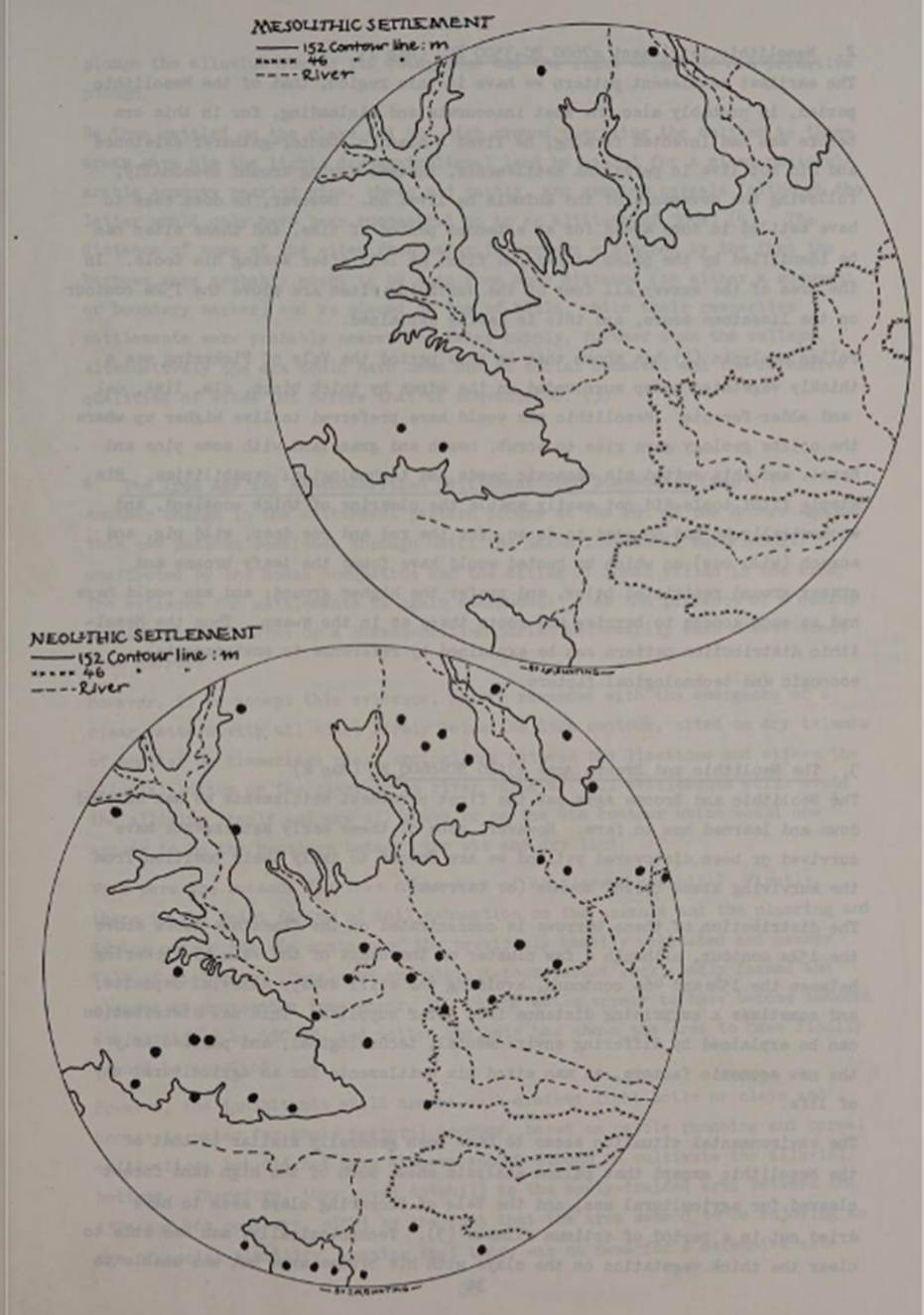
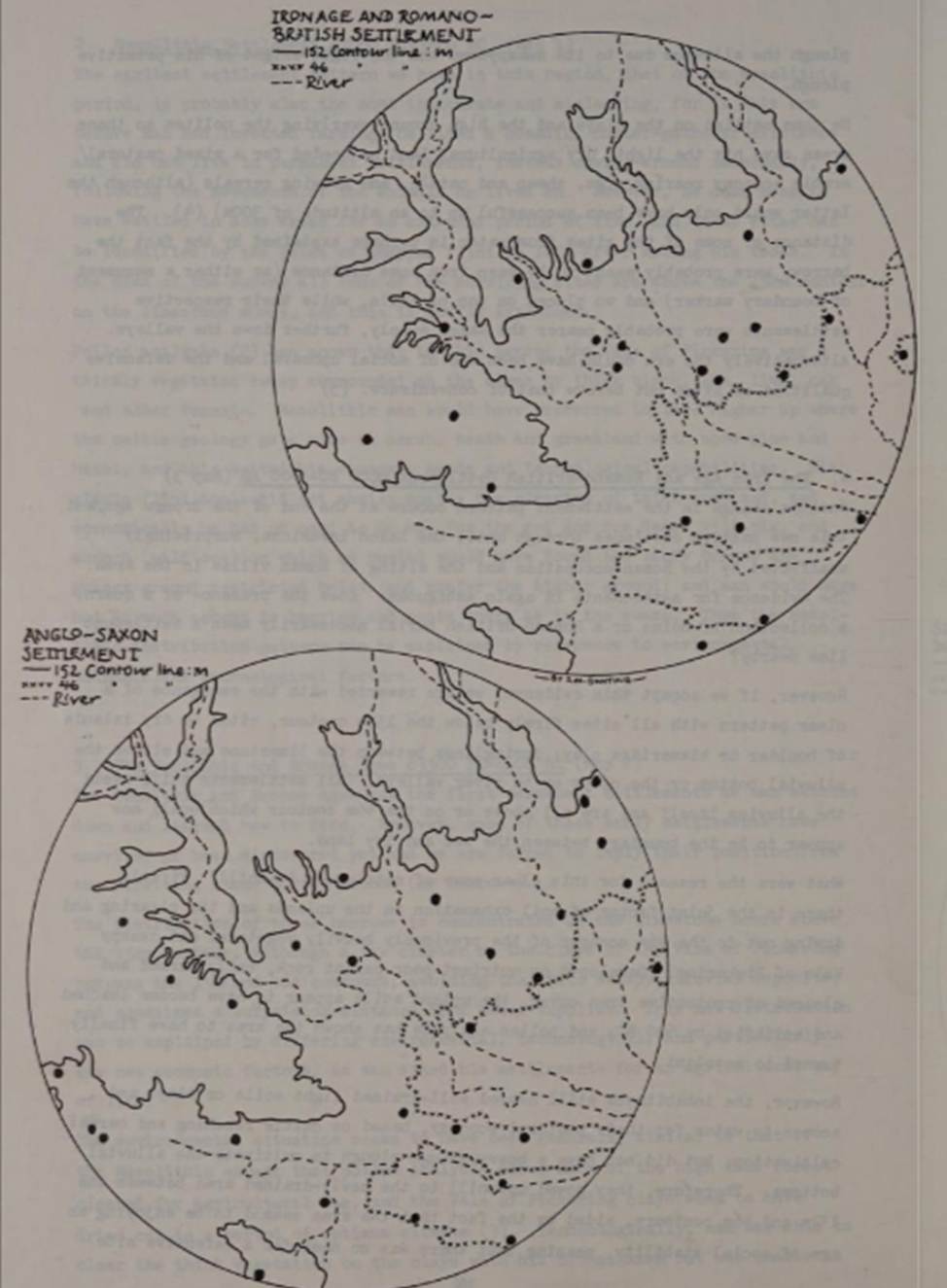
An analysis of settlement patters in the 1980s centred on Helmsley and
showing settlement patters with reference to the 152m contour line, indeed
suggested Mesolithic and Neolithic settlement on the higher ground of the
moors, at a time when the low ground was swampy and boggy and unsuitable for
settlement, changing over time to settlement on lower ground and later into the
Vale of Pickering as the moorland became overused and unsuitable for
agriculture. This might explain the richness of archaeological evidence on the
moors changing over time to a clear record of settlement into the Vale of
Pickering by the Anglo-Saxon period. This seems likely to have been the pattern
of the ancestors of those who eventually settled in Farndale in the thirteenth
century.
Settlement reflects the ever-changing
relationship between man and his environment and is never static. In the area
of the survey we see clearly how the distribution of settlement represents a
balance between environmental dictates and man‘s economic needs, his technology
and socio-political stability at that particular moment. These factors are
always changing and the distribution of settlements reacts appropriately. There
are, of course, some optimum sites which show evidence of continuous settlement
for a vast period of time, but not one site has been continually occupied for
the whole period, and only Helmsley and Hovingham can claim to have been
settled permanently since the Neolithic/Bronze Age period, and even here there
is no evidence of cultural continuity.
(A look at Ryedale Settlement Patterns, Ryedale Historian, Volume 12,
1984, page 31)
This page is a portal to the history of Farndale before 1066:
·
The
context of the Palaeolithic Period or the Old Stone Age (before about
10,000 BCE).
·
The
vicinity of Farndale in the Mesolithic
Period (10,000 BCE to 3,000 BCE).
·
The vicinity of
Farndale in the Neolithic Period, the New Stone Age (3,000 BCE to
1,800 BCE).
·
The
vicinity of Farndale in the Bronze Age (1,800 BCE to
700 BCE).
·
The
vicinity of Farndale in the Iron Age (700 BCE to 70
CE).
·
The vicinity of Farndale
and Roman Britain (70 CE to 400 CE).
·
The
vicinity of Farndale in the Anglo Saxon period (400 CE to 794
CE).
·
The vicinity of Farndale in the Anglo Saxon Scandinavian Period (793 CE to
1066).
·
The Game of
Thrones and the Estate of Kirkbymoorside (from 1066).