Agriculture
Agriculture has always been the heart of the Farndale communities
|
Return to the Home Page of the Farndale Family
Website |
The story of one family’s journey through two
thousand years of British History |
The 83 family lines into which the family is divided.
Meet the whole family and how the wider family is related |
Members of the historical family ordered by date of
birth |
Links to other pages with historical research and
related material |
The story of the Bakers of Highfields, the Chapmans,
and other related families |
Dates are in red.
Hyperlinks to
other pages are in dark
blue.
Headlines are in brown.
References and
citations are in turquoise.
Context and local
history are in purple.
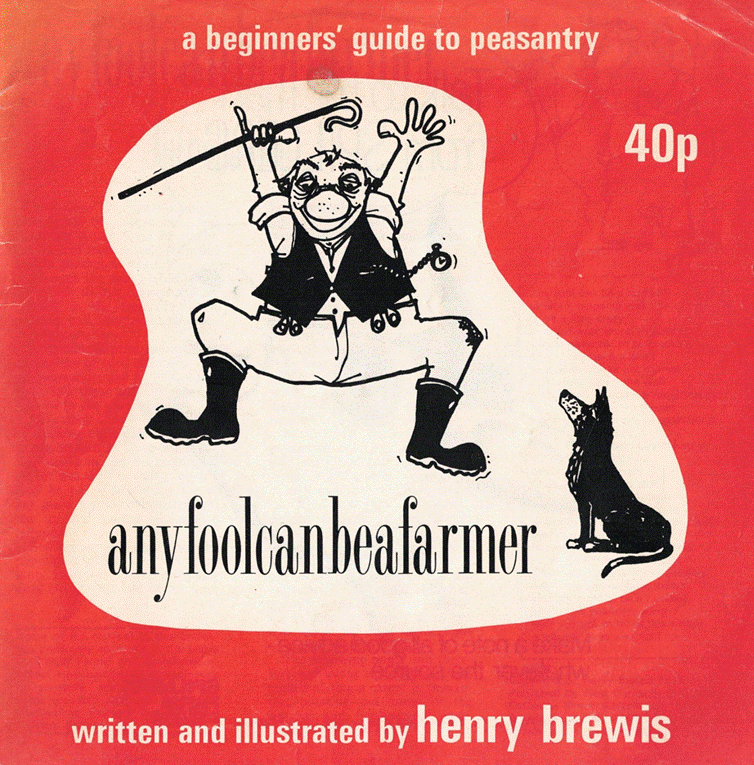
Any fool can be a
farmer, in fact it helps no end - to be a little crazy
and half way round the bend. It’s not essential to be
crackers; good gracious not at all; as long as you’re not normal and a wee bit
up the wall. If you can’t meet these requirements, no need to break your heart,
you’ll quickly get the hang of things once we get a start, ‘cos if the weather
doesn’t bug y’, it’ll be a half wit cow or a nit wit
politician or an old demented sow, or a collie dog
that’s clueless, doesn’t even know his name, or a sheep that’s just plain
awkward; they can all drive y’ insane. But mind I wouldn’t swap you for your
posh suburban pad. It’s quite nice here in the country, especially when you’re
mad. You still want to be a peasant and sing a peasant’s song; well you got as far as this alright, you might as well read
on.
Ever since Eve discovered
she needed the odd apple now and then, and Adam acquired a taste for a bit of
fruit as well, man has been a peasant at heart. Through the ages he has toiled
ceaselessly to feed himself and his fellows, in the face of floods, tempest,
hail, idiot politicians and greedy cushetts. It
should surprise no-one that in the face of such adversity over the years more and more peasants have left their land to make a
fortune in the growing cities. Here they found that instead of working eight
days a week up the armpits in clarts for nowt, they
could in fact do nothing at all for five days a week, and not only be paid
handsomely for it, but get a pension when they got fed up and retired or became
redundant. But once upon a time the entire population of England were peasants
except of course for a few dirty knights and barons who kept themselves busy
killing dragons in Durham and rescuing distressed damsels in ppinted hats locked up in tall towers. Even to this day
their descendants own much of the land though rising taxes and industrial
development make it more and more difficult for them
to hang on to it. What’s more, there is now much less countryside about (as
somebody else once said, “They aint makin’ it any more”), and each
week sees about 1,000 acres disappear under concrete for one reason or another.
Nevertheless, in spite of the precarious nature of
this way of life, and the almost total lack of profit, in
spite of the atrocious conditions under which a peasant is obliged to
work, the numbers of people still eager to be farmers remains unbelievably
high. The myth that a country life is a good pure healthy existence cushioned
by sunshine, green grass, and Government subsidies, persists in the face of
overwhelming evidence to show that in fact it is one of the most idiotic ways
to make a living.
(Brewis, Henry (1974), Any Fool Can be a Farmer, a
beginner’s guide to peasantry).
In traditional
Yorkshire and Northern English dialects:
· cushett, also spelled cushat,
cowshut, or cushie,
is a regional name for the wood pigeon or ring-dove;
· clarts means mud, sticky dirt, or mire and the related adjective clarty means muddy, sticky, or smeared with dirt,
and the verb clart means to smear or make dirty.
Introduction
Whilst of course
the family in the twenty first century comprises a large range of folk, many
now living in urban areas, the historical family is rooted in the land and agriculture.
Until the industrial revolution, most of the British population was rural and
horizons were small.
Our family’s
recorded history began with the clearing of the land in Farndale by about 1230.
There was pastureland
in Farndale by at least 1225.
Even by 1280
there were folk such as William
the Smith of Farndale who specialised in supportive trades. By 1338 people
such as Walter
de Farndale, later Vicar of Haltwhistle, Lazonby
and Chelmsford, and William
Farndale later Vicar of Doncaster, had become chaplains. By 1363, Johannis
de Farndale had moved to York and was working as a saddler in an urban
setting, and his family would stay there for generations, his grandson being a
butcher. There were large numbers of the family who joined the Armed Forces. There were several
policemen.
However the bulk of the
family remained in a rural setting, working for others on the land, and
occasionally becoming tenant farmers themselves.
Indeed even as the family
moved its centre of gravity to the area of Cleveland when Nicholas
Farndale’s family moved there in perhaps about 1565, the focus remained
rural for another four centuries. It is true that there were groups of the
family who moved to the larger urban port town of Whitby
where many turned to the sea for work,
and when the industrial revolution came, others found work in the mines, whilst some large
groups of the family moved to urban centres such as Leeds
and Bradford, particularly to work in the textile
industry. However the bulk of the family continued to
work in agricultural roles and mostly within a comparatively small radius of
not more than about ten miles around Guisborough.
This web page tells
the story of the Farndales and agriculture.
The Farndale farmers
The Farndales who
became tenant farmers included John Farndale, “Old Farndale of Kilton” (FAR000143);
William Farndale, Farmer of Craggs (FAR000146);
William Farndale (FAR00152)
perhaps for a time; John Farndale (FAR00167); John
Farndale (FAR00177);
William Farndale (FAR00183);
Elias Farndale of Ampleforth (FAR00184); John
Farndale, for a time before he turned to trade and agency and became a writer (FAR00217); Matthew
Farndale, who then emigrated to Australia where he became rooted to the land of
Victoria (FAR00225);
John Farndale (FAR00230);
Martin Farndale of Kilton (FAR00236); John
Farndale (FAR00240);
John Farndale of Whitby (FAR00244); George
Farndale of Kilton (FAR00252); Elias
Farndale of Ampleforth (FAR00274);
Charles Farndale of Kilton Hall Farm (FAR00341); George
Farndale of Brotton (FAR00350C);
Martin Farndale of Tidkinhow (FAR00364);
Matthew Farndale of Craggs (FAR00383);
William Farndale of Gillingwood Hall, Richmond (FAR00531); John
William Farndale of Danby (FAR00537);
John Farndale at Tidkinhow (FAR00553); Martin
Farndale, cattle farmer of Alberta (FAR00571);
George Farndale, farmer at Three Hills, Alberta (FAR00588);
Catherine Farndale and the Kinseys in Alberta (FAR00601);
Herbert Farndale of Craggs (FAR00652);
Grace Farndale and Howard Holmes (FAR00659);
William Farndale of Thirsk (FAR00665);
Alfred Farndale of Wensleydale (FAR00683) and
Geoff Farndale of Wensleydale (FAR00922).
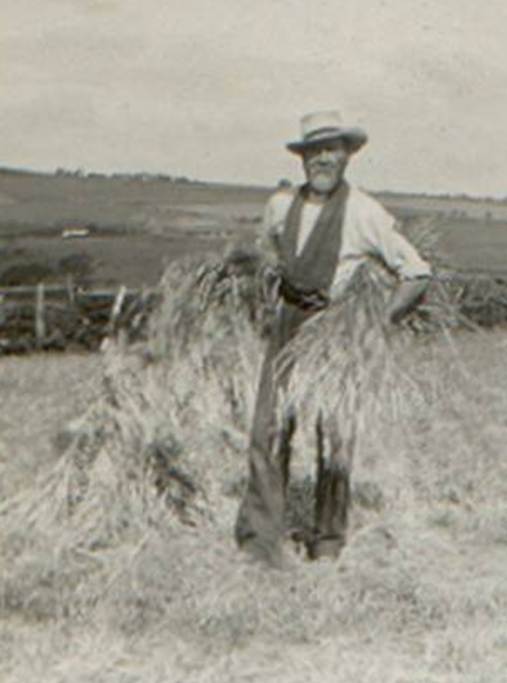
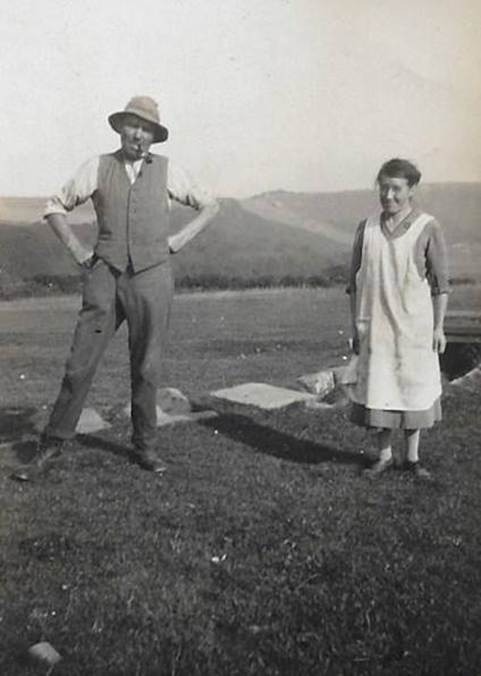
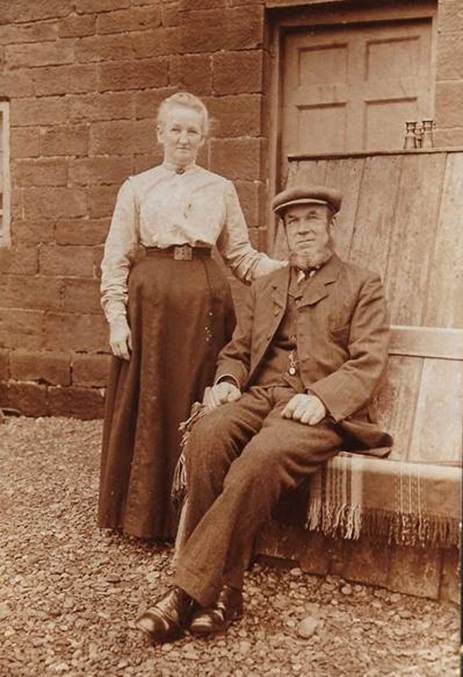
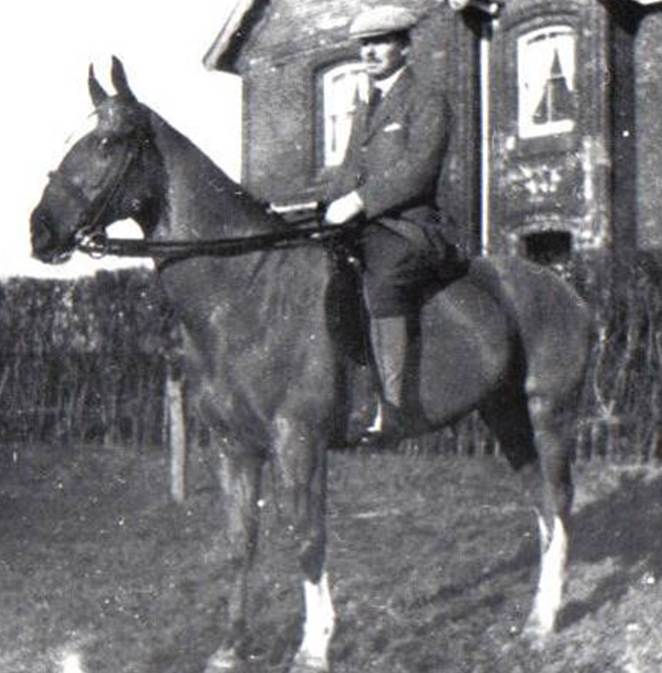
Martin Farndale at Tidkinhow about 1920 John Farndale at Tidkinhow about 1937
Matthew Farndale and Mary Ann at Craggs Hall
Farm, about 1900 George Farndale, of Kilton Hall Farm, about 1925
The Farndale Farm
Labourers
The lives of many members of the family through time, was a life
of work for others on the fields. Many of the farmers listed above spent
periods of time working for others on the land before they acquired land to
farm for themselves. Examples of those who worked as ‘agricultural labourers’
included George Farndale of Brotton (FAR00215); Jethro Farndale of Ampleforth (FAR00218); Wilson Farndale (FAR00227); Henry Farndale of Great Ayton (FAR00229); William Farndale of Brotton (FAR00243); William Farndale of Whitby (FAR00257); William Farndale of Seltringham (FAR00258); John Farndale of Eskdaleside (FAR00262); Martin Farndale of Kilton (FAR00264); William Farndale of Great Ayton (FAR00283); Joseph Farndale of Whitby (FAR00285); William Farndale of Ampleforth (FAR00286); John Farndale of Kilton (FAR00287); Richard Farndale of Great Ayton (FAR00288); Matthew Farndale of Coatham (FAR00297); John Farndale (FAR00305); John George Farndale before he emigrated to Ontario (FAR00337); William Farndale of Loftus (FAR00378); Thomas Farndale of Ampleforth (FAR00474) and George Farndale of Loftus (FAR00627).
Agriculture in the Middle
Ages
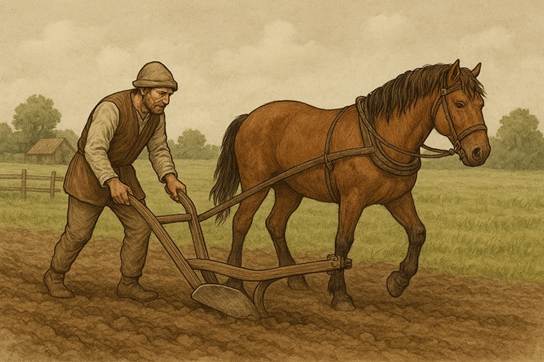
1086
By
1086, Farndale was an unknown place in
thick forested land. However there was a tiny settlement
which comprised ten villagers, one priest, two ploughlands, two lord’s plough
teams, three men’s plough teams, a mill and a church around the Chucrh
of St Gregory in Chirchebi, now at Kirkdale. It had been a community under
Orm’s suzerainty since at least 1055 and no doubt well before that.
Medieval
land units
The
rod is a historical unit of length equal to 5+1/2 yards. It may have
originated from the typical length of a mediaeval ox-goad. There are 4 rods in
one chain.
The
furlong (meaning furrow length) was the distance a team of oxen could
plough without resting. This was standardised to be exactly 40 rods or 10
chains.
An acre
was the amount of land tillable by one man behind one team of eight oxen in one
day. Traditional acres were long and narrow due to the difficulty in turning
the plough and the value of river front access.
An oxgang
was the amount of land tillable by one ox in a ploughing season. This could
vary from village to village, but was typically around
15 acres.
A virgate
was the amount of land tillable by two oxen in a ploughing season.
A carucate
was the amount of land tillable by a team of eight oxen in a ploughing season.
This was equal to 8 oxgangs or 4 virgates.
After his victory he visited York
and Pickering. Henry I redistributed land from Robert Curtose’s supporters,
including Robert de Stuteville to his new men, including Nigel d’Albini,
ancestor of the Mowbray family and Robert de Brus.
The new barons resettled the landscape with
freeholders, villeins and cottagers. The bondsmen were settled as unfree men,
sometimes referred to as serfs or villeins. The Norman, Fleming and Breton
landowners formed a new ruling class of manor lords.
Freemen were sometimes created in return for service. Roger de Mowbray settled freeholds near Thirsk on his butler, usher, cook, baker and
musicians (John Rushton, The History of Ryedale, 2003, 49).
The Norman conquest broke the continuity of ploughing for a period, but
then there was a recovery and the old fields were quickly restored.
At this time settlements of bondsmen and villeins worked two or three
adjoining fields, which were each sub divided into a dozen or so furlongs. Each
furlong was a section of the larger field usually about 5 to 10 yards wide. The
fields were cultivated collectively but each strip was cropped by the tenant.
Two oxgangs were quite commonly held by a villein.
The villages may well have been laid anew by the Normans. Often the lord’s
manor house was at the end. Nearer to the moors, large greens with ponds,
provided a source for watering stock, as at Fadmoor.
(John Rushton, The History of Ryedale, 2003,
58-59).
With the recovery of agriculture, manors started to invest in mills to
grind grain – these were a major investment, but were a
means for a lord to gain an income from their lands.
Some land was not included within the system, of oxgangs and new thwaites
(clearings) appeared including Duvansthwaite at Farndale. Sometimes fringe land near the main fields
was cleared, often called ofnames.
Significant land grants were given to the
monasteries. Rievaulx soon had a great swathe of properties, throughout Ryedale
and stretching to Teesmouth and Filey. At its peak it
had 140 monks and 400 lay brothers. They tended to site their granges away from
villages. Monastic farms were a separate economic force. The sheep grange was
dominant in Yorkshire with many examples, including at Farndale, of donations of rights to pasture a fixed
number of sheep.
Road systems
The agricultural areas were sometimes
connected by the King’s Highways, which fell under legal protection and
generally linked to the market towns. There were a few long distance
routes, often called great ways or magna vias. A magna via
through Huttons
Ambo
led to York. Routes across the high moors were sometimes called riggways.
There were a small number of bridges generally on lower ground, for instance at
Kirkham. More local routes often formed a start of routes in the immediate
neighbourhood, whose pattern changed between summer and winter. There were few signs
or markers, but occasionally crosses would mark a junction, such as Whinny
cross on Yearsley moor.
Tolls may have been taken, though locally
they were not often recorded and might have not been worth it for the lack of
traffic. Gatelaw was a road tax levied in Pickering Forest.
Early rural industry was focused on corn milling. Some castles and
monasteries had more specialised industries and most of them had bakehouses and
breweries. There is some evidence of medieval pottery, for instance pottergates of Pickering and Gilling.
Corn mills inevitably belonged to the manor. A water corn mill was a
substantial investment, but provided a lord with a
steady source of income.
Occasionally windmills were found on low flat lands.
Village fulling mills were sited on streams, including at Farndale.
The number of village blacksmiths suggests the extraction of ironstone at some
scale. Barned arrow rents suggest than iron was readily available in Farndale.
1233
The Abbot granted that if the cattle of Nicholas or
of his heirs or of his men at Kikby, Fademor, Gillingmor or Farndale,
hereafter enter upon the common of the said wood and pasture
of Houton, Spaunton and Farendale, they shall have free way in
and out without ward set; provided they do not tarry in the said pasture.’ 17th
year of the Reign of Henry III. (Yorkshire
Fines Vol LXVII) (FAR00007)
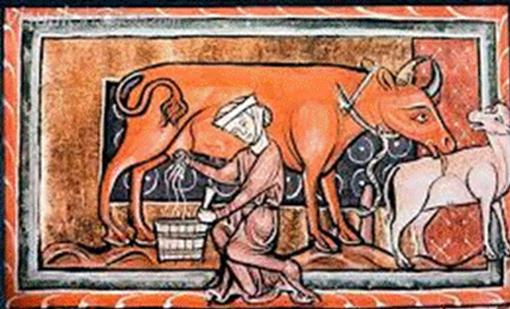
Peasant woman milking a cow, mid Thirteenth Century
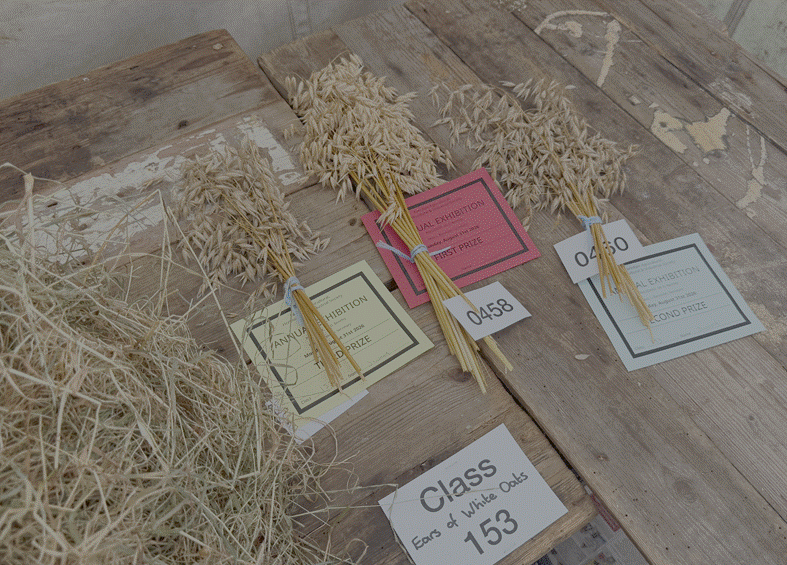
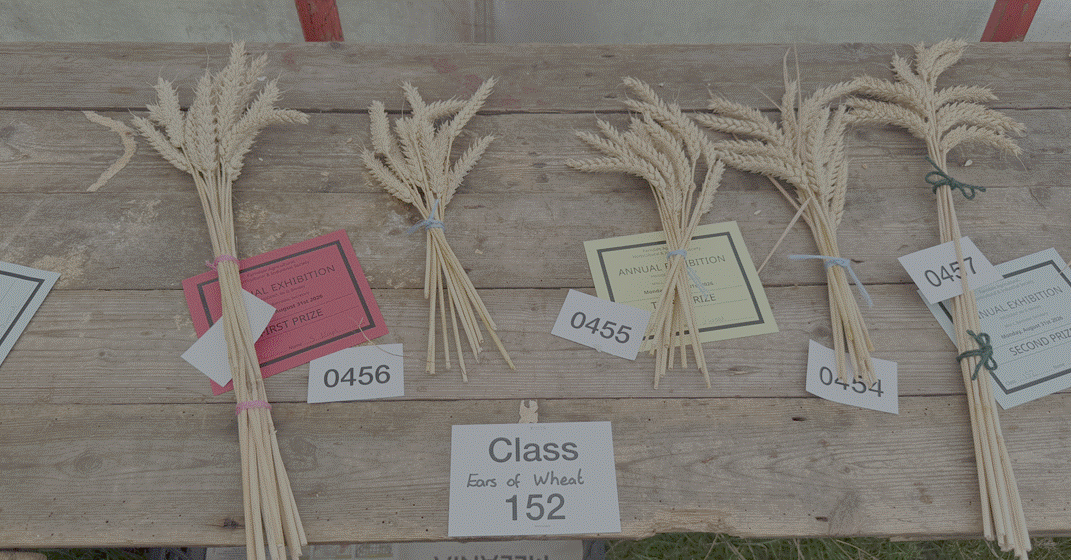
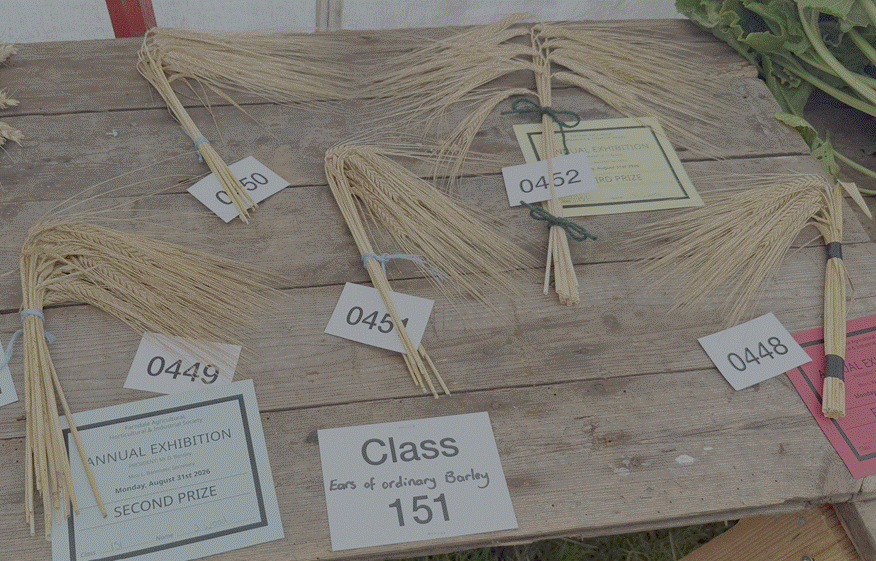
Oats at the Farndale Show 2026 Wheat at the Farndale Show 2026 Barley at the Farndale Show 2026
1236
The Commons Act allowed manorial lords to enclose
common land for their own use.
1270
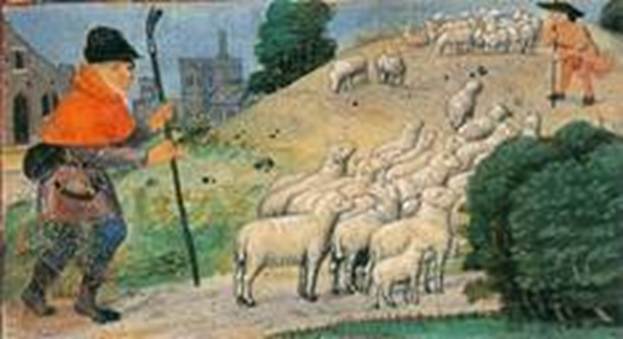
John the shepherd of Farndale must have been a
herdsman by about 1270.
By 1276 there was perhaps 545 acres of cultivated land in
Farndale.
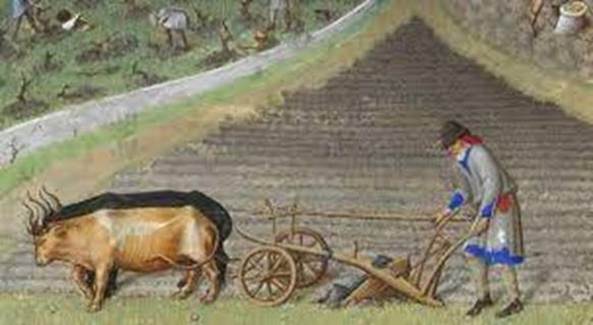
By 1282 there was perhaps 768 acres in cultivation in
Farndale.
‘In a certain dale called Farndale there are
fourscore and ten natives, not tenants by bovate of land, but by, more and
less, whose rents are extended at £38 8s 8d. Each of whom pays at Martinmas two
strikes of nuts, four of the aforesaid tenants only being excepted from the
rent of nuts. Price of nuts as above. Sum of nuts, two and a half quarters and
one strike. Sum in money 43s 9d of whom four score and five shall be harrowing
at Lent according to the size of his holding, that is, for each acre of his own
land a 1/2d worth of harrowing. Those works are extended at 29s 4d. They ought
to be talliated and given pannage as above.
The sum of £1 10s 1d. There are there three tenants in waste places
called Arkeners and Swenekelis, holding ten acres of land, an paying 10s a year and giving nuts worth 18d. The harrowing
is extended at 5d. They are serfs as the aforesaid ones of Farndale. Sum 11s
11d.’
By this time there were some 800,000 oxen and 400,000
horses in England, which enhanced the power of labour some six or seven times.
Wool was the most significant export, with some 12m
fleeces exported each year.
As the population spread into less settled regions,
with poorer soils needing more labour, a collective open field system spread.
Each vill was divided into two or three huge open
fields. One field was left fallow. The fields were ploughed in a ridge and
farrow pattern, with the undulations still visible today, as at Kilton.
Households would own strips of land in each field, but the use of the fields
was well controlled. This open field system reached its peak in the fourteenth
century.
Most
people lived in a village, worshipped in a parish and worked in a manor (Robert
Tombs, The English and their History, 2023, 92).A lord might possess many manors, or one. A manor
operated as a large collective.
Senior
villagers held offices, such as constable or church warden.
About
2/3 of manorial tenants were not free in 1200, but
were villeins or serfs. Villeins usually paid part of their rent in labour.
Strictly, they could not leave the manor without permission. They could be
sold.
The
common law gradually extended to all free men and even unfree men had certain
rights and could even pass on their land to their heirs.
At a
local level, the Lord was the pinnacle of local society and the political,
cultural and economic focal point. Norman feudalism only lasted for about a century and it was replaced by a primitive system of land
tenure. Over time this was increasingly paid for by money rather than service.
The lord provided land, justice and protection. In return the lord expected
obedience and deference; support to profit from the land; and military
assistance when necessary.
By the
1300s landlords comprised about 20,000 individuals and 1,000 institutions (Robert
Tombs, The English and their History, 2023, 94).
1301
By 1301, there was a sizeable agricultural community in
Farndale, with 39 names associated with the place and the identification of
farmed settlements which can still be identified today, including Wakelevedy’ (Wake Lady Green), ‘Westgille’
(West Gill), Monkegate (Monket
House) and ‘Elleshaye (Eller House).
1310
‘In 1310, 20 oxen the property of Nicholas the parker,
worth 8s, 6 oxen and 3 stirks of William in the horn worth £1 9s, a cow and a
stirk of Hugh Laverock 4s 8d and 6 oxen of William Stibbing
de Farndale…….’
1289
In the second half of the thirteenth century there
was a disastrous fall in global temperatures, which led to a succession of storms,
frosts and droughts. The Great Strom of 1289 ruined harvests across the
country.
1290
Real wages fell by about 20% between 1290 and 1350.
Wars in Asia Minor from the 1250s and wear with France disrupted trade.
1309
The Thames froze in 1309 to 1310.
1315
In 1315 to 1316, two years of continual rain ruined
harvests. A great famine across Europe lasted for 7 years.
These were years of perhaps the worst economic
disaster that England has faced. Half a million people died of hunger and disease.
1342
Water levels rose in the lowlands and the banks at
Rillington were raised in 1342 by the monks of Byland Abbey.
1356
The tidal rivers of the Humber rose 4 feet above
average in 1356.
Villein services were being replaced by money dues.
Villeins were replaced by husbandmen and paid rents.
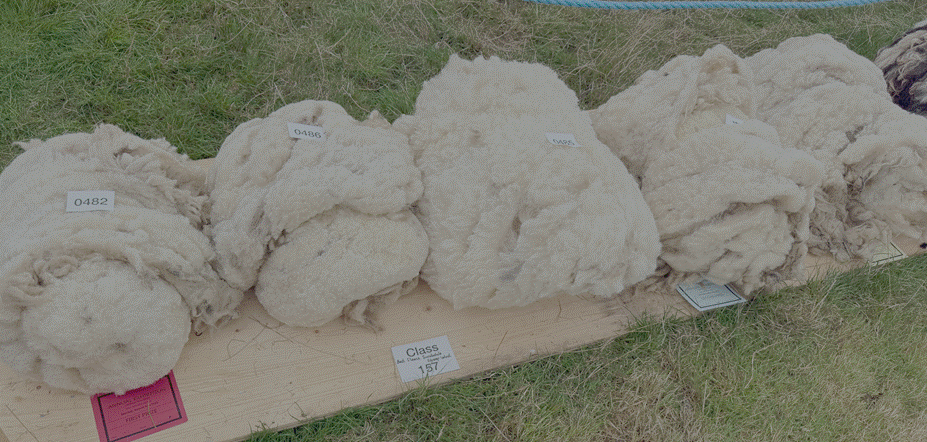
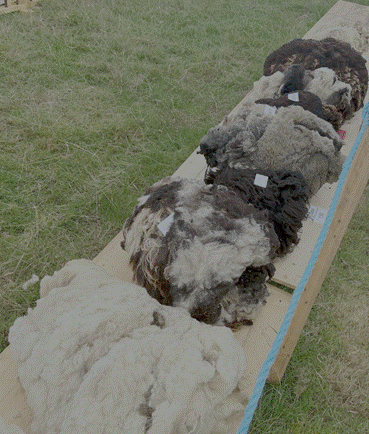
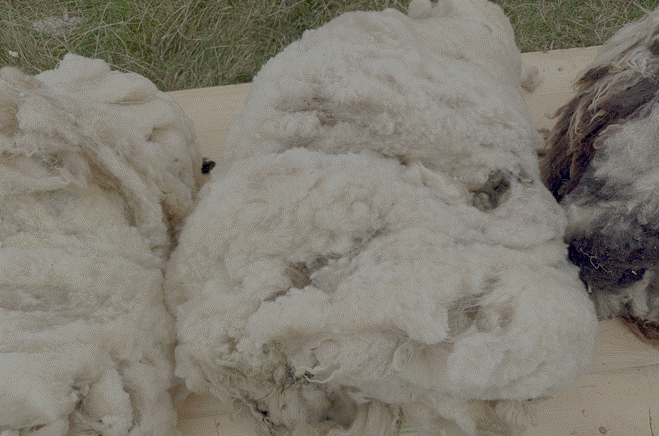
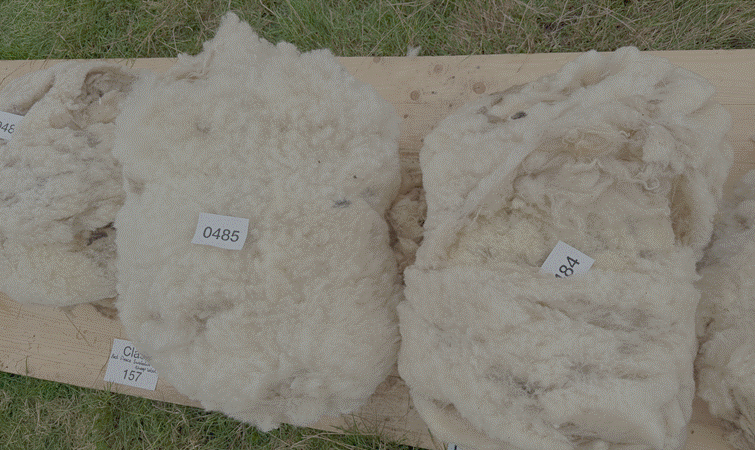
Wool fleece at the Farndale Show, 2026
1349
In 1349 came the Black Death. Indeed
the plague attacked the population four times in thirty years and became
endemic for three centuries.
The reduced population eased the demand on arable crops,
but the market still sought mutton and beef, wool and hides. In sizeable
estates, fields could be allocated for rearing and fattening. Agriculture
became more complex.
Life
as a Medieval Farmer
Many of the folk living in a late medieval village
would have had a one room house. The size of the house, the way it was built,
and the contents reveal the simplicity of the home. The villagers provided most
of what they needed for themselves and their daily
routine was governed by the seasons.
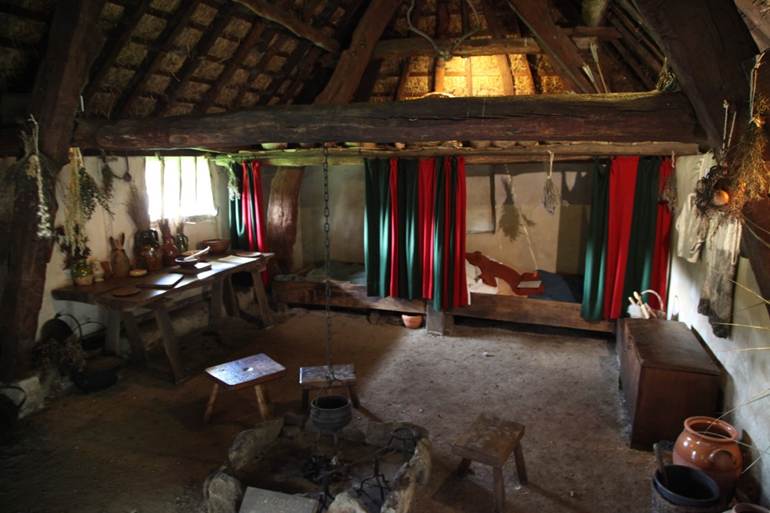
Reconstruction from the Ryedale Folk Museum
The family lived at one end of the building and the
animals, kept for milk, meat and wool, at the other. The hearth, where the
meals were cooked, was the centre of the home. The smoke would escape through
the thatch.
The cottage was also used to store tools and those
used for raking, hoeing, scything and chopping varied little over centuries.
Hay and grain, needed over winter, were stored in the loft and salted meats
hung from the roof beams.
The most precious possessions were stored in wooden chests. All the
furniture could be easily moved to allow the room to be used for other
purposes.
Serfdom
Further
research required.
Tenancy
By the late Victorian period, Lark Rise, Flora Thomson, Chapter I, Poor People’s Houses
: The first charge on the labourers’ ten shillings was house rent. Most of the cottages belonged to small
tradesmen in the market town and the weekly rents ranged from one shilling
to half a crown. Some labourers in other villages worked on farms or
estates where they had their cottages rent free; but the hamlet people did
not envy them, for ‘Stands to reason,’ they said, ‘they’ve allus got to do just what they be told, or out they goes,
neck and crop, bag and baggage.’ A shilling, or even two shillings a week, they
felt, was not too much to pay for the freedom to live and vote as they liked
and to go to church or chapel or neither as they preferred.
Sixteenth Century
Seventeenth Century
Eighteenth century
Enclosures spread rapidly around Malton, for instance at Huttons
Ambo and Appleton le Street.
(Robert Tombs, The English and their
History, 2023, 253).
Local power depended on deference, but by the early eighteenth century,
deference had to be earned. There was a growing confederacy between those
working on the land who increasingly saw the Squire’s property as fair booty
and who colluded to help each other against punishment.
Victorian period
This was a period of exponential growth in the production of coal, pig iron
and the consumption of raw cotton, dwarfing the equivalent in France and
Germany.
The growth in non agricultural production meant
the population had to be fed by imports. Since 1822 Britain’s balance of trade
has remained permanently in deficit. It had to be balanced by invisible
earnings from banking, insurance and shipping, and returns from foreign
investments.
This brought new kinds of wealth (commerce, manufacturing, food and drink,
tobacco) and new wealthy families, like the Rothschilds and the Guinness’s.
Someone of the very richest, like the Duke of Westminster, continued to derive
their wealth from their land holdings, but now because they benefitted from
mineral rights.
There were very significant disparities of wealth:
By 1914, 92% of wealth was owned by 10% of the population.
In the 1860s:
· The population was around 20M.
· 4,000 people had incomes over £5,000 per year.
· 1.4M had around £100.
· A farm labourer might earn £20.
· Women workers earned about half of men’s wages.
There was a rise in wages from mid century, with
a significant rise in 1873.
However in rural areas, wages lagged behind.
Living standard improved with a fall in the birth rate. The sharpest
increase in spending was tobacco – the mechanically produced Wills Woodbines at
1d for five were popular from the 1880s to the 1960s. The consumption of
alcohol fell sharply.
(Robert Tombs, The English and their History, 2023, 477 to 492).
Farming methods
Further
research required.
Rural Life around the
North York Moors
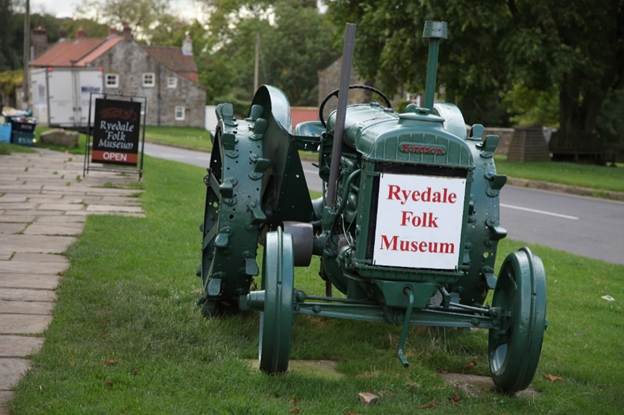
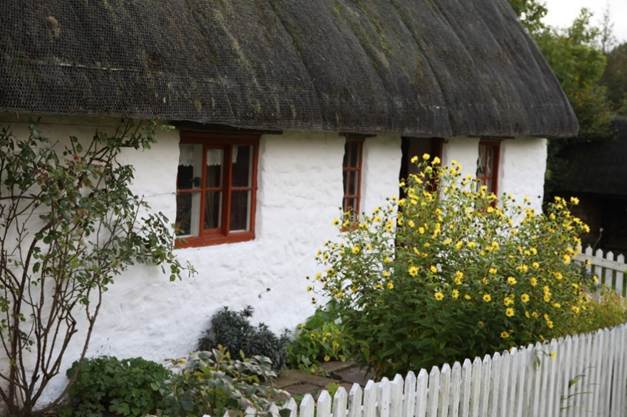
Further research required.
…
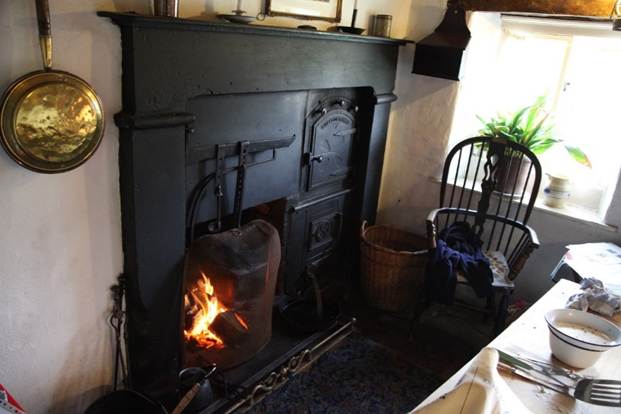
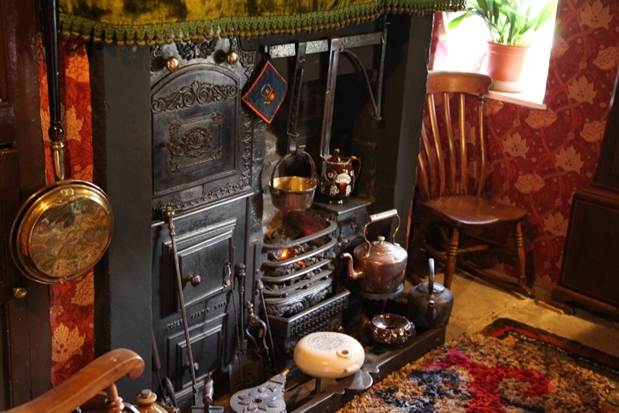
There were many foundries across the North Yorkshire Moors that specialised
in the production of parts for ranges. People could choose features and
even decoration, as they wished – for instance one or two ovens, separate or
combined hearths, a turf plate or coal basket and left or right handed. Complicated flues to alter the draught could be
operated to transfer heat from the main hearth to the ovens to cook.
There
is a manufacturer of wood burning stoves in Pickering which keeps up the
tradition, and they have a Farndale Stove!
…
Supplying water to a nineteenth century house could be a challenge. Few of the poorer
houses had indoor taps and people relied upon communal supplies such as rivers,
wells and springs. Two buckets might be carried with a yoke.
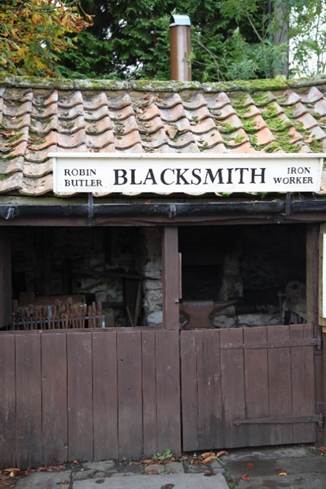
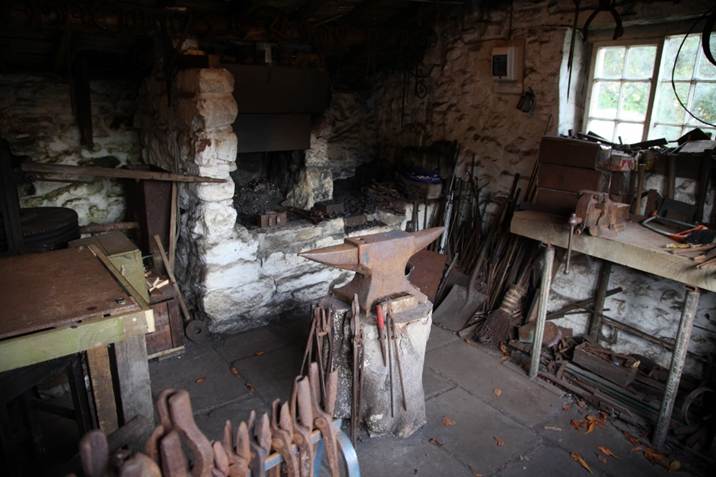
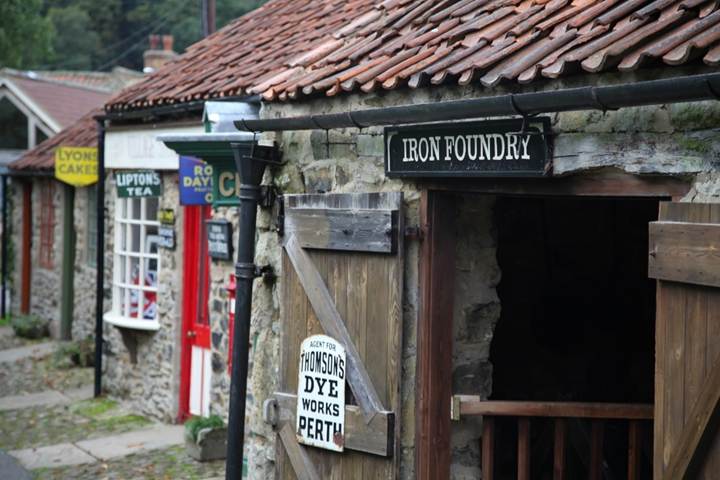
Local rural communities would have relied upon local
businesses
such as blacksmiths and iron foundries, such as these,
reconstructed at the Ryedale Folk Museum near Farndale today.
Agricultural Labourers
In the late Victorian
period …
Lark Rise, Flora Thomson, Chapter III, Men Afield: Very early in the morning,
before daybreak for the greater part of the year, the hamlet men would throw
on their clothes, breakfast on bread and lard, snatch the dinner-baskets
which had been packed for them overnight, and hurry off across fields and over
stiles to the farm. Getting the boys off was a more difficult matter. Mothers
would have to call and shake and sometimes pull boys of eleven or twelve out of
their warm beds on a winter morning. Then boots which had been drying inside
the fender all night and had become shrunk and hard as boards in the process
would have to be coaxed on over chilblains. Sometimes a very small boy would
cry over this and his mother to cheer him would remind him that they were only
boots, not breeches. ‘Good thing you didn’t live when breeches wer’ made o’ leather,’ she would say, and tell him about
the boy of a previous generation whose leather breeches were so baked up in
drying that it took him an hour to get into them. ‘Patience! Have patience, my
son’, his mother had exhorted. ‘Remember Job.’ ‘Job!’ scoffed the boy. ‘What
did he know about patience? He didn’t have to wear no le’ther
breeches.'
The e’ders stooped, had ‘narled
and swollen hands and walked badl’, for they felt the effects of a life
spent out of doors in all weathers and of the rheumatism which tried most
of them.
The men’s incomes were the same to a penny; their circumstances, pleasures, and their
daily field work were shared in common; but in
themselves they differed; as other men of their day differed, in country
and town. Some were intelligent, others slow at the uptake; some were kind and
helpful, others selfish; some vivacious, others taciturn. If a stranger had
gone there looking for the conventional Hodge, he would not have found him.
Their favourite virtue was endurance. Not to flinch from pain or hardship was
their ideal. A man would say, ‘He says, says he, that field o’ oo-ats’s got to come in afore night, for there’s a rain a-comin’. But we didn’t flinch, not we! Got the last
loo-ad under cover by midnight. A’moost too
fagged-out to walk home; but we didn’t flinch. We done it!’ Or,’Ole bull he comes for me, wi’s
head down. But I didn’t flinch. I ripped off a bit o’ loose rail an’ went for
he. ‘Twas him as did th’ flinchin’. He! He!’ Or a woman would say, ‘I set up wi’ my poor old mother six nights runnin’;
never had me clothes off. But I didn’t flinch, an’ I pulled her through, for
she didn’t flinch neither.’ Or a young wife would say to the midwife after her
first confinement, ‘I didn’t flinch, did I? Oh, I do hope I didn’t flinch.’
The farm was large, extending far beyond the parish boundaries; being, in fact, several
farms, formerly in separate occupancy, but now thrown into one and ruled
over by the rich old man at the Tudor farmhouse. The meadows around the
farmstead sufficed for the carthorses’ grazing and to support the store cattle
and a couple of milking cows which supplied the farmer’s family and those of a
few of his immediate neighbours with butter and milk. A few fields were sown
with grass seed for hay, and sainfoin and rye were grown and cut green for cattle
food. The rest was arable land producing corn and root crops, chiefly wheat.
Around the farmhouse were grouped the farm buildings; stables for the great stamping
shaggy-fetlocked carthorses; barns with doors so wide and high that a
load of hay could be driven through; sheds for the yellow-and-blue
painted farm wagons, granaries with outdoor staircases; and sheds for
storing oilcake, artificial manures, and agricultural implements. In the
rickyard, tall, pointed, elaborately thatched ricks stood on stone
straddles; the dairy indoors, though small, was a model one; there was a
profusion of all that was necessary or desirable for good farming.
The field names gave the clue to the fields’ history. Near the farmhouse, ‘Moat Piece’,
‘Fishponds’, ‘Duffus [i.e. dovehouse] piece’,
‘Kennels’, and ‘Warren Piece’ spoke of a time before the Tudor house took the
place of another and older establishment.
One name was as good as another to most of the men; to them it was just a
name and meant nothing. What mattered to them about the field in which they
happened to be working was whether the road was good or bad which led from
the farm to it; or if it was comparatively sheltered or one of those bleak open
places which the wind hurtled through, driving the rain through the clothes to
the very pores; and was the soil easily workable or of back-breaking heaviness or
so bound together with that ‘hemmed’ twitch that a ploughshare could scarcely
get through it.
There were usually three or four ploughs to a field, each of them drawn
by a team of three horses, with a boy at the head of the leader and
the ploughman behind at the shafts. All day, up and down they would go,
ribbing the pale stubble with stripes of dark furrows, which, as the day
advanced, would get wider and nearer together, until, at length, the whole
field lay a rich velvety plum-colour.
The labourers worked hard and well when they considered the occasion
demanded it and kept up a good steady pace at all times.
Some were better workmen than others, of course; but the majority took a pride
in their craft and were fond of explaining to an outsider that field work was
not the fool’s job that some townsmen considered it. Things must be done just
so and at the exact moment, they said; there were ins and outs in good land
work which took a man’s lifetime to learn. A few of less admirable build would boast:
‘We gets ten bob a week, a’ we yarns every penny of
it; but we doesn’t yarn no more; we takes
hemmed good care o’ that!’ But at team work, at least,
such ‘slack-twisted ‘uns’ had to keep in step, and
the pace, if slow, was steady.
Lark Rise, Flora Thomson, Chapter XV, Harvest Home:
After the mowing and reaping and binding came the carrying, the busiest
time of all. Every man and boy put his best foot forward then,
Harvest home! Harvest home!
Merry, merry, merry harvest home!
Our bottles are empty, our barrels won’t run,
And we think it’s a very dry harvest home.
The farmer came out, followed by his daughters and maids with jugs and
bottles and mugs, and drinks were handed round amidst general congratulations.
The harvest home dinner everybody prepared themselves for a tremendous
feast
Agricultural change
Rural society was in
decline during the Industrial revolution.
The enclosure of the land between about 1720 and 1820 divided up the
remaining common land. The agricultural system changed to large scale land
ownership (larger farms supported by fertiliser, artificial feed and
machinery), tenant farming and wage labour.
By about 1850, about 7,000 people and institutions owed 80% of land in the
UK. 360 estates of over 10,000 acres held 25% of the land in England. About 200,000 tenants of relatively large farms
employed over 1.5M people. A third of the population was involved directly or
indirectly in agriculture.
The agricultural workforce peaked in the 1850s.
The Corn Laws did not have an immediate effect, but railways and steamships
and later refrigeration, brough imports of wheat and later livestock from North
America, Russia, Canada, and then Argentina, Australia and New Zealand. In 1880
frozen Australian beef sold at Smithfield at 5 ½ d a pound. Meat consumption increased.
New eating habits emerged – fish and chips were born in Oldham in the 1860s.
These new trends led to a Great Depression in agriculture during the late nineteenth century which is usually dated from 1873 to
1896.
Farmers shifted from cereals towards milk, meat, fruit and vegetables.
A typical farmer employed 5 or 6 people in 1851, but 2 or 3 in 1901, assisted
by mechanisation and new methods. Rural England lost 4M people between 1851 and
1911. The repeal of the Corn Laws in 1846 was only revered by Britain’s
accession to the European Common Agricultural Policy (“CAP”) in 1873 so
that home grown temperate produce was over 90% of consumption in 1830, fell to
40% by 1914, and rose back to 90% during the period of the CAP.
Cheap food had economic benefits, but was
traumatic alongside the loss of the common land which had traditionally helped the
rural poor.
By the nineteenth century, rural workers were dependent on wages at a time
of downward pressure on agricultural prices.
The revolt of the field in 1872 to 1873, led by Joseph Arch sought an elevation in the status of the agricultural labourer.
The landlords took some of the strain – rents fell by a third between 1870
and 1900. Landlords sought to protect the political and social influence of
their ownership of land and subsidised their estates, but there was the start
of a trend to sell off estates of land.
There remained a sentiment of rural England, but no political will to
protect it:
· The Commons Preservation Society 1865
· The English Dialect Society 1873
· The Society for the Preservation of Ancient Buildings 1877
· The Folklore Society 1878
· The Lake District Defence Society 1883
· The Society for the Protection of Birds 1889
· The National Trust for Places of Historic Interest or
Natural Beauty 1895
· The Folk Song Society 1898
· The English Folk Dance Society 1911
· The National Trust Act 1907 allowed the Trust to declare land inalienable.
In many cases, these new organisations were largely driven by the provision
of amenity for town dwellers.
(Robert Tombs, The English and their History, 2023, 486 to 489).
By 1870 John Farndale was writing about the dramatic impact of agricultural change
on the rural landscape of Kilton. Realising the profound effect of change on
his homeland, he has recorded the events which occurred in his native place,
Kilton and the neighbourhood, and which took place when spinning wheels ad
woollen wheels were industriously used by every housewife in the district, and
long before there were such things in the world as Lucifer match boxes and
telegraphs, or locomotives built to run, without horse or bridle, at the astonishing
rate of sixty miles an hour (Guide to Saltburn by the Sea and the Surrounding District, John Farndale,
1870). Kilton had started to realise the impacts of the "monstre farm" and the Industrial Revolution. "And
now dear Farndale, the best of friends must part, I bid you and your little
Kilton along and final farewell. Time was on to all our precious boon, Time is
passing away so soon, Time know more about his vast eternity, World without end
oceans without sure."
In his depictions of rural life in semi-fictional Wessex, Thomas Hardy has sometimes been charged with romanticising rural life and portraying
the pastoral instead of the real. His characters frequently inhabit
agricultural communities, which form the basis of their lives and livelihoods.
In tension with the pastoral, romanticised village is the recognition of agriculture
as a capitalist venture: Hardy’s writings capture the end of the old sense of
land as a natural relative and the shift to land as an exploitable resource.
A E Housman’s A Shropshire Lad 1896:
X
Into my heart an air that kills
From yon far country blows:
What are those blue
remembered hills,
What spires, what farms are those?
That is the land of lost content,
I see it shining plain,
The happy highways where I went
And cannot come again.
There was a pastoral air to the music of Edward Elgar, Frederick Delius,
Ralph Vaughan Williams, but it was not as richly pastoral as Hungarian, Czech,
Finnish and Russian music. It was rooted in a world culture and even Elgar drew
on European folk traditions.
There was a stubborn emotional attachment to the rural past, but the
political will was firmly fixed on an industrial future.
Lark Rise, Flora Thomson, Chapter IV, At the ‘Wagon
and Horses’: All times are times of
transition; but the eighteen-eighties were so in
a special sense, for the world was at the beginning of a new era, the
era of machinery and scientific discovery. Values and conditions of life
were changing everywhere. Even to simple country people the change was
apparent. The railways had brought distant parts of the country
nearer; newspapers were coming into every home; machinery was superseding hand
labour, even on the farms to some extent; food bought at shops, much of it from
distant countries, was replacing the home-made and home-grown. Horizons were
widening; a stranger from a village five miles away was no longer looked upon
as 'a furriner'. But, side by side with these changes, the old country
civilization lingered. Traditions and customs which had lasted for
centuries did not die out in a moment. State-educated children still
played the old country rhyme games; women still went leazing,
although the field had been cut by the mechanical reaper; and men and boys still
sang the old country ballads and songs, as well as the latest music-hall
successes. So, when a few songs were called for at the 'Wagon and Horses', the
programme was apt to be a curious mixture of old and new.
Lark Rise, Flora Thomson, Chapter III, Men
Afield: Machinery was just
coming into use on the land. Every autumn appeared a pair of large traction
engines, which, posted one on each side of a field, drew a plough across
and across by means of a cable. These toured the district under their
own steam for hire on the different farms, and the outfit included a small
caravan, known as 'the box', for the two drivers to live and sleep in. In
the 'nineties, when they had decided to emigrate and wanted to learn all that
was possible about farming, both Laura's brothers, in turn, did a spell with
the steam plough, horrifying the other hamlet people, who looked upon such
nomads as social outcasts. Their ideas had not then been extended to include
mechanics as a class apart and they were lumped as inferiors with sweeps and
tinkers and others whose work made their faces and clothes black. On the other
hand, clerks and salesmen of every grade, whose clean smartness might have been
expected to ensure respect, were looked down upon as 'counter-jumpers'.
Their recognized world was made up of landowners, farmers, publicans, and
farm labourers, with the butcher, the baker, the miller, and the grocer as
subsidiaries.
Such machinery as the farmer owned was horse-drawn and was only in partial use. In some fields
a horse-drawn drill would sow the seed in rows, in others a human sower would walk up and down with a basket suspended from
his neck and fling the seed with both hands broadcast. In harvest time the
mechanical reaper was already a familiar sight, but it only did a small part of
the work; men were still mowing with scythes and a few
women were still reaping with sickles. A thrashing machine on hire went from farm
to farm and its use was more general; but men at home still thrashed out their
allotment crops and their wives' leazings with a
flail and winnowed the corn by pouring from sieve to sieve in the wind.
The path to modern
farming
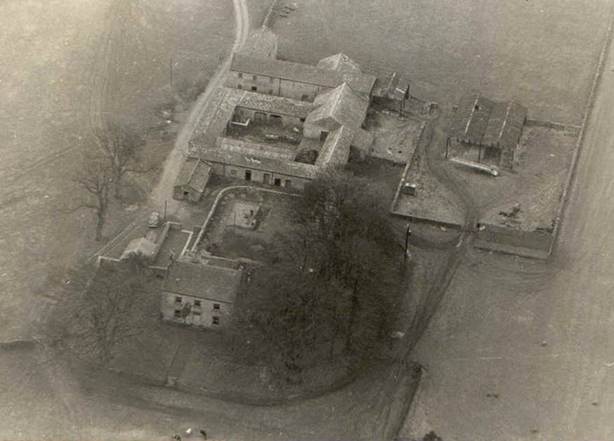
Gale Bank Farm, Wensley where Alfred and Geoff
farmed.
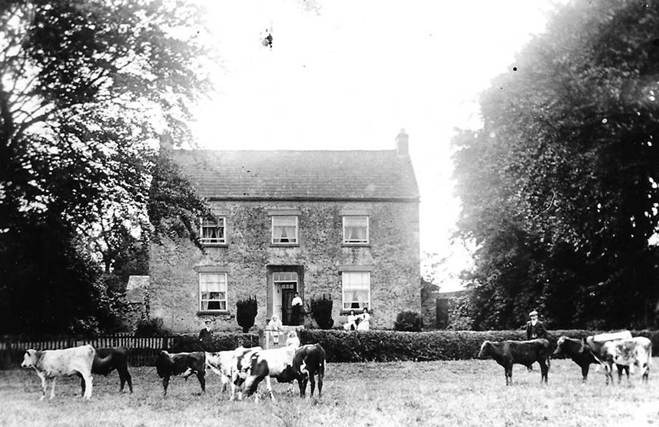
Gale Bank Farm early twentieth century
Bibliography
|
|
|