Farndales and Mining
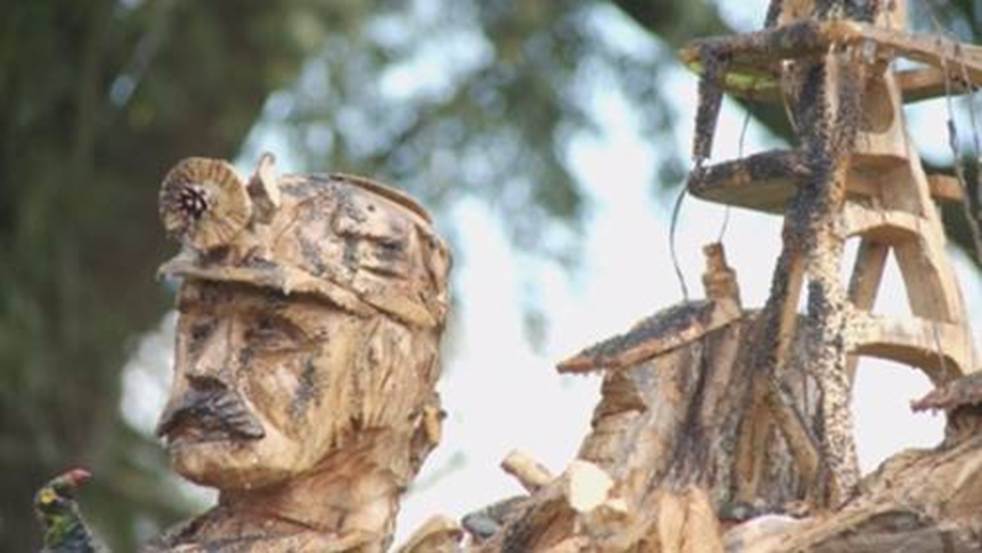
On this page we explore the many Farndales who mined, mainly
for ironstone, in Cleveland
|
Return to the Home Page of the Farndale Family
Website |
The story of one family’s journey through two
thousand years of British History |
The 83 family lines into which the family is divided.
Meet the whole family and how the wider family is related |
Members of the historical family ordered by date of
birth |
Links to other pages with historical research and
related material |
The story of the Bakers of Highfields, the Chapmans,
and other related families |
Hyperlinks to other pages are in dark blue.
Headlines are in brown.
References and citations are in turquoise.
Context and local history are in purple.
This webpage is divided into the following sections:
· Farndales and
Mining
· The Kilton Mines
· Ironstone mining
at Great Ayton
· Mining in
Cleveland
· Mining Life
· Alum Mining
· Jet Mining
· Whinstone
quarrying
The Farndales and Mining
William Farndale
was a mine labourer in the Loftus area and an ironstone miner (FAR00260).
Thomas Farndale was a miner in Bishop Auckland (FAR00280). William Farndale was a jet miner at Eston (FAR00283).
John H Farndale was a miner of West Hartlepool who was killed aged 37 by a fall
of iron stone at the Poston Mines, Ormsby, Middlesbrough (FAR00302). John
Farndale was an ironstone miner in Ormesby (FAR00328). George
Farndale was an ironstone miner of Loftus (FAR00350C).
Martin Farndale of Tidkinhow was a miner for a time (FAR00364). John
Farndale was a miner of Egton (FAR00387).
The Kilton Mines
Further research
to follow.
The Kilton Mines
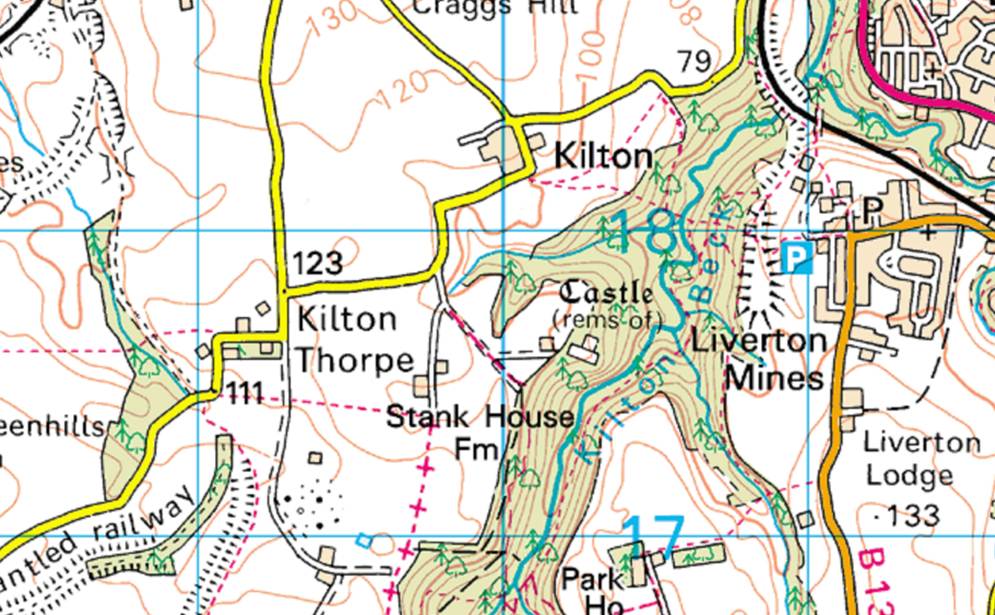
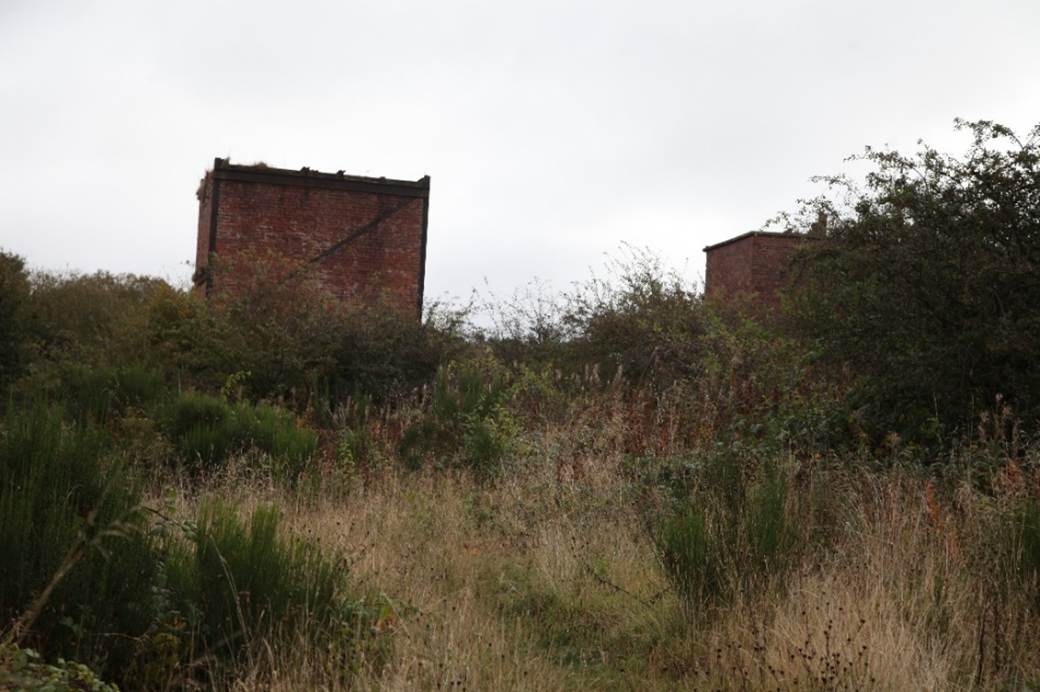
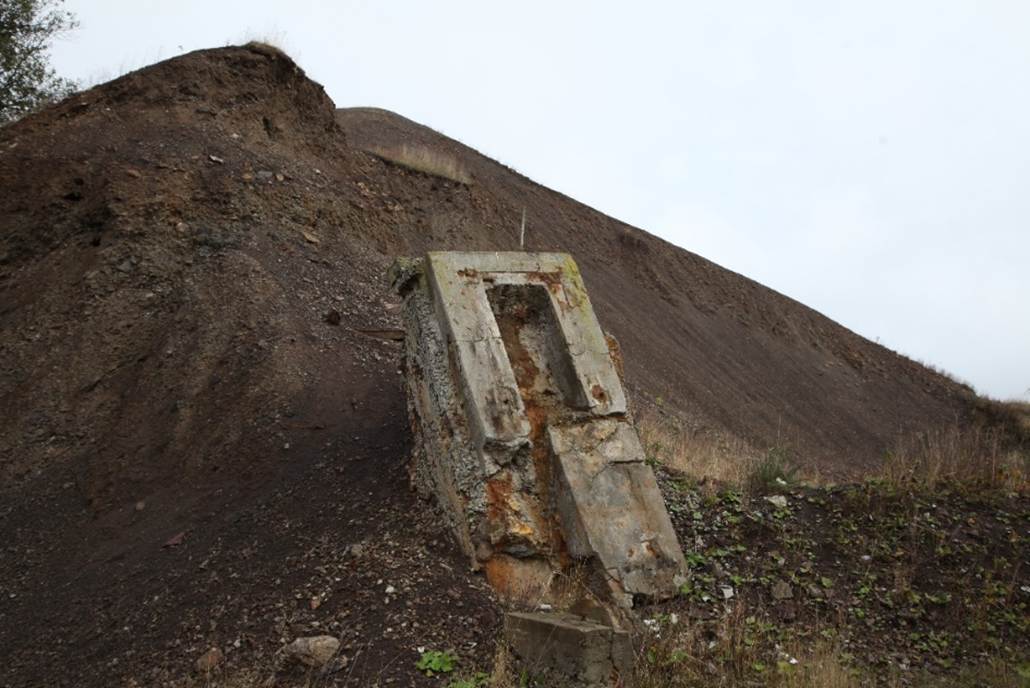
The Kilton mines were sited to the south of Kilton Thorpe and were opened
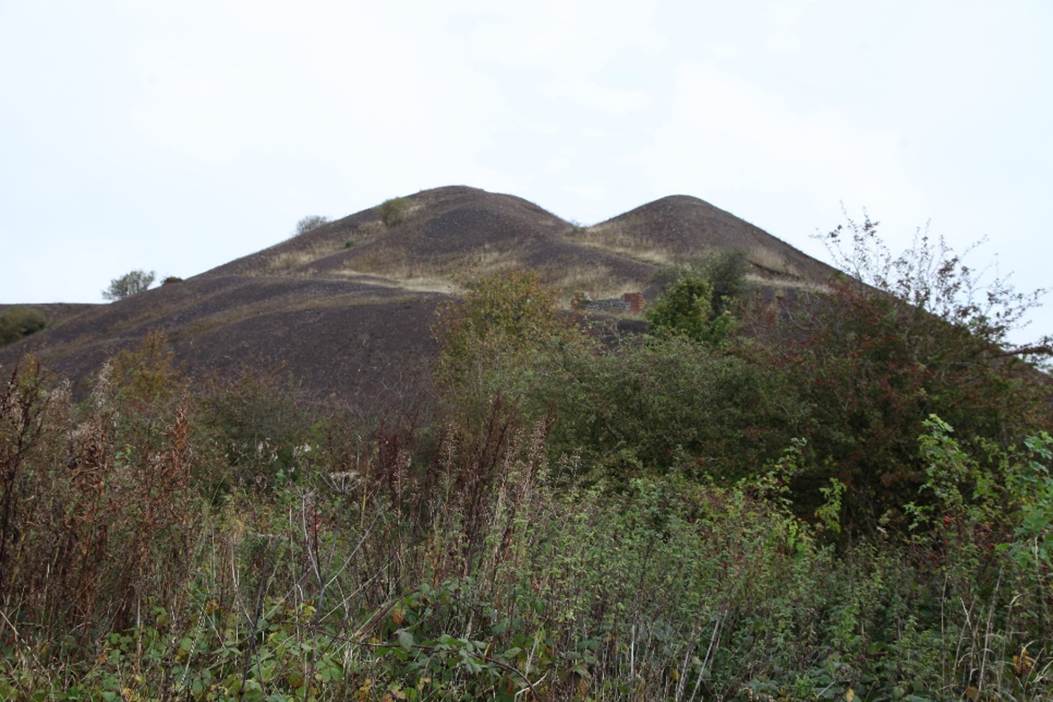
in 1871. A large spoil tip continues to dominate the skyline. Both Kilton and Lumpsey mines were served by railways and the abandoned
embankments and cuttings of the railways are still visible. The mines finally
closed in 1963.

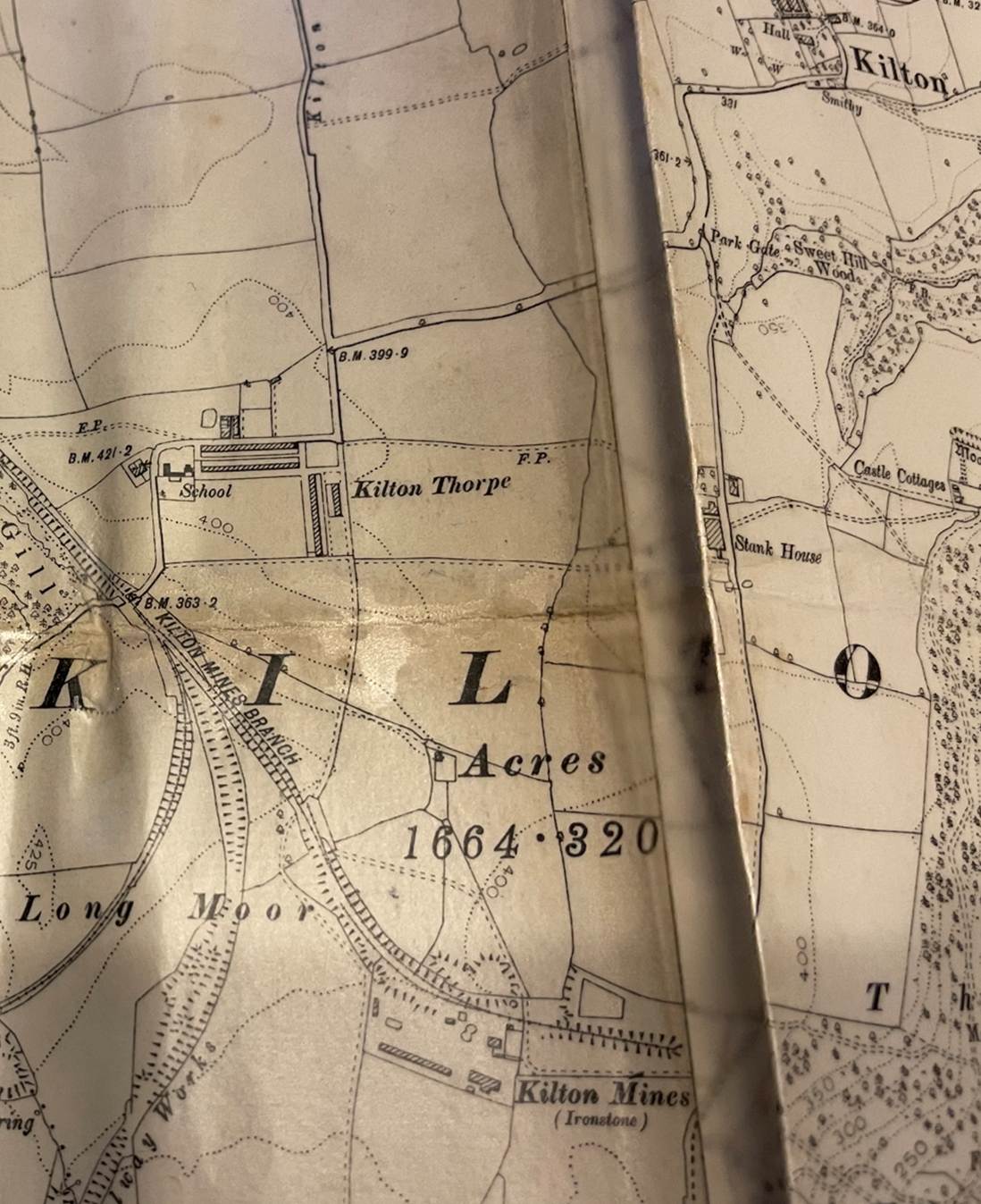
Kilton Mines, south of Kilton Thorpe in 1893
Lumpsey
The establishment
of an ironstone mine in this area in the late nineteenth century led to the
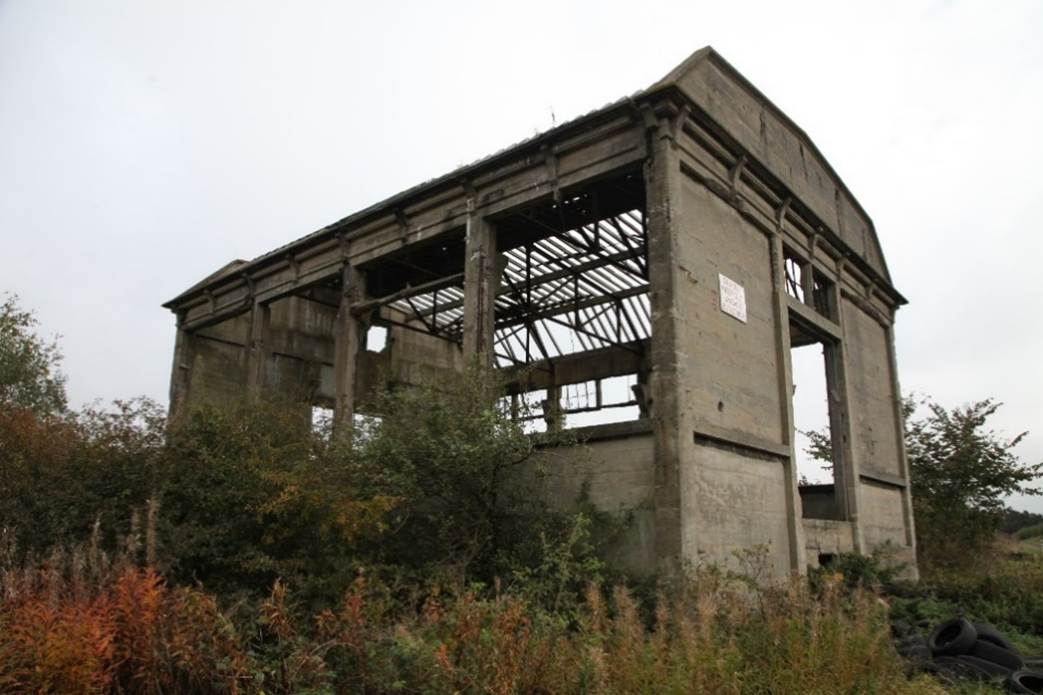
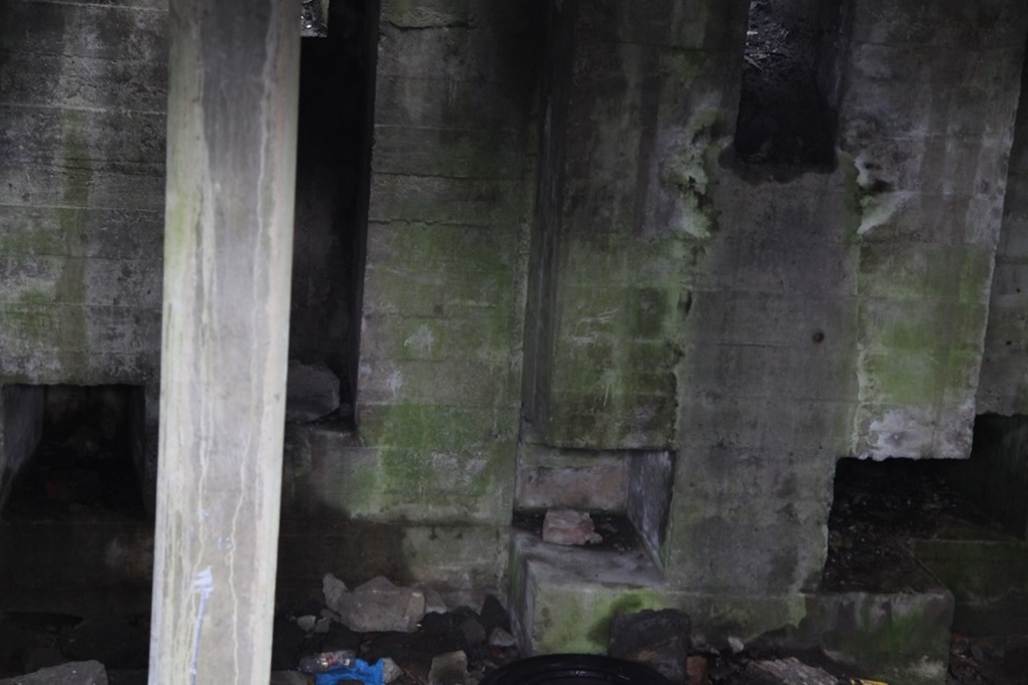
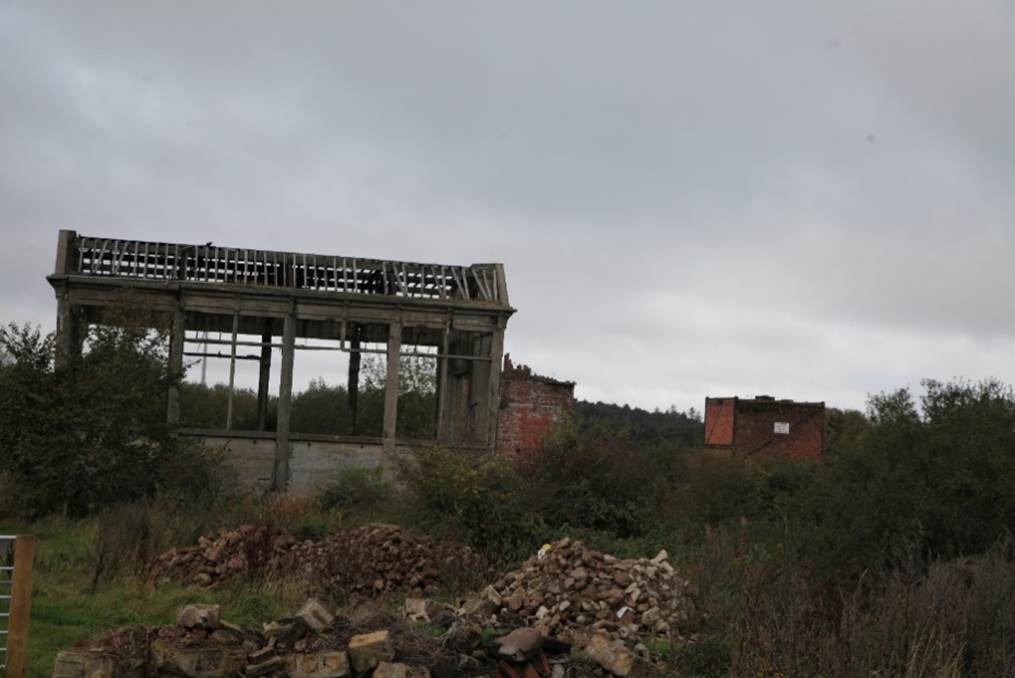
destruction of the farm and no buildings survive. The Lumpsey
mine was opened in 1881, after the shafts were first sunk in 1880. The
ironstone companies had followed the veins south and east from the Eston hills.
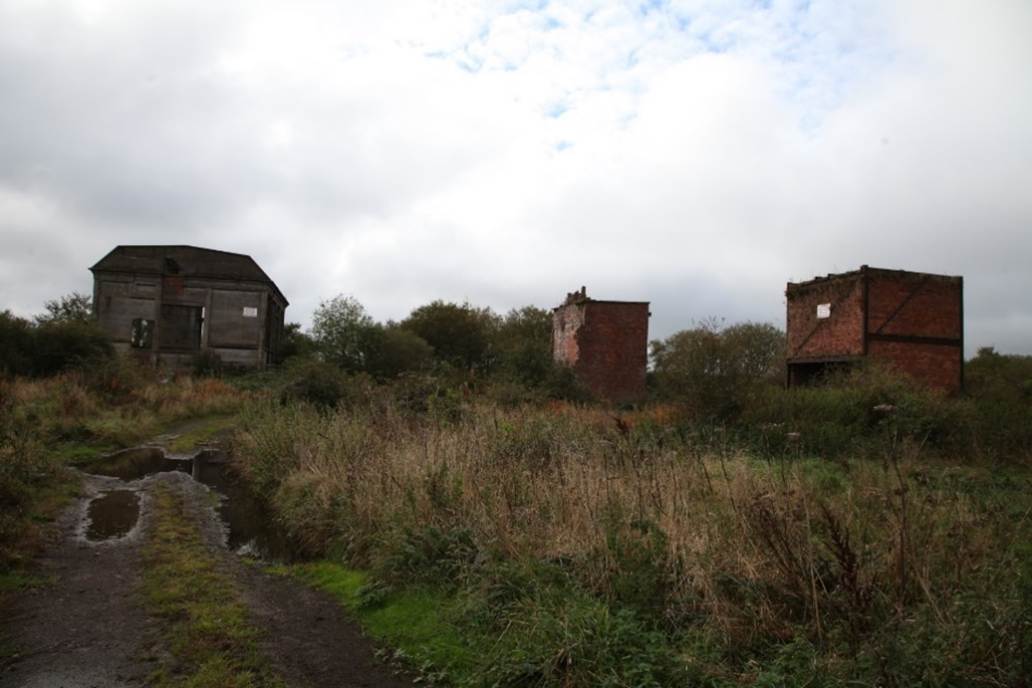
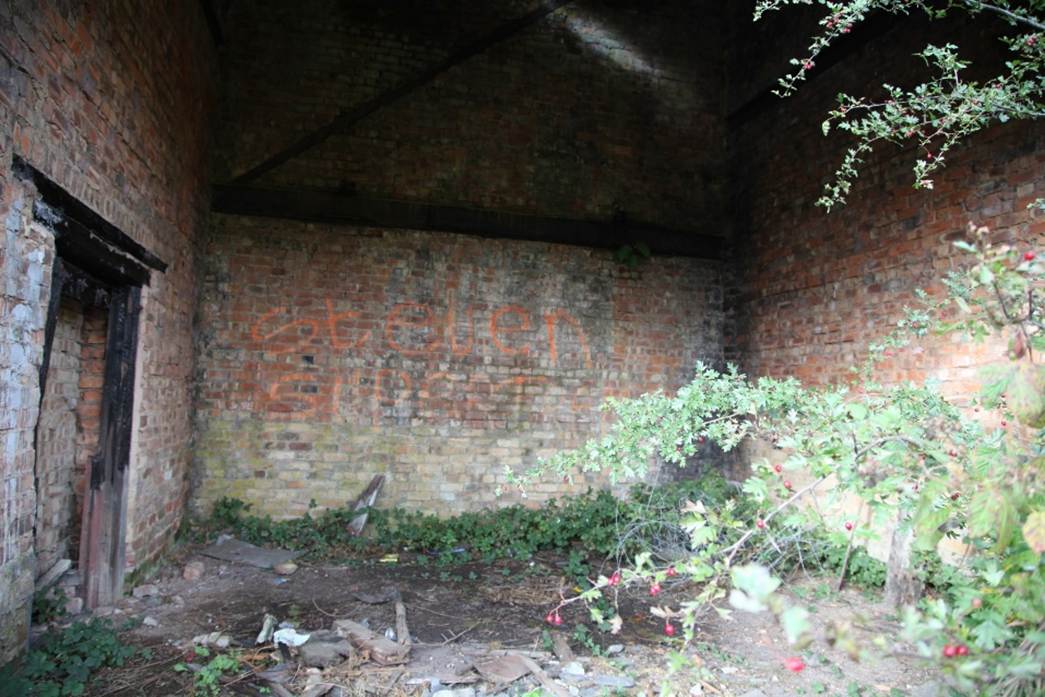
The mine occupied the former site of Lumpsey farm and
consequently no traces were left of the farm. The mine closed in 1954 but a
number of the mine buildings still survive.
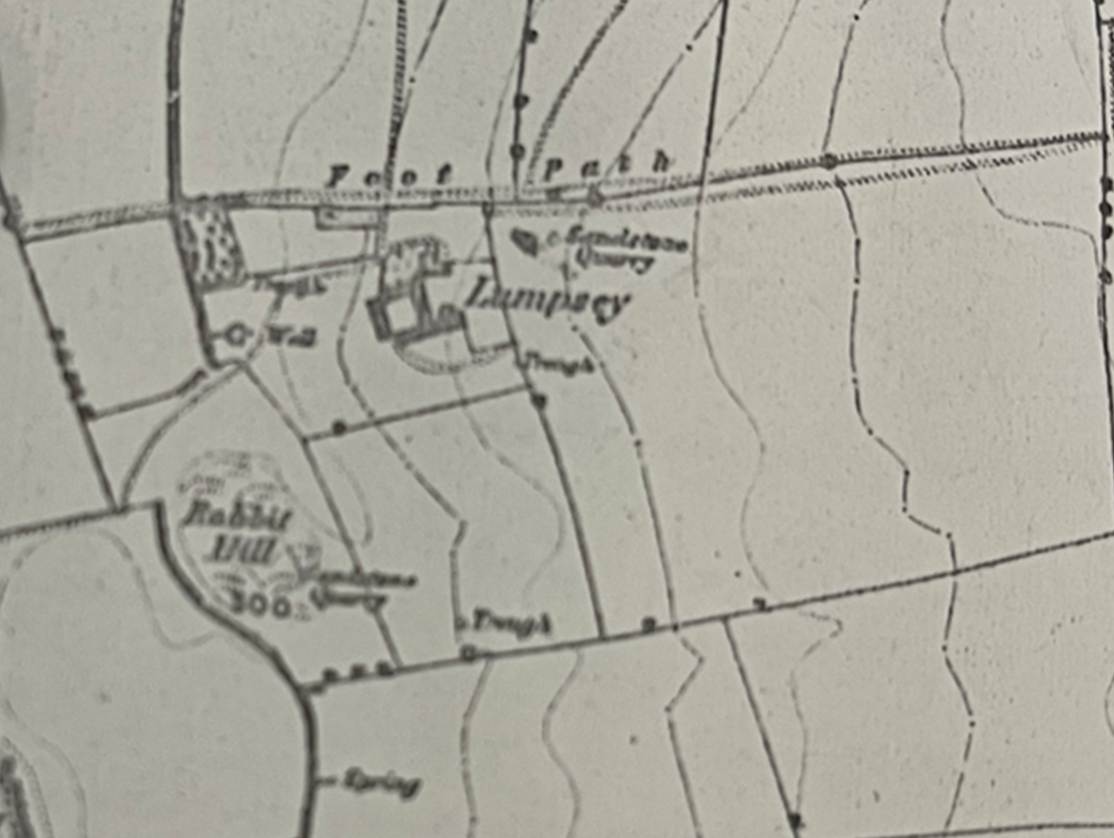
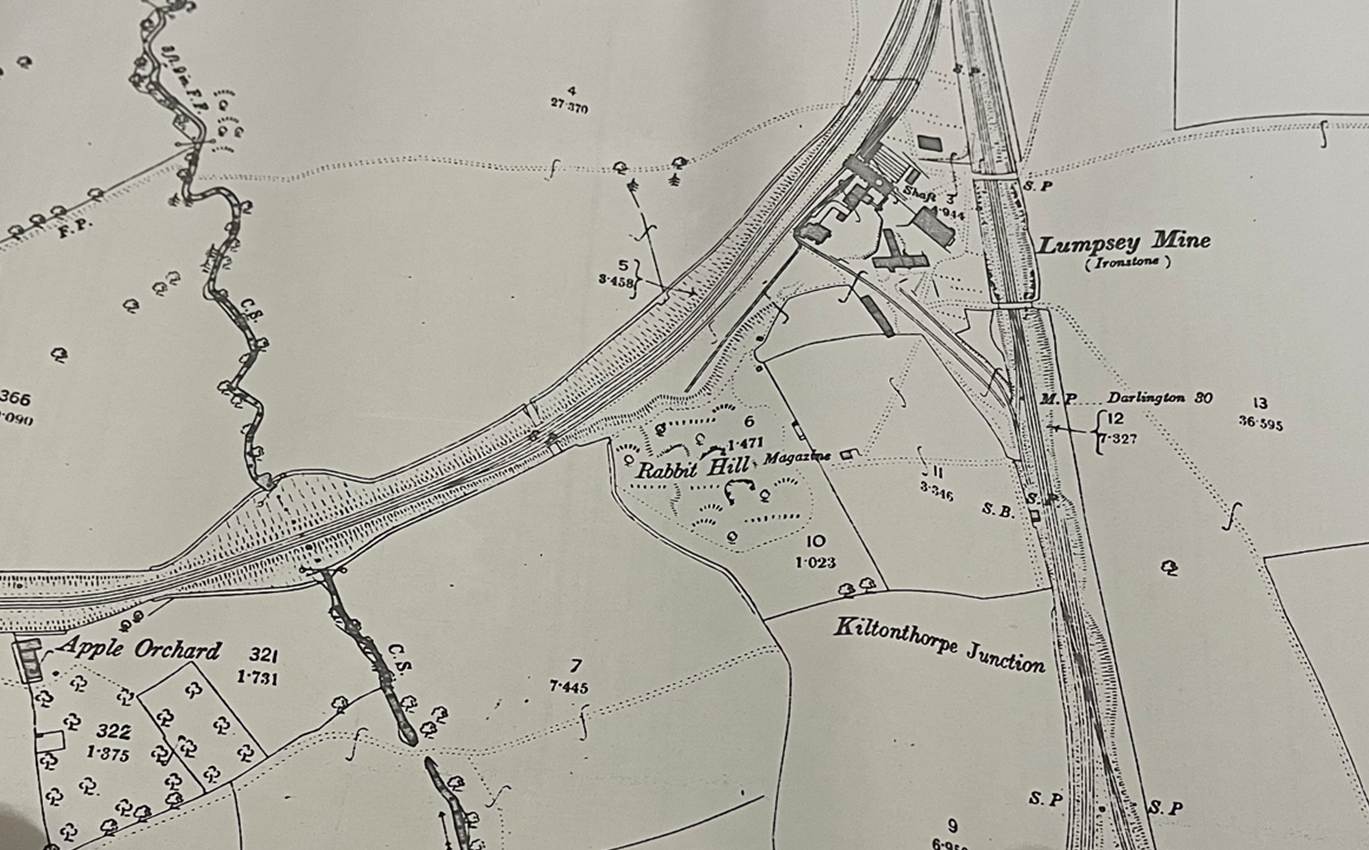
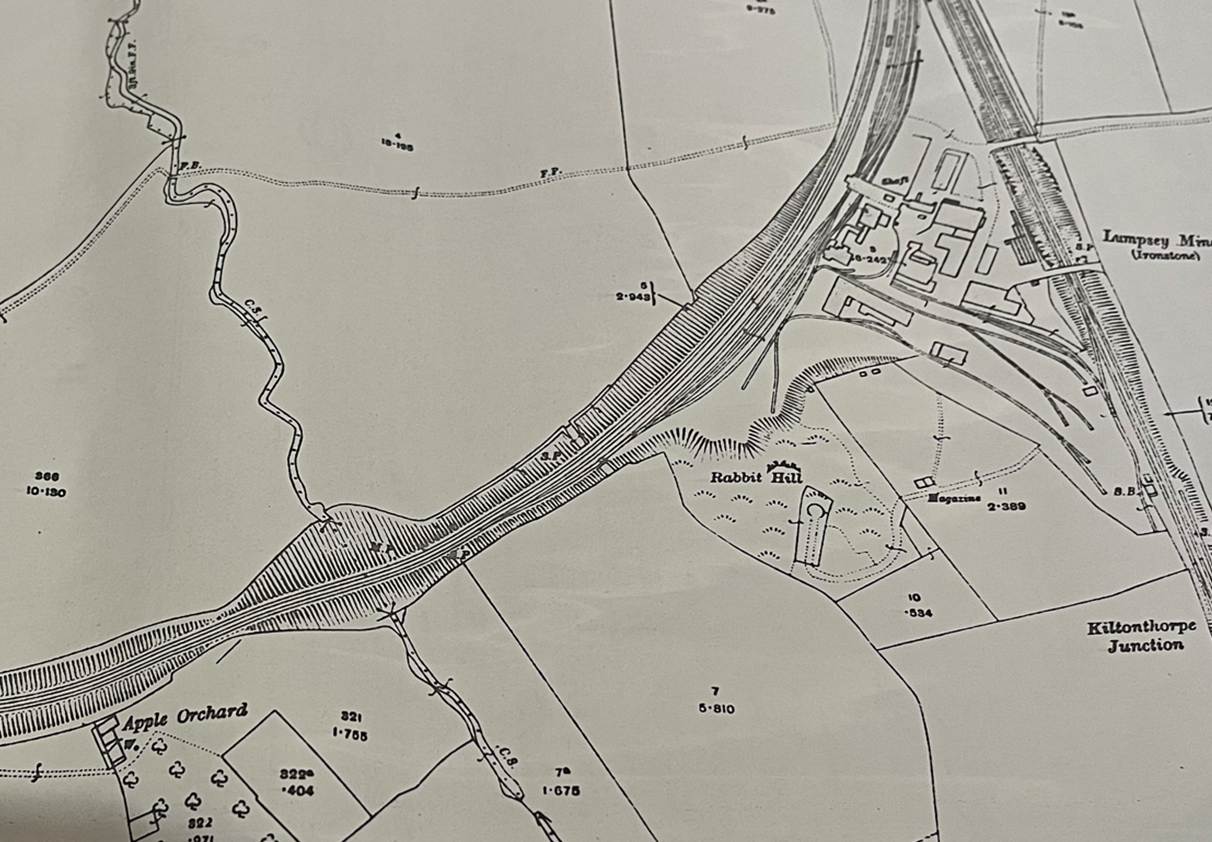
Lumpsey, 1853
Lumpsey Mines by 1893
Lumpsey Mines in 1913
Ironstone mining at Great
Ayton
There
were three ironestone mines around Great Ayton by the time of World War 1.
Griddale or Ayton Banks was a small concession operated from 1910 to 1921 by
Tees Furnace Company (OS Grid NZ 586110). The mine worked the Peckten seam of
ironstone was named after the type of fossil found in the ore. The site was not
accessible even for a narrow guage railway, so an overhead cable way was
constructed, carried on metal pillars supported by concrete bases, some of
which can still be seen.
The
ironstone was mined by drifts (“adits”) in Ayton, almost exclusively from the
main seam, which was the last of the beds to be laid down. Three mines operated
in the first thirty years of the twentieth century – Rosebury, Ayton Banks and
Ayton (Monument) Mine. They used the pillar and board method of working. The
Ayton mine workings were extensive, sgtretching as far as a second entrance
north of Ayton Banks Farm. The ore from Roseberry and Ayton mines was taken by
tramway to the main railway line. Ayton Banks ironstone was sent by aerial
ropeway to the railhead.
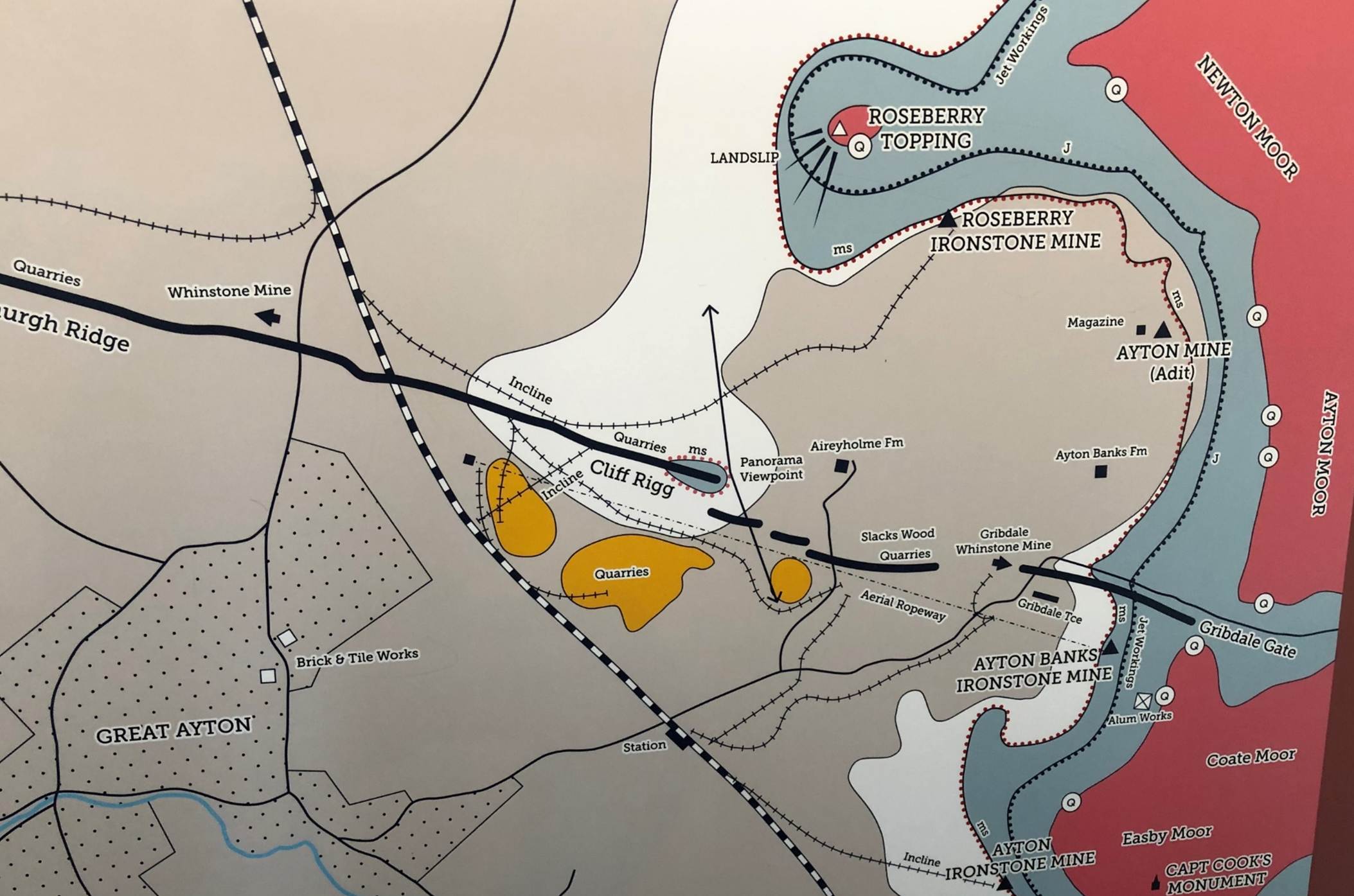
The mines at
Great Ayton
Mining in Cleveland
Ironstone
comprises iron-bearing minerals in which other elements, such as silicon, are
in chemical combination. The iron content is generally low at about 30%. Two
major minerals are siderite (iron carbonate) and bethierine
(iron silicate). The minerals were formed biochemically on the sea floor from
iron either dissolved or suspended in seawater, which was in turn derived from
a nearby shore.
The economic
value of ironstone depended on (1) the iron content; (2) the thickness of the
seam; (3) the presence of shale within the seam; and (4) the content of deleterous elements, particularly sulphur.
Between 206 and
150 Million Years, in the Jurassic era, the rocks forming the Cleveland Hills
were deposited in a warm, shallow sea, which was later the site of a river
delta. Over geological time, these sediments were compacted to form mudstones,
shales, siltstones and sandstones. Of importance to us is the Cleveland
Ironstone Formation, in the Lower Jurassic, which is around 29 metres of shales
with silty shales and with hard beds of sideritic and chamositic
ironstone. There are five main iron-rich horizons, or seams, as follows from
the lowest upward: Avicula, Raisdale,
Two Foot, Pecten and Main Seam. Higher parts of the Jurassic sequence include
the Jet Formation, Alum Shales and sometimes coal seams, all of which had an
economic value.
The Cleveland
Orefield extends over 1,000 square kilometres. The most important Main Seam was
up to 5 meres in thickness at Eston and then thinned southwards. The Loftus
Mine is less then 3 metres. The shale line where shale first appears extends
across the Loftus lease, so that as mining proceeded it became necessary to
separate this out as waste. The typical iron content of Loftus was about 28%,
which was distinctly less than the Eston mines.
Iron
Age
The iron stone
industry began in the Iron Age and continued to the present. There are examples
of ancient stone quarries and those at Malton and Pickering were larger mines
continued from Roman times.
Norman
Mining
The Rievaulx quarries were supported by the diversion of
the water course to help with the movement of the stone to the monastery.
Industrial
Revolution
The Tees Valley
was the powerhouse of the Industrial
Revolution and the British Empire. At its peak, eighty three ironstone
mines dispatched iron worldwide, to make railways and bridges across Europe,
America, Africa, India and Australia (including the Sydney Harbour Bridge).
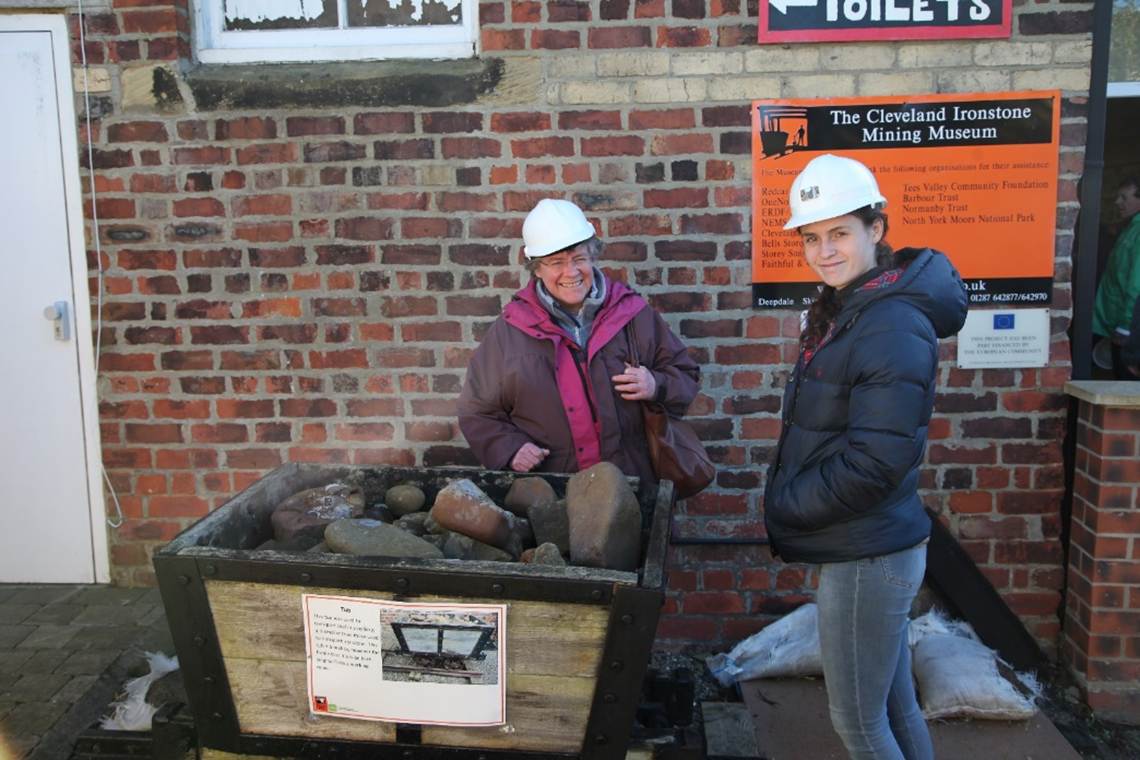
The Cleveland Ironstone Mining Museum is
situated on the site of Loftus Mine, the first mine to be opened in Cleveland.

Ironstone had
long been exploited in the area. There are, for example, extensive heaps of
slag around Rievaulx Abbey, which was supressed in December 1538. The abbey and
its ironworks were acquired by the earl of Rutland who continued working the
ironworks. By 1545, four furnaces were smelting iron ore under the management
of John Blackett, the vicar of Scawton. The vaulted undercroft of the refectory was used to store the charcoal
used as fuel. A blast furnace was added in 1577 and a forge was re-equipped between
1600 and 1612. Local supplies of timber for charcoal were all but exhausted by
the 1640s, however, and the ironworks closed. Other remains from this period
are found in Bilsdale, Bransdale, Rosedale and near Furnace House in Fryup Dale. Many of these early working appear to have
concentrated on the Dogger Seam.
There were
various attempts to mine ironstone in the early nineteenth century, with ore
being quarried on the coastal outcrops. The Pecten seam was discovered at Grosmont during the making of a cutting for the Whitby and
Pickering Railway and the newly formed Whitby Stone Company sent a cargo of
ironstone to the Birtley Iron Company in 1836. It was rejected as being of poor
quality, and it took the company some time to get its product right.
Nevertheless, the following year the two companies agreed a sales contract.
The Mining
and Collieries Act 1842 prohibited all underground work for women and
girls, and for boys under 10.
On 7 August 1848,
the first mine in Cleveland opened in Skinningrove.
It was not until
August 1850 that Bolckow & Vaughan made a trial
of the Main Seam by quarrying near Eston. Soon the workings moved underground,
using pillar and stall, and became very large scale with over half a million
tons of ironstone was raised annually in the mid 1850s.
John Farndale wrote in 1870: Long
live Messrs Bolcklow & Vaughan, the first high
spirited gentlemen, and others also, who by their skill and capital are
bringing out resources of this greatly favoured district, and thus giving
employment to thousands.
Bolckow, Vaughan & Co Limited was an English ironmaking
and mining company founded in 1864 with capital of £2.5M, making it the largest
company ever formed up to that time.
It
was founded as a partnership in 1840 by Henry Bolckow and John Vaughan. In
1846, Bolckow and Vaughan built their first blast
furnaces at Witton Park, founding the Witton Park Ironworks. The works used
coal from Witton Park Colliery to make coke, and ironstone from Whitby on the
coast. The pig iron produced at Witton was transported to Middlesbrough for
further forging or casting. In 1850, Vaughan and his mining geologist, John
Marley discovered iron ore, conveniently situated near Eston in the Cleveland Hills.
Unknown to anyone at the time, this vein was part of the Cleveland Ironstone
Formation, which was already being mined in Grosmont
by Losh, Wilson and Bell. To make use of the ore being mined at Eston, in 1851 Bolckow and Vaughan built a blast furnace at nearby South
Bank, Middlesbrough, to make use of the ore from nearby Eston, enabling the
entire process from rock to finished products to be carried out in one place.
It was the first to be built on Teesside, on what was later nicknamed "the
Steel River".
Middlesbrough
grew from 40 inhabitants in 1829 to 7,600 in 1851, 19,000 in 1861 and 40,000 in
1871, fuelled by the iron industry. The firm drove the dramatic growth of
Middlesbrough and the production of coal and iron in the north-east of England
in the nineteenth century.
By
1864, the assets of the business included iron mines, collieries, and limestone
quarries in Cleveland, County Durham and Weardale and had iron and steel works
extending over 700 acres (280 ha) along the banks of the River Tees.
Vaughan
died in 1868. The Institution of Civil Engineers, in their obituary, commented
on the relationship between Vaughan and Bolckow:
"There was indeed something remarkable in the thorough division of labour
in the management of the affairs of the firm. While possessing the most
unbounded confidence in each other, the two partners never interfered in the
slightest degree with each other's work. Mr. Bolckow
had the entire management of the financial department, while Mr. Vaughan as
worthily controlled the practical work of the establishment."
Chris
Scott Wilson has written more about Bolckow, Vaughan
& Co.
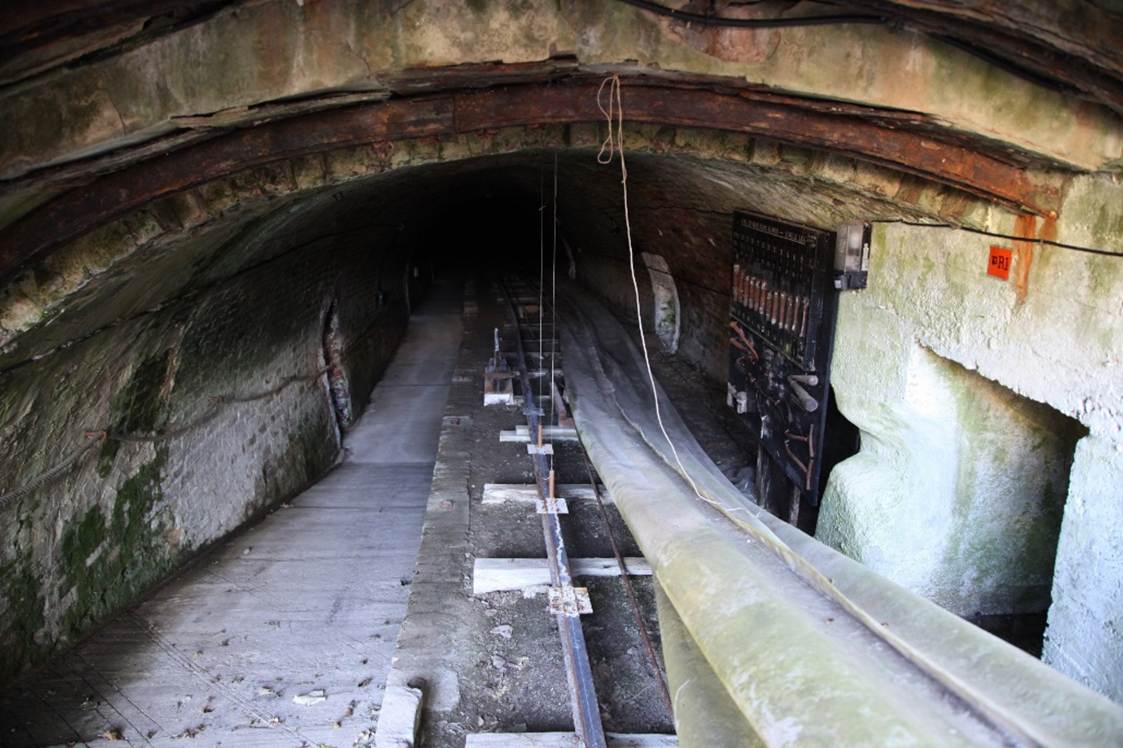
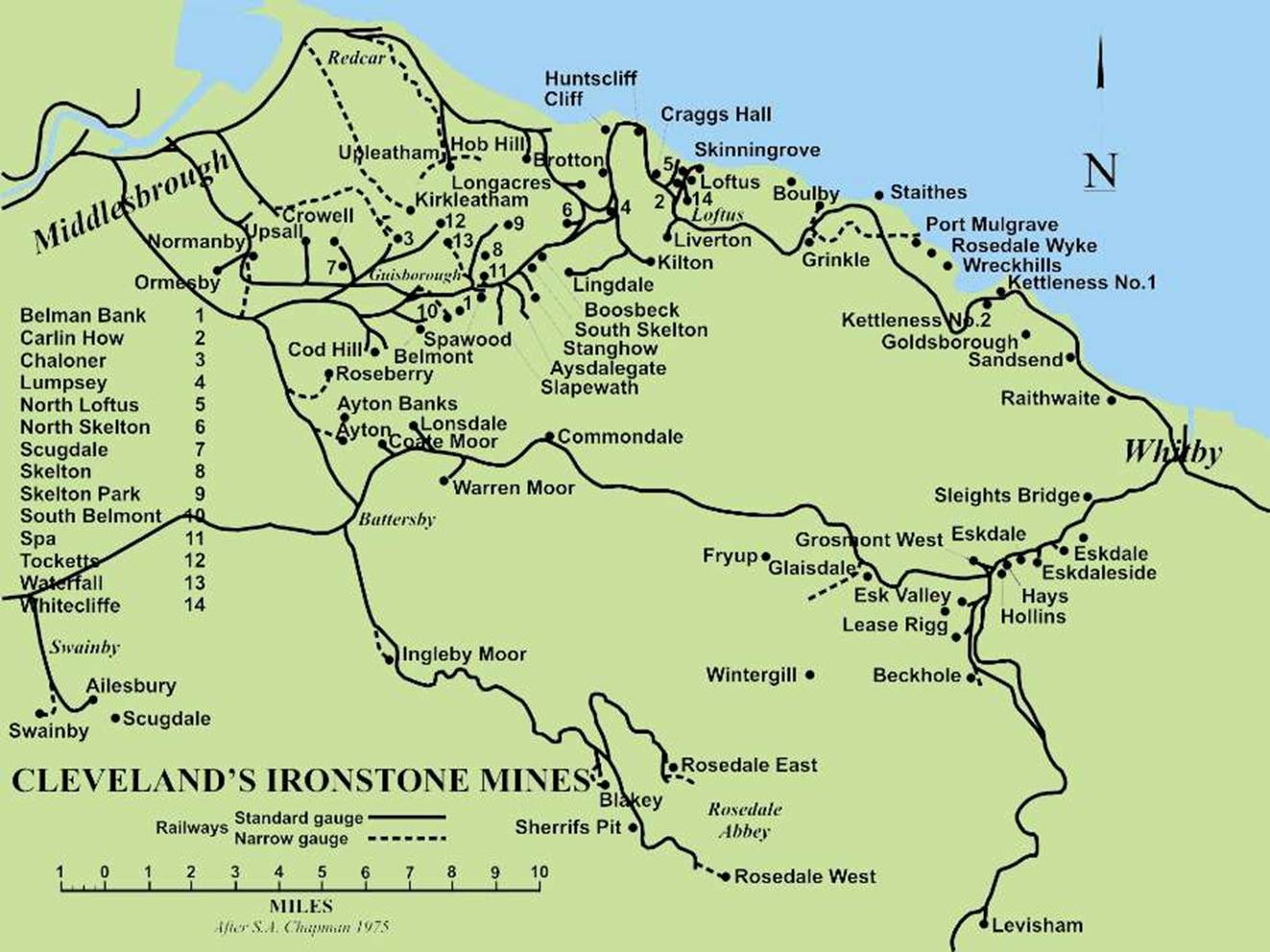
Around 35 mines
opened between Eston, Great Ayton and Hinderwell on the coast. There was a
small group of mines at Grosmont and others in
Rosedale. Railways were extended to the mines, and settlements built for the
labour sucked into what had been a very rural area. After the initial rush of
companies opening mines, a period of consolidation was needed as iron companies
absorbed smaller ventures and workings were rationalised. Marginal mines
closed. This process was helped by a down-turn in trade in the early to mid 1870s. Soon, a new generation of iron works was being
built on Teesside. These used Bessemer convertors to turn the iron into steel,
which was increasingly in demand. By 1883, therefore, production of Cleveland
iron ore peaked at six and three-quarter million tons.
The quarter
century before World War I saw many older mines close, further consolidation of
companies and some new sinkings. Rock drills and mechanised haulages were used
to increase efficiency and trim costs. Around twenty mines closed in the
inter-war years. Many of the old companies were absorbed by Dorman, Long &
Co. Ltd, which dominated the industry at the start of World War II. Only nine
mines, all in the area between Guisborough and Brotton, survived the war.
Efforts were made to make mining more efficient, diesel haulage was introduced
below ground, as were compressed air loading shovels. The mines could not,
however, compete with imported ore or that worked by opencast around Scunthorpe
and Corby. North Skelton Mine was the last to close in January 1964.
Cleveland
Ironstone Mines:
Mine Location Opened Closed Comments
Ailesbury Mine
Whorlton 1872 1887
Aysdalegate Mine
Lockwood
1863 1880 Closed
23/10/1880.
Ayton Banks Mine Great Ayton
1910 1929 Abandoned
July 1929.
Ayton Mine Great
Ayton 1908
1930
Bagnall and Co Mines Eskdaleside cum Ugglebarnby 1862 1864
Beckhole Mine Egton 1857 1864
Belmont Mine Guisborough 1854 1928 Abandoned 11/11/1886. Reopened in
1907. Abandoned 20/02/1933.
Birds Mine Eskdaleside
cum Ugglebarnby 1858 1866
Birtley Mine Eskdaleside cum Ugglebarnby 1858 1878
Blakey Mine Farndale East 1873 1881
Boosbeck Mine Skelton 1872 1901
Boulby Mine Easington 1903 1934 Abandoned July 1934. Boulby Potash Mine sunk here in the late 1960s.
Brotton Mine Brotton 1865 1921
California Mine Eskdaleside
cum Ugglebarnby 1863 1881
Carlin How Mine Kilton 1873 1924 Part
of Lumpsey until 1946.
Chaloner Mine Guisborough 1872 1939 Part
of Eston.
Cliff Mine Brotton 1866 1881 Abandoned
October 1887.
Coate Moor Mine Kildale 1866 1876 Abandoned 19/07/1876.
Cod Hill Mine Guisborough 1853 1865
Commondale Mine Commondale 1863 1876
Craggs Hall Mine Brotton 1871 1893
Easington Mine Saltburn 1877 See
also: Port Mulgrave
East Rosedale Mine Rosedale East Side 1866 1926
Esk Valley Mine Egton 1859 1883
Eskdale Mine Eskdaleside cum Ugglesbarnby 1906 1908
Eskdale Mine Eskdaleside cum Ugglesbarnby 1856 1870
Eskdaleside Mine Eskdaleside
cum Ugglesbarnby 1871 1876
Eston Mine
Guisborough 1856 1950
Farndale Mine Farndale East 1872 1897 See Blakey.
Fryup Mine Danby 1863 1874
Farndale Mine Farndale East 1872 1897 See Blakey.
Fryup Mine Danby 1863 1874
Glaisdale Mine Glaisdale 1879 Abandoned 30/03/1875.
Goldsborough Mine Lythe 1912 1915
Grinkle Mine
Hinderwell 1872 1934 Abandoned 1934.
Grosmont Mine Eskdaleside
cum Ugglesbarnby 1858 1892 West Side – Abandoned
15/05/1886.
Hays Mine Eskdaleside
cum Ugglesbarnby 1836 1866
Hinderwell Mine Hinderwell 1854 1862
Hob Hill Mine Marske 1864 1874 Abandoned 17/04/1875.
Hollin Hill Mine Lockwood 1864 1880
Hollins Mine Eskdaleside cum Ugglebarnby 1863 1879
Hollins Mine Rosedale West Side 1856 1879
Huntcliffe Mine Brotton 1872 1905 Abandoned 1906.
Hutton Mine Hutton Lowcross 1854 1867
Ingelby Mine Ingleby Greenhow 1858 1865
Kildale Mine Kildale 1866 1878
Kilton Mine
Kilton 1871 1963 Sinking
in 1871. Closed 31/12/1963.
Kirkleatham Mine Tocketts 1873 1885 Abandoned 31/12/1886.
Lane Head Mine Rosedale West Side 1876 1881
Lease Rigg Mine Eskdaleside cum Ugglesbarnby 1837 1850
Leven Vale Mine Kildale 1864 1871 See
Warren Moor.
Levisham Mine Levisham 1863 1874
Lingdale Mine Moorsholm 1877 1962
Liverton Mine Loftus 1866 1921 Abandoned 1923.
Loftus Mine Loftus 1848 1958 Abandoned 1959.
Longacres Mine Skelton 1873 1954 Closed
17/07/1915 and reopened from 1933 until 27/11/1954.
Lonsdale Mine Kildale 1865 1874
Lumpsey Mine Brotton 1880 1954 Sinking
in 1880. Closed 27/11/1954.
Margrave Park Mine Skelton 1863 1874
Mirkside Mine Eskdaleside
cum Ugglebarnby 1856 1861
New Bank Mine Guisborough 1850 1950
Normanby Mine Normanby 1856 1898 Abandoned
in 1899.
North Loftus Mine Brotton 1872 1905
North Skelton Mine
North Skelton 1865 1964 Closed
17/01/1964.
Port Mulgrave Mine
Hinderwell 1856 1893
Postgate Mine Glaisdale 1870 1876
Raithwaite Mine Newholm-cum-Dunsley 1854 1858
Roseberry Mine Great Ayton 1880 1924
Rosedale East Rosedale Abbey 1866 1925 Abandoned
1928.
Rosedale on Coast Mine Hinderwell 1854 1876
Rosedale West Rosedale West Side 1860 1911 Abandoned March 1911.
Sheriffs Mine
Rosedale West Side 1874 1911
Skelton Mine Skelton 1860 1938 Abandoned November 1938.
Skelton Park Mine Skelton 1868 1938 Abandoned April 1938.
Slapewath Mine L ockwood 1864 1899
Sleights Bridge Mine Sleights Bridge 1856 1859
South Belmont Mine Guisborough 1863 1875
South Skelton Mine Stanghow 1870 1954
Spa Mine Stanghow 1864 1904 Standing
in 1903. Abandoned in 1904.
Spawood Mine Guisborough 1865 1930 Closed 28/06/1930. Abandoned April
1934.
Staithes Mine Hinderwell 1838 1860
Stanghow Mine Boosbeck 1872 1926
Swainby Mine Whorlton 1856 1868
Tocketts Mine Tocketts 1874 1877 Abandoned in 1880.
Upleatham Mine Marske 1851 1923
Upsall Mine Upsall 1866 1927 Merged with Eston from 1870.
Warren Moor Mine Kildale 1864 1874
Waterfall Mine Tocketts 1892 1901
Wayworth Mine Commondale 1866 1867 Sinking 1866 to 1867.
West Rosedale Mine Rosedale West Side 1856 1911
Whitecliffe Mine Loftus 1871 1884
Wintergill Mine Egton 1871 1883
Wreckhills Mine Hinderwell 1856 1864
Mining Life
More work to
follow
Alum Mining
John Farndale,
‘Old Farndale of Kilton’ (FAR00143) was an
alum house merchant. As John Farndale (FAR00217) wrote: ‘My
Grandfather, who was a Kiltonian, employed many men at his alum house, and many
a merry tale have I heard him tell of smugglers and their daring adventures and
hair breadth escapes.’
There is a
separate page about alum mining.
Jet Mining
Another
extractive industry was jet mining. William Farndale (FAR00283) was a
jet miner at Eston.
Jet mines
although numerous were small and individual mines and tended not to acquire
names or documentary records. During the nineteenth century hard jet fetched a
good price and it was mined extensively in East Cleveland and along the edge of
the moors between Roseberry and Kildale. The mines typically took the form of
parallel drifts into the side of hills, with headings also driven at right
angles to the original drifts at regular intervals, so that the plan of the
mine looked like a chequerboard, with square pillars of rock left in place as
support.
The semi precious mineral is found in thin lenses in the jet
rock generally at some depth below the alum shales. It was extracted in
Victorian times from numerous small drifts driven into the hillside. There are
spoil heaps at Gribdale Gate and evidence of some
open cast mining.
Whinstone quarrying
When the local
quarrying of whinstone first started is not known but it was well under way by
the late eighteenth century. Running through Cleveland, roughly east to west,
there is a ridge which marks the line of igneous dyke. This is composed of very
hard rock called dolerite or whinstone. This stone has been extensively mined
and quarried since the mid eighteenth century. The production of cuboid setts
occupied many men and boys. These, with their regular shapes, can still be seen
around Ayton for instance./ Most of the whinstone was taken out of the area by
rail and much of it was used for road surfacing in places such as Leeds. Extraction had ceased by the 1960s. See for
instance Cliff Rigg Mines.