Martin Farndale
11 August 1798 to 22 June 1885
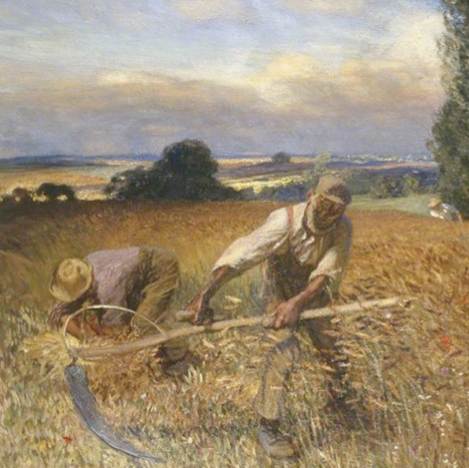
A farmer of Kilton of 600 acres
FAR00236
|
Return to the Home Page of the Farndale Family
Website |
The story of one family’s journey through two
thousand years of British History |
The 83 family lines into which the family is divided.
Meet the whole family and how the wider family is related |
Members of the historical family ordered by date of
birth |
Links to other pages with historical research and
related material |
The story of the Bakers of Highfields, the Chapmans, and
other related families |
Martin Farndale
was a Tenant Farmer of Kilton
of 200 acres and later 600 acres. He was involved as an overseer of the
poor and sat on the Guisborough Board of Guardians for about 38 years. He was a
passionate supporter of the local primitive methodist church. He was a
prominent member of the Kilton community.
Martin married Elizabeth
Hours in 1833, but they had no family. His tenancy at Kilton passed to his nephew, Charles
Farndale.
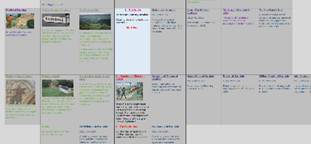
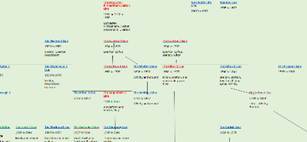
Dates are in red.
Hyperlinks to
other pages are in dark
blue.
Headlines of
Martin’s life are in brown.
References and
citations are in turquoise.
Context and local
history are in purple.
1798
Martin Farndale
was the son and sixth child of William and Mary (nee Farguson) Farndale (FAR00183) of Kilton, farmer. Martin was born on
11 August 1798 and baptised at Brotton
on 11 September 1798 (Brotton PR). The
baptism was performed by Rev James Harrison, Curate. The family were living at Kilton.

1833
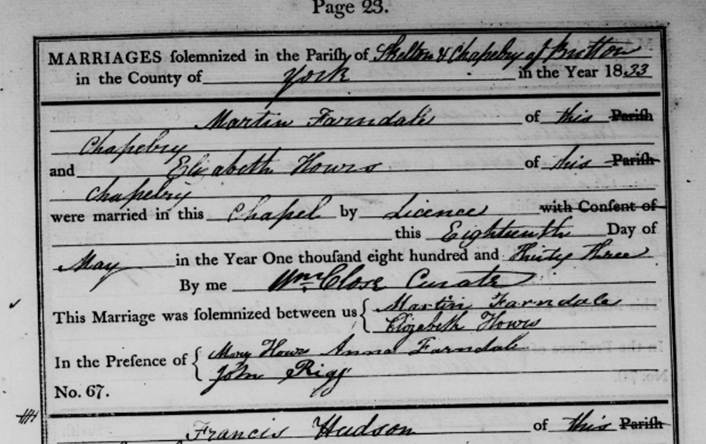
Martin Farndale (1805 to 23 February 1877) married Elizabeth Hours at
the Chapel, Brotton, on 18 May 1833. The
witnesses were Ann Farndale (this may have been his sister Anna FAR00242), Mary Hours and John
Rigg (Brotton PR).
Mary and
Elizabeth had no family. Elizabeth Hours was baptised in Woolley, south of
Wakefield, on 20 September 1804, the daughter of James and Sarah Hours (Woolley PR).
Martin was farming in his own right after his
marriage. Martin had four elder brothers, and John and Matthew also farmed in Kilton
in the early days, but it was he who continued to farm at Kilton.
1836
The Churchwarden’s Accounts, Kilton 1836 showed a
reimbursement to James Hours & Martin Farndale for 3 drafts, one day
each leading stones from the Beck Meetings 7s each
£1.1s.0d.’ (Brotton PR).
1840
From White’s History, Gazetteer and Directory for 1840 for
Yorkshire, East and West Ridings: KILTON, a small neat village, 6 miles NE by E of Guisborough, has in
its township 80 inhabitants and 1,510 acres of land, all the property and
lordship of John Wharton Esq and formerly belonging to the ancient family of Thweng, who had a castle here, of which some traces still
remain. Directory: Jph Newbegin, vict;
Thos Robson, miller; and Matthew and Martin Farndale, George Jennings, George Moore, Thomas Raw & Joseph Thompson,
farmers.
So by 1840, Martin
and at that stage his brother Matthew (who would later emigrated
to Australia) was a predominant farmer of Kilton.
1841
By
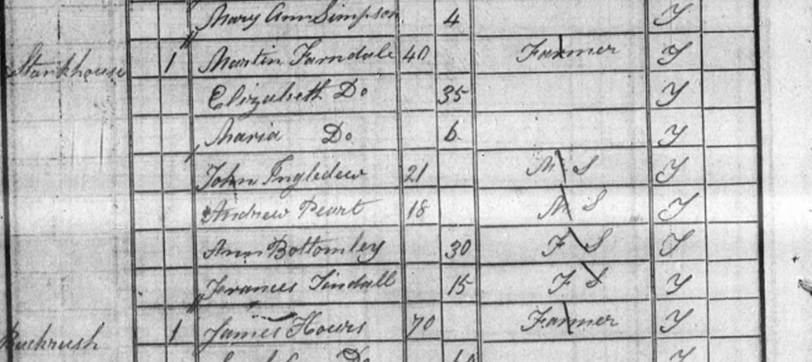
1841 the census showed that Martin was then
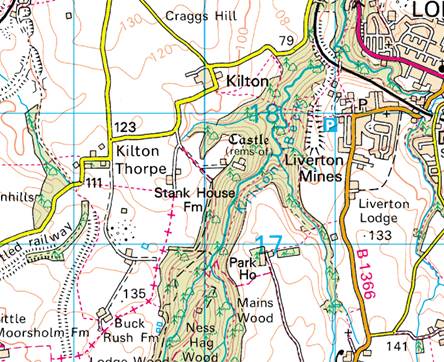
living at Stank House in Kilton with Elizabeth,
35 and Annie Maria Farndale, 6, (FAR00334), his niece and
daughter of his brother John (FAR00217).
1843
In the official statement of sums levied for the relief of the
poor in 27 parishes of the Guisborough Union during the year
ending March 1843 a table gave a return of the amount of money levied and
expended for the relief and maintenance of the Poor, and for other purposes,
during the year ending 25th March, 1843. The parishes of the Guisbrough Union were reported on – Broton, Commondale,
Danby, Easington, Eston, Guisborough, Hutton-Lowcross, Kilton, Kirkleatham,
Liverton, Lofthouse,, Marske, Moorsholm, Morton, Newton, Normanby, Ormesby, Pinchingthorpe, Redcar, Skelton, Skinningrove, Stanghow,
Tocketts, Upleatham, Upsall, Westerdale and Wilton. The guardian of each parish
was listed, and Martin Farndale was the guardian for Kilton. The amount
of money levied for Kilton was £85 2s. This contrasted with £861 14s for
Guisborough, £419 3s for Lofthouse, £312 8s for Kirkleatham, £251 15s for
Easington, £172.18 for Brotton, down to £45 for Newton, £51 14s for Hutton
Lowcross and £35 11s for Commondale. So this gives
some indication of the comparative size and significance of Kilton in 1843. Of
the £85 2s levied for Kilton, £67 2s was expended on the poor, 1d was expended
on vaccination, 2d was for fees for clergymen and registrars, £21 2d was paid
towards ‘country rate’ and 14d was expended on other purposes.
The
York Herald on 8 April 1843 listed Martin Farndale of Kilton
as the new Parish overseer appointed for the
present year.
An overseer
of the poor was an official who administered poor
relief such as money, food, and clothing in England. The position was
created by the Act for the Relief of the Poor 1597. Overseers of the poor
were often reluctant appointees who were unpaid, working under the supervision
of a justice of the peace. The law required two overseers to be elected
every Easter, and churchwardens or landowners were
often selected. Overseers of the poor were replaced in the Poor Law Amendment
Act 1834, and replaced with boards of guardians, although overseers
remained in some places as a method of collecting the poor rate.
1844
The
York Herald on 20 April 1844 reported that “The Magistrates were occupied a considerable
time in examining and allowing the surveyors’ accounts of the different
townships in this division for last year. The following are the new surveyors,
as given in to the magistrates: … Kilton, Martin Farndale and George Moore
…”
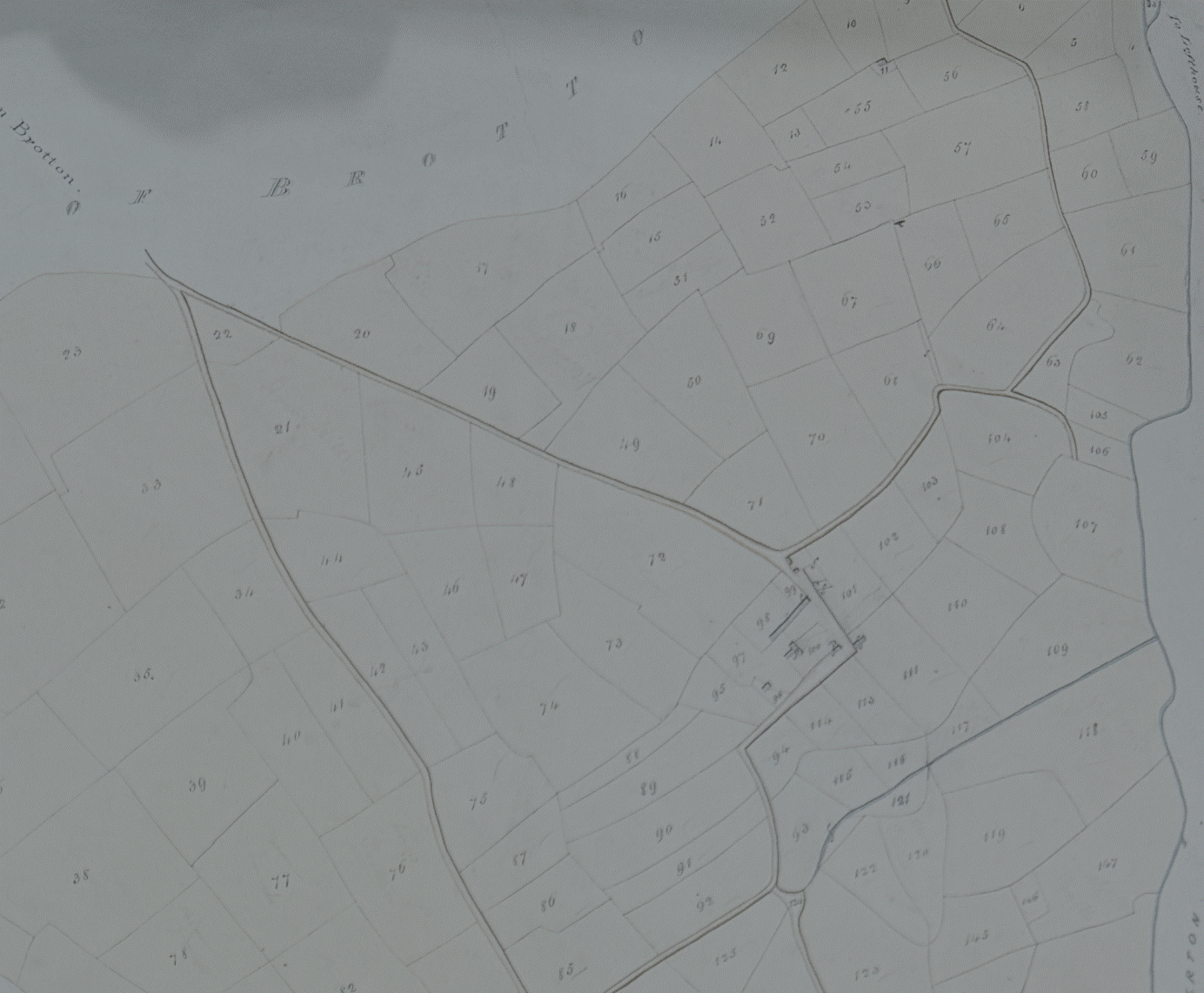
The 1844 Tithe Map provided
details of Martin Farndale’s tenancy at Kilton
in 1844. He was farming at Craggs Hill.
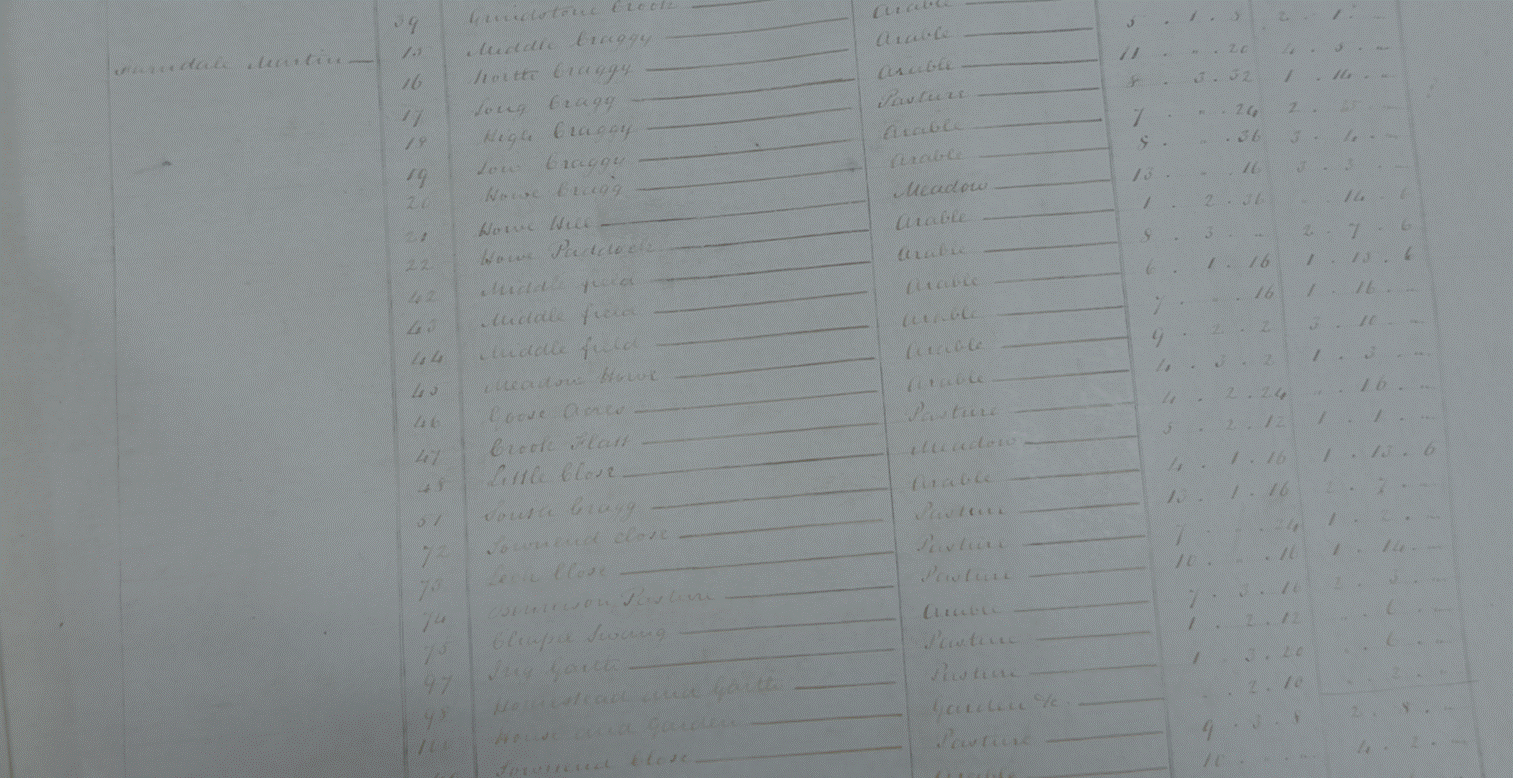
The Tithe Map
shows the location of fields 15 to 100 (in the Craggs Hill area):
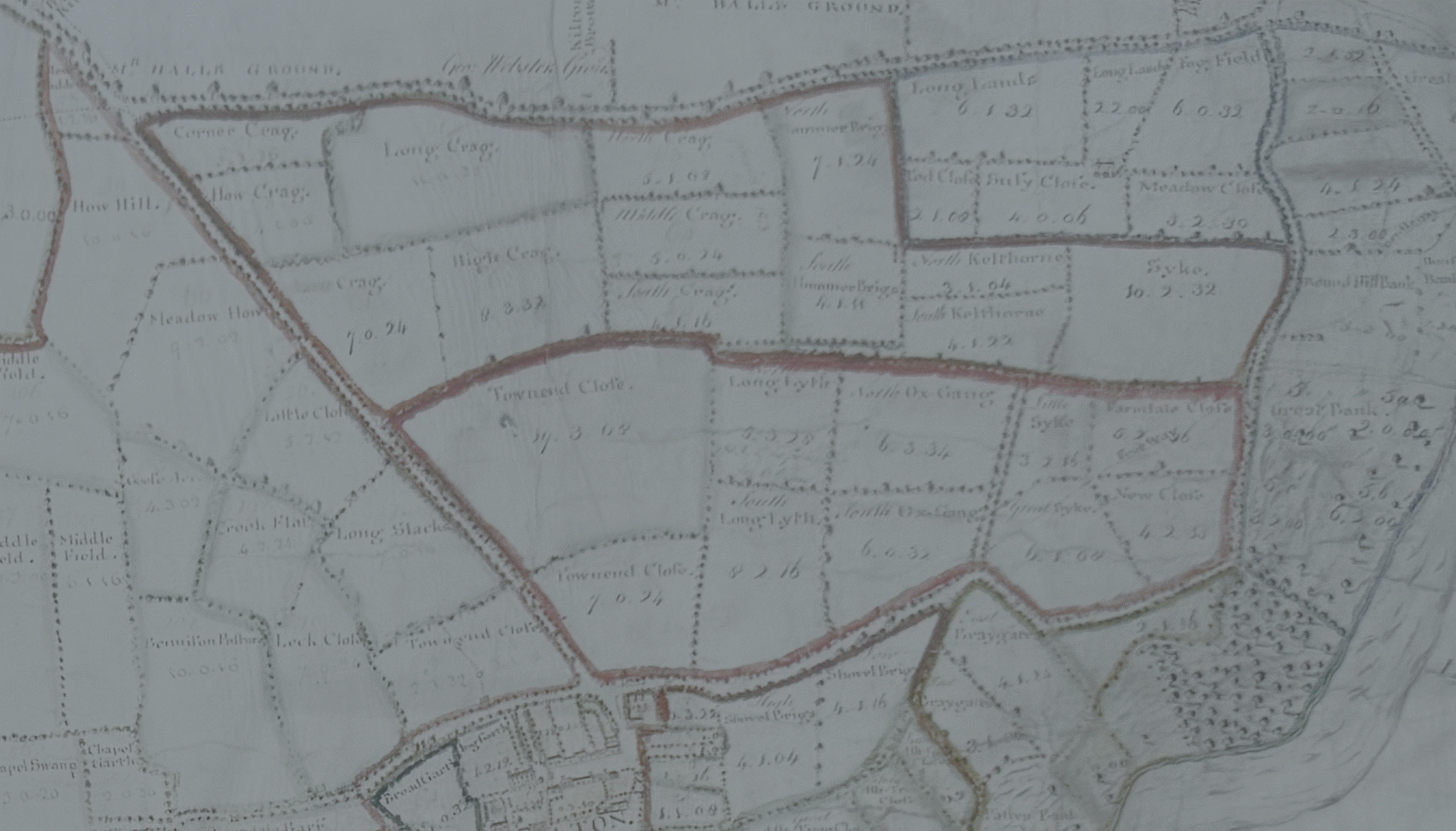
The much earlier
1767 Estate Map shows this area in more detail:
1846
1847
The
Yorkshire Gazette on 10 April 1847 reported on the election of Guardians for
Guisborough: “The following are the newly elected guardians of the several
townships in the Guisbro’ union for the ensuing year,
viz: … Kilton, Martin Farndale.”
1851
The
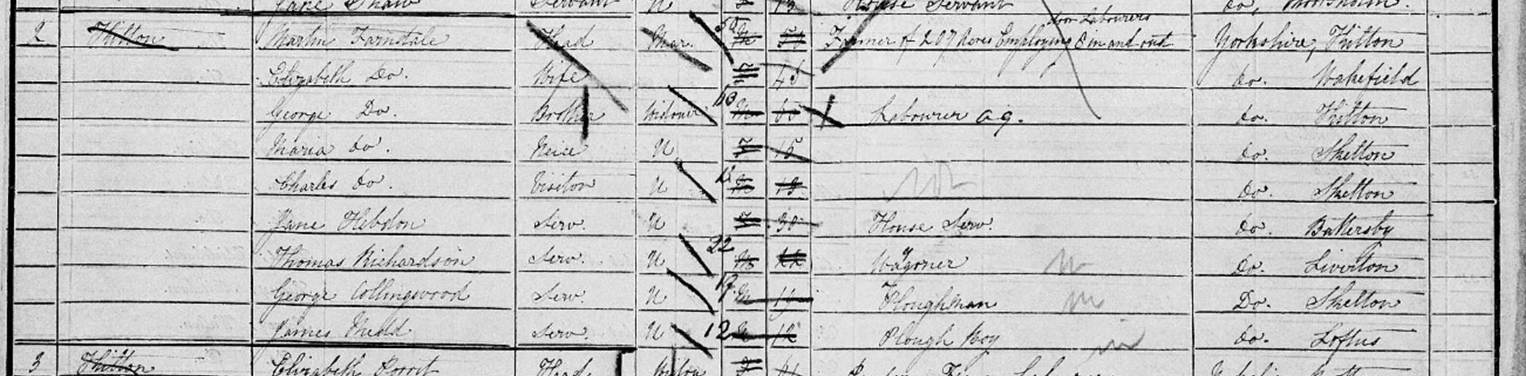
1851 census (signed on 1 April 1851) showed
that Martin was farming at Kilton Hall, then aged 50, a farmer of 207
acres, with 8 employees. He was living with his wife Elizabeth Farndale, 45, who we learn
was born in Wakefield; George Farndale (his brother - FAR00215), 60, widower,
born Kilton, an agricultural labourer; Maria Farndale, 15, unmarried, born in
Skelton, his niece (FAR00334) and Charles
Farndale,13 (FAR00341), unmarried, born in Skelton, his nephew and son of his brother
John (FAR00217). Living with them were Jane Hobson aged 30, a servant; Thomas
Richardson, aged 22, waggoner; George Collingwood, aged 19, ploughman; and James
Mudd, aged 12, ploughboy.
The Skelton and Kilton Estate Books contain a
reference to drainage costs on Martin Farndale’s tenancy in 1851, for which the
landlord will have had responsibility:

1852
The
Yorkshire Gazette for 17 April 1852
reported: “Gisbrough Poor Law Union – the following
are the newly elected guardians of the poor for the several townships in the Gisbrough Union for the year 1852, ending March 1853 …
Kilton, Martin Farndale …”
1853
In 1853, Martin Farndale was
lending his name to the promotion of a calf feed:
“HARDCASTLE’S
CELEBRATED CALF DRINK, for preventing that fatal disease, the Quarter ill, or
Evil. Prepared only by W HARDCASTLE, at the Medical Hall, Stockton on Tees, and
sold at his Establishment, in bottles, 9d each.
Sir, Previous to giving your excellent Calf Drinks, I every year
lost some calves (in one year 4 died out of 7), and since I have given them
your Preventive, none have died, except one which I omitted giving it last
year. MARTIN FARNDALE, Sept 28, 1853, Farmer, Skelton.
Numerous
Testimonials received.”
1854
In
1854 Martin’s sister Anna Farndale (FAR00242) raised a suit disputing the
will of her father in law, William Phillips,
supported by her brother, Martin against Elizabeth Hume who had married William
Phillips’ niece. When the competency of the case was allowed, the defendant
withdrew their defence. They suggested that they had to dispute the will
because there were questions of its competency.
The
Leeds Intelligencer for 5 August 1854 reported:
PHILLIPS AND ORS
V HUME – WILL CAUSE
The will in
dispute in this case was that of Wm Phillips, late of Stokeseley,
gentleman, which was dated January 6th, 1852. The suit was promoted
by Anna Phillips, the widow; John Henry Phillips, the nephew; and Martin
Farndale, against Elizabeth Hume, the wife of Wm Hume, a niece of the deceased.
MR TRAVIS submitted that in this case the competency of the testator had been
full established, and prayed that the will should be
confirmed. DR BOWER, after the inquiry which had taken place, had no longer to
dispute the factum of the will. The defendant had required the inquiry which had
taken place, not only because certain parties were excluded in the last will
who were residuary legatees under a former will, but also because there were
some reasons to question the competency of the testator, who was in a very
infirm state when the last will was made in 1852. All had now been done that
could be done for the next of kin, and therefore he only now asked for costs
out of the estate. THE JUDGER said a perfectly legitimate course had been adopted
by the next of kin, under the circumstances, and he had every right to have
costs out of the estate.
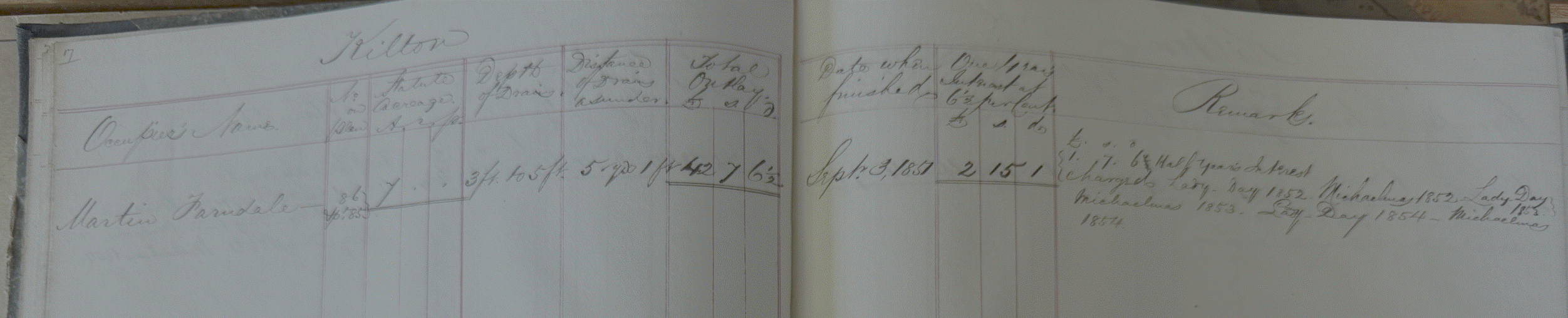
The Skelton and Kilton Estate Books contain a
reference to drainage costs on Martin Farndale’s tenancy in 1854, for which the
landlord will have had responsibility:
1855
The
Durham Chronicle on 11 May 1855 reported “Guisborough Union – The
following are the newly elected Guardians of the Poor of the several townships
comprising the Guisbro’ Union … Kilton – Martin Farndale …”
1856
The
Yorkshire Gazette, 5 April 1856 reported “Guisbro’
Union – The following are the newly elected Guardians of the Poor of the
several townships comprising the Guisbro’ Union viz…
Kilton – Martin Farndale …”
1861
Electoral
Register for 1861 showed Martin Farndale, the occupier of a farm at Kilton.
The
Yorkshire Gazette on 13 April 1861 reported “Guisbro’
– Poor Law Union – The following are the newly elected guardians of the poor for
this union for the ensuing year .. Kilton – Martin
Farndale …”
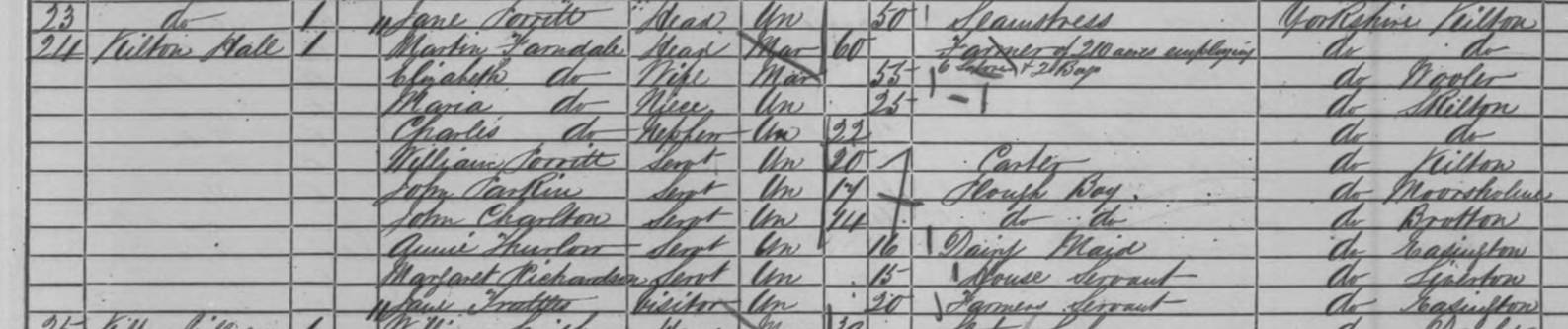
The census 1861 showed that by then Martin was farming
at Kilton Hall Farm, Kilton;
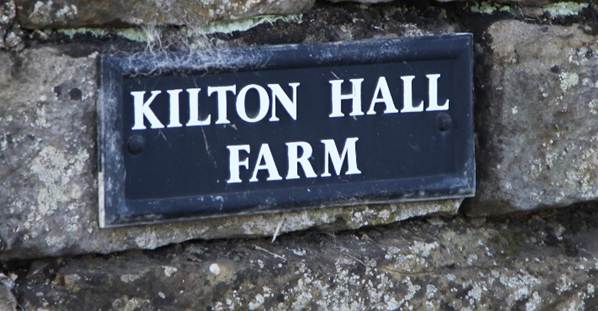
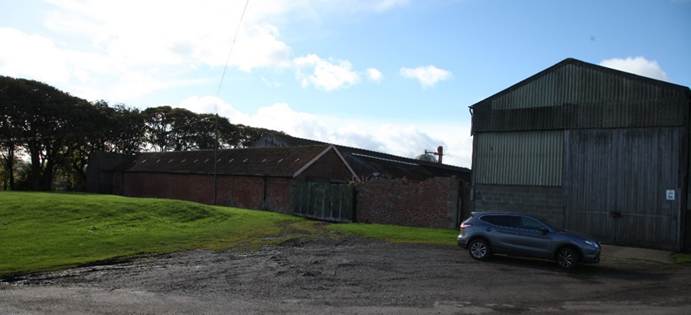
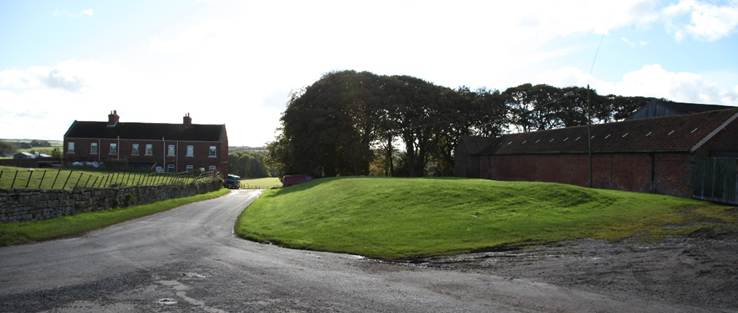
Kilton Hall Farm in
2016
Martin
Farndale was listed as the family head; aged 60; a farmer of 210 acres with
8 employees. He lived with Elizabeth Farndale, his wife aged 55;
shown this time as born in Wooler; Maria Farndale, his niece; aged 25; (FAR00334); and Charles Farndale,
his nephew; aged 22 (FAR00341).
The Terrier Lists
showed Martin Farndale was a Churchwarden at Brotton, in 1861.
1862
The Stockton Herald, South Durham and Cleveland Advertiser, on 7 March 1862 advertised a
“Desirable residence at Brotton, near Saltburn by the sea, to be let,
and may be entered upon at May day next. All that
MESSUAGE or DWELLING HOUSE and GARDEN , together with a COTTAGE attached, now
in the occupation of Mr George Abndrew; the House contains on the Ground Floor
1 Commodious Drawing room, Dining room, Entrance Hall, Kicthen,
and Scullery; on the Second Floor 7 Lodging rooms and 1 Dressing room; the
Cottage contains 4 Rooms; there is alsoi half an Acre
of Garden Ground, well stocked with choice fruit tgress,
2 Yards, Stack Yard, large Coach house, Four stalled Stable, 1 Loose box,
Granary and Hay Loft, 2 Piggeries, Coal house, and every other Convenience.
Brotton is situate One mile from Saltburn by the Sea,
to which place the Railway from Middlesbrough is now completed. For particulars
apply to Mr MARTIN FARNDALE, of IKlton, the owner; or
to MR HENRY WATSON, Buck Hotel, Guisbro. Guisbro’, Feb 19th, 1862.”
On Tuesday 1
August 1863 the second annual foal show was held at Sneaton,
near Whitby, and proved most successful. There were forty competitors entered
for different premiums, the show ground being a field belonging to Mr John
Stourhouse … Best foal for coaching, Mr Farndale, Kilton. The success of
the third annual exhibition of foals, held at this place on Tuesday last,
proves that the institution is one which the farmers and others appreciate, and
are resolved to support. There were 38 foals entered for exhibition, and their
work of selecting the best in each class was a task which the judges found most
arduous.
The
Yorkshire Gazette and the York Herald on 15 August 1863 reported on a “FOAL SHOW AT SNEATON.
On Tuesday 1st, the second annual foal show was held at Sneaton, near Whitby, and proved most successful. There
were forty competitors entered for different premiums, the show ground being a
field belonging to Mr John Stourhouse … Best foal for coaching, Mr Farndale,
Kilton …”
1864
The
York Herald on 20 August 1864 reported - Sneaton Foal Show. “This
show took place at Sneaton for the third time, on
Tuesday last. This show was considered superior to any of its predecessors. The
judges were … The following were the awards of the judges … Coaching colt, Martin Farndale, Kilton.” The Whitby Gazette, also on 20
August 1864 reported on the same foal show, “FOAL SHOW. The success of the
third annual exhibition of foals, held at this place on Tuesday last, proves that
the institution is one which the farmers and others appreciate, and are
resolved to support. There were 38 foals entered for exhibition, and their work
of selecting the best in each class was a task which the judges found most
arduous.”
1865
The
Yorkshire Gazette, on 15 April 1865 reported “Guisbro’
– Poor Law Union – The following are the newly elected Guardians of the Poor of
the Guisbro’ Union for the ensuing year namely …
Kilton – Martin Farndale …”
1867
Yorkshire
Gazette, on 20 April 1867 reported “Guisbro’ Union –
The following are the newly elected Guardians of the Poor of the Guisbro’ Union for the ensuing year… Kilton – Martin
Farndale …”
1869
The York Herald’s Report of Petty Sessions on 6 November 1869 reported that Martin Farndale had been summoned for permitting
eleven heifers to stray on the highway, in the township of Kilton, but he
claimed to have a right of 28 years standing, the case was dismissed, the bench
having no jurisdiction.
The
Northern Weekly Gazette, on 30 July 1869 reported “GUISBOROUGH – BOARD OF
GUARDIANS. The fortnightly meeting of the Guardians of the Guisborough Union
was held on Tuesday, at the workhouse. Present were Admiral Chaloner
(Chairman), the Rev J G Morehead, Messrs D T Petch, C O Ord, M Farndale …
Minutes of the last meeting were read and confirmed. He Chairman said that no
application had yet been received for the position of medical officer for the
Danby district. The Clerk said there appeared to be some undercurrent running with regard to this appointment. Mr Wilson was supposed to
have applied for reappointment, but his letter was so ambiguous that it did not
amount to another application. Mr Wilson first resigned, and then after the
resignation had been accepted and communicated …”
1870
The
York Herald and Stockton Herald, on 30 July 1870 reported on more success at a horse
show for Class 5 - horses. M Farndale won the best two year
old chapman fillies prize.
1871
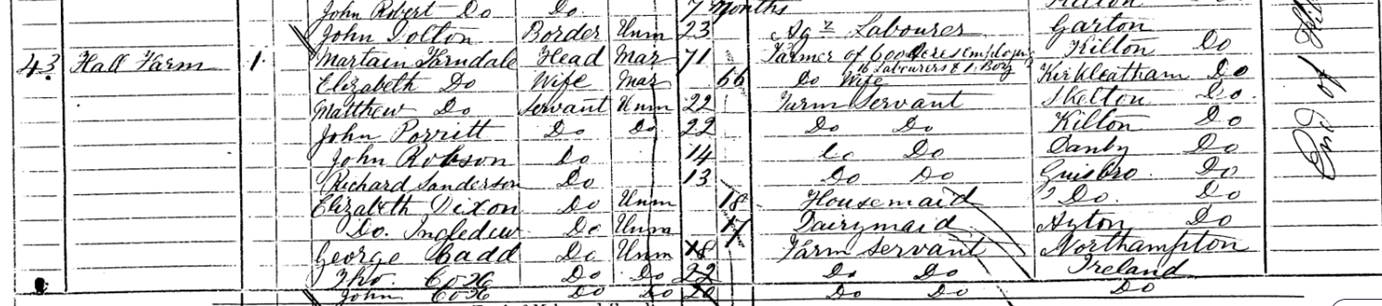
The census in 1871 showed Martin Farndale was still at
Kilton Hall Farm, Kilton, the head of the family now shown aged 71, though he was actually aged 73 in 1871; a farmer; 600 acres 16
employees. He lived with Elizabeth
Farndale, his wife; 66; this time shown born in Kirkleatham. Also living with them was
Matthew Farndale (FAR00383)
aged 22; his grand nephew, described as a servant, so
presumably working on the farm. Matthew was the son of the late Martin Farndale
(FAR00264), grandson of
Martin’s brother the late George Farndale (FAR00215).
1872
In Kelly’s Post Office Directory of 1872, we have
some picture of Kilton in that year: Kilton is a township, 6 miles north
east by east of Guisborough, and one south from Brotton. Here was
formerly a castle of which but few traces remain. Here are church schools,
recently erected and supported by John Thomas Wharton esq who is lord of the
manor and landowner. The population in 1861 was 93; in 1871, 222; acreage
1,723; gross estimated rental £1,731; rateable value £1,593.
Kilton – commercial activity is listed to include Farndale, Martin &
Charles, farmers ;
Garbutt, John, miller, Kilton hill; Judson, William, farmer, Stank House;
Kilton Iron Stone Co; Porritt, John, farmer, Buckrush; and
Wood Thomas, farmer, Greenhow.
The
Northern Weekly Gazette, on 18 April 1872 reported “GUISBOROUGH UNION – ELECTION OF
GUARDIANS. There has been no contest in any of the Parishes in this Union, this
year, and the following is a list of the Guardians elected for each parish, viz
… Kilton – Martin Farndale …”
The
Northern Weekly Gazette, on 11 and 25 July 1872 gave the following notification:
I, the
undersigned MARTIN FARNDALE, of Brotton in Cleveland, in the County of York,
one of the Churchwardens of the Township of Brotton aforesaid do HEREBY GIVE
NOTICE that a Meeting of the Owners and Ratepayers within the township of
Brotton, aforesaid, duly convened and held on 21st day of June 1872,
at Half past six o’clock in the evening,
IT WAS RESOLVED
that the “Local Government Act 1858” be adopted in and for the said Township of
Brotton. And I do HEREBY GVE FURTHER NOTICE, that a COPY of the above NOTICE
was forwarded by me to the Local Government Board on the 10th of
July 1872.
Given under my
hand this 10th day of July 1872
MARTIN FARNDALE
Churchwarden of
the Township of Brotton aforesaid.
The 1848 Act was replaced by the Local
Government Act 1858 (21 & 22 Vict. c. 98). The act came into force
in all existing local board of health districts on 1 September 1858. The act
made some changes to the procedure for constituting a local board and gave them
some additional powers. There was also a change in nomenclature: the
authorities created by the 1858 act were simply entitled "Local
Boards" and their areas as "Local Government Districts".
In 1872, Martin Farndale
was involved in setting up a new Urban Sanitary District for the Guisborough
Union area. The Daily Gazette for Middlesbrough,
16 October 1872 reported “GUISBOROUGH POOR LAW BOARD, At a meeting of this Board, held on Tuesday, Mr S T Patch in
the chair, Mr Arthur Buchanan applied to the board for sanction to form a Local
Board at Brotton. After hearing the explanations of Mr Buchanan, Mr Blewett
moved, and Mr Farndale seconded, the following motion: that in the opinion of
this Board, it is desirable that the Township of Brotton should be formed into
an Urban Sanitary District. Carried unanimously. Orders were signed for the
following sums to be paid by two instalments on the 1st November 1872 and the
2nd January 1873 by the several parishes in the Union: Broughton £280;
Commondale £44; Danby £262; Easington, £112; Eston £704; Guisborough £482;
Hutton Lowcross £66; Kilton £70; Kirtkleatham £502; Liverton £84; Lofthouse
£236; Marske £536 pounds; Moorsholm £74; Morton £52; Newton £12; Normanby £428;
Ormesby £478; Pinchinthorpe £42; Redcar £250; Skelton £278; Skinningrove £30;
Stanghow £72; Tocketts £38; Upleatham £102; Upsall £26; Westerdale £86; Wilton
£412. Total £5,758.”
1873
Contemporaneous with the global Long Depression, Britain's
agricultural depression was caused by the dramatic fall in grain prices that
followed the opening up of the American prairies to cultivation in the 1870s and
the advent of cheap transportation with the rise of steamships. British
agriculture did not recover from this depression until after the Second World
War. In 1882 Charles George Milnes Gaskell wrote that "the vast
increase in the carrying power of ships, the facilities of intercourse with
foreign countries, [and] the further cheapening of cereals and meat"
meant that economically and politically the old landed
class were no longer lords of the earth. The depression also accelerated Britain's rural
depopulation. The 1881 census showed a decline of 92,250 agricultural labourers
since 1871, with an increase of 53,496 urban labourers. Many of these had
previously been farm workers who migrated to the cities to find employment.
Between 1871 and 1901 the population of England and Wales increased by 43% but the proportion of male agricultural labourers
decreased by over one-third. According to Sir James Caird in his evidence to
the Royal Commission on the Depression in Trade and Industry in 1886, the
annual income of landlords, tenants and labourers had fallen by £43M since
1876. No other country witnessed such a social transformation and British
policy contrasted with those adopted on the Continent. Every wheat-growing country imposed tariffs in the wake of the explosion of
American prairie wheat except Britain and Belgium. Subsequently, Britain became
the most industrialised major country with the smallest proportion of its
resources devoted to agriculture.
|
Court |
Offence |
|
|
5 November 1873 |
Guisborough Police Court |
Night poaching. John Julyan, keeper
to Mr J T Wharton, of Skelton Castle, charged John Taylor, with having about
midnight of 3 November, captured a rabbit upon the farm occupied by Martin
Farndale, at Skelton |
|
3 June 1873 |
Summary conviction of William Jones
of Skinningrove miner for trespassing in the daytime in search of game on
land belonging to John Thomas Wharton esquire and occupied by Martin Farndale
Offence committed at the township of Kilton on 11 May 1873 |
|
|
9 September 1873 |
Summary conviction of Robert Johnson
of Brotton miner for trespassing in the daytime in search of game on land
belonging to John Thomas Wharton esquire and occupied by Martin Farndale
Offence committed at the township of Kilton on 27 August 1873 |
|
|
9 September 1873 |
Summary conviction of William Green
of Carlin How miner for trespassing in the daytime in search of game on land
belonging to John Thomas Wharton esquire and occupied by Martin Farndale Offence
committed at the township of Kilton on 28 August 1873 |
|
|
9 September 1873 |
Summary conviction of John Bowler of
Carlin How miner for trespassing in the daytime in search of game on land
belonging to John Thomas Wharton esquire and occupied by Martin Farndale
Offence committed at the township of Kilton on 28 August 1873 |
|
|
9 September 1873 |
Summary conviction of George Waite of
Carlin How miner for trespassing in the daytime in search of game on land
belonging to John Thomas Wharton esquire and occupied by Martin Farndale
Offence committed at the township of Kilton on 27 August 1873 |
|
|
9 September 1873 |
Summary conviction of William Green
of Carlin How miner for trespassing in the daytime in search of game on land
belonging to John Thomas Wharton esquire and occupied by Martin Farndale
Offence committed at the township of Kilton on 27 September (sic, recte August?)
1873 |
|
|
10 September 1873 |
William Green and George Bowles were
summoned by John Julyan for trespassing in pursuit of game upon land
belonging to Mr J T Wharton, at Kilton on 27th August. Fine 5s each and 8s 6d
costs. William Green, George Waite, and Robert Johnson, miners, of Carlin
How, were also summoned by the same complainant for a similar offence upon
the farm of Mr Martin Farndale, at Kilton on 28th August. To pay 14s 8d each |
|
|
4 November 1873 |
Summary conviction of John Taylor of
Brotton joiner for taking a rabbit in a close of land occupied by Martin
Farndale Offence committed at the parish of Kilton at 12 o'clock at night on 3 November 1873 |
|
|
8 November 1873 |
Langbaugh Police Court |
John Taylor, miner, was brought up
charged with night poaching, on the 3rd November,
upon the farm of Matin Farndale, of Kilton. John Julyan, keeper of Mr J T Wharton, of Skelton Castle, heard a
rustling in a stubble field when on duty about midnight. A lurcher dog with
defendant killed a rabbit, which he picked up and put in his pocket. Julyan
followed him and the rabbit was immediately given up. Defendant, when
requested, went home with Julyan, and subsequently to the police station. The
offence was admitted, To be imprisoned for seven
days with hard labour, and to give them security, two in £5 and himself in
£10, for keeping the peace |
|
16 December 1873 |
Summary conviction of Joseph Carter
of Carlin How miner for trespassing in the daytime
in search or pursuit of game on land belonging to John Thomas Wharton esquire
and occupied by Martin Farndale Offence committed at the township of Kilton on 10 December 1873 |
|
|
16 December 1873 |
Summary conviction of William Adams
of Carlin How miner for trespassing in the daytime
in search or pursuit of game on land belonging to John Thomas Wharton esquire
and occupied by Martin Farndale Offence committed at the township of Kilton on 10 December 1873 |
|
|
17 February 1874 |
Summary conviction of Thomas Burgess
of Carlin How for maliciously damaging the fence
of a field occupied by Martin Farndale Offence committed at the township of Kilton on 14 February 1874 |
|
|
21 February 1874 |
Thomas Burgess, of Carlin How, was
charged with wilfully setting fire to the fence of a field in the occupation
of Martin Farndale, of Kilton, farmer. Fined £1 8s including costs. |
|
|
19 May 1874 |
Summary conviction of William Jones
of Skinningrove miner for trespassing in the daytime in search or pursuit of
game on land belonging to John Thomas Wharton esquire and occupied by Martin
Farndale Offence committed at the township of Kilton on 13 May 1874 |
|
|
15 September 1874 |
Summary conviction of George Moore of
Skinningrove miner for trespassing in the daytime in search of game on land
belonging to John Thomas Wharton esquire and occupied by Mr Martin Farndale
Offence committed at the township of Kilton on 13 September 1874 |
|
|
15 September 1874 |
Summary conviction of William Clarke
of Skinningrove miner for trespassing in the daytime in search of game on
land belonging to John Thomas Wharton esquire and occupied by Mr Martin
Farndale Offence committed at the township of Kilton on 13 September 1874 |
|
|
29 September 1874 |
Summary conviction of Thomas Stanway
of Boosbeck miner for stealing apples from the
orchard belonging to Mr Martin Farndale Offence committed at the township of Kilton on 29 September 1874 |
|
|
3 October 1874 |
Guisborough Petty Sessions |
Thomas Stanway, of Boosbeck, miner, for stealing a quantity of apples at Kilton, belonging to Mr Martin Farndale, was fined £2 9s 6d including costs |
|
13 May 1875 |
Summary conviction of William Clarke
and George Moore, both of Skinningrove miners, for trespassing in the daytime
in search of game on land belonging to John Thomas Wharton esquire and
occupied by Martin Farndale Offence committed at the township of Kilton on 4 May 1875 |
|
|
9 September 1875 |
Summary conviction of Elizabeth Holt
of Kilton married woman for maliciously damaging with intent to steal a
quantity of peas and beans growing in a field, the property of Martin
Farndale of Kilton farmer Offence committed at the township of Kilton on 31 August 1875 |
|
|
14 September 1876 |
Summary conviction of Robert Foster and
Anthony Ward, both of Kilton joiners, and William Silvester and
Richard Annear, both of Brotton miners, for trespassing on the daytime in
search of game on land belonging to John Thomas Wharton esquire and occupied
by Martin Farndale Offence committed at the township of Kilton on 4 September 1876 |
|
|
28 April 1876 |
Loftus Petty Sessions |
Tuesday, before the reverent. GJ Morehead.
Game trespass near Kilvington. Six men, named Humphrey Keane, William Keilan,
William Mogerage., John Dad, George Dad, and Charles Spear where
charged with trespassing in pursuit of game on the land in the occupation of
Mr J T Walker (sic, recte Wharton). Mr
Collier defended the men. PC Calvert stated that on Sunday evening between
five and six o’clock, while on duty near Kilvington, he saw the defendants on
the road, and they had five dogs with them. When close to a field in the
occupation of Mr Farndale, they sent three of the dogs into it after a hare,
which they chased and returned without having caught. He also saw two dogs in
an adjoining field. The defendants were fined 19 shillings and costs each |
|
26 August 1881 |
There was a summary conviction of
John Speck, Charles Speck and George Arnold all of Brotton for maliciously
damaging beans growing in a field occupied by Martin and Charles Farndale
Offence committed at the township of Kilton on 21 August 1881. Damaging beans and oats. Three
Brotton youths, named John and Charles Spark and G Arnold were charged at
Loftus Petty Sessions on Friday by Mr Farndale of Kilton with damaging beans and oats in his field on the 21st inst. The
complaint stated that considerable damage had been done to his crops, and
although he did not wish the lads to be severely punished, he wanted to put a
stop to it. The damage was estimated at 1s each. Ordered to pay costs of 6s
2d each, and the damage, 1s each. |
The Daily Gazette for Middlesborough,
on 5 November 1873 reported Police
News, Guisborough Police Court, Night poaching. John Julyan, keeper to Mr J T
Wharton, of Skelton Castle, charged John Taylor, with having about midnight of
3 November, captured a rabbit upon the
farm occupied by Martin Farndale, at Skelton.
“Lofthouse
district ploughing and hedge cutting matches.
The
district includes Lofthouse, Liberton, Easington,
Skinningrove, Kilton, Broughton, Skelton, Moorshol,
Garrick and Stanghow.
The
above matches will take place upon Mr Farndale's Kilton Hall Farm, on Thursday,
January 23rd 1873 and will be competed for in two open
and two district classes.
Prizes.
Class 1 - open to all with either wheel or swing ploughs. First price £3 1s,
second prize £2 pounds, third £1 - entrance 3s 6d each.
Class
2 - open to the district only: first prize £2 1s, second £1 10s, 3rd 1s.
Entrance 2s 6d each.
Class
3 - open to youths in the district under 18 years of age - first prize, £2,
second prize, £1, third prize, 1s. Entrance 2s each.
Class
4 – Hedge-cutting, open to all: First prize £1 pound, 2nd
1s. Entrance 1s each. Each competitor to cut and lay from the ground 14 yards
of hedge, two feet high and finished with a turn sod.
Rules.
The land to be ploughed not less than four inches deep and the choice of place
to be drawn by lots. The competitors to be on the ground at half past eight, to
commence at nine and to finish at Two o’clock. Each competitor to plough half
an acre. Any man above 20 years of age who has previously won a prize of £2 1s,
debarred from the district class, but can compete in the open class. Anyone
making a false entry will not be entitled to a prize. Should the weather prove
unfavourable on the day fixed, the ploughing will take place on the first
Thursday after the 23rd of January. All entries to be made on or before the
20th of January 1873 to Mr. Johnson, Rosecroft, Lofthouse, or to the Secretary.
Dinner will be provided for the committee and friends at Mr Cowell's Crown Hotel,
Brotton. Thomas Etty, Honourable Secretary, Little Moorsholm, Guisborough.”
Ther outcome was reported in the
Whitby Gazette on 1 February 1873:
PLOUGHING MATCHES
the Lofthouse and
district ploughing matches took place in a field belonging to Messrs Farndale,
at Kilton, on Thursday, January 23rd. The ploughing was considered
extraordinarily good and resulted as under.
All England Class
- 1. Mr. T Webster, How Farm, Lythe; 2 Mr R Thompson, Barnby; 3 Mr W Legg,
Gerrick.
District Class – 1.
Mr Matthew Farndale, Kilton; 2 Mr. Martin Farndale Kilton; 3 Mr W Liverseed,
Gerrick.
Boys Class – 1 T
Ward, Little Moorsholm; W Buffham, Easington.
The prizes, with
one exception, were all won by messrs Ransome, Sims
and Head’s ploughs. The judges were messrs Dale and
Harding. Dinner was provided for the ploughmen by Mrs Farndale, Kilton, and for
the Committee and friends at Mr R Cowell’s, Brotton. Mr Buffham was appointed
chairman and proposed the toasts and health in his usual able manner. The secretary
read the balance sheet, which shows an increase of £2 for next year, the sum in
hand being £12 10s. After passing a very agreeable evening and fixing the
matches for Skelton next year, the company broke up about 10 o’clock, highly
pleased with the evening’s proceedings.”
Since Mathew Farndale (FAR00225) had left for
Australia by this stage, the ploughman in first place must have been the
Matthew Farndale of Coatham (FAR00297).
Meantime Martin
continued his work as a Poor Law Guardian. The
Northern Weekly Gazette, on 17 April 1873 reported Guisborough Board of Guardians. The
annual fortnightly meeting of Guardians of the Guisborough Union was held at
the Board Room, Guisborough on Tuesday afternoon, present were Messrs D T Petch
(in the chair) ….. M Farndale... A Buckanan,
clerk, W Robertson, deputy clerk and C Smith, relieving officer. The clerk reported
that the guardians of the Whitchurch Union had consented to receive Elizabeth
Taber, of Marske, and her four children, without the Board going to the expense
of an order of removal. The relieving officer was instructed to stop her relief, and remove the family to Whitchurch. Mr Ralph
Robinson said this was the last meeting of the board, and
moved a vote of thanks to Mr Petch for services in the chair - Mr Ord having
seconded, the motion was unanimously adopted. Mr Patch returned thanks. The
other was ordinary relief business.
And he continued
to show horses at the Loftus Agricultural Show, and Elizabeth had success in
the cheese class. The Whitby Gazette, on 26 July
1873 reported:
LOFTHOUSE
AGRICULTURAL SHOW
CATTLE … Coaching
filly foal … 2, M Farndale, Yearly Coaching colt …
CHEESE … Best
three cheeses … 3 Mrs M Farndale, Kilton Lodge …
However issues with
trespass and poaching continued at some pace:
·
Summary conviction of Robert Johnson of Brotton miner for trespassing
in the daytime in search of game on land belonging to John Thomas Wharton esquire
and occupied by Martin Farndale Offence committed at the township of Kilton on
27 August 1873 Case heard at Guisborough on 9 September 1873 (Yorkshire Archives, Document reference, QSB 1874
1/10/7/43, Catalogued);
·
Summary conviction of William Green of Carlin How miner for
trespassing in the daytime in search of game on land belonging to John
Thomas Wharton esquire and occupied by Martin Farndale Offence committed at the
township of Kilton on 28 August 1873 Case heard at Guisborough on 9 September 1873
(Yorkshire Archives, Document reference QSB 1874
1/10/7/44, Catalogued);
·
Summary conviction of John Bowler of Carlin How miner for trespassing
in the daytime in search of game on land belonging to John Thomas Wharton
esquire and occupied by Martin Farndale Offence committed at the township of
Kilton on 28 August 1873 Case heard at Guisborough on 9 September 1873 (Yorkshire Archives, Document reference QSB 1874
1/10/7/46, Catalogued);
·
Summary conviction of George Waite of Carlin How miner for trespassing
in the daytime in search of game on land belonging to John Thomas Wharton
esquire and occupied by Martin Farndale Offence committed at the township of
Kilton on 27 August 1873 Case heard at Guisborough on 9 September 1873 (Yorkshire Archives, Document reference, QSB 1874
1/10/7/47, Catalogued);
·
Summary conviction of William Green of Carlin How miner for
trespassing in the daytime in search of game on land belonging to John Thomas
Wharton esquire and occupied by Martin Farndale Offence committed at the
township of Kilton on 27 September (sic, recte
August?) 1873 Case heard at Guisborough on 9 September 1873 Yorkshire Archives, (Document
reference QSB 1874 1/10/7/51, Catalogued);
·
The Daily Gazette for Middlesbrough, on 10 September
1873 reported TRESSPASSERS.
William Green and George Bowles were summoned by John Julyan for trespassing in
pursuit of game upon land belonging to Mr J T Wharton, at Kilton on 27th
August. Fine 5s each and 8s 6d costs. William Green, George Waite, and Robert
Johnson, miners, of Carling Home, were also summoned by the same complainant
for a similar offence upon the farm of Mr Martin Farndale, at Kilton on 28th
August. To pay 14s 8d each.
·
Summary conviction of John Taylor of Brotton joiner for taking
a rabbit in a close of land occupied by Martin Farndale Offence committed
at the parish of Kilton at 12 o'clock at night on 3 November 1873 Case heard at
Kilton on 4 November 1873 (Yorkshire Archives,
Document reference QSB 1874 1/10/7/118, Catalogued);
·
The York Herald, on 8 November 1873 reported Guisboro’, Police.
At the Langbaugh Police Court on Tuesday … John
Taylor, miner, was brought up charged with night poaching, on the
3rd November, upon the farm of Matin
Farndale, of Kilton. John Julyan, keeper of Mr J T Wharton, of Skelton Castle,
heard a rustling in a stubble field when on duty about midnight. A
lurcher dog with defendant killed a rabbit, which he picked up and put in his
pocket. Julyan followed him and the rabbit was immediately given up.
Defendant, when requested, went home with Julyan, and subsequently to the
police station. The offence was admitted, To be
imprisoned for seven days with hard labour, and to give them security, two in
£5 and himself in £10, for keeping the peace. …
·
Summary conviction of Joseph Carter of Carlin How miner for
trespassing in the daytime in search or pursuit of game on land belonging
to John Thomas Wharton esquire and occupied by Martin Farndale Offence
committed at the township of Kilton on 10 December 1873 Case heard at
Guisborough on 16 December 1873 (Yorkshire Archives, Document reference QSB 1874 2/10/6/13, Catalogued);
·
Summary conviction of William Adams of Carlin How miner for
trespassing in the daytime in search or pursuit of game on land
belonging to John Thomas Wharton esquire and occupied by Martin Farndale
Offence committed at the township of Kilton on 10 December 1873 Case heard at
Guisborough on 16 December 1873 (Yorkshire
Archives, Document reference QSB 1874 2/10/6/22, Catalogued).
1874
The year 1874 seemed to be
completely dominated by an onslaught of cases between Martin Farndale and the
poachers:
·
The York Herald, on 21 February 1874 reported: Guisborough Thomas Burgess, of Carlinghow, was
charged with wilfully setting fire to the fence of a field in the occupation of Martin Farndale, of Kilton, farmer. Fined
£1 8s including costs.
·
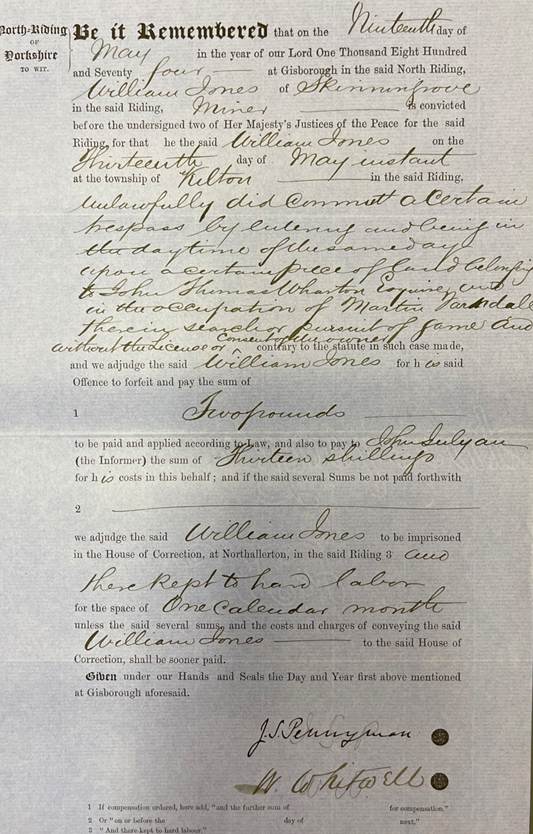
Summary conviction of William Jones of Skinningrove miner
for trespassing in the daytime in search or pursuit of game on land
belonging to John Thomas Wharton esquire and occupied by Martin Farndale
Offence committed at the township of Kilton on 13 May 1874 Case heard at
Guisborough on 19 May 1874 (Yorkshire Archives,
Document reference, QSB 1875 1/10/7/20, Catalogued)
·
Summary conviction of William Clarke of Skinningrove miner
for trespassing in the daytime in search of game on land belonging to
John Thomas Wharton esquire and occupied by Mr Martin Farndale Offence
committed at the township of Kilton on 13 September 1874 Case heard at
Guisborough on 15 September 1874 (Yorkshire
Archives, Document reference QSB 1875 1/10/7/136, Catalogued);
·
Summary conviction of Thomas Stanway of Boosbeck miner for stealing
apples from the orchard belonging to Mr Martin Farndale Offence committed
at the township of Kilton on 29 September 1874 Case heard at Guisborough on 29
September 1874 (Yorkshire Archives, Document
reference QSB 1875 1/10/7/153, Catalogued);
·
The York Herald, on 3 October 1874 reported GUISBORO PETTY SESSIONS – Thomas Stanway, of
Boosbeck, miner, for stealing a quantity of apples at Kilton, belonging to Mr
Martin Farndale, was fined £2 9s 6d including costs.
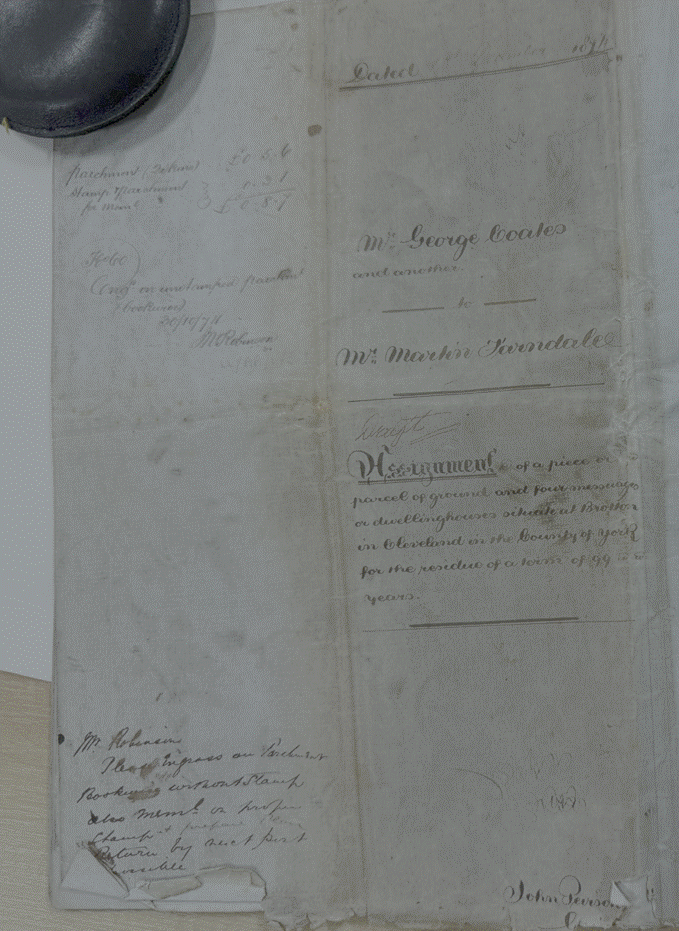
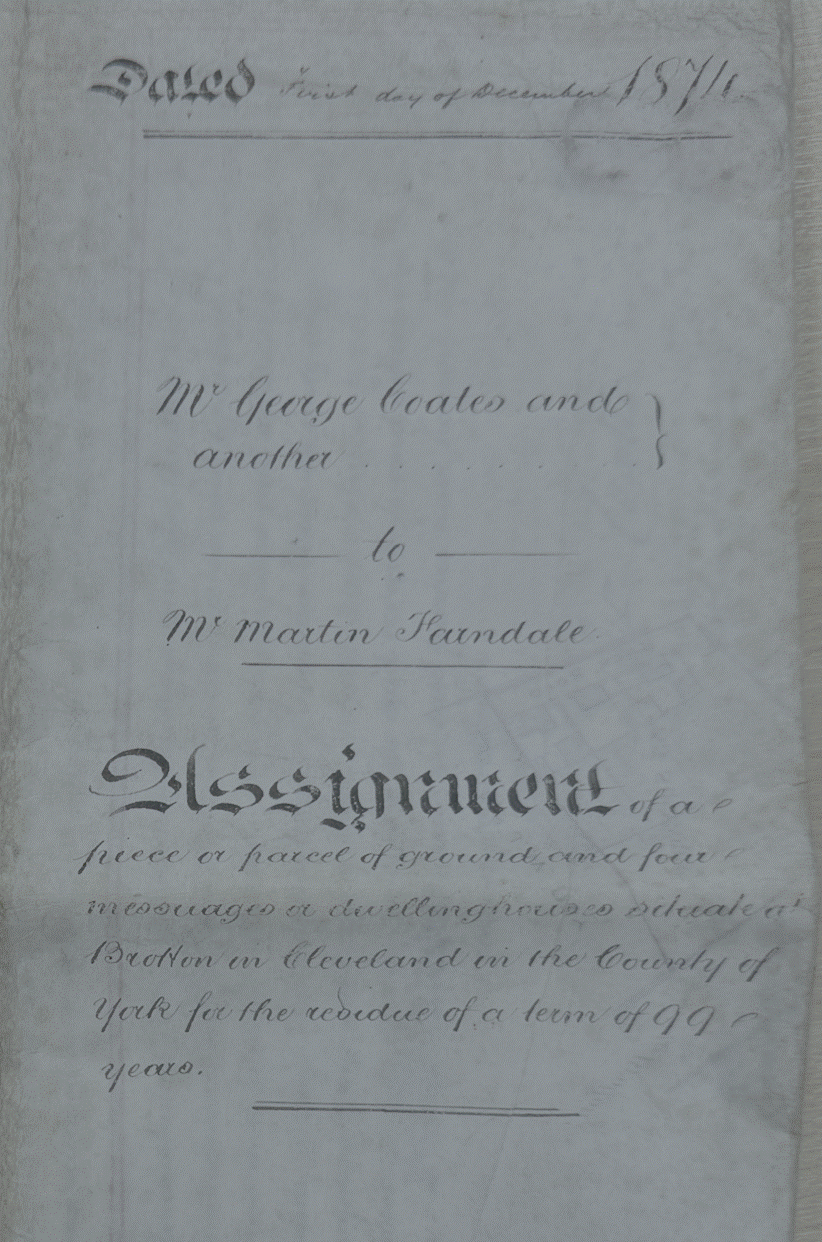
There is an
Assignment dated 1 December 1874 of the Lease from George Coates of Lackenby, yeoman and John Harrison the younger of
Darlington in Durham, to Martin Farndale of Kilton, of a parcel of land 135
square yards and the four stone houses built on it as marked on the map for the
remainder of the term of 99 years (The National
Archives U/AA/1/38
held by Teesside Archives).
There is a Draft
of an assignment dated 1 December 1874 of a lease from George Coates of Lackenby, yeoman, and John Harrison the younger of
Darlington in the county of Durham, land agent, to Martin Farndale of Kilton,
country gentleman, of a parcel of ground in Brotton measuring 1605 square yards
and bordering on the turnpike road from Skelton to Brotton village for the
remainder of the term of 99 years (The National
Archives U/AA/1/37
held by Teesside Archives, see also UAA/1/38).
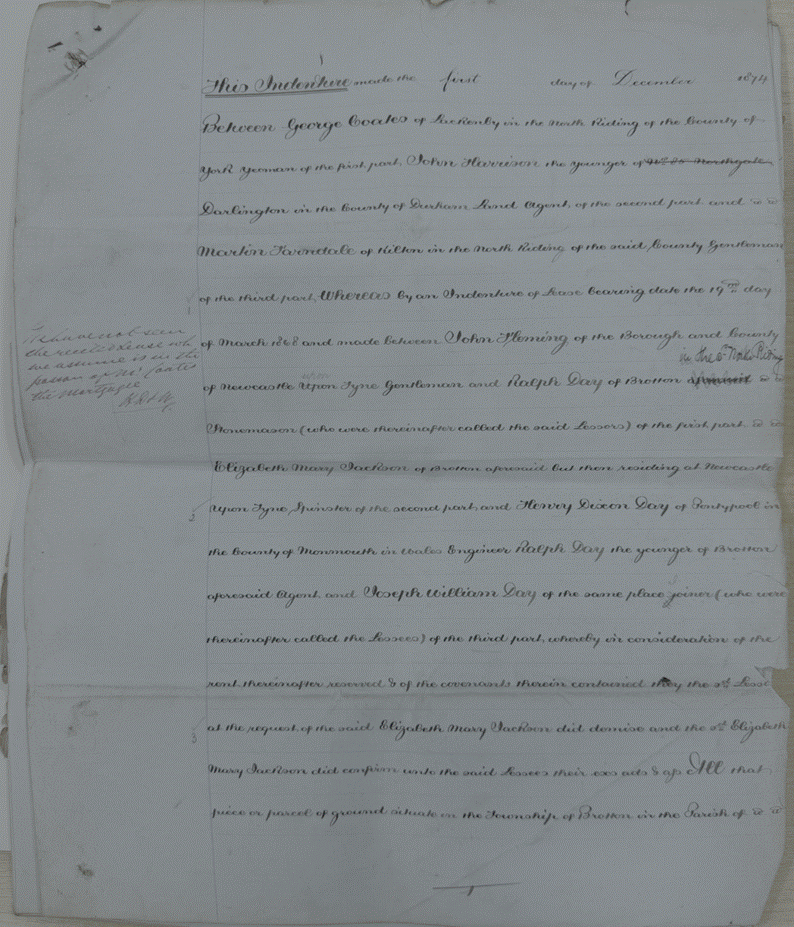
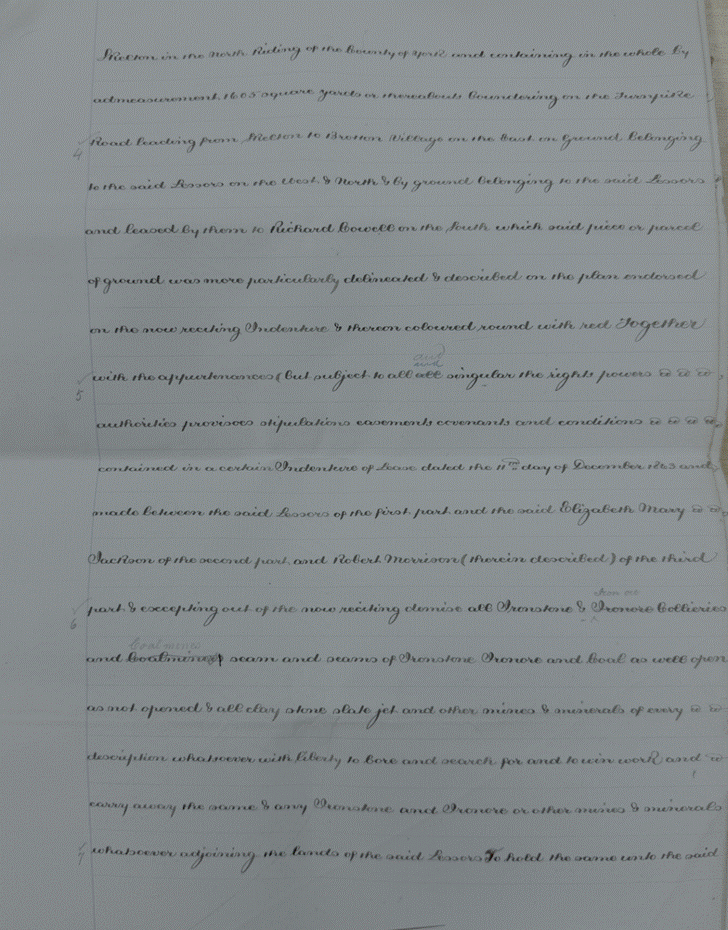
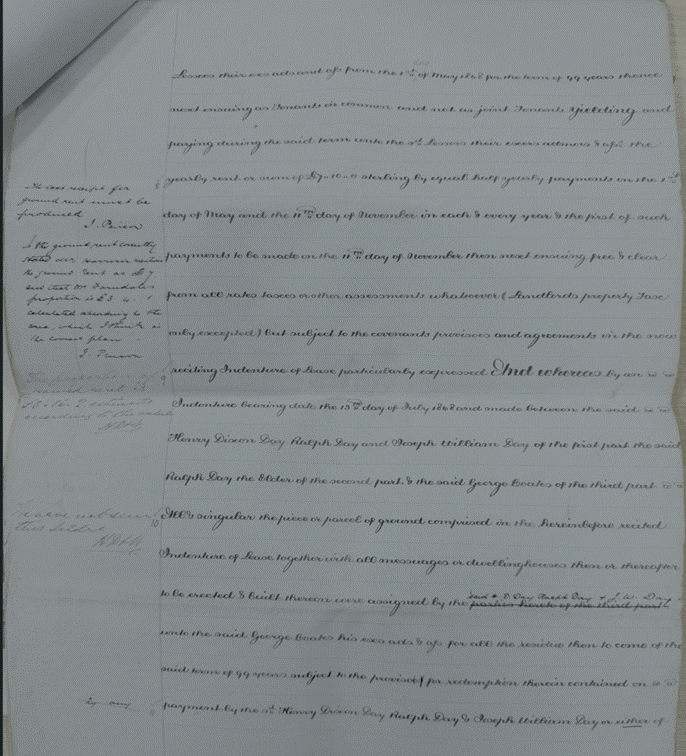
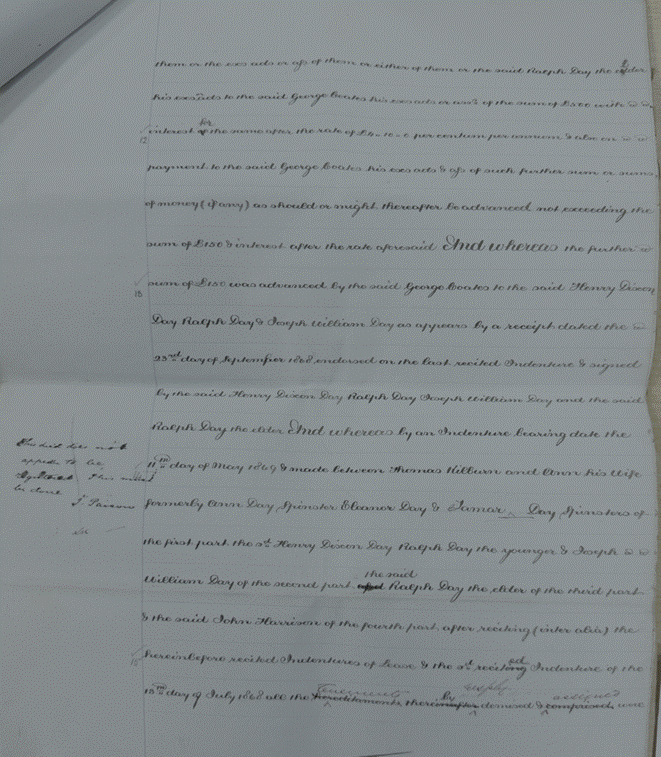
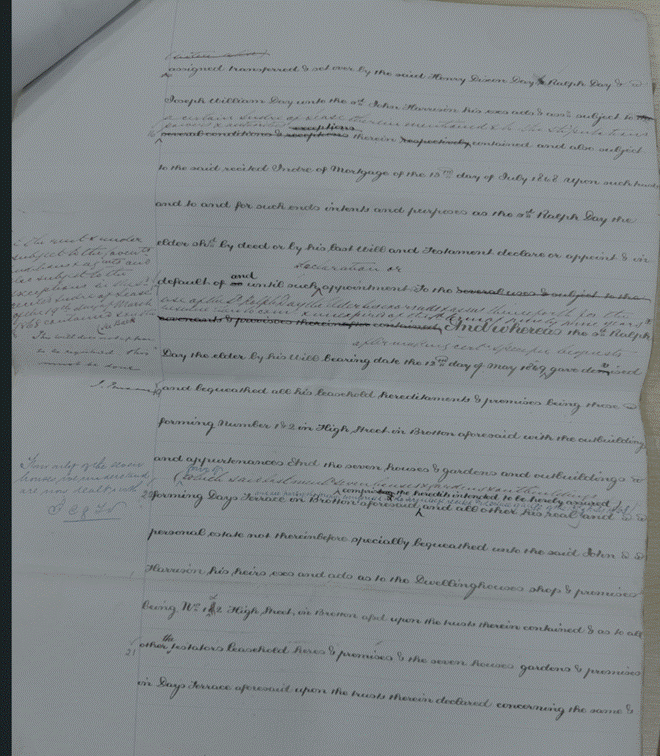
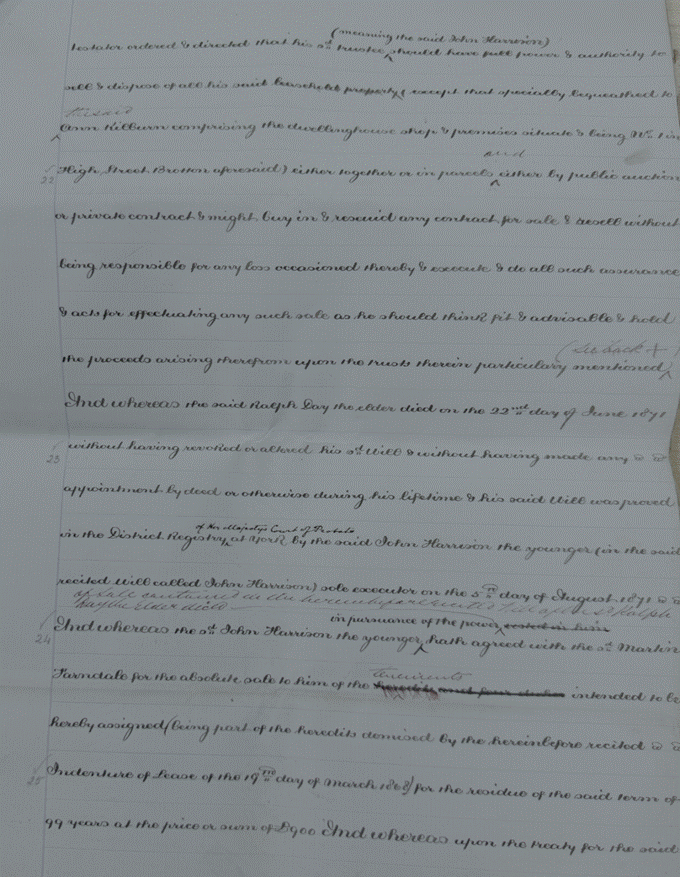
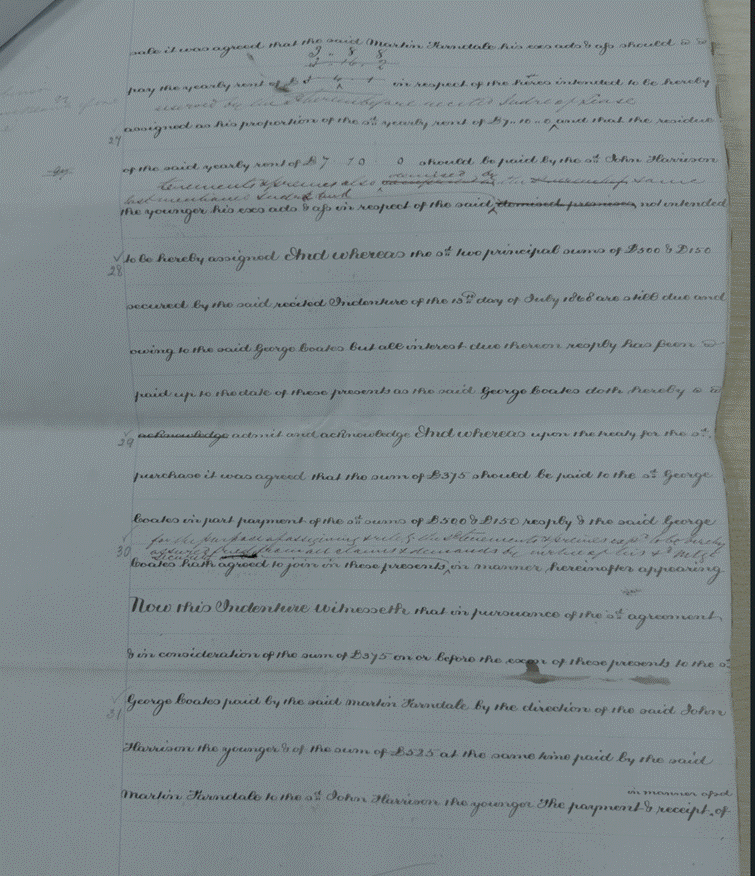
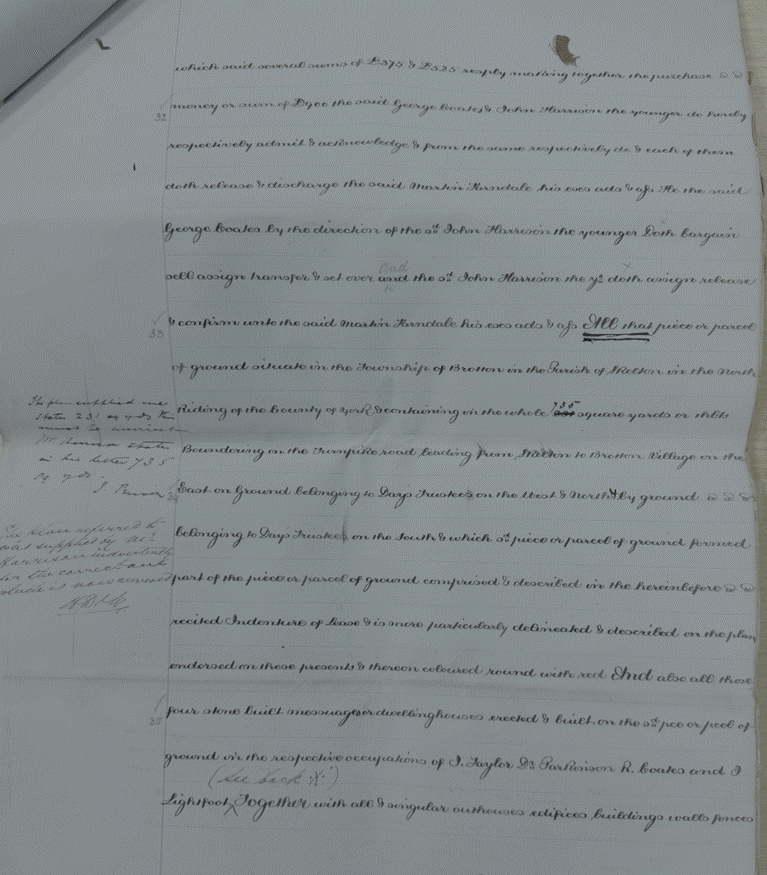
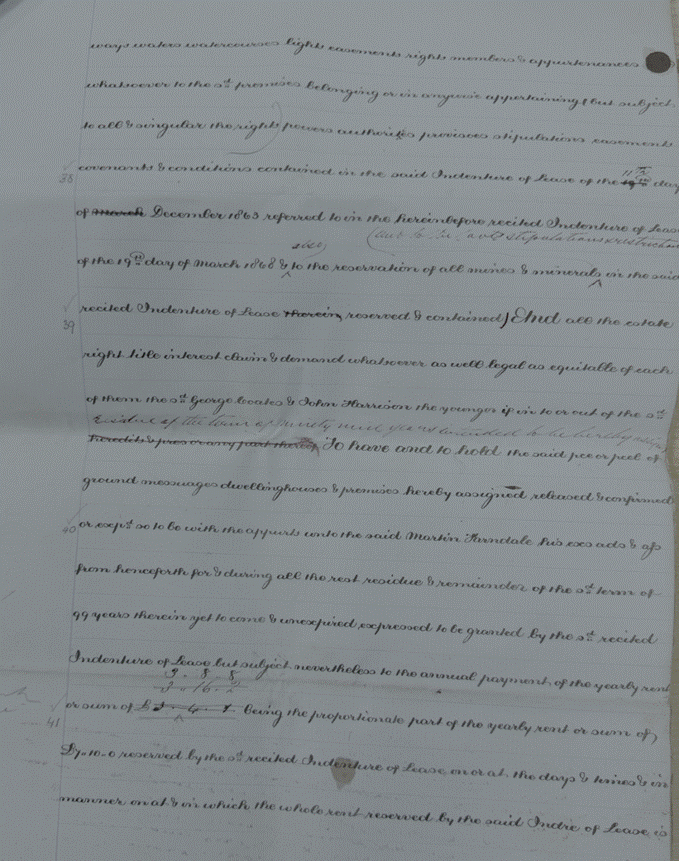
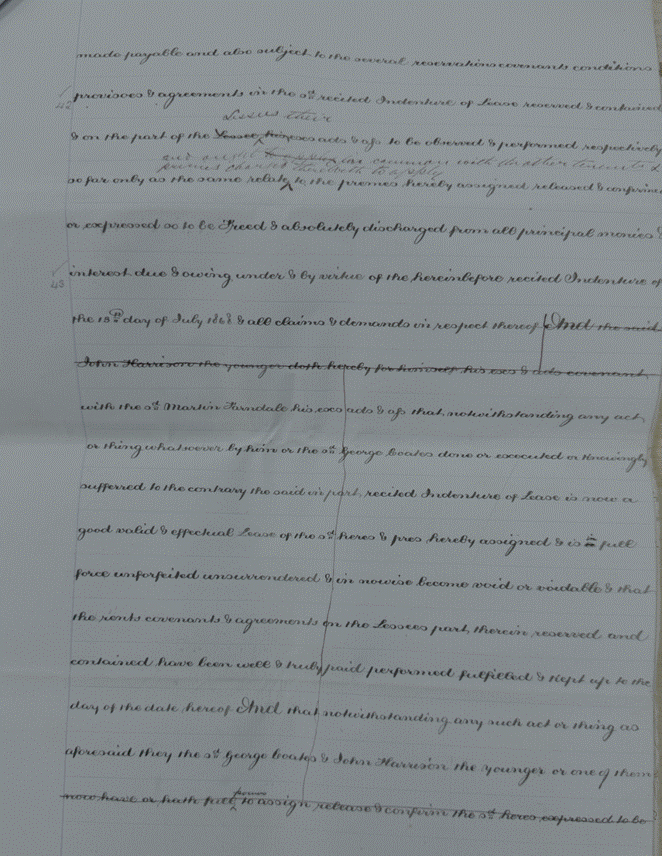
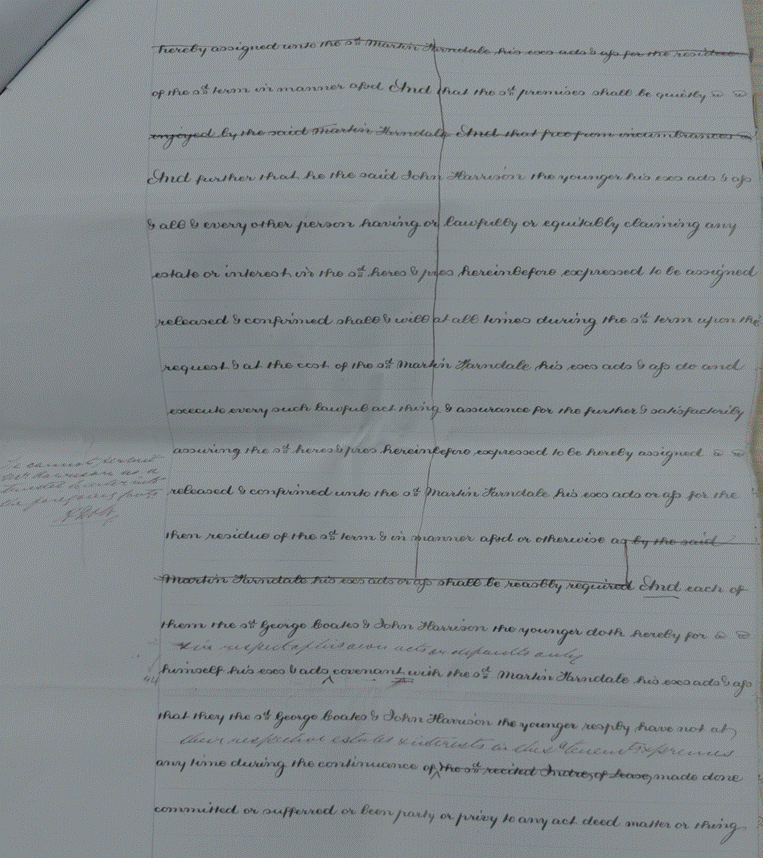
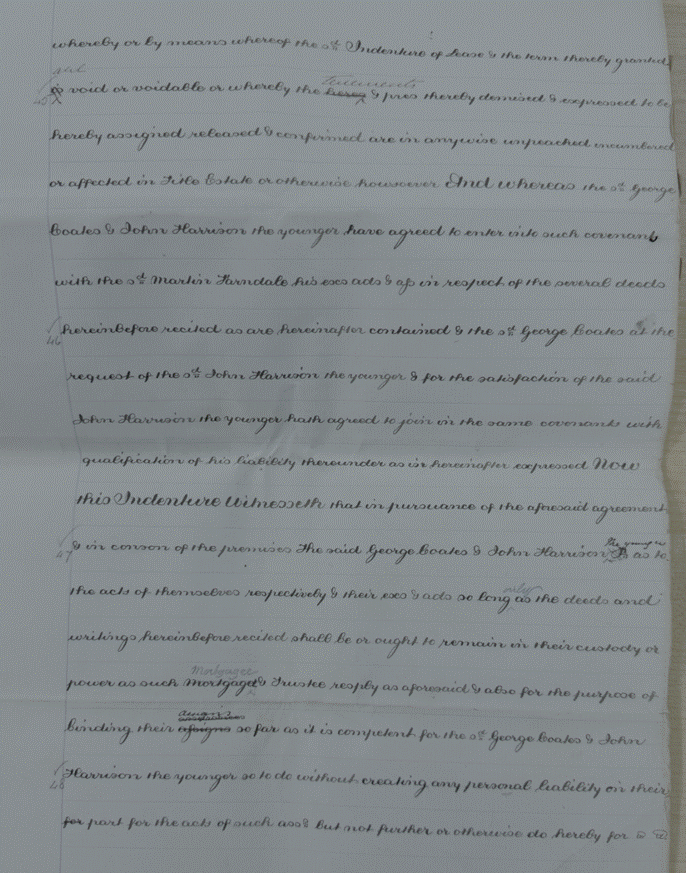
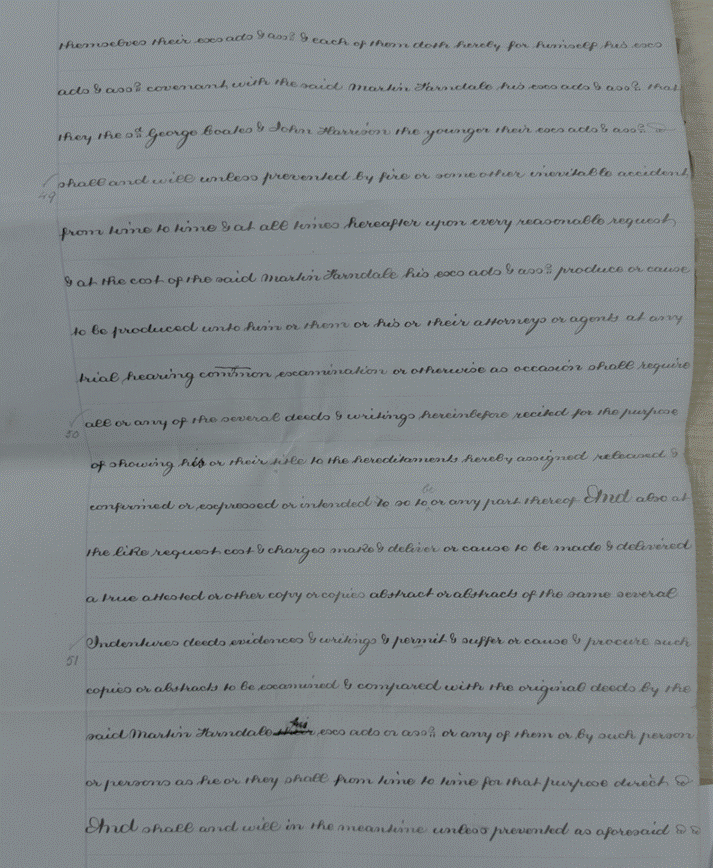
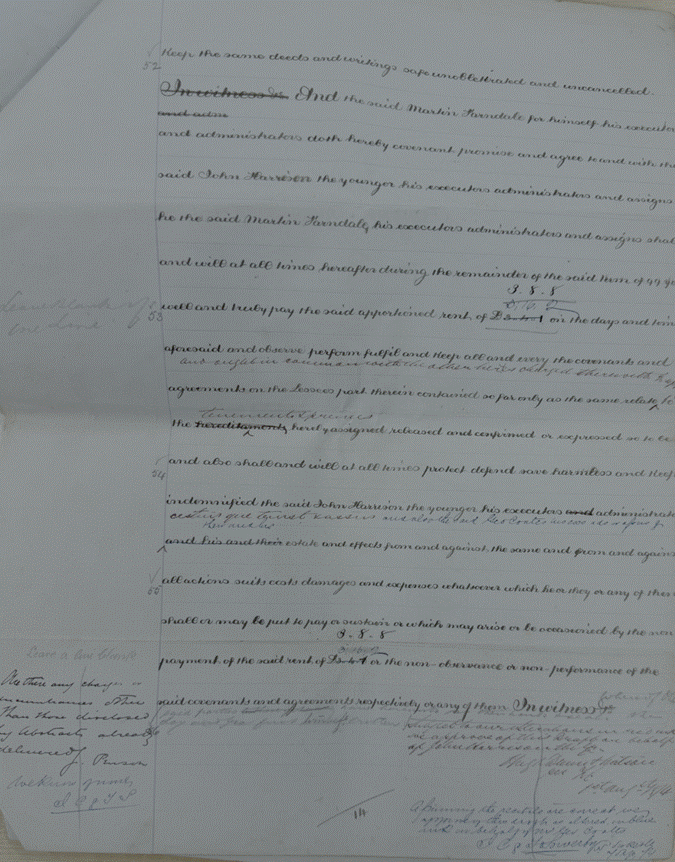
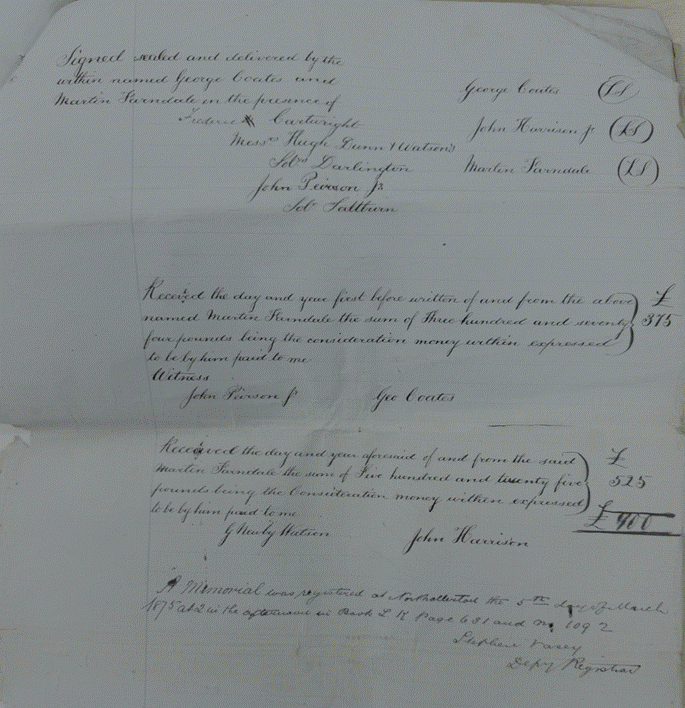
The document is a
bundle of connected 19th‑century indentures, all relating to the same leasehold
estate in Brotton, Cleveland / Skelton / Boston, and involving the same small
circle of families: Day, Harrison, Coates, Booker/Boakes,
Farndale, and others. The documents record a chain of assignments, mortgages,
repayments, and covenants relating to a 99‑year lease
originally granted in the 1840s. Over the next 30 or so years, the leasehold
land and the houses built on it were repeatedly mortgaged, transferred,
divided, and sold, with each new owner covenanting to pay their share of rent, honour
the lease conditions, and indemnify the previous owners.
The original
lease (1841–1844). A 99‑year lease was granted over a parcel of ground
at Brompton / Brotton / Skelton. Early parties include Elizabeth Mary Jackson,
Henry Dixon Day, Ralph Day, Joseph William Day, and John Harrison.
The lease
required an annual rent and contained the usual covenants, easements, and
mineral reservations (ironstone, coal, jet, etc.).
Mortgages and
financial advances (1861–1869). The Days mortgaged the leasehold property to
George Booker/Boakes, who advanced £1,500, later
increased by another £1,500. These sums were secured by the leasehold houses
and land. Several indentures recite these mortgages and confirm interest
payments.
Trust
arrangements and wills (1872–1876). Ralph Day the elder placed the leasehold
property into trust for John Harrison the younger, empowering him to sell or
divide the estate. Ralph Day’s will (12 May 1876) devised: No. 82 High Street,
Boston, Days Terrace (seven houses), and other leasehold premises, all upon
detailed trusts.
Sales and
assignments of portions of the estate (1871–1875). Multiple
transactions occur: a. Assignment to Martin Farndale.
A piece of ground (often around 800–1600 square yards) and four stone-built
houses were sold or assigned to Martin Farndale. Purchase prices include £375,
£525, £600, depending on the parcel. Harrison and Boakes
release their mortgage interests upon payment. b. Apportionment of rent. The ground rent (e.g., £9.10.0) is divided:
Farndale pays his proportional share (e.g., £9.5.6 or £3.5.5 depending on the
parcel). Harrison pays the remainder for the part he retains. c. Covenants.
Each new assignee promises: To pay their share of rent. To observe all lease
covenants.
To indemnify
Harrison and earlier owners. To allow production of deeds on request. To keep
deeds safe unless destroyed by fire or unavoidable accident.
Mineral rights
and reservations. Several pages repeat the standard reservation: All ironstone,
coal, jet, clay, slate, and other minerals remain with the original lessors.
They retain rights to bore, search, win, and carry away minerals even under the
houses.
Final receipts
and memorial (1875). George Coates, John Harrison, and Martin Farndale sign receipts
for £375 and £525. A memorial of the transaction is registered at Northallerton
on 5 March 1875.
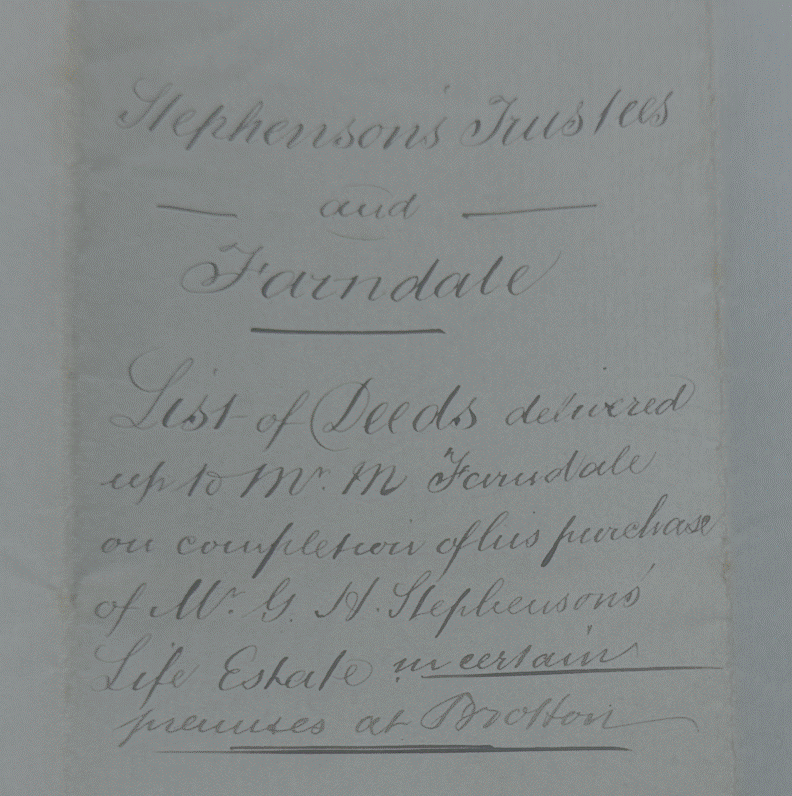
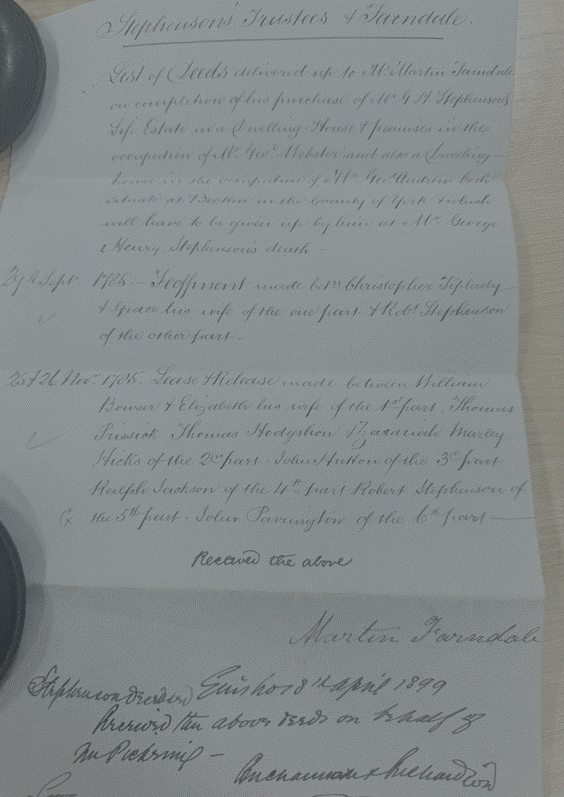
There is a List (the
list being dated 18 April 1899) of deeds delivered by Martin Farndale following
his purchase of George Henry Stephenson's life estate in 2 dwellinghouses in
Brotton (The National Archives U/AA/1/43
held by Teesside Archives).
1875
The poaching
continued into 1875:
·
Summary conviction of Elizabeth Holt of Kilton married woman
for maliciously damaging with intent to steal a quantity of peas and beans
growing in a field, the property of Martin Farndale of Kilton farmer Offence
committed at the township of Kilton on 31 August 1875 Case heard at Loftus on 9
September 1875 (Yorkshire Archives, Document
reference, QSB 1876 1/10/7/38, Catalogued).
Meantime Martin
continued to show cattle and horses at the local show. The
York Herald, on 23 July 1875 and the
Darlington & Richmond Herald, on 24 July 1875 reported: Loftus
Agricultural Show: The following is the prize list. Cattle. Bull Calf under 12
months old, Mr B Dawson, Danby Castle; Second, Mr. John Pearson, Danby. Yearling
Bull, Mr M Farndale, Kilton, second. Mr Isaac Garb, Scaling... Coaching class.
…. Filly Foal, C M Palmer Esquire, Grinkle Park, second Mr M Farndale, Brotton
…
The
Northern Echo, on 22 September 1875 advertised: Found, a black retriever bitch
pup. If not claimed within seven days will be sold to defray expenses. Apply to
M Farndale, Kilton, Brotton, Saltburn.
The Register of Voters 1837 -1875, with 1852 and 1867
missing all the rest show that Martin Farndale, was living in Kilton; the occupier
of farm.
1876
There were more
poaching cases in 1876:
· The Daily Gazette for Middlesbrough, on 28 April 1876 reported Loftus Petty Sessions. Tuesday,
before the reverent. GJ Morehead. Game trespass near Kilvington. Six men, named
Humphrey Keane, William Keilan, William Mogerage., John Dad, George Dad, and
Charles Spear where charged with trespassing in
pursuit of game on the land in the occupation of Mr J T Walker (sic, recte Wharton). Mr Collier defended the men. PC Calvert
stated that on Sunday evening between five and six o’clock, while on duty near
Kilvington, he saw the defendants on the road, and they had five dogs with
them. When close to a field in the occupation of Mr Farndale, they sent three
of the dogs into it after a hare, which they chased and returned without having
caught. He also saw two dogs in an adjoining field. The defendants were fined
19 shillings and costs each.
The York Herald, on 30 March 1876 reported, Guisbro’
- The following are the names of candidates nominated for the office of
Guardians of the Guisborough Union ... Kilton, Martin Farndale.... The Whitby Gazette, on 1 April 1876 and the Stockton Herald, South Durham and Cleveland Advertiser, on 1 April 1876 reported: Nomination
of Guardians, - The following are the names of candidates nominated for the
Office of Guardians of the Guisborough Union... Kilton, Martin Farndale...
The Daily Gazette for Middlesbrough,
on 3 August 1876 reported:
Guisborough Sanitary Authority.
A meeting of the members of this Authority was
held on Tuesday afternoon at the Union Workhouse, Guisborough, Admiral
Challoner presiding. There were also present the Rev. J R Ellis, and Messrs J T
Wharton, D T Petch, W Wilson, J Robinson, R P Petch, J Hicks and M Farndale.
The water supply at Lazenby.
In answer to the Chairman, Mr Hicks said that
nothing had yet been done with reference to the water supply at this place. The
Chairman said they must stir up the ratepayers to take action,
for it was necessary that they should have good water. Mr Hicks said there was
much doubt as to whether it could be procured. The ratepayers seemed tired of
the question. The Chairman remarked that they had been trying to find springs
on the hillside, but they did not succeed. It was no
use sinking wells near the houses, as they would soon get the water polluted.
Mr Hogg should open a spring out that was reported to be near the village, and
the ratepayers should help the Board. The Rev. J Ellis thought it was time this
matter was settled. After a little further conversation, it was decided to
adjourn the consideration of the question for a fortnight, in order that the
chief parties interested might be communicated with.
There were cases of anti vax protests in August:
The Stockton Herald, South Durham and Cleveland
Advertiser, on 5 August 1876 reported: Guisborough Board of Guardians.
The ordinary fortnightly meeting of this Board was held on Tuesday afternoon in
the Board Room, Union Workhouse, Guisborough, Admiral Challoner in the Chair.
There were also present Mr D T Petch, vice chairman, Rev H W Yeoman and J R
Ellis; messes Thomas Patch, R Robinson, J Hicks, J Clark, W Garbett, J Ward
Wilson, R P Patch, Mr Farndale. The clerk, read a letter from the Local
Government Board with reference to the case of Mr W
Dewing of Guisborough, who had refused to have his children vaccinated,
and who had been fined on various occasions. He also read a communication from Mr.
J Bennison, grocer, of Westerdale, asking the board not to proceed against him
again for non
vaccination of
his children, as he thought it was opposed to the laws of nature.
The chairman said that the Board could make to the Local Government Board was
that there were only two people in the district who refused to comply with the
Act. The guardians had no other course than to put the law in force, and if the
Local Government Board decided in its wisdom that in these cases
they had not to take further proceedings, of course they would comply with that
request. Mr D T Petch remarked that the Board would at once stay its hand if
the Local Government Board decided that they had to do so. The question invoked
no further discussion, and the clerk was ordered to write to the Local
Government Board. This was all the business.
There was a
conveyance of property at Broadbent Street and Grange Terrace, Brotton to
Martin Farndale on 6 November 1876 (Yorkshire Archives, ZOZ
Box 52/24/1 (Parcel 2576), Catalogued).
1877
There was another ploughing and hedge
cutting competition in January. The York Herald on
Friday 12 Jan 1877 reported: Loftus in Cleveland. Loftus Ploughing
and Hedge cutting Matches. These popular rural matches for the district of
Loftus were held yesterday. The weather not being favourable, the number of
spectators was limited. The ploughing match took place upon Mr Ralph Garbett's
farm, Loftus Grange, and the hedge cutting upon Mr Richard Thompson's Farm,
Seymour Hill, Loftus. The following is a list of prizewinners...
For ploughing, Open to All England, with either wheel or swing plough, 1. John
Atkinson, Bilsdale; 2. Martin Farndale Kilton... and the Northern Echo on Friday 12 Jan 1877: Prize
List of Loftus Ploughing Match. The following is the result of the contest
which took place yesterday - All England Wheel or Swing Plough - First, £3 1s, Mr.
John Atkinson, Bilsdale; Second £1 10s, Mr M Farndale Kilton... and The
Daily Gazette for Middleborough, on 13 January 1877: Loftus District Ploughing
and Hedgecutting Matches. These increasingly popular
matches, despite the incessant rains lately experienced, came off on Thursday.
Owing to the rather unfavourable weather, the number of spectators was not
large. … The following being the list of winners … Class 1, open to all
England, with either wheel or swing plough – John Atkinson, Bilsdale, 2 – Martin
Farndale, Kilton
However there was devastating news for Martin in February when his wife,
Elizabeth Farndale of Kilton, aged 72,
died and was buried at Brotton
on 23 February 1877 (BMD). The York Herald on 22 and 23 February 1877 and the
Darlington and Stockton Times, on 24 February
1877 and the Northern
Echo, on Thursday 22 Feb 1877 reported: Deaths. Farndale. On the 20th
inst, at Kilton, Elizabeth, the beloved wife of
Martin Farndale, aged 72 years; deeply lamented. Will be interred at. Bottom
this day, Friday at one o’clock. Friends will please accept this notice.
and Farndale - at Kilton Hall, 20th Inst, aged 72, Elizabeth, Relict of Mr.
Martin Farndale.
Business for the
Board of Guardians continued by June. The Whitby Gazette, on 9 June 1877: Board
of Guardians. The usual meeting at this board was held on Tuesday under the
presidency of Admiral Chaloner. An application by Dr Chalmers, of Danby, for an
increase of £20 per year as Medical Officer for that district was refused. On
the motion at the Chairman, Mr Hedley was appointed to revise the assessment of
mines at a salary of 50 guineas. Admiral Challoner gave notice that at the next
meeting he would move that a school attendance officer be appointed at a salary
of 100 pounds per year. A proposition to present Messrs Thomas Petch and Martin
Farndale with some token of recognition as to the way in which they had
performed their duties as guardians since the formation of the Union in 1838,
was referred to Messrs Robinson, Garbett and D T Patch, who were appointed a
committee to report to next meeting.
In August 1877
Martin’s services were recognised as a Guardian of 38 years since the inception
of the Guisborough Board of Guardians: The Yorkshire Gazette, on 27
October 1877 reported PRESENTATION TO
TWO GUARDIANS - The proceedings of the ordinary meeting of the
Guisborough Board of Guardians of Monday afternoon, word diversified by one of the most interesting ceremonies which has ever
taken place in connection with the Union. Mr Thomas Petch, of Liberton and Mr. Martin Farndale, of Kilton.,
who, with the exception of a slight interval, had been members of the Board
since its formation 38 years ago, were each made the recipient of an
illuminated address and a piece of plate, the gift of their brother guardians,
and both the addresses, which Mrs J W Pease, of Hutton Hall, had generally
undertaken to have executed in London at her own costs, were beautifully
mounted and finished. Admiral Chaloner made the presentation. The
Daily Gazette for Middlesbrough, on 24 October 1877 reported: Guisborough
Board of guardians. Interesting presentation to two guardians. The usual
fortnightly meeting of the Guisborough Board of Guardians was held in the workhouse
on Tuesday afternoon. Admiral Chaloner in the chair. Before the commencement of
the ordinary business of the Board, Mr Garbutt rose and said to the Board that
he requested the Chairman to present Messrs Thomas Petch and Martin Farndale
with a piece of plate and an illuminated address. The two gentlemen were then
brought into the room and the Chairman in a feeling speech made the
presentation. He said he had been requested to present a piece of plate and an illuminated
address, and found it afforded him much pleasure in doing so. The presentation
was the outcome of a spontaneous feeling among the guardians that the long
extent rendered by the two gentlemen should in some degree be rewarded. Mr
Patch had, with a slight interval, served during the whole time the board had
been in existence. On looking up some old papers connected with the Board, he
was surprised to find that Mr Patch had served for 38 years and that the Board had
been in existence for 40 years. Mr Farndale had also sat on the Board for
almost as long a period. He thought it was almost unnecessary to say they had
conducted themselves in an agreeable and easy way, which had tended, in a great
measure, to substantiate the work of the Board. For himself, individually, he
might say, he was much indebted to them for the courtesy and consideration he
had received in their hands ever since he had become chairman of the Board.
Although he had not been connected with the Board as long as they had, yet it was nearly 20 years since he
became a member. Nothing had been a source of pleasure to him in that way,
although they had a great amount of business to get through at each meeting,
yet the proceedings were rendered much more agreeable by the good feeling that
existed among the members, and this they were indebted in no small way to the
old Guardians, whose had set such an excellent example before them. He then
handed over the address and said he earnestly hoped that God might give them
many years, and that they might enjoy a the goodwill
of their friends and neighbours and guardians with whom they had been
associated. He then read the address. The address to Mr Patch as follows... Mr
Farndale’s address was, with a verbal oration or so, exactly similar
to Mr Petch’s. On the piece of plate was an inscription to the fact that
the testimonial was in recognition of the services rendered to the Board. … Mr Farndale
who was much affected, replied in a very brief speech, in which he thanked them
for the honour done him, and assured them he would prize very highly the gifts.
There was another
incident of fence damage reported in the York
Herald, on 10 August 1877: Cleveland. Loftus, Petty Sessions,
Tuesday. Samuel and Mary Pascoe were each fined 5 shillings, and costs for
being drunk and fighting. On the Brotton Road, on Saturday, last. it appears that
they, in company with another named Holiday, had all been married that day, and
had celebrated their wedding getting drunk, and on their way home a quarrel
ensued between them. Anthony Ridley and Joseph Godfrey were both fined, the
former 10s and costs, and the latter 5s and costs, for being drunk and making a
disturbance at Loftus on Saturday last. Thomas Fireman was charged by Inspector
Armstrong on behalf of the Northeastern Railway Company, with behaving
indecently at Carlin How Railway station on the 17th
July. Considering the circumstances of the case, the defendant was only ordered
to pay costs. Benjamin Byers was ordered to pay 1d damages and 6s costs for
injuring a fence belonging to Mr M Farndale of Kilton on the 6th inst.
Francis Hedley and Joseph Bedale were both fined, the former 6s and costs and
the latter 5s and costs for creating a disturbance at the Crown Hotel, Brotton
on the first inst.
The
York Herald, 3 September 1877 reported: Carlin How and Skinningrove Horticultural and
Athletic Society. On Saturday the second annual show of this society was held
in a field adjoining the blast furnace of the Loftus Iron Company at
Skinningrove, and on top of a high cliff overlooking a broad sweep of sea. The
situation was of a most romantic character, and its charms were heightened by
the brightness of the sky, flecked here and there by tearful looking clouds,
which would have better become April than September. Although the great
commercial depression has been severely felt in the neighbourhood of Carlin How
and Skinningrove, and large numbers of workmen have been thrown out of
employment, to judge by the animation displayed on Saturday, hard times might
have been unknown. The show was numerously attended, and interest evidenced in
it considerable. The flowers, fruits and vegetables were exhibited in a large
tent and were tastefully displayed. Special attention appeared to have been
paid to the rearing of vegetables - potatoes, peas, broad and kidney beans
being particularly fine. The principal executive exhibitors were Messrs
Beadwell, Watson, Pennock, Hackney, Appleton, Wilson, Foster, Bean, Atkinson,
Elderton, Fletcher, Appleby, Silman and Jackson. Attention is very properly
paid at the horticultural shows in this district to the cultivation of cottages
gardens. Prizes were accordingly offered for the best cottages garden at Carlin
How and Skinningrove and were awarded as follows... Messrs Burns, of Saltburn,
Wilkinson, of Wilton Castle and Mr. Baton officiated as judges of the flowers,
fruit and vegetables, and Mr Jackson, of Crosshill Farm and Mr Farndale, of
Kilton Farm adjudicated on the pigs.....
1878
By 1878, Martin was
clearly acting more in partnership with his nephew Charles Farndale (FAR00341).
The
York Herald, on 12 January 1878 reported on a continuance of the District Ploughing and hedge-cutting
competition at the Farndale Farm: Lofthouse. DISTRICT PLOUGHING
AND HEDGECUTTING MATCHES. These annual matches were held yesterday on the farm
of Messrs M and C Farndale, Kilton Hall. The day was fine, and the
spectators unusually numerous. The hedge-cutting was about on average with
former years, there being six entries for the open class, but none for the district.
The following were the prize winners … The ploughing was beyond all precedent,
and the prizes had not been awarded at the time our parcel was sent.
The
York Herald, on 13 July 1878 reported more equine success at the Loftus
Agricultural Show: HORSES – CLEVELAND CLASS … Two year
Cleveland fillies – Joseph Welford, 2. M and C Farndale, highly commended J
Thistlewaite, Great Ayton …
Disease hits Kilton
Martin Farndale suffered an outbreak of pleuro pneumionia
on his farm in October 1878. The Northern Echo, on 25 October
1878
reported Case of pleuro-pneumonia near Loftus. At Loftus Petty Sessions
yesterday, Inspector Alan reported a case of pleuropneumonia which had occurred
on the previous day, in a herd of animals belonging to Mr Farndale, a farmer of
Kilton. The infected animal was bought at a fair in Westmoreland on Monday, and
on reaching Kilton it showed symptoms of disease and Mr Kilburn,
a veterinary surgeon at Brotton, was called in. Another veterinary surgeon, Mr
Barker, of Middlesbrough, also visited the animal and in consequence of the
latter's report, the inspector applied for an order to have the animal
destroyed. Superintendent Clarkson said that according to the provisions of the
new Act, which had come into force, the animal had to be destroyed within 24
hours of the disease becoming known. An order for the slaughter of the animal
was then granted. In answer to a question, Superintendent Clarkson said there
were certain provisions in the new Act respecting the removal of animals in an
infected district and compensation to owners of infected animals which were
ordered to be destroyed, but these had to be considered by a meeting of local
magistrates to be held at Guisborough on Tuesday next. The
Daily Gazette for Middlesborough,
on 30 October 1878 reported Pleuro-pneumonia in Cleveland. At the Gainsborough
petty sessions on Tuesday ... a report was read from Inspector Allen, of
Loftus, and also from William Barker, veterinary surgeon, under the Contagious
Diseases (Animals) Act, stating that pleuro-pneumonia had broken out on the
farm of Mr Martin Farndale, at Kilton, and one kyloe
beast had been destroyed … Mr Farndale bought 35 beasts at Carlisle Fair, and
observing one of them was wrong put it into a shed situate in a field belonging
to Mr Proud, which adjoined his farm. After discussion it was resolved to put Mr Martin Farndale’s
farm and Mr Proud where the beast was slaughtered into quarantine as an
infected district for the 56 days required by the Act. The
Newcastle Courant, on 1 November 1878 reported: Cattle disease - At
Guisborough petty sessions on Tuesday, it was reported to the magistrate that pleuro-pneumonia had broken out on the farm
of Mr Martin Farndale, at Brotton-in-Cleveland. One cow had been killed and
buried. The bench ordered the farm to be quarantined as an infected district.
In the Leeds Mercury on 1 November 1878: “Pleuro-pneumonia
in Cleveland. Pleuro-pneumonia has broken out on the farm of Mr Martin
Farndale, at Brotton-in-Cleveland. One cow has been killed and buried. The farm
has been officially declared to be an infected district.” In the Leicester Advertiser, 9 November 1878: Pleuro-pneumonia
appears to be on the increase in the country. On Tuesday week it was reported
to the magistrates at Gainsborough that plural pneumonia had broken out on the
farm of Mr. Martin Farndale at Brotton in Cleveland. One cow had been killed
and buried. The bench ordered the farm to be quarantined as an infected
district, we are informed and in this way may be seen
the value of the Act that most recently came into operation. By this means
prompt action may be taken for isolating any case, to prevent it spreading,
whilst on the other hand the owner is bound to give information of any
outbreak. It will thus be seen that the measure is protective because no one
can tell whose stock may be infected next.
Pleuro-pneumonia is a lung disease of cattle and sheep. It
causes an inflammation of the lungs. The disease is caused by the bacterium mycoplasma
mycoides. Fever, thirst, loss of appetite, and difficult breathing are
signs of the disease.
The Contagious
Diseases (Animals) Act 1878 (41 & 42 Vict. c. 74) was an Act of the Parliament
of the United Kingdom passed by Benjamin Disraeli's Conservative government. A
select committee was appointed in 1877 to investigate animal diseases. The
resulting Act established central rather than local control over all outbreaks
of animal disease. The agriculturist Jacob Wilson considered the Act "an
undoubted benefit conferred upon the agricultural interest by the Conservative
Government". It was opposed by the Radicals.
1879
In Kelly’s
Post Office Directory 1879, Martin and Charles Farndale were shown as farmers
in the commercial section. Kilton – commercial: Farndale, Martin &
Charles, farmers. Garbutt, John, miller, Kilton hill. Judson, William, farmer,
Stank House. Kilton Iron Stone Co. Porritt, John, farmer, Buckrush.
Wood Thomas, farmer, Greenhow.
The
Northern Echo, on Friday 13 June 1879, reported: Brotton Primitive Methodist
Church. The anniversary services in connection with the above church were held
on Sunday, Monday and Tuesday. Two sermons were preached on Sunday
and a lecture entitled The Bible: Its translators, their trials and triumphs,
was given on the Monday evening by the Rev G W Morse, of Northallerton. Mr R
Gilbertson of Saltburn presided. On Tuesday evening a service of song, entitled
Uncle Tom's Cabin, was given by the choir. Chairman, Mr Joseph Farrow; Reader,
Mr John Hall Saltburn. A fair company was present at the tea and bazaar, which
brought up the proceeds of the anniversary to £10, in addition to donations of
£1 each from Messrs. Geo Taylor, M Farndale and John Rigg and other smaller
subscriptions. This society is making praiseworthy efforts to sustain its
position during this terrible depression.
The Northern Weekly Gazette, 12 July 1879 reported Primitive Methodist Picnic, Skinningrove. The above
society held their annual picnic on Saturday in a field belonging to end to
Mr Farndale at Kilton. The weather was fine and there was a good number
present. The usual games were indulged in, and all seemed to thoroughly enjoy
themselves.
1880
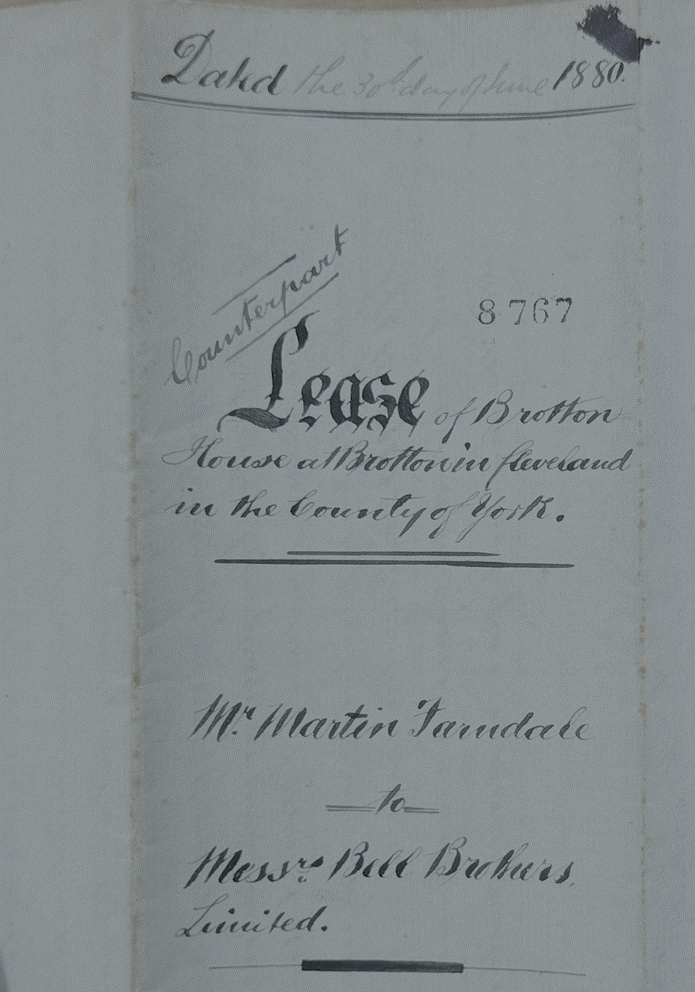
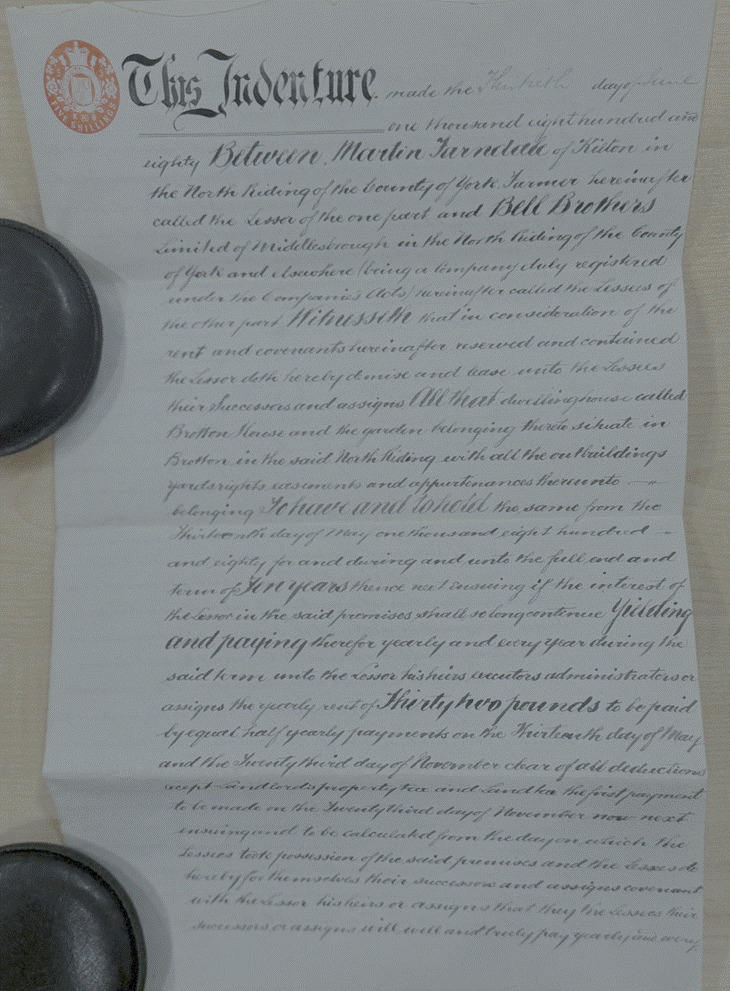
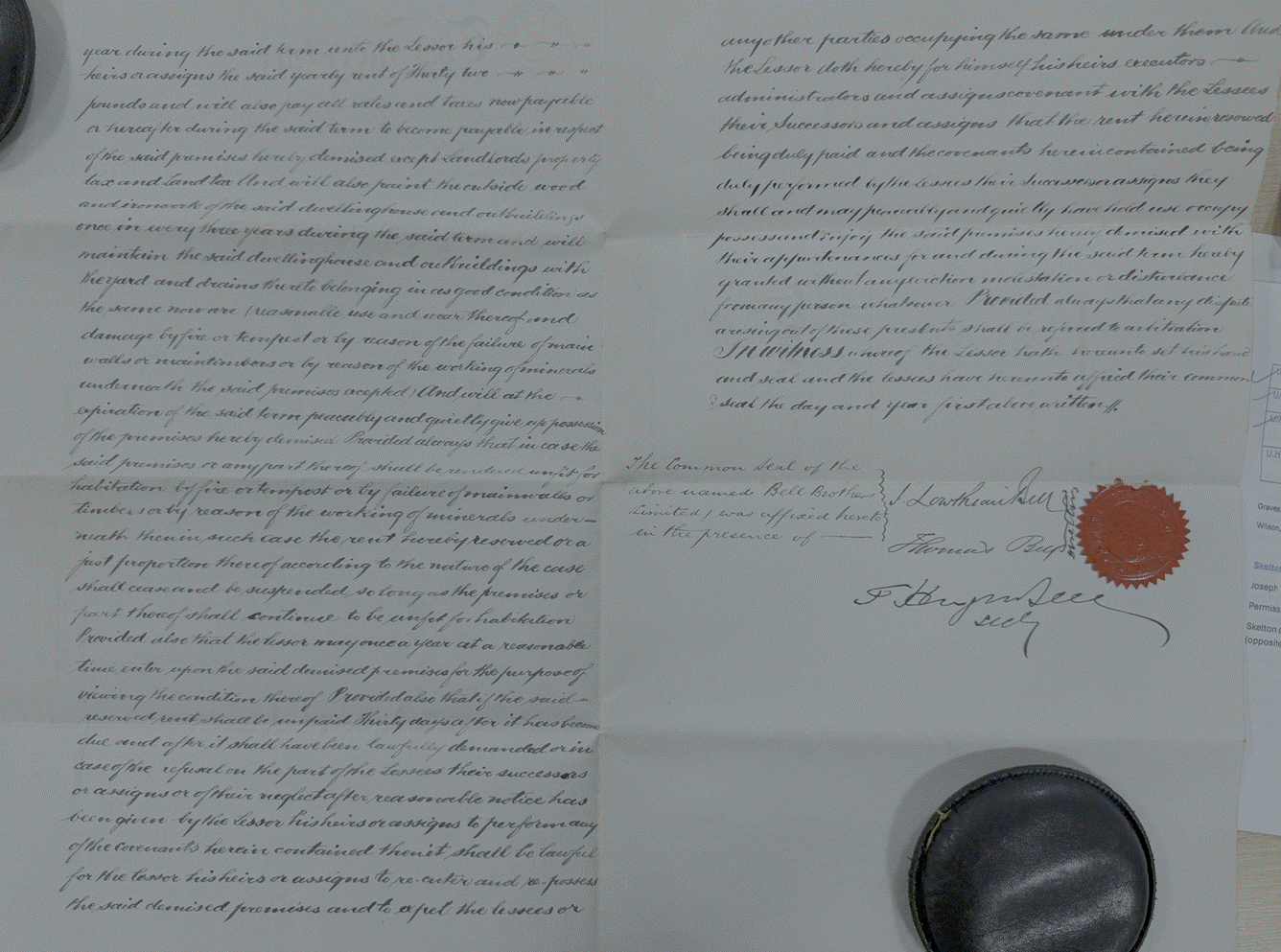
A Counterpart Lease for 10 years was granted from
Martin Farndale of Kilton, farmer to Bell Brothers Limited of Middlesbrough of
the dwellinghouse called Brotton House and the garden for £32 yearly (The National Archives U/AA/1/41 held at Teesside Archives).
1881
There was another incident of
damage to crops in 1881. There was a summary conviction of John Speck, Charles
Speck and George Arnold all of Brotton for maliciously damaging beans
growing in a field occupied by Martin and Charles Farndale Offence
committed at the township of Kilton on 21 August 1881 Case heard at Loftus on
26 August 1881 (Yorkshire Archives Document
reference QSB 1882 1/10/7/13, Catalogued) The Evening Gazette, on Saturday
27 Aug 1881 reported: Damaging beans and oats. Three Brotton youths, named John
and Charles Spark and G Arnold were charged at Loftus Petty Sessions on Friday
by Mr Farndale of Kilton with damaging beans and oats in his field
on the 21st inst. The complaint stated that considerable damage had been
done to his crops, and although he did not wish the lads to be severely
punished, he wanted to put a stop to it. The damage was estimated at 1s
each. Ordered to pay costs of 6s 2d each, and the damage, 1s each.
By this time it is notable that the land was clearly being
worked in partnership between Martin and his nephew, Charles Farndale.
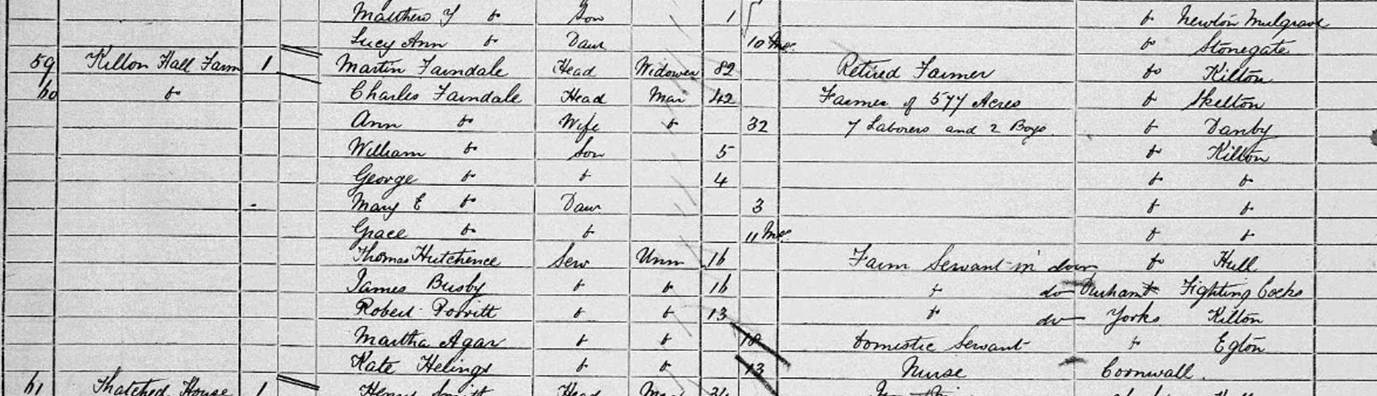
In
the census of 1881, Martin Farndale, still
the head; a widower; aged 82; was listed as retired farmer at Kilton Hall Farm, Kilton and Charles
Farndale, married; aged 42; was a farmer of 577 acres, with 9 employees (FAR00341). Now living
together were Charles’ family, Ann Farndale, wife of Charles; age 32;
William Farndale, son of Charles; age 5; (FAR00531); George
Farndale, son of Charles; aged 4; (FAR00540); Mary
Farndale, daughter of Charles; aged 3; (FAR00560); Grace Farndale,
daughter of Charles; aged 2, (FAR00566).
However Martin continued
his work as overseer of the poor. The Yorkshire
Post and Leeds Intelligencer, on 31 March 1881: Guisboorough.
At the Guisborough Petty Sessions on Tuesday, the following persons were
appointed overseers for the district. Division of Laughbaurgh East.... Kilton -
John Garbutt and Martin Farndale...
The
Daily Gazette for Middlesbrough, 23 December 1881: BROTTON Although trade at this
place has been extremely slack for several months, the tradesmen have made
ample preparations for Christmas … Mr John Allinson, butcher, shows some
good beef fed by Bolckow, Vaughan & Co, with a choice of sheep and pigs
fed by Mr M Farndale of Kilton. Mr Catron also has some very prime beef –
two four year old oxen, fed by J Petch Esq, with sheep
and pigs from Mr M Farndale of Kilton …
1882
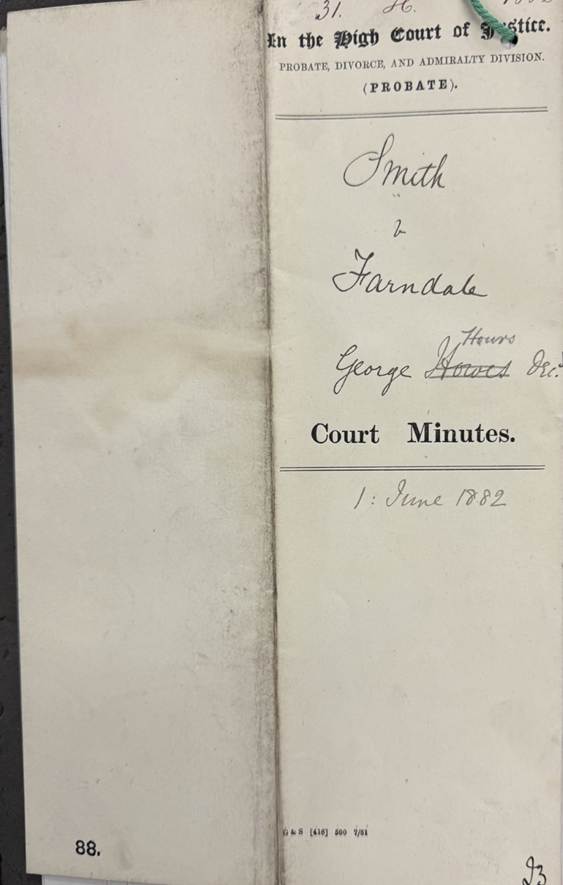
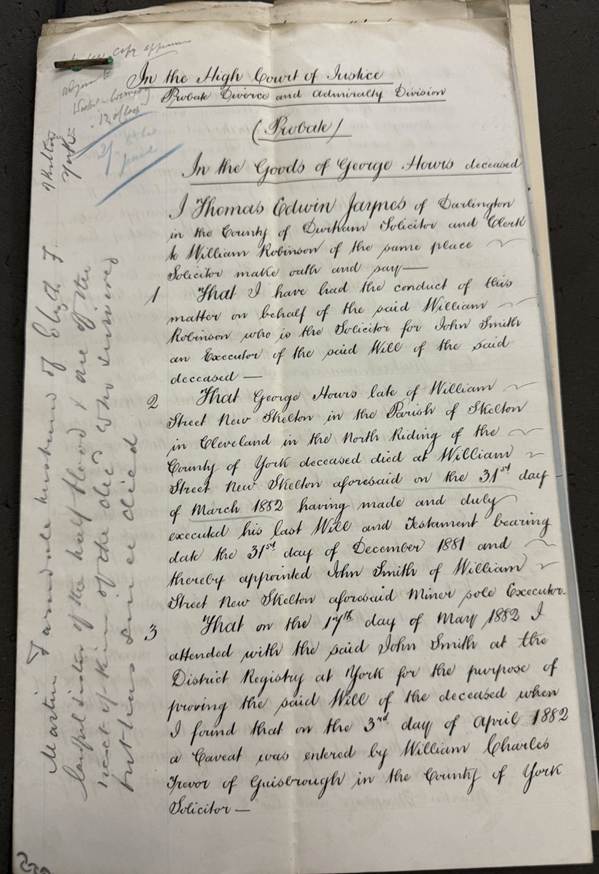
In
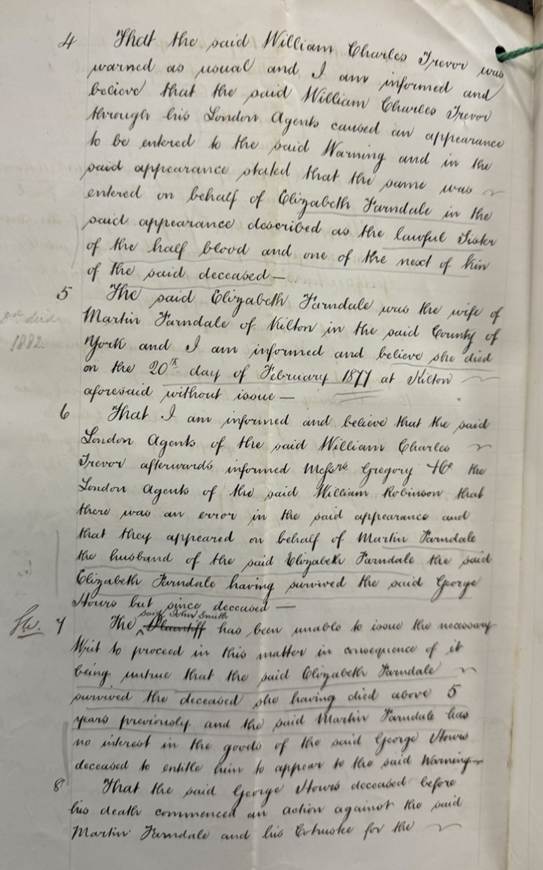
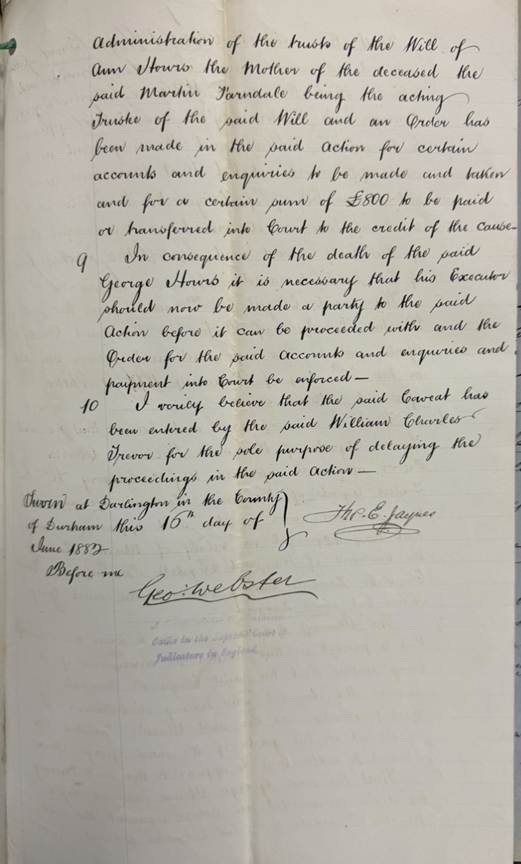
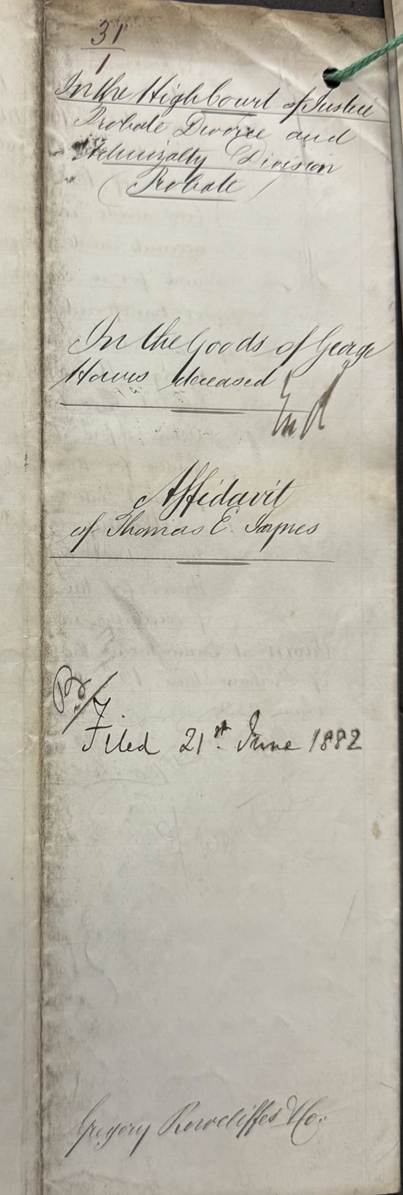
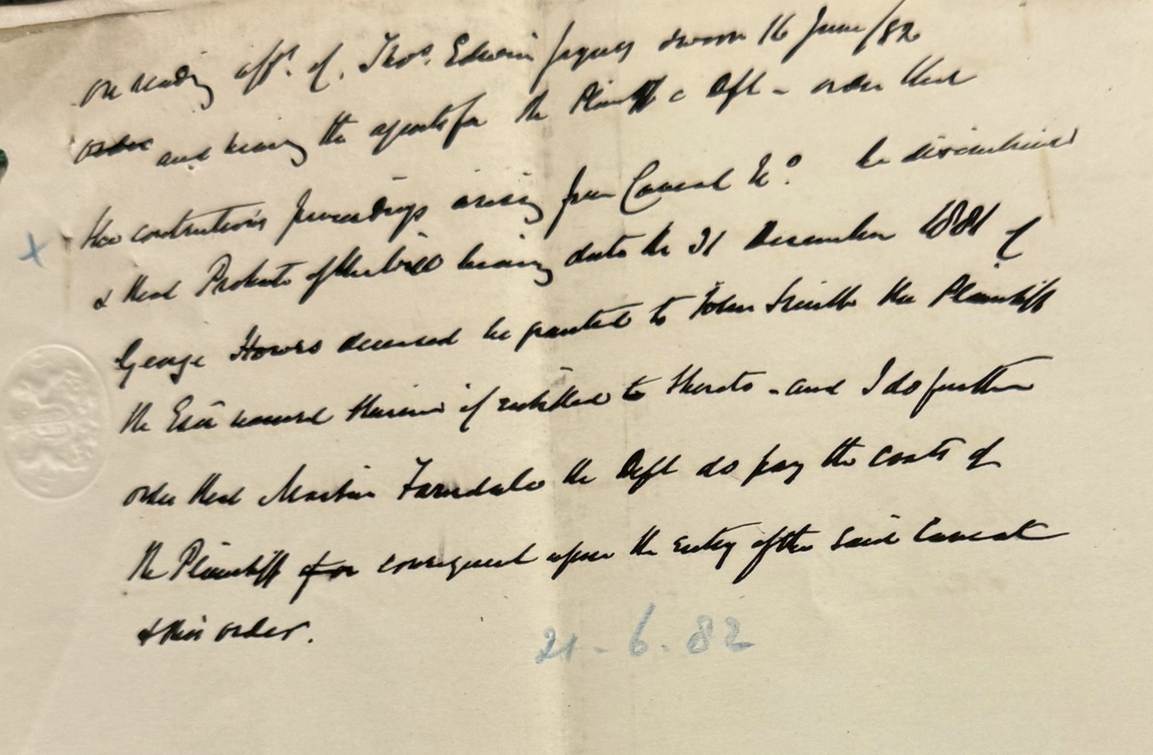
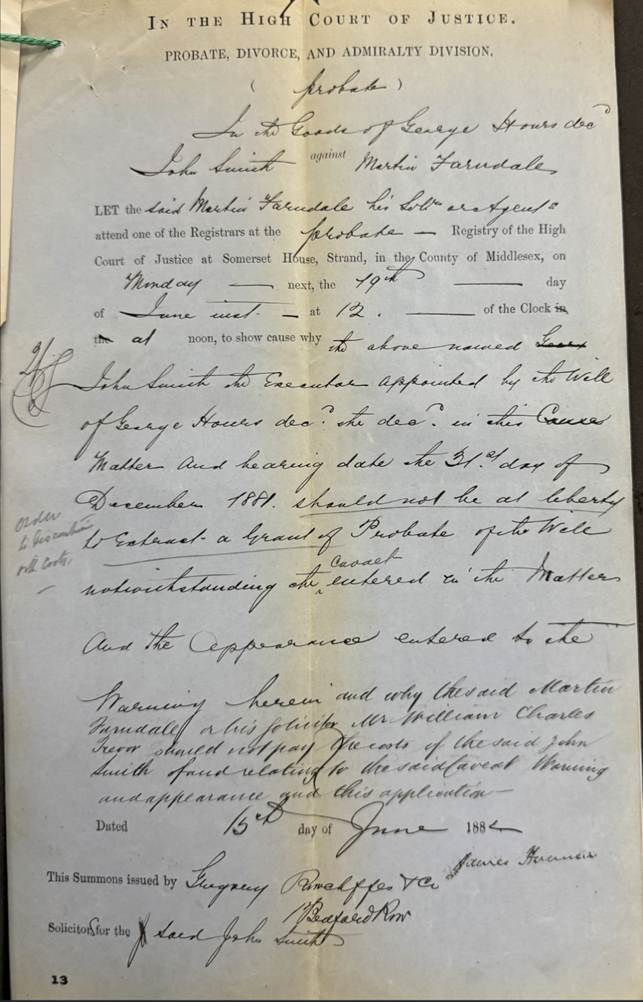
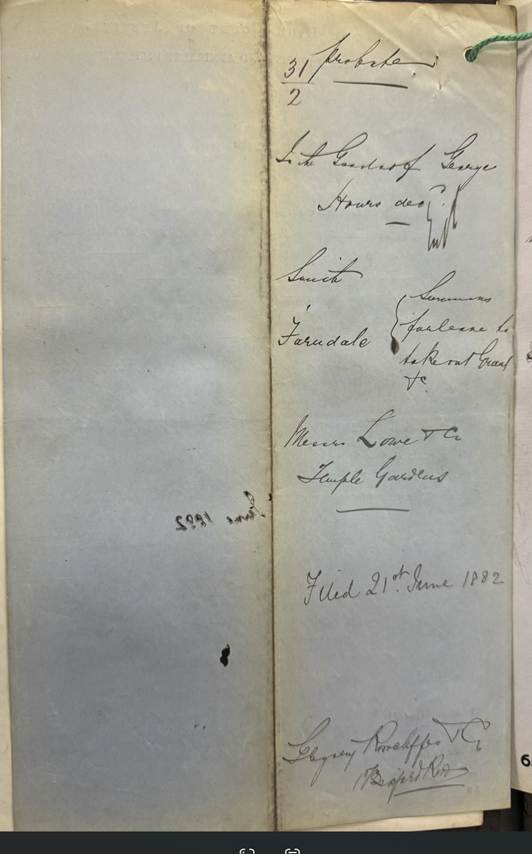
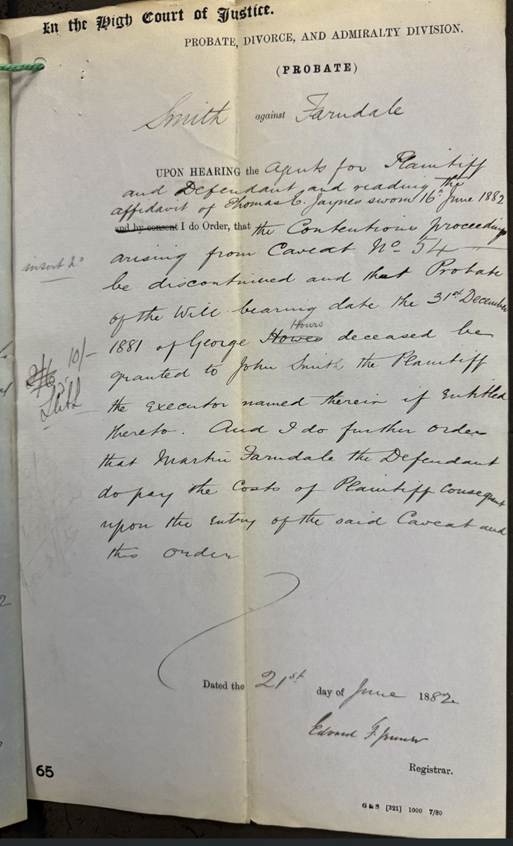
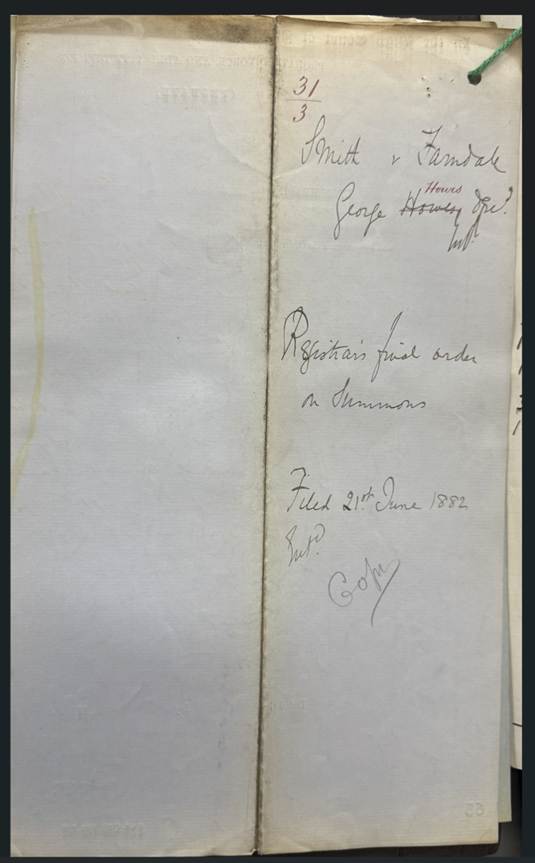
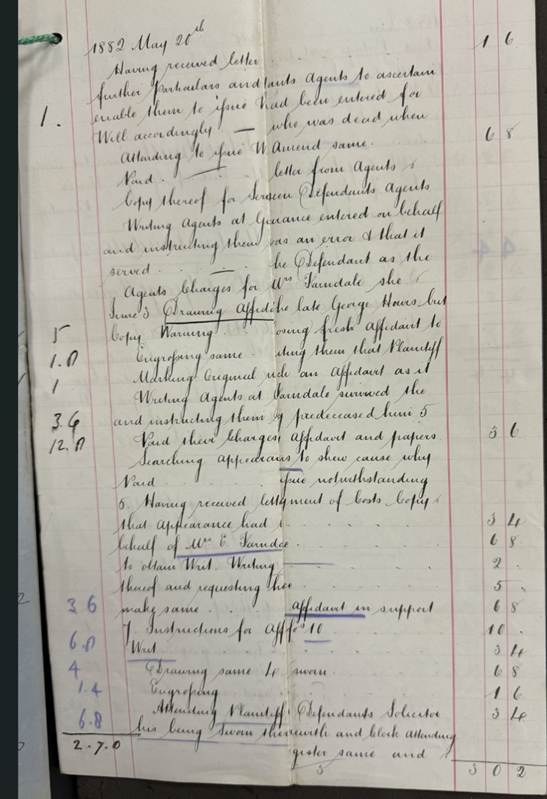
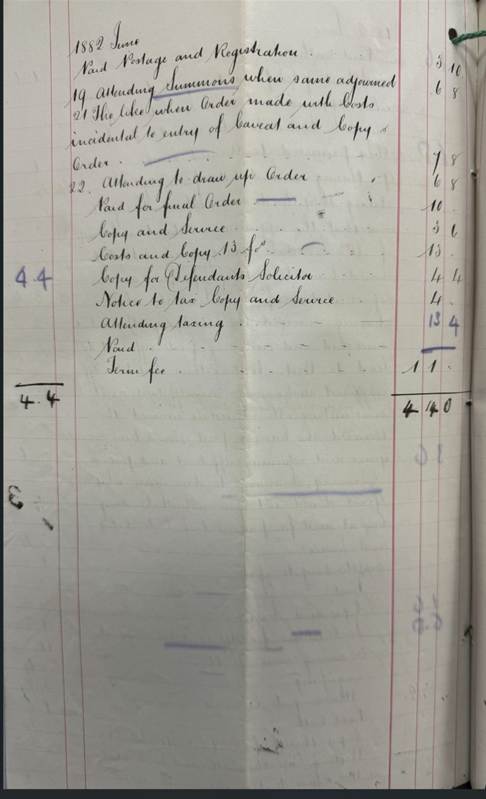
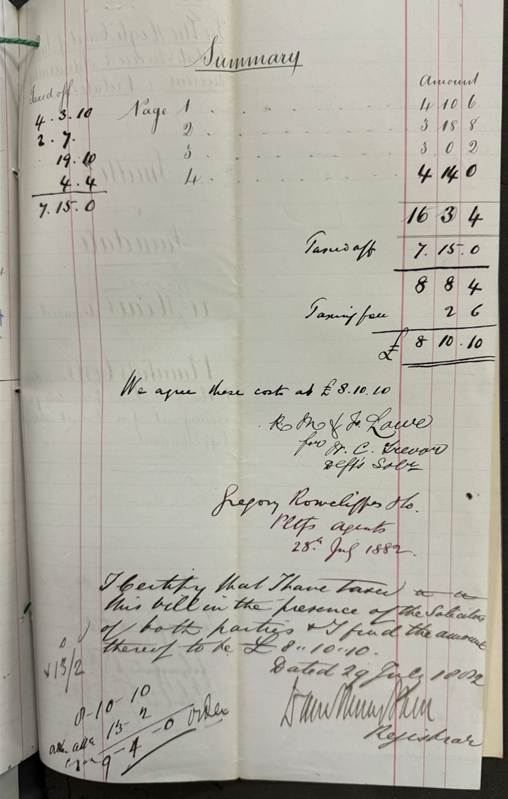
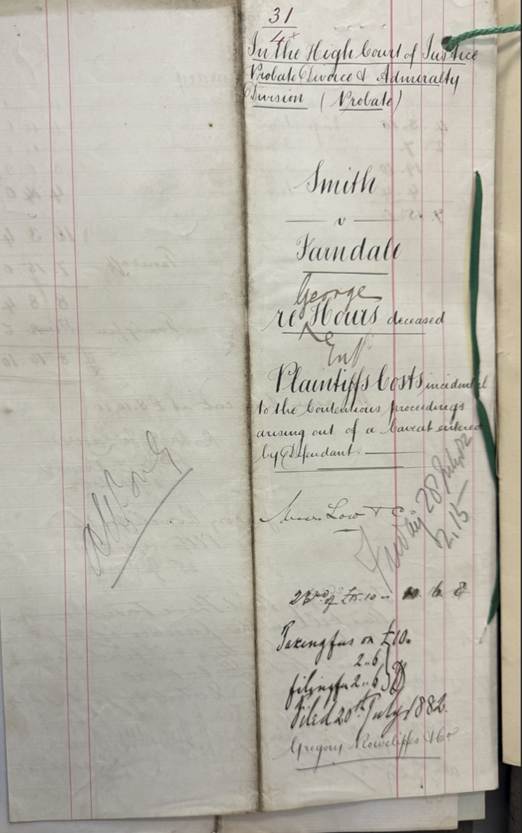
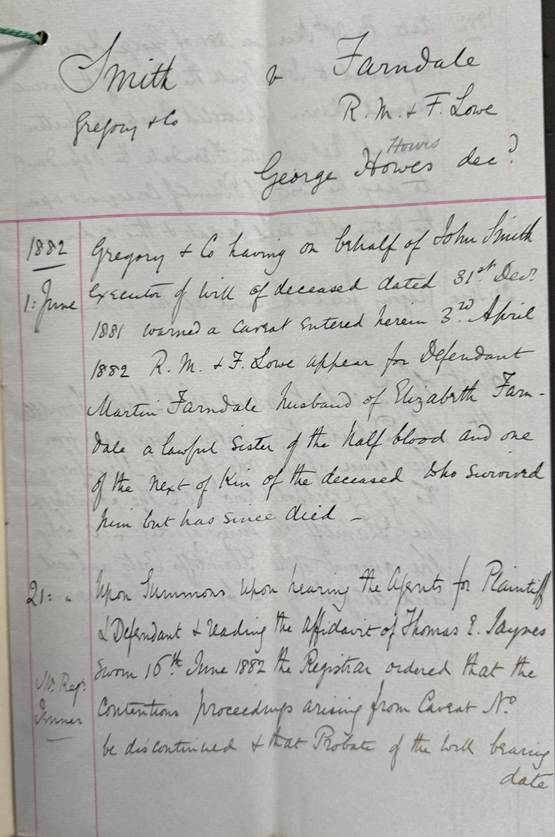
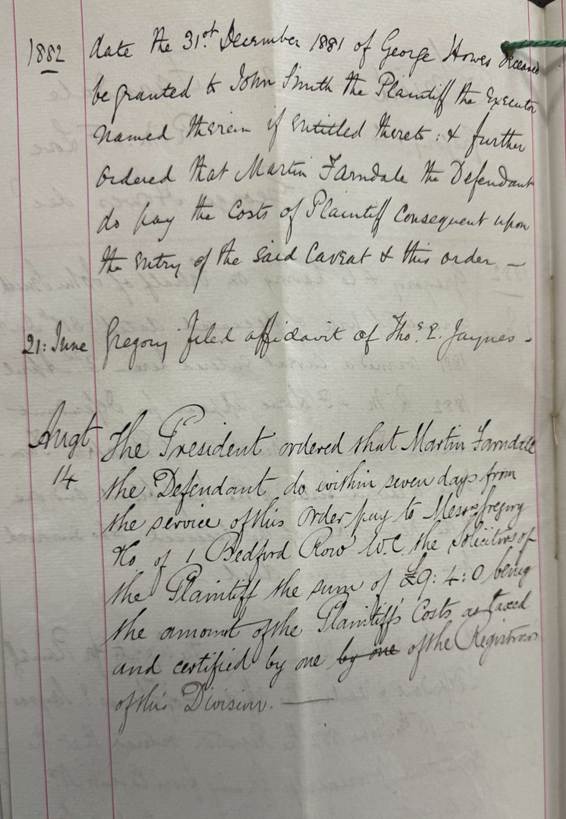
1882, Martin Farndale was involved in a dispute, Smith v Farndale, over
his late wife’s claim in her father’s estate (The
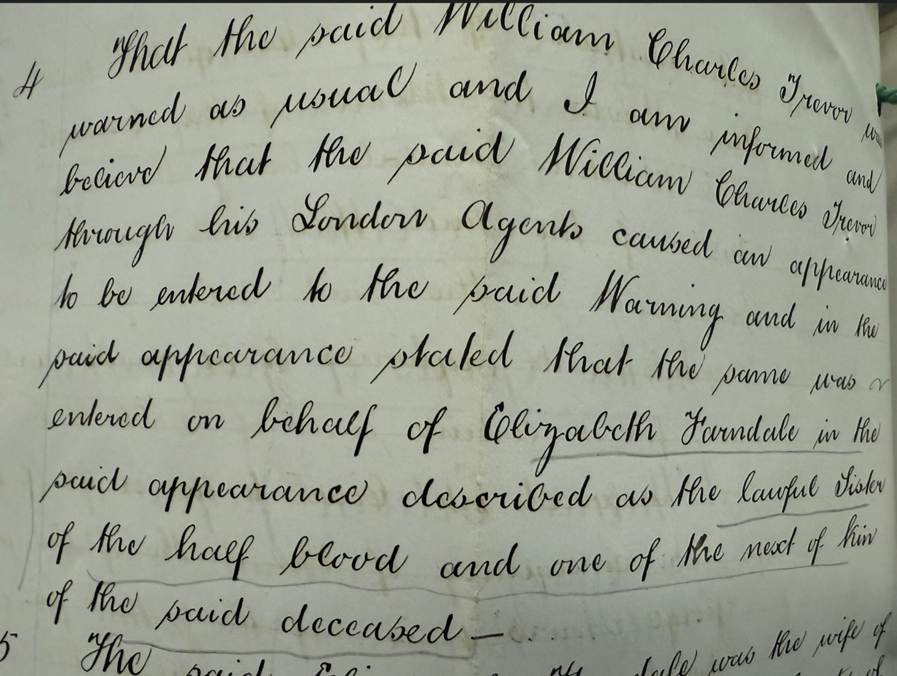
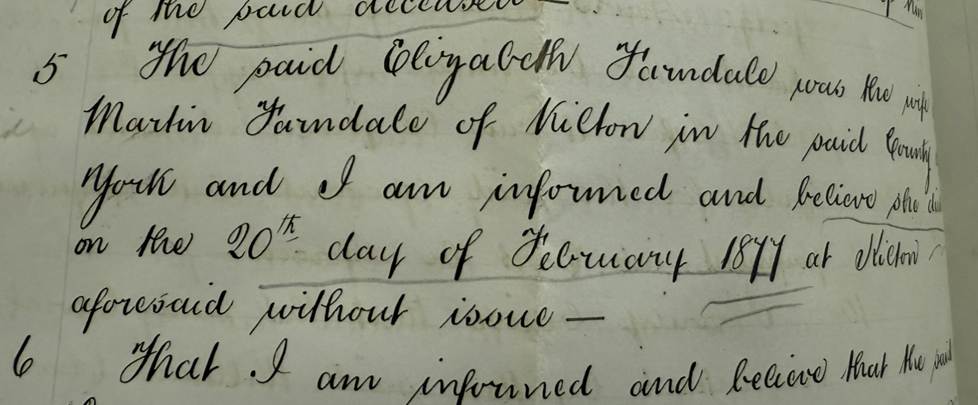
National Archives, J 121/3917). Elizabeth (nee Hours) Farndale,
had died in 1877. The case concerned a claim by John Smith, a solicitor acting
for the estate of George Hours, against Martin Farndale, husband of Elizabeth
Farndale. Elizabeth Farndale was described as a lawful sister of the ‘half blood’ and next of kin of George Hours, whose will was
disputed. Martin Farndale lost the case and paid costs of £9 4s.
1884
The
Whitby Gazette, on 12 July 1884 reported on the Skelton Agricultural Show: Horses
… Yearly coaching gelding or filly – W H S Pyman, Raithwaite;
2. M and C Farndale, Kilton.
1885
The year started
with the summary conviction of John Lantsbury and Edward Hanson both of
Carlin How miners for trespassing in the daytime in search of game
on land belonging to John Thomas Wharton esquire and occupied by Martin
Farndale Offence committed at the township of Kilton on 17 January 1885 Case
heard at Loftus on 23 Jan 1885 (Yorkshire Archives,
Document reference QSB 1885 2/10/7/67, catalogued). The North Star
(Darlington), on 24 January 1885 reported: John Lansbury and Edward Hanson,
miners, Colin Howell, were yesterday each fined 11s at Loftus for snaring a
hare in a field in the occupation of Mr M Farndale at Kilton.
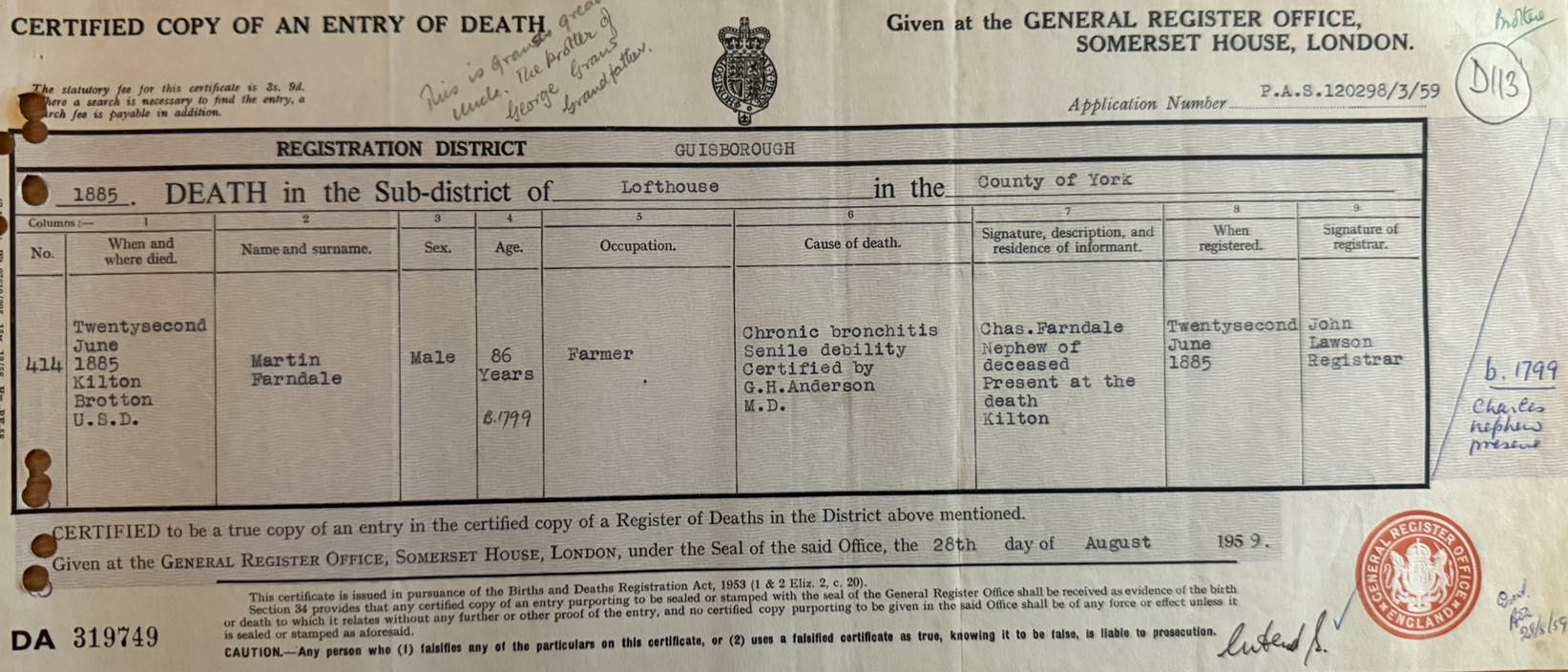
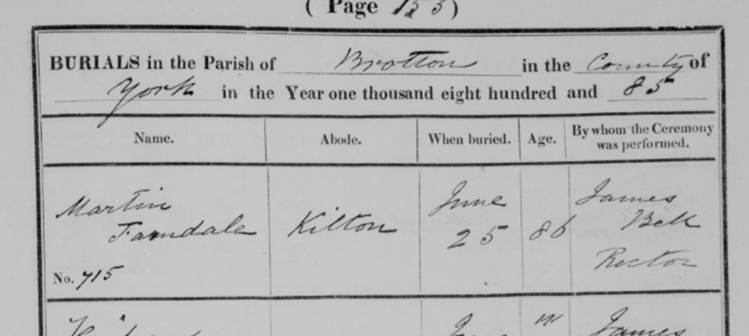
Martin Farndale a
farmer of Kilton, died of chronic
bronchitis and senile debility, aged 86, on 22 June 1885 (Death Certificate, GRO Vol 9d page 324). Charles
Farndale, his nephew was present at the death at Kilton. Martin Farndale was
buried in Brotton aged 86, on 25 June 1885. James Bell, the
Rector performed the ceremony (Brotton PR).

The
Whitby Gazette, 27 June 1885 reported: June 22nd, at Kilton, aged 86 years, Mr. Martin
Farndale.

(The Yorkshire Gazette, 28 June 1885)
His gravestone can be found at Brotton
Old Churchyard and reads ‘To the memory of Elizabeth the dearly loved
wife of Martin Farndale of Kilton. Born 24th August 1805 and died 20th February
1877. Also Martin Farndale who died 22nd June 1885
aged 86 years. They were friends to others. With Christ which is far
better.’ (Monumental
Record)
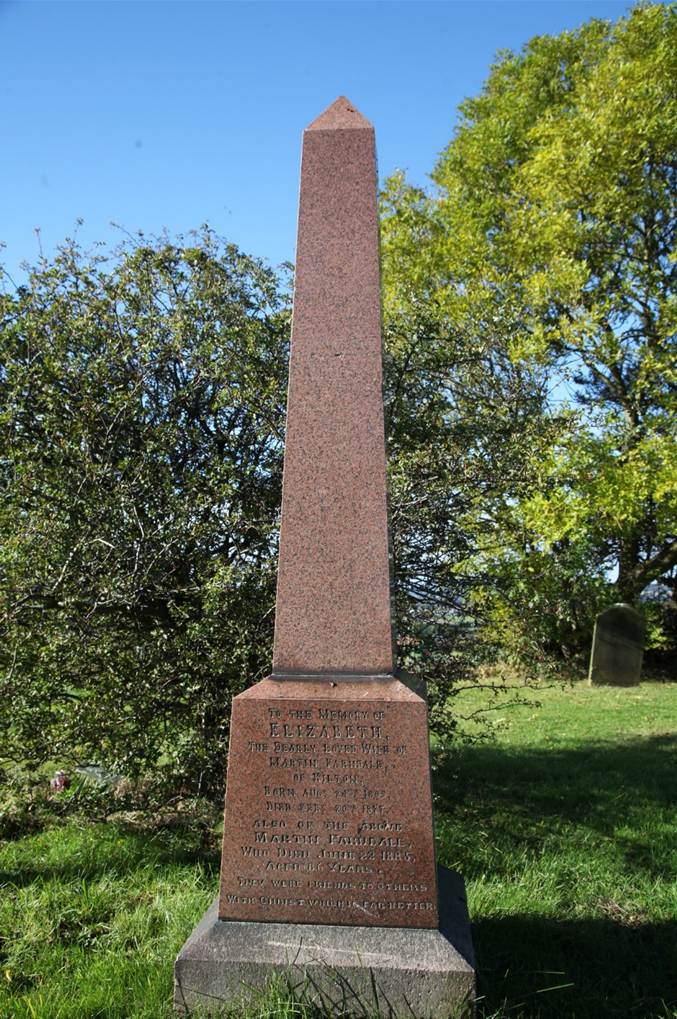
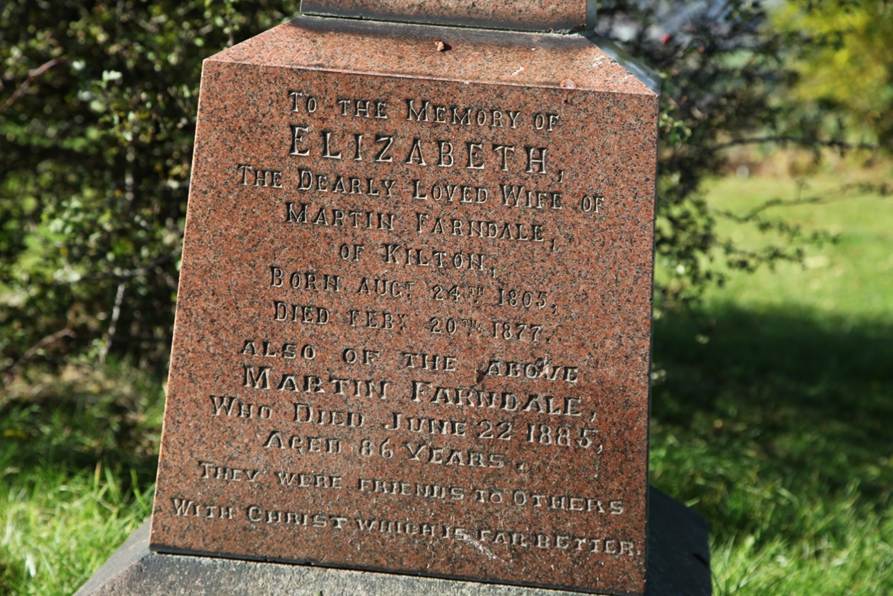
The gravestone of
Martin and Elizabeth taken by Richard Farndale in 2016
Martin Farndale left
a personal Estate of £1,625 2s 6d..The will of
Martin Farndale late of Kilton in Cleveland in the North Riding if the
County of York who died 22 June 1885 at Kilton was proved at York on 21
December 1885 by Charles Farndale of Kilton, the nephew and Thomas Hall of the
Parish of Skutterskelfe near Stokesley in Cleveland
Farmers the Executors. In 2020, this estate might equate to approximately:
£107,558.41, In 1880, you could buy 59 horses or 167 cows or pay skilled
tradesmen wages for 4,924 days with £1,625, 2s & 6d.
He is registered
in the Death Duty Register in 1885, showing Charles as his executor in the
court of probate at York.
This shows that
his will incurred an inheritance tax. First introduced in 1796 and by 1857 inheritance tax
applied to any estate worth over £20.
|
How does Martin Farndale relate to the modern
family? Martin Farndale is the website author’s great x3
uncle. He married Elizabeth Hours and they had no children, so there are no descendants
of Martin and Elizabeth. However he was a central
figure in the extended family at Kilton in the early nineteenth century. Those who trace their ancestry through the Kilton 1 Line are likely to
be relatively closely related to Martin. |