Archaeological Excavations at Street Houses Farm
Revealing the deep history of the coastal region of Cleveland from
the Neolithic to the Anglo-Saxon period
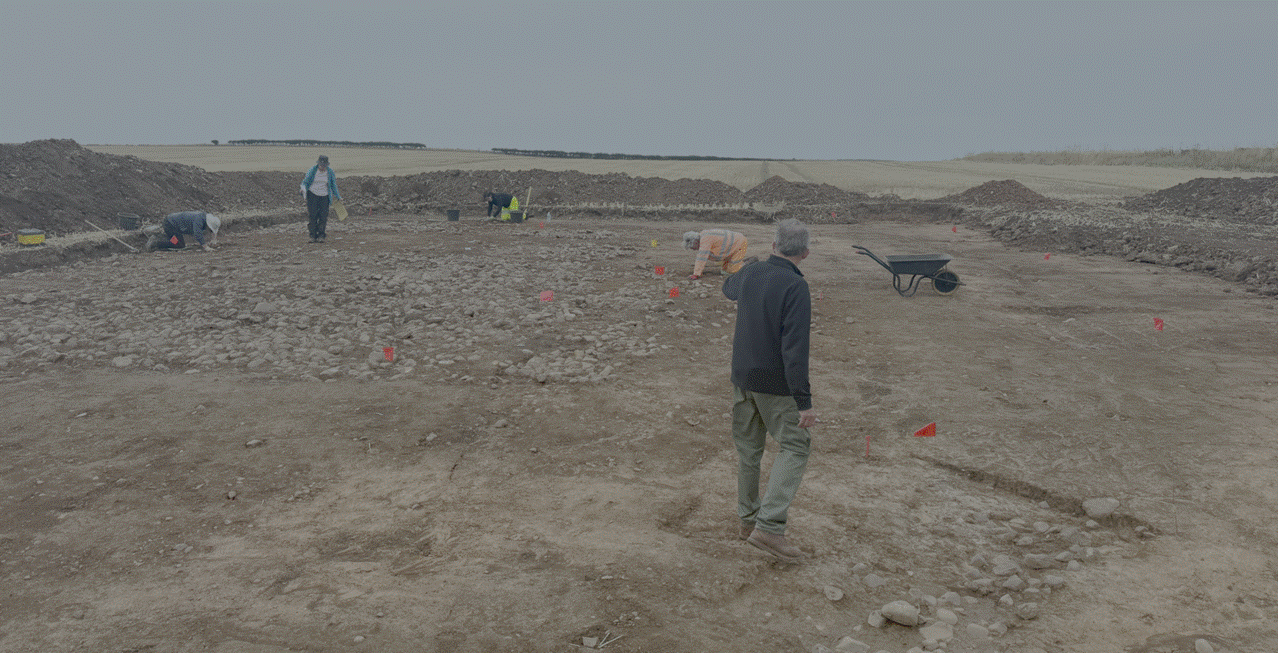
Steve Sherlock explaining the archaeological excavation of a
Neolithic Cairn at Street Houses Farm in September 2026
|
Return to the Home Page of the Farndale Family
Website |
The story of one family’s journey through two
thousand years of British History |
The 83 family lines into which the family is divided.
Meet the whole family and how the wider family is related |
Members of the historical family ordered by date of
birth |
Links to other pages with historical research and
related material |
The story of the Bakers of Highfields, the Chapmans,
and other related families |

The remarkable
excavations at Street Houses have revealed the earliest pottery making and salt
making in Britain, dating to the Neolithic, and relatively continuous activity
through the Bronze and Iron Ages to the Roman period, culminating in an
extraordinary Anglo-Saxon bed burial.
There have been
extraordinary Neolithic finds excavated Street Houses Farm site, only four
kilometres to the northeast of Kilton, above the cliffs overlooking the North
Sea. The excavations at Street Houses began in the 1930s by William Hornsby. A
Neolithic cairn was excavated by Blaise Vyner in 1981. Further sites were
excavated by Steve Sherlock from 2014 and the work is ongoing. The excavations
include a ring ditch, a possible Neolithic house, a mortuary complex and a
cairn. This coastal
hilltop site is a regionally significant centre of early Neolithic life dating
to approximately 3,800 BCE. Evidence of hearths, broken pottery, and storage
pits suggests this is the earliest Neolithic salt-making site discovered in
Britain. Because salt was a highly valued, essential commodity for preserving
meat and dairy through the winter, this site suggests that early farmers
operated a more efficient, larger-scale cattle economy than previously thought.
A multiphase Neolithic cairn with a burnt timber façade and mortuary structure
was used for the deposition of cremated human remains. A Late Neolithic
palisaded ritual monument known as the Wossit
is located a short distance from the cairn. This roughly 6,000-year-old
Neolithic hub predates Stonehenge by over two millennia and is among the
earliest found in Western Europe. The activity at nearby Street Houses is
indicative of agricultural activity in the vicinity.
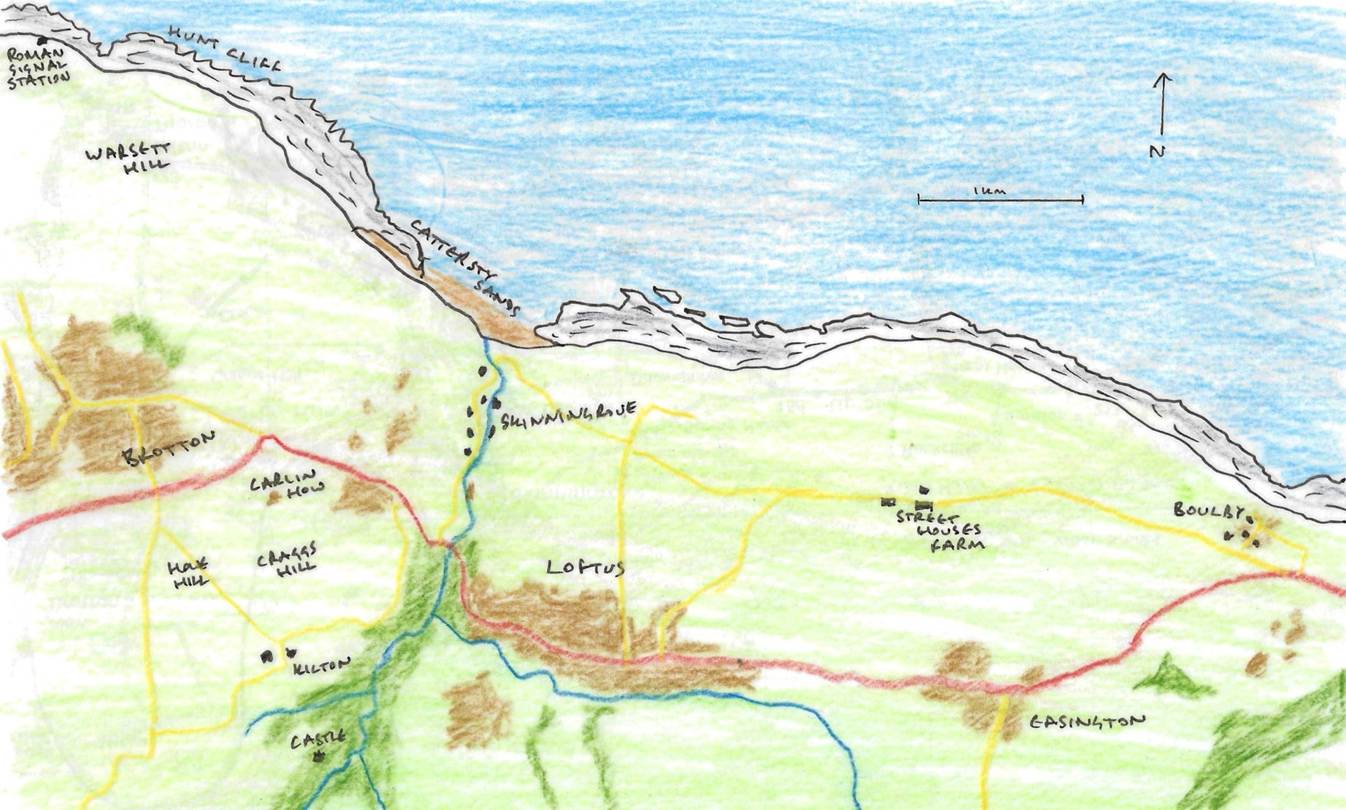
Street Houses Farm
and its relationship to Kilton, Warsett Hill, the Roman signal station at Hunt
Cliff, Carlin How and Boulby
The excavations
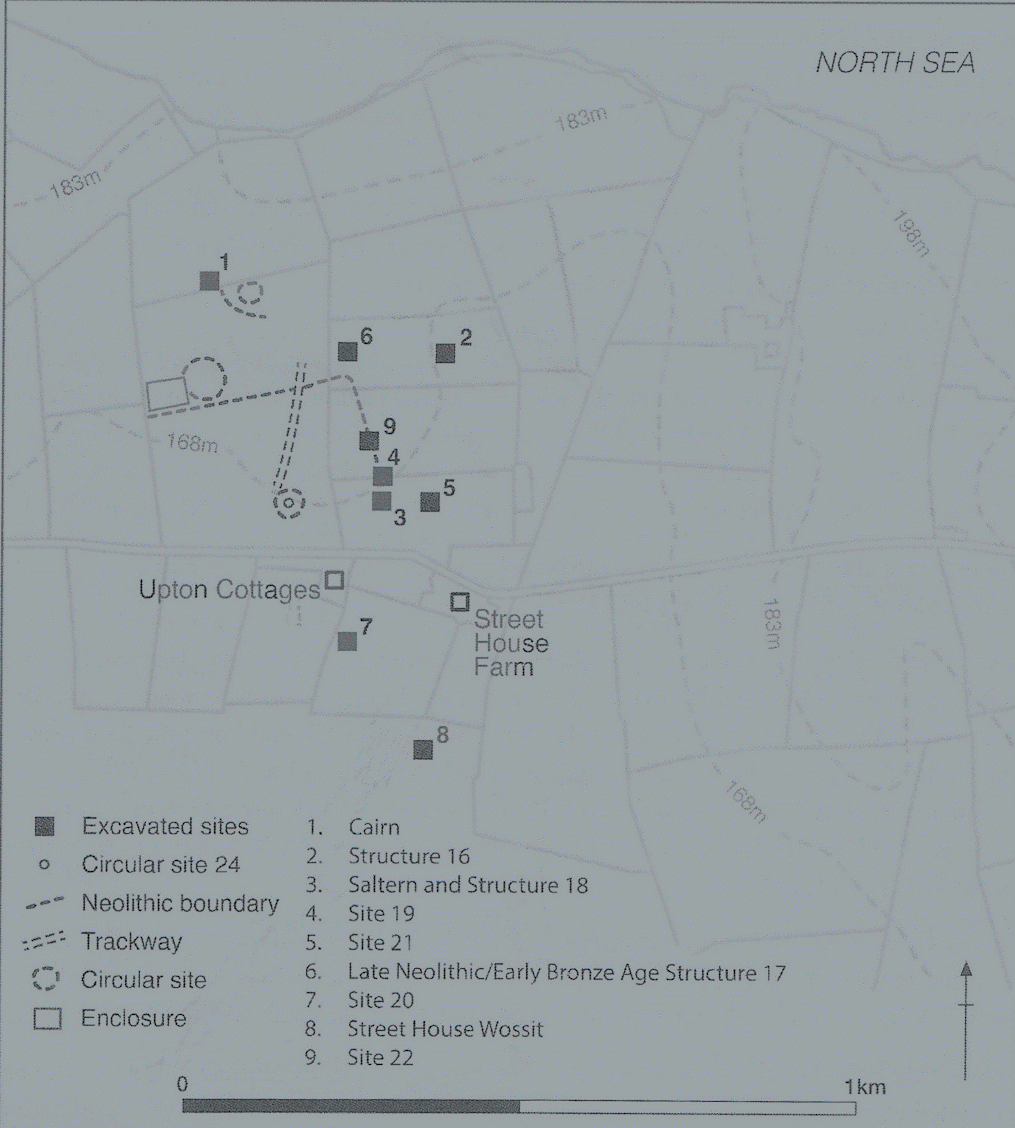
Neolithic cairn. This site was
excavated by Blaise Vyner in 1979–1981 for Cleveland County Council. The cairn
contained a central mortuary structure, with an excarnation platform to the
west and a façade trench on the east side. A radiocarbon sample was dated to
3730–3650 cal. BC. A Bronze Age burial mound (c. 2000–1500 BC) was later sited on
top of the Neolithic cairn. Finds include Carinated Bowls, flints and jet beads
(from the burial mound). Published (Vyner 1984).
Neolithic house
Structure 16. Excavated in 2010–2011 as part of the current programme of
fieldwork (by Steve Sherlock). This was a small (6m diameter) structure defined
by a segmented ditch. The finds include a small number of flint tools and a
single radiocarbon date from a hazelnut shell of 3766–3647 cal
BC. Published (Sherlock 2019).
Late Neolithic
Structure 17. Excavated in 2010–2011 by Steve Sherlock. This small oval
structure was defined by two rings of postholes, encompassing an area 8m x 6m
with an east-facing porch. Structurally different to the Iron Age structures in
the immediate area and stratigraphically earlier, Structure 17 was dated to the
Late Neolithic–Bronze Age by a small assemblage of flints (Sherlock 2019).
Early Neolithic
Structure 18. Excavated in 2016–2022 by Steve Sherlock. This structure was sited above the Neolithic saltern. Structure 18 was a small
dwelling defined by postholes with an east-facing entrance. Finds included
Carinated Bowl domestic pottery, flints and worked stone artefacts. Dated to
the Early Neolithic by radiocarbon determinations to 3800–3650 cal BC (Sherlock forthcoming).
Neolithic Saltern
and Structure 19. Excavated 2016–2022 by Steve Sherlock. The evidence for the
manufacture of salt was demonstrated by a series of in-situ features deeply stratified.
A furnace, flue and a series of hearths were excavated with kiln furniture and
other structural features. The finds included industrial ceramics, that is
briquette vessels, props and spacers, associated with salt production. Many of
the items had chemical signatures for chloride. This site is supported by a
suite of scientific dates clustering around 3711–3634 cal
BC. Published (Sherlock 2021; forthcoming).
Street House Wossit. Excavated by Blaise Vyner in 1984–1986. This segmented palisaded
monument comprised four “quadrants” with vertically set posts with a large pit
in the centre. Unparalleled at the time of excavation, later excavations at Seahenge.
Street House Site
20.
Excavated in 2024–2025 as part of the current programme of excavations (Steve
Sherlock). The site is south of Cleveland Street, 200m north-west of the Wossit. Initially found as part of a programme of
geophysics, the site is a continuous ring of stones, 2m wide defining a clay platform
of 11m diameter. The structure has been provisionally dated to the Late
Neolithic–Early Bronze Age based upon finds including part of a stone
battle-axe, seven jet beads, seventeen examples of rock art and a deposit of
carbonised grain within a ceramic vessel. (Sherlock in prep).
Iron Age
Settlement.
Initially excavated between 2004 and 2007, nine roundhouses dating between c.
150 BC and AD 100 were excavated within a ditched enclosure measuring 71m E–W and
57m N–S. A further six Iron Age round houses were excavated outside the
enclosure in 2010–2011. Published (Sherlock 2019).
Romano-British
Settlement. In
2008 a Romano-British structure of fourth-century AD date was excavated to the
immediate south of the Iron Age sites. Further Romano-British fields were
recorded in 2009, whilst to the south a more extensive farmstead was excavated
in 2013. The economy at this time was primarily farming with evidence for diversification
into jet working, pottery and salt manufacture. Published (Sherlock 2019). A
Romano-British saltern was excavated in 2023. Published (Sherlock 2025).
Anglo-Saxon
Cemetery. In
2005 during the excavation of the Iron Age settlement thirty graves of
Anglo-Saxon date were found. Although no bones had survived all of the
artefacts that were buried with the individuals survived in-situ. In 2006
further excavations revealed another thirteen graves, including the Anglo-Saxon
Princess placed in her grave on a bed. The remainder of the site was excavated
in 2007, the finds are on display in Kirkleatham Museum. Published (Sherlock
2012).
The coastal site
at Street House Farm lies on exposed but fertile farmland 2km. north-east of
the market town of Loftus on the very edge of the North York Moors National
Park at 168m above sea level, although the moors proper are 6km. to the south.
The chosen site (PL IA) was at first glance neither particularly extensive nor promising.
Hornsby had excavated a round barrow 300m. to the south where he found
fragments of a collared urn, a pygmy cup and an unidentified urn sherd. That
there had been an excavation was known only from the account of the land-owner,
Mr. W. Garbutt, for the site was completely ploughed out. The more northerly
site was preserved as a gentle swelling in the line of a hawthorn hedgebank which was thought to conceal the profile of the
mound as it had appeared when the fields were enclosed in the nineteenth
century. This site seems to have lain quite unobserved, although it stood on a
false crest above the barrow excavated by Hornsby. However, Crawford’s
attention had been drawn to it by Mr. Garbutt, who had in the past removed several
cartloads of stone from an area to the south of the hedgebank. (Barcham, Richard C (1982), Excavation of the Street
House Farm Long Cairn, Boulby, Cleveland, in the
Yorkshire archaeological journal Volume 54, Pages 1-5).
Mesolithic
The area around
Kilton and Street Houses was forested during the Mesolithic, with some evidence
of Mesolithic hunting.
Neolithic, 4,000 to 2,000
BCE
Archaeological
excavations in recent years have considerably enhanced our understanding of the
Neolithic period (4000–2000 BC) across the Tees Valley. (Loftus Time Lines,
Archaeological Excavations at Street House, Loftus, 2005 to 2025).
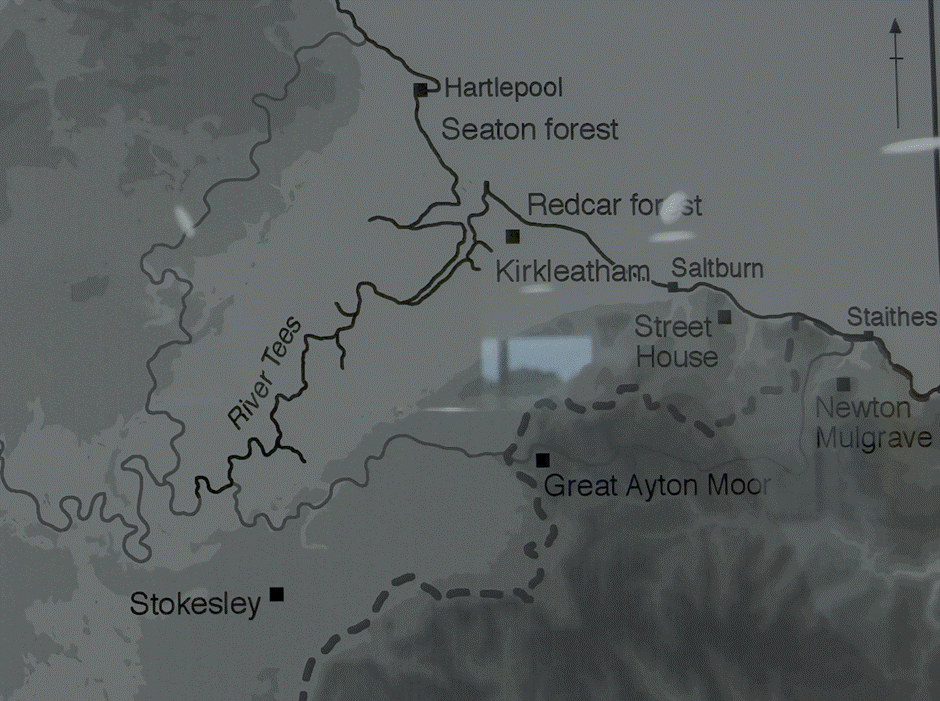
Neolithic sites around
the Tees Valley
Excavation at a
shallow earthwork surviving in a hedgebank at Street
House Farm, Loftus in the autumn of 1979 and in the summers of 1980 and 1981
revealed a multiphase neolithic cairn which incorporated a burnt timber façade
and mortuary structure. The cairn had been badly damaged by ploughing, but the
evidence for the construction and use of the monument survived to a
considerable extent. The neolithic monument had been overlain by a Bronze Age
round barrow, of which only a part had survived. (Vyner, B (1984), The Excavation of a Neolithic Cairn
at Street House, Loftus, Cleveland in Proceedings of the Prehistoric
Society Volume 50 pages
151-195).
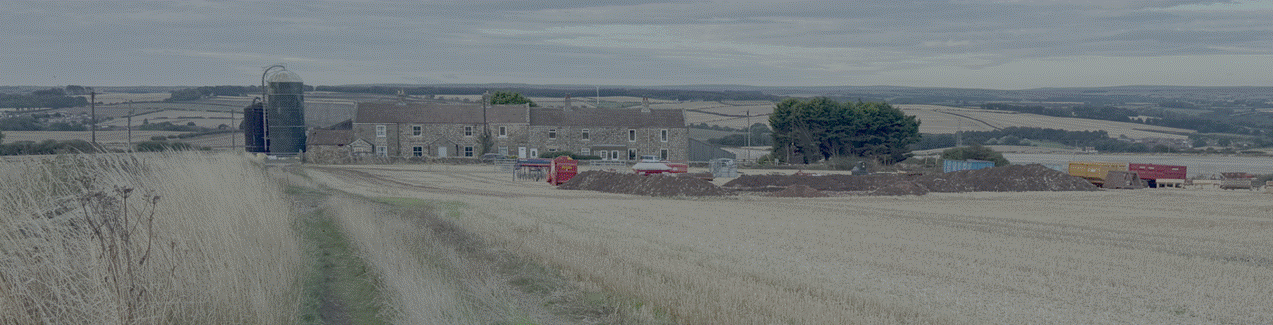
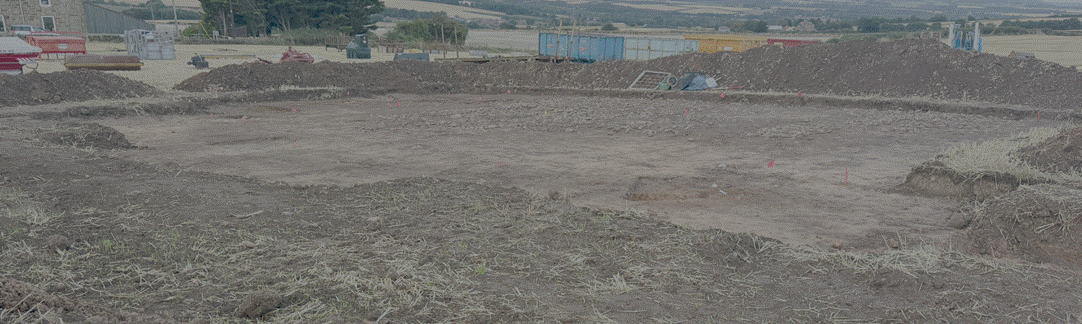
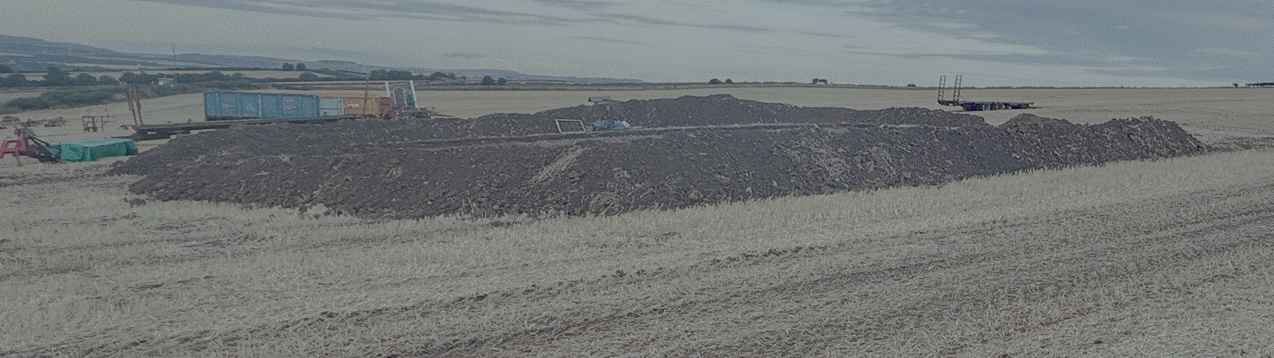
Cairn Excavation
2026
Fifty years ago
only two monuments were known, comprising the cairn on Great Ayton Moor and the
site on Newton Mulgrave Moor. Excavations on the cairn at Street House,
1979–1981, changed the perspective with the site scientifically dated to the
Early Neolithic period c. 3700 BC. The only site similar to this one is the
barrow on Newton Mulgrave Moor (not excavated) 7 km south-east of Street House.
At Kirkleatham, geophysical survey and evaluation unearthed a potential henge,
20 m in diameter and dated by flints and one radiocarbon sample to 2464–2276 cal BC. The site was investigated in 2020 with a series of
trenches over the ditch that when excavated was over 2 m wide and 1 m deep.
Although some bone survived, the ditch contained insufficient material for
dating, but further work is merited. A Greenstone axe was also found in the
immediate area and is registered on the Heritage Environment Record. This is
the only henge currently recorded within the Tees Valley, although others are
known in the Vale of York and extending north to Catterick. To the south, on
the boundary of North York Moors, an earthen cairn is known on Great Ayton
Moor. This site was excavated in the late 1950s. It is undated but appears to
pre-date a number of burial mounds alongside the site. At Stokesley, to the
west, excavations in 2015 by Durham University uncovered flints and sherds of
Neolithic Grooved Ware at a commercial development. Although the finds indicate
an Early Neolithic start date for the site, there were two pits that could be contemporary
with the finds, but few features to provide further details. Excavations on the
Headland at Hartlepool in 2004 exposed an enigmatic structure of postholes and
pits associated with a sherd of Beaker pottery and flints of Neolithic–Bronze
Age date. The plan of the postholes defines a rectangular area 6 m × 3 m and
aligned east–west. This is similar in plan and size to other Neolithic houses
recorded in Northumberland, and Mitchell Laithes, Otley and Sewerby
Farm, Sewerby in Yorkshire. These examples are
similar in size to a house at Gwithian, Cornwall, and
Structure 17 at Street House. Many of the sites mentioned here are isolated
monuments reflecting a range of ceremonial, burial and domestic activities.
Individual structures are also known at Driffield and Yarnbury
in Yorkshire, making a total of five sites including those at Street House.
Whilst these sites represent individual instances of Neolithic activity, the
concentration of sites in the Tees Valley is remarkable. The saltern at Street
House adds to this tally of significant sites in the area. (Loftus Time Lines,
Archaeological Excavations at Street House, Loftus, 2005 to 2025).
A broad range of
finds and a large number of Neolithic artefacts have been recovered from the
excavations held in this area between 1979 and 2022. The corpus of finds
includes ceramics, worked stones in various forms, lithics, jet, cremated bone
from the cairn and environmental evidence. With over 5,000 items from the
saltern and over 2,000 flints alone from the Wossit,
the total number of artefacts may be 10,000. The ceramics are some of the most
interesting finds. Assemblages of the earliest pottery in the UK, known as
Carinated Bowls, were found in Structure 18 and the cairn. Analysis of the
Carinated Bowls found lipid deposits, indicating that dairy products such as
butter and cheese were heated in the bowls and consumed as part of the diet. Of
crucial importance, salt production vessels were found on site. This type of
pottery, called briquettage and first recognised in
Neolithic Britain at Street House, was probably made on site, fired in the
furnace. There are various forms of worked stones, including saddle querns and
pounders, used for grinding seeds for flour and perhaps crushing stones used
for tempering the clay to make pottery and briquettage.
There are also burnishing and hammerstones as well as decorative pieces of stone,
often termed rock art. Stone axes have been found during excavations on the
cairn. One example, a Greenstone axe, came from Langdale in the Lake District.
This would have been a highly prized item and traded or offered as a gift.
Other highly prized items associated with the Later Neolithic period include a
mace-head fragment, found in 2010, and two partial axe heads, one found at the Wossit in 1985 and a second found at Site 20 in 2024. The
final group of artefacts are the lithics. Microliths are distinctive during the
Mesolithic period (8000–4000 BC), but unusually they are found in Neolithic
contexts at Street House. Microliths were found at the Wossit
and also at the saltern. These finds serve as testimony to Mesolithic activity
in the area. Other items included leaf‑shaped
arrowheads, scrapers, and cores that are distinctive to the Neolithic period. (Loftus Time Lines,
Archaeological Excavations at Street House, Loftus, 2005 to 2025).
One of the ways archaeologists
understand and explain the sites they find is through artistic recreations and
technical reconstructions based on the features excavated. The materials used
to illustrate the structure, that is the walls and roof, in these
reconstructions are based on environmental evidence and parallels from
well-preserved sites. Reconstructions are still interpretations of the evidence
found, but the impact of seeing structures that existed 6,000 years ago in the landscape
so familiar to us today is profound. There is a remarkable range of
archaeological sites within a small area surrounding Street House Farm, Loftus.
A number of these sites date to the Early Neolithic period. The cairn and
mortuary structure, excavated by Blaise Vyner, has been reconstructed to show a
processional route towards a façade trench, behind which was a timber mortuary
chamber and a platform where human remains were laid prior to a ceremony. Two Early
Neolithic houses were also excavated at Street House, each rather different
from one another. Structure 16 was a small roundhouse. Structure 18 was a
larger house with an entrance porch to the south-east. Domestic items and
flint-working debris were found on the floor. A further type of structure known
about, but not yet found at Street House, was the Neolithic hall. This
structure has been reconstructed at Stonehenge in Wiltshire and Butser Ancient Farm in Hampshire. These large halls are
harder to identify, but they are impressive in scale, and the interiors were
spacious and light. Also dating to the Early Neolithic period are the
industrial saltern structures at Street House. See ‘Salt Production in the
Neolithic Period’ for a reconstruction. A small timber palisaded site (the Wossit) was only 9m in diameter with four quadrants of
vertical posts and an internal pit. To the south-east of the Wossit, near the path to Easington, aerial photographs suggest
there could be a henge. The Wossit and the possible
henge date to the Late Neolithic period. They were structures with ditches,
external banks and sometimes rings of internal posts, similar to Maelmin Henge excavated at Milfield
(Northumberland) and reconstructed there. (Loftus Time
Lines, Archaeological Excavations at
Street House, Loftus, 2005 to 2025).
Salt production
in the Neolithic Period at Street House
Street Houses was
a site of intense Neolithic activity including the earliest pottery in Britain,
which benefitted from the clay soil, and the earliest evidence of salt making.
Whilst the saline solution was collected from the sea, the beach was not
suitable for salt making, given the tides and the shading of the cliffs. It may
be that lightning strikes had cleared areas of the forest on the heights above
the cliffs, leaving an optimum site for Neolithic industry.
The land was much
further out from its present position, but there was nevertheless advantage
from siting industry on the higher ground at Street Houses.
Pottery and salt
was made at scale for local use. This might suggest local agriculture was
beginning across the region, as the forest began to be cleared. They probably
reared cattle more than sheep.
Salt was
valuable. By allowing farmers to preserve both dairy and meat, it
revolutionised early agriculture. Salt was used to preserve meat and also to
treat milk so that it could be consumed by a lactose intolerant population.
Archaeological
evidence shows that early farmers combined salt production with cheesemaking to
manage their lactose intolerance and preserve their food. Early unsalted
cheese, made by separating curds from whey is highly perishable and quickly
spoils. Adding salt allowed Neolithic people to preserve the cheese, creating a
reliable food source that lasted through the winter. Salt draws moisture out of
cheese curds. Because Neolithic people didn’t have advanced pressing tools,
using salt helped dry out the curds to create a firmer, more stable cheese.
Farmers stayed in
one place to tend crops, making fresh meat harder to get. Soaking meat and fish
in salt brine stopped bacteria growth, allowing communities to store food for
the winter and survive famine. Adding salt to vegetables restored the savoury flavour
people missed from meat, while providing the sodium needed for basic body functions
like nerve and muscle work.
Over time there
is evidence of trade, including with the Tay estuary.
Discovery of the
Neolithic saltern at Street House was initially made in 2013 during a programme
of geophysical survey, although the significance of the site was not known at
the time. During excavation, begun in 2016, it became apparent that this site was
unique. It was a salt production site founded in the Early Neolithic period.
The earliest salt production sites known in the UK date c 1250 BC, during the
Bronze Age. Thirty sites from the Bronze Age are known across the country. The
salt production site at Street House is scientifically dated 2,500 years
earlier than all other UK sites. The Street House site dates from 3,800 BC. It
is the earliest salt production site in Western Europe, whilst acknowledging
there are older sites in Bulgaria and Romania to the east. The site at Street
House survived within a deep hollow, measuring 8 x 5m and up to 3m deep. It was
a major construction, and this supports the argument that salt was made on an
industrial scale. Potentially, a tonne of salt per annum was produced over
several years. The Street House site is important for the extent of the
surviving evidence found in situ. There are hearths, a furnace and a flue. The
structural evidence for manufacture, including kiln furniture (props, spacers,
supports), alongside intact vessels on stands were found. The vessels are stained
with salt deposits, and chloride (a key component of salt) was detected on the
inside of the evaporation trays. All this evidence allows us to reconstruct the
process of salt production. The excavation has recovered many finds, all Early
Neolithic in date, and over 20 radiocarbon dates that range from 3900 BC to
3660 BC. The finds include carinated bowls, some of the earliest pottery to be
made in this country, and some unique industrial pottery vessels, made on this
site and not found anywhere else in this country. The pottery was probably
fired on site in the furnace. Over 3,000 flint tools were found, including
arrowheads, blades and cores, distinctive to the Early Neolithic period. There
were also stone burnishers, grinding stones and props. The environmental
evidence for crops cultivated included barley and flax, and hazelnuts were
collected from the mixed woodland around the site. (Loftus Time Lines,
Archaeological Excavations at Street House, Loftus, 2005 to 2025).
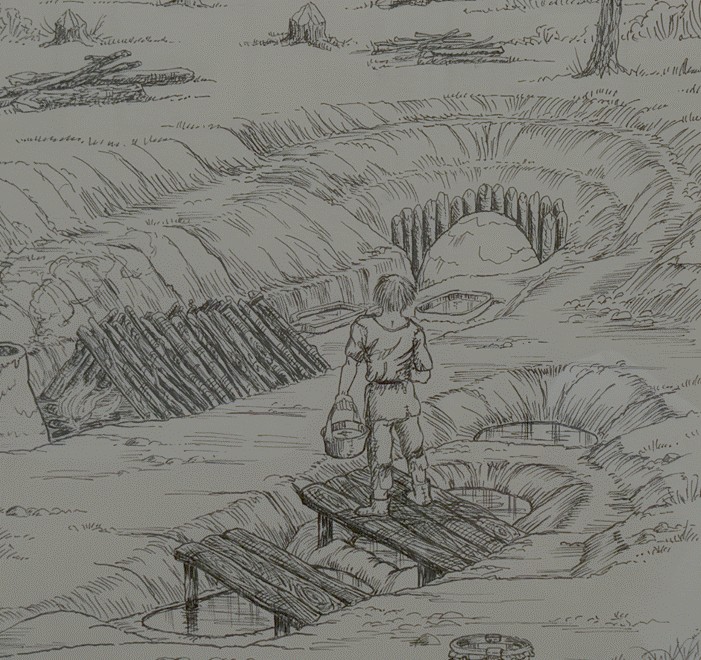
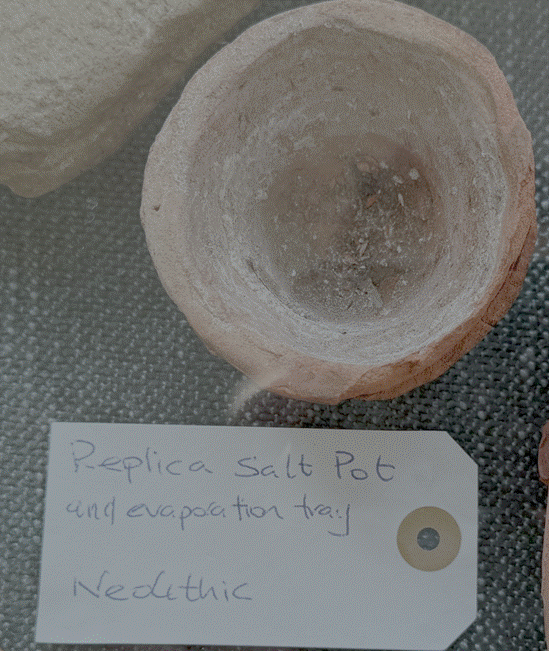
Salt making at
Street Houses
Archaeologists in
the UK have found an ancient stone age-era salt-production house in North
Yorkshire, estimated to be older even than Stonehenge, UK media outlets
reported on Wednesday. Dating from the Neolithic period around 3800 B.C.E. the
6,000-year-old find is the latest discovery from the Street House Farm site in
Loftus. Finds unearthed on a shoreline near Loftus include three hearths, fragments
of broken Neolithic pottery, a ditch, some still containing salt deposits,
shaped stone artifacts, and a storage pit. All of the finds are cited as
important evidence of salt processing. According to Steve Sherlock, the
archaeologist who led the dig, the finds are “spectacular and of national
significance”. The discovery is particularly important in that it can
substantially rewrite the historical understanding of Neolithic England because
the facility is not only the oldest facility found on the island but also one
of the oldest facilities found in Western Europe. This new finding, he
explained, according to The Independent, indicates that properly settled
civilisations developed on the island earlier than expected, with stone-age
Britons transitioning into an agricultural society from a hunter-gather
lifestyle. In fact, it pushes salt-making back by nearly 2,400 years. Salt was an
extremely valuable commodity, and the extraction process is very complex and
implies a certain level of sophistication. In fact, according to UK sea-salt
production expert David Lea-Wilson, “Any ancient coastal culture that was able
to master that technology would have been able to expand their economy
substantially,” according to The Independent. Salt was essential to the
expansion of the Stone Age. This is because it gave the people of the Neolithic
Age the ability to preserve meat. According to the Independent, James Swift, a
traditional meat preservation expert, said that effective management of cattle
is almost impossible without salt. In other words, the fact that salt can be
used at all means that the entire early agricultural sector will undergo
revolutionary changes. Male calves can be preserved after slaughter throughout
the year, and cows have more grass, which in turn means more milk production.
And not only was this salt production house effective but according to
Sherlock, salt-making experts said “you’d expect to find that in the Iron Age,”
according to the New Scientist news site. Through some archaeological detective
work, Sherlock not only figured out how the salt-making facilities work but
also first figured out how the process reached Britain. The pottery used to
extract salt from seawater is a special type of bowl that can be traced back to
France. According to The Guardian, there is a theory that migrants from the
north of France brought ceramics, and thus even technology, to Britain around
4000 BC (Arkeonews, 6000-Year-Old
Salt Production House Rewrites Europe’s History).
Neolithic people
were manufacturing salt in Britain almost 6,000 years ago, before the building of
Stonehenge and more than two millennia earlier than was first thought, a new
archaeological discovery suggests. Excavations at a site at Street House farm
have revealed evidence of the earliest salt production site ever found in the
UK and one of the first of its kind in western Europe, dating to around 3,800
BC. The finds, uncovered at a coastal hilltop site near Loftus in the borough
of Redcar and Cleveland, include a trench containing three hearths, broken
shards of neolithic pottery, some still containing salt deposits, shaped stone
artefacts and a storage pit – all key evidence of salt processing. According to
Steve Sherlock, the archaeologist who led the dig, the finds are “spectacular
and of national significance”. Numerous bronze age salt-working sites are known
in Britain, the earliest of which dates to around 1400 BC. But while neolithic
salterns have been found in continental Europe, notably in Poland and the Balkans,
no comparable sites were known in the UK. Sherlock is a professional
archaeologist who mostly works with commercial partners including Highways
England, and led excavations on the A14 development in Cambridgeshire. His
annual excavations at Street House with a team of volunteers are part of his
own self-funded research, however. “It took me a while to get the confidence to
stand up and say: ‘This could change how we view the neolithic,’” he said. But
he sought input from other academic experts in ancient salt production “and
they are all of the view that this is evidence for neolithic salt-working, and
is tremendously significant”. The people who were using the Street House
site at the time were like “pioneers”, said Sherlock, who had cleared oak and
elm forests to form their settlements. Pottery found at the site was of a type
introduced by people who migrated from northern France about 4,000BC, and “the
salt-working technology probably arrived with these migrating people”, said
Sherlock. Earlier research on pottery found at Street House showed lipid
deposits, indicating the presence of dairy products and suggesting a society
that was moving away from hunter-gathering to a more settled farming lifestyle
reliant on growing crops and keeping animals. Salt would have been a rare and
highly valuable commodity at the time, as it allowed foodstuffs to be preserved
for use throughout winter. “The people who can control and manage salt and distribute
it, are usually the wealthier elements of society,” he said. Other structures
dating from the period excavated at Street House – including a cairn, mortuary
structure and house – indicate a community that was thriving. Sherlock believes
the early neolithic people would have collected seawater at beaches nearby,
where it would be allowed to evaporate to a concentrated brine. This was then
transported to the processing site and stored in a brine pit, before the brine
was heated in pots, which were then broken to retrieve the salt cakes. It is
likely these were then traded for other goods. The fact that no comparable
early neolithic sites had been found may simply be due to rising sea levels and
coastal erosion in the intervening six millennia, said Sherlock. The discovery,
he said, “changes our view of [early neolithic people]’s ability to farm and
prepare and cook food. We need to think about the dynamics of how this
industrial process worked, and how it is marketed and distributed. It changes
how these people are seen – as farmers – to people who are undertaking a level
of industrial processing, and distributing this product over an area.” (The Guardian, 9 April 2021, Dig
Reveals 6,000 year old salt hub in north-east England).
Street House is significant
because of the range of Neolithic sites found in this small part of north-east
Yorkshire. Whilst much of the recent work focused upon the saltern, the
investigation began with the excavation in 2016 of a Neolithic house overlying
the saltern. Structure 18 was defined by a group of postholes that formed the
foundations for the house with a south-east entrance. Pottery, flints and a
suite of radiocarbon determinations date the structure to the Early Neolithic period
(c 3700 BCE). This date is contemporary with Structure 16, excavated in 2011
and radiocarbon dated to 3766–3647 cal BCE. A further
small building, Structure 17, was oval in plan with a porch entrance. It is
dated to the Late Neolithic period by the finds and similarities in size and
plan to a number of Late Neolithic houses found in Cornwall and elsewhere. The
excavations between 2016 and 2019 identified a deep feature beneath Structure
18 that has been recognised as a saltern. This site, along with other similar
anomalies, was identified by geophysical survey. An area immediately north of
the saltern was excavated in 2022 to reveal Structure 19. It had an upper
horizon of compacted white chloride deposit overlying a stone pavement. The cairn
and mortuary structure, excavated by Blaise Vyner between 1979 and 1981, dates
to c 3700 BCE. This monument had a deep façade trench as a setting for vertical
posts, with a timber mortuary structure and paved area beyond to the west.
Excavations at Street House between 1984 and 1986 exposed a small circular
structure, the Wossit, as four quadrants with
settings for vertical posts and a pit with two further posts in the middle.
This site was dated by radiocarbon determinations to 2270–2030 cal BCE. (Loftus Time Lines, Archaeological Excavations at Street House, Loftus,
2005 to 2025).
Bronze Age, 2,000 to 800
BCE
Street Houses
probably formed part of a ritual landscape with significant Bronze Barrows on Warsett
Hill and in Kilton lining with further sites on the
moors.
Early Bronze Age
Ring Ditch, Site 20: a ceremonial stone monument excavated in summer 2025
Archaeologists
discovered a large circular ditch, 15 metres in diameter, constructed over
4,000 years ago. The ditch had been filled with more than 4,000 sandstone
boulders, all brought from a cliff 500 metres away. The ditch itself was dug
using antler picks. Over 25 of the boulders were decorated with carved peck marks
before being placed into the ditch. Later, jet beads were deposited between the
stones, and a battle axe made of imported stone was found beside the boulders.
All stones in the ditch were carefully drawn to examine settings for timber
posts. The site is identified as an Early Bronze Age ring ditch, a type of
monument associated with ceremonial and burial sites. Three factors suggest
this is a ceremonial site rather than a burial monument: its size and visual
impact; the large number of carved boulders; and the absence of graves,
cremation burials, and pottery. The site is contemporary with the nearby Street
House “Wossit”, a timber‑palisaded ritual monument located 250 metres to the southeast and
differs from the smaller burial mounds to the north and east. (Loftus Time Lines,
Archaeological Excavations at Street House, Loftus, 2005 to 2025).
Iron Age, 800 BCE to 70 CE
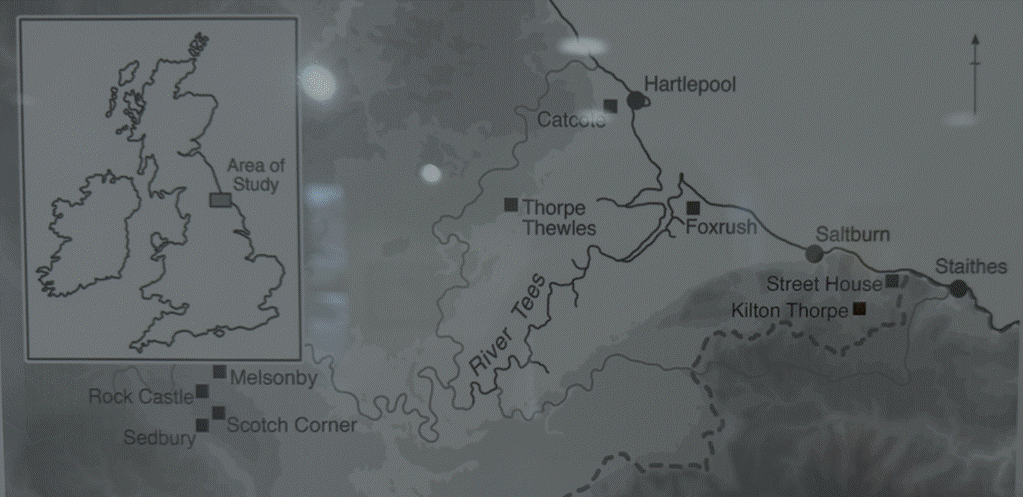
Iron Age and
Romano British sites in the Tees Valley with evidence of Salt
Salt Production
in the Iron Age
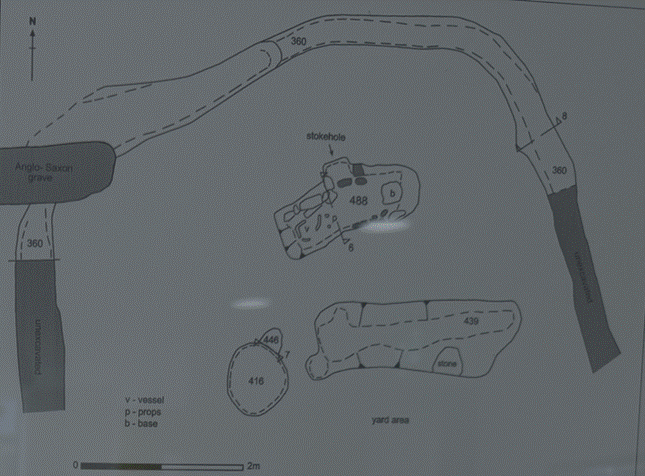
Salt was probably
produced along the Yorkshire coast during the Iron Age. Excavations at Thorpe
Thewles, Catcote and other sites in the Tees Valley
(Tees Valley) found pottery vessels (termed briquetage)
used for salt distribution, but we did not know where the salt was produced.
Excavations on the Iron Age settlement at Street House in 2006 changed
everything when a salt production site was found. A gully, defined a
rectangular area. Within it there were two pits, and a saltern, with a
stokehole on the north side. Measuring 1.84m long and 0.66m wide, the saltern
had burnt stones and fire reddened clay on the north side, with an in situ
vessel at the west end, and a base and kiln furniture with part of the
collapsed structure at the east end. A second saltern was excavated in 2007. A
saltern and two pits cutting into the boulder clay north of the saltern were
excavated. Measuring 2.70m long and 0.40m wide, the saltern had a stokehole on
the south side. The saltern was packed with stones, some burnt, and the edges
of the feature were fire reddened. The two pits adjacent to the saltern
contained salt vessels, with a rim sherd from a container and briquetage, oven furniture and a 1st-century AD
Romano-British flagon fragment. There is much evidence for salt production
during the Later Iron Age at Street House, dating between 50 BC through to the
Romano-British period. The distribution of the vessels, structures, working
areas and debris from this activity is shown on the site plan. This is the most
extensive Iron Age salt-working site in North-East England, although there are
probably others, not yet found. (Loftus Time
Lines, Archaeological Excavations at
Street House, Loftus, 2005 to 2025).
Romano-British Period, 70
to 410 CE
The proximity of
the site to the Roman Signal Station at Huntcliff suggests a degree of
direct Roman influence by the fourth century CE.
Salt Production
in the Romano-British Period at Street House
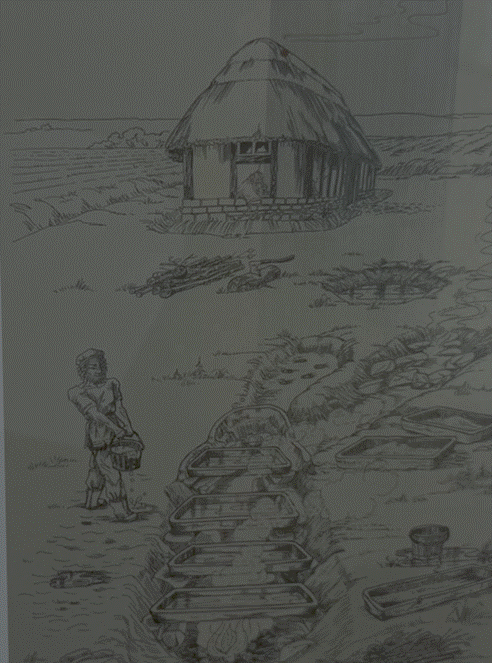
Evidence for
Roman salt‑working was found
during excavations at Street House in 2023, although the Iron Age salt‑working site probably continued to the end of the 1st century AD.
The excavation revealed a pit to the north where the brine was stored, a
furnace, nearly 4m long with a stokehole and two flues. The area around the
structure was heavily burnt clay with a stone structure that had a series of ‘steps’
as locations for ceramic trays. Hot air from the furnace flowed beneath the
trays and evaporated the brine leaving salt crystals. Chemical evidence for
this evaporation process was confirmed by portable X‑ray fluorescence. Chloride (a key component of salt) was detected
and recorded between 168 and 2,845ppm (parts per million). Analysis of the
material used as fuel in the furnace identified charred spelt and emmer wheat
and barley. One barley seed was radiocarbon dated to cal
AD 236–365, early 3rd to mid 4th century AD. Finds
from the excavation included a jet bead and over 30 sherds of Romano‑British pottery, with a broad date range 3rd to 4th century AD.
There is little evidence for Roman salt production in Yorkshire. Only one other
site is known at Black Dyke, near North Cave, East Yorkshire. There a pit was
excavated and briquetage salt vessels were found. The
Black Dyke structure is nothing like the Street House example. Sites in East Anglia
are more comparable, and there is a 4th‑century AD
structure known at Middleton in Norfolk that could be contemporary with the
Street House saltern. (Loftus Time Lines, Archaeological Excavations at Street House, Loftus,
2005 to 2025).
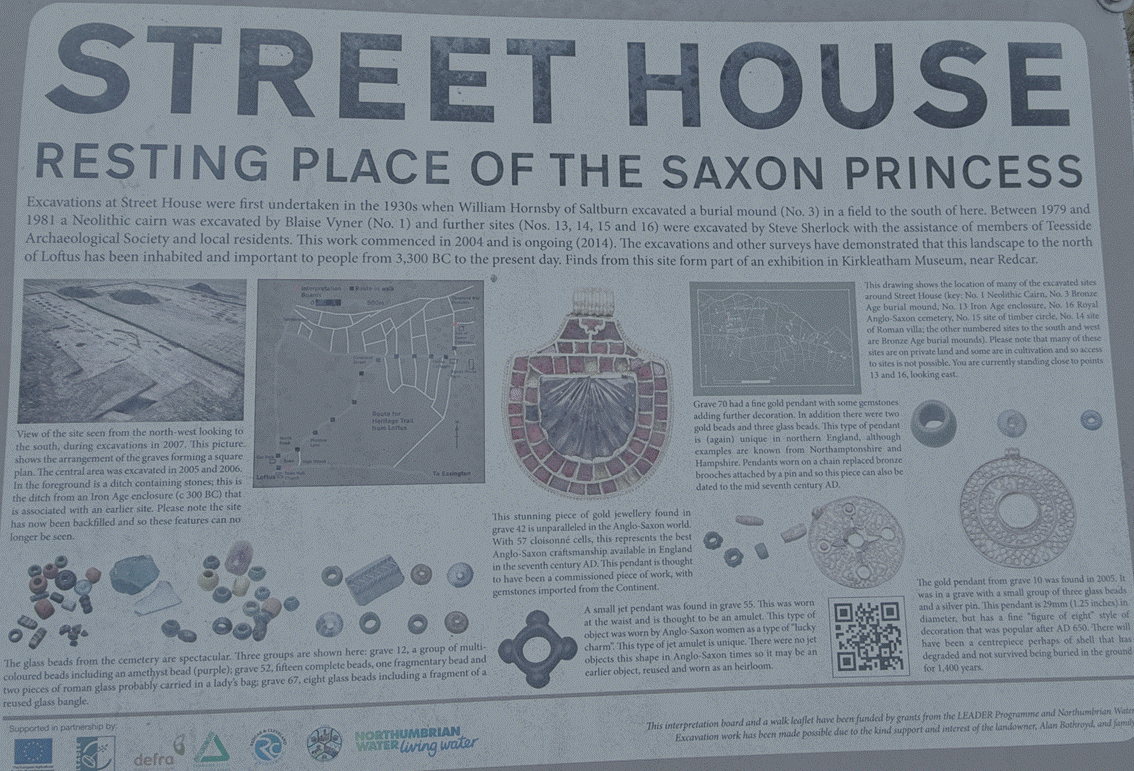
Anglo-Saxon Street Houses,
450 CE to 1066
It may be that a
person of the Anglo-Saxon elite class bought the industrial site at Street
Houses as a going concern.
An
aristocratic burial ground at Street
House near Loftus and Carlin How, in Cleveland,
dates to about 650 CE, a period of transition from paganism to Christianity in England.
This location would have been just within the northern border of Deira. The cemetery
was superimposed on a prehistoric monument and there lay a high-ranking woman
on a bed surrounded by 109 graves. The
royal princess watched over Carlin How, the hill of witches, for
thirteen centuries until she was excavated in 2005. The Saxon noblewoman died
between 650 and 700 CE. There were no remaining bones in the grave, but she has
been identified as a female of an elite class by the jewellery and other
treasures. She was laid to rest on a wooden bed which was placed into the
earth. The grave was then fitted with a timber structure which was built over
the top of the mound. This practice is referred to as a bed burial. Similar
practices in Kent might suggest that this family had some link to the East
Saxons.
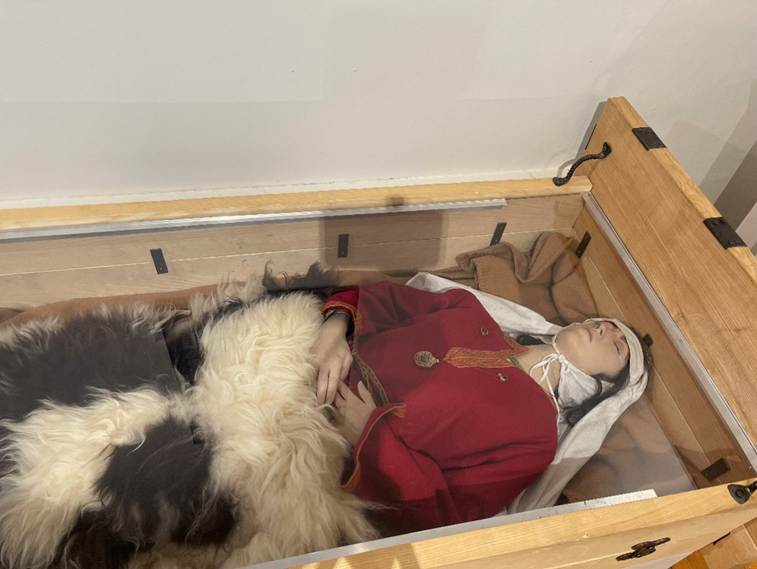
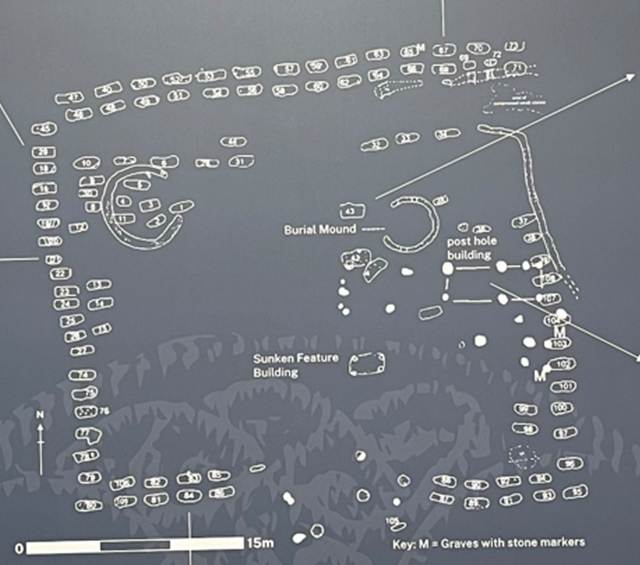
Evidence
of elite burial in Deira has come to light spectacular in a late 7th century cemetery
of unique layout at Loftus in the Cleveland hills. Some 109 graves are known,
with more than 80 set out in four neat rows, two of them double rows, to form
an open rectangle, almost square, of 36 metres by 34 metres. Within the open
area is a ditched mound, thought to be a mausoleum, some small buildings and
possibly the primary feature, a rarely seen case of an individual laid out on a
wooden bed. The rite of bed burial and grave goods, including a scallop shaped
pendant of gold and garnet, suggest a high-status female; a nearby grave,
thought to be that of a male, may be associated with her.
The cemetery was only used for a short period of time and is
focused on one burial near the centre of the cemetery, known as grave 42. The
objects from this grave were the first indication to archaeologists that this
was the site of the burial of an important person. Grave 42 contained three
gold pendants, each one unique in northern England. The female had been placed
on a wooden bed with iron fittings and decoration. Bed burials are very rare
and had only been found previously in southern England.
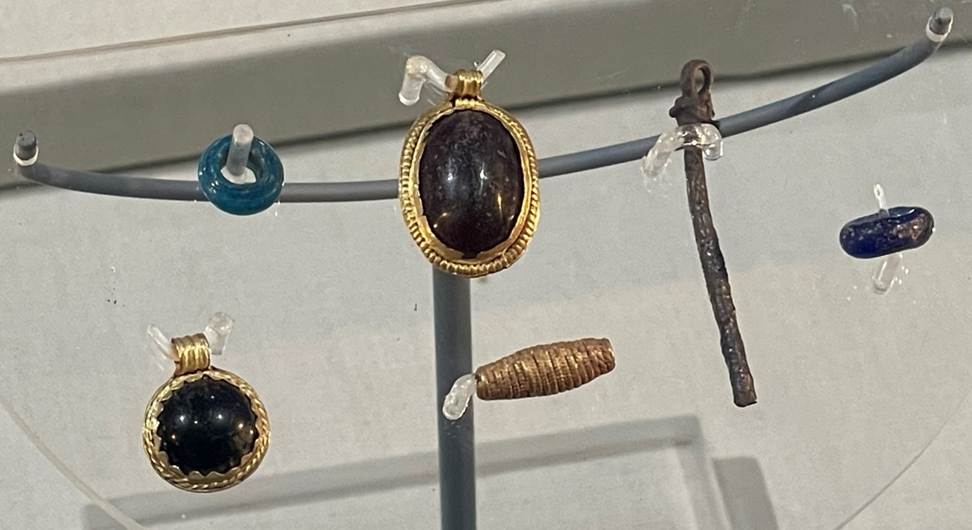
The grave contained some extraordinary objects including three
golden pendants, two glass beads, a gold wire and part of a jet hairpin.
The most extraordinary object is a shield shaped golden pendant.
Nothing like it has been found amongst Anglo Saxon archaeological artefacts apart
from the Sutton Hoo treasures. The pendant is made of gold with 57 small red
gemstones sitting on a thin gold alloy foil. The pendant may have been made
from gold coins from the continent that had been debased.
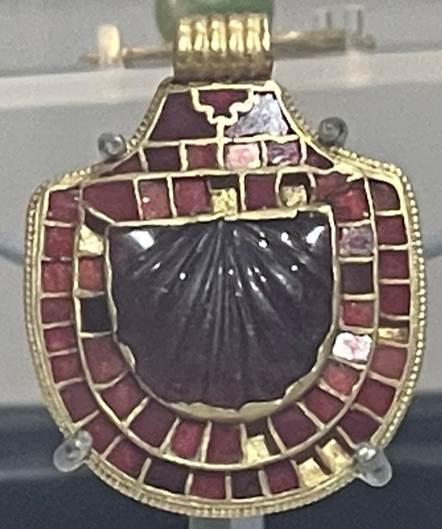
The remarkable grave jewellery to be seen
today at Kirkleatham museum
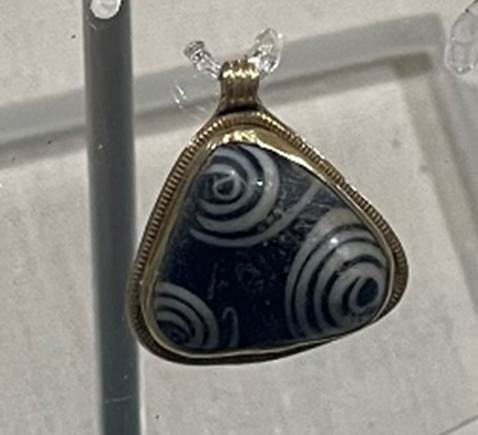
Close to the bed burial place of the princess, in a nearby grave,
a pendant was found, with a reused Iron Age bead as its centrepiece, surrounded
by gold, carefully crafted to fit its triangular shape.
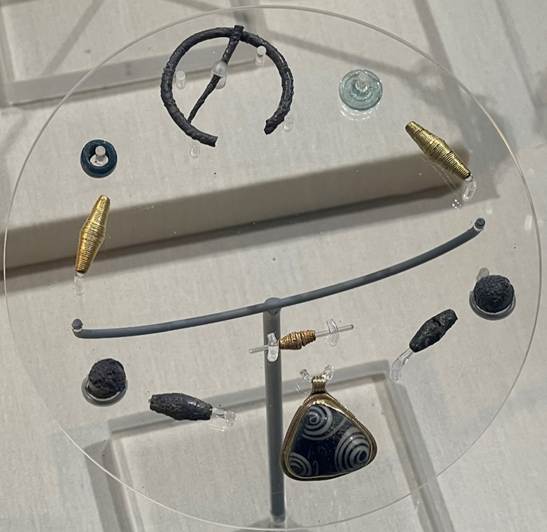
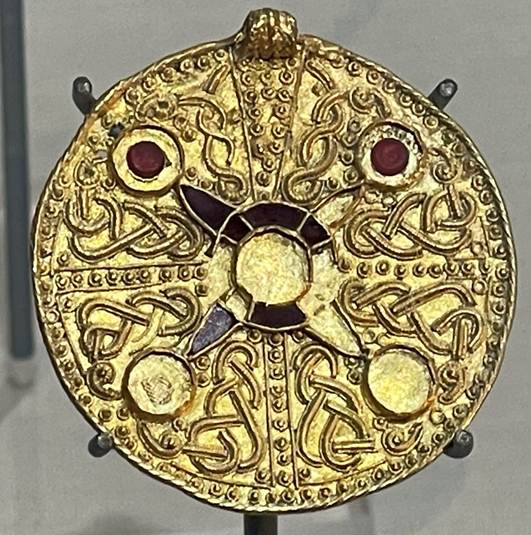
Another remarkable piece was this magnificent golden pendant,
which was probably created between 630 to 650 CE in a workshop in Kent. It was
found in the bed burial grave, together with other treasures, including four
glass beads, one adorned with gold wire, and a small gold cylinder that acted
as a spacer. These items together were probably worn on a chain. It may have been an amulet, worn as a charm
for religious purposes.
There
are only a small number of bed burials in England including two at the royal
cemetery at Sutton Hoo in Suffolk. There is another example at the Prittelworth burial site in Essex, which was recreated
at the Chalke History
Festival in 2024. The bed was placed in a chambered tomb with a low mound marking
the site of the grave. Other graves define the extent of the burial area which
forms an irregular square 36 metres by 34 metres. There are two buildings
within the cemetery, one possibly a mortuary house where the princess from
grave 42 may have been laid prior to her burial. The cemetery was created
within an earlier Iron Age enclosure dating to about 200 CE and the link to the
past may have been deliberate. Grave 42 is the richest single Anglo-Saxon grave
in the North East defined by the quantity and quality of the material found.
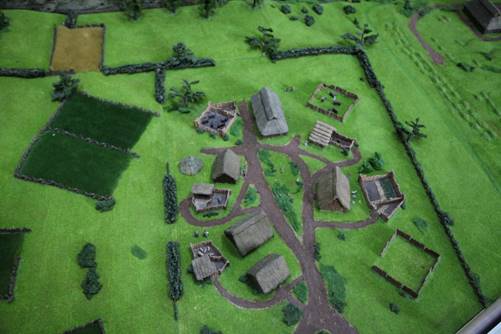
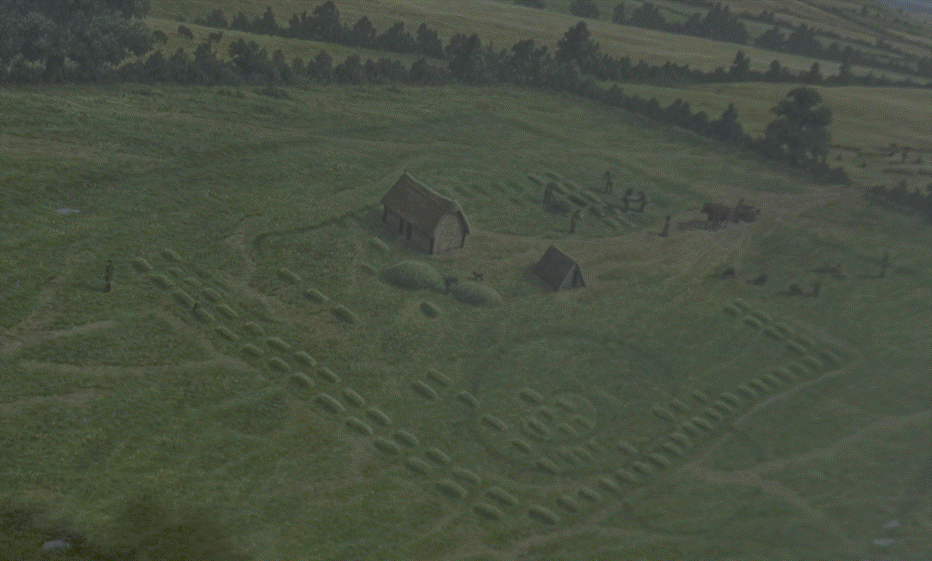
This diorama at the Kirkleatham Museum
represents the Royal Saxon settlement excavated at modern day Street House.
Initially
identified during the 2005 excavation of an Iron Age settlement, Street House
excavations slowly revealed a large Anglo-Saxon cemetery over three years,
2005–7. This site revealed many important finds and contributed significantly
to the understanding of the Anglo-Saxon world during the conversion period
between c AD 650 and c AD 750. The cemetery at Street House hosted 109 graves
that were marked by timber posts and laid in a unique square pattern, with the
graves oriented east to west. Placed within an Iron Age enclosure, this site
included two Anglo-Saxon structures in addition to the graves. One structure is
believed to have been a Grubenhaus (a post-built
structure with a timber floor constructed over a foundation pit) that was used
as a mortuary house, while the other was a larger posthole building that is
believed to have been a chapel. Of the 109 graves, 67 revealed an abundance of
various grave goods including many glass beads, iron accessories and several
small knives, while only one weapon; a seax, was found. Several high-status
items were also recovered at this site, including a string of two gold coins
with eight coloured glass beads, a circular gold pendant alongside a silver
pin, a circular silver brooch alongside a gold and silver necklace, and a gold
pendant with intricate glass and gold beads. While these finds suggest that the
individuals buried at this site were powerful, the discovery of a bed burial
elevated the believed status of this cemetery. The bed burial found at Street
House is one of 18 currently known in the UK, many of which were found in East
Anglia. Excavation of this grave revealed two polished glass and gold cabochon
pendants, a gold wire bead and a gold shield pendant. This last pendant is set
with 56 small garnets and a large scallop-shaped garnet in the central setting.
The scallop shell is an early Christian symbol and denotes pilgrimage, after
the Apostle St James. The bed burial, which used intricate ironwork and ash
wood, is believed to have been set within a timber structure that was then
enclosed in the centre of a burial mound, a practice usually reserved for the
highest-status burials during this period. The value of grave goods found
within this burial and the status of bed burials suggests that the individual
interred here was a prominent female member of the Northumbrian royal family.
The Anglo-Saxon princess found within the bed burial may well have been related
to, or at least known to, St Hild of Whitby. The discovery of the royal
cemetery at Street House has given us a unique insight into Anglo-Saxon burial
and ceremonial practices during the 7th century AD. The square orientation of
the site is unique within 7th-century AD England, while the presence of the
buildings, the timber grave markers, the burial mounds, and the creation of
structures within the graves suggest well-ordered burial rites for this
community. The wealth of finds, the gold, jewels, silver and beads, also
suggest long-distance and powerful connections between this community and
others, and further reinforce the belief that this site is that of a royal
Anglo-Saxon cemetery. (Loftus Time Lines, Archaeological Excavations at Street House, Loftus,
2005 to 2025).
It has been
suggested that the Kingdoms of Deira and Bernicia merged in the late seventh
century to form the Kingdom of Northumbria. Deira has been associated with the
lands that later became Yorkshire. Following the Roman withdrawal from Britain
a number of successor kingdoms rose in northern England, reflecting pre-Roman
tribal territories. The area between the Humber and River Tees known as Deywr or Deifr corresponds
to the tribal lands of the Parisi, bordered to the west and north by the
Brythonic kingdoms of Elmet (Elfed) and Bernicia (Bryneich)
respectively, and to the east by the North Sea. Bernicia is associated with the
land from the Tees north to the Forth.
The only known
Anglo-Saxon royal burial site in north-east England is near Loftus, overlooking
Loftus and Carlin How. The location would have been just within the northern
border of Deira. The royal princess watched over Carlin How for thirteen centuries
until she was excavated as part of a 109 grave site at Street House, Loftus.
Anglo-Saxons in
the Tees Valley
The Anglo-Saxons
came from northern Europe and began raiding and settling in Britain from the
4th century AD. By the end of the 6th century AD they had become a significant
cultural group in Britain, establishing numerous settlements across the Tees
Valley. Excavations completed at 20 sites on both sides of the River Tees,
dating between AD 500 and AD 700, reveal evidence of a shared culture across
the region. Surveys of two of these sites, Catterick and Hartlepool, offer
valuable insights into Anglo-Saxon life.
Catterick.
Catterick has been the focus of archaeological attention since the 19th
century. During this period, archaeologists have identified seven distinct
sites of Anglo-Saxon activity. Of note is a 2015 evaluation supported by Operation
Nightingale (a programme designed to help rehabilitate injured soldiers through
involvement in archaeological investigations) that took place within Marne
Barracks. There, the archaeologists found Skeleton 8 aligned north-south within
an earlier Roman structure, adjacent to the threshold. The team uncovered an
iron knife, a potsherd and an annular brooch, all identified as Anglo-Saxon in
style. These items, together with brooches and a bone comb from other burials
within the structure, were dated to the 6th century AD. Similar finds,
including glass beads, have been discovered at Maltby. At Catterick, there is a
clear trend for the reuse of Roman stone buildings as burial places in the
Anglo-Saxon period, such as at Bainesse and
elsewhere, particularly near Hadrian’s Wall. Excavations elsewhere at Marne
Barracks revealed a Grubenhaus (a post-built
structure with a sunken floor constructed over a foundation pit) 200m south-east
of the burials. It is suggested that the building was used for craft activities
including weaving.
Hartlepool. The
monastery at Hartlepool was established c AD 640, but it is perhaps best known
for the period when St Hild was abbess, AD 649–657. The monastic community that
settled there was associated with a concentration of 37 buildings, 28 of which were
of earthfast timber construction and eight had
stone-footed foundations. These buildings are significant as their design is distinctly
Anglo-Saxon, marking the arrival of a Northumbrian presence with its own
cultural and political identity. Several artefacts from these buildings are of
Christian character, such as an 8th-century AD disk-headed gilded copper-alloy
pin and a 7th- to 8th-century AD clay mould. The pin is decorated with two
opposed animals with open jaws and intertwined bodies, a motif also found in
manuscripts including the Lindisfarne Gospels. Pins of this quality belonged to
the wealthy. It is notable that this item was prudently repaired and preserved.
A clay mould, used for manufacturing jewellery, was decorated with a depiction
of an apocalyptic animal interpreted as a calf, the symbol of St Luke the
Evangelist. This object is testimony to the skill of Anglo-Saxon craftsmen at
this monastery. The concentration of Christian artefacts and iconography found
at Hartlepool sheds light on the complex landscape of conversion in Anglo-Saxon
England.
(Loftus Time Lines,
Archaeological Excavations at Street House, Loftus, 2005 to 2025).
Anglo-Saxon
cemetery at Norton-on-Tees
In May 1982 two
children playing on a spoil heap at Mill Lane, Norton, found a skull. This led
to the discovery of 120 burials forming part of an Anglo‑Saxon cemetery. The excavation, carried out between 1984 and 1985,
revealed unique burial customs. The graves were arranged in rows aligned
east–west. Male burials often contained weapons, while female burials included jewellery
such as brooches. These objects dated from AD 550 to AD 630. The absence of
Christian symbols suggested Pagan beliefs. The position of bodies varied: some
were laid on their backs, others on their sides. Grave goods indicated social
status. Double burials suggested familial or social connections. The findings
have contributed significantly to understanding Anglo‑Saxon England’s burial customs,
material culture, and religious beliefs. (Loftus Time
Lines, Archaeological Excavations at
Street House, Loftus, 2005 to 2025).
Life in
Anglo-Saxon England
Sites like Norton‑on‑Tees and Street
House, Loftus, are examples of large‑scale Anglo‑Saxon burial grounds in north‑east England.
When Anglo‑Saxons in the
Tees Valley buried their dead, they did so along with personal objects, or
grave goods. Individuals were buried with what they used and wore in daily
life. By studying these objects, including tools or weapons, accessories and textiles,
archaeologists can begin to understand how people in the past lived, worked and
expressed themselves. Anglo‑Saxon life was
centred around the village or farmstead. The people of these settlements grew
crops, tended livestock, hunted game, and caught fish and waterfowl. These
settlers also worked with materials such as wood, bone, antler and leather, and
smelted, cast and smithed with metal ore. Textile production, too, was embedded
into daily life as a key part of the yearly farming cycle. Work began in the
fields, with flax and hemp sown in spring and harvested in July or August and
sheep shorn in June. The labour moved to the village outskirts in the autumn as
fibres were prepared for a winter of yarn‑spinning and
ended indoors with sewing and weaving the following spring. While men did some
of the heavier labouring in the fields, most of the textile production in an
Anglo‑Saxon community was
the work of women. Women worked together throughout the year, as harvesters,
spinners, dyers and weavers, influencing production techniques and clothing
trends through these specialised crafts. Taking up a substantial part of the
year, and involving a large portion of the village population, the production
of cloth was part of a wider community effort. Communities in the Tees Valley
had a much greater range of clothing styles. Compared to southern Anglo‑Saxon kingdoms, communities in the North were influenced by
surviving Romano‑British
technologies and cultural exchanges with Celts and Scandinavians. Variety was
also introduced at a local level as production techniques were shared by women
within and moving beyond their home villages through marriage or migration. As
found today, clothing in the Anglo‑Saxon period
could be functional, decorative and symbolic. Metalwork was especially
important in terms of function and form. Accessories like brooches that fastened
on to cloaks and wrist clasps that closed dress sleeves functioned like modern
buttons and zippers. Some accessories were probably expressions of the owner’s
age, culture, status, gender and individuality. Iron latch‑lifter keys, for example, worn on a woman’s belt with a girdle hanger (Fig 6), were used
to secure goods behind locked doors; as an accessory, it also represented the
role of Anglo‑Saxon women as
keepers of the home. Items made from precious metals were, like today, status symbols.
Ornate jewellery, such as silver and gold bracelets or amulets, were
expressions of individual or familial wealth and craftsmanship. Anglo‑Saxon clothing also followed fashion trends. For example, in the
early Anglo‑Saxon period
women wore tubular gowns, or peplos, fastened with a brooch on either shoulder
in a style first found in classical Greece, and which was worn across Iron Age
Europe and Asia. The migration of people from the European Continent further influenced
clothing styles, with wealth carried in the form of accessories, such as
necklaces comprising up to a hundred amber and blue glass beads (compare “Anglo‑Saxons in the Tees Valley” with “Anglo‑Saxon Cemetery at Street House”), belt buckles and brooches made of precious
metals like gold and silver, or other practical objects such as hide shields or
iron swords and seaxes. As Anglo‑Saxon communities
became more established by the mid 6th century AD,
clothing and burial practices also reflected a more settled way of life. Grave
goods emphasized craft tools over weaponry; and fashion trends shifted from an
abundance of accessories to fewer, higher‑quality pieces.
Established settlements across the Anglo‑Saxon world
produced unique forms of dress and old styles, such as the use of belt buckles,
fell out of fashion with changing times. The changes in style of accessories
form a distinct chronology and together with analytical techniques they are used
by archaeologists to help date burials and settlement activity within the Anglo‑Saxon period. (Loftus Time Lines, Archaeological Excavations at Street House, Loftus,
2005 to 2025).
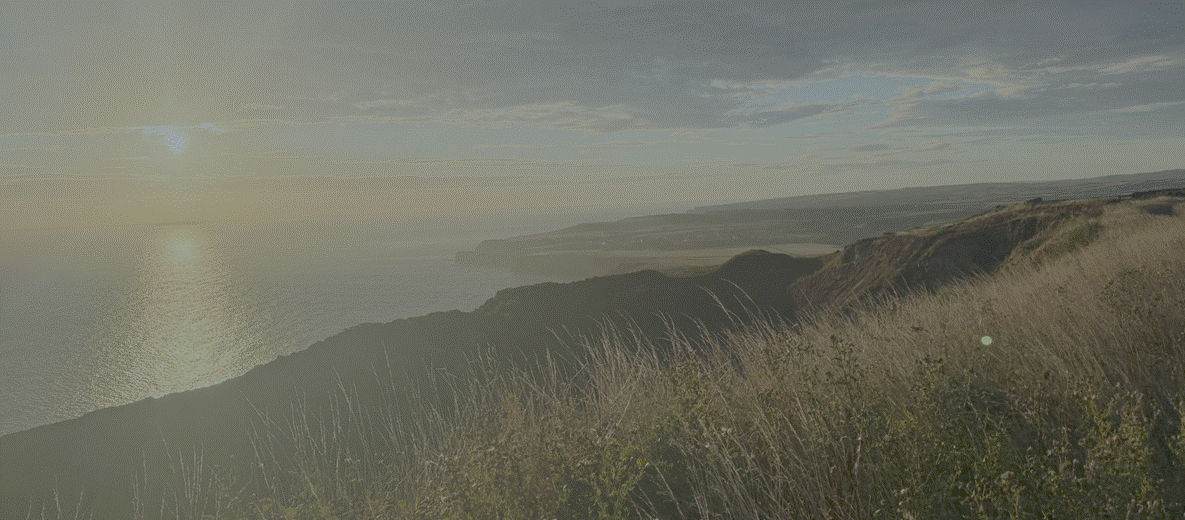
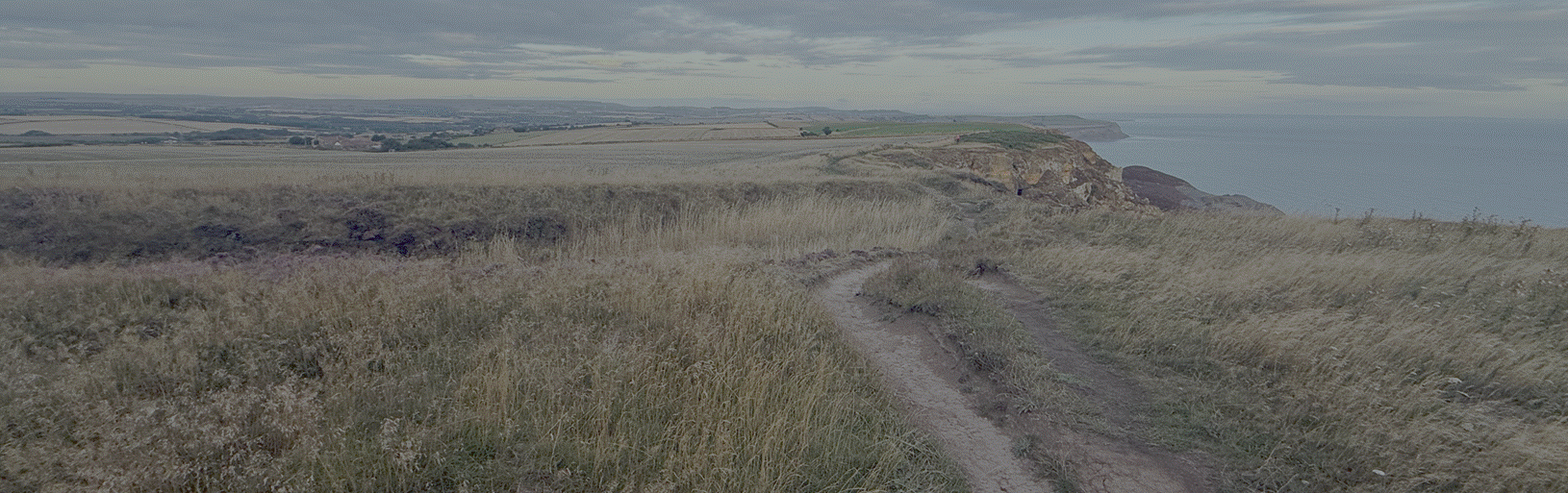
Cleveland Way
along the coast adjacent to Street Houses
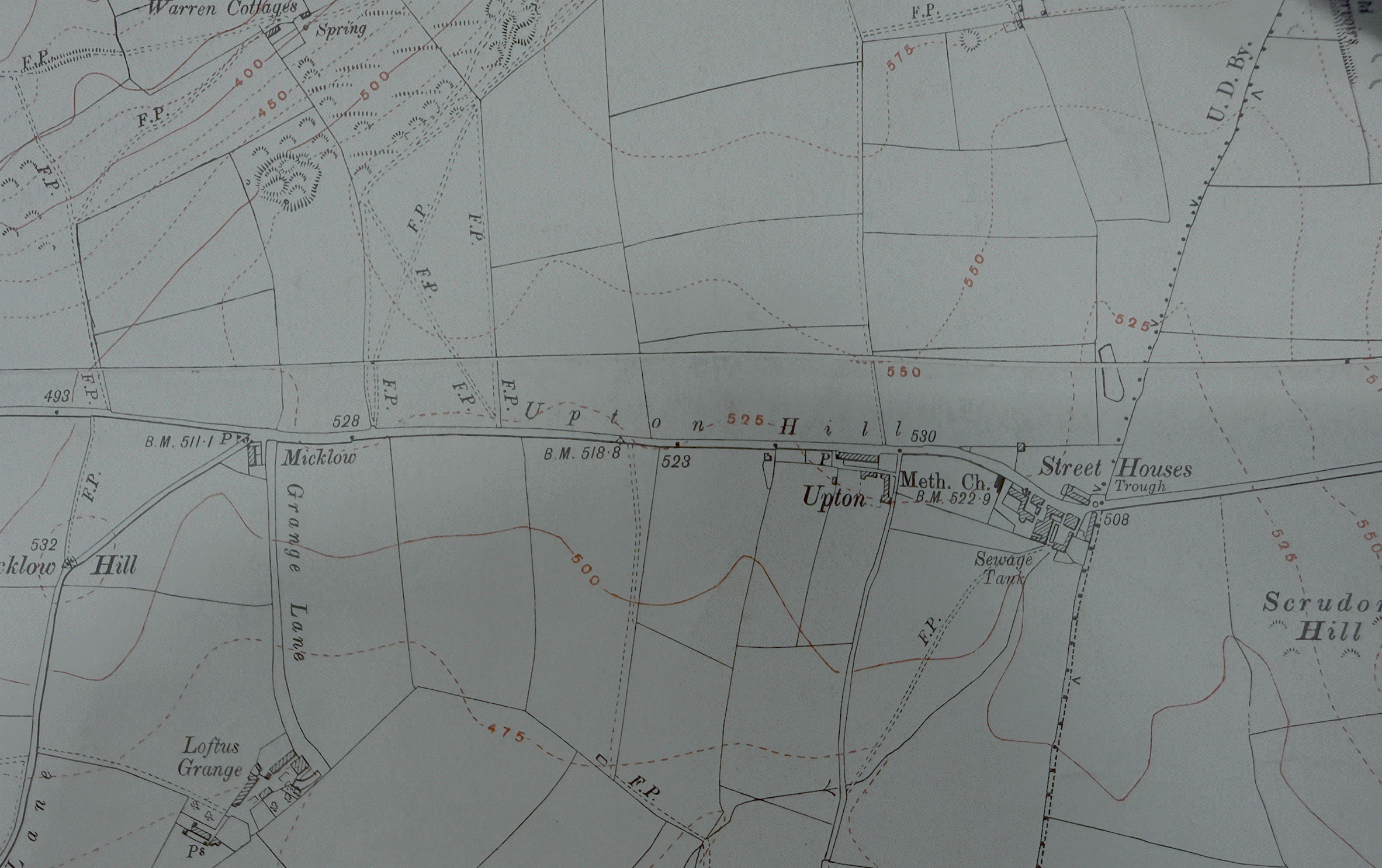
1948
There is an Ordnance Survey map showing Street Houses Farm in 1948 (The National Archives U.SG/8/33
held at Teesside Archives).
The Farndales and Carlin
How
In Victorian
times, the Craggs line of Farndales
would make Craggs Farm at Carlin How, their home, in this place of Saxon ghosts.
The Farndales have had a close association with Craggs Hill which sits just
above the old village of Carlin How, including the Craggs Line. Kerling is the
Old Norse for a hag or witch and how comes from the Scandinavian haugr or hill. Carlin How is therefore the hill of
witches.
Bibliography
Adams, Max and O’Brien, Colm (2025), Northumbria
AD 367-867, pages 105 to 106.
Arkeonews, 6000-Year-Old
Salt Production House Rewrites Europe’s History.
Barcham, Richard C (1982), Excavation
of the Street House Farm Long Cairn, Boulby,
Cleveland, in the Yorkshire archaeological journal Volume 54, Pages 1-5.
Brotton
Howe, Brotton, Cleveland, North Yorkshire, The Northern Antiquarian.
Crawford, G M (1990), Bronze
Age Burial Mounds in Cleveland, Cleveland County Council.
Elgee, Frank (1930), Early
Man in North-East Yorkshire. Gloucester: John Bellows.
Guardian, 9 April 2021, Dig
Reveals 6,000 year old salt hub in north-east England.
Hornsby, William and
Stanton, Richard (1918), British Barrows near Brotton in Yorkshire
Archaeological Journal Volume 24 Page 263-268.
Megalithic Portal (2011), Street House Farm -
Barrow Cemetery in England in Cleveland.
Modern Antiquarian, Street House.
Saxon Princess Exhibition at the Kirkleatham
Museum.
Schwenninger,
Jean Luc, Healy, Frances and Sherlock, Stephen (2025), Street
House, Street House Farm, North Yorkshire, Historic England
Research Report Series.
Sherlock, Stephen John
(2010), An
Examination of Late Prehistoric Settlement in North East England with Specific
Emphasis on the Settlements of the Tees Valley, University of
Leicester, School of Archaeology and Ancient History.
Sherlock, Stephen J (2012), Late
Prehistoric Settlement in the Tees Valley and Northeast England, Tees
Archaeology Monograph Seies Volume 5, Hartlepool. *
Sherlock, Stephen J (2012), A
Royal Anglo-Saxon Cemetery at Street House, Loftus, Northeast Yorkshire,
Tees Archaeology Monograph Series Volume 6, Hartlepool. *
Sherlock, Stephen J (2019), A
Neolithic to Late Roman Landscape on the Northeast Yorkshire Coast: Excavations
at Street House, Loftus 2004 to 2017, Tees Archaeology Monograph Seies
Volume 7, Hartlepool. *
Sherlock, Stephen J (2021), Early
Neolithic salt production at Street House, Loftus, northeast England in Antiquity,
Volume 95, Issue
381 pages 648-669. *
Sherlock, Stephen J (2025), A
Romano-British Saltern at Street House, Loftus, Northeast Yorkshire in
Durham Archaeological Journal Volume 24, pages 85 to 95.
Spratt, D A (1979), The
Archaeology of Cleveland. Middlesbrough Borough Council.
Spratt, DA (1982), Prehistoric
and Roman Archaeology of North-East Yorkshire. British Archaeological
Reports British Series 104.
Vyner, B (1984), The Excavation of
a Neolithic Cairn at Street House, Loftus, Cleveland in Proceedings of the
Prehistoric Society Volume 50 pages
151-195. *
Vyner, B (1988), The Street House Wossit: The Excavation of a Late Neolithic and Early Bronze
Age Palisaded Ritual Monument at Street House, Loftus, Cleveland in
Proceedings of the Prehistoric Society Volume 54, pages
173-202.
Vyner, Blaise E (2000), Report
on the Iron Age and Roman Period Pottery Assemblage Excavated from Kilton
Thorpe, Cleveland, Report for Northern Archaeology Associates. *
Vyner, Blaise E (2001), The
Pottery in the Iron Age Settlement at Kilton Lane, Brotton, Report by Tees
Valley Archaeology. *
Vyner, Blaise (2024), An
Indication of Northern Souls: Revisiting the ‘Territory of Ritual’ in
Offa’s Dyke Journal, Volume 6, page
10-53.
|
|
|
|
|
|
|
|
|
|
|
|
|
|
|
|
|
|
|
|
|
|
|
|