The Territory of Deira
The rulers who dominated our
ancestral lands
A Genealogy of the Deira and Bernician Kingdoms and the chronology of the Kingdom of
Northumbria.
Warlords
in the Chaos
During the sixth century CE, the Romano-British kingdom
rapidly broke up into smaller kingdoms and York became the capital of the
British kingdom of Ebrauc. By about 560 CE the area of eastern Yorkshire was generally subjugated
by a single political group. The name the Angles gave to the territory was Dewyr, or Deira (pronounced day-era). Early
rulers of Deira extended the territory north to the River Wear and King Aella
ruled Deira from about 569 to 599 CE.
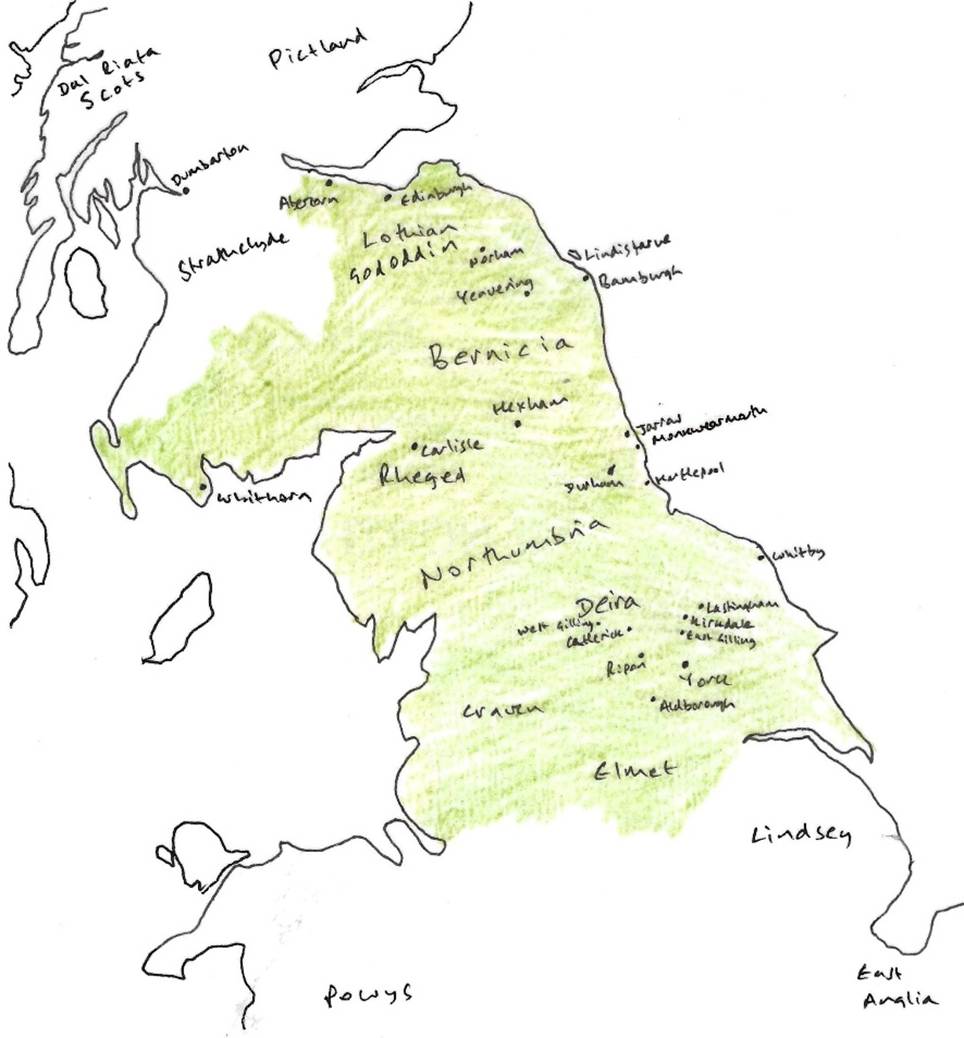
To the north of Deira the territory was known as Bernicia and
north of Bernicia there were the lands of the Gododdin which stretched up to the Firth.
These boundaries were fluid and Bernicia sometimes stretched into the Goddodin lands and control over the Bernician
and Deiran lands switched over time from Deiran to Bernician
control. Over time all these lands came to be recognised as a single large
kingdom, which adopted the Old English name Norþanhymbre
meaning "the people or province north of the Humber".
Northumbria started to consolidate into one kingdom in the early seventh
century, when Deira and Bernicia became dynastically united.
We focus here on the territory of
Deira, our ancestral lands, but from time to time those lands were controlled
by the Bernician Kings, or later merged into
Northumbria.
The Old English ‘Æ’ meant ‘Lord’.
The House
Deira
Deira 569 CE to 589 CE
Ælla was
the son of Yffa. He is the first known king of Deira.
Ælla was
almost certainly a pagan. When Pope Gregory the Great encountered two
pale-skinned Deirans at a slave market in Rome he is said to have remarked that
they were "not Angles, but angels, if they were Christian” and when
he heard that the King of Deira was Ælla he said
"Alleluia should be sung in that land".
Æthelric (589 CE to 604
CE)
Deira 589 CE to 604
CE
The
Anglo-Saxon Chronicle suggests that Ælla was
succeeded by his brother Æthelric in 589 CE, who
reigned for five years.
He fled into
exile when Deira was conquered by Æthelfrith.
The House
Bernicia
Æthelfrith (? CE to 616 CE)
Bernicia
593 CE to 616 CE and Deira 604 CE to 616 CE
Æthelfrith
was the son of Æthelric and grandson of Ida, and probably
succeeded Hussa as king of the Bernicians in about
593 CE.
Bede tells of the pagan Æthelfrith's significant
success over the Britons. He "ravaged the Britons more than all the
great men of the English, insomuch that he might be compared to Saul, once king
of the Israelites, excepting only this, that he was ignorant of the true
religion. For he conquered more territories from the Britons, either making
them tributary, or driving the inhabitants clean out, and planting English in
their places, than any other king or tribune."
It may have
been Æthelfrith who destroyed an army of Britons at
the Battle of Catraeth
(Catterick) in about 600 CE. The battle was
described in an early poem Y Gododdin.
Áedán mac Gabráin, the king of Dál Riata (northwest
of Bernicia), was alarmed by Æthelfrith's successes, and in 603 CE he led
"an immense and mighty army" against him, but Æthelfrith, who
commanded an inferior force, won a crushing victory at Degsastan.
Æthelfrith gained control of Deira in about 604
CE. The details are not known but he probably conquered Deira since Edwin, son
of the former King Ælla, was exiled. It is though
possible that this was the formalisation of some existing relationship between
the two Kingdoms. It is possible that Æthelfrith was
the son of Æthelric.
It was in about 604 CE that Æthelfrith's son Oswald was born. In about 614 CE, his son
Oswy was born.
The Historia Brittonum says that Æthelfrith gave the town
of Din Guaire to his wife Bebba, after whom it was named Bamburgh.
Æthelfrith
was the first Anglo-Saxon leader to hold both Deira and Bernicia.
Later in his reign, he attacked the Kingdom of Powys and
defeated its army in a battle at Chester. He also massacred the monks of
Bangor-Is-Coed who were assembled to aid the Britons by their prayers.
He was
killed at the Battle of the River
Idle in 616 CE by
Rædwald, King of East Anglia (under whose protection Edwin the Exile remained).
The House
Deira
Edwin (586 to 633 CE)
Deira and
Bernicia after 12 April 616 to 12 October 633 CE
Edwin was the son of Ælla. When Æthelfrith became King of
Bernicia, Edwin fled into exile. He travelled between several kingdoms during
his period of exile and spent time in Mercia, where he married a daughter of
King Cearl. Then, he took refuge in East Anglia,
where his presence precipitated the events that caused Æthelfrith's downfall.
Bede suggests that Æthelfrith
tried to have Rædwald murder his rival, and that
Rædwald intended to do so until his wife persuaded him otherwise with Divine
prompting.
Æthelfrith's sons Eanfrith, Oswald,
and Oswy fled northwards to the Gaelic kingdom of Dál Riata. It was House
Bernicia’s turn to flee into exile.
Edwin incorporated the Isle of Man and the lands of Gwynedd
in North Wales into his Kingdom.
By the early seventh century CE,
there was a political structure across the area of modern Ryedale, under
Edwin’s peripatetic government, which held gatherings on estates where food was
consumed. Eoforwic (the next of the many historic
designations of modern York) was at its centre.
Edwin
married Æthelburh, a Christian Princess from Kent in 625 CE. She was the sister of Eadbald of Kent who required as a
condition of the marriage that Edwin converted to Christianity. The marriage of
Eadbald's Merovingian mother Bertha had resulted in the conversion of Kent and Æthelburg's would do the same in Northumbria.
Æthelburh was accompanied by Paulinus, a member of the Gregorian mission to
Northumbria
Edwin
converted to the Christian religion, along with his nobles and many of his
subjects in 627 CE and was baptised at Eoforwic where he built the first wooden
church amidst the Roman ruins which was later replaced
by a larger stone church. The site of this first church was probably beside the
old Roman principia or military headquarters, to the north of the
current minster, in the current Dean’s Park
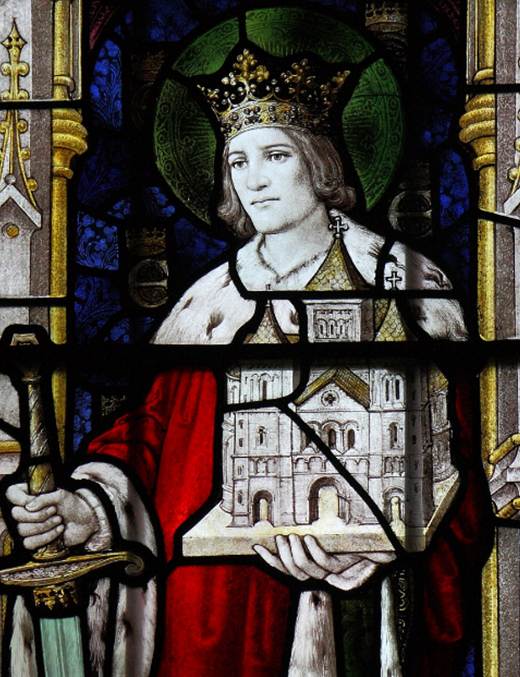
Edwin, St Mary, Sledmere, Yorkshire
Paulinus then converted many of Edwin's subjects, including
the future saint, Hild who would found Streanæshealh. Paulinus built churches.
Edwin was
killed at the Battle
of Hatfield Chase, near Doncaster, on
12 October 633 CE by Cadwallon of Gwynedd and Penda of Mercia.
He was venerated as a saint and martyr after his death.
His unification of the northern
Kingdom did not outlast him, and his conversion to Christianity was renounced
by his successors. The rise of Penda and of Mercia, and the return from Irish
exile of the sons of Æthelfrith, tied the Kingdom of Northumbria into the sea
connections of the Celtic and Irish for several generations.
After Edwin’s death, Eanfrith
temporarily regained power in Bernicia, and subsequently Oswald restored the Bernician line of Æthelfrith to
power in both Bernicia and Deira. After this point, Æthelfrith's descendants
continued to rule until the first part of the eighth century.
Ad Gefrin, ‘the Hill of the Goat’ at Yeavering was a royal Anglo Saxon settlement
at this time. Its construction reflected ideas of protection depicted in poems
such as Beowulf.
Osric
Deira,
Late 633 to summer 634 CE
Edwin was succeeded by Osric, son of Edwin's paternal uncle Ælfric, in Deira. He
reverted to paganism, but was killed by Cadwallon.
Oswald then
defeated and killed Cadwallon and united Northumbria once more.
The House
Bernicia
Oswald (d 642 CE)
Bernicia
and Deira 12 October 633 to 5 August 642 CE
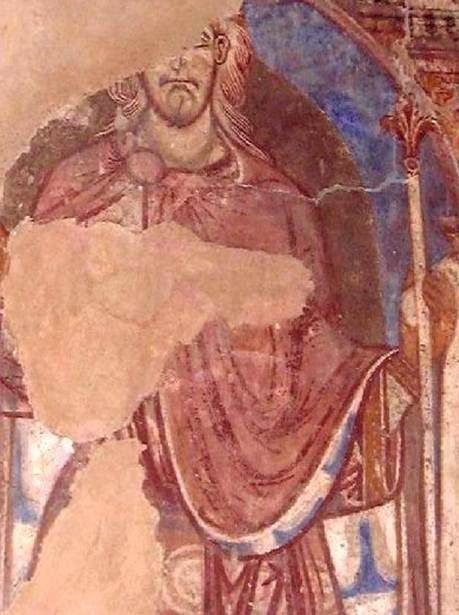
Oswald, c 12th century, Durham Cathedral
Oswald was
the son of Æthelfrith. After his father’s defeat in 616 CE, he fled northwards
to the Gaelic kingdom of Dál Riata. He converted to
Christianity and may have fought in Ireland during his
exile.
After the
Battle of Hatfield Chase in 633 CE, Northumbria was split into its constituent
kingdoms of Bernicia and Deira. Oswald's brother
Eanfrith became king of Bernicia but was killed by Cadwallon in about 634 CE. Oswald
then met Cadwallon in Battle at Heavenfield,
near Hexham.
After Heavenfield, Oswald reunited Northumbria and re-established
Bernician supremacy.
He asked the Irish of Dál Riata to send a bishop to help the conversion of his
people. The Irish first sent an "austere" bishop, who had little
success. They later sent Aidan, who brought a gentler approach. Oswald gave the
island of Lindisfarne to Aidan as his episcopal see. Aidan spread Christianity.
Bede says that Oswald acted as Aidan's interpreter as Aidan didn’t really speak
English and Oswald had learned Irish during his exile.
Oswald was killed at the Battle of Maserfield by Penda, King of Mercia in 642 CE.
He was venerated as a saint after his
death.
Oswy,
Oswiu
Bernicia
and later also Deira (15
November 642 to 15 February 670 CE)
Oswy was another son of Æthelfrith. He was also exiled with
his brother Oswald to the Irish kingdom of Dál Riata. He was exiled between the age
of 4 to 21. He became fluent in the Old
Irish language.
He succeeded his brother after his
death at Maserfield.
In about 642 CE, Oswy married
Eanflæd, Edwin’s daughter.
In 655 CE, Oswy killed Penda at the Battle of the Winwaed, which gave the Northumbrian King
control the Kingdom of Mercia.
After 655 CE he had become one of the
most powerful rulers in Britain. He secured control of Deira, with his son Alhfrith served as a sub-king. For three years, Oswy’s
power over Mercia earned him recognition as Bretwalda.
He presided over the Synod
of Whitby at Streanæshealh in 664
CE.
Oswy died from illness in 670 CE and Deira and Bernicia was
divided between two of his sons.
The House
Deira
Oswine
Oswine was the son of Osric, who
belonged to the rival Deiran royal family.
Oswy and Oswine came into conflict in
651 CE. Owine was unable to maintain his army and withdrew to Wilfaresdun, about ten miles from Cataract (Catterick). He
was betrayed by the local earl and Oswy slew him. In order to expiate the
killing of Oswine, Oswy established a monastery at Gilling Abbey which was
probably at Gilling East.
The House
Bernicia
Œthelwald
Deira
651 to 654
Oswine was
followed as king of the Deirans by Oswald's son Œthelwald.
Alhfrith (Oswy’s son) (c. 630 – c. 664)
Deira
Sub-King 656 to 664
Alhfrith
was sub King of Deira under his father Oswy, King of Bernicia, from 656 until
sometime after 664.
Alhfrith
apparently clashed with his father over religious policy, which came to a head
at the Synod of Whitby in 664 CE. After this, Alhfrith disappeared from the historical record.
Ecgfrith (d 20 May 685 CE)
Deira
Sub-King 664 to 670 CE, then King of Northumbria from 1 to 17 September 670
until his death in 20 May 685
Ecgfrith was
Sub-king under his father Oswy, upon whose death he
became king of all Northumbria.
He ruled over Northumbria when it was
at the height of its power, but his reign ended with a disastrous defeat at the
Battle of Nechtansmere against the Picts of Fortriu in which he lost his life.
(The Reign of King Ecgfrith of
Northumbria, Kenneth Harrison, Yorkshire Archaeological Journal, Volume 43,
1971, page 79)
Ælfwine
Deira
sub-king 670 CE to 679 CE
Ælfwine, son of Oswiu of Northumbria and a
brother of Ecgfrith, was still a boy in 670 CE, and his sub-kingship might have
been intended to designate him as the heir of the childless Ecgfrith. He was,
however, killed in battle against the Mercians at the Battle of the Trent in
679.
Bede wrote In the ninth year of
the reign of King Ecgfrith (in 679), a great battle was fought between him and Æthelred, king of the Mercians, near the river Trent, and Ælfwine, brother to King Ecgfrith, was slain, a youth about
eighteen years of age, and much beloved by both provinces; for King Æthelred had married his sister Osthryth. There was now reason to expect a more bloody war, and more lasting
enmity between those kings and their fierce nations; but Theodore, the bishop,
beloved of God, relying on the Divine aid, by his wholesome admonitions wholly
extinguished the dangerous fire that was breaking out; so that the kings and
their people on both sides were appeased, and no man was put to death, but only
the due mulct paid to the king who was the avenger for the death of his
brother; and this peace continued long after between those kings and between
their kingdoms.
There were no further sub kings of
Deira and Northumbria was ruled as a single province.
Aldfrith
Northumbria after 14 December 685 to
704 CE or 14 December 705
The son of
Oswy, Aldfrith was a man of learning. Some of his works and some letters
written to him survive. His reign was relatively peaceful, marred by disputes
with Bishop Wilfrid.
Eadwulf I
(d 717 CE)
Northumbria
704 to 705 CE
Aldfrith’s
son Osred was a child when his father died, and it is assumed that Eadwulf I
usurped the throne.
He seems to have been exiled to either Dál Riata or
Pictland.
Osred I (c697 to 716 CE)
Northumbria
after 14 December 705 to 716 CE
The son of
Aldfrith, Osred did not directly succeed his father as Eadwulf I seized the
throne, but held it for only a few months.
Osred
reached his majority in 715 or 716, and within a very short period he was
killed.
Coenred (d 718 CE)
Northumbria
716 to 718
He descended
from Ida of Bernicia, and was the first of his branch of the family to rule
Northumbria.
Osric (d 9 May 729)
Northumbria
after 23 April 718 to 9 May 729
Bede reports
little of Osric's reign, but records that comets were seen at his death, a sign
of ill omen.
Ceolwulf (d 765 CE)
Northumbria
on or after 9 May 729 to 737 (but in 731 or 732 he was briefly deposed and then restored
to power)
Ceolwulf abdicated
and entered the monastery at Lindisfarne.
Bede
described him as the "most glorious king".
Eadberht
of Northumbria (d
768 CE)
Northumbria
738 to 758 CE
Eadberht son
of Eata was a descendant of Ida of Bernicia. His brother was Ecgbert, who
became Archbishop of York, teacher if Alcuin.
His reign was
a return to the imperial ambitions of seventh-century Northumbria and a period
of economic prosperity.
He faced
internal opposition from rival dynasties and at least two of his rivals were
killed during his reign.
In 758 CE he
abdicated in favour of his son Oswulf and became a
monk at York.
Oswulf (d
24 July 759)
Northumbria
758 to 759 CE
Oswulf was
murdered the year after he became King by his bodyguards at Market Weighton on
24 July 759.
Æthelwald Moll
Northumbria
759 to 765 CE
Æthelwald
Moll seized the throne after Oswald’s murder.
He was King
for seven years until he was deposed by Alhred. After
his removal from the throne Æthelwald became a monk,
perhaps involuntarily.
Alhred
Northumbria
765 to 774 CE
Æthelwald
Moll was deposed in 765 and Alhred became king.
Little is said of his reign in the Anglo-Saxon Chronicle other than that he
became king, and was then deposed and exiled in 774 CE.
Æthelred I
Northumbria
774 to 779 and 790 to 796
The son of Æthelwald Moll, he was murdered on 18 April 796.
Ælfwald I
(c 767 to 788)
Northumbria
779 to 788 CE
Ælfwald was
probably the son of Oswulf, and grandson of Eadberht.
Osred II
Northumbria
789 to 790
Osred was
the son of Alhred and Osgifu, daughter of Eadberht.
Osbald (d 799)
Northumbria
during 796
Oswald a
violent man and most likely a murderer. On 9 January 780, he killed Bearn, the
son of King Ælfwald by burning him to death at Selectune (possibly Silton, North Yorkshire).
He was a
friend of Alcuin who often sent him
letters of advice, urging him to give up his extravagant way of life. Alcuin
told him, disapprovingly that Luxury in emperors means poverty for the
people.
He ruled for
27 days before being abandoned by the royal household and deserted by his
people. He went into exile in Lindisfarne. Alcuin
continued to chastise him: My dear friend Osbald ... I am disappointed in
you for not taking my advice. I urged you in my letter that you should give up
this way of life. Do not add sin to sin by ruining your country and shedding
blood. Think how much blood of emperors, princes, and people has been shed
through you and your clan.
Eardwulf (c790 – c 830)
Northumbria
796 to 806 (possibly a second reign from 808 until 811)
In 798,
early in his reign, Eardwulf fought a battle at Billington Moor against a
nobleman called Wada, who had killed King Æthelred. Wada was defeated and
driven into exile.
In 801,
Eardwulf led an army against Coenwulf of Mercia, perhaps because of Coenwulf's
support for other claimants to the Northumbrian throne.
In 806 CE
Eardwulf was deposed and went into exile.
Eanred
Northumbria
c 811 to c 840
Eanred's
reign saw the appearance of the styca, a new style of small coin which
replaced the earlier sceat.
Æthelred II (d 862 CE)
Northumbria
c 840 to c 848 CE
There was an
interruption in 844 CE when Rædwulf usurped the throne,
but was killed the same year fighting against the Vikings.
Æthelred
was assassinated, but nothing more is known of his murder.
Osberht (d 21 March 867)
Northumbria
c 848 to 862 CE
Osberht
became king after Æthelred son of Eanred was
murdered.
Ælla
Northumbria
862 to 866 CE
Osberht was
replaced as king by Ælla. While Ælla
is described in most sources as a tyrant, and not a rightful king, one source
records that he was Osberht's brother
The Great
Heathen Army marched on Northumbria in the late summer of 866 CE, seizing York on 21 November 866.
Ragnarssona þáttr (The Tale of Ragnar's sons) provides
legendary accounts of the Viking conquest of York. This associates the
semi-legendary king of Sweden Ragnar Lodbrok and his sons, Hvitserk, Björn
Ironside, Sigurd Snake-in-the-Eye, Ivar the Boneless, and Ubbe. According to
the stories, Ragnar was killed by Ælla, and the army
which seized York in 866 was led by Ragnar's sons who avenged his death by
subjecting Ælla to the blood eagle.
Halfdan
Ragnarsson
Viking
overlord of Northumbria 866 to 867 CE
Halfdan
Ragnarsson and his brother Ivar the Boneless were the Viking leaders of the
Great Heathen Army which invaded England in 865.
They sought
revenge against Northumbria for the death of their father, who was supposedly
killed by Ælla of Northumbria.
While
Halfdan only ruled Northumbria directly for about a year in 876, he placed
Ecgberht on the throne as a client-king
Ecgberht
I
Client
King of Northumbria 867 to 872 CE
Symeon of
Durham recorded that After these events, the pagans appointed Egbert king
under their own dominion; Egbert reigned for six years, over the Northumbrians
beyond the Tyne.
He was
probably the Great Heathen Army's tax collector and likely belonged to one of
the several competing royal families in Northumbria.
In 872,
Symeon of Durham wrote The Northumbrians expelled their king Egbert, and
their Archbishop Wulfhere. That year Northumbria rebelled against the Great
Heathen Army and their collaborators and expelled Ecgberht I and Wulfhere of
York.
Ricsige
Client
King of Northumbria 873 to 876
The Great
Heathen Army came north against the Northumbrians in 873 CE. There was a
destruction of monasteries.
Ecgberht
II
Bamburgh
and northern Northumberland 876 CE to an unknown date
Ecgberht
probably only reigned over the northern parts of Northumbria as Symeon recorded
Ricsig, king of the Northumbrians, died, and
Egbert the second reigned over the Northumbrians beyond the river Tyne.
Interregnum
Halfdan was
killed in Ireland in 877 CE whilst trying to regain control over Dublin, a land
he had ruled since 875 CE.
There was an
interregnum after Halfdan died until Guthred became
king in 883.
Guthred Hardacnutsson (c 844 to 24 August 895 CE)
Norse
king of Northumbria c 883 to 895 CE
Guthred was
probably the first Christian Viking King of York.
Symeon’s
account was that During this time the Viking army, and such of the
inhabitants as survived, being without a king, were insecure; whereupon the
blessed Cuthbert himself appeared in a vision to abbot Eadred of the monastery
at Carlisle and addressed him in the following words:—"Go to the army of
the Danes," he said, "and announce to them that you are come as my
messenger; and ask where you can find a lad named Guthred,
the son of Hardacnut, whom they sold to a widow. Having found him, and paid the
widow the price of his liberty, let him be brought forward before the whole
aforesaid army; and my will and pleasure is, that he be elected and appointed
king at Oswiesdune, (Oswin's hill), and let the
bracelet be placed upon his right arm.
He seems to
have defeated a large invasion by the Scots.
Siefredus or Sigfrith
Norse
King of Northumbria c 895 to 900 CE
A number of
silver coins bearing the inscription Siefredus Rex
were found as part of a Northumbrian hoard.
He may have
pirated the coast of Wessex from the land of the Northumbrians with a large fleet, ravaged twice and
afterwards sailed back to his own homeland.
Cnut
Norse
King of Northumbria c 900 to 905 CE
About 3,000
silver coins bearing the inscription CNVT REX were found as part of the Cuerdale Hoard in Cuerdale,
Lancashire.
Cnut of
Northumbria is not the same person as the future King Cnut.
Æthelwold
Æthelwold
was the son of Æthelred, the king of Wessex from 865 to 871. Following his
father's death, in 871, his uncle Alfred the Great became king. When Alfred
died in 899. Alfred's son Edward the Elder ascended the throne of Wessex.
However, Æthelwold made a bid for power, seizing his
father’s old estate in Wimbourne. Edward's forces
besieged Æthelwold's position, forcing him to flee.
He went to York, where the locals accepted him as king, in 901.
He was
killed in 902, which ended the challenge to Edward’s rule.
Ragnall I
Jorvik
(York) 914 to 921 CE
The folk of
York were unhappy with Ragnall. They therefore promised obedience to Æthelflæd, Lady of the Mercians in early 918, but the
negotiations were ended prematurely by her death in June of that year. Later in
his reign, Ragnall submitted to Edward as overlord, but was allowed to keep his
kingdom.
Sitric Cáech
Scandinavian
Northumbria 921 to 927 CE
Sitric was
a kinsman of Ragnall, and another Scandinavian leader expelled from the Kingdom
of Dublin, in 902. Sitric, however had returned to
Ireland to retake Dublin and become their king. Then in 920 he travelled to
York and joined Ragnall where in 921 Ragnall died and
Sitric replaced him as king.
Sitric
raided Davenport, Cheshire, in violation of the terms of submission agreed
between Ragnall and Edward the Elder.
Edward was
replaced by his son Æthelstan, and although the annals indicated that Sitric was reluctant to submit to Edward, he submitted to Æthelstan at Tamworth in January 926. Part of the agreement
was that Sitric should marry Æthelstan's sister
Eadgyth and that he should be baptised. He seems to have repudiated
Christianity and rejected his bride shortly afterwards.
Gofraid ua Ímair
Scandinavian Northumbria 927 CE
Sitric Cáech died in 927 and Gofraid
left for Northumbria, delegating authority in Dublin to his sons. This upset
the sons of Sitric, who allied with a "son of
Helgi" and seized Limerick. This act began a period of conflict between
the Hiberno-Scandinavian of Dublin and Limerick which would last until 937.
Gofraid's attempt to rule in Northumbria was unsuccessful and he was driven out
by Æthelstan of England within six months.
Æthelstan of Wessex
King of
the Anglo Saxons 927 to 939 CE
Æthelstan
was King of the Anglo-Saxons from 924 to 927 and King of the English from 927
to 939.
The new
title reflects that in 927 CE, Æthelstan conquered
the Scandinavian Kingdom of York, previously part of the Northumbrian Kingdom.
Æthelstan
is widely considered one of the greatest Anglo-Saxon kings for his efforts to
consolidate the English kingdom and the prosperity his reign brought.
His reign
was prosperous and legal and economic reform, but there were frequent clashes
with the Scots and the Vikings.
Æthelstan
died in 939, and soon afterwards the Vikings' retook of York.
Scandinavian
Rule 939 to 944 CE
When Æthelstan died in 939, the Scandinavian leader Olaf
Guthfrithson arrived from Dublin and took over Northumbria with minimal
opposition. Coins minted at York during his reign show the Raven motif.
In 940, his
cousin Olaf Cuaran joined him in York. It is probable that Olaf Guthfrithson
died in 942 and was replaced by Olaf Cuaran. Then in 943 the Anglo-Saxon
Chronicle says that Olaf Cuaran was baptised, with Edmund as sponsor, and that
same year, another king of Northumbria, was named as Ragnall
Guthfrithson and he was confirmed also with Edmund as
sponsor. Both Olaf and Ragnall were called king, but it is uncertain whether
they were co-rulers or rival kings.
English
rule 944 to 947 CE
In 944 CE
Edmund was able to expel the Scandinavian leaders from Northumbria.
Eadred was
the half-brother of Æthelstan and full brother of
Edmund, all of whom were sons of King Edward the Elder. Eadred inherited
Northumbria, but like Edmund lost it soon afterwards.
Eric of
York (possibly Eric Bloodaxe)
Northumbria
947–948 CE, 952–954 CE
Eric
expelled Anglo- Scandinavian
rulers of Northumbria in 947 CE, who then regained the land in 948 or 949. Eric
took back the throne in 952, only to be deposed again in 954.
Eric was the
last Scandinavian king of Northumbria and his authority only extended to the
southern kingdom of York.
Scandinavian
domination came to an end when Eadred's forces killed Eric Bloodaxe at the
Battle of Stainmore in 954.
The whole
area was then governed by earls, from the local nobility, who were appointed by
the kings of England.
Oswulf I of Bamburgh
Earl of
Northumbria 954 to c 963 CE
When Eadred
finally regained control in 954, he appointed Oswulf
earl of the whole of Northumbria. By the twelfth century Oswulf was
held responsible for the death of Northumbria's last Norse king, Eric of York.
Eadwulf
II “Evil Child” of Bamburgh
Earl of
Northumbria c 963 CE
St
Brice’s Day Massacre 1002
In 975 CE
Edgar, son of Edmund and King of England died suddenly. The succession was
contested between his two sons Edward and Æthelred.
Edward became king but was killed under suspicious circumstances in 978 CE.
Æthelred
replaced him as ruler and in 1002 he was told that the Danish men in his
territory "would faithlessly take his life, and then all his
councillors, and possess his kingdom afterwards". In response, he
ordered the deaths of all Danes living in England. The orders were carried out
on 13 November 1002 (now known as the St Brice's Day massacre).
This
provoked the King of Denmark, Sweyn Forkbeard, to invade England in 1003. The
onslaught continued until 1014 when Æthelred and his
family were driven into exile and Sweyn was installed as king of England.
However he only reigned for five weeks before he died.
Waltheof
of Bamburgh
Earl of
Northumbria to c 994 to 1006
Waltheof was
high-reeve or ealdorman of Bamburgh, son of Ealdred, and the grandson of Oswulf I.
He was
father of Uhtred the Bold, Ealdorman of Northumbria.
The name
Waltheof remained in his family when Earl Siward married his
great-granddaughter and named his son Waltheof.
In 1006
Malcolm II of Scotland invaded Northumbria and besieged the episcopal city of
Durham. The Danes were raiding southern England and King Æthelred
was unable to send help to the Northumbrians. Ealdorman Waltheof was too old to
fight and remained in his castle at Bamburgh. Ealdorman Ælfhelm of York also
took no action. Waltheof's son Uhtred, acting for his father, called together
an army from Bernicia and Yorkshire and led it against the Scots. The result
was a decisive victory for Uhtred. Local women washed the severed heads of the
Scots, receiving a payment of a cow for each, and the heads were fixed on
stakes to Durham's walls. Uhtred was rewarded by King Æthelred
II with the ealdormanry of Bamburgh even though his
father was still alive.
Uhtred of
Bamburgh, “the Bold”
Earl of
Northumbria 1006 to 1016
Uhtred was
the son of Waltheof I, ruler of Bamburgh (Bebbanburg),
whose family the Eadwulfings had ruled for over a
century.
Uhtred was murdered,
probably on Cnut's orders. His death by assassination was described in De obsessione Dunelmi and has
been interpreted as the beginning of a blood feud.
King Cnut
King of
England 1016 to 1035
After Sweyn's death, his son Cnut became the leader of the Danish army. Æthelred returned to England and drove Cnut out of England and back to Denmark. Then in 1015, Cnut relaunched his campaign against the English.
In 1016 Æthelred died and was succeeded by his son, Edmund
Ironside. Edmund and his forces were decisively beaten by Cnut at the Battle of
Ashingdon. After the battle, Cnut made a treaty with
Edmund whereby Edmund would be King of Wessex and Cnut would rule the rest of
England.
Edmund
Ironside died a few weeks later. Cnut then became king of all England. He
divided England into four semi-independent earldoms using a system of
governance based on the Scandinavian system of the time. Northumbria was not
well integrated into the rest of the country.
Erik of Hlathir
Earl of
Northumberland 1016 to 1033
Cnut
appointed his most trusted followers as earls, with the Norwegian Erik of Hlathir appointed to the Earldom of Northumbria.
Siward (d 1055)
Earl of
Northumbria 1033 to 1055
Siward
became the last Scandinavian Earl of Northumbria when he succeeded Erik in
about 1033. He governed for 22 years without too much difficulty.
Siward
strengthened his position in northern England by marrying Ælfflæd, the daughter
of Ealdred, Earl of Bamburgh. After killing Ealdred's successor Eadulf in 1041,
Siward gained control of all Northumbria.
He supported
Cnut's successors Harthacnut and Edward with military aid and counsel, and
probably gained control of the middle shires of Northampton and Huntingdon by
the 1050s. There is some evidence that he spread Northumbrian control into
Cumberland.
In the early
1050s, Siward turned against the Scottish King Mac Bethad
mac Findlaích ("Macbeth"). Despite the
death of his son Osbjorn, Siward defeated Mac Bethad in battle in 1054. This
was later immortalised in William Shakespeare's Macbeth.
Siward died
in 1055, leaving one son, Waltheof.
Tostig
Godwinson
Earl of
Northumbria 1055 to 1065
On Siward's death
in 1055, Edward the Confessor, chose a West Saxon to govern Yorkshire, in place
of Siward's son, Waltheof. Edward's choice, Tostig Godwinson, was unpopular
with locals.
Tostig was
the third son of the Anglo-Saxon nobleman Godwin, Earl of Wessex and Gytha Thorkelsdóttir, the daughter of Danish chieftain Thorgil Sprakling.
In 1051,
Earl Godwin's opposition to Edward's policies had brought England to the brink
of civil war. The Godwins' opposition convinced
Edward to banish them in 1051.
The banished
Godwin family, including Gytha and Tostig, together with Sweyn and Gyrth, sought refuge with his brother-in-law the Count of
Flanders. They returned to England the following year with an armed force. They
gained support and demanded that Edward restore Tostig's earldom.
Three years
later in 1055, Tostig became the Earl of Northumbria on the death of Earl
Siward.
He was on
intimate terms with his brother-in-law, Edward the Confessor, and in 1061 he
visited Pope Nicholas II at Rome in the company of Ealdred, archbishop of York.
Tostig was
not popular with the Northumbrian ruling class, who descended from Danish
invaders and Anglo-Saxon survivors. He was heavy handed with those who resisted
his rule, and murdered several members of leading Northumbrian families.
In late 1063
or early 1064, Tostig had Gamal son of Orm
and Ulf son of Dolfin assassinated when Gamal visited him under safe conduct.
The Vita Edwardi, otherwise sympathetic to Tostig, records that
he had 'repressed the Northumbrians with the heavy yoke of his rule'.
He was often
absent and may have shown a lack of leadership against the raiding Scots. Their
king was a personal friend of Tostig, and Tostig's unpopularity made it
difficult to raise local levies to combat them. He resorted to using a strong
force of Danish mercenaries (housecarls) as his main force, an expensive and
resented policy. The housecarls' leaders were later slaughtered by rebels.
On 3 October
1065, the thegns of York and the local nobility descended on York and occupied
the city. They killed Tostig's officials and supporters, then declared Tostig
outlawed for his unlawful actions. They replaced him with Morcar,
brother of Edwin of Mercia.
Morcar
Earl of
Northumberland 1065 to 1066
The
northerners choice of new earl was accepted by Edward.
After Edward
the Confessor's death in 1066, Tostig’s brother, Harold Godwinson became King
of England. He visited York early in his reign and according to the Anglo-Saxon
Chronicle returned to Westminster at Easter 1066.
Norman
Rule
In September
1066 Tostig returned with his ally, Harald Hardrada of Norway. On the 20
September 1066 the allies defeated the northern earls, Morcar
and Edwin at the Battle of Fulford. The people of York submitted to Tostig and
Hardrada who did not occupy the city.
Five days
later Tostig and Hadrada were defeated and killed, by
Harold Godwinson, at the Battle of Stamford Bridge.
Shortly
after William of Normandy landed at Pevensey on 28 September and on 13 October
Harold of England fought his last battle on the Sussex coast at Hastings.
It took
several years for the Normans to consolidate their rule over England. It is
likely that the Conqueror exercised little authority north of the Humber during
1067.
or
Go Straight to Chapter 4 – Anglo
Saxon Kirkdale