The Farndale Timeline 1
The Middle Ages
1000 CE to 1600
|
Return to the Home Page of the Farndale Family
Website |
The story of one family’s journey through two
thousand years of British History |
The 83 family lines into which the family is divided.
Meet the whole family and how the wider family is related |
Members of the historical family ordered by date of
birth |
Links to other pages with historical research and
related material |
The story of the Bakers of Highfields, the Chapmans,
and other related families |
The colour code key to this page:
Dates in red.
Kings and Queens in Blue.
Key National Events in Orange
Feudal history impacting on Farndale history in
purple (the history of the feudal overlords).
Farndale history in green.
A preliminary note about Kirkbymoorside
(Chirchebi)
Kirkbymoorside lies only 25 miles from of York.
The name Kirkbymoorside suggests one of the key
reasons for the settlement’s establishment was the shelter offered by the
southern slopes of the moors into which the town nestles. The Ancient Britons left
behind flint and stone axes, and traces of their Celtic language in the street
names of Tinley Garth (garden) and Howe End (a ’howe’ being a burial mound).
Anglo-Saxon and Viking artefacts include a silver coin dating from around 790,
found within the grounds of the parish church of All Saints.
At the time of the Conquest, the estate was referred
to as Chirchebi.
About 1030
Orm Gamalson was probably given the land of
Kirkbymoorside which included the then unknown forested land which is now Farndale
by King Cnut (1016-1035). Orm was prominent in Northumbria in the middle years
of the eleventh century. He married into the leading aristocratic clan of the
region. His wife Aethelthryth was the daughter of Ealdred, Earl of Northumbria
in the mid eleventh century. His brother in law was
Siward, Earl of Northumbria until 1055, famous for his exploits against
Macbeth, the King of Scots.
1055 to 1065
The sundial over the entrance to St Gregory’s
Church, Kirkdale reads “Orm the son of Gamel acquired St Gregory’s Church
when it was completely ruined and collapsed, and he had it built anew from the
ground to Christ and to St Gregory in the days of King Edward and in the days
of Earl Tostig”.
King Edward referred to in the panel is King Edward
the Confessor (1042 to 1066). Tostig, the son of Earl Godwin of Wessex and
brother of Harold II, the last Anglo Saxon King of England was the Earl of
Northumbria between 1055 and 1065. It was therefore in the
course of that decade that Orm, son of Gamel rebuilt St Gregory’s
Church.
The land of Kirkbymoorside was called Chirchebi. It appears in the Domesday Book, recording
that it past after the conquest from Orm to Hugh Fitz Badric:
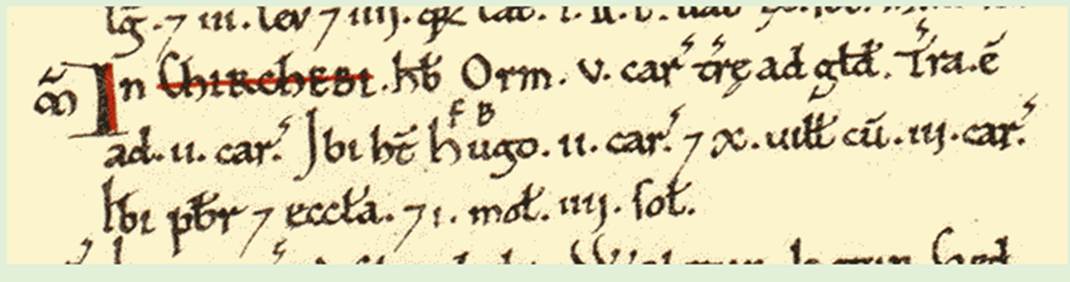
The Domesday Book provides us with the following
facts at 1086: 10 villagers. 1 priest. Land and resources Ploughland: 2
ploughlands. 2 lord's plough teams. 3 men's plough teams. Other resources: 1
mill, value 4 shillings. 1 church. Tenant-in-chief in 1086: Hugh
son of Baldric. Lord in 1086: Hugh son of Baldric.
Lord in 1066: Orm (son of Gamal).
So presumably just before the conquest the land of
Chirchebi, which was to become Kirkbymoorside, and which included the land that
would become known in time as Farndale, had a settlement around the church of
St Gregory at Kirkdale, with a couple of ploughed fields.
The Victoria History of Yorkshire suggests that
before the Conquest Orm held 5 carucates of land in Kirkbymoorside. A carucate
or carrucate (Latin, carrūcāta
or carūcāta) was a medieval unit of land
area approximating the land a plough team of eight oxen could till in a single
annual season. Presumably this is therefore describing the area of ploughed
fields, with the wider area of the estate, stretching through forests and
Farndale and Bransdale, was vast.
It is suggested that In
1086 the great multiple estate of Kirkbymoorside, which passed in the
possession of Hugh Fitz Baldric after the Conquest, was said to be 12 leagues
long.
1066
The Norman Conquest. William defeated
Harold at the Battle of Hastings, but the north of England remains unsubdued.
The House of Normandy, 1066-1154
William I (the Conqueror), 1066-1087
William the Conqueror redistributed land, granting
tracts of land to his Norman supporters and to the church.
Norman barons often adopted the name of their lands in
England as surnames.
1069 to 1070
The Harrying of the North.
1070
Domesday Book published.
The manor and Estate of Kirkbymoorside has passed to High Fitz
Baldric.
In England Hugh son of Baldric was an important tenant-in-chief
in Yorkshire, and to a smaller extent in Lincolnshire; he also held two manors
in Nottinghamshire, single holdings in Wiltshire and Berkshire, and interests
in four holdings in Hampshire. In Yorkshire Hugh son of Baldric held about 50
manors with many berewicks and sokeland,
assessed at approximately 410 carucates.
But Hugh Fitz Baldric died at his hometown of Cottingham in
1086.
The greater part of these holdings passed, presumably by royal
grant, to Robert de Stuteville. 'The estates of Hugh son of Baldric, Domesday
lord of Cottingham, were divided after his death and the bulk of his lands in
Yorkshire passed to Robert I de Stuteville.' Ivor John Sanders, English
Baronies: A Study of Their Origins and Descent 1086-1327
Kirkbymoorside passed to Robert de Stuteville.
William II (Rufus), 1087-1100
1096
Henry I, 1100-1135
The start of the Guild system to protect
trade, set prices and offer apprenticeships.
Population reaches about 2 million.
The de Stutevilles were deprived of the estate in 1106 when it
was granted to Nigel d’Aubigny, one of Henry I’s “new
men”.
The relevant estate including Kirkbymoorside passed to Nigel d'Aubigny (Neel d'Aubigny or
Nigel de Albini, died 1129), who was a Norman Lord and English baron who was
the son of Roger d'Aubigny and Amice or Avice de Mowbray.
His paternal uncle William was lord of Aubigny, while his father was an avid
supporter of Henry I of England. His brother William d'Aubigny
Pincerna was the king's Butler and father of the 1st Earl of Arundel. He was
the founder of the noble House of Mowbray.
He is described as "one of the most favoured of Henry's
'new men'". While he entered the king's service as a household knight and
brother of the king's butler, William d'Aubigny, in the
years following the Battle of Tinchebrai in 1106 Nigel was rewarded by Henry
with marriage to an heiress who brought him lordship in Normandy and with the
lands of several men, primarily that of Robert de Stuteville. The Mowbray
honour became one of the wealthiest estates in Norman England. From 1107 to
about 1118, Nigel served as a royal official in Yorkshire and Northumberland.
In the last decade of his life he was frequently
traveling with Henry I, most likely as one of the king's trusted military and
administrative advisors.
Nigel's first marriage, after 1107, was to Matilda de L'Aigle, whose prior marriage to the disgraced and
imprisoned Robert de Mowbray, Earl of Northumbria, had been annulled based on
consanguinity. She brought to the marriage with Nigel her ex-husband's lordship
of Montbray (Mowbray).
Following a decade of childless marriage and the death of her
powerful brother, Nigel in turn repudiated Matilda based on his consanguinity with
her former husband, and in June 1118 Nigel married to Gundred
de Gournay (died 1155), daughter of Gerard de Gournay and his wife Edith de
Warenne, and hence granddaughter of William de Warenne, 1st Earl of Surrey.
Nigel and Gundred had son who would be known as Roger
de Mowbray after the former Mowbray lands he would inherit from his father, and
he was progenitor of the later noble Mowbray family.
1128
First Cistercian abbey at Waverley.
Nigel died in Normandy, possibly at the abbey of Bec in 1129.
Gundreda administered the estate on behalf of her under aged son Roger
de Mowbray.
It was she who granted the whole of Welburn and Skiplam together
with the western side of Bransdale to Rievaulx Abbey, who developed the whole
area as a series of granges and cotes, including Colt House and Stirk House in
Bransdale.
1130
Financial records kept by the Exchequer
for the Crown, known as the Pipe Rolls, recording Exchequer payments and names of tenants.
Surnames began to be used
more widely to assert rights to hereditary property.
Stephen, 1135-1154
Sir Roger de Mowbray (c. 1120–1188) was an Anglo-Norman
magnate. He had substantial English landholdings. A supporter of King Stephen,
with whom he was captured at Lincoln in 1141, he rebelled against Henry II. He
made multiple religious foundations in Yorkshire. He took part in the Second
Crusade and later returned to the Holy Land, where he was captured and died in
1187.
Roger was the son of Nigel d'Aubigny
by his second wife, Gundreda de Gournay. On his
father's death in 1129 he became a ward of the crown. Based at Thirsk with his
mother, on reaching his majority in 1138, he took title to the lands awarded to
his father by Henry I both in Normandy including Montbray,
from which he would adopt his surname, as well as the substantial holdings in
Yorkshire and around Melton.
Soon after, in 1138, he participated in the Battle of the Standard
against the Scots and, according to Aelred of Rievaulx, acquitted himself
honourably. Thereafter, Roger's military fortunes were mixed. Whilst
acknowledged as a competent and prodigious fighter, he generally found himself
on the losing side in his subsequent engagements.
During the anarchic reign of King Stephen Roger de Mowbray was
captured with Stephen at the battle of Lincoln in 1141. Soon after his release,
Roger married Alice de Gant (d. c. 1181), widow of Ilbert de Lacy and daughter
of Walter de Gant. Roger and Alice had two sons, Nigel and Robert. Roger also
had at least one daughter, donating his lands at Granville to the Abbaye aux
Dames in Caen when she became a nun there.
1144
In 1147, he was one of the few English nobles to join Louis VII
of France on the Second Crusade. He gained further acclaim, according to John
of Hexham, defeating a Muslim leader in single combat.
The Plantagenets, 1154-1399
Henry II, 1154-1189
Roger de Mowbray, son of Niel Daubeney, grantee of the
Stuteville lands, was holding Kirkby Moorside.
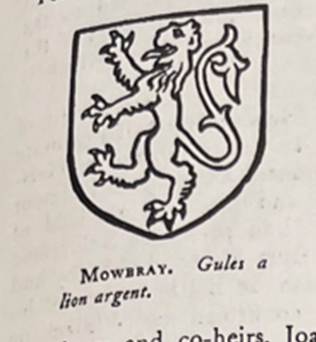
Robert de Stuteville, grandson of the first Robert, laid claim
to the barony.
Roger gave him Kirkby Moorside for 10 knights’ fees in
satisfaction of his claim. This arrangement however was not ratified in the
King’s courts.
The first reference to Farndale, the
place
It was only to be expected that the monks would seek to extend
their properties into the Mowbray territories further east and at some time before
1155, Roger, granted them a wood in Farndale called Midelhoved, ie middle head, and
another word called Duvanesthuat, probably near
Duffin Stone Farm at the northwestern end of the dale, together with common
pasture rights and permission to take building timber and wood for those who
stay there. Duvanesthuat embodies an Irish Norse
personal name, but there is nothing to suggest that it was a functioning
settlement by the mid 12th century. The whole area
was regarded as a private forest of the Mowbrays. The grant was made “saving
Roger’s wild beasts”, and it seems to have been anticipated that the monks
would want to build a new dwelling there, probably to use as a grange or cote.
Two clearings in the valley of Farndale
(Midelhovet and Duvansesthuat) were granted by Roger
de Mowbray to the Abbey and monks of Rievaulx Abbey. By it
Roger bestowed upon the Monastery, ‘….Midelhovet, that
clearing in Farndale where the hermit Edmund used to dwell; and another
clearing which is called ‘Duvanesthuat’ and common of
pasture in the same valley of Farndale….’
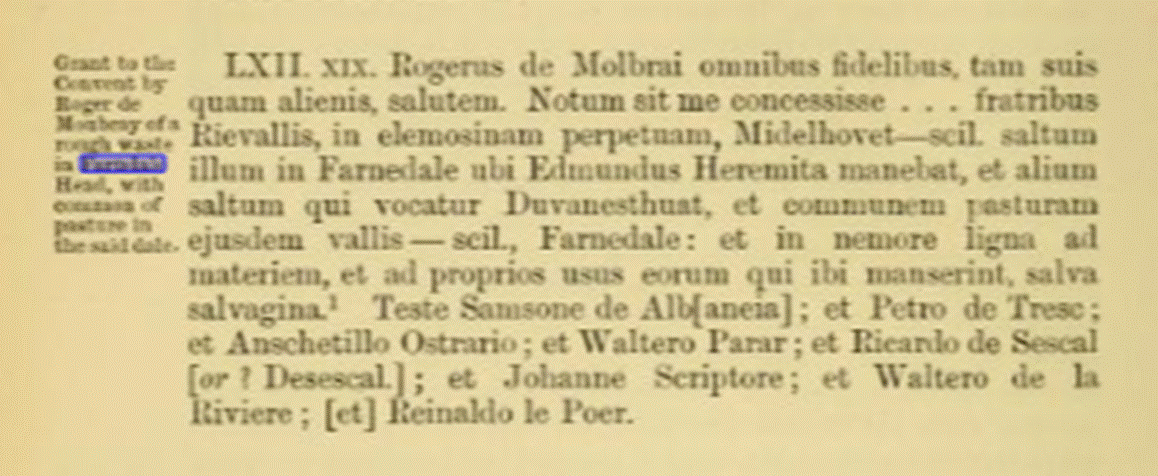
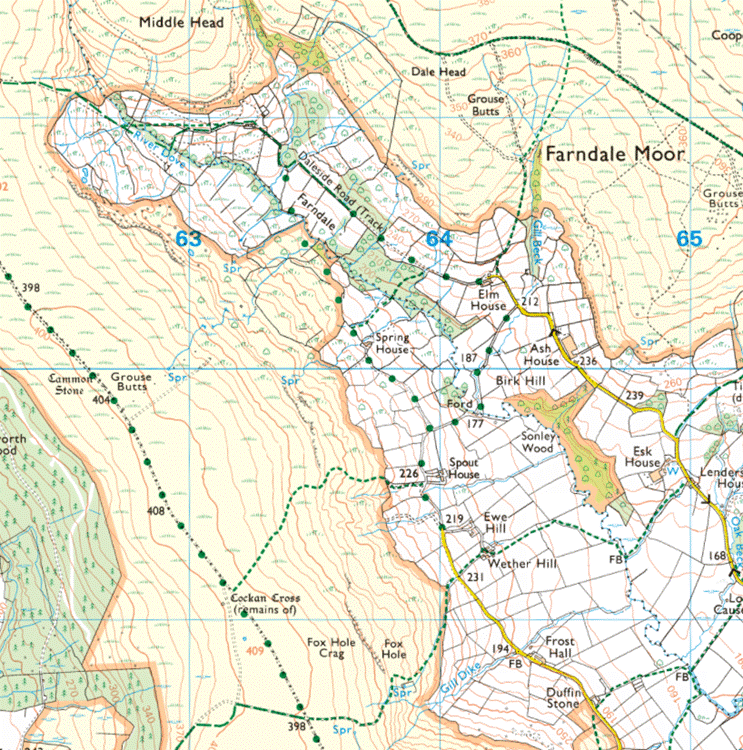
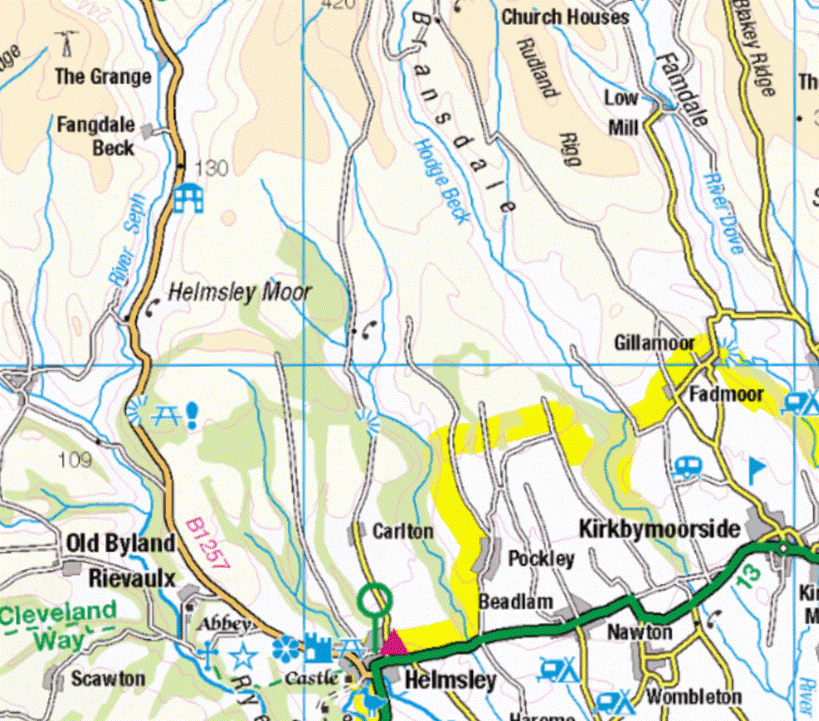
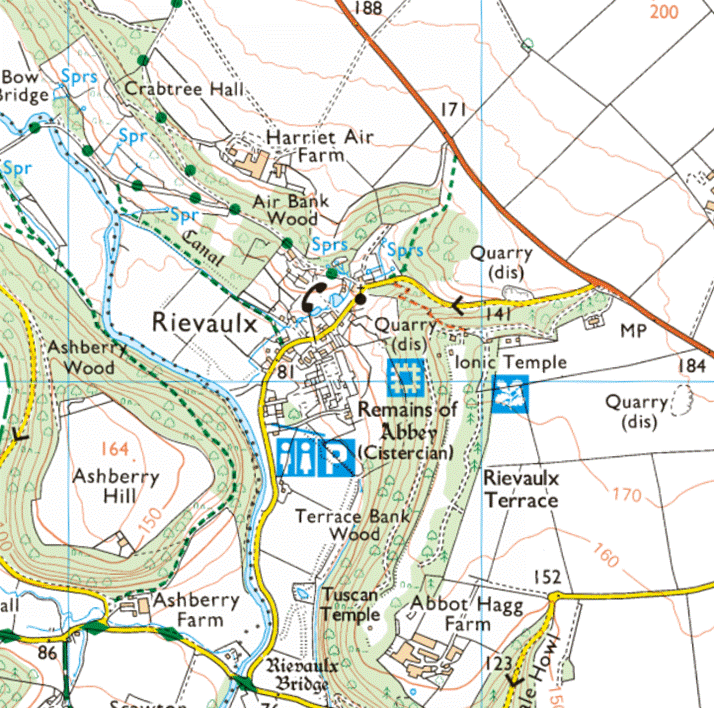
Probably refers to Middle
Head and Duffin Stone.
Edmund the Hermit used to
dwell in Farndale. Edmund the hermit of Farndale was a legendary figure who
lived in a cave in the North York Moors in the 12th century. He was said to be
a holy man who performed miracles and healed the sick. He was also reputed to
be a descendant of King Alfred the Great and a cousin of King Stephen. However,
there is no historical evidence to support his existence or his royal lineage.
He may have been a fictional character created by local monks to attract
pilgrims and donations to their monastery. Alternatively, he may have been
based on a real person who lived in the cave, but whose identity and story were
embellished over time. Some scholars have suggested that he may have been a
Norman knight who fled to the cave after the Battle of the Standard in 1138, or
a Saxon rebel who resisted the Norman conquest. The cave where Edmund
supposedly lived is known as Hob Hole and is located near Westerdale in
Farndale. It is a natural limestone cave that has been enlarged by human
activity. It has two chambers, one of which may have served as a chapel. The
cave is now a scheduled monument and is protected by law. You can see some
photos of the cave.
1155
The weavers were granted a royal charter,
the oldest livery company in London.
1161
The abolition of the Danegeld tax, first
raised in 991 to pay off Viking raiders.
Roger de Mowbray was compelled to hand back Kirkbymoorside along
with many other fees. The Stutevilles favoured the Benedictine
monks of Saint Mary's Abbey, York, and their own small House of nuns founded at
Keldholme, near Kirkbymoorside. Rievaulx Abbey was unable to sustain its claim
to the Farndale property and a little before 1166 Robert De Stuteville granted to
Keldholme Priory timber and wood in Farndale, together with a vaccary, pasture
and cultivated land in East Bransdale. This implies some earlier settlements,
but not very much. The Keldholme property in Bransdale, which can still be
identified in the survey of 1610, never amounted to more than 40 or 50 acres at
Cockayn at the head of the valley. At about the same
time Robert gave to Saint Mary's Abbey, who held the nearby Manor of Spaunton, as
much timber and wood as they required together with pasture and pannage of pigs
in Farndale. All the documents mentioned so far clearly indicate that Farndale
was regularly primarily as a resource of timber and pasture in the mid 12th century, with little evidence of settlement.
1170
London’s population was about 30,000.
Roger supported the Revolt of 1173–74 against Henry
II and fought with his sons, Nigel and Robert, but they were defeated at Kinardferry, Kirkby Malzeard and
Thirsk.
1185
Henry II’s enquiry into assets and status
of widows and wards, Rotuli de Dominabus
et Pueris et Puellis de XII
Comitatibus.
The Templars’ enquiries into
land holdings, Rotuli de Dominabus.
The earliest recorded
windmill built at Weedley in Yorkshire.
Roger left for the Holy Land again in 1186, but encountered
further misfortune being captured at the Battle of Hattin in 1187. His ransom
was met by the Templars, but he died soon after and, according to some accounts,
was buried at Tyre in Palestine. There is, however, some controversy
surrounding his death and burial and final resting-place.
1187
The Feet of Fines, judgements pertaining to land ownership, began.
Richard I (The Lionheart), 1189-1199
1188
Saladin Tithe levied in England to fund
the Third Crusade.
Richard I (The
Lionheart), 1189-1199
1189 to
1192
Carlisle came under English
rule in 1192.
The House of Mowbray, the senior line of which would become
Barons Mowbray, descended from Roger's son Nigel, who died on crusade at Acre
in 1191.
1194
Eyre Rolls recording legal cases across
England.
1198
Liber Feodorum, a list of feudal
landholdings.
King John, 1199-1216
Charter Rolls began recording royal
grants issued by the Chancery.
Manorial records include administrative details of
estates.
Population reaches about 3.5 million.
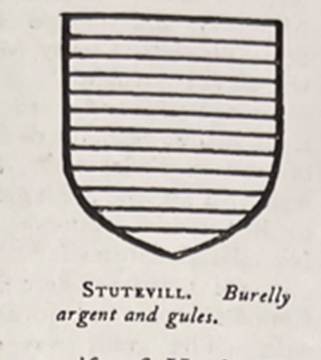
A dispute broke out again between William de Stuteville, son of
Robert and William de Mowbray, grandson of Roger.
Background:
· Robert II of Stuteville was born about 1084 in Yorkshire. Son of Robert (Estouteville) d'Estouteville I.
Brother of Nicolas I (Estouteville) Stuteville and
Emma (Estouteville) de Grentmesnil.
Husband of Erneburge (Fitzbaldric)
Stuteville. Husband of Jeanne (Talbot) de Stuteville. Father of Burga
(Stuteville) Pantulf, Nicholas (Stuteville) de Stuteville,
Alice (Stuteville) Fleming, Osmund (Stuteville) de Stuteville, John
(Stuteville) de Stuteville, Patrick (Stuteville) de Stuteville and Robert
(Stuteville) de Stuteville III. Not believed to have held lands in England. A
supporter of Robert Curthose with his father, he was captured at St.Pierre-sur-Dive shortly before
the battle of Tinchebrai. Died after 1138 after about age 54 in Cottingham,
Yorkshire.
· Robert III de Stuteville Baron of Cottingham. Robert III de Stuteville was son
of Robert II de Stuteville (from Estouteville in
Normandy), one of the northern barons who commanded the English at the battle
of the Standard in August 1138. His grandfather, Robert Grundebeof, had
supported Robert of Normandy at the battle of Tinchebray
in 1106, where he was taken captive and kept in prison for the rest of his
life. Robert de Stuteville, the third, occurs as witness to a charter of Henry
II of England on 8 January 1158 at Newcastle-on-Tyne. He was a justice itinerant
in the counties of Cumberland and Northumberland in 1170–1171, and High Sheriff
of Yorkshire from Easter 1170 to Easter 1175. The King's Knaresborough Castle
and Appleby Castle were in his custody in April 1174, when they were captured
by David of Scotland, Earl of Huntingdon. Stuteville, with his brothers and
sons, was active in support of the king during the war of 1174, and he took a
prominent part in the capture of William the Lion at Alnwick on 13 July (Rog.
Hov. ii. 60). He was one of the witnesses to the Spanish award on 16 March
1177, and from 1174 to 1181 was constantly in attendance on the king, both in
England and abroad. Stuteville by his wife, Helewise de Murdac,
had two sons William and Nicholas and two daughters, Burga, who was married to
William de Vesci and Helewise, who was married firstly to William de Lancaster,
secondly to Hugh de Morville and thirdly to William de Greystoke. He may have
also had sons Robert, Eustace and Osmund. Robert de Stuteville was probably
brother of the Roger de Stuteville who was sheriff of Northumberland from 1170
to 1185, and defended Wark on Tweed Castle against
William the Lion in 1174. Roger received charge of Edinburgh Castle in 1177,
and he built the first Burton Agnes Manor House. However
Roger may have been his kinsman, not his brother, as son of Osmund de
Stuteville (b. about 1125, of Burton Agnes, Yorkshire, England, d. before Sep
1202) and his wife (m. abt 1146) Isabel de
Gressinghall, daughter of William Fitz Roger de Gressinghall. He is the
probable founder of the nunneries of Keldholme and Rosedale, Yorkshire, and was
a benefactor of Rievaulx Abbey. He seems to have died in the early part of
1186. He claimed the barony, which had been forfeited by his grandfather, from
Roger de Mowbray, who by way of compromise gave him Kirby Moorside.
Finally William de Mowbray confirmed the previous agreement and gave 9
knights’ fees in augmentum.
Henceforward Kirkby Moorside was held of the Mowbrays by the
heirs of the Stutevilles until the end of the 14th century.
1202 to
1204
1202
The Patent Rolls, provide
a record of royal correspondence and helps to trace individuals in the Middle
Ages.
1204
Close Rolls recorded
grants made by the monarch to individuals or groups.
1209
The
forest of Farndale, 1209-1211 (FAR00003).
Rights to Nicholas de
Stuteville in the Royal Forest of Farndale. Entries in the Pipe Roll 1209, 1210 and 1211 refer to
granting rights in the forest of Farndale to Nicholas de Stuteville by the
Abbot of York in the reign of King John and disputes that arose therefrom.
1213 to
1221
1215
Joan de Stuteville, heiress of Cottingham, born 1216. She was
the daughter of Nicholas II de Stuteville and Devorguilla
of Galloway, wife of Hugh Wake, feudal lord of Bourne and Hugh Bigod, Chief
Justice of England, mother of Nicholas Wake, Sir; Sir Hugh Wake; Sir Baldwin
Wake, III, Lord of Bourne; Joan Burnet; Roger Bigod, 5th Earl of Norfolk and 2
others, the sister of Margaret de Stuteville, the half
sister of Nicholas III de Stuteville. This Joan, better
known as the "Fair Maid of Kent," [not sure this is right - see
below] survived her husband, and, resuming her maiden name, left the
barony to her son, Baldwin de Wake. The impression of her seal bore the device
of a lady riding on horseback sideways, a style which she is said to have been the
first to adopt. The Wake line ended in three co-heiresses, one of whom married
the Earl of Westmoreland, who succeeded to the barony of Kirbymoorside,
and it remained in the possession of this family until 1570.
She died on or about 6 April 1276.
Henry III, 1216-1272
1221
Dominicans
(black friars) began to arrive in England.
1224
Franciscans
(grey friars) began to arrive in England.
1225
Unfortunately the records relating to Farndale are
then silent for a century or more after the Rievaulx entries of 1154.
But in 1225, Pastures at Farendal, 1225 and 1227 (FAR00005). Entries in the Curia Regis for
1225 and 1227 refer to Nicholas de Stuteville and pastures at Hoton (Hutton), Spaunton and Farendal.
1228 to
1229
1229
The forest of Farndale,
1229-1255 (FAR00004).
More reference to the Royal
Forest of Farndale. Entries in the Close
Roll for 1229, 1253 and 1255 refer to the forest of Farndale as an antique
forest and the rights of Hugh de Bigod are defined in it. In 1229 Henry III
decreed, ‘the whole of the forest of Galtres and the
forest between the Ouse and the Derwent, and the forest of Farndale, are
ancient forests.’ But the forest was not much used. There is a possibility that
Edward II once visited but no other monarch seems to have ventured there.
Assarting was clearly proceeding apace in
the middle decades of the 13th century, since Lady Joan de Stuteville
successfully prosecuted the Abbot of Saint Mary's, York, for exceeding her
rights of taking wood in Farndale by actually assarting
100 acres of land.
Assarting is the act of clearing forested
lands for use in agriculture or other purposes. In English land law, it was
illegal to assart any part of a royal forest without
permission. This was the greatest trespass that could be committed in a forest,
being more than a waste: while waste of the forest involves felling trees and
shrubs, which can regrow, assarting involves completely uprooting all trees—the
total extirpation of the forested area. The term assart
was also used for a parcel of land assarted. Assart
rents were those paid to the British Crown for the forest lands assarted. The
etymology is from the French word essarter meaning to
remove or grub out woodland. In northern England this is referred to as
ridding. In the Middle Ages, the land cleared was usually common land but after
assarting, the space became privately used. The process took several forms. Usually it was done by one farmer who hacked out a clearing
from the woodland, leaving a hedged field. However, sometimes groups of
individuals or even entire villages did the work and
the results were divided into strips and shared among tenant farmers. Monastic
communities, particularly the Cistercians, sometimes assarted, as well as local
lords. The cleared land often leaves behind an assart
hedge, which often contains a high number of woodland trees such as small leafed lime or wild service and contains trees that
rarely colonise planted hedges, such as hazel. Assarting has existed since
Mesolithic times and often it relieved population pressures. During the 13th
century, assarting was very active, but decreased with
environmental and economic challenges in the 14th century. The Black Death in
the late 1340s depopulated the countryside and many formerly assarted areas
returned to woodland. Assarting was described by landscape historian Richard
Muir as typically being "like bites from an apple" as it was usually
done on a small scale but large areas were sometimes
cleared. Occasionally, people specialized in assarting and acquired the surname
or family name of 'Sart'. Field names in Britain
sometimes retain their origin in assarting or colonisation by their names such
as: 'Stocks'; 'Stubbings'; 'Stubs'; 'Assart'; 'Sart'; 'Ridding'; 'Royd'; 'Brake'; 'Breach'; or 'Hay'.
Nicholas
de Farndale, born in about 1230 (FAR00006). The
Farndale 1 Line. The
first personal name linked to Farndale. Nicholas de Farndale paid taxes to the
Eyre Court in 1280.
Nicolas de Stuteville’s son Nicholas in 1232 quitclaimed common
of pasture of Farndale to the Abbot of St Mary’s, York.
1233
Nicholas de Stuteville the Younger died, leaving two daughters
and co-heirs, Joan wife of Hugh Wake and Margaret, whose marriage had been
granted to William de Mastac.
Passage of cattle rights,
1233 (FAR00007).
‘The Abbot grants that if the cattle of Nicholas or of his heirs or of his men
at Kikby, Fademor, Gillingmor or Farndale, hereafter enter upon the common of
the said wood and pasture of Houton, Spaunton and Farendale, they shall have free way
in and out without ward set; provided they do not tarry in the said pasture.’
17th year of the Reign of Henry III.
1236
The
Commons Act allowed manorial lords to enclose common land for their own use.
1240
The earliest Inquisitions Post
Mortem (“IPM”) (escheats)
recorded information regarding property, family descents and allienaces, especially between 1270 and 1350.
Hugh died in or about 1241, and Joan obtained the custody of his
heirs until their full age. She married, as her second husband, Hugh le Bigod,
but as a widow was known as Joan de Stutville.
1242
Gunpowder introduced into Europe.
1250
First map of the British Isles by Matthew Paris.
The Rotuli Hundredorum (“the Hundred Rolls”) recorded the rights of the Crown
over land and property.
Margaret was dead, and Joan now had her lands.
Alan
son of Nicholas Farndale, born in about 1255 (FAR00011).
The Farndale 1 Line.
The son of Nicholas
Farndale, who we know about because he paid taxes.
1259
Normandy surrendered to France.
1264
The Battle of Lewes and the rise of Simon
de Montfort as the uncrowned King of England.
Civil War
Simon de Montfort was killed
in 1265 at the Battle of Evesham.
1265
De Willelmo
de Farndale, 1265 (FAR00013). A Farndale name
living in Danby.
1267 to
1272
1271
Marco
Polo arrived in China.
1271 to
1272
Before Margaret’s death she had enfeoffed in the manor of Kirkby
Moorside her son Baldwin Wake. Baldwin took homage of the King as her heir in
1276.
Edward I (Longshanks), 1272-1307
The Fine Rolls recorded payments to the
Crown for grants and privileges.
1276
Only a few years later, the
Inquisition Post Mortem taken after Joan’s death in
1276, reveals settlement on a grand scale. In Farndale, bond tenants holding by
acres and paying a standard rent of 1-0d for each acre produced £27-5-0d,
presumably for 545 acres. In East Bransdale, bondmen held another 141 acres
paying a standard rent of 6d per acre, but they are said to hold ‘by cultures’. The significance of these terms is explained in
the IPM of Joan’s Son, Baldwin Wake, taken only six years later, where the
bondmen are said to hold their land ‘not by the bovate of land, but by more or
less’. Thus standard bovate holdings, usually in the
lowlands and in some of the older settled moorland villas, have been dispensed with
in favour of holdings of varied size rented by the acre.
Rent in Farndale, 1276 (FAR00017).
References to payment of
rent in Farndale. ‘Tenants in bondage, holding by acres, who pay £27 5s, that
is 12d per acre. Seven cottars in Farndale, pay 15s 8d. tenants in Duthenwayt in a certain plot in the moor, holding by plots
32s per year.
1279
The Statute of Mortmain prevented land
being given to the Church without royal licence.
1280
Farndale
poachers, 1280 (FAR00019). From sureties of
persons indicted for poaching and for not producing persons so indicted on the
first day of the Eyre Court in accordance with the suretieship
due to Richard Drye. There follows a long list of names including,…..1s
8d from Roger son of Gilbert of Farndale, bail from Nicholas de Farndale, 2s
from William the smith of Farndale 3s 4d from John the shepherd of Farndale,
and 3s 4d from Alan the son of Nicholas de Farndale.
Nicholas de Farndale, (FAR00006).
The Farndale 1 Line paid taxes
to the Eyre Court in 1280.
William
the smith of Farndale, born in about 1240 (FAR00009)
paid taxes to the Eyre Court
in 1280.
John
the Shepherd of Farndale, born in about 1250 (FAR00010)
paid taxes to the Eyre Court in 1280.
Baldwin Wake died in 1282 and was succeeded by his son and heir
John, who was summoned to Parliament as Lord Wake by Edward I.
The 1282 extent of cultivated
land in Farndale shows a considerable increase over that of 1276, but this
probably means nothing more than that a new and up-to-date survey was used as the
basis for the later document. The Farndale rents now amounted £ 38-8-8d
together with a nut-rent and a few boon works and if the rate of 1s 0d per acre
still applied, this would give a total acreage held in bondage of no less than
768 acres. In Bransdale rents were up to £4-14-3d which would give us about 188
acres at the old rent of 6d per acre. For the first time the number of bondmen are given - 25 in East Bransdale and 90 in Farndale.
The sheer scale is impressive
enough, but there are features which point to a planned campaign of settlement.
It is difficult to imagine how men of villain status, compelled to pay rents of
1s 0d per acre for minute holdings of marginal land, could also have managed to
undertake their own assarting. It seems more likely that the land had been
reclaimed in advance of letting, as at Goathland, by the Lord’s agents, while
the standard rents suggest a single campaign on a large scale rather than piece
meal assaulting. A number of key questions cannot be
answered from the sources we have used so far. Was settlement of the two Dales
completed by 1282? Where were the new farms located and how were they laid out?
Serfs of Farndale, 24 March
1282 (FAR00020).
In a certain dale called
Farndale there are fourscore and ten natives, not tenants by bovate of land.
1285
The Statute of Winchester led
to Parish Constables organised to question strangers and patrol towns to
maintain the peace.
1288
Piepowder Courts set up to try offenders
at fairs and markets.
The Taxatio
Ecclesiastica listed 8,500 churches and chapels across the country.
1290
Lay
Subsidy Rolls began to record taxes
imposed on the laity (commoners).
1293
Peter
de Farndale, born in about 1238 (FAR00008). The Farndale 2 Line. Peter de Farndale, whose son Robert (FAR00012) was
fined at Pickering Castle in 1293.
Robert son of Peter de Farndale, born in about 1263 (FAR00012). The Farndale 2 Line was
outlawed for hunting.
Roger milne
(miller) of Farndale (FAR000013A), son of Peter
(FAR00008) below
together with Walter Blackhous and Ralph Helved, all of Spaunton on Monday in January 1293, killed a soar and slew a hart with bows and arrows at some unknown
place in the forest. All outlawed on 5th April 1293.
(Say Roger 28 at the time then he was born about 1265).
1295
The
first legally elected legislature, the Model Parliament.
The prebends of York wrote about the prebendary of Ampleforth and
concluded that if the lord’s corn is ricked outside the barn and is to be
carried into the barn, the bondmen and cottars shall cart it for one meal, if
the rick is square; and if it is round, for nothing. They ought to go for the
lord’s provisions and for those of the steward and bailiff, at Ebor, Helmesley, Kirkby Moresheued and Thresk, at the lord’s expense, for one meal. They shall
give merchet for their daughters and relief for their lands. (Yorkshire
Archaeological Society Record Series Volume 94. 1937.
Miscellaneous Volume 4, page 23).
John enfeoffed the king of his lands in 1298, and they were
regranted to him and his wife Joan in fee simple in the same year.
Joan outlived her husband, and was
‘lady of Liddell’ during the minority of her son Thomas.
The custody of this boy was granted to Henry de Percy, who
transferred it to the Society of the Ballardi of Lucca. This was not ratified
by the King, but later ‘not recollecting the confirmation of the grant’,
he “caused the manor, then in the hands of the merchants, to be taken into
his hands, and he delivered it with fees &c, who since he has held the said
manor has received £340 out of the issues thereof, for which Henry de Percy has
made supplication to the King to caused satisfaction to be made to the
merchants for his exoneration.”
1300
Population reaches about 5 million.
Social mobility increased in
England with a growth of a mercantile, middle class.
1301
The lay subsidy assessments
of 1301 afforded a brief glimpse of the settlement pattern, listing numerous
contributors bearing the names of the farms which is still to be found at
Farndale such as ‘Wakelevedy’ (Wake Lady Green), ‘Westgille’ (West Gill), Monkegate
(Monket House) and ‘Elleshaye
(Eller House) and which are scattered all around the dale. Further confirmation
of this pattern is provided by surveys of 1570 and 1610, both of which give the
names of many more extent farms and allow us to identify others from field
names.
The total acreage in the two
dales amounted to just over 1300 acres compared to 950 acres in 1282 and the
rents amounted £62 compared with £45 in 1282.
Farndale subsidies to the
King, 1301 (FAR00029).
Thirty
five people in
Farndale paid a subsidy mainly for the upkeep of the Great Forest of Chartres.
De Johanne de Farndale, born
in about 1275 (FAR00014).
De Johanne de Farndale who
had now moved yet further afield to Egton.
Edward II, 1307-1327 (deposed)
1309
Simon
de Farndale, born in about 1282 (FAR00021).
The Farndale 4 Line.
Simon the miller of
Farndale. Simon the miller paid more rent than anyone in Farndale in 1309.
Simon de Farndale’s son Robert was fined at Pickering Castle in 1332.
1310
William Stibbing
of Farndale's oxen, 1310 (FAR00033).
‘In 1310, 20 oxen the
property of Nicholas the parker, worth 8s, 6 oxen and 3 stirks of William in the
horn worth £1 9s, a cow and a stirk of Hugh Laverock 4s 8d and 6 oxen of
William Stibbing de Farndale…….’
1315
1316
Nomina Villarum recorded names and lordship in every town under royal
jurisdiction.
Richard de
Farndale, born in about 1275 (FAR00016). Richard
de Farndale had a gift of land at Marton (now part of Middlesborough) but was
excommunicated for stealing in 1316.
Thomas and Richard of
Farndale, born in about 1291 (FAR00023).
Thomas and Richard were
excommunicated at Pickering Castle for stealing on 12 August 1316.
1320
Adam de Farndale, born in
about 1295 (FAR00025).
The Farndale 4 Line. An appeal by Agnes, late wife of
John de Maunby against Adam de Farndale for the death of her husband on 21 Sep
1320.
1322
Robert
of Farndale, born in about 1292 (FAR00024). The Farndale 2 Line. Robert was fined at Pickering Castle for poaching in
1322.
1324
John
de Farndale, born in about 1298 (FAR00026). John de Farndale,
released from excommunication at Pickering Castle on 9 Apr 1324.
Edward III, 1327-1377
1328-1349
Walter
de Farndale, born in about 1275 (FAR00015) Walter de Farndale was a vicar and we have several records about him. This might have
been the same Walter de Farndale, whose death by Hugh de Faulkes of Lebreston was pardoned but on condition that Hugh de
Faulkes joined an expedition against the Scots.
1332
Simon de Farndale, born in about 1282 (FAR00021). The Farndale 4 Line. Simon
the miller of Farndale. Simon the miller paid more rent than anyone in Farndale
in 1309. Simon de Farndale’s son Robert was fined at Pickering Castle in 1332.
Robert
of Farndale, born in about 1307 (FAR00031). The Farndale 4 Line. Outlawed with others
for hunting a hart in the forest in 1332.
1334-1335
Nicholas
de Farndale, born in about 1284 (FAR00022). The Farndale 3 Line. Nicholas of
Farndale, gave bail for Roger son of Gilbert of Farndale who had been caught
poaching in 1334 and 1335.
Roger de Farndale, born in
about 1300 (FAR00028).
The Farndale 3 Line.
Bailed for poaching in 1334
and 1335.
Sir William Farndale, vicar of
Doncaster, born in about 1335 (FAR00038)(the
Doncaster-Kirkleatham-Skelton Line).
1336
William,
smith of Farndale, born in abut 1310 (FAR00037). William, smith of
Farndale, on Monday 2 Dec 1336, came hunting in Lefebow
with bow and arrows and gazehounds………’
1337 to
1453
The Hundred Years War against France
1341
Nonarum Inquisitiones recorded a valuation for
taxation purposes.
1344-1345
Gilbert
de Farndale, born in about 1279 (FAR00018). The Farndale 3 Line. Bailed by Nicholas
Farndale (FAR00022) for poaching in 1344 and 1345.
1345
The long wars with the Scots, involving the
people of Yorkshire, ended with an invasion by David II of Scotland in 1346,
encouraged by the French. He reached York, but failed to take the city.
Archbishop de la Zouche
rallied Yorkshiremen to resist the invasion and a
crushing defeat was inflicted at Neville's Cross. David was imprisoned.
Founding of a House of
Friars, Farndale, 30 July 1345 (FAR00039).
‘At Reading. Licence for the
alienation in frank almoin by Thomas Wake of Lyde to
the friers of the Holy Order of the Holy Cross of a toft and 10 acres of land
in the moor of Blakenhowe in Farndale, for them to found
a house of the Order there and to build an Oratory and dwelling houses.’
1346
1347 to
1350
In rural areas, the heavier rate of
mortality was in the more densely populated East Riding.
As the plague subsided, there
was widespread movement of labourers and their families as workers sought more
for their labour.
1347-1348
William
Smyth of Farndale, 17 January 1348 (FAR00040) commission
of oyer and terminer to a long list of names including William Smyth of Farndale
the younger and Richard Ruttok of Farendale for
breaking in to the park at Egton, hunting and carrying away the property of the
owner with deer, and for assaulting the owner’s men and servants causing their
inability to work for a long time, for which they were fined 1 mark.
Thomas Wake remained in possession of the relevant lands
including Kirkbymoorside until he died in 1349.
His heir was his sister Margaret, wife of Edmund Earl of Kent,
whose son John succeeded her.
Walter de Farndale, warden of the free chapel of
Chelmsford, London (FAR00041A).
The Black Death
By 1349, merchant ships transported rats carrying the black
death to Britain. The black death soon swept through the villages in the south
and then the north of Britain. Soon it
swept through most villages in Britain.
1350
The
Fair at Farndale, 1350 (FAR00041).
1351
The earliest surviving
churchwarden accounts including for Ripon and Hedon in Yorkshire.
John died three years later, however without issue, and his
sister Joan, ‘the fair maid of Kent’, was his heir. Her first husband was
Thomas Holand, created Earl of Kent in 1360, by whom he had a son and heir
Thomas Holand.
1353
Farndale folk, 1353 (FAR00042).
The manor with its members
in Farndale.
1354
John Colynman of Farndale,
1354 (FAR00043).
‘At Westminster. Commission
of Oyer and Terminer to 20 May, John Colynman of Farnedale……….’
1355
Sir William Farndale, vicar of Doncaster, born in about
1335 (FAR00038)(the Doncaster-Kirkleatham-Skelton Line) was chaplain at Doncaster.
1357
Richard Farendale, born perhaps in about 1357 (but to reconcile with date of his will) (FAR00044). The Sheriff Hutton 1 Line.
1358
William Farndale, born in
about 1310 (FAR00034). The first recorded use of Farndale
as a surname without the ‘of’ or ‘de’. On 15 Oct 1358, a pardon was given by
the Sergeant at Arms to William Attwode for having enfeoffed John de Banaby and William Farndale, chaplains of the Manor of Derleye, held in chief, and then re-entered into the Manor,
which they quit-claimed to him without the King’s licence and grant that he shall
retain the same fee.’
1359
Helen Farndale, born in about
1359 in Sheriff Hutton (FAR00045). The Sheriff Hutton 1 Line.
1360
The Gough Map, the oldest surviving road
map of Great Britain.
Agnes Farndale, born in about 1361 in Sheriff Hutton
(FAR00046). The Sheriff Hutton 1 Line.
Transfer
of the lands of Kirkbymoorside (including lands in Farndale, Gillyngmore, Brauncedale and Fademore) from Thomas de Holand earl of Kent to his widow
Joan. (FAR00046A)
1363
Johannis de Farndale, born in
about 1303 (FAR00030).
The York 1 Line.
A saddler, made Freeman of York in 1363.
Later Joan married Edward the Black Prince, with whom in 1365
she settled this manor on Thomas and Alice his wife and their heirs, with
reversion to the prince and herself.
1366
Farndale folk, 10 February
1366 (FAR00047). Reference to folk of Farndale. ‘At
Westminster. Commission of Oyer and Terminer…William Blakhose of Farndale….John Cokrell the younger of Farndale….’
1368
Sir William Farndale, vicar of
Doncaster, born in about 1335 (FAR00038)(the
Doncaster-Kirkleatham-Skelton Line) had land transferred to him at Lovershall,
Doncaster.
1367
Johannis de Farendale, born
in about 1330 (FAR00035).
The York 1 Line.
Johannis was made a Freeman
of York in 1367.
1369
1370
The emergence of peasant farmers (yeoman
class) with up to 100 acres.
William Farndale of Caleys, 7 May 1370 (FAR00047A).
Pardon to William Farndale
of Caleys of the King's suit for the death of John de
Spaldyngton, whereof he is indicted or appealed, and of any consequent
outlawry.
1372
Farndale folk, 20 November
1372 (FAR00048).
Reference to folk of
Farndale caught hunting. ‘At Westminster. Commission of Oyer and Terminer. John
porter of Farndale ….Hugh Bailey of Farndale. Adam
Bailley of Farndale…..caught hunting.’
1377
William Langdale’s poem, Piers Plowman provides significant description of medieval farming
practices.
Earliest records from the
Court of Common Pleas.
Richard II (1377-1399) (deposed)
A Poll Tax levied on almost
every individual except paupers.
1381
The Peasants Revolt prompted by the Poll
Tax in towns and country.
1383
Margorie Farndale, born in
about 1383 (FAR00049). The Sheriff Hutton 1 Line.
1384 to 1390 (with an entry for
1445)
John Farndale, born in about
1354 (FAR00042A).
John was a party to a major
livestock haul. ‘John Farndale and others broke their close, houses and hedges
at Wittonstalle and Fayrhils,
Co Northumberland and seized 30 horses, 20 mares, 100 oxen and 100 cowes valued at £200 and carried them off with goods and
chattels, assaulted his men, servants and tenants and so threatened them that
they left his service.’ and other events.
1385
Agnes Farndale, born in about
1385 (FAR00050). The Sheriff Hutton 1 Line.
John Farndale, born in about
1385 (FAR00051A).
1387
Geoffrey Chaucer’s Canterbury Tales.
Alice Farndale, born in about
1387 (FAR00051). The Sheriff Hutton 1 Line.
1388
Licence on 19 November 1388
for the inhabitants of Farndale to have masses celebrated in the chapel of
Farndale (FAR00041).
1396
Pardon to Robert de Wodde of
Farndale, 19 April 1396 (FAR00053).
Pardon for the death of John
Hawlare of Kirby Moorseved.
In 1397 Thomas Earl of Kent died and Alice was left in
possession for life. Of her sons, Thomas the Elder was beheaded as a traitor in 1399 and his brother
Edmund died before his mother in 1408, when the earldom of Kent fell into
abeyance.
William Farnedale of Shyrefhoton, born in about 1332 (FAR00036).
The Sheriff Hutton 1
Line. William
Farnedale of Shyrefhoton’s Will was proved on 13 Mar
1397/8.
1397 – 1403
Sir William Farndale, vicar of
Doncaster, born in about 1335 (FAR00038)(the
Doncaster-Kirkleatham-Skelton Line) was Vicar at Doncaster Cathedral.
1398
Pardon to Robert de Wodde of Farndale, 19 April 1396 (FAR00053). Pardon for the death of John Hawlare of Kirby Moorseved.
House of Lancaster
Henry IV, 1399-1413
1400
1408
Johannes (John) Fernedill,
born in about 1378 (FAR00048A).
The York 1 Line.
Butcher and freeman of York.
Johannes Fernedill, boucher, made Freeman of York.
Henry V, 1413-1422
1415
Henry VI, 1422-1461 (deposed)
1422
Reference to Tydkinhowe, 28 May 1422 (FAR00055).
The Tidkinhow Line were a
line of Farndales who farmed at Tidkinhow farm from the mid nineteenth century.
1428
William Farndayll, born in
about 1388 (FAR00052).
Possibly the Sheriff Hutton 1 Line. In 1428 William Farndayll of Huton held at Gowthorpe in the
East Riding, three bovates of land, part of the Archbishopric of York.
1429
The
right to vote to men over 21 or owning freehold land.
1440
Johannes
Gutenberg’s printing press.
1446
William Farndale (FAR00056A).
William’s wife was
wrongfully deprived of her inherited lands. “To The Archbishop of Canterbury
and Chancellor of England. Rose Farndale, plaintiff, late wife of William Farndale
that John Reignold of Dodynghurst, Co Essex,
husbandman, sold to said William for a sum agreed and paid, a tenement set in Dodynghurst aforesaid, called Whitefeldes
‘tenement’ with a garden and two fields, one called Hornefeld
and the other Barnefeld and the said john Reignold
promised to make ‘sufficient estate thereof’ to said William or to whom he
would advise; before any estate made thereof the same William made his will by which
he willed that the plaintiff should have the said tenement and land to her and
her heirs for ever. Since his death the plaintiff has required said John
Reignold to make estate of the premises to her and to her heirs and he has
refused and has entered into the said lands and
occupies them contrary to all reason and conscience.” Doddinghurst
is a Parish in SW Essex near Brentford.
1450
A map of Goole Moor (Inclesmoor) and Thorne Moor in south Yorkshire relating to a land dispute.
1453
The loss of all French lands
except Calais.
The War of the Roses.
1461
Many thousands died during the Battle of
Towton in Yorkshire.
Edward IV, 1461-1483
Edward V, 1483-1483
Richard III, 1483-1485
The End of the Wars of the Roses
1483
The founding of the College of Arms.
1485
Henry VII, 1485-1509
1492
Christopher Columbus reached America.
The Fall of Granada and the
Moors were expelled from Spain.
1495
The Vagabonds and Beggars Act allowed the
punishment of the poor.
The licensing of alehouses
began.
1498
Vasco da Gama rounded the Cape and sailed
to India.
1508-1509
Robert
Farndale, born in about 1460 (FAR00056).
The Sussex Line.
Rector of
South Stoke, Sussex. Robert
Farndale, presented to the college of Holy Trinity in 1508, resigning in 1509.
Henry VIII, 1509-1547
1512
An
estimated date for the birth of Nicholas
Farndale, possibly in or near Campsall, north of Doncaster.
1513
The Battle of Flodden Field
1515
Conversion of land from arable to pasture became an
offence.
Cardinal Wolsey, Archbishop of York and Lord
Chancellor, 1515-1530
1516
An
estimated date for the birth of Agnes (later
Farndale), possibly in or near Campsall, north of Doncaster.
1519
Ferdinand Magellan began his circumnavigation of the
world.
1523
The Great Subsidy on all individuals over 16 years old.
A long list of taxpayers were included in the returns.
1524
Thomas fyndaille,
born in about 1484 (FAR00057).
Thomas fyndaille
of Lythe, mentioned in a Lay Subsidy of Henry
VIII.
1535
A detailed survey of church wealth
1536
The Dissolution of the monasteries 1536 to 1539
The Pilgrimage of Grace in Lincolnshire and East Riding
of Yorkshire in opposition to the dissolution of the monasteries (rebels were
executed).
A poor law act allowed vagrants to be whipped.
1537
The foundation of the Honourable Artillery Company, the
oldest regiment in the British Army.
A possible date for the marriage of Nicholas and Agnes
Farndale, perhaps in or near Campsall.
1539
William Farndale (FAR00063), may have been born in around 1539
in or around Doncaster.
John Leland’s journey through
England and Wales published in the 5 volume The Itinerary.
1540
Jean Farndale (FAR00064), may have been born in around 1540
in or around Doncaster.
The Statute of Wills permitted freehold land to be
bequeathed.
1545
The Mary Rose sank.
Edward VI, 1547-1553
The Vagabonds Act allowed the branding and enslavement
of beggars deemed capable of work.
1548
The Book of Common Prayer introduced a new liturgy.
1549
Kett’s rebellion in Norfolk against enclosure of land.
1551
The Alehouse Act to combat drunkenness.
1552
The Poor Act banned begging and authorised a Collector
of Alms in each parish to keep a register of licensed poor.
1553
Lady Jane Grey 1553 (9 days)
Mary I (Bloody Mary), 1553-1558
280 Protestants burned at the stake.
Wyatt’s Rebellion against the marriage of Queen Mary to
Philip of Spain.
Elizabeth I, 1558-1603
The practical start date for parish records.
1559
The Act of Uniformity laid the basis for the Protestant
Church in England.
1564
William Farndale married Margaret
Atkinson at St Mary Magdalene Church in Campsall on 29 October 1564.
1564 to 1567
The possible emigration of
Nicholas and Agnes Farndale, with their family William and Margaret Farndale,
and Jean Farndale, to Kirkleatham and Skelton in Cleveland, moving the heart of
the Farndale family from south of the North York Moors to Cleveland and norther
of the North York Moors for the following generations.
1567
Jean Farndaile married
Richard Fairley at Kirkleatham on 16 October 1567.
1570
The growth of Presbyterianism.
The estimated year of birth
of George
Farndale, probably the son of William and Margaret Farndale.
1572
6 August 1572 is the known date of the burial of Nicholas Farndale in
Kirkleatham.
1579
Christopher Saxton’s country maps of England and Wales.
1581
Recusancy (not attending Anglican services, especially
by Catholics) became a criminal offence.
1583
Newfoundland claimed as a colony of England.
1586
23 January 1586 is the known
date of the burial of Agnes Farndale in Kirkleatham.
William Camden’s Britannia was the first topographical survey
of England.
1588
The Spanish Armada, 1588.
1592
George Farndale had moved to Moorsholm.
1595
George Farndale married Margery Nelson.
The Nine Years War began in Ireland against England.
1600
The East India Company began to trade in the Far East.
Population reached 4.8 million.